2023 The Year In Pictures

This Christmas marks the 10th edition of my astrophotography calendar, consisting of my better images from the previous 12-months, which I produce for myself and members of the family.  Wow doesn’t time fly? Based on these images, I also compile a video of the images set to music, which we all watch together before seeing the actual calendar.  It’s become something of an occasion and is a great way to present the images, which look wonderful on today’s smart TV’s and is fun to watch and share with the family.

THE CALENDAR

Much longer imaging times (total of more than 145 hours), re-imaging old favourites in new ways and unusual, overlooked, or difficult objects, resulted in a very good 2023 astrophotography year and perhaps the best calendar yet?  The calendar for 2024 on YouTube can be viewed by clicking HERE and below is a brief overview of each image.  More detailed background information and imaging details for those interested can be found in relevant blogs I posted on this website.  The background music is the track Appleshine from Underworld’s album Drift.

 COVERSH2-284: Close-up of April’s image – along the inside of the ring structure are many dark dust pillars and globules, which on the right seem to resemble a hand with a bony finger pointing inwards!  
JANUARYNGC 1333: Nestled within the western area of the Perseus Molecular Cloud, some 1,100 light-years from Earth is the colourful NGC 1333 reflection nebula, one of the closest and most active star-forming regions of the night-sky.  
FEBRUARY  Spaghetti Nebula: Straddling the boundary of Taurus and Auriga constellations, is the giant supernova remnant (SNR) Simeis-147.  The stellar explosion occurred 40,000 years ago, leaving a rapidly spinning neutron star or pulsar at the core of the now complex and the expanding SNR.  
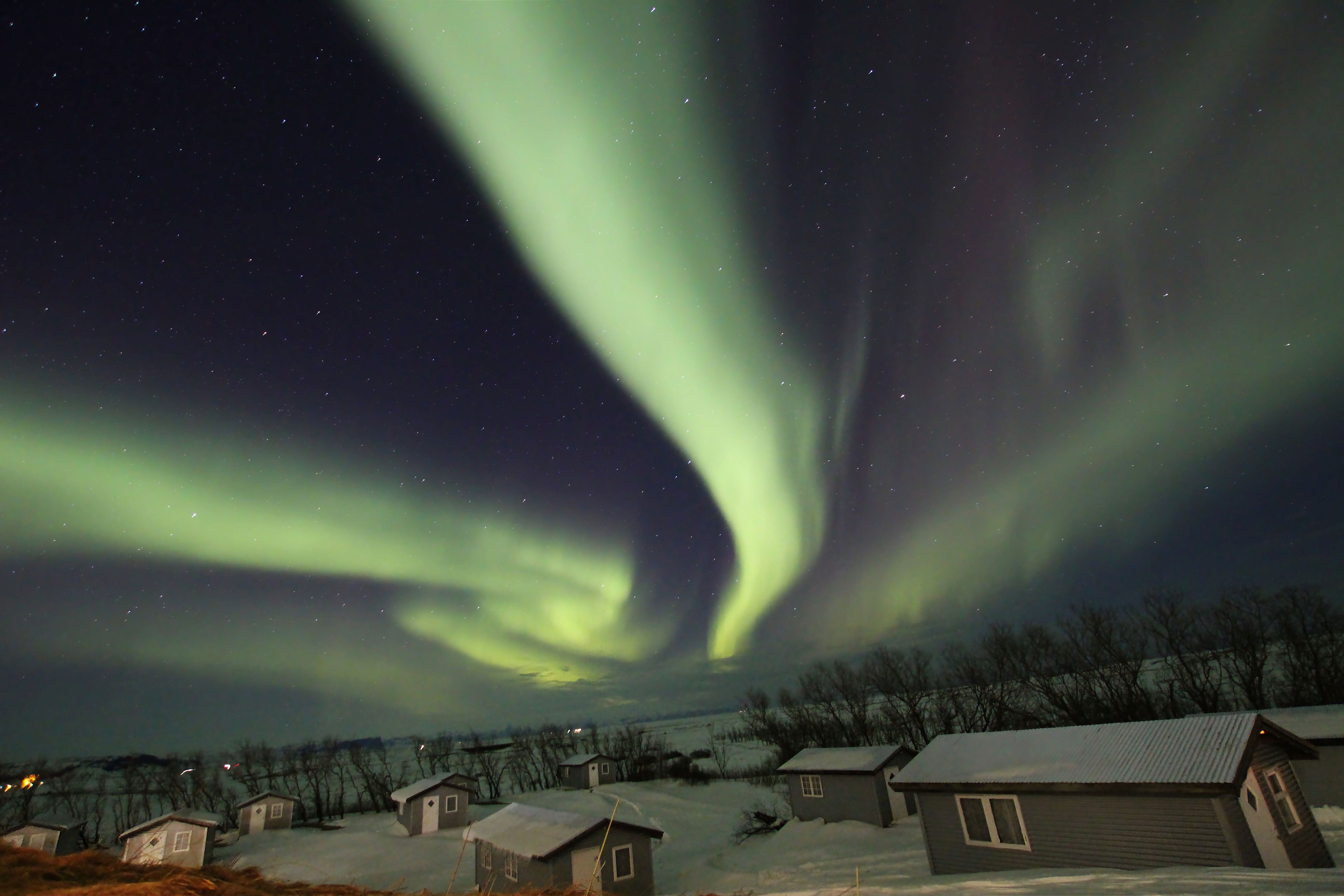
MARCHAurora Borealis: Situated just below the Arctic Circle, Iceland is well known both for its geology and views of the Aurora Borealis, which we saw in March on the south coast near Kirkjubaejarkklaustur.  
APRILSH2-284: A star-forming region of dust and gases, sculpted by radiation and interstellar winds emanating from a young (3 to 4 million years) star cluster located near the centre.       
MAYM3 Globular Cluster*: Consisting of 500,000 stars and over 11 billion years old, M3 is one of150 globular clusters that orbit around the Milky Way Galaxy.  
JUNEM27 Apple Core Nebula*: A planetary nebula, consisting of a glowing shell of ionized gas ejected from a red giant star in its late stage of life to become a white dwarf. Complex hydrogen (red) and oxygen (blue) fans form around the outer regions, with a pulsar-like beam transecting the nebula.  
JULYMonkey Head Nebula: Located 6,400 light years from Earth in the Orion constellation, the ‘Monkey’ is a so-called emission nebula, where new stars are being created within at a rapid rate.  
AUGUSTSH2-115: This widefield image contains a richness of various emission nebulae, centred around the distinctive large blue SH2-115 region.  Just to the left of SH2-115 is the small but enigmatic SH2-116 a faint, blue disc thought to be a planetary nebula.    
SEPTEMBERLDN-768 Black Cat Nebula: Close to M27 in the constellation of Vulpecula (“Little Fox”), is a dense region of stars broken-up by dark nebulae to create intriguing shapes. Here strung out from left-to-right, several of the dark nebulae seem to coalesce (visually) to create the form of a black cat.
OCTOBERSH2-126 Great Lacerta Nebula: On the western edge of the Milky Way in the southern part of Lacerta, is the very large but faint emission nebula SH2-126.  The red filament structures stretch over 3 degrees, to the right is the Gecko Nebula, a molecular cloud associated with bright young stars.
NOVEMBERFlaming Star & Tadpoles Nebula: Two emission nebulae: dust & gas of the Flaming Star (below) combined with red ionized hydrogen gas produces a flame affect. Above, the stellar winds and radiation pressure from hot massive stars creates the Tadpoles ‘wriggling’ away from the centre.
DECEMBERM51 Whirlpool Galaxy*: As the smaller galaxy passes behind M51, joint gravitational forces are interacting, resulting in the misalignment of stars and unusually bright blue and pink areas across the Whirlpool galaxy. Their fates are inextricably linked and might eventually merge.
                 Footnote: All images taken from Redhill, Surrey or telescope at a dark sky site in
          New Mexico, USA shown by an asterisk*
HAPPY NEW YEAR + CLEAR SKIES FOR 2024

Icelandic Aurora

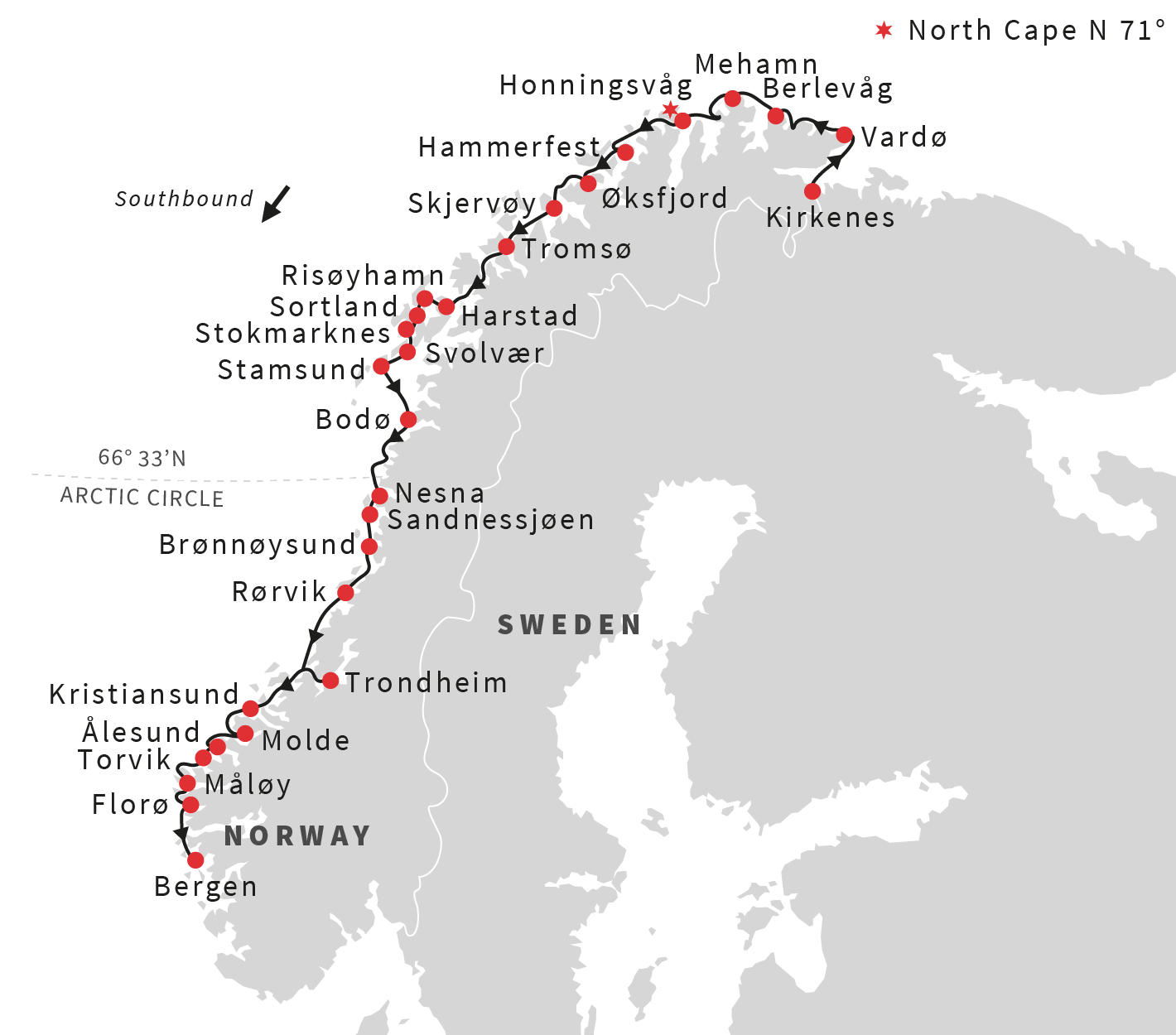
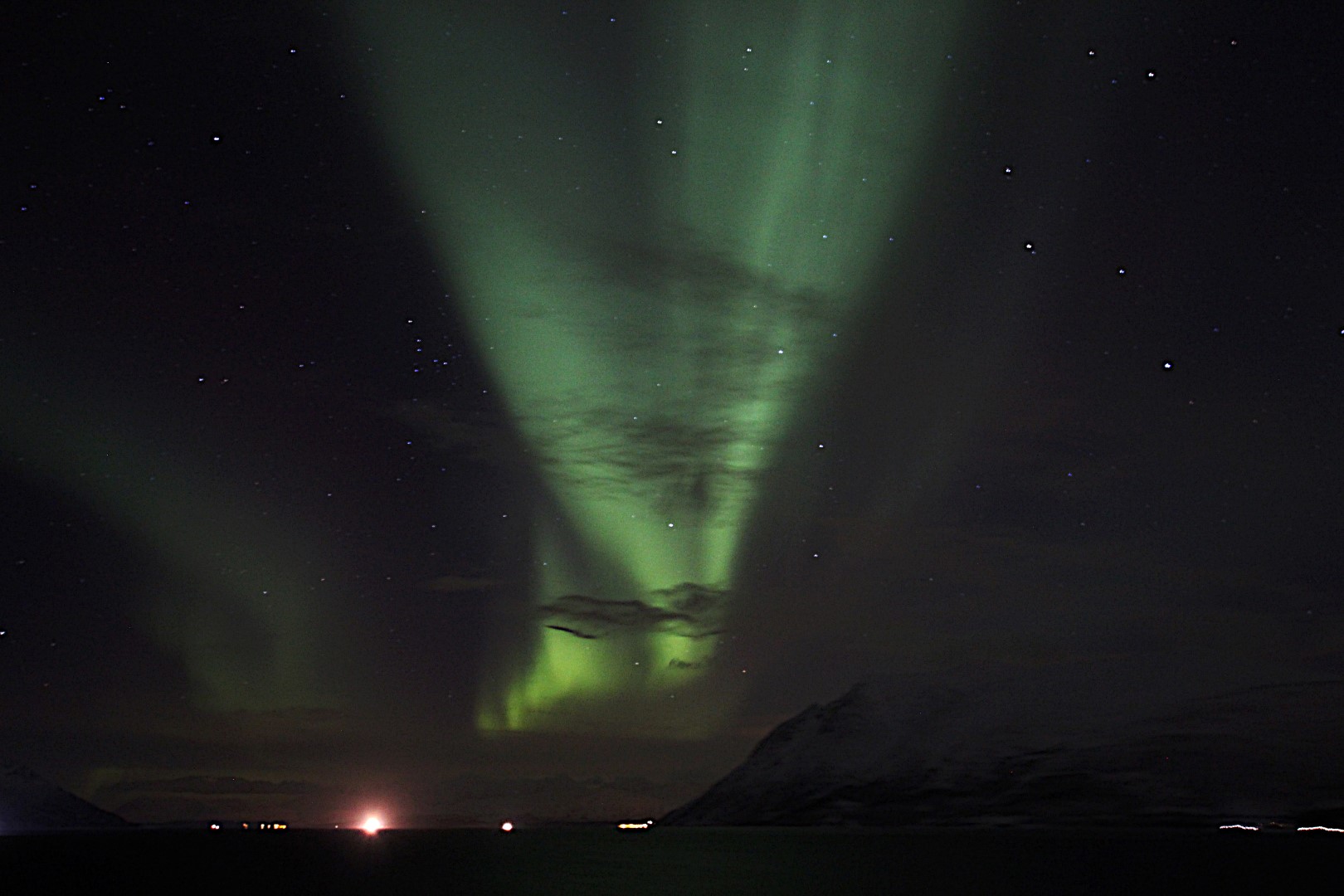
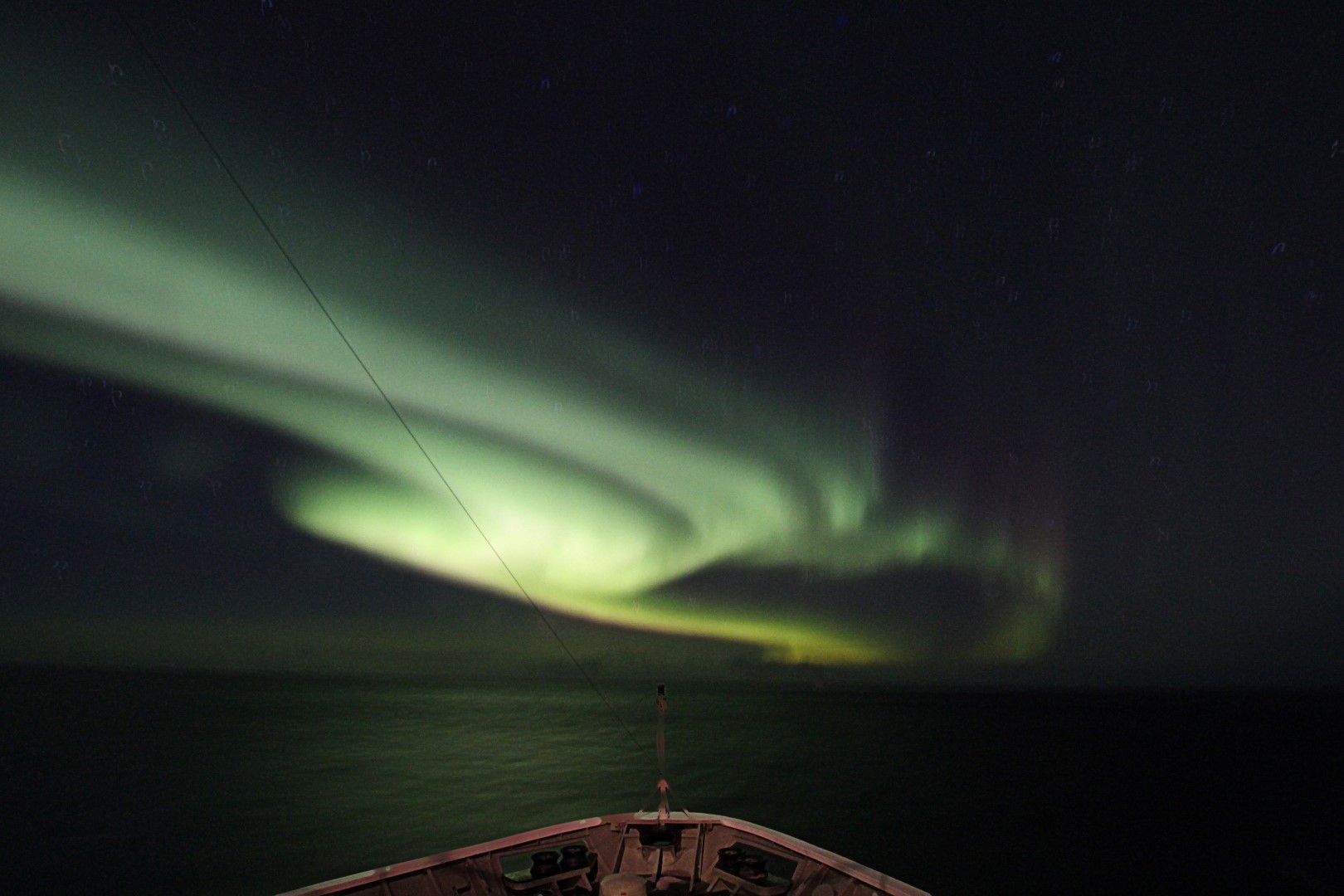
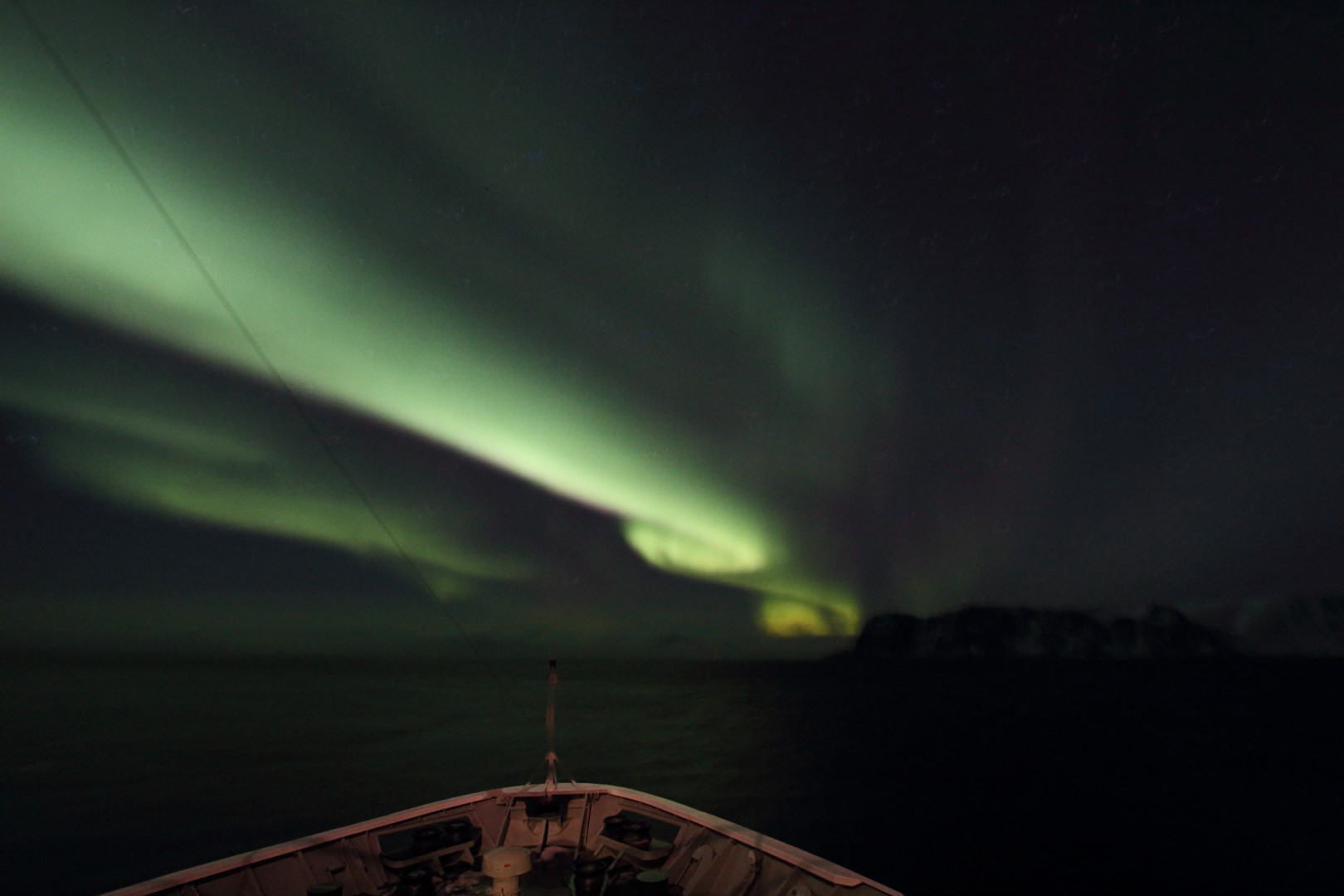
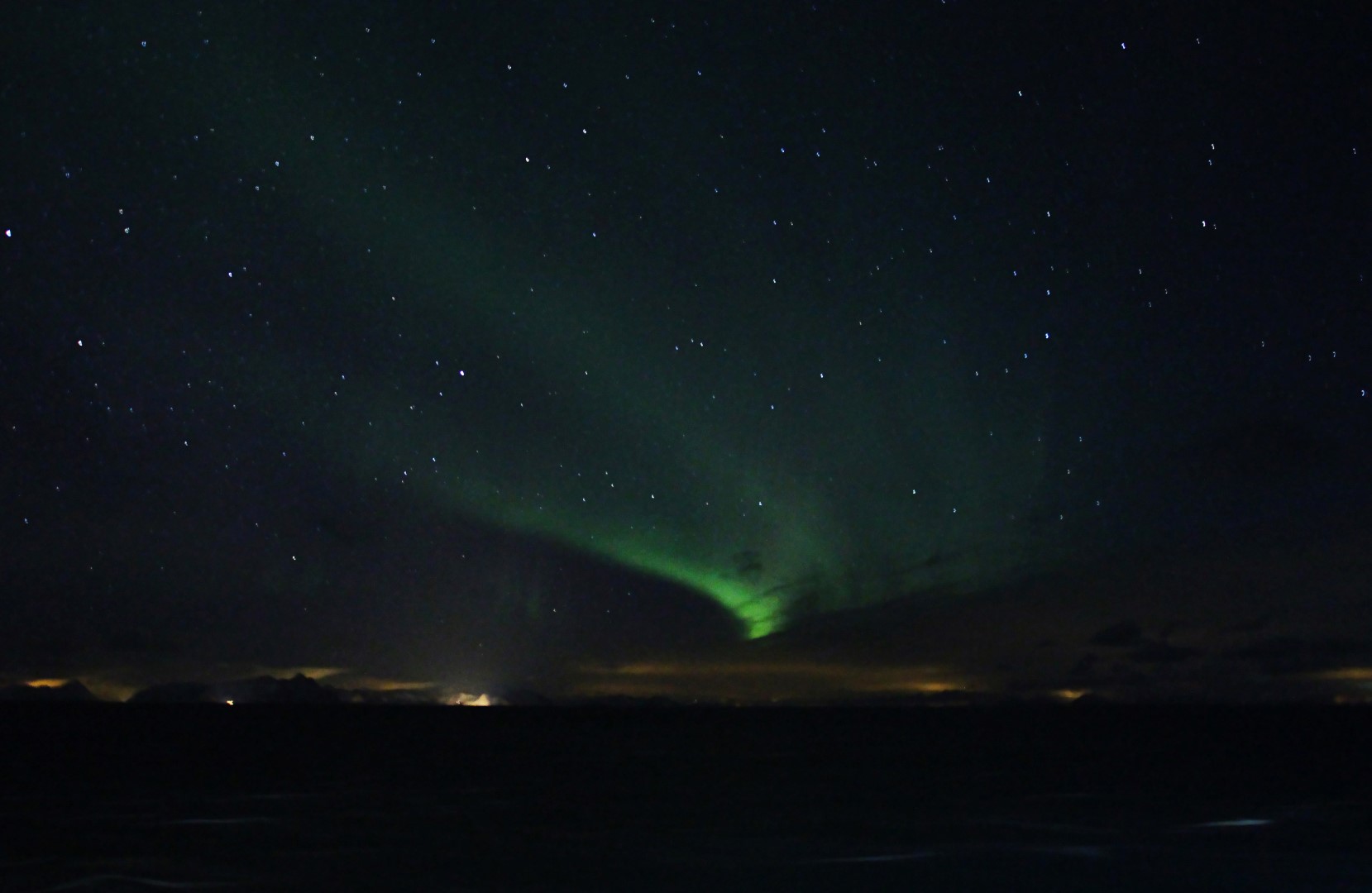
It’s just over 6-years since my last arctic adventure, which was a trip along the Norwegian coast by ship from Bergen to Kirkenes and back, stopping along the way for deliveries and pick-ups at 30-ports.  On that occasion we had good views of the Aurora Borealis whilst at sea somewhere north of the Arctic Circle and with some difficulty, I was eventually able to obtain some images (see below). Standing outside on ther deck at +70o North latitude in February was incredibly cold, making camera operation difficult, whilst the ship’s movement from side-to-side and up-and-down was hardly conducive to photography of the night sky!

This time, I’m just back from circumnavigating the island of Iceland by car from mid to late-March, which is described more fully on my other website Round The Bend here.  It was timed to avoid the worst of winter conditions and, with darkness quickly disappearing as Spring / Summer beckoned, maybe still get a chance to see and image the Northern Lights again – this time on terra firma.  Despite such planning, severe snow, ice and very strong winds were common for much of the time but, when it was clear the scenery was spectacular and, on a couple of evenings later in the trip, the Aurora Borealis put on a great show.

Situated just below the Arctic Circle, mostly between 64o and 66o latitude, Iceland is well known both for its geology and sightings of the Aurora Borealis or Northern Lights.  As a geologist, I travelled to Iceland primarily to view the rocks and though it was getting late in the season, I was also keen to see the Aurora again if possible.  Given the days of bad weather it was therefore fortunate to have clear skies and good views of the Northern Lights on two separate evenings whilst on the south coast, first at Gerdi near Jökulsárlόn and later just south of Kirkjubaejarkklaustur.

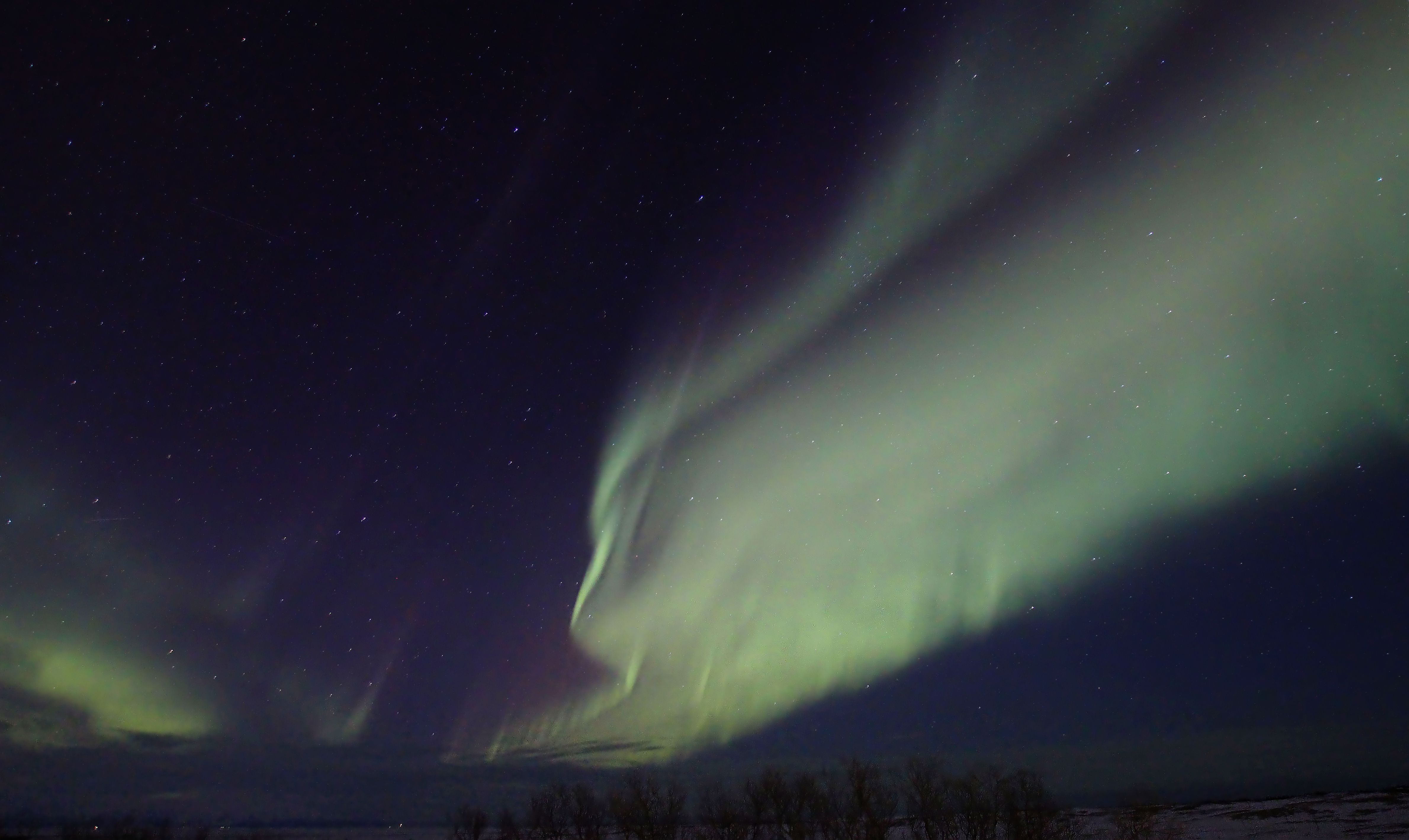
Despite my previous experience, each aurora is different and on this occasion I found using a Canon 700D DSLR mounted on a Gorilla Pod, using a Sigma wide-angle lens set at a focal length of 10mm f3.5 + ISO 3,200 and 10 second exposures generally produced a good image.  It seemed that we were on the southern edge of the aurora on the first night at Gerdi (see top of the page), which was therefore weaker but exhibited a striking purple colour (helium).  The following night the aurora was much stronger, this time mostly green (oxygen) with red and purple fringing (nitrogen & helium) and generally much more active, resulting in some great views with the naked eye and even better images (see below).

Arctic Antics

img_8084-large

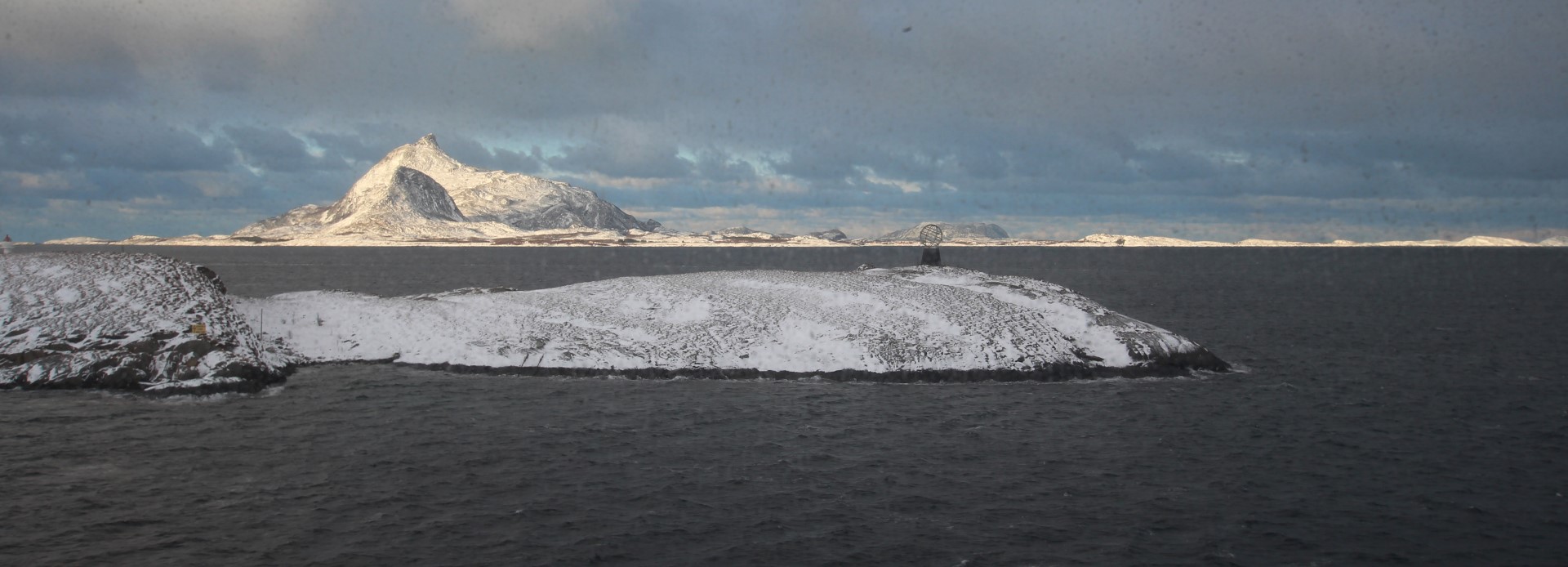
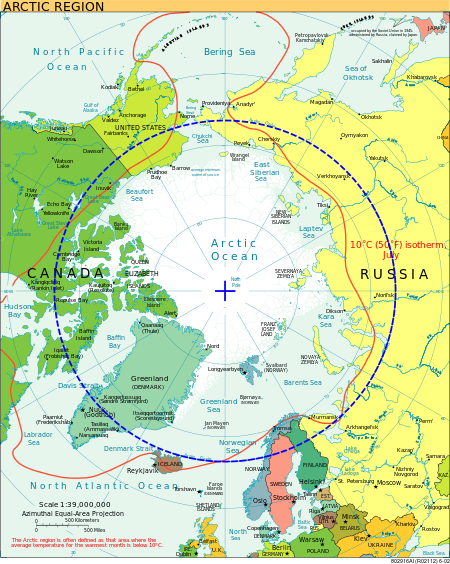
The globe pictured above on the island of Vikingen marks the location of the Arctic Circle off the western Norwegian coast.  However, surprisingly the position of the Arctic Circle is not fixed – as of 28 February 2017 it was 66°33′46.6″ north of the Equator but changes depending on the Earth’s axial tilt, which itself varies within 2° over a 40,000-year period due to differing tidal forces that occur as the Moon’s  orbit changes around Earth.  The region north of the Arctic Circle is famous for the midnight sun in the summer and its corresponding 24-hour darkness during the winter months, with major implications for life itself, as well as contrasting scenery and photographic conditions unique to this hostile region.

450px-arctic_circle-svg

During the last two weeks of February, when the return of limited daylight has just begun to mark the end of winter, I travelled by ship along the entire western and northern coast of Norway close to the Russian border, spending much of the time within the Arctic Circle.  The area is famous for its beautiful scenery, in particular the fjords which typify the coastline and for time immemorial have posed a significant challenge to all seafarers passing this way.

Our ship, the Richard With, was named after the Norwegian captain who in 1893 pioneered this difficult sea passage which we took from Bergen to Kirkenes and back.  Today a fleet of 12 ships are operated by the original Norwegian company Hurtigruten on a daily basis providing ferry transport for goods, vehicles and personnel, as well as a base for tourists seeking a view of the Northern Lights – in all the ship stops at over 30 ports in each direction.

kb_l4_map_desktop_us

Apart from the scenery, during the winter months the area north of the Arctic Circle is probably best known for the occurrence of the Aurora Borealis or Northern Lights (Norwegian – Nord Lys).  A view of this feature is treasured by all who see them but for astrophotographers it will be one of their ‘must do’ images to acquire.  The Aurora is caused by a solar wind originating from the Sun that consists of charged particles, which when drawn downwards at the Earth’s poles by the planet’s magnetosphere ‘excites’ atmospheric atoms which produce different coloured lights depending on the type of gas which is excited by the charged particles; a similar feature occurs around the South Pole called the Aurora Australis and is also now known to occur on Saturn and Jupiter.  The lights are mostly green in colour (ʎ 557.7 nm), sometimes red (ʎ 630 nm) or blue (428 ʎ nm) and less commonly pink, ultraviolet or yellow, depending on the altitude and type of excited gas – which is mostly either oxygen or nitrogen.  The resulting aurora takes the form of rapidly moving clouds or often curtains of light that dart across the night sky, constantly changing shape under the influence of the Earth’s magnetic field and does not disappoint when seen.

The Northern Lights are best imaged with a standard DSLR camera on a sturdy tripod, using a wide angle lens at full aperture, set at between ISO 800 to 1,600 and exposures of about 8 secs to 25 secs, depending on the brightness and quality of the light and the speed of movement of the aurora; focus and all other control needs to be operated manually for best results.  On land a tracking mount, such as a Vixen Polarie, could be used to improve sharpness but on a moving ship set-up and technique is a more difficult.

In this case exposure needs to be carefully balanced in order to account for the ships movement – forwards + up-and-down on the water – and the quality of the aurora light.  As exposures will always need to be greater than a few seconds, star trails are unavoidable and have to be dealt with in post processing as best as possible. I found imaging directly forwards or to the rear of the ship helped minimise this effect but still trails were still inevitable. Experimenting with various settings I found about 12 to 15 seconds exposure and ISO 1,600 generally worked quite well but varied depending on the sea conditions and nature of the aurora at any time.

At such high latitudes it is still very cold in February and warm head-to-feet-to-hands clothing is absolutely essential.  On this occasion, together with wind chill the temperature at the ships bow ranged from between -20oC to -30oC (that’s a minus sign!), making camera control very difficult and uncomfortable!  I tried using an intervalometer for remote shooting but as settings have to be changed frequently by hand it was not very practical; I’m sure on land it would prove much more helpful.  Furthermore, much of the time I had to hold the tripod down with some force as the wind was very severe.

Notwithstanding, I’m very pleased with the results shown below and would love to return again one day, perhaps in the summer – it is a truly different and very special part of the world – hat’s off to Richard With and all those who still sail these waters.

img_7634hpass-largeimg_7768x-large

img_7754star-crop-largeimg_8063x-large