It might seem paradoxical but sometimes it is the absence of light that makes an astrophotography image interesting. Such a feature is the so-called Aquila Rift, a vast, dark interstellar cloud that spans the constellations of Aquila (Eagle), Serpens Cauda and eastern Ophiuchus. Towards the central section of the rift, about 600 million light-years from Earth, within the Aquila constellation and not far from the Summer Triangle’s Altair star, is Lynd’s Dark Nebula (LDN) 673.
Some 7-light years in size, this fragmented dark molecular cloud complex contrasts well against the colourful molecular clouds and stars of the Milky Way; the very dense dust of the dark nebulae scatters the blue light of the surrounding stars, producing a yellow-red bias. In places the density within the nebula that energetic outflows can be seen in the form of the red nebulosity of RNO 109 and Herbig-Haro object HH-32.
Like many astrophotographers, the Rosette Nebula holds a special attraction for me; it’s size, details and colours produce a perfect narrowband target. I revisited the old favourite again this year for the fourth time since 2015 (+2017 & 2018), in an attempt to capture even better its unique and dynamic beauty using newer equipment, skills, and techniques.
Located approximately 5,000 light-years away, this vast cloud of gas and dust has been sculpted into a distinctive rose-like shape. The central star cluster (NGC 2237) has blown-away a large hole within the surrounding molecular cloud (NGC 2244), which all together is some 1.7 degrees or 150 light-years in diameter. Numerous star-producing dark Bok globules are visible along the upper-left, central quadrant of the nebula, collectively referred to as the “Carnival of Animals”.
The skies this winter have been poor and, as a result, imaging possibilities have been very limited. However, over five nights from January to March I was eventually able to obtain 9-hours of Ha, OIII and SII integration time which, moreover, produced a good data set of 10-minute exposures.
I’m very pleased with the final SHO image (top of the page), which successfully displays the intricate details and colours that arise from the aforesaid make-up and processes that makes the nebula so popular. Furthermore, experimenting with an HSS palette produced an alternative and exciting image of this rose of night sky (see above), that might be even more in-keeping with its given moniker. All-in-all, despite this year’s difficulties I’m satisfied that I gave the Rosette my best shot, which is definitely a cut above my previous attempts – though I fully expect to return again in a few years seeking further improvements.
IMAGING DETAILS
Object
Rosette Nebula NGC 2244 + 2237, 2238, 2239 & 2246
Constellation
Monoceros
Distance
5,000 light-years
Size
Approx. 100 light-years ~ 1.3o
Apparent Magnitude
+9.0
Scope
William Optics GT81 + Focal Reducer FL 382mm f4.72
Mount
SW AZ-EQ6 GT + EQASCOM computer control & Cartes du Ciel
Guiding
William Optics 50mm guide scope
+ Starlight Xpress Lodestar X2 camera & PHD2 guiding
Camera
ZWO ASI294MM CMOS sensor
FOV 2.87o x 1.96o Resolution 2.50”/pix Max. image size 4,144 x 2,822 pix
EFW
ZWOx8 EFW & 31mm Chroma Ha, OIII, SII filters
Capture & Processing
Astro Photography Tool (APT), Deep Sky Stacker & PixInsight v1.8.9-2
Image Location & Orientation
Centre = RA 06:31:55.304 DEC +05:00:56.913 Left = North
Exposures
Ha x18 + OIII x18 + SII x18 x 600 sec R x20 + G x20 + B x20 x 60sec Total Integration Time: 10hr
@ Gain 120 & 30 Offset 21 @ -15oC
Calibration
5 x 600 sec Darks 10 x NB Flats & Dark Flats @ ADU 32,000
Location & Darkness
Fairvale Observatory – Redhill – Surrey – UK Typically Bortle 5-6
Date & Time
19th January, 12th February, 6th 7th March 2024 @ +20.00h
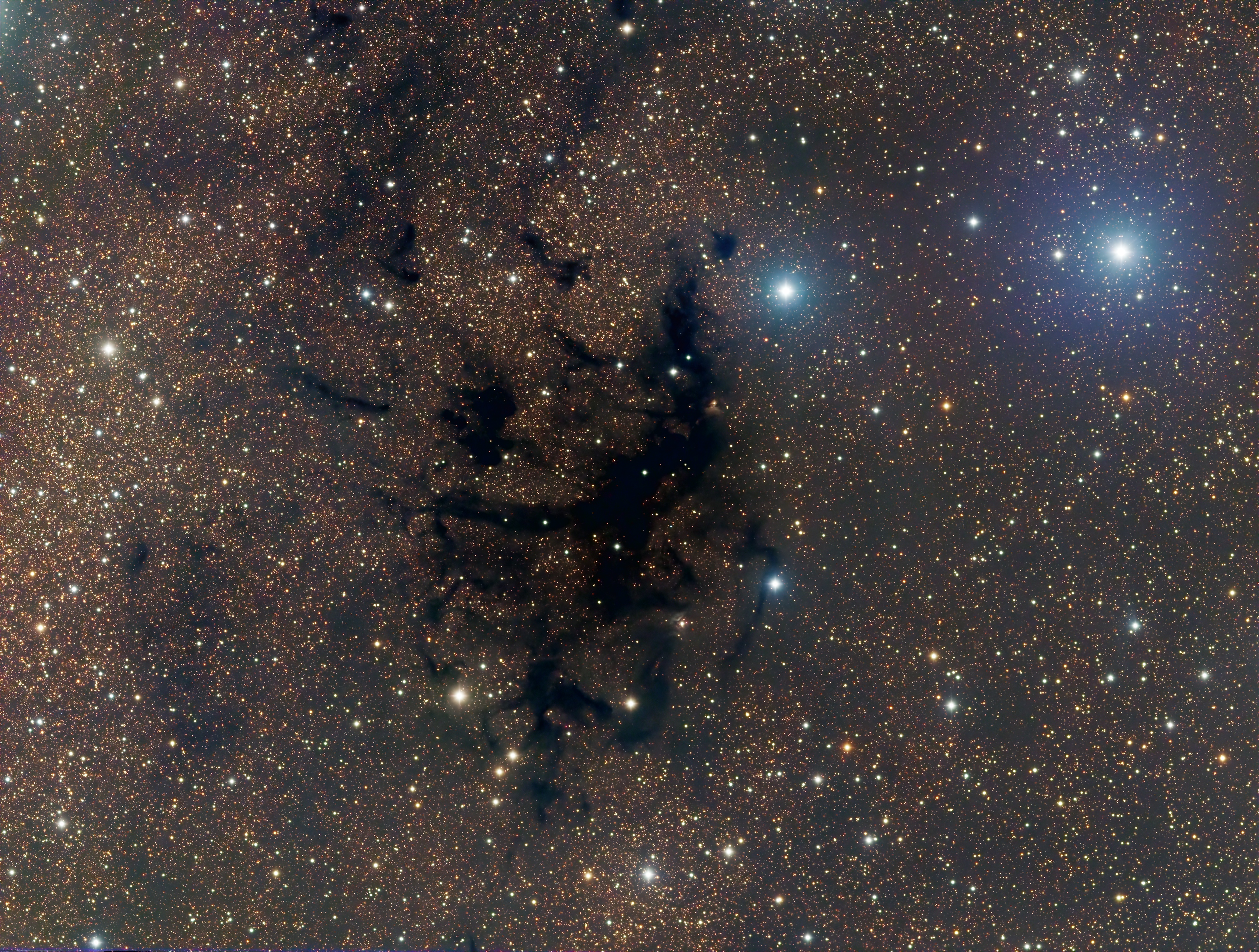
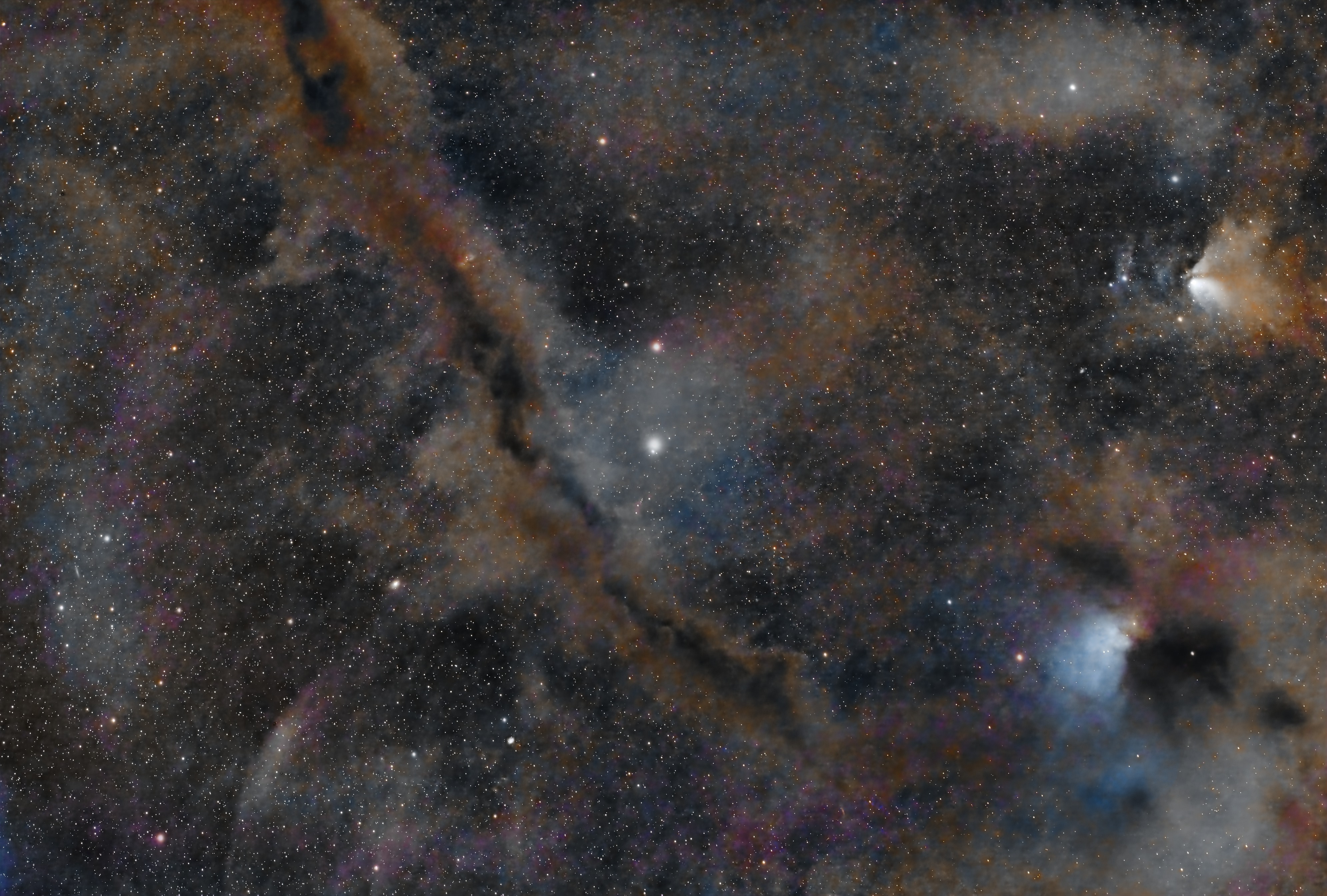
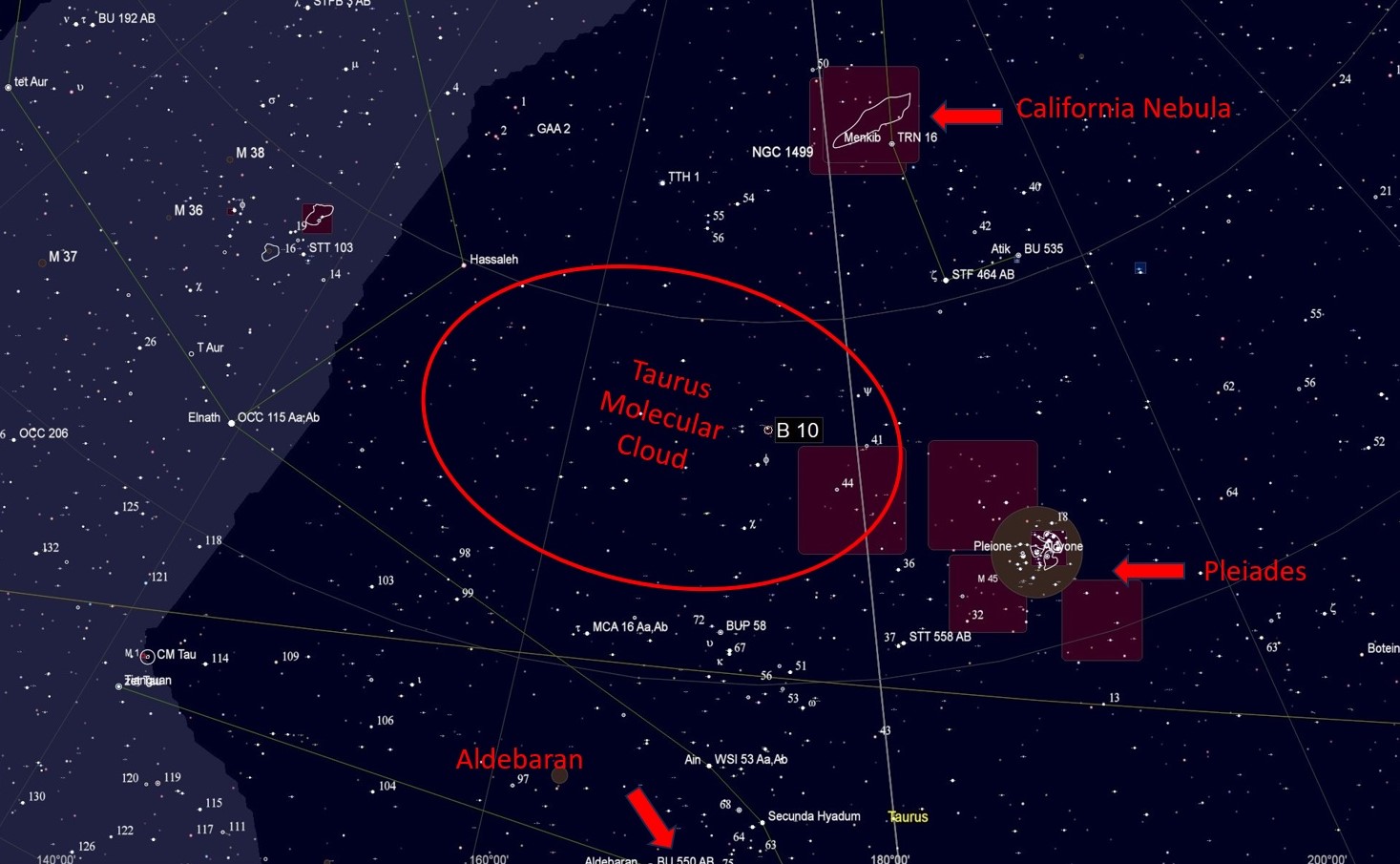
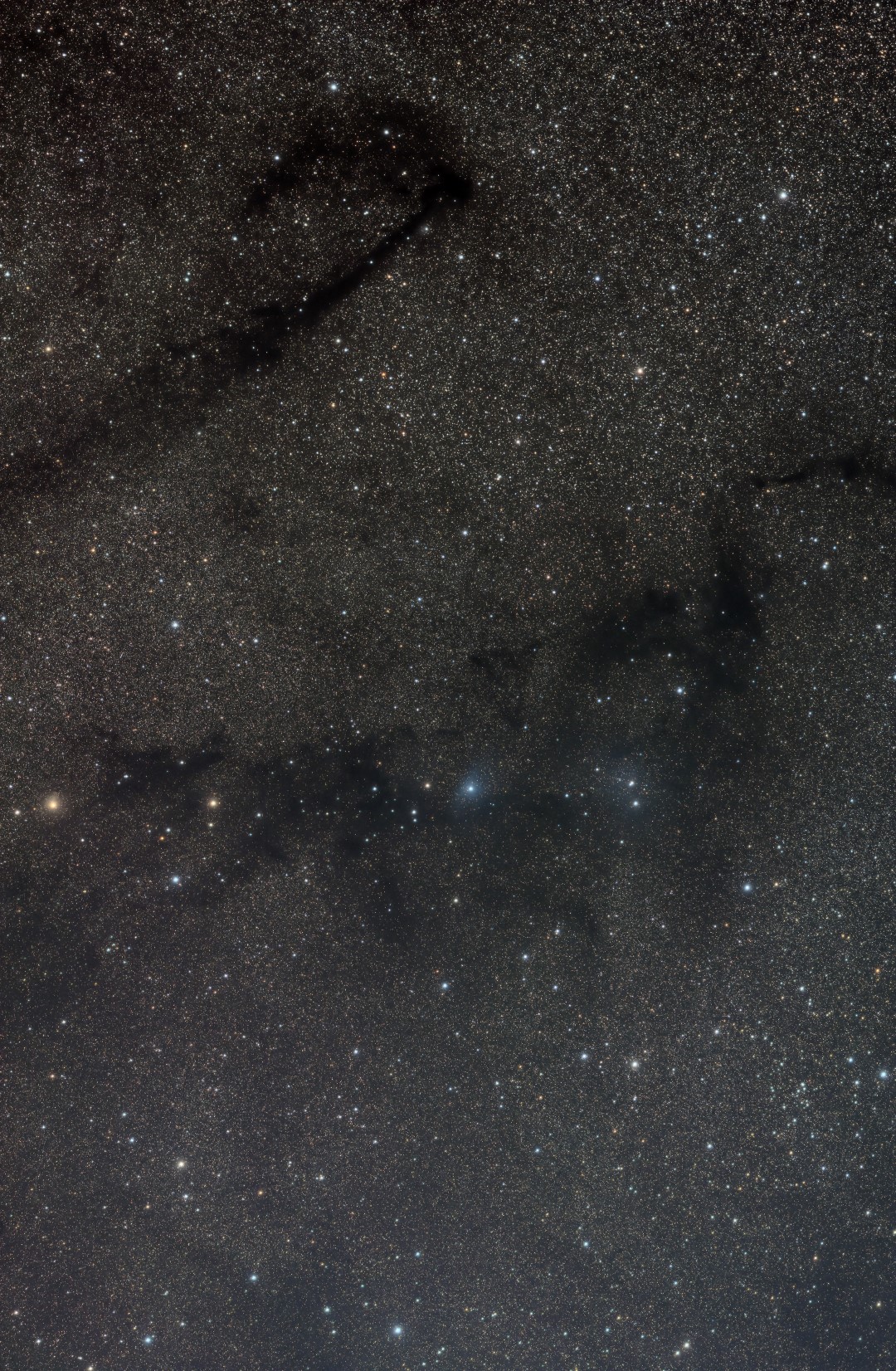
Located northeast (left) of Pleiades, south of California Nebula and north (above) of Aldebaran, spanning more than 30o of the night sky is the Taurus Molecular Cloud (TMC), a rich area of dark nebulae punctuated by bright areas of new star formation. Moreover, the TMC is thought to be the nearest star forming region to Earth.
Herschel Space Observatory far-infrared’s view of the TMC & approximate image location
All-in-all, the very large TMC provides many promising imaging opportunities. This image captures numerous, complex dark nebulae across the field-of-view, including Barnard 10 & 214, LDN 1495 & VdB 27, together with bright reflection nebulae LBN 782 & 785 and the odd galaxy – if you look carefully.
IMAGING DETAILS
Object
Barnard 10, VdB 27, LBN 782 & 785
Constellation
Taurus
Distance
450 light-years
Scope
William Optics GT81 + Focal Reducer FL 382mm f4.72
Mount
SW AZ-EQ6 GT + EQASCOM computer control & Cartes du Ciel
Guiding
William Optics 50mm guide scope
+ Starlight Xpress Lodestar X2 camera & PHD2 guiding
Camera
ZWO ASI294MM CMOS sensor
FOV 2.87o x 1.96o Resolution 2.50”/pix Max. image size 4,144 x 2,822 pix
EFW
ZWOx8 EFW & LRGB 31mm Chroma filters
Capture & Processing
Astro Photography Tool (APT), Deep Sky Stacker & PixInsight v1.8.9-2
Image Location & Orientation
Centre = RA 04:20:19.60 DEC +27:22:.07.66 Right = North
Exposures
L x50, R x30, G x31, B x27 x300 sec Total Integration Time: 11hr 30 min
@ Gain 120 & Offset 30 @ -15oC
Calibration
5 x 300 sec Darks 10 x NB Flats & Dark Flats @ ADU 32,000
Location & Darkness
Fairvale Observatory – Redhill – Surrey – UK Typically Bortle 5 / 6
Date & Time
6th 7th 14th November 2023 + 15th January 2024 @ +21.00h
This Christmas marks the 10th edition of my astrophotography calendar, consisting of my better images from the previous 12-months, which I produce for myself and members of the family. Wow doesn’t time fly? Based on these images, I also compile a video of the images set to music, which we all watch together before seeing the actual calendar. It’s become something of an occasion and is a great way to present the images, which look wonderful on today’s smart TV’s and is fun to watch and share with the family.
THE CALENDAR
Much longer imaging times (total of more than 145 hours), re-imaging old favourites in new ways and unusual, overlooked, or difficult objects, resulted in a very good 2023 astrophotography year and perhaps the best calendar yet? The calendar for 2024 on YouTube can be viewed by clicking HERE and below is a brief overview of each image. More detailed background information and imaging details for those interested can be found in relevant blogs I posted on this website. The background music is the track Appleshine from Underworld’s album Drift.
COVER
SH2-284: Close-up of April’s image – along the inside of the ring structure are many dark dust pillars and globules, which on the right seem to resemble a hand with a bony finger pointing inwards!
JANUARY
NGC 1333: Nestled within the western area of the Perseus Molecular Cloud, some 1,100 light-years from Earth is the colourful NGC 1333 reflection nebula, one of the closest and most active star-forming regions of the night-sky.
FEBRUARY
Spaghetti Nebula: Straddling the boundary of Taurus and Auriga constellations, is the giant supernova remnant (SNR) Simeis-147. The stellar explosion occurred 40,000 years ago, leaving a rapidly spinning neutron star or pulsar at the core of the now complex and the expanding SNR.
MARCH
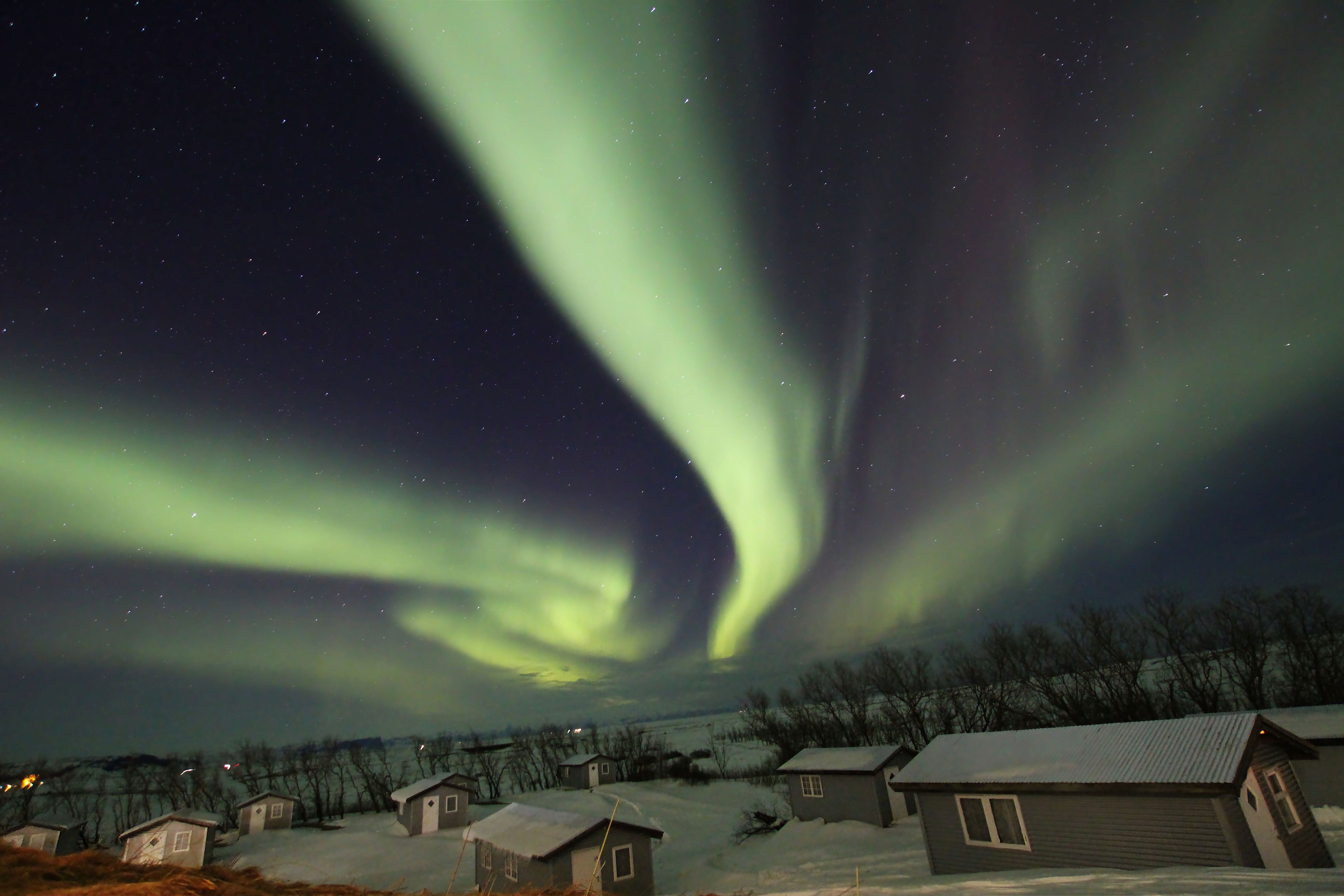
Aurora Borealis: Situated just below the Arctic Circle, Iceland is well known both for its geology and views of the Aurora Borealis, which we saw in March on the south coast near Kirkjubaejarkklaustur.
APRIL
SH2-284: A star-forming region of dust and gases, sculpted by radiation and interstellar winds emanating from a young (3 to 4 million years) star cluster located near the centre.
MAY
M3 Globular Cluster*: Consisting of 500,000 stars and over 11 billion years old, M3 is one of150 globular clusters that orbit around the Milky Way Galaxy.
JUNE
M27 Apple Core Nebula*: A planetary nebula, consisting of a glowing shell of ionized gas ejected from a red giant star in its late stage of life to become a white dwarf. Complex hydrogen (red) and oxygen (blue) fans form around the outer regions, with a pulsar-like beam transecting the nebula.
JULY
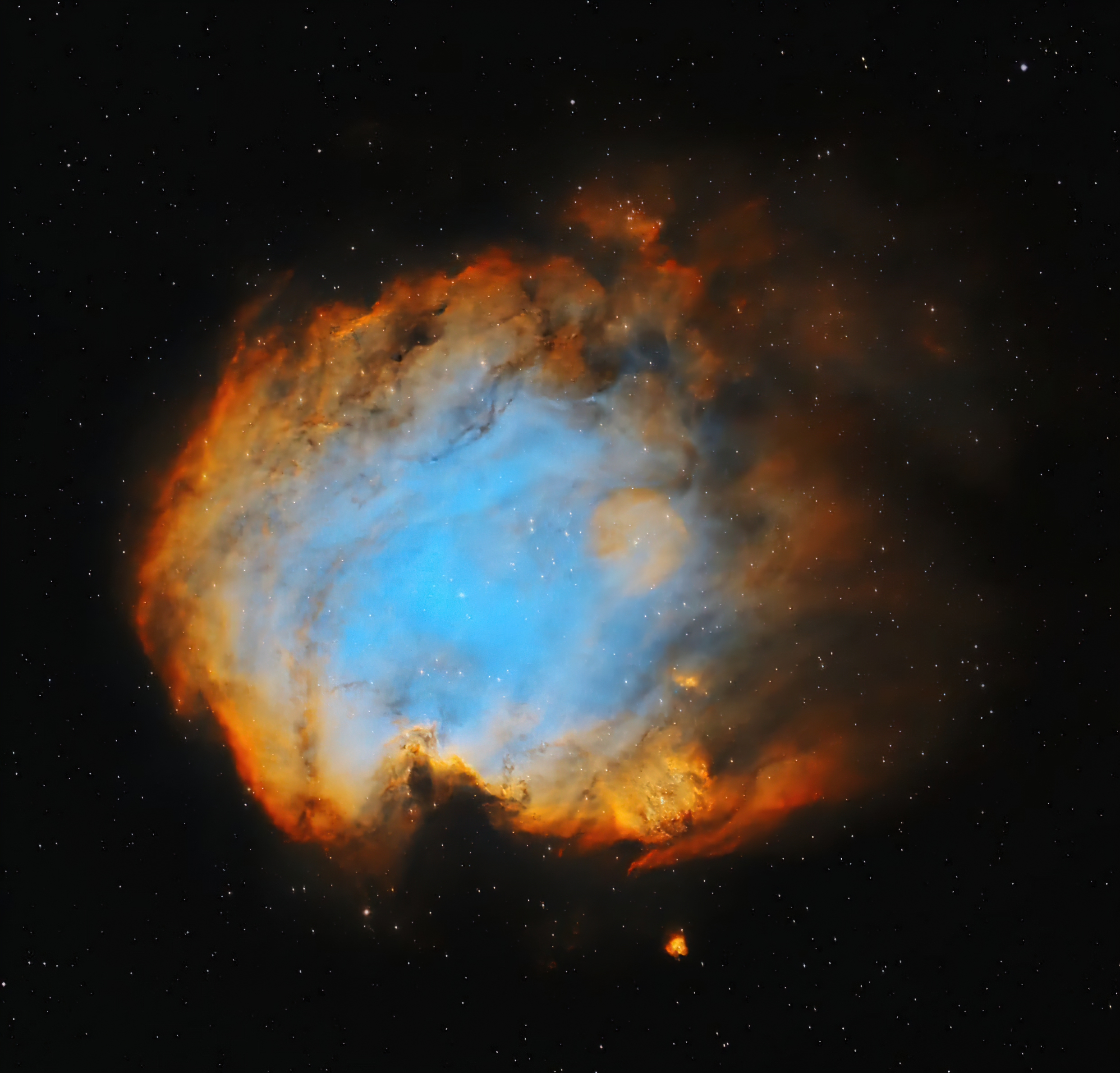
Monkey Head Nebula: Located6,400 light years from Earth in the Orion constellation, the ‘Monkey’ is a so-called emission nebula, where new stars are being created within at a rapid rate.
AUGUST
SH2-115: This widefield image contains a richness of various emission nebulae, centred around the distinctive large blue SH2-115 region. Just to the left of SH2-115 is the small but enigmatic SH2-116 a faint, blue disc thought to be a planetary nebula.
SEPTEMBER
LDN-768 Black Cat Nebula: Close to M27 in the constellation of Vulpecula (“Little Fox”), is a dense region of stars broken-up by dark nebulae to create intriguing shapes. Here strung out from left-to-right, several of the dark nebulae seem to coalesce (visually) to create the form of a black cat.
OCTOBER
SH2-126 Great Lacerta Nebula: On the western edge of the Milky Way in the southern part of Lacerta, is the very large but faint emission nebula SH2-126. The red filament structures stretch over 3 degrees, to the right is the Gecko Nebula, a molecular cloud associated with bright young stars.
NOVEMBER
Flaming Star & Tadpoles Nebula: Two emission nebulae: dust & gas of the Flaming Star (below) combined with red ionized hydrogen gas produces a flame affect. Above, the stellar winds and radiation pressure from hot massive stars creates the Tadpoles ‘wriggling’ away from the centre.
DECEMBER
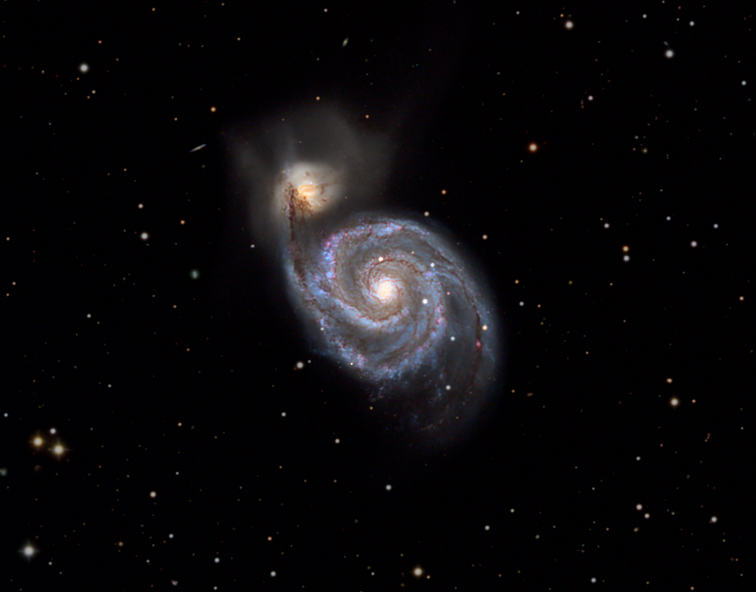
M51 Whirlpool Galaxy*: As the smaller galaxy passes behind M51, joint gravitational forces are interacting, resulting in the misalignment of stars and unusually bright blue and pink areas across the Whirlpool galaxy. Their fates are inextricably linked and might eventually merge.
Footnote: All images taken from Redhill, Surrey or telescope at a dark sky site in New Mexico,USA shown by an asterisk*
Two months past the summer solstice in late August, shortly after the new moon, I was drawn to the constellation of Vulpecula (Latin for “little fox) and an interesting region of reflection and dark nebulae that provide good imaging possibilities. In particular, a vast area of stars in which the contrasting dark nebulae create some intriguing shapes.
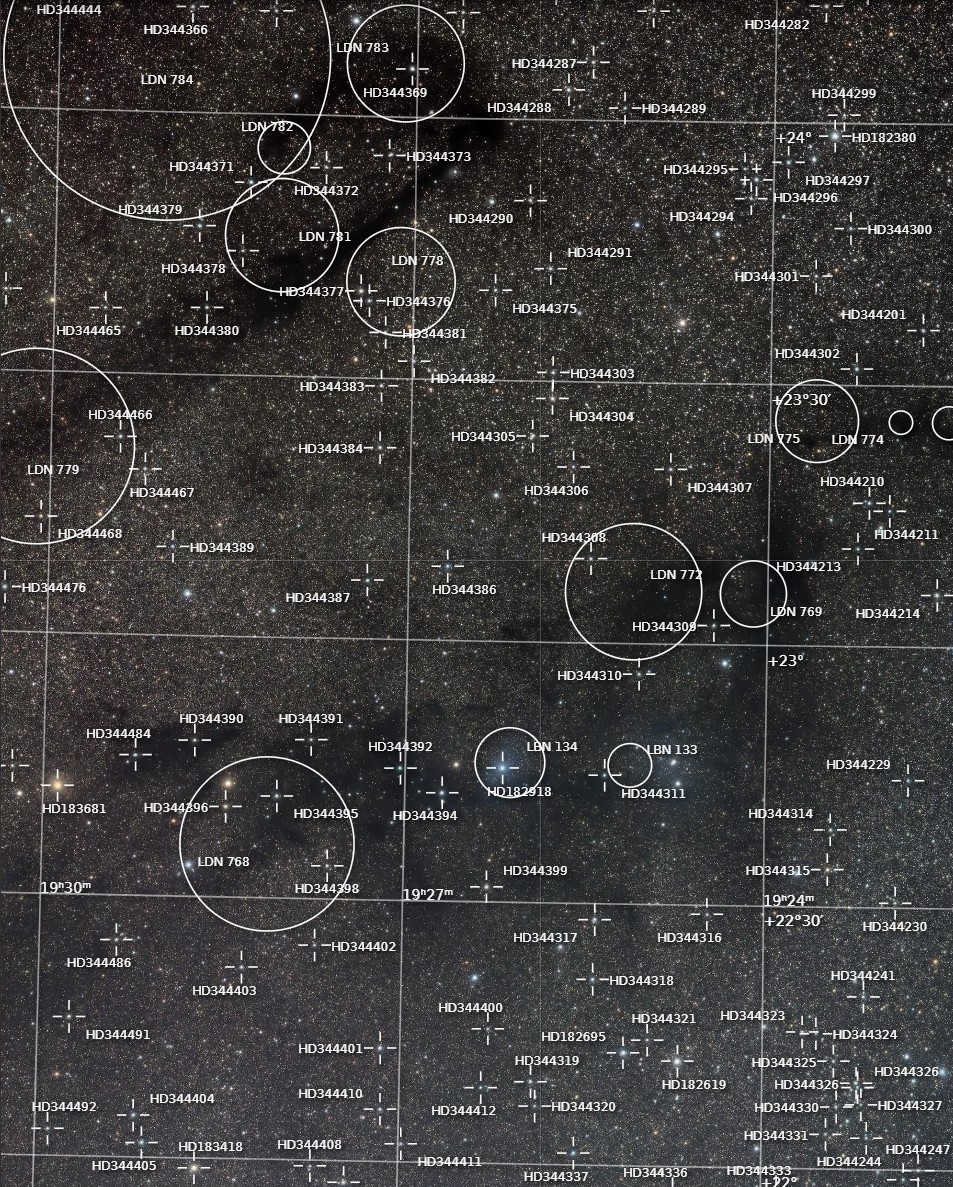
At the centre of the resulting image, strung out from east to west (left to right), several of the dark nebulae seem to coalesce (visually) to create the form of a black cat: LDN 773, 774, 769 & 768; an alternative interpretation is that of the Loch Ness Montser. Further enhancing the image, the cat is adorned by two large, bright orange stars near its head and within the ‘body’ to the right, several various reflection nebulae created by hot blue stars (VdB 126 / LBN 133 & 134 etc.).
Moreover, above the cat’s head another group of dark nebula form what I’d describe as a furled umbrella (LDN 781, 782, 783 & 779). Finally, towards the lower right edge of the image (below the cat’s rear leg) is the open star cluster of NGC 6793.
Apart from its obvious beauty, the inspiration for this image was my four-year old granddaughter who just loves cats – especially her own one-eyed black cat!
IMAGING DETAILS
Object
LDN 768, LDN 772, LDN 781, Vdb 126, LBN 133
Constellation
Vulpecula
Distance
Various
Size
Various
Apparent Magnitude
Various
Scope
William Optics GT81 + Focal Reducer FL 382mm f4.72
Mount
SW AZ-EQ6 GT + EQASCOM computer control & Cartes du Ciel
Guiding
William Optics 50mm guide scope
+ Starlight Xpress Lodestar X2 camera & PHD2 guiding
Camera
ZWO ASI294MM CMOS sensor
FOV 2.87o x 1.96o Resolution 2.50”/pix Max. image size 4,144 x 2,822 pix
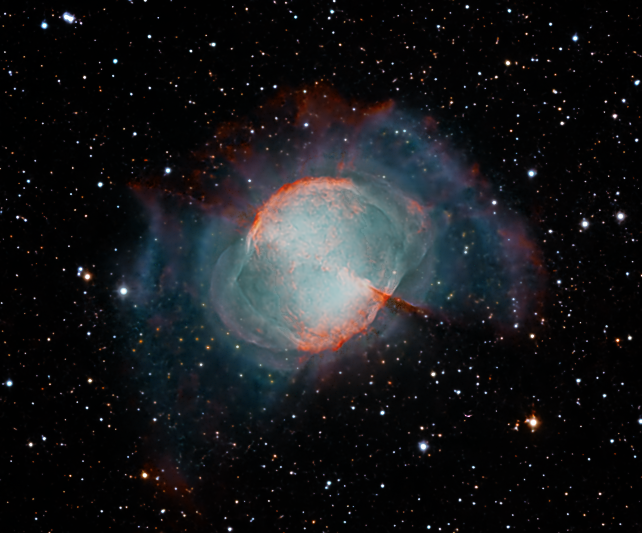
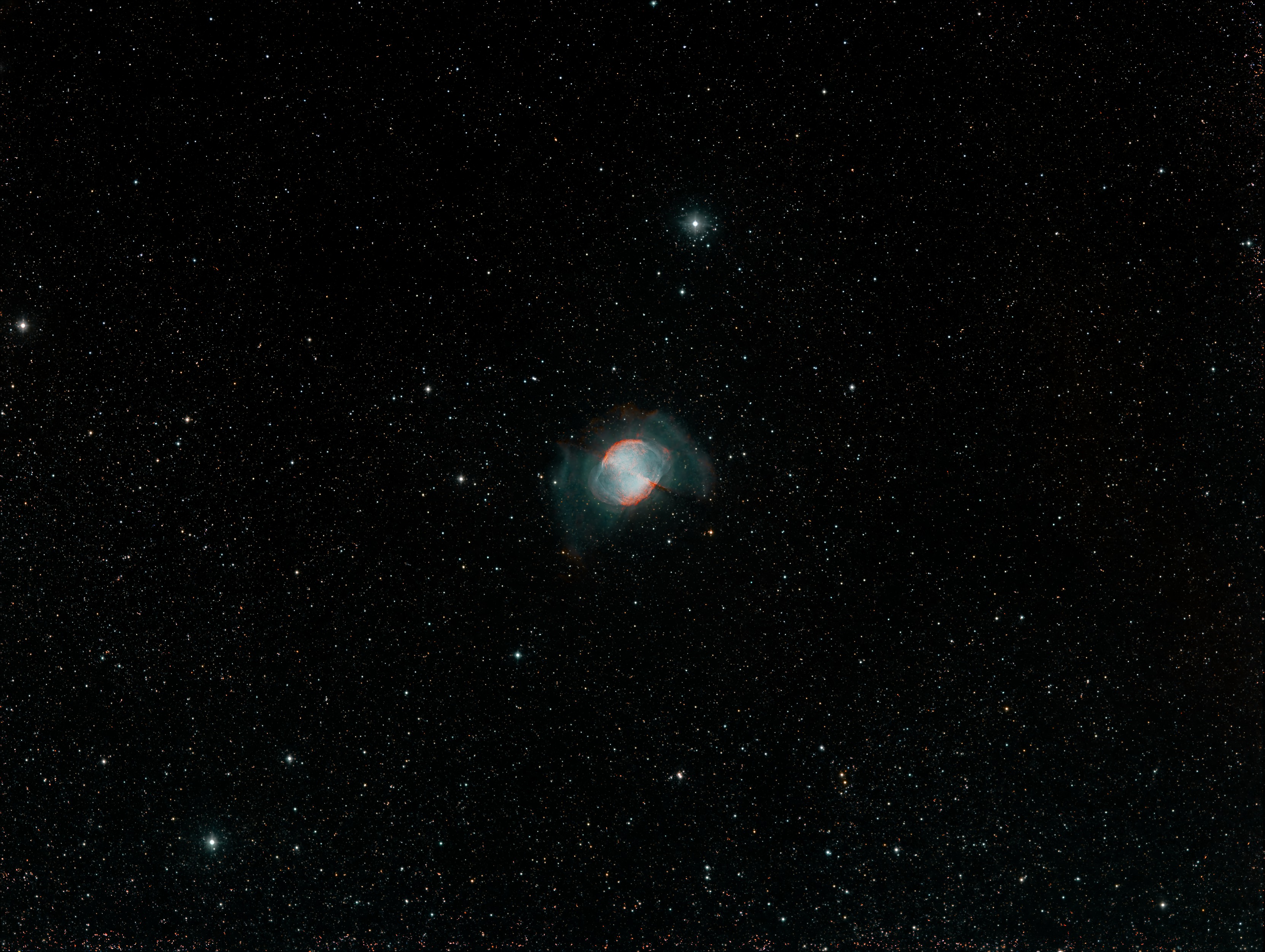
A popular object at this time of the year, the planetary nebula M27 consists of a glowing shell of ionized gas, which has been ejected from a red giant star in its late stage of its life to become a white dwarf. Like many planetary nebulae, the main inner shell exhibits numerous dark and light knots, of which red ionized hydrogen areas form two bright lobes that together make the shape of an apple- core / dumbbell, which are M27’s two nicknames. There also seems to be different bi-polar influences occuring, that have resulted in complex Ha (red) and OIII (blue) fans around the outer regions and a pulsar-like beam transecting the nebula (see cropped version at the top of the page).
Despite the good data quality and long integration time, the complicated nature of the planetary nebula made processing very difficult, in particular, teasing out the aforesaid but very faint outer fans. In this case it was necessary to carry out individual soft stretches of the Ha and OIII stacks before combining them into an HOO image, from which a starless colour image was created and then processed further to bring out the fans. Thereafter, Pixelmath was used to amalgamate this image with two other starless HOO and RGB versions that emphasized the main part of the nebula, before finally adding back RGB stars and finishing off.
After considerable experimentation to obtain this result, I’m happy with the final image, which I hope shows off the said apple core / dumbbell and its outer fans to good effect (see above).
IMAGING DETAILS
Object
M27 AKA Dumbbell or Apple Core Nebula or NGC 6853
Constellation
Vulpecula
Distance
1,360 light-years
Size
8.0 x 5.7 arc-minutes (core) 15 arc-minutes (total) or 5 light-years (actual)
Of all the incredible features that constitute the Universe, located relatively close to home, I always marvel at the nature of globular clusters. Largely unknown by the lay person and myself until I took-up astronomy, more than 150 of these incredible objects orbit around the Milky Way in the form of a spherical halo both above and below the galactic disc. Between galaxy season (March – April) and the appearance of the Sagittarius arm of the Milky Way in the summer, is the globular so-called cluster season, which is heralded by the arrival of M3, one of the brightest and most popular of the clusters.
M3 was discovered by Charles Messier in 1764 but only correctly identified as a globular cluster twenty years later by William Herschel. Consisting of more than 500,000 million stars, of which at least 274 are variable stars, it is estimated to be over 11-billion years old, thus being some of the oldest stars in the Universe.
Using data gathered remotely from a Takahashi 106 FSQ situated in the dark skies of New Mexico, USA, the resulting image shows this spectacular object in all its glory. Apart from the marvellous star details within the cropped version of M3 (see top of the page), there’s also much to see and enjoy in the original widefield image (see above), that is also bountiful of colourful stars as well as several galaxies. Altogether I’m very pleased with the final image, which is probably my best globular cluster so far.
IMAGING DETAILS
Object
M3 Globular Cluster AKA NGC 5272
Constellation
Canes Venatici
Distance
34,000 light-years
Size
18 arc minutes, which spans approx. 180 light-years
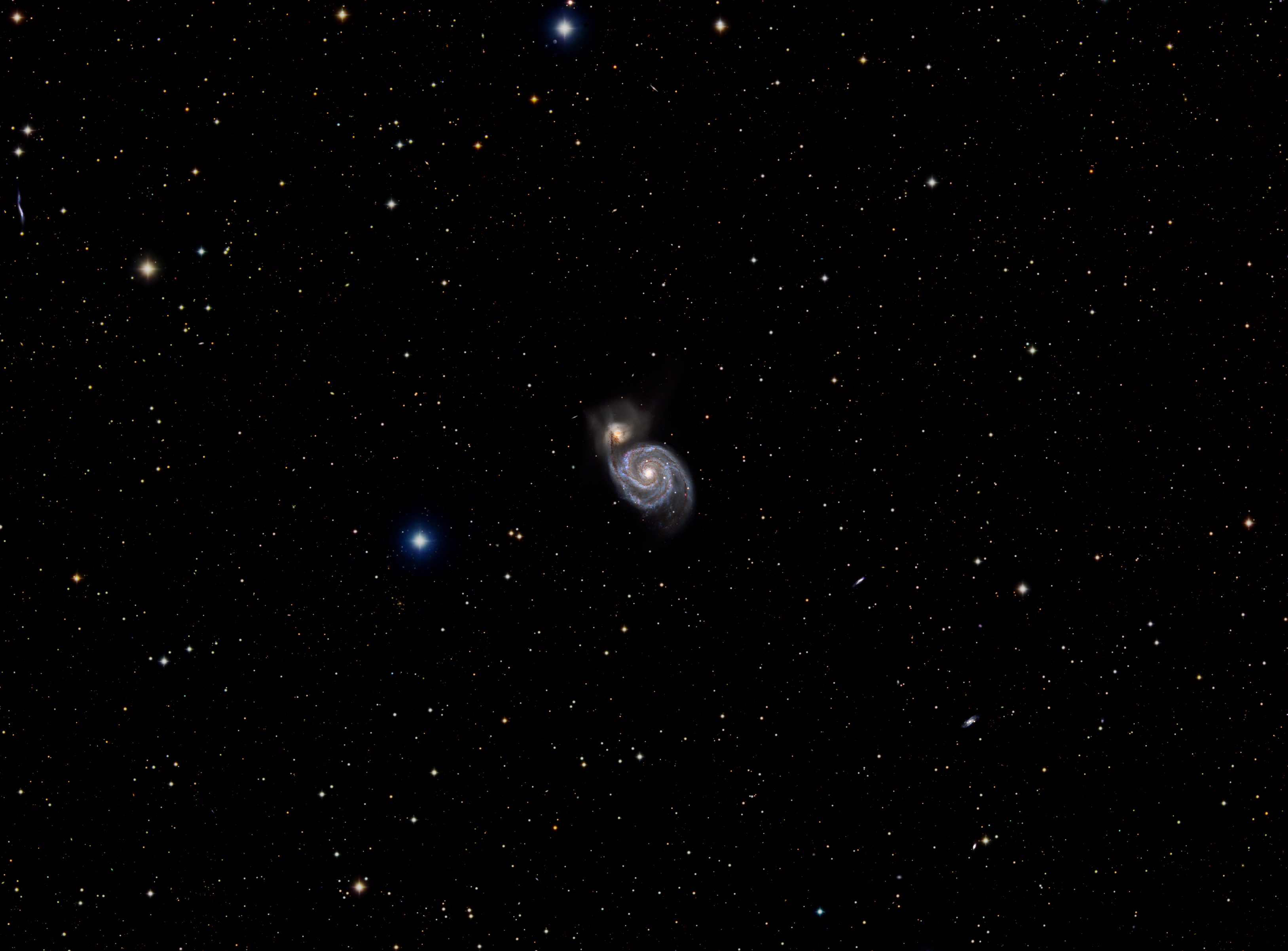
The size and diversity of the cosmos produces many wonderful features, of which M51 the Whirlpool Galaxy ranks highly amongst astrophotographers and is certainly one of my favourites. Unfortunately, it is at the limit for my equipment and location, though in 2020 I was fortunate to capture over 16-hours integration time and a reasonable image (see here). Whilst currently in the summer doldrums of limited darkness, I chose to process M51 data previously obtained using a Takahashi FSQ 106 located at Deep Sky West in New Mexico, USA.
Seen face-on from Earth, the balanced arms of this grand design galaxy contains dark dust lanes, blue star clusters and numerous pink star-forming regions rich in hydrogen gas. But it is the cosmic dance taking place between M51 and its companion dwarf galaxy NGC 5195 that makes this such an exciting and popular object.
The most popular theory of what’s happening, is that the smaller galaxy is passing behind M51 and the joint gravitational forces are interacting between the two, resulting in the misalignment of stars and unusually bright blue and pink areas across the M51 galaxy. Though not certain, it seems that their fates are inextricably linked and might eventually merge. Whatever the process taking place, it will take millions of years if not longer to play out and is likely to provide this exciting spectacle for many generations of astrophotographers yet to come!
Whilst I was satisfied with my image obtained here in Surrey at Fairvale Observatory in 2020, there’s no denying that the data set from New Mexico is in a different league and was a pleasure to process. Given the short focal length of both telescopes, Takahashi FSQ 106 (530mm f5) and William Optics GT 81 (382mm f4.72), out of the camera both set-ups inevitably produce a wide FOV but nonetheless pleasing images (see image above). However, the quality of the DSW data holds up much better when cropping out M51 and its dance partner, thus showing off the aforesaid details of this dynamic and colourful scene to great effect (see top of page).
Constellation names mostly originated from ancient Middle Eastern, Greek, and Roman cultures, when they identified groups of stars and named them after their gods, goddesses, animals, and objects that were important to them. Other world-wide groups and throughout time – Native American, Asian, and African – have also made and named similar pictures from star groups based on their cultures and related beliefs. Given the number of stars observed when looking up into a clear dark sky, it is obviously helpful to ‘construct’ familiar patterns and adopt memorable names, which can then be used to identify areas of the sky in a way that can be easily identified by all. I have no problem with this long and well-established convention, which despite their antiquity works just as well in the modern world but I do have an issue with nicknames.
I’ve smiled at some of the nicknames given to popular, usually deep sky objects that have been well established by astronomers, but despite the possible use of describing their form, I am increasingly finding them a distraction when considering the merit of astrophotography images: Seagull Nebula, Running Man Nebula, Pelican Nebula etc. The problem is that they absolutely do look like the object they’re meant to depict but, like an earworm is to music, once seen they are difficult to view any other way.
With this partly in mind, for the first time in seven years I recently chose to image NGC 2174 again. I previously used the William Optics GT81 with a modded Canon 550D DSLR camera, which resulted in an image that wasn’t too bad, except it looked like a monkey! Given its nickname of the Monkey Head Nebula, this was to be expected but unfortunately, thereafter the picture of a monkey has remained with me ever since when I view NGC 2174 images. The challenge on this occasion was therefore to limit the monkey’s impact on the image, thereby showing the object for what it really is – an emission nebula.
Using the same OTA but with a mono CMOS camera and a good set of filters, the new data set obtained was much improved, and with better processing experience it was time to see the monkey (or not) in a new light. The first thing to do was present the image in an orientation that produces a more favourable perspective (less monkey like). Using a basic SHO palette in PixInsight the initial image was promising (see below) but with an alternative PixelMath dynamic SHO palette* and then processing with autocolor script, color saturation, Russell Croman’s XT-suites and other tweaks, I was pleased to see that the monkey was nowhere to be seen in the final image (see image at the top-of-the-page), or at least to my eye.
At last, it is now possible to look at NGC 2147 and see the inherent features of this interesting emission nebula, where new stars are being born at a rapid rate. Moreover, the inner details can now be clearly viewed within, thus also showing the associated open star cluster NGC 2175 and more. As a result of this monkey make-over, the NGC 2174 image now not only looks much better but critically, I no can longer see the ape! Now where’s that Seagull?
IMAGING DETAILS
Object
NGC 2174
Constellation
Orion
Distance
6,400 light-years
Size
40 arc secs
Apparent Magnitude
+6.80
Scope
William Optics GT81 + Focal Reducer FL 382 mm f4.72
Mount
SW AZ-EQ6 GT + EQASCOM computer control & Cartes du Ciel
Guiding
William Optics 50mm guide scope
+ Starlight Xpress Lodestar X2 camera & PHD2 guiding
Camera
ZWO ASI294MM CMOS sensor
FOV 2.87o x 1.96o Resolution 2.50”/pix Max. image size 4,144 x 2,822 pix
It’s just over 6-years since my last arctic adventure, which was a trip along the Norwegian coast by ship from Bergen to Kirkenes and back, stopping along the way for deliveries and pick-ups at 30-ports. On that occasion we had good views of the Aurora Borealis whilst at sea somewhere north of the Arctic Circle and with some difficulty, I was eventually able to obtain some images (see below). Standing outside on ther deck at +70o North latitude in February was incredibly cold, making camera operation difficult, whilst the ship’s movement from side-to-side and up-and-down was hardly conducive to photography of the night sky!
This time, I’m just back from circumnavigating the island of Iceland by car from mid to late-March, which is described more fully on my other website Round The Bendhere. It was timed to avoid the worst of winter conditions and, with darkness quickly disappearing as Spring / Summer beckoned, maybe still get a chance to see and image the Northern Lights again – this time on terra firma. Despite such planning, severe snow, ice and very strong winds were common for much of the time but, when it was clear the scenery was spectacular and, on a couple of evenings later in the trip, the Aurora Borealis put on a great show.
Situated just below the Arctic Circle, mostly between 64o and 66o latitude, Iceland is well known both for its geology and sightings of the Aurora Borealis or Northern Lights. As a geologist, I travelled to Iceland primarily to view the rocks and though it was getting late in the season, I was also keen to see the Aurora again if possible. Given the days of bad weather it was therefore fortunate to have clear skies and good views of the Northern Lights on two separate evenings whilst on the south coast, first at Gerdi near Jökulsárlόn and later just south of Kirkjubaejarkklaustur.
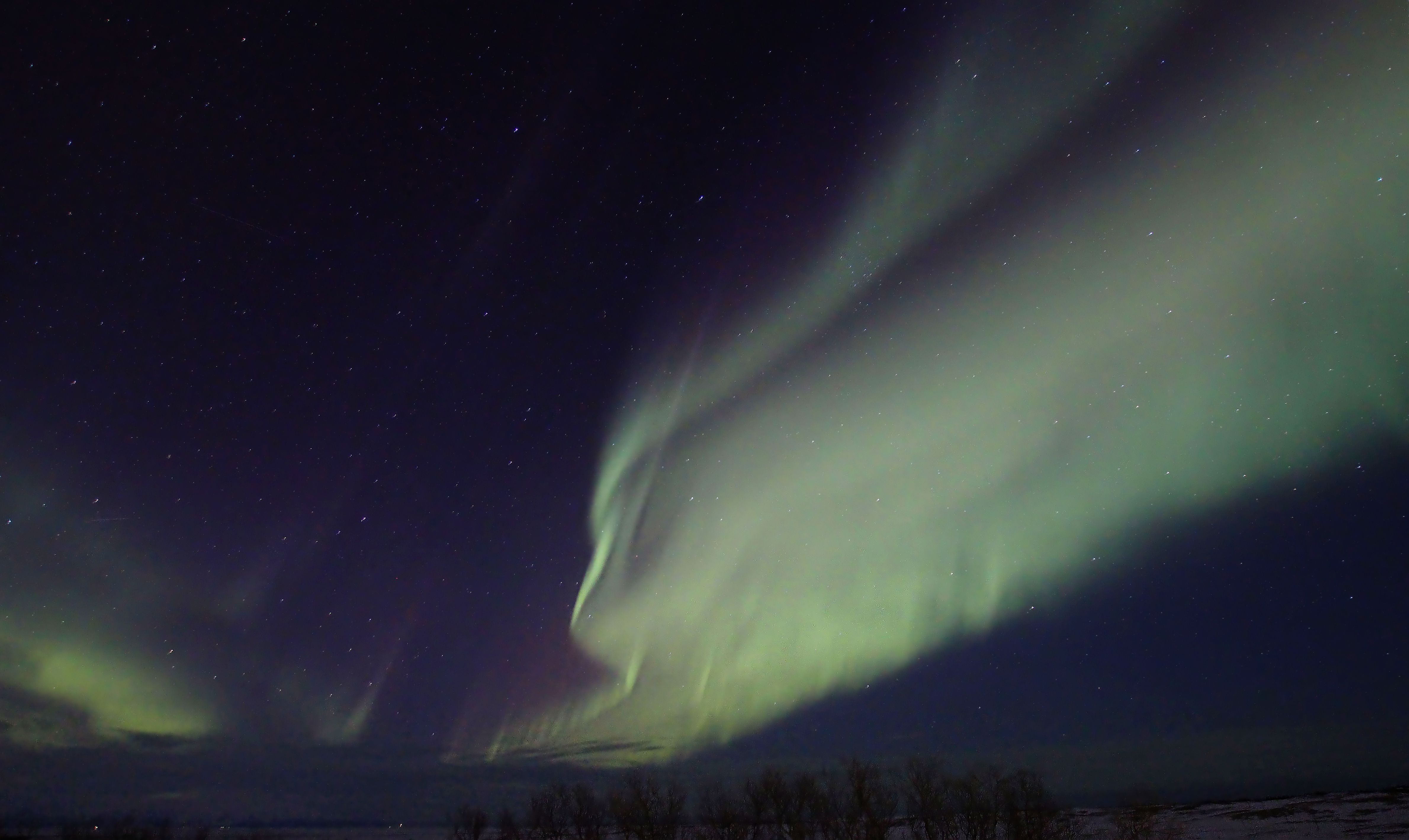
Despite my previous experience, each aurora is different and on this occasion I found using a Canon 700D DSLR mounted on a Gorilla Pod, using a Sigma wide-angle lens set at a focal length of 10mm f3.5 + ISO 3,200 and 10 second exposures generally produced a good image. It seemed that we were on the southern edge of the aurora on the first night at Gerdi (see top of the page), which was therefore weaker but exhibited a striking purple colour (helium). The following night the aurora was much stronger, this time mostly green (oxygen) with red and purple fringing (nitrogen & helium) and generally much more active, resulting in some great views with the naked eye and even better images (see below).











 WATCH THIS SPACE(MAN)