Interstellar Maelstrom: M42

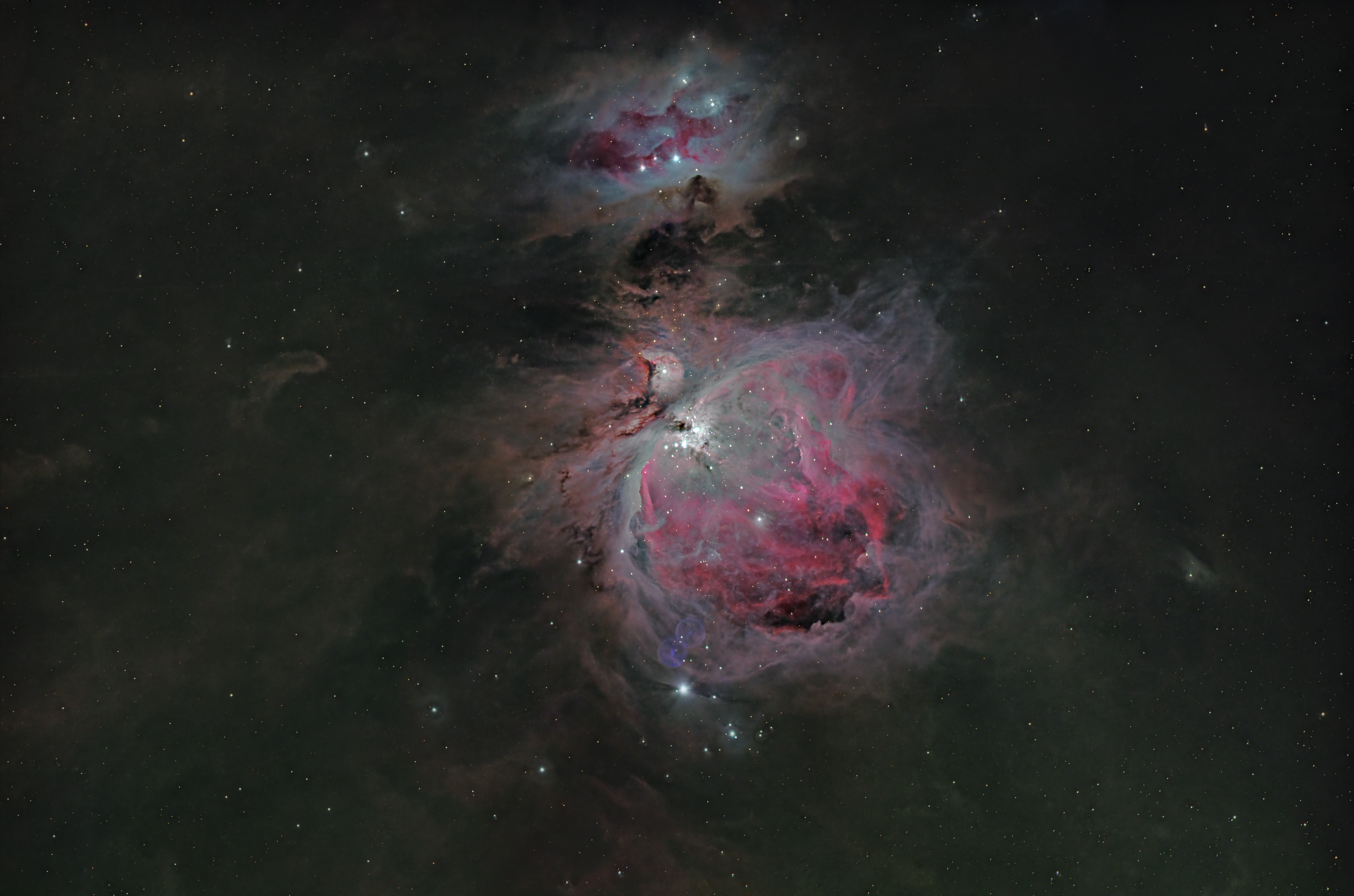
I get a warm feeling at the first view of the Orion constellation each year.  Just viewed with the naked eye, late at night against a clear black sky it is a wonderful sight that somehow seems strangely reassuring but for the astronomer and especially astrophotographers, there are many exciting targets that hold great promise, principal of which is M42 the Great Orion Nebula.  This winter my first view of Orion was last October, rising from the eastern horizon in the early morning, just as I was about to go to bed after a late-night imaging session. Unfortunately, it was more than two months before the weather relented and I was finally able to snatch an albeit brief image of the said Orion Nebula. 

M42 and other nearby diffuse & reflection nebula (M43 & NGC1975 AKA the Running Man Nebula) is one of the most famous star-forming regions, which being the brightest nebula in the northern hemisphere and just over 1,300 light years distance from Earth, can itself also been seen with the naked eye on a clear night.  To my surprise, I hadn’t imaged this beguiling object for 6-years, during which much had changed: a new mount, camera & filters + I had learned a few more processing tricks.
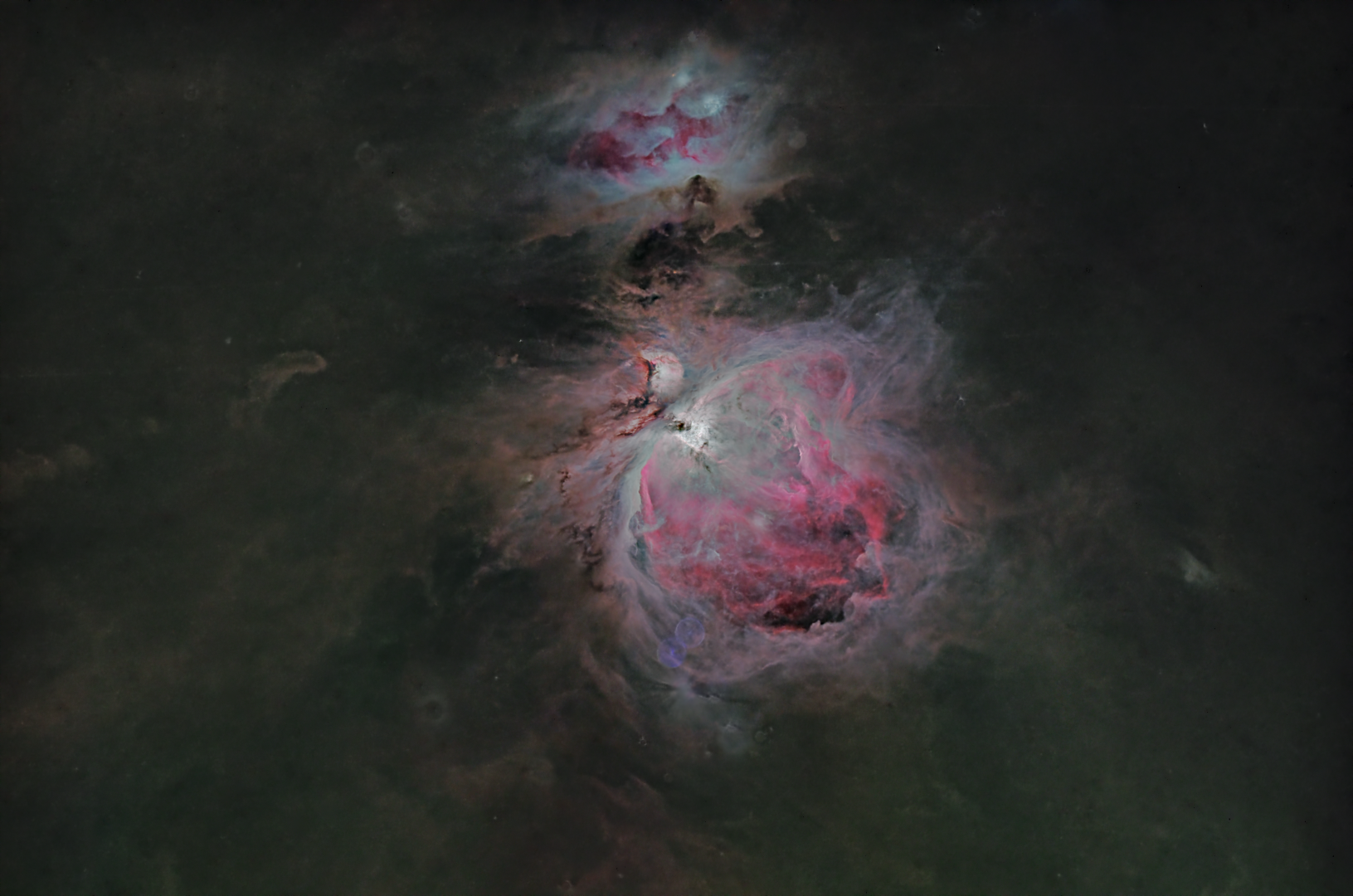
The Orion Nebula is a gigantic cosmic cloud of interstellar dust and gas, which is the basis for the birth of numerous new stars or a “star nursery” (see starless image below) .  Moreover, these powerful, young stars unleash vast streams of ultraviolet radiation that sculpt the nebula into a myriad of fantastic shapes, further highlighted by a red tint that arises due to the presence of hydrogen gas.  For astronomers, such activities reveal much about the processes of how stars and planetary systems are formed from collapsing clouds of gas and dust.
Known as the Trapezium, four stars tightly located at the centre of M42 are very difficult to image, because of the overpowering bright white light that obscures this area from sight.  However, for astrophotographers the elusive nature of the Triangulum is therefore considered to be the ultimate measure of a good Orion Nebula image.  To overcome this problem, the key is to image the nebula across a range of exposures, from very short to long, which can then be compiled into a single final photograph that equally captures details of bright and darker areas alike.

Although poor weather conditions limited the shoot to a relatively short integration time, I’m pleased to say that the subsequent application of various new processing techniques (*see footnote for details) has created an exciting final image, full of detail and colour, as well as the aforesaid Triangulum, that I believe does justice to this magnificent object that is surely the real star of the winter night sky. 

  • Blemish Blaster by Seti Astro – helps remove inevitable blemishes of the starless image created by StarXTerminator process, which I found much easier to use than PixInsight’s Clone Stamp mostly with better results too;
  • Star Stretch also by Seti Astro – Makes the often-tricky action of stretching star images from StarXTerminator a complete doddle;
  • Astro Image Detail by Hidden Light Photography – An excellent script that makes a great job of teasing out detail from the nebula, that results in a really exciting final image.     


2024 The Year In Pictures

Long periods of bad weather made 2024 one of the most difficult years for my astrophotography but, I am pleased to say that this, the 11th calendar is another belter!  Purchased in 2014, I continue to use a William Optics GT81 telescope for most images taken from home, but this means that I’m running out of suitable targets for this equipment.  Part of the answer has been to upgrade related equipment and improve my processing, which I hope you will see reflected in this year’s images.  Moreover, I have used new skills and techniques to process the better-quality data in new ways – I hope you like the results?

Below is a brief summary of the calendar images used this year but for other pictures and more detailed information, please refer elsewhere to this website, my Flickr page or Astrobin page. In addtion, a video of the calendar can be viewed HERE on YouTube, which is best accessed on a PC or smart TV screen. The background music this year is from Jean-Michel Jarre’s Oxygène album.

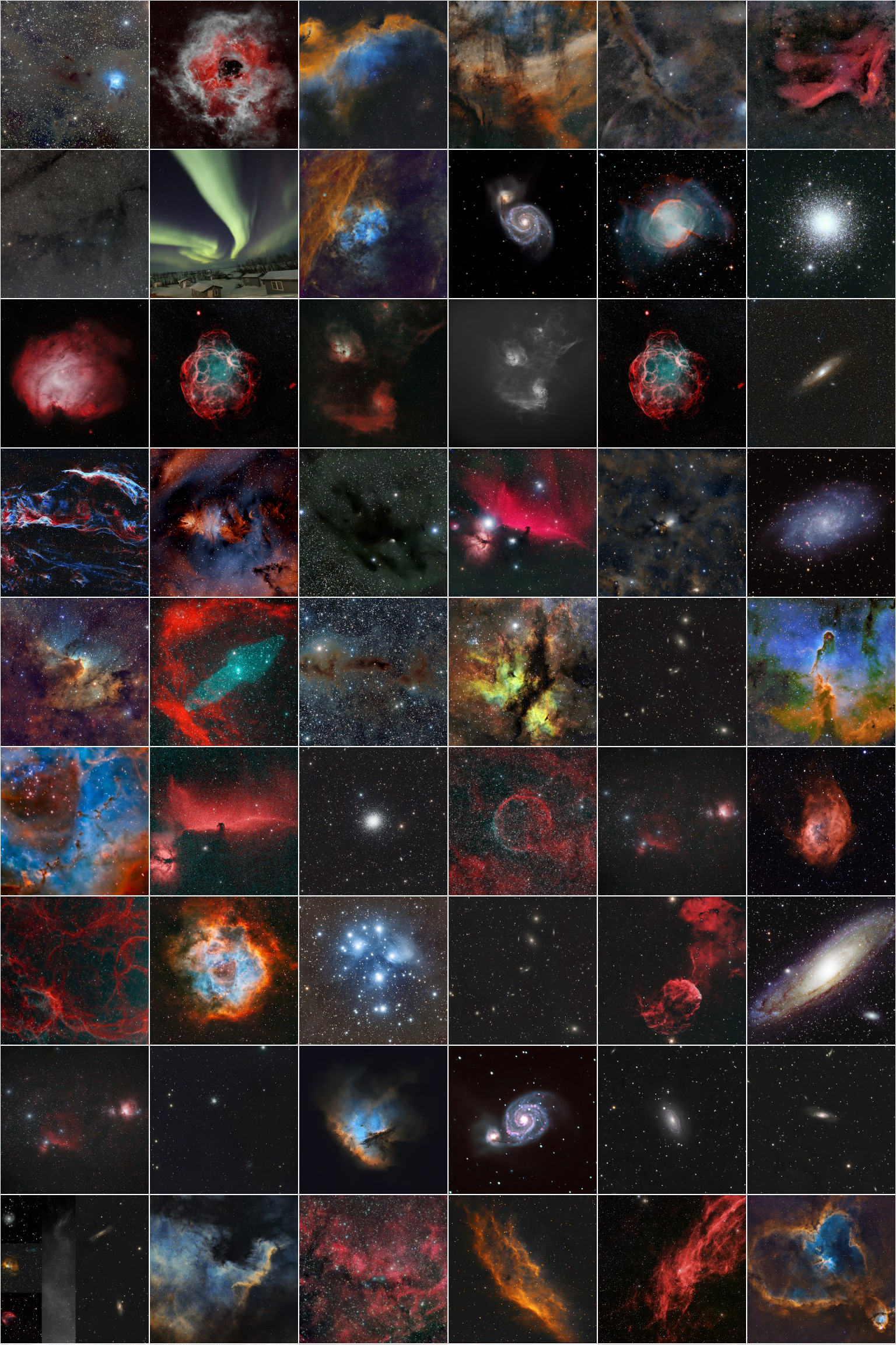
 COVERASTRO IMAGING MONTAGE: This colourful splash is a random selection of images, mostly taken from Redhill over the past +10-years of my astrophotography.
JANUARYSEAGULL NEBULA, IC 2177:  Located 3,650 light-years from Earth is the emission and reflection nebula complex of the so-called Seagull Nebula, some 200 light-years in size.  It’s been 8-years since imaging this object and for good reason.  From my location, the bird flies very low on the southern horizon and thus spends much of its time behind houses, trees, and tall hedges!
FEBRUARYTAURUS MOLECULAR CLOUD:  Located northeast of the Pleiades, below (south) the California Nebula (see November), spanning more than 30o of the night sky is the Taurus Molecular Cloud (TMC), a rich area of dark nebulae punctuated by bright areas of new star formation.  The TMC is thought to be the nearest star forming region to Earth which, if you look carefully, includes numerous complex dark and reflection nebulae and the odd galaxy.
MARCHHIND’S VARIABLE NEBULA & HYADES, NGC 1555*:  Discovered by the English astronomer John Russell Hind in 1852 this nebula is situated 400 light-years away in the constellation of Taurus, between the stars of Aldebaran and the Pleiades.  The nebula is a Herbig-Haro object – a bright patch of nebulosity in which new stars are forming – which often change in apparent size and brightness.
 
APRILLEO GALAXY CLUSTER:  With few exceptions, galaxies are located very far from Earth, making them very small from our perspective and a challenge for my equipment.  However, here I imaged the spectacular Leo Galaxy Cluster, a mere 330 million light-years from Earth. Containing at least 70 major galaxies, the Leo Cluster unusually consists mostly of spiral galaxies.  The bright elliptical galaxy near the centre of the image, has one of the largest known black holes in the universe, which is about 10 billion times more massive than our sun!
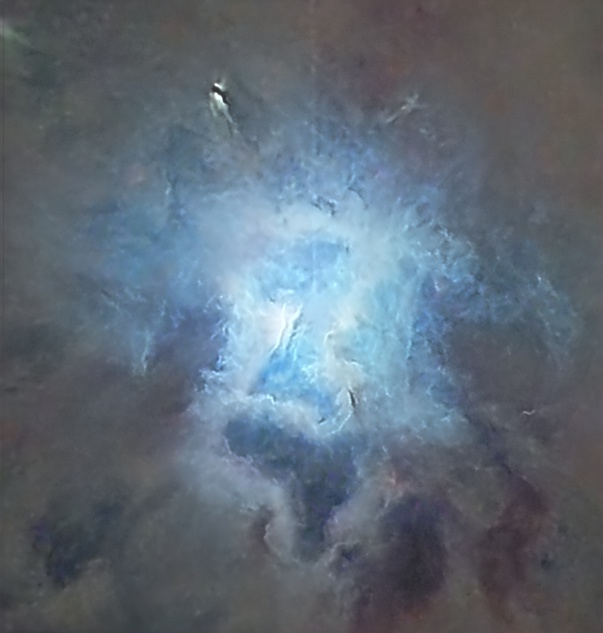
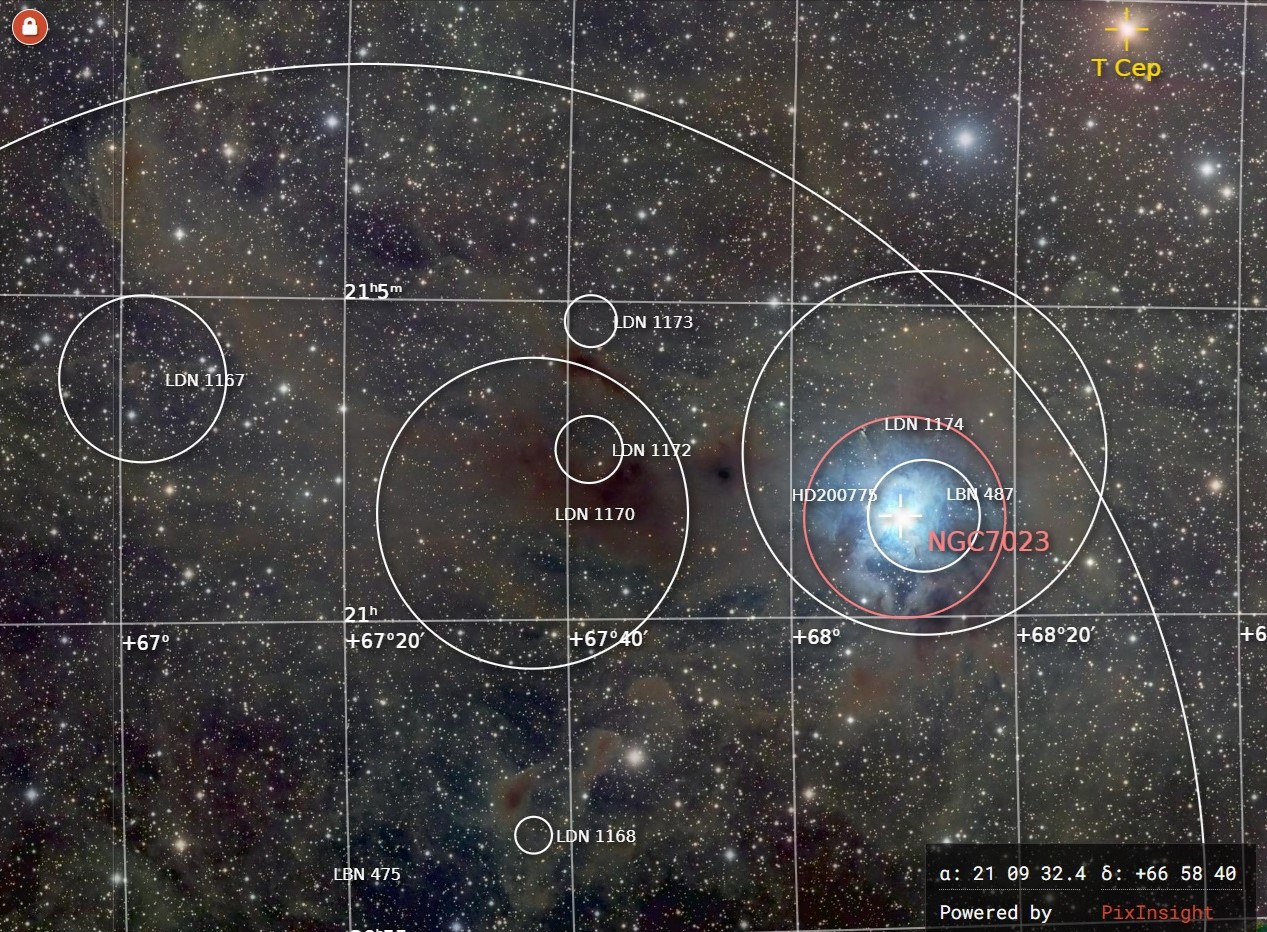
MAY IRIS NEBULA, NGC 7023*:  While the focus of the image is the alluring bright blue reflection nebula, careful processing reveals that this celestial flower is enveloped within a vast region of interstellar dust.
 
JUNESOMBRERO GALAXY, MESSIER 104:  Seen from Redhill, the Sombrero galaxy is even lower in the summer sky than the aforesaid Seagull, transiting between the trees and along the top of our +15-foot hedge!  An unbarred galaxy, its bright bulbous centre is encircled by dark dust lanes, which viewed side-on from Earth creates the appearance of a sombrero hat or perhaps a flying saucer?
JULYPuWe-1*:  Is a very faint planetary nebula in the Lynx constellation, discovered in 1980 by Purgathofer & Weinberger.  It is one of the largest planetary nebulae visible, with a diameter like the full moon and at 1,200 light-years, is one of the closest to Earth.  A planetary nebula is a region of cosmic gas and dust formed from the cast-off outer layers of a dying star; despite the name, planetary nebulae have nothing to do with planets.
AUGUSTNORTH AMERICA & PELICAN NEBULAE: It’s at this time of the year (August) I usually turn my attention to the Cygnus constellation and the plethora of imaging opportunities it provides, which inevitably tend to be narrowband targets. Interstellar dust illuminated by large bright areas of star formation are responsible for the formation of both these popular objects.
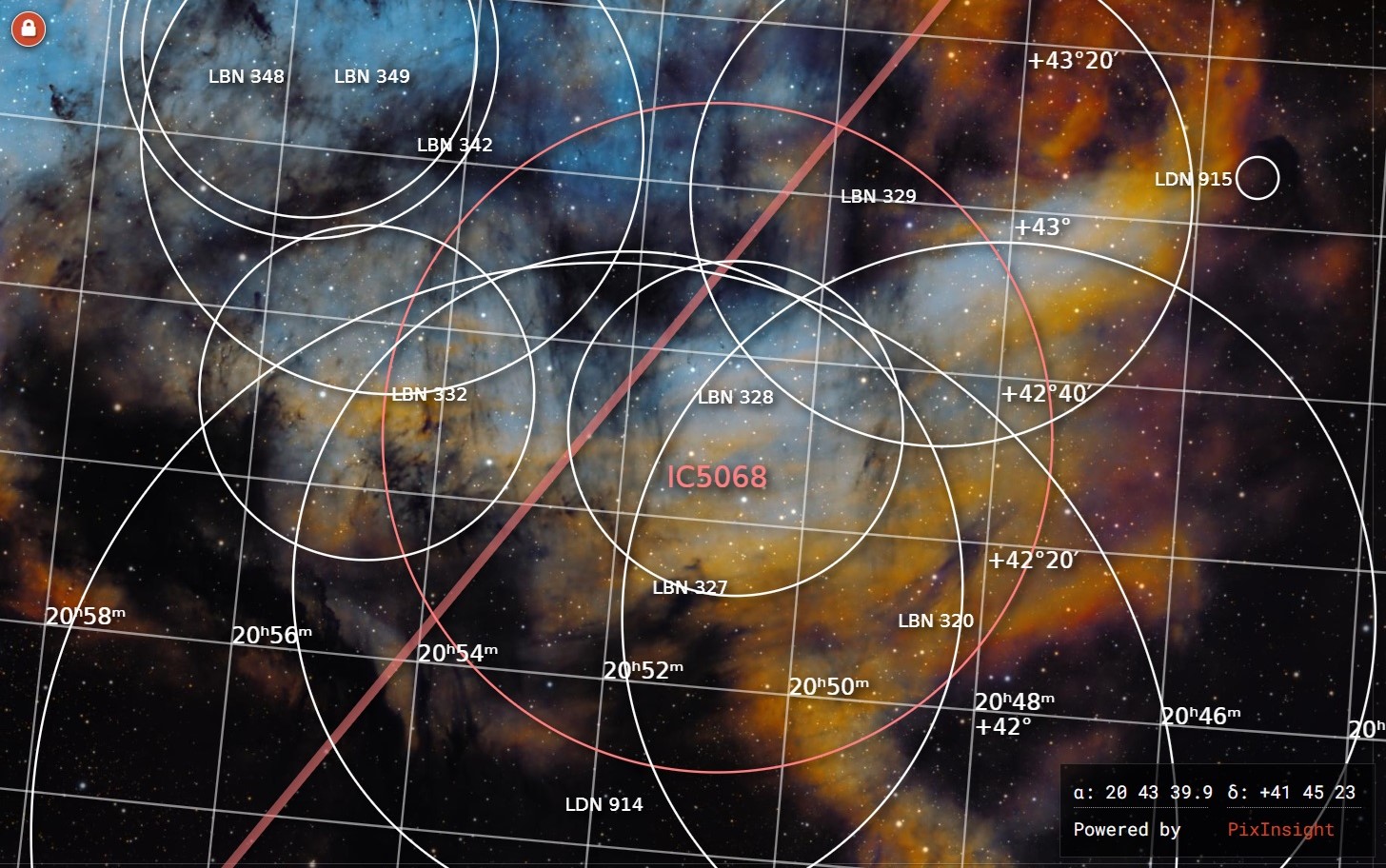
SEPTEMBERFORSAKEN NEBULA, IC 5068:  This complex area is known for the graphically shaped streaks of cold, dark dust clouds that criss-cross the dense, brightly coloured gas regions of nebulosity.  Situated within the adjacent Cygnus molecular cloud just below the Pelican Nebula and close to other more famous objects, this low emission nebula is unfortunately known as the Forsaken Nebula!
OCTOBERTHE CHINESE CHARACTER, LDN 673*:  It might seem paradoxical but often it is the absence of light that makes an image interesting.  About 600 million light-years from Earth, within the Aquila constellation, is Lynd’s Dark Nebula (LDN) 673.  Some 7-light years in size, this fragmented dark molecular cloud complex contrasts against the colourful molecular clouds and stars of the Milky Way, which is reminiscent of a Chinese character.
  
NOVEMBERCALIFORNIA NEBULA, NGC 1499:  Located in the Perseus constellation, in the Orion arm of the Milky Way 1,000 light-years from Earth, NGC 1499 is a large emission nebula about 100 light-years long.  First imaged in 2016, new improved data and processing now discloses the full grandeur of this object.
 
DECEMBERROSETTE NEBULA, NGC 2244: Approximately 5,000 light-years away, the vast cloud of gas and dust had been sculpted into the distinctive rose-like shape, while meanwhile a central star cluster has blown-away a large hollow within the molecular cloud.  Revisiting this old favourite for the fourth time since 2015, here I have experimented with an unusual colour palette combination that has produced an exciting alternative image of the night sky’s rose.
                 Footnote: All images taken from Redhill, Surrey or at a dark sky site in
          New Mexico, USA shown by an asterisk*
HAPPY NEW YEAR + CLEAR SKIES FOR 2025

Heavenly Art

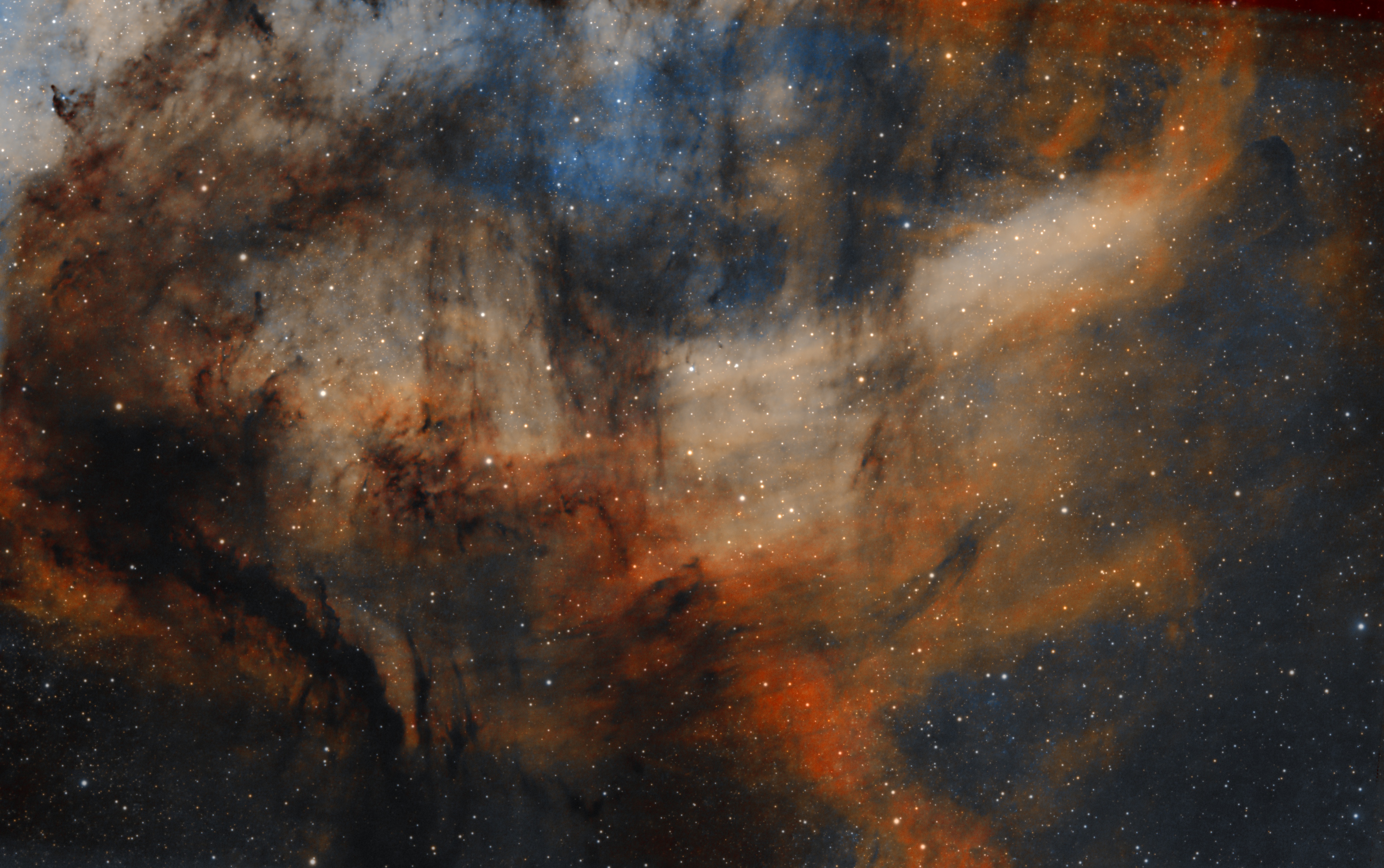
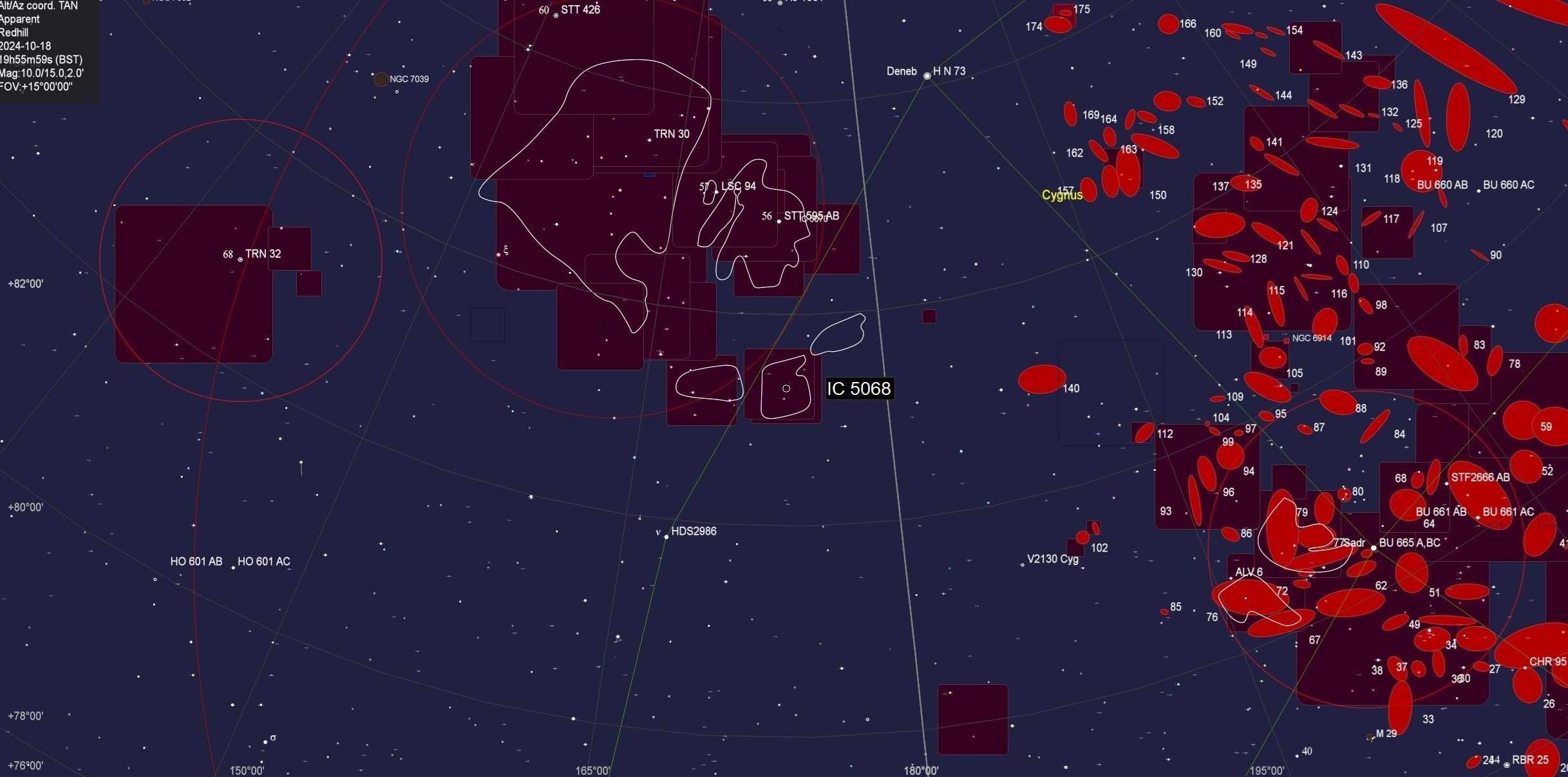
It’s at this time of the year I turn my attention to Cygnus and the plethora of imaging opportunities it provides, which inevitably tend to be narrowband targets. This year it is IC 5068, a low emission nebula often overlooked because of its location near the more popular North American and Pelican nebulae, as well as many other fabulous targets within the adjacent Cygnus molecular cloud, and as a result is unfortunately known as the Forsaken Nebula

Located just below the Pelican Nebula and close to the blue supergiant Deneb star (see above), this complex area is known for the graphically shaped streaks of cold, dark dust clouds that criss-cross the dense, brightly coloured gas regions of nebulosity.

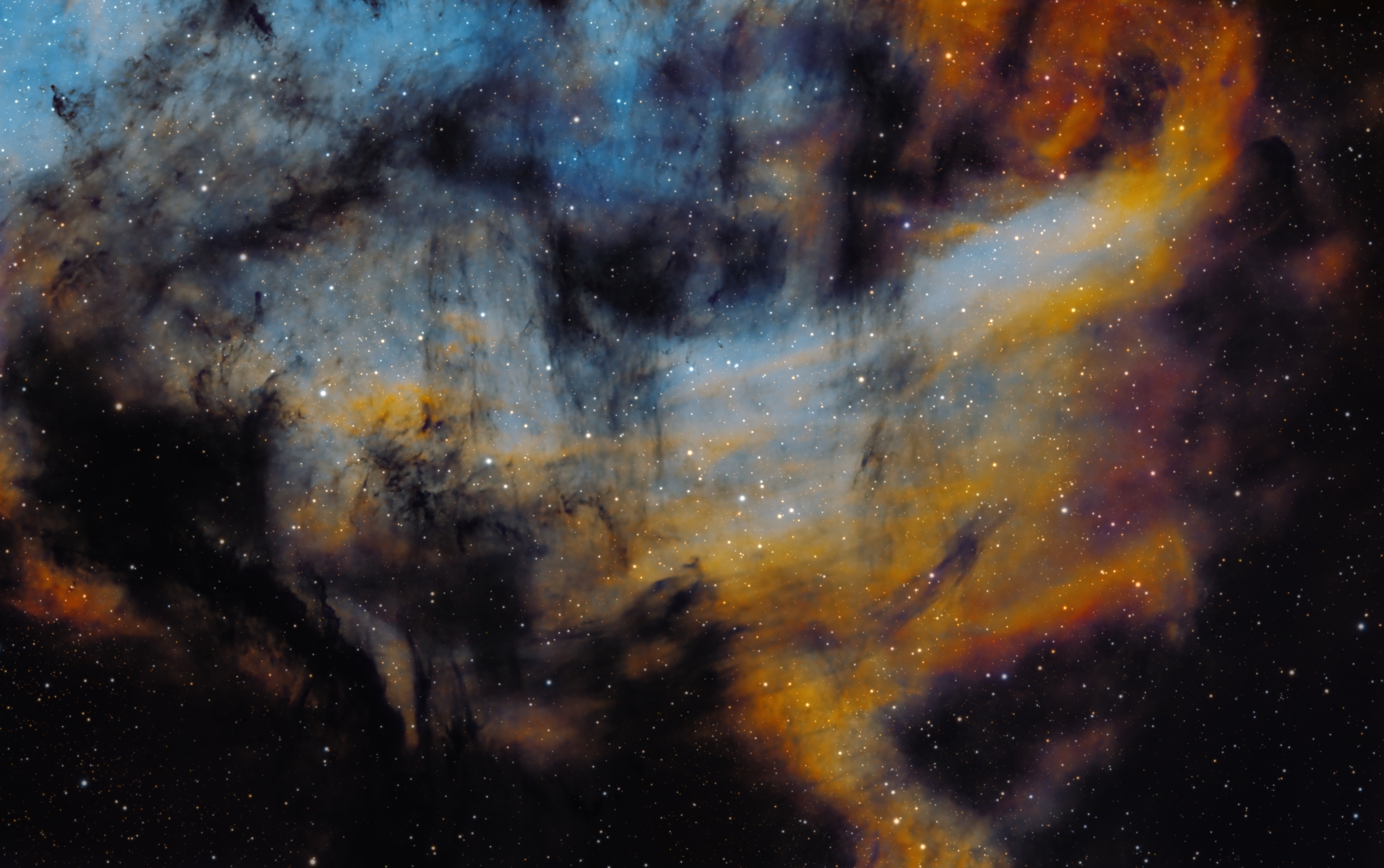
As a narrowband target my initial choice of image processing was the traditional Hubble Palette SHO configuration, which as envisaged, resulted in an exciting and colourful rendition of the busy IC 5068 (see image below).  Notwithstanding, having recently discovered some other, fairly new Pixinsight processing techniques (NB Color Mapper & NB Image Blend), I decided to give them a try to produce an alternative blended HOO–S image.  Though still very much recognisable as IC 5068, the resulting (warm) colours and details reveal a very different and perhaps more dynamic image (see image at the top of the page).

Narrowband images leave much to the imagination when processing and often take on a stirring look when completed.  In the case of IC 5068, each of the images produced seem to have the feel of abstract art, whilst at the same time posing many questions regarding the origin of many unusual features.  I believe this exciting region deserves much greater attention and should belong in the pantheon of popular Cygnus objects such as the North American, Pelican & Veil nebulae.  Moreover, the so-called Foresaken Nebula warrants a name more befitting of its exciting beauty.


Celestial Fleur-De-Lys

Whilst the highlight is the alluring bright blue reflection nebula NGC 7023 AKA Iris Nebula, careful processing reveals that this celestial flower is enveloped within a vast region of interstellar dust, altogether making for a spectacular image.   Strictly speaking NGC 7023 refers to an open cluster within the reflection nebula, which is itself illuminated by a magnitude +7.4 star designated HD 200775 – the cropped starless image shows the beautiful detail that makes up the Iris ‘flower’. 

2023 The Year In Pictures

This Christmas marks the 10th edition of my astrophotography calendar, consisting of my better images from the previous 12-months, which I produce for myself and members of the family.  Wow doesn’t time fly? Based on these images, I also compile a video of the images set to music, which we all watch together before seeing the actual calendar.  It’s become something of an occasion and is a great way to present the images, which look wonderful on today’s smart TV’s and is fun to watch and share with the family.

THE CALENDAR

Much longer imaging times (total of more than 145 hours), re-imaging old favourites in new ways and unusual, overlooked, or difficult objects, resulted in a very good 2023 astrophotography year and perhaps the best calendar yet?  The calendar for 2024 on YouTube can be viewed by clicking HERE and below is a brief overview of each image.  More detailed background information and imaging details for those interested can be found in relevant blogs I posted on this website.  The background music is the track Appleshine from Underworld’s album Drift.

 COVERSH2-284: Close-up of April’s image – along the inside of the ring structure are many dark dust pillars and globules, which on the right seem to resemble a hand with a bony finger pointing inwards!  
JANUARYNGC 1333: Nestled within the western area of the Perseus Molecular Cloud, some 1,100 light-years from Earth is the colourful NGC 1333 reflection nebula, one of the closest and most active star-forming regions of the night-sky.  
FEBRUARY  Spaghetti Nebula: Straddling the boundary of Taurus and Auriga constellations, is the giant supernova remnant (SNR) Simeis-147.  The stellar explosion occurred 40,000 years ago, leaving a rapidly spinning neutron star or pulsar at the core of the now complex and the expanding SNR.  
MARCHAurora Borealis: Situated just below the Arctic Circle, Iceland is well known both for its geology and views of the Aurora Borealis, which we saw in March on the south coast near Kirkjubaejarkklaustur.  
APRILSH2-284: A star-forming region of dust and gases, sculpted by radiation and interstellar winds emanating from a young (3 to 4 million years) star cluster located near the centre.       
MAYM3 Globular Cluster*: Consisting of 500,000 stars and over 11 billion years old, M3 is one of150 globular clusters that orbit around the Milky Way Galaxy.  
JUNEM27 Apple Core Nebula*: A planetary nebula, consisting of a glowing shell of ionized gas ejected from a red giant star in its late stage of life to become a white dwarf. Complex hydrogen (red) and oxygen (blue) fans form around the outer regions, with a pulsar-like beam transecting the nebula.  
JULYMonkey Head Nebula: Located 6,400 light years from Earth in the Orion constellation, the ‘Monkey’ is a so-called emission nebula, where new stars are being created within at a rapid rate.  
AUGUSTSH2-115: This widefield image contains a richness of various emission nebulae, centred around the distinctive large blue SH2-115 region.  Just to the left of SH2-115 is the small but enigmatic SH2-116 a faint, blue disc thought to be a planetary nebula.    
SEPTEMBERLDN-768 Black Cat Nebula: Close to M27 in the constellation of Vulpecula (“Little Fox”), is a dense region of stars broken-up by dark nebulae to create intriguing shapes. Here strung out from left-to-right, several of the dark nebulae seem to coalesce (visually) to create the form of a black cat.
OCTOBERSH2-126 Great Lacerta Nebula: On the western edge of the Milky Way in the southern part of Lacerta, is the very large but faint emission nebula SH2-126.  The red filament structures stretch over 3 degrees, to the right is the Gecko Nebula, a molecular cloud associated with bright young stars.
NOVEMBERFlaming Star & Tadpoles Nebula: Two emission nebulae: dust & gas of the Flaming Star (below) combined with red ionized hydrogen gas produces a flame affect. Above, the stellar winds and radiation pressure from hot massive stars creates the Tadpoles ‘wriggling’ away from the centre.
DECEMBERM51 Whirlpool Galaxy*: As the smaller galaxy passes behind M51, joint gravitational forces are interacting, resulting in the misalignment of stars and unusually bright blue and pink areas across the Whirlpool galaxy. Their fates are inextricably linked and might eventually merge.
                 Footnote: All images taken from Redhill, Surrey or telescope at a dark sky site in
          New Mexico, USA shown by an asterisk*
HAPPY NEW YEAR + CLEAR SKIES FOR 2024

Core Blimey

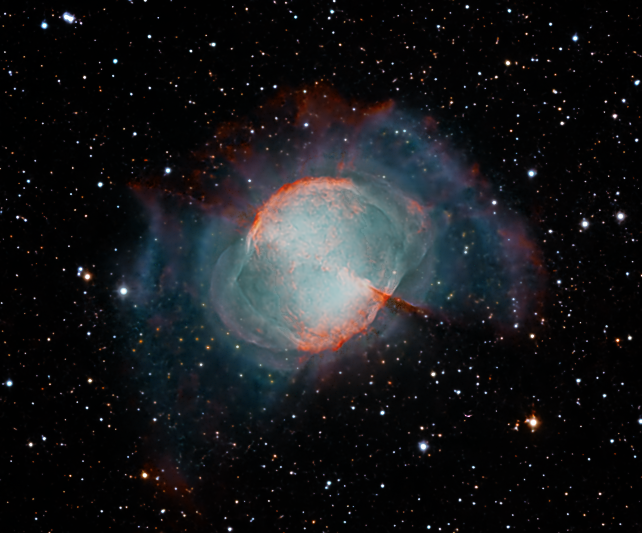
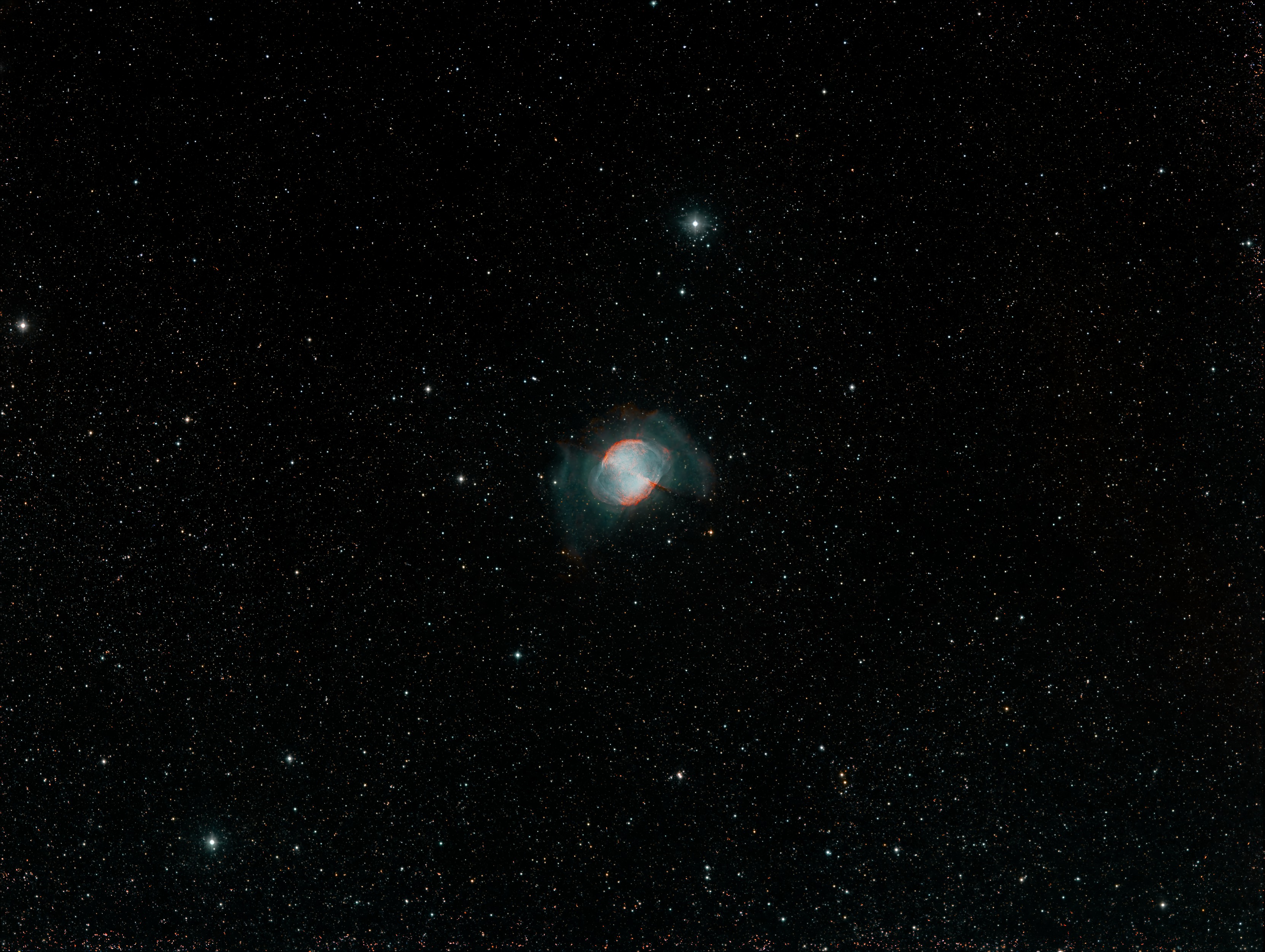
A popular object at this time of the year, the planetary nebula M27 consists of a glowing shell of ionized gas, which has been ejected from a red giant star in its late stage of its life to become a white dwarf.  Like many planetary nebulae, the main inner shell exhibits numerous dark and light knots, of which red ionized hydrogen areas form two bright lobes that together make the shape of an apple- core / dumbbell, which are M27’s two nicknames. There also seems to be different bi-polar influences occuring, that have resulted in complex Ha (red) and OIII (blue) fans around the outer regions and a pulsar-like beam transecting the nebula (see cropped version at the top of the page). 

Despite the good data quality and long integration time, the complicated nature of the planetary nebula made processing very difficult, in particular, teasing out the aforesaid but very faint outer fans.  In this case it was necessary to carry out individual soft stretches of the Ha and OIII stacks before combining them into an HOO image, from which a starless colour image was created and then processed further to bring out the fans.  Thereafter, Pixelmath was used to amalgamate this image with two other starless HOO and RGB versions that emphasized the main part of the nebula, before finally adding back RGB stars and finishing off. 

After considerable experimentation to obtain this result, I’m happy with the final image, which I hope shows off the said apple core / dumbbell and its outer fans to good effect (see above).


 IMAGING DETAILS
ObjectM27 AKA Dumbbell or Apple Core Nebula or NGC 6853
ConstellationVulpecula
Distance1,360 light-years
Size 8.0 x 5.7 arc-minutes (core) 15 arc-minutes (total) or 5 light-years (actual)
Apparent Magnitude+7.5
  
Scope Takahashi FSQ 106  FL 530mm  f/5  +  Moonlight Nightcrawler focuser  
MountParamount MyT
GuidingYes
CameraQSI 683-WSG8    KAF-8300 full frame CCD sensor   5.4nm pixels  
 FOV 1.94o x 1.46o   Resolution 2.1”/pix.   Image array 3326 x 2,507 pix   
ProcessingDeep Sky Stacker,  PixInsight v1.8.9-1
Image Location              & OrientationCentre – RA 19:59:35.363      DEC +22:42:54.383                    Up = North  Left = East
ExposuresHa x28 & OIII x 35 x20min + R x12, G x22, B x14 x10min @ -20C Total Integration Time: 29hrs      
Calibration24 x 20min & 30 x 10 min Darks   x60 Bias & x20 Ha, OIII & RGB Flats  
Location & DarknessDeep Sky West – amateur hosting facility near Rowe, New Mexico  – USA    SQM Typically >= 21.7
DateQ2 2019    

The Flame & Frogs

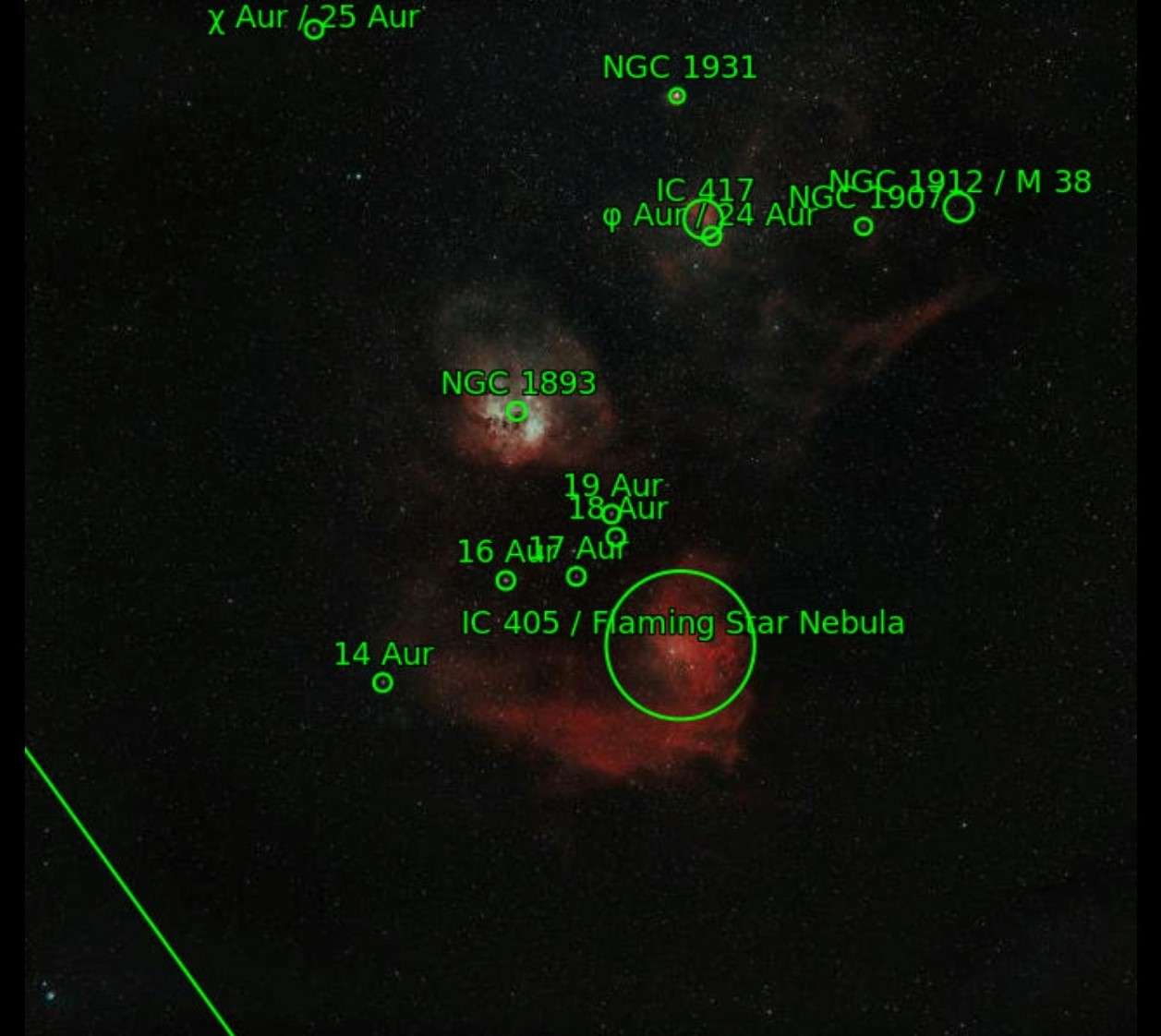
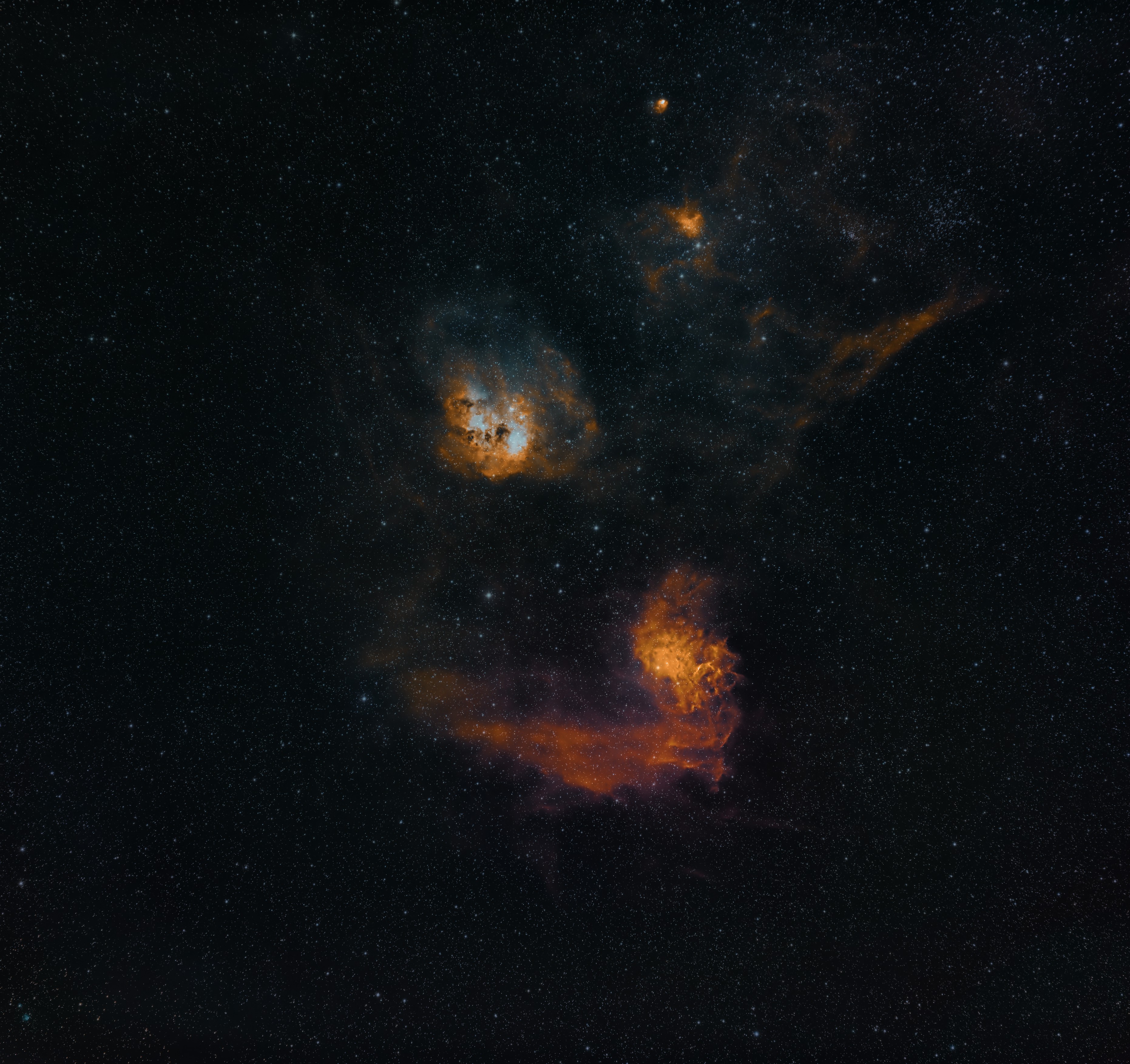
There’s a lot going on in and around the Auriga constellation and this winter I’ve been mainly imaging in this region, almost exclusively using the Samyang 135 widefield rig.  Here with the whopping 7.50o x 5.67o field-of-view this set-up provides, it easily incorporates both emission nebulae IC405, AKA the Flaming Star Nebula and it’s nearby (visually) neighbour IC410, the Tadpoles Nebula, as well as much more.

  • Hydrogen gas ionized by the central AE Auriga star produces the dominant strong red colour, which combined with the rippling dust and gas lanes that run through the head of IC405 leads to a ‘flame affect’ and thus the nebula’s popular nickname.
  • The structures in IC410 are illuminated by radiation from the open star cluster NGC1893, located at the centre of the nebula.  Hot, massive, young stars abound, especially around Simeis 129 & 130, the two tadpoles.  These structures are ‘wriggling away’ from the centre of the nebula, because of the prevailing stellar winds and radiation pressure from the stars in NGC 1893.

This image is the cornerstone of a series of covering a wider area completed during January, which I intend to first present individually before, hopefully, bringing them together as an HOO mosaic later.

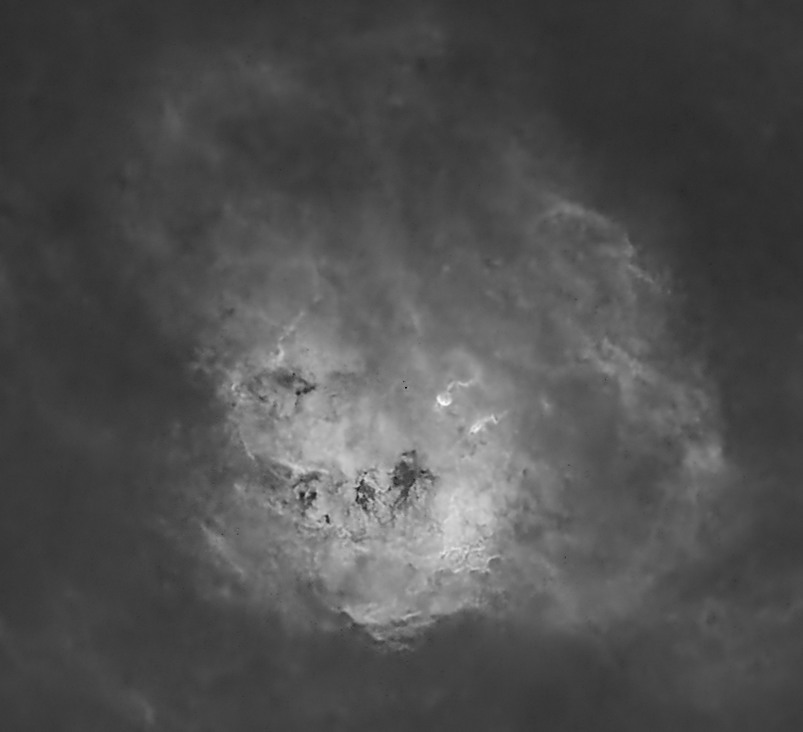
This image has been processed as two SHO versions of the Hubble Palette: (i) a basic mix above and (ii) using a dynamic mix ( main cropped image at top-of-the page).  Once more I have been impressed by the ability of this small camera lens to produce exceptional detail and colours, but especially here with the starless Ha version of IC410, where the signature features or so-called tadpoles have been captured to great effect (see cropped starless Ha version of IC410 below).

 IMAGING DETAILS
ObjectIC 405 The Flaming Star Nebula + IC 410 The Tadpoles Nebula
ConstellationAuriga
Distance1,500 & 12,000 light-years
Size  Approx. 37’ x 10’ & 40’ x 30’
Apparent Magnitude+6.0 & +10
  
Scope  / LensSamyang 135 @f2.8  
MountSW AZ-EQ6 GT + EQASCOM computer control & Cartes du Ciel  
GuidingSky-Watcher EvoGuide 50ED
 + Starlight Xpress Lodestar X2 camera & PHD2 guiding
CameraZWO1600MM-Cool mono  CMOS sensor
 FOV 7.5o x 5.67o Resolution 5.81”/pix  Max. Image Size 4,656 x 3,520 pix   
EFWZWOx8 EFW & 31mm ZWO LRGB & 7nm Narrowband filters  
Capture & ProcessingAstro Photography Tool + PHD2 + PixInsight v1.8.9-1  
Image Location              & OrientationCentre: RA 05:19:54.329      DEC +33:47:12.699                         Right = North   Top = East 
Exposures24 x 300 sec Ha & OIII, 18 x 300 sec SII Total Integration Time: 5 hr 30 min     
 @ 139 Gain   21 Offset @ -15oC    
Calibration10 x 300 sec Darks 20 x Flats & Flat Darks  
Location & DarknessFairvale Observatory – Redhill – Surrey – UK        Typically Bortle 5 – 6  
Date & Time2nd & 9th January 2023 @ +18.30h   
WeatherApprox. <=2oC   RH >=80%                  🌙 +80%  

Diaphanous Delectation

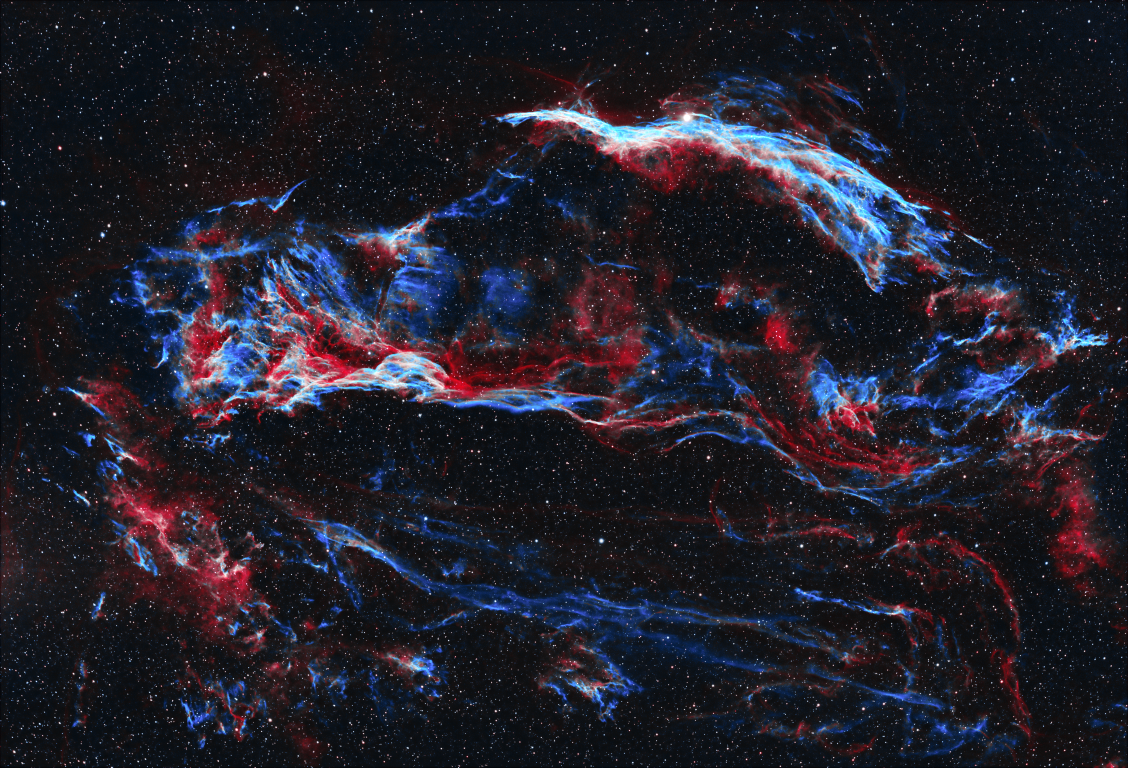
Following my routine summer break from astrophotography, I restarted in early August first using my new Samyang 135 + ZWO ASI1600MM-Cool rig, which immediately demonstrated its ability to produce excellent widefield images of very large objects, in this case the Cygnus Loop.  However, also in late spring I had rejigged my William Optics GT81 telescope with the addition of a new ASI294MM camera, the successor to the ASI1600 which had been redeployed to the aforesaid Samyang rig.  Having constructed, tested and briefly obtained First Light with this new combination, I then had to wait for the return of astronomical darkness and more suitable objects.  Once again, I turned to the Cygnus Loop but this time concentrating on the western and central areas, generally known as the Western Veil and Pickering’s Triangle.

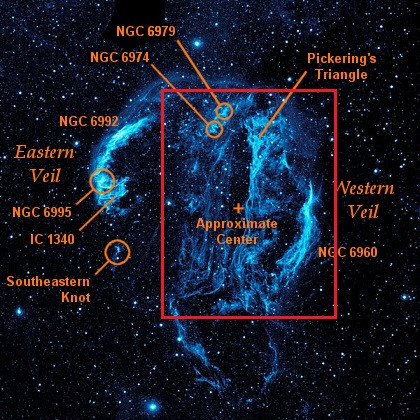
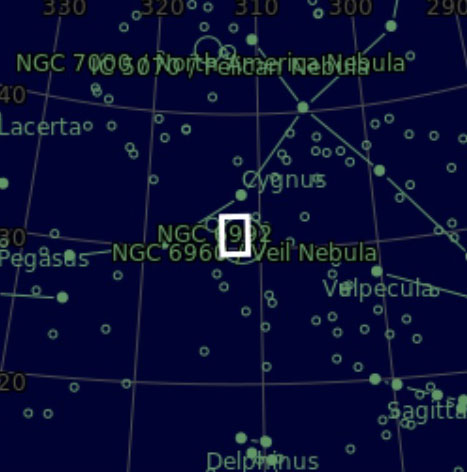
Cygnus Loop Morphology, ID &
Approximate Image Location (Red Box)

Located 1,500 light-years from Earth within the plane of the Milky Way in the constellation of Cygnus, this large supernova remnant (SNR) occurred between 5,000 and 8,000 years ago.  In its entirety the debris cloud has been sculpted by the shock wave from the star’s explosion, to form the Cygnus Loop object that we see today.  The coloured light is created by the excitement of hydrogen (red) and oxygen(blue) gasses of the SNR, which is still expanding at about 100 km (60 miles) per second; image integration times for OIII & Ha wavelengths are in the ratio of 2:1 to enhance the weaker oxygen signal.  More than twice the width of the full moon and spanning 35 light-years, this section of SNR only just fits into my field-of-view but with careful framing it works perfectly.

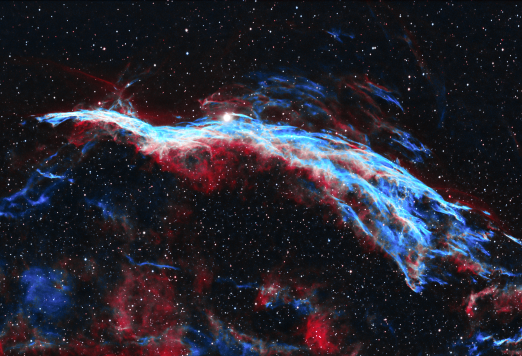
Western Veil (NGC 6960) Detail
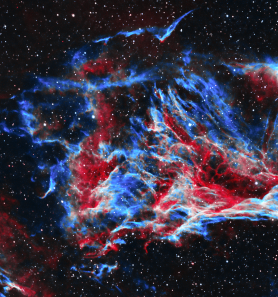
Pickering’s Triangle Detail

The resulting image successfully brings out the exquisite nature of this exciting SNR, in particular highlighting the abundant waveforms that run throughout the entirety of this dynamic object.  Furthermore, the combination of the new ASI294MM camera and 3nm Chroma filters, has produced a vibrant red-blue colour palette that further enhances the said structures.  Altogether this diaphanous delectation convincingly demonstrates the power and beauty of the Universe whilst, moreover, pointing to a new level for my astrophotography.          

Image Location & Orientation
 IMAGING DETAILS
ObjectCygnus Loop Section: Western Veil Nebula (NGC 6960),  
Pickering’s Triangle, NGC 6979 & 6974
ConstellationCygnus
Distance1,500 light-years
Size  ~2.9o total
Apparent Magnitude+7.0  
  
Scope William Optics GT81 + Focal Reducer FL 382mm  f4.72
MountSW AZ-EQ6 GT + EQASCOM computer control & Cartes du Ciel
GuidingWilliam Optics 50mm guide scope
 + Starlight Xpress Lodestar X2 camera & PHD2 guiding
CameraZWO ASI294MM  CMOS sensor
 FOV 2.87o x 1.96o Resolution 2.50”/pix 
Max. image size 4,144 x 2,822 pix   
EFWZWOx8 EFW & 31mm Chroma LRGB filters 
Capture & ProcessingAstro Photography Tool + PHD2 + Deep Sky Stacker,
PixInsight v1.8.8-12, Photoshop CC v23.5.0
Image Location &      OrientationCentre = RA 20:48:47.0      DEC +31:00:54.7                         Left = North     
ExposuresHa 41 x 300 sec (3hr 25m), OIII 82 x 300 sec (6hr 50m) Total Integration Time: 10hr 15 min     
 @ 120 Gain   30 Offset @ -15oC    
Calibration5 x 300 sec Darks  15 x  LRGB Flats & Dark Flats         @ ADU 32,000
Location & DarknessFairvale Observatory – Redhill – Surrey – UK        Typically Bortle 5-6
Date & Time27th + 29th + 30th + 31st August 2022  @ +21.00h  
WeatherApprox. <18oC   RH >=65%                  🌙 0% New

Hidden Treasures

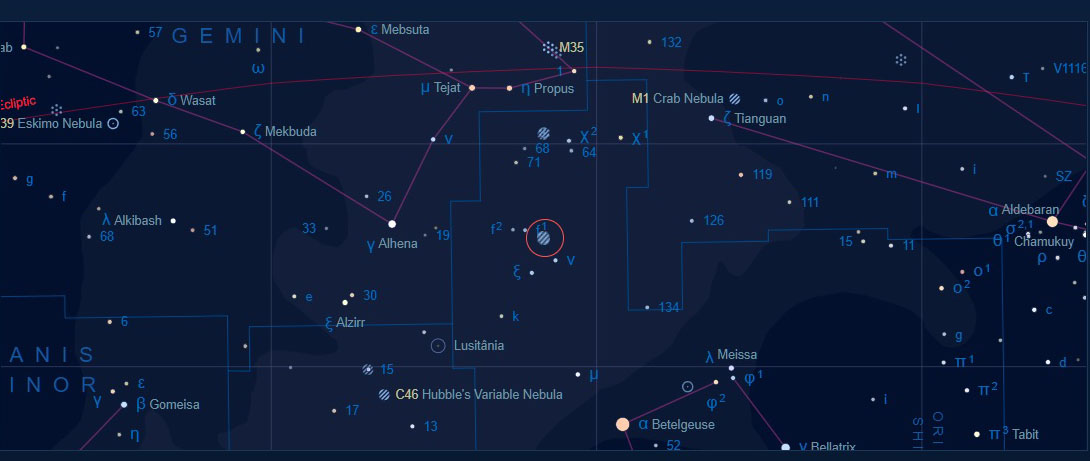
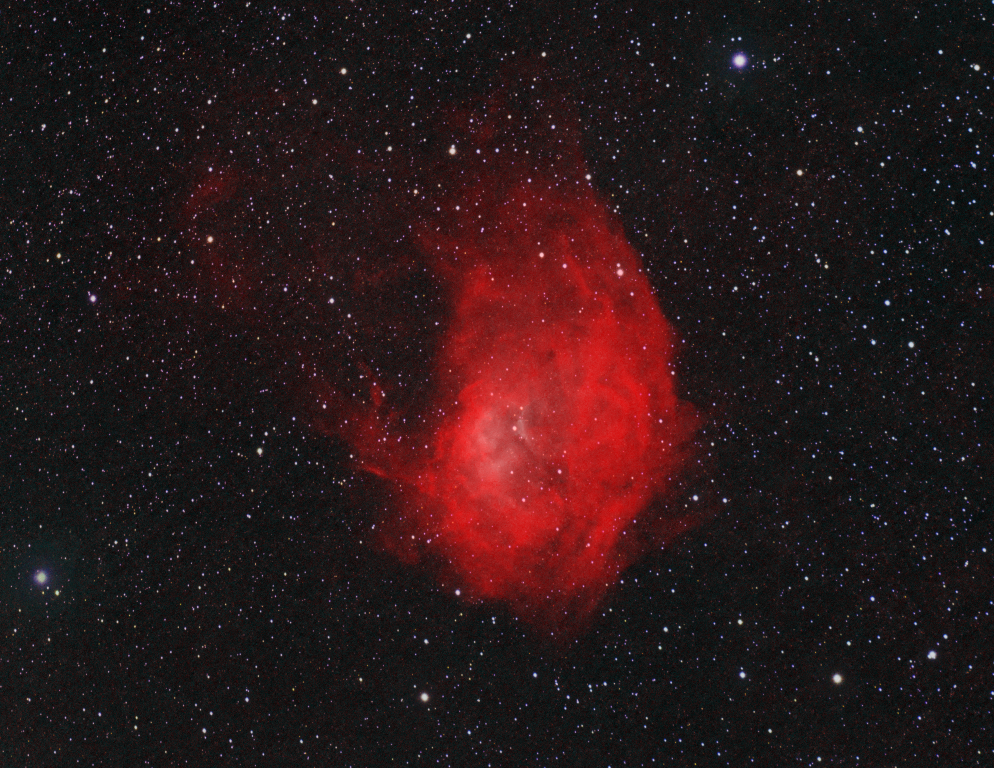
Discovered by Harold Lower and his son Charles in 1939, SH2-261 or Lower’s Nebula is located in the outer regions of the Orion constellation, which is visually between Betelgeuse and Propus in Gemini, on the border of the galactic region between the Orion and Perseus arms of the Milky Way.  Mainly consisting of ionized hydrogen, it’s surprising that this interesting, quite large but faint object does not get more attention from astrophotographers, who are perhaps too busy collecting photons from the more famous objects of Orion elsewhere?  

Lower’s Nebula Location (from eSky)

Unusually clear skies were plentiful here at Fairvale Observatory during January, which allowed for some 17-hours integration time, albeit mostly accompanied by a waxing to full moon.  The data lends itself to various processing approaches and I played around for a long while with different combinations, in the end favouring an SHO + HOO blend as the main image (see top of the page) and am pleased with the very interesting result; for comparison other bassic versions (HOO & Ha) are shown below.

The aforesaid HII ionized gas is thought to be energised by the runaway bright star HD41997 situated at the centre, adjacent to a mysterious small bluish triangular object and a much fainter blue bubble, seen better elsewhere in higher resolution images.  Moreover, catalogued and encompassed within SH2-261 are LBN 862 and LBN 864 and several dark nebulae, which would also require greater magnification (focal length and aperture) to achieve finer detail.

Like most astronomers I’m routinely drawn towards Orion’s famous and rightly popular objects such as M42 the Great Orion Nebula, the Flame Nebula and B33 the Horsehead Nebula, M78 reflection nebula, Barnard’s Loop and other jewels found in and around the central region of the Orion constellation.  However, taking a wider perspective, literally and figuratively, the area contains other riches that are too easy to overlook and form good alternative imaging targets at this time of the year – time taken to identify such hidden treasures can be rewarding – in this case thanks to the Lower’s family. 

 IMAGING DETAILS
ObjectSH2-261 Lower’s Nebula
ConstellationOrion
Distance3,200 light-years approx..
Size Apparent 50 x 30 arc minutes ~ 25 x 13 light years
Apparent Magnitud+10  
  
Scope William Optics GT81 + Focal Reducer FL 382mm  f4.72
MountSW AZ-EQ6 GT + EQASCOM computer control & Cartes du Ciel
GuidingWilliam Optics 50mm guide scope
 + Starlight Xpress Lodestar X2 camera & PHD2 guiding
CameraZWO1600MM-Cool mono  CMOS sensor
 FOV 2.65o x 2.0o Resolution 2.05”/pix  Max. image size 4,656 x 3,520 pix   
EFWZWO x8 EFW & 31mm Ha OIII SII 3nm filters 
Capture & ProcessingAstro Photography Tool, PHD2, Deep Sky Stacker, PixInsight v1.8.8-12, Photoshop CC v23.2.1, Topaz Denoise
Image Location  &            OrientationCentre  RA 06:09:25.245      DEC +15:45:10.754                     Right = North     
ExposuresHa x44   OIII x33   SII x28   @ 600 secs Total Integration Time: 17hrs     
 @ 139 Gain   21  Offset @ -20oC    
Calibration5 x 600 sec Darks   15 x Ha, OIII,  SII Flats & Flat Darks      @ ADU 25,000
Location & DarknessFairvale Observatory – Redhill – Surrey – UK        Typically Bortle 5-6
Date & Time12th 13th 14th 17th & 20th January 2022  @ +18.30h  
WeatherApprox. 2oC   RH >75%                  🌙 waxing 50% to Full Moon

2021 The Year In Pictures

Every year since 2014 I’ve published a retrospective blog of my astrophotgraphy year just ending called Reflections. It’s been a useful task that enables me to bring together the best and sometimes the worst of my images, in order to consider the good and bad points + progress made + set some objectives for the coming year. Eight years on, after which I believe I’ve now reached at least a respectable level of imaging and processing, I’ve decided to stop this format for the time being.

Notwithstanding, at this time of the year I also produce an astrophotography calendar for members of my family, which consists of the better images from the year just ending; I think they like them and certainly all use the calendar during the coming year. Moreover, I also recently started to compile a video of the said calendar images set to appropriate music, which we all watch together prior to seeing the actual calendar. It’s a great way to present the images, which look really stunning on today’s large Smart TV’s and is fun to watch with the family too.

The video for this last year 2021 can be viewed on YouTube HERE and below is a brief very general overview of each image. More detailed background information and imaging details for those interested can be found in relevant blogs posted on this site during the past year.

2022 CALENDAR

A new set of filters, improved processing techniques and access to data from a telescope at a dark sky site in New Mexico, USA (shown by an asterisk *) contributed to an exciting astrophotography year in 2021.                  

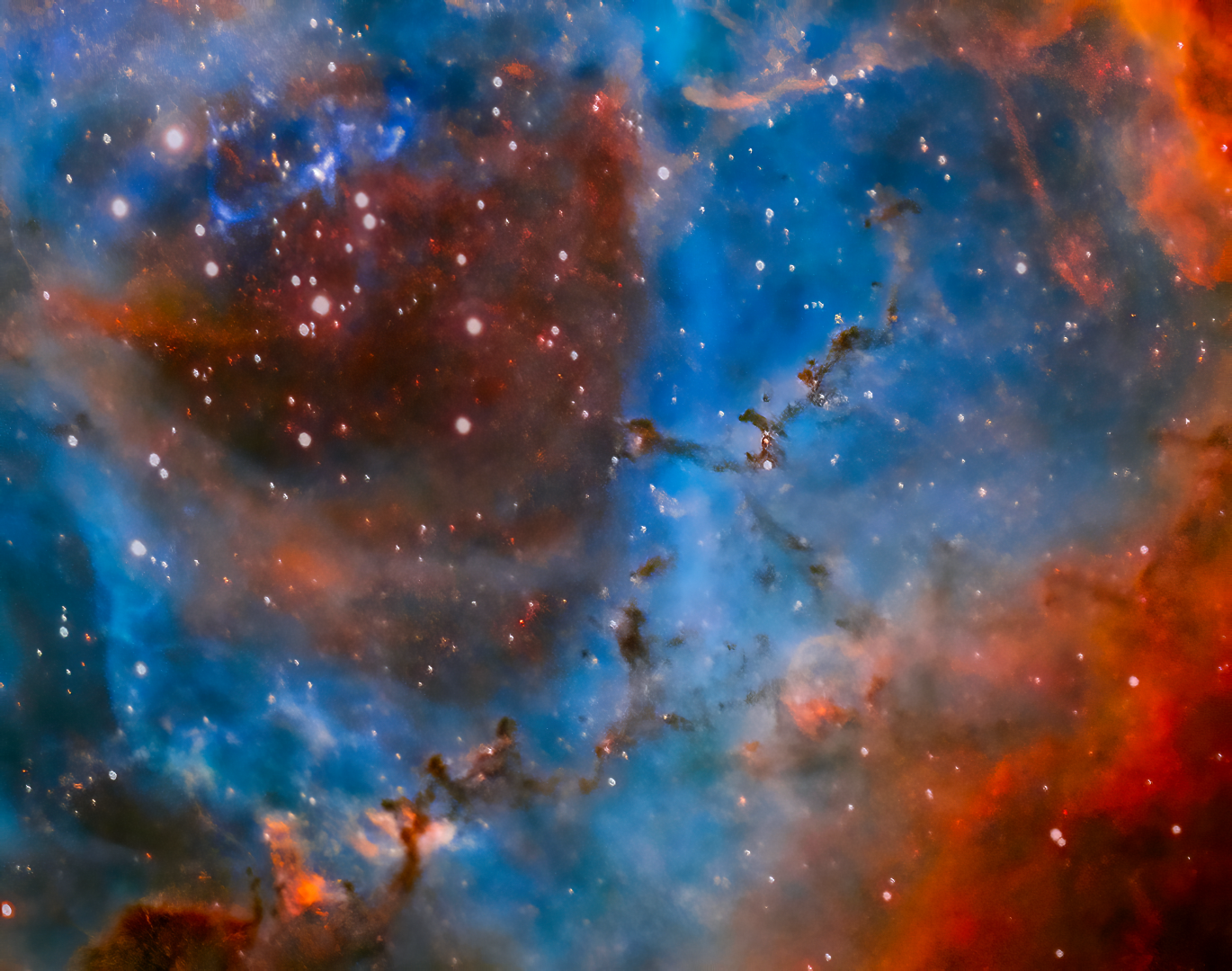
FRONT COVERThe Carnival of Animals: Special processing of the inner region of the Rosette Nebula highlights the ‘animals’ or Bok Globules – clouds of dust undergoing gravitational collapse as part of the process of new star formation.  
JANUARYLDN-1250 Dark Nebula*: Dark or absorption nebulae are a type of interstellar cloud which are so dense they obscure or absorb visible light emitted from objects behind or within and thereby contrast with the general light flux of the Universe as dark areas.  
FEBRUARYCTB-1 Supernova Remnant*: The overall structure of this supernova remnant is that of a circular shell, with a conspicuous rupture towards the north (lower right of image).  The main red Ha-shell is composed of multiple interlocking filament limbs, with a blue / green OIII arc along one side.  
MARCHJellyfish Nebula: Locatedin the Gemini constellation some 5,000 light years from Earth, this is a remnant of a supernova that took place during the past 30,000 years. With a diameter of 70 light-years, the object is visually speaking nearly twice the size of a full moon.     
APRILMarkarian’s Chain: The Virgo cluster consists of more than 2,000 galaxies, within which Markarian’s Chain forms a J-curve string of bright galaxies that share a common motion through space.    
MAYM13 Great Globular Cluster of Hercules*: Consisting of several hundred thousand stars and 145 light-years in diameter, M13 is considered to be the finest cluster in the Northern Hemisphere.  
JUNECave Nebula*: Located along the plane of the Milky Way is the diffuse emission nebula referred to as the Cave Nebula.  The Cave at the centre is critically located at the boundary of the Cepheus molecular cloud and the hot, young stars which ionize the surrounding gases to great effect.  
JULYOrion Widefield: Framed around the area of Orion’s Belt, the Horsehead Nebula and the Great Orion Nebula, look hard and the refection nebula M78 can also be seen in the lower left corner.    
AUGUSTElephant’s Trunk Nebula*: A very large emission nebula, the so-called Elephant’s Trunk Nebula is rightly viewed as one of astrophotography’s most iconic images. The ‘trunk’ itself dominates the centre of this image and is illuminated from behind by a bright star forming region.  
SEPTEMBERM31 Andromeda Galaxy: The full benefit of new filters, improved guiding, clear skies over 6-nights and extensive use of new processing techniques can be seen in my best image yet of Andromeda.      
OCTOBERButterfly Nebula: Situatedwithin the Orion Arm of the Milky Way is the Gamma Cygni nebula, a diffuse emission nebula surrounding the star Sadr.  Either side of the dark rift which divides the image from top to bottom are two large bright areas that together form the so-called Butterfly.  
NOVEMBERM33 Triangulum Galaxy: Like it’s neighbour Andromeda, better data and processing has produced an exciting new image of M33 this year, the red areas highlight Ha-rich star-forming regions  
DECEMBERFlying Bat & Giant Squid Nebula*: This very faint OIII emission nebula Ou4 required an imaging time of 40-hours.  For obvious reasons Ou4 has become known as the Giant Squid Nebula which, moreover, lies within the much larger SH2-129 HII emission region or the Flying Bat Nebula.     

HAPPY NEW YEAR + CLEAR SKIES IN 2022