Reflections – 2016

2016 was the second full year of Watch This Space Man (WTSM) and once again it’s been something of a mixed period.  Faced with a major, apparently insoluble problem, by mid-year I actually thought of giving up but by year-end it’s all come good again, in fact very good.   Reflections is a look back at the ups-and-downs of the past year, astronomically speaking and a peek into the next twelve months, which one way or another could determine the future of my astrophotography.
wtsm-visitor-map

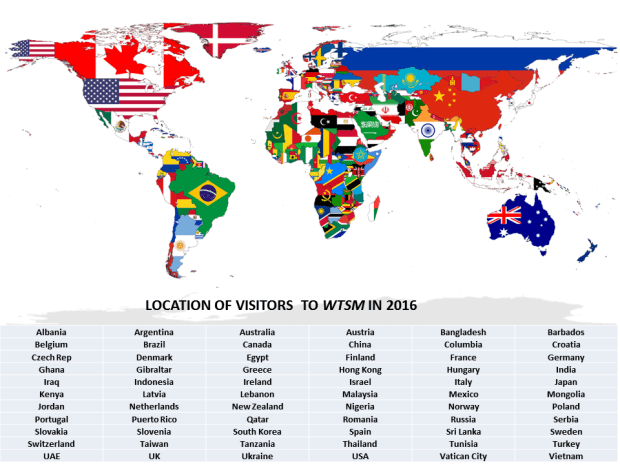
I have been astonished by the interest in this website, with some 7,000 visits and 14,000 page views from more than 65 different countries during the year, the list is quite amazing.  Though I write this blog for myself, I am increasingly aware of this unsolicited readership – you are all most welcome and I would be very pleased to hear from anyone who would like to get in touch with queries, comments or just to say hello – contact details are in the Contact drop-down section of the About main menu.

reflections-2016

JANUARY TO MARCH

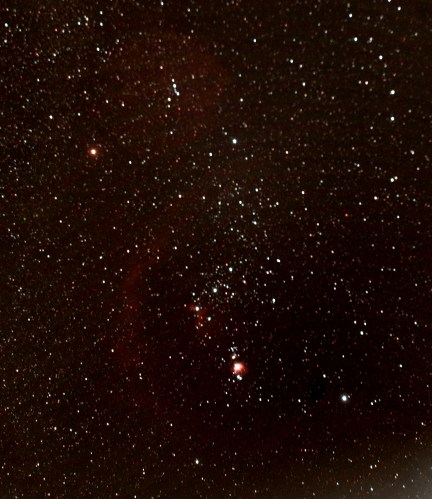
The year started poorly, got much worse, then finally improved. Using my recently acquired Vixen Polarie I was pleased to start the year with an image of Barnard’s Loop, something notoriously difficult to photograph and had previously eluded me.  Sadly I was not so successful with the Milky Way and have reluctantly come to the obvious conclusion that this can only be imaged in much darker skies than I’m ever likely to experience located just to the south of London and close to Gatwick airport!

As Orion starts to move on after Christmas and especially from February, I struggle to find suitable imaging targets; Coma Berenices and other constellations at this time contain numerous galaxies but they’re mostly too small for my William Optics GT81 and otherwise what might be doable I have already done before.  Notwithstanding, after looking carefully I came across two HII nebulae still lurking in the early evening.  The size and Ha-light of NGC 2174 Monkey Head Nebula and IC 2177 Seagull Nebula, provided just what I was looking for.  Located close to Gemini and Monoceros constellations, both these DSOs are within the part of the Milky Way section of the sky, an area that thankfully produces many other similar opportunities at this time of the year for a modded DSLR camera.
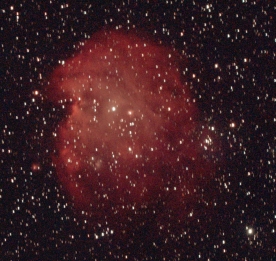
Picture saved with settings embedded.

Monkey Head Nebula

It’s often the small things that either alone or cumulatively can help transform the outcome with astrophotography.  The quarterly period finished by acquiring two new pieces of equipment, one which could help improve the set-up and operation of the mount, the other which I hoped would help me move to the next level of imaging.

  • When working in the dark and worse still in the cold, the ergonomics and general convenience of operating the equipment becomes paramount.  Since starting to use EQMOD-ASCOM and Cartes du Ciel for mount control and tracking, I encountered the problem of having to be in two places at the same time; in this case co-ordinating adjustments at the mount and the computer, in particular when making and syncing star alignments.  The answer to this conundrum was a gamepad, which I purchased for a nominal sum on eBay and after watching the inimitable Chris Shillito’s video on setting up and using a gamepad with EQMOD-ASCOM, have never looked back.  By using the gamepad the telescope can now be manually slewed, centred and synced on any object whilst remaining at the scope, thereby making the process of alignment much quicker and convenient.
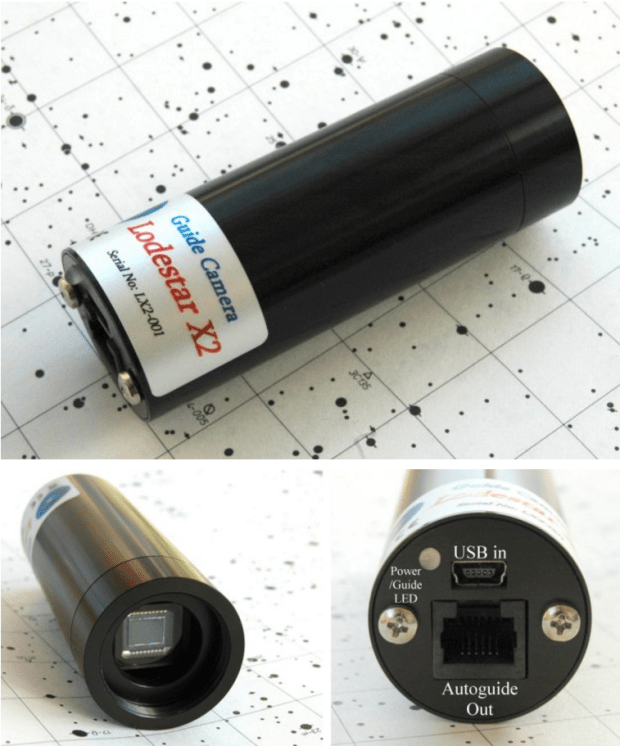
  • At the end of 2015 it was my intention to start guiding in the coming year, a prerequisite for the long exposures necessary to increase data capture and thus hopefully improve image quality.  I had originally intended to use my ZWO ASI120 MC camera together with a William Optics 50mm guidescope for this purpose but there always seemed to be other problems to overcome first and to be honest, I was somewhat intimidated about tackling the black art of guiding.  I was finally prompted to do something about this when in March a second-hand Starlight Express Lodestar X2 autoguide camera came up on the UK Astronomy Buy & Sell.  From previous research I knew this was considered to be a very good and popular guiding camera, so as it had only just been posted on the website, I immediately went for it and was successful – timing is everything.  Inevitably I had problems setting-up and in particular getting the camera to focus – which was my own fault – but by the end of March I was guiding!  Truth is my guiding at this stage was not very good and I needed to look further into using the PHD2 guiding software but nonetheless, the equipment was at least now working together!

No

Date Object*

Name

1 07/01/16 Orion Barnard’s Loop
2 14/01/16 Orion Barnard’s Loop
3 02/02/16 Catalina Comet
4 02/02/16 Milky Way  
5 10/02/16 IC 2087 Dark nebula
6 NGC 2174 Monkey Head Nebula
7 IC 2177 Seagull Nebula

*Record of quarterly photographic images taken in 2016

APRIL TO JUNE

After finishing the previous quarter on something of a high note by getting PHD2 working for the first time, I was now hopeful that from herein my exposures and thus images would show improvement – unfortunately I was soon to be very disappointed.

In April we went on a trip to the Southwestern USA – something of a geological pilgrimage for my wife and I (we are both geologists) – to see the Grand Canyon, Monument Valley, Bryce Canyon and Zion National Park as well as many other similar areas.  Prior to going I had purchased a Sigma 10mm-20mm wide-angle lens in anticipation of all the big views that are characteristic of the region and was not disappointed by the lens or the scenery.

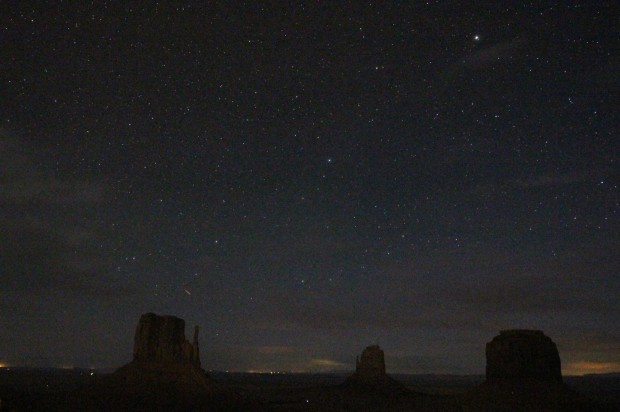
Being largely an uninhabited wilderness area, I also took the Vixen Polarie with a plan to at last capture images of the Milky Way.  Unfortunately, whilst I had checked the sky beforehand on Cartes du Ciel, I think I must have made an error with the dates.  We did get clear skies but unfortunately it turned out to be a full moon whilst there, which ruled out any hope of seeing, let alone imaging the Milky Way; oh well there’s always another day and it’s not going anywhere in the meantime.  Notwithstanding I did manage some pleasing nightscapes at Monument Valley and Bryce Canyon.
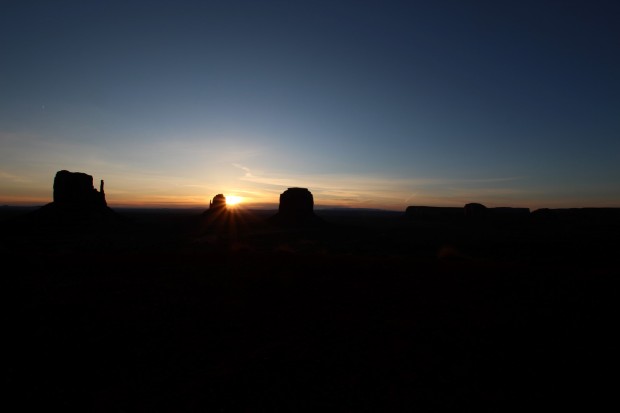
IMG_6235 (Large)

Given my initial guiding success prior to visiting the USA, I had been looking forwards to getting to grips with improving guiding and imaging on my return.  Furthermore, on 6th May there was a rare solar transit of Mercury and in preparation, the week before I set up and tested all the equipment and then successfully took some test images of the Sun using a Baader solar filter.  All was well on the appointed day which was also fortunately clear and sunny, so that shortly before contact I was all set and ready to try and capture the movement of a small black dot (Mercury) across the face of the Sun.  Unfortunately it was not to be and the weeks that followed almost marked the end of my still nascent hobby of astrophotography!

In short, EQMOD crashed when I turned on the DSLR camera to image the transit!  I tried re-booting and checked every other piece of equipment numerous times but to no avail.  I subsequently spent weeks trying to track down the problem, checking and re-checking every cable, piece of equipment and updating or reinstalling all the relevant software without success.  The nature of the problem strongly suggested there was a conflict between EQMOD-ASCOM and the camera and I therefore turned to the EQMOD forum for help, without success.  Somewhat late in the day and by now desperate, I posted the issue on SGL and quickly received a reply from someone who had had a very similar problem, which though also very difficult to identify, turned out to be a very small break in the outer cover of the DSLR AC/DC power adapter cable.  It’s not clear to me why this matters but I bought a new adapter and as they say, Bob’s your uncle, it worked!  I have looked very carefully at my adapter and cable and can see nothing wrong but am very thankful for the advice.
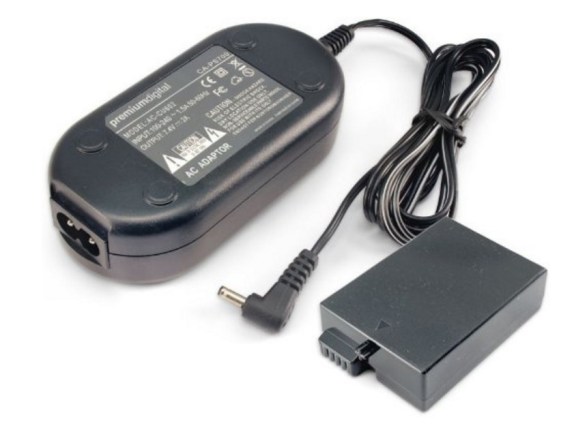
acdc

AC/DC Adapter: How can something as basic as this cause so much disruption?

It seems ridiculous that this very minor problem was nearly terminal but just in case it happens again I have since bought another spare power adapter.  Together with my daughter’s wedding in early June and the adapter meltdown, imaging for two of the three months during this period was almost non-existent.  Still by July I was ready to start again but by then there was no astronomical darkness!

No

Date Object

Name

8 April USA Monument Valley etc
9 06/06/16 M5 Globular cluster
10 M13 Globular cluster
11 M57 Ring Nebula

JULY TO SEPTEMBER

After the carnage of the last quarter, I was then unable to resume imaging in July due to travel commitments.  So I used what time was available to improve my knowledge of PHD2 and once again, check everything was now working ready for the return of astronomical darkness and better night skies from 20th July; I am of course now paranoid of another similar breakdown.  At the start of August I manged to obtain a just passable image of the Eagle Nebula for the first time.  Then shortly afterwards on the evening of 11th / 12th August, clear skies produced a decent night for viewing and imaging a few of this year’s Perseids meteor shower.  But it was at month-end and continuing into September that my imaging in 2016 finally took off.
m27-comps-paintfile

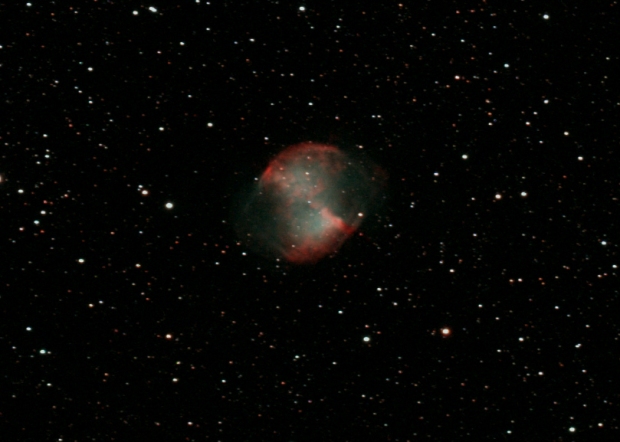
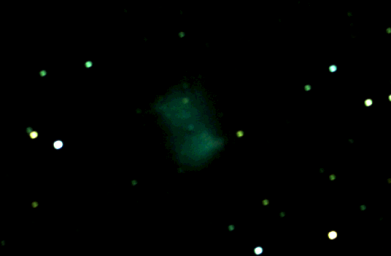
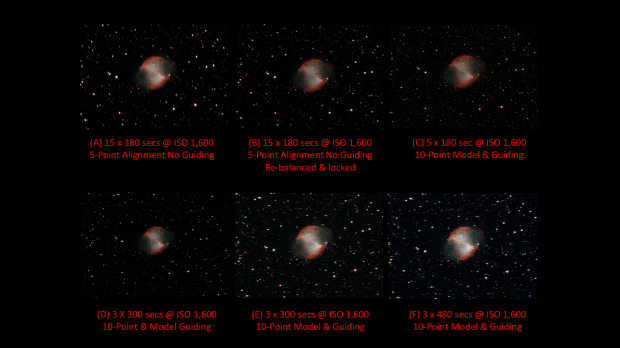
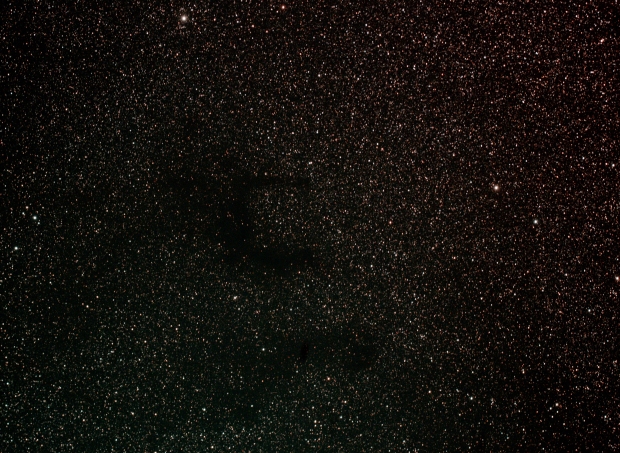
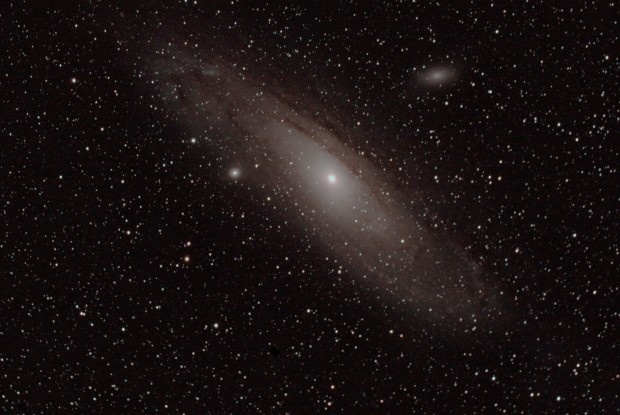
At that time the weather was consistently dry and warm, providing more than a week of clear skies and almost nightly imaging.  Dark nebulae are interesting features I’d hitherto not recognised as imaging opportunities and was therefore intrigued to successfully image the E-Nebula at this time.  Thereafter I used the opportunity of the weather window to experiment with PHD2 by using M27 the Dumbbell or Apple Core Nebula as a control imaging object.  Of course, each year is different but I’ll try to use any similar conditions in the future to sort out and develop old and new techniques, such unusual moments are precious for UK astronomers.  At the end of nearly two tiring weeks I had PHD2 working quite well and have not looked back since.  As a result of this work soon thereafter obtained good images of the Andromeda Galaxy, as well as the Veil, Crescent and Ring Nebulae.

No

Date Object

Name

12 07/08/16 M16 Eagle Nebula
13   M11 Globular
14   B142-3 Dark E-Nebula
15 11/08/16 Perseids  
16 23/08/16 LDN 673 Dark Nebula
17   NGC 6781 Planetary Nebula
18   M27 Dumbbell Nebula
19   Albireo Double star
20   Moon  
21 28/08/16 M11 Globular cluster
22   NGC 6905 Blue Flash Neb
23   Albireo Double star
24   15 Aquilea Double star
25   NGC 6960 W Veil / Witch’s Broom
26   M32 Andromeda Galaxy
27 29/08/16 M27 Dumbbell Neb
28   NGC 6960 W Veil / Witch’s Broom
29   NGC 7814 Pegasus galaxy
30   M15 Globular
31   M27 Dumbbell Nebula
32   M27 Dumbbell Nebula
33 08/0916 M27 Dumbbell Nebula
34   M27 Dumbbell Nebula
35   NGC 6960 W Veil / Witch’s Broom
36   NGC 6960 W Veil / Witch’s Broom
37   M31 Andromeda Galaxy
38 11/09/16 NGC 6888 Crescent Nebula
39   NGC 6992 Eastern Veil  (NGC 6995)
40 13/09/16 M57 Ring Nebula

OCTOBER TO DECEMBER

Normal conditions resumed later in September and into the final quarter in the form of overcast skies.  A minor break in the weather allowed a crack at the M33 Triangulum Galaxy towards the end of October but only in late November did another clear period occur, by which time the winter sky had arrived and temperatures had fallen to nearly 0oC.
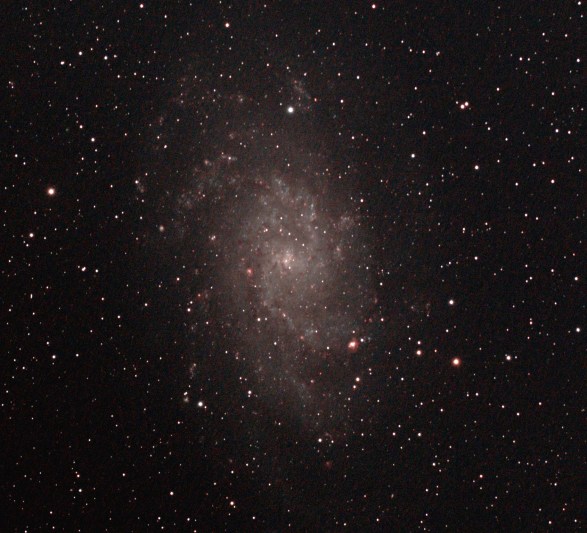
Picture saved with settings embedded.

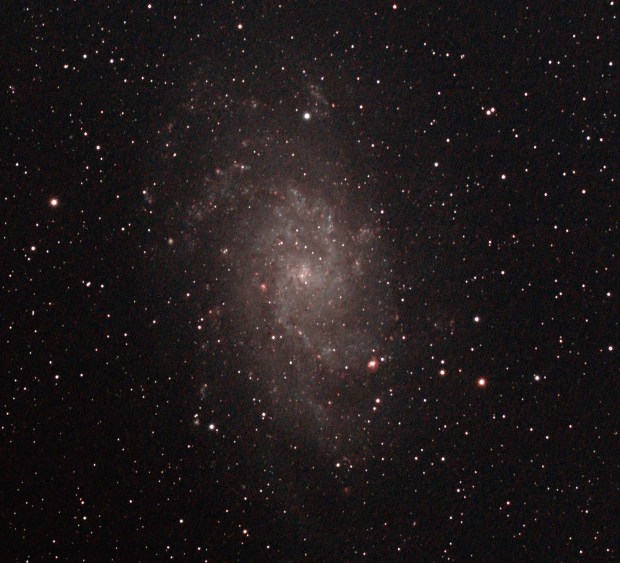
M33 Triangulum Galaxy – consisting of some 40-billion stars, the photons in this image have travelled 3-million light years in order to reach my camera sensor! | WO GT81 + modded Canon EOS 550D & FF guided | 18 x 300 secs @ ISO 800 & full calibration | 22nd October 2016

Unfortunately I am unable to establish a permanent observatory here at Fairvale and have to take-out the bring-in all the astronomy equipment each time.  Apart from being inconvenient this has two practical disadvantages: (i) it can be uncomfortable even unpleasant working outside in such temperatures, and (ii) it is necessary to polar and star align every time; on occasion when using SynScan and EQMOD-ASCOM it can take up to 2-hours before starting imaging.  Fortunately, I think I have now sorted out both these problems which should greatly help in the future.

By re-configuring the computer, mount and camera wiring, combined with establishing a wireless link between my tablet and the computer, once set-up I can now control most of the functions from indoors.  The comfort of being indoors benefits operating in general and especially thinking, which can be quite difficult when astroimaging and made even harder when it is cold.

With prolonged periods of clear weather in the second-half of the year, I was sometimes able to set-up and leave the equipment for a few days under a waterproof cover, which meant that from day-to-day I could be up-and-running each time in less than 30 minutes!  However, I expect this will only rarely be possible and nightly set-ups are likely to continue to be the norm.  Fortunately, I have also recently discovered two techniques that should help both streamline and improve star and polar alignment in the future.

In addition to guiding, PHD2 has a very good polar alignment facility that eliminates the use of the SynScan handset and enables the procedure to be carried out from the computer; it can also be undertaken without sight of the Polaris star, which is a major problem at Fairvale Observatory where it is totally obscured by my house.  At times when the mount can be left outside, I can also save and subsequently re-use the star-alignment model in EQMOD-ASCOM.  All-in-all these and other procedures have made a very positive impact on my astronomy and astroimaging.  The outcome of these changes led to a decent sequence of imaging with which to finish the year and, furthermore, hopefully provides a strong foundation for continuing improvements in 2017.

No

Date Object

Name

41 22/10/16 M15 Globula cluster
42   M33 Triangulum Spiral Galaxy
43 28/11/16 M45 Pleiades
44   NGC 2024 Horsehead Nebula
45   M42 Orion Nebula
46 29/11/16 Hyades Open star cluster
47   NGC 2244 Rosette Nebula
48 30/11/16 NGC 1499 California Nebula
49   IC 405 Flaming Star Nebula
50 03/12/16 M74 Spiral Galaxy
51   M77 Spiral Galaxy
52   M1 Crab Nebula
53   IC 2118 Witch’s Head
54   M78 Reflection Nebula
55 04/12/16 SH2-264 Lamda Orionis
56   SH2-261 Lower’s Nebula

ETCETERA

A few other astronomy and imaging related matters helped shape the past year for me. After  coming across WTSM, I was surprised to be contacted by the Purley Photography Camera Club to give a lecture on astrophotography in March.  I’m pleased to say the event went very well and, furthermore, the process of compiling the presentation beforehand helped expand my own knowledge of the subject too.
TTT Cover

In May I received a sun dial installed on a carved Purbeck Stone plinth as a retirement present.  As a time piece it’s accuracy is limited but it is a beautiful addition to my garden and solar astronomy for which I am very grateful.  By coincidence, later in the year I also came across a simple but charming sun dial set into the ground by the upper lake at Earlswood Common, a short walk from my home and  Fairvale Observatory.  Intriguingly it works by standing on a central stone, located depending on the season, and then uses your own shadow to read off the time – clever.

In September we visited Lacock Abbey in Wiltshire, home of William Fox Talbot in the 19th Century – photography pioneer and notable for developing photographic fixing and printing.  The photography museum there is very good and it was fascinating to see his place of work in the house, where the very first photographic print is also displayed.  His contribution to photography  is unique and today he is generally recognised as the father of modern photography.
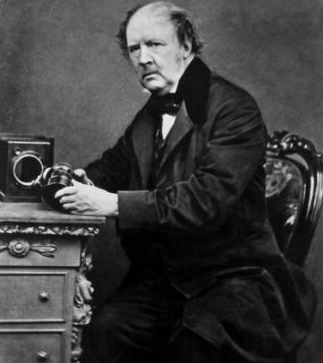
william-henry-fox-talbot-with-camera-141697035181903901-141210123557

As  a Londoner born and bread, I like to think I know the city well and over my lifetime have visited most of its unique sites, old and new.  However, for some inexplicable reason I had never been to Westminster Abbey, so decided to put that right in November.  It is, of course, a building of unparalleled history, with numerous graves and memorials of centuries of kings & queens, as well as scientists, explorers, poets, actors etc.  Noteworthy amongst these for the astronomer is the physicist and mathematician Sir Isaac Newton and  Second Astronomer Royal, Edmond Halley.

I must next give mention to the man who throughout the year dominated my reading, learning and thinking – Albert Einstein.  His work during the early part 20th Century still dominates today’s physics and astronomy.  We continue to make ground breaking discoveries that substantiate and build on his ideas that were originally postulated over 100-years ago.  Pictures only recently obtained using the the Hubble telescope have spectacularly demonstrated the effect of gravitation lensing and in 2016 for the first time ever the existence of gravitational waves was confirmed.  This year I therefore decided to understand the man and his work better.  During the first half of the 2016 I read Walter Isaacson’s excellent biography of Einstein and have recently completed and 8-week Stanford University course on the Special Theory of Relativity.  They were both very enjoyable, immensely interesting and time well spent.

Finally, this Christmas I was surprised and very pleased to receive a printed, bound copy of the WTSM blog for the period since its inception on 5th August 2014 until 10th November 2016.  A lot of work has gone into producing this blog and I’ve always been concerned that somehow something might go wrong with the website or internet and it would all be lost. This book now safely preserves in print all the blogs and images posted during the aforementioned period.  The production is generally very good and I have already enjoyed re-reading some of my blogs once again.
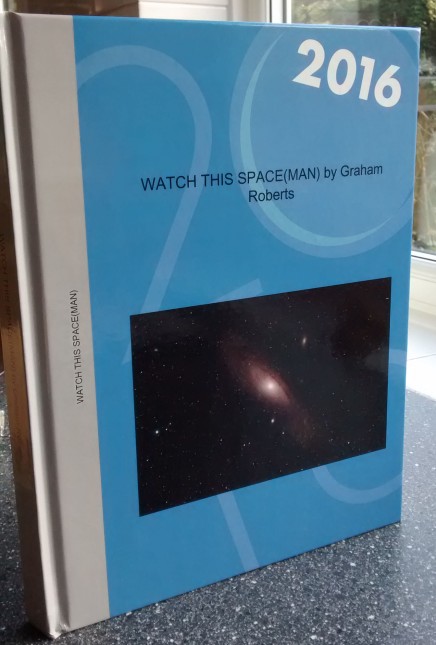
img_20161227_122915516

WTSM: The Book!

Favourite Images

As a result of the aforementioned issues, 2016 has certainly been a year of two halves.  Having resolved the equipment problem and started to employ some very useful new techniques and software, I was eventually able to obtain some good images. My personal favourites in no particular order are shown here below:
Picture saved with settings embedded.

Barnard’s Loop & Lamda Orionis Nebula : Vixen Polarie & modded Canon 550D + Sigma UWA @ 20mm | 11 x 240 secs @ ISO 1,600 + darks | 7th January 2016
IMG_6219L1C1 (Large)

Monument Valley by Night: order of buttes same as daytime photo above. Canon 700D + 10mm Sigma wide-angle lens | 20 x 15 secs @ ISO 6,400 | 10th April 2016
Picture saved with settings embedded.

B142/3 Barnard Dark E-Nebula

Picture saved with settings embedded.

M27 Apple Core Nebula | William Optics GT81 + 50mm Guide Scope & 10-point EQMOD-ASCOM alignment model | modded Canon 550D + Field Flattener | 3 x 300 secs @ ISO 1,600 & full calibration, 90% cropped | 30th August 2016
Picture saved with settings embedded.

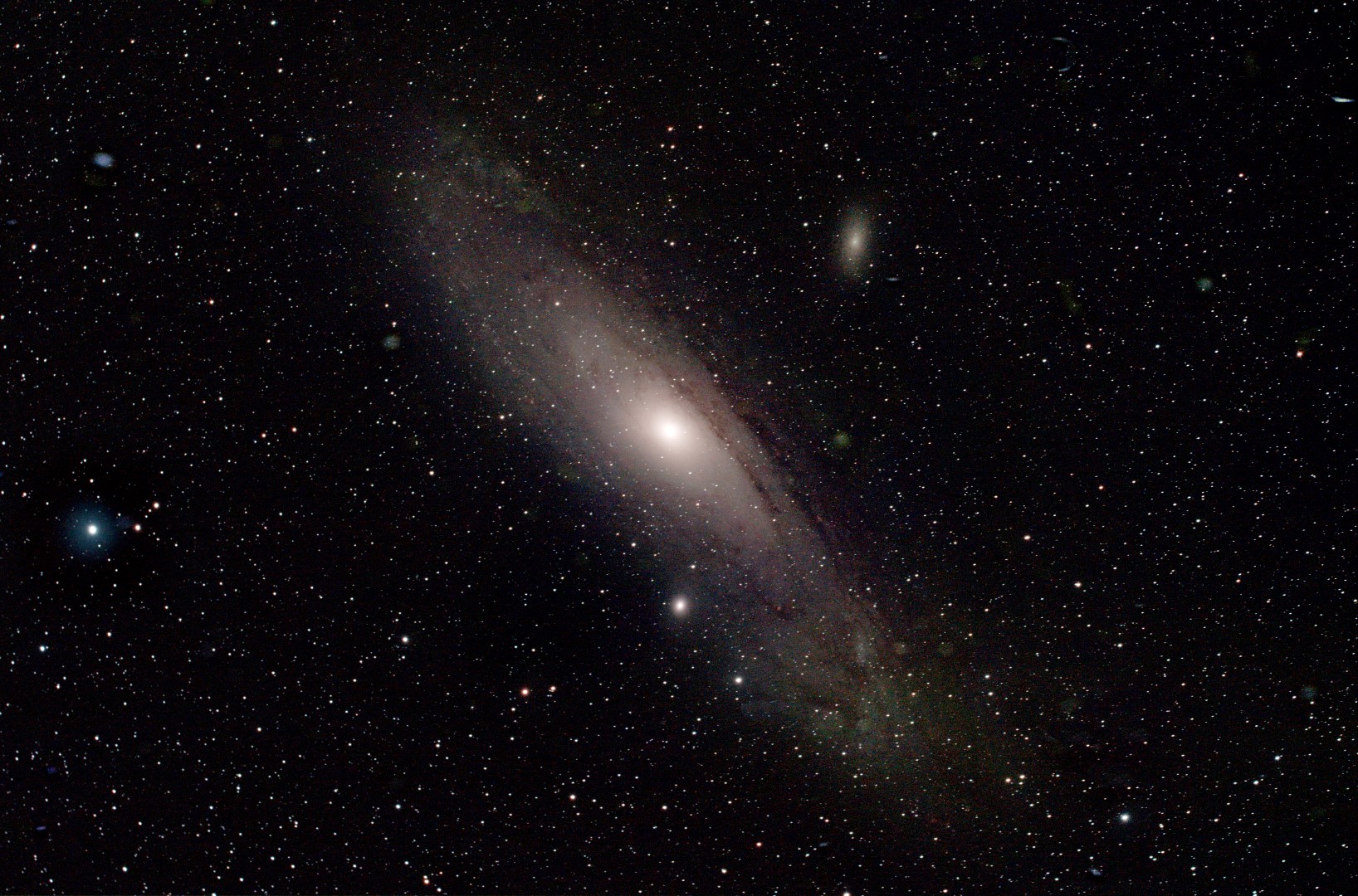
M31 | WO GT81 + modded Canon 550D & FF | 10 x 300 secs @ ISAO 1,600, darks + flats | 8th September 2016


Round-up & goals for 2017

Despite the frankly awful start to the year, astronomically speaking 2016 finished on something of a high.  Furthermore, contrary to initial indications I was in the end partially successful in achieving some of my objectives set out at the beginning of last year:

RECORD CARD – 2016
Goal Specifics / Results Outcome
Increase imaging exposure times Improved equipment set-up and alignment and successfully started autoguiding with exposure times of up to 8-minutes. DONE


Improve processing Started using newer version of Photoshop CS2 + other related software. Improvement with post-processing using online tutorials and Nik Syzmanek’s booklet Shooting Stars. GETTING THERE


Start widefield imaging Purchased Vixen Polarie, with portability put to use in the USA but did not make UK dark sky sites as planned. GETTING THERE


img_20161130_234303293

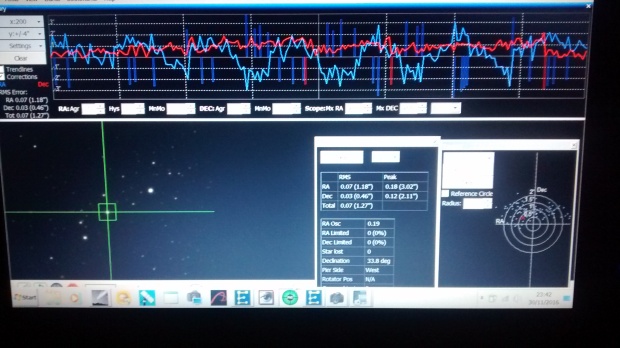
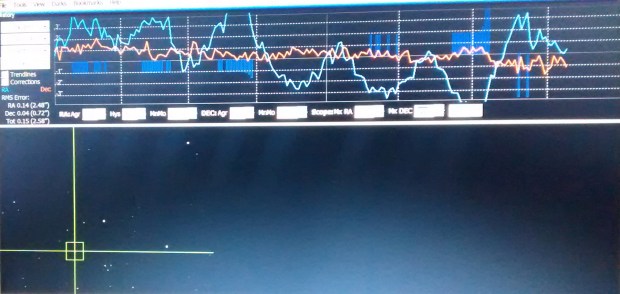
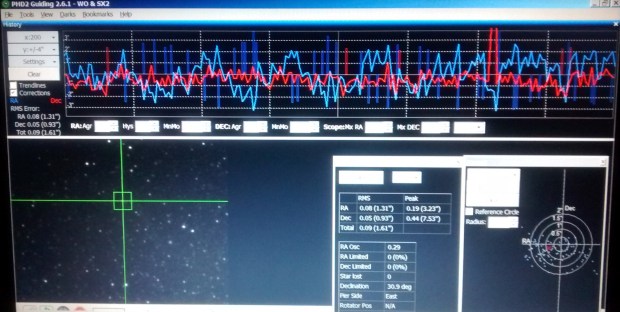
Getting better: PHD2 working screen 30th November 2016, DEC is good but room for improvement with the RA settings. Notwithstanding, the impact of tracking and image quality is noticeable.

download

I’m concerned about setting more goals or the forthcoming year but I think it helps, so here goes:

  • Improve processing: As the headmaster’s report would say “room for improvement” and I will try.  I have purchased Warren Keller’s book Inside PixInsight, considered by many to be the gold standard of post-processing software but is a nightmare to learn – this may be a step too far for now, we’ll have to see – maybe 2018?
  • Expand and improve widefield imaging: First – use the Vixen Polarie as had been intended last year to obtain nightscape images at UK dark-site locations.  Second – look at ways of using a widefield set-up with the mount more successfully.
  • Start LRGB imaging: I spent a lot of time in 2016 considering the question – what next? I am keen to image smaller DSO objects, in particular galaxies and was on the verge of purchasing a larger telescope – probably another refractor.  However, after attending a talk by Nik Syzmanek, one of Britain’s foremost astrophotographers, I have come to the conclusion that the next step should probably be a move to LRGB imaging, which if successful probably has the greatest potential to improve my pictures – let’s hope so.

Looking back 2016 was a funny old year, which for me was defined by three experiences:

Despite two wonderful periods at the end of August and November the weather for astronomy was mostly awful, with cloud cover for weeks on-end and when it was clear, it was a full moon – frustrating or what?

I had already learned that patience and perseverance are required in large quantities for astroimaging but the equipment break-down in May and June was so severe and apparently insoluble that, together with the aforementioned cloudy skies, I really thought of giving up.

However, this time there is a happy ending: after I finally solved the equipment problem and started autoguiding, I feel I have eventually made some great strides with my imaging in 2016 which, furthermore, holds much promise for the coming year and I hope can record in WTSM’s Reflections at the end of 2017.

Watch this space!
 

Photons & Photography

william-henry-fox-talbot-with-camera-141697035181903901-141210123557

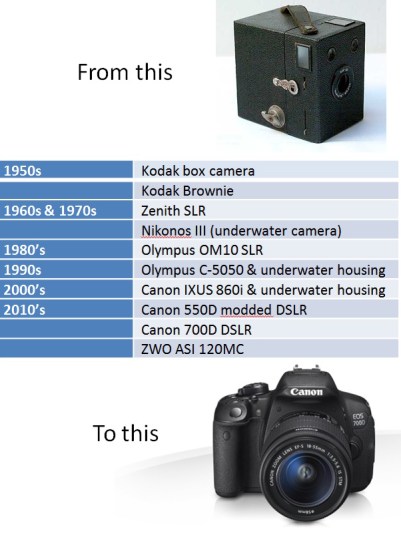
I’ve been interested in photography from a young age.  As I child I played with my parent’s Kodak box camera and, as far as I can remember, my first camera was a Kodak Brownie at the age of about nine. It’s a wonderful medium that I have now experienced for over 50-years, on land, underwater and now for astrophotography.

cameras

My cameras

I’d like to think I know a thing or two about photography by now; underwater photography and digital astrophotography have been particularly challenging in different ways but the latter is a real eye opener that has expanded my knowledge of digital imaging significantly.  Capturing images of distant objects that can only be seen with the use of sophisticated equipment and complex processing also requires an in-depth understanding of light itself.

Having spent the first half of this year reading Einstein’s biography, I have recently started an online course at Stanford University on his ground-breaking Special Theory of Relativity.  Einstein’s many insights into the physical world are profound, which more than 100-years on still challenge most of us to understand.  Light was at the core of his famous 1905 paper, in particular it’s duality as a waveform and light quanta, or photons – defined as a quantum of electromagnetic radiation.  His concept of the photoelectric effect has enabled the development of today’s digital camera sensors and CCDs.  The core principal is the production of electrons as light shines onto a material, whereby the light (photon) knocks out an electron which can then be collected electronically – the basis of digital photography.

In September I visited Lacock Abbey in Wiltshire, initially a 13th century nunnery which is now run by the National Trust.  Today it is better known as the home of William Henry Fox Talbot (1800 – 1877) – mathematician, astronomer and archaeologist but most famously the inventor and pioneer of photography, notably developing, fixing and printing.  The window photograph below (left) was taken at Lacock Abbey in August 1835 and is recognised as being from the oldest ever camera negative produced by Fox Talbot, on the right is the same window in 2016.

In the early 19th century Thomas Wedgwood had made photograms – silhouettes of leaves and other objects – but these faded quickly. In 1827, Joseph Nicéphore de Niepce produced pictures on bitumen, and in January 1839, Louis Daguerre displayed his ‘Daguerreotypes’ – pictures on silver plates – to the French Academy of Sciences. Three weeks later, Fox Talbot reported his ‘art of photogenic drawing’ to the Royal Society, which subsequently became the de facto basis of modern film photography.

img_2566-medium

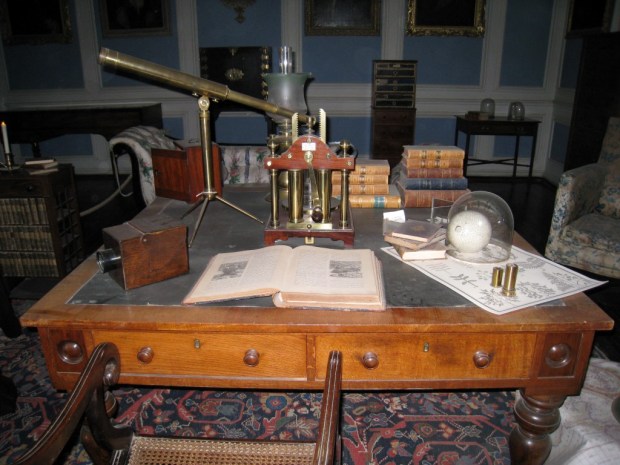
Fox Talbot’s desk in his study at Lacock Abbey

Fox Talbot lived and worked at the Abbey for most of his life.  As well as an excellent museum, which details the history of photography and photographic processes, the house contains his rooms where he developed (no pun intended) the aforementioned inventions and is surely a ‘must do’ visit for any keen photographer.  Like many at that time he was a polymath, with notable friends and accomplices who worked in similar and other scientific fields:

Sir John Herschel – astronomer, mathematician, botanist & chemist, Gold Medal winner and founder of the Royal Astronomical Society, son of William Herschel who discovered Uranus.

Charles Babbage – mathematician, philosopher, mechanical engineer, considered “the father of the computer”;

William Whewell – leading 19th century scientist, recognised in the fields of architecture, mechanics, mineralogy, moral philosophy, astronomy, political economy, and the philosophy of science;

Sir Charles Wheatstone – physicist, inventor of stereoscopic photography, the telegraph & accordion;

Sir David Brewster – physicist specialising in optics, mathematician, astronomer & inventor of optical mineralogy and the kaleidoscope;

Peter Roget – physician, theologian, lexicographer and publisher of Roget’s Thesarus.

This particular group are now remembered by a table setting in the Abbey’s dining room, where they gathered for dinner; the mind boggles at the conversation!

Fox Talbot’s pioneering photography work preceded the early 20th century understanding of light that arose from Einstein and its more recent application in semi-conductors as camera sensors, of which I am sure he would have approved.  At that time the Universe outside of our galaxy was also unknown and he would have marvelled further at the thought of imaging other such distant galaxies such as M33 below; like photons, photography has come a long way since his death in 1877.

Picture saved with settings embedded.

M33 Triangulum Galaxy – consisting of some 40-billion stars, the photons in this image have travelled 3-million light years to reach my camera’s sensor! | WO GT81 + modded Canon EOS 550D & FF guided | 18 x 300 secs @ ISO 800 & full calibration | 22nd October 2016

Two’s Company


230658_castr2hp2-copy

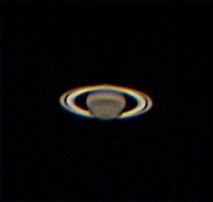
The night sky is full of wonderful worlds, which themselves consist of amazing objects and features.  I was originally drawn to astronomy by viewing Saturn through a telescope, which to this day retains a fascination and beauty for me.  Of course it is Saturn’s rings that make it stand out as perhaps the iconic object of the night sky; even to the lay person their nature and colour tell us something special is taking place.  The rings and associated shepherd moons indicate that something is happening to bring all the particles and objects precisely together in a disc that rotates around the planet – gravity. Perhaps surprisingly this force remains a mystery to science, although it is now clear that it has an overarching impact on the development of the Universe itself.

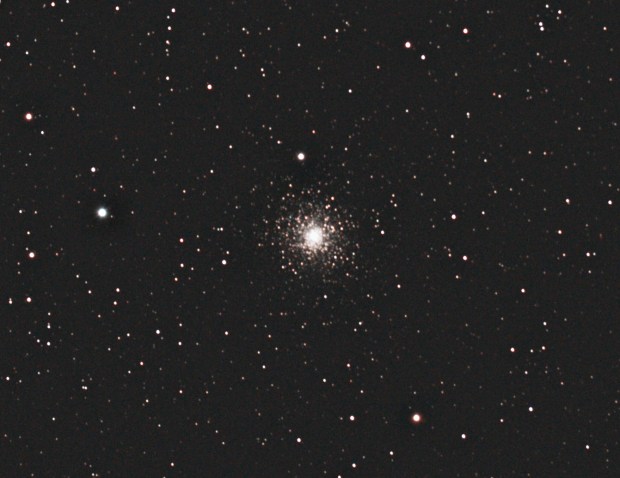
Another fascinating feature of gravity is the formation of globular clusters, which I find both beautiful and bewildering.  Bound tightly by gravity, each cluster is made of at least several hundred thousand very old stars, typically between 8 to 10 billion years, which usually orbit at a far distance outside and at right angles to the galactic disc.  So far about 158 globular clusters have been identified around the Milky Way and we now know such objects are also commonly associated with other galaxies.  During the summer and autumn many of these enigmatic star clusters can be seen across the sky, which form wonderful imaging targets.

Picture saved with settings embedded.

M15: 12bn light-years old globular star cluster | Constellation Pegasus, 33,600 ly from Earth, apparent mag. +6.2, size 18.0′ (diameter 176 ly) | WO GT81 + modded Canon 550D & FF | 10 x 300 sec @ ISO 800 & full calibration | 22nd October 2016

Although I have previously spent time observing and imaging Saturn and various globular clusters, as well as notable single stars such as Betelgeuse and Altair, for some reason I have neglected their binary relations.  And so in early autumn this year I turned the telescope and camera towards two of the better examples of these double or binary stars. So-called Doubles consist of two stars orbiting around a barycentre, captured by each other’s gravity.  The challenge is to ‘split’ the stars, thereby differentiating each star as individual features and if relevant by colour, either by observing though the telescope or in an image.

albireo-sky

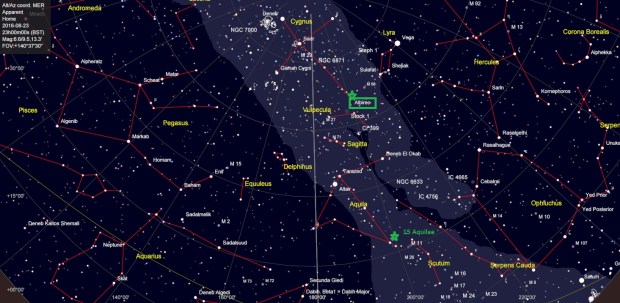
My initial target was the beautiful Albireo (below), a double star consisting of the mag. +3.1 gold coloured Beta Cygni A and its mag. +5.1 bright blue partner Beta Cygni-B.  At a distance of 430 light-years from Earth and separated by 35 arc seconds, the stars have an implied orbital period of at least 100,000 years.  Together with Deneb, Sadr, Gienah and Delta Cygni, Albireo forms the Northern Cross asterism, which lies almost overhead at midnight during the late summer months in the Northern Hemisphere. Situated at the head of the Cygnus (Swan) constellation, Albireo is also known as the “beak star”.  The contrasting colours of the two stars form one of the most beautiful doubles of the summer sky and forms an attractive imaging target.

albeiro-img_0042

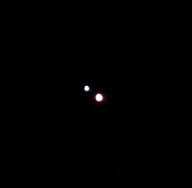
Located in the nearby constellation of Aquila but less notable than Albeiro, is the double 15 Aquilae (below). Some 4-billion years old and a hot 11,000oC in temperature, the larger mag. +5.4 orange giant star is located some 190 light-years from Earth.  Its smaller partner is a cooler white mag. +7.7 star, situated 38 arc seconds away but ‘only’ 4,400oC hot.  Such features abound in the Aquila constellation and I hope to return to this region of the sky again next year for more double fun!

15-aquila-img_0050

Doubles are a real treasure of the night sky that are surprisingly common but are easy to overlook.  They are often interesting as well as beautiful to observe and image – I can’t think why it’s taken me so long to get round to them?


Overspill

images-1

After months of cloud followed by 3-months of lost imaging time due to a mysterious camera / mount control problem, I was on the verge of throwing in the towel by August.  But then I sorted the problem, started guiding and as if by magic, with a prolonged spell of good weather managed 7-nights of astronomy between 23rd August and 13th September; such was the intensity I was able to work over consecutive nights and by the end quite exhausted but happy.

Under clear skies and warm nights I could operate in just shorts and a T-shirt, a hitherto unknown experience at Fairvale Observatory.  In such comfort I was also able to experiment and optimize the equipment set-up further – oh, if it could only be like this always.  Of course I did not miss the opportunity to chase some night sky objects as well, imaging 11 targets all-in-all, sometimes on more than one occasion.  It was a glorious time which has since taken time to organise and process.

Top left – NGC 6905 Blue Flash Nebula in Delphinus constellation 42″ x 35″ mag +11 26th August; Bottom left – NGC 6781 planetary nebula in Aquila constellation 1.8′ +mag 11.8 23rd August; Middle M57 Ring Nebula Lyra constellation 1.4′ x 1.1′ mag +8.8 13th September; Right M57 23rd August

A number of these images have already been reviewed in Forbidden Fruit and The future is not what it used to be but, such was productivity that for the record I’ve collected the overspill here.  Inevitably targets reflected what was about and in sight from this location at the time but were nonetheless diverse in nature, ranging from the Witch’s Broom to planetary nebulae, the Andromeda galaxy and, making use of the otherwise frustrating monthly occurrence, the Moon.  Features such as M57 and NGC 6781 are intrinsically too small for the William Optics GT81 and Canon 550D, filling significantly less than 1% of the original image but after cropping both are evident in the final picture.

Top Left – M15 Globular cluster Pegasus constellation 29th August; Top Right – Q1 Moon 23rd August; Middle Right – NGC 6960 Witch’s Broom Western Veil Nebula; Bottom – M31 Andromeda Galaxy 26th August

These images are not particularly memorable but it was a fun time and I will remember the enjoyable experience for a long while.  Of course, the cloud has now returned and since passing the autumn equinox night temperatures have plunged into single figures.  On the plus side, Orion is on its way together with all the other photogenic objects that characterize the winter night sky – can’t wait!

Forbidden Fruit

sonof

Soon after embarking on my astrophotography adventure just over two years ago it became apparent that after getting the basics right – polar & star alignment, focus, image capture etc. – the Holy Grail of imaging is increased exposures times, thereby collecting more of those elusive photons that have travelled across the Universe.  The first step to achieving this goal is tracking, which since purchasing my AZ-EQ6 mount in 2015 I have been successfully improving over time, on a good day achieving 180-second exposures and from time-to-time resulting in some decent images.  However, the light from DSOs is often very feint and can require much longer times, which is easier said than done.

At the same time as acquiring the aforesaid mount and a William Optics GT81 telescope I also purchased a William Optics 50mm guide scope, with which I intended to start guiding and thus push exposures above my 3-minute barrier.  Despite these aspirations, through a combination of events and my unease about the apparent difficulty of guiding, the guide scope has remained unused – until now.  Having recently purchased a dedicated Starlight Express Lodestar X2 guide camera, I have finally been emboldened enough to give it a try.

sx2

Starlight Express Lodestar x2 Guide Camera can be used either via the mount’s ST4 port or via ASCOM and the computer for pulse guiding.

I initially struggled to set up the guide scope and get the guide camera working together.  In particular obtaining focus proved very difficult; like the GT81 the guide scope focus turns out to be achieved within a very short distance that is measured in fractions of millimetres, which in this case required the insertion of an extension tube.

img_20160902_173811432

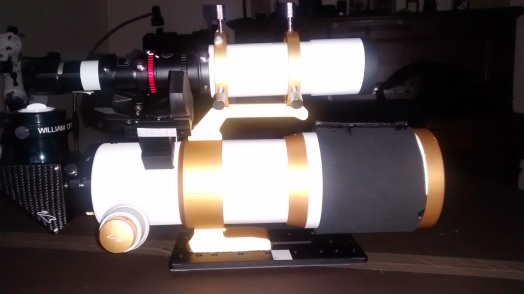
Reminiscent of the Space Shuttle on its Boeing 747 transport plane! The William Optics 50mm guide scope + Lodestar X2 guide camera neatly mounted atop the GT81 imaging scope using the integral rings.

Thereafter the big challenge, which I had previously avoided, was to start using the very popular PDH guiding software; Push Here Dummy (PHD) is named tongue-in-cheek by its original creator Craig Stark and is an amazing but somewhat intimidating piece of software.

option1


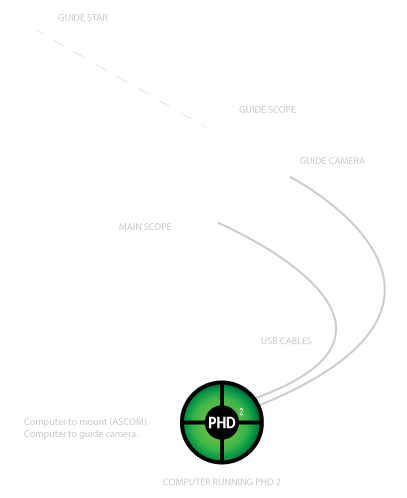
The principle is simple – find a star within the FOV and use it as a fixed reference point from which to assess and then correct small tracking errors in order to achieve better tracking, which thereby maintains pinpoint accuracy and enables longer exposure times, thus avoiding trailing of the sky and the objects being imaged.  Its use is regarded as something of a dark art but I have finally grasped the nettle with some success.  After months of clouded skies followed by an almost fatal equipment failure (see here for more), a period of exceptionally good weather and clear skies since late August provided the ideal opportunity to get to grips with this challenge that has so far eluded me.

At first I used a couple of sessions to overcome some past problems and ensure that everything was stable and worked well for basic tracking and imaging, in particular:

  • Repair and improve the imaging camera’s AC/DC adapter lead;
  • Where possible improve all other leads and connections – once bitten …..!  In this respect I have significantly re-arranged and tidied up the many power, control and camera leads, which has included the addition of right-angle USB / mini-USB camera connectors that now makes plugging-in easier and produces less strain on the connections i.e. more secure.  Simple, cheap and something I should have undertaken long ago;
  • Revisit EQMOD-ASCOM in order to achieve more robust tracking – especially reviewing the star alignment procedures;
  • Fit the guide scope using the rings incorporated onto the GT81 OTA, subsequently re-balancing the equipment and improve the mount’s feet positioning.

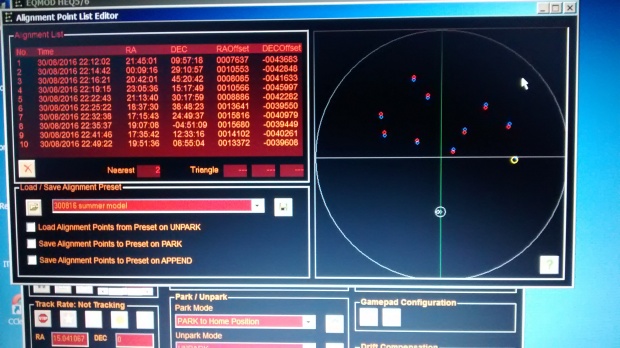
At this point I spent a couple of nights just playing with the equipment and in particular EQMOD-ASCOM, so as to obtain the best possible alignment; having suffered an enforced absence from imaging I just wanted to have some fun again too.  At the end of this process, first using SynScan for polar alignment before switching to EQMOD-ASCOM + Cartes du Ciel for star alignment, I successfully produced a good 10-star alignment model which was then saved for future use.  The resulting images already showed some improvement but I still had to tackle PHD.  With unusually good weather I decided to leave the final set-up outside under cover, thus preserving the settings for a shot at the aforementioned task of guiding next time.  In the interim I then needed to read the operating instructions and watch numerous videos on the use of PHD.

img_20160911_213525309

EQMOD-ASCOM 10-point alignment model. With an obstructed view of the northern sky by my house, all points are inevitably located in the southern quadrants.

Like so much of amateur astronomy, I will forever be grateful for the time and effort given by others to help those like me pursue our hobby.  The material, videos and responses to my forum queries on guiding have as usual been nothing short of outstanding and very, very helpful.  It’s still been difficult to get going but without the help and support of others it would be a complete non-starter.  In this respect I’d like to pay credit to SGL and the Open PHD Guiding forums.

Armed with this knowledge I have since undertaken a few sessions using PHD2 with reasonable success, achieving exposure times of 5-minutes and more.  Changing conditions and different objects make it necessary to continually finesse guide settings throughout the night and between nights and it’s already obvious that there’s much more to learn.  Such adjustments are not always linear or empirical in nature and will often only come from gut feel (experience).

I have chosen to use ASCOM pulse guiding, though my equipment also has ST4-ports which I had initially intended to use due to its apparent simplicity.  I am unable to argue the pros and cons of each method but there seems to be an overwhelming preference for pulse.  What I do understand (I think) are the greater subtleties that can be obtained with the pulse guiding technique and in particular, the co-ordination it provides with ASCOM, thereby ensuring PHD and the mount communicate with each other to provide essential directional information as well as guiding.  I am still investigating the impact of various BRAIN settings but through trial-and-error have progressed since my first guiding session.

img_20160831_000920crop2-large

First Pass: early guiding results 30th August 2016

img_20160912_014945688crop-large

Getting better: most recent guiding results 12th September 2016

Calibration of PHD is frustratingly slow and it seems that even after successfully completing the RA-procedure can still fail during the subsequent DEC / backlash clearance.  After calibration use of the PHD Guide Assistant can then provide more help in achieving the best settings for the given set-up and conditions, though it is also very slow.  However, once completed PHD is fantastic and so far has run well during the night, even when changing objects.  Furthermore, I’ve also studied and experimented with the PHD Drift Align tool and am hopeful that by using this I may soon be able to both dispense with SynScan altogether and improve polar alignment, hitherto my imagining nemesis as I cannot see Polaris from my location – a very exciting prospect – what’s not to like?

Starting a sequence of experimentation I chose a familiar but hitherto difficult DSO object to image that should benefit from longer exposures.  Having by now reached late-summer / early autumn, there were a few old favourites around such as the Veil and North America nebulae but for these trials I decided to go for the low hanging fruit of M27 or Apple Core nebula AKA Dumbbell nebula.

m27-170814-dss

My previous image of M27 in August 2014!

With limited success I imaged this planetary nebula in my early days of astrophotography but with its 8.0’ x 5.6’ size and apparent magnitude of +7.5, I found it difficult to obtain good detail and colour.  However, even without guiding the improved set-up and alignment produced better results at 3-minutes and with +5-minute guided exposures the images immediately showed very noticeable improvement.

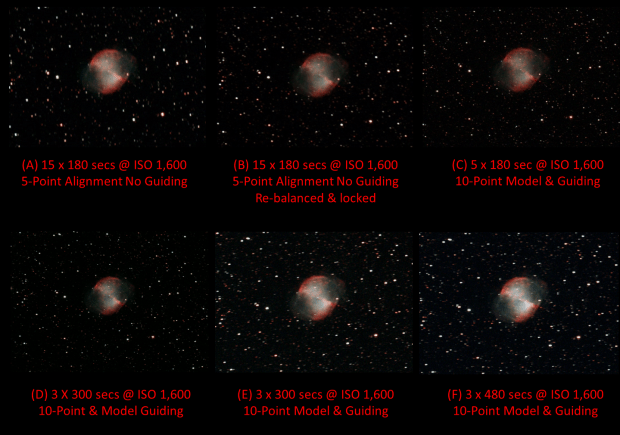
The images were taken on four different nights starting on 23rd August and finished on 8th September, during which time the sky was clear and the weather warm with very low humidity, though by the end seeing conditions had started to deteriorate due to the impact of the emerging 1st quarter Moon.  All images have been cropped to the same size of 700 x 500 pixels or 2% of the original FOV i.e. an object size of about 0.20%!  Given this very small size M27 really is at the limit of the GT81 telescope.

m27-comps-paintfile-cropped

Strictly speaking the images are not fully comparable as the aggregate exposure times are not equal but nonetheless I think the results demonstrate the positive impact of guiding. The final two images are guided but do show greater star distortion, particularly at 8-minutes.  I suspect this may be due to the period over which the mount was left outside and would probably have benefited from some alignment tweaking before imaging re-commenced – lesson learned; the severe cropping ratio has also magnified any problems that would probably be less obvious in a larger widefield image.  There’s obviously room for improvement but I’m very happy with these early results which I can hopefully now build on.

Picture saved with settings embedded.

M27 Apple Core Nebula – my first and favourite guided image | William Optics GT81 + 50mm guide scope & 10-point EQMOD-ASCOM star alignment model | modded Canon 550D + field flattener & Starlight Express Lodestar X2 guide camera | 3 x 300 secs @ ISO 1,600 & full calibration, 3.3% cropped image| 30th August 2016

Unfortunately there is some downside to the longer exposures obtained from Fairvale Observatory: potentially more aircraft tracks and cloud plus more extended imaging time is unavoidable but overall it is, as expected, a major leap forwards for my astrophotography.  There’s still much to learn and improve with the technique but for now I am delighted to say that after nearly two years I am at last successfully guiding  – would you Adam & Eve it?

Space Odyssey

I have just finished reading Chris Hadfield’s excellent book An Astronaut’s Guide to Life on Earth, which is an entertaining and insightful look at being an astronaut and the lessons it provides for life in general.  Who of us has not at least considered such an adventure ourselves but, of course, it is impossible for all but a few.

51lLw6nsBsL._SX328_BO1,204,203,200_

Astronomy is thought provoking enough in itself looking out at the vastness and beauty of the Universe, being in space and looking down on our planet would take such thoughts to a whole different level; from their subsequent accounts it is clear that those who have walked on the Moon became changed people, returning different to the rest of us.

apollo08_earthrise

Ever since following the pioneering space adventures of Yuri Gagarin and Alan Sheppard and especially watching the Apollo 11 Moon landing in 1969, I have been fascinated by space, its science and the human experience of travelling there.  My solution to going into space was to take up scuba diving and since 1976 have had many wonderful diving experiences all over the world.  Of course, it’s not space but it is very much other worldly and the weightless feeling is as close as most of us will get to being in space; the astronauts train extensively underwater for just that reason.  Furthermore, as a geologist and more recently taking up astronomy has altogether provided me with a better understanding of the Universe.

Maldives, Kandooma 2004: the closest I'll get to space!
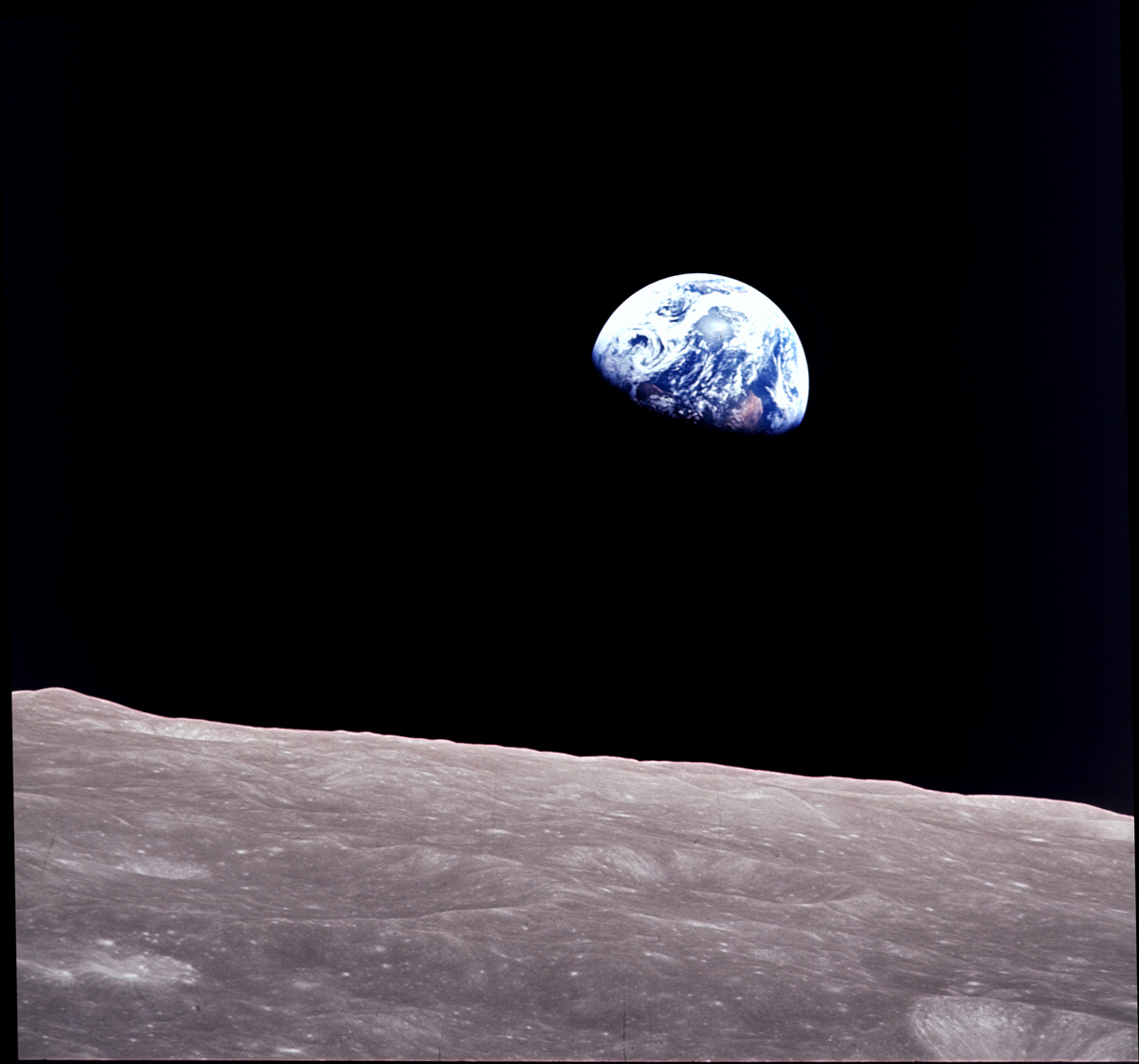
Maldives, Kandooma 2004: the closest I’ll get to space!

Given my long standing interest in space, it is perhaps surprising that I came late to astronomy itself, so why now?  The best answer is time – in recent years I have had more of it and in the past work, family and extensive travel precluded such a pastime.  Like so many sciences in the modern era, technology has also unlocked major new opportunities for scientists and amateurs alike.  Whilst I enjoy the science itself and especially viewing the night sky, the ability to produce frankly incredible images has been the most important key to my recent personal interest.

The phenomenal imaging improvements that have occurred since the launch of Hubble have made the power and beauty of the Universe even more accessible to us all on Earth.  Digital image capture and processing is now so powerful that pictures of hitherto unimaginable quality can be achieved from Earth.  Furthermore, for a relatively modest cost outlay, such images can be obtained by amateurs like me, literally outside my back door.  More than any other development, this is what has now engaged my interest.  The product of astroimaging can easily be overlooked as just an attractive, often spectacular photograph of the night sky – and they are.  But the equipment and pictures produced are also important tools that can assist our understanding as well as imagination of space.

andromeda

After a forced absence from astroimaging for the past six months, I was recently fortunate to obtain a number of exciting pictures of familiar objects on my first night back, in particular M31 or the Andromeda Galaxy.  As the nearest galaxy to Earth, Andromeda is an obvious target for those new to astroimaging but despite its proximity, it is not to be underestimated as an imaging target.  I have attempted imaging M31 before but, like many others, found it very difficult to coax out the detail which makes it such a beauty.  I am not completely sure what was different this time but the resulting picture at last starts to capture these details; I was even more surprised at the outcome which is the result of just nine 120 second exposures at the end of a long night before heading for bed!

M31 Andromeda Galaxy WO GT 81 + modded Canon 550D + FF | 9 x 120 secs @ ISO 1,600 | 19th September 2015

M31 Andromeda Galaxy
WO GT 81 + modded Canon 550D + FF | 9 x 120 secs @ ISO 1,600 | 19th September 2015

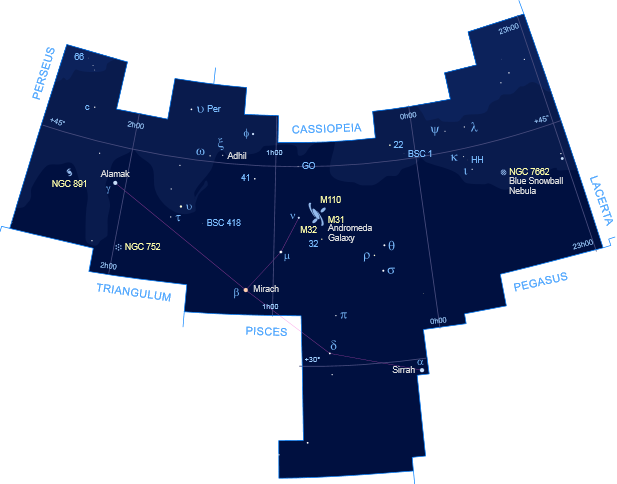
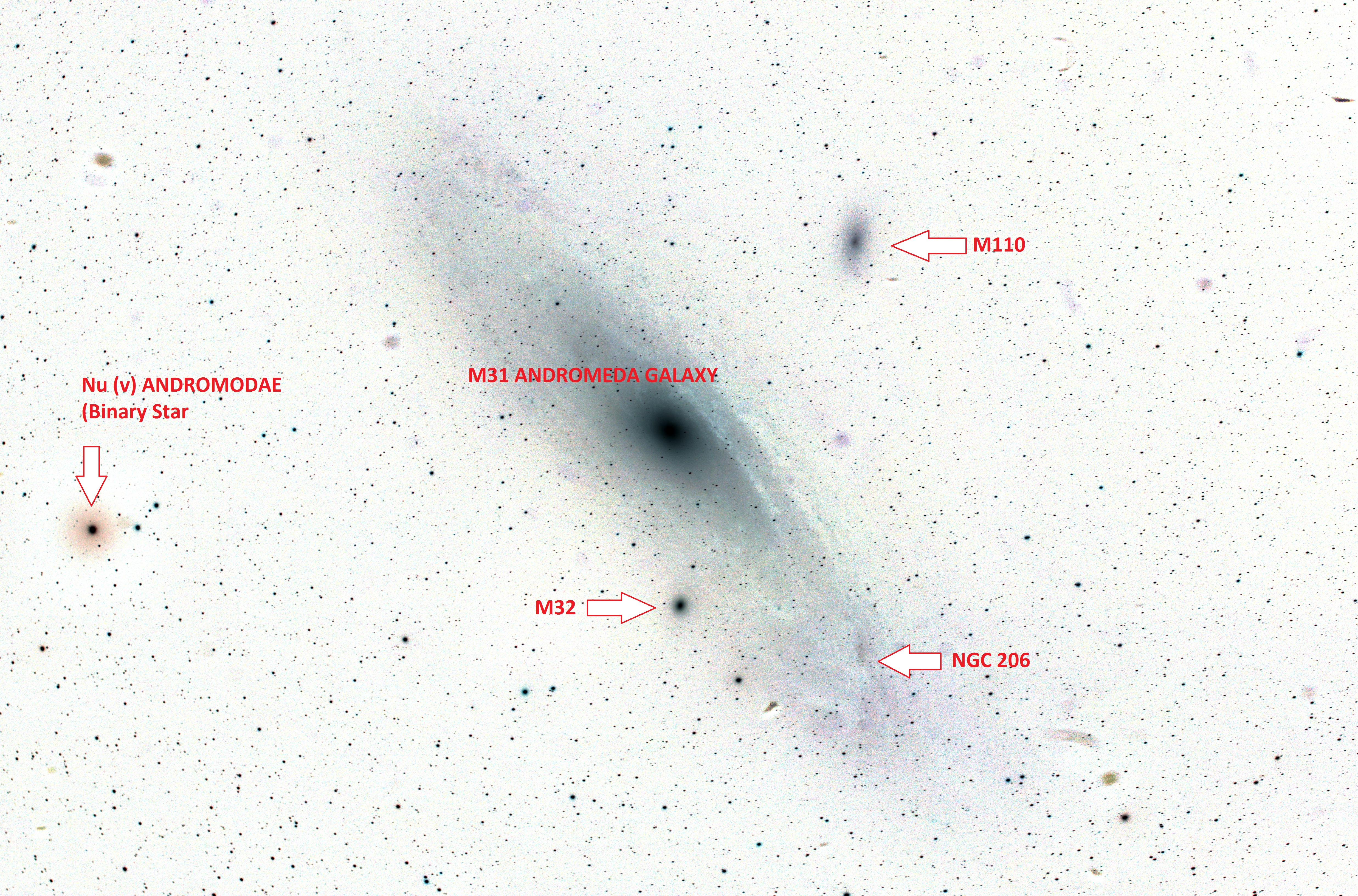
Andromeda poses two main challenges for the photographer: (i) the contrast in brightness between the central area and the rest of the galaxy, and (ii) the need to show the brown dust bands within the main disc, which provide a fascinating insight into the galaxy’s overall structure – that is not unlike out own Milky Way.  The classic technique is to use two sets of images, with camera settings appropriate to the two contrasting areas, subsequently bringing them together during post-processing.  Despite the limited number of prime focus images taken the final picture achieved still came out well.  Though the bright central area is overexposed, the galaxy’s dust bands are clearly evident and for the first time have captured the full character of this magnificent feature. Furthermore, within M31 the NGC 206 is evident, a star formation region of over 300 new stars, whilst in the adjacent sky two other Messier galaxies are shown in the image M32 and M110.

M31 Anfromeda Galaxy: inverted & anotated

M31 Andromeda Galaxy: inverted & annotated

I think it is correct to say that the Andromeda Galaxy is one of the iconic images of the night sky and I feel obtaining such a picture marks another notable point in my personal space odyssey.  I would hope Chris would approve, as well as Major Tom?