Two’s Company

For good reason spring is known as “galaxy season” by astronomers but during this period, shortly before astronomical darkness inevitably disappears for summer, there’s also another show in town.  Closer to home in the denser extremities of our galaxy, over 150 globular clusters have so far been identified orbiting above and below the plane of the Milky Way within the galactic halo.  Globular clusters consist of hundreds of thousands of tightly packed stars that are surely one of the more enigmatic features of astronomy, as we now know that similar clusters also are associated with other galaxies throughout the Universe.  Whilst the formation of globular clusters is poorly understood, we do know that at 10.0 to 13.5 billion years they are very old.  Given their age, location and density, it seems that globular clusters formed under very different circumstances to the more recent dispersed star clusters.

Image Setting / Location

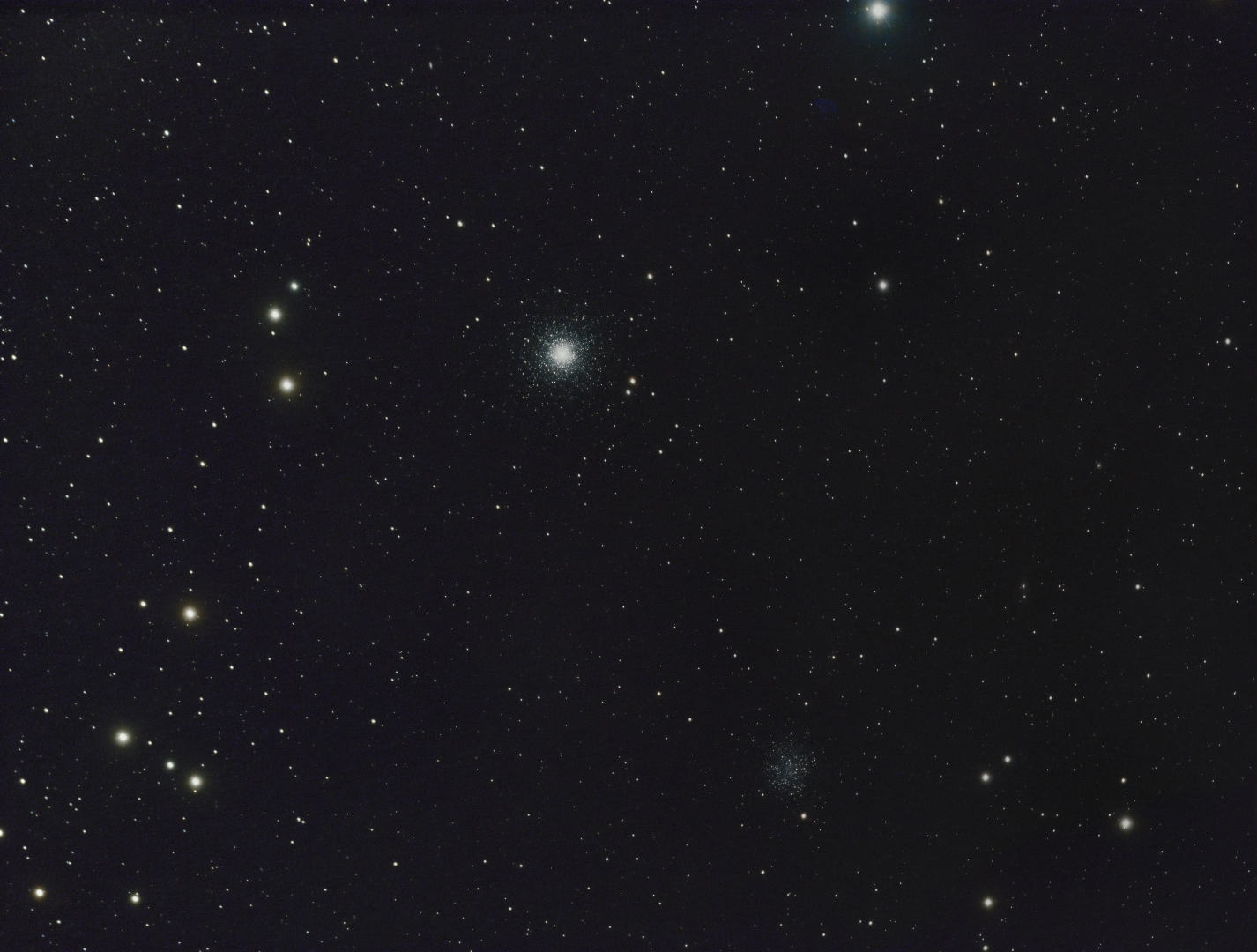
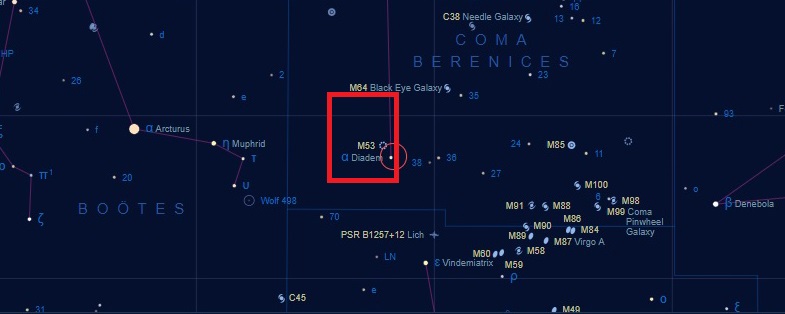
 Sagittarius and Ophiuchus brim with globular clusters but at the higher latitude here at Fairvale Observatory it is necessary to view those around the regions of Canes Venatici, Virgo or Coma Berenices; the Great Cluster of M13 and others such as M92 and NGC 6229 located in the aforesaid Hercules constellation move into a better view later during early summer. Having previously imaged a number of these clusters in the past, this spring I looked around for something new and different, which I found in the name of M53 (Above + left of centre – main image top of the page) .  In this case it turned out to be two for the price of one, as with careful framing it was possible to include a second globular cluster, NGC 5053 (Below + right of centre – main image top of the page).

True Orientation (top = North) + 30% crop – Image Rotated 90 degrees clockwise

Located in the southern area of the Coma Berenices constellation, M53 (Above left of centre – main image, top of the page) is some 58,000 light years from Earth.  Containing some 500,000 metal-poor stars, the cluster equates to 13 arc minutes of sky or about 220 light years in diameter, with an estimated age of 12.67 billion years.  Just over 1o east of M53, NGC 5053 is 53,500 light-years away, with an apparent size of 10.5 arc minutes or 160 light-years.  Although classified as a globular cluster, NGC 5053 is more irregular and dispersed in nature without a distinct bright core and is therefore dimmer than its neighbour, making it more difficult to image.

M35 Full Crop

All-in-all I believe these two globular clusters, combined with the star studded background that just includes the binary Diadem star (Upper edge + right of middle – main image, top of the page) southwest of M53, altogether makes for a rich and interesting final image.

 IMAGING DETAILS
ObjectM53 & NGC 5053
ConstellationComa Berenices
DistanceApprox.. 58,000 & 53,000 light-years
Size  13.0 & 10.5 arc minutes
Apparent Magnitude+8.33 & +10.00    
  
Scope William Optics GT81 + Focal Reducer FL 382mm  f4.72
MountSW AZ-EQ6 GT + EQASCOM computer control & Cartes du Ciel
GuidingWilliam Optics 50mm guide scope
 + Starlight Xpress Lodestar X2 camera & PHD2 guiding
CameraZWO1600MM-Cool mono  CMOS sensor
 FOV 2.65o x 2.0o Resolution 2.05”/pix  Max. image size 4,656 x 3,520 pix   
EFWZWOx8 EFW & 31mm Chroma LRGB filters 
Capture & ProcessingAstro Photography Tool + PHD2 +  Deep Sky Stacker, PixInsight v1.8.8-7, Photoshop CS3, Topaz Denoise
Image Location &          OrientationCentre  RA 13:13:59.405      DEC +18:01:48.627                      Lower Left Corner = North   Top = South West    
Exposures55 x 180 sec L , 34 x 180 sec R,  30 x 180 sec G&B Total Integration Time: 7hr 27 min     
 @ 139 Gain   21  Offset @ -20oC    
Calibration10 x 60 sec Darks  15 x  LRGB Flats & Dark Flats         @ ADU 25,000
Location & DarknessFairvale Observatory – Redhill – Surrey – UK        Typically Bortle 5-6
Date & Time13th, 15th & 16th April 2021  @ +21.00h  
WeatherApprox. <5oC   RH >55%                  🌙 6% waxing


Galactic Stepping Stones

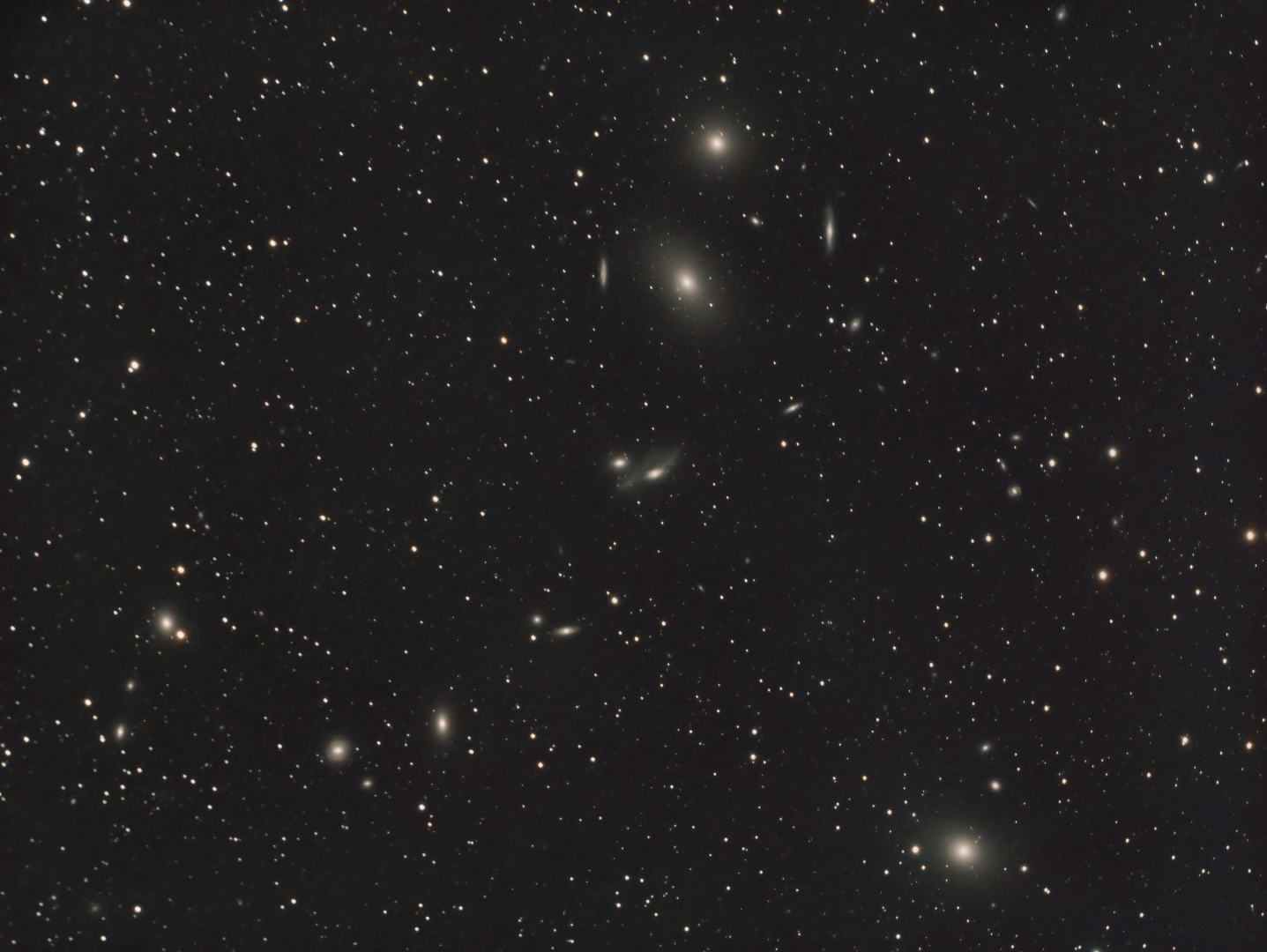
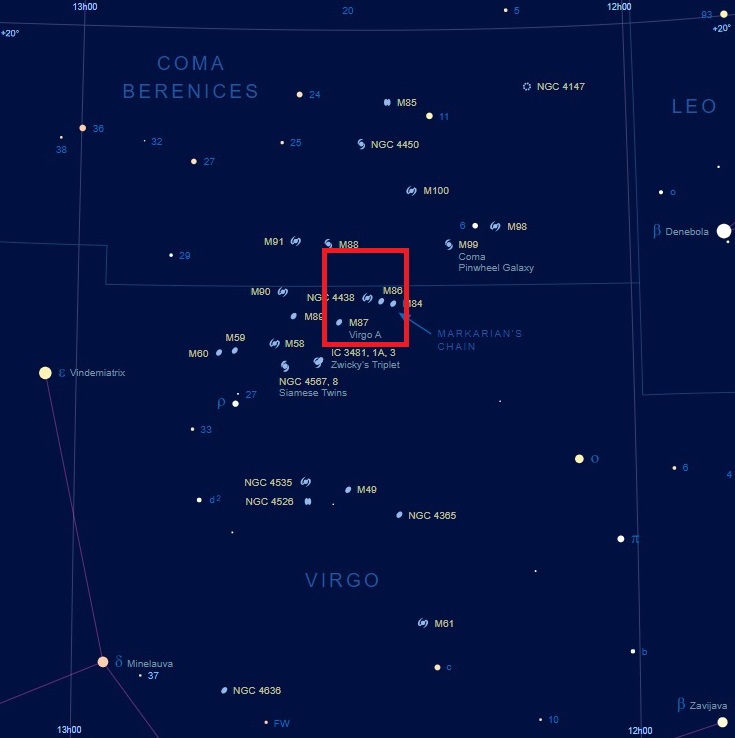
The Virgo Cluster consists of more than 2,000 galaxies, which unfortunately are optically too much for my small William Optics GT81 telescope individually.  However, one of several sub-groups within the Virgo Cluster forms a striking J-curve shape that does make for a pleasing LRGB image.  Discovered and named after the Armenian astrophysicist Benjamin Markarian, Markarian’s Chain is a string of bright galaxies that share a common motion through space.  I first imaged the Chain in April 2015 using a modded DSLR and then again in April 2017, as my first LRGB image with the then new ZWO ASI1600MM-Cool camera but with integration times of less than 1-hour on both occasions, the resulting images were far from ideal.  On this occasion using my new Chroma LRGB filters for the first time I was determined to do better.

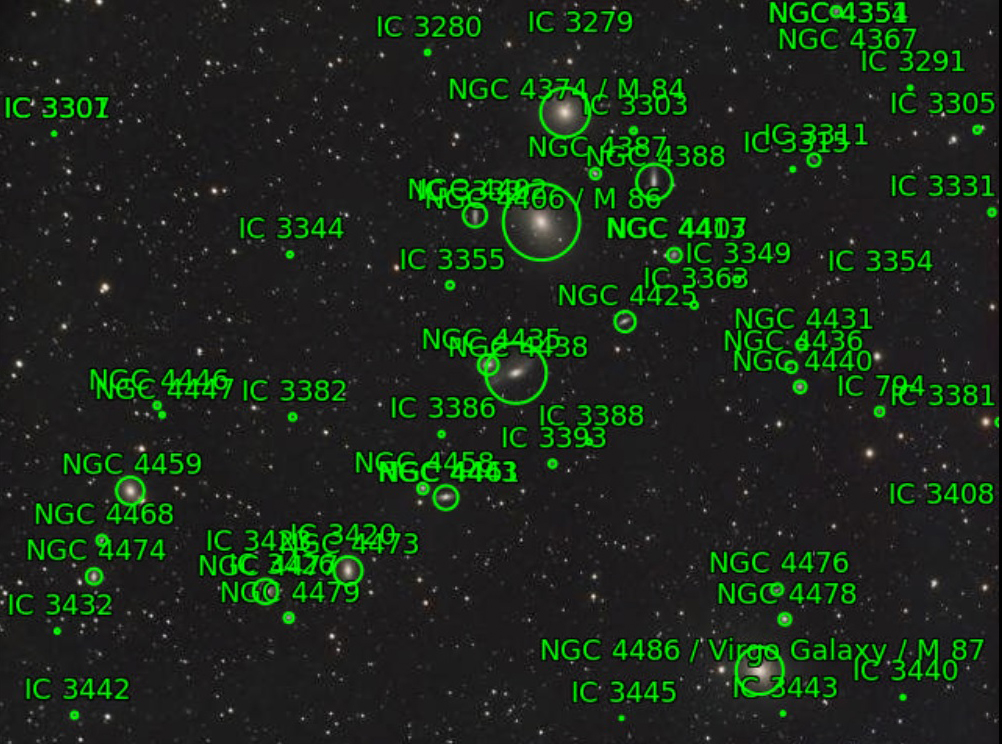
The new filters and nearly 7-hours integration time has resulted in a much more dynamic and detailed image, which I believe now does justice to this spectacular group of galaxies.  Analysis of the image using Astrometry.net shows just how crowded this area of Virgo is with galaxies (see annotated image above) but it is Markarian’s Chain that inevitably stands out together with a few other adjacent galaxies.

  • Large 10th magnitude M84 & M86 galaxies at the western end of the Chain dominate the image.  M84 is the object with the highest blue shift in the Messier catalogue, which is a result of its rapid movement (244km/sec) towards the centre of the Virgo Cluster and us.  At the centre of M84 is a 1.5 billion solar mass black hole.
  • NGC 4420 & NGC 4388 – by comparison these edge-on galaxies together with even smaller NGC 4413 & NGC 4425 seem to frame the larger M84 and M86.   
  • Next along the Chain is a pair of interacting galaxies, the smaller round shaped NGC 4435 and NGC 4438 with its distorted disk, known as “The Eyes”.                             
  • As the Chain starts to turn, some 20’ along is NGC 4458 and its partner, the 11th magnitude elliptical NGC 4461.
  • The final section of the Chain consists first of NGC 4473, its brightness generated by a supermassive black hole – at 100 million solar masses its diameter of 4.46au which would stretch from the Sun to the asteroid belt!  Thereafter the 11.4 magnitude barred lenticular galaxy NGC 4477 defines the north eastern extremity of Markarian’s Chain.
  • As previously noted, there are many other galaxies in this part of the Virgo Cluster.  Perhaps most notable though is M87, from which the first ever image of a black hole was the obtained in 2019 – consisting of some 6.5 billion solar masses.


All-in-all Markarian’s Chain makes for a rewarding image using my small telescope combined with the new Chroma filters.  Such is the nature of the image the galaxies might also suggest a string of pearls or perhaps galactic stepping stones – metaphorically leading to the next phase of my astroimaging journey.

 IMAGING DETAILS
ObjectMarkarian’s Chain
ConstellationVirgo & Coma Berenices
Distance50 – 55 million light-years
Size  ~2.5o total
Apparent MagnitudeVaries +10 to +12 approx.  
  
Scope William Optics GT81 + Focal Reducer FL 382mm  f4.72
MountSW AZ-EQ6 GT + EQASCOM computer control & Cartes du Ciel
GuidingWilliam Optics 50mm guide scope
 + Starlight Xpress Lodestar X2 camera & PHD2 guiding
CameraZWO1600MM-Cool mono  CMOS sensor
 FOV 2.65o x 2.0o Resolution 2.05”/pix  Max. image size 4,656 x 3,520 pix   
EFWZWOx8 EFW & 31mm Chroma LRGB filters 
Capture & ProcessingAstro Photography Tool + PHD2 +  Deep Sky Stacker, PixInsight v1.8.8-7, Photoshop CS3, Topaz Denoise
Image Location &           OrientationCentre  RA 12:27:46.65      DEC +13:03:06.44  @21.30h                      Left = North     
Exposures100 x 60 sec L , 54 x 60 sec R,  55 x 60 sec G&B Total Integration Time: 6hr 44 min     
 @ 139 Gain   21  Offset @ -20oC    
Calibration10 x 60 sec Darks  15 x  LRGB Flats & Dark Flats         @ ADU 25,000
Location & DarknessFairvale Observatory – Redhill – Surrey – UK        Typically Bortle 5-6
Date & Time5th & 6th April 2021  @ +21.00h  
WeatherApprox. <2oC   RH >=45%                  🌙 30% waning

Rosette Nebula – Chroma First Light

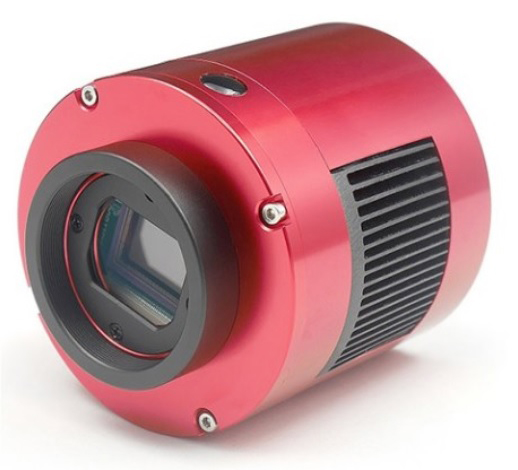
The history of astrophotography will record a period of rapid innovation during the past decade, amongst which one of the stand-out developments has been that of the CMOS sensor based camera, notably the ZWO ASI1600MM-Cool (see below).  Just look at any astrophotography website such as Astrobin and it won’t take long to find an image taken with this camera such is its popularity.  It is this very camera that I was fortunate to purchase in December 2016 shortly after its release and has been the core of my astrophotography set-up ever since. 

I have generally been very happy with the results achieved with the ZWO camera, although an issue sometimes occurs when imaging large stars, so called ‘star bloating’.  There are a number of theories discussed ad nauseam online why this might occur, of which microlensing and / or diffraction seems most likely and probably relates to either – the sensor, sensor cover or filters.  Since beginning with the ZWO camera I’ve used their excellent matching EFW with LRGB and 7nm narrowband filters.  Notwithstanding, the filters are considered to be somewhat ‘low end’ by the aficionados of such things and after living with the ZWO filters for some time, at considerable cost I recently decided to upgrade to a set of Chroma 31mm filters – LRGB + 3nm narrowband.  Together with Astrodon, Chroma filters are generally considered to be the best and my expectations were therefore high.

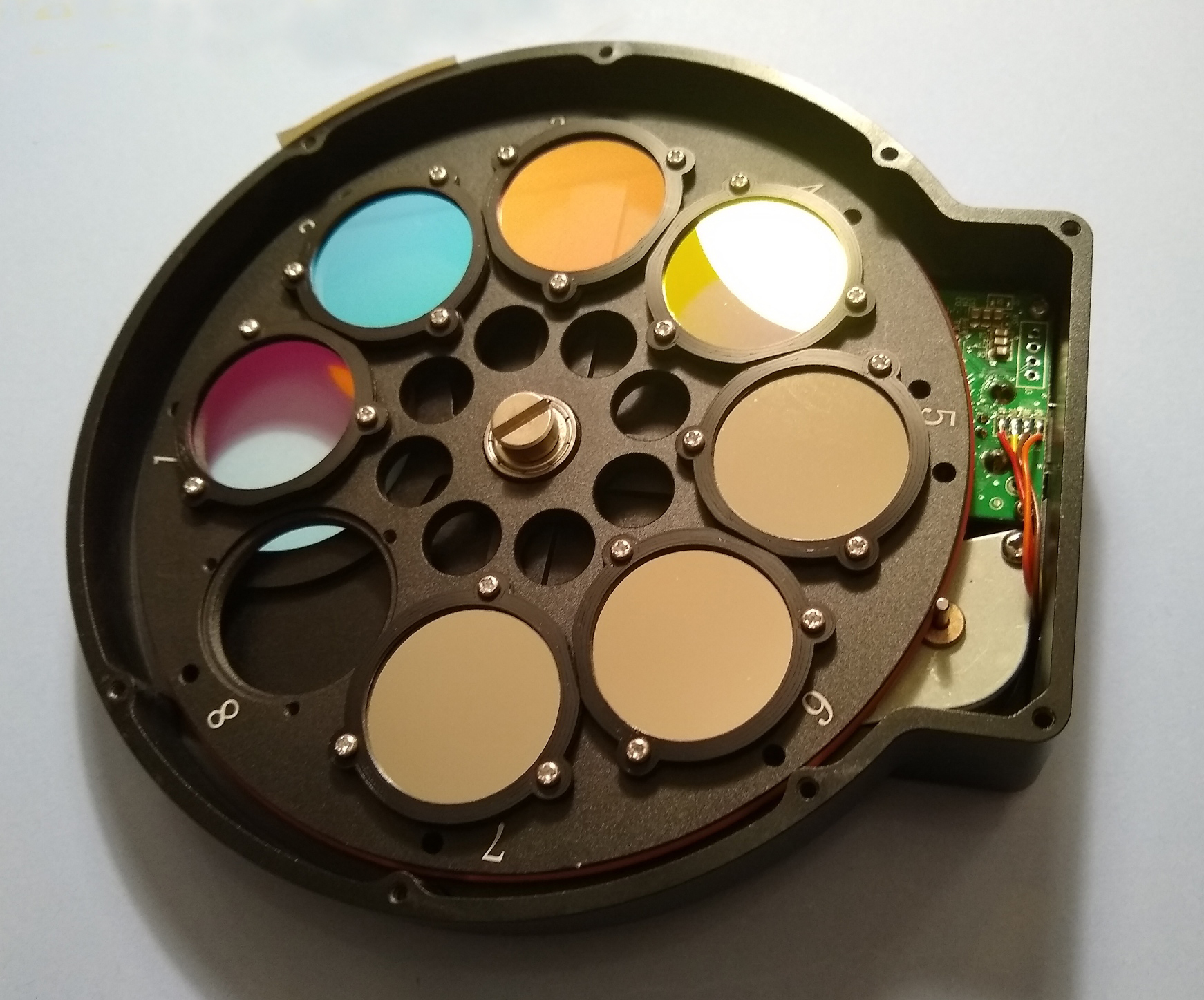
Being unmounted I’d previously found the ZWO filters tricky to install using the small screws and fibre washers supplied.  At 3mm Chroma are physically 1mm thicker than ZWO filters and also need to be fitted in a specific direction, which is ‘letters up’ or with top of the ID letters on the side of the filter facing towards the sensor; this is disputed by the manufacturer but there’s substantial first-hand experience online that suggests otherwise.  With these issues in mind I sought out bespoke filter masks and longer M2 6mm screws to hold the thicker filters firmly in place.  The 3D printed masks from Buckeyestargazer in the USA did a great job securing the filters and are better than those from ZWO – the internal edge of the mask forms an L-shaped ledge into which the filter fits snuggly.  Ready to go, I then had to wait nearly 4-months before the clouds parted to try out these expensive pieces of glass and then it was a full moon – I often wonder if astrophotography is a good hobby to choose in the United Kingdom but it’s too late now?

Chroma filters secured with Buckeyestargazer masks and ready to go

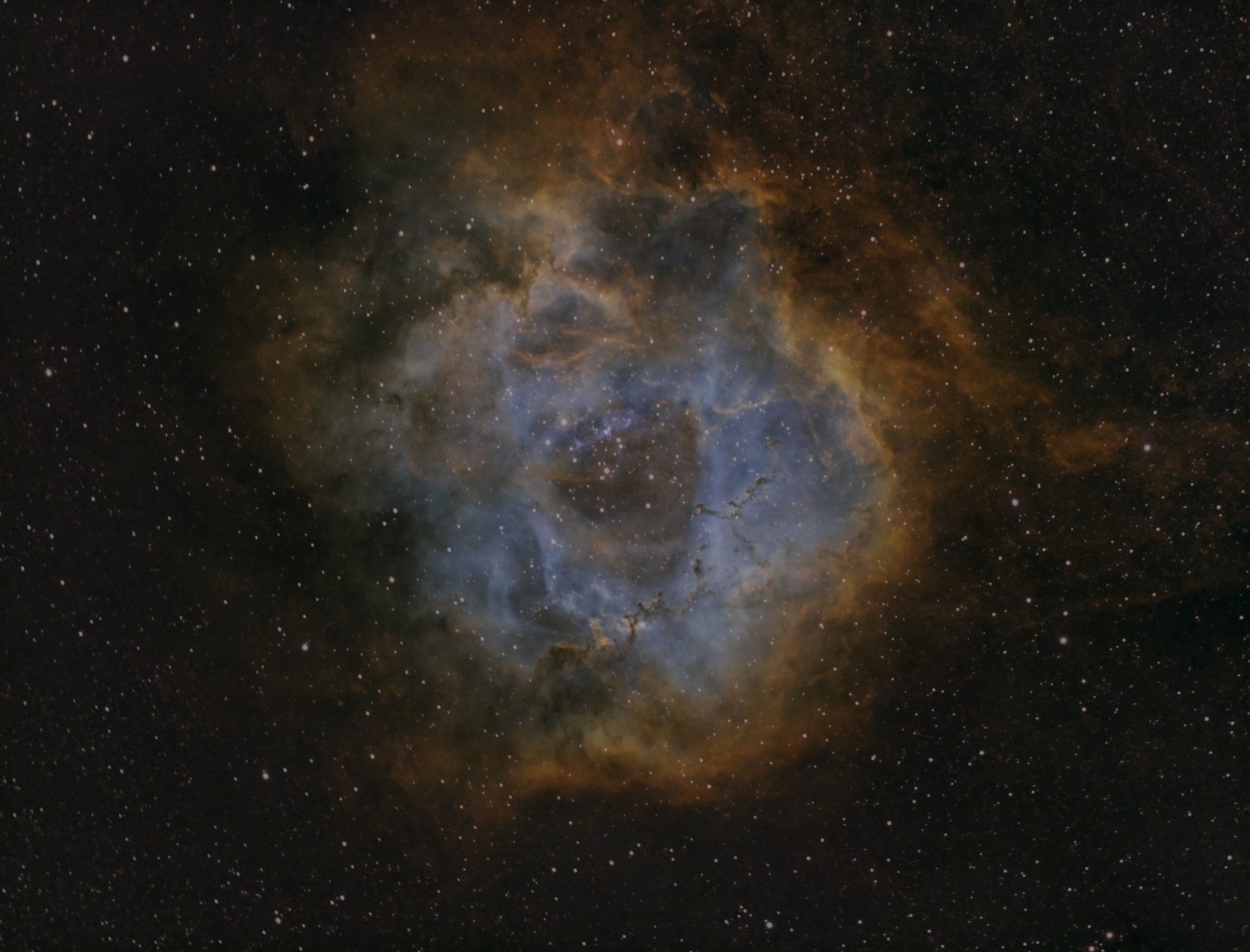
Given the presence of the moon it therefore had to be suitable narrowband target and after three years since I’d last imaged this object it was an opportunity to have another go at NGC 2244 AKA the Rosette Nebula, though being late February there was limited time each night before the object sunk low behind trees on the western horizon; coincidentally the ZWO ASI1600MM-Cool First Light in early 2017 was also the Rosette.  Before starting serious imaging I first tried some test shots to make sure everything worked OK and immediately discovered that the change from 7nm to 3nm had a significant impact on light gathering, thus requiring greater exposure times of an unprecedented 10 minutes.  Not surprisingly this was also apparent when taking flats which increased exposure time of up to x10 longer in duration compared to the ZWO filters; conversely preliminary but limited tests on the broadband filters seem to indicate greater transparency and thus shorter exposures, time will tell if this is correct.

So was it all worth it?  I’m very pleased with the final image which was processed using the SHO Hubble Palette with PixInsight and Photoshop (see top of the page).  There are a number of significant bright stars in and around the Rosette which the Chroma filters have handled well but overall it is the more delicate tone that has been achieved which is most pleasing.  Fundamentally the 3nm filters have produced a more subtle quality to the overall image and in particular the nebulosity.  In addition, applying Hartmut Bornemann’s excellent colour calibration script AutoColor for the first time (see Visible Dark’s video tutorial here) has resulted in a soft but exciting colour palette. 

Subsequently I have focussed on the inner region of the nebula which contains the so-called ‘Carnival of Animals’ (see above), which has been cropped and reprocessed individually to show-off the ‘animals’ or Bok globules –   named after the Dutch-American astronomer Bart Bok, who in 1947 proposed that these dark nebula indicated clouds of dust undergoing gravitational collapse as part of the process of new star formation, which has since been confirmed.  In conclusion I’d therefore say that despite the obstacles, issues and long wait, on the evidence so far the addition of the Chroma filters to my set-up has been very successful – transformative in fact.  Now I wonder if they make something that removes the clouds?  

 IMAGING DETAILS
ObjectNGC 2244 + 2337 + 2238 + 2239 + 2246  AKA the Rosette Nebula
ConstellationMonoceros
Distance5,200 light-years
Size65 light-years
Apparent Magnitude9
  
Scope William Optics GT81 + Focal Reducer FL 382mm  f4.72
MountSW AZ-EQ6 GT + EQASCOM computer control & Cartes du Ciel
GuidingWilliam Optics 50mm guide scope
 + Starlight Xpress Lodestar X2 camera & PHD2 guiding
CameraZWO1600MM-Cool mono  CMOS sensor
 FOV 2.65o x 2.0o Resolution 2.05”/pix  Max. image size 4,656 x 3,520 pix   
EFWZWO EFW + Chroma Ha, OIII & SII 3nm filters 
Capture & ProcessingAstro Photography Tool + PHD2 +  Deep Sky Stacker & Photoshop CS3
Image Location              & OrientationCentre  RA 06:31:52.688      DEC 04:58:11.11                        Top = North     
Exposures12 x 600 sec  Ha & SII  11 x 600 sec OIII Total Time:  5hr 50 min   
 @ 139 Gain   21  Offset @ -20oC    
Calibration5 x 600 sec Ha + OIII + SII   Darks 20 x 1/4000 sec Bias  &  15 x  Ha + OIII + SII Flats & Dark Flats               @ ADU 25,000
Location & DarknessFairvale Observatory – Redhill – Surrey – UK        Typically Bortle 5-6
Date & Time26th 27th 28th February 2021  @ +21.15h  
WeatherApprox. <5oC   RH >=65%                  🌙 100% Full Moon

Orion In A New Light

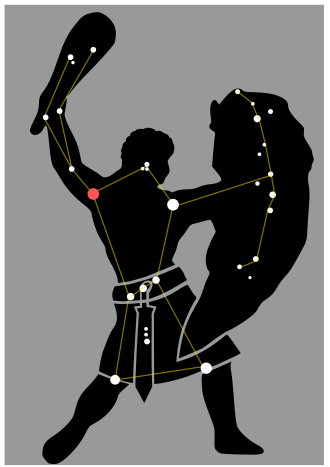
In ancient history Orion’s stars were considered to form a pattern that resembled a hunter holding a club above with his right arm and a shield in front with his left.  The appearance of Orion each year marks the highlight of the astronomy for many including me but for the second year running months of continuous cloud have precluded any astronomy since October; I note from comments online far-and-wide that this phenomenon has prevailed across much of the northern hemisphere, no doubt resulting in a lot of unhappy astronomers.

The Anantomy of Orion

Finally the clouds briefly relented over Fairvale Observatory in February but only for a few hours each time, thus eliminating the possibility of imaging with a CMOS mono camera.  Faced with these problems I therefore returned to my somewhat neglected modded Canon 550D camera and suitable lenses for appropriate widefield compositions, in order to image some classic targets around the Orion constellation in a broader context.  Having first whetted my appetite with the Samyang 135 f2 and its large 9.45o x 6.30o FOV to successfully image the iconic area that encompasses Orion’s belt, the Horsehead Nebula and M42 (see Going Big), it was time to go really big in order to capture the entire constellation literally and figuratively in a new light.

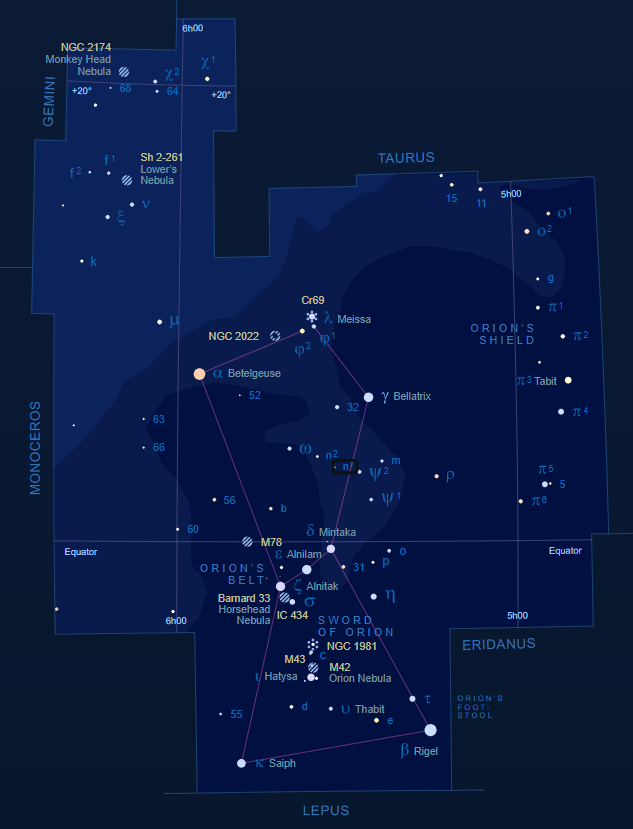
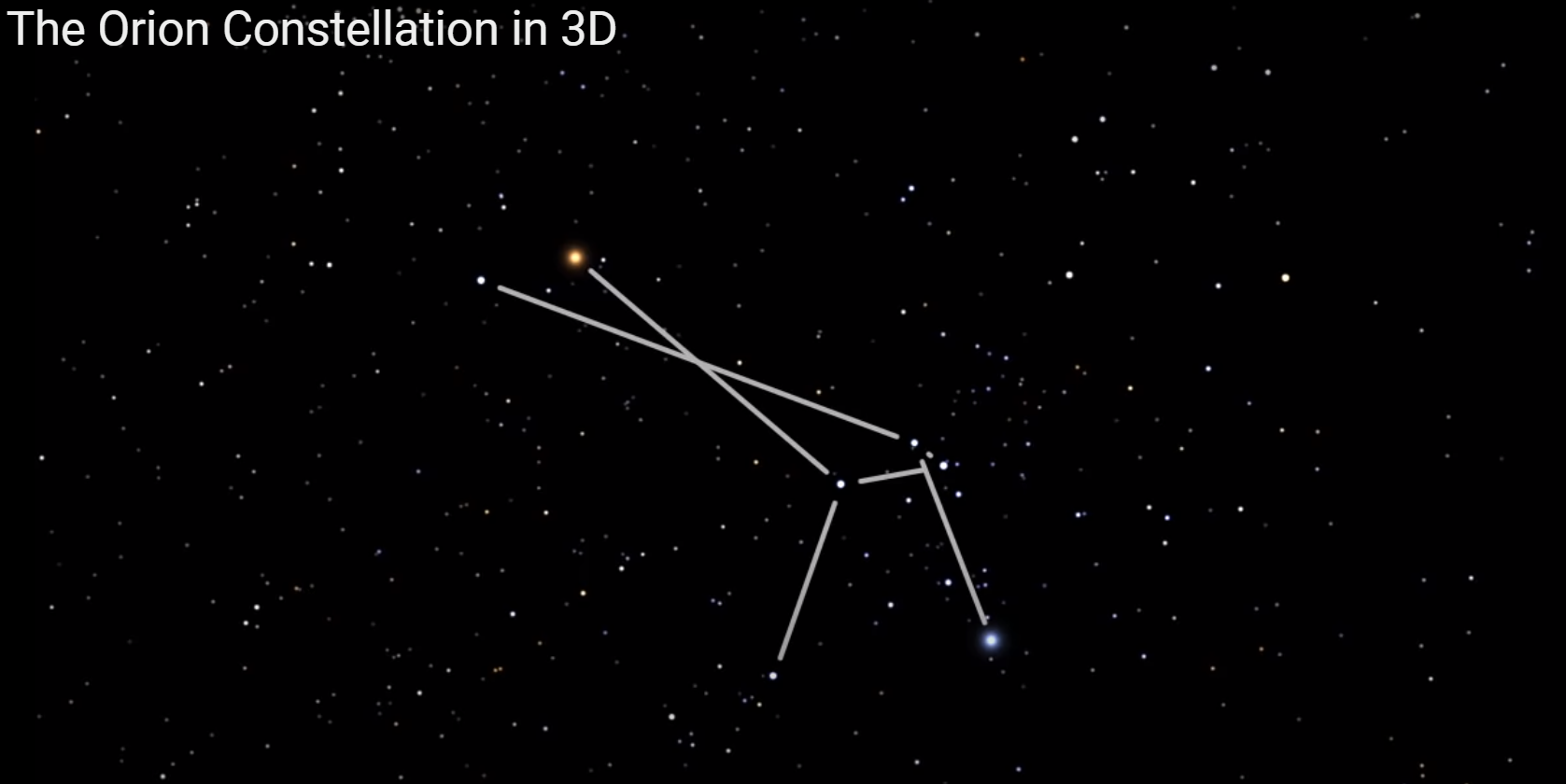
Seven bright stars define the area which outlines the torso and upper legs of Orion the Hunter: Betelgeuse, Bellatrix, Rigel and Saiph at the top and bottom, connected across the centre by his ‘belt’ formed from Alnitak, Alnilam and Mintaka.  The H-shape thus created by these stars is a familiar sight over the winter months but like so many asterisms of the night sky all is not what it seems.  Plotting the distance from Earth of each star it is immediately obvious that their spatial relationship significantly changes the shape of the constellation compared to what as we perceive by eye.  It is a sobering thought that with the passage of time those asterisms familiar to astronomers today will look very different in the future as the stars move though space and therefore continue to change their relative positions, look and shape.          

StarBetelgeuseBellatrixRigelSaiphAlnitakAlnilamMintaka
Distance from Earth* (light years)  643  243  772  724  800  1,359  900
*Source: Royal Greenwich Observatory

Click HERE for annotated version of the Orion Constellation in 3D ref. Space Science Telescope Instititue

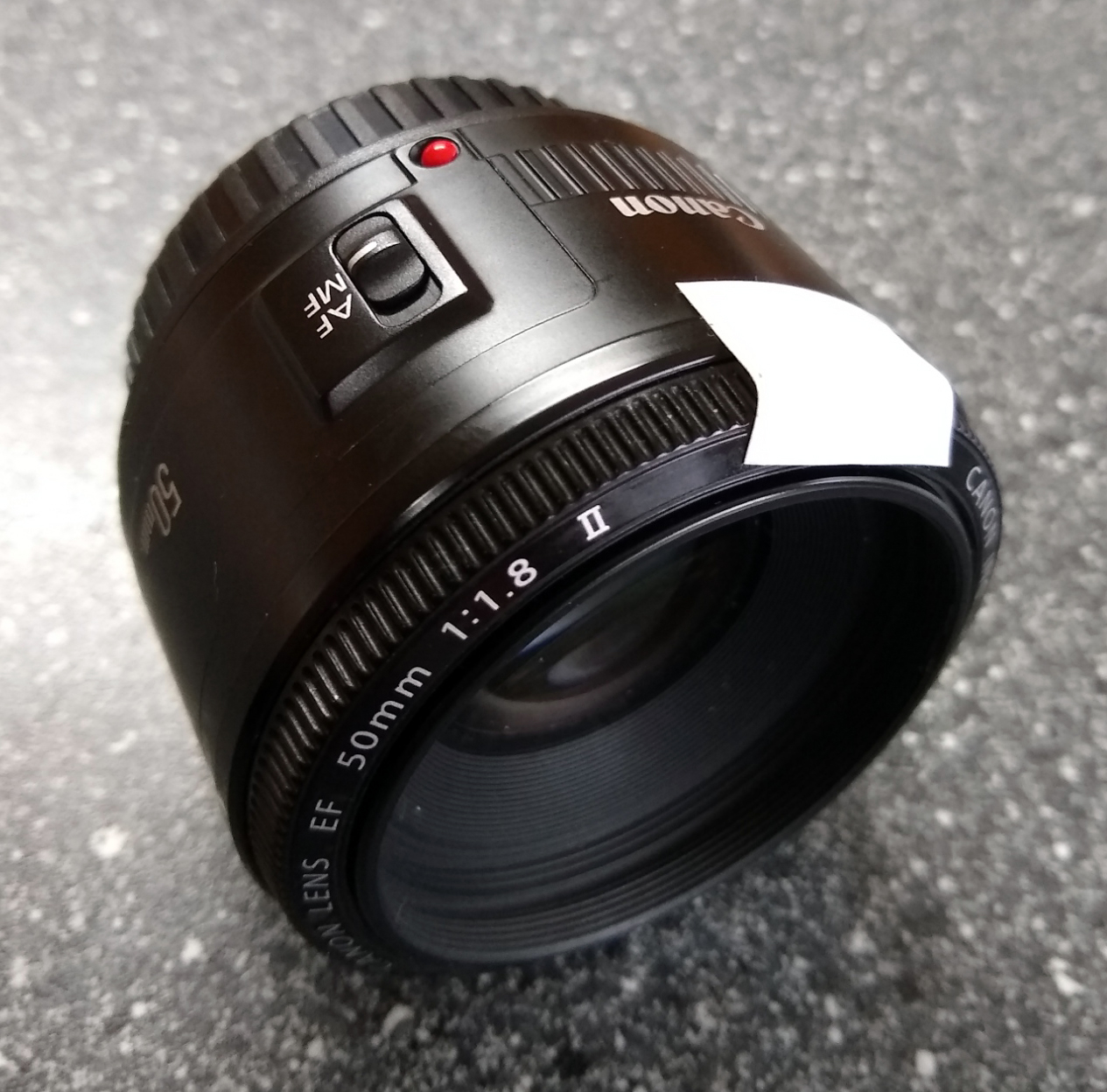
The Canon ‘Nifty Fifty’ 50mm f1.8 fixed aperture lens is perfect for an ultra widefield image of Orion. Whilst the glass is excellent, focus leaves a lot to be desired and once achieved needs to be secured with tape

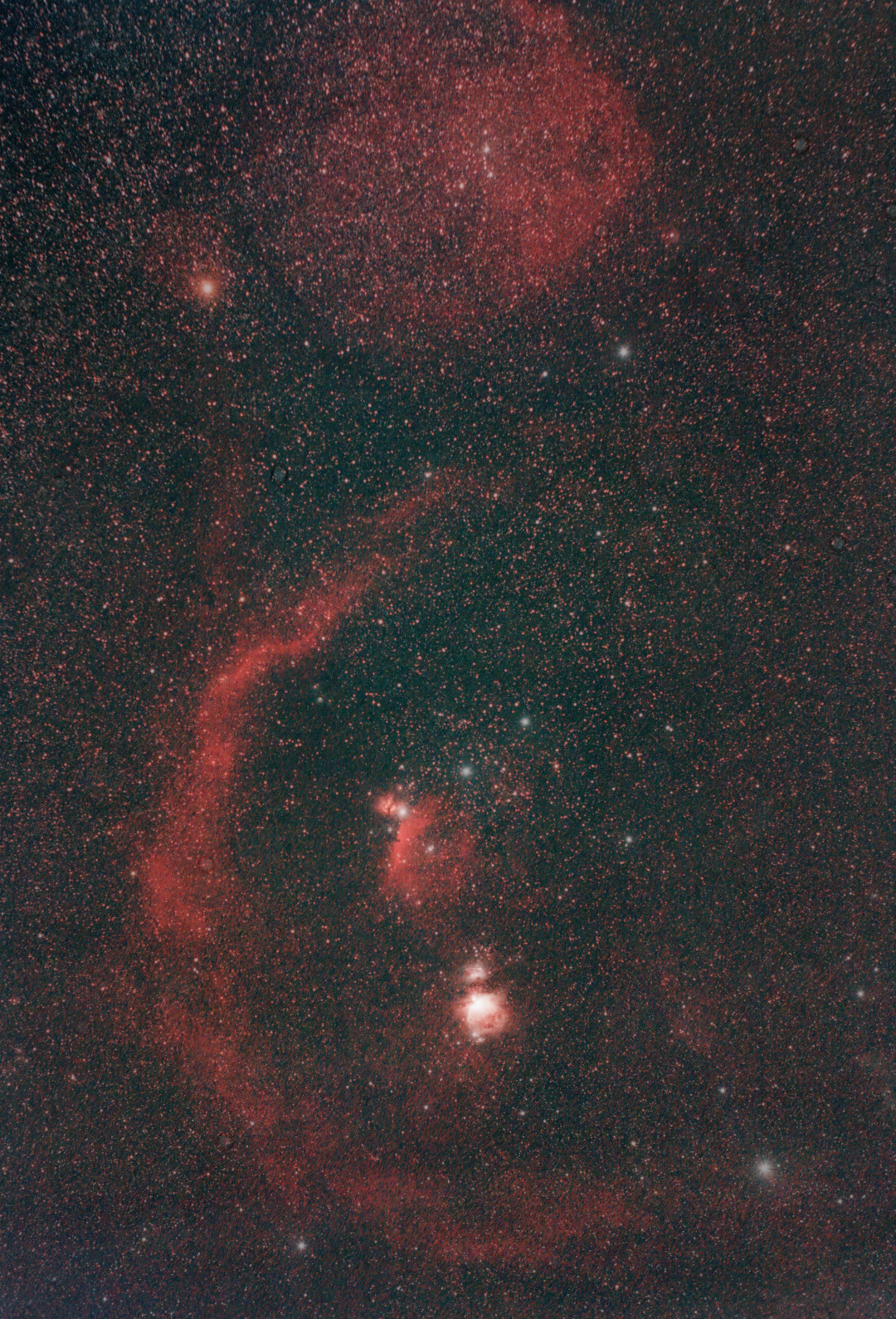
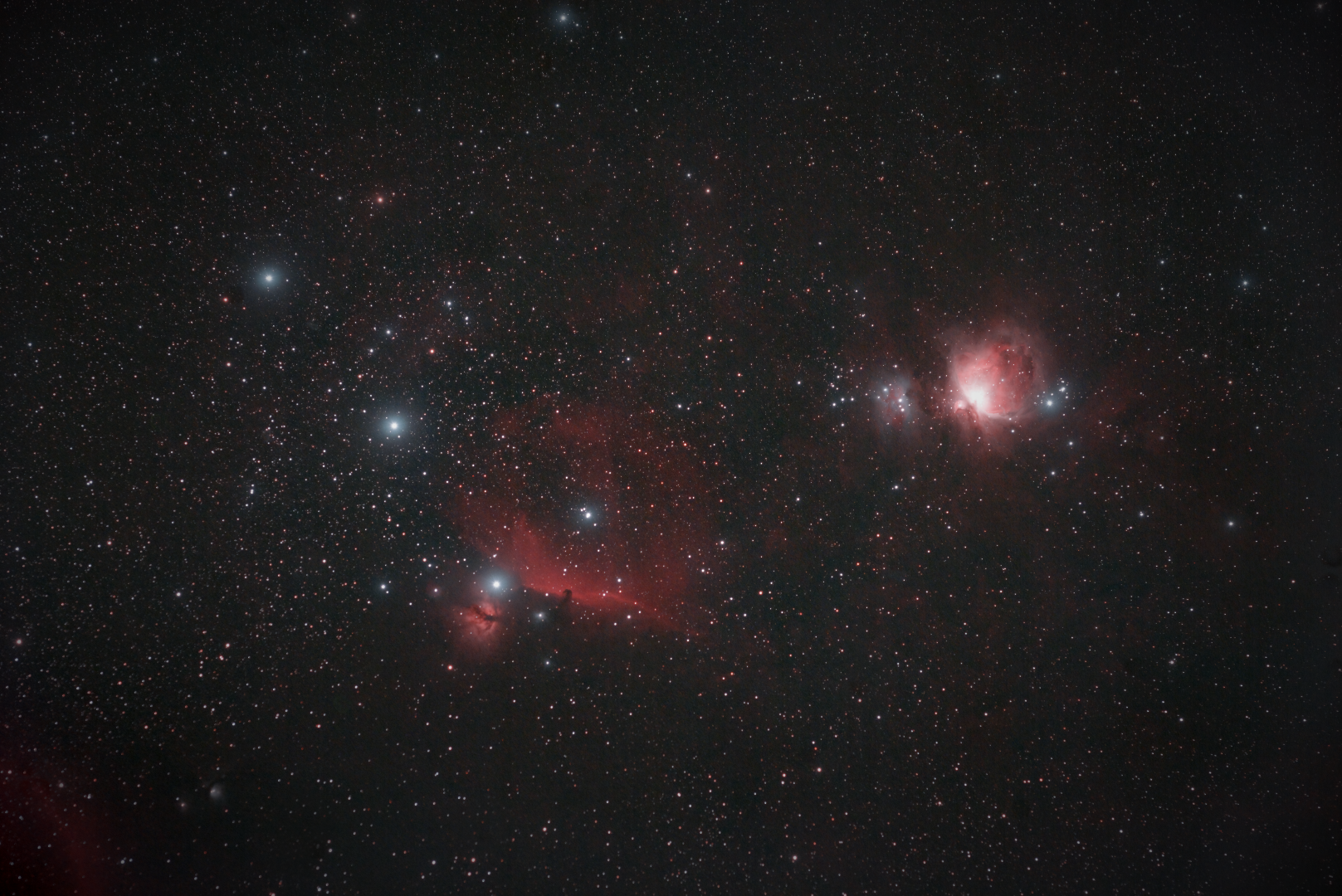
Aside from the said visual perspective of Orion, like so much of space we only see a fraction of what is really present in the Universe but can nevertheless often be disclosed by astrophotography.  And so I next decided to image the entirety of Orion, this time with a basic Canon 1.8 50mm lens – the so called “nifty fifty”- with the purpose of capturing in one shot the constellation with which we are all familiar, together with vast spectacular HII-regions that encompass much of the constellation but usually remain unseen. This camera-lens combination provides an enormous 25.5o x 17.0o field-of-view (x7 > Samyang lens, x83 William Optics GT81!) albeit with lower resolution, which perfectly encompasses most of Orion and therefore the entire arc of Barnard’s Loop on the left and the Angelfish Nebula (Orion’s “head”) located above and between Betelgeuse and Bellatrix. 

Above: Orion constellation from Fairvale Observatory 24th December 2014 (Left) compared with long exposure image + modded camera 10th February 2020 (right)

Barnard’s Loop is an emission nebula, forming part of the Orion Molecular Cloud Complex which also contains the dark Horsehead and bright Great Orion Nebulae M42.  The Loop is believed to have originated from a supernova explosion about 2 million years ago, which is now ionized by stars from within and around the Orion Nebula and takes the form of a large arc centred approximately on the Orion Nebula. Discovered and photographed by E. E. Barnard in 1894, this vast feature extends over some about 600 arcminutes when viewed from Earth or physically up to 300 light years across, depending on the distance from Earth.

The Angelfish Nebula SH2-264 is centred on the young star cluster of Lamda Orionis, of which Meissa is the brightest. An HII-region with an apparent size of 5 degrees and actual size of 150 light years, it is also an emission nebula that is energised by the aforesaid star cluster and is considered to form the so-called head of Orion.

Having previously imaged notable parts throughout Orion, I’ve long wanted to capture the full extent of this wonderful constellation in all its glory and am very pleased with the outcome on this occasion.

DSLR IMAGING DETAILS*
ObjectOrion Constellation
ConstellationOrion
Distance243 to 1,360 light-years
Size594o2
Apparent MagnitudeVaries
  
Lens / Scope Canon 50mm f1.8  
MountSW AZ-EQ6 GT + EQASCOM computer control & Cartes du Ciel
GuidingNo Guiding
CameraCanon 550D modified
 FOV 25.5o x 17.7o Resolution 17.72”/ pixel      
Capture & ProcessingAstro Photography Tool + PHD2 Deep Sky Stacker, PixInsight, Photoshop CS3 & Topaz Denoise AI
Image Location &        OrientationCentre  RA 05:37:37.3      DEC +00:48:50.26         
Top = North    Right = West     
Exposures & Aperture42 x 120 sec  @ ISO800 Total: 1hr 24 min F1.8   
Calibration5 x 120’ Darks,  20 x 1/4000 sec Bias  20 x Flats         
Location & DarknessFairvale Observatory – Redhill – Surrey – UK        Typically Bortle 5-6
Date & Time10th February 2021  @ +21.00h  
WeatherApprox. <=0oC   RH <=65%                  🌙 NEW MOON

*For higher resolution and plate-solving data go to Astrobin HERE and click on image

Going Big – Widefield Imaging

After considering the limitations created by UK weather, I chose to purchase a Samyang 135 f/2 lens last year, rather than typically moving to a larger aperture / focal length scope.  Unfortunately because of the aforesaid poor weather conditions that have since prevailed its use has so far been restricted.  However, after literally months at last the clouds briefly relented over Surrey recently and I was able to get a couple of hours imaging the Orion constellation.

I really enjoy the widefield aspect of astrophotography, particularly without resorting to a mosaic which is too often impractical given the lack of favourable imaging conditions in the UK.  Such images can produce another perspective of favourite targets previously imaged with a telescope or are just fascinating in their own right.  For the moment I’m using the Samyang lens at f2.8 with a modded Canon 550D, manual focus and no guiding but eventually intend to pair it with a mono CMOS camera.  This combination results in a whopping 9.45o x 6.30o field-of-view, no-less than 11x that of my standard William Optics GT81 and ZWO1600 set-up.  Whilst using the lens at its maximum f/2.0 aperture would be even better, stopping down to f2.8 improves focus quality and removes any possibility of vignetting.

In this instance I chose to frame the image around the area of Orion’s Belt and the Great Orion Nebula M42 but such is the lens’ extensive field-of-view that M78 and part of Barnard’s Loop have also sneaked into the lower left corner.  Even though this was something of a ‘quick & dirty’ session resulting in just 112 minutes integration time, looking closer at M42 (see cropped version) the detail and colours achieved with this lens has far exceeded my expectations.   As well as the detail of M42 and the Horsehead Nebula, I’m also impressed at how well the lens has dealt with the usually difficult large bright stars of Orion’s Belt & others in the image. 

The quality produced with this small lens is quite extraordinary and it is definitely one of my star astronomy purchases.  Going forwards the challenge will be to find suitable targets that can fill its very large field-of-view, as well the inevitable wait for clear skies!

DSLR IMAGING DETAILS*
ObjectOrion: M42, Horsehead, M78 & Barnard’s Loop
ConstellationOrion
Distance243 to 1,360 light-years
Size594o2
Apparent MagnitudeVaries
  
Lens / Scope Samyang 135 f/2  
MountSW AZ-EQ6 GT + EQASCOM computer control & Cartes du Ciel
GuidingNo Guiding
CameraCanon 550D modified
 FOV 9.45o x 6.30o Resolution 6.45”/pix      
Capture & ProcessingAstro Photography Tool + PHD2 Deep Sky Stacker, PixInsight, Photoshop CS3 & Topaz Denoise AI
Image Location  &             OrientationCentre  RA 05:36:48      DEC -03:11:30.4               
Right = North   Top = West     
Exposures & Aperture56 x 120 sec  @ ISO800 Total: 1hr 52 min F2.8   
Calibration5 x 120’ Darks,  20 x 1/4000 sec Bias  20 x Flats         
Location & DarknessFairvale Observatory – Redhill – Surrey – UK        Typically Bortle 5-6
Date & Time3rd February 2021  @ +22.00h  
WeatherApprox. 6oC   RH +85%                  🌙 67% waning
*For high resoluton image go to Astrobin HERE and click on image

Image Redux

An astrophotography image is clearly the sum of its parts, which can broadly be defined as: Equipment – Image Capture – Processing.  Much attention and money is given to the first two items but it’s easy to overlook the importance of processing, I should know I’ve done it for years!  With time on my hands this year during Covid-19 & lockdown, I have at last turned my attention to this most critical of items to very good effect.  Hitherto I’ve used Deep Sky Stacker (DSS) for calibration & stacking, before moving to Photoshop for all other processing, which has usually produced satisfactory results.  However, I’ve often thought more might be obtained from the data by using more powerful software combined with an improvement of my overall skills.

On taking up astrophotography it’s a shock when first looking at the camera’s data, which will usually produce a dark almost featureless image, represented by a very narrow, steep image histogram – a graphical representation of the tone and light collected by the exposures.  This is because most of the image of the night sky will of course be dark, with precious few photons arriving from distant objects being photographed contained only within the said narrow histogram – the trick is to tease them out during processing in the so-called digital darkroom, thereby revealing the image within. 

In the right hands Photoshop is an excellent tool for post processing but it’s no coincidence that most accomplished astrophotographers are using PixInsight (PI), for good reason: it is dedicated to astrophotography, is very powerful, whilst at the same time being very flexible.  Unfortunately the learning curve for PixInsight is steep but from my recent experience very much worth the effort.  Metaphorically speaking, I’m in the foothills of using PixInsight but now with sufficient knowledge to process images from start to finish, I have already successfully tackled complex LRGB images LBN 325 and NGC 6194.  Subsequently I’ve turned my attention to re-processing old narrowband data, which first time round produced unsatisfactory results using Photoshop; this being as much the user as anything else.

Whilst PixInsight was the principal software for this re-processing, it was used in conjunction with Photoshop to achieve certain affects and other newly acquired dedicated software for specific tasks: Starnet++ to produce starless images and Topaz Denoise AI for noise reduction and sharpening. Using the HST palette in all cases, the workflow (see table at the end) was adapted for each image depending on the characteristics of the object.  Before (top) and after (below) images are shown beneath, together with links to the original blogs for more background and imaging information.

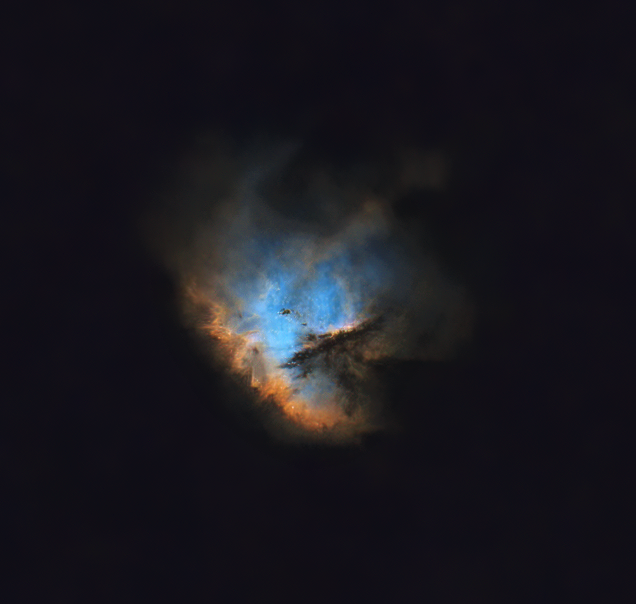
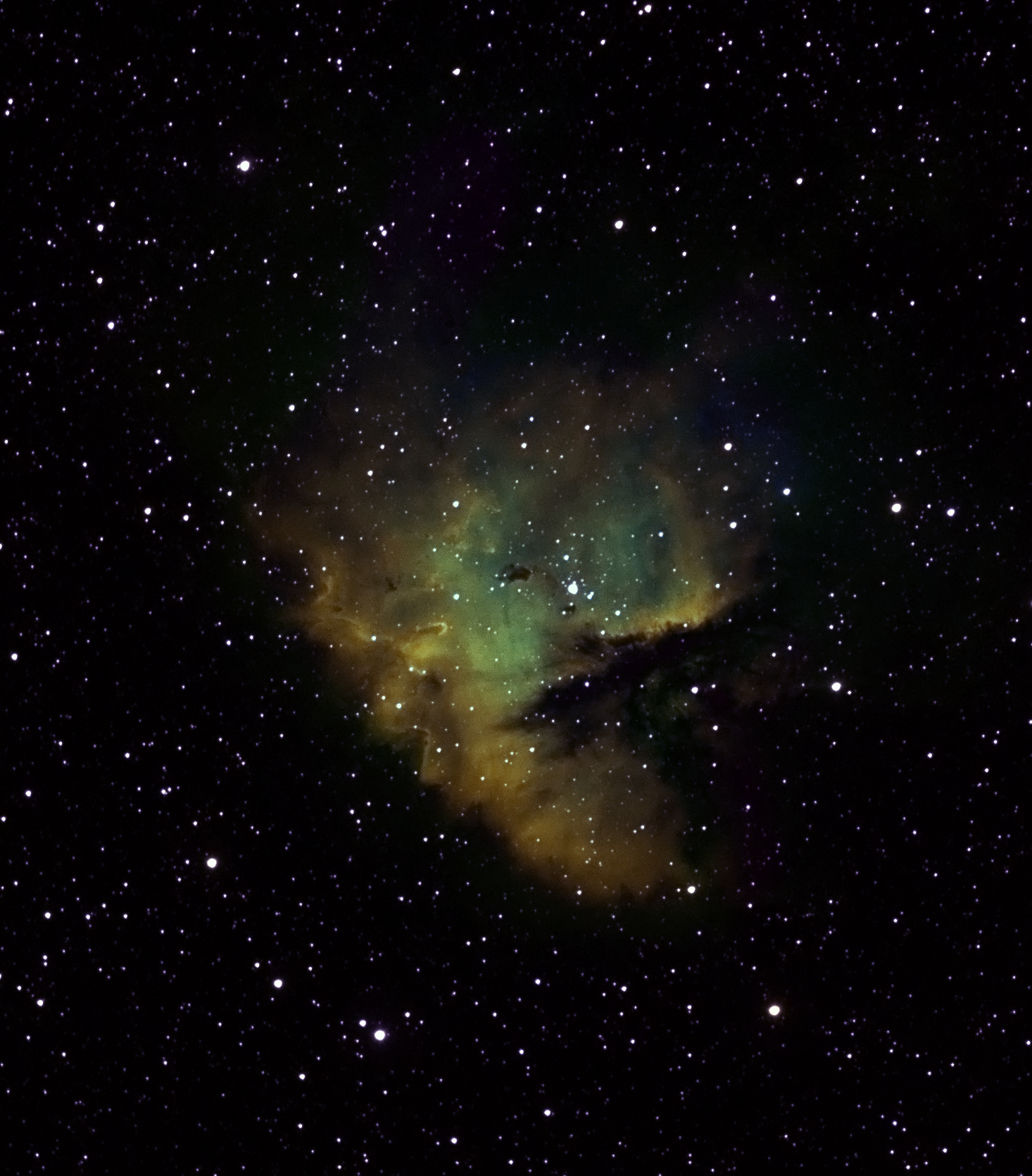
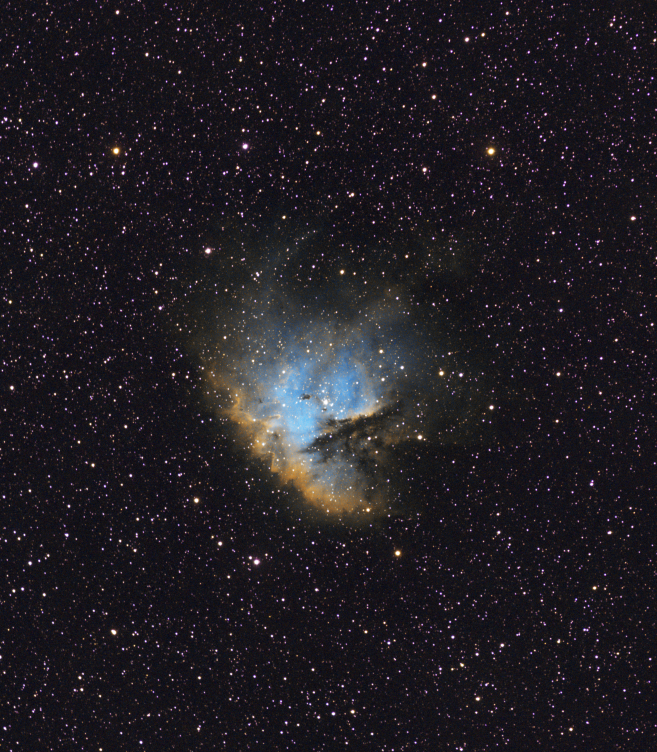
NGC 281 Pacman Nebula, August 2019:  Whilst the initial HaOO bicolour image looked good I struggled to do the same with the SHO version.  However, the transformation after re-processing with PI is, as they say – a whole new ballgame.  Vibrant colours have emerged from the previous somewhat gloomy image, together with detailed internal structures.  Although somewhat artistic in character, I particularly like the starless version which is shown at the top of the page.

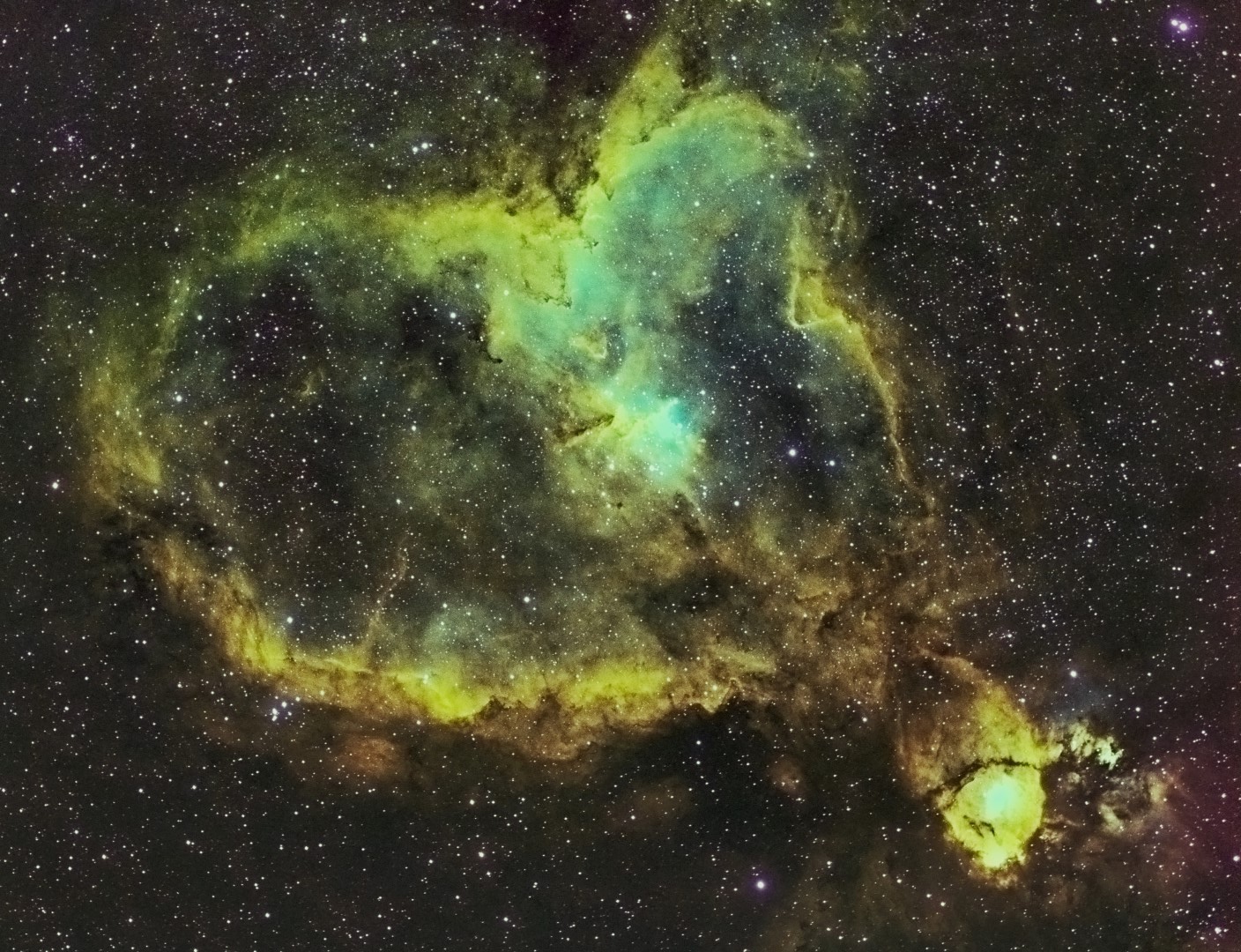
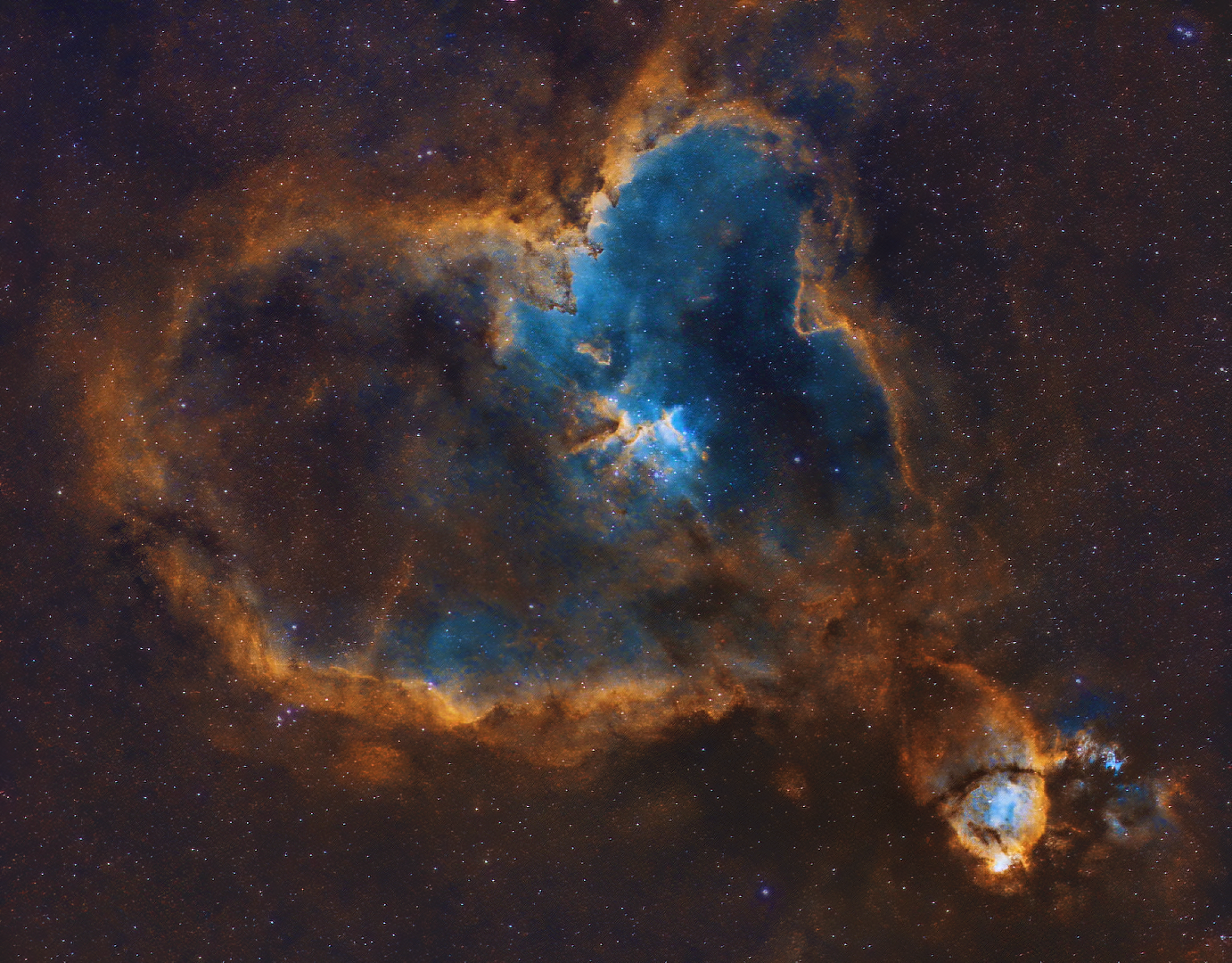
IC 1805 Heart Nebula, August 2018:  Like Pacman the original bicolour processing was also successful but SHO much less so.  Re-processing has brought out warm colours and details around the inner edge of the heart-shaped nebulosity but it is the striking blue inner region which highlights Melotte-15 at the centre that steals the show.  Here fierce stellar forces associated with superhot, young open star clusters, model the adjacent dust clouds into features analogous to those of the Eagle Nebula’s Pillars of Creation.

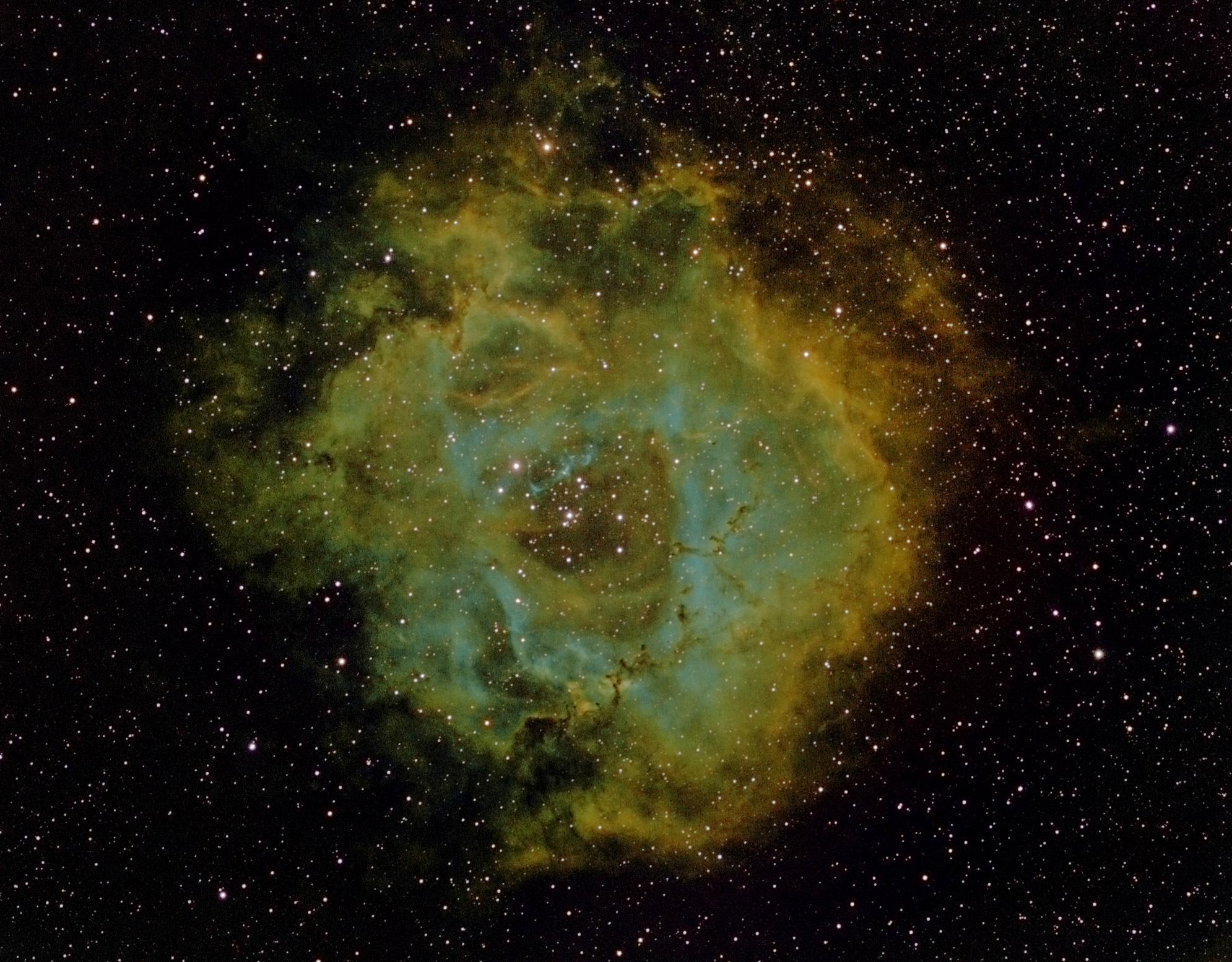
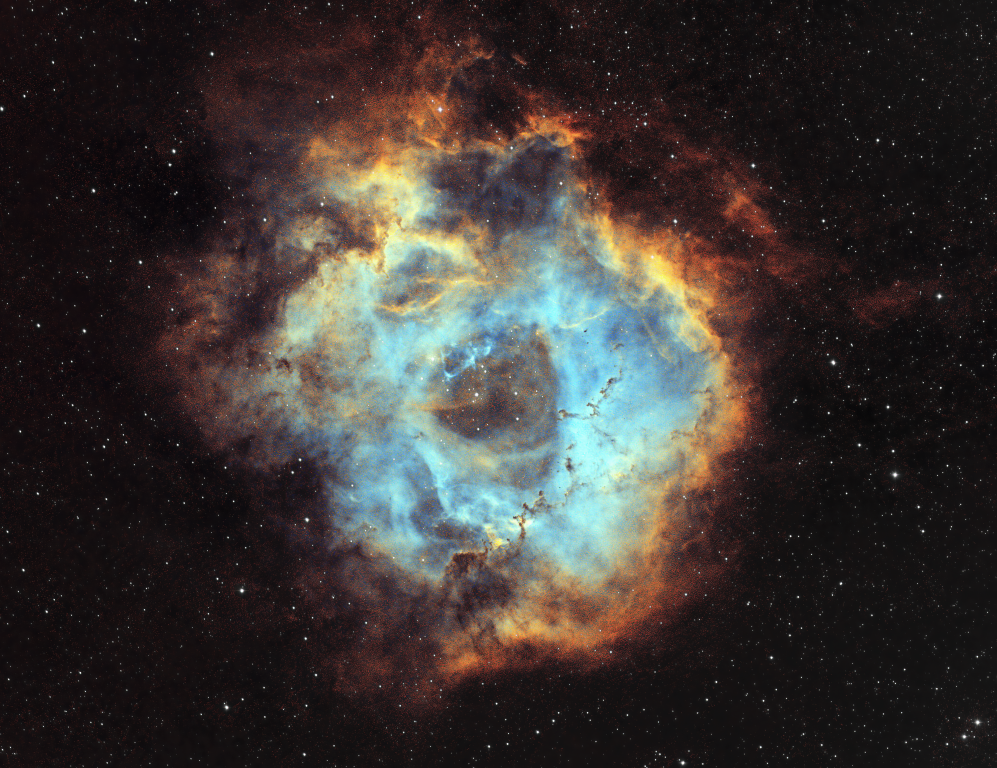
NGC 2244 Rosette Nebula, February 2018: The Rosette was the most difficult data to re-process and therefore turned out to be the most satisfying.  Similar to the Heart Nebula, the rose-like dark nebulous outer region and bright inner edge frames the dramatic, somewhat translucent pale blue inner area.  Therein billowing, cloud-like blue nebulosity shows off various internal features, which include an open star cluster at the centre and the so-called Carnival of Animals marching across the lower right quadrant.  Altogether new processing has transformed this image into something rather special.        

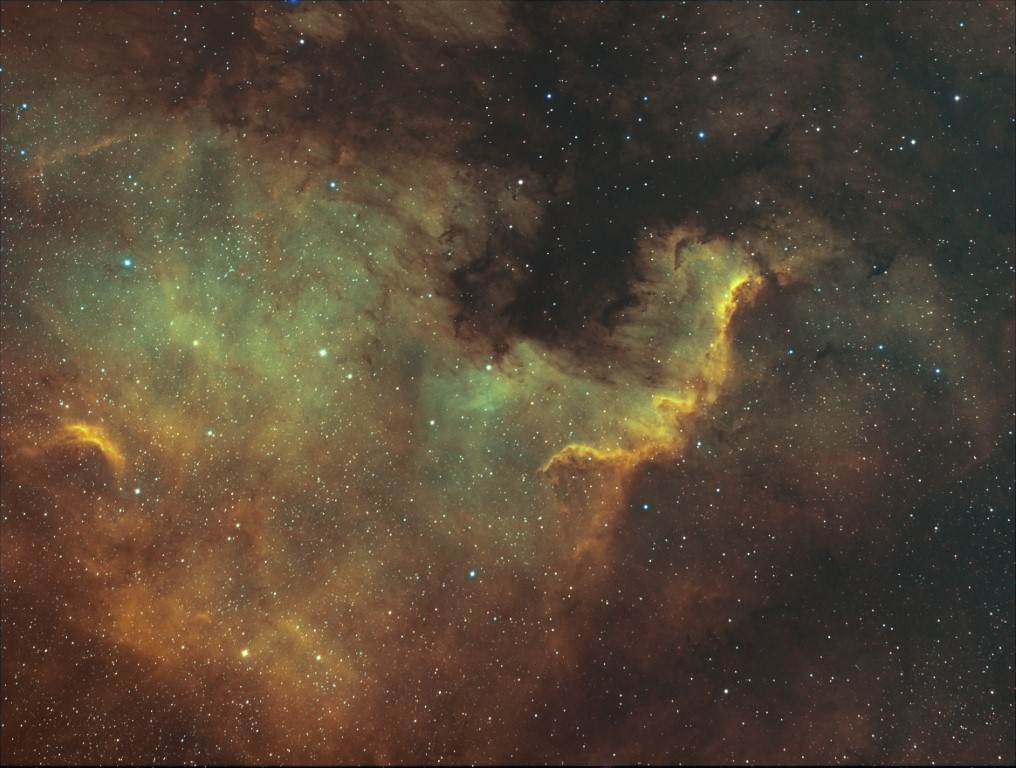
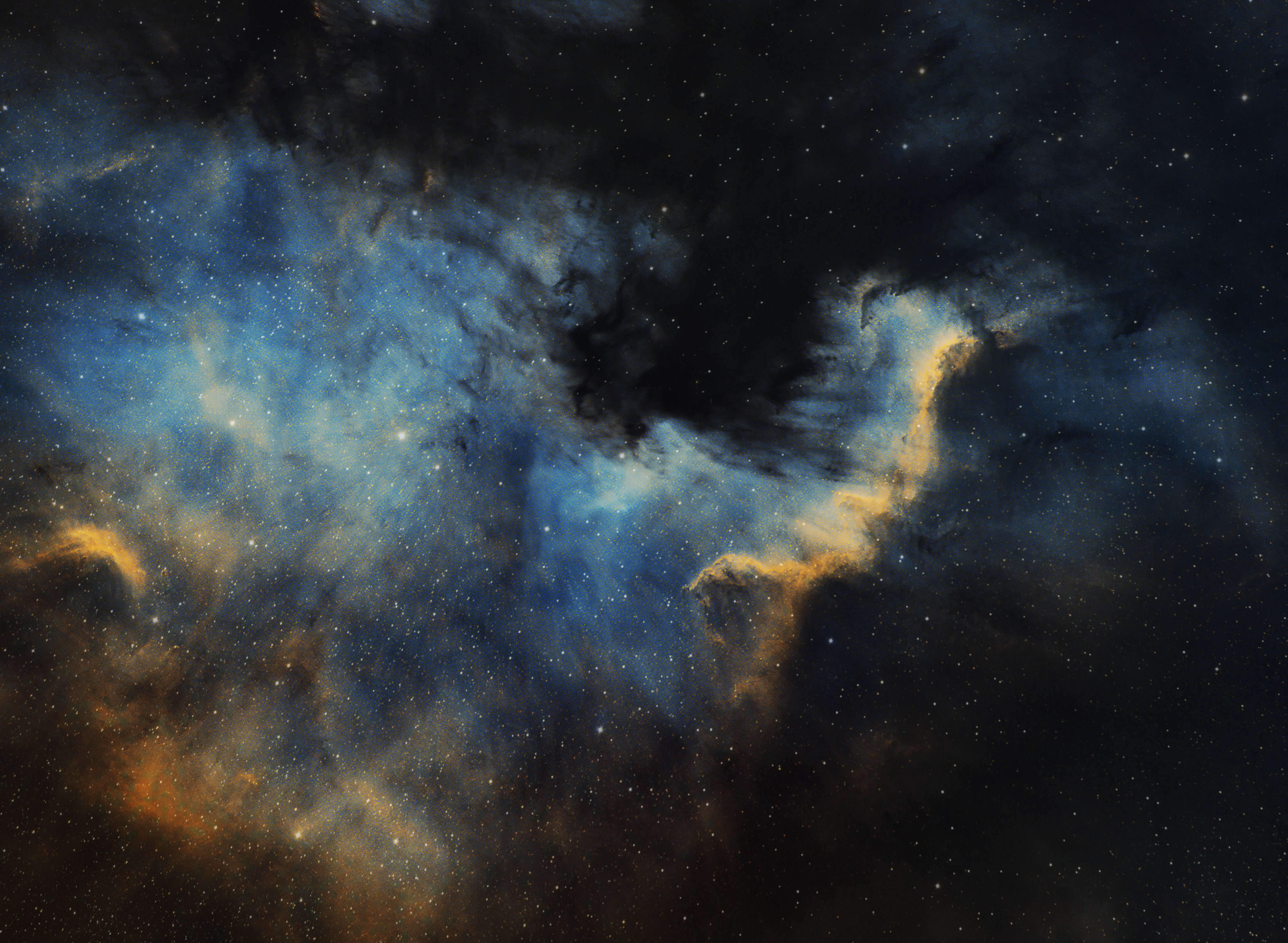
NGC 7000 North America Nebula, August 2017:  Although very happy with the original SHO image processed using Photoshop, the revised version is not so much better but different.  Use of the SCNR function and subsequent PI and Photoshop colour adjustments have introduced greater detail overall, as well as produced more delicate colours, especially the diaphanous blue  nebulosity around the ‘Gulf of Mexico’

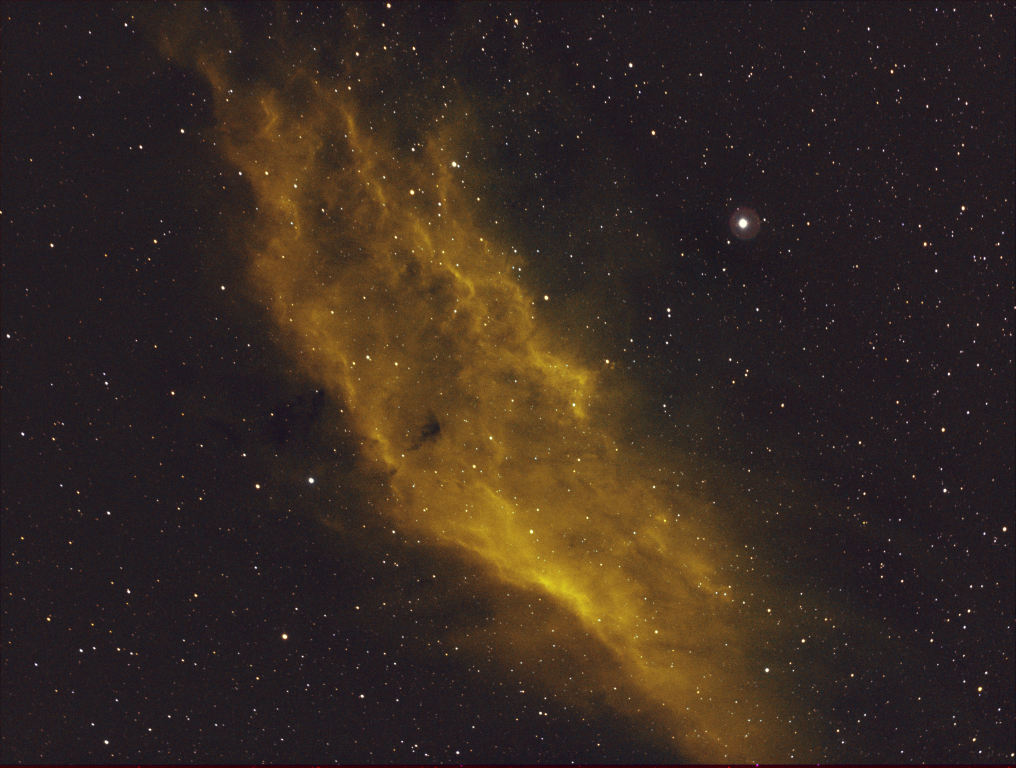
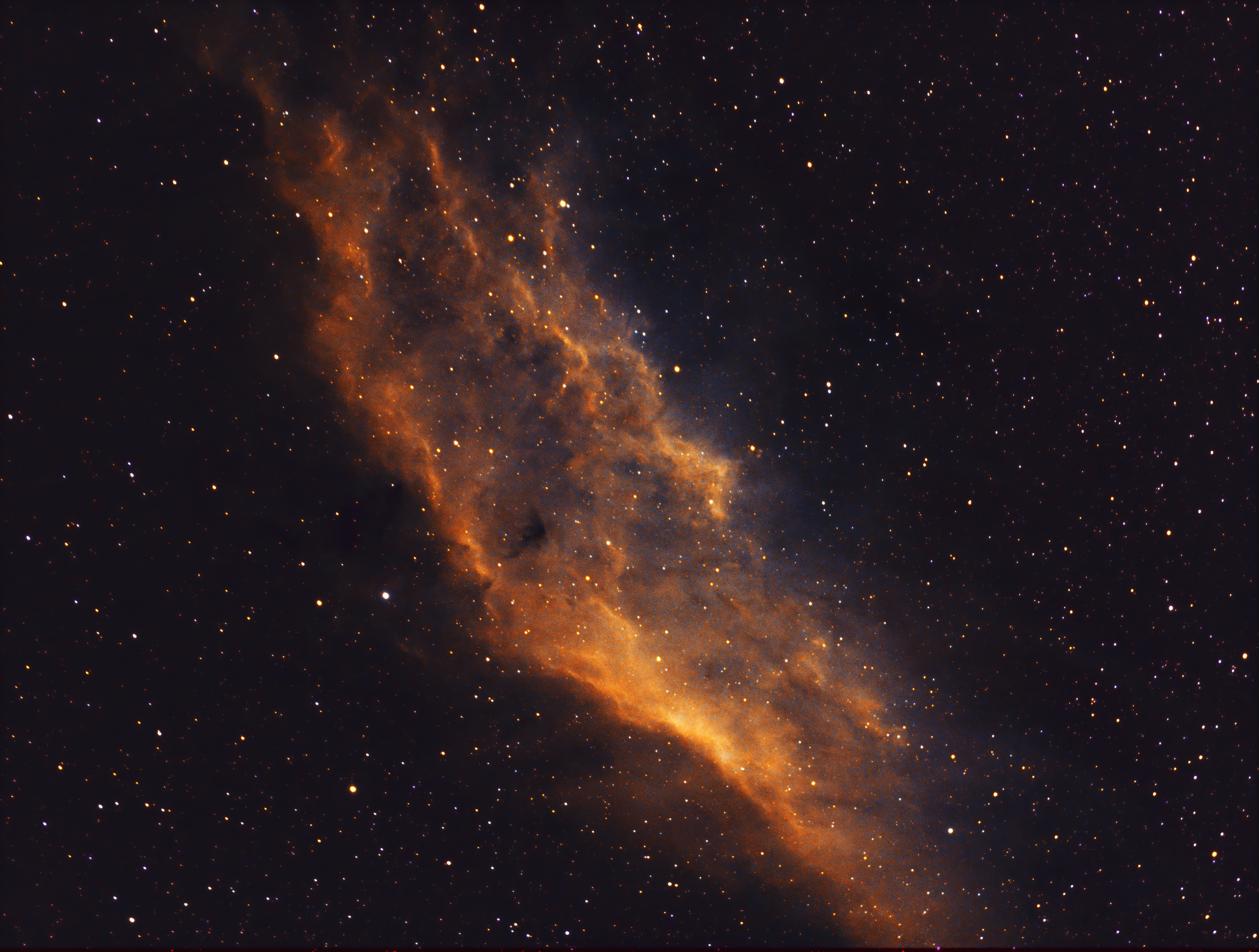
NGC 1499 California Nebula, October 2017:  In this case re-processing has brought out greater structure throughout the nebula and, to a lesser degree, improved the overall colour.  However, the nature of the object, limited integration time and relative lack of what is faint OIII and SII data has probably limited the final impact.    

Frankly I found PixInsight a complete pain to understand and use initially, however, with the help of online videos, tutorials and the recently published excellent Mastering PixInsight book, I believe the results more than justify the effort and speak for themselves; overall I’m very pleased with the outcome, which far exceeds my expectations.  Notwithstanding, going forwards I can’t see PixInsight being my only processing software (though it could be) but it almost certainly will now become my main choice for post processing, where necessary supplemented by Photoshop and other packages dedicated to specific tasks.  It’s a case of using the right tool for the job and the wider combination outlined provides much more flexibility, as well as producing excellent results.  All I need now are clear skies!

OUTLINE HST NARROWBAND WORKFLOW*

ACTIONCOMMENT
Alignment & StackingDeep Sky Stacker

NON-LINEAR PRE-PROCESSING
Dynamic Crop  All stacks
Dynamic Background Extraction (DBE)  Gradient removal
RGB Combination  SHO Hubble palette
Linear Fit   
Background Neutralisation   
Colour Calibration-1  
Deconvolution (sometimes)Not used here but can be if necessary
Noise ReductionUse ACDNR or Topaz DeNoise AI
Histogram TransformationNon-linear stretch

 LINEAR PROCESSING
Curves Transformation (CT)Preliminary to bring out colours but not too strong
Colour Calibration-2 
SCNRRemove Green Hue
Magenta star adjustmentIf present + use PixelMath script
Starnet++Separate Nebula & Stars  
(a) Curves Transformation & / or
(b) Colour Saturation
Colour punch Apply Range Mask to accentuate specific areas
Photoshop – selective coloursFurther specific colour adjustment
Re-combine starless & stars imagesPixelMath script + experiment with proportions  
Final adjustments where necessaryDBE + CT + ACDNR or DeNoise AI + Linear / Curves adjustment
 * PixInsight processing unless stated otherwise 

The Big Picture

I’ve been very happy with my main imaging set-up for nearly 4-years: Skywatcher AZ-EQ6 GT Mount + William Optics GT81 + ZWO1600MM-Cool mono camera.  Nevertheless, thoughts inevitably stray towards the big and usually expensive question – what next?  Given the said equipment, a natural move is likely to be the addition of a larger telescope to get at those faint fuzzies and I have been toying with such an idea for some time – probably another refractor in the 100mm to 130mm range.  However, I’ve always been held back by a number of nagging issues:

  • Without a sightline of Polaris for polar alignment from the main location at Fairvale Observatory,  guiding is always going to be sub-optimal – I can get away with it with the smaller William Optics but a larger aperture / focal length would be more challenging;
  • Being a set-up / take-down observatory each night, the increased technical demands of a larger OTA would certainly take longer and in general be more difficult to undertake – as I get older moving the mount is already taking its toll on my back;
  • Time is short as there’s simply no getting away from the problem we all suffer in the UK – cloud and lots of it!  It’s been normal to go weeks, even months without a clear night sky and as a result last year I managed to image just 18 objects over some 27 nights, of which some were only over a few hours before the clouds rolled in;
  • A static observatory would help enormously but my garden is unsuitable: apart from the aforesaid problem that my house obscures a northerly view, there are also houses and substantial trees and very high hedges on all the other sides.

Regretfully I have therefore always come to the same conclusion, that unless I moved house it was best to continue with my current set-up – until now!  Inspired by a fascinating thread on the Stargazers Lounge Forum the solution was blindingly obvious, or at least it was once I understood there was another way, a larger field-of-view rather than larger telescope, achieved with a traditional though far from ordinary camera lens.

As a life-long photographer on land and underwater, astrophotography surprisingly came as something of a shock, as it’s just so contrasting to the aforesaid disciplines and requires quite different technical knowledge and aptitude.  Of course, I’ve often used my camera equipment to image the night sky, particularly the Milky Way and started out astrophotography using a modded DSLR but otherwise did not consider that a camera lens could form the basis for my astrophotography going forwards – then I discovered the Samyang 135 f2 lens.  Moreover, looking at what others achieved matching this lens with a tracking mount and mono camera, the decision to join the Samy club was a no brainer.

Located in South Korea, Samyang Optics has been manufacturing good camera lenses since 1972.  Also sold under the Rokinon brand name, the Samyang 135 f2 stands out for two reasons:

  1. The optics of the lens are top drawer, consisting of 11-elements in 7-groups using very high quality glass;
  2. The lens is very well suited to gathering photons with a maximum f2 aperture – though most users stop down to 2.8 in order to achieve good star shapes right into the corners.

The optical quality produces sharp image quality from corner to corner but combining this with a 135mm focal length achieves an enormous 9.45o x 6.30o field of view @ f2 with a Canon 550D compared with my current set-up of 2.67o x 1.78o, opening up whole new imaging possibilities.

Inner rectangle: FOV using William Optics GT81 + focal reducer & ZWO 1600MM-Cool camera
Outer rectangle: FOV using Samyang 135 f/2 & CAnon 550D DSLR camera
It would take approximately a 9 x panel mosaic from the WO to cover the Samyang area!

Furthermore, this much smaller rig is lighter, easier and thus quicker to set-up and break-down.  Put together it’s a powerful combination that I hope to fully exploit in the future.

Camera

Equipment

FOV

Resolution

ZWO ASI1600MM-Cool

WO GT81 + 0.80 FR*

2.65o x 2.00o

2.05”/px

Samyang 135 f/2

7.50o x 5.67o

5.80”/px

Canon 550D DSLR

WO GT81 + 0/80 FR*

2.67o x 1.78o

1.85”/px

Samyang 135 f/2

9.45o x 6.30o

6.45”/px

*Current set-up  

By today’s standards this lens might be considered somewhat old fashioned with no autofocus or image stabilisation etc., but the intrinsic high manufacturing standards and manual focus are excellent for those who know how to handle such a lens and perfect for astrophotography.  For such a purpose users generally either create their own rig by adapting various astronomy bits and pieces or use one of a growing number of bespoke brackets that are being made for this increasingly popular lens.

For the moment I chose to use a 3D printed bracket and integrated manual microfocuser, made by the French company AstroKraken and its founder Philippe Leca.  Therein the lens is cradled by two hinged rings, which when screwed down hold the lens firmly to either a Vixen bar or Losmandy plate.  The microfocuser then fits snuggly around and then clamps onto the focus ring, so that two screws on either side can be adjusted so as to push against a bridge located above and between the two rings, thus providing fine control over the focus ring; the said bridge also has a Synta fitting shoe on top to fix a finder / guide scope.  Altogether it’s a neat and very effective design that provides an easy-to-use tailor made platform for the lens, which can then be combined either with a DSLR or mono camera on the back; users of mono cameras tend to recommend changing the lens’ bayonet for a screw fitting and possibly add a third ring for the camera in order to eliminate the possibility of any flexure.

Whilst the AstroKraken bracket works well, the structural layout is inevitably tight making it difficult to view the focus ring settings but once established close to focus, subsequent use of the microfocuser is excellent in finessing the job of focussing before locking down the adjustment screws.  In addition, I’ve acquired a second Starlight Express Lodestar X2 autoguiding camera for use with a Skywatcher Evoguide 50ED guidescope but so far have not needed it with short exposures currently being used.

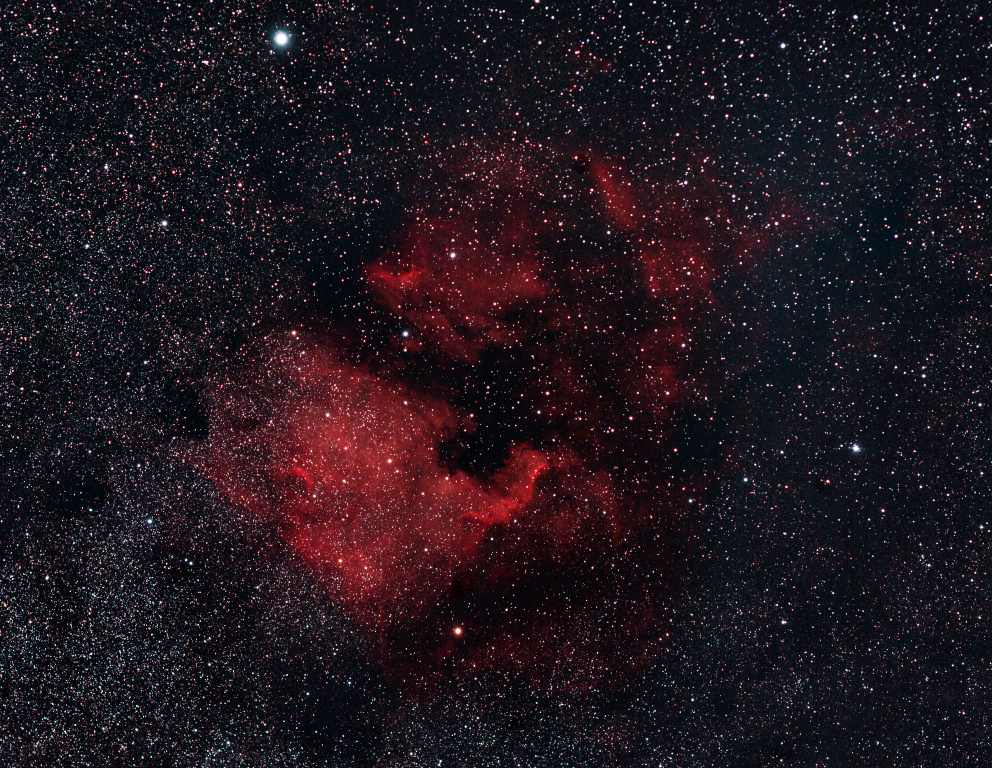
As a project for the new rig I had intended to spend the late summer imaging the suitably large Cygnus HII region but in the end conditions limited my time on this wonderful area of the sky at this time of the year and will have to wait for another time.  Notwithstanding, first light using my modded Canon 550D DSLR camera of the said Cygnus area was briefly achieved at the end of July, with promising results (see above – uncropped).  More recently, in early September I was able to obtain images of the Veil Nebula (see below – cropped to 70%) and North America Nebula (see top-of-the page, cropped to 80%), in all cases taken at 120sec exposures and ISO 1600.  Unfortunately all integration times have been just under 60 minutes for each target and in the long run the real magic of this lens will be unlocked with the addition of a mono camera and much greater imaging times.

Looking back personally and professionally, it’s apparent to me that the concept of the big picture, metaphorically or otherwise, has played a central role in my life and is an area I like to work with; it’s the big picture that provides context, understanding and opportunity. Perhaps it should therefore not be a surprise that in the end my next step in astrophotography will now follow such a path.  The detail provided with my current equipment is fulfilling and beautiful but the additional context provided by the Samyang’s extensive FOV can be more insightful and even breathtaking in scope.  After something of a slow start, I’m now really looking forwards to spending more time with this new and exciting rig in the future.  

Canine Capers

Following a very poor winter period, spring has been nothing less than spectacular and provided many clear nights for astronomy, ironically made all the better by the covid-19 lockdown.  With the near absence of road traffic and especially aircraft – Fairvale Observatory is badly affected by flights from nearby Gatwick, Heathrow and Redhill aerodrome – it has resulted in noticeably better seeing, as well as a quieter and more enjoyable environment overall; it’s worth noting that after experimenting with Deep Sky Stacker (DSS), increasing the Kappa-Sigma clipping parameter from 2.0 to 2.50 for the light subs, in all but the worst cases eliminated aircraft tracks in the final stacked image.  Resulting from these favourable conditions, I’ve recently been able to image four otherwise difficult targets, amounting to some 40-hours total integration time, literally unprecedented conditions in the +30 years I’ve lived here.

CanVen Map

Apart from a brief diversion imaging the Leo Triplet, my attention has otherwise been centered on the constellation of Canes Venatici, AKA the Hunting Dogs.  At this time of the year the constellation starts to come into view high overhead from the east at about 10 p.m. and crosses the meridian about three hours later.  Located below Ursa Major and above Bootes, the relatively small Canes Venatici hosts five Messier objects, four of which are galaxies and it is these I’ve been drawn to.  From earlier test shots I determined that the M94 galaxy was unlikely to be suitable for my equipment but I did obtain and have already described images of first M106 and then M63.  Notwithstanding, I had unfinished business with the last of the four galaxies, which I therefore now turned to.

In 2019 I was pleased to acquire my first ever image of the wonderful M51Whirlpool Galaxy and its smaller companion, NGC 5195.  However, I noted then that the final LRGB image still needed much more integration time than just 2hr 18min. achieved, plus the addition of Ha-subs and that I hoped to return to the Whirlpool and its neighbour as soon as possible for this purpose.

M51 HaLRGBFinal-denoise-denoise

It was therefore a great pleasure to image M51 over no less than seven nights in March and April this spring, which combined with last year’s data resulted in over 16 hours integration time, substantially longer than any previous image I’ve compiled before.  Moreover, the quality of seeing also benefitted SNR and guiding quality, thus achieving RMS errors of at least 0.80 arc seconds or better.  I did encounter some plate solving issues and had to resort to manual framing on a few nights but fortunately DSS software dealt with alignment OK and the final image is all I could have hoped for (see above + top-of-the-page cropped).  Naturally the interaction of the two galaxies is the signature feature of this image but it is the improvement in general colour, detail and addition of Ha-subs highlighting regions of new star formation, that have been most transformative in portraying these objects in all their glory.

Using my current set-up it seems unlikely that the image would benefit significantly from any further data acquisition but I’d like to think I’ll return another day using a larger telescope and higher resolution with which to capture and enjoy even more detail of all these exciting objects of Canes Venatici.  It is said that “it’s an ill wind that blows no good” and I am doubtful we’ll ever have such good conditions here again but for now I was delighted to be able to positively exploit this otherwise difficult time in lockdown.

  IMAGING DETAILS
Object M51 The Whirlpool Galaxy & NGC 5951
Constellation Canes Venatici
Distance 23 million light-years
Size 11.2’ x 6.9’   77,000 light-years (M51 only)
Apparent Magnitude +8.4
   
Scope  William Optics GT81 + Focal Reducer FL 382mm  f4.72
Mount SW AZ-EQ6 GT + EQASCOM computer control & Cartes du Ciel
Guiding William Optics 50mm guide scope
  + Starlight Xpress Lodestar X2 camera & PHD2 guiding
Camera ZWO1600MM-Cool mono  CMOS sensor
  FOV 2.65o x 2.0o Resolution 2.05”/pix  Max. image size 4,656 x 3,520 pix   
EFW ZWO x8 ZWO LRGB & Ha OIII SII 7nm filters 
Capture & Processing Astro Photography Tool + PHD2 +  Deep Sky Stacker & Photoshop CS3
Image Location              & Orientation Centre  RA 13:30:03      DEC 47:11:43  (approx.)                   Top  = South  Bottom = North 
Exposures L x 95   R x 62   G x58   B x 66   Ha x 46 = 327 x 180 sec                                                         Total Integration Time: 16hr 21 minutes   
  @ 139 Gain   21  Offset @ -20oC    
Calibration 10 x 180 sec  Darks  20 x 1/4000 sec Bias  10 x  HaLRGB Flats                             @ ADU 25,000
Location & Darkness Fairvale Observatory – Redhill – Surrey – UK        Typically Bortle 5-6
Date & Time 10th April 2019 +23rd 24th 25th 27th March & 20th 21st 22nd April 2020@ +22.00h
Weather Approx. 6oC   RH <=60%                  🌙 New Moon approx.

Galactic Bloom


M63 HaLRGB FinalCropRotate3 (Large)-denoise-denoise

You don’t have to be an astronomer to appreciate Van Gogh’s wonderful evocation of the night sky in his 1889 painting Starry Night.  He knew a thing or two about sunflowers too and I’ve often stopped by the National Gallery in Trafalgar Square to take a peep at his famous painting of them.  However, it was still more than thirty years after completing these paintings that we first learned that such features as galaxies and the rest of the Universe even existed beyond our own Milky Way.  Since then our knowledge of the cosmos has expanded considerably and today provides no end of imaging opportunities for the astrophotographer, subject to clear skies!

Having started the galaxy season with M106 and, given the excellent conditions that prevailed throughout much of Spring this year, I chose to return to the same area of the sky again to image M63, AKA the Sunflower Galaxy.  M63 has a spiral form but with no apparent central bar and in visible light lacks large scale spiral structure, although two-arm structures are noticeable in near infra-red.  Instead the dust lanes are extensively disrupted producing a patchy appearance and is thus classified as a flocculent galaxy – in this case looking something like a sunflower.

As previously discussed, most galaxies are a real challenge for my equipment but an earlier experiment indicated it might just be possible to image M63, the trick would be obtaining sufficient integration time.  Fortunately three clear nights approaching a new moon in April provided over 8-hours of good subs, which I’m pleased to say resulted in a decent final image after all.  The background sky is less busy than I would wish but there’s nice colour in the stars and also a few very small faint fuzzies on close inspection.  Notwithstanding,  M63 is clearly the star of the show (no pun intended) with the so-called flocculation clearly evident and numerous random dust lanes criss-crossing the entire galactic disc.

Although in 1924 Edwin Hubble’s recognition that galaxies, such as our own, existed outside the Milky Way, M63 was discovered by Pierre Méchain and catalogued by Charles Messier in 1779, long before Van Gogh’s paintings.  He might conceivably have known of its presence therefore but not what it was and would surely be inspired to see and know about the Sunflower Galaxy as we do today.

IMAGING DETAILS
Object M63, NGC 5055 AKA Sunflower Galaxy
Constellation Canes Venatici
Distance 29 million light-years
Size 12.6’ x 7.2’
Apparent Magnitude +9.3
 
Scope  William Optics GT81 + Focal Reducer FL 382mm  f4.72
Mount SW AZ-EQ6 GT + EQASCOM computer control & Cartes du Ciel
Guiding William Optics 50mm guide scope
  + Starlight Xpress Lodestar X2 camera & PHD2 guiding
Camera ZWO1600MM-Cool mono  CMOS sensor
  FOV 2.65o x 2.0o Resolution 2.05”/pix  Max. image size 4,656 x 3,520 pix   
EFW ZWOx8 + ZWO LRGB & Ha OIII SII 7nm filters 
Capture & Processing Astro Photography Tool + PHD2 +  Deep Sky Stacker & Photoshop CS3
Image Location              & Orientation Centre  RA 13h 15m 49.47”      DEC +42o 01’ 45.62”                     

Top = North approx..     

Exposures 30 x L  17 x R  18 x G  23 x B  12 x Ha x 300 sec

Total Time:  8hr 20 min    

  @ 139 Gain   21  Offset @ -20oC    
Calibration 5 x 300 sec Ha + 10 X 300’ RGB  Darks,  20 x 1/4000 sec Bias  10 x  HaRGB Flats               @ ADU 25,000
Location & Darkness Fairvale Observatory – Redhill – Surrey – UK        Typically Bortle 5-6
Date & Time 14th 15th & 16th April 2020  @ +22.00h  
Weather Approx. <=8oC   RH 60 – 70%                  🌙 40% waning

Reflections 2019

The website Watch This Space (Man) began in 2015 as I started out in astronomy and is a record of my personal journey, comments and thoughts.  Apart from the main blog, the website also contains links to other astrophotographers, astronomy tools, astronomy weather, and scientific papers etc., which can be accessed from the top menu.

Whilst there is a photo gallery of my work in this website, an overview of the better images can be found in the My Astrophotography FLICKR album, which can be found in the GALLERY menu.  Furthermore, this year I took the plunge and joined the Astrobin community, where my images can be found using the appropriate link also in the GALLERY menu.

Heat Map 2019

During the past year the site was visited from 64 different countries, literally from every corner of the world.  I always like to hear from anybody out there – comments, questions, help or just to say hello  – and can be contacted via details given in the ABOUT menu section or just leave a comment on any item if you prefer.

Reflections 2019 BannerX

Reflections is compiled at the end of each year as a review of my astronomy and astrophotography during the previous twelve months, together with some thoughts on possible future developments.

Overview, Images & Goals for 2020

The past year’s plan was simple: build-on and experiment with developments from the previous year, in particular using Plate Solving to achieve longer integration times and explore further the north sky, which I could now see from the new Shed Observatory and operates during the spring and summer months.

By routinely using Plate Solving integration times, now obtained over a number of nights or even months, have increased by up to four-fold compared to previous years.  As a result I concentrated on less objects but for longer time, achieving between 6 to 8 hours of subs on some occasions, the limiting factor as ever being British weather.  Although quite modest compared to those able to use fixed observatories, or in clear, dry climates with Bortle 1 or 2 skies, I was very pleased with the positive impact this had on my images.

Starting astronomy and astrophotography somewhat late in the day a few years ago, like many others after retirement, the learning curve was steep and often frustrating.  There were times I’ve almost considered giving up but with perseverance I’ve made progress and often get great pleasure from some of the results, as well as just enjoying and learning about this wonderful subject.  For me it is just a hobby but recognising some of my achievements and abilities acquired since starting out in 2014, I was especially proud this year to be elected a Fellow of the Royal Astronomical Society.  For all the help in reaching this point, I’d like to thank all those who have helped me from the astronomy community, wherever they are.

RAS logo

Favourite Images

My weakness in astrophotography remains processing but having at last obtained some good integration times, this year I made a greater effort to improve these techniques – with some success.  Adopting the theme less is more, I imaged just 17 different objects this year – of which nine were full narrow or broadfband images, with the rest being  experimental or DSLR – with a total integration time of 65 hours (2018: 25 objects & 43 hours).  The resulting images turned out well, achieving Picture of the Week on the British Astronomical Association website on six occasions.  It’s therefore difficult to choose favourites from this select group based on merit alone, so this year’s favourites (see below) represent those good images that also mark a significant milestone in my astrophotography.  Detailed reviews of these and all other images from 2019 are discussed in dedicated articles that can be found via the Blog Index under the ABOUT dropdown menu.

SHO2 CompF (Large)

Horsehead & Flame Nebula: Usually imaged in LRGB broadband, this narrowband SHO version produced a very different affect and colours, whilst also showing the beauty of the accompanying clouds of interstellar gas and dust.  Taken over three nights, at nearly 7-hours, this image was also one of my longest integration times to date.     

M101 HaLRGB final Closeup

M101 Pinwheel Galaxy: Given Bortle 5-6 skies, being on the Gatwick Airport flightpath and a using a small refractor, I struggle to image galaxies and often LRGB images in general from Fairvale Observatory.  However, on this occasion the combination of 5-hours HaLRGB subs and new processing techniques to enhance the colours, M101 proved the exception and is perhaps my first decent classic spiral galaxy imaged from home.  Moreover, the HII regions light up along the spiral arms with the addition of Ha wavelength, producing a dazzling and dynamic image. 

Picture saved with settings embedded.

Heart & Soul Nebula:  Combining existing data from 2018 of the Heart Nebula and new 2019 data of the Soul Nebula + the intervening space, this is my first albeit modest mosaic, which promises to open up significant possibilities in the future. 

RECORD CARD – 2019
Goal Specifics / Results Outcome
Improve broadband and narrowband imaging


Achieved major increase of image integration times and overall quality. MUCH, MUCH BETTER


Improve processing Continuing to make slow improvements, with greater use of new Photoshop techniques. BETTER


Expand & Improve Widefield Imaging Despite some good images of the Milky Way in the USA, I never used the Vixen Polarie tracking mount and did not make it to any other dark sky sites  = disappointing. FAILED


My objectives in 2019 mostly went well in (see above), so here goes for 2020:

  • Imaging: There’s always scope to improve imaging techniques but probably most of all I still need to improve guiding quality and increase exposure and image integration times even further.
  • Mosaic: Expand the use of mosaic imaging using Plate Solving and new CdC planning software.
  • Improve processing: I expect this will continue to be something of a challenge for some time to come unless I go to the dark side and adopt software such as PixInsight & / or APP.
  • New Observatory: Unfortunately this will not be a fixed obsy whilst I continue to live here at Fairvale which is unsuitable.  However, I’m hopeful that another location between the Main (North) Observatory and the Shed Observatory might open up the north sky better and by getting away from the high hedges that surround the garden allow longer imaging sessions than can be currently obtained at the Shed.
  • Other: My mind is always thinking about larger telescopes or a dual rig and / or a new high-end encoded mount but probably not until I make further progress with the above goals and / or move to a better dark sky location – dreaming is part of astrophotography = watch this space!

Although you never know, I don’t see any major breakthroughs in the coming year but more of the same – revisiting familiar objects in order to obtain new image versions based on greater integration time and hopefully using mosaic techniques to build-out images in order to encompass wider areas of the sky.  This year I was surprised to discover objects that I had hitherto considered out of reach from my location (M101, M51 etc.), as well as exciting features that were completely new to me and still hold great promise e.g. DWB 111 AKA the Propeller Nebula.

Looking back I’m very happy to say 2019 was an excellent year for astronomy and astrophotography, almost certainly my best yet.  You can’t ask for more than that and I hope that WTSM’s Reflections 2020 will record further such success.

Watch this space!

wtsm logo


2019 CHRONICLE 

Below is a quarter by quarter summary of my astronomy and astrophotography for the year, followed by an imaging record.

JANUARY TO MARCH

Towards the end of 2018 I decided to undertake a project, with the prime objective to gather a much longer period of integration than hitherto achieved by using my newly developed skill of Plate Solving.  I’d previously imaged the Horsehead and Flame Nebula in the more traditional colour palette, either with a modded DSLR or by LRGB broadband.  However, I’d recently seen this iconic image undertaken using the Hubble Palette to great affect and was inspired to do the same myself. Thereafter, for more than 2-months the clouds rolled in and I thought my project would then be impossible, not least because by now Orion had crossed the Meridian in the early evening and imaging times were at best limited.  But as is often the case with astrophotography everything suddenly changed and it was game on!

The first evening of clear skies since 11th November 2018 coincided with the full lunar eclipse on 21st January, which I was therefore able to image once again.  Then six days later a very untypical clear and quite warm period of weather arrived and I was able to complete my intended project after all, with further time to image both the Great Orion Nebula and the reflection nebula M78 + Barnard’s Loop (see images below).

HaLRGB2FINALcrop (Large)

Combined +180 degrees 3+5min HaLRGB (Large)

Achieving much longer integration times of between 5 and nearly 8-hours, the impact on the resulting images was transformative.  I was especially pleased with the outcome of the Horsehead project in SHO (see Favourites Images section) but found the Ha-only starless version of the same scene (see below) particularly mesmerising, as the large HII structures throughout this region bring the image to life.

NGC 2024 Ha Starless2

By the end of February the night sky at 51o latitude has moved inexorably on to the so-called Galaxy Season, which provides something of a dearth of imaging opportunities for my 81mm telescope.  However, with a good patch of weather at the end of March, whilst experimenting with the Leo Group I noticed that small areas of Ursa Major region could be seen directly above for a couple of hours, which to my surprise opened up a whole new world of possibilities hitherto considered unavailable.  Shortly after I managed to obtain almost 5-hours of data on M101 the Pinwheel Galaxy, which is one of my best galaxy images taken from Fairvale Observatory (see Favourite Images section).

APRIL TO JUNE

Having discovered the albeit limited possibilities of seeing Ursa Major, I moved to the Shed Observatory early in April, which by then afforded slightly better views of the same area of sky and thereby to my great joy provided the possibility of imaging the wonderful Whirlpool Galaxy, M51.  Unfortunately time was somewhat limited but it was better than nothing and I was thrilled to obtain an image of this wonderful object for the first time.  Weather permitting I’ll be back for more data in 2020 with which to build on the promising result obtained this year.

LRGB Image FINALX2 (Large)

By the end of April just 8-weeks away from the summer solstice astronomical darkness is in short supply.  Fortunately having moved earlier to the Shed Observatory this year, I was in a good position to return to inaging the Bodes and Cigar Galaxies (see below), which had been my first ever image of north sky objects in 2018.

LRGBFinal (Large)

JULY TO SEPTEMBER

From May until late July the absence of Astronomical darkness makes astronomy difficult and frankly having progressed from the time of being a beginner, it is quite refreshing to take a break.  Therefore it was only after an evening viewing the partial eclipse on 16th July and a brief experiment with the Wizzard Nebula (something for the future) at the beginning of August, that much later I returned to astrophotography seriously.

SHO2SCcrop (Large)

Having messed up imaging the Soul Nebula with poor framing in 2018 and being at the Shed Observatory, I decided to re-image the Soul properly, together with some of the adjacent sky in order to combine the new data with last year’s adjacent Heart Nebula to form a mosaic of both objects.  I don’t know why but this was my first attempt at a mosaic.  Only very recently has integrated software for mosaic planning combining  Cartes de Ciel and Astrophotography Tool for image capture has been released.  However, on this occasion I planned and implemented the said mosaic imaging manually, with a satisfying outcome (see Favourite Images section) but with the new software now available I hope to embark on more extensive mosaic projects in the near future.

This year’s astrophotography has followed two themes, the aforementioned ‘less is more’ with the aim of producing better images using much greater integration times.  The second has been largely determined by chance, being the discovery of new objects that had hitherto either been unknown to me or considered to be out of view from Fairvale Observatory; the combination of my house, very high hedges + trees and adjacent houses obscures large swathes of the night sky.  Earlier in the year such chance had led me to the M101 and M51 galaxies and in the autumn it was first the iconic Pacman Nebula and then an exciting area of Cygnus constellation.

Pacman is not particularly large for my equipment but nevertheless produced a decent narrowband image, my last from the Shed Observatory for this year.  Not until late September did the clouds again relent for my next project that initially seemed something of a long shot but actually turned out very well.  The Propeller Nebula is located in a vast HII region of the Cygnus Constellation, which from my point-of-view was a complete surprise.  At some 25 arc seconds the nebula is again on the small side for my equipment but the complexity of the adjacent HII region transforms the wider image into something really spectacular (SHO version below), which I certainly intend to visit again next year to build on the current data and explore further afield the HII region which presents exciting possibilities.

SHO F HLVG (Large)

A subsequent long trip to the USA stopped all astronomy in Surrey but a couple of evenings out in Wyoming and Utah produced some incredible dark skies and DSLR Milky Way images (see below).  Despite the remoteness of Spilt Mountain in the UTAH section of the Dinosaur National Monument – designated a Dark Sky Area – whilst imaging at 20 second exposures only one-in-ten images were without a plane track, very sad.

IMG_2345 ComboX

OCTOBER TO DECEMBER

Prior to the arrival of Orion and other fun objects of the mid-winter night skies, imaging opportunities are sparse with my equipment but it’s been a couple of years since I last imaged M31 the Andromeda Galaxy and therefore for two evenings in late October it was time to give our neighbour the extended integration treatment.  At 7½ hours data acquisition went well but although the processed image is probably my best yet of this object, there’s room for improvement, which I suspect will require a move to more advanced processing software?

HaLRGBx5b (Large)

ASTROMINAGING RECORD 2019

No Date Type Object Name
       
1 21/01/19 DSLR Full Lunar Eclipse  
       
2 27/01/19* NB  Barnard-33 &

 NGC 2024

Horsehead & Flame Nebula
       
3 23/02/19* Combo M42 Great Orion Nebula
       
4 25/02/19* Combo M78 Reflection Nebula Orion
       
5 12/03/19 BB NGC443/444 Jellyfish Nebula
       
6 24/03/19 Combo M95/96/105 Leo-1 Group
       
7 29/03/19* Combo M101 Pinwheel Galaxy
       
8 10/04/19 Combo M51 Whirlpool Galaxy
       
9 13/04/19 BB M81 & m82 Bodes & Cigar Galaxies
       
10 16/07/19 DSLR Partial Lunar Eclipse  
       
11 02/08/19 NB NGC 7380 Wizzard Nebula
       
12 23/08/19* BB IC 1848 Soul Nebula +

Mosaic Link

       
13 26/08/19 NB NGC 281 PacMan Nebula
       
14 05/09/19* NB DWB 111 Propeller Nebula
       
15 Sept DSLR Milky Way Split Mountain Utah
       
16 22/10/19* Combo M31 Andromeda Galaxy
       
17 18/11/19 BB M74 Galaxy
       
18 18/11/18 NB SH2-240 Spaghetti Nebula
       

*multiple evenings        Combo = HaLRGB       Underlined = BAA published

POSTSCRIPT

The ones that got away – imaged but not seen in WTSM this year – warts and all

RHB_2ajelly (Medium)

I saw some wonderful narrowband versions of the supernova remnant IC 443 Jellyfish Nebula this year, in particular adopting a wider view to incoporate its sentinel-like parner stars Tejat (Mu Geminorum) left and the tripple star Propus (Eta Geminorum) right, together with the reflection nebula IC 444 in the background.  As an experiment I think it may hold promise but will require a lot more integration time to improve the quality, colour and bring out more of IC 444.

M95_96_105 (Medium)

I’ve tried the Leo-1 group (M95/96/105) before but, as they say, if you don’t succeed try again.  Unfortunately the passage of time didn’t help – I need a larger telescope to do these critters justice! 

IMG_2336 (Large)

Dinosaur National Monument – Split Mountain, Utah.  Even at this wonderfully remote location, which is one of the darkest places in the USA, passing planes still get in the way of a good image – just like at Fairvale Observatory

M74 LRGBx (Medium)

At <=10 arc minutes the spiral galaxy M74 is too much for my equipment.

SH2-240 AB combined Ha Stretch (Large)

Located between the constellations Auriga and Gemini, SH2-240, Simeis 147 AKA the Spaghetti Nebula is a very large (+3 degrees) supernova remnant but it’s very low brightness makes imaging extremely difficult.  In fact prior to and during capture in Ha-wavelength, I had no idea if it was even within the image frame.  Aggressive stretching shows that it was there but only much darker skies and probably longer exposure time is likely to produce a more viable picture.