One In A Trillion

HaLRGBx5b (Large)

Since the early twentieth century when Edwin Hubble recognized that the Milky Way was not the only galaxy, it has been estimated that there are some two hundred billion galaxies in the observable Universe; the Milky Way is thought to contain about 250 billion stars +/- 150 billion.  Research in 2016 now suggests this might significantly underestimate the number of galaxies, which could exceed more than two trillion!

Perhaps the ultimate astrophotograph is the Hubble Ultra Deep field image.  At just one seventeenth a degree of the sky in size it shows objects up to some 13 billion light-years away, which is the furthest visible light image ever taken and contains some 10,000 galaxies.

Somewhat closer to home at a mere 2.5 million light-years, is our nearest neighbour M31, AKA the Andromeda galaxy.  Like the Milky Way, Andromeda is a spiral galaxy with a concentrated bulge of matter at the centre, surrounded by a disk of gas, dust and stars and an immense halo.  Andromeda and the Milky Way are moving inexorably together on a collision course at the rate of about 70 miles per second and are expeted to meet in about 4.5-billion years.  However, such is the space between the matter in each galaxy, the most likely outcome will not be a collision but the interaction of gravity between the opposing masses, leading to their eventual coalescence into a new giant galaxy.

Since starting astroimaging I’ve often returned to Andromeda at this time of the year ( 21/08/14 Meet the Neighbours, 09/10/15 Space Oddysey, 27/10/15 Overspill, 03/11/17 Galactic Neighbours), it is after all one of the magnificent features of the night sky.  At some 3o x 1o in size, with an apparent magnitude of +3.44 the galaxy completely fills the field-of-view of my equipment but I’ve always found imaging and particularly processing to be somewhat challenging.  As ever integration time is a major determinant of final image quality and this time I was able to obtain 7.5 hours over two nights, far greater than on previous occasions.   However, the overwhelming brightness of the galaxy’s core is always difficult to control during capture and processing and this was again to be the case.

Notwithstanding, I’m pleased to say that after four previous occasions imaging Andromeda, the combination of much greater integration time and better processing is this time evident in an improved image, which is overall more powerful.  Moreover, the galaxy’s internal structure has been enhanced with the addition of Ha-subs, which highlight large HII-areas of star formation that broadly follow the dust lanes.  However, you can never have too many subs and I’ll inevitably return again to this object in order to add to this year’s data and hopefully further improve processing so as to tame the subtleties that make Andromeda such a wonderful feature for astrophptography.

IMAGING DETAILS
Object M31 the Andromeda galaxy.
Constellation Andromeda
Distance 2.5 million light-years
Size 3.2o  x 1o  or 220,000  light-years  
Apparent Magnitude +3.44
 
Scope  William Optics GT81 + Focal Reducer FL 382mm  f4.72
Mount SW AZ-EQ6 GT + EQASCOM computer control & Cartes du Ciel
Guiding William Optics 50mm guide scope
  + Starlight Xpress Lodestar X2 camera & PHD2 guiding
Camera ZWO1600M M-Cool mono  CMOS sensor
  FOV 2.65o x 2.0o Resolution 2.05”/pix  Max. image size 4,656 x 3,520 pix   
EFW ZWOx8 + ZWO LRGB & Ha OIII SII 7nm filters 
Capture & Processing Astro Photography Tool + PHD2 +  Deep Sky Stacker & Photoshop CS3
Image Location              & Orientation Centre  RA 00:42:44      DEC 41:16:04                     

  Top = North

Exposures L 44 x 180 sec  R 26 x 180 sec  G 26 x 180  B  27 x 180sec  Ha 27 x 180sec                            (Total time: 7hr 30 minutes)   
  @ 139 Gain   21  Offset @ -20oC    
Calibration 10 x 180 sec & 15 x 60 sec Darks  20 x 1/4000 sec Bias  10 x  HaLRGB Flats               @ ADU 25,000
Location & Darkness Fairvale Observatory – Redhill – Surrey – UK        Typically Bortle 5-6
Date & Time 22nd & 27th October 2019 @ +/-19.00h  
Weather Approx. 7oC   RH >=75%                  🌙 50% to 5% waning


Other Worlds

LRGB Image FINALX2 (Large)

Being galaxy season it was appropriate that the BAA spring meeting this year on 27th April was all about – galaxies.  This was my first BAA meeting and I’m pleased to say it was well attended and very worthwhile, I especially enjoyed the following presentations:

  • Prof. Richard Ellis: The Quest for “Cosmic Dawn”;
  • Prof. Chris Impey: Einstein’s Monsters: Black Holes at the Heart of Galaxies;
  • Stewart Moore: Galaxies: A Brief History of Discovery, and
  • Owen Brazell: Observing Galaxy Clusters.

It seems incredible that just 100-years ago the prevailing view was that Universe consisted entirely of the Milky Way, though that was soon about to change.  Whilst Immanuel Kant had proposed the possibility of galaxies outside our own as long ago as 1755, it was not until Edwin Hubble’s work at the Mount Wilson Observatory, California that the existence of other worlds, in the form of galaxies, was proven and accepted during the period between 1924 and 1929.

Following Copernicus’s controversial theory in 1543 that the Earth orbited the Sun, the evidence this time that there was much, much more beyond the Milky Way was equally profound in its implications, if not more so.  However, I was surprised to learn that it was Vesto Slipher and not Hubble who discovered the redshift of galaxies that was fundamental to understanding that galaxies existed outside the Milky Way that were moving away from us – it would seem to me that he deserves much greater credit as well as Hubble for this work.  The current estimate is that there are some 100 to 200 billion galaxies in the observable universe but new research now estimates that the total number is likely to be at least ten times greater!  Either way there are many other worlds out there.

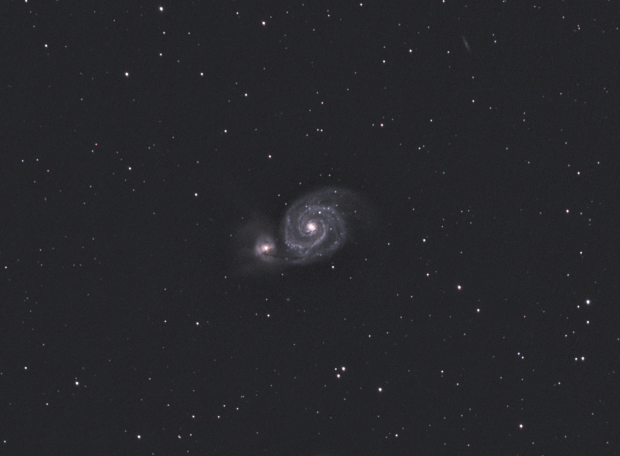
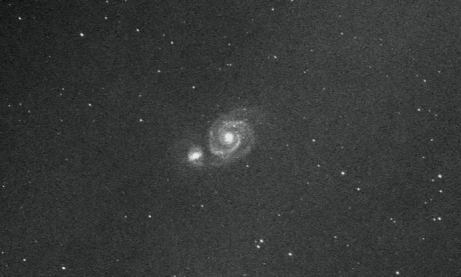
After recently learning that I could after all see and image a few larger galaxies from Fairvale Observatory  in-and-around the Ursa Major constellation, it was to my great delight when I then discovered that one of them was M51 AKA the Whirlpool Galaxy.  I’ve seen many images of this wonderful object and was frustrated that it seemed to be completely out of sight from here but thankfully that is not the case.  Armed with this knowledge, following an imaging session of M101 at the end of March, I therefore went on and immediately grabbed a single Luminance test sub of M51 (below) before it disappeared behind the roof of my house, (a) because I could, and (b) to see how it looked with my equipment.  The answer was that it was almost certainly a viable target for another night when more time was available.

M51 KStar

While located just above the star Alkaid in Ursa Major, M51 is now included within the nearby constellation Canes Venatici; created by Johannes Hevelius in the 17th Century, M51 was previously in Ursa Major.  One of the more famous grand-design spiral galaxies i.e. with prominent well-defined spiral arms, the Whirlpool Galaxy forms a striking image as it interacts and distorts the dwarf galaxy NGC 5195 located at the tail of its outer second arm.  The exquisite structure of M51 is further enhanced by large star-forming regions along the spirals, which are picked out by the associated hydrogen alpha gases.

CdC M51 location 100419 10pm

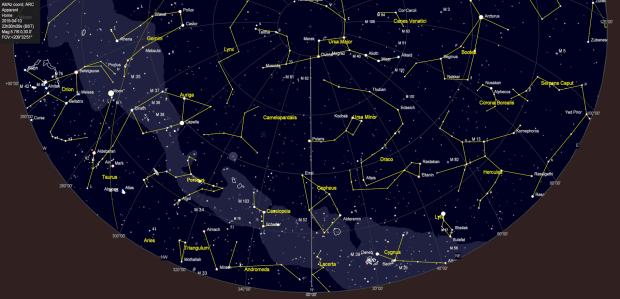
Timing is everything: M51 is in a tricky position seen from Fairvale Observatory, obscured for much of the time at the north viewing location by the house and from the south location by a 20ft hedge – in between there’s a maximum window of no more than 2.5 hours for imaging!

The smaller dimensions of the M51 galaxy would normally place it at the limit of my equipment for imaging but is helped by its aforementioned clear-cut features, strong colours, favourable apparent magnitude and its location towards the zenith immediately above my observatory.  This has long been in my top-10 ‘must-do’ imaging list but hitherto was thought to be out of view.  Unlike M101, which lies below Alkaid i.e. south, being further north the imaging time of M51 from Fairvale Observatory North is even shorter before it too retreats behind the rooftop.  However, this year I decided to move early to the summer location at the bottom of the garden – Fairvale Observatory South – where it was possible to gain a slightly longer view, though still only just over two hours before it disappears for the night, this time behind the adjacent 20-foot hedge!

It’s clear that the final LRGB image would be greatly enhanced with further integration time and the addition of Ha-wavelength but for now I’m content that at last I’ve managed to capture this spectacular object on camera.  Skies permitting I hope to return to the Whirlpool and its companion NGC 5195 as soon as possible.

IMAGING DETAILS
Object M51 The Whirlpool Galaxy & NGC 5951
Constellation Canes Venatici
Distance 23 million light-years
Size 11.2’ x 6.9’  or 43,000 light-years (M51 only)
Apparent Magnitude +8.4
 
Scope  William Optics GT81 + Focal Reducer FL 382mm  f4.72
Mount SW AZ-EQ6 GT + EQASCOM computer control & Cartes du Ciel
Guiding William Optics 50mm guide scope
  + Starlight Xpress Lodestar X2 camera & PHD2 guiding
Camera ZWO1600MM-Cool mono  CMOS sensor
  FOV 2.65o x 2.0o Resolution 2.05”/pix  Max. image size 4,656 x 3,520 pix   
EFW ZWO x8 ZWO LRGB & Ha OIII SII 7nm filters 
Capture & Processing Astro Photography Tool + PHD2 +  Deep Sky Stacker & Photoshop CS3
Image Location              & Orientation Centre  RA 13:30:03      DEC 47:11:43                     

Top  = South  Bottom = North 

Exposures (A)    L 18 x 180 sec  RG 9×180 sec  B 10 x 180                                                        (Total time: 2hr 18 minutes)   
  @ 139 Gain   21  Offset @ -20oC    
Calibration 10 x 180 sec  Darks  20 x 1/4000 sec Bias  10 x  HaLRGB Flats                                        @ ADU 25,000
Location & Darkness Fairvale Observatory – Redhill – Surrey – UK        Typically Bortle 5-6
Date & Time 10th April 2019 @ +22.00h  
Weather Approx. 6oC   RH 60%                  🌙 ¼ waxing

Fireworks


HaLRGB final-denoise2-denoise-PS (Large)

At Fairvale Observatory North it’s normal that I struggle to find suitable objects when the so-called Galaxy Season arrives in late winter through spring.  Despite the abundance of galaxies my William Optics 81mm aperture rules out all but a few for imaging as they are mostly just too small.  However, smaller galaxies that make up features such as Markarian’s Chain and the Leo group do produce a pleasing widefield image full of the so-called faint-fuzzies but hitherto with the exception of M31 the Andromeda galaxy I’ve struggled to obtain the real thing – a decent, full-on spiral galaxy – they are there of course but are either obscured to the north by my house and trees or, as indicated, are too small for my equipment to resolve properly.

LRGB.png

M95_96 Anotated

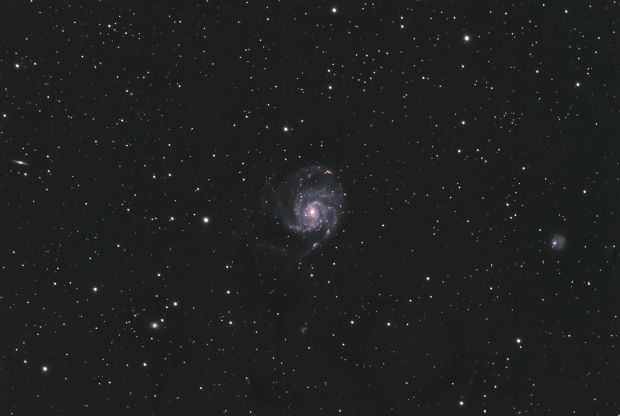
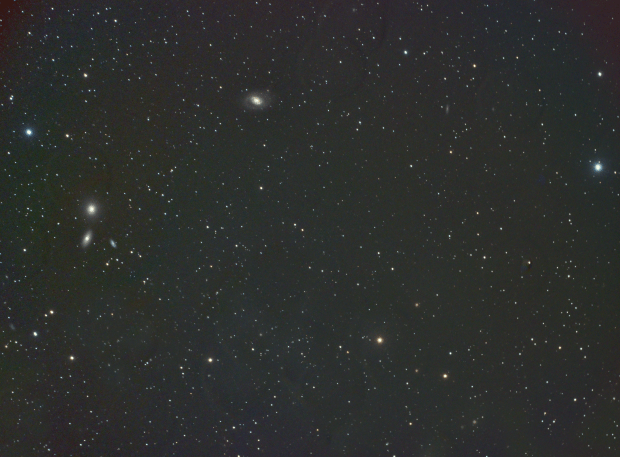
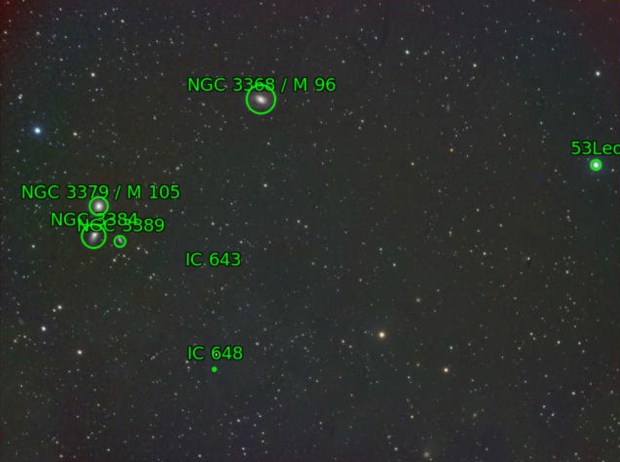
Nonetheless, this year after playing around imaging the aforesaid Leo Group (see above), I looked directly above the observatory and to my surprise discovered a new world of galaxies close to the Zenith that were just visible, briefly transiting along the southern edge of the house roof, which included a few large classics in-and-around the constellation Ursa Major.  After 2-hours imaging the Leo group time was too short for a serious attempt at any of these galaxies but nonetheless was sufficient to experiment with what looked like a potential target, the wonderful M101 the Pinwheel Galaxy, which at over 28 arc seconds showed real potential with only 42 minutes of subs before it disappeared out of sight for the night.  Moreover, large parts of Ursa Major and nearby galaxies also briefly appeared at other times on the night from behind the roof, tracking close to the gutter for nearly 2.5 hours before returning behind the roof in a similar manner to M101.  Thus assuming full set-up could be achieved earlier in the evening, this seemed to provide a window of opportunity that I grasped over two subsequent evenings with a very satisfactory outcome.

With nearly 5-hours of subs, processing of M101 would be a challenge in order to bring out the galaxy’s colours and perhaps highlight the stellar nursery areas that are found along the spiral arms and are rich in Ha-light.  To do this I first changed the RGB image stack to Lab Colour in Photoshop, increased the saturation in the (a) and (b) channels before returning to RGB mode.  This had the desired effect of successfully enhancing the colours, which can otherwise look washed-out after stacking, stretching and combining.  After this I split the RGB channels and pasted the Ha-stack into the Red channel, before re-combining again into an RGB image, at which point the H II regions along the spiral arms just lit up!  These were both new processing techniques for me that greatly improved the final image and hold great promise for processing HaLRGB objects in the future.

M101 closeup data crop

M101 widefield data crop

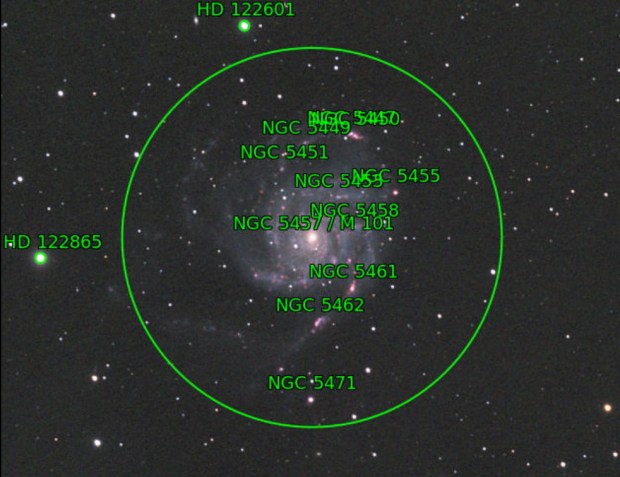
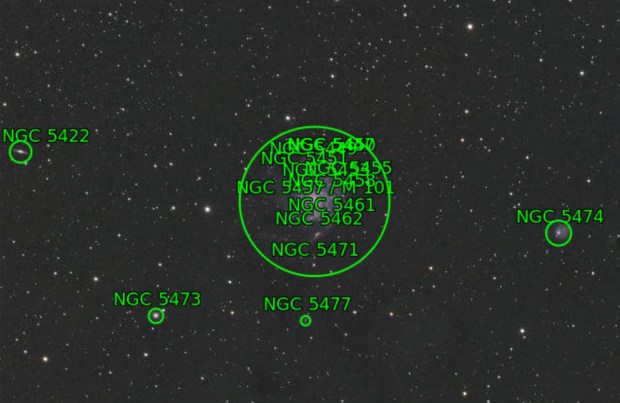
The final image (top of the page + crop below) far exceeded my expectations in detail and colour, showing off much of the galaxy’s wonderful structure and the aforementioned HII regions. There’s no doubt that further integration time will benefit the faint extremities of the galaxy but for now it was a very satisfying outcome of a spectacular object that hitherto I thought was beyond my seeing at Fairvale Observatory.  Also noteworthy, the image has caught a plethora of companion galaxies close to and around M101 (see annotated images above), most conspicuous of which is the classic side-view of NGC 5422 (left of M101) and the more unusual dwarf spiral galaxy NGC 5474 (right of M101),  which has been noticeably distorted by gravitational interaction with the Pinwheel itself.  All-in-all a fine display of galactic fireworks worthy of November 5th.

M101 HaLRGB crop-denoise-denoisePS


IMAGING DETAILS
Object M101  Pinwheel galaxy
Constellation Ursa Major
Distance 20.9 million light-years
Size 28.8’ x  26.9’  or 170,000 light-years  
Apparent Magnitude +7.86
 
Scope  William Optics GT81 + Focal Reducer FL 382mm  f4.72
Mount SW AZ-EQ6 GT + EQASCOM computer control & Cartes du Ciel
Guiding William Optics 50mm guide scope
  + Starlight Xpress Lodestar X2 camera & PHD2 guiding
Camera ZWO1600MM-Cool mono  CMOS sensor
  FOV 2.65o x 2.0o Resolution 2.05”/pix  Max. image size 4,656 x 3,520 pix   
EFW ZWOx8 + ZWO LRGB & Ha OIII SII 7nm filters 
Capture & Processing Astro Photography Tool + PHD2 +  Deep Sky Stacker & Photoshop CS3
Image Location              & Orientation Centre  RA 14:03:15      DEC 54:20:46                     

Top = North  

Exposures (A)    L 31 x 180 sec  HaRGB each 16×180 sec                                                                  (Total time:4hr 45 minutes)   
  @ 139 Gain   21  Offset @ -20oC    
Calibration 10 x 180 sec & 15 x 60 sec Darks  20 x 1/4000 sec Bias  10 x  HaLRGB Flats               @ ADU 25,000
Location & Darkness Fairvale Observatory – Redhill – Surrey – UK        Typically Bortle 5-6
Date & Time 29th & 31st March 2019  @ +22.00h  
Weather Approx. 8oC   RH <=70%                  🌙  ¼ waning


Reflections 2018

Reflections is a summary of my astronomy and astrophotography during the past year, plus some thoughts about what might happen in going forwards.  In some ways it’s a bit of a chore to compile but as it provides me with some perspective on what I’ve achieved year-to-year, I do find it to be a worthwhile exercise.

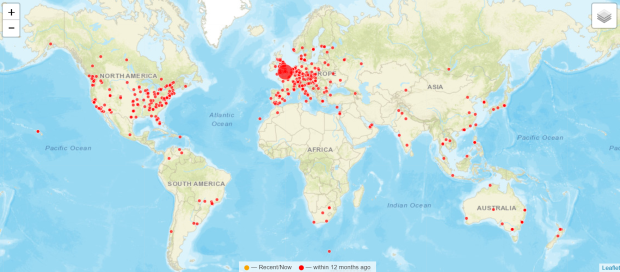
Watch This Space (Man) started in 2015 as a personal record of my astronomy journey. Notwithstanding, the blog has so far attracted 15,000 views from all over the world, including various locations in 64 countries over the past year (see map below for visitors in 2018).   I do like to hear from anybody out there – comments, questions, help or just to say hello  – and can be contacted via details in the ABOUT menu section or alternatively  just leave a comment on any item if you prefer.
 

WTSM Map 2018


I’m always tinkering with the website where apart from the main blog, there are also links to other astrophotographers, astronomy tools, astronomy weather, scientific papers etc.,  so even if you’re a regular visitor please take a look around from time-to-time.  Looking back I see I did not file any reports this year  under the new Astrobites section, on the other hand look out for more notable occasional image that now appears in the right-hand column under the heading Screenshot, which this year included: the Eskimo Nebula, Jupiter, the Moon & Jupiter in conjunction and Venus etc.         

Whilst there is a photo gallery of my work, for a more summary view of some of my better images there’s a FLICKR album link which is accessible from the GALLERY menu.  Following the change to mono imaging techniques in 2017, for reference each image is now accompanied by a detailed tabulation of the technical information; personally I find this information invaluable when looking at other astrophotographer’s images as a guide to settings and issues when imaging the same object myself for the first time.

Reflections Banner

Overview, Images & Goals for 2019

Since getting to grips with autoguiding in 2017, I’m pleased to say all the basic processes worked well throughout 2018, resulting in a marked improvement of individual image subs.  Long imaging times are difficult to achieve in the UK with poor skies being the norm but the successful adoption of Plate Solving this year marked a very significant breakthrough and holds great promise for ever longer integration times in the future.  Re-configuring the equipment and operating set-up in 2017 now enables operating from indoors most of the time, which apart from improving working conditions, has also made operating itself much more efficient.

I’m especially pleased that after more than 4-years astrophotography I finally manged to establish a new imaging location at the bottom of the garden this year, thereby for the first time enabling imaging of the north sky, literally opening up a new world!  For another perspective I was also fortunate to experience some excellent night skies in New Zealand, France and Cornwall during the year, which was great fun and led to some excellent images too (see 2018 CHRONICLE later in this blog).

Favourite Images

Apart from the odd DSLR shot of the night sky, my astrophotography at Fairvale Observatory in 2018 was entirely carried out with the ZWO1600MM-Cool mono CMOS sensor camera & EFW, combined with the William Optics GT81 scope, in both narrowband and broadband wavelengths.  The new camera has in every sense been a game changer and a lot more work but, in my opinion, the images this year show substantial improvement.  I also made progress using more complex processing techniques in Photoshop and improved colour and detail by combining Ha with LRGB or adding RGB and narrowband wavelengths.  With these advances I submitted a number of images to the British Astronomical Association which, I’m pleased to say, were chosen for publication on their website at various times throughout the year (see Astroimaging Record 2018 at end of blog for details).

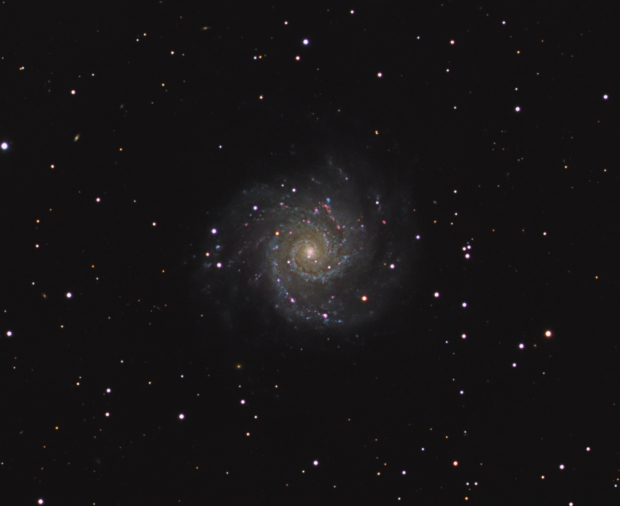
A few of my personal favourites are shown below, in no particular order:
GR Final HaLRGB

M74 Phantom Galaxy (HaLRGB)

RGB HaOO XXX2

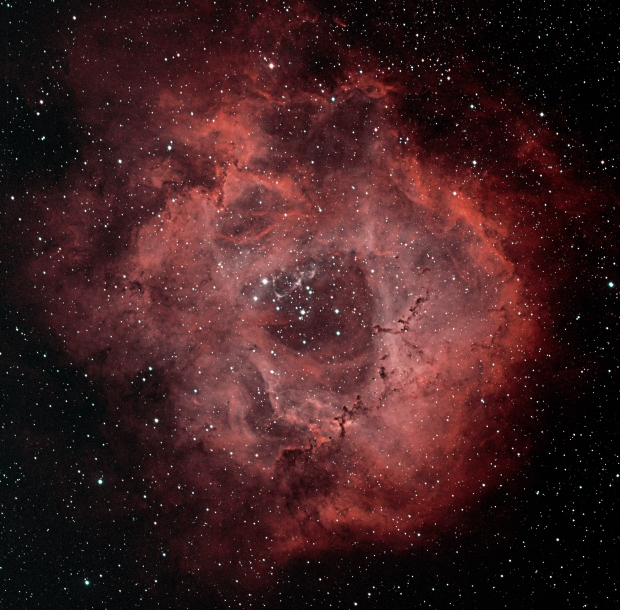
Rosette Nebula (HaOO) 

M13 LRGB Close-up

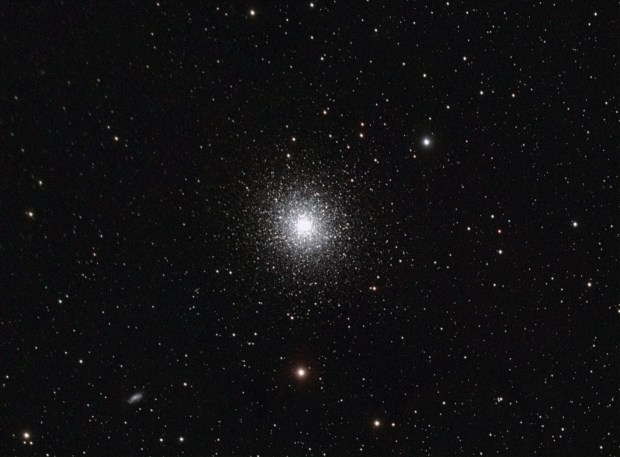
M13 Great Globular Cluster of Hercules (LRGB) 
Sombrero Galaxy

M104 Sombrero Galaxy (LRGB)

HHOO hlvg (Large)

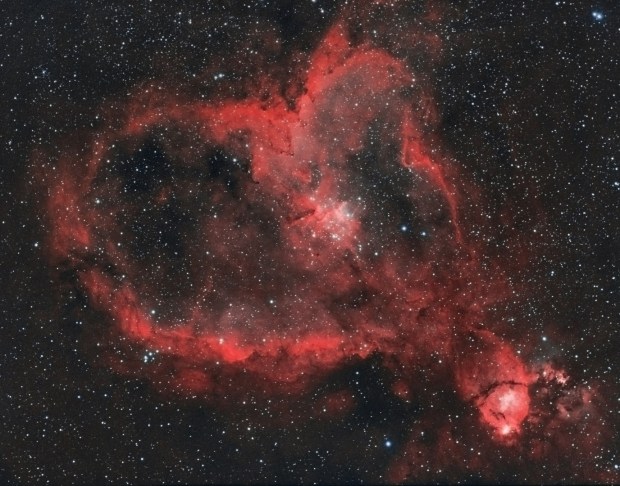
Heart Nebula (HaOO)

RGB2 GxFinalX (Large)

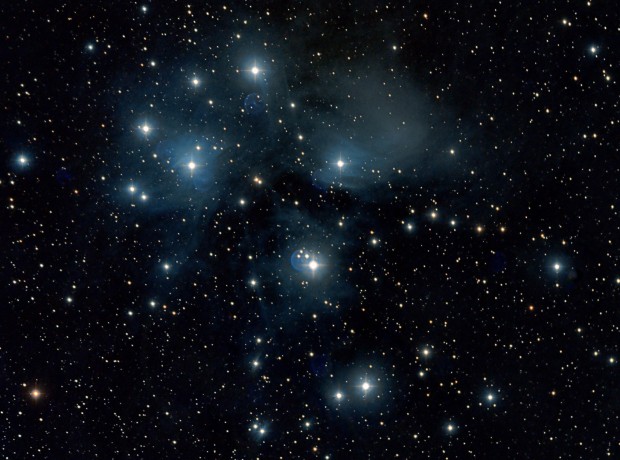
M45 Pleiades (LRGB)


RECORD CARD – 2018
Goal Specifics / Results Outcome
Improve broadband and narrowband imaging


Improved understanding and use of the ZWO1600MM-Cool mono camera leading to better subs.  Major breakthrough with Plate Solving enabling a significant increase in image integration times and overall quality. MUCH BETTER


Improve processing Continuing to make improvements and achieving noticeably better narrowband images but with more work to do in broadband. Much greater use of various Photoshop techniques is improving detail, colours and final quality. BETTER


Expand & Improve Widefield Imaging Despite some good images of the Milky Way in the UK and NZ I barely used the Vixen Polarie tracking mount and did not make it to any dark sky sites in the UK. FAILED


I think it helps to set new goals each year, so here goes for 2019:

  • Imaging: (i) There’s lots of scope to improve imaging techniques but probably most of all I now need to improve guiding quality and then increase exposure and image integration times further. (ii) Start mosaic imaging using Plate Solving.
  • Improve processing: Despite progress, I expect this will continue to be a major challenge for some time to come. Working with Olly Penrice in France and using Steve Richards’ new book Dark Art or Magic Bullet provided lots of opportunities to learn more but I’m still considering a move to new software for pre- and post-processing – we shall see.
  • Other: (i) Widefield imaging – Since acquiring the Vixen Polarie two years ago I’ve done little more than dabble in the occasional night sky shot. Maybe just set my sights lower this year and just see what happens! (ii) Do more observing – I had been thinking of getting something bigger like a Dob for observing whilst imaging is underway but frankly now thinking just do a bit more when I can with what I’ve got.  (iii) Notwithstanding weather issues at Les Granges observatory in France, get back to at least one good dark sky site next year.

I’m very pleased to say 2018 was again very good year for astrophotography, almost certainly my best yet, which was especially defined by two positive developments that are already transforming my astrophotography and hold further promise in 2019 (I said the same last year but it’s true):

  • Starting to Plate Solve has opened up whole new possibilities, in particular: Meridian flips and multiple imaging over different nights; Mosaic imaging.
  • Fairvale Observatory South – The ability to see and image the north sky from the new location expands imaging possibilities very significantly – should have done it sooner.

You can’t ask for more than that and hope that WTSM’s Reflections 2019 will record further such success.

Watch this space!
wtsm logo

2018 CHRONICLE

Below is a quarter by quarter summary of my astronomy and astrophotography for the year 2018, followed by an imaging record.  It’s interesting but not surprising that I recorded about 50% less objects than in the previous year but, as explained, integration times have increased markedly – “never mind the width, feel the quality”!

JANUARY TO MARCH

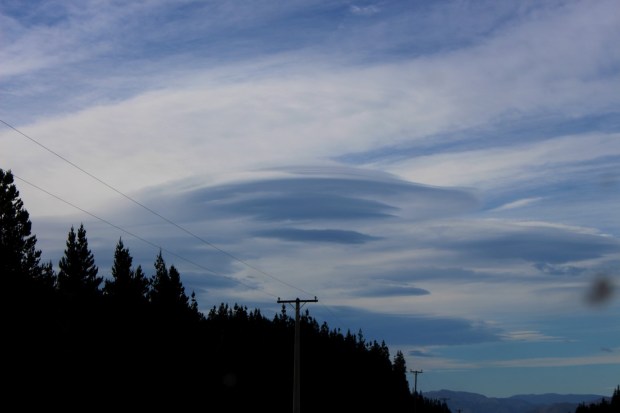
The year started with a new perspective on astronomy – upside down!  A six week trip to New Zealand over the Christmas period produced some wonderful views of the night sky in the Southern Hemisphere. Using my basic DSLR and a GorillaPod, I was able to obtain some good images of the Milky Way, accompanied by the Large and Small Magellanic Clouds, which are unseen in the Northern Hemisphere.  New Zealand’s weather conditions and terrain also produced opportunities to see various noctilucent cloud formations, particularly on South Island (below).
IMG_9102 (Large)

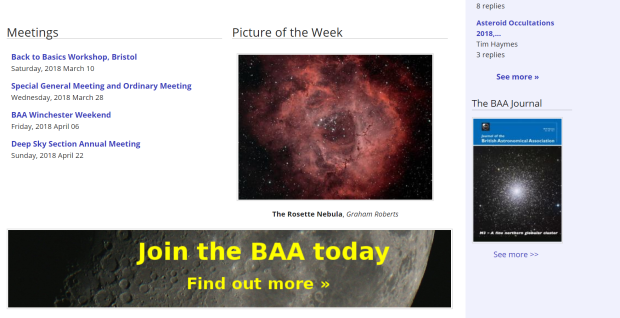
Being Down Under for much of January I was unable to start astroimaging until February but it was worth the wait, which resulted in an excellent narrowband image of the Rosette Nebula with which to start the year .  From the experience and advice gained in 2017, in narrowband I now tend to stretch each Ha-OII-SII wavelength more aggressively prior to post-processing and, as a result, obtain better detail and contrast.  In this case the resulting HaOO version of the Rosette (see Favourite Images section above) was particularly good and for the first time was included on the British Astronomy Association’s website 🙂
BAA PotW

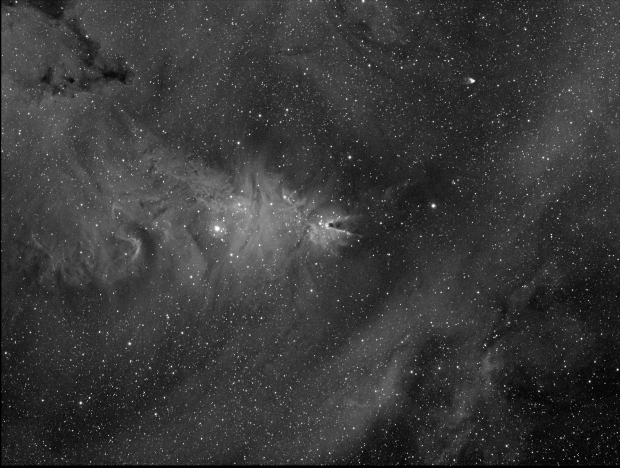
Since obtaining the ZWO1600MM-Cool mono camera narrowband imaging has been nothing less than a revelation to me.  Whilst tone mapping using the Hubble Palette produces quite spectacular and colourful results, applying the aforementioned stretching to the just the stacked Ha-wavelength subs can often result in equally exciting black and white (grey) images which show exquisite detail.  One such image taken in March was the Cone Nebula, which showed the more extensive nature of the HII-region as well as the Cone and Fox Fur Nebulae (below).
Picture saved with settings embedded.

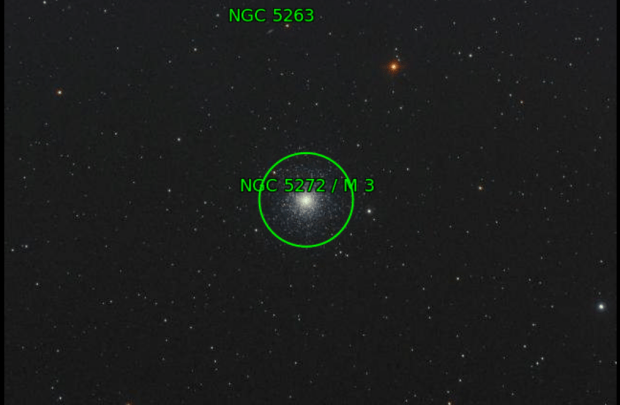
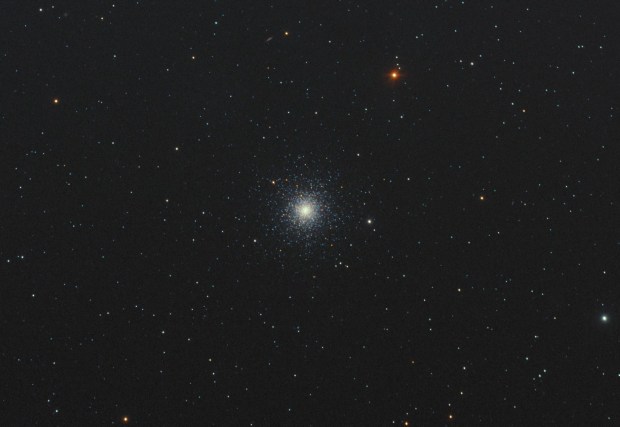
With the passing of winter’s narrowband targets by the end of February, I moved on to broadband imaging in March.  Of all the DSO features, I am perhaps most fascinated by globular clusters but had previously obtained mixed results with a DSLR camera.  Using the CMOS based ZWO1600 mono camera, I was now able to obtain much noticeably better colour and detail of these exciting but enigmatic objects (see Favourite Images section for M13 & below for M3).
M3 LRGB Crop (Large)

I can be put-off by some of the more technical requirements associated with astrophotography and, I‘m ashamed to say, that my approach is first to – ignore it, then maybe undertake some research but do nothing, then consciously put it off again and then, when there’s absolutely no alternative – give it a try.  I am not a technophobe, quite the opposite, but often find technology and the people who design and write about it unclear to the point of making no sense sometimes or at least misleading; it seems  somewhat paradoxical that I even got onto astrophotography given these issues! Notwithstanding, when I eventually summon the courage to tackle such problems, almost always I get it to work, eventually.  Such has been the case with Plate Solving this year.

With sight lines limited by houses, hedges and tall trees to the east, south and west, I’ve hitherto had to make do with average imaging windows of up to 2-hours, either to the east or west of the Meridian and depending on the object’s declination – a lower levels  the Meridian view is itself hidden by two tall trees, obscuring up to 30o vertically and 10o either side.  Naturally these constraints limit the image integration times severely, with an inevitable impact on the quality of images, notably with higher noise, less colour and detail.  The answer of course is plate solving and during February this year I finally bit the proverbial bullet.

Since changing to the ZWO 1600MM-Cool camera I have used Astro Photography Tool (APT) for image capture and camera control, with great success.  The software is quite comprehensive and it is excellent to use, though like most software can be a little idiosyncratic in places.  This is the point where I either give-up, try other software or, as is the case with APT, turn to their excellent product Forum.  Armed with the APT manual and answers from the Forum, I soon managed to plate solve and obtain images of the Leo Triplet over two consecutive nights, which subsequently aligned and stacked well – at last!

APRIL TO JUNE

For the past year or more I’d been thinking about the possibility of moving the observatory to the end of the back garden during the spring and summer period, so as to provide a platform from which to view the northern sky, which as previously mentioned is otherwise completely obscured by my house.  The principal issue was how to operate the equipment some 30-metres away?  From the experience of others it seemed that both WiFi and Bluetooth can have big reliability issues and I am always keen to keep it simple, so for now I chose to try and use a long ethernet cable to link the operating / capture computer with a control computer indoors.

I had intended to set-up on the lawn but after I had recently extended the paving around a nearby shed in the corner of the garden, cut back some of the bushes and cleared out the shed it, was obvious that this was a preferable location; the paved base was more stable and provided a dry foundation on which to work but, furthermore, the adjacent shed could house the operating computer.  Despite successful tests indoors using an ethernet cable between the two computers and Teamviewer software, only when the equipment was set-up in position outside did I finally discover it no longer worked; I still don’t know why and the problem remains work in progress (when I can be bothered to look at it again).

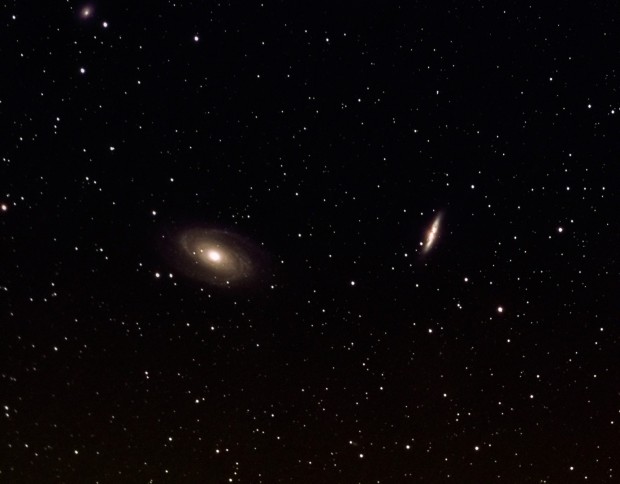
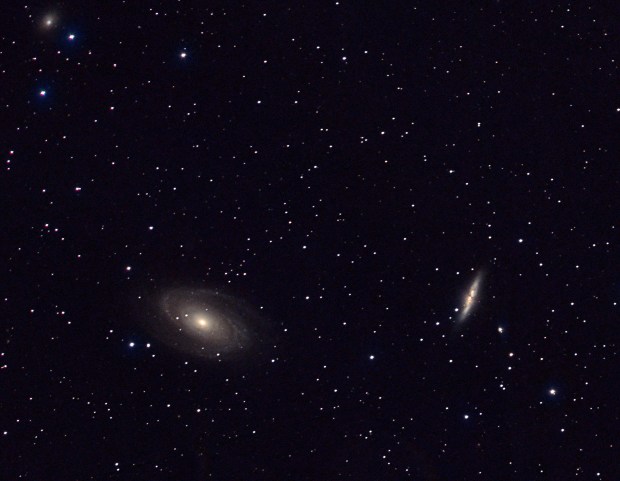
Notwithstanding, it was obvious that I could instead comfortably operate the mount and camera myself from the shed and duly set about establishing what has now become Fairvale Observatory South or the Shed Observatory (see photos above); the principal observatory location by the house now becomes Fairvale Observatory North or Patio Observatory. Having established myself at the end of the garden with a not unreasonable view of the north sky over the roof of my house, I eagerly set about imaging some northern classics over the next few months.  Imaging in both narrowband and broadband I was pleased to obtain decent pictures of the Bode & Cigar galaxies and the Elephant’s Trunk Nebula before taking a break in June and July when there’s no astronomical darkness; I have imaged at this time of the year before but it’s sometimes good to take a break.
M81 B (Large)

My very first image of the northern sky M81 Bode & M82 Cigar Galaxies (LRGB)

Now I know the observatory works from this location, I plan to move there sooner in 2019 in order to spend more time with new set-up, hopefully improving on the aforementioned objects as well as trying new ones.  All-in-all the new location was a big success as well as being great fun.  Strangely I was surprised to find that the experience of guiding could be more demanding in the north sky but of course thinking about it more, as the views essentially centre on Polaris on which RA lines converge the tracking needs to be more extreme in order to move the same angular distance when compared to a southward view.  However, anxious not to upset the established settings too much, my set-up was shoddy and, as a result, guiding error was generally poor from this locality.  Next time I’ll pay more attention to this and hopefully achieve better guiding and subs.

JULY TO SEPTEMBER

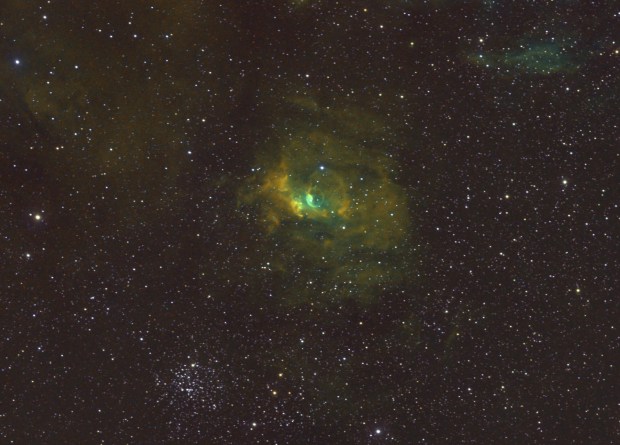
After a break of nearly 8-weeks I was eager to get back to the ‘new’ observatory at the bottom of the garden.  Furthermore, much of the summer through into September was dominated by a heatwave which was accompanied by clear skies, night after night!  As a result I was able to get some very encouraging results of the Heart (see Favourite Images section above) and Soul Nebulae and finally, to my surprise, the unusual Bubble Nebula (see image below).
SHO2int3 (Large)

OCTOBER TO DECEMBER

Needless to say, once back at Fairvale Observatory North the clouds rolled in and, furthermore, suitable objects for my equipment are initially sparse at this time of the year.  Since obtaining the ZWO1600MM-Cool camera I’ve concentrated on nebulae and narrowband imaging.  Though I’ve managed a few decent LRGB images, it’s fair to say that there’s room for improvement here and therefore finished the year on M33 the Triangulum Galaxy (see below) and subsequently M45 the Pleiades.  Despite being a good size for my scope it’s become clear to me that M33 is actually a tricky object and I was not satisfied with the final image – again better guiding and longer integration next time will almost certainly help.  However, Pleiades subsequently came out well (see Favourite Images section above) but the delicate interplay of the blue star light and interstellar dust does require careful post-processing.
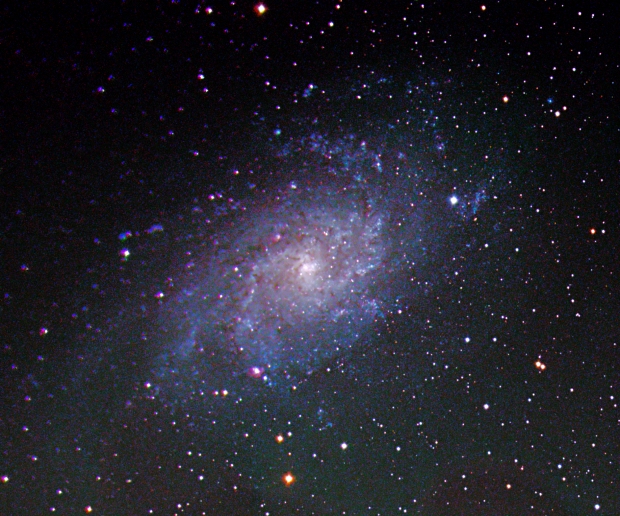
LRGB P2 CropXX

As it was my birthday and it’s been something of an overdue trip since first conceived in 2015, I travelled to Olly Penrice’s Les Granges Observatory at the beginning of November.  It’s a great set-up and Olly was a real pleasure to work and learn from.  As a somewhat remote location in the Hautes-Alpes region of Provence, when it’s clear the SQM values at Les Granges can exceed 22 and for the first two nights we were able to image M74 the Phantom galaxy in HaLRGB under such conditions using his TEC 140, though following some rain during the day seeing conditions were mixed on the first night.
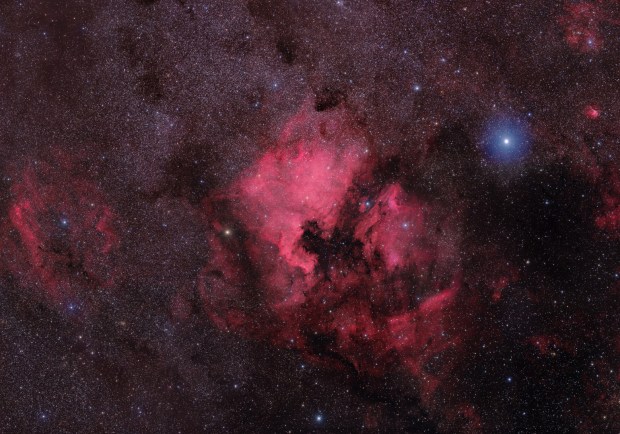
HaLRGB mosaic (Large)

Unfortunately the clouds had followed me from the UK and for the rest of the time there we were unable to image, though it did allow me to spend some useful and enjoyable time processing with Olly.  Other than processing the M74 image and learning some new techniques, using data previously acquired by Olly and with his help, I was able to compile a wonderful 9-panel HaLRGB widefield mosaic image of the North America Nebula and surrounding region (see above).


Notwithstanding the mixed weather conditions, I was able to obtain my first good, face-on image of a spiral galaxy (see Favourite Images section above), which with some additional subs from Olly’s previous sessions using an 14″ ODK scope turned into a truly spectacular image (see below) of this less than popular object.
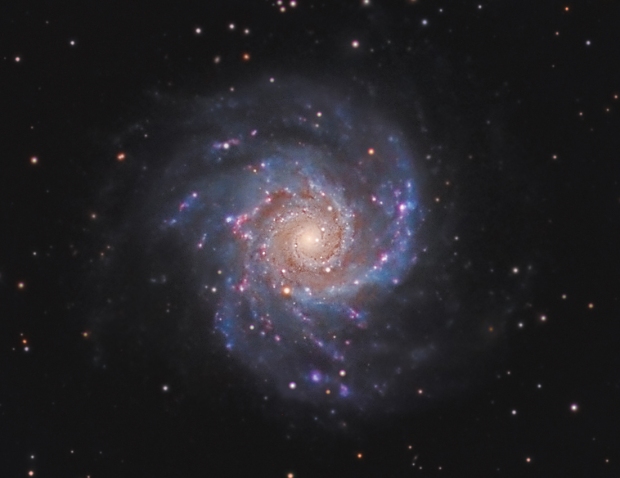
M74 ODK with TEC STARS HaLRGB Crop


ASTROIMAGING RECORD 2018

No Date Type Object Name
1 Jan 2018 DSLR New Zealand


Milky Way, Lenticular Clouds etc. 
2 09/02/18 NB NGC 2244 Rosette Nebula
       
3 11/02/18 NB NGC 2264 Cone Nebula
       
4 11/02/18 BB M44 Beehive Cluster
       
5 11/02/18 NB Abell 21 Medusa Nebula
       
6 11/02/18 BB NGC 2392 Eskimo Nebula
       
7 24/02/18 NB IC 405 Flaming Star Nebula
       
8 24/02/18 BB Moon  
       
9 19/04/18 BB M65 + M66 Leo Triplet
       
10 05/05/18 BB M3 Globular Cluster
       
11 06/05/18 BB M104 Sombrero Galaxy
       
12 06/05/18 BB M13 Globular Cluster
       
13 18/05/18 * BB M81 & M82 Bodes & Cigar Galaxies
       
14 20/05/18 NB NGC 7822 Nebula
       
15 22/05/18 NB IC 1396 Elephant’s Trunk Nebula
       
17 16/08/18 * NB IC 1805 Heart Nebula
       
18 02/09/18 NB IC 1848 Soul Nebula
       
19 03/09/18 NB NGC 7635 Bubble Nebula
       
20 09/10/18 BB M33 Triangulum Galaxy
       
21 28/10/18 BB M33 Triangulum Galaxy
       
22 2/11/18 BB M74 Phantom Galaxy
       
23 17/11/18 BB M45 Pleiades
       
24 18/11/18 BB IC 2118 Witch’s Head Nebula
       

*multiple evenings                                            Underlined = BAA published


Triangulum

LRGB P2 CropXX

After we say goodbye to Orion each year, the galaxy season starts in February and lasts through until late April.  It seems almost unbelievable that the existence of galaxies outside of our own Milky Way was unknown to mankind until Edwin Hubble’s work in 1929; the Andromeda Nebula turned out to be a galaxy as did all those other faint fuzzies and many more that have since been discovered.  Like grains of sand on the beach, there are currently known to be at least two trillion galaxies in the observable Universe and no doubt many more as yet remain undiscovered.  On Earth we really are a very, very small speck in space and can only wonder at those other worlds.

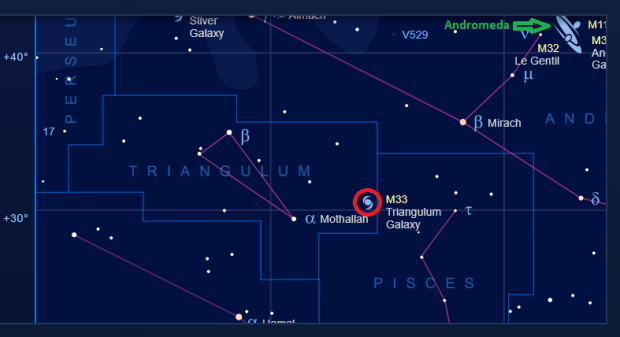
Despite their abundance I struggle to image galaxies with the otherwise excellent William Optics GT81 telescope, except for the few largest ones that are closest to Earth in the so-called Local Group, such as the aforesaid Andromeda Galaxy and located nearby M33 or the Triangulum Galaxy.  About one quarter the size pf Andromeda, M33 still provides a decent imaging target for my equipment, which I’ve attempted before using a DSLR camera with some success.  So, before the winter night sky arrives I thought I’d give M33 a try for the first time using the ZWO1600MM-Cool CMOS mono camera.

M33 Chart

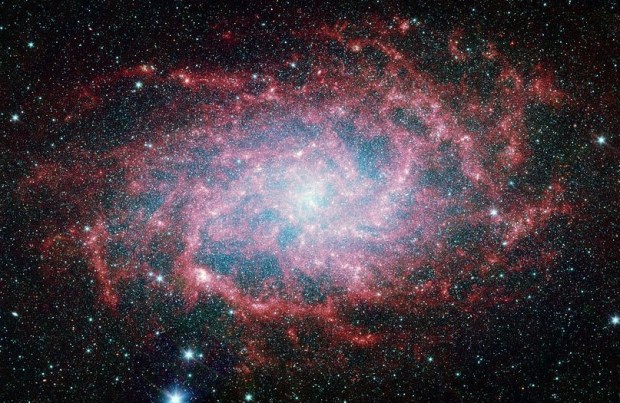
M33 is characterized by its large, sprawling spiral arms, within which are located numerous H-II regions, home to large stellar nurseries.  Its mass is thought to extend well beyond the visible galaxy, with large areas of cold dust now identified around and beyond the spiral arms.  Interestingly infrared imaging by the Spitzer Space Telescope (below) shows much more discrete structures throughout the disc than is evident in the visible light spectrum.  The future of M33 is somewhat uncertain but seems to point towards its destruction, either by Andromeda or alternatively crashing into the Milky Way!

1280px-Spitzer_m33 Imaging experience to-date with the ZWO camera has shown that 5-minute exposures and unitary settings – Gain 139 Offset 21 – produces a good result with most nebulae targets, however, imaging star clusters and galaxies remains work-in-progress.  Whilst tempted to continue with this approach, after reviewing and adjusting the PHD2 settings my guiding has been poor recently, so on this occasion I chose shorter 3-minute exposures to obtain LRGB and Ha subs.
With nearly 3-hours integration time the resulting LRGB image turned out good (top-of-the page) and noticeably better than using a DSLR camera.  The H-II regions were captured with the Ha-subs but subsequently did not integrate very well with the main LRGB image – or maybe that was my error?  Whilst pleased with the outcome for now, on reflection I think there are issues that still need to be addressed in order to obtain a better outcome next time:

  • Although M33 is quite bright, the spiral arms are somewhat diffuse in nature and would benefit from much longer integration time and better guiding to achieve less noise and greater depth in the resulting image;
  • The jury’s out on exposure times but I feel that 5-minutes might still work better and is certainly worth trying;
  • Though much improved, processing remains a weakness and needs to be improved.

Notwithstanding the above M33 is a wonderful object and, as ever, I remain inspired by the galaxy itself and images of others to do better in the future.

IMAGING DETAILS
Object M33 Triangulum Galaxy
Constellation Triangulum
Distance Approx.. 2.7 million light-years
Size 71’ x 42’  or 60,000 light-years
Apparent Magnitude +5.72
 
Scope  William Optics GT81 + Focal Reducer FL 382mm  f4.72
Mount SW AZ-EQ6 GT + EQASCOM computer control
Guiding William Optics 50mm guide scope
  + Starlight Xpress Lodestar X2 guide camera & PHD2 control
Camera ZWO1600MM-Cool (mono)   CMOS sensor
  FOV 2.65o x 2.0o Resolution 2.05”/pix  Max. image size 4,656 x 3,520 pix   
EFW ZWOx8 + ZWO LRGB & Ha OIII SII 7nm filters 
Capture & Processing Astro Photography Tool + PS2,  Deep Sky Stacker & Photoshop CS2, HLVG
Image Location              & Orientation Centre  RA 01:34:02    DEC 30:38:51                     

Top = North  Right = West   Bottom = South Left = East 

Exposures 12 x 180 sec RGB + 10×10 sec L & Ha  (Total time: 168 minutes)   
  @ 139 Gain   21  Offset @ -20oC    
Calibration 10 x 180 sec Darks  20 x 1/4000 sec Bias  10 x Flats LRGB + Ha  @ ADU 25,000  
Location & Darkness Fairvale Observatory – Redhill – Surrey – UK        Typically Bortle 5
Date & Time 9th October 2018 @ +22.00h  
Weather Approx. 12oC   RH = 90%


Boreal Breakthrough


M81 LRGB Final HLVG

I have often written about imaging difficulties here at Fairvale Observatory, which apart from overflying aircraft from Gatwick and Heathrow airports, 24/7 helicopters from Redhill aerodrome and general light pollution, also consists of numerous sightline obstructions in the form of large trees to the east and south, high garden hedges and the complete obstruction of the north sky by my house!  I have toyed with the idea of moving onto the lawn so as to look back northwards over the house but was concerned by all the faffing about to get the equipment down and back up a flight of steps, as well as added complications with equipment control and dew problems; I concede that many do operate successfully in this way but with plenty of other problems to cope with, I like my hobby to be as easy and convenient as possible.

Last year I enjoyed working outside during the summer months – notwithstanding the lack of darkness during much of this period – and therefore over the past winter finally considered how such a garden-based set-up could be achieved, primarily for use between May and September.  The resulting Plan-A was to place three paving stones within the lawn to support the tripod and run a USB-cable back to the house for control.  However, after recently expanding a small paved area outside the shed at the end of the garden and looking at the potential sightlines from this location, it was obvious that a Plan-B set-up here could also work.  Whilst not quite as good viewing angles as the original location, there are a number of other worthwhile benefits:

  • Being off the lawn on paving it seemed likely that dew could be less of a problem;
  • Working on the paving around the mount would be more convenient and dry;
  • By clearing out the adjacent shed it could be used as a dry location from which to control the equipment.

And so early in May I set about establishing Plan-B and soon afterwards putting it to work.

Pan1 Comp (Medium)

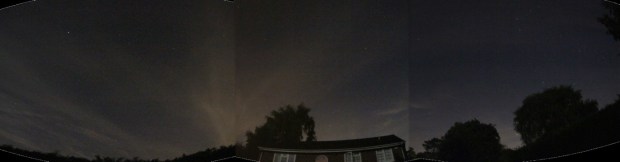
The view from the shed looking northwards is surprisingly quite good (see above) and I don’t know why I hadn’t considered this before. There are a few large trees to the north east, a high hedge along the western boundary and of course my house is still somewhat in the way but altogether it’s not too bad and for the first time I have a clear view of Polaris, as well as a whole new plethora of imaging targets!  Whilst this direction looks directly towards south London, being on the southern slope of the Greensand Ridge the worst of the city’s glow is fortunately obscured by the hill.  Furthermore, it is ironic that my house and the hedges also provide considerable protection from the local street lights, which I’m pleased to say are now turned off after midnight anyway.

Set-up

Local equipment layout the same as previously

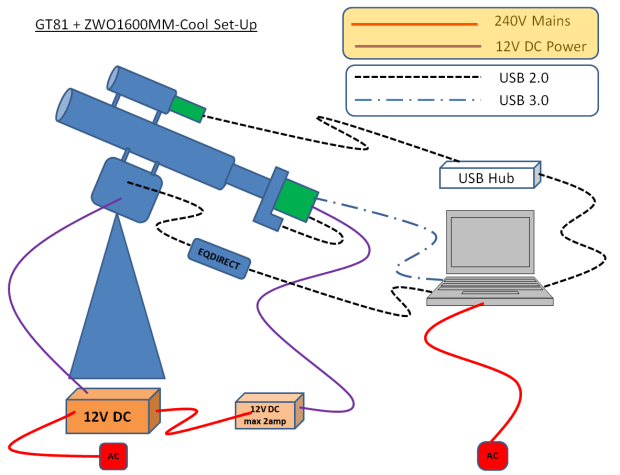
I cut-back some of the adjacent vegetation to improve sightlines and ran a power cable from the house to the shed otherwise it’s exactly the same set-up which was being used at the main, south looking location on the patio by the house.  I looked into WiFi-control of the equipment but from the experience of others concluded it could be unreliable and instead considered using Teamviewer software via a USB Cat-5 repeater cable from the mount / shed computer to a second computer in the house.  However, given the distance of some 30 metres I finally decided to adopt a more robust LAN Cat-6 ethernet cable for this purpose. Unfortunately whilst this had worked successfully during testing in the house, I have so far been unable to get it to work outside and for now have had to operate the equipment from inside the shed, which has nonetheless proved to be a comfortable and effective alternative.

Being lazy and cautious about changing too much about the set-up, I levelled, aligned and reset the new location data of the tripod but kept all other settings the same for now.  I realise this is not ideal but initially just wanted to experience the new location and north sky to understand what was possible within the given field-of-view and identify any obvious problems.  Fortunately a settled period of good weather allowed me to try out the new location soon thereafter.

North Sky ViewX

White area shows optimum imaging area from Fairvale Observatory South – AKA ‘The Shed’

What I hadn’t expected on first use was that slewing and tracking would become more difficult and takes noticeably longer at higher latitudes, especially approaching Polaris.  Following subsequent enquiries and with some further thought it now makes sense.  At higher latitudes near and above about 70 degrees as the lines of Longitude are closer together, it makes the RA slew rate bigger and bigger the closer you get to the North Celestial Pole.  Of course the celestial pole is not coincident with the terrestrial pole, which means that those objects within the latitude of 90o minus the observer’s latitude – in my case this equals 39o – means that all those objects above 39o will be circumpolar from my point-of-view i.e. will rotate over the year around North Celestial Pole.  This is basic astronomy but hitherto I had not considered the implications for tracking and guiding before and will need to bear it in mind when selecting targets in the future.

M81 B (Large)

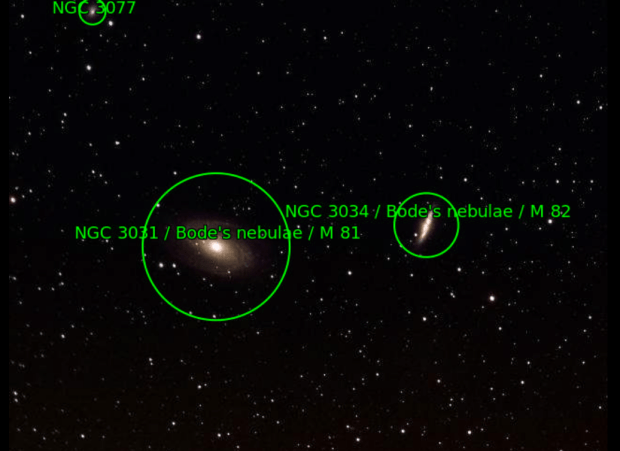
I had one particular target in mind but as it was only viable much later in the night, on this occasion I chose to start imaging the north sky for the first time with Bode’s Galaxy AKA M81 and the nearby Cigar Galaxy AKA M82; for comparison using low gain, long exposure on the first night (top of the page) and high gain, short exposure (below) on the following night.  Given the target’s DEC position of 70o I soon discovered the aforesaid tracking difficulties, which resulted in the RMS guiding error varying from 3’ to 20’ and deleterious consequences for the images!


Whilst I’m pleased with my very first north sky images, it is obvious I’ll need to return again with better guiding and much longer integration time.  On a positive note the general set-up worked very well and the shed provided an excellent place from which to operate the control and image capture equipment.  Furthermore, despite a few restrictions the overall view of the northern night sky is good and holds much promise for future, hitherto inaccessible imaging objects.  As a result of establishing this new site I intend to name the new north looking location Fairvale Observatory South or ‘The Shed Observatory’ (see mosaic above) and the principal, south looking location by the house Fairvale Observatory North or ‘The Patio Observatory’.  Altogether this marks a major breakthrough for my astronomy and I eagerly await the return of astronomical darkness on 20th July onward.

AstroNet ResultX

IMAGING DETAILS
Objects Bode’s Galaxy M81  &  Cigar Galaxy M82     
Constellation Ursa Major
Distance M81  11.8  &  M82  11.4 -12.4 million light-years
Size M81 26.9’ x 14.1’   &    M82 11.2’ x  4.3’
Apparent Magnitude M81 +8.0  &  M82 +8.4
 
Scope  William Optics GT81 + Focal Reducer FL 382mm  f4.72
Mount SW AZ-EQ6 GT + EQASCOM computer control
Guiding William Optics 50mm guide scope
  + Starlight Xpress Lodestar X2 guide camera & PHD2 control
Camera ZWO1600MM-Cool (mono)   CMOS sensor
  FOV 2.65o x 2.0o Resolution 2.05”/pix  Max. image size 4,656 x 3,520 pix   
EFW ZWOx8 + ZWO LRGB & Ha OIII SII 7nm filters 
Capture & Processing Astro Photography Tool + PS2,  Deep Sky Stacker & Photoshop CS2
Image Location Centre Image-B    RA 09:55:13.46    DEC 69:21:08.36  (19/0518) 
Exposures                       


A 18/05/18   10 x 180 sec L  + 5×180 sec RGB  (Total time: 75 minutes)    @ 139 Gain   21  Offset @ -20oC

B 19/05/18   45 x 60 sec L    + 15 x 60 sec RGB  (Total time: 90 minutes)    @ 300 Gain   50  Ofsett @ -20oC    

Calibration                    


A 15 x 180sec Darks  20 x 1/4000 sec Bias  10 x Flats LRGB  @ ADU 25,000  

B 15 x 60sec Darks     20 x 1/4000 sec Bias  10 x Flats LRGB  @ ADU 25,000  

Location & Darkness Fairvale Observatory South – Redhill – Surrey – UK       Typically Bortle 5
Date & Time (A)    18th  &   (B) 19th May 2018 @ +23.45h approx.


Star Struck


M13 LRGB F2 CROP (Large)

Of all the things I’ve discovered since taking up astronomy, perhaps it is the presence and nature of globular clusters that has most surprised me. Bound closely together by gravity, these massive spherical collections of stars orbit the galactic core perpendicular to its plane.  In the case of the Milky Way there are 150 globular clusters but they can be much larger in other galaxies, such as M87 which has some 13,000; clusters of clusters have also now been discovered in the Universe!  Typically each cluster might contain a few thousand or tens of thousands of stars, although in some cases they can be much larger.  Omega Centauri is the largest globular cluster in the Milky Way, being 150 light-years in diameter it contains 10 million stars; though clearly visible from Earth it can only be viewed from the Southern Hemisphere, which we unfortunately did not see when in New Zealand earlier this year.

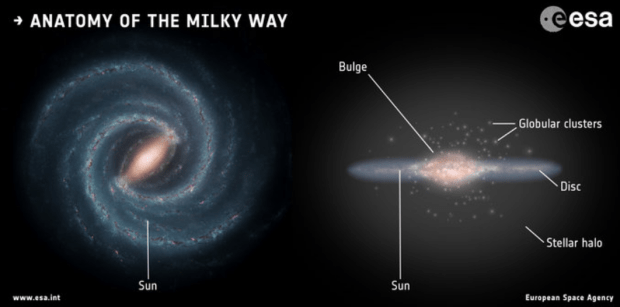
MW &amp; globs

Despite all the advances being made in cosmology, the origin of globular clusters still seems to remain quite uncertain.  Characteristically the stars are all very old, typically in the region of 8 to 12-billion years and are of low metallicity i.e. they contain a low proportion of elements other than hydrogen and helium.  At least some, such as Alpha Centauri, are thought to have condensed from dwarf galaxies and such a process may currently be taking place within the large Magellanic Cloud – which we did see in New Zealand!  In other cases it is thought that the clusters have probably originated independently and were subsequently captured by the relevant galaxies.  However, their very old age – sometimes nearly as old as the universe itself – origin and relationship to galaxies remains intriguing.  For these and many other reasons I personally find globular clusters fascinating, probably more than any other astronomical feature, amazing as they too may be.

GlobsX

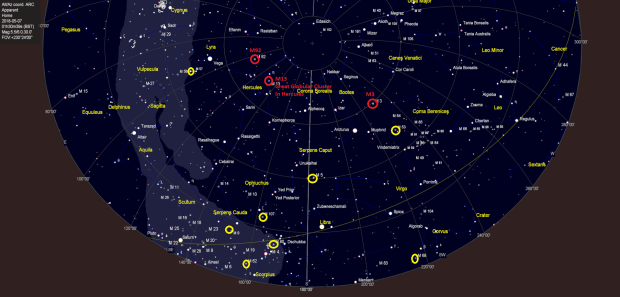
Globular Clusters May 2018: M3, M13 & M92 (red circles) + Others (yellow circles)

From time-to-time I’ve tried imaging various globular clusters but have not been satisfied with the outcome.  Now using guiding, plate solving and the high-resolution ZWO1600MM-Cool camera, it was time to give it another try this spring, when some of the best clusters are present in the northern night sky.

M3 LRGB Final (Large)

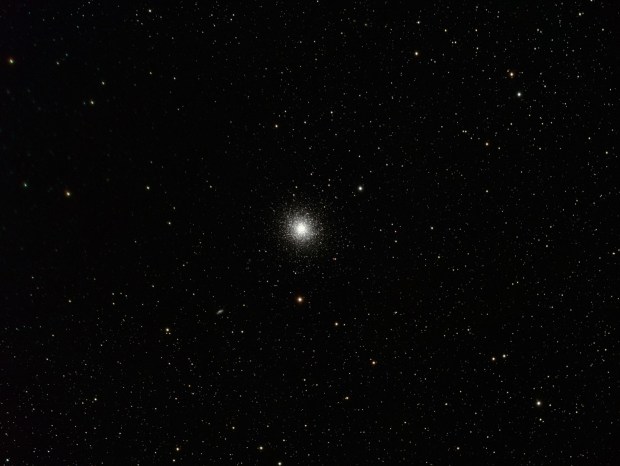
First up was M3 (Final image above), the very first Messier Object to be discovered by Charles Messier himself in 1764.  Consisting of 500,000 stars, between 8 and 11-billion years old and spanning some 220 light-years, M3 is one of the largest and brightest (absolute) globular clusters associated with the Milky Way – about 300,000 times brighter than our Sun.  It is noteworthy that the cluster contains some 274 variable stars, the highest number of any clusters, as well as a relatively high number of ‘blue stragglers’ – young main-sequence stars that appear to bluer and more luminous than the other stars in the cluster and are thought to be formed through stellar interaction of the older stars.

M3 LRGB Crop (Large)

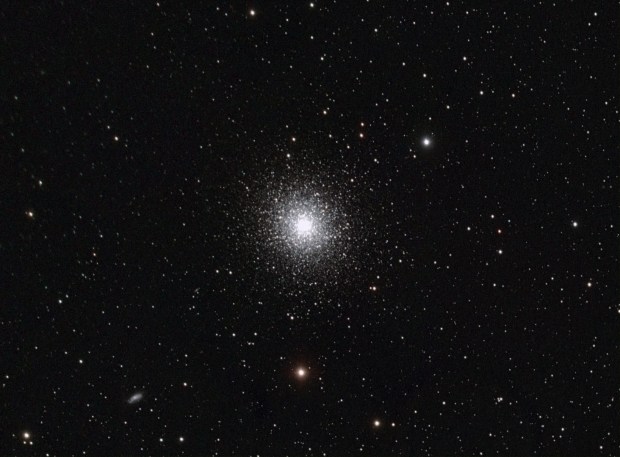
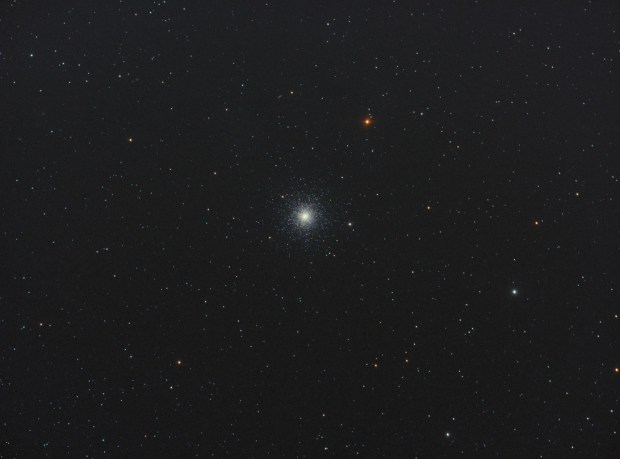
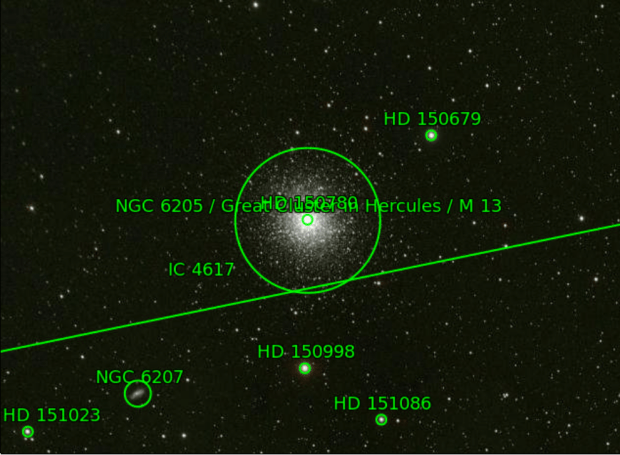
With these attributes it is not surprising that M3 is considered a popular target in astrophotography (cropped image above), likely surpassed however by M13 AKA the Great Globular Cluster in Hercules (cropped image top-of-the-page), which conveniently follows M3 in the same area of the sky about 3-hours later (together with nearby the globular cluster M92).  And so having bagged M3 it was time to turn the telescope and camera towards M13 (Main image below).  Discovered by the eponymous Edmond Hailey in 1716 (he of Hailey’s Comet), seen from Earth M13 is slightly brighter than M3 with a wide range of star colours that certainly makes for an exciting image.  At 11.65 billion years old, M13 has been around almost three times as long as the planet Earth.

M13 LRGB Final (Large)

Since starting astrophotography I like to try my hand at imaging a globular cluster at least once each year but hitherto with disappointing results.  This time I’m pleased with the outcome, especially M13 which is surely one of the most magnificent objects in our night sky; as a bonus there are also a few galaxies in the background of both the M3 and M13 images too.  It is therefore fortunate that for those of us in the higher latitudes of the northern hemisphere the Great Globular Cluster in Hercules can be seen all-year round, though is at its highest and therefore best position between May and September – thereby inaccessible for the Kiwis who are instead compensated by Alpha Centauri!  I expect to be back again next year to marvel at these amazing and enigmatic objects, if not before.

M3 Location Crop

IMAGING DETAILS
Object M3    (NGC 5272)     
Constellation Canes Venatici
Distance 33.9 million light-years
Size 18.0’ or 220 light-years     
Apparent Magnitude +6.2
 
Scope  William Optics GT81 + Focal Reducer FL 382mm  f4.72
Mount SW AZ-EQ6 GT + EQASCOM computer control
Guiding William Optics 50mm guide scope
  + Starlight Xpress Lodestar X2 guide camera & PHD2 control
Camera ZWO1600MM-Cool (mono)   CMOS sensor
  FOV 2.65o x 2.0o Resolution 2.05”/pix  Max. image size 4,656 x 3,520 pix   
EFW ZWO x 8 + ZWO LRGB & Ha- OIII-SII 7nm filters 
Capture & Processing Astro Photography Tool + PS2,  Deep Sky Stacker & Photoshop CS2
Image Location Centre  RA 13:42:23     DEC 28:22:50  
Exposures 24 x 180 sec L + 10×180 sec RGB  (Total time: 162 minutes)   
  Unity @ 139 Gain   21  Offset @ -20oC    
Calibration 10 x 180sec Darks  20 x 1/4000 sec Bias  10 x Flats LRGB  @ ADU 25,000  
Location & Darkness Fairvale Observatory – Redhill – Surrey – UK        Typically Bortle 5
Date & Time 5th + 6th  May 2018 @ +23.00h

M13 Location Crop

IMAGING DETAILS
Object M13     (NGC 6205)
Constellation Hercules
Distance >=20,000 light-years
Size 20’  or 150 light-years
Apparent Magnitude +5.8
 
Scope  William Optics GT81 + Focal Reducer FL 382mm  f4.72
Mount SW AZ-EQ6 GT + EQASCOM computer control
Guiding William Optics 50mm guide scope
  + Starlight Xpress Lodestar X2 guide camera & PHD2 control
Camera ZWO1600MM-Cool (mono)   CMOS sensor
  FOV 2.65o x 2.0o Resolution 2.05”/pix  Max. image size 4,656 x 3,520 pix   
EFW ZWOx8 + ZWO LRGB & Ha OIII SII 7nm filters 
Capture & Processing Astro Photography Tool + PS2,  Deep Sky Stacker & Photoshop CS2
Image Location Centre  RA 12:39:59    DEC -11:37:20  
Exposures 20 x 180 sec L + 15×180 sec RGB  (Total time: 195 minutes)   
  @ Unity 139 Gain   21  Offset @ -20oC  USB 40 
Calibration 10 x 180sec Darks  20 x 1/4000 sec Bias  10 x Flats LRGB  @ ADU 25,000  
Location & Darkness Fairvale Observatory – Redhill – Surrey – UK        Typically Bortle 5
Date & Time 6th + 7th + 9th May 2018 @ +00.30h  


Chapeau!

LRGB GxC Crop-2 (Large)


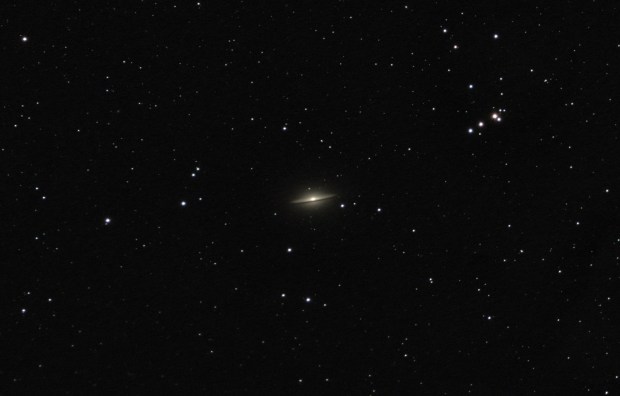
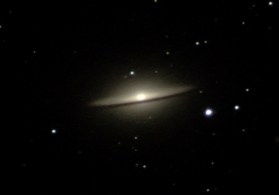
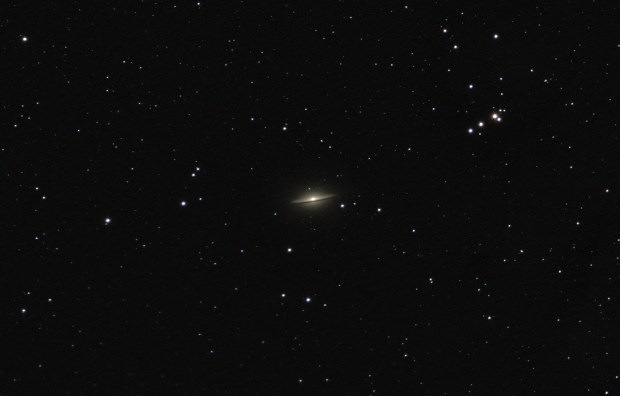
I always had a general interest in astronomy but was eventually sparked into action after viewing Saturn through the Thompson 26 inch refractor at Herstmonceaux observatory in 2014.  The beauty of the planet and its unique rings is captivating and like many others it remains my favourite planet to this day.  One year on and looking further afield at Joan Genebriera’s Tacande Observatory on the island of La Palma, I discovered what is now  one of my very favourite Deep Sky Objects – M104 or the Sombrero Galaxy; until recently I used the resulting picture obtained whilst at La Palma as the main banner image for this website.  Though perhaps not as spectacular as the Orion Nebula or certain spiral galaxies, the sombrero-like galaxy (with a passing resemblance of a flying saucer too), is beguiling in its own unique way and ever since then I’ve been eager to return to The Hat and image it myself from home.

Chart_1.cdc3

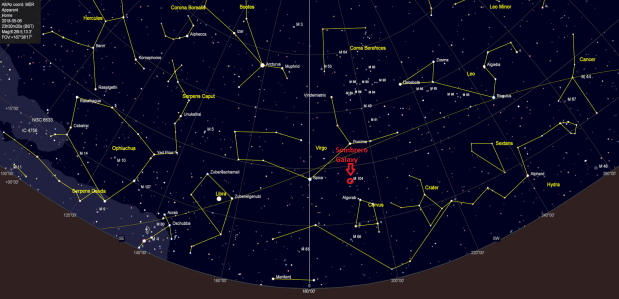
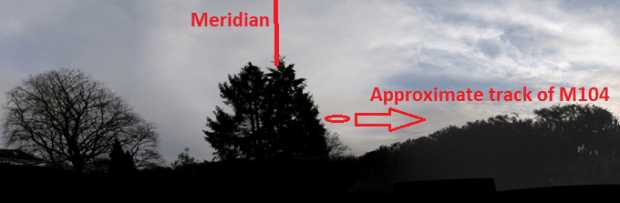
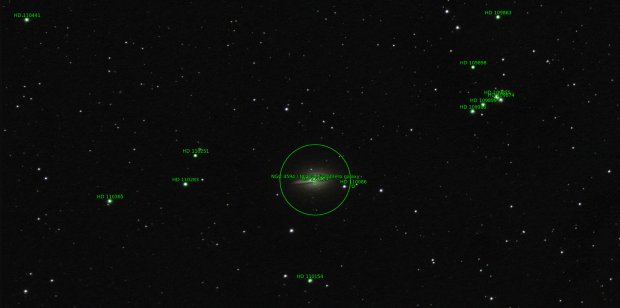
However, imaging the Sombrero from the UK and especially at my location just south of London is quite another matter to La Palma.  Aside from light pollution, being at 51o north compared to 28o in La Palma, M104 is considerably lower in the sky when viewed from Fairvale Observatory in Redhill; at the time of imaging in early May it was about 26o above the southern horizon.  Furthermore, my sight lines are obscured on three sides by 15-foot hedges and directly south by two 45-foot conifers – see below SE to SW view of M104 imaging track at Fairvale Observatory.

M104 Track crop

As a result, only after it emerges from behind the western edge of the aforesaid conifers can M104 (just) be imaged, as it moves along the top of the hedge for just over an hour before disappearing from view once again.  Of course this is far from ideal but with my enthusiasm for the Sombrero, a high-resolution ZWO1600M-Cool camera and newly acquired ability to plate solve, I gave it a try over three consecutive nights.


RGB GxC crop (Large)


An unbarred spiral galaxy, the hallmark of M104 is its bright bulbous centre encircled by dark dust lanes, which when viewed from Earth tilted at just 6-degrees above the equatorial plane creates the appearance of a sombrero hat (see cropped image above).  With the much higher resolution of the Hubble telescope some 2,000 globular clusters have been identified with M104, ten-times that of the Milky Way.  In 1912 the galaxy was found to be moving away from Earth at 700 miles per second, providing an early indication that the Universe was in fact expanding in all directions.

All-in-all the Sombrero galaxy is a fascinating and unusual object, though small and all-in-all a challenging imaging target, especially seen from Fairvale Observatory.  Notwithstanding, at last I am very pleased to obtain my own exciting image of the Sombrero – chapeau!

M104 Location

IMAGING DETAILS
Object Sombrero Galaxy  M104     
Constellation Virgo
Distance 29 million light-years
Size 9’ x 4’  or  50,000 light-years
Apparent Magnitude +8.0
 
Scope  William Optics GT81 + Focal Reducer FL 382mm  f4.72
Mount SW AZ-EQ6 GT + EQASCOM computer control
Guiding William Optics 50mm guide scope
  + Starlight Xpress Lodestar X2 guide camera & PHD2 control
Camera ZWO1600MM-Cool (mono)   CMOS sensor
  FOV 2.65o x 2.0o Resolution 2.05”/pix  Max. image size 4,656 x 3,520 pix   
EFW ZWOx8 + ZWO LRGB & Ha OIII SII 7nm filters 
Capture & Processing Astro Photography Tool + PS2,  Deep Sky Stacker & Photoshop CS2
Image Position Centre  RA 12:39:59    DEC -11:37:20  
Exposures 25 x 180 sec L + 3x5x180 sec RGB  (Total time: 120 minutes)   
  @ 139 Gain   21  Offset @ -20oC    
Calibration 10 x 180sec Darks  20 x 1/4000 sec Bias  10 x Flats LRGB  @ ADU 25,000  
Location & Darkness Fairvale Observatory – Redhill – Surrey – UK        Typically Bortle 5
Date & Time 5h + 6th + 7th  May 2018 @ 23.30h  approx.


AstroBites-2: Home Sweet Home

IMG_8748 FINAL (Large)

From time-to-time I’ve been fortunate to see the Milky Way but due to the lack of dark skies, rarely in the UK.  With a move towards urbanisation taking place throughout the world, light pollution is a major obstacle to such views and astronomy in general and it is only in more remote, unpopulated locations that such sights are now possible.  On such occasions a view of our galaxy from within is always striking and usually memorable. I’ve been fortunate to visit many such remote places but either didn’t look upwards (why not?) or was hindered by the inevitable cloud.  Recently on a trip in 2016 to Arizona and Utah in the South West USA, such views were hampered by the full moon – timing is everything!  However, there have been two occasions when the darkness was so complete that I found the view of the Milky Way to be not only incredible but quiet profound – first in the Kalahari desert in Botswana and subsequently on a scuba diving trip whilst motoring southwards along the middle of the Red Sea at night with the boat’s lights turned off.

Notwithstanding, since my interest in astronomy started a few years ago I have yet to successfully image the Milky Way, which has remained resolutely elusive to my camera sensor.  I have tried a few times at Fairvale Observatory but the night sky here at best rates 5 on the Bortle scale and makes such imaging almost impossible.  Then whilst in the Arizona desert last year (see above) and on other occasions I have been thwarted by a full moon.  Apart from the obvious problem of light pollution I was beginning to wonder if I was doing something wrong but no, it was the sky conditions.

Finally during September this year, whilst camping in Dorset on the Isle of Purbeck just west of Corfe Castle, I at last managed to image the all elusive galaxy – our galaxy (see top of page).  Looking south across the Purbeck hills towards the English Channel, the Milky Way was revealed in all its glory traversing the clear, very dark sky which itself was pierced by the vivid light of the myriad of stars; it is on such occasions I realise just what I’m missing at home.  Once accustomed to the darkness the form and some detail of the Milky Way could be clearly discerned with the naked eye but of course the camera saw a lot more.

Picture saved with settings embedded.

Some processing shows good detail of the Milky Way but at ISO 6400 is too noisy

Using my unmodded Canon 700D DSLR and an ultra wide-angle 10mm lens, for the first time I was able to capture some reasonable images of the Milky Way.  All were shot on a static tripod between 15 and 20 second exposures at ISO 6,400; I had set-up the camera on the Vixen Polarie for tracking but could not obtain a favourable view of the galaxy in this way.  From this experience next time I would reduce the ISO to at least 3,200 or less and increase the exposure time based on the ‘Rule of 500’ to about 30 seconds.  However, for now I’m happy with the result and hope the next opportunity doesn’t take another  lifetime coming.

A New Palette

Colour

It still remains early days with the new ZWO 1600MM-Cool camera but the initial signs using the narrowband filters have been very promising and frankly good fun.  I’ve been surprised at the benefits gained using these filters and especially the new and exciting possibilities it introduces to imaging. But there’s more.

When first using a digital camera for astrophotography it came as a surprise to discover that the colours come from an RGB Bayer Matrix placed in front of the sensor.  The so-called One Shot Colour camera or OSC, provided me with many decent images and when I recently started to think about getting a better camera another OSC seemed the way to go.  Their major benefit is that you are able to just take, as it says, one shot – or multiple colour shots for stacking.  Of course there’s still much to learn when starting out but the process is relatively simple and a decent set of subs and calibration frames can be obtained in a few hours or less; subsequent processing is also straightforward with one set of subs and no more than three sets of calibration frames.

Notwithstanding, when looking at more specialized OSC cameras, it soon became clear that the benefits of moving from DSLR were limited.  Another surprise with astrophotography is that the best images are obtained using a mono camera, in combination with colour and if required narrowband filters.  Hitherto, this has meant precise guiding in order to obtain long exposures using a very expensive CCD camera.  However, last year everything changed with the introduction of completely new technology in the form of a cooled CMOS camera, which I and the astrophotography community are currently getting to grips with – the aforementioned ZWO ASI1600MM-Cool.

Whilst more complex to use than a DSLR, this camera seems to be something of a game changer for astrophotographers in that: (a) it has a larger more sensitive sensor than a CCD camera, (b) it’s cheaper (though not cheap), (c) because of its sensitivity imaging requires only relatively short exposures, thus reducing the need for ultra-precise guiding as it gathers light more quickly than a conventional camera.  It was the latter feature that convinced me to go ahead with the camera and it is already clear this was not a mistake.

I often complain about the excessive cloud cover we suffer here at Fairvale Observatory, which can often prohibit imaging for weeks or even months on-end.  The advantage of imaging quickly when the clouds do eventually part is therefore a major factor for me.  If the camera has one problem it’s probably the vast quantity of data generated, putting huge demand on computer memory and processing power – but it’s worth it.

LRGB

LRGB imaging is the main format used by most advanced astrophtographers, after all the resulting colours and detail achieved can be spectacular and it was now time for me to give it a try.  I was astonished to learn that some 80% of the detail in an image is in the luminance and only 20% colour, so the advantage of LRGB imaging becomes immediately apparent.  I also purchased the ZWO x8 EFW and matching 31mm filters with the camera and initially had some problems getting it to work.  However, once sorted it has been a pleasure to use and makes image sequencing with different filters a piece of cake.

At the moment I’m using Astro Photography Tool (APT) for capture and apart from my own lack of LRGB imaging experience and some misunderstandings of the software, it works very well.  A full LRGB sequence is easy to set-up beforehand and after that the imaging automatically looks after itself!  I carry out most of the calibration frames manually but this too is generally quite easy; I did struggle at first with the flats, which is a quite different method compared to a DSLR but once I got the hang of the APT Flats Aid – courtesy of the APT Forum members – all was OK.

Notwithstanding, at first I was concerned by large concentric light and dark halos in the flats.  I have long used the combination of a flowerpot, LED and T-shirt for taking flats, which has always worked well.  I therefore expected the flats from the new camera using APT would not be a problem.  However, as mentioned taking flats with this camera is a whole new ball game which has taken some time to master, or at least learn.

IMG_20170328_085919971_HDR (Medium)

The flower pot flats set-up has always worked well before.

Unlike the DSLR, which just requires changing to the AV mode, it is necessary to calculate an exact exposure – to five decimal places – using a mid-range ADU setting of between 20,000 and 25,000 for each different LRGB filter.  Sounds awful and it does generate a lot of frames but now I’ve got the hang of the Flats Aid it is much easier and very effective; on average I have so far found the required exposures vary from 0.00145 sec to 0.00792 sec.  I did discover some minor light leakage in the optical train when testing the flats taken in daylight but by doubling up the T-shirt material and adopting a more careful set-up of the flower pot directly in front of the telescope object lens, the halos now seem to have disappeared.

The other new ‘toy’ with this camera is cooling.  Despite the camera’s low noise and high sensitivity, like all digital cameras there is an inevitable amount of unwanted signal and currents created by the sensor.  Apart from applying calibration frames, this problem can be significantly reduced by cooling the sensor when imaging.   APT also has cooling and warming aid controls to avoid thermal shock but at first I struggled to get these working – turns out I forgot to plug the power lead in!  After that it has worked like a dream and I am now routinely imaging at -30oC.  The one drawback is that cooling down and warming up adds another 10 or 15 minutes to the set-up and take-down times, which can be annoying at 2.00 a.m. when you want to get to bed!

Unfortunately, now I have this camera working suitable imaging targets are in short supply for the moment.  At first I was able to carry out some narrowband imaging of the remaining late winter nebulae just before they disappeared for the season but I must now wait for a few months until later in the year for similar objects to appear again. Meanwhile, whilst the night sky in spring abounds with some wonderful galaxies, most of these are really too small for my set-up to resolve properly.  However, in the absence of larger DSO objects I have had to make do with these and have been pleasantly surprised by some of the results obtained.

The outcome of Leo Triplet and Markarian’s Chain were particularly good and demonstrate the superior abilities and power of the camera.  Compared to the Canon 550D, when used with the William Optics GT81 refractor and a x0.80 field flattener, the ZWO 1600MM-Cool’s sensor produces a notably larger image with much greater sensitivity.  As a result detail of all three galaxies that form the Leo Triplet M65, M66 and the end-on view of NGC 3628 is quite apparent and in another image, the spirals of the very small M61 galaxy can be clearly seen, though the quality is poor.

LRGB1 GXCrop

Leo Triplet – M65 (top right) M66 (centre right) NGC 3628 (lower left) Leo Constellation: William Optics GT81 & ZWO 1600MM-Cool + x0.80 field flattener | 60 sec 20 x L, 5 x RGB + full calibration, Gain 300 Offset 10 @ -20C | 21st March 2017

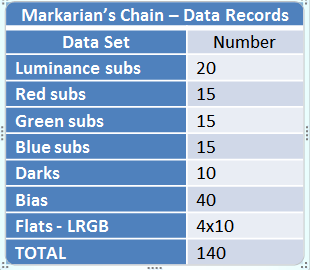
As expected the size of the data set from LRGB imaging with the camera is prodigious and furthermore, requires great care to organise before processing if mistakes are to be avoided.  In the case of Markarian’s Chain I experimented with binning – only to learn later that it has no effect with CMOS sensors – which reduced the file size of the RGB and calibration images.  Nonetheless, in all there were still 140 images with a combined file size of 1.6 Gigabytes!  Notwithstanding, the benefits of LRGB imaging with this camera and EFW outweigh such problems and nowadays an extra storage disk is relatively inexpensive.  Only processing power could perhaps be a problem if using an older PC but my 64-bit + i7 chip +16 GB RAM laptop computer has so far dealt easily with data processing very well.

lrgb data

The difference between imaging and processing with a DSLR and the ZWO CMOS mono camera has been much greater than I anticipated and required more adjustment which I am still dealing with – the learning curve is steep!  Notwithstanding, the experience previously gained using a DSLR has proved invaluable and I would not like to take-on LRGB imaging from scratch; I’d like to think that my adage of walk before you run once again has paid off.  This camera is very exciting and I am confident that when the autumn and winter skies eventually return the new palette now in my hands will reap great rewards – can’t wait.

rgb2gx (Large)

Markarian’s Chain | Subs 60 sec – see table for details Gain 300 Offset -30C | 18th April 2017

m61xxx

M61 piral Galaxy in Virgo Cluster | William Optics GT81 & ZWO 1600MM-Cool + x0.80 field flattener | L 30 x 40 sec RGB 3×20 sec + full calibration Gain 75 Offset 15 -30C | 2nd April 2017