2025 The Year In Pictures

The year 2025 was like no other.  Starting with a knee replacement operation in January, shortly after we finally found a new house in March and moved to the lovely dark skies of Somerset at the end of June.  Unfortunately, the ensuing turmoil left only a limited time for astronomy.  Notwithstanding, I was able to supplement images from Redhill and our new home in Wookey, with some excellent data from Texas, USA and Chile to produce, what I hope you will agree, is an exciting 2026 calendar. 

For other pictures and information, go to my website https://watchthisspaceman.com/ or a video of the calendar can be found here on YouTube https://www.youtube.com/watch?v=gn3ls_s71lQ   and is best accessed on a PC or smart TV screen. Background music this year is Massive Attack’s track Atlas Air.

 COVERNIGHT SKY MONTAGE AT CASTLE FARM OBSERVATORY:

All these images (at the top of the page) were taken at various times from the same location at our house in Wookey, Somerset.  Clockwise from bottom left: (1) Nightscape of a small coppice looking south (2) Double Cluster – a pair of open star clusters in the Perseus constellation (3) Star trails (4) Sunset looking west. 

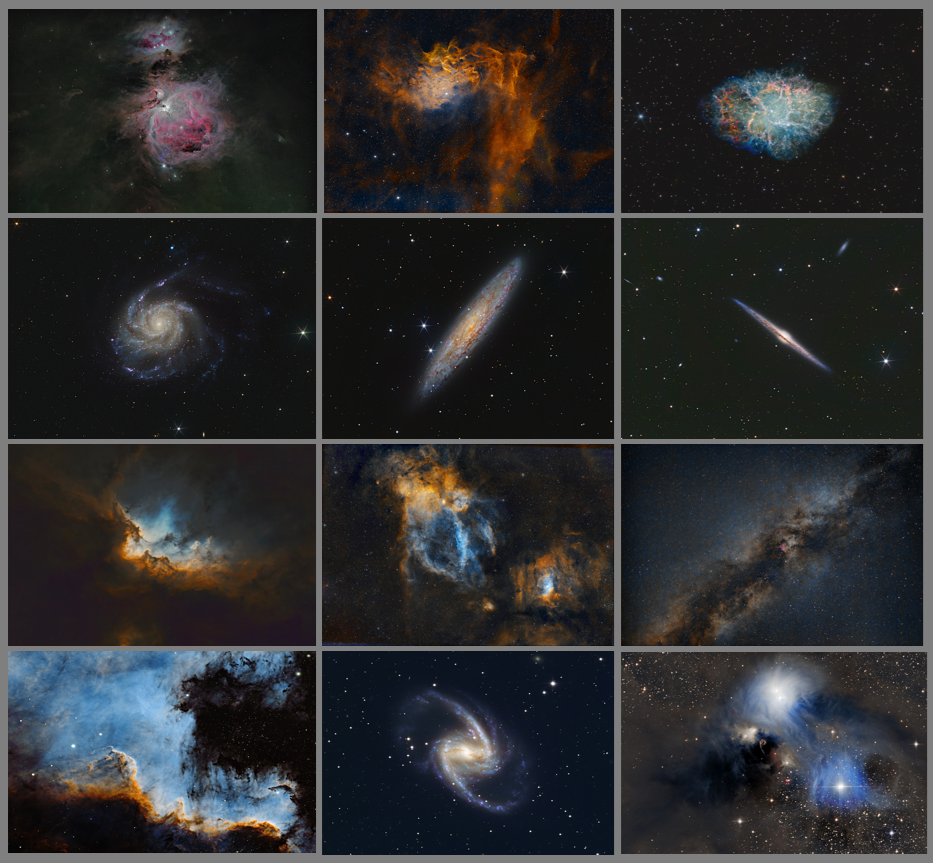
JANUARYTHE GREAT ORION NEBULA, M42 (1)
 
The Orion Nebula is a gigantic cosmic cloud of interstellar dust and gas, which is the basis for the birth of numerous new stars or a “star nursery”.  Being the brightest nebula in the northern hemisphere and just over 1,300 light-years distance from Earth, it can be seen with the naked eye on a clear night.
FEBRUARYFLAMING STAR NEBULA, IC405 (1)
 
This nebula is illuminated by a powerfully bright blue variable star, AE Aurigae. The object’s epithet comes from the brightly lit ripples of gas and dust at the top of the image, illuminated by AE Aurigae and glowing hydrogen gas. This “runaway star” was ejected by a collision two million years ago from the Triangulum region of The Great Orion Nebula.
MARCHCRAB NEBULA, M1 (3)
 
This small but beautiful supernova Remnant (SNR) was the result of the explosion of the star CM Tau just over 970 years ago.  Located at the centre of the nebula, the remaining Crab Pulsar neutron star spins at the rate of 30 times per second.        
 
APRILPINWHEEL GALAXY, M101 (3)
 
At nearly twice the size of the Milky Way and containing at least an estimated trillion stars, M101 is the second largest galaxy of the Messier catalogue and certainly one of the highlights of the spring galaxy season. 
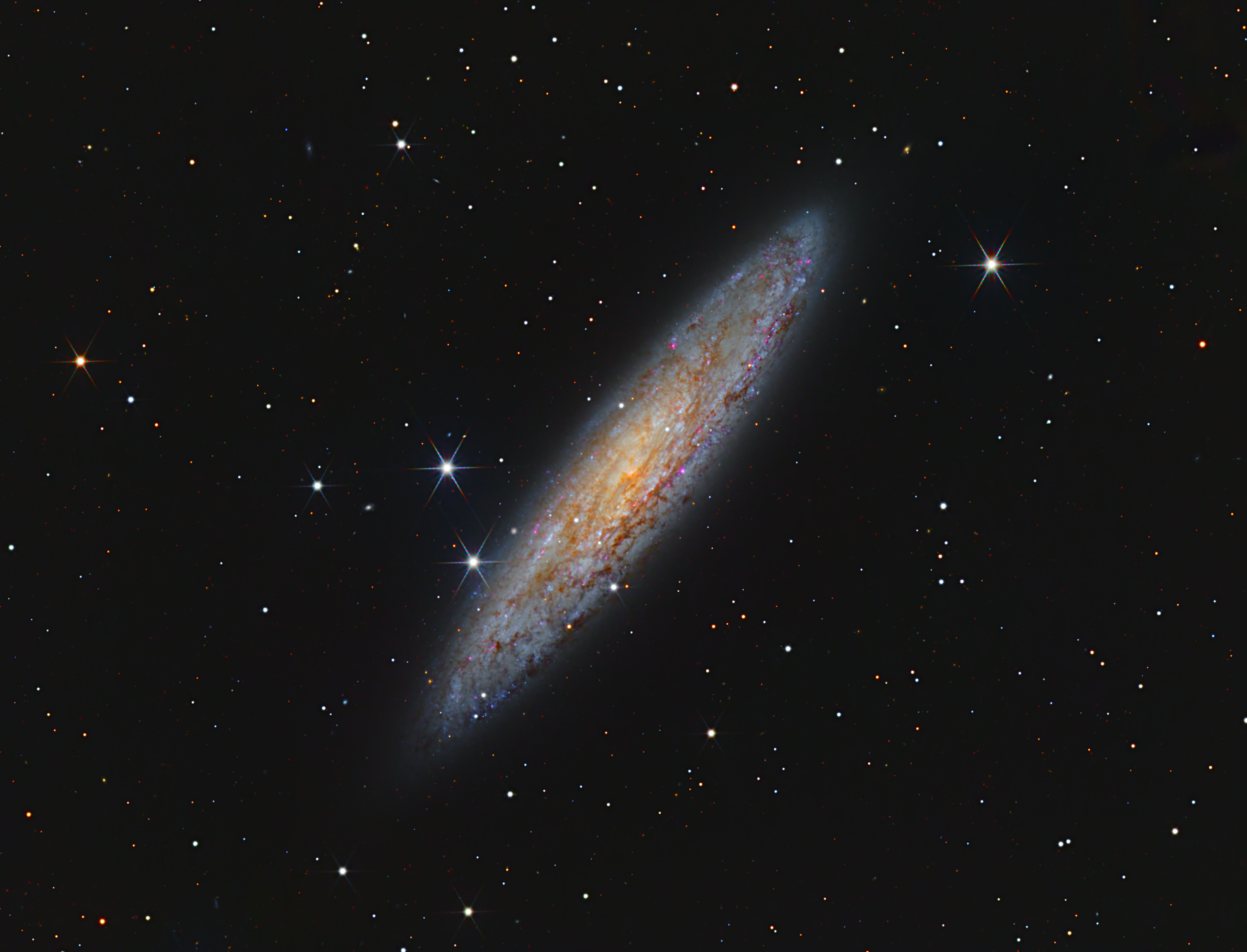
MAY SCULPTOR GALAXY, NGC 253 (3)
 
One of the advantages of obtaining data from Texas, USA, is that it enables views of objects in the Southern Hemisphere that are impossible from the UK.  Also known as the Silver Dollar, it is one of the brightest galaxies in the night sky, which results from very high rates of star formation that are fed by the abundance of thick dust lanes.
 
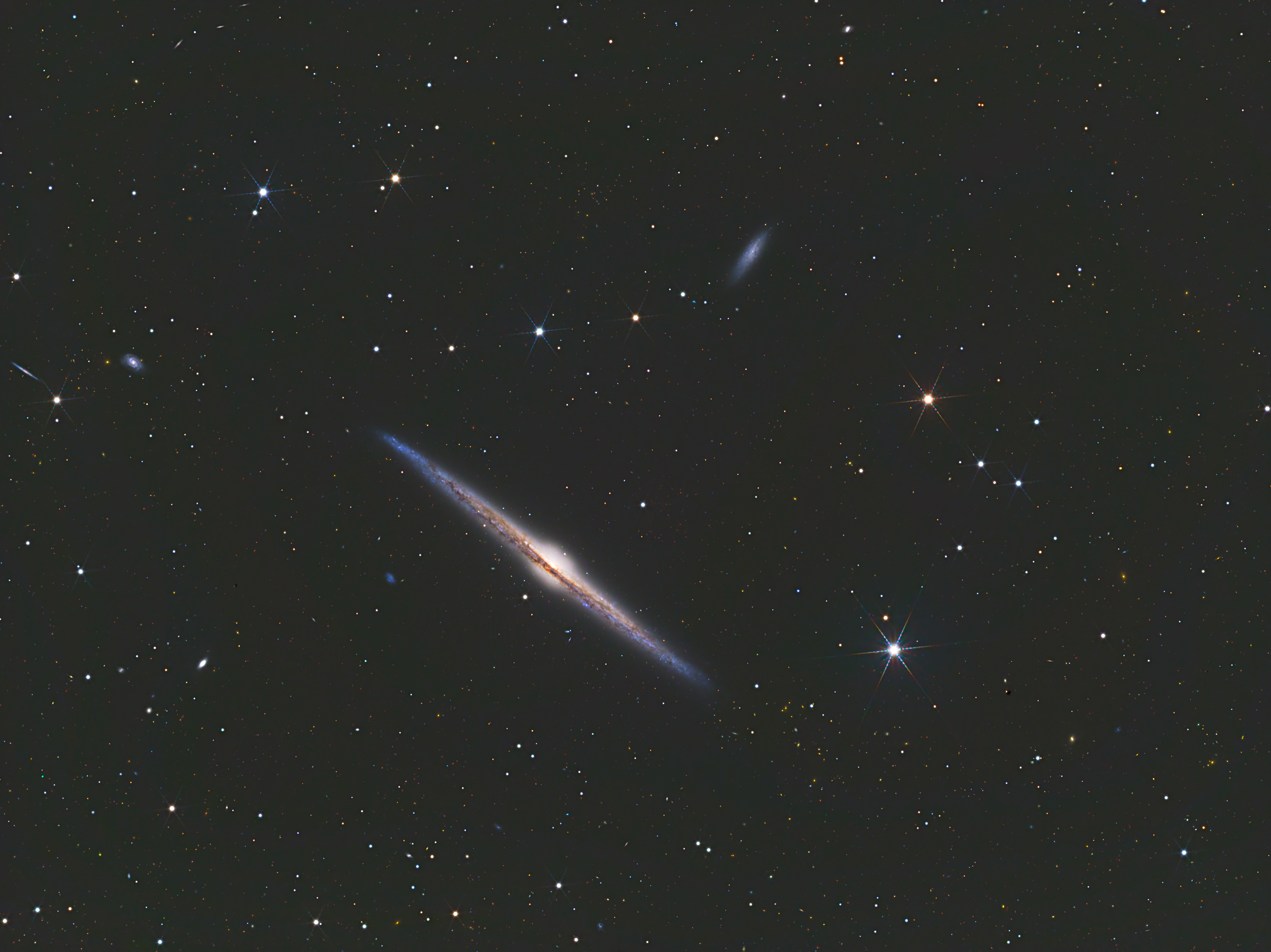
JUNENEEDLE GALAXY, NGC 4546 (3)
 
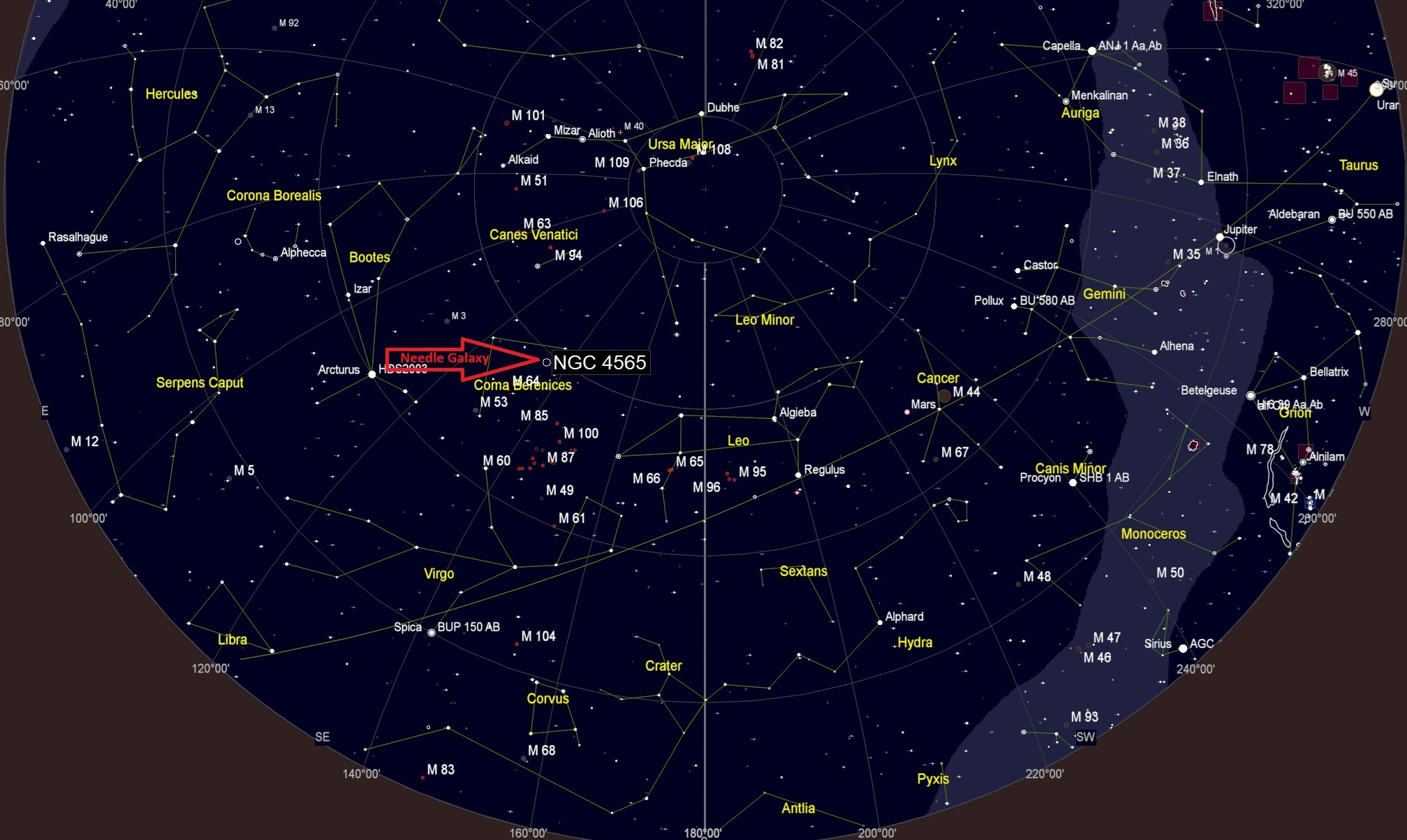
Seen edge-on from Earth, the Needle Galaxy is thought to be a barred spiral galaxy, some 33% larger than the Milky Way. It has at least two satellite galaxies and 240 globular clusters. Seen through a telescope the Needle Galaxy appears like a thin streak drawn across the dark night sky but look closer and its detailed magnificence is revealed.

JULYWIZARD NEBULA, NGC 7380 (2)
 
Formed only a few million years ago, the gases of this young emission nebula glow due to intense radiation from hot, massive stars within. Interwoven within this glowing gas are dark, dense regions of dust that sculpt the nebula’s dramatic and somewhat mystical appearance, in this case a wizard – which marks my first image from Somerset.
 
AUGUSTLOBSTER CLAW & BUBBLE NEBULAE, SH2-157 & NGC 7635 (2)

Located in the Perseus Arm of the Milky Way, the Lobster consists of ionized hydrogen gas energized by ultraviolet radiation from nearby hot, young stars. The nebula’s distinctive claw-like shape arises from intricate filaments of glowing gas and dark dust. Nearby the Bubble Nebula owes its distinctive looks to a single, massive star, which emits fierce stellar winds that sweep up the surrounding gas into a nearly perfect, glowing shell.

SEPTEMBERMILKY WAY (2)
 
The night sky in Somerset is three times darker than Redhill, providing significantly better astronomy views.  In this case a spectacular image of the Milky Way’s galactic centre. 

OCTOBERTHE CYGNUS WALL (2)
 
The Wall is a prominent ridge located within the much larger North America Nebula in the Cygnus constellation. It is an active star-forming region, about 20 light-years long, composed of gas and dust that glows from the energy of young stars.
  
NOVEMBERGREAT BARRED GALAXY, NGC 1365 (4)

A double-barred spiral galaxy located 56-million light-years away, spans over 200,000 light-years across, twice the Milky Way. The most distinctive feature is its massive central bar, which plays a crucial role in channelling gas and dust into the galactic core. As a Seyfert galaxy the nucleus is extremely bright due to energetic processes around its black hole. 
 
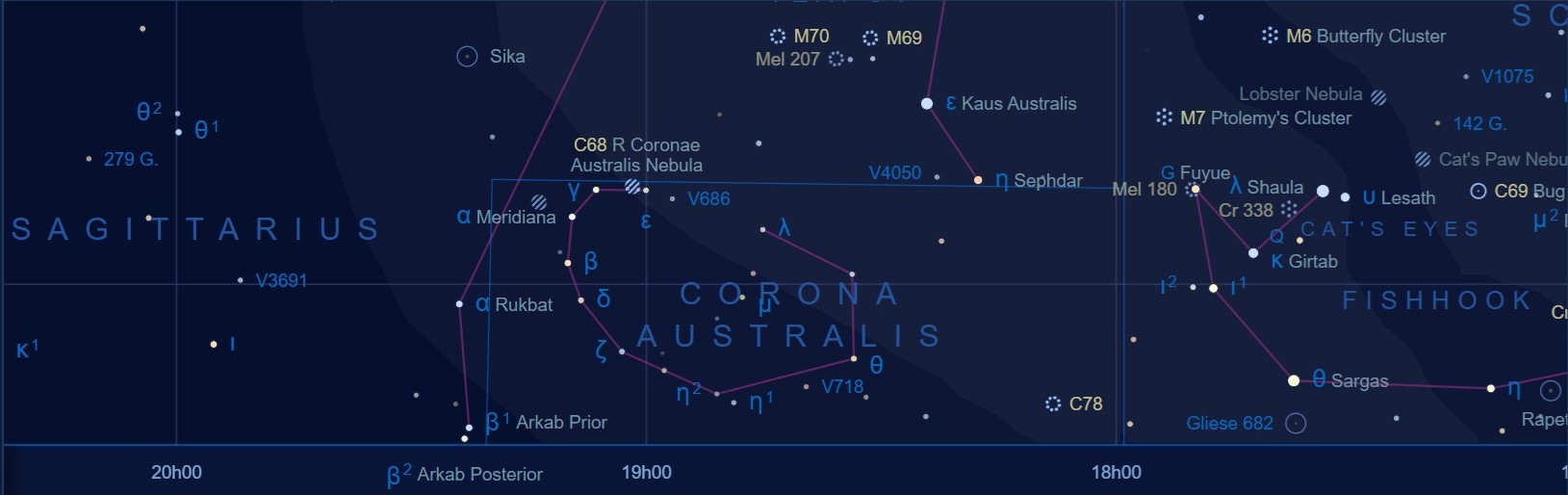
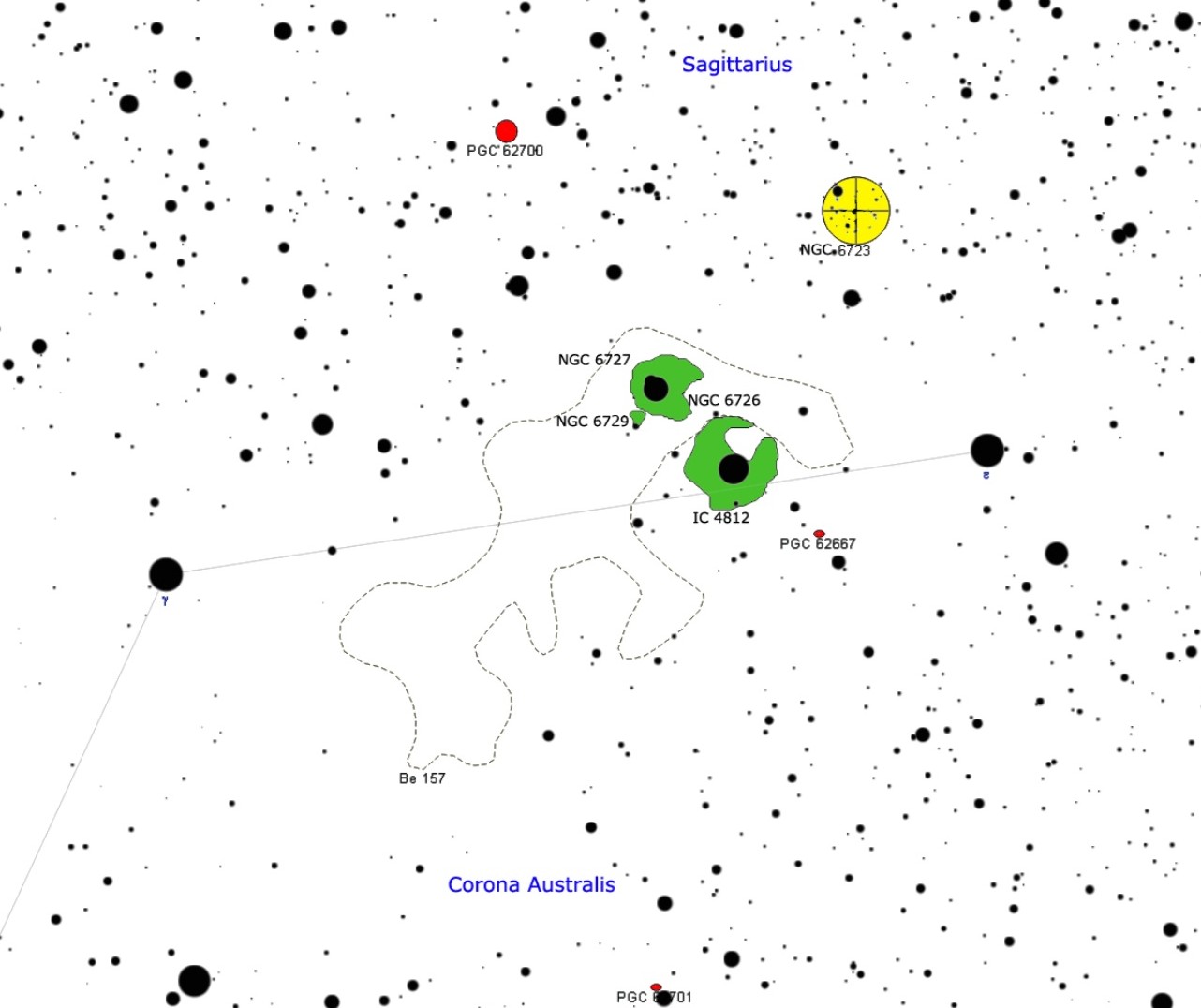
DECEMBERCORONA AUSTRALIS, NGC 6729 (4)

This spectacular image is a combined reflection and emission nebula, set within the Australis Molecular Cloud. This wonderful, hazy looking nebula unusually exhibits both variable brightness and morphology over time.

 Image Data Source: (1)Redhill, Surrey (2)Castle Farm, Somerset (3)USA (4)Chile               
HAPPY NEW YEAR + CLEAR SKIES FOR 2026

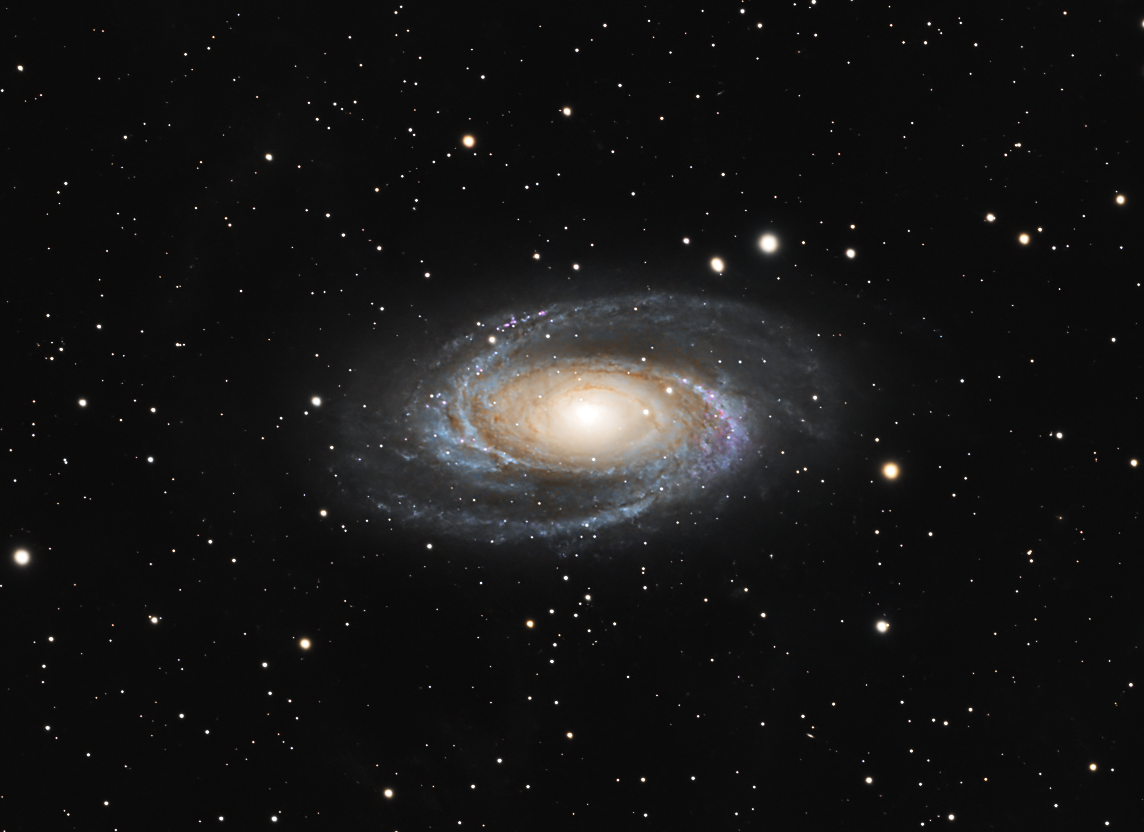
The Needle Galaxy

Perspective is everything – in life and so it is, with astronomy.  Hipparchus first pointed the way in 127 BC when he described the procession of the equinoxes and, as they say one thing led to another as,  Nicolas Copernicus (1473-1543), Tycho Brahe (1546-1601), Galileo Galilei (1564-1642), Johannes Kepler (1571–1630), Johannes Hevelius (1611–1687), Giovanni Cassini (1625-1712), John Flamsteed (1646-1719) and others opened our eyes to the night sky and what lay beyond Earth. Notwithstanding, it was Edwin Hubble’s discovery of galaxies in 1924 that ultimately led to mankind’s recognition that there was much, much more, that we now take for granted to be the Universe.  However, even to the experienced modern astronomer the scale, complexity and beauty of the Universe can be somewhat overwhelming, like when we consider that the observable Universe may consist of 2 trillion galaxies!

Since Hubble’s work we have become familiar with many types of galaxies, which the average person might describe as a colourful spinning firework-like disc, consisting of vast gravitationally bound systems of stars, stellar remnants, interstellar gas, dust and dark matter.  This stereotypic impression arises because most galaxy images are viewed face-on or at an inclined angle, so that we can see the structures and processes that have created it.  However, given the number of galaxies and therefore the many possible views, it is not surprising that some can only be seen edge-on from our perspective on Earth, the Needle Galaxy AKA NGC 4546 is one of these.

Thought to be a barred spiral galaxy, NGC 4546 is some 33% larger than the Milky Way.  It has at least two satellite galaxies, about 240 globular clusters (Milky Way ~ 150) and is the brightest of the Coma 1 Group of galaxies.  Seen through a telescope or when imaged the Needle Galaxy it appears like a thin streak drawn across the dark night sky but look closer and its magnificence is revealed, as in the image above.

Here ribbons of dust can be seen criss-crossing along the edge of the thin galactic disc, thereby blocking much of the from light behind.  However, it is the bright central bulge that inevitably catches the eye but remains something of an enigma, as little can be seen from within.  This excellent data set obtained using the MOANA 10” Newtonian telescope located in Texas’ dark skies, reveals such exquisite details that are provided by the less common edgewise perspective of this intriguing galaxy.   

Footnote & credit: Following a knee replacement I’m currently unable to set-up and use my astronomy equipment, fortunately I havve been able to continue processing using this excellent public amateur data from the MOANA project located near Fort Davis, Texas  https://erellaz.com/moana/. Many thanks to its creator Elleraz.

Sculptor Galaxy

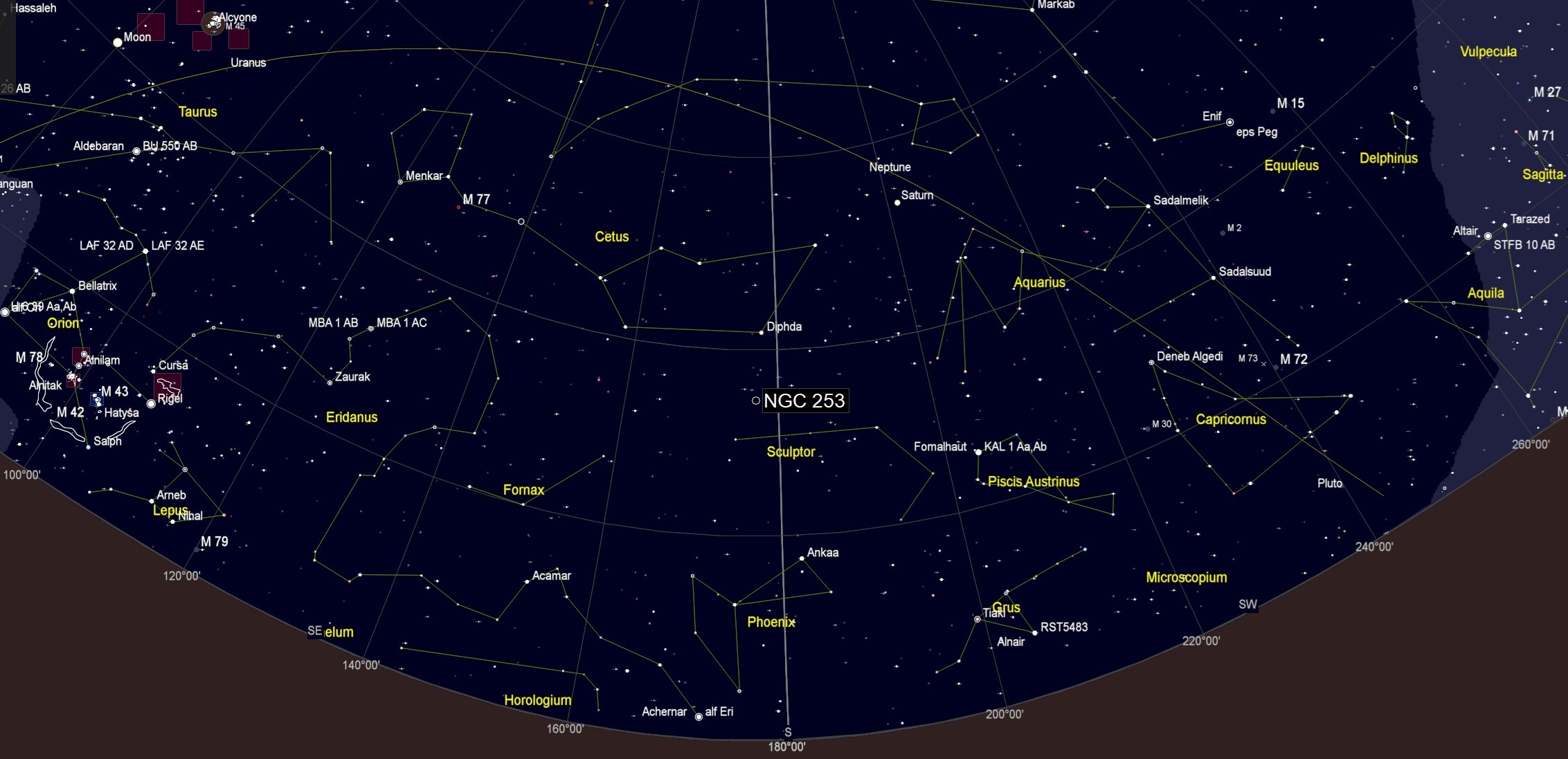
One of the advantages of obtaining data from Texas, USA, is that it enables views of objects in the Southern Hemisphere that are impossible from my location in Surrey, UK.  Located close to the University of Texas’ renowned McDonald Observatory at latitude 30.6795o, the MOANA project is more than 20o further south and, furthermore, boasts some of the best dark skies in North America, what better place to image the exciting spiral Sculptor Galaxy?  Also known as NGC 253 or the Silver Dollar, it is one of the brightest galaxies in the night sky, which results from very high rates of star formation that are fed by the abundance of thick dust lanes.      

Footnote & credit: Following a recent knee replacement I’m currently unable to set-up and use my astronomy equipment, fortunately I’m still able to continue processing using the excellent public amateur data from the MOANA project located near Fort Davis, Texas  https://erellaz.com/moana/. Many thanks to its creator Elleraz.

Pinwheel Galaxy

This time of the year is perfect to observe the spectacular face-on spiral M101 or Pinwheel galaxy.  At nearly twice the size of the Milky Way and containing at least an estimated trillion stars, M101 is the second largest galaxy of the Messier catalogue and certainly one of the highlights of the spring galaxy season.

A loosely bound cluster of galaxies known as the M101 Group, primarily located in the Ursa Major constellation, is also dominated by the Pinwheel Galaxy, which moreover, is considered to form part of a larger structure within the Virgo Supercluster.  Many of the other galaxies in this group are companions to M101, orbiting and interacting with it gravitationally.

Despite its size, M101 is challenging for my William Optics GT81, though I did manage a reasonable image in March 2019.  On this occasion using nearly 17 hours of data from the much larger MOANA 10” Newtonian based at the Dark Sky Observatory in Texas, USA, the resulting image shows the galaxy’s beauty to good effect.

Footnote & credit: Following a recent knee replacement I’m currently unable to set-up and use my astronomy equipment, fortunately I’m still able to continue processing using the excellent public amateur data from the MOANA project located near Fort Davis, Texas  https://erellaz.com/moana/. Many thanks to its creator Elleraz.


2024 The Year In Pictures

Long periods of bad weather made 2024 one of the most difficult years for my astrophotography but, I am pleased to say that this, the 11th calendar is another belter!  Purchased in 2014, I continue to use a William Optics GT81 telescope for most images taken from home, but this means that I’m running out of suitable targets for this equipment.  Part of the answer has been to upgrade related equipment and improve my processing, which I hope you will see reflected in this year’s images.  Moreover, I have used new skills and techniques to process the better-quality data in new ways – I hope you like the results?

Below is a brief summary of the calendar images used this year but for other pictures and more detailed information, please refer elsewhere to this website, my Flickr page or Astrobin page. In addtion, a video of the calendar can be viewed HERE on YouTube, which is best accessed on a PC or smart TV screen. The background music this year is from Jean-Michel Jarre’s Oxygène album.

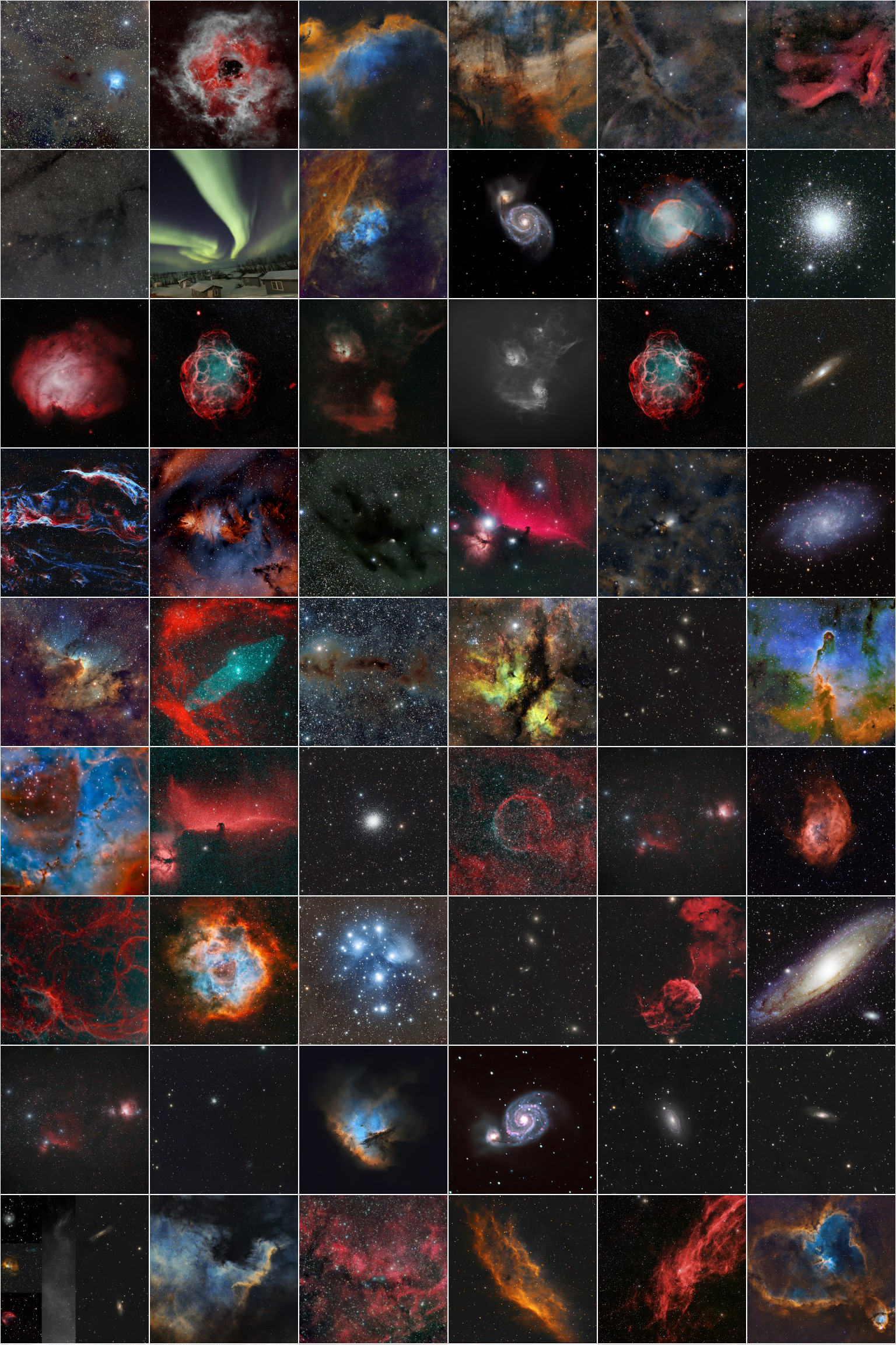
 COVERASTRO IMAGING MONTAGE: This colourful splash is a random selection of images, mostly taken from Redhill over the past +10-years of my astrophotography.
JANUARYSEAGULL NEBULA, IC 2177:  Located 3,650 light-years from Earth is the emission and reflection nebula complex of the so-called Seagull Nebula, some 200 light-years in size.  It’s been 8-years since imaging this object and for good reason.  From my location, the bird flies very low on the southern horizon and thus spends much of its time behind houses, trees, and tall hedges!
FEBRUARYTAURUS MOLECULAR CLOUD:  Located northeast of the Pleiades, below (south) the California Nebula (see November), spanning more than 30o of the night sky is the Taurus Molecular Cloud (TMC), a rich area of dark nebulae punctuated by bright areas of new star formation.  The TMC is thought to be the nearest star forming region to Earth which, if you look carefully, includes numerous complex dark and reflection nebulae and the odd galaxy.
MARCHHIND’S VARIABLE NEBULA & HYADES, NGC 1555*:  Discovered by the English astronomer John Russell Hind in 1852 this nebula is situated 400 light-years away in the constellation of Taurus, between the stars of Aldebaran and the Pleiades.  The nebula is a Herbig-Haro object – a bright patch of nebulosity in which new stars are forming – which often change in apparent size and brightness.
 
APRILLEO GALAXY CLUSTER:  With few exceptions, galaxies are located very far from Earth, making them very small from our perspective and a challenge for my equipment.  However, here I imaged the spectacular Leo Galaxy Cluster, a mere 330 million light-years from Earth. Containing at least 70 major galaxies, the Leo Cluster unusually consists mostly of spiral galaxies.  The bright elliptical galaxy near the centre of the image, has one of the largest known black holes in the universe, which is about 10 billion times more massive than our sun!
MAY IRIS NEBULA, NGC 7023*:  While the focus of the image is the alluring bright blue reflection nebula, careful processing reveals that this celestial flower is enveloped within a vast region of interstellar dust.
 
JUNESOMBRERO GALAXY, MESSIER 104:  Seen from Redhill, the Sombrero galaxy is even lower in the summer sky than the aforesaid Seagull, transiting between the trees and along the top of our +15-foot hedge!  An unbarred galaxy, its bright bulbous centre is encircled by dark dust lanes, which viewed side-on from Earth creates the appearance of a sombrero hat or perhaps a flying saucer?
JULYPuWe-1*:  Is a very faint planetary nebula in the Lynx constellation, discovered in 1980 by Purgathofer & Weinberger.  It is one of the largest planetary nebulae visible, with a diameter like the full moon and at 1,200 light-years, is one of the closest to Earth.  A planetary nebula is a region of cosmic gas and dust formed from the cast-off outer layers of a dying star; despite the name, planetary nebulae have nothing to do with planets.
AUGUSTNORTH AMERICA & PELICAN NEBULAE: It’s at this time of the year (August) I usually turn my attention to the Cygnus constellation and the plethora of imaging opportunities it provides, which inevitably tend to be narrowband targets. Interstellar dust illuminated by large bright areas of star formation are responsible for the formation of both these popular objects.
SEPTEMBERFORSAKEN NEBULA, IC 5068:  This complex area is known for the graphically shaped streaks of cold, dark dust clouds that criss-cross the dense, brightly coloured gas regions of nebulosity.  Situated within the adjacent Cygnus molecular cloud just below the Pelican Nebula and close to other more famous objects, this low emission nebula is unfortunately known as the Forsaken Nebula!
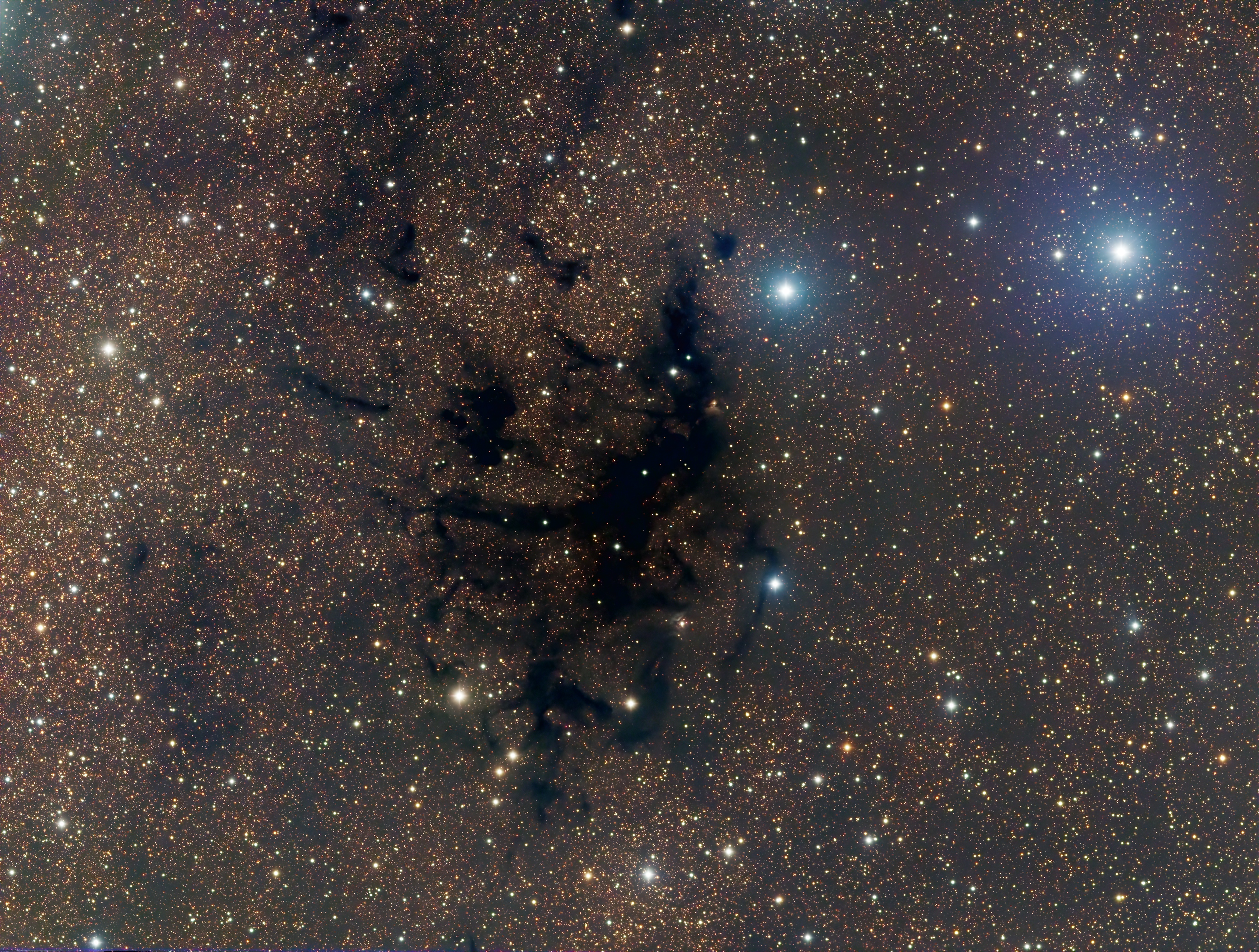
OCTOBERTHE CHINESE CHARACTER, LDN 673*:  It might seem paradoxical but often it is the absence of light that makes an image interesting.  About 600 million light-years from Earth, within the Aquila constellation, is Lynd’s Dark Nebula (LDN) 673.  Some 7-light years in size, this fragmented dark molecular cloud complex contrasts against the colourful molecular clouds and stars of the Milky Way, which is reminiscent of a Chinese character.
  
NOVEMBERCALIFORNIA NEBULA, NGC 1499:  Located in the Perseus constellation, in the Orion arm of the Milky Way 1,000 light-years from Earth, NGC 1499 is a large emission nebula about 100 light-years long.  First imaged in 2016, new improved data and processing now discloses the full grandeur of this object.
 
DECEMBERROSETTE NEBULA, NGC 2244: Approximately 5,000 light-years away, the vast cloud of gas and dust had been sculpted into the distinctive rose-like shape, while meanwhile a central star cluster has blown-away a large hollow within the molecular cloud.  Revisiting this old favourite for the fourth time since 2015, here I have experimented with an unusual colour palette combination that has produced an exciting alternative image of the night sky’s rose.
                 Footnote: All images taken from Redhill, Surrey or at a dark sky site in
          New Mexico, USA shown by an asterisk*
HAPPY NEW YEAR + CLEAR SKIES FOR 2025

Dark Eagle

It might seem paradoxical but sometimes it is the absence of light that makes an astrophotography image interesting.  Such a feature is the so-called Aquila Rift, a vast, dark interstellar cloud that spans the constellations of Aquila (Eagle), Serpens Cauda and eastern Ophiuchus.  Towards the central section of the rift, about 600 million light-years from Earth, within the Aquila constellation and not far from the Summer Triangle’s Altair star, is Lynd’s Dark Nebula (LDN) 673.

Some 7-light years in size, this fragmented dark molecular cloud complex contrasts well against the colourful molecular clouds and stars of the Milky Way; the very dense dust of the dark nebulae scatters the blue light of the surrounding stars, producing a yellow-red bias.  In places the density within the nebula that energetic outflows can be seen in the form of the red nebulosity of RNO 109 and Herbig-Haro object HH-32.

Celestial Fleur-De-Lys

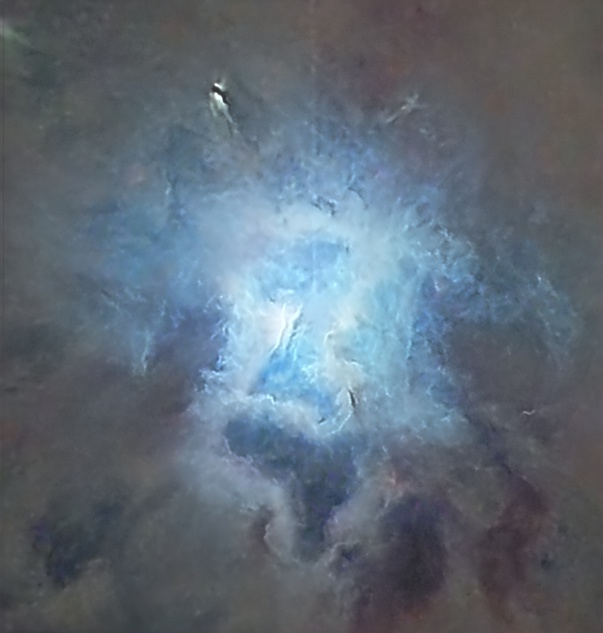
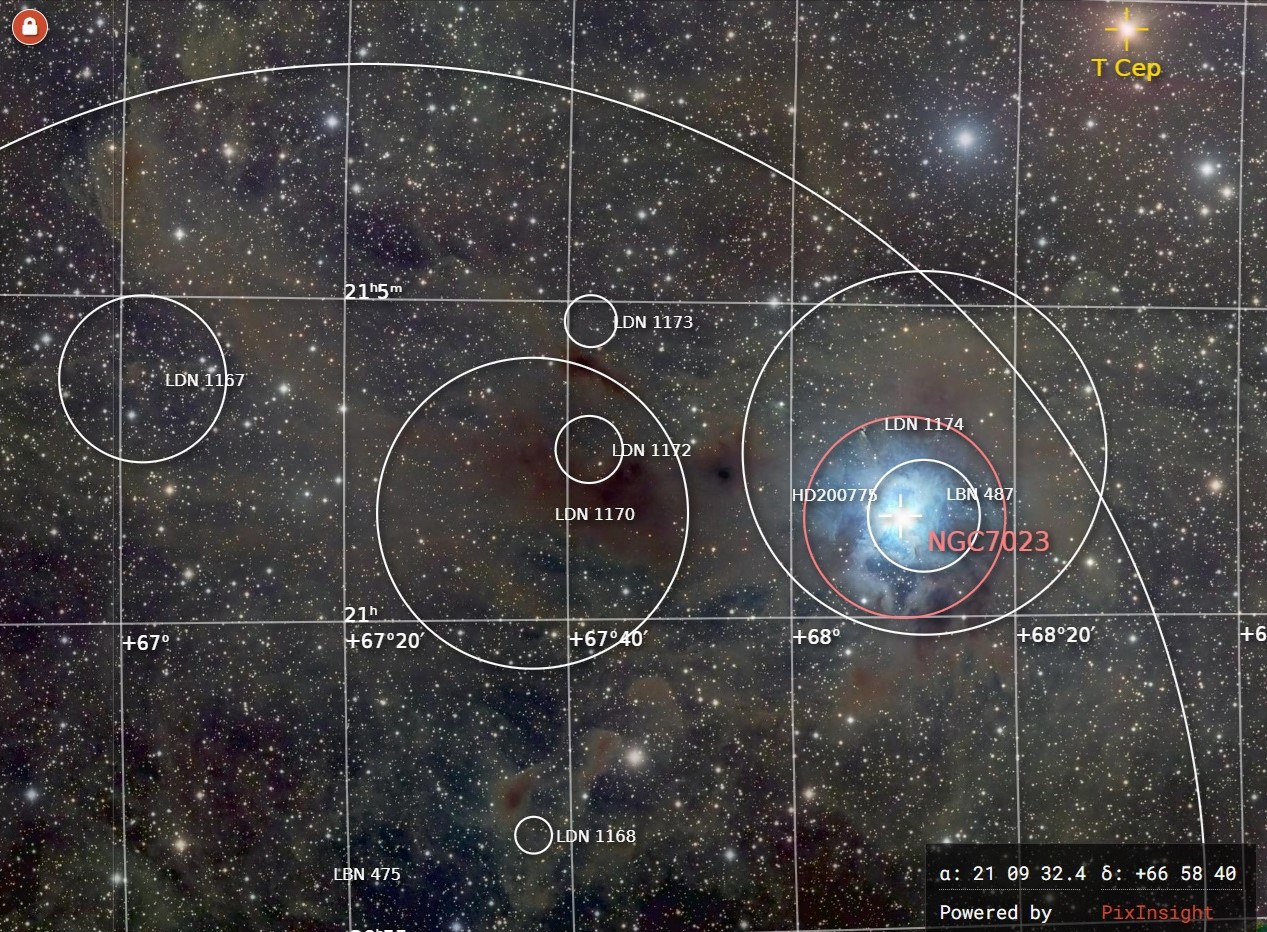
Whilst the highlight is the alluring bright blue reflection nebula NGC 7023 AKA Iris Nebula, careful processing reveals that this celestial flower is enveloped within a vast region of interstellar dust, altogether making for a spectacular image.   Strictly speaking NGC 7023 refers to an open cluster within the reflection nebula, which is itself illuminated by a magnitude +7.4 star designated HD 200775 – the cropped starless image shows the beautiful detail that makes up the Iris ‘flower’. 

Starry Messenger

The first galaxies were identified in the 17th Century by the French astronomer Charles Messier, although at the time he did not know what they were.  It was only when in 1924 American astronomer Edwin Hubble measured the distance to the Andromeda galaxy using cepheid variables, that the existence of other galaxies was finally established.  One hundred years on it’s now estimated that there are between 200 billion and 2 trillion galaxies in the Universe; as Douglas Adams said in the Hitchhikers Guide to the Galaxy, “Space…….is really big”! 

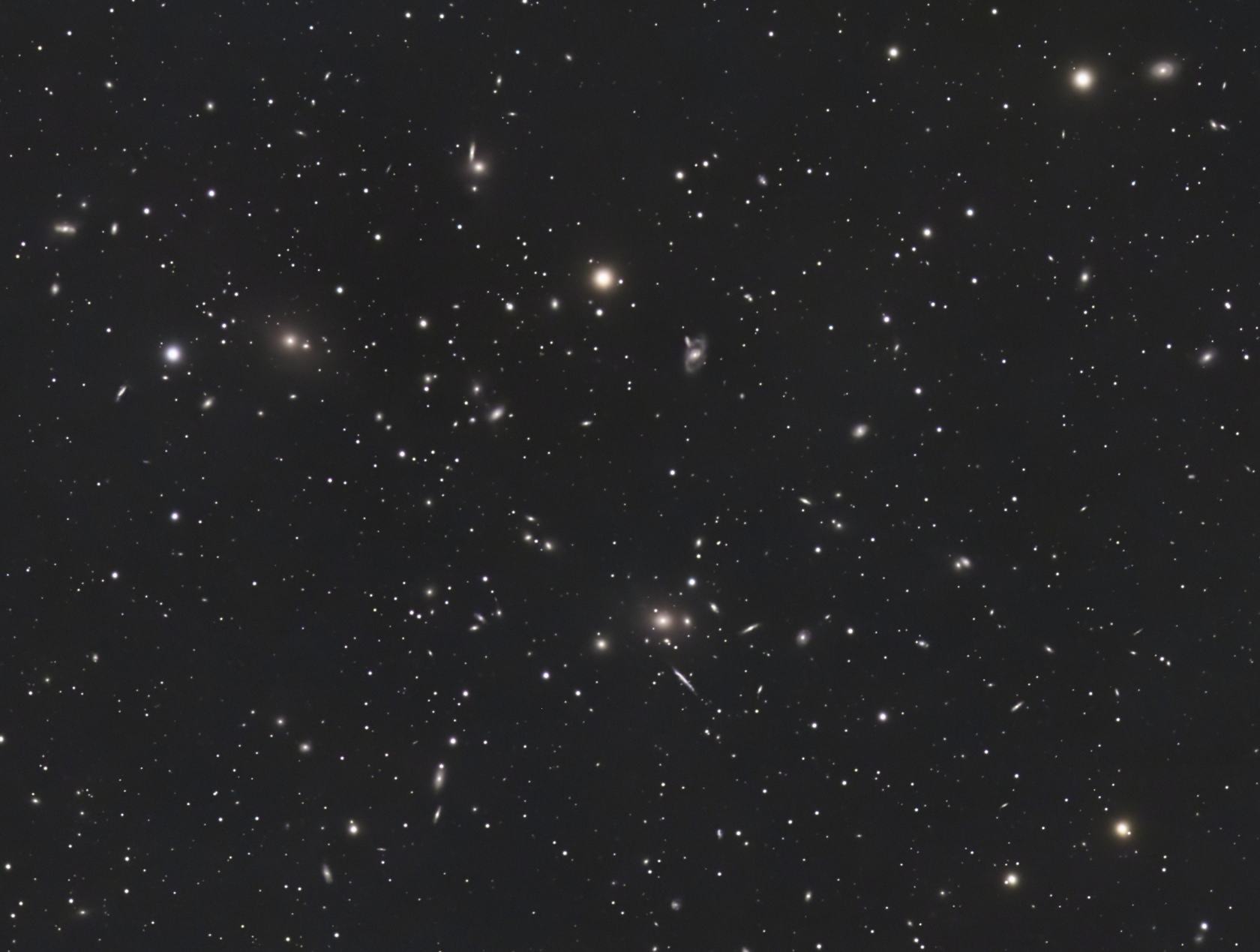
For astronomers this time of the year is generally referred to the ‘Galaxy Season’, as our view of the Milky Way from Earth changes from the winter sky of the Orion Spur and Perseus Arm to the summer view with Cygnus overhead down to Sagittarius in the south, in between we’re looking into deep space.  With very few exceptions, galaxies are located very far from Earth, which from our perspective makes them small and therefore a challenge for my imaging equipment.  However, this Spring I’ve been imaging the spectacular Leo Galaxy Cluster, a mere 330 million light-years from Earth (see cropped version of cluster at the top of the page).

Containing at least 70 major galaxies, the Leo Cluster unusually consists mostly of spiral galaxies, which are best seen here cropped from the original widefield image.  The bright elliptical galaxy near the centre of the image, NGC 3842, has one of the largest known black holes in the universe, which is about 10 billion times more massive than our sun! 

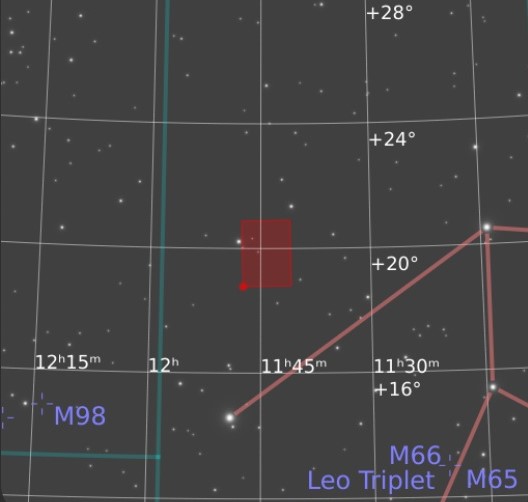
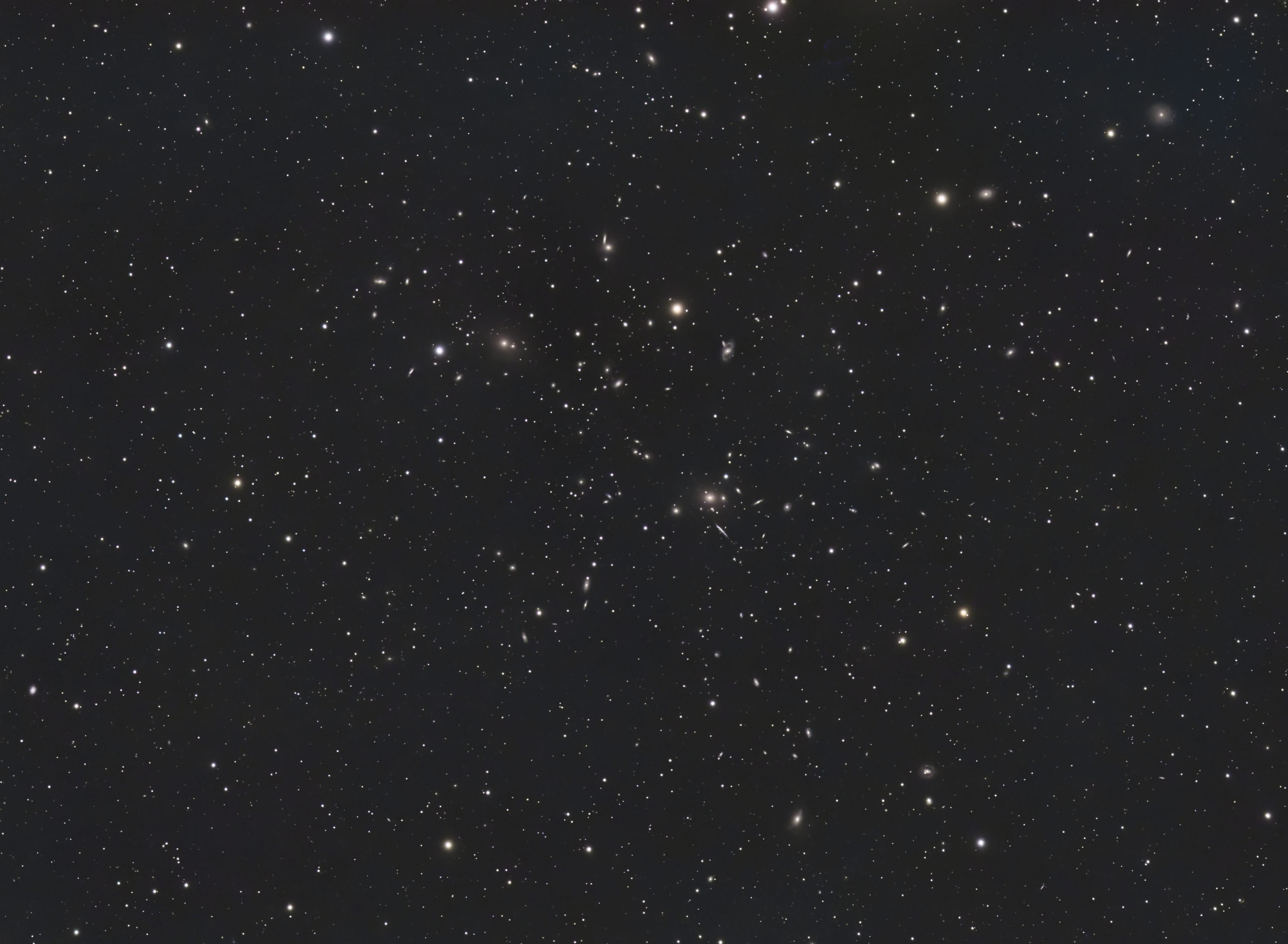
We have come a long way since Galileo Galilei published his astronomical treatise Sidereus Nuncius AKA Starry Messenger in 1610, the first scientific publication based on observations made through a telescope. Galileo’s work completely changed the way humanity understood the night sky and, by extension, our place in space, later leading to the acceptance of the heliocentric model of the planets.  Profound as that was, our understanding of the Universe since 1924 has even greater implications.  Moreover, the ability for an amateur to image something like the Leo Cluster from my back garden is exciting and very rewarding (see widefield version above + image location + orientation where the red dot = top left of image).        

Dark Art: Taurus Molecular Cloud

Located northeast (left) of Pleiades, south of California Nebula and north (above) of Aldebaran, spanning more than 30o of the night sky is the Taurus Molecular Cloud (TMC), a rich area of dark nebulae punctuated by bright areas of new star formation.  Moreover, the TMC is thought to be the nearest star forming region to Earth.

Herschel Space Observatory far-infrared’s view of the TMC & approximate image location

All-in-all, the very large TMC provides many promising imaging opportunities.  This image captures numerous, complex dark nebulae across the field-of-view, including Barnard 10 & 214, LDN 1495 & VdB 27, together with bright reflection nebulae LBN 782 & 785 and the odd galaxy – if you look carefully.


2023 The Year In Pictures

This Christmas marks the 10th edition of my astrophotography calendar, consisting of my better images from the previous 12-months, which I produce for myself and members of the family.  Wow doesn’t time fly? Based on these images, I also compile a video of the images set to music, which we all watch together before seeing the actual calendar.  It’s become something of an occasion and is a great way to present the images, which look wonderful on today’s smart TV’s and is fun to watch and share with the family.

THE CALENDAR

Much longer imaging times (total of more than 145 hours), re-imaging old favourites in new ways and unusual, overlooked, or difficult objects, resulted in a very good 2023 astrophotography year and perhaps the best calendar yet?  The calendar for 2024 on YouTube can be viewed by clicking HERE and below is a brief overview of each image.  More detailed background information and imaging details for those interested can be found in relevant blogs I posted on this website.  The background music is the track Appleshine from Underworld’s album Drift.

 COVERSH2-284: Close-up of April’s image – along the inside of the ring structure are many dark dust pillars and globules, which on the right seem to resemble a hand with a bony finger pointing inwards!  
JANUARYNGC 1333: Nestled within the western area of the Perseus Molecular Cloud, some 1,100 light-years from Earth is the colourful NGC 1333 reflection nebula, one of the closest and most active star-forming regions of the night-sky.  
FEBRUARY  Spaghetti Nebula: Straddling the boundary of Taurus and Auriga constellations, is the giant supernova remnant (SNR) Simeis-147.  The stellar explosion occurred 40,000 years ago, leaving a rapidly spinning neutron star or pulsar at the core of the now complex and the expanding SNR.  
MARCHAurora Borealis: Situated just below the Arctic Circle, Iceland is well known both for its geology and views of the Aurora Borealis, which we saw in March on the south coast near Kirkjubaejarkklaustur.  
APRILSH2-284: A star-forming region of dust and gases, sculpted by radiation and interstellar winds emanating from a young (3 to 4 million years) star cluster located near the centre.       
MAYM3 Globular Cluster*: Consisting of 500,000 stars and over 11 billion years old, M3 is one of150 globular clusters that orbit around the Milky Way Galaxy.  
JUNEM27 Apple Core Nebula*: A planetary nebula, consisting of a glowing shell of ionized gas ejected from a red giant star in its late stage of life to become a white dwarf. Complex hydrogen (red) and oxygen (blue) fans form around the outer regions, with a pulsar-like beam transecting the nebula.  
JULYMonkey Head Nebula: Located 6,400 light years from Earth in the Orion constellation, the ‘Monkey’ is a so-called emission nebula, where new stars are being created within at a rapid rate.  
AUGUSTSH2-115: This widefield image contains a richness of various emission nebulae, centred around the distinctive large blue SH2-115 region.  Just to the left of SH2-115 is the small but enigmatic SH2-116 a faint, blue disc thought to be a planetary nebula.    
SEPTEMBERLDN-768 Black Cat Nebula: Close to M27 in the constellation of Vulpecula (“Little Fox”), is a dense region of stars broken-up by dark nebulae to create intriguing shapes. Here strung out from left-to-right, several of the dark nebulae seem to coalesce (visually) to create the form of a black cat.
OCTOBERSH2-126 Great Lacerta Nebula: On the western edge of the Milky Way in the southern part of Lacerta, is the very large but faint emission nebula SH2-126.  The red filament structures stretch over 3 degrees, to the right is the Gecko Nebula, a molecular cloud associated with bright young stars.
NOVEMBERFlaming Star & Tadpoles Nebula: Two emission nebulae: dust & gas of the Flaming Star (below) combined with red ionized hydrogen gas produces a flame affect. Above, the stellar winds and radiation pressure from hot massive stars creates the Tadpoles ‘wriggling’ away from the centre.
DECEMBERM51 Whirlpool Galaxy*: As the smaller galaxy passes behind M51, joint gravitational forces are interacting, resulting in the misalignment of stars and unusually bright blue and pink areas across the Whirlpool galaxy. Their fates are inextricably linked and might eventually merge.
                 Footnote: All images taken from Redhill, Surrey or telescope at a dark sky site in
          New Mexico, USA shown by an asterisk*
HAPPY NEW YEAR + CLEAR SKIES FOR 2024