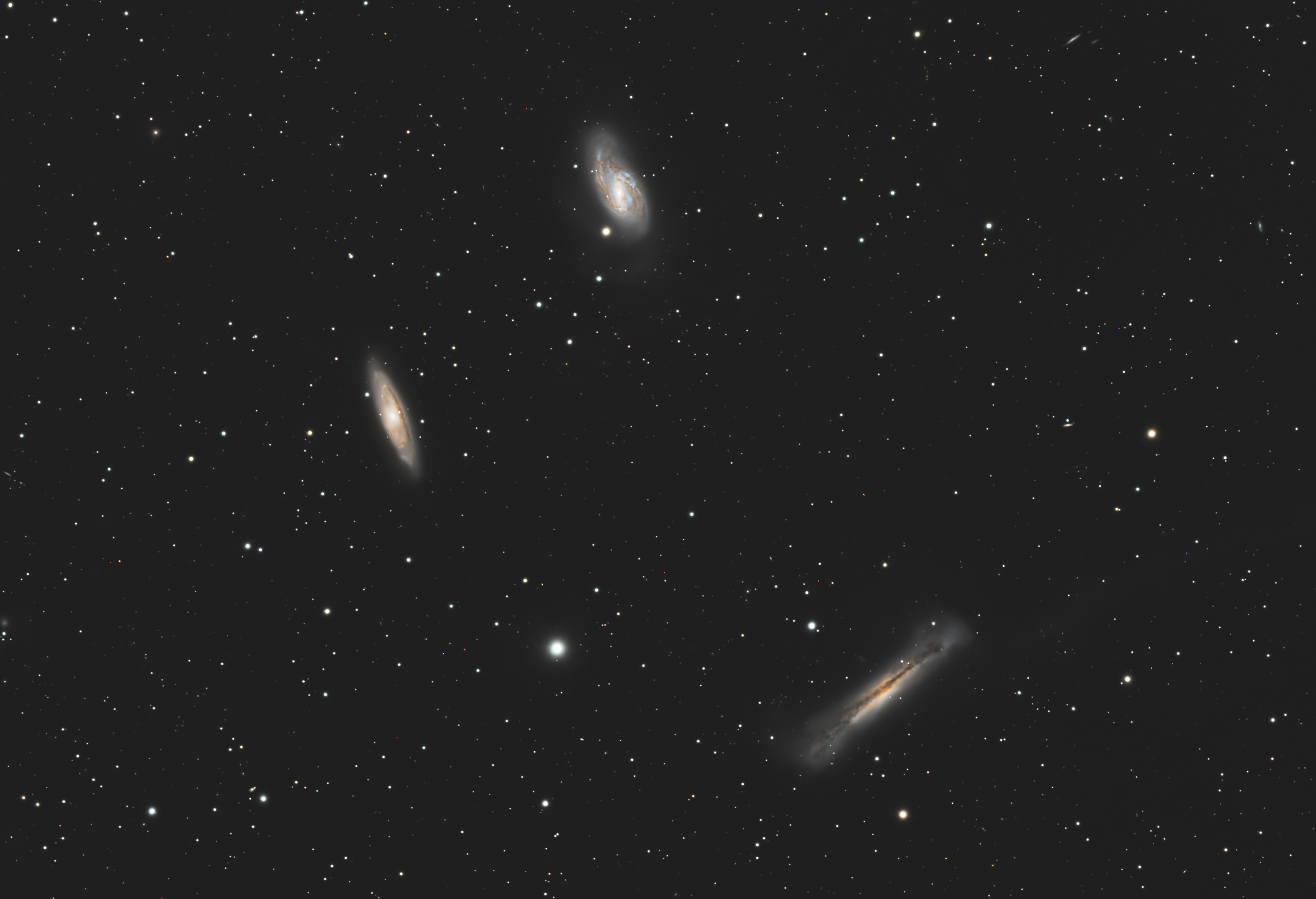
Located 35 million light-years from Earth, the Leo Triplet is a beautiful galaxy group that is suitable even for my equipment, combining interesting structures and good framing that results in a balanced composition. Unsurprisingly situated in the constellation Leo, the group consists of three prominent spiral galaxies: M65, M66 and NGC 3628, often called the Hamburger Galaxy!
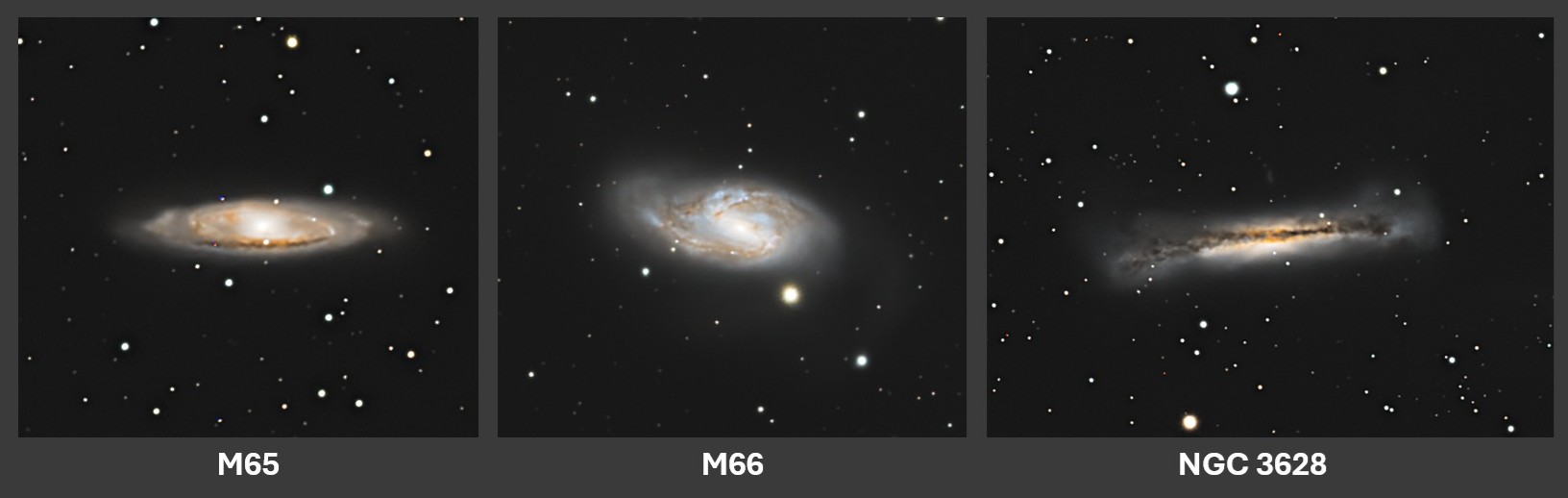
There is evidence of mutual gravitational influence between each of these galaxies, although M65, M66, and NGC 3628 remain distinct systems. Good data and careful processing can bring out the delicate dust structures of NGC 3628 and the intricate spiral patterns of M66, which is generally considered to be the most distorted member of the group. By contrast, M65 has retained a more regular appearance. Viewed edge-on, NGC 3628 is prized for its broad dust lane which creates a strong visual contrast against the bright stellar disk and results in the aforesaid nickname.
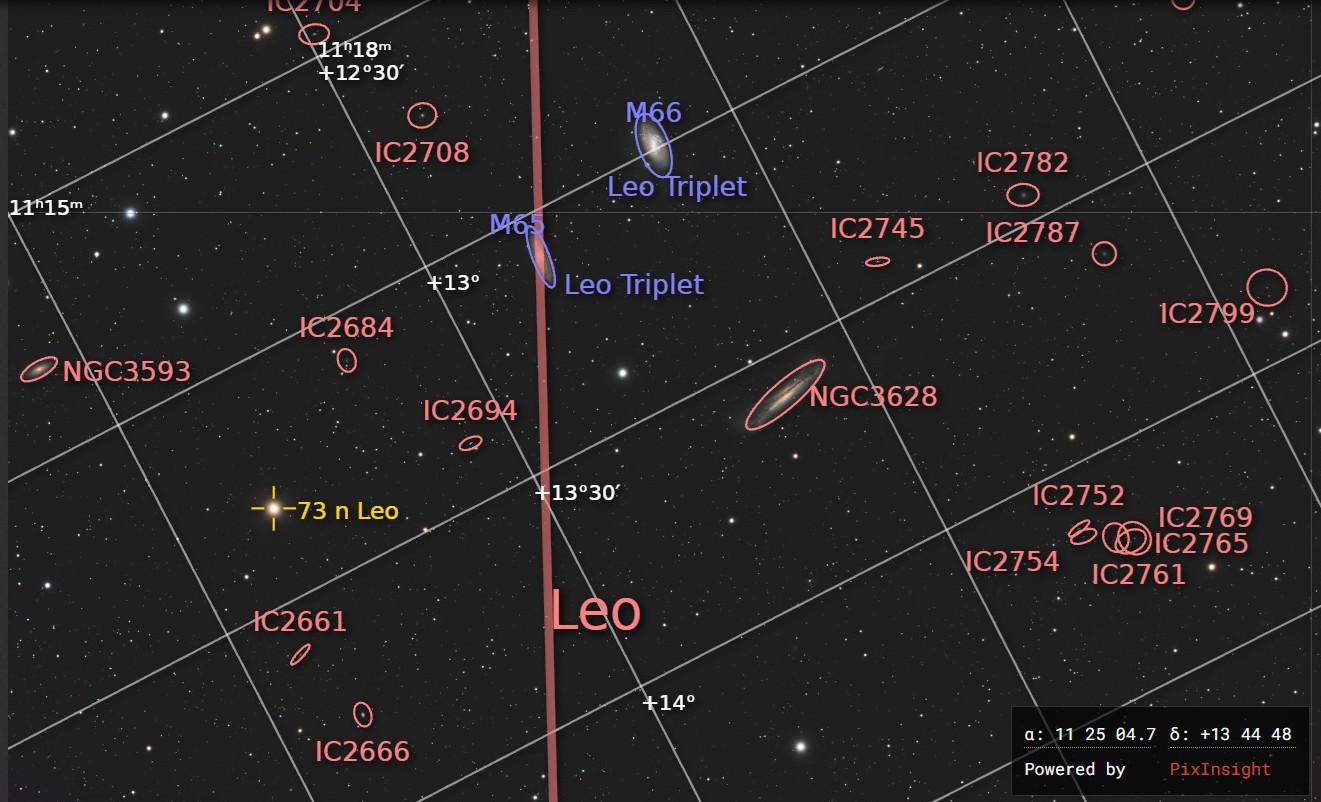
I have successfully imaged this beguiling group of galaxies before, but the benefit of Somerset’s dark skies has again brought out much more of the fascinating details and colours after just 4-hours integration time, compared previously with nearly 8-hours in Surrey. Notwithstanding, I had hoped for more but the clouds inevitably curtailed imaging and I therefore hope to be back again for more photons from the lions before not too long.
FOOTNOTE:
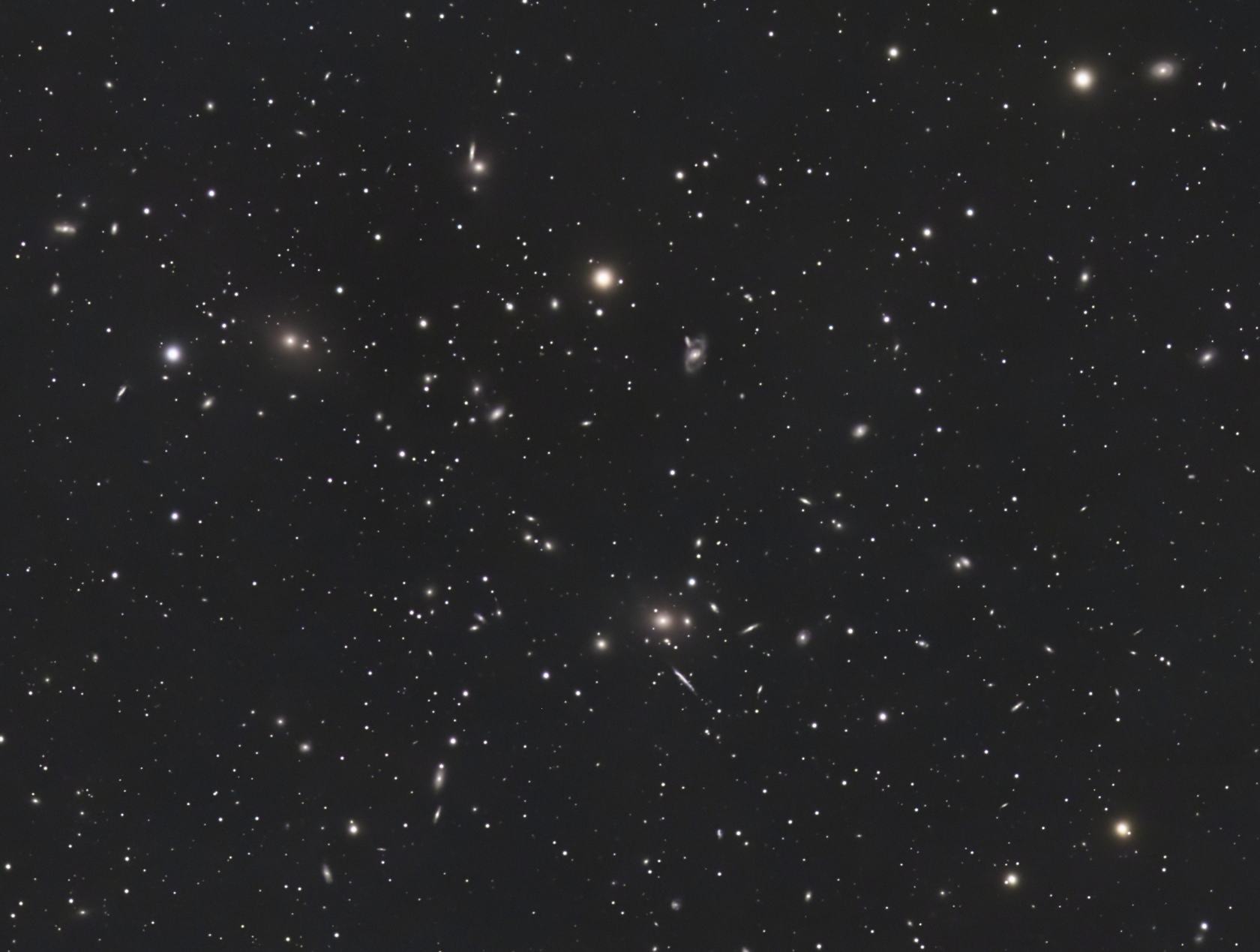
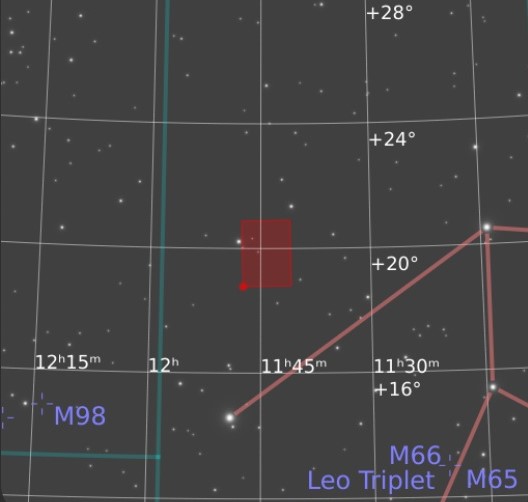
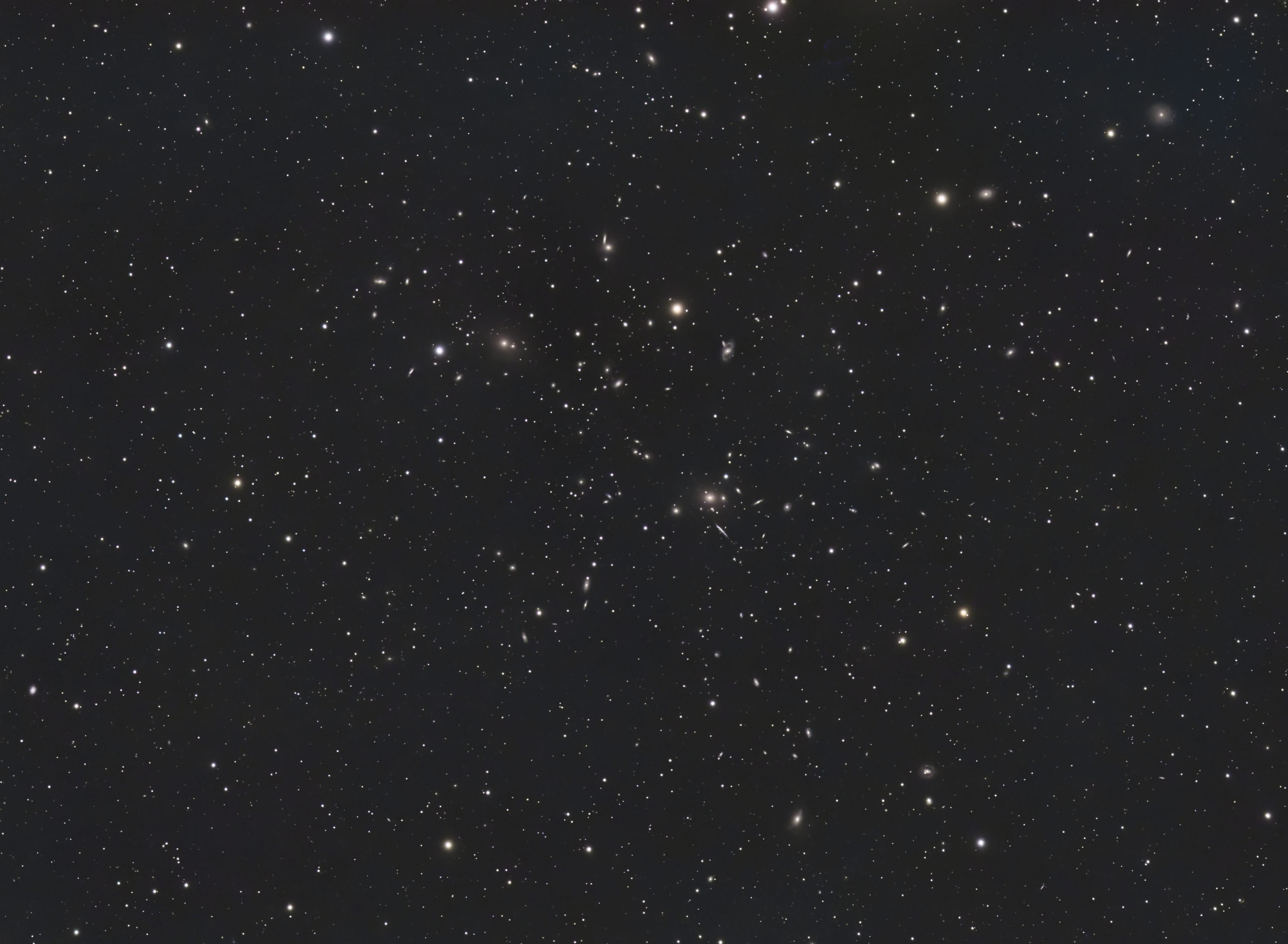
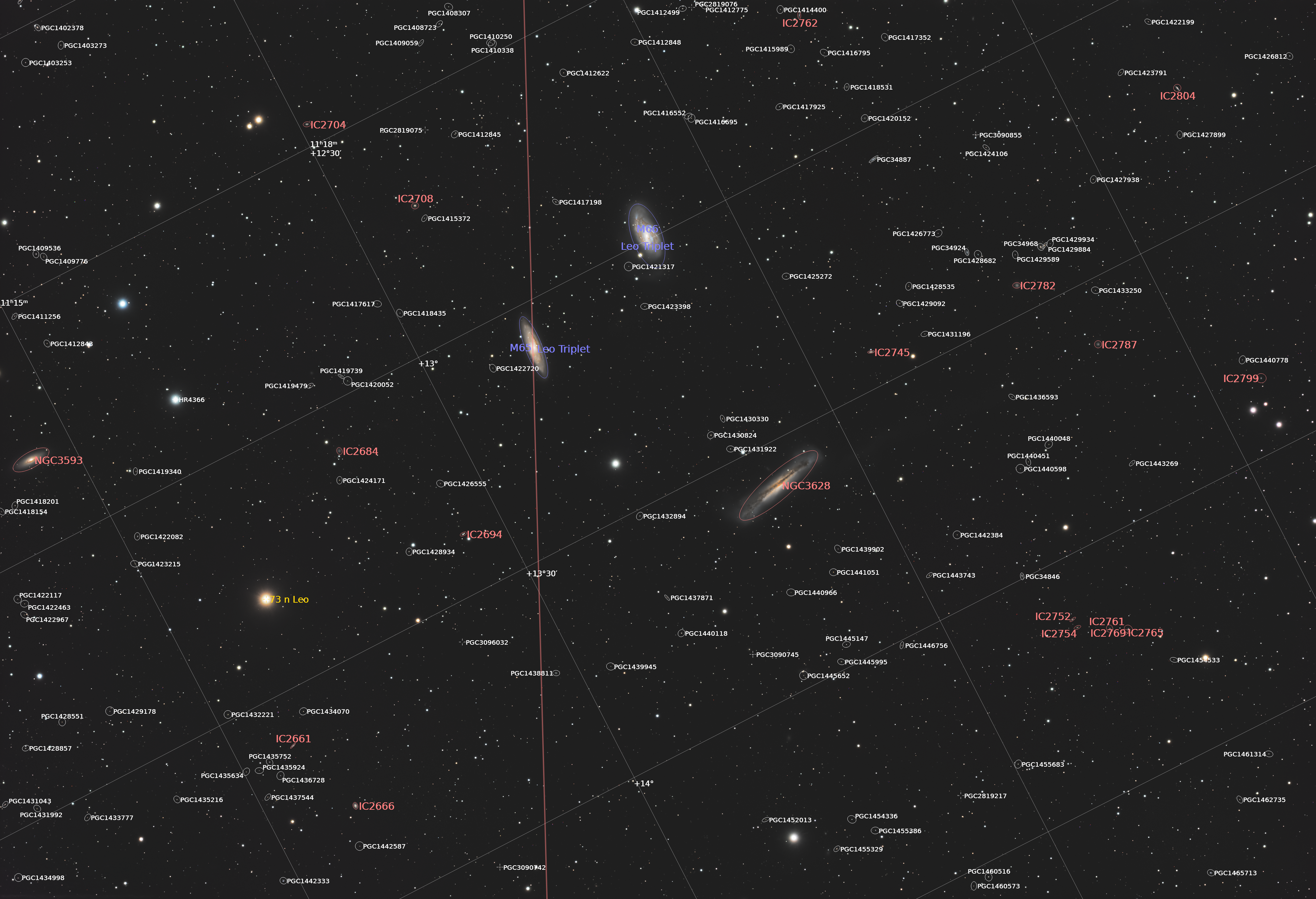
This being Galaxy season and having recently discovered PixInsight’s magic in identifying chosen types of objects, in the case galaxies, I had to run the process over this image too. The outcome (see below) was astonishing / frightening; by my count, including the Leo Triplet, there are 142 galaxies in the image!!!
| IMAGING DETAILS | |
| Object | Leo Triplet: M65, 66 & NGC3628 |
| Constellation | Leo |
| Distance | 35 million light-years |
| Size | M65 8.71’ x 2.45’ M66 9.1’ x 4.2’ NGC 3628 15’ x 3.6’ |
| Apparent Magnitude | M65 +10.3 M66 +9.97 & NGC 3628 +9.4 |
| Scope | William Optics GT81 + Focal Reducer FL 382mm f4.72 |
| Mount & Control | ZWO AM5 + ASIair |
| Guiding | William Optics 50mm guide scope |
| + ZWO 120MM Mini | |
| Camera | ZWO ASI294MM CMOS sensor |
| FOV 2.87o x 1.96o Resolution 2.50”/pix Max. image size 4,144 x 2,822 pix | |
| EFW | ZWOx8 EFW & 31mm Chroma Ha, OIII, SII 3nm & RGB filters |
| Capture & Processing | ASIair, Deep Sky Stacker & PixInsight v1.9.3 Lockhart |
| Image Location & Orientation | Centre = RA 11: 19: 18.1 DEC +13:24:18.1 Bottom Right = North |
| Exposures | L x 23 + RGB x20 each @ 180 sec Total Integration Time: 4hr 9min |
| @ Gain 120 & 30 Offset 21 @ -15oC | |
| Calibration | 10 x 180 sec Darks + 20 x LRGB Flats & Dark Flats @ ADU 32,000 |
| Location & Darkness | Castle Farm Observatory, Wookey, Somerset – UK Typically Bortle 4 |
| Date & Time | 21st & 23rd April 2026 @ +22.00h |
| Weather | Approx. <=5oC RH =<60% 🌙 +24% waxing |