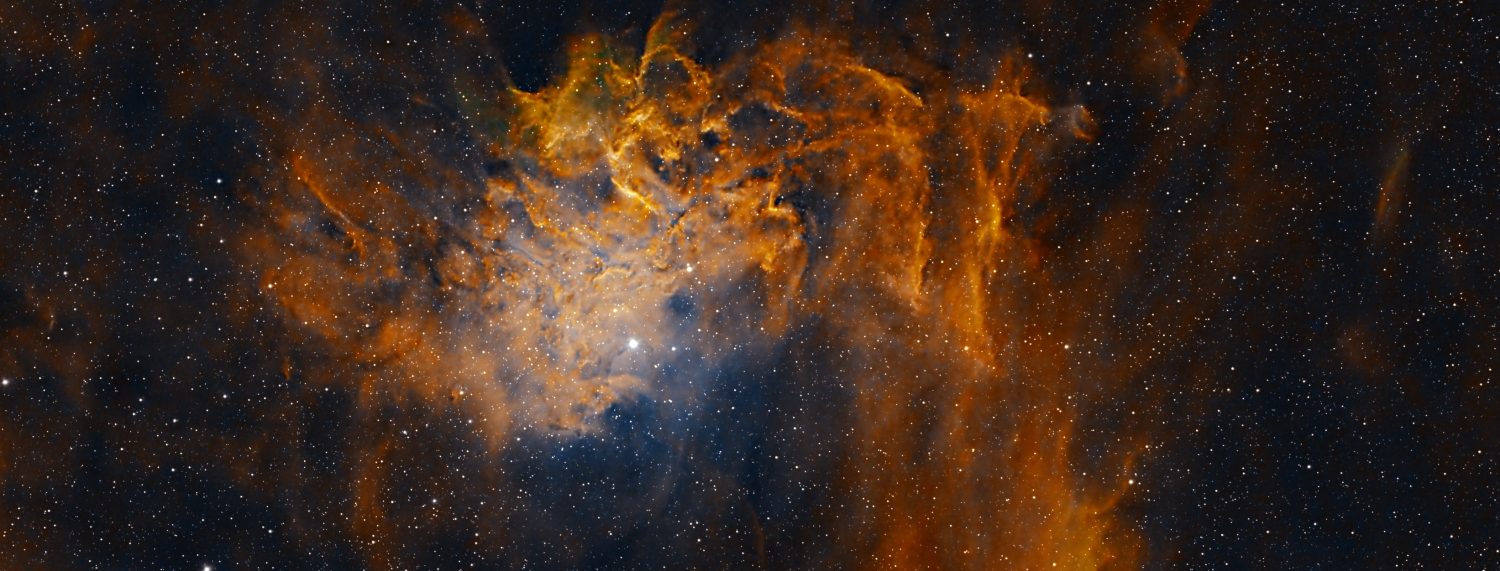
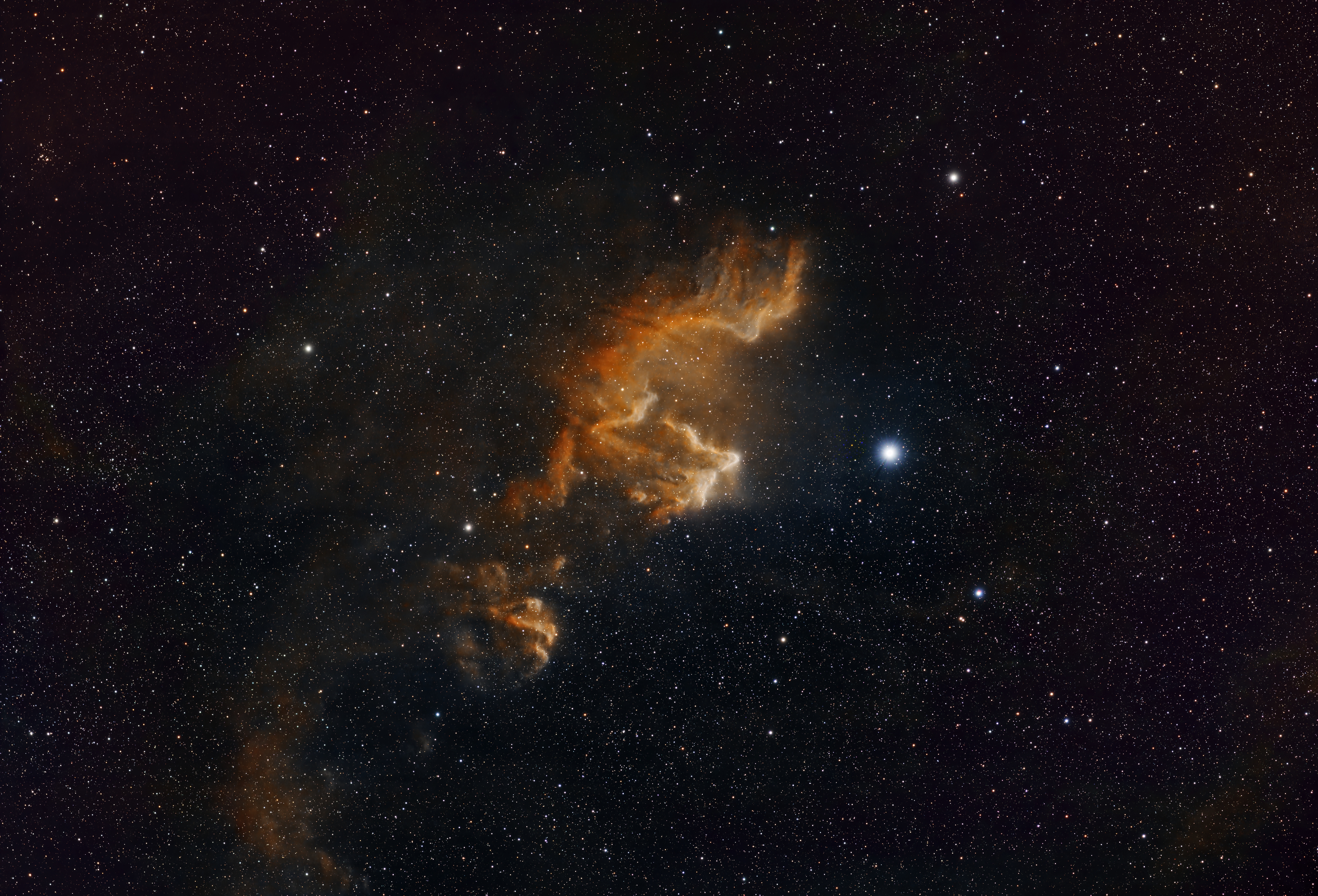
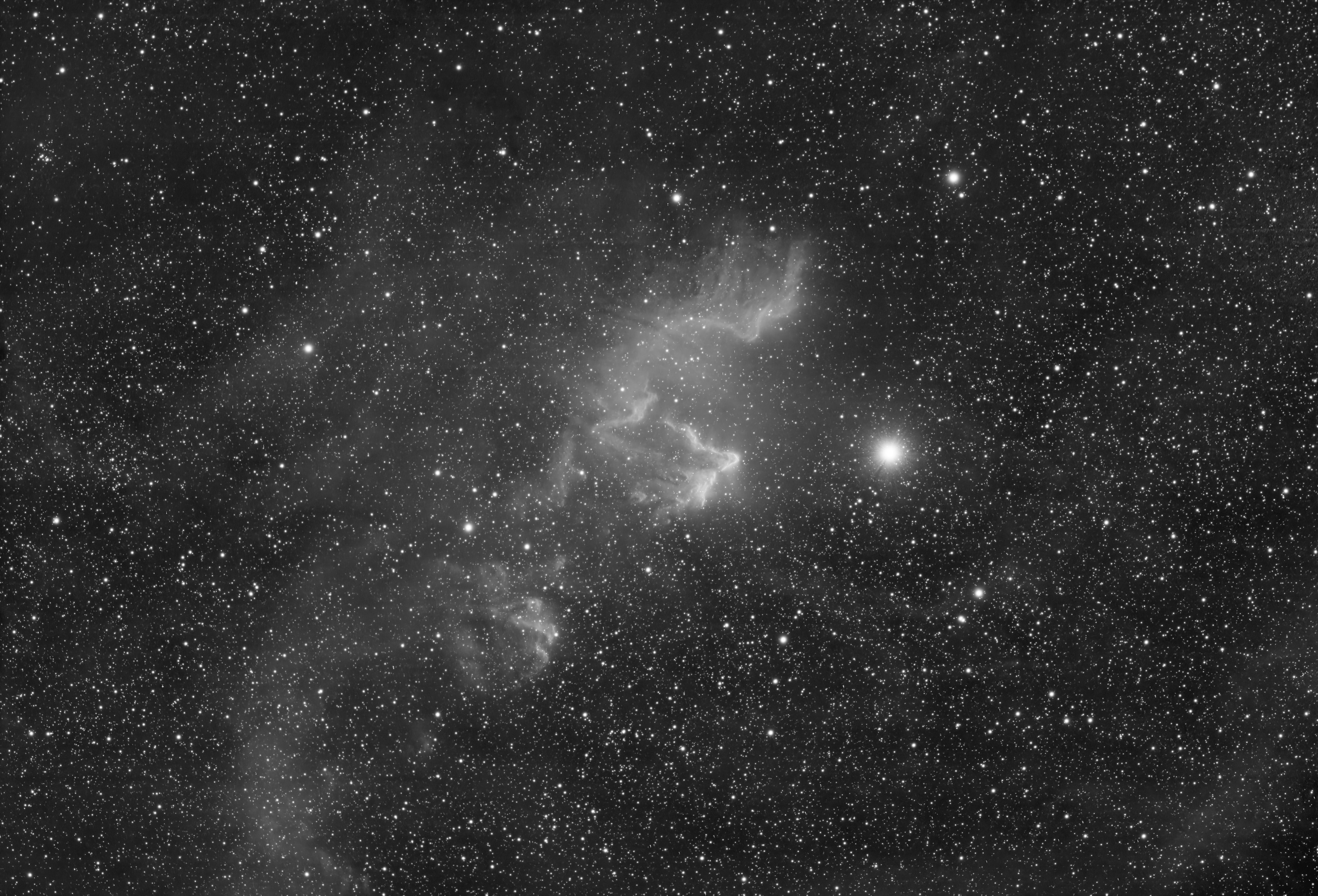
Returning after a summer break, my first target this autumn has been a fascinating and challenging deep-sky imaging object SH2-185, located in the constellation of Cassiopeia. Often referred to as the Gamma Cassiopeiae Nebula, it is closely associated with the very bright star Gamma Cassiopeiae (γ Cas), which dominates the surrounding star field. SH2-185 encompases the wider HII region that also includes two distinct nebulae IC59 and IC63, which together create the familiar appearance of the Ghost of Cassiopeia. The entire SH2-185 complex (see below) is therefore a combination of both emission and reflection nebulae (see details in the annotated image below).
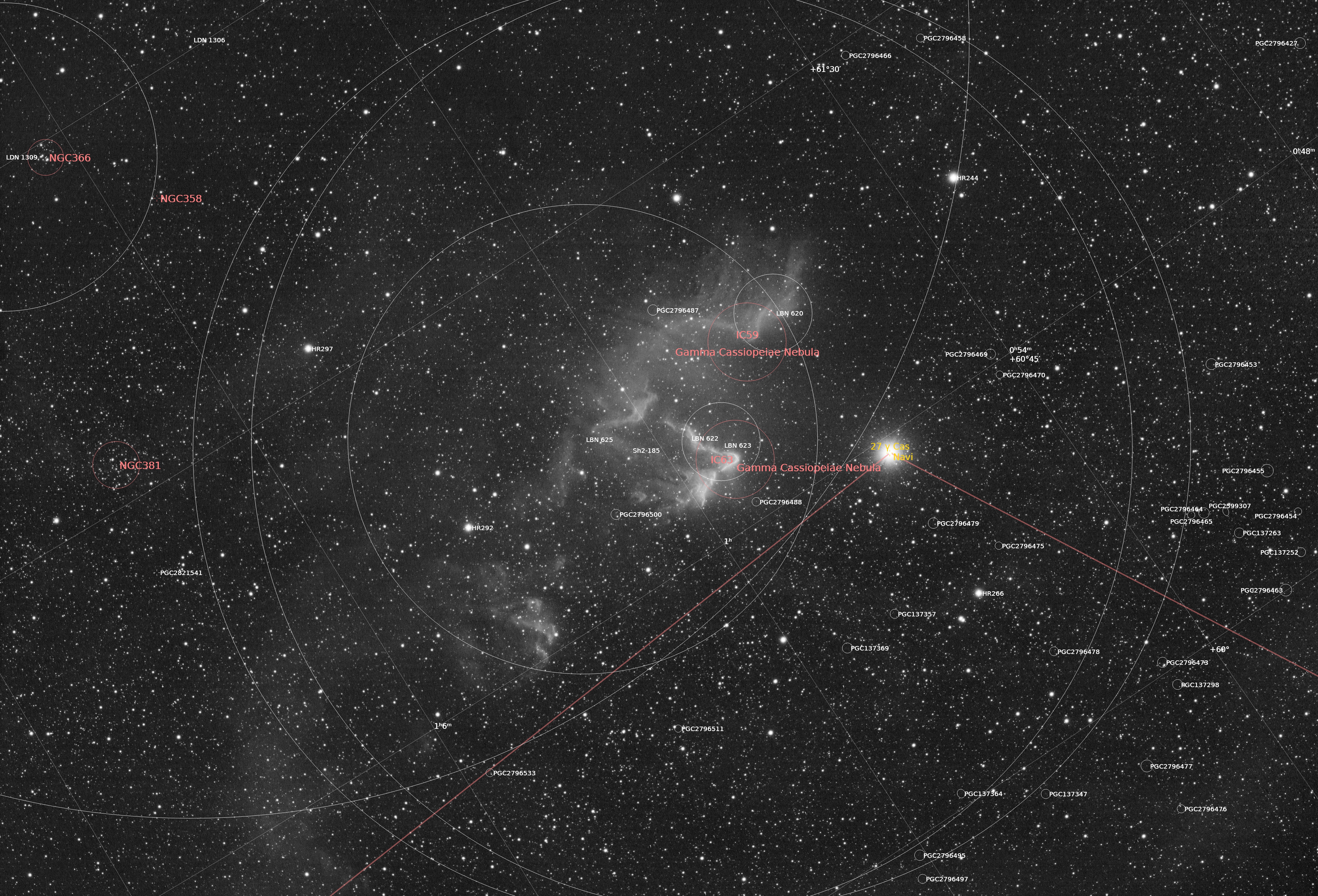
Although the two components are usually treated as a single imaging target, IC 59 and IC 63 have different appearances and physical relationships with Gamma Cassiopeiae. The differences explain both the colours and challenges involved in processing the data. IC 59 lies to the north and north-east of Gamma Cassiopeiae, where its appearance is dominated by the reflected starlight. IC 63, the Ghost Nebula, lies south-west of the main star and is generally the more conspicuous of the two with its curved, comet-like shape and bright ionisation front which make it especially distinct. The adjacent Gamma Cassiopeiae is a hot, massive, rapidly rotating B-type star. Its intense ultraviolet radiation interacts with the surrounding gas and dust, thereby highlighting the area and especially the aforesaid structures within IC 59 and IC 63.
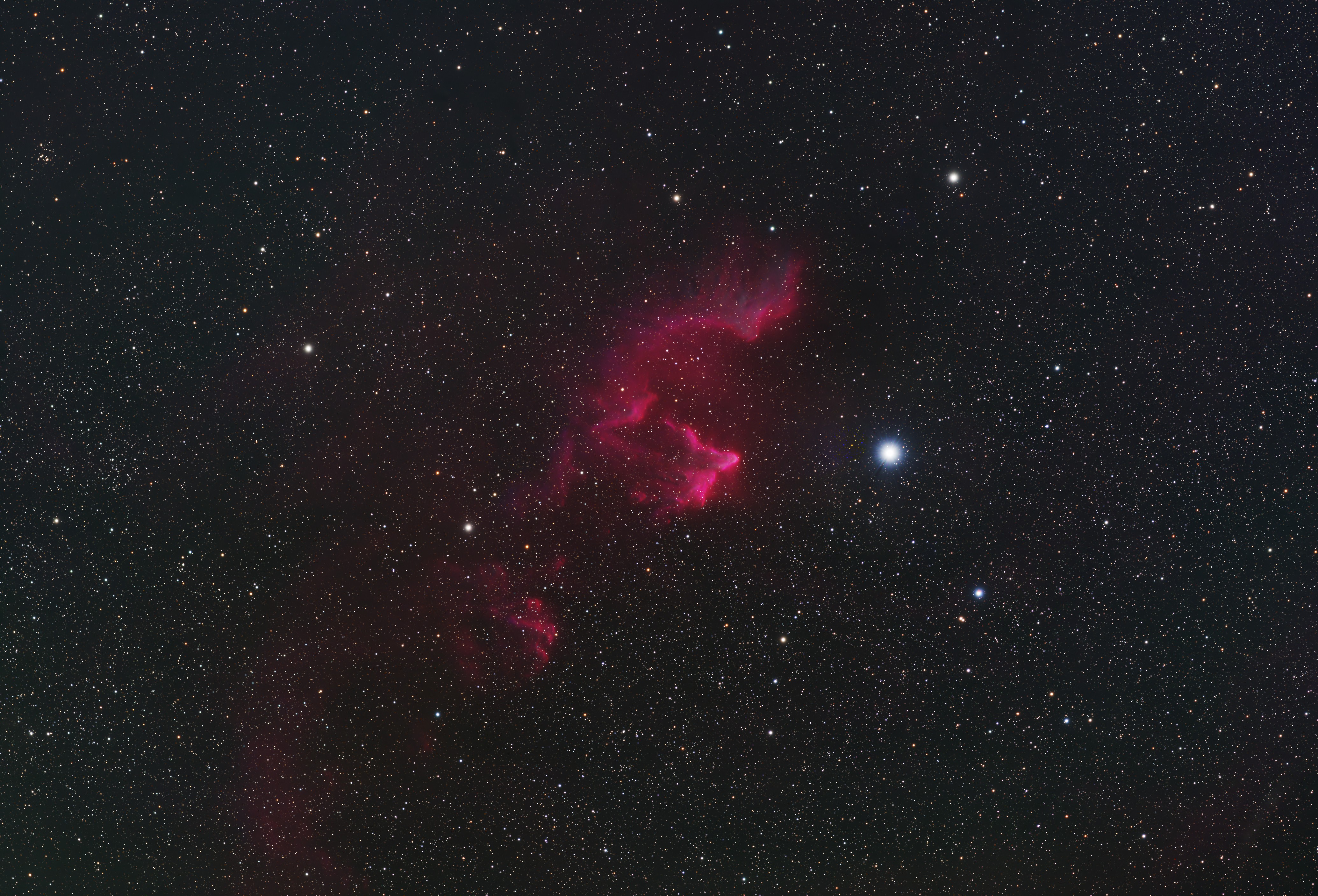
SH2-185 has been a rewarding but demanding target because of the bright main star and faint surrounding nebulosity which present very different imaging and processing challenges. In this case I chose to process the data in two ways, each of which highlight different qualities: SHO (top of the page) and HOS (above). The results reveal a complex and dynamic region of the northern sky within our galaxy; the importance of Ha in shaping the final image can be seen in the image below.
| IMAGING DETAILS | |
| Object | SH2-185 Ghost of Cassiopeia |
| Constellation | Cassiopeiae |
| Distance | 550 – 750 light-years |
| Size | 25 light-years or 2o apparent |
| Apparent Magnitude | +15.8 – 10 & main star Gamma Cassiopeiae (γ Cas) +2.2 |
| Scope | William Optics GT81 + Focal Reducer FL 382mm f4.72 |
| Mount & Control | ZWO AM5 + ASIair |
| Guiding | William Optics 50mm guide scope |
| + ZWO 120MM Mini | |
| Camera | ZWO ASI294MM CMOS sensor |
| FOV 2.87o x 1.96o Resolution 2.50”/pix Max. image size 4,144 x 2,822 pix | |
| EFW | ZWOx8 EFW & 31mm Chroma Ha, OIII, SII 3nm & RGB filters |
| Capture & Processing | ASIair, Deep Sky Stacker & PixInsight v1.9.3 Lockhart |
| Image Location & Orientation | Centre = RA 01:00:01.4 DEC +60:59:49 Top Left = North |
| Exposures | Ha x 23 + OIII x 12 + SII x 9 @ 300 sec + RGB x9 each @ 120 sec Total Integration Time: 4hr 34min |
| @ Gain 120 & 30 Offset 21 @ -15oC | |
| Calibration | 5 x 300 sec & 10 x 120 sec Darks + 20 x NB & BB Flats & Flat Darks @ ADU 32,000 |
| Location & Darkness | Castle Farm Observatory, Wookey, Somerset – UK Typically Bortle 4 |
| Date & Time | 11 & 12th September 2026 @ +22.00h |
| Weather | Approx. <12oC RH >=<60% 🌙 New Moon |

