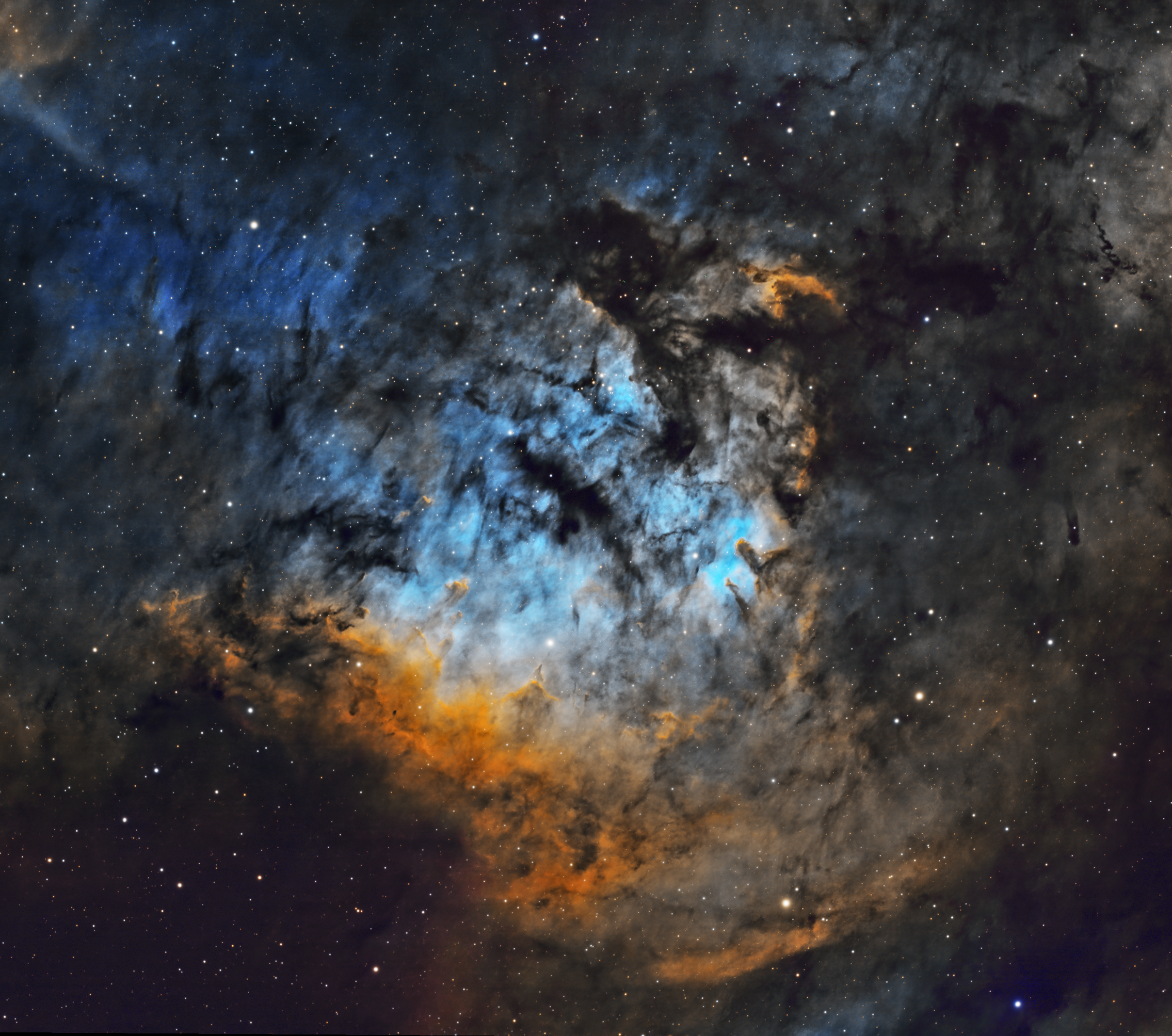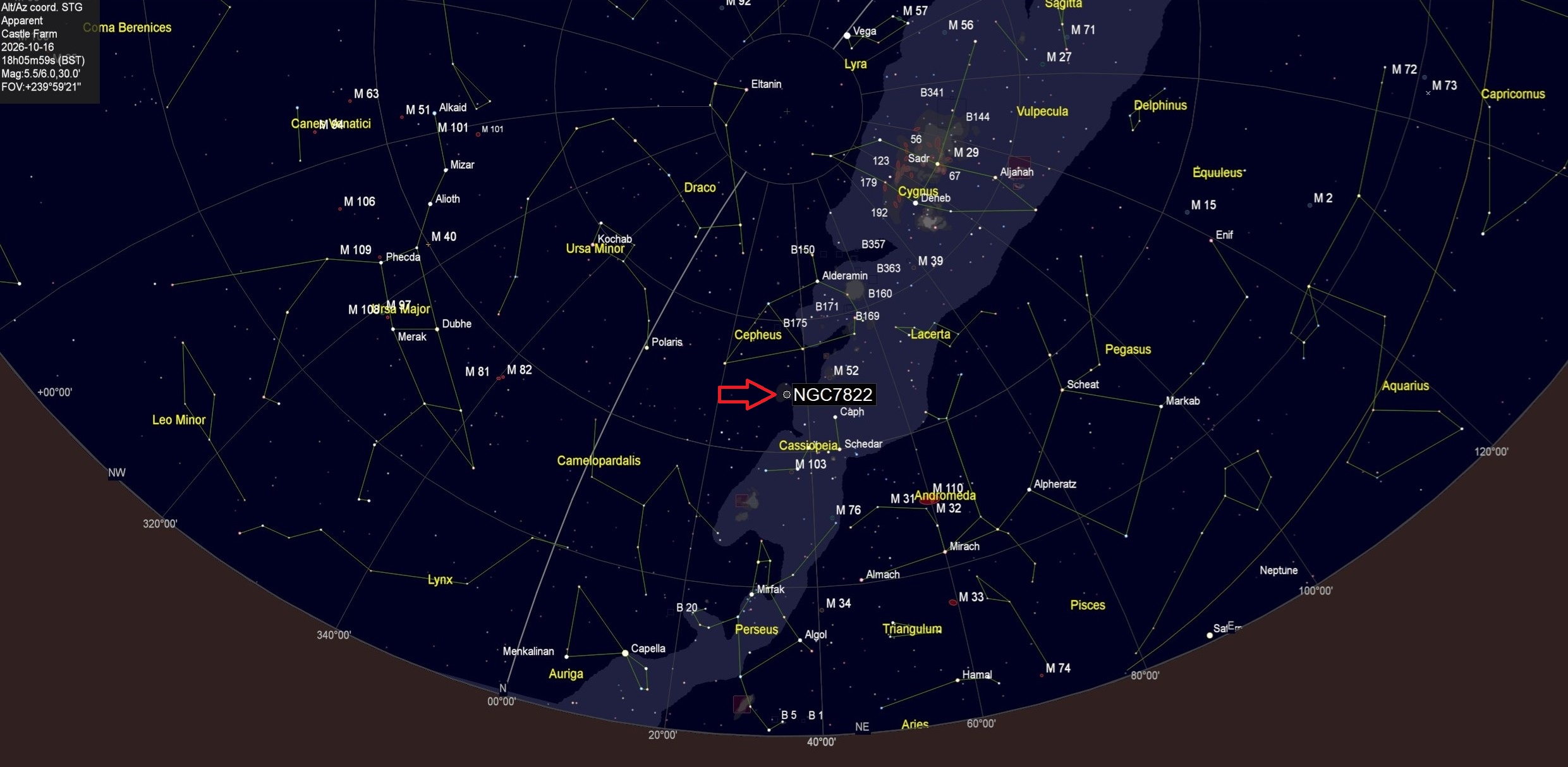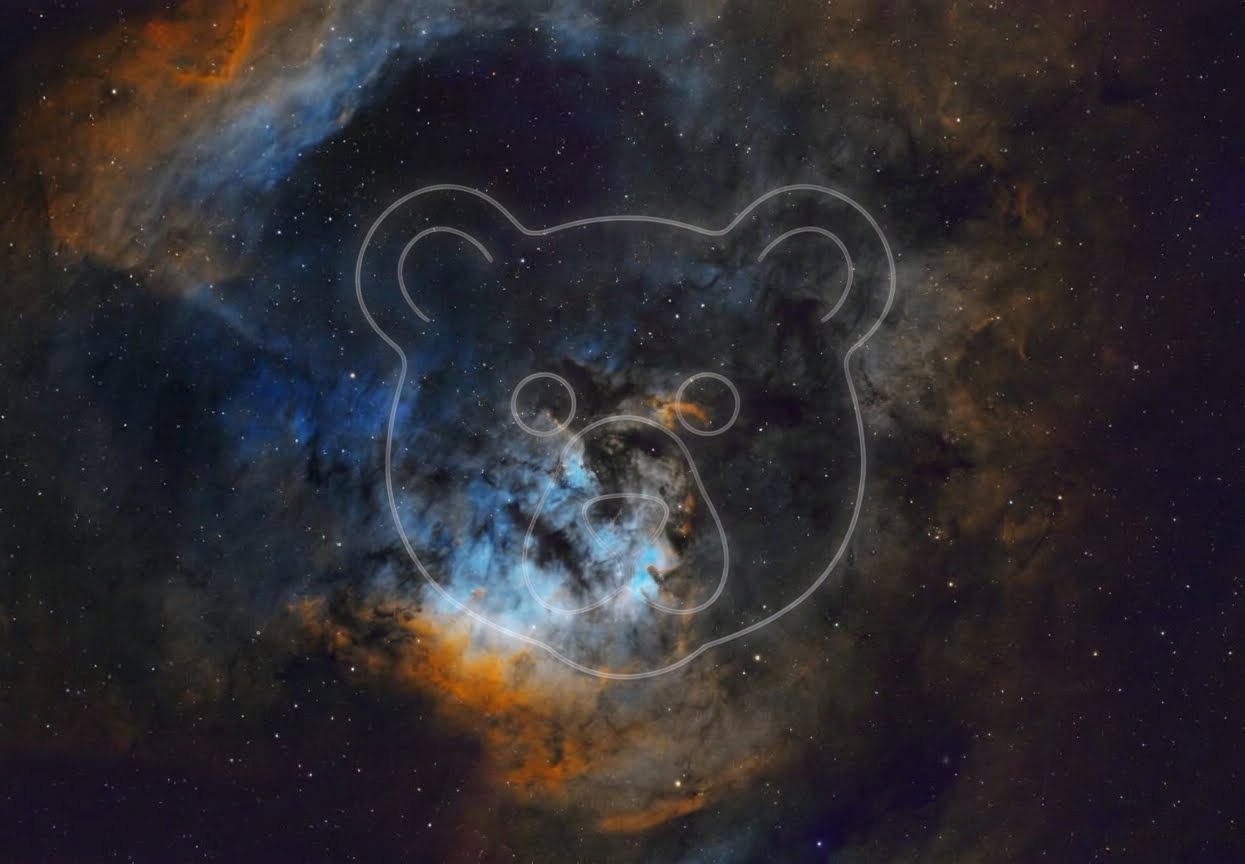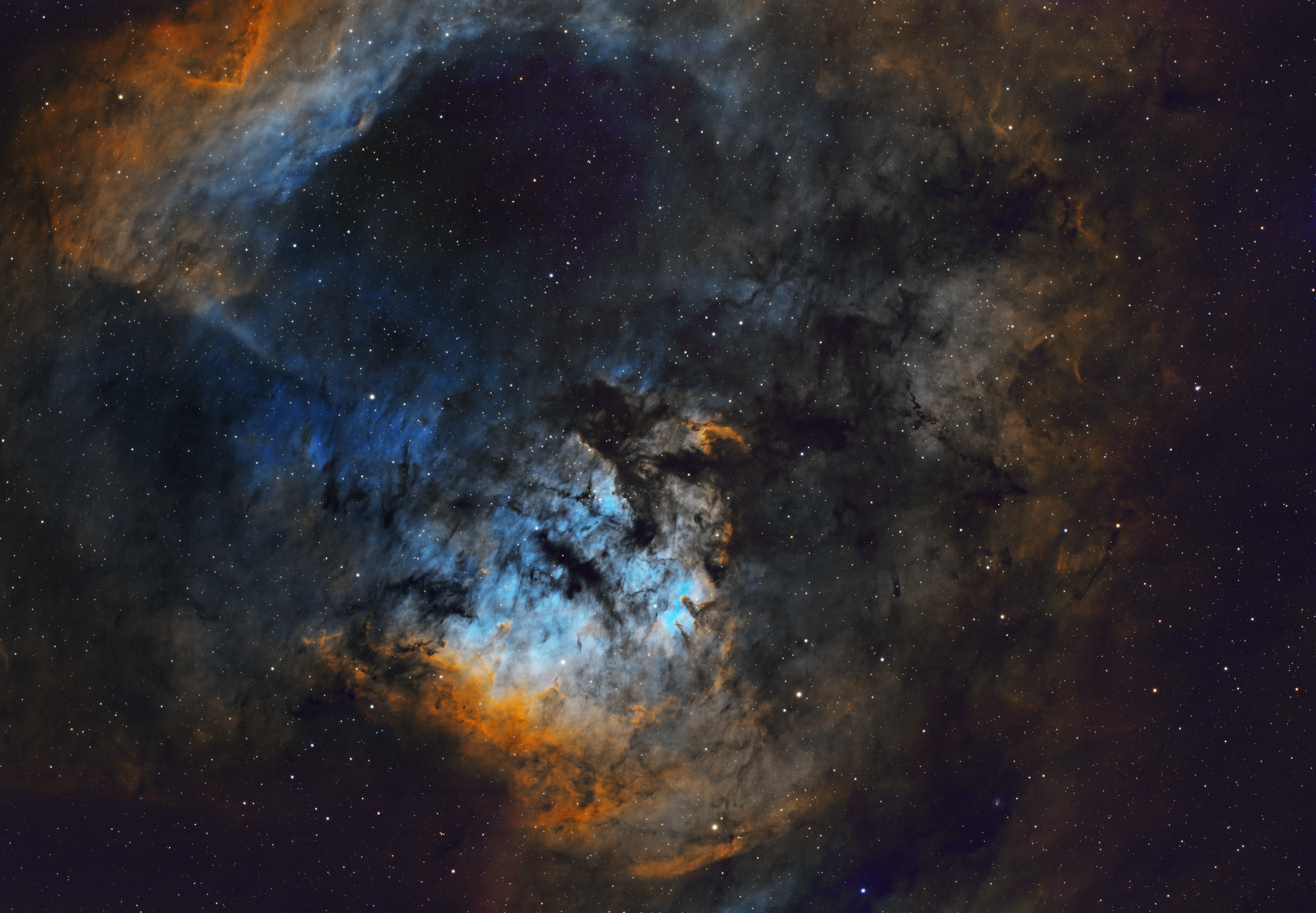
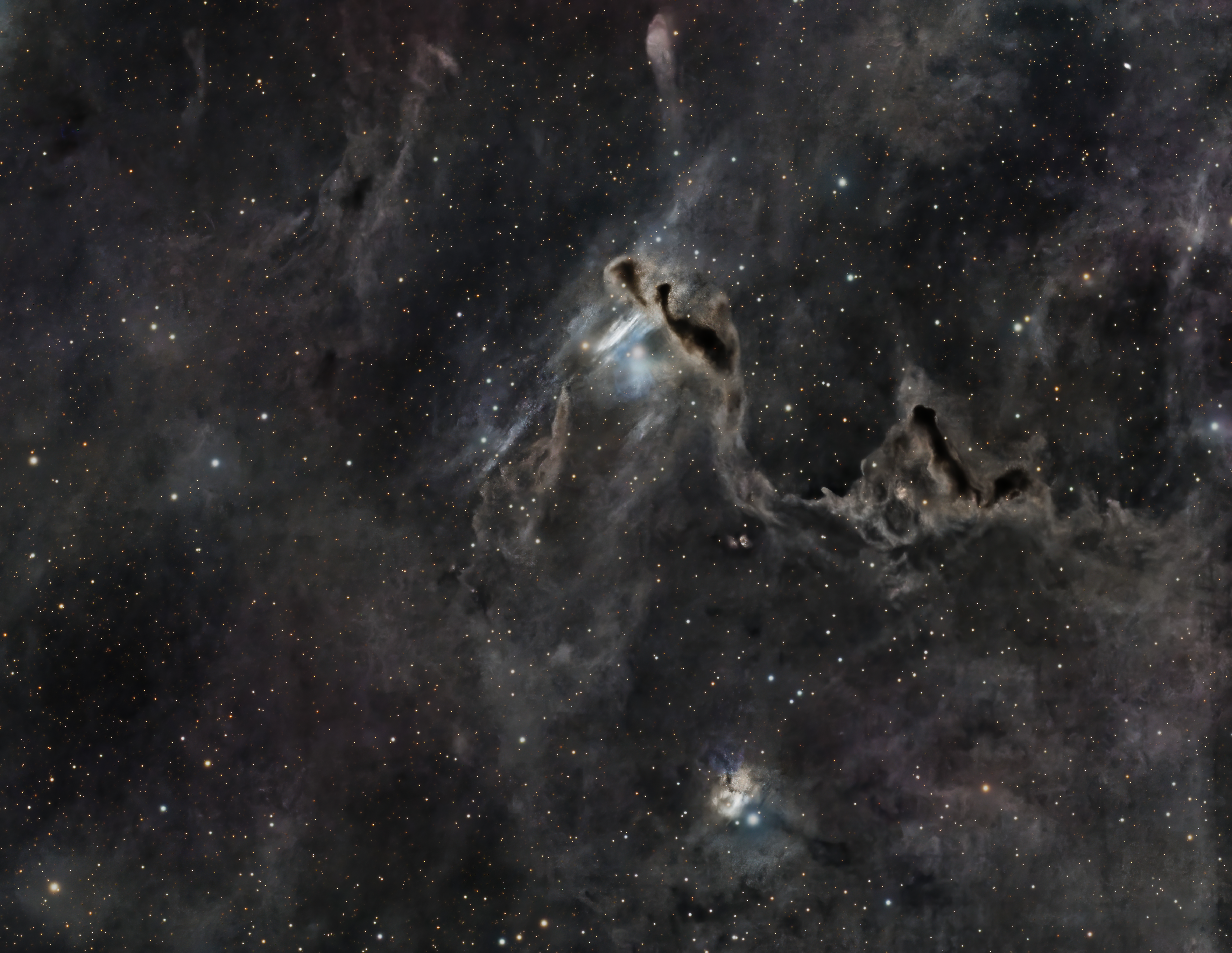
This autumn my main project has been an extremely faint dark nebula that proved something of a challenge; I should have known better as it was LDN 1355 or the Helping Hand Nebula, a notoriously difficult astrophotography target! One of the northern sky’s more evocative objects, tucked away near the border of the constellation Casseopiea, it reveals itself through shadow, silhouette and pareidolia – the human tendency to find familiar shapes in otherwise random patterns. Inevitably this requires long integration time and complex processing.
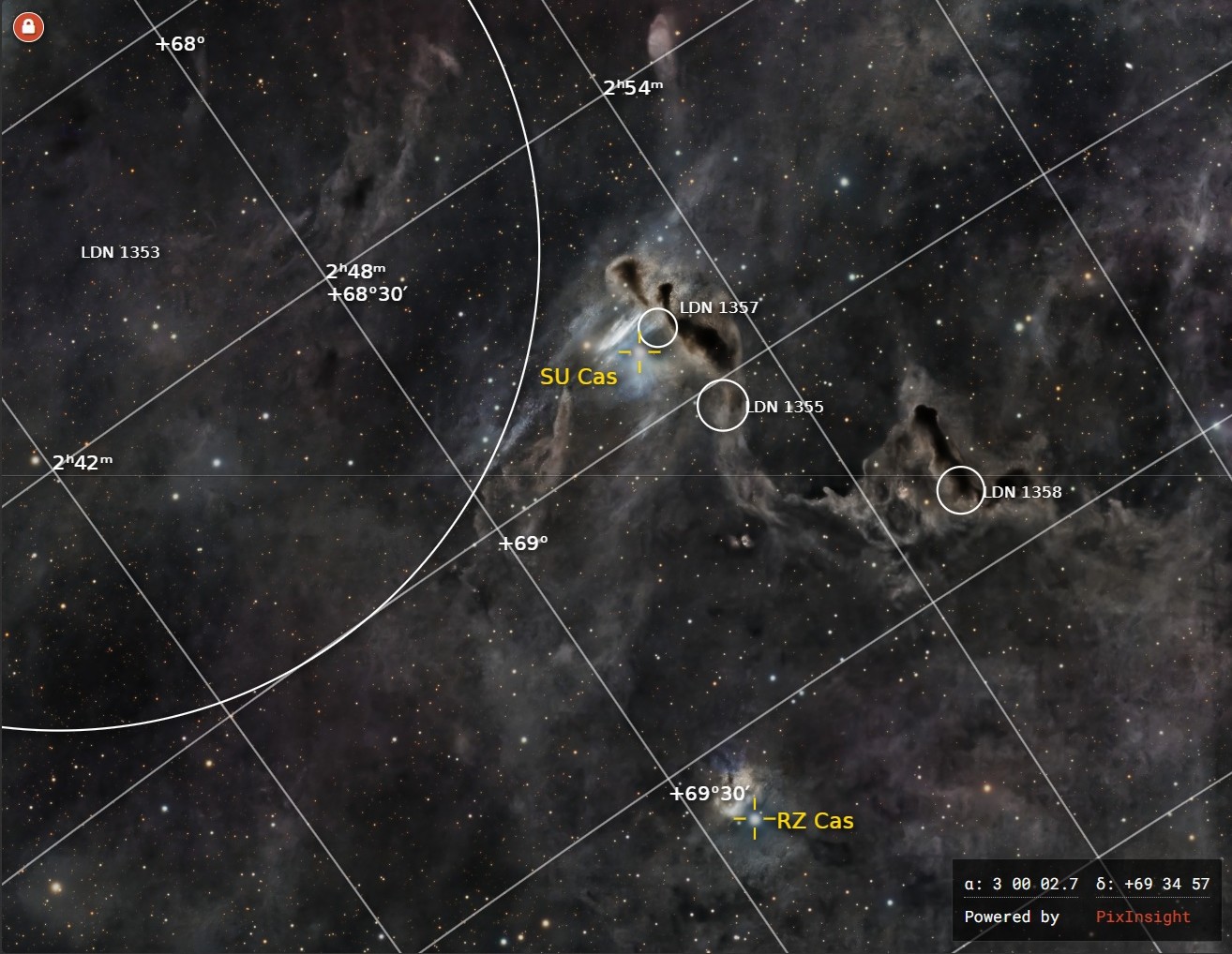
LDN 1355 is at the centre of a larger complex of interstellar dust clouds which includes its neighbours, LDN 1357 and LDN 1358 (see above). Together these dense clouds of molecular gas and cosmic dust form the outstretched arm and open palm. Moreover, the wider view provided in this image has teased out a vast region of complex dust features that accompany the aforesaid appendage. As my first attempt to image this tricky object I am satisfied with the outcome but given the difficulties encountered might rename it in the future: Give me a hand!
| IMAGING DETAILS | |
| Object | LDN 1355 The Helping Hand nebula |
| Constellation | Cassiopiea |
| Distance | 1,400 light-years |
| Size | ~2.5o x 2.0o |
| Apparent Magnitude | NA |
| Scope | William Optics GT81 + Focal Reducer FL 382mm f4.72 |
| Mount & Control | ZWO AM5 + ASIair |
| Guiding | William Optics 50mm guide scope |
| + ZWO 120MM Mini | |
| Camera | ZWO ASI294MM CMOS sensor |
| FOV 2.87o x 1.96o Resolution 2.50”/pix Max. image size 4,144 x 2,822 pix | |
| EFW | ZWOx8 EFW & 31mm Chroma Ha, OIII, SII 3nm & RGB filters |
| Capture & Processing | ASIair, Deep Sky Stacker & PixInsight v1.9.3 Lockhart |
| Image Location & Orientation | Centre = RA 02:50:22.62 DEC +69:02:23.0 Bottom Right = North |
| Exposures | L x 246 @ 180 sec + R x 16, G x16 B x15 @ 300 sec Total Integration Time: 16hr 13min |
| @ Gain 120 & 30 Offset 21 @ -15oC | |
| Calibration | 5 x 300 sec Darks + 10 x NB Flats & Dark Flats @ ADU 32,000 |
| Location & Darkness | Castle Farm Observatory, Wookey, Somerset – UK Typically Bortle 4 |
| Date & Time | 15th & 20th September + 12th & 13th November 2026 @ +18.00h |
| Weather | Approx. < 3oC RH >=>70% 🌙 >=10% |