
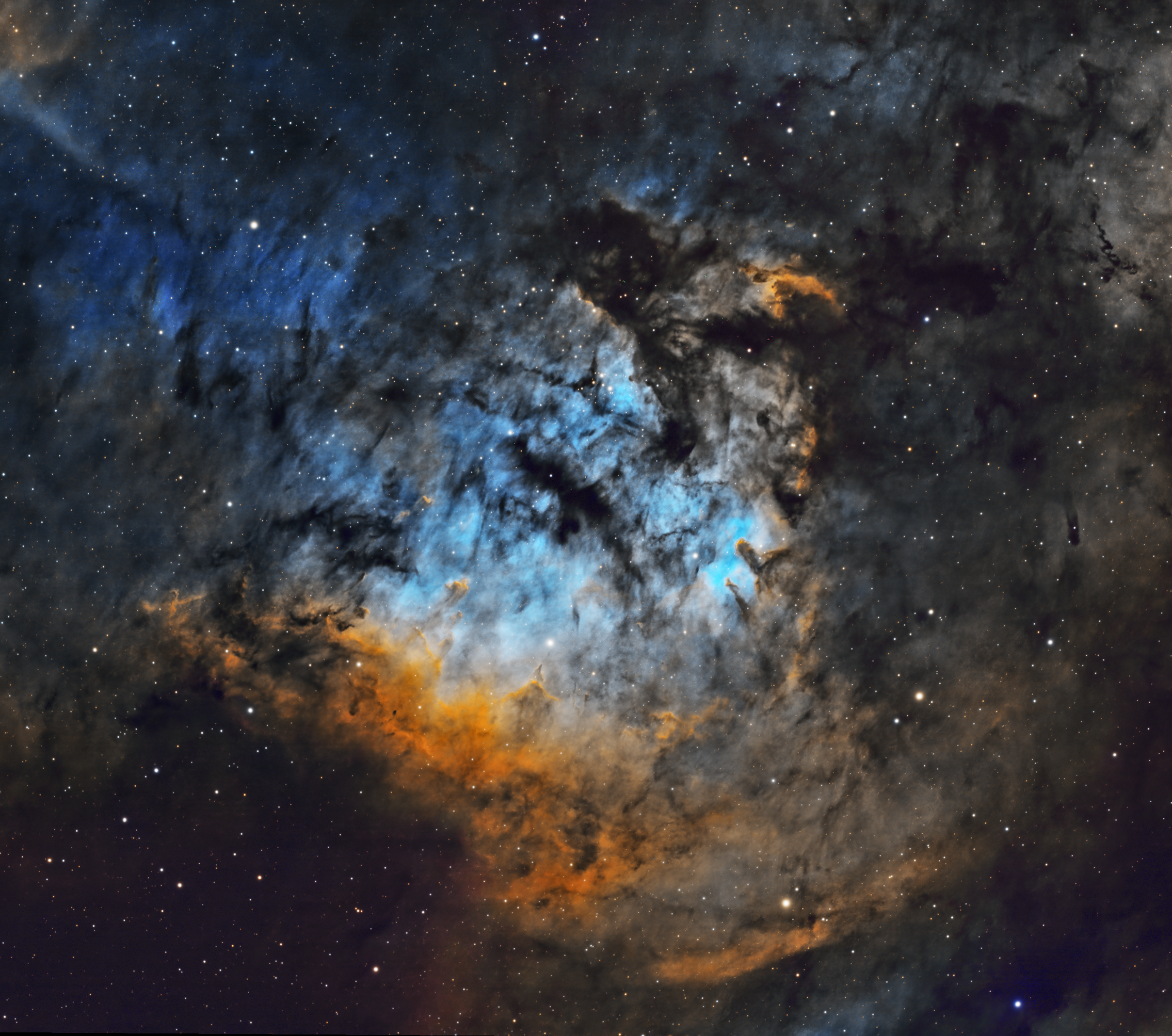
I came across the intriguingly named Question Mark Nebula (NGC 7822) a few years ago but at the time being obscured by my house it was not viable to image; the nickname is because its overall visual shape in wide-field astronomical images resembles a punctuation question mark. Now living in Somerset with northerly views, it was therefore an obvious target for this autumn. However, at some 3o apparent size it would require a mosaic with my equipment and here clear night skies are usually too short for this. Moreover, unfortunately my more suitable widefield Samyang 135 rig is not yet configured to work with my AM5 / ASIair set-up. Not to be defeated, the so-called Teddy Bear Nebula (see main image at the top of the page) was a good alternative solution.
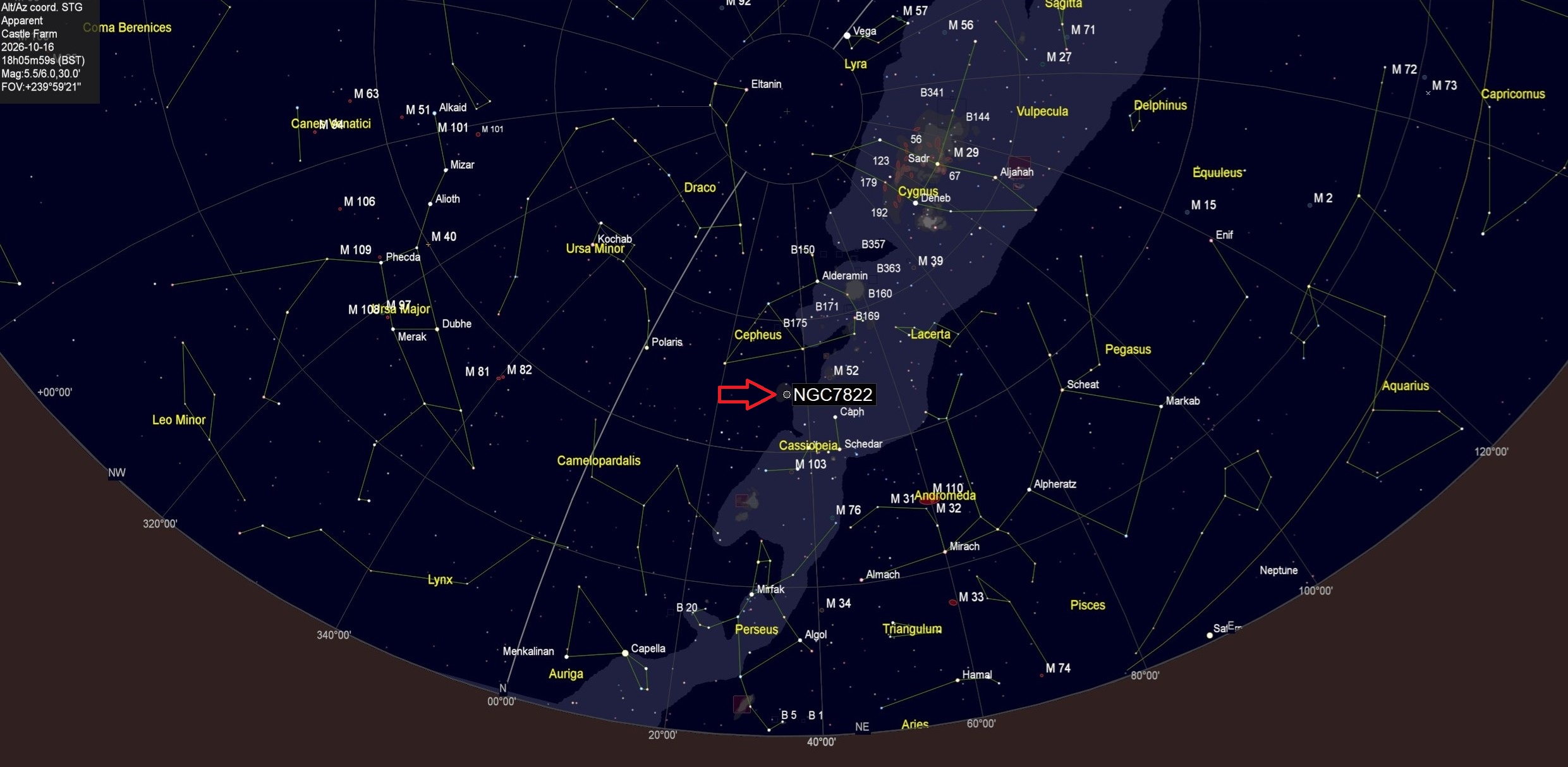
An emission nebula, NGC 7822 is an extensive star-forming region, with complex of glowing gas, dark dust lanes and young stars. At the heart of this region lies Berkeley 59, a young open cluster containing exceptionally hot and luminous stars. Among them is BD+66 1673, an extraordinary star with a surface temperature approaching 45,000 Kelvin and a luminosity roughly 100,000 times that of our Sun.
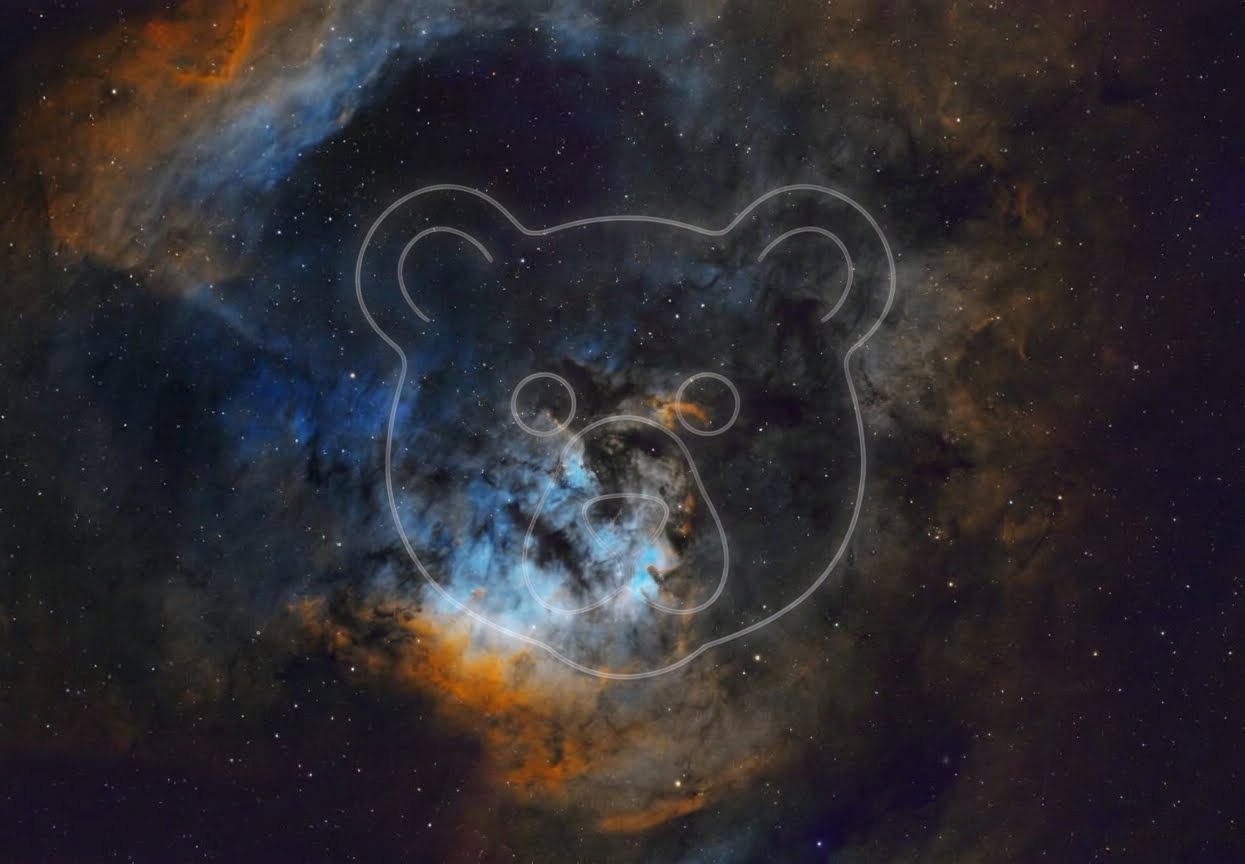
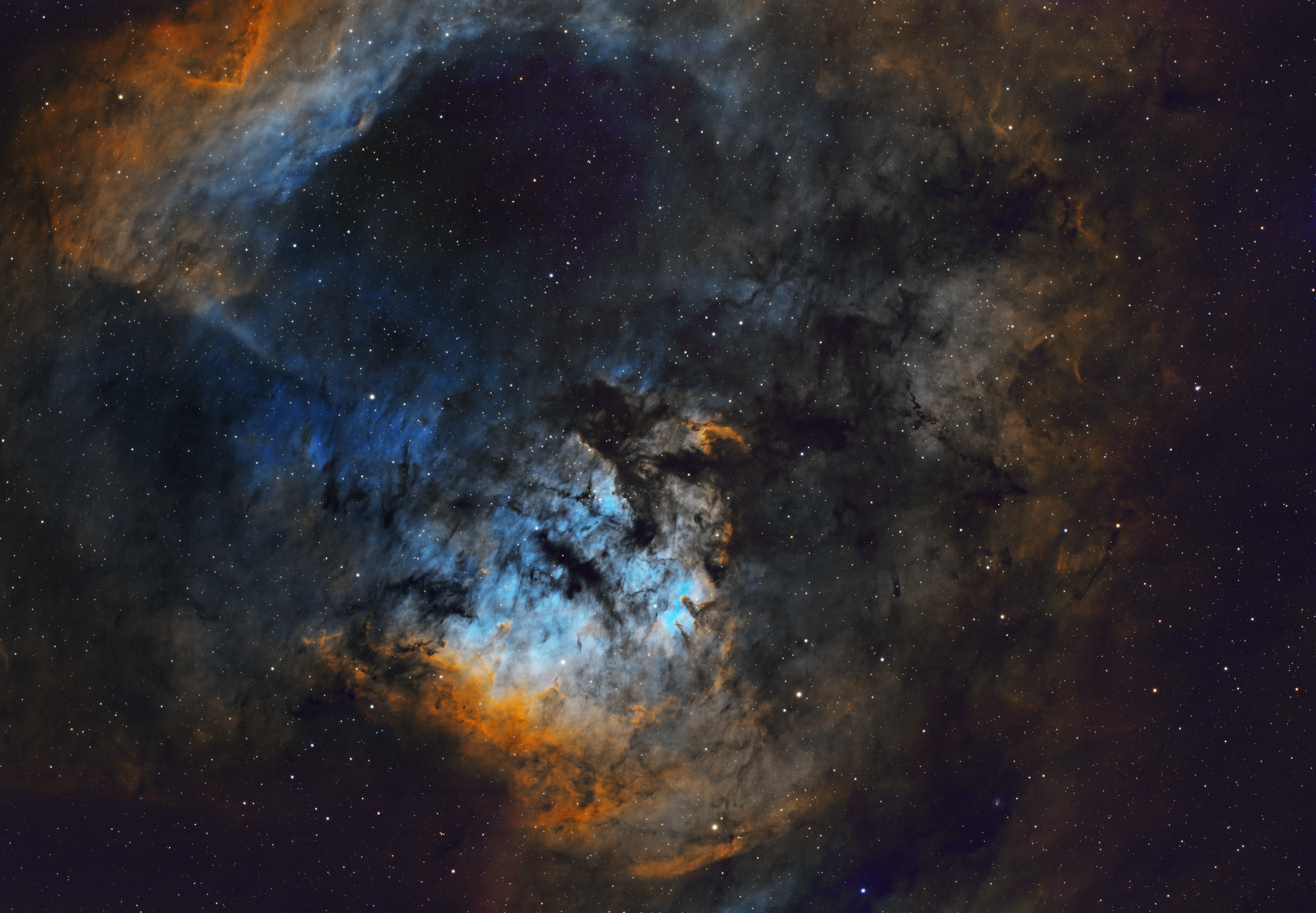
An alternative to imaging the entire and very large Question Mark Nebula (widefield NGC 7822 image below) is instead a smaller area that forms a distinct region of nebulosity and star formation located within NGC 7822, known as the Teddy Bear Nebula, itself including SH2-171. Therein, one of the most captivating features is the collection of towering pillars and irregular structures of gas and dust, not unlike M16’s more famous Pillars of Creation.
Thankfully, this time with clear skies over three nights of October resulted in 10-hours of excellent data and an exciting image of the Bear that shows the aforesaid features to good effect.
| IMAGING DETAILS | |
| Object | NGC 7822 AKA Teddy Bear Nebula or with a wider view Question Mark Nebula |
| Constellation | Cepheus |
| Distance | 2,900 to 3,000 light-years |
| Size | 75 light-years or 1.5o |
| Apparent Magnitude | +6.5 |
| Scope | William Optics GT81 + Focal Reducer FL 382mm f4.72 |
| Mount & Control | ZWO AM5 + ASIair |
| Guiding | William Optics 50mm guide scope |
| + ZWO 120MM Mini | |
| Camera | ZWO ASI294MM CMOS sensor |
| FOV 2.87o x 1.96o Resolution 2.50”/pix Max. image size 4,144 x 2,822 pix | |
| EFW | ZWOx8 EFW & 31mm Chroma Ha, OIII, SII 3nm & RGB filters |
| Capture & Processing | ASIair, Deep Sky Stacker & PixInsight v1.9.3 Lockhart |
| Image Location & Orientation | Centre = RA 00:00:37.41 DEC +67:25:07.7 Top Left = North |
| Exposures | Ha x 38 + OIII x 41 + SII x 41 @ 300 sec Total Integration Time: 10hr |
| @ Gain 120 & 30 Offset 21 @ -15oC | |
| Calibration | 5 x 300 sec Darks + 10 x NB Flats & Dark Flats @ ADU 32,000 |
| Location & Darkness | Castle Farm Observatory, Wookey, Somerset – UK Bortle 4 |
| Date & Time | 13th 16th & 17th October 2026 @ +21.00h |
| Weather | Approx. <5oC RH >=<60% 🌙 +10% to +40% |

