Playing poker with the heavens

cards1

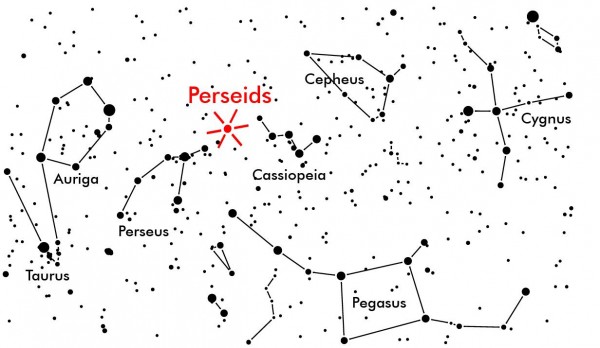
It’s that time of the year when Earth ploughs its way through the tail of comet Swift-Tuttle, resulting in a the Perseids meteor shower. The name is derived from the location of the radiant point within the constellation of Perseus and Greek mythology’s reference to the sons of Perseus.  Such are the orbital paths that Earth’s encounter with the comet occurs around 11th to 13th of August each year and can provide an enjoyable spectacle as the meteor particles rain down through atmosphere.

perseids-e1312951836623

Travelling at some 37 miles-a-second, the sand-grain size particles literally burn up in the blink of an eye, with the energy created producing a bright path of the light path that very briefly shoots across the night sky, sometimes green or red coloured.  Some 16-miles in size, from time-to-time the comet itself actually passes nearby to Earth during its orbit around the Sun, last time being in 1992 and the next in 2126.

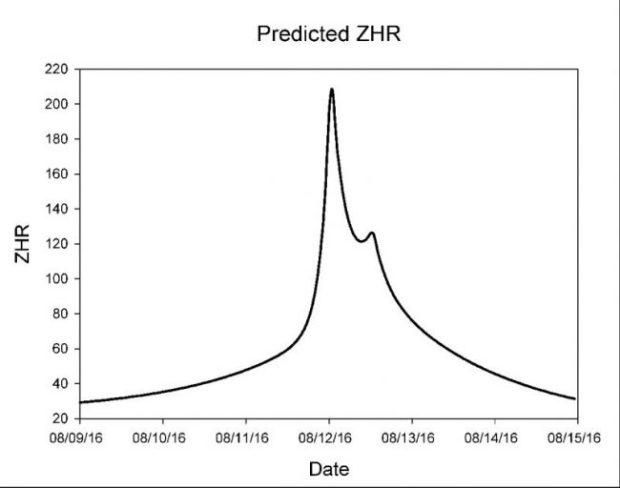
Perseid ZHR 2016

Whilst the timing of our annual encounter can be predicted with good accuracy, a sight of each individual meteoroid particle is entirely down to chance.  Over a period of two or three days the frequency (Zenithal Hourly Rate or ZHR) may vary from a few tens to a few hundred, depending on which section of the comet’s tail Earth is passing through. Of course, observation requires a clear sky – something that’s been notably absent here at Fairvale Observatory for some time now.  Notwithstanding, this year there were three consecutive clear, dark, warm nights, which occurred shortly after a new Moon that provided excellent Perseid observing opportunities.

Viewing is a matter of lying back in a suitable garden chair looking up towards the radiant position, which starts in the north east then moves to the south during the night and just waiting.  This year peak Perseids were on the evening of 11th/12th August between about 11pm and 1am, during which time we probably saw between 20 to 40 hits an hour; the previous and subsequent evenings were also quite good, though with slightly less hits.  Such is the randomness of each meteoroid hit that in practice Perseid trails occurred all over the sky and were easy to miss if outside the peripheral vision.  However, overall it was a very good and enjoyable show but probably  not as good as that from the ISS.

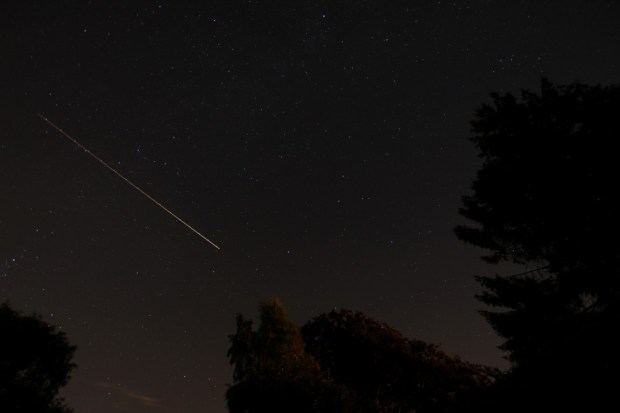
IMG_7024 (Medium)

At first this looks great but look again, it’s an aircraft trace – living next to Gatwick airport doesn’t help. The giveaway is in the next shot which shows the track continuing i.e. too long and too far for a meteoroid.

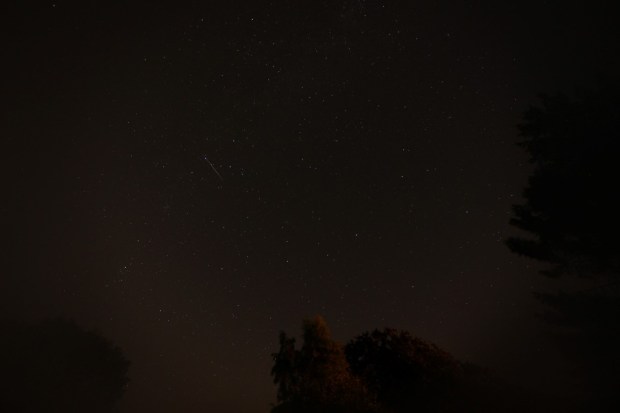
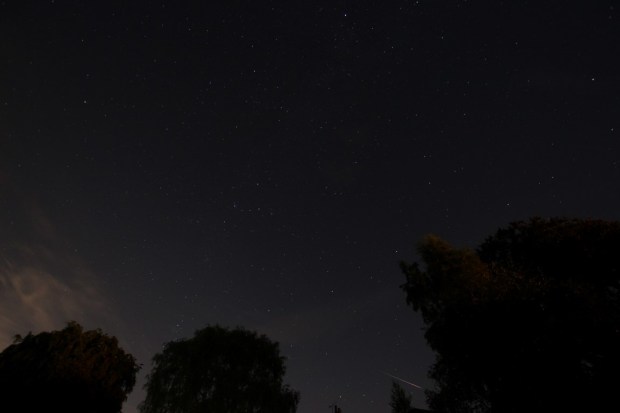
At the same time using the Canon DSLR and an ultra-wide lens, I also attempted to image the Perseid shower.  On the first night using Vixen Polarie tracking, set towards the radiant position and on the second night pointing east, without tracking.  Control was via an intervalometer, with camera settings at ISO 800, 20 or 14 second exposures, and 5-second shot intervals.  Even with such a high incidence of meteoroid hits, obtaining a photograph was still very difficult; mostly the strikes occurred outside the field-of-vision or sometimes in the 5-second pause.  In total I shot over 300 images but obtained just two Perseid hits and more than a few plane tracks!  Even with good preparation and clear skies it really is a case of chance but I was nonetheless pleased to have my share of luck this time and look forwards to another opportunity this time next year, weather permitting.

IMG_7111 (Medium)

Gotcha – the real thing: ISO 800 @ 20 seconds with tracking.


IMG_7303 (Medium) (2)

Only just! This time the Perseid is just sneaking out of view at the bottom of the frame: ISO 800 @ 14 seconds, without tracking.

Reflections – 2015

Launched in August 2014, 2015 is the first full year of Watch This Space (Man) and despite some personal set-backs it’s been an interesting year astronomically, with much to write about.  Whilst I have made progress with my imaging, it was not what I would have wished for but nonetheless I have been pleased with the outcome.  Continuing on from last year, Reflections is a recap and thoughts on all that happened to me astronomically in 2015 and looks forward to the coming year.

Although this website is just intended as my record of A personal discovery of the Universe through astronomy and astrophotography, it has been pleasing to see that over the year the site has attracted 1,310 visitors from 77 countries around the world and over 2,700 views; you are all most welcome.  This was not the intention of the blog but I am humbled by the interest and would be very pleased to hear from anyone who would like to get in touch with queries, comments or just to say hello – contact details are in the About section.

Reflections 2015

JANUARY TO MARCH

The first quarter turned out to be my most active and successful period of the year for reasons that will become apparent later.  Strictly speaking my image of the Rosette Nebula posted on 5th January was taken on 29th December 2014 but what an image to start the year with, clearly I was doing something right by now.  Notwithstanding, from looking at pictures of the same object taken by other more accomplished photographers, it was evident that something was missing – red!  This was an easy to problem to solve and I immediately set out on a quest to find a suitably modified camera with the IR filter removed.  Soon thereafter I was lucky to find an excellent second hand modded Canon EOS 550D, which has now become my main imaging camera of choice and with all that extra red Ha-light has led to a quantum improvement of many images since.  Such cameras are very popular so I felt lucky to have secured this one.
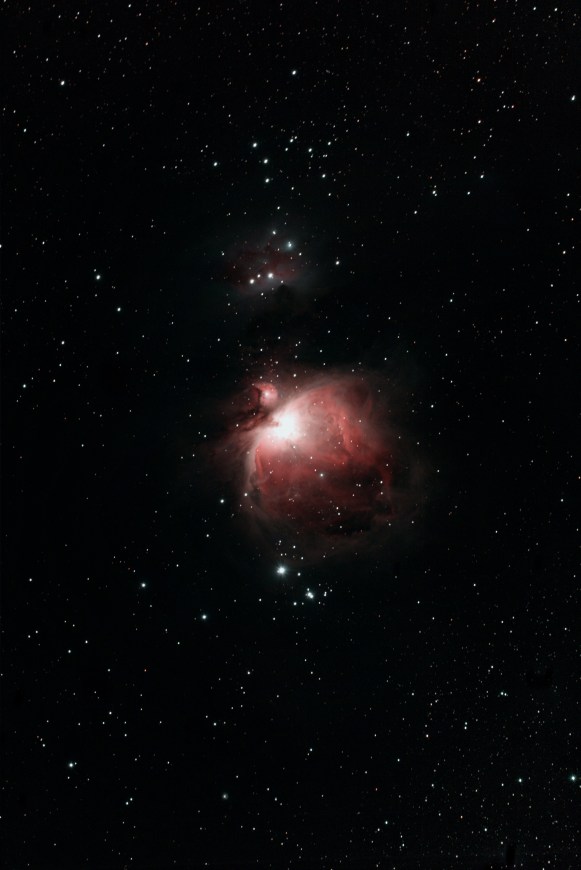
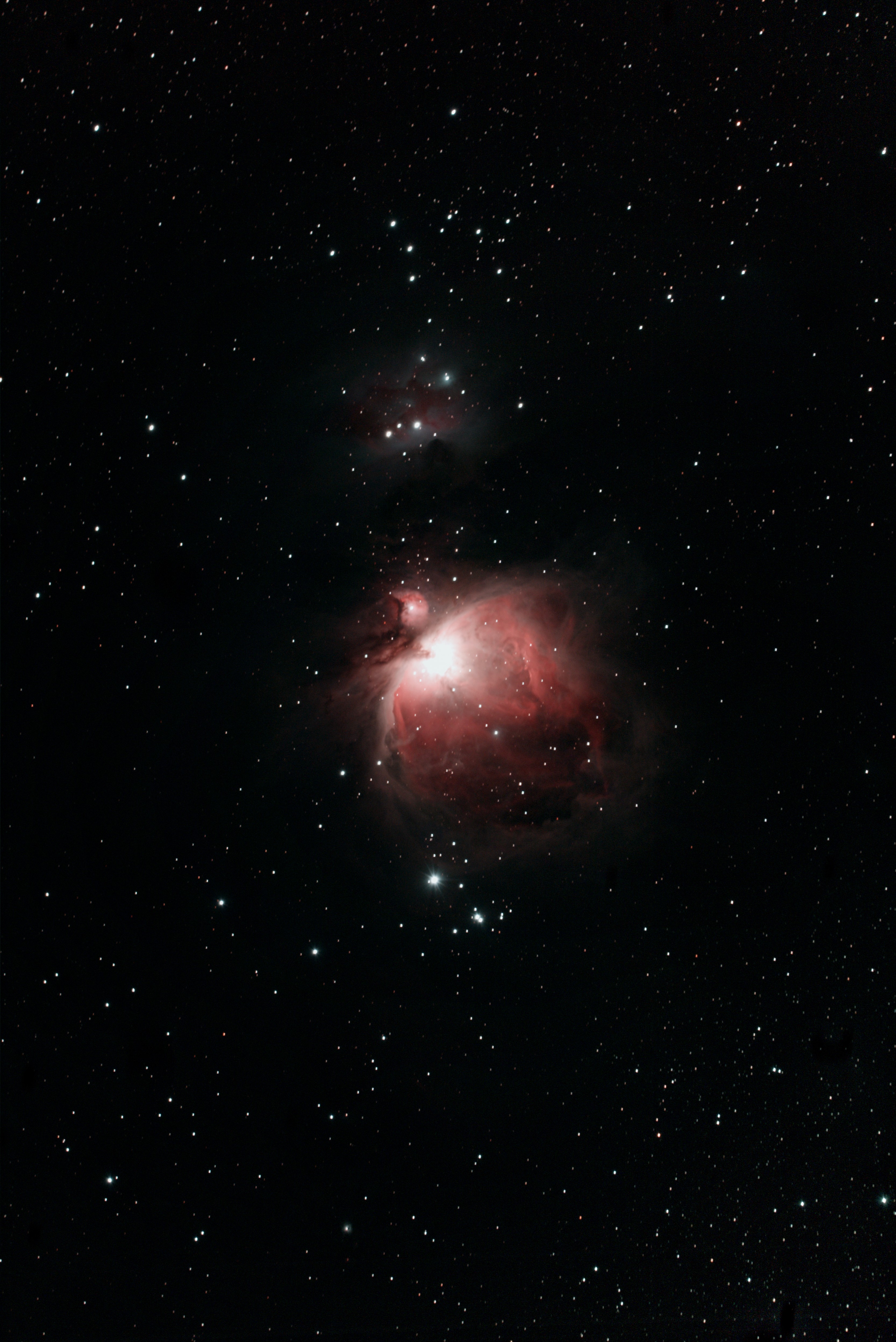
Orion's Sword: M42 The Great Orion Nebula, Running Man Nebula & NGC 1981 Star Cluster WO GT81 + modded Canon 550D & FF | 10 x 180 secs @ ISO 800 & darks calibration | 8th February 2015

Orion’s Sword: M42 The Great Orion Nebula, Running Man Nebula & NGC 1981 Star Cluster
WO GT81 + modded Canon 550D & FF | 10 x 180 secs @ ISO 800 & darks calibration | 8th February 2015.  Modification of the camera by removing the IR filter increased red Ha-light.

EQMOD / ASCOM is a popular free software project developed by amateurs that, amongst other things, provides computer and planetarium linked control of the mount; with other compatible linked programmes such as APT (Astrophotography Tool) and PHD (Push Here Dummy) control can be extended to cameras and for autoguiding.  At the start of the year I successfully started using Carte du Ciel planetarium linked with EQMOD for computer controlled alignment and mount control, which as expected was very useful – particularly when it got really cold and I was able to take the equipment indoors and operate the equipment remotely.  However, later in the year I have encountered connection problems which are, as yet, not fully resolved.

Whilst EQMOD is an excellent project which provides first class mount control when working, it requires additional faffing about and problems on a different level of scale, which with limited imaging conditions in the UK and having to set up outside from scratch each time is a pain.  For this reason and others I have not yet moved to autoguiding, which I know will be highly beneficial to imaging but for the moment has proved to be a step too far for me.  Such is the fickle nature of all this that I’m now considering other ways of achieving the same end, perhaps with professional software control and a stand-alone guider, such as the Lacerta M-GEN – of course a dedicated observatory would help a lot but seems unlikely at the moment!

I have previously found the early winter sky of Orion, Taurus, Pegasus and Monoceros very productive with beautiful imaging objects such as M42 and the Horsehead Nebula.  However, this year looking more closely at the late-winter / early spring skies turned out to be just as exciting, with a veritable playground of galaxies to choose from during February and March.  Notwithstanding, the highlight during the winter was successfully imaging Comet Lovejoy, a first for me that required changes to  normal DSO and planetary imaging techniques as this ephemeral object was speeding across the night sky at over 70,000 mph – post processing also turned out to be quite different.
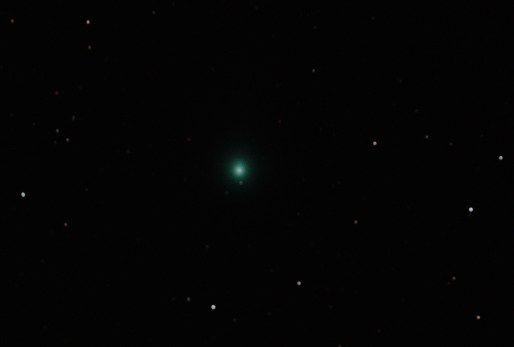
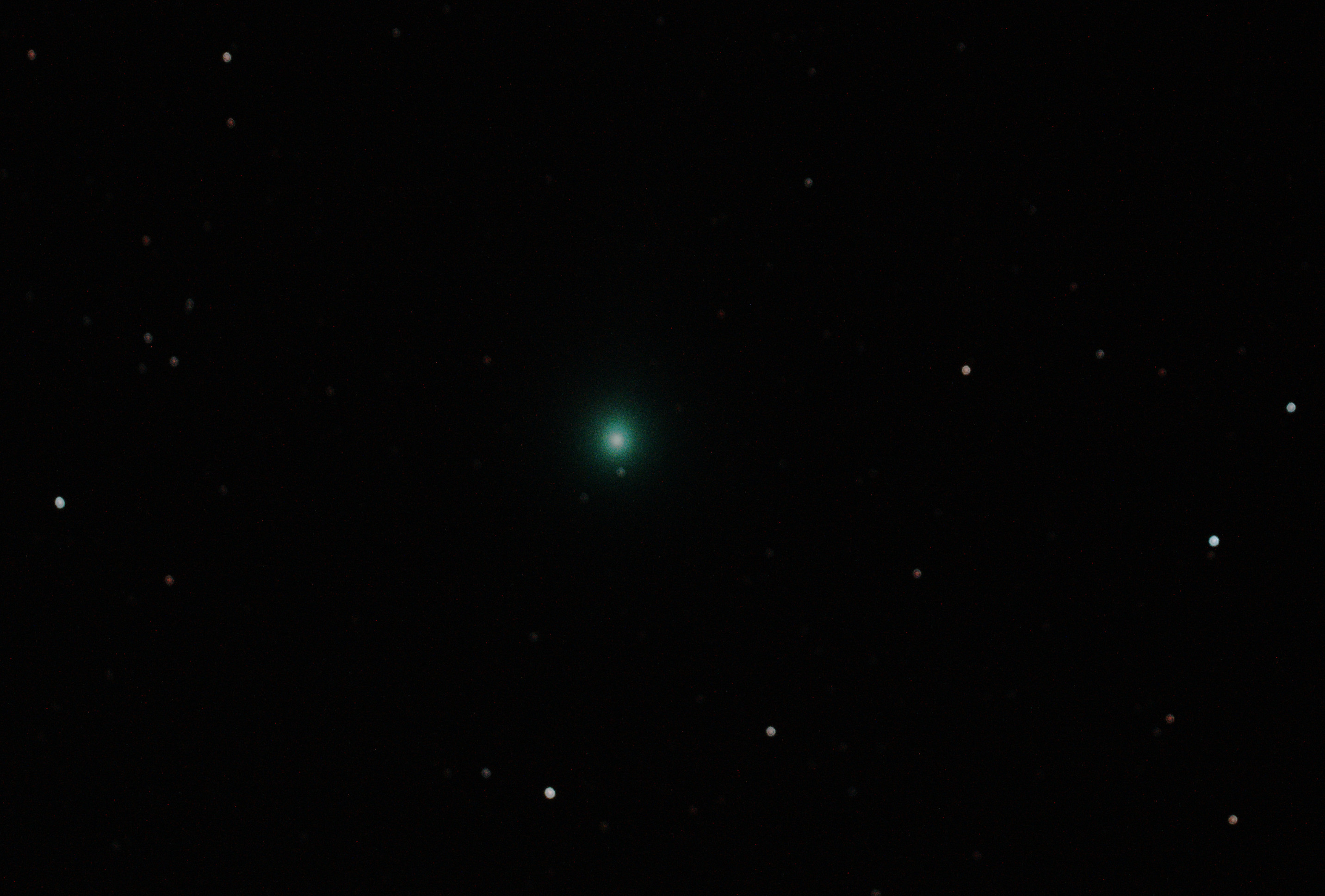
C/2014 Q2 Comet Lovejoy WO GT81 + Canon 550D (modded) & FF | 40 x 20secs @ ISO1,600 + darks | 16th January 2014

C/2014 Q2 Comet Lovejoy
WO GT81 + Canon 550D (modded) & FF | 40 x 20secs @ ISO1,600 + darks | 16th January 2014


No Date Object* Name
1 16/01/15 C/2014 Q2 Comet Lovejoy
2 16/01/15 C/2014 Q2 Comet Lovejoy
3 16/01/15 NGC 2244 Rosette Nebula
4 22/01/15 M42 etc Orion Nebula
5 22/01/15 M45 Pleiades
6 22/01/15 Comet Lovejoy
7 22/01/15 Comet Lovejoy
8 22/01/15 Banard’s Loop
9 22/01/15 Banard’s Loop
10 22/01/15 Orion Constellation
11 24/01/15 NGC 1909 Witch Head Nebula
12 24/01/15 NGC 2392 Eskimo Nebula
13 24/01/15 M44 Beehive Cluster
14 24/01/15 IC-443 Jellyfish Nebula
15 08/02/15 M42 Gt Orion Nebula etc
16 08/02/15 Barnard 33 Horsehead Nebula etc
17 21/02/15 M65 Leo Triplet (Galaxies)
18 21/02/15 M105 M96 Group (Galaxies)
19 24/02/15 Venus & Mars
20 25/03/15 NGC 2903 Spiral galaxy – Leo
21 25/03/15 NGC 3842 Galaxy cluster: Leo
22 25/03/15 M 88 Spiral galaxy: Virgo cluster
23 25/03/15 M100 Spiral galaxy: Virgo cluster
24 26/03/15 NGC 4438 Markarian’s Chain
25 26/03/15 M104 Sombrero
26 26/03/15 M53 Globular cluster


*Record of quarterly photographic images in 2015, excluding other widefield pictures

APRIL TO JUNE

Things took a turn for the worse in April when I went into hospital for a knee replacement operation.  All went well but it is a major operation and recovery has been slow and often painful, thus prohibiting any real astronomy until September.  It did however provide the time and opportunity to read about astronomy and pursue some MOOC astronomy courses.

After a period of convalescence, I did manage to obtain some widefield camera shots of the planets, the ISS and simple night sky images in the summer.  Whilst not as satisfying as prime focus photography, it was interesting and kept me sane during this otherwise difficult time.
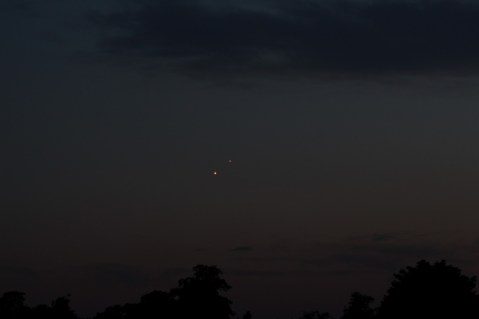
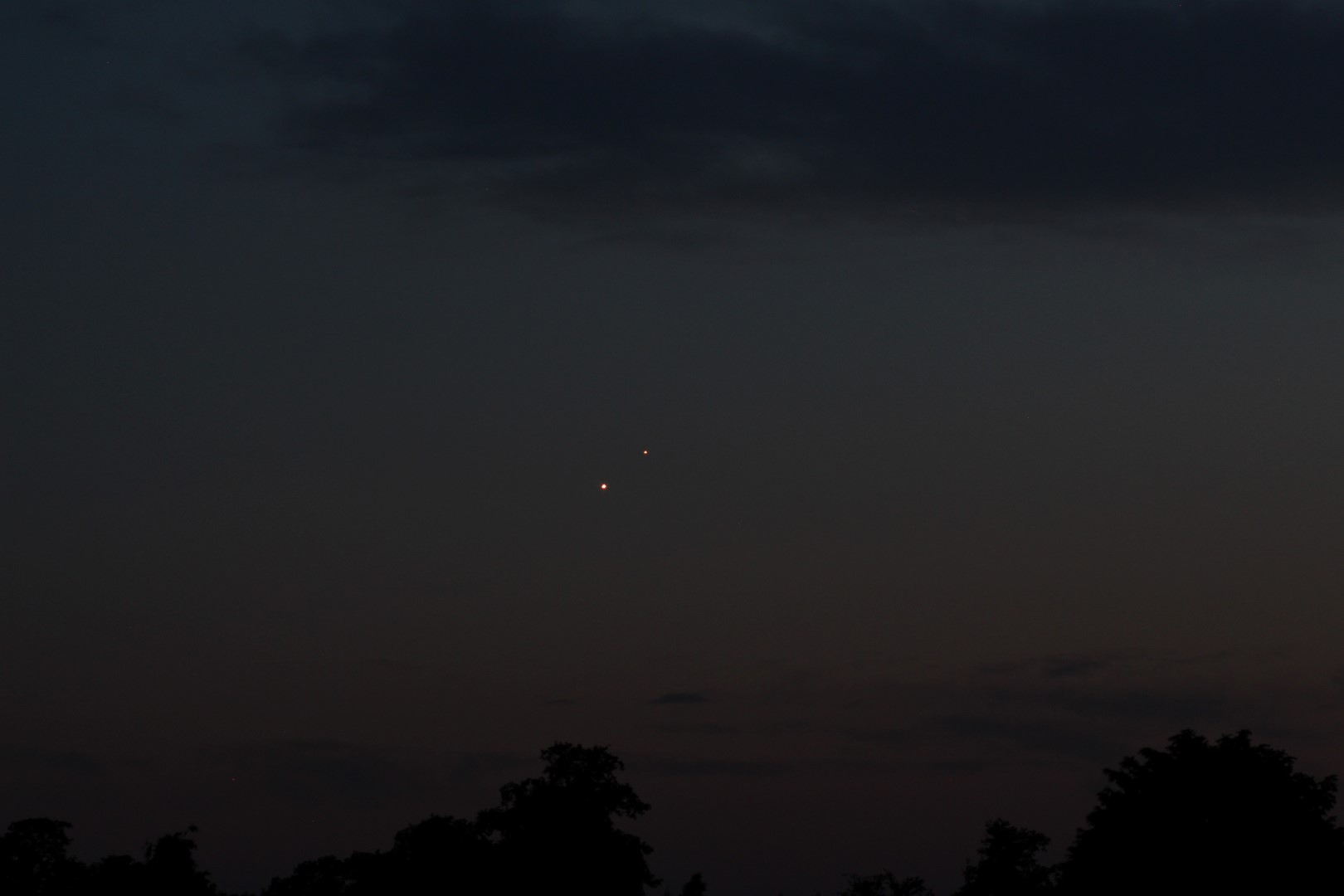
1st July 2015. Bingo = conjunction; though one day later Jupiter has now moved to the right of Venus.

1st July 2015. Conjunction of Jupiter to the right of Venus.

No Date Object Name
27 11/04/15 NGC 4438 Markarian’s Chain
28 11/04/15 NGC 4565 Spiral galaxy-side


JUNE TO SEPTEMBER

This period was more of the same until on 19th September, when at last I managed to set-up Fairvale Observatory for the first time since March, what a relief.  As a bonus I was particularly chuffed to achieve a good image of the Andromeda Galaxy but the highlight of this period and the year was the lunar eclipse at the end of the month on 28th September.

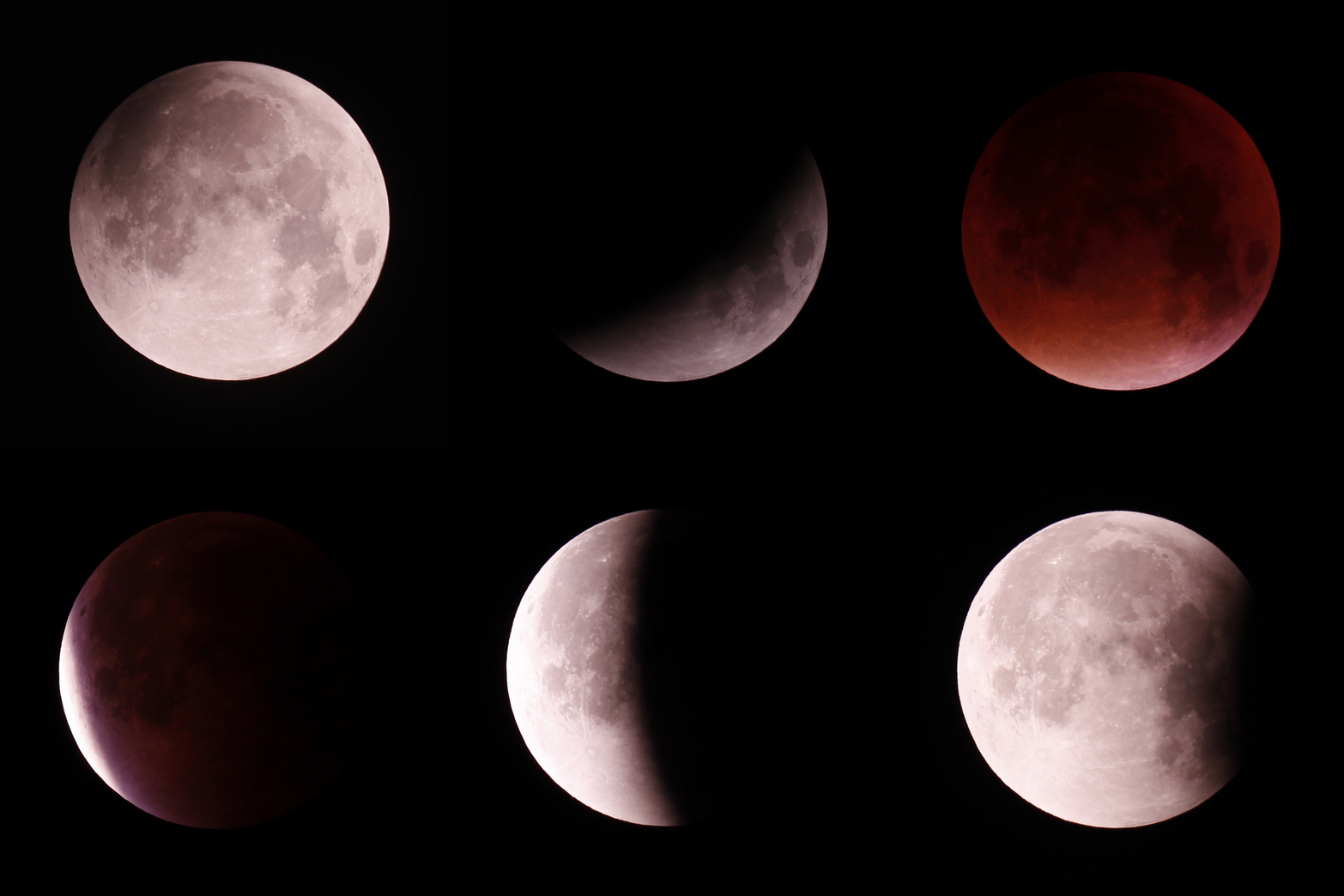
For once everything was perfect: a clear sky all night with a perfect view of the eclipse from start to finish.  I stayed up all night and would have to say it was one of the best, if not the best event I have so far experienced since taking up astronomy; apart from being an outstanding imaging opportunity, the ambiance throughout the eclipse was spellbinding.  I was therefore very pleased to obtain an excellent set of images of the entire eclipse, mainly using a prime focus camera set-up with the WO GT81 telescope but also with an alternative  camera and telephoto lens on a tripod.  The memory of that night will stay with me for a long while and, in part, helped to make up for the lost time since my operation in April.
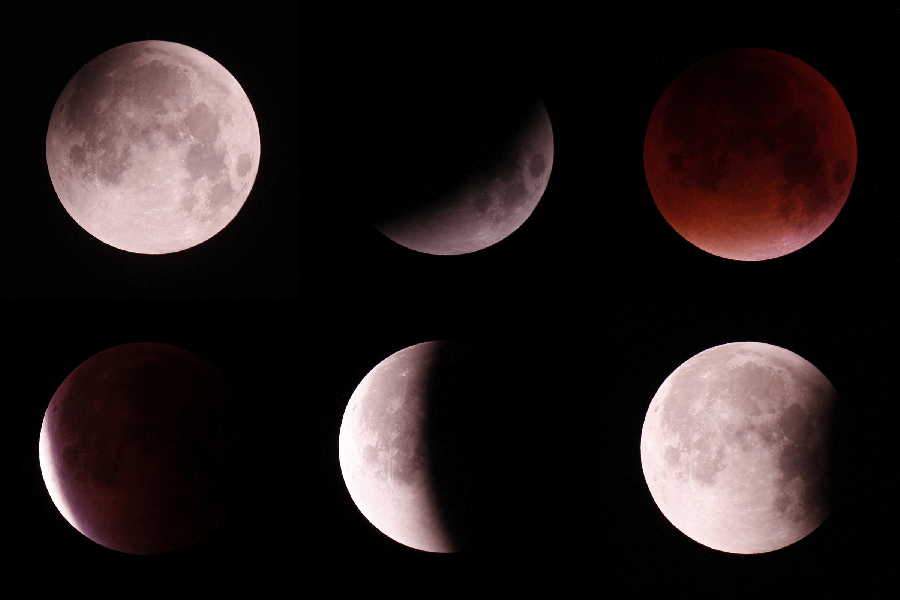
Eclipse Animation 28th September 2015

Eclipse Animation 28th September 2015

No Date Object Name
29 19/09/15 IC 5070 Pelican Nebula
30 19/09/15 NGC 6979 Pickering inc Veil Nebula
31 19/09/15 M15 Globular Cluster
32 19/09/15 M31 Andromeda
33 28/09/15 Lunar Eclipse Entry @ 1 sec intervals
  28/09/15 Lunar Eclipse Totality
  28/09/15 Lunar Eclipse Entry @ 1 sec intervals
34 28/09/15 Lunar Eclipse Exit – camera + tripod
35 30/09/15 IC 1318 Sadr Region (+NGC 6910)
36 30/09/15 IC 1318 Sadr Region – Pt2


OCTOBER TO DECEMBER

The final quarter of the year has been very frustrating due to the almost complete absence of suitable imaging conditions, mainly due to cloud cover but even when there was a few clear nights it was of course a full Moon – you can’t win!  I was particularly unhappy as this time marks the arrival of the constellation Orion and all its wonderful imaging opportunities, for which I had new plans.

Given the short focal length of the William Optics GT81 and relatively small aperture, used with a APS-C cropped sensor DSLR camera the resulting field-of-view is a quite large and, where possible, this year I’ve therefore concentrated on objects of 2.5o to 3.0o apparent dimensions.  Together with the modded camera this has resulted in some exciting new images of old and new objects.

However, large as the field-of-view is with this set-up, I have become increasingly aware of the simply enormous scale of some nebulous features such as Barnard’s Loop.  As a result I have become more interested in widefield imaging using just a camera and tripod.  Like prime focus imaging, widefield imaging will also benefit from achieving longer exposures through the use of tracking.  Early in this period I was fortunate to purchase a Vixen Polarie lightweight tracking mount for this purpose, but due to the aforementioned conditions I have unfortunately been unable to use it very much.  In fact it’s fair to say that other than some brief experimentation, it’s hardly been used at all so far.  Notwithstanding, I can see the potential and have high hopes for future imaging opportunities when the clouds part and the Moon is absent.

The year finished with a couple of other purchases that I hope will assist with imaging in 2016:

  • A new laptop – running Windows 10 with a core i7 Intel chip, 2 TB hard drive, 16 GB RAM, dedicated AMD graphics card and an HD 17.3” screen, which I hope will help improve post processing.  Running my preferred Windows 7 operating system, I will continue to use the smaller 13” i5 chip laptop for mount and camera control.
  • Ultra-Wide Angle lens – the truth is I’ve recently acquired this wonderful Sigma 10 – 22mm  f3.5 lens for a trip to the Grand Canyon in April, however, I will of course also be using it with the Vixen Polarie when the skies clear.
No Date Object Name
37 09/10/15 NGC 6888 Crescent Nebula
38 09/10/15 M 74 Spiral galaxy (near Pegasus)
39 09/10/15 NGC 7814 Little Sombrero
40 09/10/15 NGC 7479 Barred spiral galaxy
41 09/10/15 M 31 Andromeda galaxy
42 08/12/15 NGC 1499 California Nebula
43 08/12/15 IC 405 Flaming Star Nebula
44 08/12/15 NGC 2264 Cone Nebula
45 09/12/15 M42 Great Orion Nebula etc
46 08/12/15 Orion Constellation


Favourite Images

Despite the lack of activity this year I have been fortunate to obtain some good images and I can only hope 2016 will be just as rewarding.  Acting as judge and jury, my personal favourites in no particular order are:
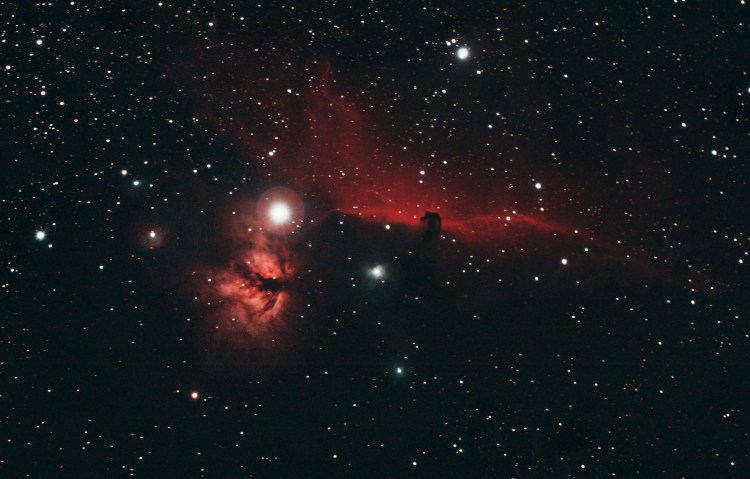
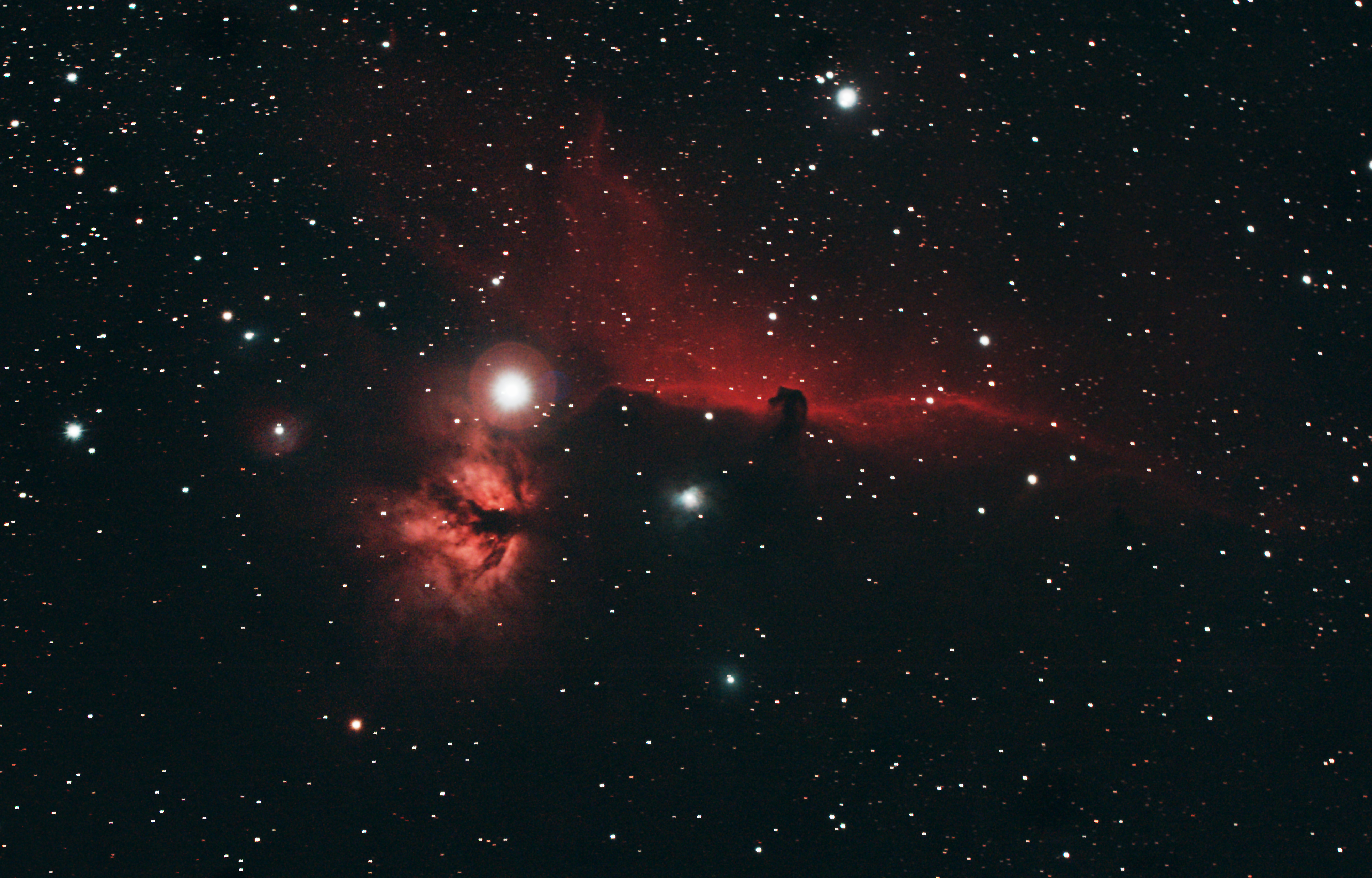
NGC 2024 Flame Nebula & Horsehead Nebula WO GT81 + modded Canon 550D & FF | 10 x 180 secs @ ISO 800 & darks calibration | 8th February 2015

NGC 2024 Flame Nebula & Horsehead Nebula
WO GT81 + modded Canon 550D & FF | 10 x 180 secs @ ISO 800 & darks calibration | 8th February 2015

 

Eclipse: Inward sequence from umbral contact to totality WO GT81 + Canon 700D + FF | 1/500 to 1/3 sec @ ISO 100 | 18th September 2015

Eclipse: Inward sequence from umbral contact to totality
WO GT81 + Canon 700D + FF | 1/500 to 1/3 sec @ ISO 100 | 18th September 2015
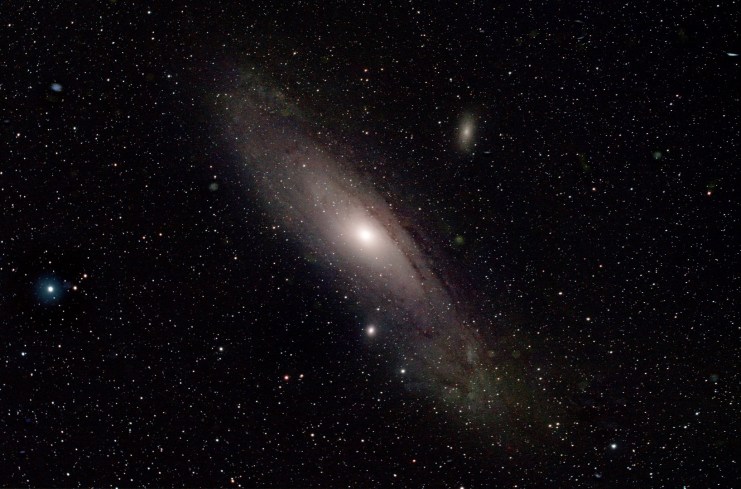
 

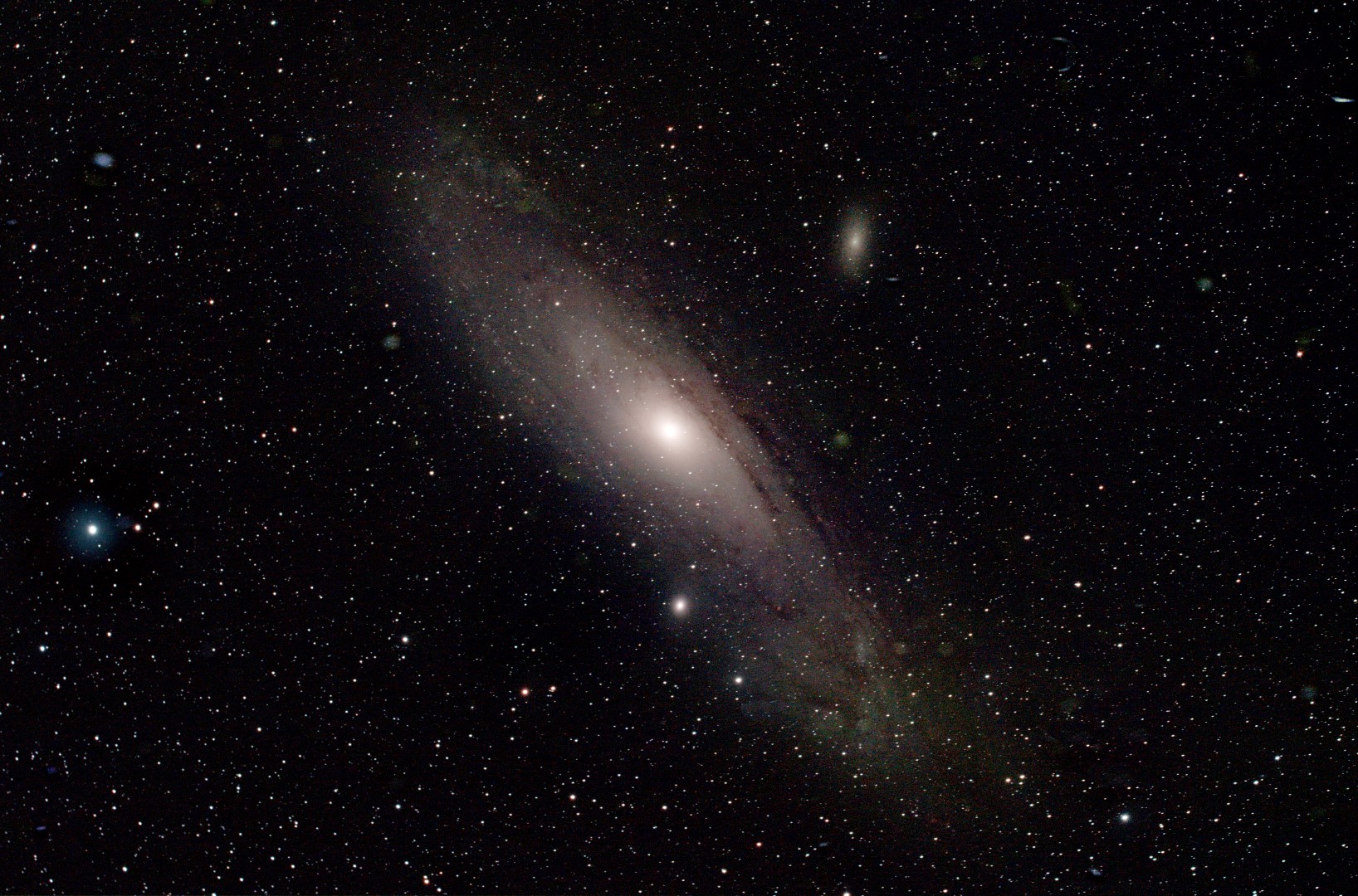
M31 Andromeda Galaxy WO GT 81 + modded Canon 550D + FF | 9 x 120 secs @ ISO 1,600 | 19th September 2015

M31 Andromeda Galaxy
WO GT 81 + modded Canon 550D + FF | 9 x 120 secs @ ISO 1,600 | 19th September 2015

 

??????????????

Goals for 2016

After the year that’s just finished I am reluctant to set out goals for 2016 but here goes:

  • Increase imaging exposure times: This is a euphemism for (a) improving equipment set-up and alignment, and (b) start autoguiding. As previously outlined, I have been struggling with both of these issues but one way or another I have to overcome the problems in order to obtain exposure times of at least 5-minutes and hopefully longer;
  • Improve processing: I was pleased to get to grips with Photoshop in 2015, albeit using a very old version, which together with other minor improvements to processing has added to the quality of the final images.  However, I know that even now there is more to be teased out of the existing imaging data for which I am already considering new software;
  • Start widefield imaging: First I just need clear skies in order to get out and start using the Vixen Polarie tracking mount from Fairvale Observatory, with the initial objective of imaging Barnard’s Loop, which has hitherto proved elusive to my current set-up.  However, one of the attractions of the Polarie-DSLR-Tripod combination is its portability, which I’d like to put to good use in 2016 by visiting dark sky areas in the UK.

There are other possible developments which at the moment seem unlikely to eventuate but you never know: a larger probably SCT telescope, a cooled CCD camera, and / or a permanent observatory (well I can dream can’t I?).


So all things considered 2015 was a good but not great year.  As a fundamental and important development I had really hoped to start autoguiding and thus increase exposure times but it was not to be.  Certainly the loss of astronomy time between April and September was a major set-back in many different ways.  Notwithstanding, during the remaining times available when I did manage to get outside I believe I achieved some of my best images to date and discovered many new and exciting objects in the night sky, which can’t be bad.  In particular, I am sure the lunar eclipse in September will remain a highlight of my astronomy experiences for many years to come.
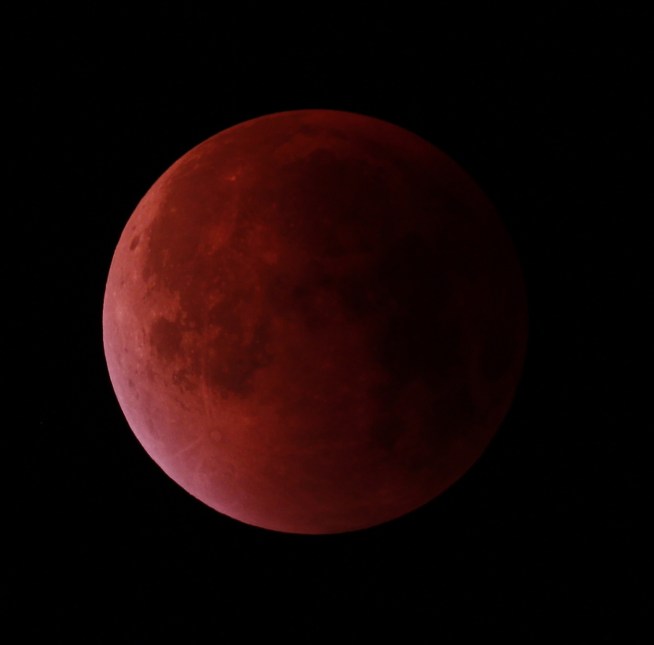
Harvest Moon at Totality WO + Canon 700D + FF | 1/3rd Sec @ ISO 400 | 28th September 2015

Harvest Moon at Totality
WO + Canon 700D + FF | 1/3rd Sec @ ISO 400 | 28th September 2015


I’m now looking forwards to 12-months of uninterrupted astronomy, clear skies and plenty to report in the WTSM blog at the end of 2016!

Watch this space!
Spaceship Earth

bbbb

I’m now into my second year of ‘serious’ astronomy and astrophotography, which accompanied by a greater knowledge of the Universe has brought an element of familiarity: with the equipment, with viewing & imaging techniques and space itself.  In the past I have worked underground as a geologist on mines and like to think that I have good spatial awareness.  Through this growing familiarity and knowledge of the night sky, I have become increasingly aware of our place in the Universe and how we on Earth are travelling through space; I also feel a growing empathy other peoples such as mariners who use and relate to the sky and space in a way ordinary people do not.

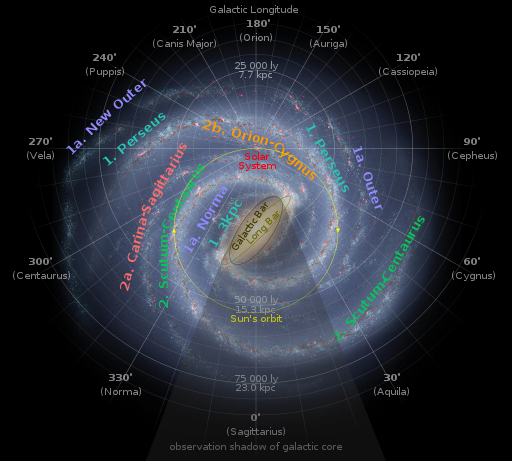
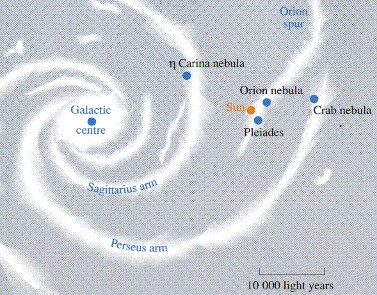
Whilst spinning on its axis at 1,037 mph at the equator (653 mph here at Fairvale Observatory’s higher latitude), the Earth is moving at about 70,000 mph round the Sun.  Furthermore, located in the Orion-Cygnus arm of the Milky Way, the Solar System is also moving around the spiral galaxy at 500,000 mph, resulting in a galactic year of nearly 250,000 Earth years .  Notwithstanding these complex and frankly mind boggling statistics, it thankfully all feels quite serene when outside at night with my telescope at Fairvale Observatory.

Milky_Way_Arms_ssc2008-10


Going back some 5,000 years the constellations might seem to describe the ‘shape’ of space and provide a sense of stability to the sky but this is misleading.  These and other asterisms are 2D patterns that mankind has created for practical use, whereas in reality most of the stars that make up these patterns bear little if any meaningful relationship with each other when viewed in 3D – like this animation showing the true shape of Orion.

spiralArms

Furthermore, under the force of gravity and other as yet unknown influences e.g. dark energy, these too are moving through space in their own way at vast speeds.  In reality the constellations are therefore anything but permanent and through the millennia their apparent shapes change and will eventually be destroyed as far as we on Earth are concerned.  As with my professional subject geology, this is the problem with space – it is very big and the timescales are very, very large, essentially beyond human comprehension, which result in otherwise unimaginable events; this animation wonderfully illustrates the scale and complexity of the known Universe.

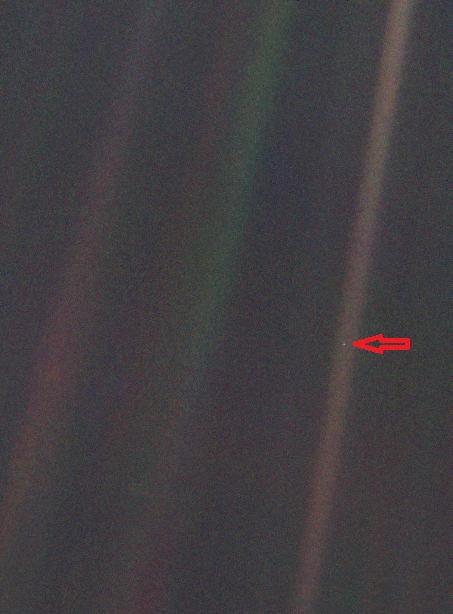
Space selfie - the insignificance of Earth. The Pale Blue Spot photograph of Earth (right side of picture) taken 6 billion kilometers (40.5 AU) away by Voyager-1 on February 14th 1990,

Space selfie = the insignificance of Earth.
The Pale Blue Spot photograph of Earth (right side of picture) taken 6 billion kilometers (40.5 AU) away by Voyager-1 on February 14th 1990,

The beauty of such a system is that it can be modelled very accurately, from which it is possible to predict with great certainty the projected position of all these celestial objects, thus making spaceflight and the prediction of astronomical events possible.  Likewise using the same data modelling it is possible to look backwards at past events.  Such computerisation is no longer just the preserve of NASA and University academics but is at our fingertips using a computer based planetarium, in my case Carte du Ciel – incredible!
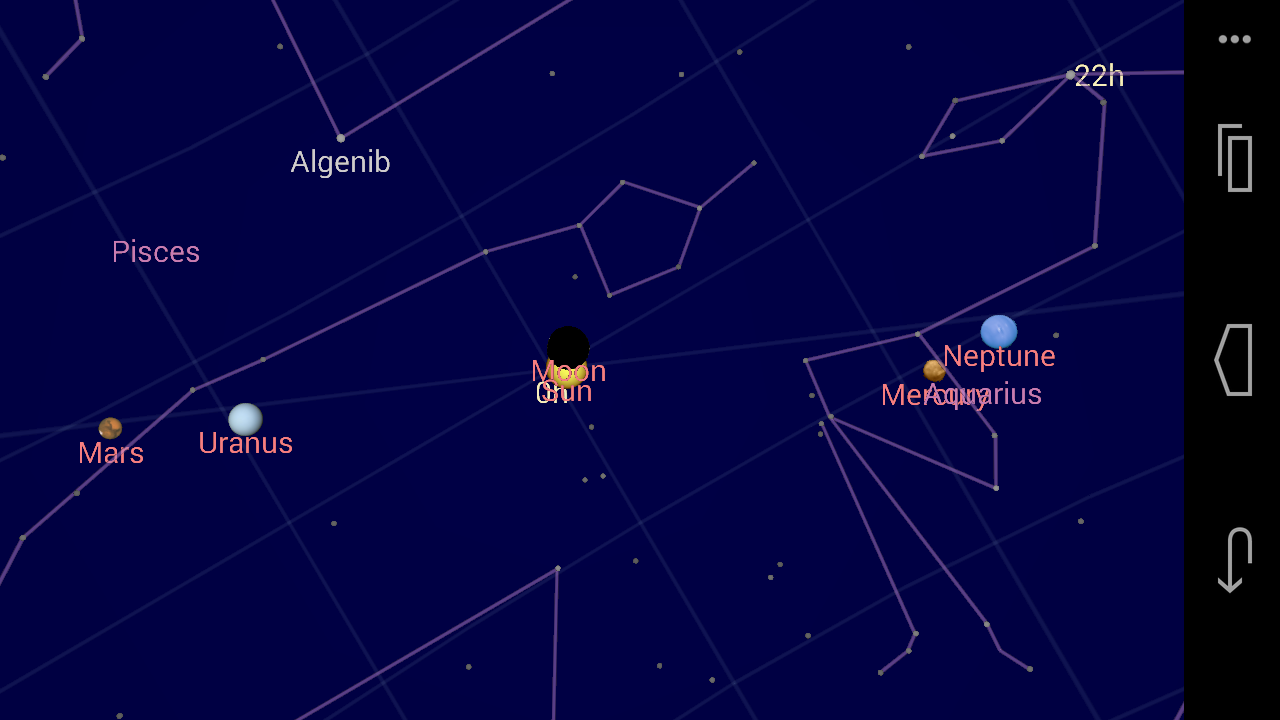
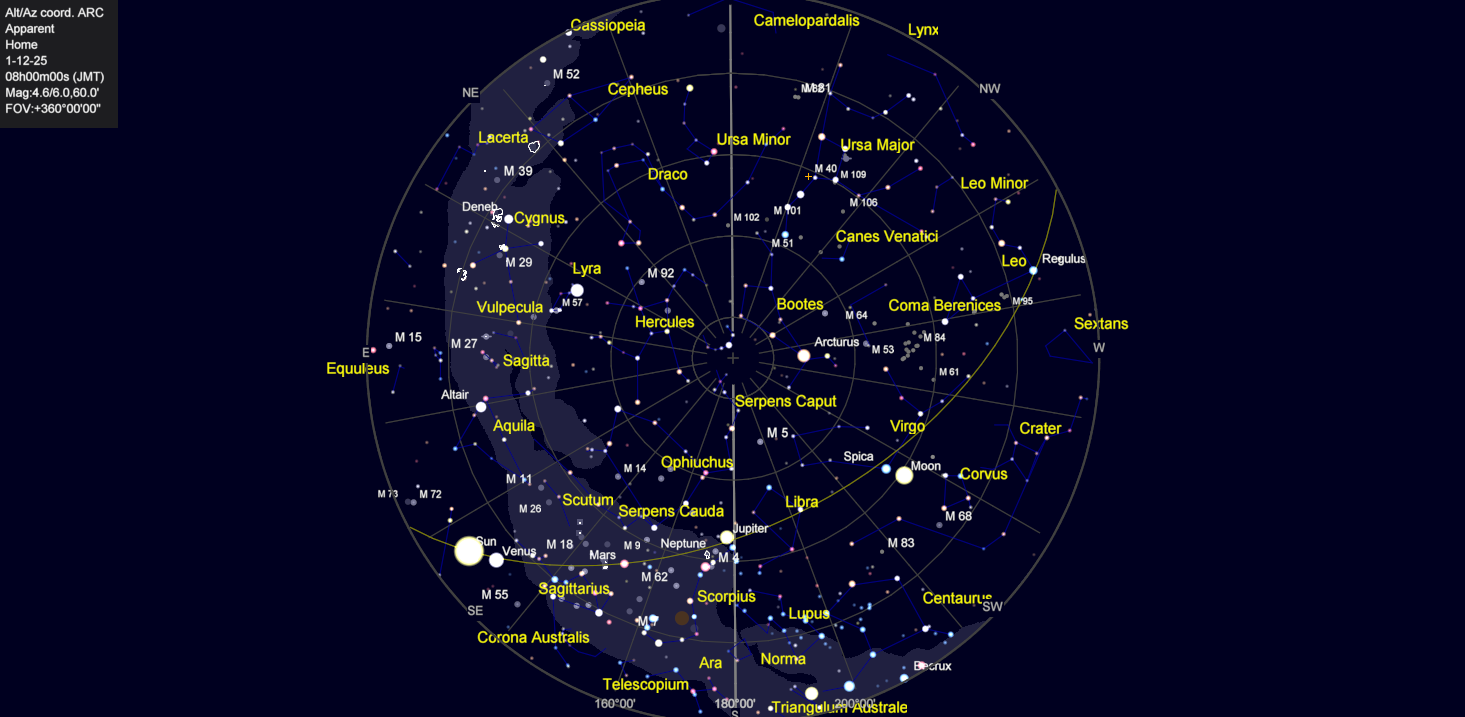
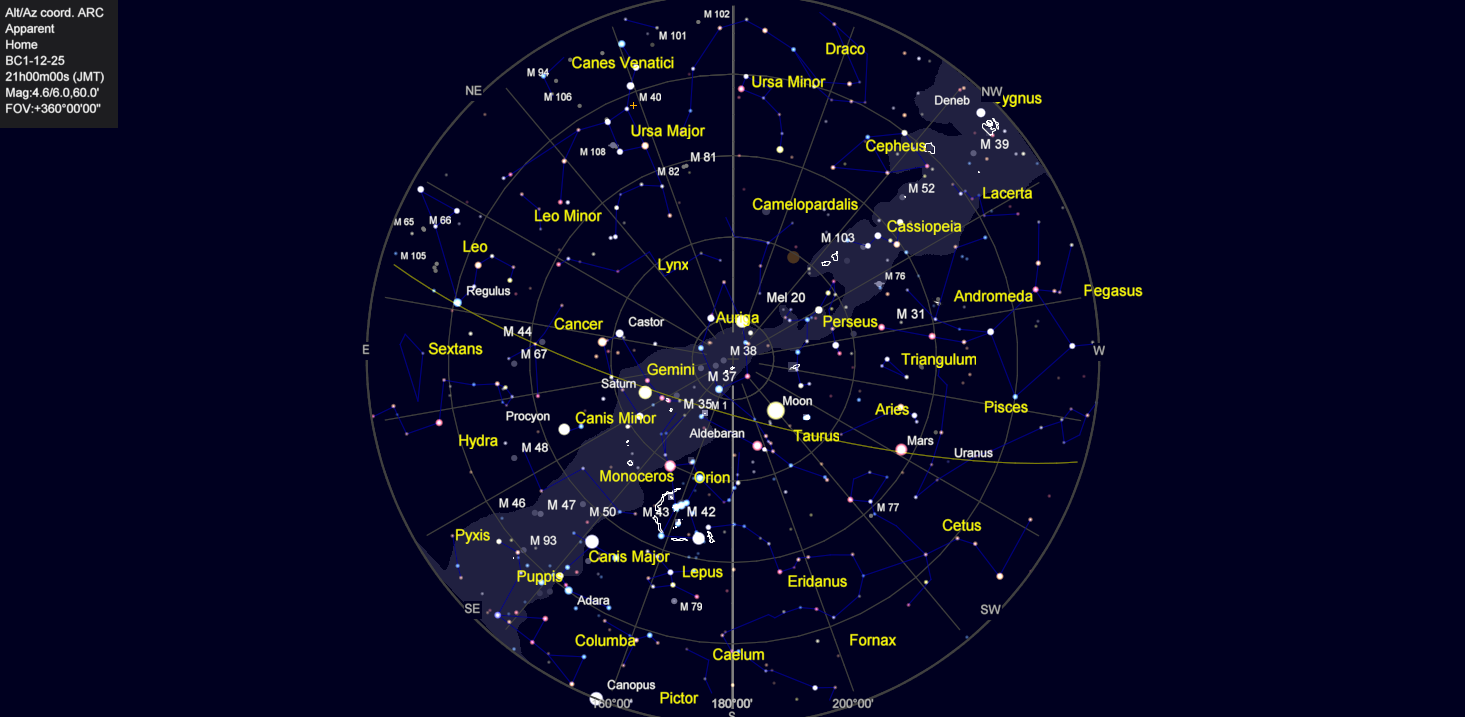
Given the time of year I have therefore used the aforesaid programme to generate a view of the night sky from Bethlehem 2015 years ago on the morning and evening of 25th December.  Even then differences can be seen in the shape of the constellations compared to now.  If we are to believe the story of the Three Wise Men following a bight ‘star’ at this time, it seems it would be most likely to be in the morning when first Jupiter and then Venus are present.  Either way it’s fascinating to be able to model the night sky in this way for any chosen moment in time.

xmas.cdc5


xmas.cdc3


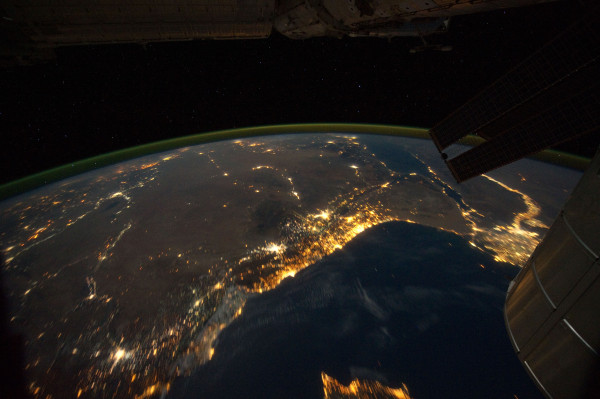
Santa's view of Bethlehem - actually from the ISS on 24th December 2011

Santa’s view of Bethlehem from the ISS on 24th December 2011

After weeks of cloud cover I recently managed to get outside again for what turned out to be a wonderfully clear night, from dawn to dusk, furthermore there was no Moon!  As a result imaging was productive and included some exciting new objects.  However, again given the time of year for the moment I am repeating an object used last Christmas.  One year on the difference is that this time I have used a  modded Canon 550D DSLR camera and thus improved (I think) the red Ha-light detail.
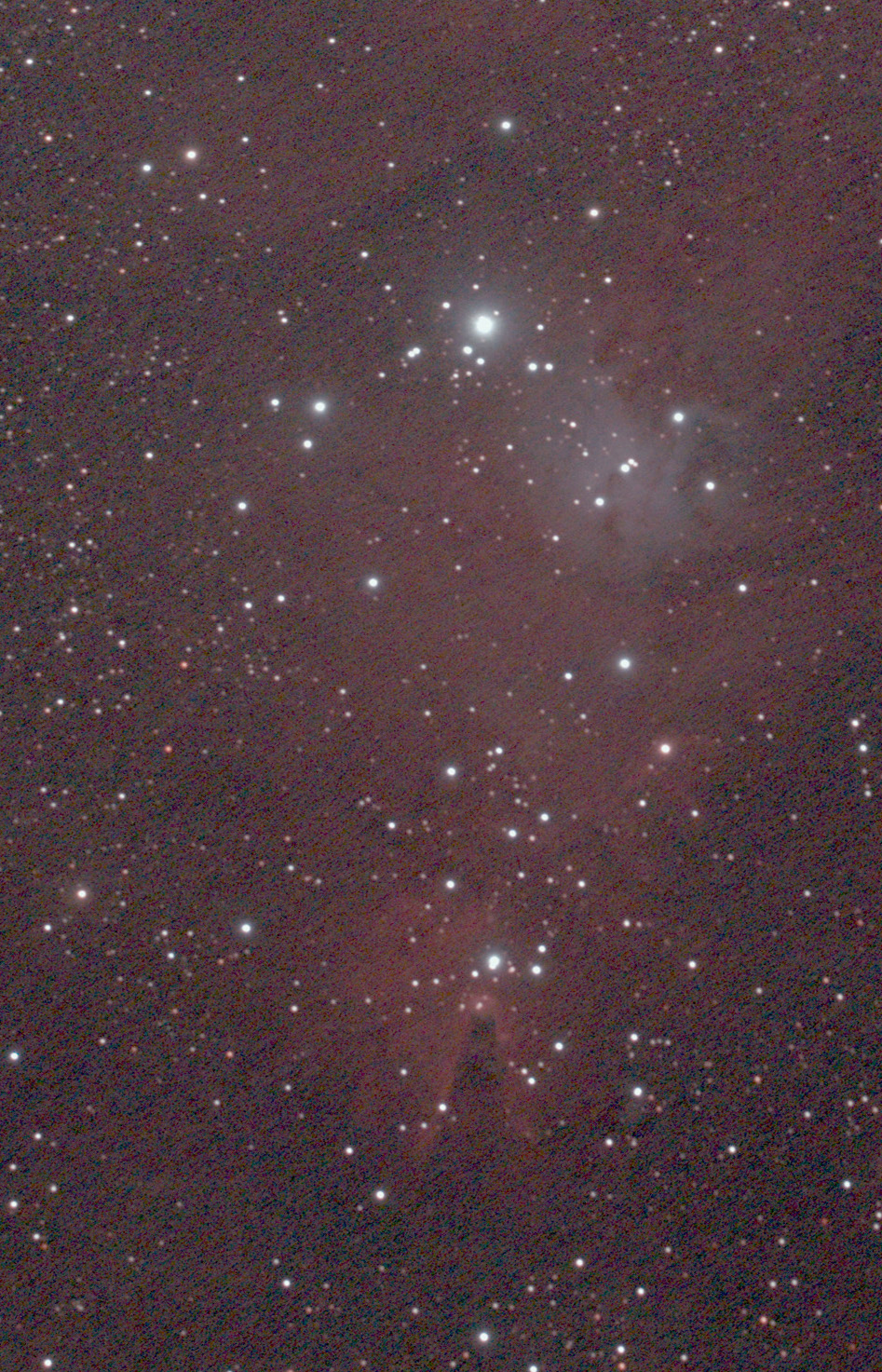
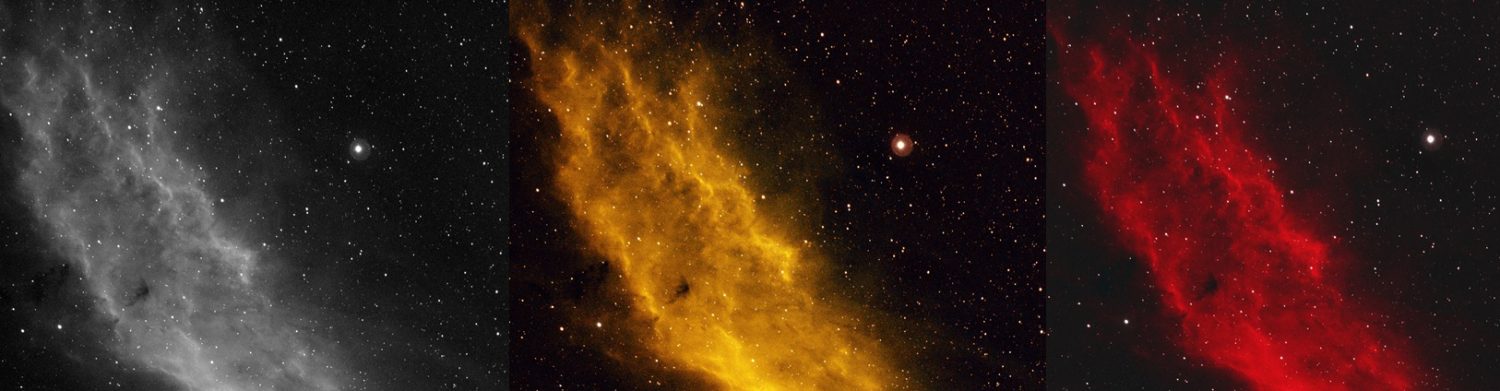
Cone Nebula & Christmas Tree Cluster WO GT81 + Modded Canon 550D & FF | 15 sec @ ISO 1,600 + calibration | 8th December 2015

Cone Nebula & Christmas Tree Cluster – right of centre
WO GT81 + Modded Canon 550D & FF | 15 sec @ ISO 1,600 + calibration | 8th December 2015


Cone Nebula (bottom centre) & Christmas Tree Cluster (inverted)

Cone Nebula (bottom centre) & Christmas Tree Cluster (inverted)

NGC 2264 or Christmas Tree cluster and its neighbour the Cone Nebula are located within the Monoceros AKA Unicorn constellation, which being part of the Milky Way are therefore inextricably linked to a similar destiny as spaceship Earth as it makes its way through space.  Being some 2,700 light-years away we are unlikely to meet, though you never know with space and time!

HAPPY CHRISTMAS

HAPPY CHRISTMAS


By Jove

As a visual and photographic spectacle, in my opinion Jupiter comes a close second to Saturn among the planets.  The so-called ‘King of the Planets’, Jupiter is more than twice as massive as all the others combined. Notwithstanding its size, Jupiter has the shortest ‘day’ of any planet, rotating fully in just 9-hours and 50 minutes – as a result creating a significant equatorial bulge that measures 88,760 miles in diameter and 83,082 miles from pole-to-pole.  However, as a gas giant the planet does not rotate en masse, with the outer regions moving slower than the equatorial region leading to a series of distinctive belts and zones, most notable of which is the Great Red Spot – a massive storm on the edge of the South Equatorial Belt.

Partly because of its vast size and resulting gravitational field, Jupiter is thought to have played a dominant role in shaping the present Solar System.  The planet we see today is not alone, with 67 moons so far identified, the four largest discovered by Galileo 400 years ago being easily visible from Earth.  In order of distance from Jupiter the moons of Io, Europa, Ganymede and Callisto are extremely diverse in nature – ranging from the highly volcanic Io to the frozen world of Europa, whilst Ganymede and Callisto may have sub-surface oceans and are bigger than the planet Mercury.


Despite being by far the largest planet in the Solar System and the fourth brightest object after the Sun, Moon and Venus, my attempts to image Jupiter and its Jovian neighbours have so far met with only mixed success.

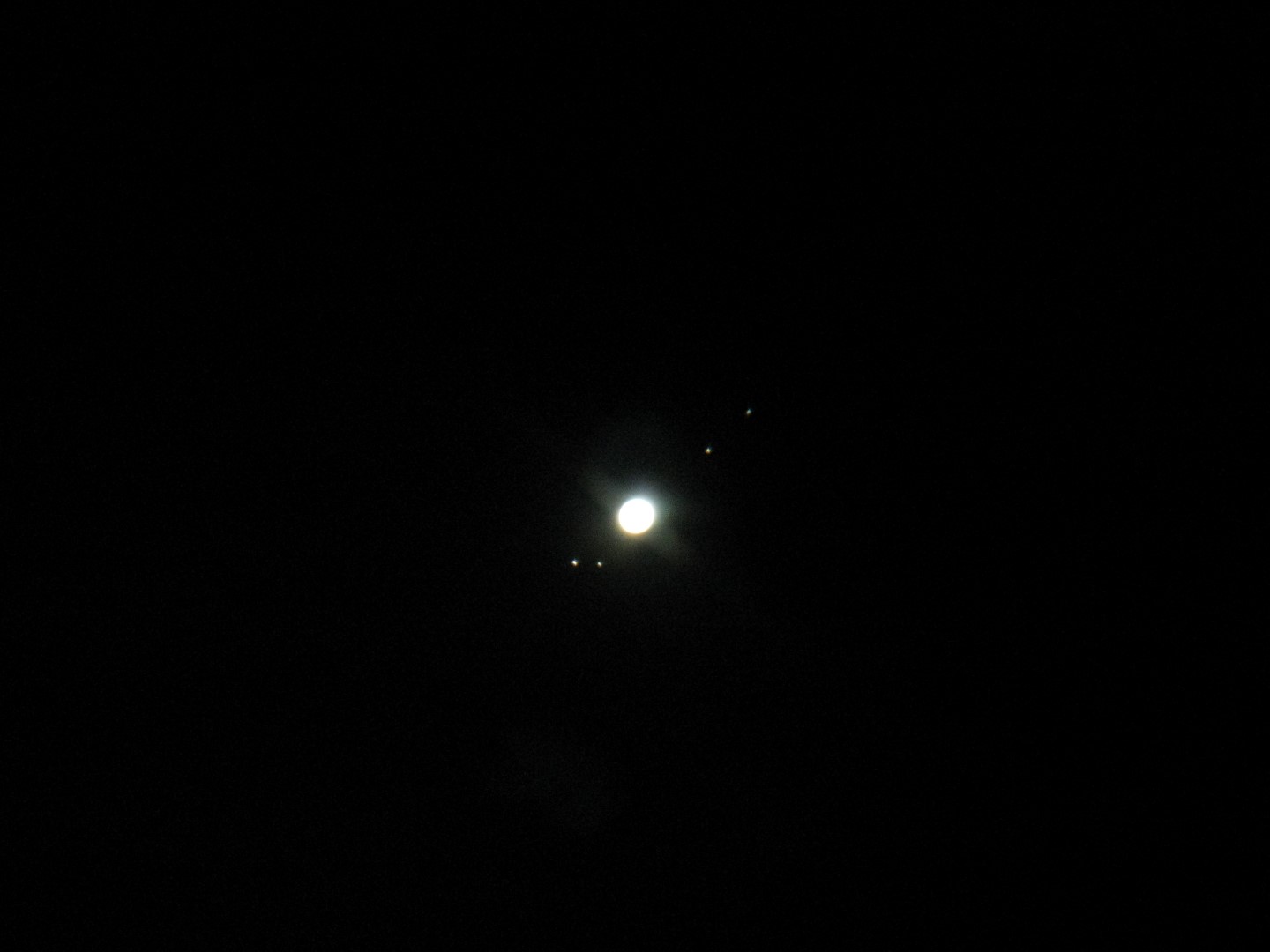
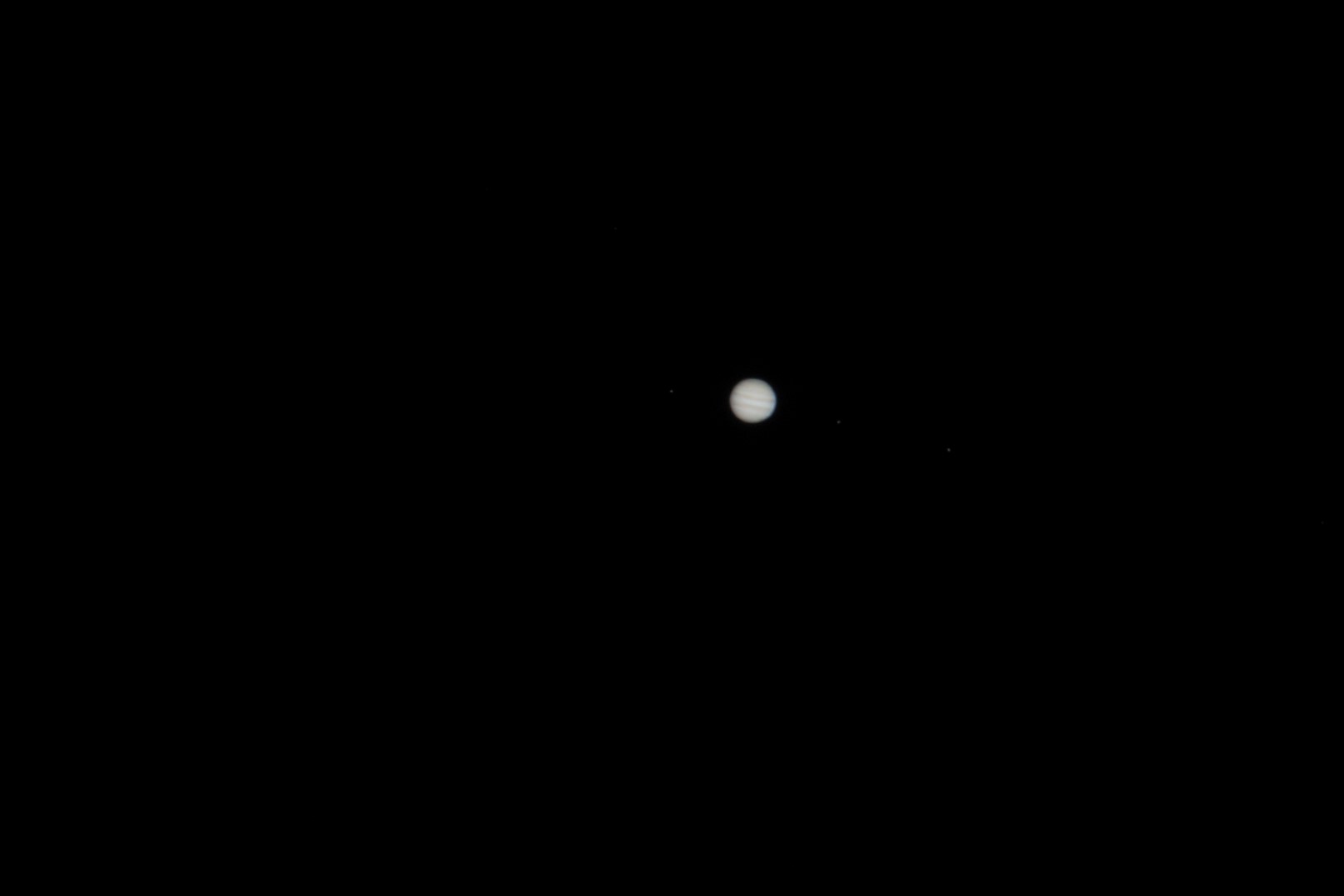
Most people’s first view of Jupiter is likely to be through binoculars or a basic telescope, which will   show the very bright planet accompanied by a number of its Gallilean moons, depending on their orbital position i.e. when located behind the planet they will, of course, not be visible.  Having viewed Jupiter a few times like this, my first attempt to image the planet and its moons was just such a view simply using the William Optics 81mm refractor, a x2 Barlow and my Canon 700D DSLR.  Compared to Jupiter the moons are not as bright and to capture their presence it is necessary to boost either the ISO or exposure time, which then overexposes the bright planet resulting in loss of detail – in this case the distinctive coloured gas bands. Conversely, with a lower ISO or exposure this detail once again becomes apparent but some or all of the moons are then lost in the image.  The way round is to combine two sets of images taken at different camera settings, thus obtaining the best of both worlds, literally.  For the moment however this remains work in progress.

Jupiter  - overexposed but  shows all four Gallilean moons.

January 2014, Jupiter – overexposed but shows all four Gallilean moons | 1 sec @ ISO 400


upiter - lower exposure shows the gas belts but the moons, though there, are now very difficult to see.  1/3rd sec @ ISO 800

Jupiter – lower exposure shows the gas belts but the moons, though there, are now very difficult to see. 1/3rd sec @ ISO 800

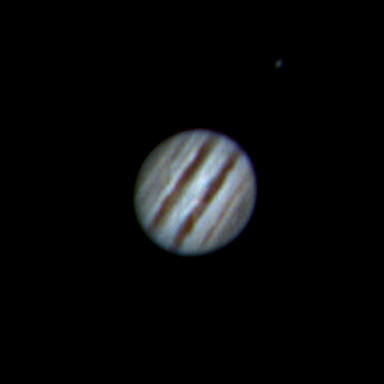
Personally I like the wider view of Jupiter and its moons but inevitably the holy grail has to be a close-up image showing details of the planet’s characteristic gas belts, which requires the use of a CCD video, in my case a ZWO ASI 120MC camera.  Having mostly concentrated on DSO photography to-date using a DSLR, my use of the ZWO camera is limited and with mixed success.  Using this camera and the Skywatcher 150PL reflector telescope I have previously managed images of Saturn, Mars and the Moon but this time I used the William Optics refractor instead.

CCD imaging is a very different technique to DSLR and it’s fair to say that I still have much to learn. Notwithstanding, using Registax for processing I obtained some reasonable first-time Jupiter images but will need more practice to improve the detail; the quality might also be improved using WinJUPOS software during processing, which applies a de-rotational programme to the fast moving planet thus reducing blur – however, I have yet to understand let alone master this software.  Also, whilst the quality of the William Optics telescope is far superior to the Skywatcher 150PL, it is obvious that its relatively short focal length is not really adequate for good planetary imaging.

21st February 2015. Jupiter up close WO 81GT81 | ZWO 120 MC

21st February 2015. Jupiter up close
WO 81GT81 | ZWO 120 MC

So far this year Jupiter had already provided a number of different opportunities for imaging.  Between February and April the planet moved across the southern sky in all its glory, whilst more recently it moved into close conjunction with Venus at the end of June and there’s more to come.

On 26th August from our vantage point on the Earth, Jupiter will appear very close to the Sun in the sky as it passes around the far side of the solar system from the Earth.  At closest approach, Jupiter and the Sun will appear at a separation of only 0°52′, making Jupiter totally unobservable for several weeks while it is lost in the Sun’s glare.  At around the same time, Jupiter will also be at its most distant from the Earth – receding to a distance of 6.40 AU – since the two planets will lie on opposite sides of the solar system.  Over following weeks and months, Jupiter will re-emerge to the west of the Sun, gradually becoming visible for ever-longer periods in the pre-dawn sky. After around six months, it will reach opposition, when it will be visible for virtually the whole night, by which time I have hopefully mastered some new techniques for imaging this Jovian King of the Planets.

Alternative Eclipse

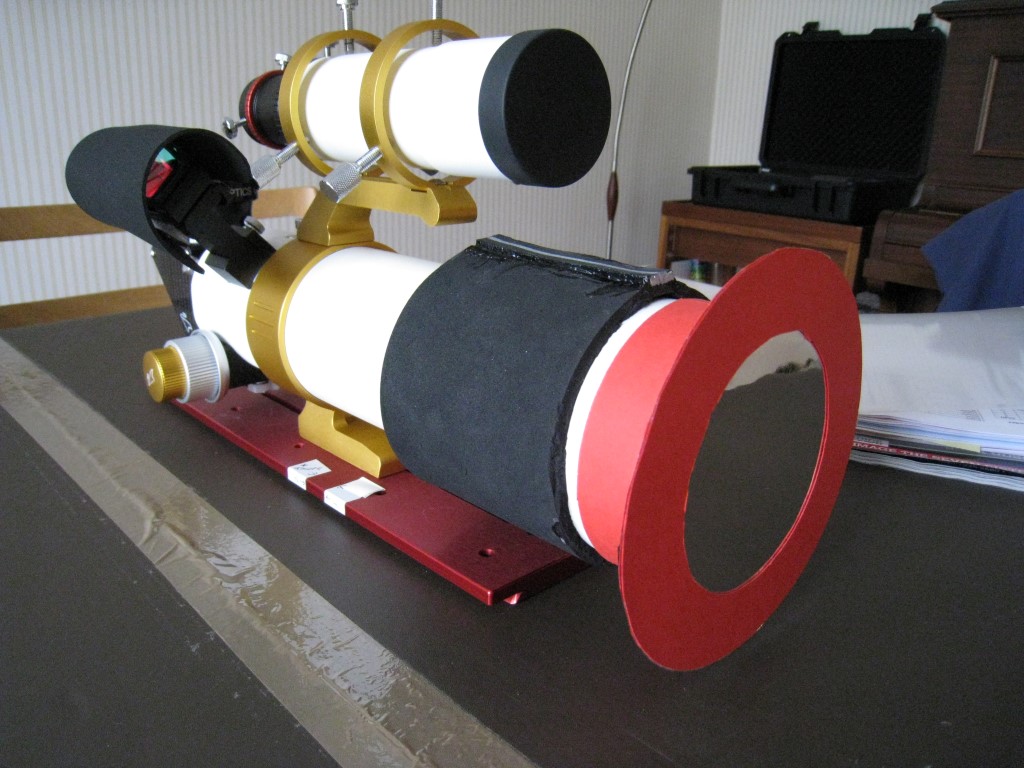
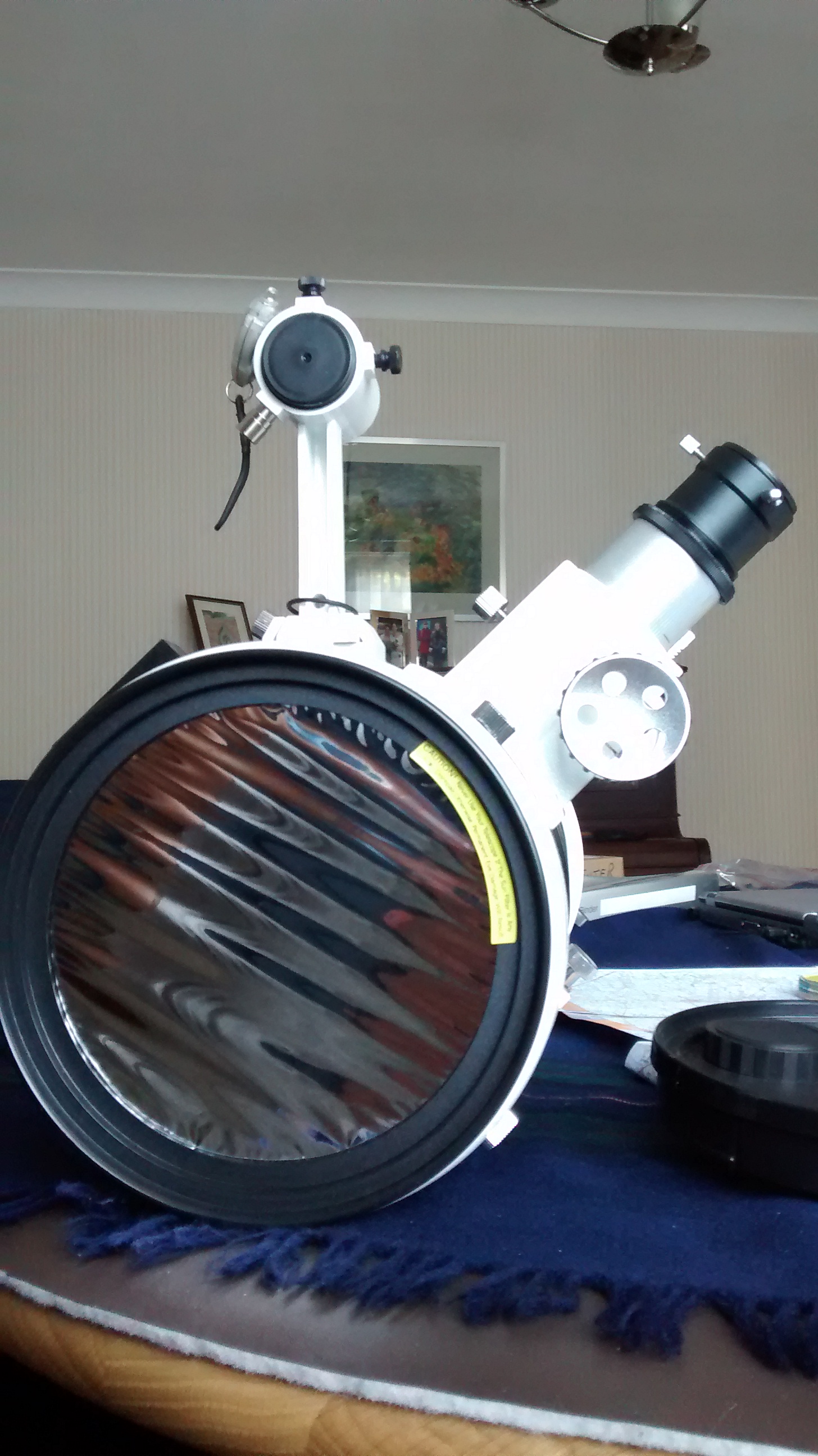
With astronomy preparation is everything and so with the prospect of a solar eclipse here today I have been getting ready during the past week.  I looked at and imaged the Sun using my Skywatcher 150PL and a bespoke solar filter last year.  Whilst I was pleased with the results, such is the field-of-view of the 150PL that the resulting image only covers sections of the Sun and a full picture needs to be created using a mosaic; the upside of this is high magnification and therefore better detail of the Sun’s surface.  With the prospect of an eclipse I wanted to try and image the entire spectacle this time and therefore constructed a new solar filter to fit my William Optics GT81 refractor telescope, which has a wider field-of-view and all together better optics that would comfortably image the entire Sun.

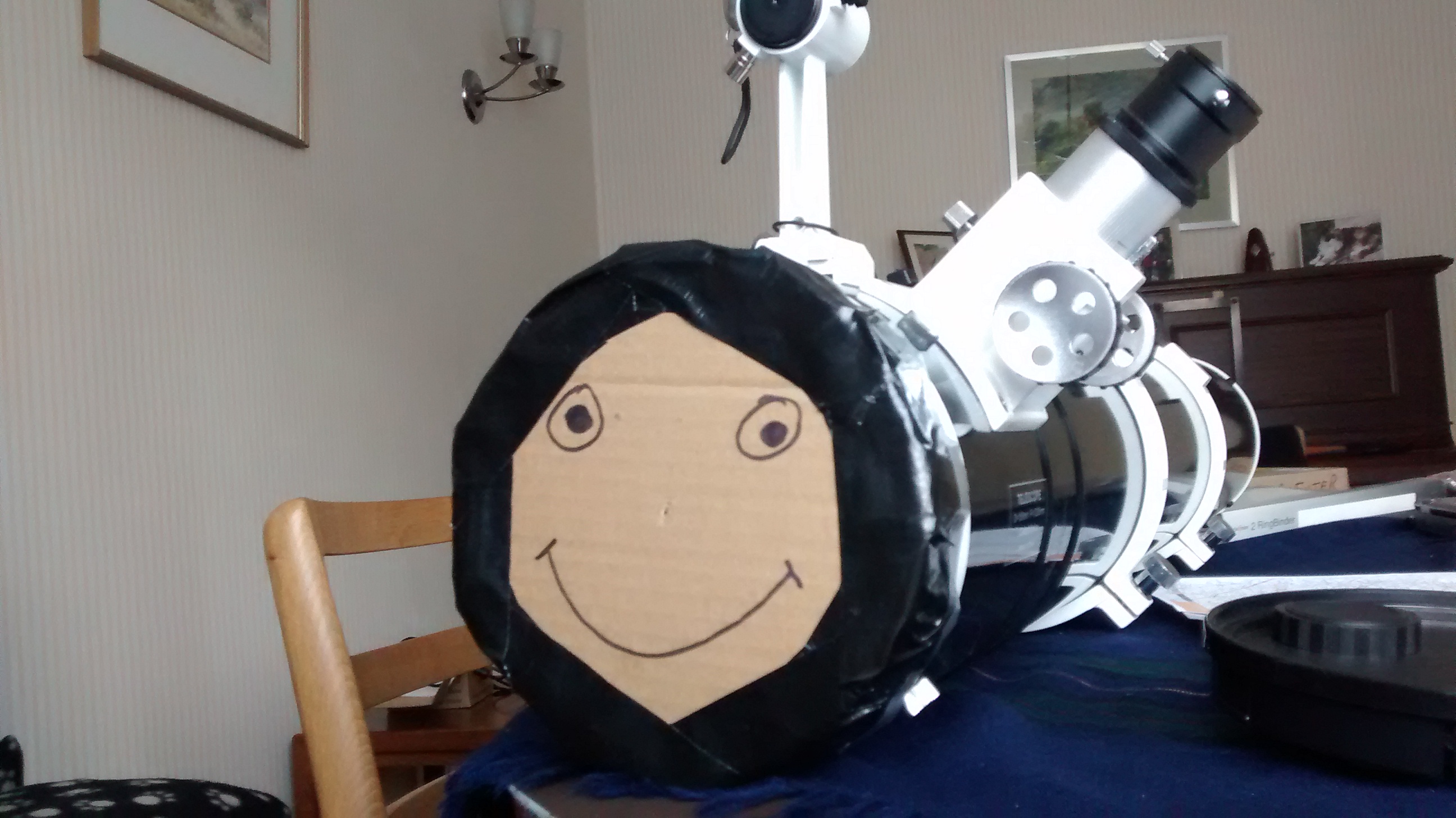
Using Baader AstroSolar ND 5.00 safety film and some cardboard, I constructed a tube which fits exactly over the end of the telescope, with the film across the front but not stretched.  By restricting wavelengths the film removes about 99% of the Sun’s light and allows safe viewing but is very difficult to work with and must be treated carefully to ensure it is not damaged; birds can be attracted to the film’s silver finish and may peck holes in it when fitted, it is therefore important to be aware of such threats and, in my case, I also constructed a cardboard slip to cover the filter when the telescope is left unattended during use.  It is also very important to either block off or remove the guidescope and / or finder from the telescope, which without a filter could otherwise also focus on the Sun and either burn out or even worse, cause personal injury.

Home-made solar filter on the William Optics GT81.  When used I blocked-off the red dot finder and removed the finder scope in order to attach another home-made Sun finder.

Home-made solar filter on the William Optics GT81. When used I blocked-off the red dot finder and removed the finder scope in order to attach another home-made Sun finder.

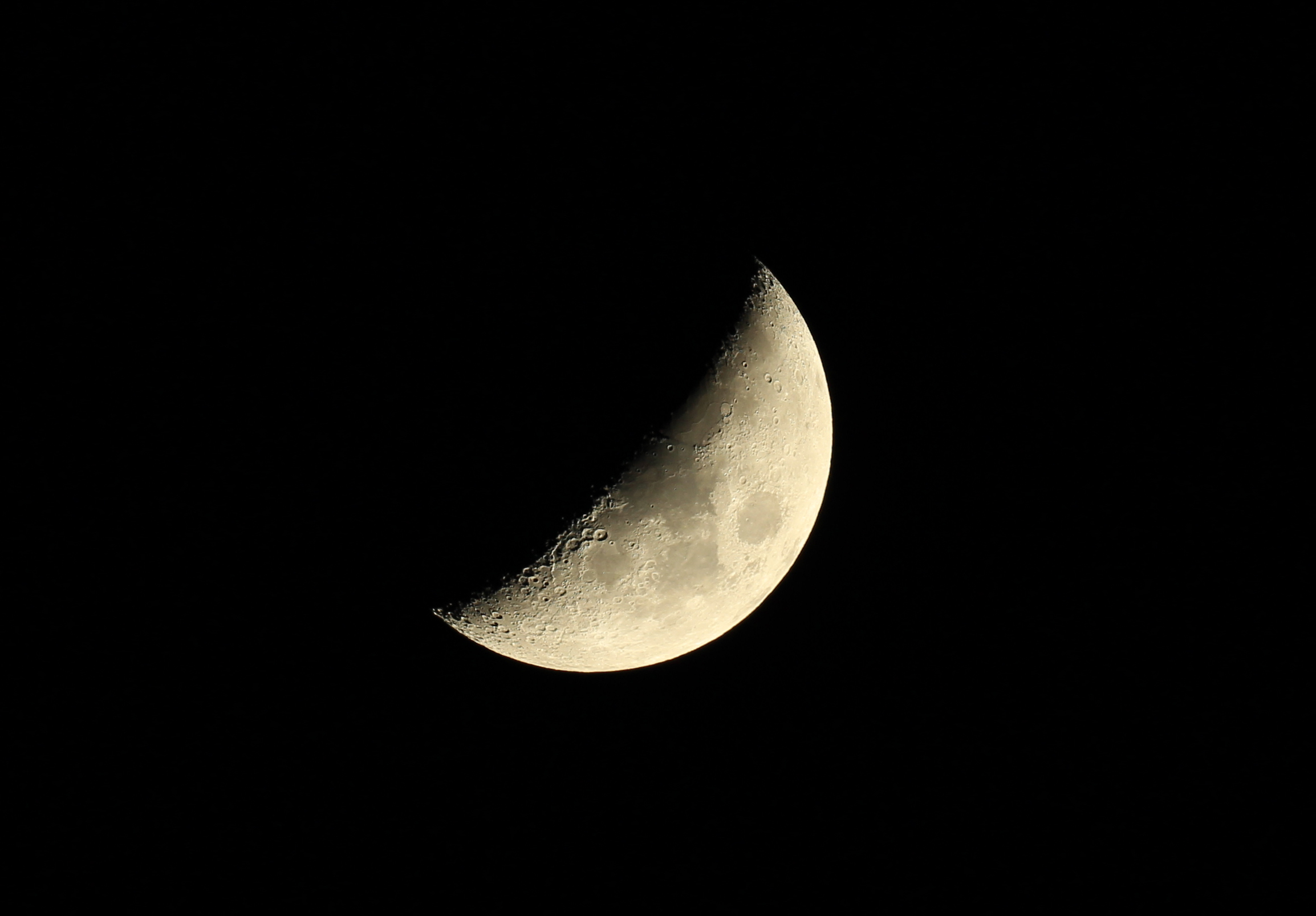
The Players: having constructed the filter and with a clear sky on Wednesday I therefore tried it out and furthermore experimented with exposure settings, with good results.  Earlier in the month I had captured an excellent image of the quarter Moon too.  So I was ready to go, right?  Wrong!

The Moon @ First Quarter  | WO GT81 & Canon 700D + FF| 1/100th sec @ ISO 100 | 24th February 2015

The Moon @ First Quarter | WO GT81 & Canon 700D + FF| 1/100th sec @ ISO 100 | 24th February 2015

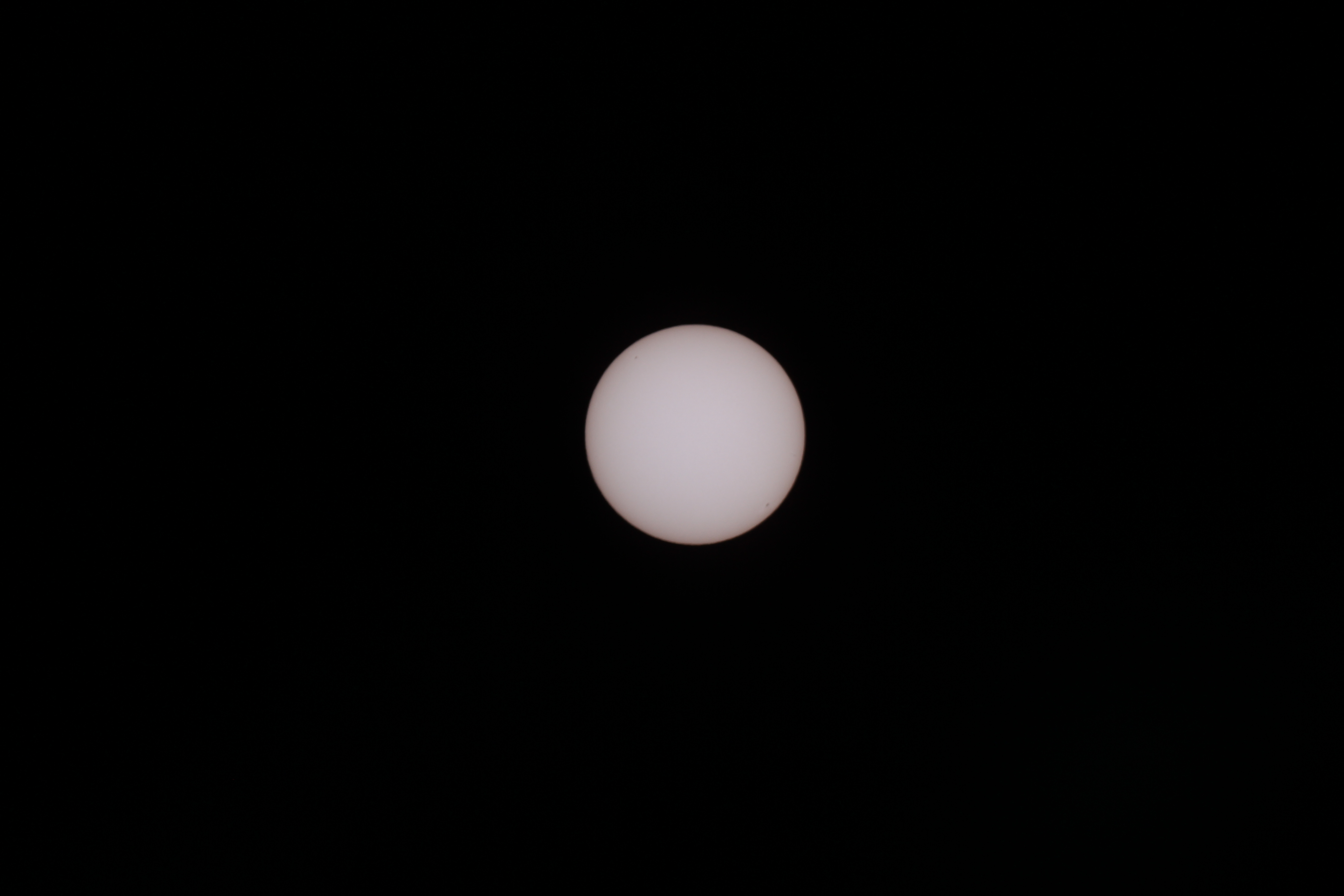
GT81 + Canon 700D & Baader ND 5.00 Solar Filter 1/500th sec @ ISO 100 | 18th March 2015

GT81 + Canon 700D & Baader ND 5.00 Solar Filter
1/500th sec @ ISO 100 | 18th March 2015

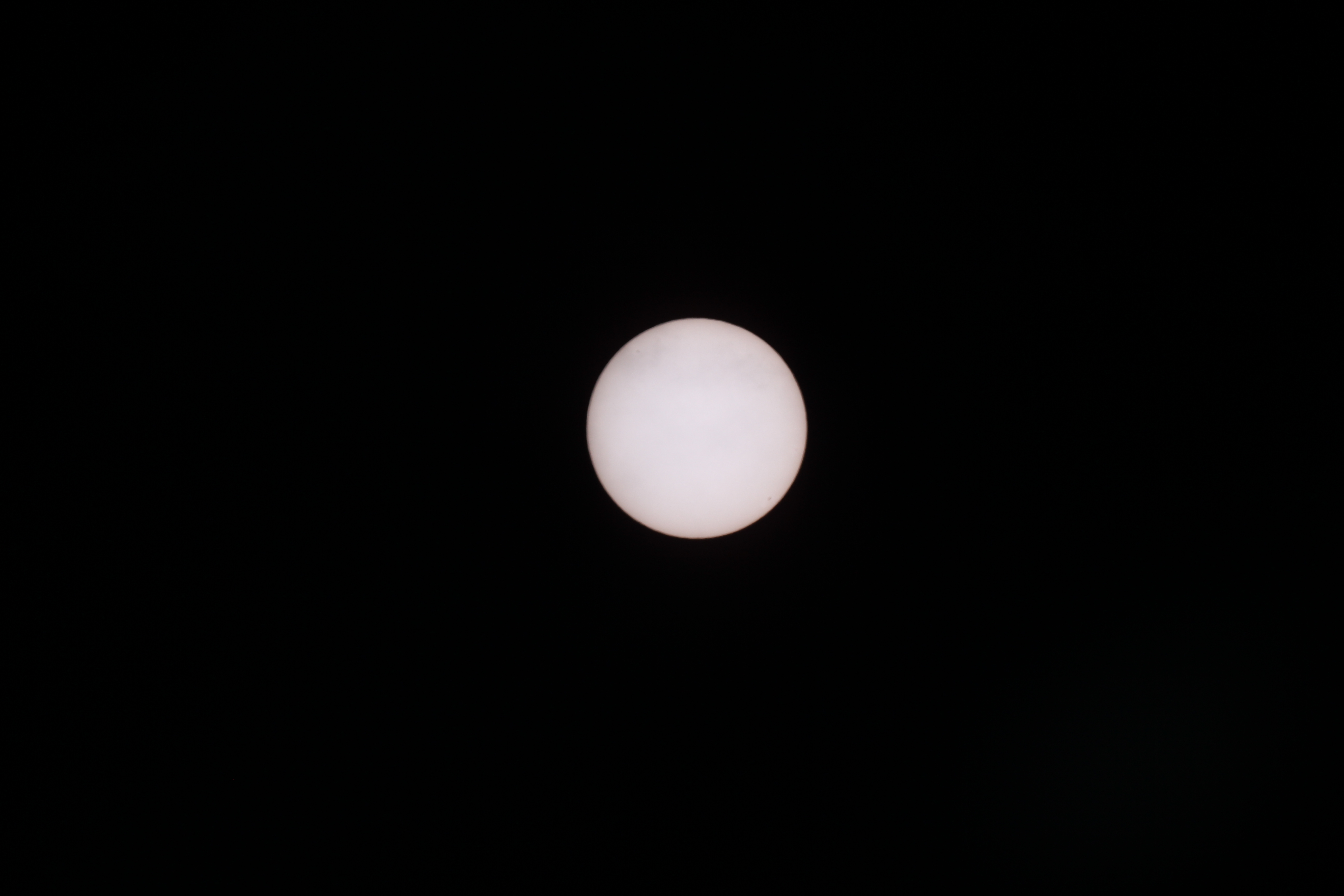
The Sun 1/20th Sec @ ISO 100 | 18th March 2015

The Sun
1/250th Sec @ ISO 100 | 18th March 2015

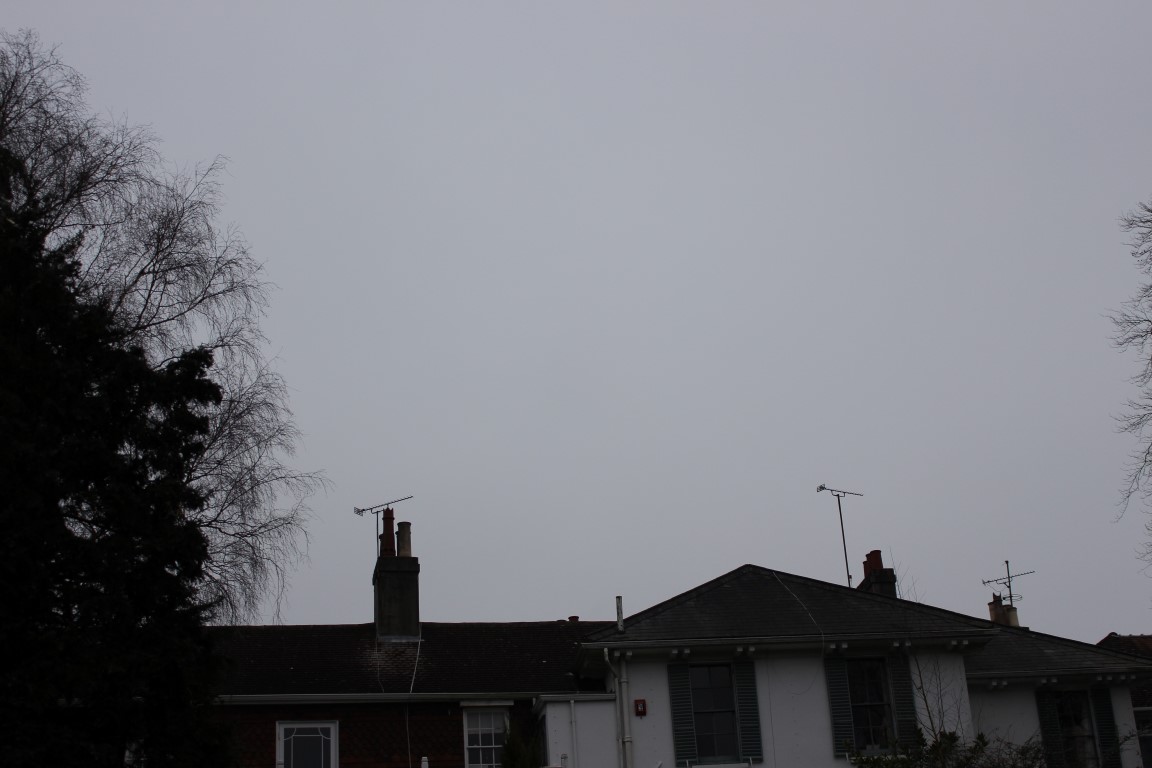
Despite my best planning it was cloudy here at Fairvale Observatory this morning, something that has been proving a major obstacle to any astronomy all this month.  Notwithstanding, I have instead experienced an ‘alternative eclipse’.

First, I recorded the change in light during the eclipse.  Though ‘only’ an 85% eclipse here the deterioration in light was very noticeable as well as other features: it got colder and the birds became quieter.

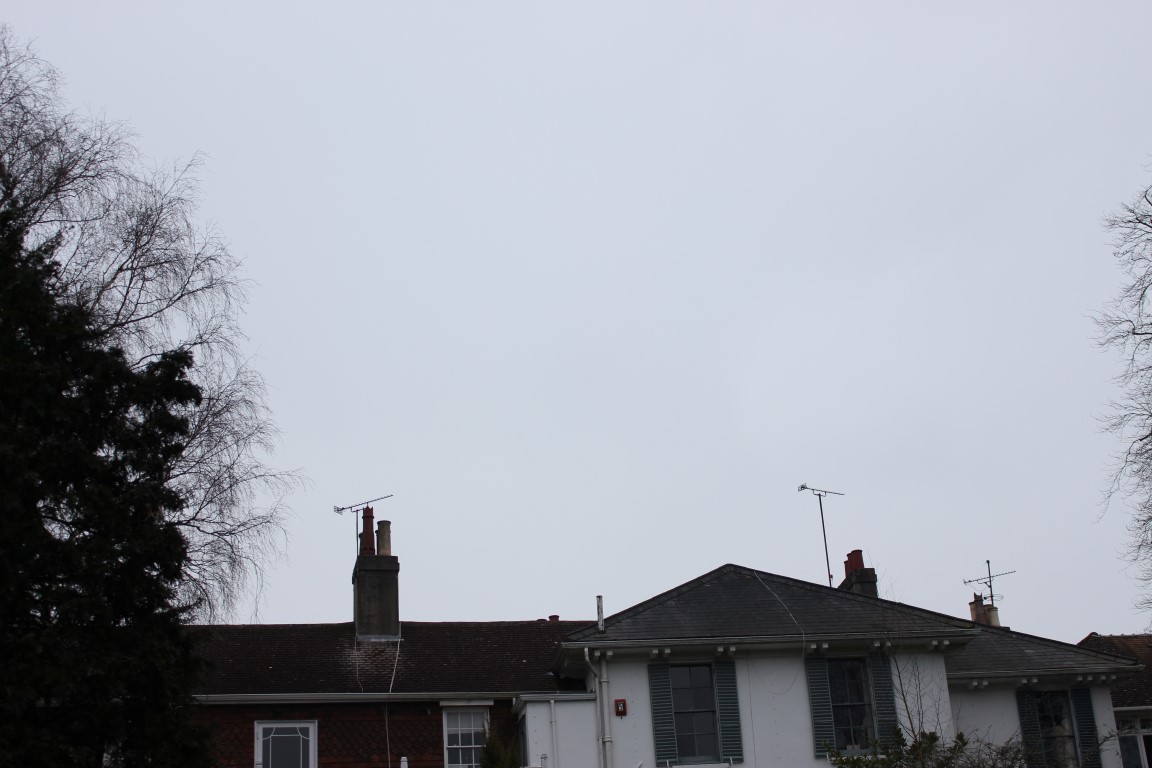
20th March 2015 Eclipse - the sky just after contact at 9.50 a.m.

20th March 2015 Eclipse – the sky at 9.50 a.m. sky just after contact.

Contact + 15 minutes

Contact + 15 minutes

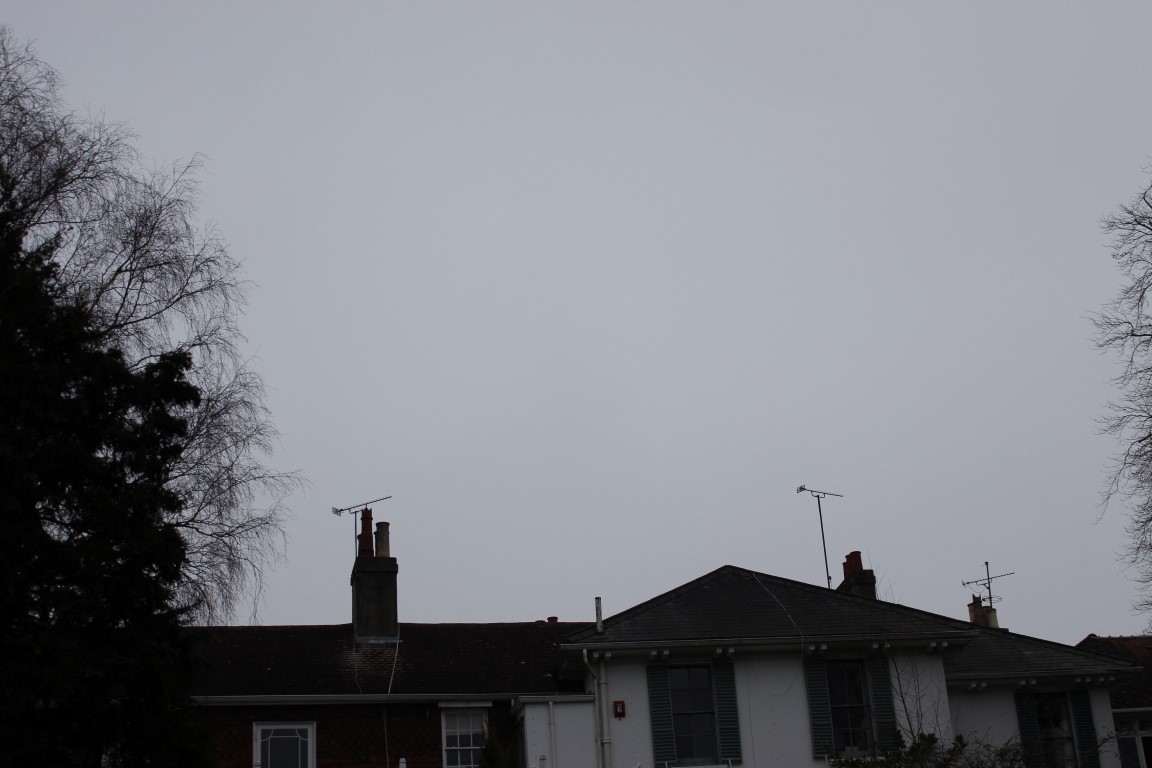
At maximum 85% eclipse.

At maximum 85% eclipse, 9.30 a.m.

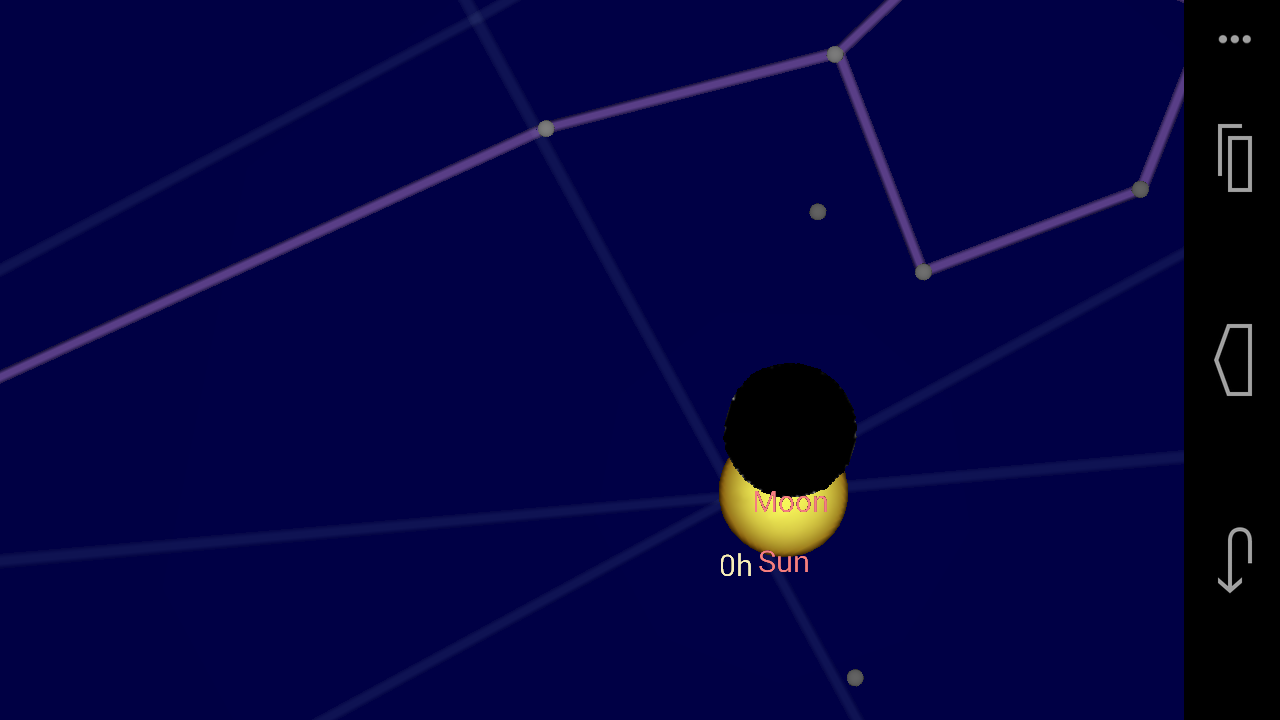
Next I ‘looked’ at the progress of the eclipse using Google Sky, which seemed to be very accurate.  It was fascinating to note that four other planets were lined up alongside the Sun at the same time, though of course would not be visible in the daytime sky even if it had been clear.

Eclipse as 'seen' by Google Sky

Eclipse as ‘seen’ by Google Sky

Google Sky screenshot.

Google Sky screenshot.

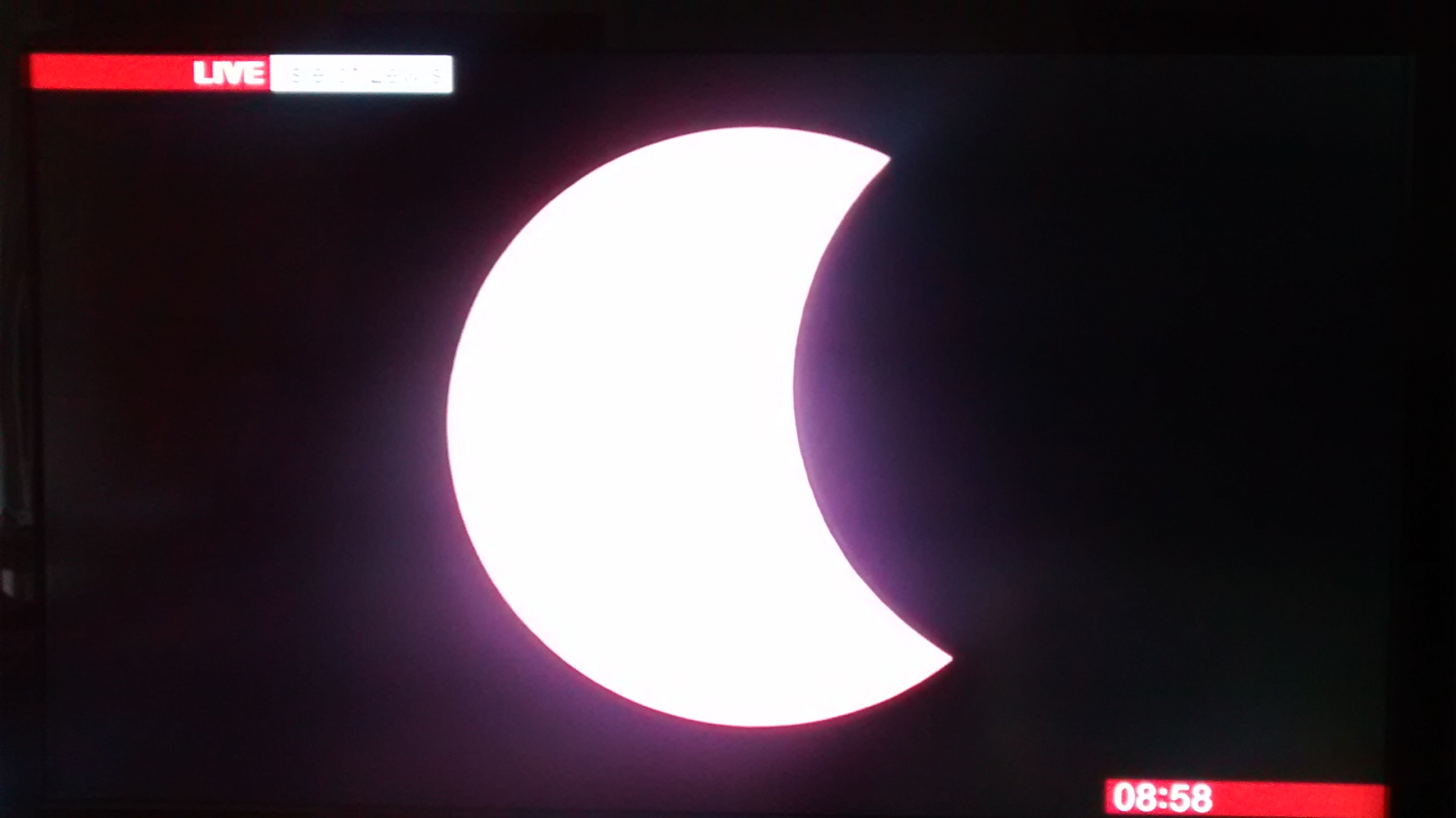
In between my own real time experience, I watched the BBC coverage of the event which provided some excellent images from the UK and especially from the air off the Faroe Islands where totality occurred.

Uk eclipse courtesy if the BBC.

UK eclipse courtesy if the BBC.

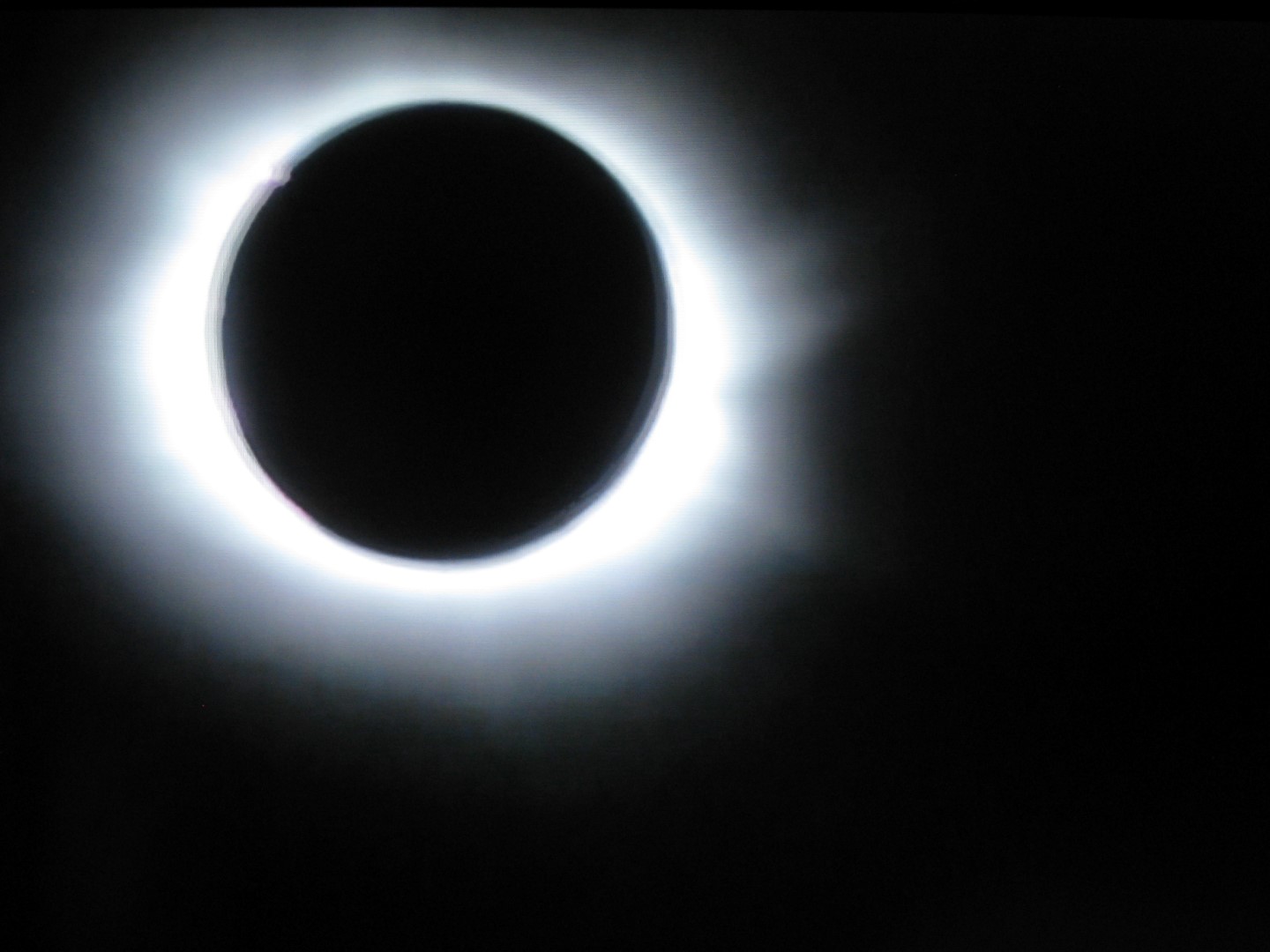
Eclipse totality at 28,000 ft from the Faroe Islands.

Eclipse totality at 28,000 ft from the Faroe Islands.

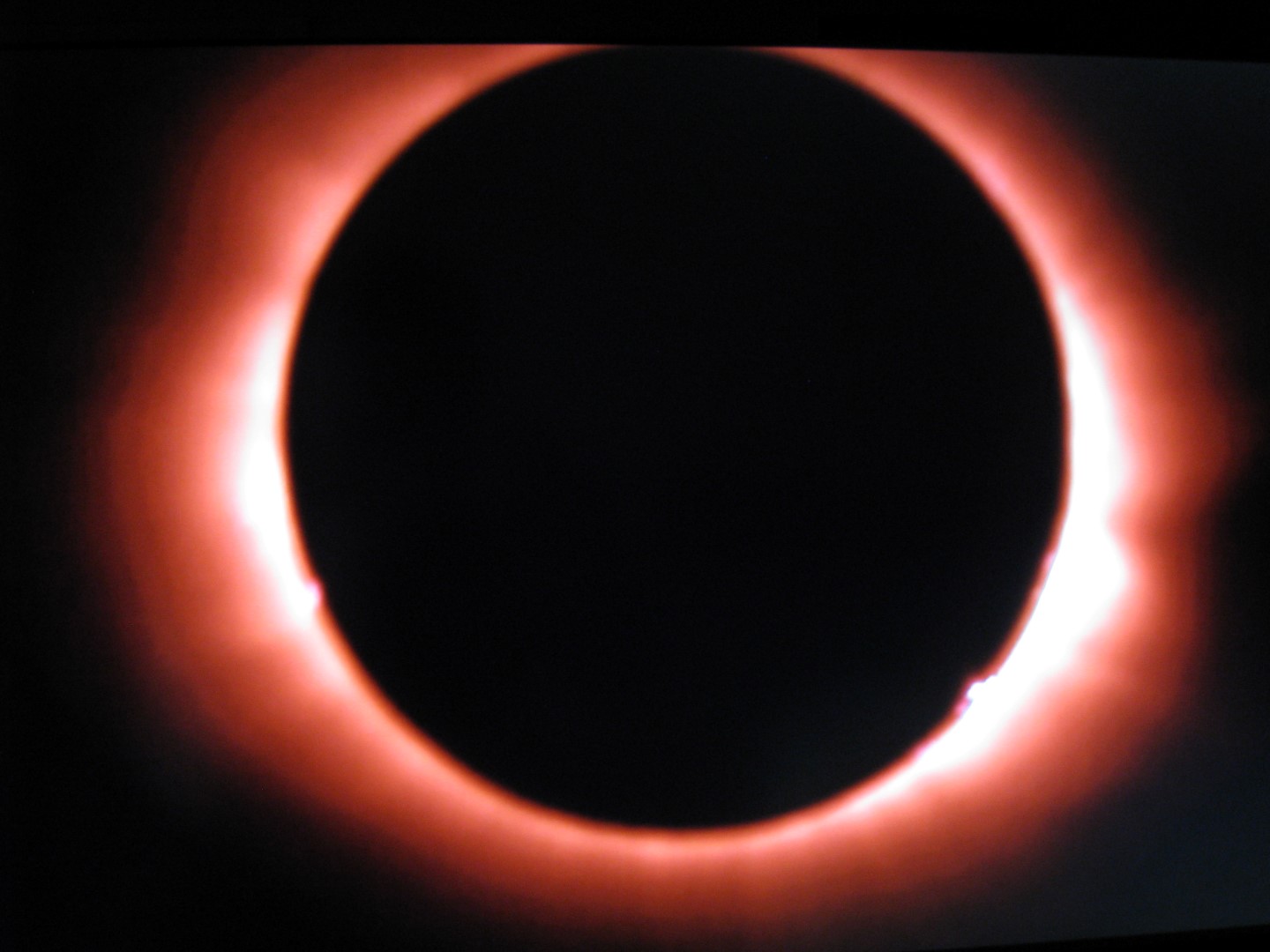
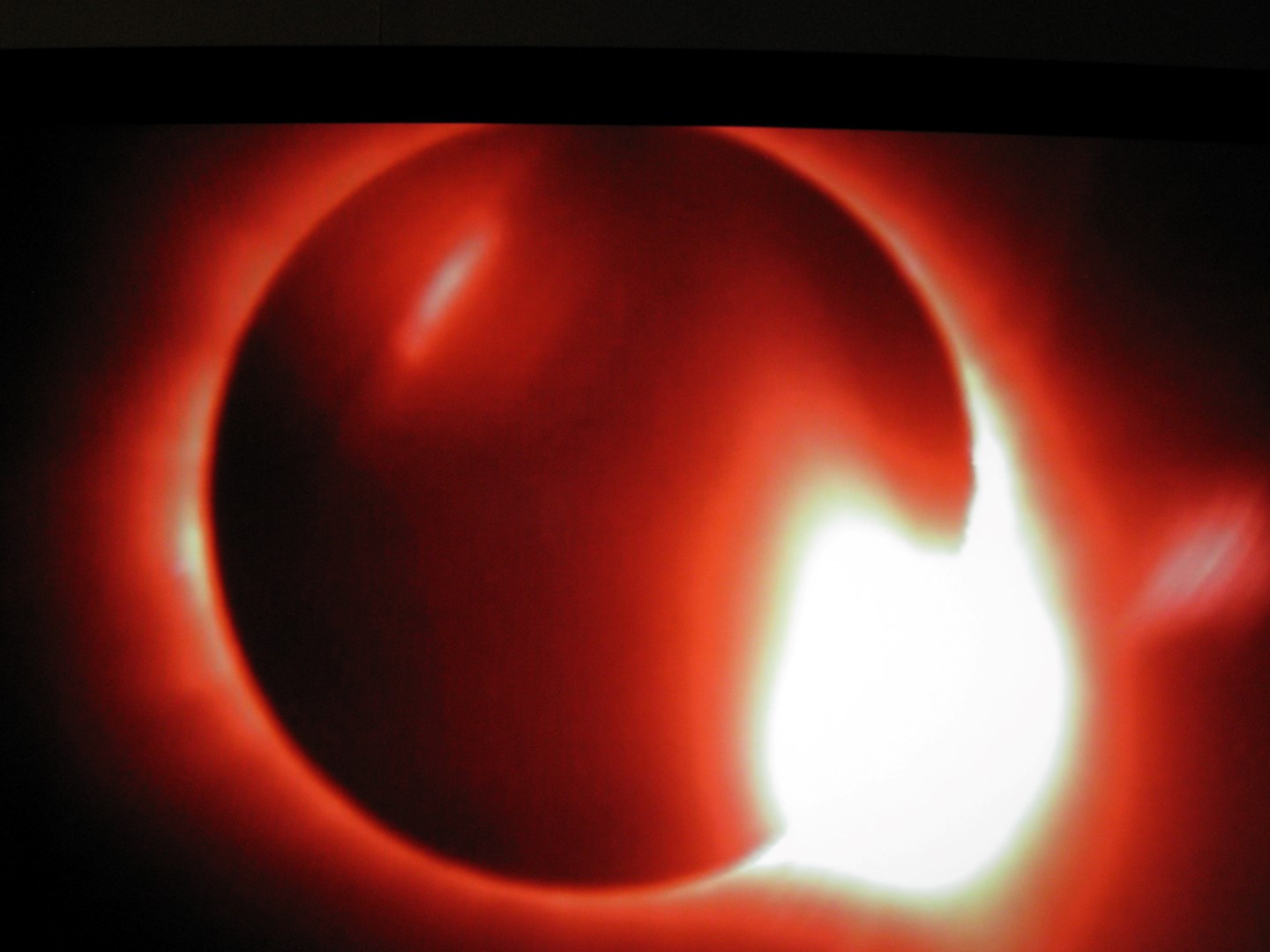
Baily's beads in hydrogen-alpha image. Faroe Islands March 2015.

Baily’s beads hydrogen-alpha image.   Faroe Islands March 2015.

Diamond Ring hydrogen-alpha image. Faroe Islands March 2015

Diamond Ring hydrogen-alpha image.
Faroe Islands March 2015

An eclipse is astronomy in action and inevitably I’m disappointed not to see and image the actual eclipse here but my alternative eclipse was still interesting and good fun. I was lucky to witness a total eclipse in France in August 1999 so that’s a 50% success rate so far.  The next partial eclipse in the UK will be on 12th August 2026 so I have time to prepare but, of course, will be unable to do anything about the weather again.  Fingers crossed then I suppose!

Another perspective.  Eclipse 2006, taken form the ISS the Moon's shadow passing over Turkey.

Another perspective. Eclipse 2006, taken from the ISS the Moon’s shadow passes over Turkey at 2,000 kph.

Moons

I am currently halfway through an Open University course on moons. Truth be told, after a less than satisfactory OU course on Orion (actually more a beginner’s guide to the Universe) recently, I had not intended to enrol for the moons course but at the last moment signed up.  In comparison, the experience this time has been outstanding: the quality, content and organisation of the course has been exceptional and moons have turned out to be much more interesting than I had expected.

ou_moon_art_2108_exploring_what_makes_a_moon

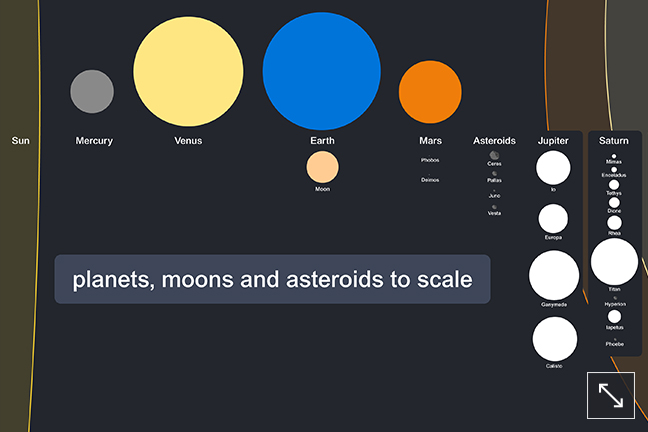
The combination of space travel and much improved earth-based astronomy, has recently led to an explosion in our knowledge of and about moons.  As a result there are now at least 176 known moons in the Solar System, with every possibility that this will continue to grow.  I have been surprised to learn that the largest moons even exceed the size of some planets.  Numerous space missions have provided amazing close-up pictures which show that many of these moons are far more interesting than previously thought, often with the presence of liquid which may even host life and in some cases volcanic activity is evident, including so-called cryo-volcanism – which is a new term to me.

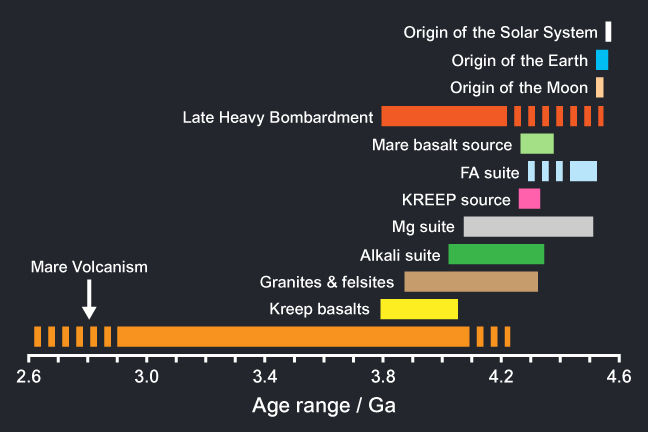
Geological history of the Moon

Geological History of the Moon

Since starting DSO imaging in August I have somewhat neglected the Solar System but as last week we eventually started to study The Moon itself, it seemed like a good time to image our nearest neighbour once again.  Being just one day before reaching First Quarter, the detail along the Lunar terminator remains very good and I believe has made a beautiful picture.  With the Moon now in its waxing gibbous phase, DSO photography will be ruled out for at least another week, so it’s time to catch up with other matters of astronomy and the like and just enjoy our Moon, clear skies permitting.

IMG_4746crop

The Moon | WO GT81 + Canon 700D & FF | 1/100th sec @ ISO 100 | 24th February 2014

Two’s Company

During the late 20th Century planetary relationships took on a new meaning as a metaphor for the difference between men and women, following the publication of John Gray’s book Men Are From Mars, Women Are From Venus.  Making a beautiful view at the moment, Venus is currently flirting with Mars in the early evening sky, for a very brief period low on the western horizon just after sunset. Its appulse with Mars can be easily seen with the naked eye but the view from Fairvale Observatory lasts only about 20 minutes and therefore requires good seeing conditions and quick action to get a picture.

At the weekend the view was even better, with the crescent of the New Moon adjacent to the field of view of Venus and Mars at the same time but my camera was not ready. Ideally I would like to image its apparition with a telescope but having to act quickly, last night I managed to get a quick photograph of the two planets using a DSLR camera and a 600 mm telephoto lens; the International Space Station flew by shortly afterwards but unfortunately too late get a photograph combining all three, timing is everything.

Later in the month the apparition of Venus will also include Uranus, making an even better show but will definitely not be a case of two’s company, three’s a crowd!

Picture saved with settings embedded.

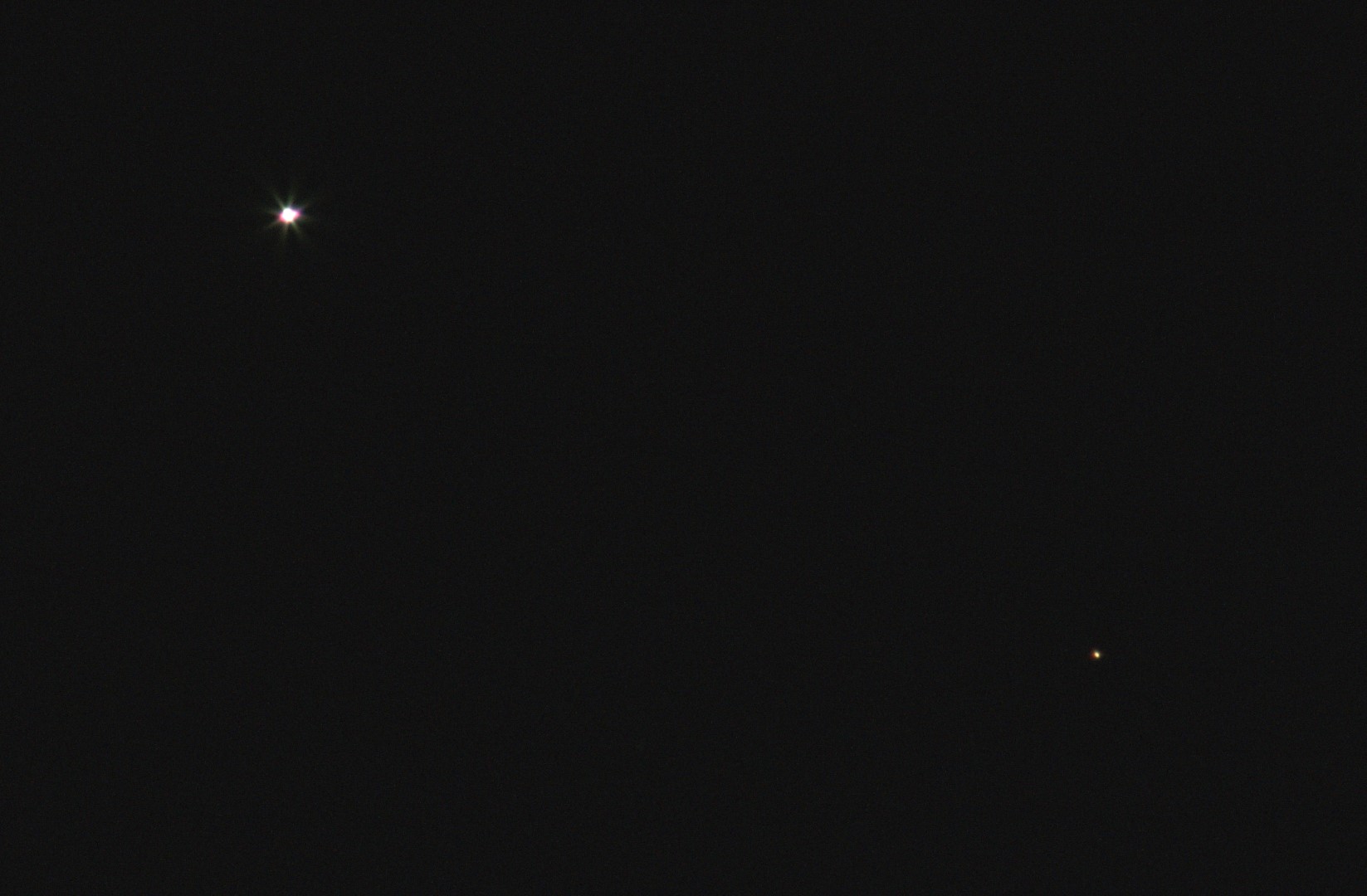
Shining brilliant white, magnitude -3.9 Venus – top left & the smaller, faint magnitude +1.3, red planet of Mars – bottom right

STOP PRESS!

Another good evening sky this evening and tonight I manged to set-up the telescope to take this beautiful picture of Venus and Mars:

IMG_4731crop (Large)

Lovejoy Part-2

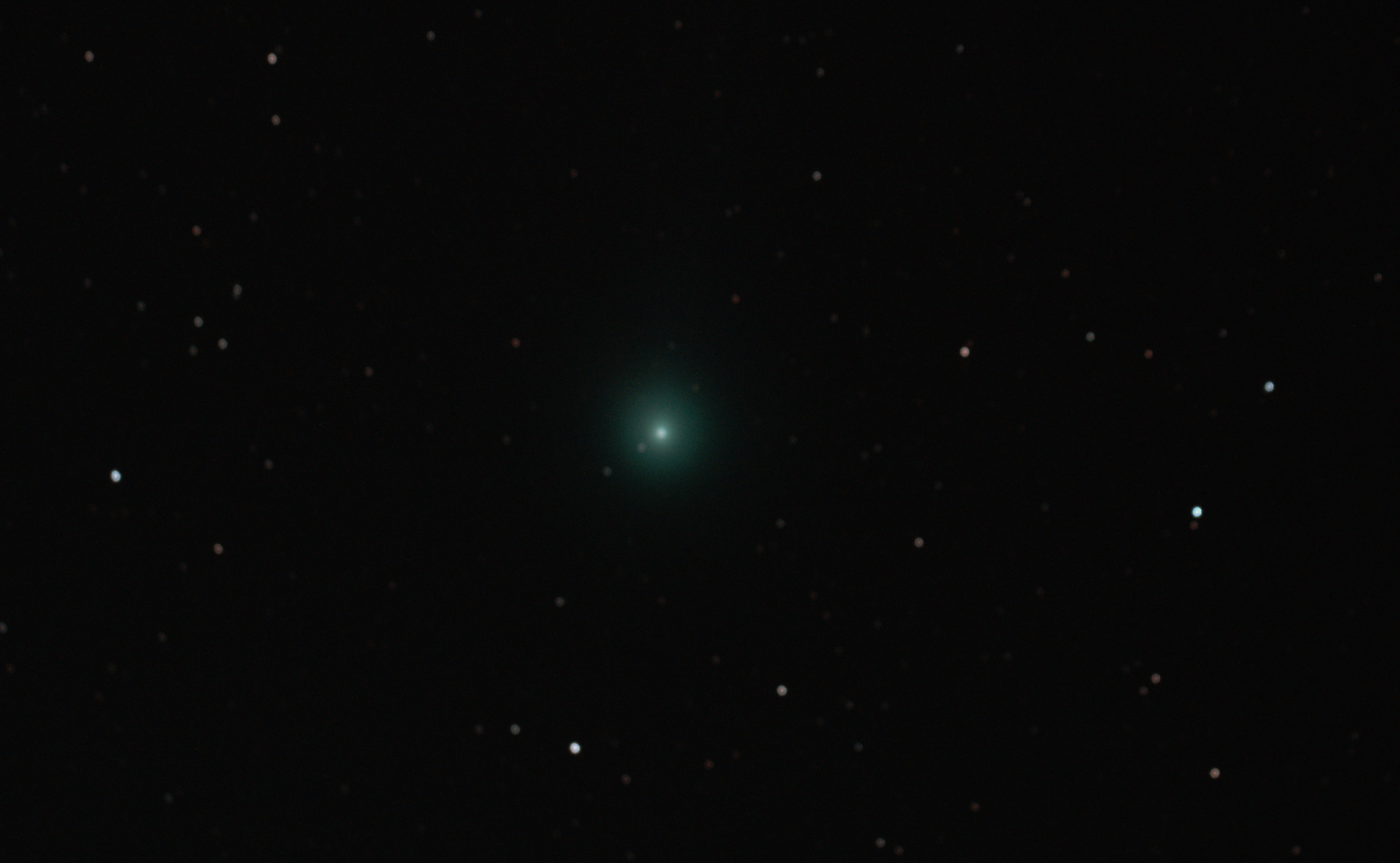
I first became acquainted with C/2014 Q2 Comet Lovejoy just before Christmas and have since been keen to obtain my own image of the object from Fairvale Observatory; at the time I was fortunate to obtain a photograph of the comet from a fellow astronomer in La Palma.  Despite the comet reaching its best positon on January 7th, some 44 million miles from Earth and with the apparent magnitude (brightness) improving throughout January to less than +4.0, unfortunately nature and life prohibited me from attempting this task: Christmas, New Year, travel, bad weather, full Moon etc.  A couple of clear skies did present a good visual sighting through binoculars but no image.

Last week, on Thursday evening, I eventually got my first opportunity but due to very strong winds (hence the clear sky) was unable to even set-up the equipment.  The following evening a cold but clear sky again occurred and this time I took my chance.

Photographing and processing a comet is not straightforward.  Since my last post, Comet Lovejoy has tracked west (to the right) of the Orion constellation and at the time of imaging was located just above the western end of Taurus, before it passes west of Pleiades on 19th January.  The first problem is therefore obvious – it’s travelling very fast, about 82,000 mph.  Fortunately Livecometdata.com provides real time information on the comet’s journey, which is both impressive (how does it do this?) and very useful.  Inputting the real time RA and DEC location data into the SynScan handset, the mount slewed straight to the comet, which was just off-centre of the field of view.  And thus I had my first, proper live view of a comet – fantastic! Now for the tricky part: how to get an image?

I had already posed this question on Stargazers Lounge and had a number of useful suggestions. Of course, whilst the mount tracks the celestial sphere, the comet is making its own way through the sky, which is not the same path as the stars seen from Earth; I believe it is possible to track the actual comet but that’s too difficult for me. Therefore, it is necessary to err towards lots of shorter exposures to avoid blurring; the longer the exposure the more likely it is the comet’s tail can also be captured in the image but it is a fine line between achieving this and blurring.  In the end I took two sets of images at 20 seconds and 60 seconds – probably too cautious but I was happy with the result and will be better prepared for my next comet, whenever that is.

Then came the next obstacle – stacking and processing.  I had not thought about this before but in the world of stacking, the software is unable to distinguish the comet from stars.  As a result it is necessary to identify the comet in each light frame by manually tagging it; at this point I regretted taking x40 exposures! Deep Sky Stacker will then stack using one of three procedures which basically prioritises either the comet or the stars or a combination of both – I chose the latter.  As usual post processing in Photoshop is then used to improve the final image.

C/2014 Q2 Comet Lovejoy WO GT81 + Canon 550D (modded) & FF | 40 x 20secs @ ISO1,600 + darks | 16th January 2014

C/2014 Q2 Comet Lovejoy
WO GT81 + Canon 550D (modded) & FF | 40 x 20secs @ ISO1,600 + darks | Fairvale Observatory 16th January 2015

Whilst I am very excited to have successfully photographed Comet Lovejoy, I was less than impressed by the stacked image and actually prefer the original.  Processing comet images takes the dark art of processing to a new level and I feel I’ve only reached the learning foothills so far.

Lovejoy will be in the sky for some weeks to come as it tracks across Andromeda and Perseus during February and into Cassiopeia in March.  Whilst the best may be almost past, I certainly hope to follow its progress and, subject to conditions, might even attempt to image it once again before it continues its 8,000 year orbit into deep space.  However, for now I’ve got my comet and am well satisfied – I will spend the intervening winter days practicing my comet stacking.

Comet Lovejoy WO GT81 + Canon 550D & FF | 15 x 60 secs @ ISO1,600 + darks| 16th January 2015

Comet Lovejoy
WO GT81 + Canon 550D (modded) & FF | 15 x 60 secs @ ISO1,600 + darks| Fairvale Observatory 16th January 2015

Rendezvous

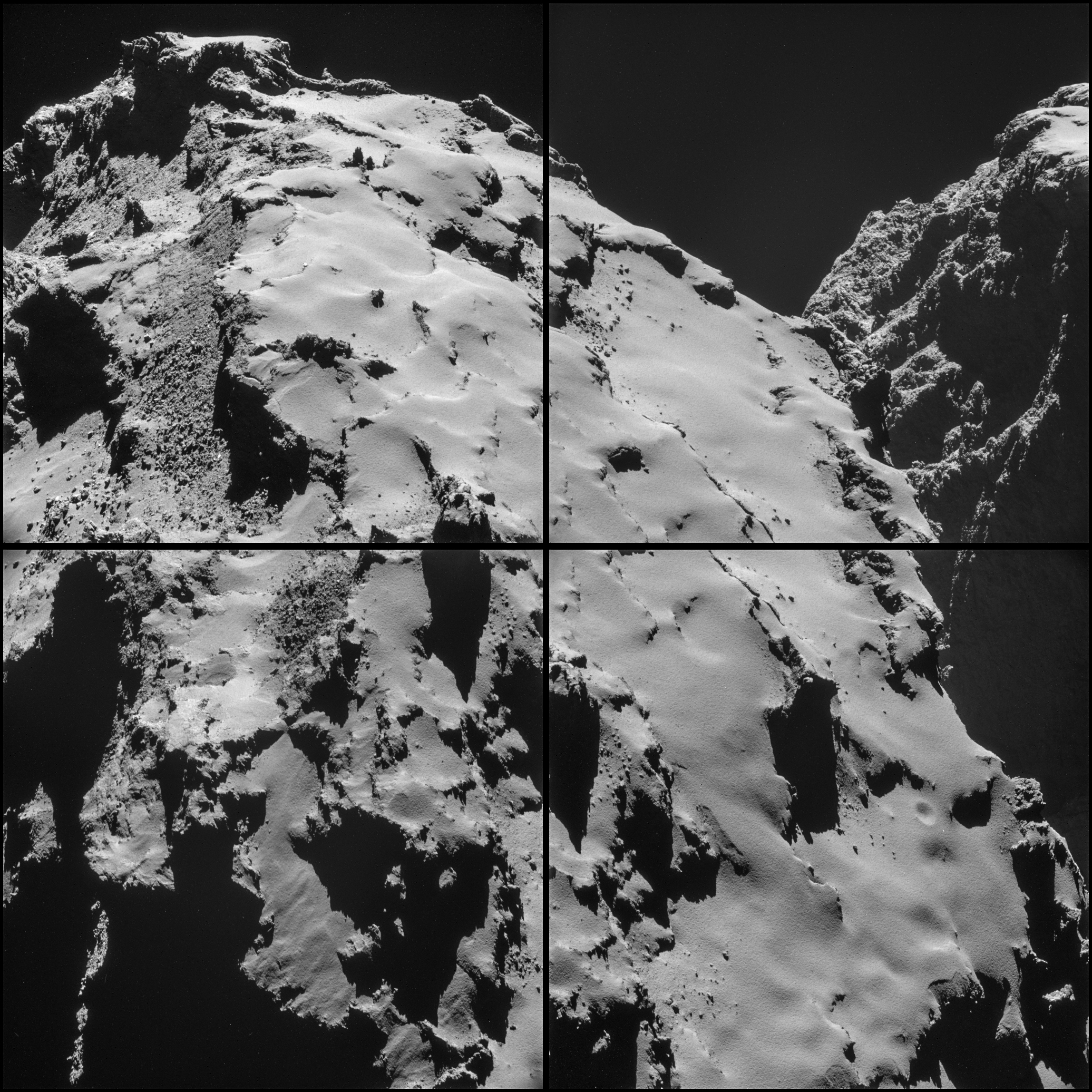
Comet_on_28_October_NavCam

At first this picture looks like something taken whilst walking in the Alps but, look again.  It is a composite photograph taken on 28th October by the Rosetta space probe, currently orbiting the 67P/Churyumov-Gerasimenko comet, approximately 7.7 km from the surface.  I must admit I had been somewhat doubtful about the nature and chance of success of this mission but there’s no denying the science and technology is amazing, almost, but not quite, as exciting as the first Moon landing on 29th July 1969.

The Rosetta probe was launched on 2nd March 2004 and has since taken a circuitous route through deep space to eventually rendezvous with the comet in August this year.  Initially approaching the comet at a maximum relative speed of 19,000 mph, the probe was put into orbit around the comet on 10th September, since when it has been mapping the comet’s surface and sending back some truly amazing photographs. This link provides real time tracking data from the probe, which locked together with the comet is currently travelling at 40,000 mph relative to the Sun. http://www.livecometdata.com/comets/67p-churyumov-gerasimenko/

Even now it sounds like science fiction and the best is yet to come.  In nine days, on 12th November, Rosetta is scheduled to send a lander to the comet’s surface.  After attaching itself to the comet, a scientific mission will be undertaken by the lander in order to study its nature, origin and possible implications for life on Earth itself. Wow, can’t wait!!!

http://www.esa.int/Our_Activities/Space_Science/Rosetta/Europe_s_comet_chaser

Taken on 7th October, Rosetta takes a 'selfie' whist imaging the comet 16 km away.

7th October: Rosetta takes a ‘selfie’ whilst imaging the comet 16 km away.

Finding the Sun

As our nearest star, the Sun is an obvious target for astronomy and with all this nice summer weather at the moment, that’s exactly what I’ve been doing.  The statistics of the Sun are, of course, mind boggling and the views can be truly amazing http://http://en.wikipedia.org/wiki/Sunen.wikipedia.org/wiki/Sun .

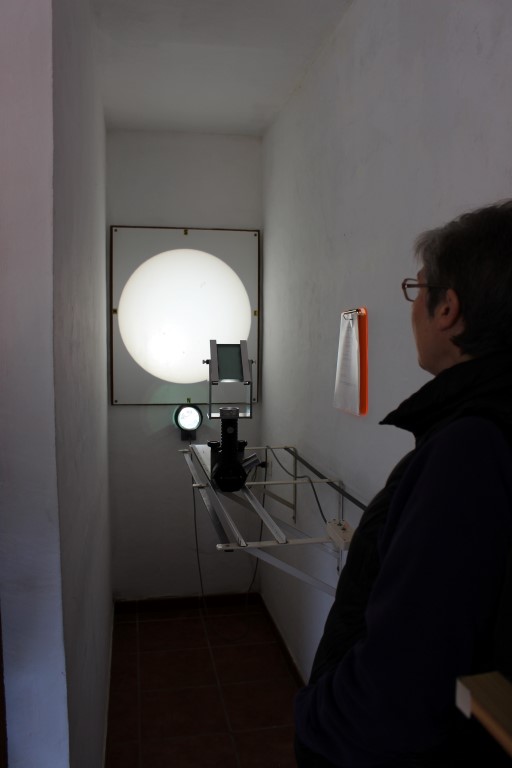
I first saw the sun through a telescope whilst in La Palma earlier this year https://watchthisspaceman.wordpress.com/2014/08/06/la-palma-nice-one-joan/ both using Joan’s 15″ Mak Cassegrain + solar filter and his beautifully constructed helioscope, which bounced the Sun’s light / image from the outside, through a hole in the wall of the observatory, which was then focused perfectly on a screen:

Mak + white light filter

Mak + white light filter

Heliograph focus track after collecting the sun's image outside

Heliograph focus track after collecting the sun’s image outside

Final heliograph image of the Sun's surface

Final heliograph image of the Sun’s surface

Rightly or wrongly I decided to use my SW 150PL Newtonian to view the sun, with a larger, open OTA there should be better ventilation and it just seems less complicated (& cheaper) than the refractor for the moment. The standard method, which I also used, is to place a Baader Astro Solar Safety Film in front of the OTA. This looks a lot like cooking foil but is much more sophisticated and expensive, basically reducing the light from the Sun to a narrow, harmless wavelength http://www.365astronomy.com/solar-filter-for-150mm-newtonian-telescopes-p-2933.html. You can buy this film in A4 sheets and make your own filter but I bought the type that was already made and fitted snugly into the end of the OTA:

Solar filter fitted inside the 150PL

Solar filter fitted inside the 150PL – also note solar finder in the finderscope bracket (see below for description)

To be honest, I was uneasy at the prospect at looking at the Sun which, if undertaken incorrectly, could result in the loss of sight – so I didn’t want to risk the DIY route.  Whilst on this theme, it is essential to thoroughly check the filter each time before use to check for holes, even a pin prick could be dangerous and result in injury. In addition, whilst in use but not being attended – maybe gone off for a cup of tea – it is said that birds can be attracted to the shinny filter and can peck holes! I have therefore made a cardboard cover to put over the filter whilst away from the scope for this reason:

Crude and cheap but it might save your eyesight!

Crude and cheap cardboard cover but it might save your eyesight!

At this point I realised that finding the sun to view i.e. lining it up, is not as easy as it might seem – after all you cannot just look directly at the sun and point the scope, for obvious reasons. One method is simply to use the OTA’s own shadow, so that when it is lined up with the sun its shadow will be at its minimum. There are also numerous gadgets out there to buy (there always is in astronomy).  However, I came across a DIY version that frankly I think is difficult to beat – it costs nothing and takes seconds to make! This guy deserves an award for such a design http://pembsastronomers.freeforums.org/how-to-make-a-solar-finder-in-three-seconds-t485.html.

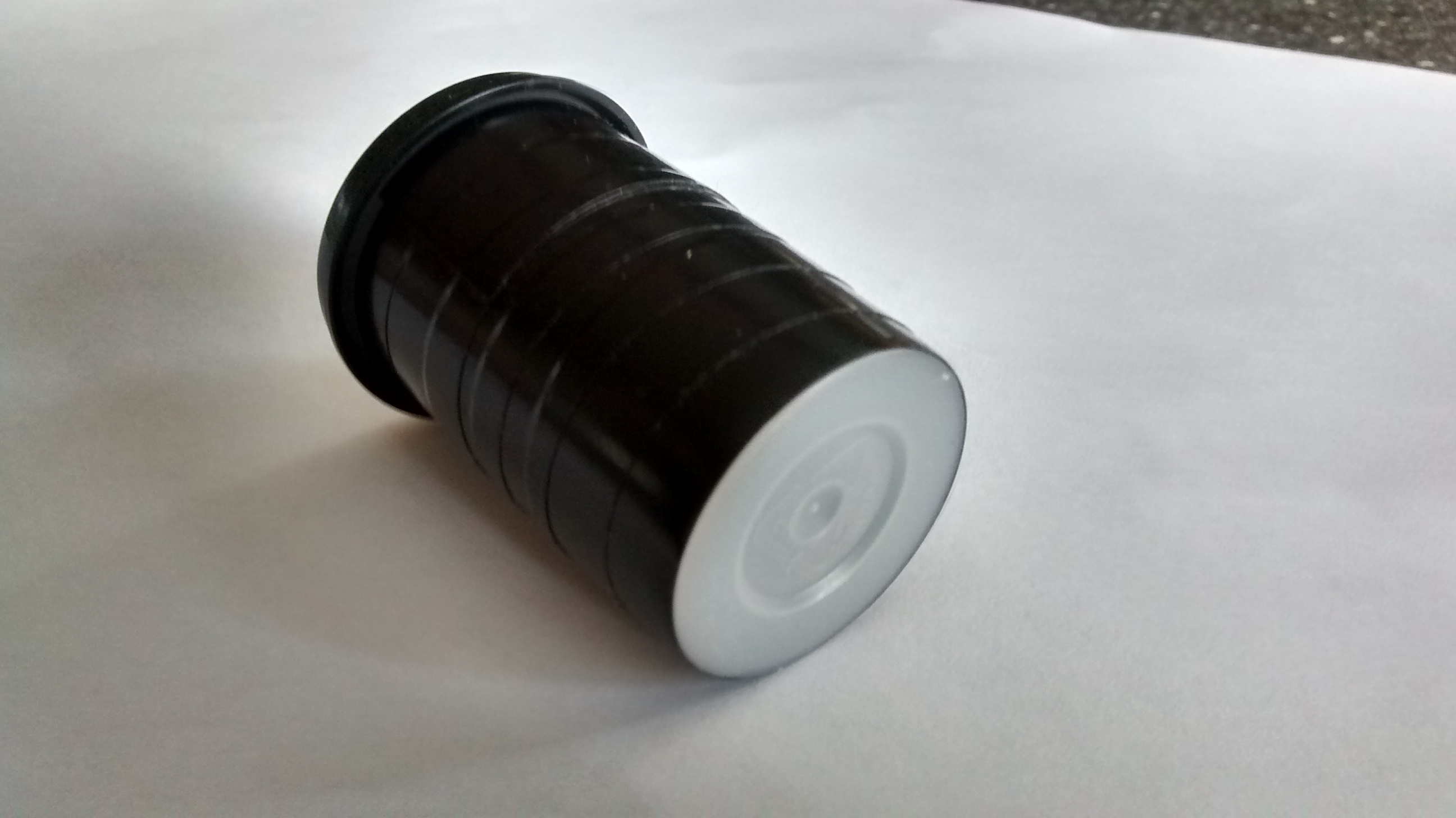
Basically it is a 35mm film canister, with a black top on a clear container: wrap the container in black electric tape and pierce a very small pinhole in the top. In my case it slipped straight into the finderscope bracket (thus also also allowing proper alignment with the scopes viewing axis) and then you manoeuvre the scope until the beam of sunlight that passes though the pinhole, falls directly at the centre of the base of the canister, which acts as a screen. Genius!

35mm canister with small, pinhole in the top

35mm canister with small, pinhole in the top

Using a clear canister wrapped in black tape, the base acts as a screen. Sunlight passes through the pinhole which then appears as a small, bright spot on the base of the canister - moving this to the centre of the base by adjusting the orientation of the scope ensures the scope is directly aligned with the Sun for viewing.

Using a clear canister wrapped in black tape, the base acts as a screen. Sunlight passes through the pinhole which then appears as a small, bright spot on the base of the canister – moving this to the centre of the base by adjusting the orientation of the scope ensures the scope is directly aligned with the Sun for viewing.

Using the Baader Solar Filter produces a white light image, in particular showing sunspots:

The photo mosaic segments would not line up perfectly but the sunspots are clear to see and more prevalent than a couple of weeks ago. Notwithstanding, the 11-years sun spot cycle is not as expected, with the number of spots quite low at the moment.

The DSLR photo mosaic segments would not line up perfectly but the sunspots are clear to see and more prevalent than a couple of weeks ago. Notwithstanding, the 11-years sun spot cycle is not as expected, with the number of spots quite low at the moment.                                             Skywatcher 150PL & 2x Barlow 1/40th sec at ISO100

Compact camera afocal image - lacks detail but you get the whole of the sun in the frame.

Compact camera afocal image – lacks detail but you get the whole of the sun in the frame.

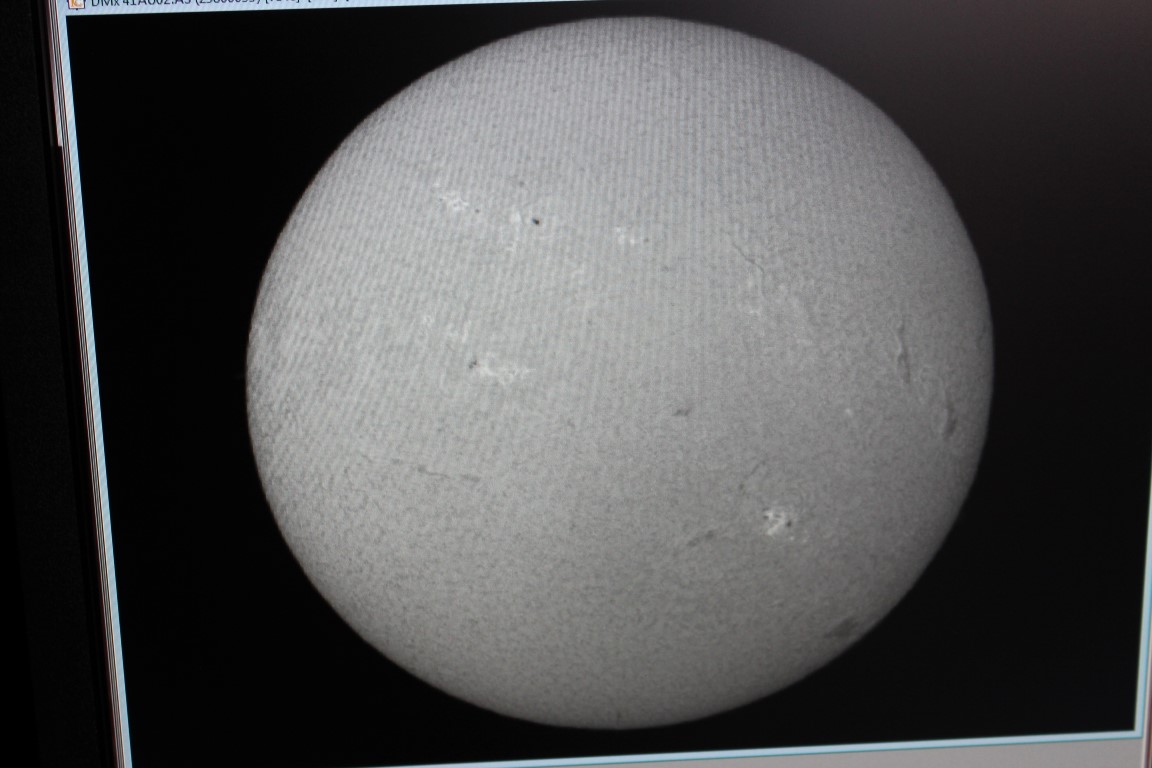
For the moment I’m quite pleased with the view but would eventually like to improve things. Still looking at white light, the Herschel Wedge looks like a good attachment that could instead be used with the WO refractor http://en.wikipedia.org/wiki/Herschel_wedge . This deflects most of the light and heat and, supposedly, produces a superior image – it’s inevitably quite a bit more expensive.  The holy grail is a hydrogen-alpha scope, of which the Coronado PST is probably the most popular, not least because it is financially cheaper  http://www.meade.com/products/coronado/coronado-personal-solar-telescope-pst-0-5-angstrom.html but if you are really flush with cash this will do the job nicely http://www.telescopehouse.com/acatalog/Lunt-152mm-H-alpha-OTA—B1800-BF—Feather-T—P-Tuner.html . The point of the H-alpha scope is that it works at a different wavelength that, unlike white light, enables the Sun’s prominences to be seen, dream on.

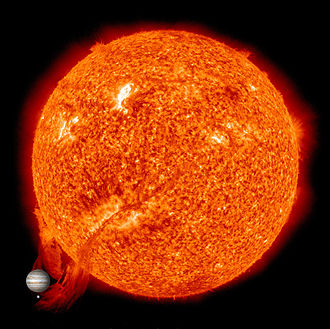
For scale that's Jupiter down there in the lower, left hand corner

For scale that’s Jupiter down there in the lower, left hand corner