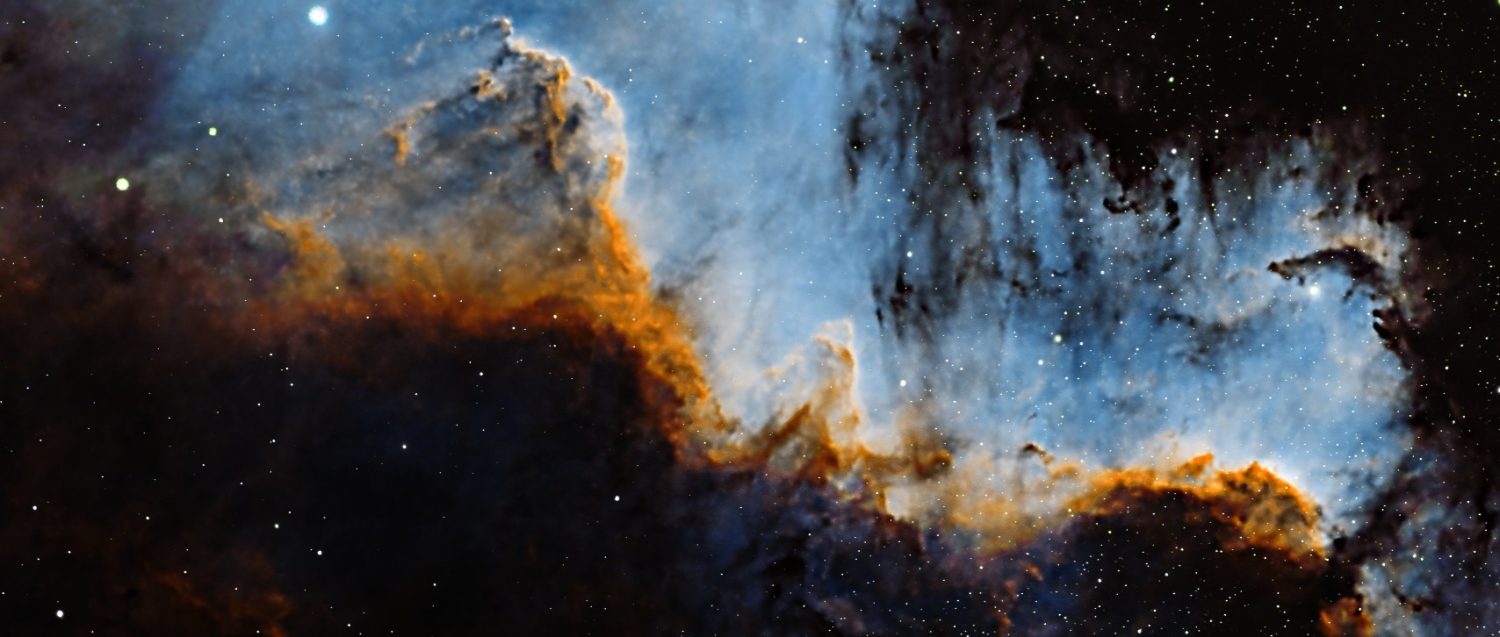
Other Worlds

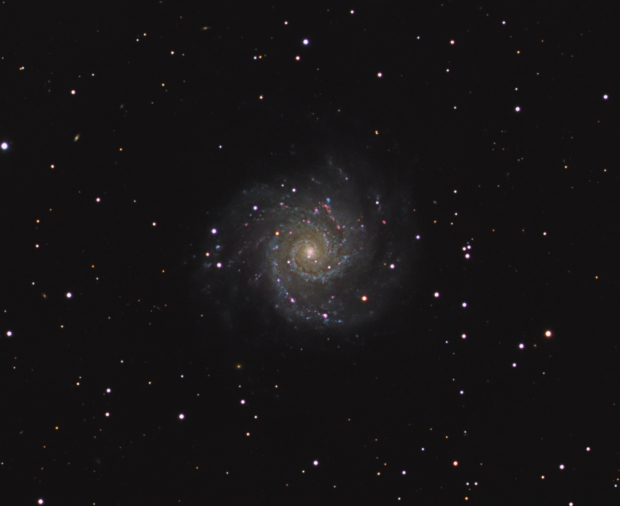
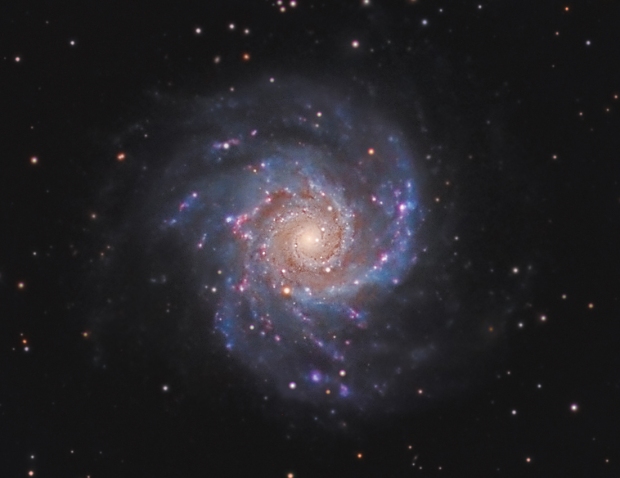
GR Final HaLRGB

Apart from the simple enjoyment of travel, it often opens the potential for new opportunities and experiences that more profoundly broadens one’s horizons; I’ve travelled extensively during my life which has been enriched accordingly.  Earlier this month I visited astrophotographer Oliver (Olly) Penrice at his Les Granges Observatory in the Hautes-Alps region of Provence in France, with the objectives of imaging with a more favourable dark sky and to learn from Olly’s experience.

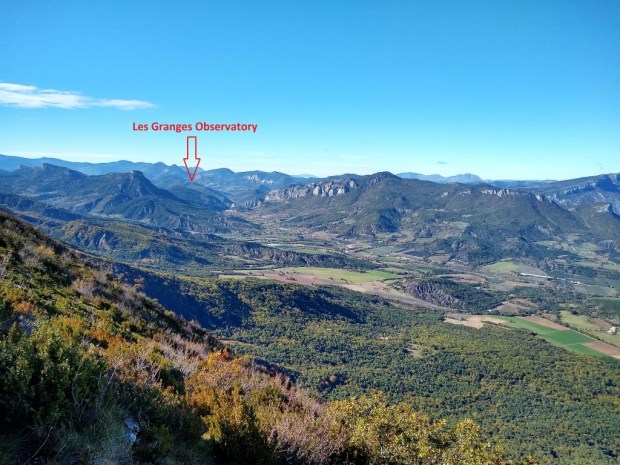
Les Granges Location (Medium)

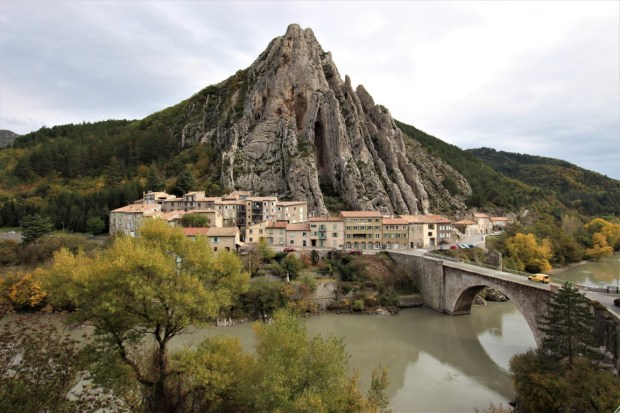
Situated deep in the mountains and very much off the beaten track, Les Granges is in the small (28 people) hamlet of Ètoile-Saint-Cyrice, some way from Peter Mayle’s better known Provence but nonetheless itself interesting and beautiful, with some wonderful geology to boot; after all my wife and I are also geologists.

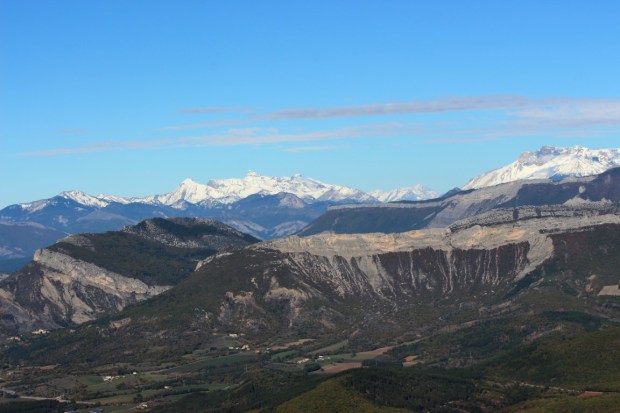
IMG_1046 (Medium)

Area immediately north east of Etoile-Saint-Cyrice

IMG_1066 (Medium)

Spectacular monocline rock folding at Sisteron

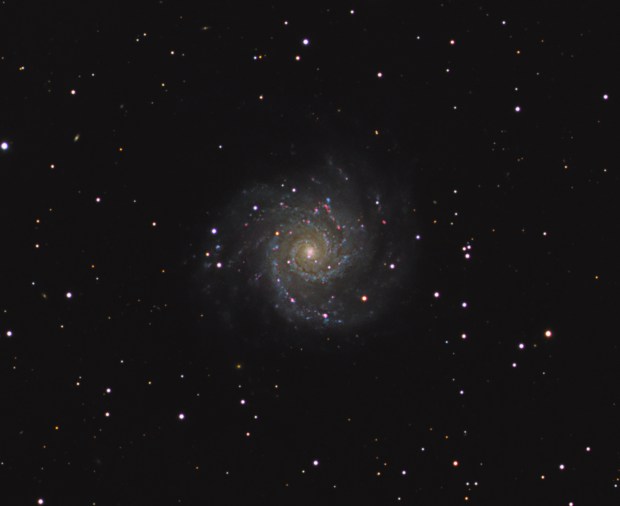
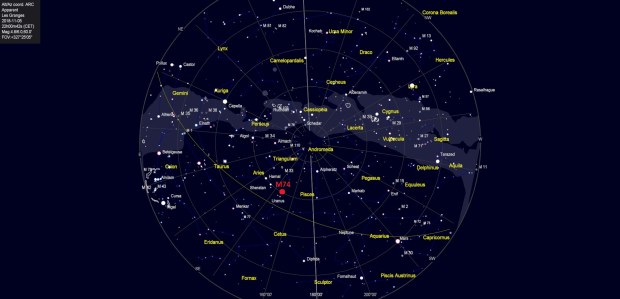
Subject to time and conditions, I particularly wanted to image a target that could not be achieved at home, either because it cannot be seen from my location or is beyond the capabilities of my equipment. Before leaving for France I therefore researched the projected night sky at Les Granges and developed a short list of potential targets, number one of which was a spiral galaxy.  At the moment my equipment struggles with these faint fuzzies and I’ve long wished to bag a good image of a ‘proper’ galaxy.  With galaxy season still a few months off the choice was limited but it soon became clear that M74, the Phantom Galaxy would provide such a target: it is not commonly imaged, is somewhat faint and difficult to see but is a classic, face-on spiral galaxy – just right for Guy Fawkes Night on November 5th too!

M74 at les granges 051118 10pm

Olly’s imaging equipment consists of a Takahashi FSQ106Ns rig and a more suitable TEC 140 f/7 refractor, which when matched with an Atik 460 CCD camera was just the job for the proposed task.  Outstanding night skies at the Les Granges Observatory are commonplace, with SQM values in excess of 22 but it was raining when we arrived and the outlook seemed less than perfect.  Notwithstanding, the next two nights were clear in the early evening and so on the first night we managed to obtain 3-hours of RGB subs, followed by nearly 2.5 hours of Ha and Luminance data the following evening.  Whilst imaging we also spent time observing, in these conditions Andromeda Galaxy was clearly visible with the naked eye but using the 14″ Meade LX200 which Olly inherited from the late Alan Longstaff other objects such as M27 and M33 came to life in the eyepiece.

IMG_20181108_115731653 (Medium)

Does what it says on the tin – entrance to Les Granges observatory

Sadly the rain returned thereafter and this turned out to be the only window of opportunity for the rest of the week!  Thankfully Olly has a vast wealth of data that included some of M74, from which we were able to bolster our meagre data from the first two evenings of imaging the same object.

Since returning home I’ve worked on the recently acquired data again and am pleased with the resulting image, shown at the top of the page.  In particular, the addition of Ha-wavelength light has brought the galaxy to life where it highlights areas of star formation located within the spiral arms, in the form of distinctive areas of magenta coloured red spots – a characteristic sign of such activity within galaxies.  Olly also produced an alternative image by combining data from the aforesaid recent image with additional data previously taken with an ODK 14 inch scope.  This resulted in a total integration time of some 17-hours and produced a stunning image of M74 that I’m pleased to say I played a small part in (see below).

M74 ODK with TEC STARS HaLRGB Crop

It was disappointing that much of the time at Les Granges was spoilt by poor weather but I was able to use some of that time on processing techniques with Olly and just enjoying the wonderful ambiance that comes from being in such a location.  I hope to return again some time in order to enjoy the beauty of the area and the night sky that can be seen – when it’s not cloudy.  In the meantime, I’m more than pleased to catch some photons from another world of another world, which has resulted in stunning images of a spiral galaxy – at last.

  IMAGING DETAILS
Object M74 Phantom Galaxy
Constellation Pisces
Distance 30-million light-years
Size 10.5’ x 9.50’     
Apparent Magnitude +10.0
   
Scope  TEC 140   FL 980 mm   f7.00      (+ADK 14”)
Mount Mesu 200
Guiding PHD2 
Camera Atik 460 CCD  Pixels 4.50 ɥm
  FOV 43.80’ x 35.04’  Resolution 0.96”/ pixel     
Capture & Processing Atik software capture, Astroart pre-processing, PixInsight and Photoshop CS3 post processing
Image Location RA 01:36:41    DEC 15:47:01                       
Exposures 6 x 600sec RGB + 5×900 sec L & Ha  = 320 minutes  @ -20o
Location & Darkness Ètolie-Saint-Cyrice, Hautes-Alps Provence, France        SQM <=21.50 – 22.00
Date & Time 2nd & 3rd November 2018 @ +20.30h  
Weather <=8oC    RH% high

Star Struck


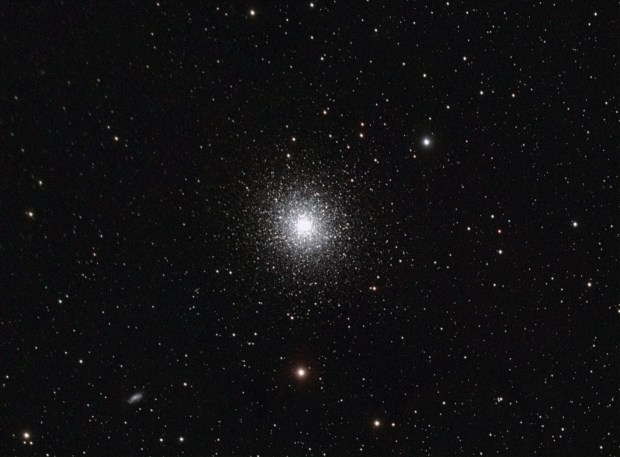
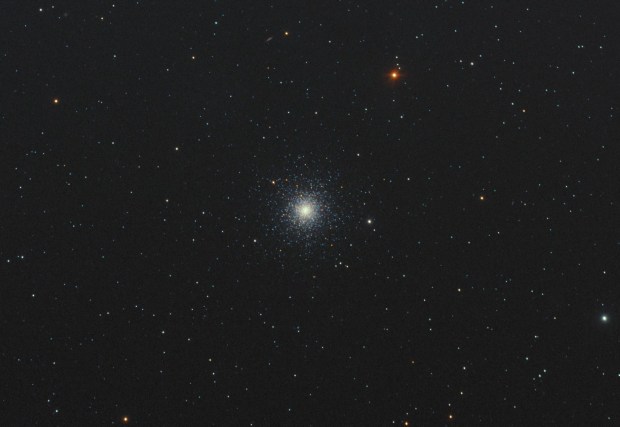
M13 LRGB F2 CROP (Large)

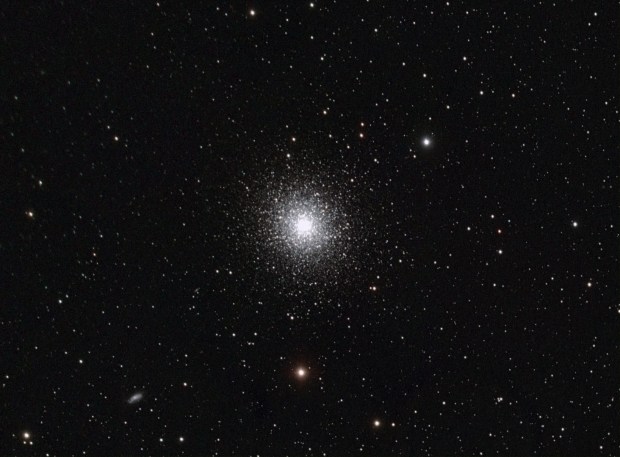
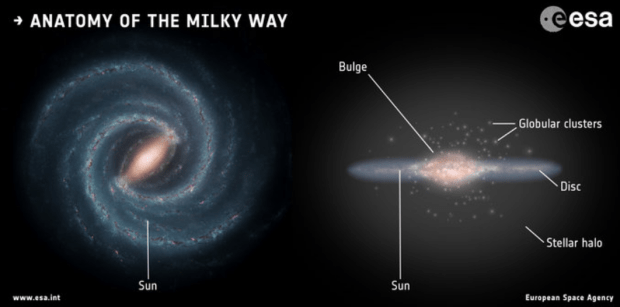
Of all the things I’ve discovered since taking up astronomy, perhaps it is the presence and nature of globular clusters that has most surprised me. Bound closely together by gravity, these massive spherical collections of stars orbit the galactic core perpendicular to its plane.  In the case of the Milky Way there are 150 globular clusters but they can be much larger in other galaxies, such as M87 which has some 13,000; clusters of clusters have also now been discovered in the Universe!  Typically each cluster might contain a few thousand or tens of thousands of stars, although in some cases they can be much larger.  Omega Centauri is the largest globular cluster in the Milky Way, being 150 light-years in diameter it contains 10 million stars; though clearly visible from Earth it can only be viewed from the Southern Hemisphere, which we unfortunately did not see when in New Zealand earlier this year.

MW &amp; globs

Despite all the advances being made in cosmology, the origin of globular clusters still seems to remain quite uncertain.  Characteristically the stars are all very old, typically in the region of 8 to 12-billion years and are of low metallicity i.e. they contain a low proportion of elements other than hydrogen and helium.  At least some, such as Alpha Centauri, are thought to have condensed from dwarf galaxies and such a process may currently be taking place within the large Magellanic Cloud – which we did see in New Zealand!  In other cases it is thought that the clusters have probably originated independently and were subsequently captured by the relevant galaxies.  However, their very old age – sometimes nearly as old as the universe itself – origin and relationship to galaxies remains intriguing.  For these and many other reasons I personally find globular clusters fascinating, probably more than any other astronomical feature, amazing as they too may be.

GlobsX

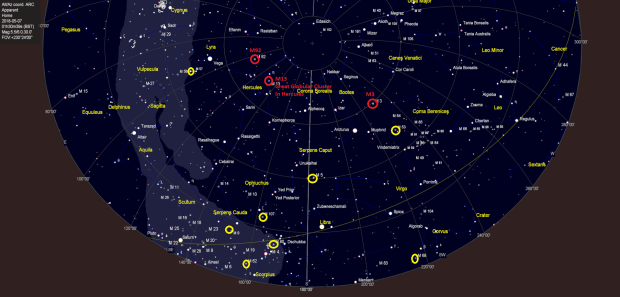
Globular Clusters May 2018: M3, M13 & M92 (red circles) + Others (yellow circles)

From time-to-time I’ve tried imaging various globular clusters but have not been satisfied with the outcome.  Now using guiding, plate solving and the high-resolution ZWO1600MM-Cool camera, it was time to give it another try this spring, when some of the best clusters are present in the northern night sky.

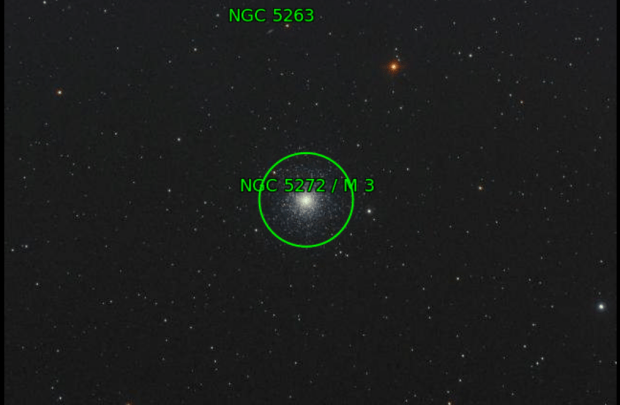
M3 LRGB Final (Large)

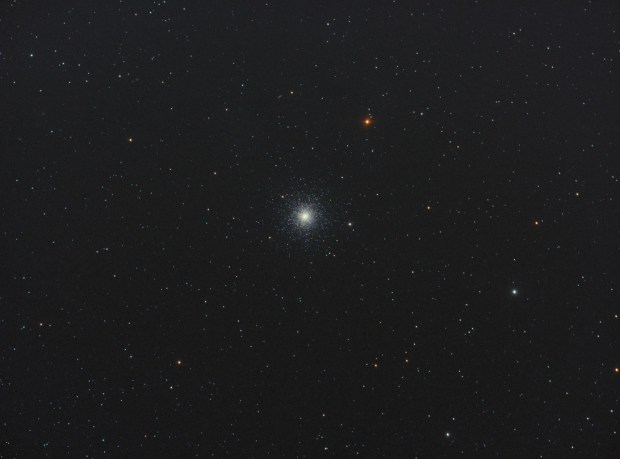
First up was M3 (Final image above), the very first Messier Object to be discovered by Charles Messier himself in 1764.  Consisting of 500,000 stars, between 8 and 11-billion years old and spanning some 220 light-years, M3 is one of the largest and brightest (absolute) globular clusters associated with the Milky Way – about 300,000 times brighter than our Sun.  It is noteworthy that the cluster contains some 274 variable stars, the highest number of any clusters, as well as a relatively high number of ‘blue stragglers’ – young main-sequence stars that appear to bluer and more luminous than the other stars in the cluster and are thought to be formed through stellar interaction of the older stars.

M3 LRGB Crop (Large)

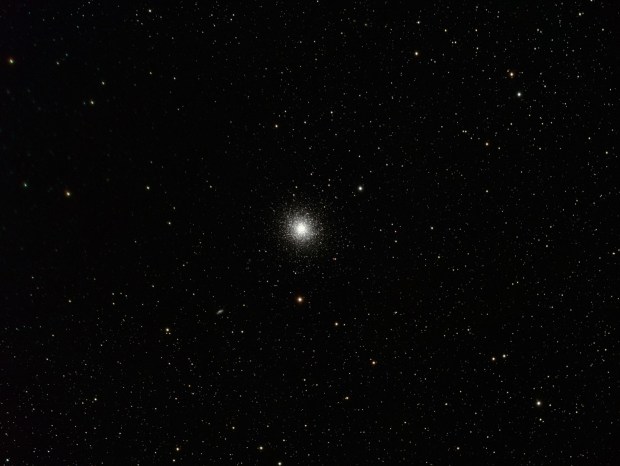
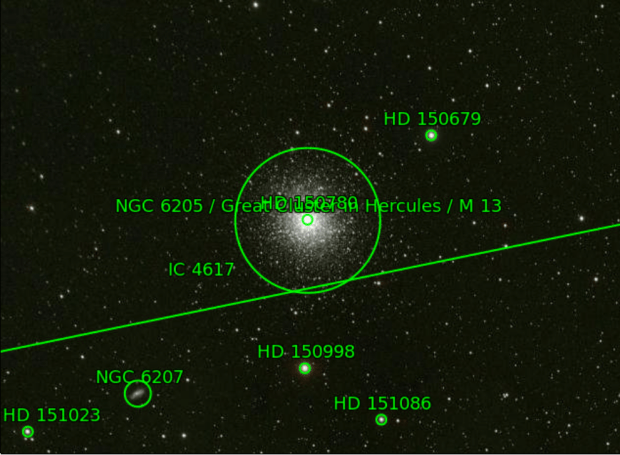
With these attributes it is not surprising that M3 is considered a popular target in astrophotography (cropped image above), likely surpassed however by M13 AKA the Great Globular Cluster in Hercules (cropped image top-of-the-page), which conveniently follows M3 in the same area of the sky about 3-hours later (together with nearby the globular cluster M92).  And so having bagged M3 it was time to turn the telescope and camera towards M13 (Main image below).  Discovered by the eponymous Edmond Hailey in 1716 (he of Hailey’s Comet), seen from Earth M13 is slightly brighter than M3 with a wide range of star colours that certainly makes for an exciting image.  At 11.65 billion years old, M13 has been around almost three times as long as the planet Earth.

M13 LRGB Final (Large)

Since starting astrophotography I like to try my hand at imaging a globular cluster at least once each year but hitherto with disappointing results.  This time I’m pleased with the outcome, especially M13 which is surely one of the most magnificent objects in our night sky; as a bonus there are also a few galaxies in the background of both the M3 and M13 images too.  It is therefore fortunate that for those of us in the higher latitudes of the northern hemisphere the Great Globular Cluster in Hercules can be seen all-year round, though is at its highest and therefore best position between May and September – thereby inaccessible for the Kiwis who are instead compensated by Alpha Centauri!  I expect to be back again next year to marvel at these amazing and enigmatic objects, if not before.

M3 Location Crop

IMAGING DETAILS
Object M3    (NGC 5272)     
Constellation Canes Venatici
Distance 33.9 million light-years
Size 18.0’ or 220 light-years     
Apparent Magnitude +6.2
 
Scope  William Optics GT81 + Focal Reducer FL 382mm  f4.72
Mount SW AZ-EQ6 GT + EQASCOM computer control
Guiding William Optics 50mm guide scope
  + Starlight Xpress Lodestar X2 guide camera & PHD2 control
Camera ZWO1600MM-Cool (mono)   CMOS sensor
  FOV 2.65o x 2.0o Resolution 2.05”/pix  Max. image size 4,656 x 3,520 pix   
EFW ZWO x 8 + ZWO LRGB & Ha- OIII-SII 7nm filters 
Capture & Processing Astro Photography Tool + PS2,  Deep Sky Stacker & Photoshop CS2
Image Location Centre  RA 13:42:23     DEC 28:22:50  
Exposures 24 x 180 sec L + 10×180 sec RGB  (Total time: 162 minutes)   
  Unity @ 139 Gain   21  Offset @ -20oC    
Calibration 10 x 180sec Darks  20 x 1/4000 sec Bias  10 x Flats LRGB  @ ADU 25,000  
Location & Darkness Fairvale Observatory – Redhill – Surrey – UK        Typically Bortle 5
Date & Time 5th + 6th  May 2018 @ +23.00h

M13 Location Crop

IMAGING DETAILS
Object M13     (NGC 6205)
Constellation Hercules
Distance >=20,000 light-years
Size 20’  or 150 light-years
Apparent Magnitude +5.8
 
Scope  William Optics GT81 + Focal Reducer FL 382mm  f4.72
Mount SW AZ-EQ6 GT + EQASCOM computer control
Guiding William Optics 50mm guide scope
  + Starlight Xpress Lodestar X2 guide camera & PHD2 control
Camera ZWO1600MM-Cool (mono)   CMOS sensor
  FOV 2.65o x 2.0o Resolution 2.05”/pix  Max. image size 4,656 x 3,520 pix   
EFW ZWOx8 + ZWO LRGB & Ha OIII SII 7nm filters 
Capture & Processing Astro Photography Tool + PS2,  Deep Sky Stacker & Photoshop CS2
Image Location Centre  RA 12:39:59    DEC -11:37:20  
Exposures 20 x 180 sec L + 15×180 sec RGB  (Total time: 195 minutes)   
  @ Unity 139 Gain   21  Offset @ -20oC  USB 40 
Calibration 10 x 180sec Darks  20 x 1/4000 sec Bias  10 x Flats LRGB  @ ADU 25,000  
Location & Darkness Fairvale Observatory – Redhill – Surrey – UK        Typically Bortle 5
Date & Time 6th + 7th + 9th May 2018 @ +00.30h  


Galactic Neighbours

M31 LUM ProcessedX (Large)

I continue to be very impressed and pleased with the William Optics GT81 triplet refractor and ZWO1600MM-Cool camera combination, which has unleashed an exciting  new era in my astrophotography.  Still less than one year since acquiring the camera I continue to learn about its features, as well as master the increasing complexity of using a mono camera and filters; I am particularly pleased I waited last year for the release of the larger ZWO x8 EFW and matching 31mm filters.  Armed with this new set-up I’m working through my list of favourite targets that were previously imaged with a modded-Canon 550D DSLR, the difference is often nothing less than quite spectacular revealing previously unseen details and colours.

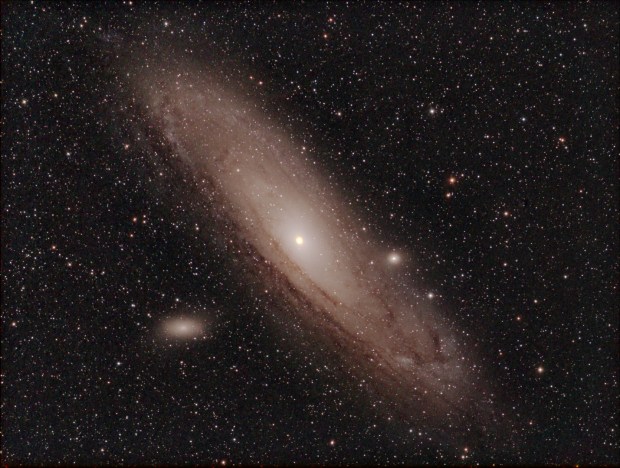
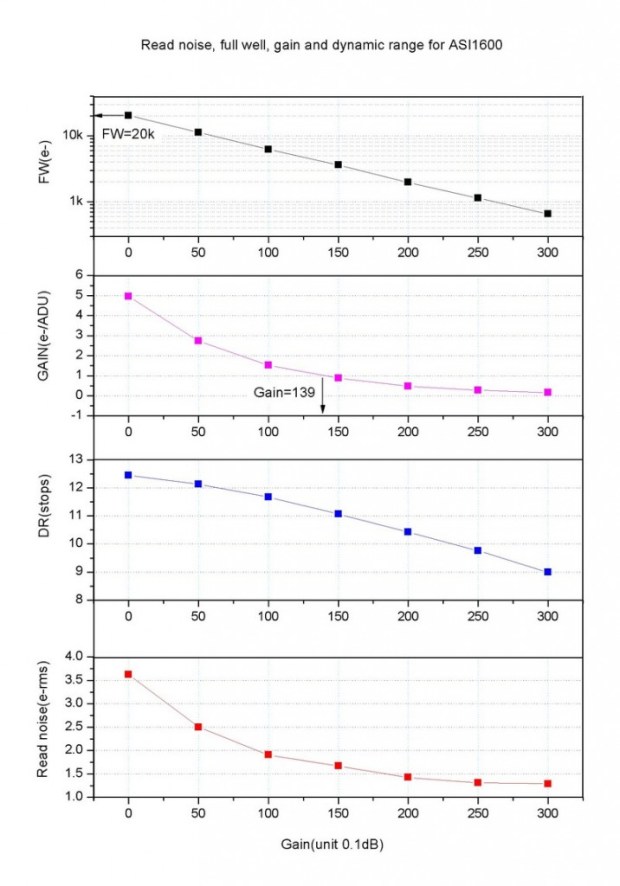
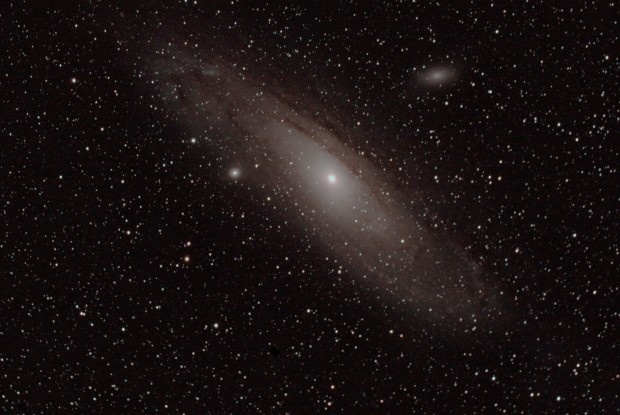
As the autumn equinox approached and the skies darkened again and imaging opportunities have thankfully greatly improved, subject to clear skies of course!  Whilst the scope-camera combo is excellent for larger DSO targets and especially nebulae, it is unable to tackle most of the galaxies which are usually small and require greater power than this provides.  However, there are a few exceptions, most significant of which arrives here towards the end of August if you are prepared to stay up very late.  It is our nearest neighbour M31, the Andromeda galaxy and smaller friends.  I think I’ve been quite successful imaging M31 before with a DSLR but now it was time to get to grips with the new camera and LRGB!1600-Gain-RN-DR-FW-vs-gain-716x1024

I’m new to the issue of Gain, Offset and ADU and am still experimenting with these settings on the ZWO1600.  As the camera performs quite differently to a more conventional CCD sensor, it’s fair to say that most other users, even those with CCD experience, are also on this learning curve.  After little more than a year since this revolutionary CMOS-based camera was introduced in the UK, only now are users starting to agree on suitable operating parameters.  Unity at 139 and has become the safe Gain setting but many have obtained some exciting results using either high gain and very short exposures or low gain and long exposures.  Given its size, apparent magnitude and high contrast core, it was clear that Andromeda was going to pose some new problems with the ZWO camera.

GAIN

OFFSET

ADU

0 10 400
75 12 550
139 21 850
200 30 1690
300 50 2650

Current popular guidance on ZWO1600MM-Cool settings

In view of the galaxy’s characteristics the obvious adjustment would be to reduce Gain but I continued to use my standard setting of 300 and Offset 10; the offset should be higher but for some reason I was initially successful with this level and have also conveniently stored a good set of matching calibration subs too.  My initial impression afterwards was that the subs were overcooked, blown-out in the centre and lacking detail in the spiral.  Enquires on the SGL Forum seemed to confirm that I needed to turn down the Gain for the core whilst seeking a target ADU count of about 500 to 600.  Shortly afterwards I therefore imaged M31 again but this time using two different settings for the core and the spiral:  Gain-O Offset-3 + Gain-100 and Offset-17 respectively.

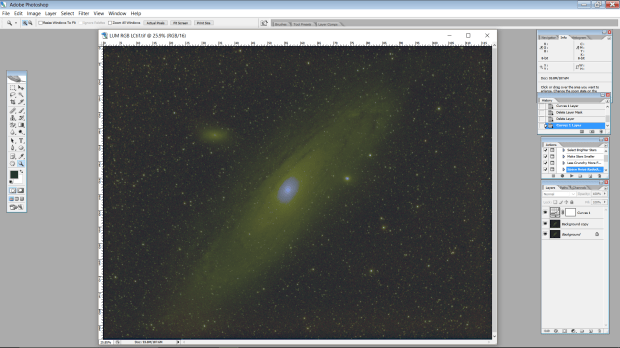
Green Mud

The ‘disc of green mud’ during processing! Clearly lower Gain and Offset settings combined with shorter 30 second exposure was not working.

Despite these changes initial processing of the subs obtained from the second imaging session resulted in an even worse outcome, with the galaxy now looking more like a disc of green mud! As a result I returned to the original subs and with care and perseverance teased a decent image of Andromeda (top of page) – patience and care is everything with astrophotography, if at first you don’t succeed try and try again.

IMAGING DETAILS
Object M31 Andromeda Galaxy + M32 & M110  
Constellation Andromeda
Distance 2.5 million light-years
Size Approx. 3.17o x 1.0o or 220,000 light years
Apparent Magnitude +3.44
 
Scope  William Optics GT81 + Focal Reducer FL 382mm  f4.72
Mount SW AZ-EQ6 GT + EQASCOM computer control
Guiding William Optics 50mm guide scope
  + Starlight Xpress Lodestar X2 guide camera & PHD2 control
Camera ZWO1600MM-Cool (mono)   CMOS sensor
  FOV 2.65o x 2.0o Resolution 2.05”/pix  Max. image size 4,656 x 3,520 pix   
EFW ZWOx8 + ZWO LRGB & Ha OIII SII 7nm filters 
Capture & Processing Astro Photography Tool,  Deep Sky Stacker & Photoshop CS2
Exposures 60 sec 40 x L + 20 x RGB  (Total integration time: 100 minutes)
  @ Gain 300 Offset 10 @ -20oC  
Calibration 5 x 60 sec Darks + 10 x 1/4000 sec Bias + 10 x  LRGB Flats  
Location & Darkness Fairvale Observatory – Redhill – Surrey – UK   Typically Bortle 5
Date & Time 28th August 2017 @ 00.00h

Reflections – 2016

2016 was the second full year of Watch This Space Man (WTSM) and once again it’s been something of a mixed period.  Faced with a major, apparently insoluble problem, by mid-year I actually thought of giving up but by year-end it’s all come good again, in fact very good.   Reflections is a look back at the ups-and-downs of the past year, astronomically speaking and a peek into the next twelve months, which one way or another could determine the future of my astrophotography.

wtsm-visitor-map

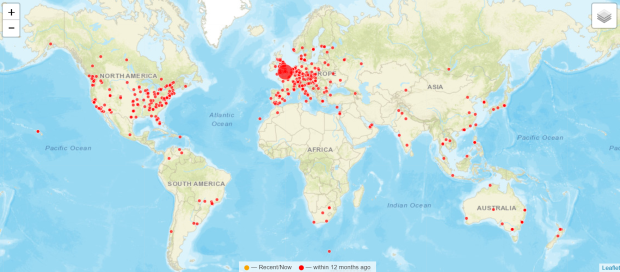
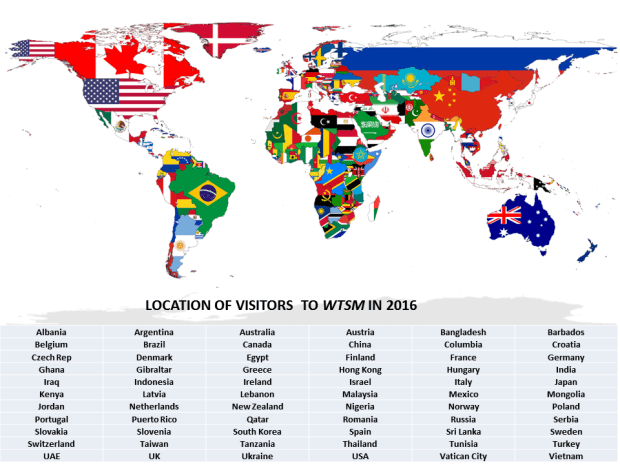
I have been astonished by the interest in this website, with some 7,000 visits and 14,000 page views from more than 65 different countries during the year, the list is quite amazing.  Though I write this blog for myself, I am increasingly aware of this unsolicited readership – you are all most welcome and I would be very pleased to hear from anyone who would like to get in touch with queries, comments or just to say hello – contact details are in the Contact drop-down section of the About main menu.

reflections-2016

JANUARY TO MARCH

The year started poorly, got much worse, then finally improved. Using my recently acquired Vixen Polarie I was pleased to start the year with an image of Barnard’s Loop, something notoriously difficult to photograph and had previously eluded me.  Sadly I was not so successful with the Milky Way and have reluctantly come to the obvious conclusion that this can only be imaged in much darker skies than I’m ever likely to experience located just to the south of London and close to Gatwick airport!

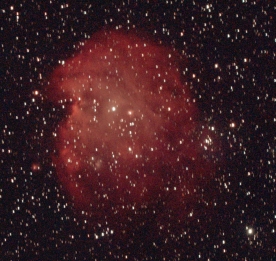
As Orion starts to move on after Christmas and especially from February, I struggle to find suitable imaging targets; Coma Berenices and other constellations at this time contain numerous galaxies but they’re mostly too small for my William Optics GT81 and otherwise what might be doable I have already done before.  Notwithstanding, after looking carefully I came across two HII nebulae still lurking in the early evening.  The size and Ha-light of NGC 2174 Monkey Head Nebula and IC 2177 Seagull Nebula, provided just what I was looking for.  Located close to Gemini and Monoceros constellations, both these DSOs are within the part of the Milky Way section of the sky, an area that thankfully produces many other similar opportunities at this time of the year for a modded DSLR camera.

Picture saved with settings embedded.

Monkey Head Nebula

It’s often the small things that either alone or cumulatively can help transform the outcome with astrophotography.  The quarterly period finished by acquiring two new pieces of equipment, one which could help improve the set-up and operation of the mount, the other which I hoped would help me move to the next level of imaging.

  • When working in the dark and worse still in the cold, the ergonomics and general convenience of operating the equipment becomes paramount.  Since starting to use EQMOD-ASCOM and Cartes du Ciel for mount control and tracking, I encountered the problem of having to be in two places at the same time; in this case co-ordinating adjustments at the mount and the computer, in particular when making and syncing star alignments.  The answer to this conundrum was a gamepad, which I purchased for a nominal sum on eBay and after watching the inimitable Chris Shillito’s video on setting up and using a gamepad with EQMOD-ASCOM, have never looked back.  By using the gamepad the telescope can now be manually slewed, centred and synced on any object whilst remaining at the scope, thereby making the process of alignment much quicker and convenient.
  • At the end of 2015 it was my intention to start guiding in the coming year, a prerequisite for the long exposures necessary to increase data capture and thus hopefully improve image quality.  I had originally intended to use my ZWO ASI120 MC camera together with a William Optics 50mm guidescope for this purpose but there always seemed to be other problems to overcome first and to be honest, I was somewhat intimidated about tackling the black art of guiding.  I was finally prompted to do something about this when in March a second-hand Starlight Express Lodestar X2 autoguide camera came up on the UK Astronomy Buy & Sell.  From previous research I knew this was considered to be a very good and popular guiding camera, so as it had only just been posted on the website, I immediately went for it and was successful – timing is everything.  Inevitably I had problems setting-up and in particular getting the camera to focus – which was my own fault – but by the end of March I was guiding!  Truth is my guiding at this stage was not very good and I needed to look further into using the PHD2 guiding software but nonetheless, the equipment was at least now working together!

No

Date Object*

Name

1 07/01/16 Orion Barnard’s Loop
2 14/01/16 Orion Barnard’s Loop
3 02/02/16 Catalina Comet
4 02/02/16 Milky Way  
5 10/02/16 IC 2087 Dark nebula
6 NGC 2174 Monkey Head Nebula
7 IC 2177 Seagull Nebula

*Record of quarterly photographic images taken in 2016

APRIL TO JUNE

After finishing the previous quarter on something of a high note by getting PHD2 working for the first time, I was now hopeful that from herein my exposures and thus images would show improvement – unfortunately I was soon to be very disappointed.

In April we went on a trip to the Southwestern USA – something of a geological pilgrimage for my wife and I (we are both geologists) – to see the Grand Canyon, Monument Valley, Bryce Canyon and Zion National Park as well as many other similar areas.  Prior to going I had purchased a Sigma 10mm-20mm wide-angle lens in anticipation of all the big views that are characteristic of the region and was not disappointed by the lens or the scenery.

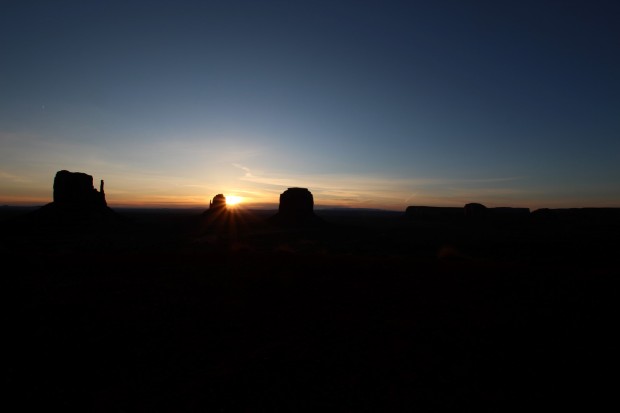
Being largely an uninhabited wilderness area, I also took the Vixen Polarie with a plan to at last capture images of the Milky Way.  Unfortunately, whilst I had checked the sky beforehand on Cartes du Ciel, I think I must have made an error with the dates.  We did get clear skies but unfortunately it turned out to be a full moon whilst there, which ruled out any hope of seeing, let alone imaging the Milky Way; oh well there’s always another day and it’s not going anywhere in the meantime.  Notwithstanding I did manage some pleasing nightscapes at Monument Valley and Bryce Canyon.

IMG_6235 (Large)

Given my initial guiding success prior to visiting the USA, I had been looking forwards to getting to grips with improving guiding and imaging on my return.  Furthermore, on 6th May there was a rare solar transit of Mercury and in preparation, the week before I set up and tested all the equipment and then successfully took some test images of the Sun using a Baader solar filter.  All was well on the appointed day which was also fortunately clear and sunny, so that shortly before contact I was all set and ready to try and capture the movement of a small black dot (Mercury) across the face of the Sun.  Unfortunately it was not to be and the weeks that followed almost marked the end of my still nascent hobby of astrophotography!

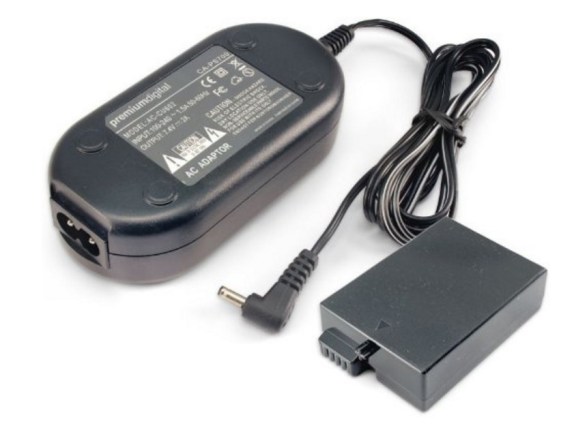
In short, EQMOD crashed when I turned on the DSLR camera to image the transit!  I tried re-booting and checked every other piece of equipment numerous times but to no avail.  I subsequently spent weeks trying to track down the problem, checking and re-checking every cable, piece of equipment and updating or reinstalling all the relevant software without success.  The nature of the problem strongly suggested there was a conflict between EQMOD-ASCOM and the camera and I therefore turned to the EQMOD forum for help, without success.  Somewhat late in the day and by now desperate, I posted the issue on SGL and quickly received a reply from someone who had had a very similar problem, which though also very difficult to identify, turned out to be a very small break in the outer cover of the DSLR AC/DC power adapter cable.  It’s not clear to me why this matters but I bought a new adapter and as they say, Bob’s your uncle, it worked!  I have looked very carefully at my adapter and cable and can see nothing wrong but am very thankful for the advice.

acdc

AC/DC Adapter: How can something as basic as this cause so much disruption?

It seems ridiculous that this very minor problem was nearly terminal but just in case it happens again I have since bought another spare power adapter.  Together with my daughter’s wedding in early June and the adapter meltdown, imaging for two of the three months during this period was almost non-existent.  Still by July I was ready to start again but by then there was no astronomical darkness!

No

Date Object

Name

8 April USA Monument Valley etc
9 06/06/16 M5 Globular cluster
10 M13 Globular cluster
11 M57 Ring Nebula

JULY TO SEPTEMBER

After the carnage of the last quarter, I was then unable to resume imaging in July due to travel commitments.  So I used what time was available to improve my knowledge of PHD2 and once again, check everything was now working ready for the return of astronomical darkness and better night skies from 20th July; I am of course now paranoid of another similar breakdown.  At the start of August I manged to obtain a just passable image of the Eagle Nebula for the first time.  Then shortly afterwards on the evening of 11th / 12th August, clear skies produced a decent night for viewing and imaging a few of this year’s Perseids meteor shower.  But it was at month-end and continuing into September that my imaging in 2016 finally took off.

m27-comps-paintfile

At that time the weather was consistently dry and warm, providing more than a week of clear skies and almost nightly imaging.  Dark nebulae are interesting features I’d hitherto not recognised as imaging opportunities and was therefore intrigued to successfully image the E-Nebula at this time.  Thereafter I used the opportunity of the weather window to experiment with PHD2 by using M27 the Dumbbell or Apple Core Nebula as a control imaging object.  Of course, each year is different but I’ll try to use any similar conditions in the future to sort out and develop old and new techniques, such unusual moments are precious for UK astronomers.  At the end of nearly two tiring weeks I had PHD2 working quite well and have not looked back since.  As a result of this work soon thereafter obtained good images of the Andromeda Galaxy, as well as the Veil, Crescent and Ring Nebulae.

No

Date Object

Name

12 07/08/16 M16 Eagle Nebula
13   M11 Globular
14   B142-3 Dark E-Nebula
15 11/08/16 Perseids  
16 23/08/16 LDN 673 Dark Nebula
17   NGC 6781 Planetary Nebula
18   M27 Dumbbell Nebula
19   Albireo Double star
20   Moon  
21 28/08/16 M11 Globular cluster
22   NGC 6905 Blue Flash Neb
23   Albireo Double star
24   15 Aquilea Double star
25   NGC 6960 W Veil / Witch’s Broom
26   M32 Andromeda Galaxy
27 29/08/16 M27 Dumbbell Neb
28   NGC 6960 W Veil / Witch’s Broom
29   NGC 7814 Pegasus galaxy
30   M15 Globular
31   M27 Dumbbell Nebula
32   M27 Dumbbell Nebula
33 08/0916 M27 Dumbbell Nebula
34   M27 Dumbbell Nebula
35   NGC 6960 W Veil / Witch’s Broom
36   NGC 6960 W Veil / Witch’s Broom
37   M31 Andromeda Galaxy
38 11/09/16 NGC 6888 Crescent Nebula
39   NGC 6992 Eastern Veil  (NGC 6995)
40 13/09/16 M57 Ring Nebula

OCTOBER TO DECEMBER

Normal conditions resumed later in September and into the final quarter in the form of overcast skies.  A minor break in the weather allowed a crack at the M33 Triangulum Galaxy towards the end of October but only in late November did another clear period occur, by which time the winter sky had arrived and temperatures had fallen to nearly 0oC.

Picture saved with settings embedded.

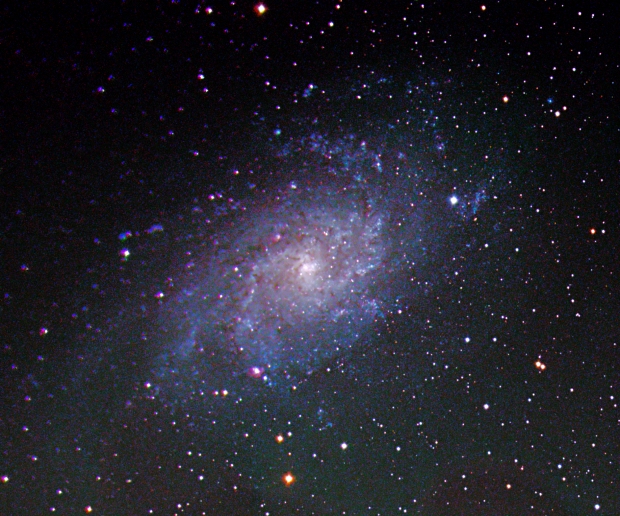
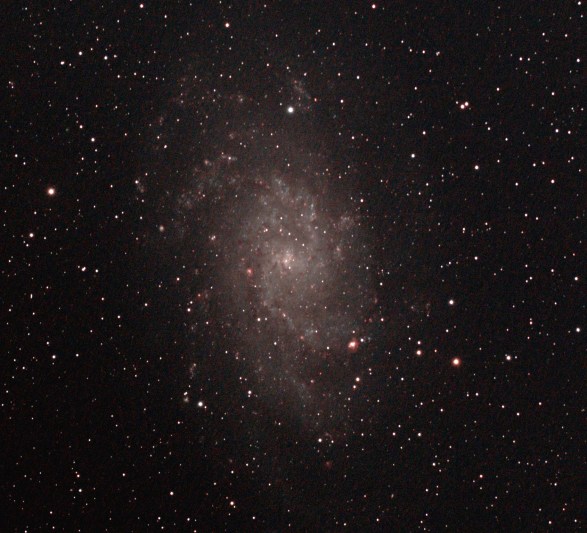
M33 Triangulum Galaxy – consisting of some 40-billion stars, the photons in this image have travelled 3-million light years in order to reach my camera sensor! | WO GT81 + modded Canon EOS 550D & FF guided | 18 x 300 secs @ ISO 800 & full calibration | 22nd October 2016

Unfortunately I am unable to establish a permanent observatory here at Fairvale and have to take-out the bring-in all the astronomy equipment each time.  Apart from being inconvenient this has two practical disadvantages: (i) it can be uncomfortable even unpleasant working outside in such temperatures, and (ii) it is necessary to polar and star align every time; on occasion when using SynScan and EQMOD-ASCOM it can take up to 2-hours before starting imaging.  Fortunately, I think I have now sorted out both these problems which should greatly help in the future.

By re-configuring the computer, mount and camera wiring, combined with establishing a wireless link between my tablet and the computer, once set-up I can now control most of the functions from indoors.  The comfort of being indoors benefits operating in general and especially thinking, which can be quite difficult when astroimaging and made even harder when it is cold.

With prolonged periods of clear weather in the second-half of the year, I was sometimes able to set-up and leave the equipment for a few days under a waterproof cover, which meant that from day-to-day I could be up-and-running each time in less than 30 minutes!  However, I expect this will only rarely be possible and nightly set-ups are likely to continue to be the norm.  Fortunately, I have also recently discovered two techniques that should help both streamline and improve star and polar alignment in the future.

In addition to guiding, PHD2 has a very good polar alignment facility that eliminates the use of the SynScan handset and enables the procedure to be carried out from the computer; it can also be undertaken without sight of the Polaris star, which is a major problem at Fairvale Observatory where it is totally obscured by my house.  At times when the mount can be left outside, I can also save and subsequently re-use the star-alignment model in EQMOD-ASCOM.  All-in-all these and other procedures have made a very positive impact on my astronomy and astroimaging.  The outcome of these changes led to a decent sequence of imaging with which to finish the year and, furthermore, hopefully provides a strong foundation for continuing improvements in 2017.

No

Date Object

Name

41 22/10/16 M15 Globula cluster
42   M33 Triangulum Spiral Galaxy
43 28/11/16 M45 Pleiades
44   NGC 2024 Horsehead Nebula
45   M42 Orion Nebula
46 29/11/16 Hyades Open star cluster
47   NGC 2244 Rosette Nebula
48 30/11/16 NGC 1499 California Nebula
49   IC 405 Flaming Star Nebula
50 03/12/16 M74 Spiral Galaxy
51   M77 Spiral Galaxy
52   M1 Crab Nebula
53   IC 2118 Witch’s Head
54   M78 Reflection Nebula
55 04/12/16 SH2-264 Lamda Orionis
56   SH2-261 Lower’s Nebula

ETCETERA

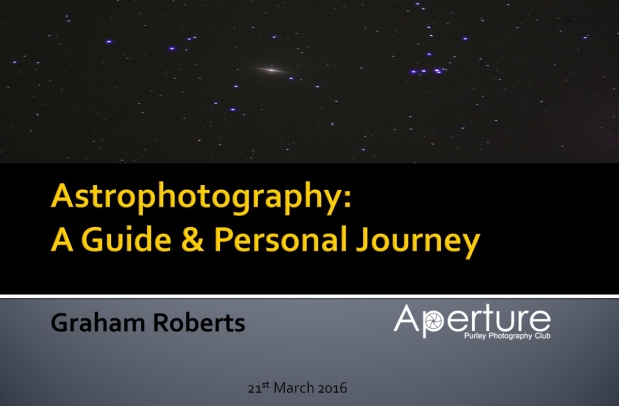
A few other astronomy and imaging related matters helped shape the past year for me. After  coming across WTSM, I was surprised to be contacted by the Purley Photography Camera Club to give a lecture on astrophotography in March.  I’m pleased to say the event went very well and, furthermore, the process of compiling the presentation beforehand helped expand my own knowledge of the subject too.

TTT Cover

In May I received a sun dial installed on a carved Purbeck Stone plinth as a retirement present.  As a time piece it’s accuracy is limited but it is a beautiful addition to my garden and solar astronomy for which I am very grateful.  By coincidence, later in the year I also came across a simple but charming sun dial set into the ground by the upper lake at Earlswood Common, a short walk from my home and  Fairvale Observatory.  Intriguingly it works by standing on a central stone, located depending on the season, and then uses your own shadow to read off the time – clever.

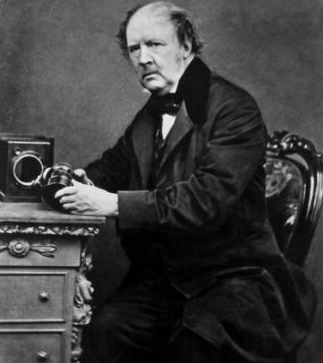
In September we visited Lacock Abbey in Wiltshire, home of William Fox Talbot in the 19th Century – photography pioneer and notable for developing photographic fixing and printing.  The photography museum there is very good and it was fascinating to see his place of work in the house, where the very first photographic print is also displayed.  His contribution to photography  is unique and today he is generally recognised as the father of modern photography.

william-henry-fox-talbot-with-camera-141697035181903901-141210123557

As  a Londoner born and bread, I like to think I know the city well and over my lifetime have visited most of its unique sites, old and new.  However, for some inexplicable reason I had never been to Westminster Abbey, so decided to put that right in November.  It is, of course, a building of unparalleled history, with numerous graves and memorials of centuries of kings & queens, as well as scientists, explorers, poets, actors etc.  Noteworthy amongst these for the astronomer is the physicist and mathematician Sir Isaac Newton and  Second Astronomer Royal, Edmond Halley.

I must next give mention to the man who throughout the year dominated my reading, learning and thinking – Albert Einstein.  His work during the early part 20th Century still dominates today’s physics and astronomy.  We continue to make ground breaking discoveries that substantiate and build on his ideas that were originally postulated over 100-years ago.  Pictures only recently obtained using the the Hubble telescope have spectacularly demonstrated the effect of gravitation lensing and in 2016 for the first time ever the existence of gravitational waves was confirmed.  This year I therefore decided to understand the man and his work better.  During the first half of the 2016 I read Walter Isaacson’s excellent biography of Einstein and have recently completed and 8-week Stanford University course on the Special Theory of Relativity.  They were both very enjoyable, immensely interesting and time well spent.

Finally, this Christmas I was surprised and very pleased to receive a printed, bound copy of the WTSM blog for the period since its inception on 5th August 2014 until 10th November 2016.  A lot of work has gone into producing this blog and I’ve always been concerned that somehow something might go wrong with the website or internet and it would all be lost. This book now safely preserves in print all the blogs and images posted during the aforementioned period.  The production is generally very good and I have already enjoyed re-reading some of my blogs once again.

img_20161227_122915516

WTSM: The Book!

Favourite Images

As a result of the aforementioned issues, 2016 has certainly been a year of two halves.  Having resolved the equipment problem and started to employ some very useful new techniques and software, I was eventually able to obtain some good images. My personal favourites in no particular order are shown here below:

Picture saved with settings embedded.

Barnard’s Loop & Lamda Orionis Nebula : Vixen Polarie & modded Canon 550D + Sigma UWA @ 20mm | 11 x 240 secs @ ISO 1,600 + darks | 7th January 2016

IMG_6219L1C1 (Large)

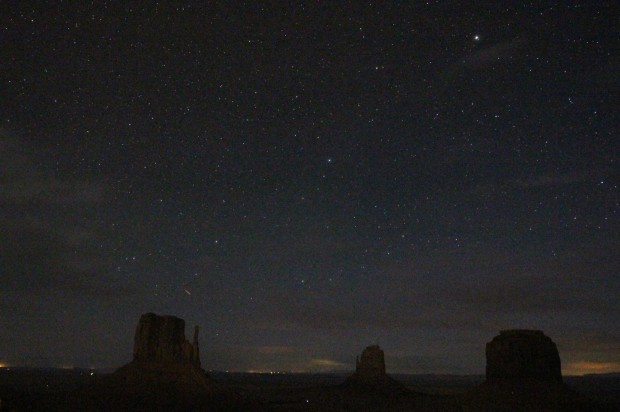
Monument Valley by Night: order of buttes same as daytime photo above. Canon 700D + 10mm Sigma wide-angle lens | 20 x 15 secs @ ISO 6,400 | 10th April 2016

Picture saved with settings embedded.

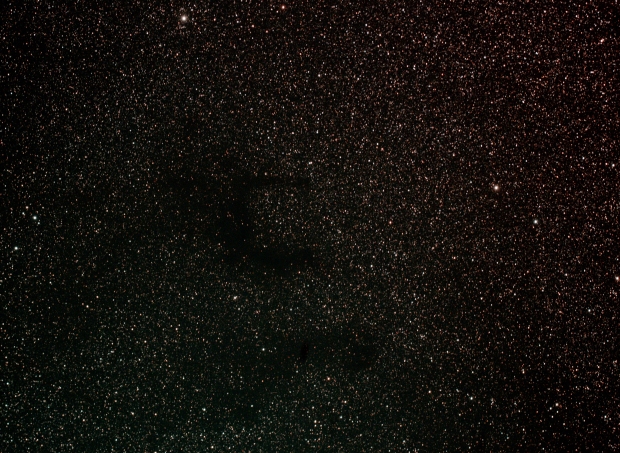
B142/3 Barnard Dark E-Nebula

Picture saved with settings embedded.

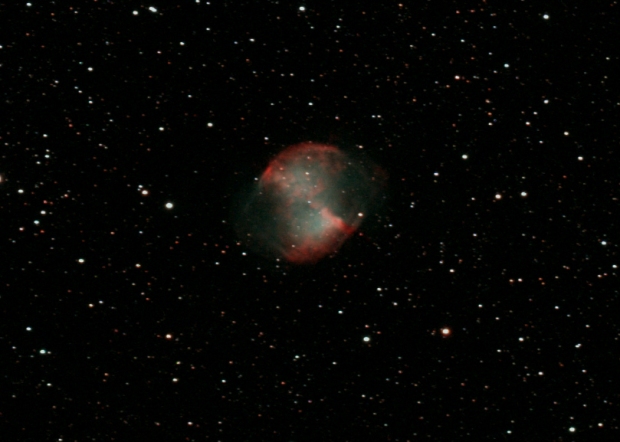
M27 Apple Core Nebula | William Optics GT81 + 50mm Guide Scope & 10-point EQMOD-ASCOM alignment model | modded Canon 550D + Field Flattener | 3 x 300 secs @ ISO 1,600 & full calibration, 90% cropped | 30th August 2016

Picture saved with settings embedded.

M31 | WO GT81 + modded Canon 550D & FF | 10 x 300 secs @ ISAO 1,600, darks + flats | 8th September 2016


Round-up & goals for 2017

Despite the frankly awful start to the year, astronomically speaking 2016 finished on something of a high.  Furthermore, contrary to initial indications I was in the end partially successful in achieving some of my objectives set out at the beginning of last year:

RECORD CARD – 2016
Goal Specifics / Results Outcome
Increase imaging exposure times Improved equipment set-up and alignment and successfully started autoguiding with exposure times of up to 8-minutes. DONE


Improve processing Started using newer version of Photoshop CS2 + other related software. Improvement with post-processing using online tutorials and Nik Syzmanek’s booklet Shooting Stars. GETTING THERE


Start widefield imaging Purchased Vixen Polarie, with portability put to use in the USA but did not make UK dark sky sites as planned. GETTING THERE


img_20161130_234303293

Getting better: PHD2 working screen 30th November 2016, DEC is good but room for improvement with the RA settings. Notwithstanding, the impact of tracking and image quality is noticeable.

download

I’m concerned about setting more goals or the forthcoming year but I think it helps, so here goes:

  • Improve processing: As the headmaster’s report would say “room for improvement” and I will try.  I have purchased Warren Keller’s book Inside PixInsight, considered by many to be the gold standard of post-processing software but is a nightmare to learn – this may be a step too far for now, we’ll have to see – maybe 2018?
  • Expand and improve widefield imaging: First – use the Vixen Polarie as had been intended last year to obtain nightscape images at UK dark-site locations.  Second – look at ways of using a widefield set-up with the mount more successfully.
  • Start LRGB imaging: I spent a lot of time in 2016 considering the question – what next? I am keen to image smaller DSO objects, in particular galaxies and was on the verge of purchasing a larger telescope – probably another refractor.  However, after attending a talk by Nik Syzmanek, one of Britain’s foremost astrophotographers, I have come to the conclusion that the next step should probably be a move to LRGB imaging, which if successful probably has the greatest potential to improve my pictures – let’s hope so.

Looking back 2016 was a funny old year, which for me was defined by three experiences:

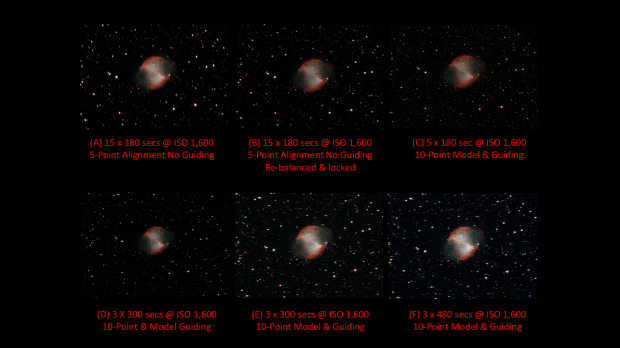
Despite two wonderful periods at the end of August and November the weather for astronomy was mostly awful, with cloud cover for weeks on-end and when it was clear, it was a full moon – frustrating or what?

I had already learned that patience and perseverance are required in large quantities for astroimaging but the equipment break-down in May and June was so severe and apparently insoluble that, together with the aforementioned cloudy skies, I really thought of giving up.

However, this time there is a happy ending: after I finally solved the equipment problem and started autoguiding, I feel I have eventually made some great strides with my imaging in 2016 which, furthermore, holds much promise for the coming year and I hope can record in WTSM’s Reflections at the end of 2017.

Watch this space!


Reflections – 2015

Launched in August 2014, 2015 is the first full year of Watch This Space (Man) and despite some personal set-backs it’s been an interesting year astronomically, with much to write about.  Whilst I have made progress with my imaging, it was not what I would have wished for but nonetheless I have been pleased with the outcome.  Continuing on from last year, Reflections is a recap and thoughts on all that happened to me astronomically in 2015 and looks forward to the coming year.

Although this website is just intended as my record of A personal discovery of the Universe through astronomy and astrophotography, it has been pleasing to see that over the year the site has attracted 1,310 visitors from 77 countries around the world and over 2,700 views; you are all most welcome.  This was not the intention of the blog but I am humbled by the interest and would be very pleased to hear from anyone who would like to get in touch with queries, comments or just to say hello – contact details are in the About section.

Reflections 2015

JANUARY TO MARCH

The first quarter turned out to be my most active and successful period of the year for reasons that will become apparent later.  Strictly speaking my image of the Rosette Nebula posted on 5th January was taken on 29th December 2014 but what an image to start the year with, clearly I was doing something right by now.  Notwithstanding, from looking at pictures of the same object taken by other more accomplished photographers, it was evident that something was missing – red!  This was an easy to problem to solve and I immediately set out on a quest to find a suitably modified camera with the IR filter removed.  Soon thereafter I was lucky to find an excellent second hand modded Canon EOS 550D, which has now become my main imaging camera of choice and with all that extra red Ha-light has led to a quantum improvement of many images since.  Such cameras are very popular so I felt lucky to have secured this one.

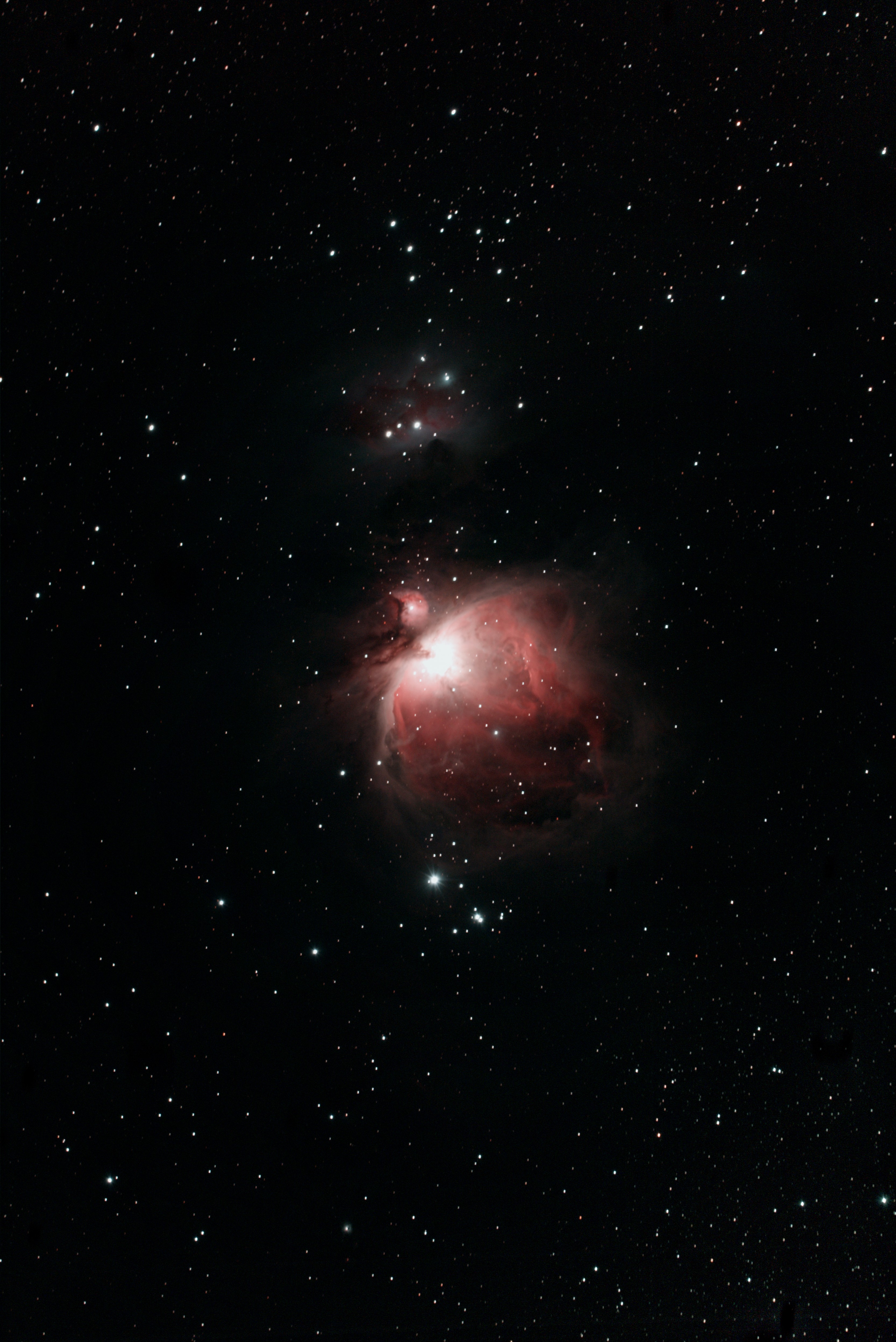
Orion's Sword: M42 The Great Orion Nebula, Running Man Nebula & NGC 1981 Star Cluster WO GT81 + modded Canon 550D & FF | 10 x 180 secs @ ISO 800 & darks calibration | 8th February 2015

Orion’s Sword: M42 The Great Orion Nebula, Running Man Nebula & NGC 1981 Star Cluster
WO GT81 + modded Canon 550D & FF | 10 x 180 secs @ ISO 800 & darks calibration | 8th February 2015.  Modification of the camera by removing the IR filter increased red Ha-light.

EQMOD / ASCOM is a popular free software project developed by amateurs that, amongst other things, provides computer and planetarium linked control of the mount; with other compatible linked programmes such as APT (Astrophotography Tool) and PHD (Push Here Dummy) control can be extended to cameras and for autoguiding.  At the start of the year I successfully started using Carte du Ciel planetarium linked with EQMOD for computer controlled alignment and mount control, which as expected was very useful – particularly when it got really cold and I was able to take the equipment indoors and operate the equipment remotely.  However, later in the year I have encountered connection problems which are, as yet, not fully resolved.

Whilst EQMOD is an excellent project which provides first class mount control when working, it requires additional faffing about and problems on a different level of scale, which with limited imaging conditions in the UK and having to set up outside from scratch each time is a pain.  For this reason and others I have not yet moved to autoguiding, which I know will be highly beneficial to imaging but for the moment has proved to be a step too far for me.  Such is the fickle nature of all this that I’m now considering other ways of achieving the same end, perhaps with professional software control and a stand-alone guider, such as the Lacerta M-GEN – of course a dedicated observatory would help a lot but seems unlikely at the moment!

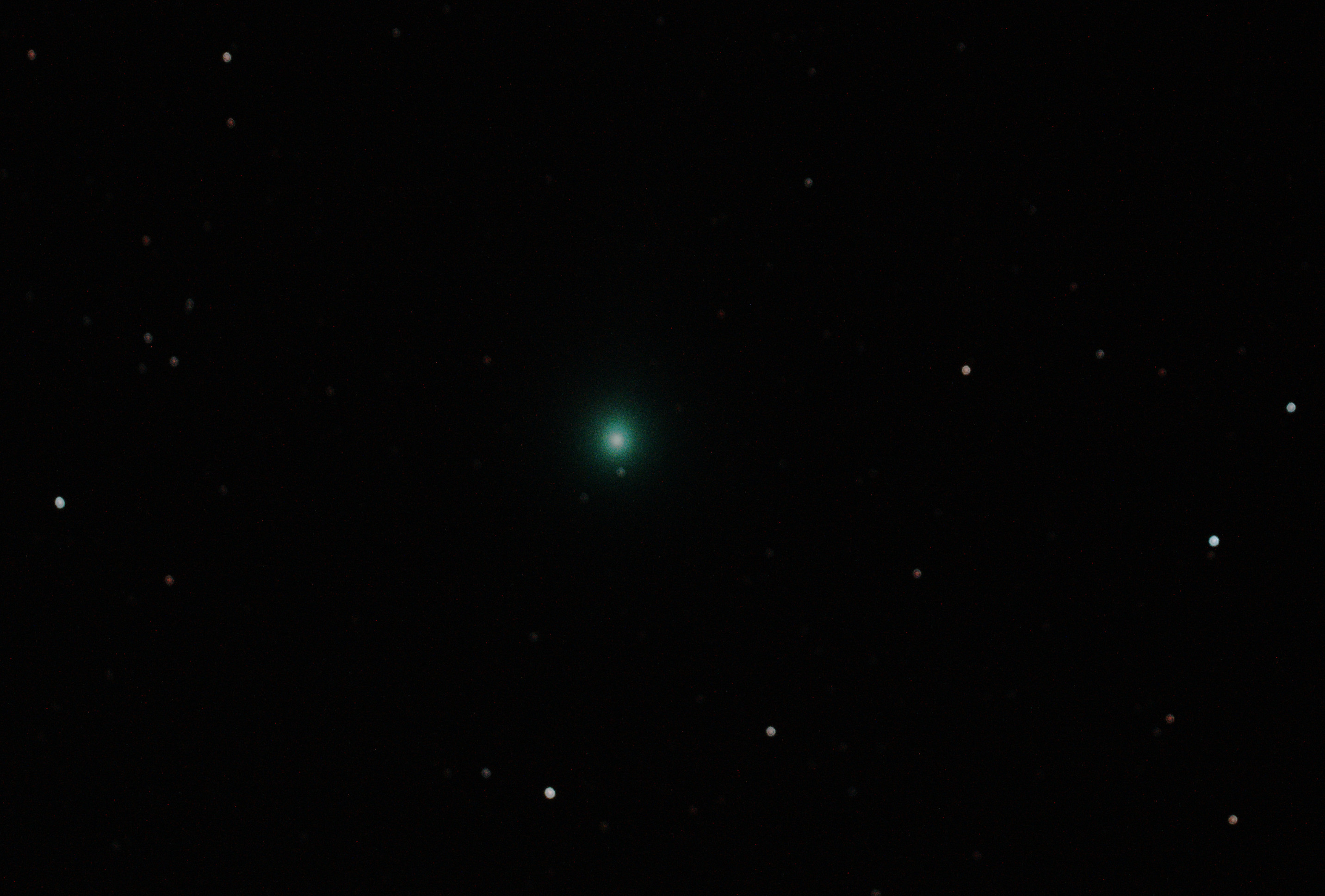
I have previously found the early winter sky of Orion, Taurus, Pegasus and Monoceros very productive with beautiful imaging objects such as M42 and the Horsehead Nebula.  However, this year looking more closely at the late-winter / early spring skies turned out to be just as exciting, with a veritable playground of galaxies to choose from during February and March.  Notwithstanding, the highlight during the winter was successfully imaging Comet Lovejoy, a first for me that required changes to  normal DSO and planetary imaging techniques as this ephemeral object was speeding across the night sky at over 70,000 mph – post processing also turned out to be quite different.

C/2014 Q2 Comet Lovejoy WO GT81 + Canon 550D (modded) & FF | 40 x 20secs @ ISO1,600 + darks | 16th January 2014

C/2014 Q2 Comet Lovejoy
WO GT81 + Canon 550D (modded) & FF | 40 x 20secs @ ISO1,600 + darks | 16th January 2014


No Date Object* Name
1 16/01/15 C/2014 Q2 Comet Lovejoy
2 16/01/15 C/2014 Q2 Comet Lovejoy
3 16/01/15 NGC 2244 Rosette Nebula
4 22/01/15 M42 etc Orion Nebula
5 22/01/15 M45 Pleiades
6 22/01/15 Comet Lovejoy
7 22/01/15 Comet Lovejoy
8 22/01/15 Banard’s Loop
9 22/01/15 Banard’s Loop
10 22/01/15 Orion Constellation
11 24/01/15 NGC 1909 Witch Head Nebula
12 24/01/15 NGC 2392 Eskimo Nebula
13 24/01/15 M44 Beehive Cluster
14 24/01/15 IC-443 Jellyfish Nebula
15 08/02/15 M42 Gt Orion Nebula etc
16 08/02/15 Barnard 33 Horsehead Nebula etc
17 21/02/15 M65 Leo Triplet (Galaxies)
18 21/02/15 M105 M96 Group (Galaxies)
19 24/02/15 Venus & Mars
20 25/03/15 NGC 2903 Spiral galaxy – Leo
21 25/03/15 NGC 3842 Galaxy cluster: Leo
22 25/03/15 M 88 Spiral galaxy: Virgo cluster
23 25/03/15 M100 Spiral galaxy: Virgo cluster
24 26/03/15 NGC 4438 Markarian’s Chain
25 26/03/15 M104 Sombrero
26 26/03/15 M53 Globular cluster


*Record of quarterly photographic images in 2015, excluding other widefield pictures

APRIL TO JUNE

Things took a turn for the worse in April when I went into hospital for a knee replacement operation.  All went well but it is a major operation and recovery has been slow and often painful, thus prohibiting any real astronomy until September.  It did however provide the time and opportunity to read about astronomy and pursue some MOOC astronomy courses.

After a period of convalescence, I did manage to obtain some widefield camera shots of the planets, the ISS and simple night sky images in the summer.  Whilst not as satisfying as prime focus photography, it was interesting and kept me sane during this otherwise difficult time.

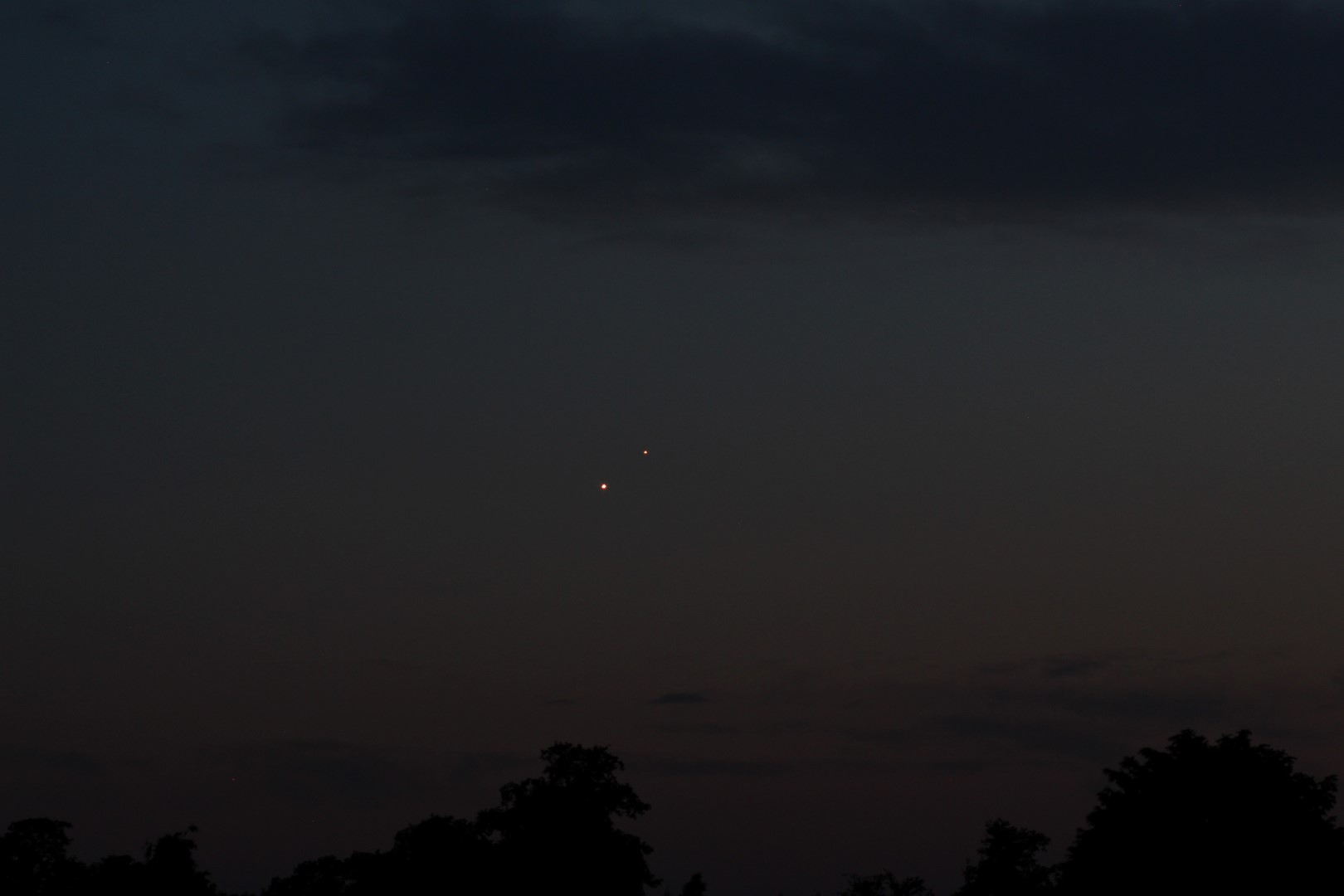
1st July 2015. Bingo = conjunction; though one day later Jupiter has now moved to the right of Venus.

1st July 2015. Conjunction of Jupiter to the right of Venus.

No Date Object Name
27 11/04/15 NGC 4438 Markarian’s Chain
28 11/04/15 NGC 4565 Spiral galaxy-side


JUNE TO SEPTEMBER

This period was more of the same until on 19th September, when at last I managed to set-up Fairvale Observatory for the first time since March, what a relief.  As a bonus I was particularly chuffed to achieve a good image of the Andromeda Galaxy but the highlight of this period and the year was the lunar eclipse at the end of the month on 28th September.

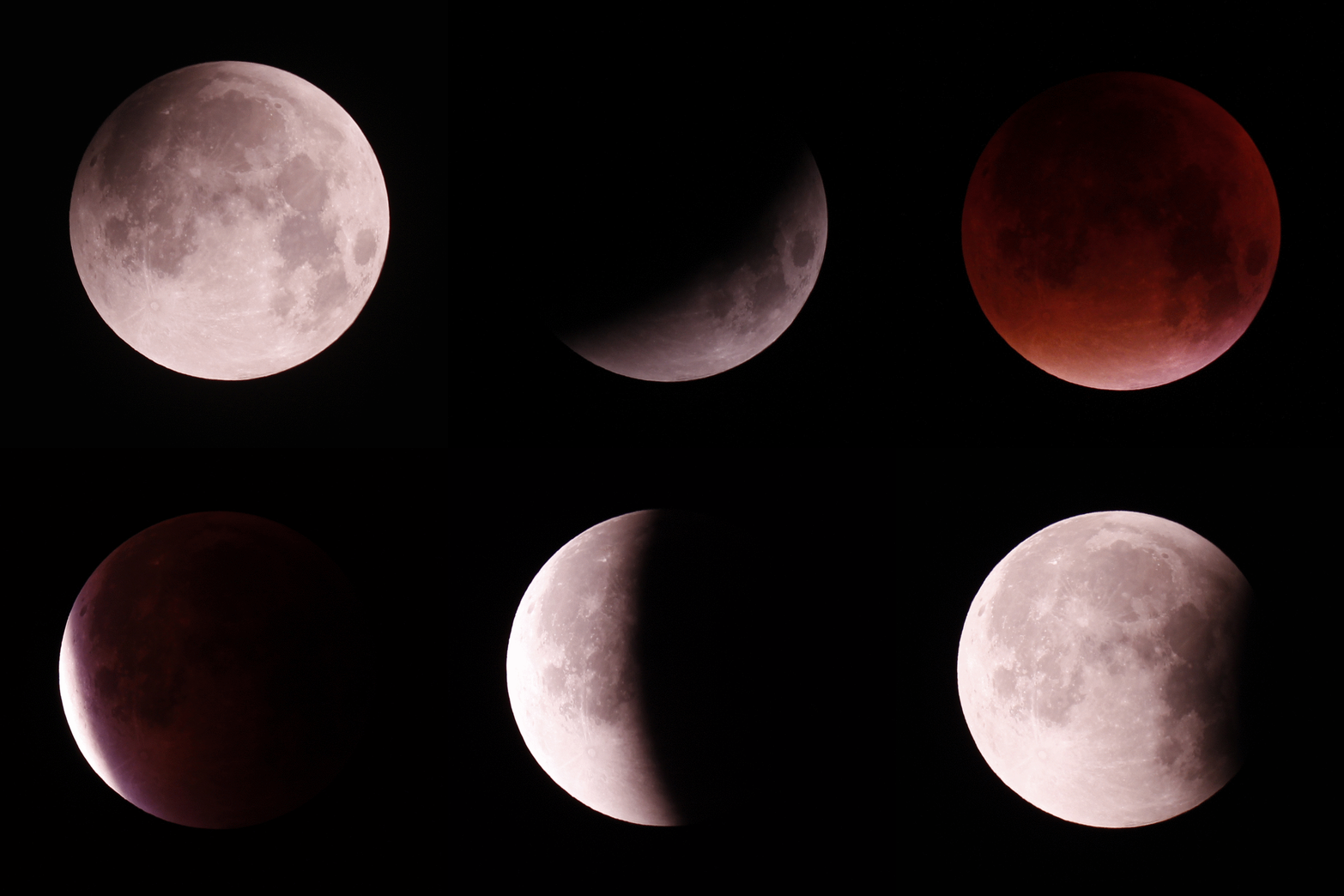
For once everything was perfect: a clear sky all night with a perfect view of the eclipse from start to finish.  I stayed up all night and would have to say it was one of the best, if not the best event I have so far experienced since taking up astronomy; apart from being an outstanding imaging opportunity, the ambiance throughout the eclipse was spellbinding.  I was therefore very pleased to obtain an excellent set of images of the entire eclipse, mainly using a prime focus camera set-up with the WO GT81 telescope but also with an alternative  camera and telephoto lens on a tripod.  The memory of that night will stay with me for a long while and, in part, helped to make up for the lost time since my operation in April.

Eclipse Animation 28th September 2015

Eclipse Animation 28th September 2015

No Date Object Name
29 19/09/15 IC 5070 Pelican Nebula
30 19/09/15 NGC 6979 Pickering inc Veil Nebula
31 19/09/15 M15 Globular Cluster
32 19/09/15 M31 Andromeda
33 28/09/15 Lunar Eclipse Entry @ 1 sec intervals
  28/09/15 Lunar Eclipse Totality
  28/09/15 Lunar Eclipse Entry @ 1 sec intervals
34 28/09/15 Lunar Eclipse Exit – camera + tripod
35 30/09/15 IC 1318 Sadr Region (+NGC 6910)
36 30/09/15 IC 1318 Sadr Region – Pt2


OCTOBER TO DECEMBER

The final quarter of the year has been very frustrating due to the almost complete absence of suitable imaging conditions, mainly due to cloud cover but even when there was a few clear nights it was of course a full Moon – you can’t win!  I was particularly unhappy as this time marks the arrival of the constellation Orion and all its wonderful imaging opportunities, for which I had new plans.

Given the short focal length of the William Optics GT81 and relatively small aperture, used with a APS-C cropped sensor DSLR camera the resulting field-of-view is a quite large and, where possible, this year I’ve therefore concentrated on objects of 2.5o to 3.0o apparent dimensions.  Together with the modded camera this has resulted in some exciting new images of old and new objects.

However, large as the field-of-view is with this set-up, I have become increasingly aware of the simply enormous scale of some nebulous features such as Barnard’s Loop.  As a result I have become more interested in widefield imaging using just a camera and tripod.  Like prime focus imaging, widefield imaging will also benefit from achieving longer exposures through the use of tracking.  Early in this period I was fortunate to purchase a Vixen Polarie lightweight tracking mount for this purpose, but due to the aforementioned conditions I have unfortunately been unable to use it very much.  In fact it’s fair to say that other than some brief experimentation, it’s hardly been used at all so far.  Notwithstanding, I can see the potential and have high hopes for future imaging opportunities when the clouds part and the Moon is absent.

The year finished with a couple of other purchases that I hope will assist with imaging in 2016:

  • A new laptop – running Windows 10 with a core i7 Intel chip, 2 TB hard drive, 16 GB RAM, dedicated AMD graphics card and an HD 17.3” screen, which I hope will help improve post processing.  Running my preferred Windows 7 operating system, I will continue to use the smaller 13” i5 chip laptop for mount and camera control.
  • Ultra-Wide Angle lens – the truth is I’ve recently acquired this wonderful Sigma 10 – 22mm  f3.5 lens for a trip to the Grand Canyon in April, however, I will of course also be using it with the Vixen Polarie when the skies clear.
No Date Object Name
37 09/10/15 NGC 6888 Crescent Nebula
38 09/10/15 M 74 Spiral galaxy (near Pegasus)
39 09/10/15 NGC 7814 Little Sombrero
40 09/10/15 NGC 7479 Barred spiral galaxy
41 09/10/15 M 31 Andromeda galaxy
42 08/12/15 NGC 1499 California Nebula
43 08/12/15 IC 405 Flaming Star Nebula
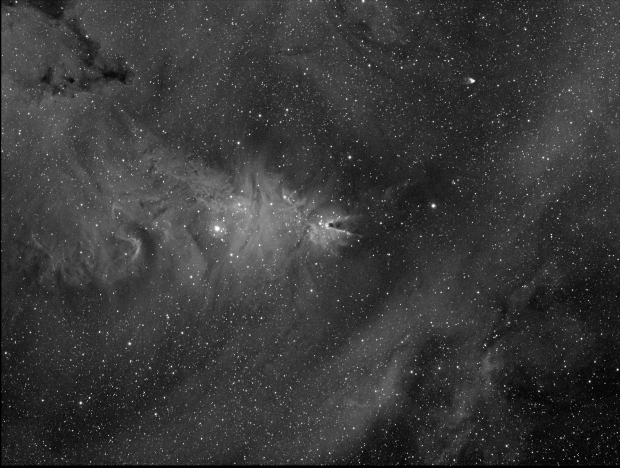
44 08/12/15 NGC 2264 Cone Nebula
45 09/12/15 M42 Great Orion Nebula etc
46 08/12/15 Orion Constellation


Favourite Images

Despite the lack of activity this year I have been fortunate to obtain some good images and I can only hope 2016 will be just as rewarding.  Acting as judge and jury, my personal favourites in no particular order are:

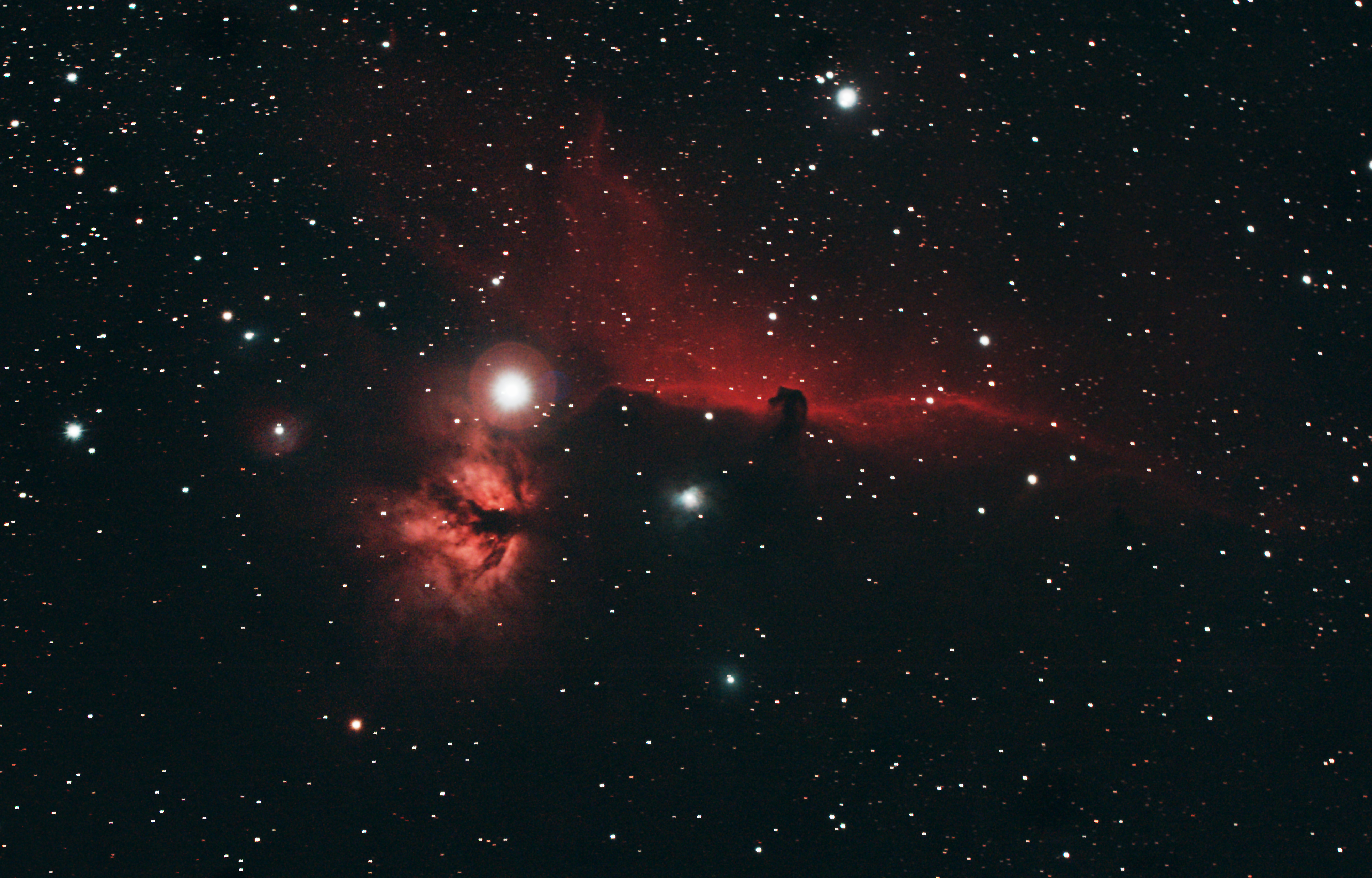
NGC 2024 Flame Nebula & Horsehead Nebula WO GT81 + modded Canon 550D & FF | 10 x 180 secs @ ISO 800 & darks calibration | 8th February 2015

NGC 2024 Flame Nebula & Horsehead Nebula
WO GT81 + modded Canon 550D & FF | 10 x 180 secs @ ISO 800 & darks calibration | 8th February 2015


Eclipse: Inward sequence from umbral contact to totality WO GT81 + Canon 700D + FF | 1/500 to 1/3 sec @ ISO 100 | 18th September 2015

Eclipse: Inward sequence from umbral contact to totality
WO GT81 + Canon 700D + FF | 1/500 to 1/3 sec @ ISO 100 | 18th September 2015


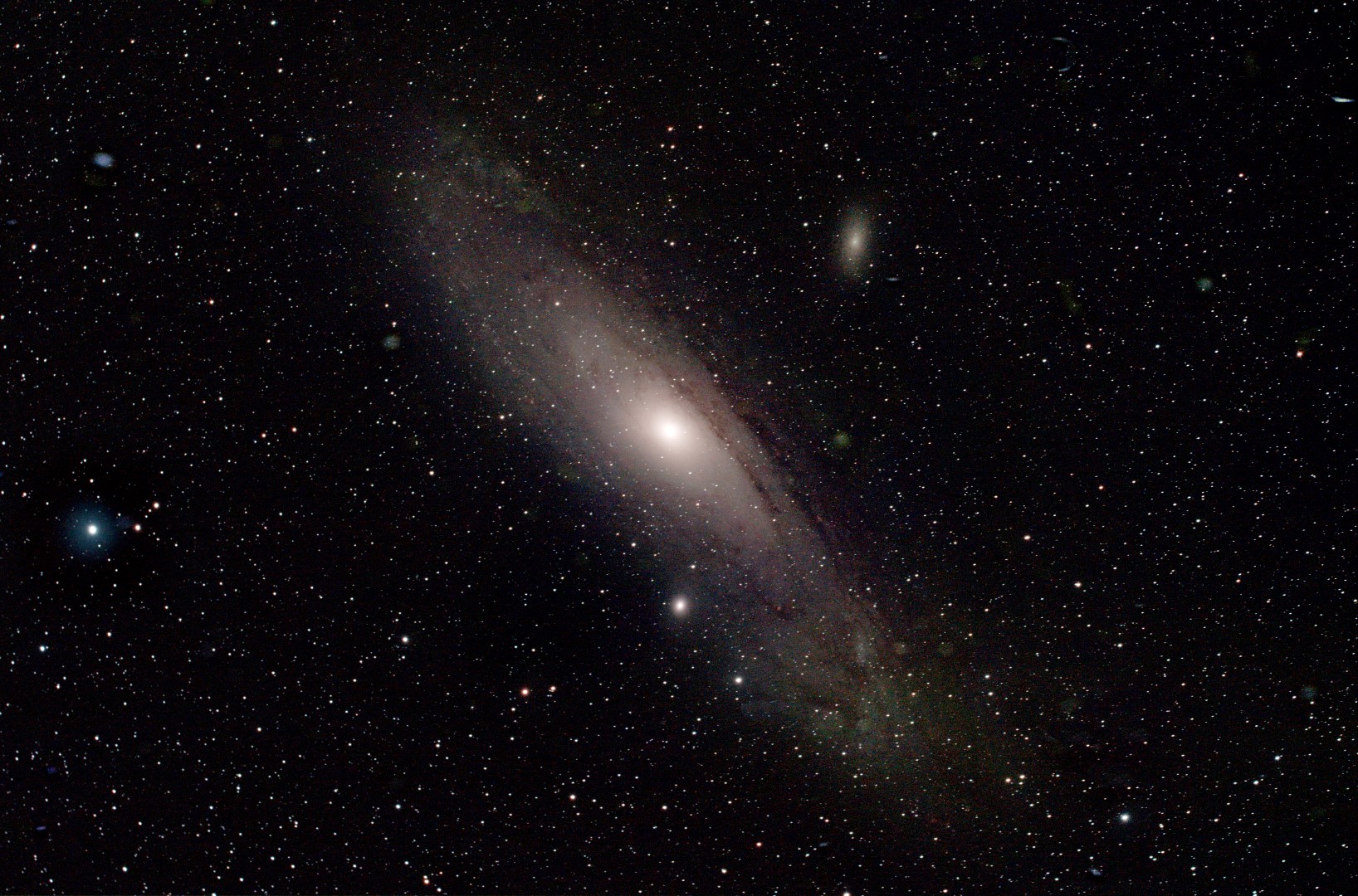
M31 Andromeda Galaxy WO GT 81 + modded Canon 550D + FF | 9 x 120 secs @ ISO 1,600 | 19th September 2015

M31 Andromeda Galaxy
WO GT 81 + modded Canon 550D + FF | 9 x 120 secs @ ISO 1,600 | 19th September 2015


??????????????

Goals for 2016

After the year that’s just finished I am reluctant to set out goals for 2016 but here goes:

  • Increase imaging exposure times: This is a euphemism for (a) improving equipment set-up and alignment, and (b) start autoguiding. As previously outlined, I have been struggling with both of these issues but one way or another I have to overcome the problems in order to obtain exposure times of at least 5-minutes and hopefully longer;
  • Improve processing: I was pleased to get to grips with Photoshop in 2015, albeit using a very old version, which together with other minor improvements to processing has added to the quality of the final images.  However, I know that even now there is more to be teased out of the existing imaging data for which I am already considering new software;
  • Start widefield imaging: First I just need clear skies in order to get out and start using the Vixen Polarie tracking mount from Fairvale Observatory, with the initial objective of imaging Barnard’s Loop, which has hitherto proved elusive to my current set-up.  However, one of the attractions of the Polarie-DSLR-Tripod combination is its portability, which I’d like to put to good use in 2016 by visiting dark sky areas in the UK.

There are other possible developments which at the moment seem unlikely to eventuate but you never know: a larger probably SCT telescope, a cooled CCD camera, and / or a permanent observatory (well I can dream can’t I?).


So all things considered 2015 was a good but not great year.  As a fundamental and important development I had really hoped to start autoguiding and thus increase exposure times but it was not to be.  Certainly the loss of astronomy time between April and September was a major set-back in many different ways.  Notwithstanding, during the remaining times available when I did manage to get outside I believe I achieved some of my best images to date and discovered many new and exciting objects in the night sky, which can’t be bad.  In particular, I am sure the lunar eclipse in September will remain a highlight of my astronomy experiences for many years to come.

Harvest Moon at Totality WO + Canon 700D + FF | 1/3rd Sec @ ISO 400 | 28th September 2015

Harvest Moon at Totality
WO + Canon 700D + FF | 1/3rd Sec @ ISO 400 | 28th September 2015


I’m now looking forwards to 12-months of uninterrupted astronomy, clear skies and plenty to report in the WTSM blog at the end of 2016!

Watch this space!

At the limit

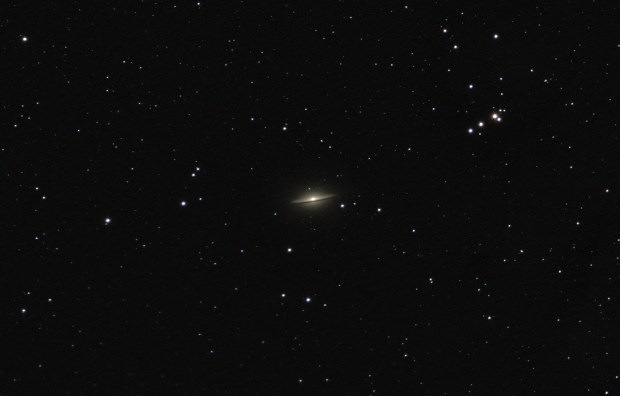
Earlier this month the weather and clear skies produced particularly good imaging conditions that resulted in some excellent pictures; it’s already a distant memory as the weather has since turned cold and cloudy day-after-day – or at least every night except when there’s a full Moon!  With these images knowingly in the bag and the telescope well aligned, I took the opportunity to indulge in a short session imaging some galaxies that happened to be around the Meridian at this time which, as it turned out, were located in proximity to the constellation of Pegasus.

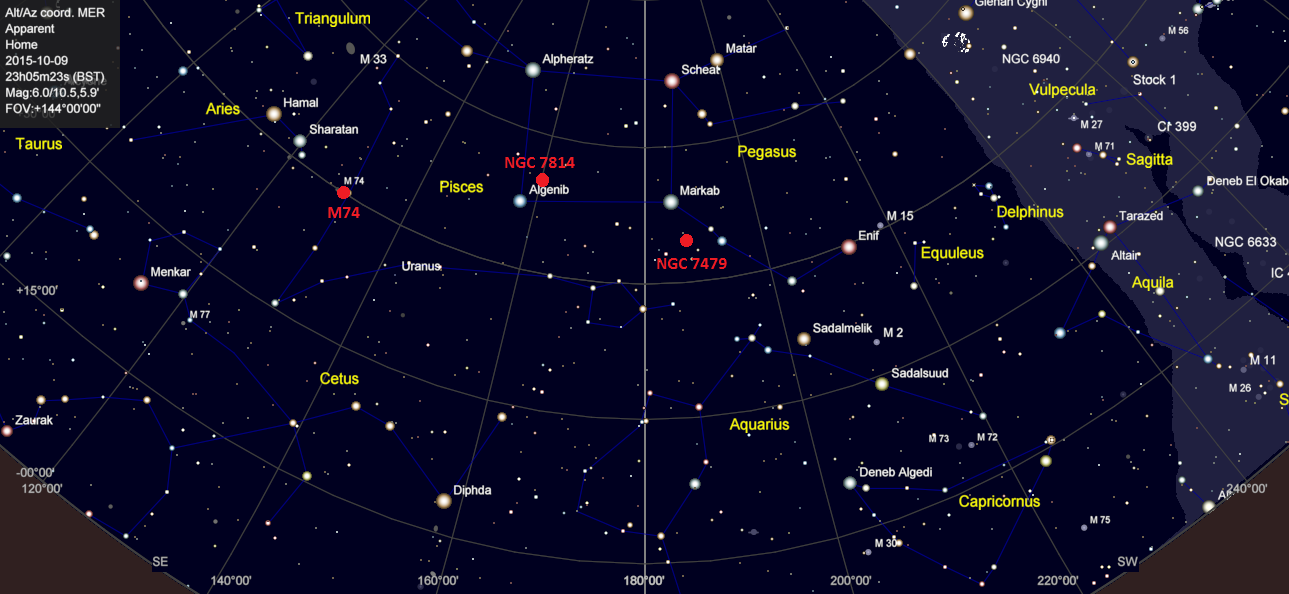
pegasus ANOTATE

Two of the objects (M74 & NGC 7814) were confined to just ten shots and the third fifteen, all at 180 seconds exposure and ISO 1,600.  For such dim and distant objects this in itself was obviously insufficient but still it was fun to experiment.  As expected the resulting images are feint and noisy but the object’s form can be clearly seen and, in the case NGC 7814 – the Little Sombrero, even the edge-on dust lanes are evident.

In order to better understand the limits of the equipment, a comparison of the images with the objects’ physical information given side-by-side illustrates the problems and possibilities for the future.  The truth is that these are all at or beyond the realistic limit of my current set-up but I was interested to see what results could be achieved and I always enjoy their beauty, even if imperfectly captured.

Picture3

Apart from the obvious problem of size, mainly a function of distance in this case, their apparent magnitude is also challenging.  It is interesting to consider that using the 18 megapixel Canon 550D and WO GT81, each camera pixel which measures 4.30μm samples just 1.855 arc seconds per pixel and therefore even the largest of these objects (M74) spans an area of just about one tenth of a degree (0.10o).  Better alignment and longer exposure should tease out more detail but as the recorded image of each object is no more than 2% of the total image the reality is that I am pushing my luck.

Still it is fun and I have managed to capture a few of the photons that left these galaxies so long ago.  As my equipment, techniques and knowledge continue to improve then hopefully so will the limits.  Watch this space!


Space Odyssey

I have just finished reading Chris Hadfield’s excellent book An Astronaut’s Guide to Life on Earth, which is an entertaining and insightful look at being an astronaut and the lessons it provides for life in general.  Who of us has not at least considered such an adventure ourselves but, of course, it is impossible for all but a few.
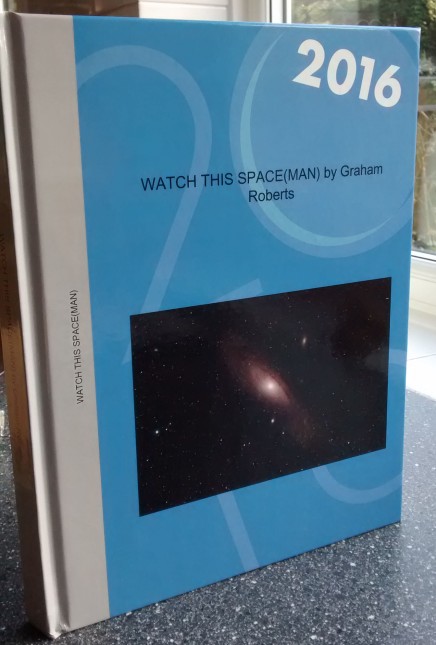
51lLw6nsBsL._SX328_BO1,204,203,200_

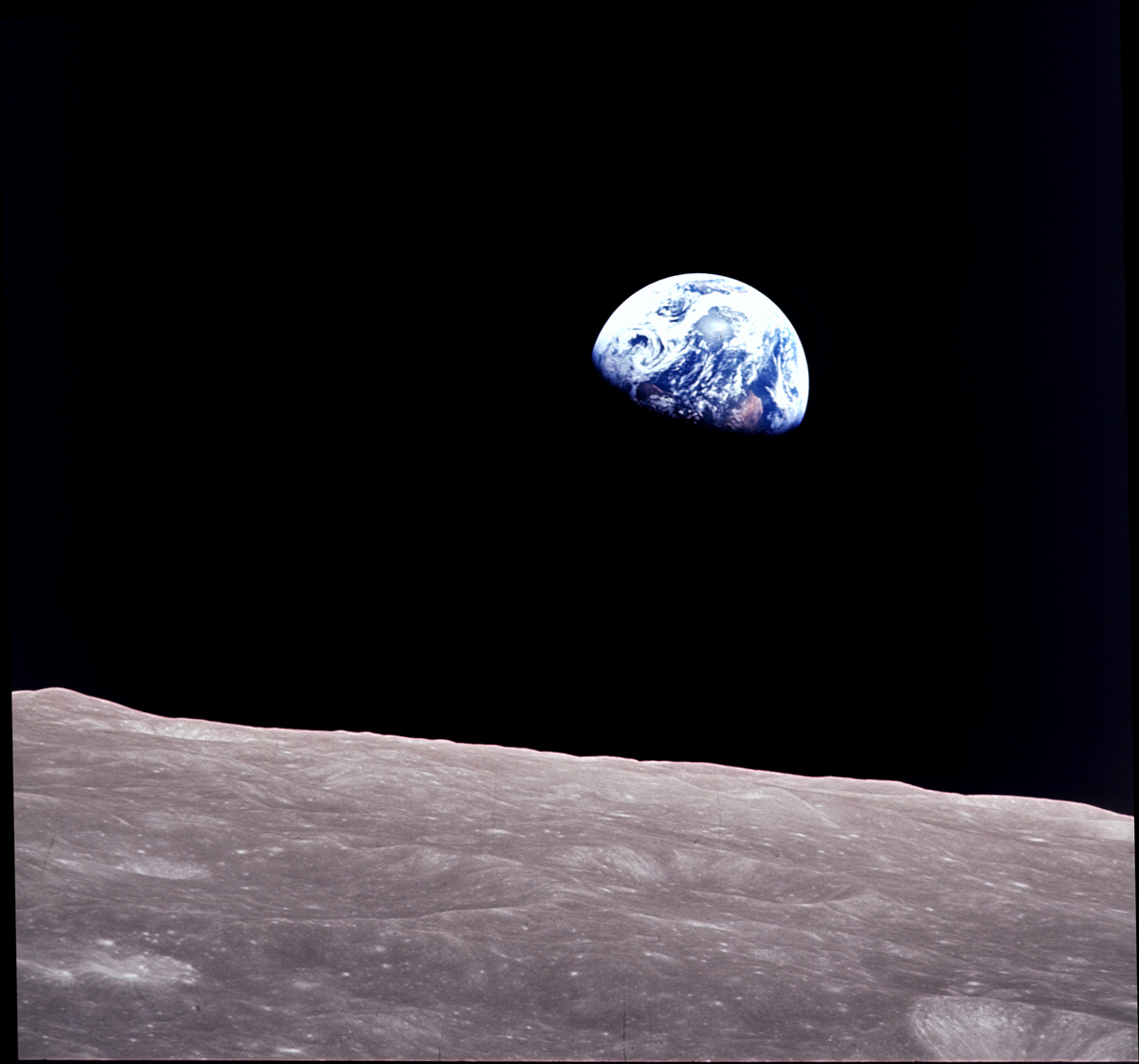
Astronomy is thought provoking enough in itself looking out at the vastness and beauty of the Universe, being in space and looking down on our planet would take such thoughts to a whole different level; from their subsequent accounts it is clear that those who have walked on the Moon became changed people, returning different to the rest of us.
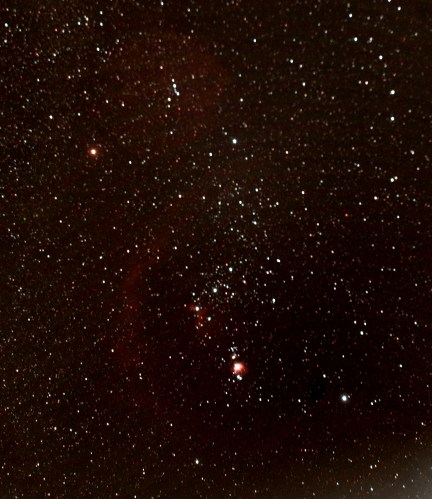
apollo08_earthrise

Ever since following the pioneering space adventures of Yuri Gagarin and Alan Sheppard and especially watching the Apollo 11 Moon landing in 1969, I have been fascinated by space, its science and the human experience of travelling there.  My solution to going into space was to take up scuba diving and since 1976 have had many wonderful diving experiences all over the world.  Of course, it’s not space but it is very much other worldly and the weightless feeling is as close as most of us will get to being in space; the astronauts train extensively underwater for just that reason.  Furthermore, as a geologist and more recently taking up astronomy has altogether provided me with a better understanding of the Universe.

Maldives, Kandooma 2004: the closest I'll get to space!

Maldives, Kandooma 2004: the closest I’ll get to space!

Given my long standing interest in space, it is perhaps surprising that I came late to astronomy itself, so why now?  The best answer is time – in recent years I have had more of it and in the past work, family and extensive travel precluded such a pastime.  Like so many sciences in the modern era, technology has also unlocked major new opportunities for scientists and amateurs alike.  Whilst I enjoy the science itself and especially viewing the night sky, the ability to produce frankly incredible images has been the most important key to my recent personal interest.

The phenomenal imaging improvements that have occurred since the launch of Hubble have made the power and beauty of the Universe even more accessible to us all on Earth.  Digital image capture and processing is now so powerful that pictures of hitherto unimaginable quality can be achieved from Earth.  Furthermore, for a relatively modest cost outlay, such images can be obtained by amateurs like me, literally outside my back door.  More than any other development, this is what has now engaged my interest.  The product of astroimaging can easily be overlooked as just an attractive, often spectacular photograph of the night sky – and they are.  But the equipment and pictures produced are also important tools that can assist our understanding as well as imagination of space.

andromeda

After a forced absence from astroimaging for the past six months, I was recently fortunate to obtain a number of exciting pictures of familiar objects on my first night back, in particular M31 or the Andromeda Galaxy.  As the nearest galaxy to Earth, Andromeda is an obvious target for those new to astroimaging but despite its proximity, it is not to be underestimated as an imaging target.  I have attempted imaging M31 before but, like many others, found it very difficult to coax out the detail which makes it such a beauty.  I am not completely sure what was different this time but the resulting picture at last starts to capture these details; I was even more surprised at the outcome which is the result of just nine 120 second exposures at the end of a long night before heading for bed!

M31 Andromeda Galaxy WO GT 81 + modded Canon 550D + FF | 9 x 120 secs @ ISO 1,600 | 19th September 2015

M31 Andromeda Galaxy
WO GT 81 + modded Canon 550D + FF | 9 x 120 secs @ ISO 1,600 | 19th September 2015

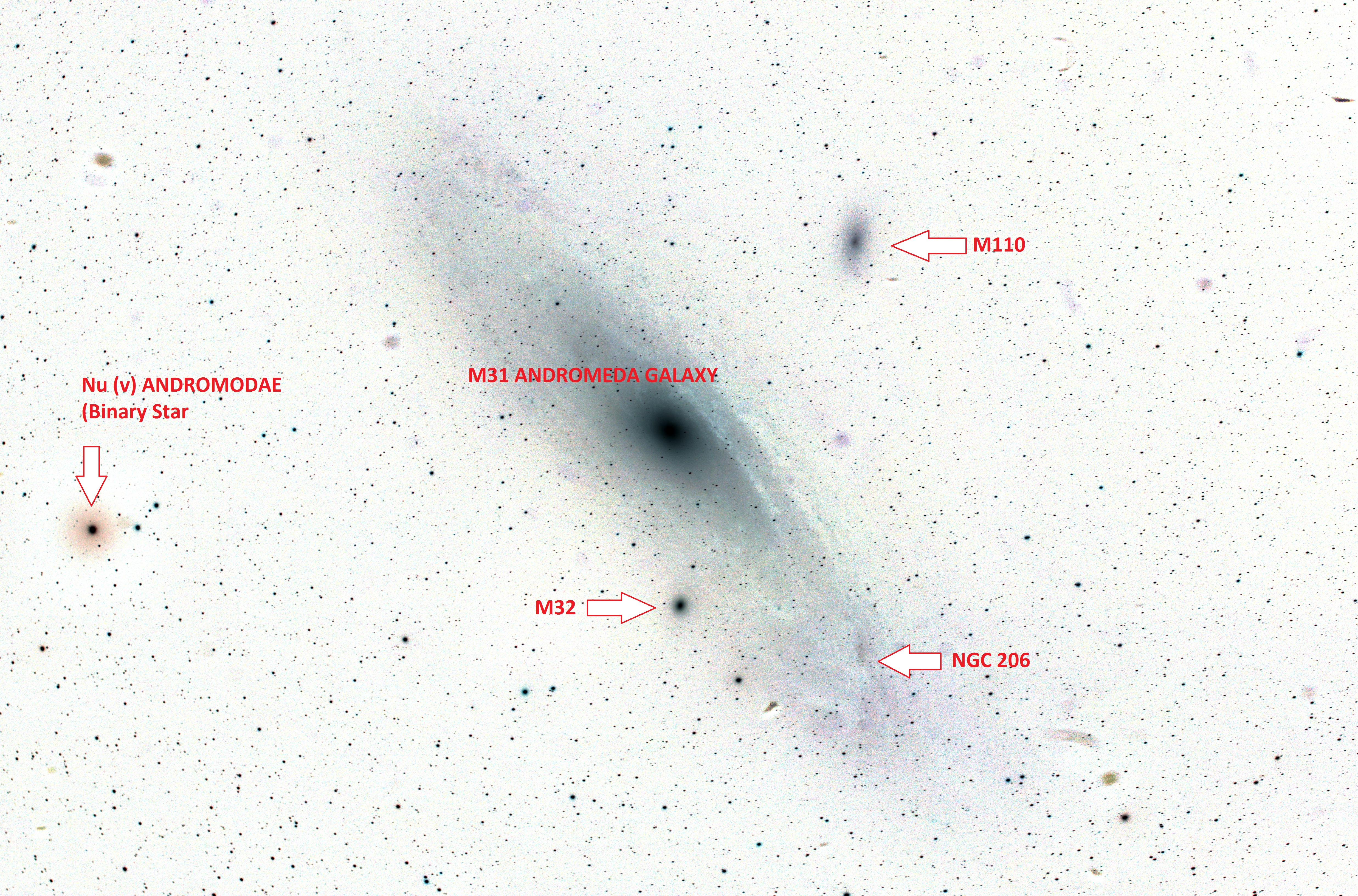
Andromeda poses two main challenges for the photographer: (i) the contrast in brightness between the central area and the rest of the galaxy, and (ii) the need to show the brown dust bands within the main disc, which provide a fascinating insight into the galaxy’s overall structure – that is not unlike out own Milky Way.  The classic technique is to use two sets of images, with camera settings appropriate to the two contrasting areas, subsequently bringing them together during post-processing.  Despite the limited number of prime focus images taken the final picture achieved still came out well.  Though the bright central area is overexposed, the galaxy’s dust bands are clearly evident and for the first time have captured the full character of this magnificent feature. Furthermore, within M31 the NGC 206 is evident, a star formation region of over 300 new stars, whilst in the adjacent sky two other Messier galaxies are shown in the image M32 and M110.

M31 Anfromeda Galaxy: inverted & anotated

M31 Andromeda Galaxy: inverted & annotated

I think it is correct to say that the Andromeda Galaxy is one of the iconic images of the night sky and I feel obtaining such a picture marks another notable point in my personal space odyssey.  I would hope Chris would approve, as well as Major Tom?

Spring’s Playground

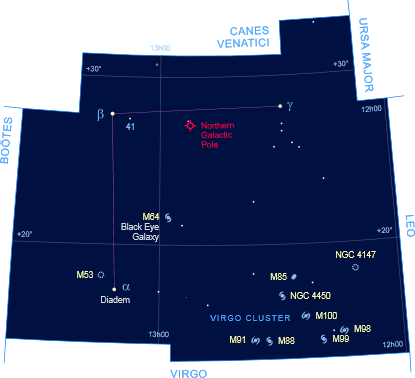
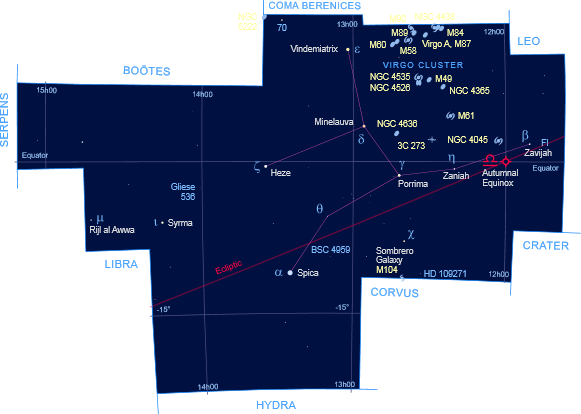
The night sky has been full of surprises for me this Spring, in particular the very extensive presence of galaxies.  Their occurrence has been mostly associated with the constellations of Leo and Virgo but also less well known (to me) Coma Berenices, located between the two aforementioned constellations.  Despite being the 42nd constellation by size and relatively small with few bright stars, Coma Berenices is nonetheless something of a little gem and every bit as interesting as it’s more famous neighbours.

comaberenices

Previously part of the Leo Constellation, Coma Berenices was promoted to a constellation in the 16th Century and named after Queen Berenice II of Egypt; the asterism was previously considered to be the tuft of hair at the end of the lion’s (Leo) tail, which has now become the ‘Queens Hair’.  Though small, Coma Berenices contains eight Messier objects, several globular clusters and is rich in galaxies – including the northern part of the Virgo cluster – also with the North Galactic Pole located within its boundaries.  All-in-all the constellation forms an impressive and interesting part of the sky at this time of the year.

Notable objects are: M53 (NGC 5024), M85 (NGC 4382), M88 (NGC 4501), M91 (NGC 4548), M98 (NGC 4192), M99 (NGC 4254), and M100 (NGC 4321).  Whilst amongst the more famous features of the Coma Berenices is the Black Eye Galaxy (M64), the Needle Galaxy (NGC 4565) and the Coma Cluster of galaxies.

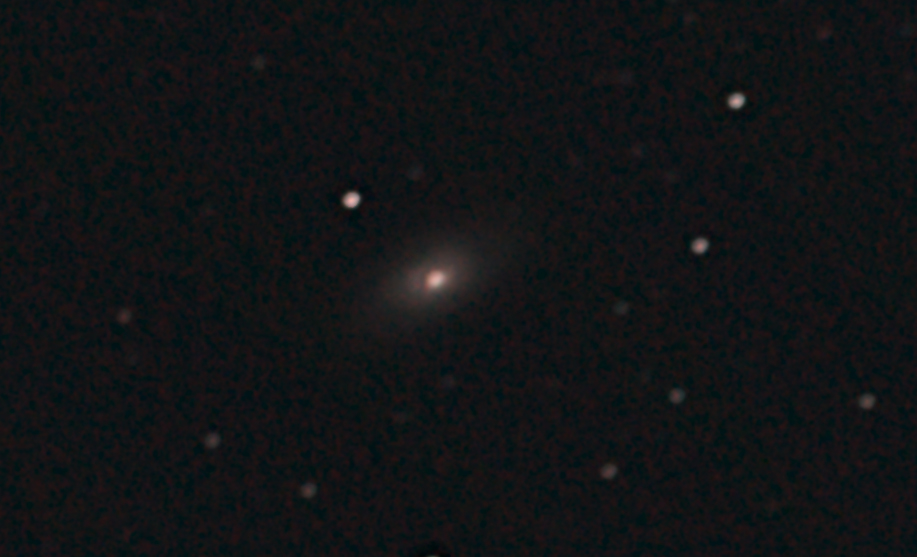
M64, AKA Black Eye Galaxy, Evil Eye Galaxy or the Sleeping Beauty Galaxy is the brightest in Coma Berenices and gets its name from the dark (black) dust band that obscures the stars in its bright core.

M64 Black Eye Galaxy WO GT81 & Canon 550D (modded) + FF | 10 x 180 secs @ ISO 1,600 | 11th April 2015

M64 Black Eye Galaxy
WO GT81 & Canon 550D (modded) + FF | 10 x 180 secs @ ISO 1,600 | 11th April 2015

NGC 4565 or the Needle Eye Galaxy is considered one of the finest examples of an edge-on galaxy, thus producing a slender, needle-like profile. Located 40 million light years away, almost directly above the North Galactic Pol, this giant barred spiral galaxy is about one third larger than the Milky Way and is more luminous that Andromeda.

NGC 4565 Needle Eye Galaxy WO GT81 & Canon 550D (modded) + FF | 10 x 180 secs @ ISO 1,600 | 11th April 2015

NGC 4565 Needle Eye Galaxy
WO GT81 & Canon 550D (modded) + FF | 10 x 180 secs @ ISO 1,600 | 11th April 2015

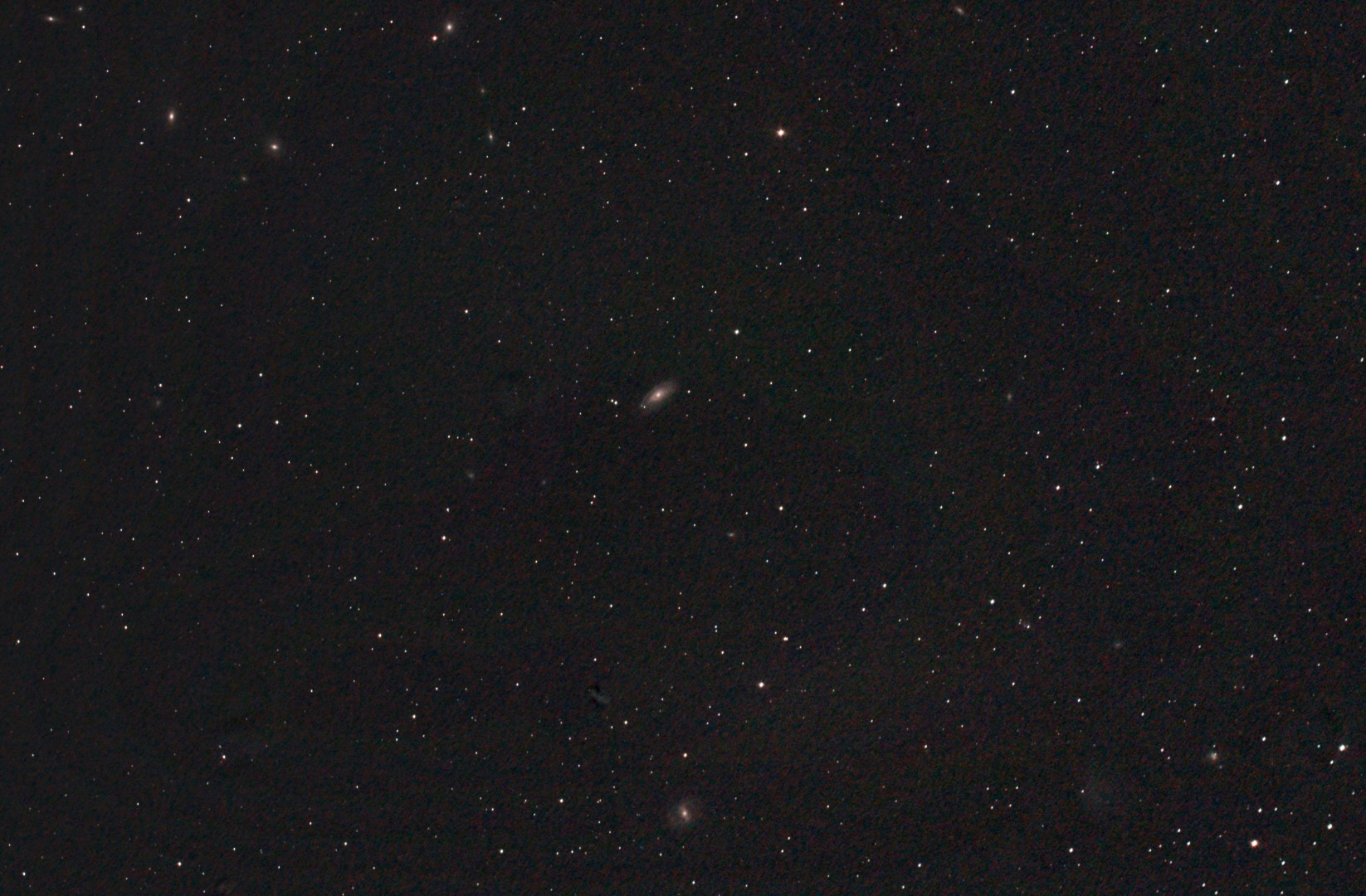
Some 60 million light-years away, M88 is located in the lower area of Coma Berenices, is over 100,000 light years diameter and one of the brightest galaxies of the Virgo Cluster.


M88 with other galaxies of the Virgo Cluster nearby. WO GT81 + Canon 550D (modded) + FF | 20 x 180 secs @ ISO 1,600 | 25th March 2015

M88 with other galaxies of the Virgo Cluster nearby.
WO GT81 + Canon 550D (modded) + FF | 20 x 180 secs @ ISO 1,600 | 25th March 2015


Apart from a few occasional opportunities since obtaining my new equipment last Summer, I have been yearning for more galaxies to image and have thoroughly enjoyed Spring’s veritable playground of galaxies that have filled the sky in their hundreds and sometimes thousands since February. Notwithstanding, my 81mm refractor though good struggles to obtain the detail of these magnificent, mind-blowing Deep Sky Objects and I can only look forward to the day of owning a larger aperture telescope and have mastered the art of long-exposure tracking, which I am still working on.  In the meantime, I now await the development of the Summer sky and another crack at objects first encountered last year.

All in a spin

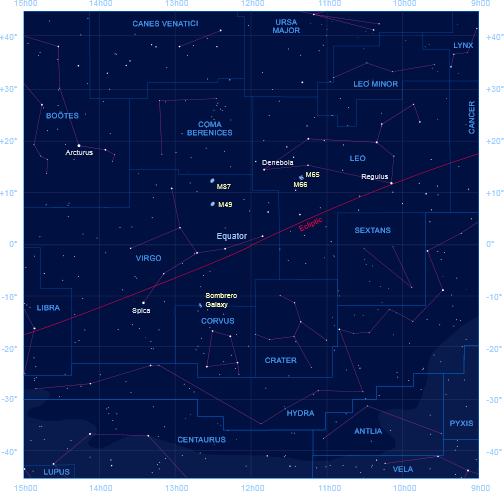
It is now just over six months since acquiring my new astronomy equipment and therefore the first time I have experienced imaging DSO objects of the Spring night sky.  Following the passage of Leo, the main show has now well and truly arrived as the constellations of first Coma Berenices and then Virgo pass overhead, bringing with them a virtual fireworks type display of spectacular stellar features. sky-12h00 comaberenices virgo To DSO fans Spring means one thing – galaxies – too many to comprehend, making it difficult to know where to start.  In my case the detailed beauty of these galaxies will need to wait until I have a substantially larger telescope and can achieve much, much longer exposures.  In the meantime I just marvel at the spectacle and have been trying to image some of the more iconic of these springtime beauties.  Both constellations seem abound with galaxies but two groups are particularly exciting: the Coma Cluster and Virgo Cluster, within which there a large number of fine examples to choose from.

Just the tip of the iceberg: part of the Virgo Cluster that is crowded by galaxies.

Just the tip of the iceberg: part of the Virgo Cluster crowded with thousands of galaxies.

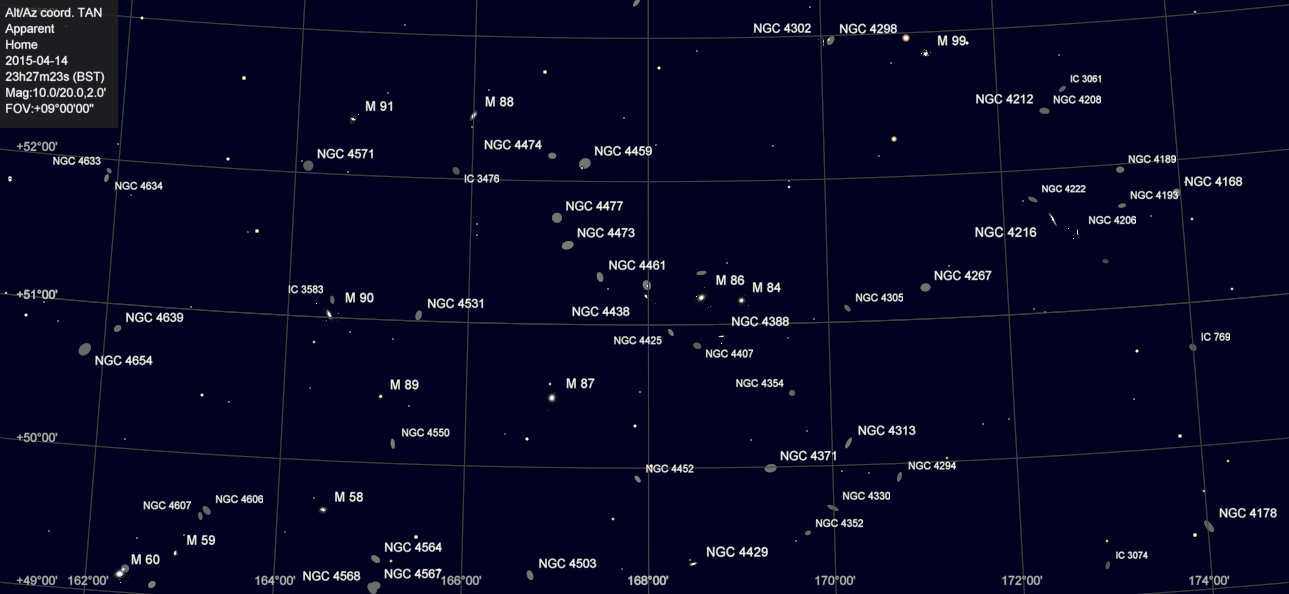
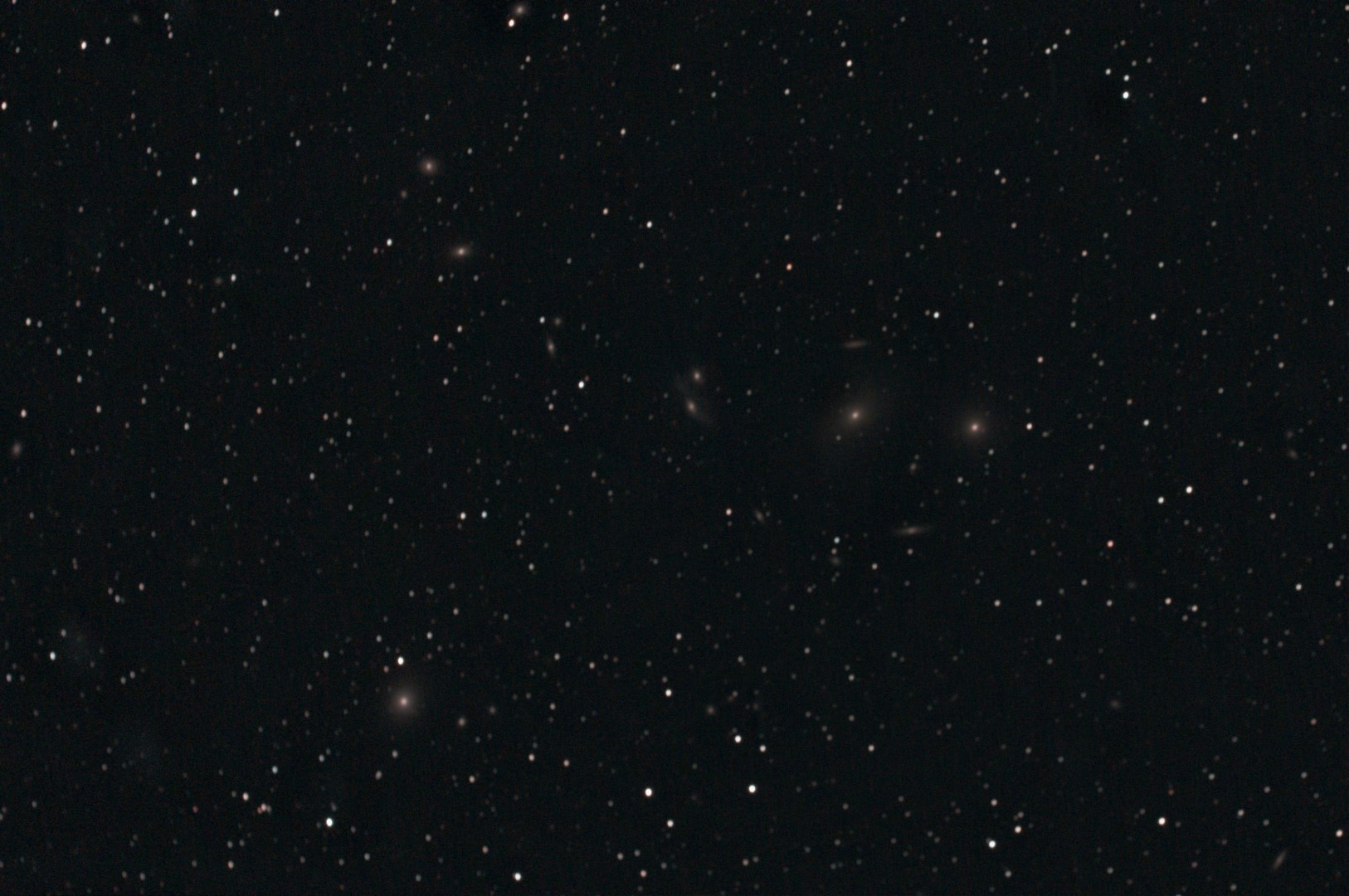
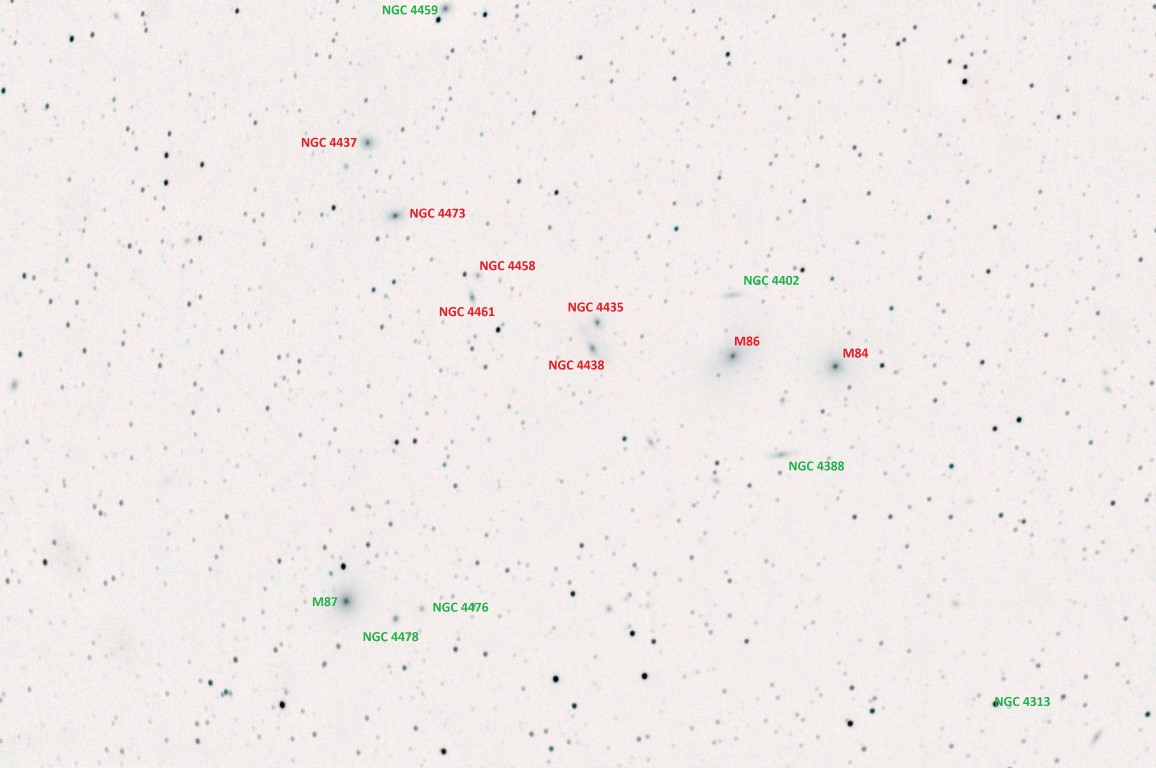
I was first drawn to Markarain’s Chain in the Virgo Cluster, a string of galaxies that form a gentle curve.  Stretched over some x ly the chain includes two Messier Objects – M86 & M84, together with NGC 4438, NGC 4435, NGC 4461, NGC 4458, NGC 4473 & NGC 4477 amongst many others.  In fact this entire part of the sky contains literally thousands of galaxies, of which Markarain’s Chain is just a small but interesting part.

Markarain's Chain WO GT81 & Canon 550D + FF | 15 x 180 secs @ ISO 1,600 | 26th March 2015

Markarian’s Chain
WO GT81 & Canon 550D + FF | 15 x 180 secs @ ISO 1,600 | 26th March 2015

Markarian's Chain (red)  &  some other galaxies (green) inverted.

Markarian’s Chain (red) & some other galaxies (green) – inverted image.

The one that got away

At the end of February the appearance of the Leo constellation marks the end of the winter sky and the transition to Spring.  After previously succeeding in imaging the Leo Triplet and M96 group, there remained one feature I still wanted to capture and, after a long period of difficult seeing conditions, I finally got my chance much later in March.

Just west of the lion’s head, south of the star Alterf (Lambda Leonis) is the 10th magnitude barred spiral galaxy NGC 2903, discovered by no less than William Herschel in 1784.  At 12.6’ x 6.0’ (80,000 ly) NGC 2903 is a little smaller than the Milky Way and too small for my equipment to show much detail but it is possible to see the spiral arms and the bright core, which is known to exhibit an exceptional rate of star formation.  However, the galaxy’s main notoriety is that this significant feature should have been overlooked by Messier though, to be fair, he did well with 103 other wonderful objects that I’m still working through.

NGC 2903 WO GT81 + Canon 550D & FF | 10 x 180 sec @ ISO 1,600 | 25th March 2015

NGC 2903
WO GT81 + Canon 550D & FF | 10 x 180 sec @ ISO 1,600 | 25th March 2015