Astronomical Smorgasboard

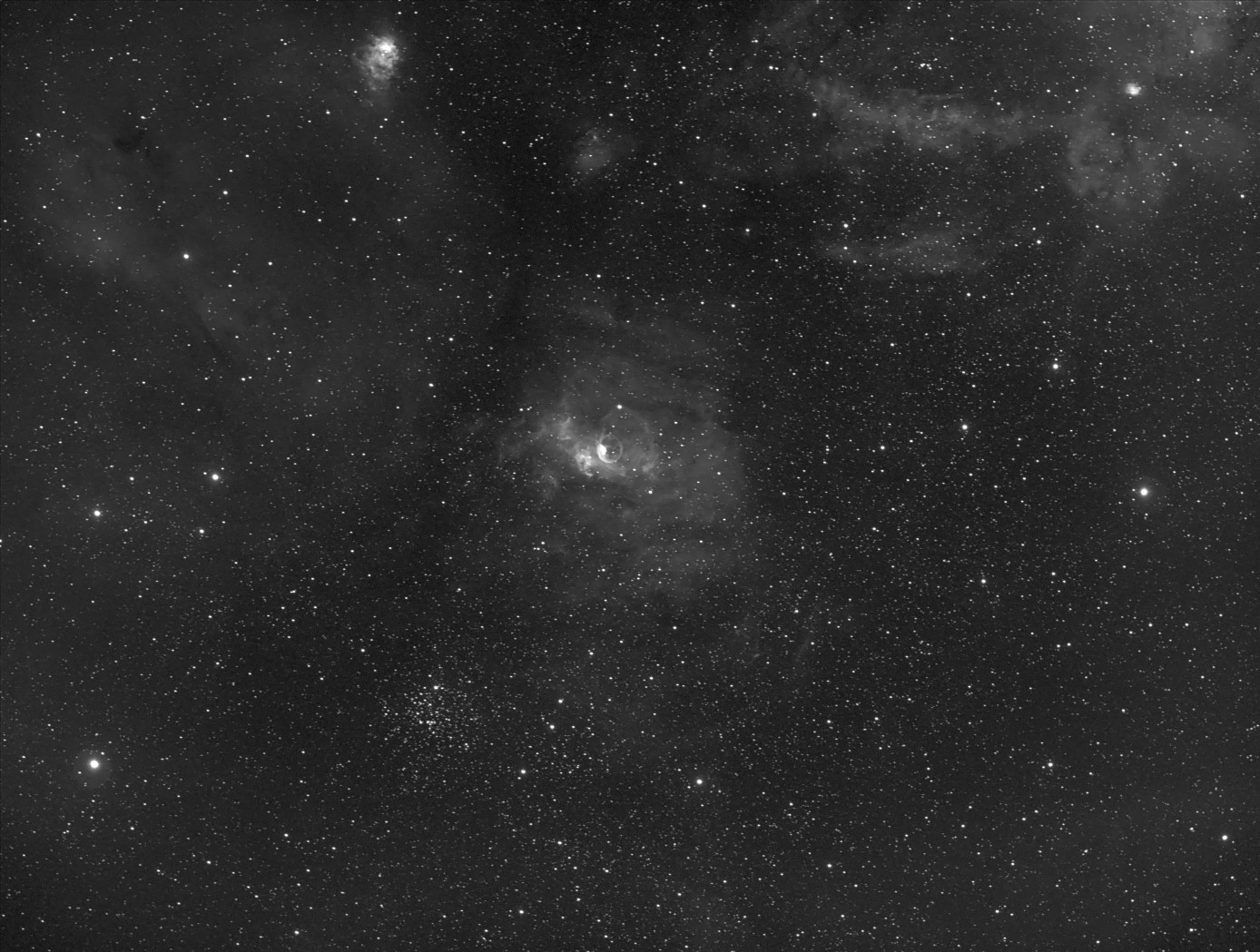
The Lobster Claw Nebula (SH2-157) and Bubble Nebula (NGC 7635) are two striking emission nebulae located close to the border of Cassiopeia and Cepheus constellations. The Lobster Claw Nebula derives its name from the curved, segmented shapes that resemble a lobster’s pincers. It is an Ha II region of glowing ionized hydrogen excited by the intense ultraviolet radiation of nearby hot, young stars. Notably, within it lies the young Wolf-Rayet star 157, whose powerful stellar winds sculpt the surrounding gas into complex arcs and filaments.

Relatively nearby, the Bubble Nebula features a spherical bubble of gas about seven light-years across. The bubble is ‘blown’ by the fierce stellar wind of a massive O-type star (SAO 20575) at its centre. The expanding shell of gas glows where it collides with denser regions of the interstellar medium, producing a visually stunning contrast of colours.

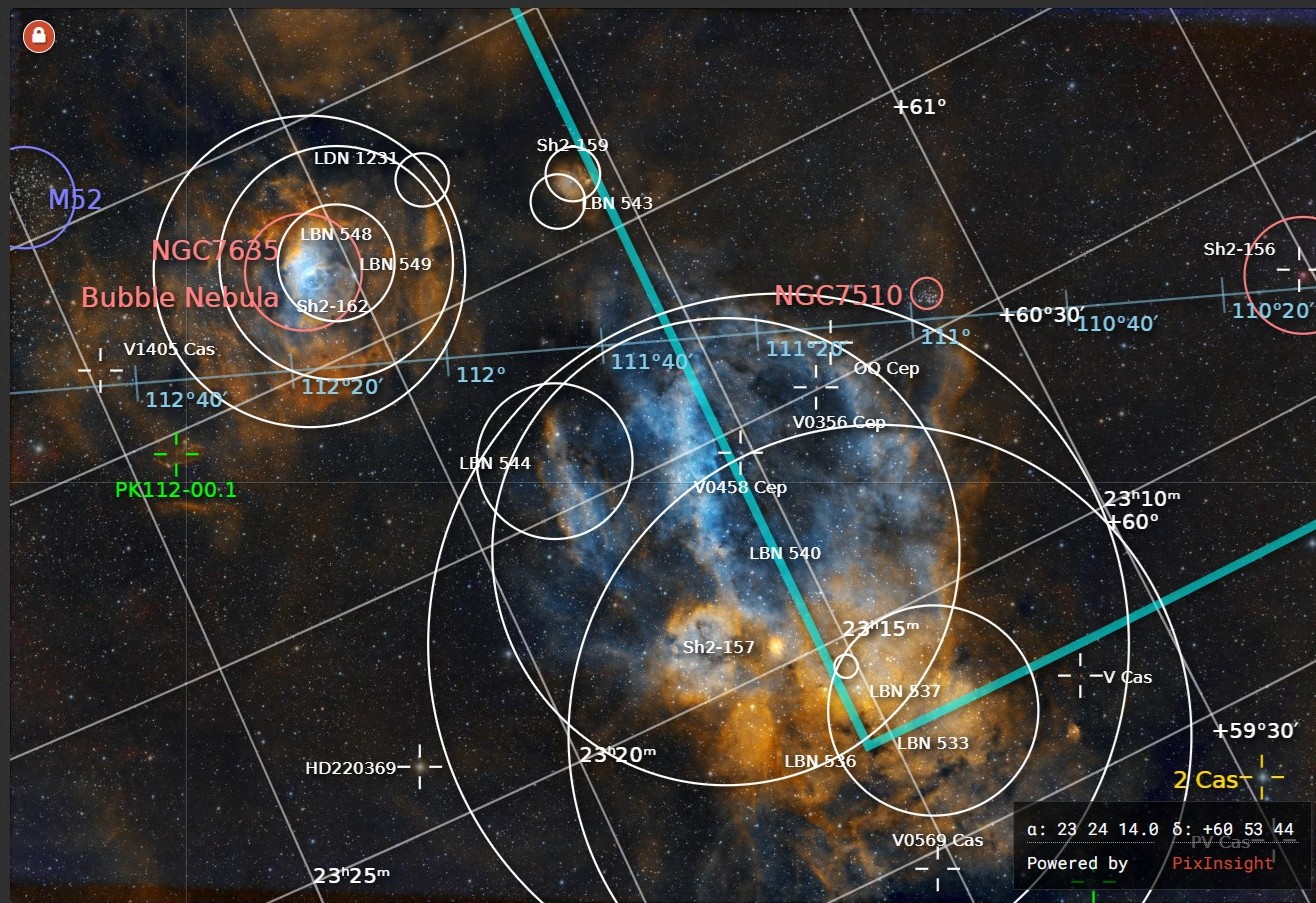
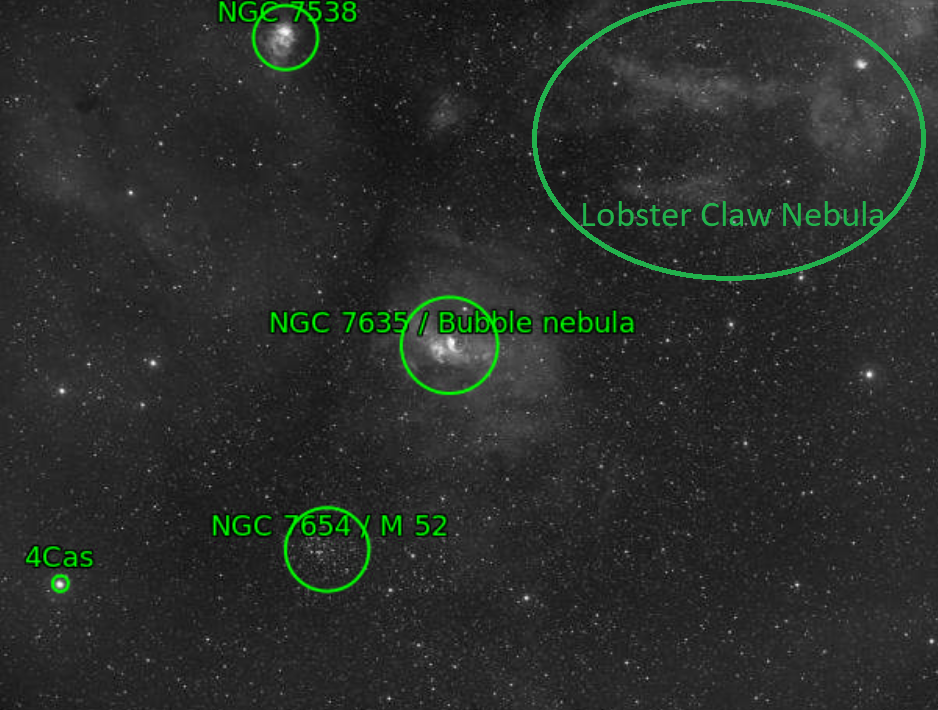
Notwithstanding the spectacular nature of both of these nebulae, the image captures a myriad of other objects, which are identified in the accompanying plate solved image, notable of which are the open star clusters of M52 AKA the Scorpio Cluster and NGC 7510. Overall, the constellation of Cassiopeia is full of interesting nebulae and bright star clusters, which my second image from Castle Farm Observatory has caught in abundance.

Cosmic Eruption

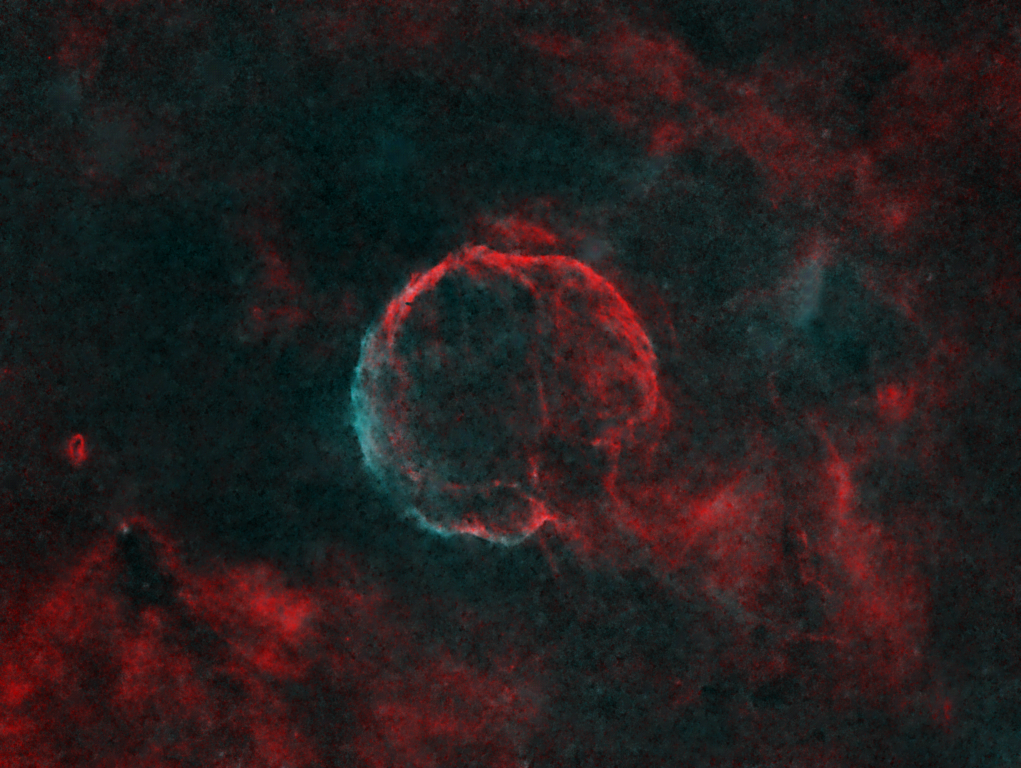
Originally thought to be a planetary nebula, Abell included this object in his catalogue as Abell-85 but later in 1971 it was revised as a supernova remnant (SNR) and renamed CTB-1, thus also denoting it as a radio source.  The overall structure is a circular shell with a conspicuous rupture towards the north (bottom right of image).  The main red Ha-shell is composed of multiple interlocking filament limbs, with a blue / green OIII arc along one side (see main image above).

I experimented extensively processing the data because of its overall complexity and is an interesting object, which is therfore also presented below as greyscale Ha-wavelength only and starless versions.  The main Ha and OIII data is shot at long 1,800 second exposures, which together with RGB adds up to a whopping 29 hours of integration time. However, CTB-1 is an extremely faint object, which probably still requires considerably more time – I’ve seen somebody else’s 61-hour integration which they described as “not enough” and despite the quality of their image I’d probably have to agree.  

CTB-1 is a very exciting object, which might have been what Douglas Adams had in mind when creating Milliways or The Restaurant At The End Of The Universe in the Hitchhiker’s Guide, from which such spectacular events could be ordered to view with your meal! 

 IMAGING DETAILS
ObjectCTB-1  (Abell-85)
ConstellationCassiopeia
Distance10,000  light-years
Size 35 arcminutes ~  100 light-years
Apparent Magnitude–  
  
Scope Takahashi FSQ 106  FL 530mm  f/5  +  Moonlight Nightcrawler focuser  
MountParamount MyT
GuidingYes
CameraQSI 683-WSG8    KAF-8300 full frame CCD sensor   5.4nm pixels  
 FOV 1.94o x 1.46o   Resolution 2.1”/pix.   Image array 3326 x 2,507 pix   
ProcessingDeep Sky Stacker,  PixInsight v1.8.8-8,  Photoshop CS3
Image Location &             OrientationCentre  –  RA 23:59:19.402      DEC +62:25:39.406   
North = bottom right                    
Exposures29 Ha &  20 OIII x 1,800 secs  @ -15C 18 R  17 G  19 B x 300 secs Total Integration Time: 29hr     
Calibration48 x 1,800 secs Darks* x47 Bias  &  x16 HaOIII +LRGB Flats *RGB scaled to 300sec  
Location & DarknessDeep Sky West – amateur hosting facility near Rowe, New Mexico  – USA    SQM Typically >= 21.7
Date & TimeQ3  2020    

The Sum Of The Parts

Picture saved with settings embedded.

Having established an alternative imaging site at the southern end of my garden in the summer of 2018 AKA The Shed Observatory, I was thrilled to be able to image objects in the north sky for the first time, hitherto obscured by my house from the usual observing location.  Soon thereafter it was with great pleasure I achieved a good narrowband image of IC 1805 the Heart Nebula but was subsequently disappointed to find that part of the neighbouring object, IC 1848 the Soul Nebula, had been missed after encountering a framing problem.

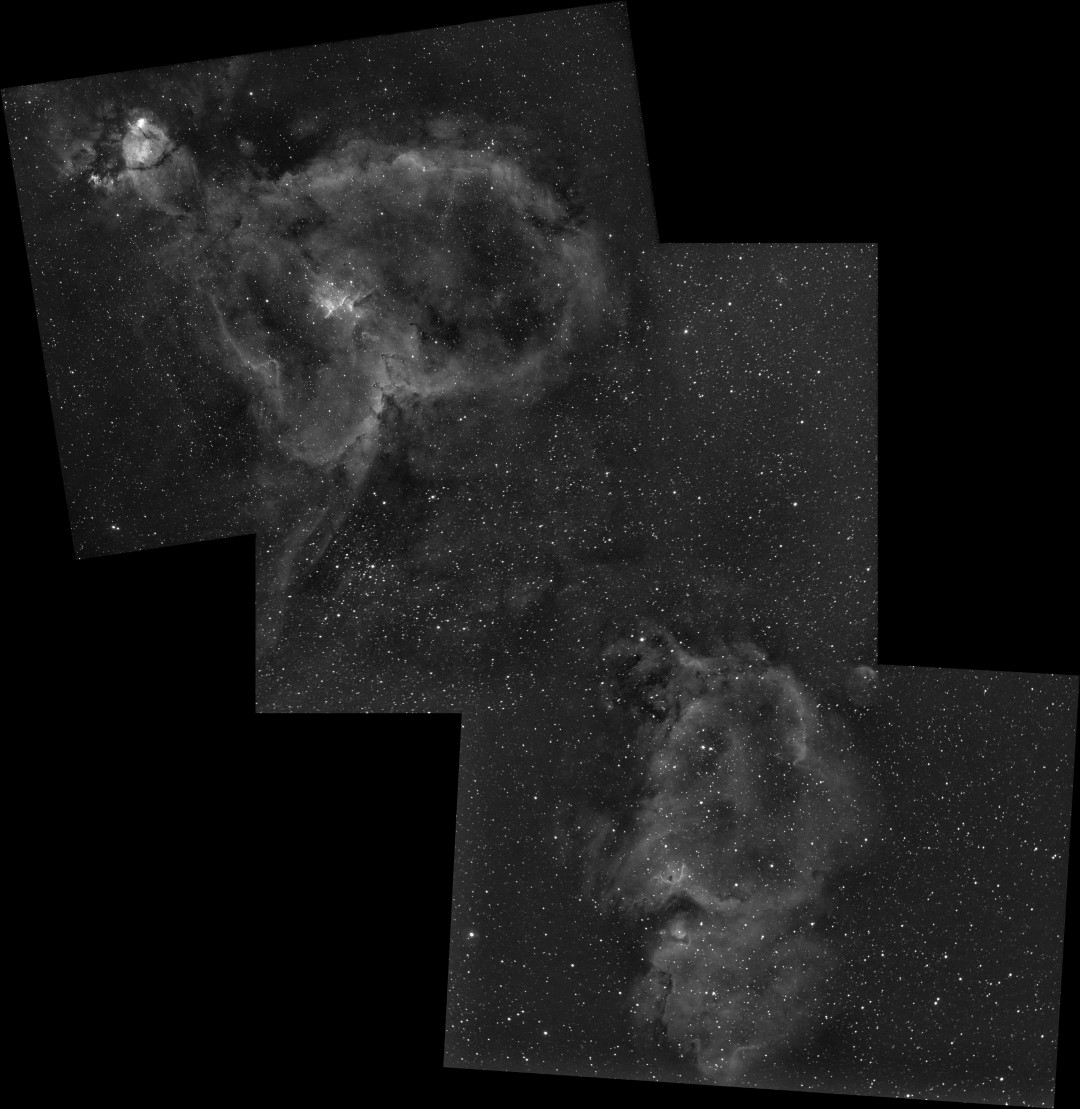
One year on I was back in The Shed with new objectives for these targets: (i) to obtain a complete image of the Soul Nebula, and (ii) given the relative proximity of the Heart & Soul Nebula, to compile a mosaic which included the two objects; surprisingly I’d not attempted a mosaic before and this seemed like a good place to start.  Given the increased imaging time needed to complete even a small mosaic + the lack of darkness at the end of August + British Weather, I chose to restrict imaging to just the Ha-wavelength, which works well with both these targets and could build on the Ha subs already obtained of the Heart Nebula in 2018.

Traditionally mosaic images are based on a grid of say 1+1, 1+1+1, 2 x 2, 3 x 3  etc., which are then combined using the relevant aforesaid sequences, however, in this case starting with the original Heart Ha-subs such a system was not possible.  Since moving to mono imaging with the ZWO ASI1600-Cool camera I’ve used the excellent APT (Astro Photography) image capture software, which hitherto has catered very well with all my needs – including plate solving.  However, at this time APT did not yet have a comprehensive mosaic facility (see footnote) which would allow an imaging grid to be planned and pre-programmed.  Instead it was therefore necessary to first determine suitable image coordinates for each mosaic panel that would cover the Heart & Soul + 25% overlap and then manually establish each position prior to imaging.

Given the proximity of each component I estimated a suitable mosaic could be achieved with three panels, one for each of the main objects and an intermediate panel that would bridge the space between, thus linking the objects to form a continuous mosaic.  Given the spatial relationship, each ofthe three panes needed to be stepped relative to each other and also slightly rotated.  The final data for each nebula consisted of 1h 40m integration time + a further 1h 15m for the link panel, or 4h 35m in total for the complete mosaic.

To my relief the final mosaic was relatively easy to create.  First modestly stretching each panel, paying attention to the background levels and removing any gradients, in order to ensure uniformity between the images before compilation.  I then used Microsoft’s free ICE (Image Composite Editor) software to stich the three panels together into a final mosaic, after which further adjustments were made in Photoshop.

I’m very pleased with the outcome of my first, albeit modest mosaic.  With the ability to return to targets on any occasion using plate solving and, as always weather permitting, multi-image mosaics now open up whole new possibilities which can be captured and compiled over a period of time – even years.  However, until I am able to use a suitable mosaic programme for sequencing, I’m more likely to restrict such projects to small areas that only require limited imaging time, such as the Heart & Soul.

The Greeks and Romans knew a thing or two about mosaics and I’ve long enjoyed Escher’s use of the mosaic form as a basis for his graphic art (see above).  I’m quite sure they would marvel at the astrophotography of Deep Sky Objects and how mosaics can be used in their creation.  The mosaic is all about the sum of the parts, which not only produces a wider, more encompassing view but in doing, so the combined parts add a different quality to the final image.  For now my first mosaic has been quite successful, was good fun and moreover, I can see that the technique ultimately has the potential to open up new and exciting possibilities even with my existing equipment.

Footnote: Since imaging and processing the Heart & Soul mosaic, a recently updated Cartes du Ciel (CdC) verson 4.2 has been released, which incorporates a mosaic planning function.  Moreover, the aforesaid plan can then be imported into the APT software (subject to a minor adjustment being undertaken by APT to fix a panel numbering issue) and thereby provide integrated mosaic planning and programming.   

IMAGING DETAILS – 2018
Object Heart Nebula IC 1805     
Constellation Cassiopeia
Distance 7,500 light-years
Size 150’ x 150’  =  2.5o or 200 light-years
Apparent Magnitude +18.3
 
Scope  William Optics GT81 + Focal Reducer FL 382mm  f4.72
Mount SW AZ-EQ6 GT + EQASCOM computer control
Guiding William Optics 50mm guide scope
  + Starlight Xpress Lodestar X2 guide camera & PHD2 control
Camera ZWO1600MM-Cool (mono)   CMOS sensor
  FOV 2.65o x 2.0o Resolution 2.05”/pix  Max. image size 4,656 x 3,520 pix   
EFW ZWOx8 + ZWO LRGB & Ha OIII SII 7nm filters 
Capture & Processing Astro Photography Tool + PS2,  Deep Sky Stacker & Photoshop CS2, HLVG
Image Location              & Orientation Centre  RA 02:33:09    DEC 61:24:23                     


Exposures Heart Nebula 20 x 300 sec Ha  =  100 minutes   
  @ 139 Gain   21  Offset @ -20oC    
Calibration 5 x 300 sec Darks  20 x 1/4000 sec Bias  10 x Flats Ha  @ ADU 25,000  
Location & Darkness Fairvale Observatory – Redhill – Surrey – UK        Typically Bortle 5
Date & Time 16th & 17th  August 2018 @ +23.30h  
Weather Approx. 12oC   RH <=95%


IMAGING DETAILS – 2019
Object Soul Nebula IC 1848   & Link Pane
Constellation Cassiopeia
Distance 6,500 light-years
Size 150’ x 75’  or 100 light-years
Apparent Magnitude +18.3
 
Scope  William Optics GT81 + Focal Reducer FL 382mm  f4.72
Mount SW AZ-EQ6 GT + EQASCOM computer control
Guiding William Optics 50mm guide scope
  + Starlight Xpress Lodestar X2 guide camera & PHD2 control
Camera ZWO1600MM-Cool (mono)   CMOS sensor
  FOV 2.65o x 2.0o Resolution 2.05”/pix  Max. image size 4,656 x 3,520 pix   
EFW ZWOx8 + ZWO LRGB & Ha OIII SII 7nm filters 
Capture & Processing Astro Photography Tool + PS2,  Deep Sky Stacker & Photoshop CS2, HLVG
Image Location              & Orientation Centre – Soul Nebula   RA 02:56:16    DEC 60:20:07

Centre – Link Pane         RA 02:43:38    DEC 60:55:59    

Exposures Soul Nebula  20 x 300 sec Ha  = 100 mins   

Link Pane       15 x 300 sec Ha  =  75 mins

  @ 139 Gain   21  Offset @ -20oC    
Calibration 5 x 300 sec Darks  20 x 1/4000 sec Bias  10 x Flats HaI  @ ADU 25,000  
Location & Darkness Fairvale Observatory – Redhill – Surrey – UK        Typically Bortle 5
Date & Time 23rd & 25th August 2019 @ +23.30h 
Weather Approx. 18oC   RH <=60%


New Northern Horizons

SHO2int3 (Large)

Having past the Autumn Equinox I’ve moved the observatory back to its main location on the patio looking south for the winter but not before a final look at the northern sky from the newly established Shed Observatory situated at the end of the garden.  After setting up The Shed in mid-May I have had a productive and very enjoyable time imaging and looking at the northern night sky properly for the first time.  My objective has been to learn more about this part of the sky and bag as many northern DSO classics as possible during the limited darkness available at this time of the year.  Furthermore, I set out to determine optimum imaging parameters for these objects in preparation for more extensive sessions at the same time next year.

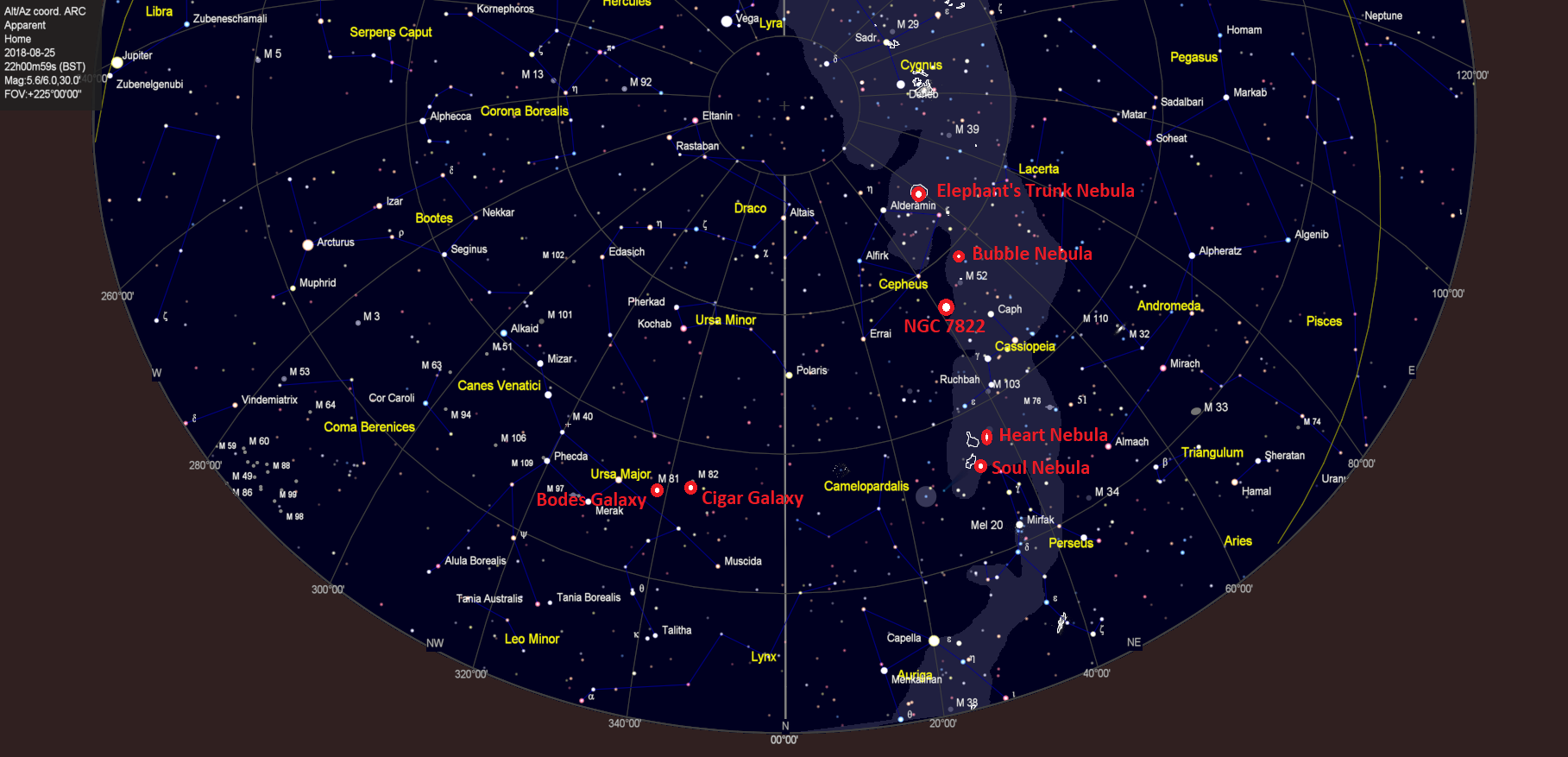
Altogether I managed six targets with some good results, three of which have already been posted here: M81 Bodes & M82 Cigar galaxies, IC 1396 Elephant’s Trunk Nebula and IC 1805 the Heart Nebula. Whilst the new Shed Observatory provided a good view of much of the north sky, I did cut corners with the set-up and as a result guiding was not always at its best, sometimes with an impact on quality.  This has been a period of experimentation but now I know this location works, next time I’ll pay more attention to these matters.  In addition to the aforementioned objects I was also able to image three others, with mixed results.

I came across NGC 7822 soon after moving to the new Shed Observatory site whilst investigating the imaging possibilities from this location.  This complex emission nebula appears to be overlooked by many astrophotographers, though judging from the images that are available it can be quite a spectacular target, providing great promise in narrowband wavelengths when using the right equipment.  Whilst the main Ha image looked promising (below), sadly on this occasion the SHO & HOO images lack detail and colour; on reflection the focus looks a bit suspect too!

IMAGING DETAILS
Object NGC 7822
Constellation Cepheus
Distance 2,900 light-years
Size 100’   
Apparent Magnitude +18.3
 
Scope  William Optics GT81 + Focal Reducer FL 382mm  f4.72
Mount SW AZ-EQ6 GT + EQASCOM computer control
Guiding William Optics 50mm guide scope
  + Starlight Xpress Lodestar X2 guide camera & PHD2 control
Camera ZWO1600MM-Cool (mono)   CMOS sensor
  FOV 2.65o x 2.0o Resolution 2.05”/pix  Max. size 4,656 x 3,520 pix   
EFW ZWOx8 + ZWO LRGB & Ha OIII SII 7nm filters 
Capture & Processing Astro Photography Tool + PS2,  Deep Sky Stacker & Photoshop CS2, HLVG
Image Location              & Orientation Centre  RA 00:02:35     DEC 67:13:55                     

North Sky: Top Left = North  Top Right = East  

Exposures 20 x 180 sec Ha + 10×180 sec OIII & SII  (Total time: 120 minutes)   
  @ 300 Gain   50 Offset @ -20oC    
Calibration 5 x 300 sec Darks  20 x 1/4000 sec Bias  10 x Flats Ha-OIII-SII  @ ADU 25,000  
Location & Darkness Fairvale Observatory  South – Redhill – Surrey – UK        Typically Bortle 5
Date & Time 20th May 2018 @ +00.00h  
Weather Approx. <12oC   RH 70%

Once astronomical darkness was re-established in late July I soon returned to the northern sky thereafter.  After a gap of more than 2-months since my previous session in May, the north sky now provided other new opportunities, principal of which were the Heart Nebula and Soul Nebula.  Given their size and my field-of-view these objects need to be imaged separately and after a good result with the Heart Nebula, I was soon also able to tackle the nearby Soul Nebula.  However, this time the guiding was at first very poor and I decided to use the PHD2 Guiding Assistant to help correct the problem.  The new settings recommended by the Assistant made a big difference to the guiding but unfortunately I then overlooked that the consequence of running the process had changed the previous image framing of the object.  As a result of this the lower section of the nebula was no longer within the field-of-view and subsequently lost in the final image – oh well lesson learned for another day.

HaHOO crop (Large)

IMAGING DETAILS – Soul Nebula HaHOO (above) 
Object Soul Nebula IC 1848   (Westerhout-5)
Constellation Cassiopeia
Distance 6,500 light-years
Size 150’ x 75’  or 100 light-years
Apparent Magnitude +18.3
 
Scope  William Optics GT81 + Focal Reducer FL 382mm  f4.72
Mount SW AZ-EQ6 GT + EQASCOM computer control
Guiding William Optics 50mm guide scope
  + Starlight Xpress Lodestar X2 guide camera & PHD2 control
Camera ZWO1600MM-Cool (mono)   CMOS sensor
  FOV 2.65o x 2.0o Resolution 2.05”/pix  Max. size 4,656 x 3,520 pix   
EFW ZWOx8 + ZWO LRGB & Ha OIII SII 7nm filters 
Capture & Processing Astro Photography Tool + PS2,  Deep Sky Stacker & Photoshop CS2, HLVG
Image Location              & Orientation Centre  RA 02:52:25    DEC 60:01:35                     

Top  Left North  Top Right = East   Bottom Right = South   Bottom Left = West      

Exposures 20 x 300 sec Ha + 10×300 sec OIII  (Total time: 150 minutes)   
  @ 139 Gain   21  Offset @ -20oC    
Calibration 5 x 300 sec Darks  20 x 1/4000 sec Bias  10 x Flats Ha-OIII-SII  @ ADU 25,000  
Location & Darkness Fairvale Observatory – Redhill – Surrey – UK        Typically Bortle 5
Date & Time 2nd September 2018 @ +00.20h  
Weather Approx. 12oC   RH <=95%

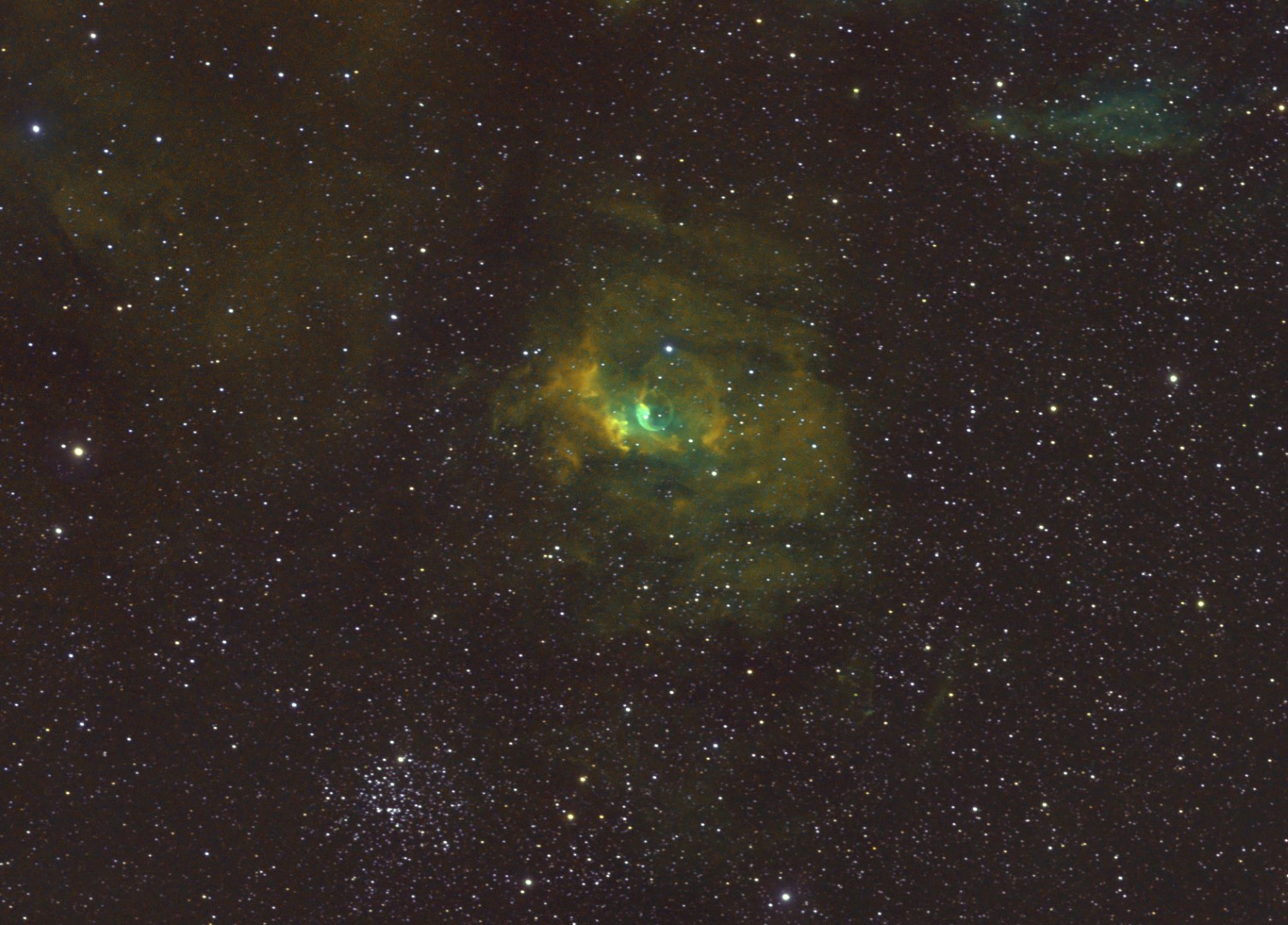
Finally I was surprised and pleased to discover that with the early evening darkness now available in September, I might be able to image the strange but beautiful Bubble Nebula NGC 7635.  Being very high in the sky at this time, the challenge was to track the object for as long as possible before at about 1.00 a.m. it disappears overhead behind the high garden hedge located immediately adjacent to the telescope location.  I managed, just about, and was very happy to see the ‘bubble’ in the middle of the resulting image. The enigmatic bubble is created by a stellar wind from a massive, hot central star (SAO 20575) which excites the nebula and causes it to glow.  Whilst the central Bubble Nebula is undoubtedly the star of the show, this region of the sky and resulting picture holds great promise to image other objects on another occasion, notably the open cluster M51 just below and to the left of the Bubble and the Lobster Claw Nebula SH2-157 in the top-right corner.

Ha2A (Large)


Claw2

IMAGING DETAILS: Bubble Nebula – Ha above, SHO top of page 
Object Bubble Nebula NGC 7635
Constellation Cassiopeia
Distance 7,100 light-years
Size 15’ x 8’  (Bubble 7 light-years)
Apparent Magnitude +10.0
 
Scope  William Optics GT81 + Focal Reducer FL 382mm  f4.72
Mount SW AZ-EQ6 GT + EQASCOM computer control
Guiding William Optics 50mm guide scope
  + Starlight Xpress Lodestar X2 guide camera & PHD2 control
Camera ZWO1600MM-Cool (mono)   CMOS sensor
  FOV 2.65o x 2.0o Resolution 2.05”/pix Max. size 4,656 x 3,520 pix   
EFW ZWOx8 + ZWO LRGB & Ha OIII SII 7nm filters 
Capture & Processing Astro Photography Tool + PS2,  Deep Sky Stacker & Photoshop CS2, HLVG
Image Location              & Orientation Centre  RA 23:21:27    DEC 61:06:52                     

Top = north  Right = East   Bottom = South  Left = West 

Exposures 15 x 300 sec Ha + 10×300 sec OIII & SII  (Total time: 175 minutes)   
  @ 139 Gain   21  Offset @ -20oC    
Calibration 5 x 300 sec Darks  20 x 1/4000 sec Bias  10 x Flats Ha-OIII-SII  @ ADU 25,000  
Location & Darkness Fairvale Observatory – Redhill – Surrey – UK        Typically Bortle 5
Date & Time 3rd September 2018 @ +21.45h  
Weather Approx. 15oC   RH >=70%

My time at the end of the garden this summer at the Shed Observatory has been a great success, made all the better by a prolonged period of warm weather.  I am confident that with more attention to the set-up, better guiding and longer integration times, next year will be even better and I’m already looking forwards to revisiting this year’s new horizons in the north sky in 2019.

North Sky summer Objects

North Sky Imaged Objects May to September 2018

Heart Of Darkness

HHOO hlvg (Large)

Aside from all the paraphernalia required for astrophotography, two other critical items are essential to start imaging: clear skies and darkness.  This year astronomical darkness ceased on 25th May at Fairvale Observatory and remained absent for the next 8-weeks  whilst Earth performed its annual summer gyration about the Sun, culminating on 21st June with the solstice.  As a result this period is typically quite a barren time for astronomers, especially for those in the higher latitudes where the sun does not set for the entire 24-hour day.  Some options during this time are:  give up, stop imaging and use the time to sort out equipment, if you have the right equipment change to solar astronomy or just enjoy what happens to be about in the less than dark sky.  This year I chose the latter, during what has been a very hot summer, often with continuously clear skies for days-on-end.

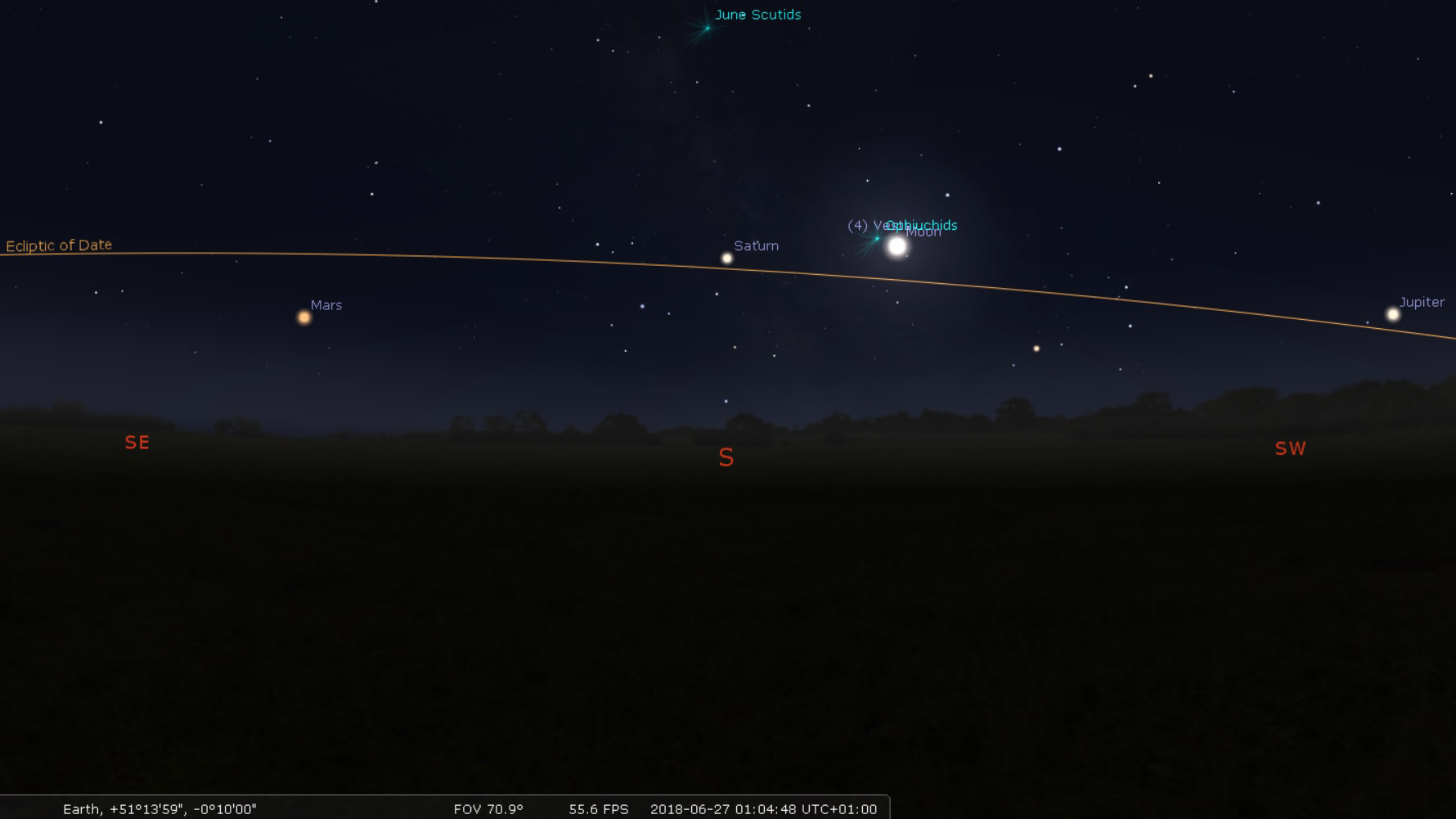
Planets June 2018

From the early evening we’ve been treated to views of all the planets of the Solar System, as during the short nights one-by-one they transited along the ecliptic, though were relatively low in the sky seen from the UK.  In order of appearance, the main show (see above) each night has been that of Jupiter, followed by Saturn and finally at about 2.00 a.m. (June) Mars – which this year was an unusually large, unusually bright  red disc as it reached its closest orbit relative to Earth for almost 60,000 years – all of which could be clearly seen with the naked eye.  Unable to sleep in the hot weather, night after night I was able to view and sometimes imaged the aforesaid planets with a DSLR camera as they moved across the night sky.

Shortly after darkness started to return on 20th July came two further special events.  First on 27th July a lunar eclipse, that despite all the previous clear nights was ironically obscured by cloud cover over most of the UK!  Fortunately, clear skies returned for 13th August and the annual Perseids meteor shower, which on this occasion produced some of the best meteor trails I have personally experienced.

And so, with astronomical darkness back and the chance to return to the recently established Fairvale Observatory South AKA The Shed Observatory, it was time to resume my hitherto brief imaging experience of the northern sky again.  As a newcomer to this part of the night sky there were considerable new imaging possibilities to explore but only one I now wanted to capture – the Heart Nebula or IC 1805 (also known as the Running Dog Nebula when viewed from a different angle).

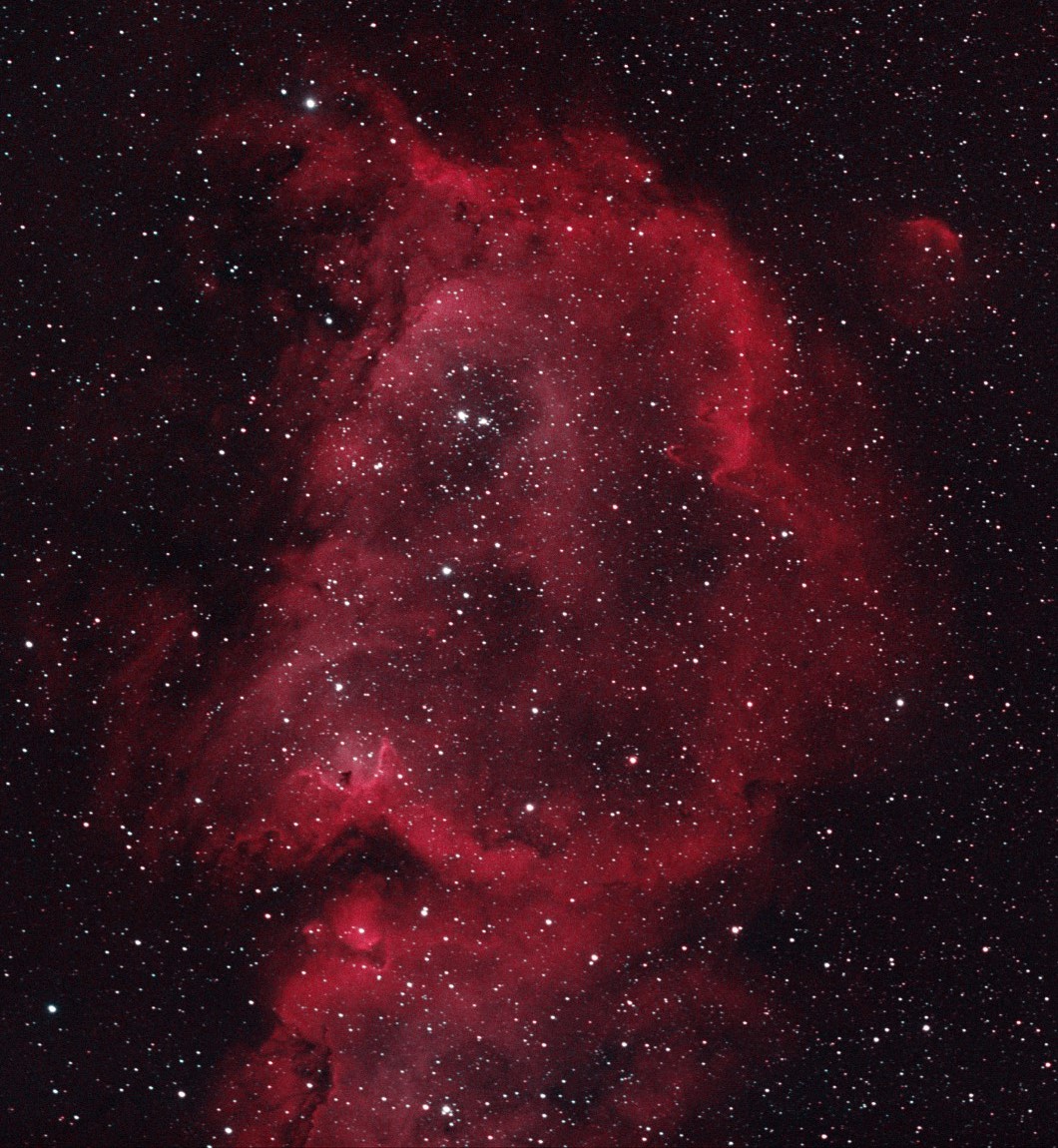
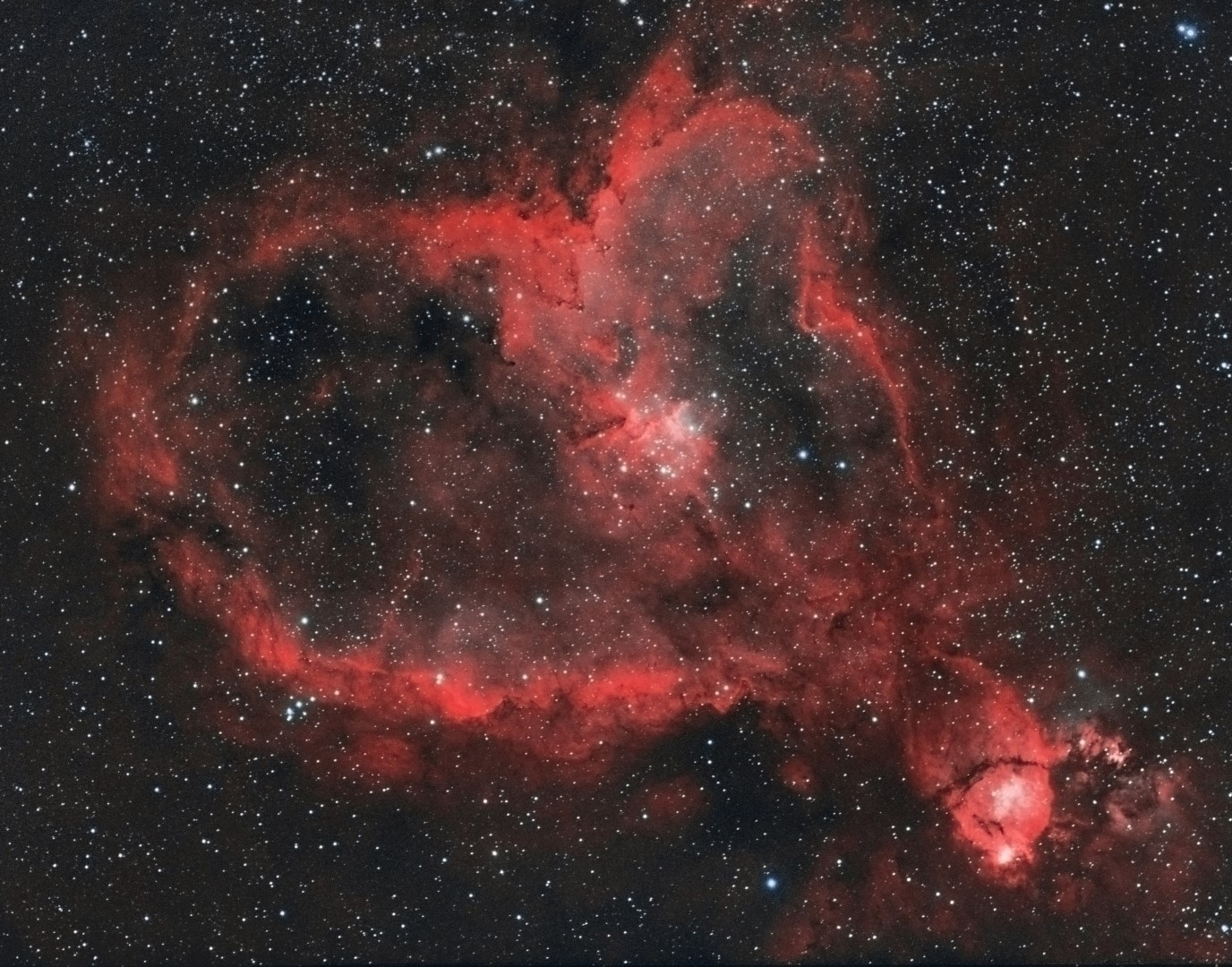
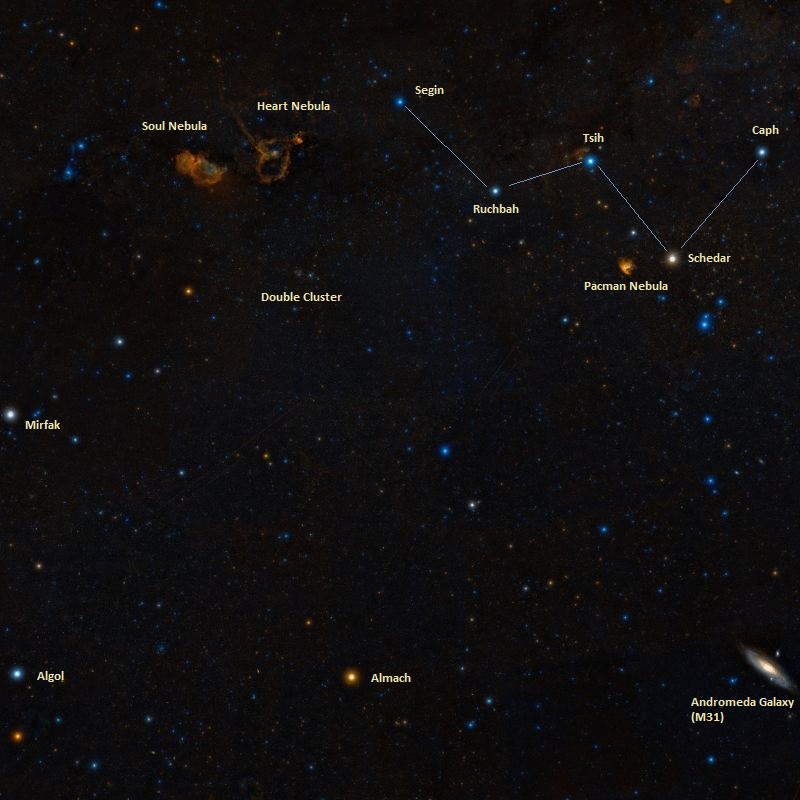
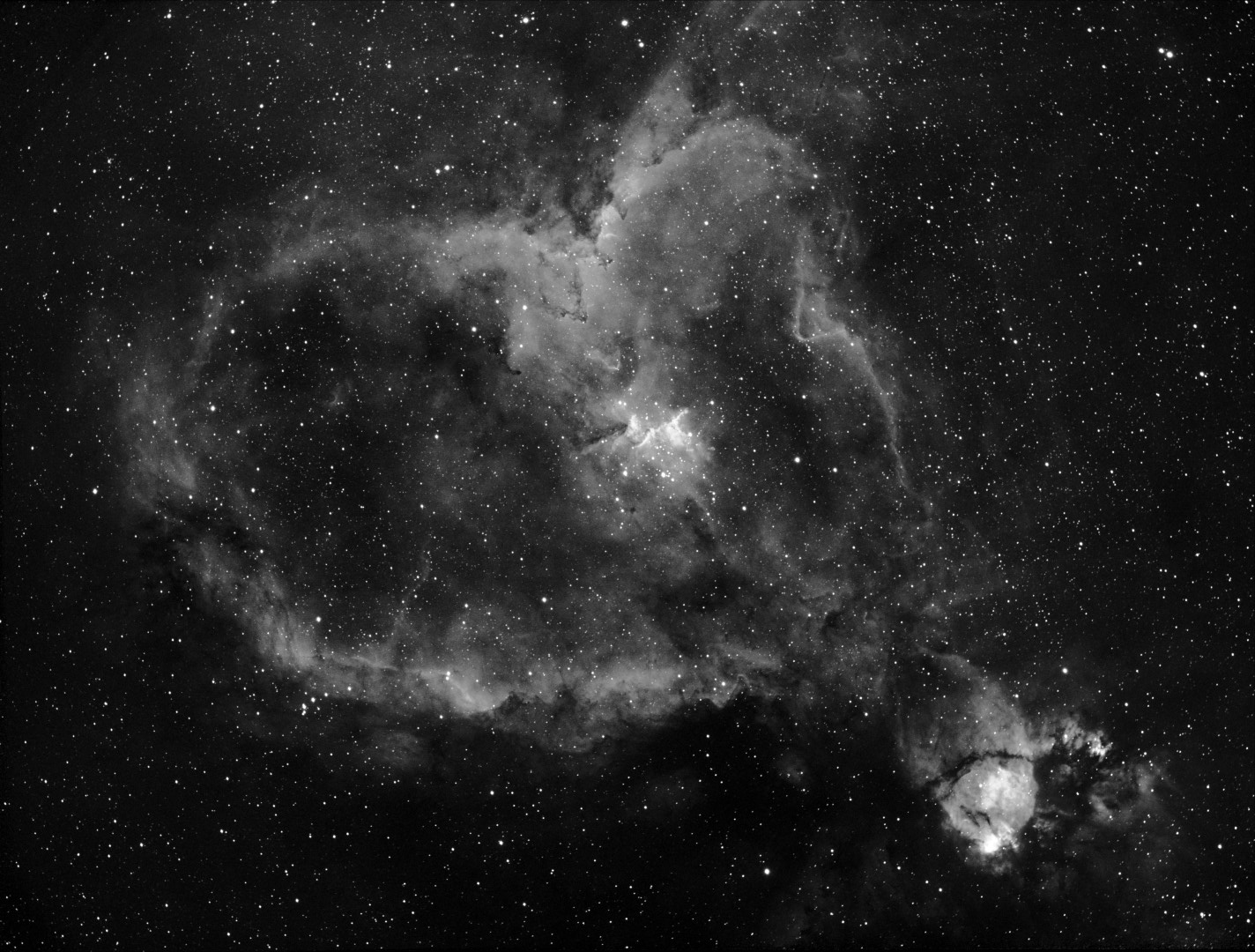
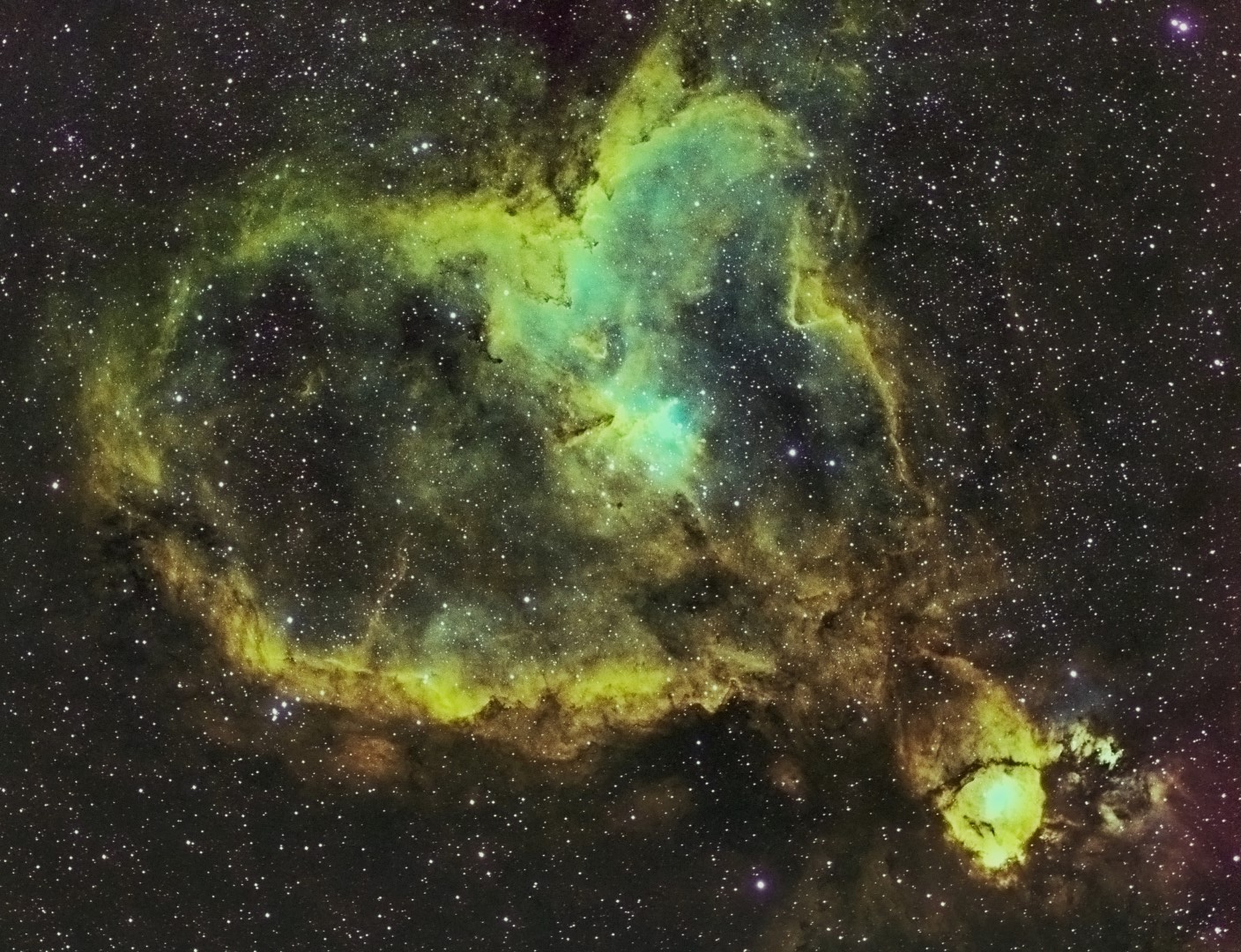
Heart-and-Soul-location The Heart and nearby Soul Nebula are situated in a busy region of the sky (see above – from Wikisky), which also contains seven open clusters of young stars, as well as the Pacman Nebula and galaxies of Maffei 1 & 2 and M31 Andromeda.  The discovery of a bright fish-shaped HII object – known as the Fishhead Nebula IC 1795 or NGC 896 at the edge of the main object – preceded that of the Heart Nebula itself in 1787 by William Herschel.  The Heart Nebula has a red glow, a result of intense radiation emanating from a small cluster of large, hot, young (1.5 My) bright-blue stars at the centre known as Melotte-15.  The stellar wind and stream of charged particles that flow out from these newborn stars then creates the characteristic heart-shape of the nebula from the stellar dust and hydrogen gas clouds.
Picture saved with settings embedded.

Located in the Perseus arm of the Milky Way in the Cassiopeia constellation, this large emission nebula is an excellent object for narrowband imaging at all wavelengths and is also well framed in the field-of-view of my telescope-camera combination; the images presented here are rotated 180 degrees to achieve the correct orientation to see the heart shape, with the Fishhead Nebula located in the bottom right corner.  Not surprisingly this large HII object produces strong Ha subs, which make a pleasing stand-alone image (above section). But the OIII and especially SII wavelengths are also very good, resulting in very good HHOO bi-colour (top-of-the-page) and SHO (below) images too.

SHO end3Final (Large)

The limited time I’ve had to image the northern sky for the first time this year has already proved to be exciting and bodes well for the future.  On this occasion I’ve been very pleased with my first imaging results of the Heart Nebula, which is a superb object for my equipment and am sure to return next year given suitably clear skies and, of course, darkness.

IMAGING DETAILS
Object Heart Nebula IC 1805    AKA Running Dog Nebula   Sharpless 2-190
Constellation Cassiopeia
Distance 7,500 light-years
Size 150’ x 150’  =  2.5o or 200 light-years
Apparent Magnitude +18.3
 
Scope  William Optics GT81 + Focal Reducer FL 382mm  f4.72
Mount SW AZ-EQ6 GT + EQASCOM computer control
Guiding William Optics 50mm guide scope
  + Starlight Xpress Lodestar X2 guide camera & PHD2 control
Camera ZWO1600MM-Cool (mono)   CMOS sensor
  FOV 2.65o x 2.0o Resolution 2.05”/pix  Max. image size 4,656 x 3,520 pix   
EFW ZWOx8 + ZWO LRGB & Ha OIII SII 7nm filters 
Capture & Processing Astro Photography Tool + PS2,  Deep Sky Stacker & Photoshop CS2, HLVG
Image Location             & Orientation Centre  RA 02:33:09    DEC 61:24:23 

Top = South   Right = West   Bottom = North   Left = East  

Exposures 20 x 300 sec Ha + 10×300 sec OIII & SII  (Total time: 200 minutes)   
  @ 139 Gain   21  Offset @ -20oC    
Calibration 5 x 300 sec Darks  20 x 1/4000 sec Bias  10 x Flats Ha-OIII-SII  @ ADU 25,000  
Location & Darkness Fairvale Observatory – Redhill – Surrey – UK        Typically Bortle 5
Date & Time 16th & 17th  August 2018 @ +23.30h  
Weather Approx. 12oC   RH <=95%


Looking Up

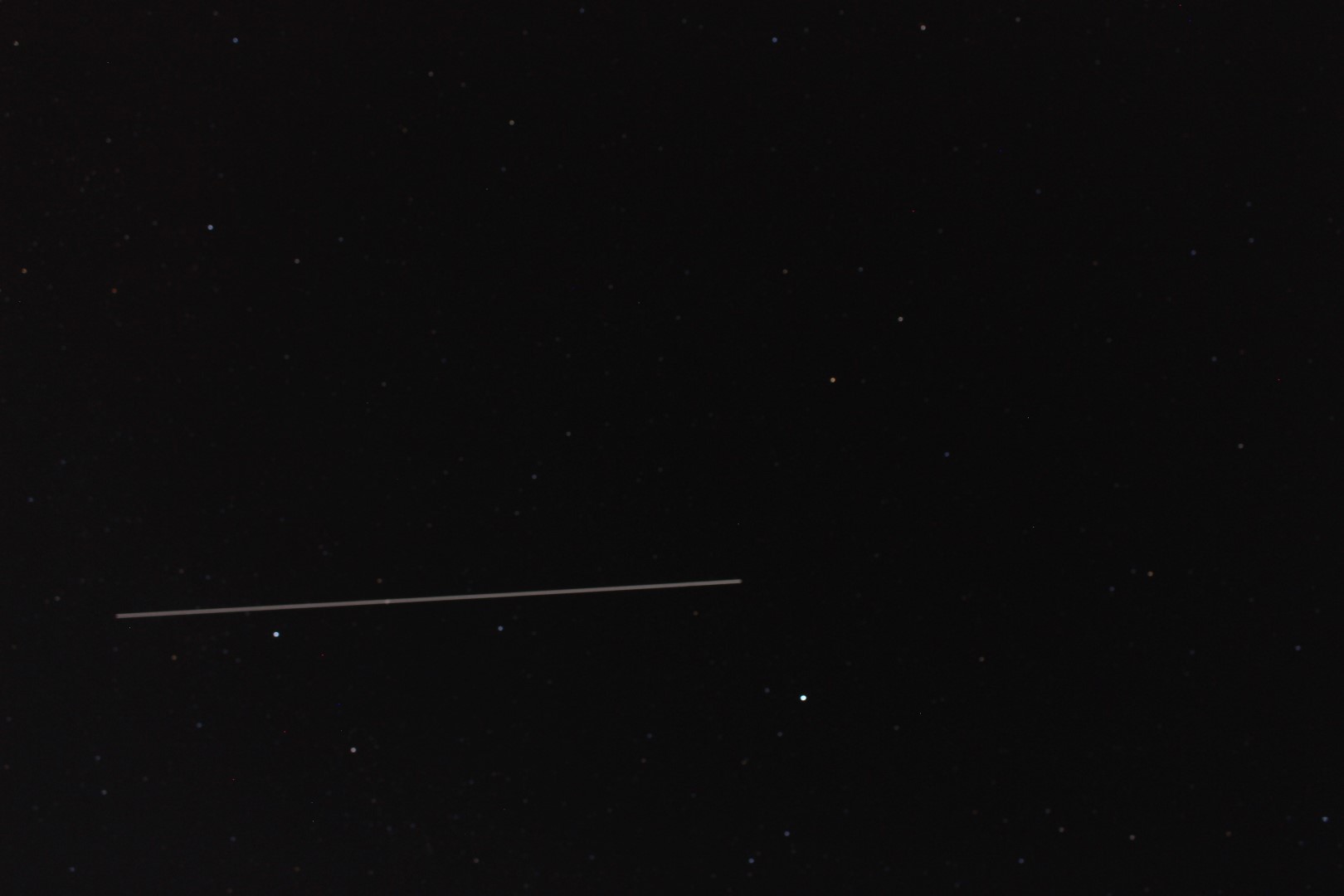
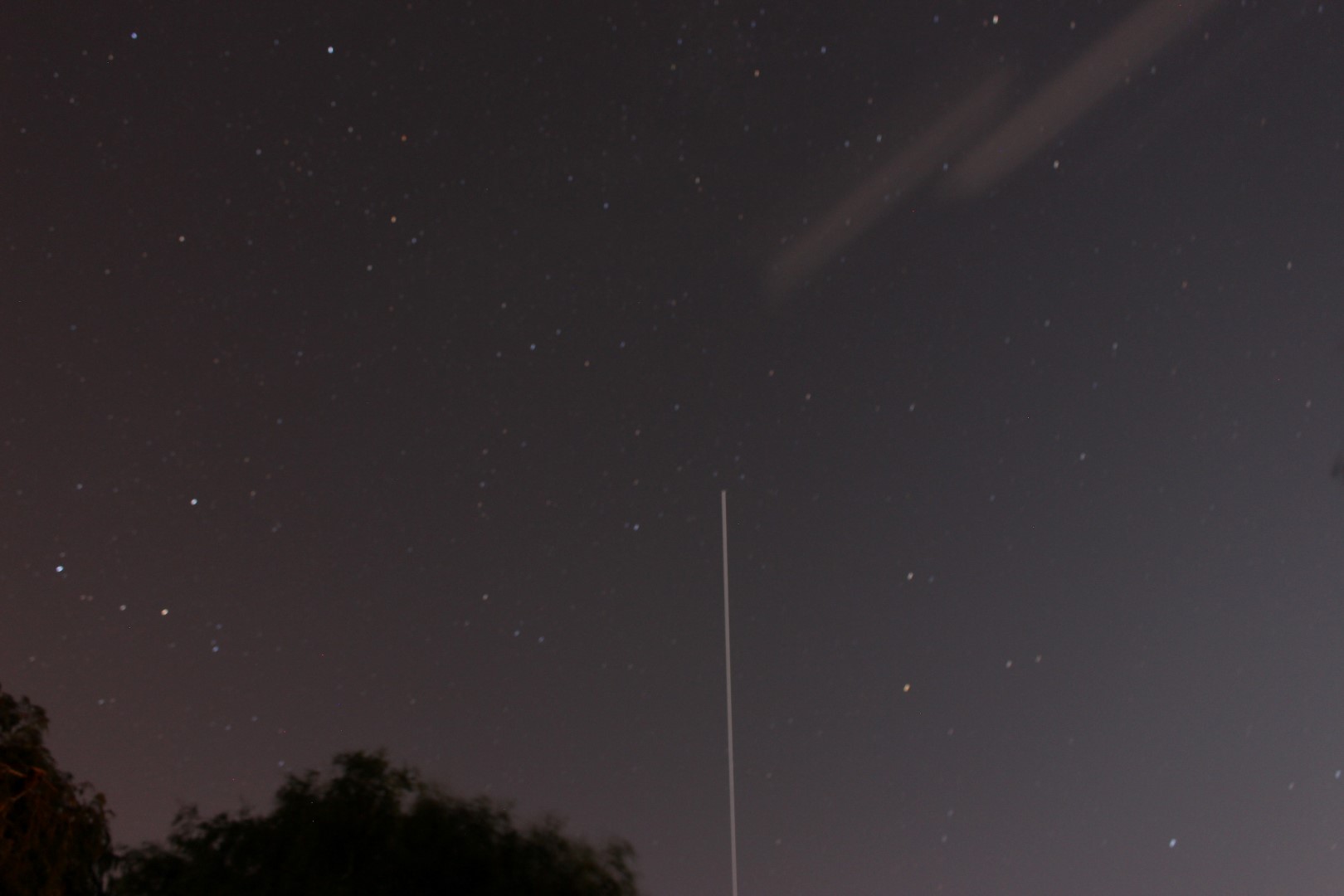
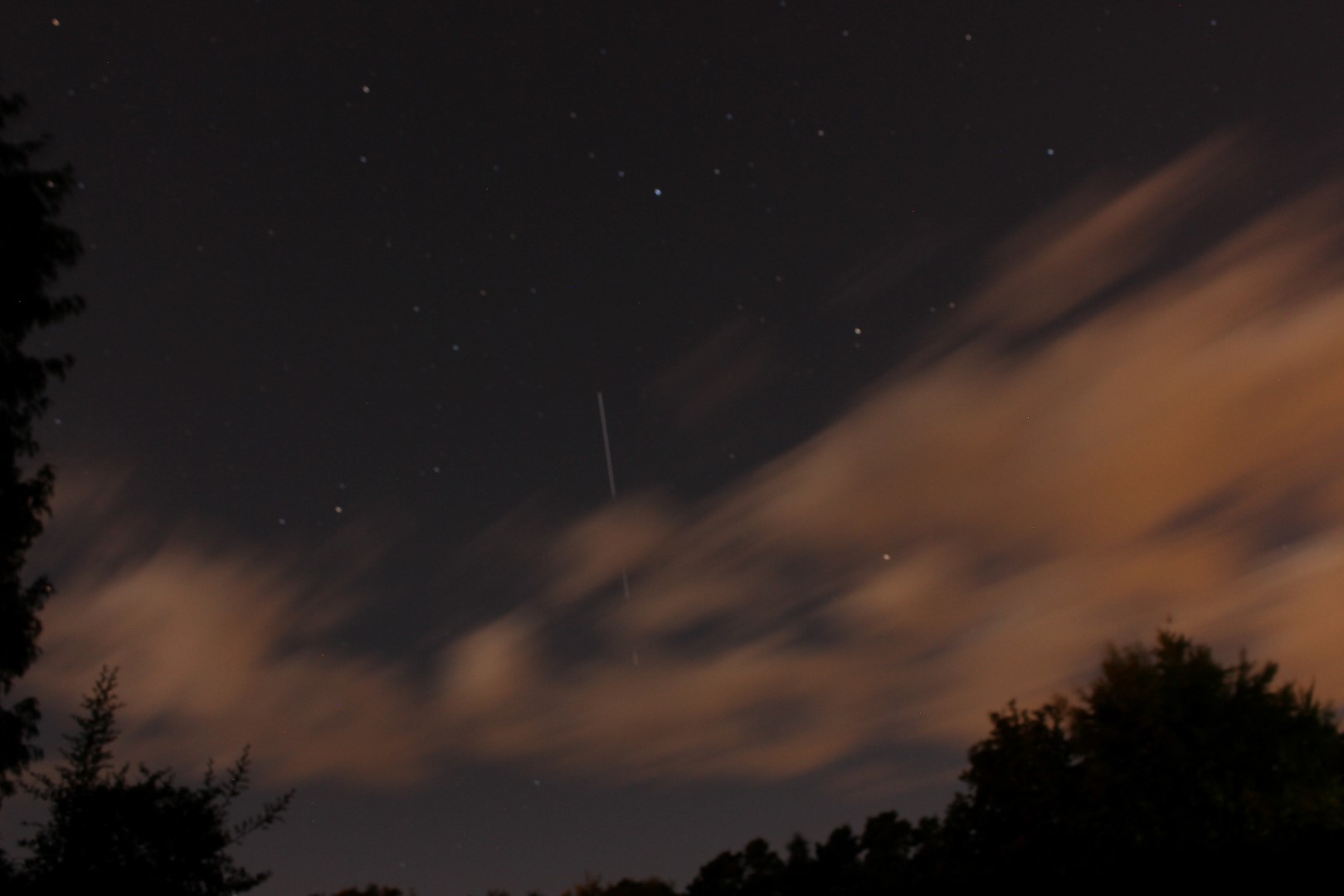
Having been unable to set-up Fairvale Observatory since April, it has been frustrating with almost no hands-on astronomy taking place.  However, last night the march of time and serendipity played their part; by chance I glanced out of the window and lo and behold saw the International Space Station (ISS), which was then scheduled to pass almost directly overhead again 90-minutes later at 11.17 p.m.  Now six weeks past the Summer Equinox sunset is coming increasing earlier, currently 8.45pm and by the time the ISS would be back the night sky was almost at astronomical darkness.  This would provide a favourable setting for viewing and imaging – furthermore, the sky was almost clear and the temperature a comfortable 180C, far from the sub-zero conditions back in February.

I have just purchased a second-hand EFS 55 – 250mm Canon IS telephoto lens, so what else was there to do but get outside and get ready to image the ISS next time round, thereafter one thing led to another!  Being a more mobile set-up I was able to venture further from the house than usual and thereby obtain images of some constellations and asterisms which I cannot usually achieve from the Observatory.

Though not as spectacular as the Planets and DSO images, I found the simple sky photographs satisfying to shoot and enjoyable to look at.  The beguiling night environment, exciting subjects, improving darkness conditions and my increased mobility, suggests things are looking up – in more than one way.


ISS Western view: 6 minute transit from West to East at 850

ISS Western view: 6 minutes total transit time from West to East at 85 degrees elevation.

ISS Overhead view

ISS Overhead view


ISS Eastern view

ISS Eastern view

Summer Triangle – signature asterism of the summer night sky: clockwise from top left: Deneb - Vega – Altair.

Summer Triangle – signature asterism of the summer night sky: clockwise from top left: Deneb – Vega – Altair.

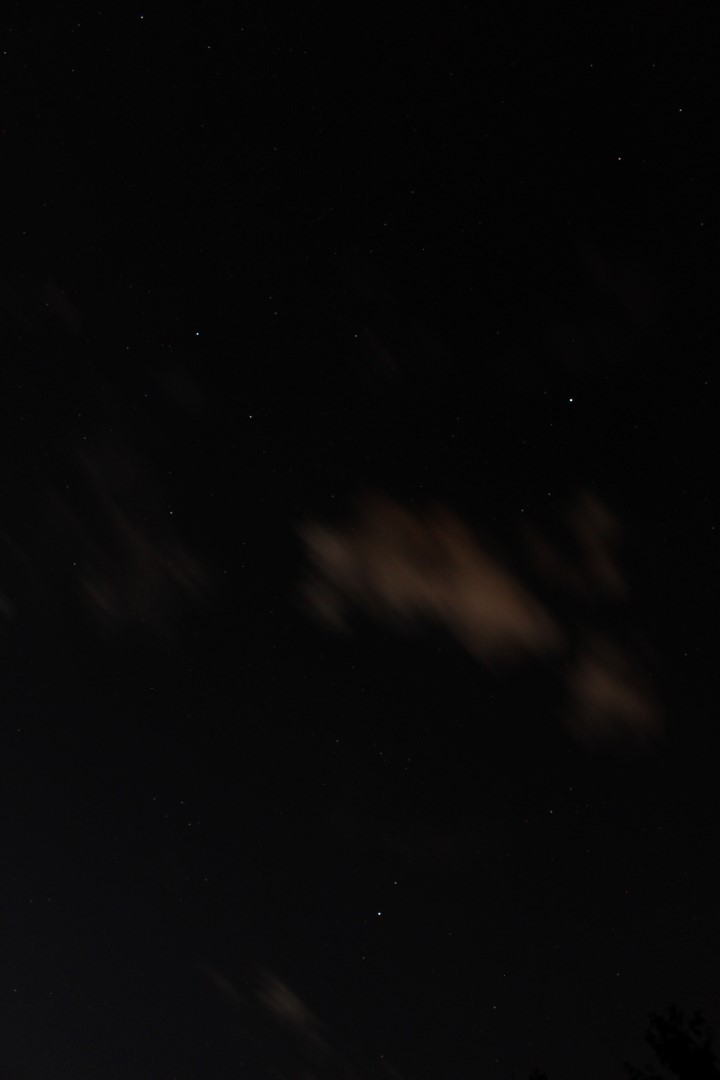
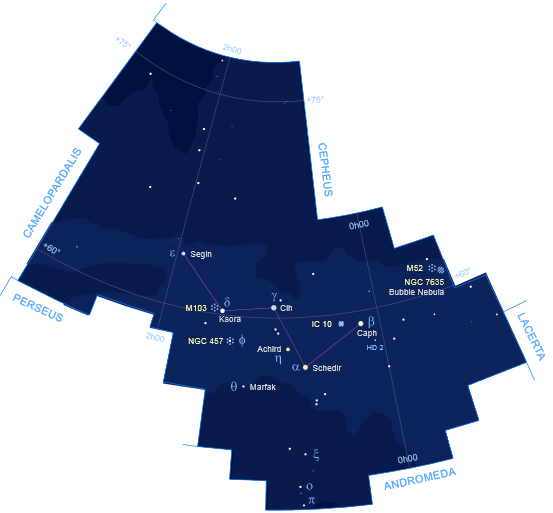
The W-shaped asterism of the Cassiopeia straddles the Milky Way in the northern sky and is made of  5-stars: Segin, Ksora, Cih, Schedar and Caph.  The constellation contains a number of star clusters, most notable being M52 and close to Ksora, M103.

cassiopeia


Cassiopeia

Cassiopeia

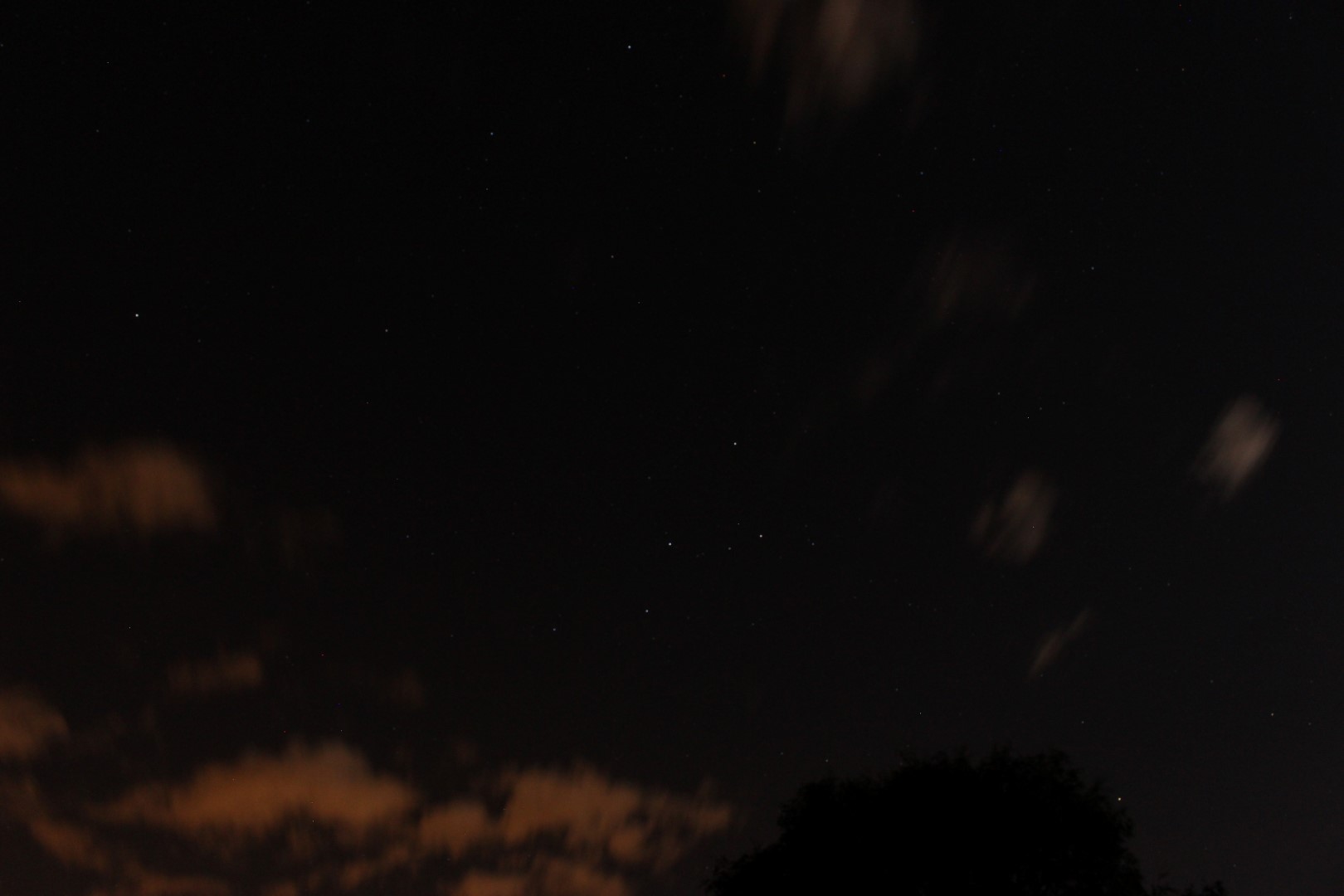
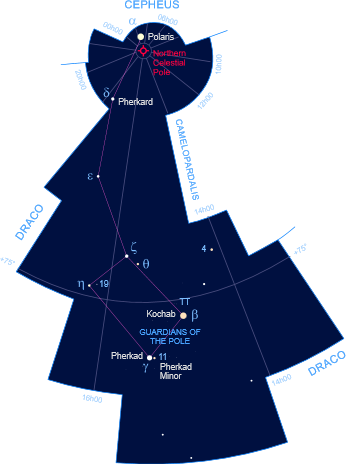
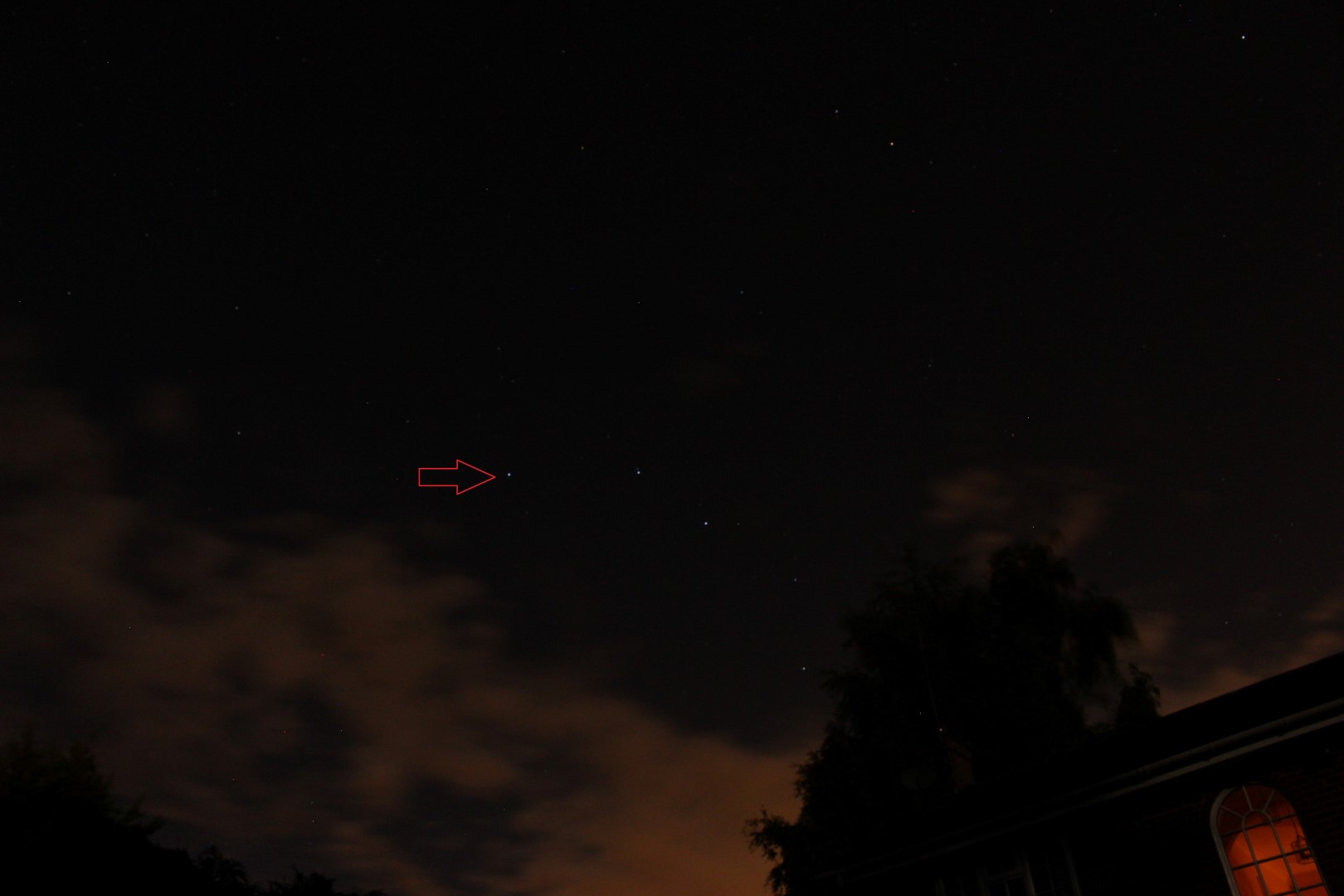
Ursa Minor –  Like the Plough in Ursa Major, Ursa Minor has a ‘dipper-like’ shape and they are therefore respectively known as the Big and Little Dippers.  Ursa Minor’s main significance is the North or Pole Star, AKA Polaris.  Situated very close to the Celestial Pole, alignment of the telescope mount with Polaris is essential to achieve accurate tracking; unfortunately Polaris is obscured from Fairvale Observatory but can be seen from the garden.

ursaminor


Ursa Minor - Polaris star indicated by red arrow, with the 'dipper' to the right.

Ursa Minor – Polaris star indicated by red arrow, with the ‘dipper’ to the right.