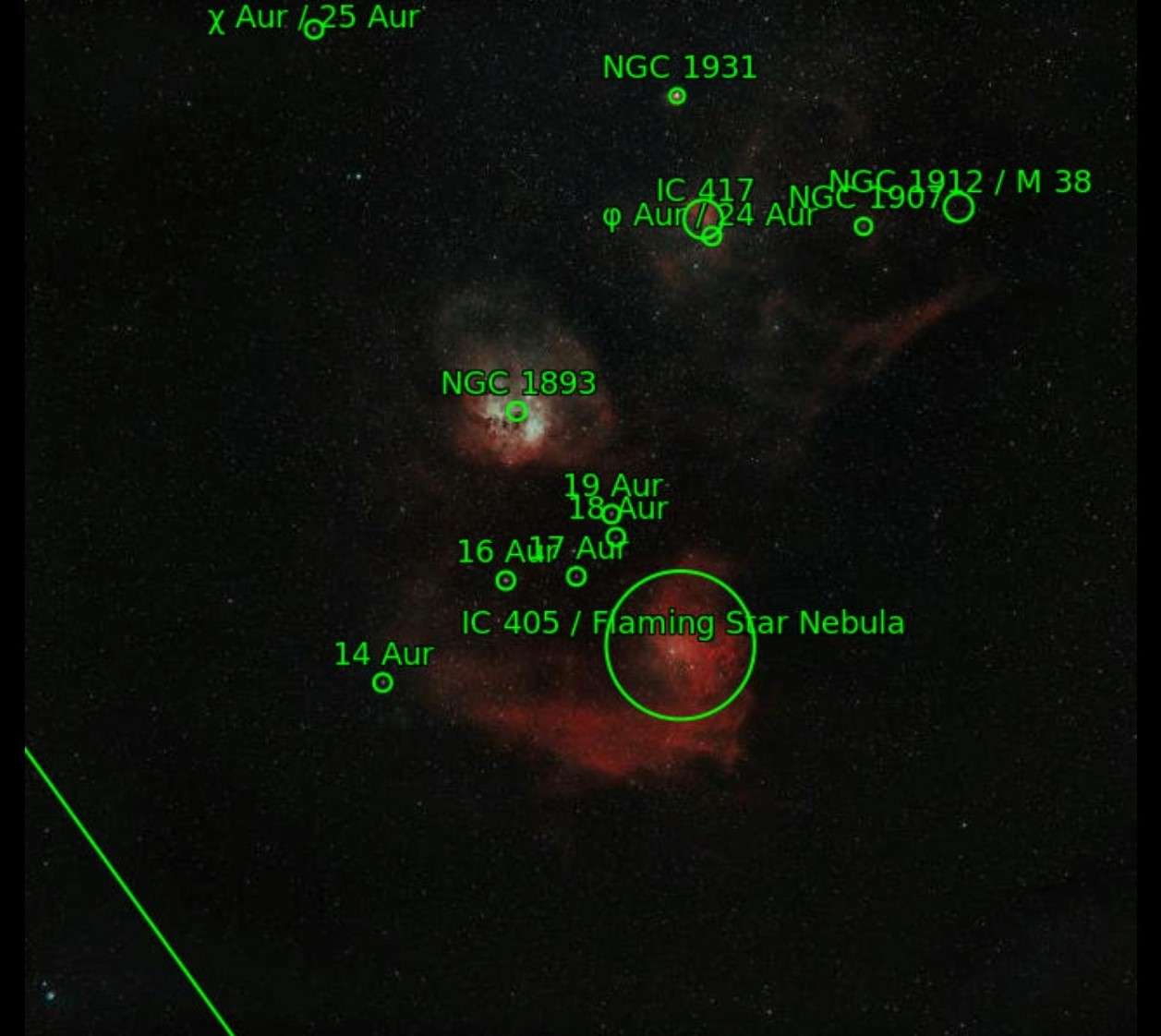
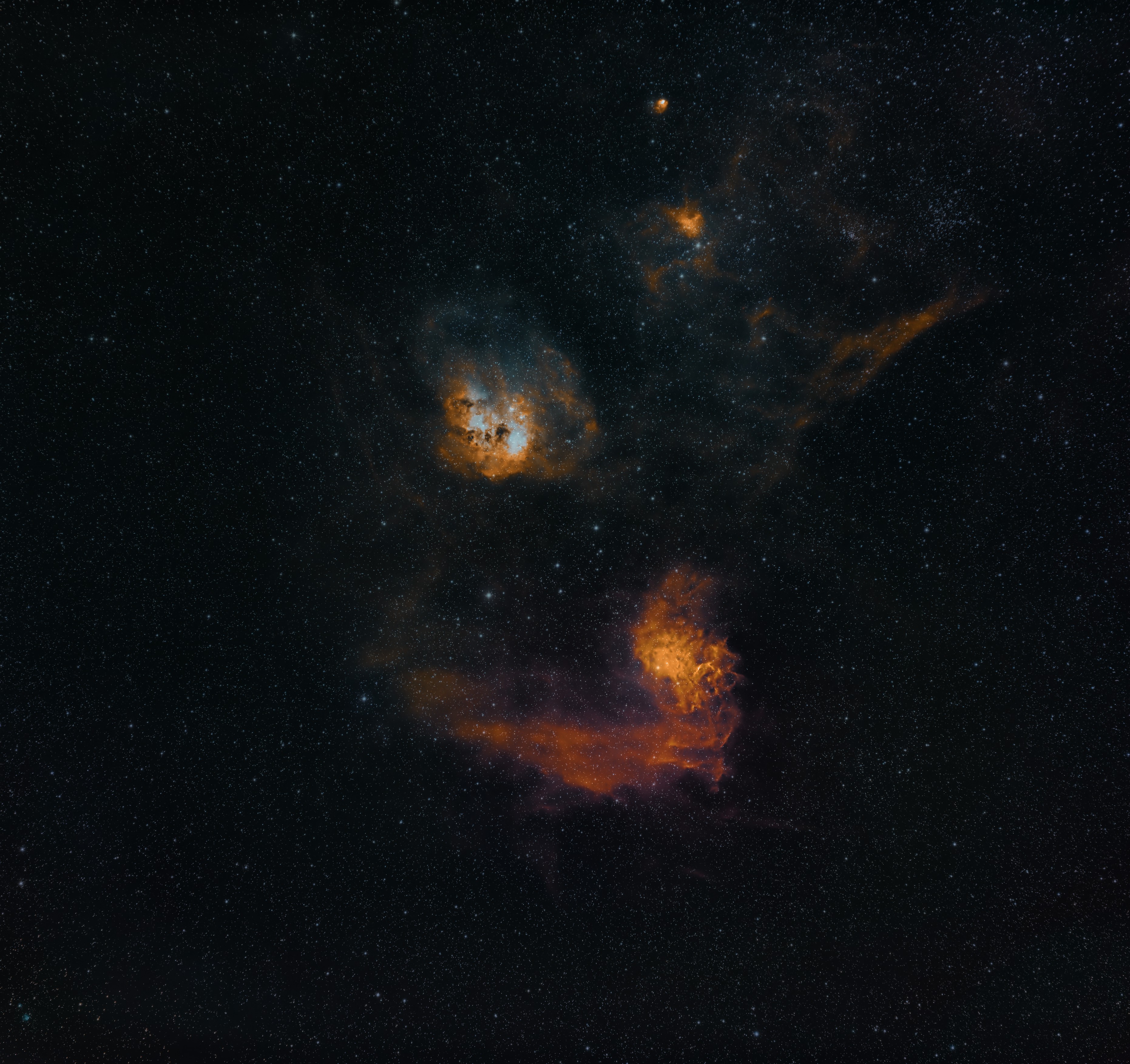
There’s a lot going on in and around the Auriga constellation and this winter I’ve been mainly imaging in this region, almost exclusively using the Samyang 135 widefield rig. Here with the whopping 7.50o x 5.67o field-of-view this set-up provides, it easily incorporates both emission nebulae IC405, AKA the Flaming Star Nebula and it’s nearby (visually) neighbour IC410, the Tadpoles Nebula, as well as much more.
Hydrogen gas ionized by the central AE Auriga star produces the dominant strong red colour, which combined with the rippling dust and gas lanes that run through the head of IC405 leads to a ‘flame affect’ and thus the nebula’s popular nickname.
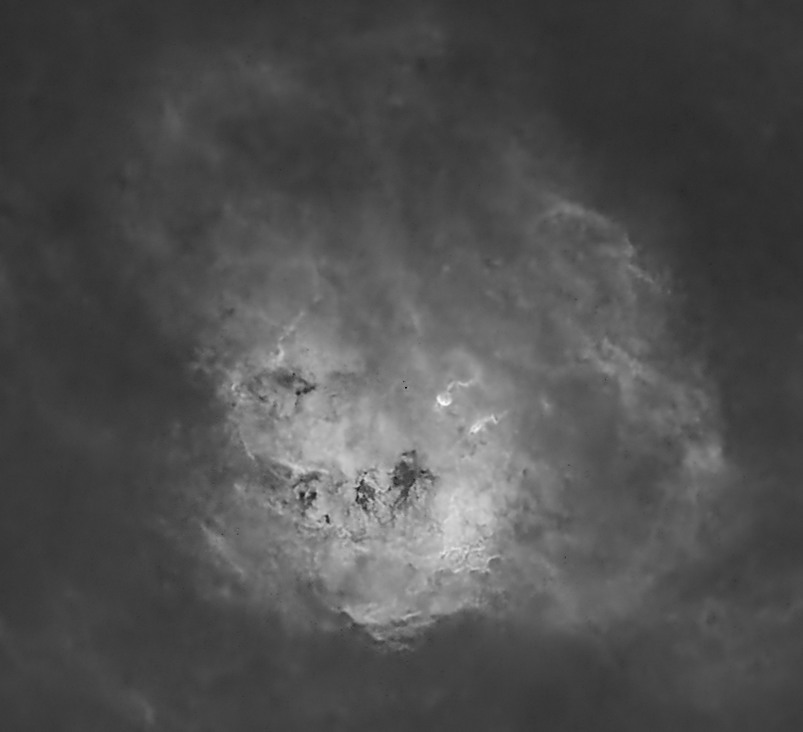
The structures in IC410 are illuminated by radiation from the open star cluster NGC1893, located at the centre of the nebula. Hot, massive, young stars abound, especially around Simeis 129 & 130, the two tadpoles. These structures are ‘wriggling away’ from the centre of the nebula, because of the prevailing stellar winds and radiation pressure from the stars in NGC 1893.
This image is the cornerstone of a series of covering a wider area completed during January, which I intend to first present individually before, hopefully, bringing them together as an HOO mosaic later.
This image has been processed as two SHO versions of the Hubble Palette: (i) a basic mix above and (ii) using a dynamic mix ( main cropped image at top-of-the page). Once more I have been impressed by the ability of this small camera lens to produce exceptional detail and colours, but especially here with the starless Ha version of IC410, where the signature features or so-called tadpoles have been captured to great effect (see cropped starless Ha version of IC410 below).
IMAGING DETAILS
Object
IC 405 The Flaming Star Nebula + IC 410 The Tadpoles Nebula
Constellation
Auriga
Distance
1,500 & 12,000 light-years
Size
Approx. 37’ x 10’ & 40’ x 30’
Apparent Magnitude
+6.0 & +10
Scope / Lens
Samyang 135 @f2.8
Mount
SW AZ-EQ6 GT + EQASCOM computer control & Cartes du Ciel
Guiding
Sky-Watcher EvoGuide 50ED
+ Starlight Xpress Lodestar X2 camera & PHD2 guiding
Camera
ZWO1600MM-Cool mono CMOS sensor
FOV 7.5o x 5.67o Resolution 5.81”/pix Max. Image Size 4,656 x 3,520 pix
The Cygnus constellation is rich in potential astrophotography targets and since the return of astronomical darkness I’ve bagged three objects from this area with my new widefield Samyang 135 rig: Cygnus Loop, Sadr Region & Crescent Nebula, and the Western Veil & Pickering’s Triangle. As the Cygnus season now draws to a close – in my case disappearing northwards behind my house – I was ready to snap one final Cygnus object using my main William Optics GT81 rig but then looked closer and realised using the Samyang 135 rig with careful framing there was another a more ambitious possibility.
The original object in question was SH2-119 AKA the Clamshell nebula, an emission nebula somewhat overlooked by photographers. Nevertheless, imaged in narrowband there’s plenty of structure to see throughout the nebulosity that makes up the two ‘shells’, whilst the bright magnitude +5 star 68 Cygni might be likened to the pearl at the centre, which would work well with the 81mm William Optics field-of-view. But deploying with care the much wider field-of-view of the Samyang 135 and it’s possible to include the North America and Pelican nebulae as well, just!
With some difficulty (weather) I finally managed to obtain 13-hours integration time over 6-nights, which has resulted in a pleasing SHO image (see main image at the top of the page – below is a dynamic version processed using PI PixelMath), once again demonstrating the capacity of this small but powerful lens. Personally, I find bringing all three objects together within a much larger field-of-view creates greater context, resulting in a more interesting image overall – in football parlance you might call it a hat-trick of nebulae!
IMAGING DETAILS
Objects
North America Nebula (NGC7000) + Pelican Nebula (IC5070 & IC5067) + Clamshell Nebula (SH2-119)
Constellation
Cygnus
Distance
approx. 2,600 light-years
Size
3.0o
Apparent Magnitude
approx. +4 to 8
Scope / Lens
Samyang 135 @f2.8
Mount
SW AZ-EQ6 GT + EQASCOM computer control & Cartes du Ciel
Guiding
Sky-Watcher EvoGuide 50ED
+ Starlight Xpress Lodestar X2 camera & PHD2 guiding
Camera
ZWO1600MM-Cool mono CMOS sensor
FOV 7.5o x 5.67o Resolution 5.81”/pix Max. Image Size 4,656 x 3,520 pix
Hitherto, most of my astrophotography has concentrated on a variety of specific objects that work within the 2.65o x 2.0o field-of-view provided by the combination of my William Optics GT81 refractor and ZWO ASI1600MM-Cool camera. After recently pairing the aforesaid ZWO mono camera with a Samyang 135 lens (often marketed elsewhere as the Rokinon 135) my astrophotography world has expanded dramatically to an enormous 7.50o x 5.67o, some x8 larger than before. As a result, this excellent lens that also captures great detail, provides new opportunities to image some of the very large features that abound throughout the Universe without having to resort to a mosaic imaging; this a great advantage when working in UK weather conditions which usually provides less imaging time than required.
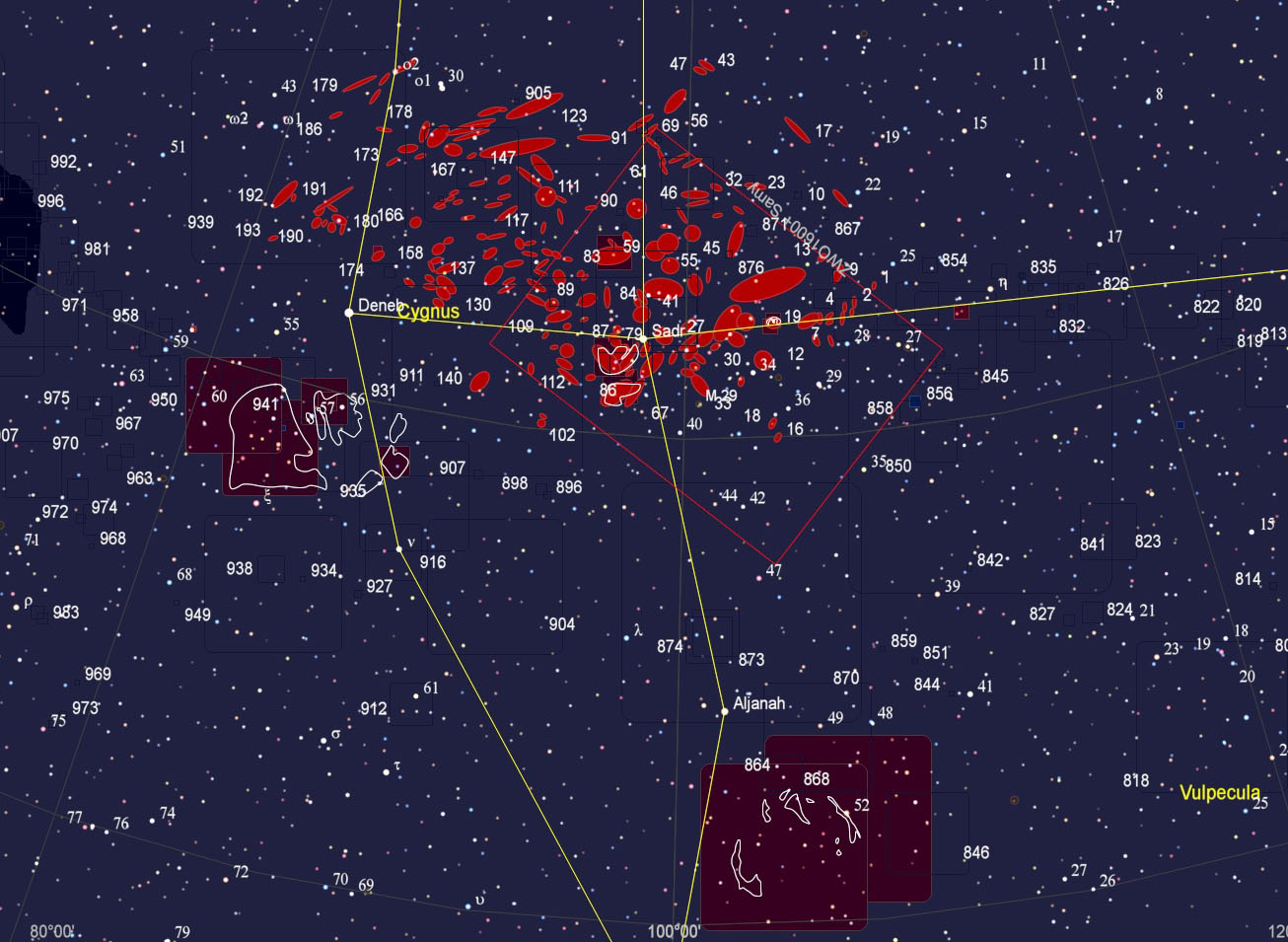
Above, Cygnus-X Region & notable nearby objects: The red box appproximately outlines the image area, which in this plan is presented upside-down compared to the main image. The numerous red shapes define the location of the HII objects that make up the DWB catalogue (19 is the Crescent nebula). Just beyond to the left is the North America Nebula (NGC7000) and below the SNR Cygnus Loop, AKA the Veil Nebula (NGC 6960 & 6992).
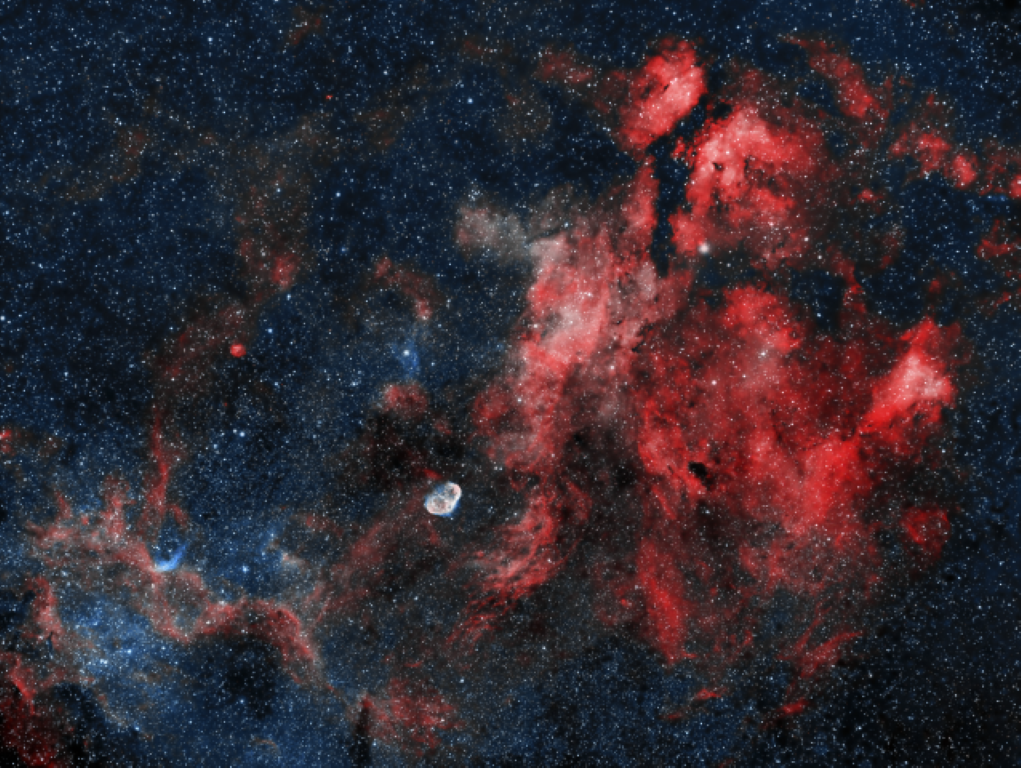
In this case I chose to frame the image in such a way as to encompass some familiar objects, such as the Butterfly Nebula (IC1318) and the Crescent Nebula (NGC6888) anchored by Sadr, the yellow-white supergiant star that stands out from within the very large Cygnus-X region. Processed here in HOO, with 6-hours integration time and full calibration (darks, flats & flat darks), the final image provides a magnificent view of this large, interesting region that augurs well for future widefield imaging with this new rig. I’m particulalry intrigued by the bluish feature at about 8.0 o’clock of the Crescent Nebula, which I now believe to be associated with WR-134: a bubble-like structure some 50 light-years in diameter consisting of OIII rich light formed by an intense wind emanating from the Wolf-Rayet star at it’s centre. The breadth of view it provides can encompass myriad of objects in exceptional detail, thereby providing a wider context that is simply awe-inspiring to see – it’s just like shrinking the Universe!
Astrometry image plan
IMAGING DETAILS
Object
Sadr Region
Constellation
Cygnus
Distance
+5,000 light-years
Size
Full FOV – see below
Apparent Magnitude
+/- 7.0
Scope / Lens
Samyang 135 @f2.8
Mount
SW AZ-EQ6 GT + EQASCOM computer control & Cartes du Ciel
Guiding
Sky-Watcher EvoGuide 50ED
+ Starlight Xpress Lodestar X2 camera & PHD2 guiding
Camera
ZWO1600MM-Cool mono CMOS sensor
FOV 7.5o x 5.67o Resolution 5.81”/pix Max. Image Size 4,656 x 3,520 pix
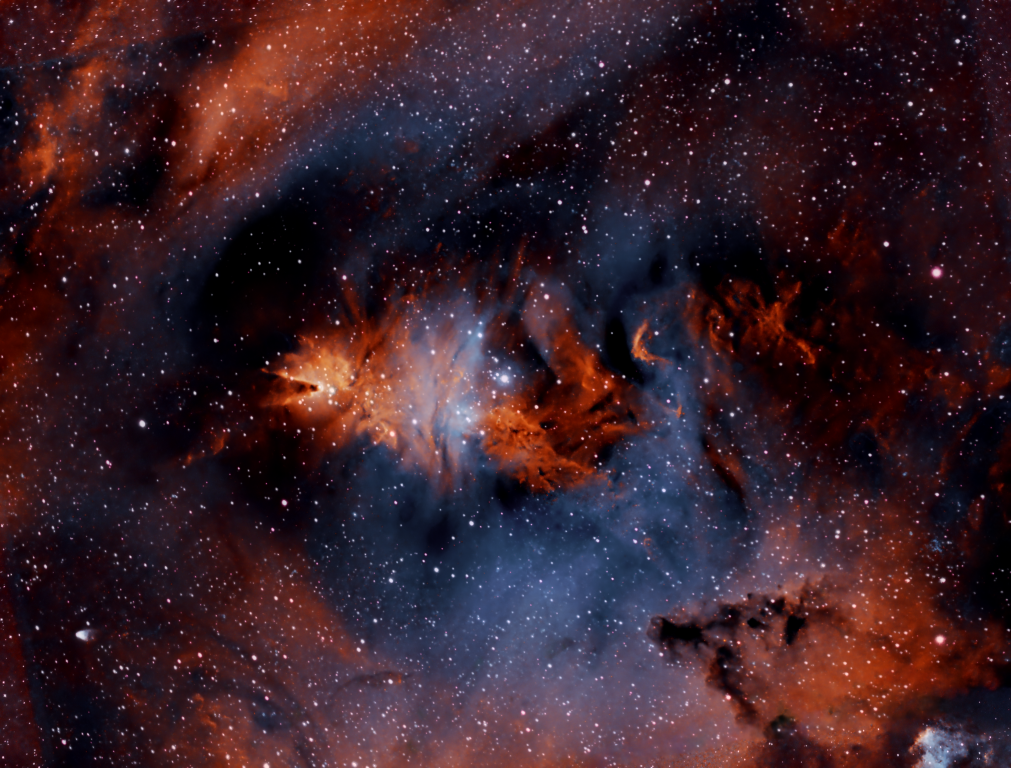
Projecting a line from Bellatrix to Betelgeuse a similar distance beyond to the east (left) by eye, to the northern extremity on Monoceros is one of late winter’s treats. Located about 2,500 light years from Earth is the star forming region NGC 2264, consisting of the Christmas Tree Cluster (an open cluster), the nearby so-called Cone Nebula and in between the Fox Fur nebula. I first imaged these objects in 2014 and again in 2018 but now armed with better skills and equipment, a return to this rich area of the night sky which is full of HII, reflection and dark nebula was long overdue + I had a plan to obtain greater detail and colour than was hitherto achieved.
Location of NGC 2264 Christmas Tree Cluster et al based on Wikisky image
Key to the plan was greater integration time and with 13h 25minutes obtained over three nights at the end of February, this established a solid data foundation. As ever with all broadband images, there’s an endless choice of permutations combining wavelengths to form a final image and inspired by the work of others, I used the popular SHO Hubble Palette but adapted here by using synthetic SII and OIII channels in PixInsight’s Pixel Math to enhance the related colours: SII = (Ha*0.30+SII*0.70) & OIII (Ha*0.40+SII*0.60+OIII). The resulting final image has exceeded my expectations, as the colours and details here now successfully highlight the aforesaid central objects as well as the wider complexity and beauty of flowing dust and gases that abounds in this region, which also includes NGC 2261 Hubble’s variable nebula, NGC 2259 open cluster and the emission nebula LBN 902.
NGC 2264 starless version shows detail more clearly
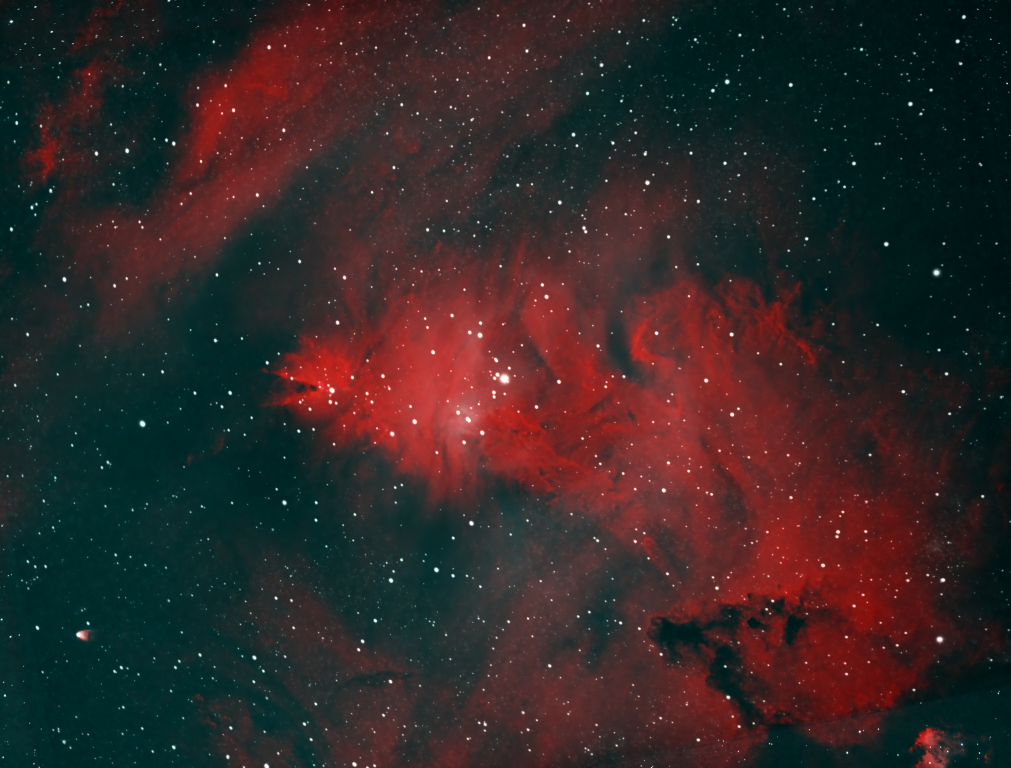
Conventional HOO image version of NGC 2264 widefield
IMAGING DETAILS
Objects
NGC 2264 – Christmas Tree Cluster, Cone Nebula, Fox Fur Nebula + NGC 2261 Hubble’s variable nebula, LBN 902 emission nebula & NGC 2259 open star cluster
Constellation
Monoceros
Distance
2,500 light-years
Size
~2.5o total
Apparent Magnitude
Varies
Scope
William Optics GT81 + Focal Reducer FL 382mm f4.72
Mount
SW AZ-EQ6 GT + EQASCOM computer control & Cartes du Ciel
Guiding
William Optics 50mm guide scope
+ Starlight Xpress Lodestar X2 camera & PHD2 guiding
Camera
ZWO1600MM-Cool mono CMOS sensor
FOV 2.65o x 2.0o Resolution 2.05”/pix Max. image size 4,656 x 3,520 pix
EFW
ZWO x8 EFW & 31mm Chroma Ha, SII & OIII filters
Capture & Processing
Astro Photography Tool + PHD2 + Deep Sky Stacker, PixInsight v1.8.8-12, Photoshop CC
Image Location & Orientation
Centre RA 06:40:55.725 DEC +09:53:45.407 Top is 280o E of N i.e. Right = approx. North
Exposures
x39 Ha , x83 OIII, x39 SII @ 300 sec Total Integration Time: 13hr 25 min
@ 139 Gain 21 Offset @ -20oC
Calibration
5 x 300 sec Darks + 15 x Ha, OIII, SII Flats & Dark Flats @ ADU 25,000
Location & Darkness
Fairvale Observatory – Redhill – Surrey – UK Typically Bortle 5-6
Every year since 2014 I’ve published a retrospective blog of my astrophotgraphy year just ending called Reflections. It’s been a useful task that enables me to bring together the best and sometimes the worst of my images, in order to consider the good and bad points + progress made + set some objectives for the coming year. Eight years on, after which I believe I’ve now reached at least a respectable level of imaging and processing, I’ve decided to stop this format for the time being.
Notwithstanding, at this time of the year I also produce an astrophotography calendar for members of my family, which consists of the better images from the year just ending; I think they like them and certainly all use the calendar during the coming year. Moreover, I also recently started to compile a video of the said calendar images set to appropriate music, which we all watch together prior to seeing the actual calendar. It’s a great way to present the images, which look really stunning on today’s large Smart TV’s and is fun to watch with the family too.
The video for this last year 2021 can be viewed on YouTubeHERE and below is a brief very general overview of each image. More detailed background information and imaging details for those interested can be found in relevant blogs posted on this site during the past year.
2022 CALENDAR
A new set of filters, improved processing techniques and access to data from a telescope at a dark sky site in New Mexico, USA (shown by an asterisk *) contributed to an exciting astrophotography year in 2021.
FRONT COVER
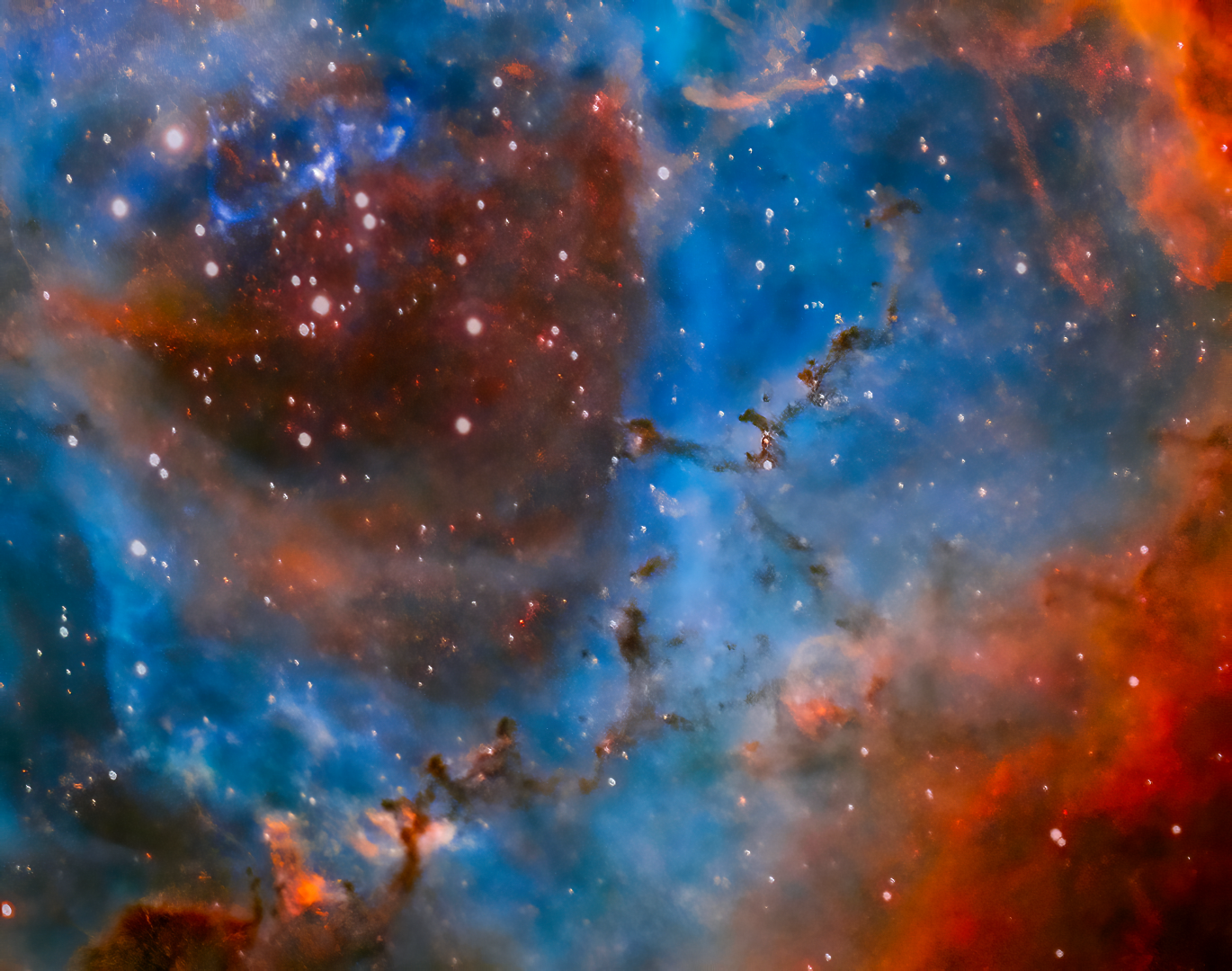
The Carnival of Animals: Special processing of the inner region of the Rosette Nebula highlights the ‘animals’ or Bok Globules – clouds of dust undergoing gravitational collapse as part of the process of new star formation.
JANUARY
LDN-1250 Dark Nebula*: Dark or absorption nebulae are a type of interstellar cloud which are so dense they obscure or absorb visible light emitted from objects behind or within and thereby contrast with the general light flux of the Universe as dark areas.
FEBRUARY
CTB-1 Supernova Remnant*: The overall structure of this supernova remnant is that of a circular shell, with a conspicuous rupture towards the north (lower right of image). The main red Ha-shell is composed of multiple interlocking filament limbs, with a blue / green OIII arc along one side.
MARCH
Jellyfish Nebula: Locatedin the Gemini constellation some 5,000 light years from Earth, this is a remnant of a supernova that took place during the past 30,000 years. With a diameter of 70 light-years, the object is visually speaking nearly twice the size of a full moon.
APRIL
Markarian’s Chain: The Virgo cluster consists of more than 2,000 galaxies, within which Markarian’s Chain forms a J-curve string of bright galaxies that share a common motion through space.
MAY
M13 Great Globular Cluster of Hercules*: Consisting of several hundred thousand stars and 145 light-years in diameter, M13 is considered to be the finest cluster in the Northern Hemisphere.
JUNE
Cave Nebula*: Located along the plane of the Milky Way is the diffuse emission nebula referred to as the Cave Nebula. The Cave at the centre is critically located at the boundary of the Cepheus molecular cloud and the hot, young stars which ionize the surrounding gases to great effect.
JULY
Orion Widefield: Framed around the area of Orion’s Belt, the Horsehead Nebula and the Great Orion Nebula, look hard and the refection nebula M78 can also be seen in the lower left corner.
AUGUST
Elephant’s Trunk Nebula*: A very large emission nebula, the so-called Elephant’s Trunk Nebula is rightly viewed as one of astrophotography’s most iconic images. The ‘trunk’ itself dominates the centre of this image and is illuminated from behind by a bright star forming region.
SEPTEMBER
M31 Andromeda Galaxy: The full benefit of new filters, improved guiding, clear skies over 6-nights and extensive use of new processing techniques can be seen in my best image yet of Andromeda.
OCTOBER
Butterfly Nebula: Situatedwithin the Orion Arm of the Milky Way is the Gamma Cygni nebula, a diffuse emission nebula surrounding the star Sadr. Either side of the dark rift which divides the image from top to bottom are two large bright areas that together form the so-called Butterfly.
NOVEMBER
M33 Triangulum Galaxy: Like it’s neighbour Andromeda, better data and processing has produced an exciting new image of M33 this year, the red areas highlight Ha-rich star-forming regions
DECEMBER
Flying Bat & Giant Squid Nebula*: This very faint OIII emission nebula Ou4 required an imaging time of 40-hours. For obvious reasons Ou4 has become known as the Giant Squid Nebula which, moreover, lies within the much larger SH2-129 HII emission region or the Flying Bat Nebula.
A very large emission nebula, the so-called Elephant’s Trunk Nebula in the Cepheus constellation is rightly one of astrophotography’s most iconic images. Unfortunately my house obscures northern views of the sky from the main observatory and I’ve therefore only imaged this once before in 2018 with some success but definite room for improvement. However, using a Takahashi FSQ 106 located at the DSW observatory in New Mexico, USA during Q3 there were no such constraints, which has resulted in a 29.5 hour data set that forms the foundation of this exciting HaSHO image.
SH2-131 consists of glowing gases illuminated by an open star cluster, which is divided by lanes of dark interstellar dust clouds. The ‘trunk’ itself, designated IC 1396A, dominates the centre of this image and is spectacularly illuminated from behind by a bright star forming region; a longer focal length combined with the QSI camera and 30% crop has produced much closer view than previoulsy in 2018. Together with the Cave Nebula, Fyling Bat and Giant Squid Nebula, the dark nebula LDN-1250 and now the Elephant Trunk Nebula, Cepheus, has proved a very productive area for me this year.
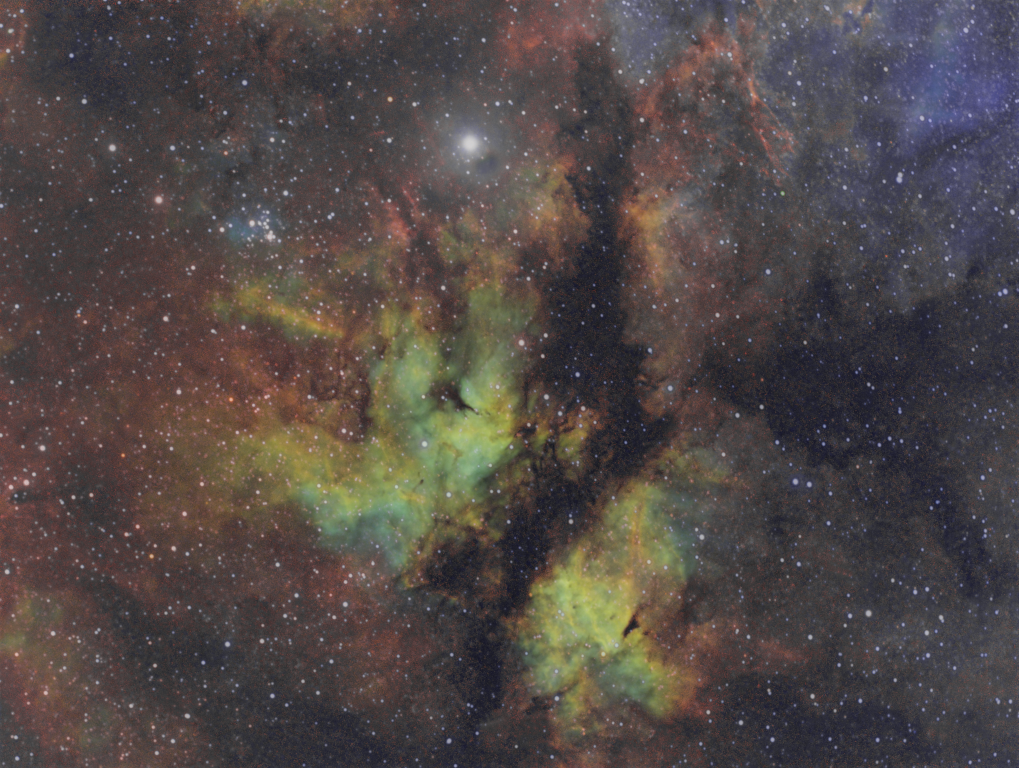
Located within the Orion Arm of the Milky Way galaxy is the Gamma Cygni nebula, a diffuse emission nebula that surrounds the star of the same name, otherwise better known as Sadr. Moreover, this large area forms part of an even bigger HII-region that is mainly (80%) located in the north and east quadrants of the so-called Cygnus Cross, which is defined by the stars Deneb – Sadr – Delta Cygni – Albireo – Aljanah (see below).
This vast area passes directly high overhead at this time the year before disappearing behind the house roofline in the early morning hours and has already provided many exciting imaging opportunities for me in the past. The heart (not the centre) of the region is the supergiant star Sadr and I first imaged this area in autumn 2015 using my modded DSLR camera. A return visit was therefore long overdue and this time I set out to better capture the so-called Butterfly Nebula in narrowband wavelengths.
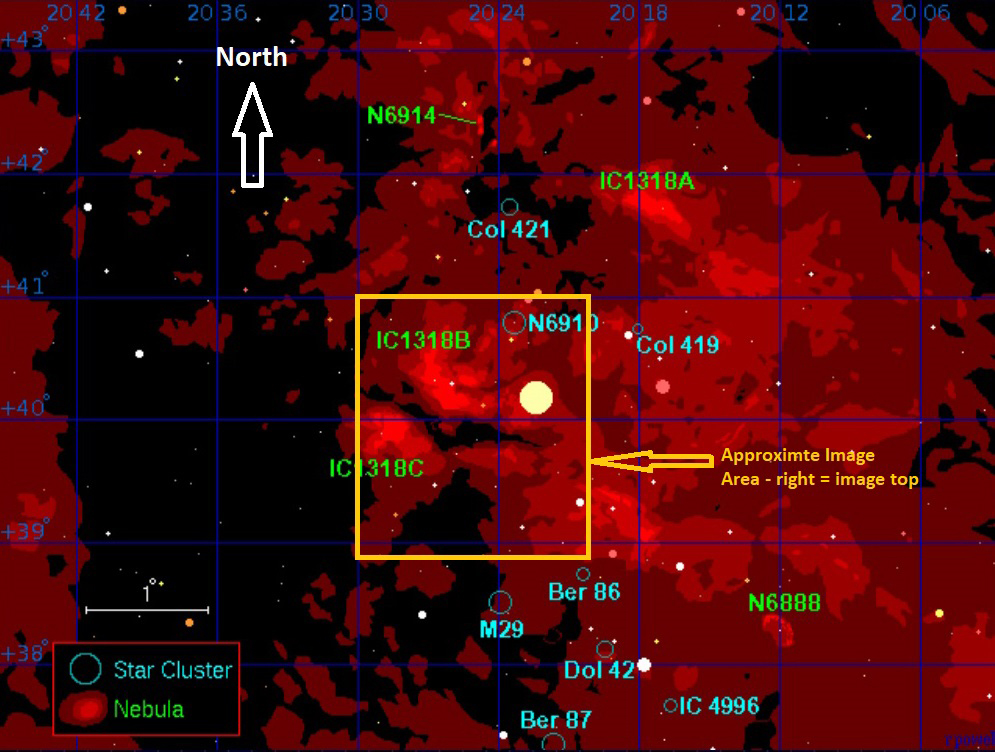
The resulting data has been processed to good effect as an SHO image (see top-of-the-page) using the Hubble Palette techniques. Other than the dominant supergiant star Sadr and widespread colourful nebulosity, two significant features are worthy of note in the final image. Either side of the almost central dark rift that divides the image laterally, are two large bright areas which together form the ‘wings’ of the so-called Butterfly Nebula IC 1318-C (right = south) and IC 1318-B (left = north). Furthermore, just beyond the Butterfly’s left wing north of Sadr is the young, bright open star cluster NGC 6910.
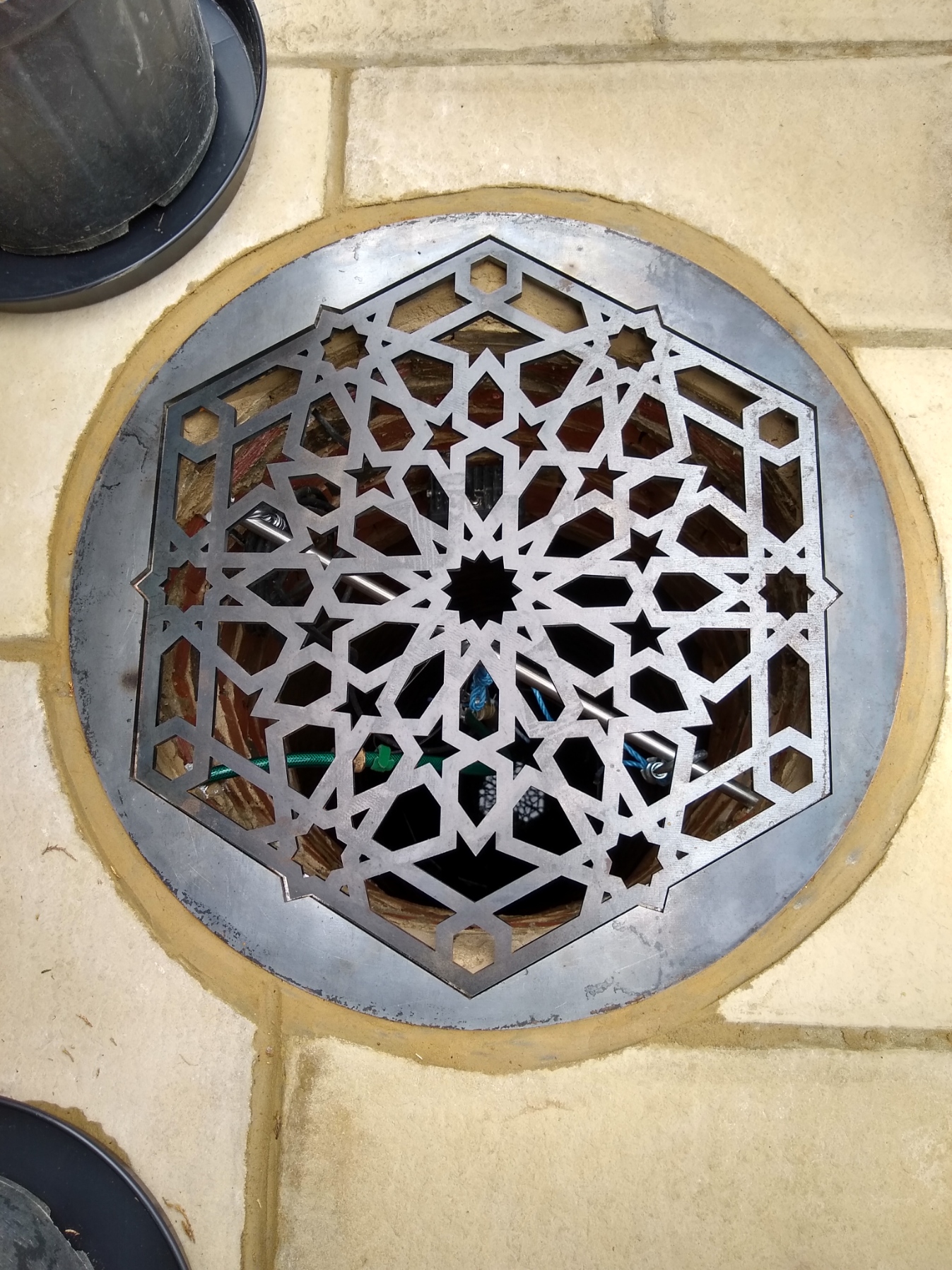
Finished well with submersible water pump & floodlight (turned off for astronomy!)
I’m very pleased with this image, which is my first since the end of March, in part because nowadays I take an astronomy break during the long late spring / summer days when astronomical darkness is largely absent. However, this year the pause has been protracted as the patio on which Fairvale Observatory is situated was re-laid, during which a hitherto unknown water well was discovered. Thereafter one thing led to another and turned into a summer project to recommission the well, thus delaying completion of the patio. As a result I’ve only recently been able to reinstate the astronomy equipment, a job that is still ongoing. The new patio is firm and flat, providing a much better surface for the mount than before and I’m hopeful that once recalibration is completed will result in improved tracking results – watch this space!
IMAGING DETAILS
Object
IC1318-B & IC1318-C Gamma Cygni Nebula or Butterfly Nebula NGC 6910 Open cluster
Constellation
Cygnus
Distance
3,700 light-years
Size
1Approximately 100 light-years
Apparent Magnitude
Varies
Scope
William Optics GT81 + Focal Reducer FL 382mm f4.72
Mount
SW AZ-EQ6 GT + EQASCOM computer control & Cartes du Ciel
Guiding
William Optics 50mm guide scope
+ Starlight Xpress Lodestar X2 camera & PHD2 guiding
Camera
ZWO1600MM-Cool mono CMOS sensor
FOV 2.65o x 2.0o Resolution 2.05”/pix Max. image size 4,656 x 3,520 pix
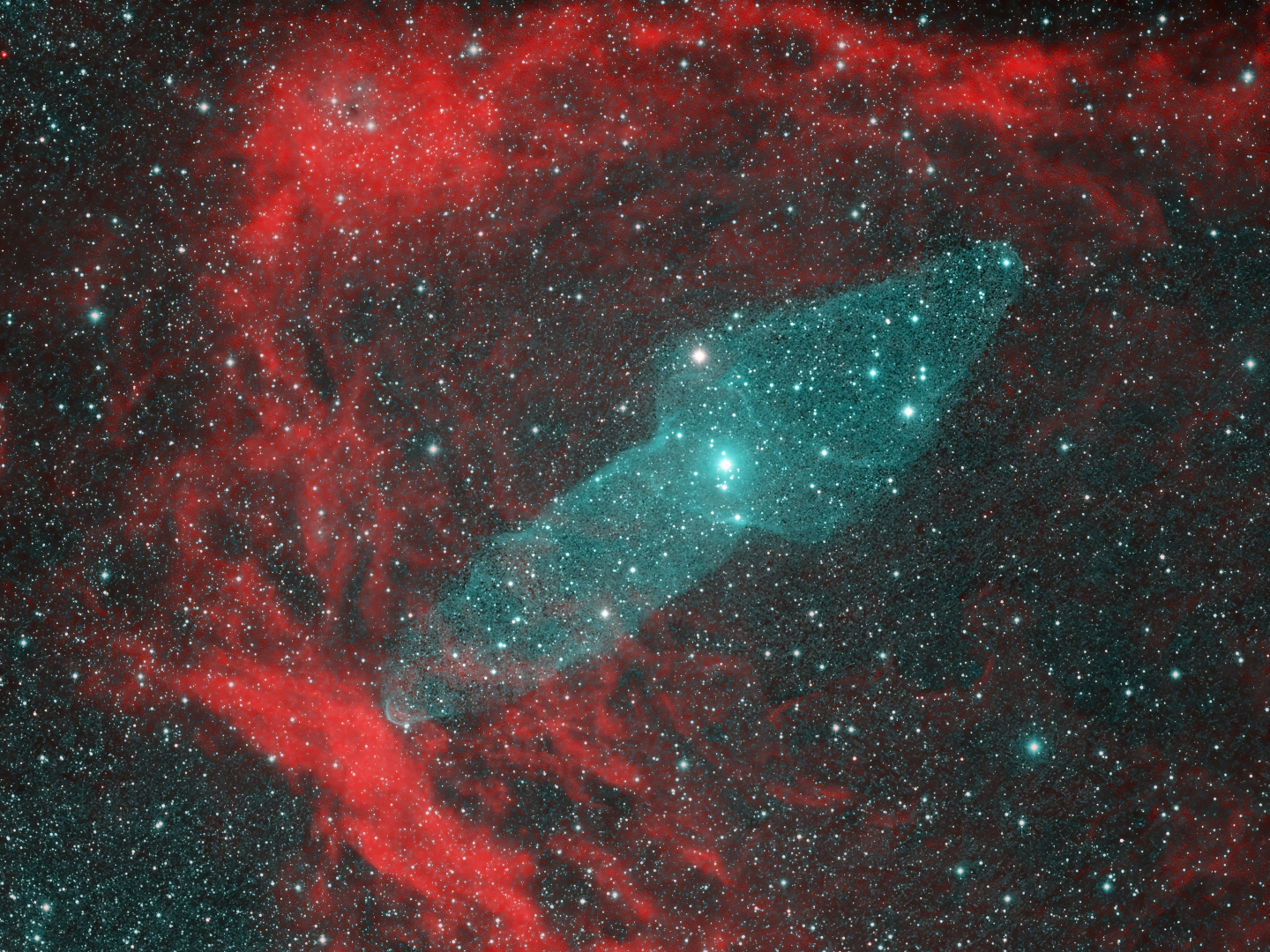
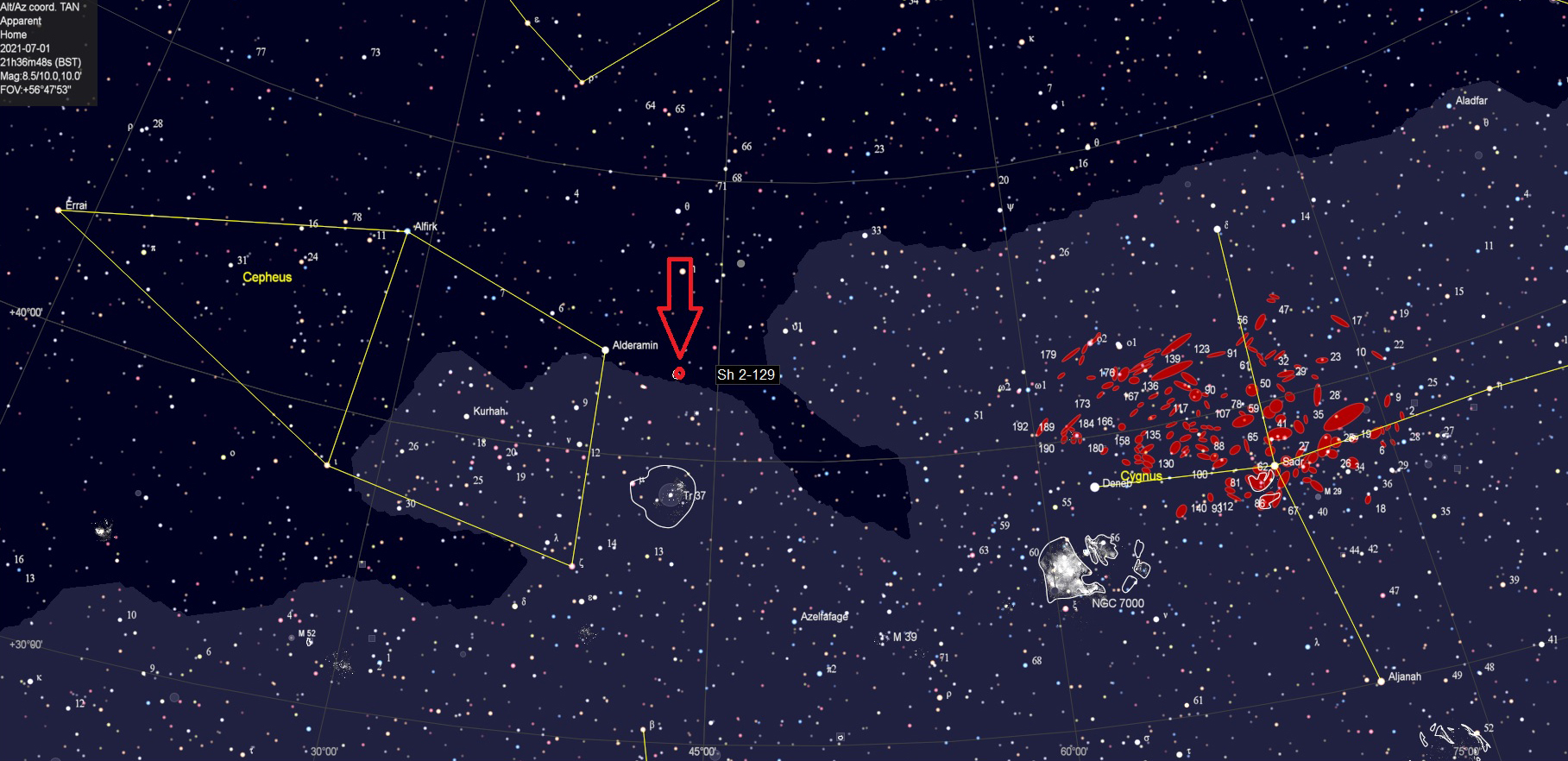
Discovered as recently as 2011 by French astronomer Nicolas Outters, is the very faint OIII emission nebula Ou4. Located in the constellation of Cepheus , this somewhat elusive object requires very long exposures and integration time to successfully image. For obvious reasons Ou4 has become known more commonly as the Giant Squid Nebula and belongs to the difficult but must-do objects list of astrophotographers. Moreover, the Squid lies within the much larger SH2-129 HII emission region or the Flying Bat Nebula, only part of which is shown here. In this case some 40-hours of exposure, of which the Squid is 15-hours, combined with careful processing has produced a wonderful image of both these exciting objects.
Initially considered to be a Planetary Nebula, Ou4 is now thought to be a bipolar outflow that was discharged 90,000 years ago from the hot massive triple star system HR 8119 situated within the Sh 2-129 HII-region, which is also responsible for ionizing the red emission nebula itself. The Squid consists of two collimated lobes with arc-shaped tips of enhanced OIII emission that resemble bow-shocks seen in stellar outflows and a few bubbles and filamentary arcs. The bipolar Ou4 lobes measure some 50×8 light-years, which though faint forms one of astrophotography’s great spectacles.
Here at Fairvale Observatory, most of the exciting deep sky objects associated with the transit of the Milky Way during winter have disappeared over the western horizon by early spring. Notwithstanding, a brief period of decent conditions at the very end of March provided a late window of opportunity to image a core area of our galaxy, which being viewed above Oirion at a higher declination in the constellation of Gemini, helped to extend the limited imaging time available. Frankly after such a terrible period of weather since last November, I was desperate to get one last image from this rich part of the night sky and try out my new Chroma narrowband filters again, which thankfully worked out well after imaging IC443 the Jellyfish Nebula over four nights, despite there being less than two hours of suitable viewing and darkness each night.
The remnant of a supernova that occurred between 3,000 and 33,000 years ago, located in the Gemini constellation the Jellyfish Nebula is some 5,000 light years from Earth. With a diameter of 70 light-years, the angular view of the nebula is some 50 arcminutes or nearly twice the size of a full moon. Overall the nebula consists of at least three distinct shells reflecting the complex nature of this Type-II supernova, which is interacting with the surrounding area of molecular clouds.
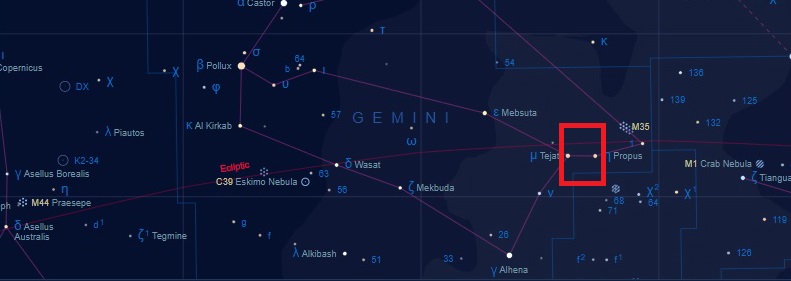
Red box indicates location and orientation of image
Acknowledging the limited time available – compounded by lingering cloud each night – I chose to image The Jellyfish in narrowband bicolour, hoping to collect some SII photons on another day to add to the Ha & OIII. At the end I also added some short LRGB subs to improve the final star colours and during processing used Ha as a false luminance layer to help bring out the complex structure of the nebula further. The image has been deliberately framed by the adjacent large stars Propus (bottom) and Tejat (top), which caused plenty of problems during processing but in my opinion form an essential component when imaging this object. Whilst IC443 is undoubtedly the main act, it is set off well by the large adjacent area of detailed nebulosity and the smaller reflection nebula IC444 to the right which is easy to overlook. Despite many issues I am very pleased with the final image that beautifully shows off this spectacular DSO and the surrounding region in all its glory, which seems all the better being something of a last chance opportunity that I thought I’d missed for this season.
IMAGING DETAILS
Object
IC443 Jellyfish Nebula & IC444
Constellation
Gemini
Distance
5,000 light-years
Size
50 arc minutes ~70 light years
Apparent Magnitude
+12
Scope
William Optics GT81 + Focal Reducer FL 382mm f4.72
Mount
SW AZ-EQ6 GT + EQASCOM computer control & Cartes du Ciel
Guiding
William Optics 50mm guide scope
+ Starlight Xpress Lodestar X2 camera & PHD2 guiding
Camera
ZWO1600MM-Cool mono CMOS sensor
FOV 2.65o x 2.0o Resolution 2.05”/pix Max. image size 4,656 x 3,520 pix
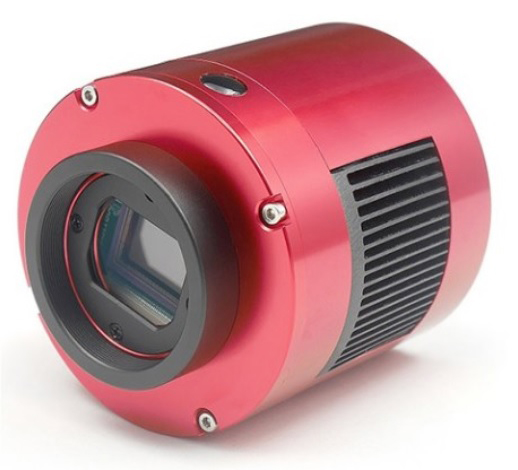
The history of astrophotography will record a period of rapid innovation during the past decade, amongst which one of the stand-out developments has been that of the CMOS sensor based camera, notably the ZWO ASI1600MM-Cool (see below). Just look at any astrophotography website such as Astrobin and it won’t take long to find an image taken with this camera such is its popularity. It is this very camera that I was fortunate to purchase in December 2016 shortly after its release and has been the core of my astrophotography set-up ever since.
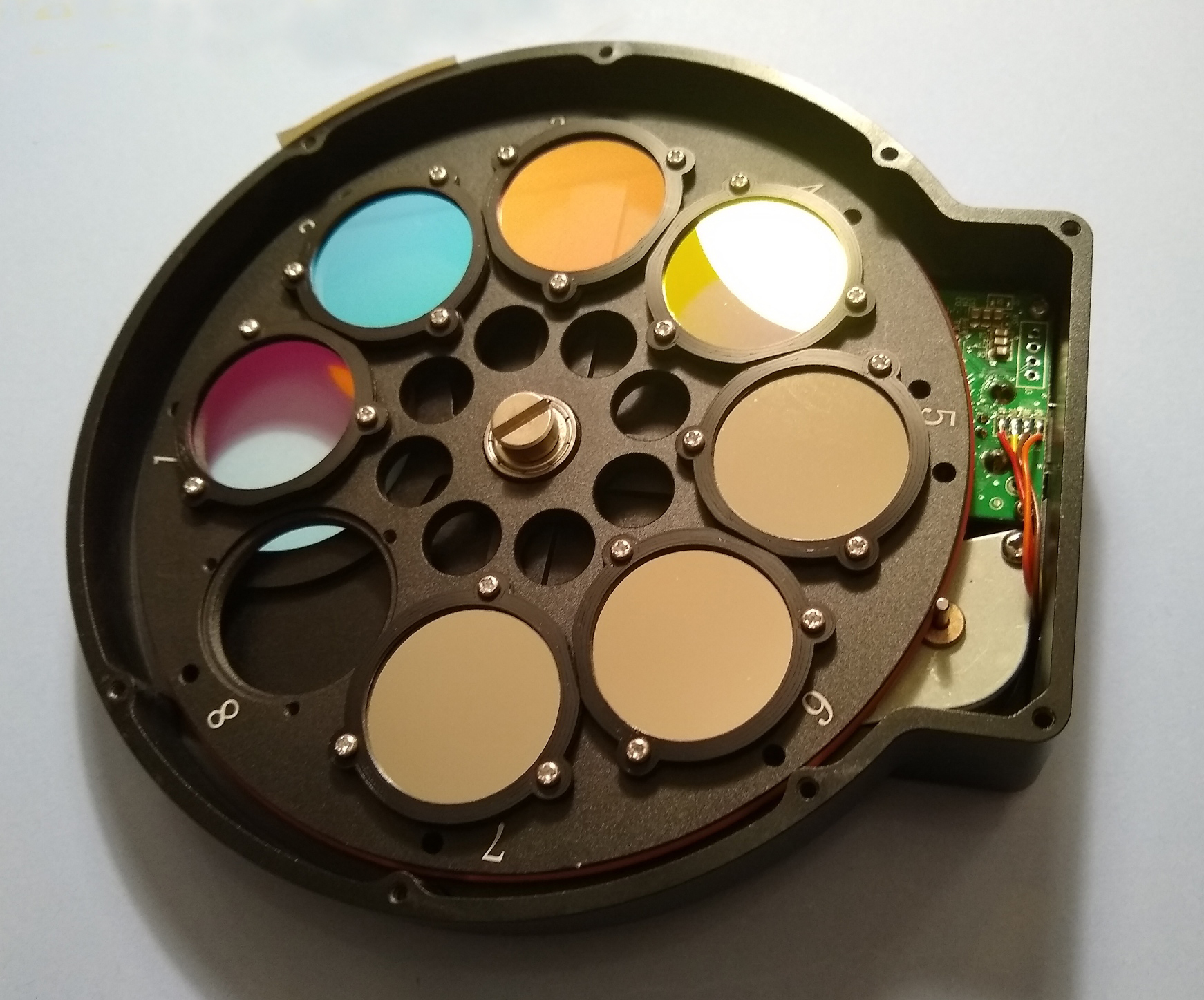
I have generally been very happy with the results achieved with the ZWO camera, although an issue sometimes occurs when imaging large stars, so called ‘star bloating’. There are a number of theories discussed ad nauseam online why this might occur, of which microlensing and / or diffraction seems most likely and probably relates to either – the sensor, sensor cover or filters. Since beginning with the ZWO camera I’ve used their excellent matching EFW with LRGB and 7nm narrowband filters. Notwithstanding, the filters are considered to be somewhat ‘low end’ by the aficionados of such things and after living with the ZWO filters for some time, at considerable cost I recently decided to upgrade to a set of Chroma 31mm filters – LRGB + 3nm narrowband. Together with Astrodon, Chroma filters are generally considered to be the best and my expectations were therefore high.
Being unmounted I’d previously found the ZWO filters tricky to install using the small screws and fibre washers supplied. At 3mm Chroma are physically 1mm thicker than ZWO filters and also need to be fitted in a specific direction, which is ‘letters up’ or with top of the ID letters on the side of the filter facing towards the sensor; this is disputed by the manufacturer but there’s substantial first-hand experience online that suggests otherwise. With these issues in mind I sought out bespoke filter masks and longer M2 6mm screws to hold the thicker filters firmly in place. The 3D printed masks from Buckeyestargazer in the USA did a great job securing the filters and are better than those from ZWO – the internal edge of the mask forms an L-shaped ledge into which the filter fits snuggly. Ready to go, I then had to wait nearly 4-months before the clouds parted to try out these expensive pieces of glass and then it was a full moon – I often wonder if astrophotography is a good hobby to choose in the United Kingdom but it’s too late now?
Chroma filters secured with Buckeyestargazer masks and ready to go
Given the presence of the moon it therefore had to be suitable narrowband target and after three years since I’d last imaged this object it was an opportunity to have another go at NGC 2244 AKA the Rosette Nebula, though being late February there was limited time each night before the object sunk low behind trees on the western horizon; coincidentally the ZWO ASI1600MM-Cool First Light in early 2017 was also the Rosette. Before starting serious imaging I first tried some test shots to make sure everything worked OK and immediately discovered that the change from 7nm to 3nm had a significant impact on light gathering, thus requiring greater exposure times of an unprecedented 10 minutes. Not surprisingly this was also apparent when taking flats which increased exposure time of up to x10 longer in duration compared to the ZWO filters; conversely preliminary but limited tests on the broadband filters seem to indicate greater transparency and thus shorter exposures, time will tell if this is correct.
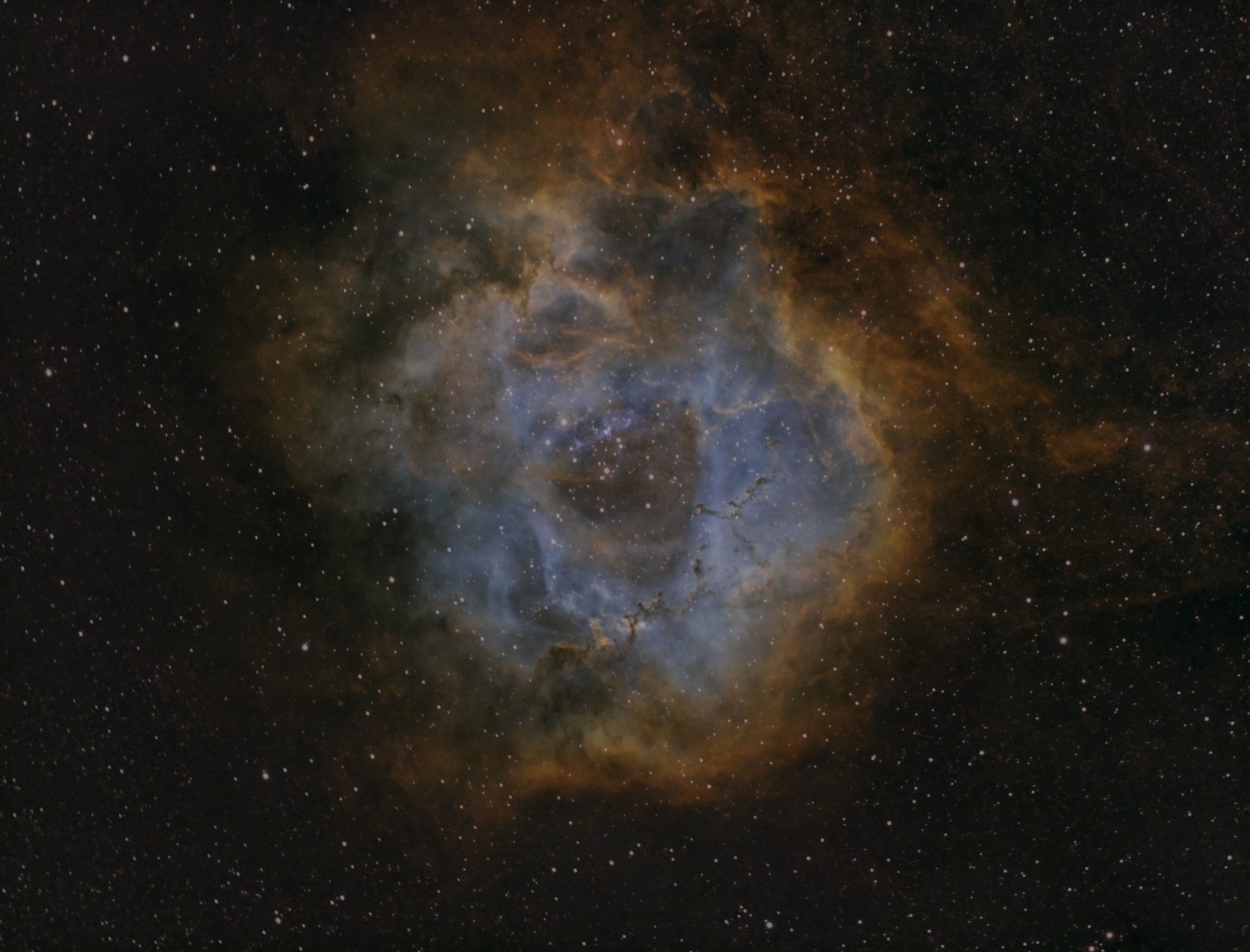
So was it all worth it? I’m very pleased with the final image which was processed using the SHO Hubble Palette with PixInsight and Photoshop (see top of the page). There are a number of significant bright stars in and around the Rosette which the Chroma filters have handled well but overall it is the more delicate tone that has been achieved which is most pleasing. Fundamentally the 3nm filters have produced a more subtle quality to the overall image and in particular the nebulosity. In addition, applying Hartmut Bornemann’s excellent colour calibration script AutoColor for the first time (see Visible Dark’s video tutorial here) has resulted in a soft but exciting colour palette.
Subsequently I have focussed on the inner region of the nebula which contains the so-called ‘Carnival of Animals’ (see above), which has been cropped and reprocessed individually to show-off the ‘animals’ or Bok globules – named after the Dutch-American astronomer Bart Bok, who in 1947 proposed that these dark nebula indicated clouds of dust undergoing gravitational collapse as part of the process of new star formation, which has since been confirmed. In conclusion I’d therefore say that despite the obstacles, issues and long wait, on the evidence so far the addition of the Chroma filters to my set-up has been very successful – transformative in fact. Now I wonder if they make something that removes the clouds?
IMAGING DETAILS
Object
NGC 2244 + 2337 + 2238 + 2239 + 2246 AKA the Rosette Nebula
Constellation
Monoceros
Distance
5,200 light-years
Size
65 light-years
Apparent Magnitude
9
Scope
William Optics GT81 + Focal Reducer FL 382mm f4.72
Mount
SW AZ-EQ6 GT + EQASCOM computer control & Cartes du Ciel
Guiding
William Optics 50mm guide scope
+ Starlight Xpress Lodestar X2 camera & PHD2 guiding
Camera
ZWO1600MM-Cool mono CMOS sensor
FOV 2.65o x 2.0o Resolution 2.05”/pix Max. image size 4,656 x 3,520 pix











 WATCH THIS SPACE(MAN)