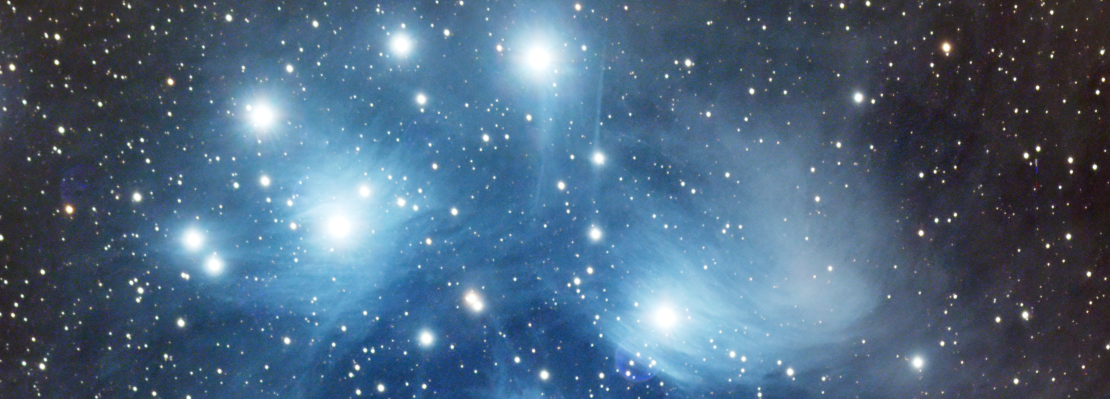
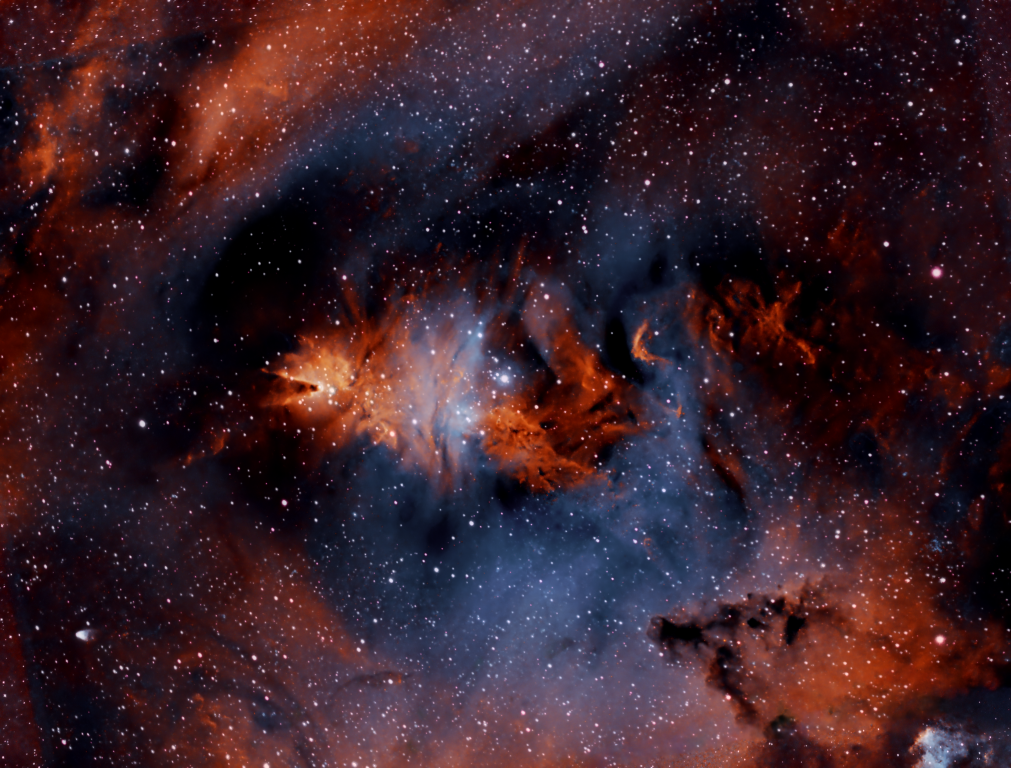
Projecting a line from Bellatrix to Betelgeuse a similar distance beyond to the east (left) by eye, to the northern extremity on Monoceros is one of late winter’s treats. Located about 2,500 light years from Earth is the star forming region NGC 2264, consisting of the Christmas Tree Cluster (an open cluster), the nearby so-called Cone Nebula and in between the Fox Fur nebula. I first imaged these objects in 2014 and again in 2018 but now armed with better skills and equipment, a return to this rich area of the night sky which is full of HII, reflection and dark nebula was long overdue + I had a plan to obtain greater detail and colour than was hitherto achieved.

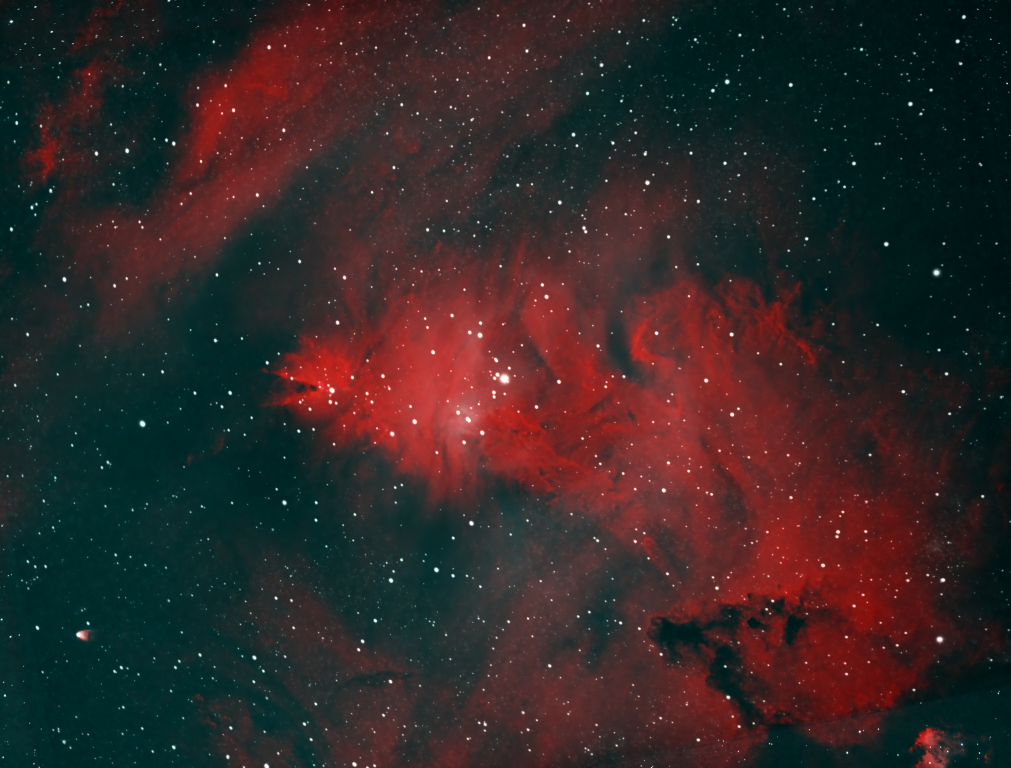
Key to the plan was greater integration time and with 13h 25minutes obtained over three nights at the end of February, this established a solid data foundation. As ever with all broadband images, there’s an endless choice of permutations combining wavelengths to form a final image and inspired by the work of others, I used the popular SHO Hubble Palette but adapted here by using synthetic SII and OIII channels in PixInsight’s Pixel Math to enhance the related colours: SII = (Ha*0.30+SII*0.70) & OIII (Ha*0.40+SII*0.60+OIII). The resulting final image has exceeded my expectations, as the colours and details here now successfully highlight the aforesaid central objects as well as the wider complexity and beauty of flowing dust and gases that abounds in this region, which also includes NGC 2261 Hubble’s variable nebula, NGC 2259 open cluster and the emission nebula LBN 902.

| IMAGING DETAILS | |
| Objects | NGC 2264 – Christmas Tree Cluster, Cone Nebula, Fox Fur Nebula + NGC 2261 Hubble’s variable nebula, LBN 902 emission nebula & NGC 2259 open star cluster |
| Constellation | Monoceros |
| Distance | 2,500 light-years |
| Size | ~2.5o total |
| Apparent Magnitude | Varies |
| Scope | William Optics GT81 + Focal Reducer FL 382mm f4.72 |
| Mount | SW AZ-EQ6 GT + EQASCOM computer control & Cartes du Ciel |
| Guiding | William Optics 50mm guide scope |
| + Starlight Xpress Lodestar X2 camera & PHD2 guiding | |
| Camera | ZWO1600MM-Cool mono CMOS sensor |
| FOV 2.65o x 2.0o Resolution 2.05”/pix Max. image size 4,656 x 3,520 pix | |
| EFW | ZWO x8 EFW & 31mm Chroma Ha, SII & OIII filters |
| Capture & Processing | Astro Photography Tool + PHD2 + Deep Sky Stacker, PixInsight v1.8.8-12, Photoshop CC |
| Image Location & Orientation | Centre RA 06:40:55.725 DEC +09:53:45.407 Top is 280o E of N i.e. Right = approx. North |
| Exposures | x39 Ha , x83 OIII, x39 SII @ 300 sec Total Integration Time: 13hr 25 min |
| @ 139 Gain 21 Offset @ -20oC | |
| Calibration | 5 x 300 sec Darks + 15 x Ha, OIII, SII Flats & Dark Flats @ ADU 25,000 |
| Location & Darkness | Fairvale Observatory – Redhill – Surrey – UK Typically Bortle 5-6 |
| Date & Time | 26th, 27th February & 7th March 2022 @ +19.00h |
| Weather | Approx. <4oC RH >=70% 🌙 approx.. New Moon |

