A Wider Perspective

I like to think and operate at both ends of the spectrum: sometimes considering detail and its implications and often exquisite beauty, whilst on the other hand taking a wider view will often provide broader insight and answers – notwithstanding, I am usually drawn towards the latter.  There was no shortage of scope for such thoughts in my career as a geologist and now as my hobby in astronomy.  I have become fascinated with parts of the Universe and captivated by imaging them: galaxies, nebulae, star cluster etc. but the wider view is often even more astounding and perplexing.

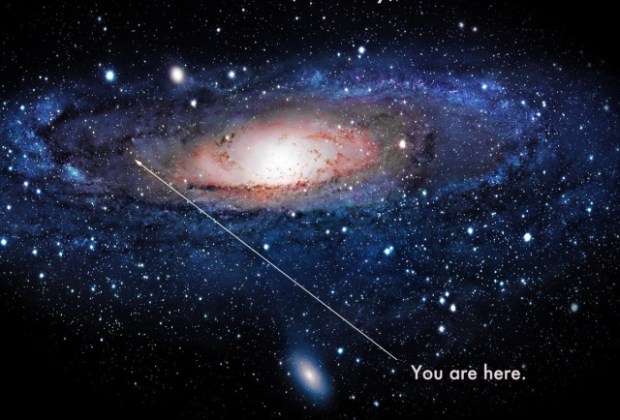
you-are-here-2

My nascent astroimaging has already produced some rewarding photographs, which using the fast William Optics GT81 refractor has enabled me to obtain images of up to 3o FOV. In fact this became something of a theme last year, successfully imaging features such as the Sadr Region and as they say, one thing has led to another.  Wanting to image even wider views there’s mostly only one alternative, using a camera and lens.  I’ve tried this before, on a tripod and fixed to the ALT-AZ EQ6 mount but with mixed success.  Meanwhile, I came across excellent pictures taken using lightweight tracking mounts on a tripod and as a result the way forwards became obvious; after scanning the Classified advertisements online for a while I was fortunate to find and purchase a second-hand Vixen Polarie mount last September.

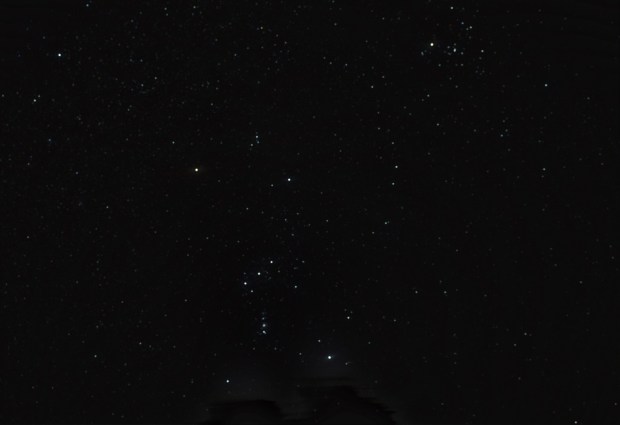
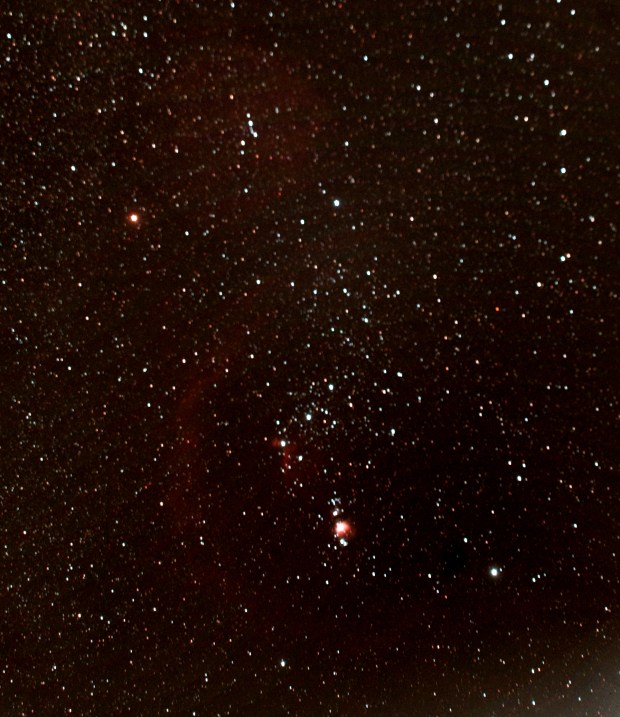
Probably my favourite object, which can rightly be considered the signature image of the winter night sky and is therefore around at the moment, is the constellation of Orion and especially its numerous and often exciting constituent parts: M42, Horsehead & Flame Nebulae etc.  After waiting for weeks for the clouds to clear, I briefly got a chance to image Orion using the Vixen Polarie early in November, whilst at the same time using the WO GT81 to obtain yet another picture of the irresistible Great Orion Nebula M42. 

Picture saved with settings embedded.

Orion’s Sword – including the wonderful Great Orion Nebula M42 et al : WO GT81 + modded Canon 550D & FF | 14 x 180 secs @ ISO 1,600 | 9th November 2015

The Vixen Polarie is a deceivingly simple and well-made solution to obtaining long exposure images of the wider night sky using a camera and lens.  As stability remains essential for the mount and camera to operate at their best, I also purchased a decent Manfrotto tripod and suitable ball heads to attach the Polarie.  After that it was simple, well not quite! Trying out the Polarie at the same time as using the GT81 and being first time out was a mistake.  I fumbled setting up the equipment and initially even forgot to turn on the tracking, leaving only a short time to grab a few images before the clouds rolled in once again!  Not surprisingly the results were mixed and I was left frustrated.  With continuing poor seeing conditions, it was to be a further month before I had an opportunity to properly use the Vixen Polarie again – this time with a new Sigma 10 – 20 mm ultra-wide angle lens I had just purchased.

Picture saved with settings embedded.

Vixen Polarie & Canon 700D + 18 – 55mm lens | 19 x 60 secs @ ISO 800 | 9th November 2015

Having by now spent more time looking at the manual (we all get there, in the end) and concentrating on imaging using only the Polarie, this time I was able to achieve a good set-up and remembered the correct sequence of operation.  As the mount sits high on the tripod I am just about able to see Polaris in a small gap between the roof of my garage and house, something hitherto impossible when using the lower positioned AZ-EQ6 mount.  As a result I am able to achieve a reasonably good visual polar alignment, though a polar scope made specifically for the Vixen Polarie would improve this further; probably something for another time?  Nevertheless, such an alignment at Fairvale Observatory is a first and was a major breakthrough that has already permitted exposures of 4 minutes and could probably go to 5 to 6 minutes or more.

IMG_2135 (Large)

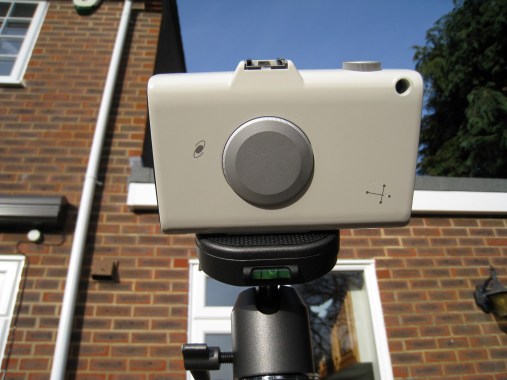
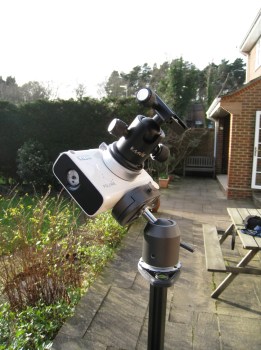
The high position of the Vixen Polarie on the tripod provides an otherwise elusive view of Polaris between the garage / utility room and the main house for polar alignment, at last! Alignment of the mount is carried out by viewing through the hole in the top right of the Polarie – better alignment can be achieved by using a polar scope which fits through the middle of the Polarie mount.

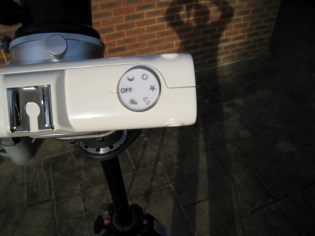
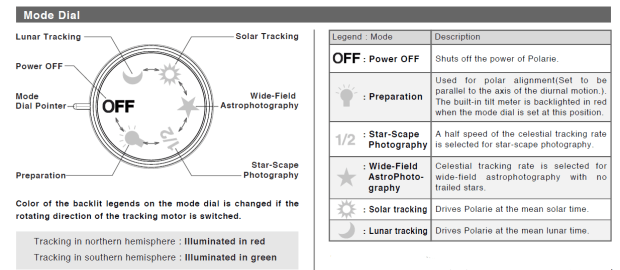
Once polar aligned, fixed on the front of the Vixen Polarie the camera then rotates to follow the celestial sphere and chosen object in order to achieve a sharp image with long exposures.  For this purpose there are 4 tracking rates: sidereal, half sidereal, lunar and solar.  With no interesting foreground here I concentrated on the sky by using the sidereal rate; for more scenic shots with the landscape incorporated, using half-sidereal provides a compromise in order to achieve a non-blurred image of the sky and landscape, though this method is inevitably limited to shorter exposures than sidereal.

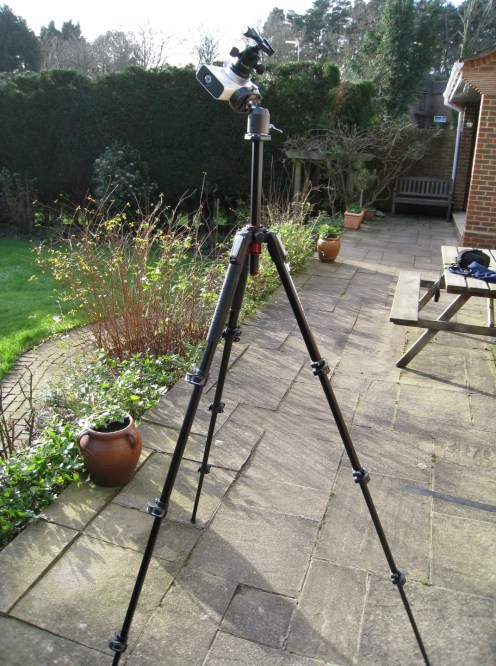
IMG_2124 (Large)

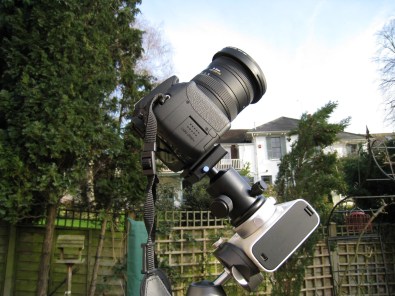
Vixen Polarie mount on Manfrotto tripod – a lightweight, portable tracking method for widefield astroimaging

IMG_2125 (Large)

Vixen Polarie – close-up showing x2 ball head fittings

IMG_2131 (Large)

Vixen Polarie – tracking speed settings

VP Dial

IMG_2136 (Large)

Vixen Polarie with DSLR attached & ultra-wide lens

I have adapted a somewhat basic red dot finder to fit on top of the DSLR camera using the hot shoe, which was immediately helpful to accurately locate the desired target area.  However, as previously experienced, once again achieving focus proved quite difficult, basically requiring just trial and error; I intend to look into a more efficient method but in the absence of a Bahtinov mask this is likely to be the best technique for now.  A laptop can be used for image capture but maintaining the themes of portability and simplicity, I successfully used an intervalometer to control exposures.

Whilst initially my target was the Orion constellation, I’ve long held the ambition to image Barnard’s Loop, a much larger and elusive feature surrounding the constellation and more difficult to photograph.  I had tried this before last January with limited success but ever since acquiring the Vixen Polarie this has been my No1 imaging goal.

Orion Constellation 220115 Stacked1L2C3GX (Large)

The Orion Constellation & Barnard’s Loop (up / north is left) : AZ-EQ6 Mount + Canon 550D & 200mm Telephoto | 180 secs @ ISO 1,600 & calibration | 22nd January 2015

Unable to see with the naked eye, only using long exposure photography unveils the majesty of Barnard’s Loop, an emission nebula to the left (east) of the Orion constellation. Shaped as a large-C, the loop completely encompasses the eastern side of the constellation and is thought to be a recent supernova front moving out from Orion and illuminated by stars from within the nebula, as well as part of the Orion Molecular Cloud Complex.  Discovered and named after astrophotographer E. E. Barnard in 1895, at some 14o or 300 million light-years across Barnard’s Loop is enormous; however, the entire Molecular Cloud is about 30o in size!

pleyades31_02

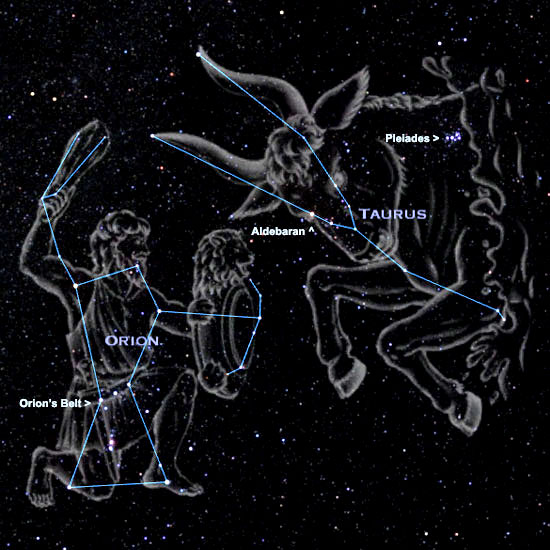
The Orion constellation was originally conceived in Greek mythology as the Hunter, pursuing Taurus the Bull to the west, with the stars tracing out a shape of a hunter holding a shield and club in each hand, a belt around the waste with a sword attached.  What they could not have known at the time is that he also has a head, in the form of the Lamda Orionis Nebula (Sh2-264), located centrally and above Betelgeuse and Bellatrix.

Picture saved with settings embedded.

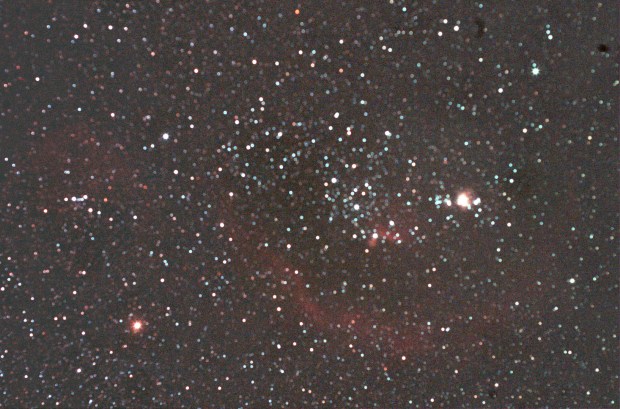
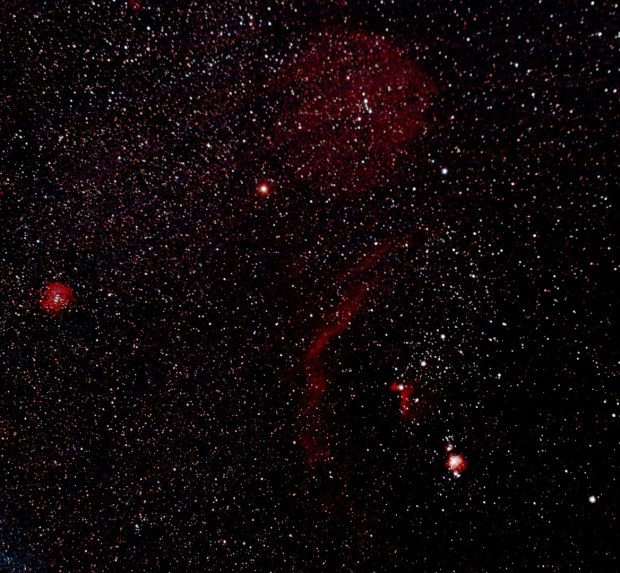
Barnard’s Loop & Lamda Orionis Nebula : Vixen Polarie & modded Canon 550D + Sigma UWA @ 20mm | 11 x 240 secs @ ISO 1,600 + darks | 7th January 2016

I was able to image Barnard’s Loop on 7th and 14th January; at ISO 1,600 the first images showed the Loop but certainly left room for improvement, as a result I shot the subsequent images at ISO 800 and obtained a noticeably better outcome – though I had to push post processing to reveal the features.  The Loop and head are clearly evident but I’ve been intrigued to see other objects also revealed, albeit without the detail obtained with prime focus imaging using the telescope: Great Orion Nebula, Horses Head & Flame Nebulae and surprisingly on the left (east) of the Loop the Rosette Nebula.  Looking at other’s images of Barnard’s Loop it is clear that I will need to take significantly more subs to properly reveal the full beauty of this wonderful and very large feature – dark skies would be nice too – but for the moment I am pleased with my first outing using the Vixen Polarie, which holds great promise for capturing a wider perspective of the Universe.

Picture saved with settings embedded.

Barnard’s Loop & Lamda Orionis Nebula + Rosette Nebula on far left : Vixen Polarie & modded Canon 550D + Sigma UWA lens @ 20mm | 14 x 240 secs @ ISO 800 | 14th January 2016

Spaceship Earth

bbbb

I’m now into my second year of ‘serious’ astronomy and astrophotography, which accompanied by a greater knowledge of the Universe has brought an element of familiarity: with the equipment, with viewing & imaging techniques and space itself.  In the past I have worked underground as a geologist on mines and like to think that I have good spatial awareness.  Through this growing familiarity and knowledge of the night sky, I have become increasingly aware of our place in the Universe and how we on Earth are travelling through space; I also feel a growing empathy other peoples such as mariners who use and relate to the sky and space in a way ordinary people do not.

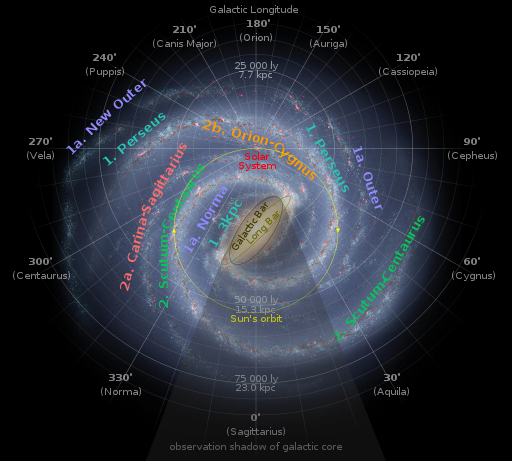
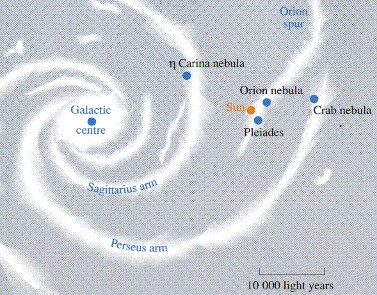
Whilst spinning on its axis at 1,037 mph at the equator (653 mph here at Fairvale Observatory’s higher latitude), the Earth is moving at about 70,000 mph round the Sun.  Furthermore, located in the Orion-Cygnus arm of the Milky Way, the Solar System is also moving around the spiral galaxy at 500,000 mph, resulting in a galactic year of nearly 250,000 Earth years .  Notwithstanding these complex and frankly mind boggling statistics, it thankfully all feels quite serene when outside at night with my telescope at Fairvale Observatory.

Milky_Way_Arms_ssc2008-10


Going back some 5,000 years the constellations might seem to describe the ‘shape’ of space and provide a sense of stability to the sky but this is misleading.  These and other asterisms are 2D patterns that mankind has created for practical use, whereas in reality most of the stars that make up these patterns bear little if any meaningful relationship with each other when viewed in 3D – like this animation showing the true shape of Orion.

spiralArms

Furthermore, under the force of gravity and other as yet unknown influences e.g. dark energy, these too are moving through space in their own way at vast speeds.  In reality the constellations are therefore anything but permanent and through the millennia their apparent shapes change and will eventually be destroyed as far as we on Earth are concerned.  As with my professional subject geology, this is the problem with space – it is very big and the timescales are very, very large, essentially beyond human comprehension, which result in otherwise unimaginable events; this animation wonderfully illustrates the scale and complexity of the known Universe.

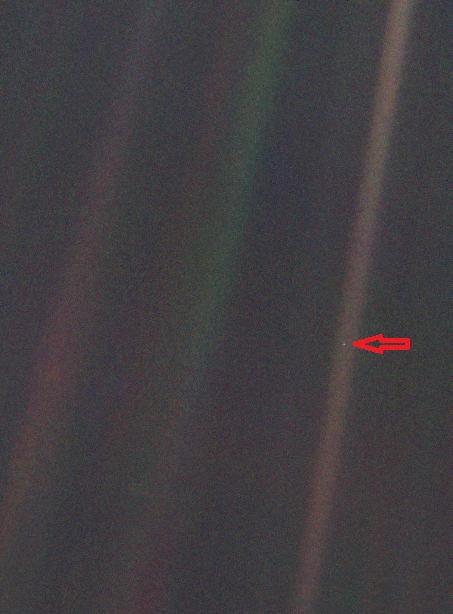
Space selfie - the insignificance of Earth. The Pale Blue Spot photograph of Earth (right side of picture) taken 6 billion kilometers (40.5 AU) away by Voyager-1 on February 14th 1990,

Space selfie = the insignificance of Earth.
The Pale Blue Spot photograph of Earth (right side of picture) taken 6 billion kilometers (40.5 AU) away by Voyager-1 on February 14th 1990,

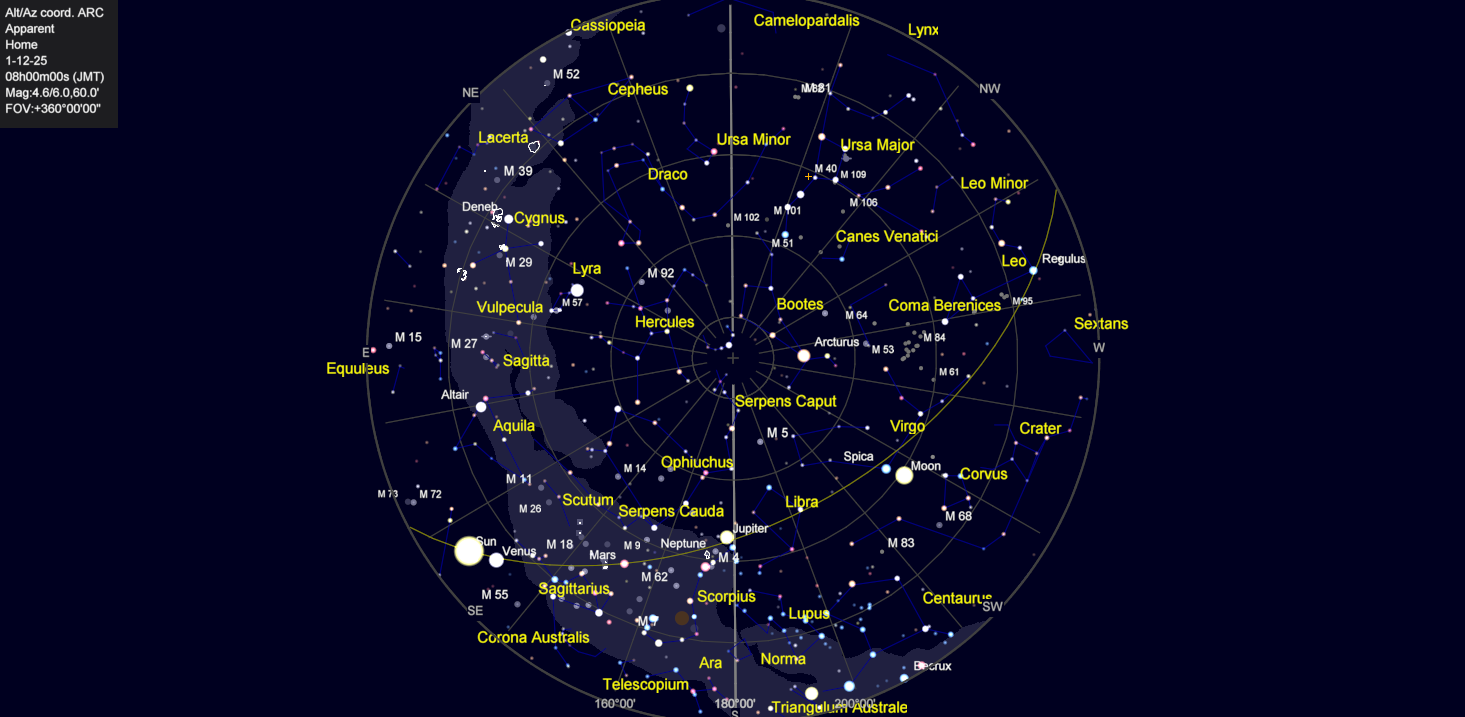
The beauty of such a system is that it can be modelled very accurately, from which it is possible to predict with great certainty the projected position of all these celestial objects, thus making spaceflight and the prediction of astronomical events possible.  Likewise using the same data modelling it is possible to look backwards at past events.  Such computerisation is no longer just the preserve of NASA and University academics but is at our fingertips using a computer based planetarium, in my case Carte du Ciel – incredible!

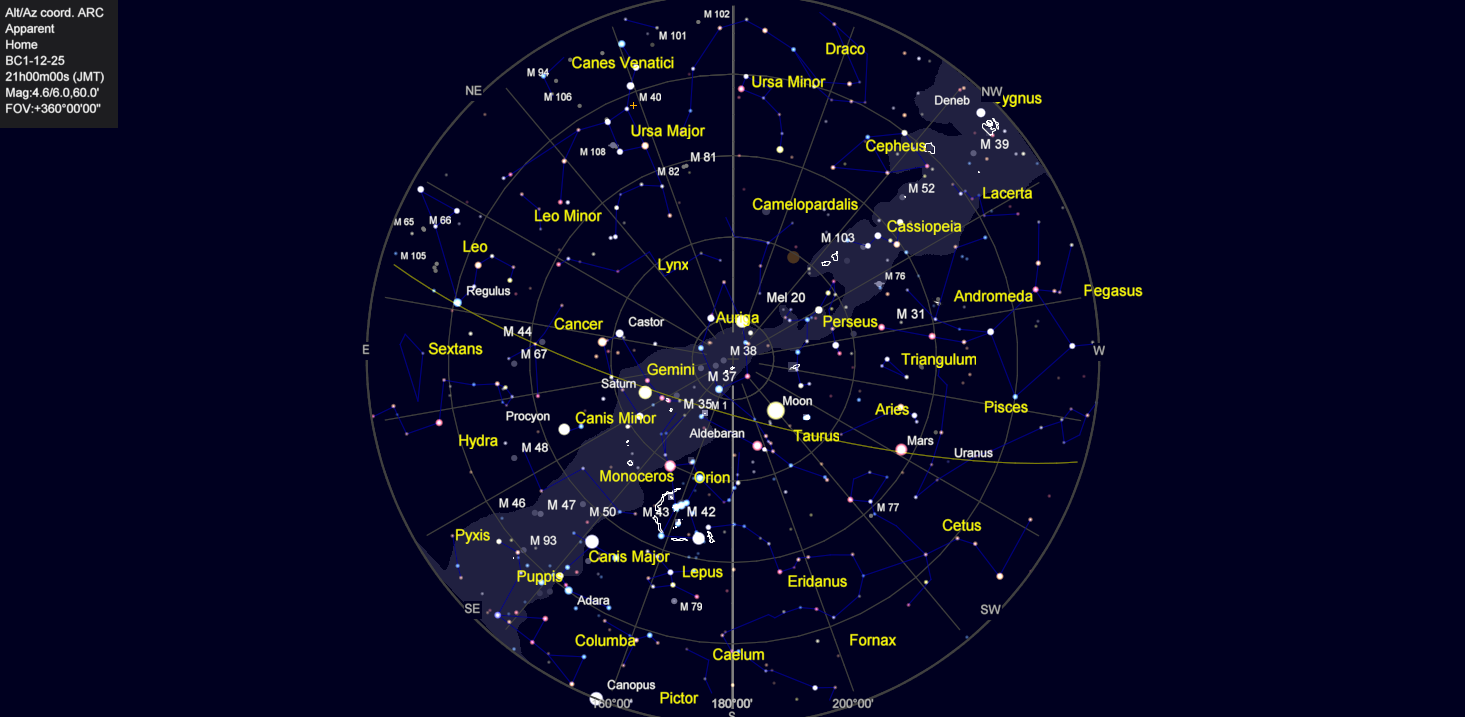
Given the time of year I have therefore used the aforesaid programme to generate a view of the night sky from Bethlehem 2015 years ago on the morning and evening of 25th December.  Even then differences can be seen in the shape of the constellations compared to now.  If we are to believe the story of the Three Wise Men following a bight ‘star’ at this time, it seems it would be most likely to be in the morning when first Jupiter and then Venus are present.  Either way it’s fascinating to be able to model the night sky in this way for any chosen moment in time.

xmas.cdc5


xmas.cdc3


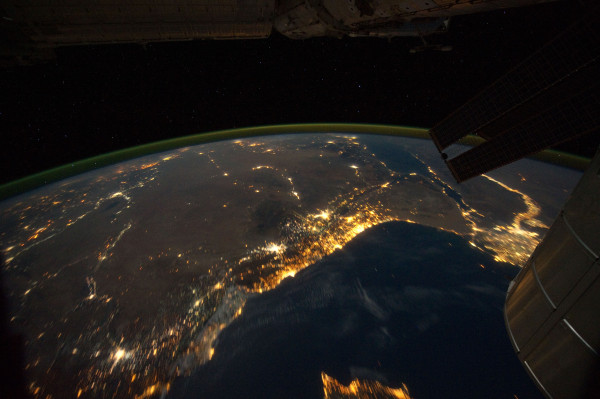
Santa's view of Bethlehem - actually from the ISS on 24th December 2011

Santa’s view of Bethlehem from the ISS on 24th December 2011

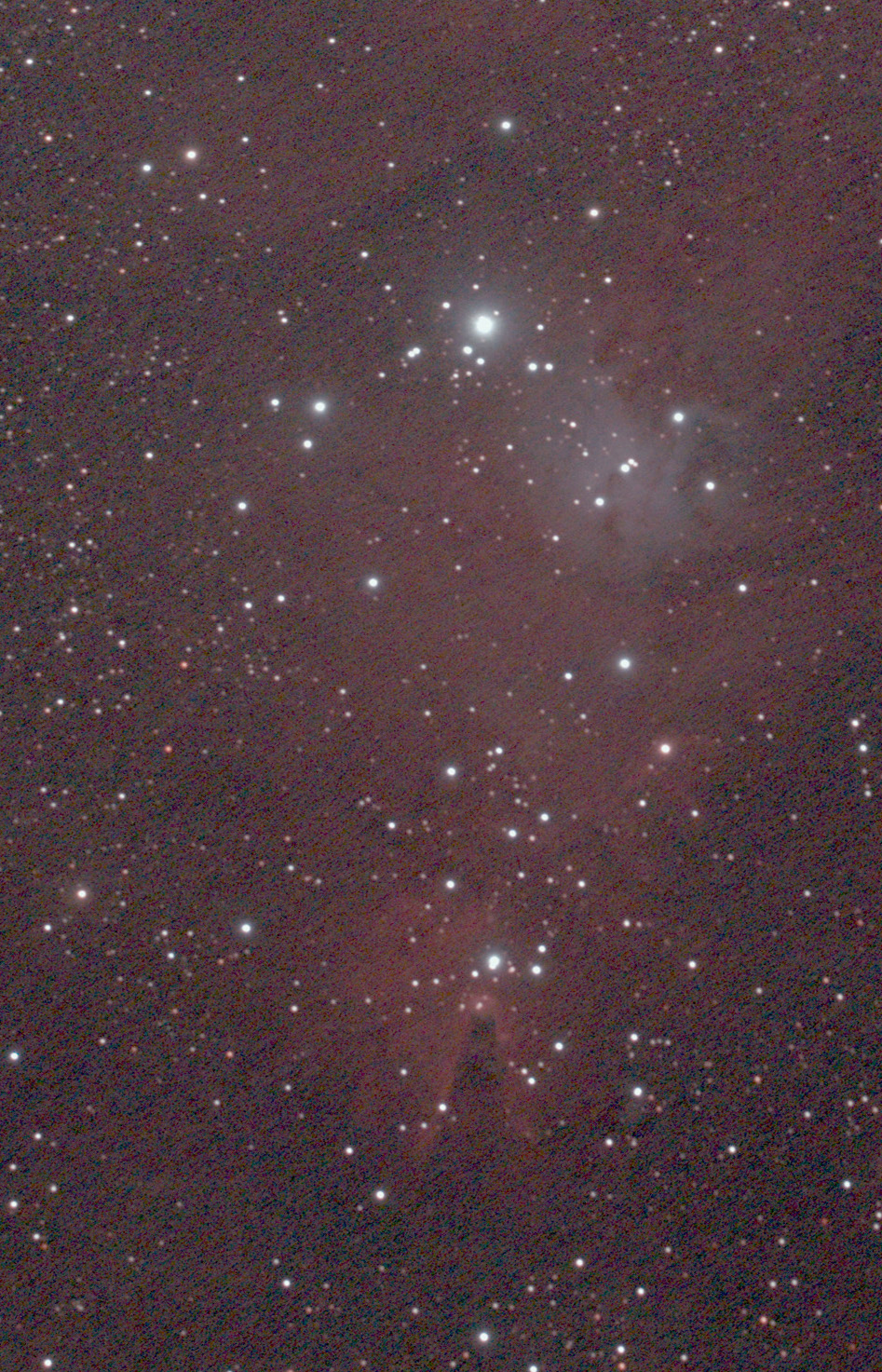
After weeks of cloud cover I recently managed to get outside again for what turned out to be a wonderfully clear night, from dawn to dusk, furthermore there was no Moon!  As a result imaging was productive and included some exciting new objects.  However, again given the time of year for the moment I am repeating an object used last Christmas.  One year on the difference is that this time I have used a  modded Canon 550D DSLR camera and thus improved (I think) the red Ha-light detail.

Cone Nebula & Christmas Tree Cluster WO GT81 + Modded Canon 550D & FF | 15 sec @ ISO 1,600 + calibration | 8th December 2015

Cone Nebula & Christmas Tree Cluster – right of centre
WO GT81 + Modded Canon 550D & FF | 15 sec @ ISO 1,600 + calibration | 8th December 2015


Cone Nebula (bottom centre) & Christmas Tree Cluster (inverted)

Cone Nebula (bottom centre) & Christmas Tree Cluster (inverted)

NGC 2264 or Christmas Tree cluster and its neighbour the Cone Nebula are located within the Monoceros AKA Unicorn constellation, which being part of the Milky Way are therefore inextricably linked to a similar destiny as spaceship Earth as it makes its way through space.  Being some 2,700 light-years away we are unlikely to meet, though you never know with space and time!

HAPPY CHRISTMAS

HAPPY CHRISTMAS


Space Odyssey

I have just finished reading Chris Hadfield’s excellent book An Astronaut’s Guide to Life on Earth, which is an entertaining and insightful look at being an astronaut and the lessons it provides for life in general.  Who of us has not at least considered such an adventure ourselves but, of course, it is impossible for all but a few.

51lLw6nsBsL._SX328_BO1,204,203,200_

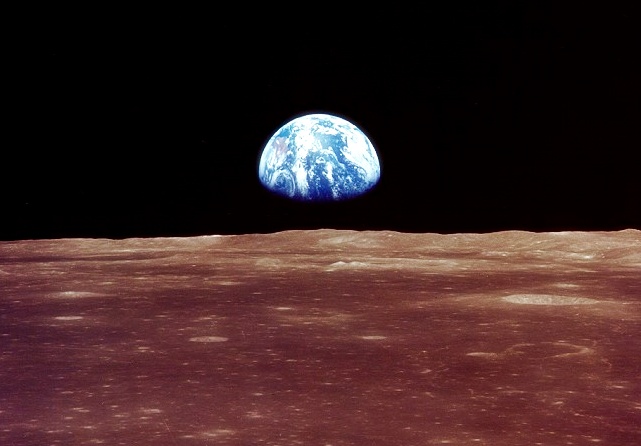
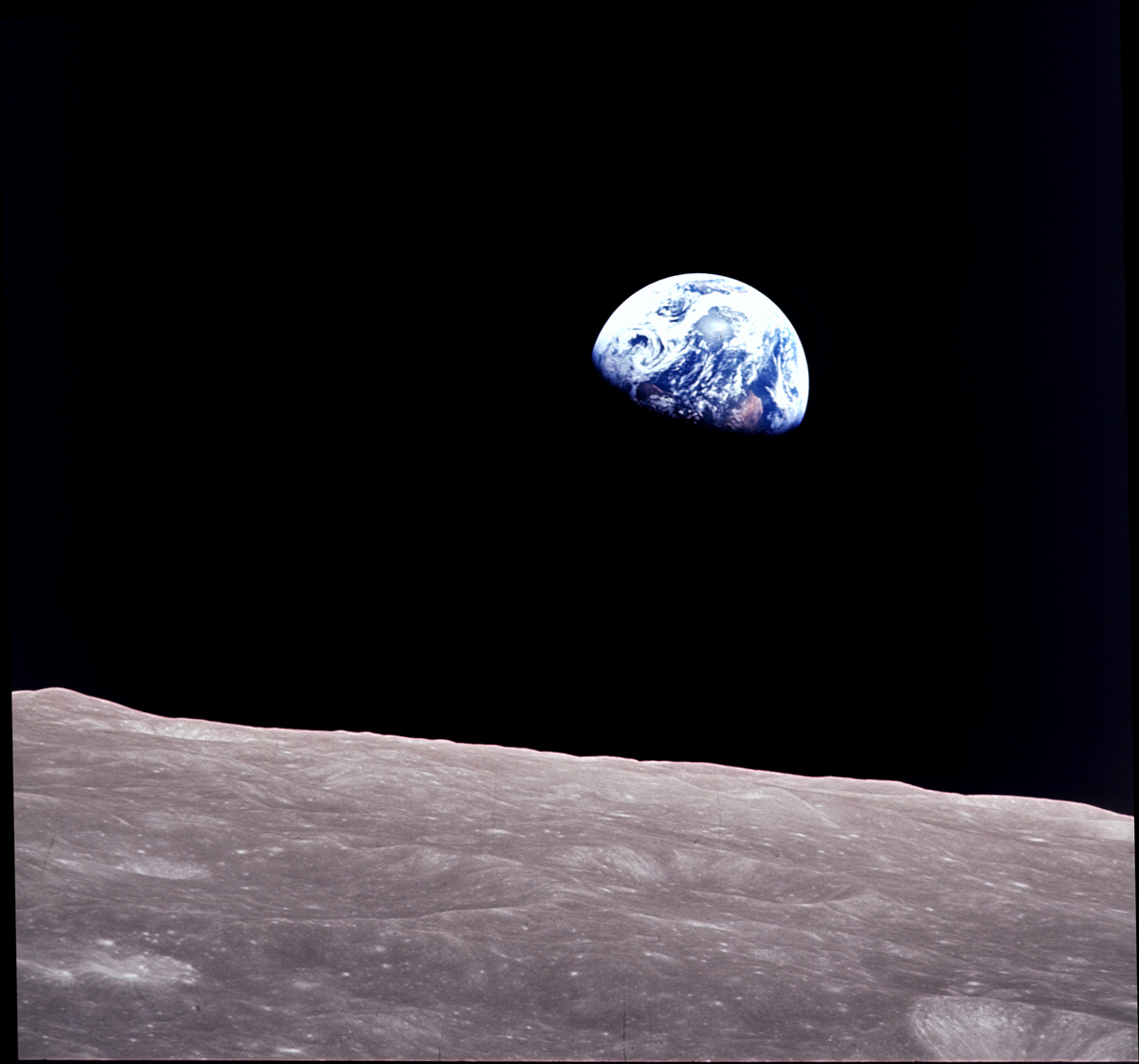
Astronomy is thought provoking enough in itself looking out at the vastness and beauty of the Universe, being in space and looking down on our planet would take such thoughts to a whole different level; from their subsequent accounts it is clear that those who have walked on the Moon became changed people, returning different to the rest of us.

apollo08_earthrise

Ever since following the pioneering space adventures of Yuri Gagarin and Alan Sheppard and especially watching the Apollo 11 Moon landing in 1969, I have been fascinated by space, its science and the human experience of travelling there.  My solution to going into space was to take up scuba diving and since 1976 have had many wonderful diving experiences all over the world.  Of course, it’s not space but it is very much other worldly and the weightless feeling is as close as most of us will get to being in space; the astronauts train extensively underwater for just that reason.  Furthermore, as a geologist and more recently taking up astronomy has altogether provided me with a better understanding of the Universe.

Maldives, Kandooma 2004: the closest I'll get to space!

Maldives, Kandooma 2004: the closest I’ll get to space!

Given my long standing interest in space, it is perhaps surprising that I came late to astronomy itself, so why now?  The best answer is time – in recent years I have had more of it and in the past work, family and extensive travel precluded such a pastime.  Like so many sciences in the modern era, technology has also unlocked major new opportunities for scientists and amateurs alike.  Whilst I enjoy the science itself and especially viewing the night sky, the ability to produce frankly incredible images has been the most important key to my recent personal interest.

The phenomenal imaging improvements that have occurred since the launch of Hubble have made the power and beauty of the Universe even more accessible to us all on Earth.  Digital image capture and processing is now so powerful that pictures of hitherto unimaginable quality can be achieved from Earth.  Furthermore, for a relatively modest cost outlay, such images can be obtained by amateurs like me, literally outside my back door.  More than any other development, this is what has now engaged my interest.  The product of astroimaging can easily be overlooked as just an attractive, often spectacular photograph of the night sky – and they are.  But the equipment and pictures produced are also important tools that can assist our understanding as well as imagination of space.

andromeda

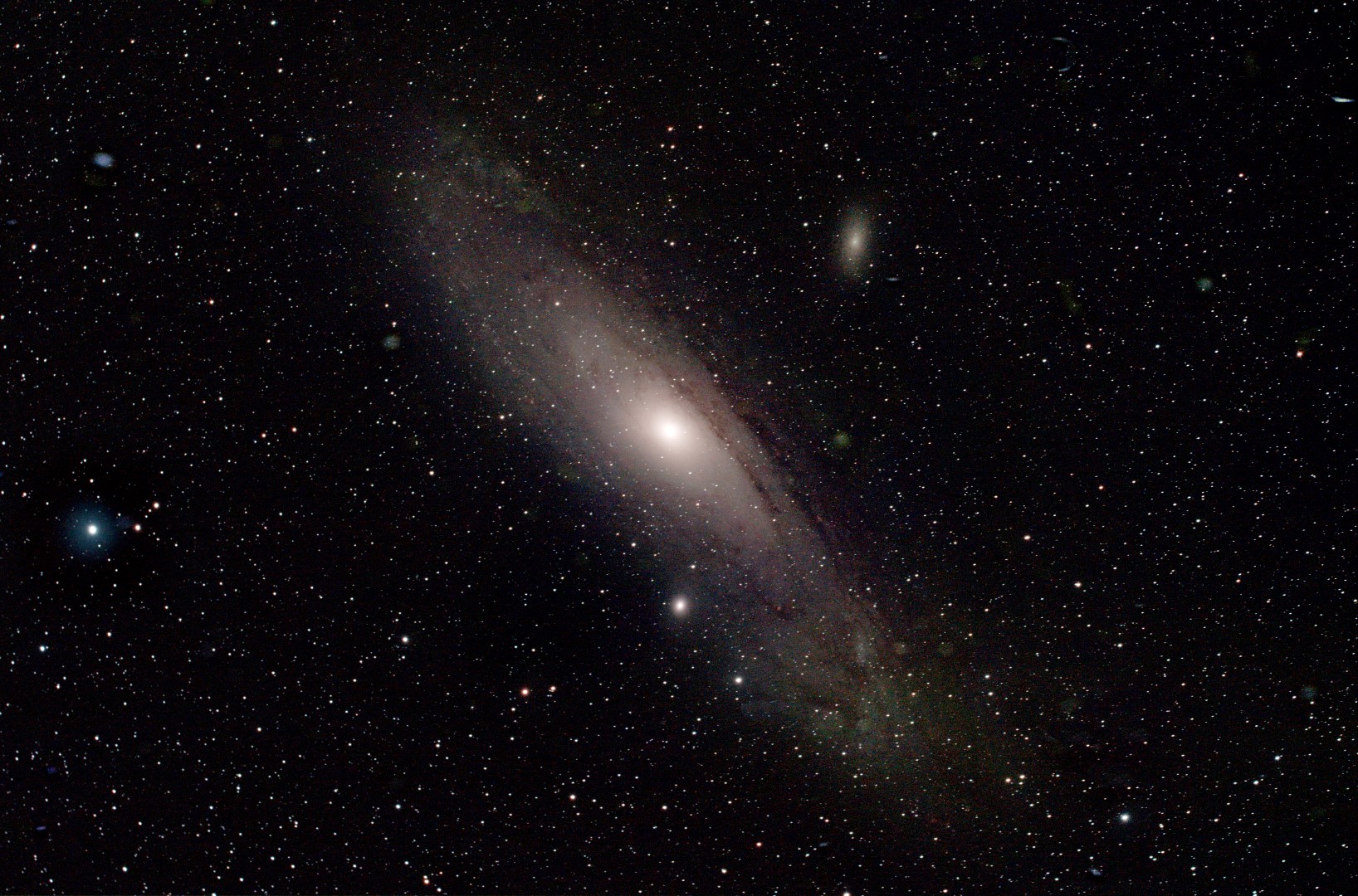
After a forced absence from astroimaging for the past six months, I was recently fortunate to obtain a number of exciting pictures of familiar objects on my first night back, in particular M31 or the Andromeda Galaxy.  As the nearest galaxy to Earth, Andromeda is an obvious target for those new to astroimaging but despite its proximity, it is not to be underestimated as an imaging target.  I have attempted imaging M31 before but, like many others, found it very difficult to coax out the detail which makes it such a beauty.  I am not completely sure what was different this time but the resulting picture at last starts to capture these details; I was even more surprised at the outcome which is the result of just nine 120 second exposures at the end of a long night before heading for bed!

M31 Andromeda Galaxy WO GT 81 + modded Canon 550D + FF | 9 x 120 secs @ ISO 1,600 | 19th September 2015

M31 Andromeda Galaxy
WO GT 81 + modded Canon 550D + FF | 9 x 120 secs @ ISO 1,600 | 19th September 2015

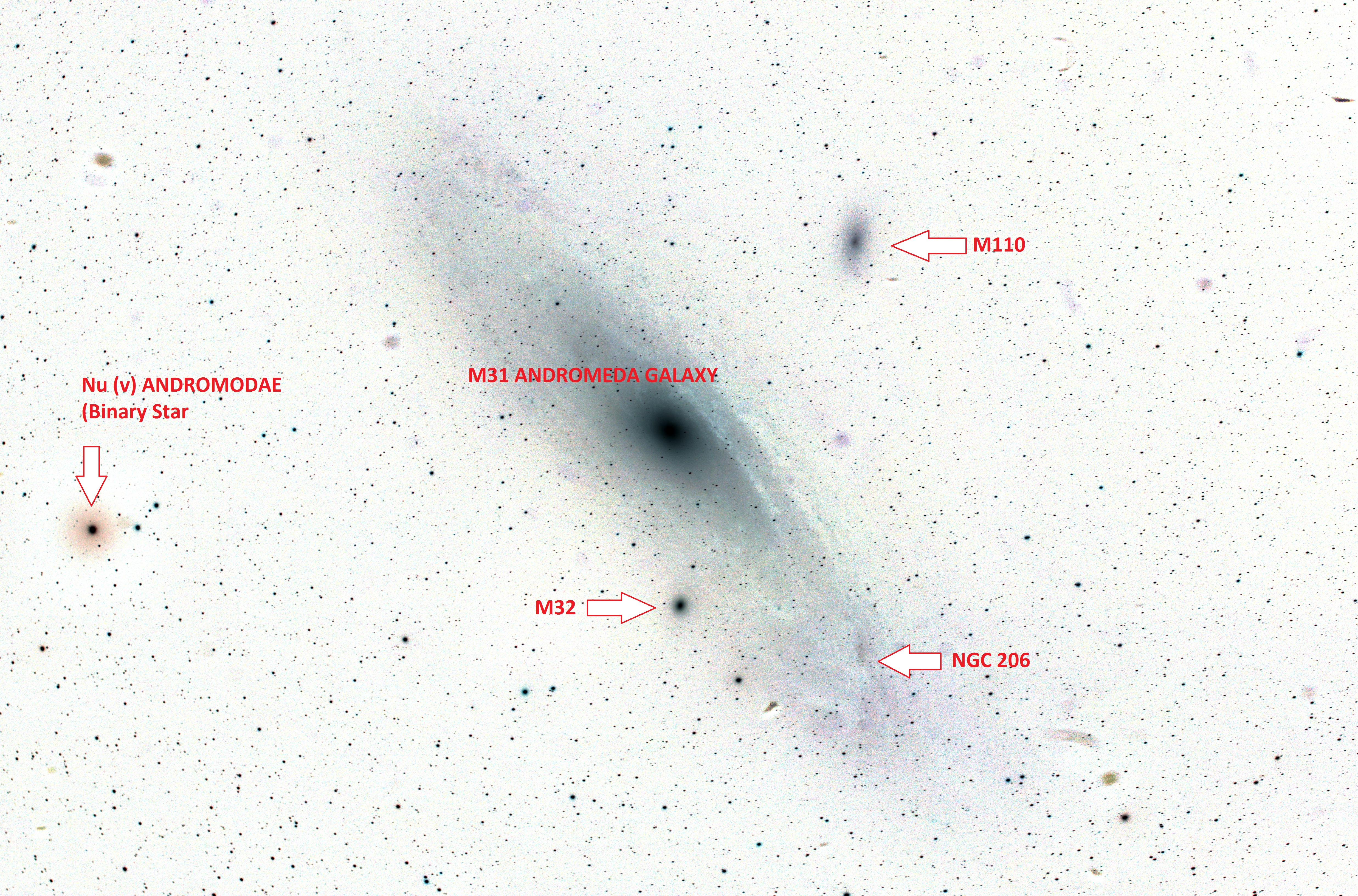
Andromeda poses two main challenges for the photographer: (i) the contrast in brightness between the central area and the rest of the galaxy, and (ii) the need to show the brown dust bands within the main disc, which provide a fascinating insight into the galaxy’s overall structure – that is not unlike out own Milky Way.  The classic technique is to use two sets of images, with camera settings appropriate to the two contrasting areas, subsequently bringing them together during post-processing.  Despite the limited number of prime focus images taken the final picture achieved still came out well.  Though the bright central area is overexposed, the galaxy’s dust bands are clearly evident and for the first time have captured the full character of this magnificent feature. Furthermore, within M31 the NGC 206 is evident, a star formation region of over 300 new stars, whilst in the adjacent sky two other Messier galaxies are shown in the image M32 and M110.

M31 Anfromeda Galaxy: inverted & anotated

M31 Andromeda Galaxy: inverted & annotated

I think it is correct to say that the Andromeda Galaxy is one of the iconic images of the night sky and I feel obtaining such a picture marks another notable point in my personal space odyssey.  I would hope Chris would approve, as well as Major Tom?

Earth’s Junkyard

Only very recently the BBC Horizon programme covered the increasing problem of space junk that now orbits Earth forming a virtual cloud of debris posing a serious threat in general and, in particular, to future space activity: obsolete satellites, broken, damaged or even fragments from destroyed man-made objects.  In addition to the ISS, communication and other satellites can often be seen passing overhead but in reality these only represent the tip of the iceberg.

Earth's Junkyard Computer-generated image of objects and debris currently being tracked orbiting Earth; it's the stuff we can't see or track that is most worrying!

Earth’s Junkyard
Computer-generated image of objects and debris currently being tracked orbiting Earth; it’s the stuff we can’t see or track that is most worrying!

Whilst visiting my daughter in Somerset at the weekend the night sky was clear and fantastically dark thanks to the New Moon and lack of light pollution when compared to Fairvale Observatory in Surrey.  Having already tried to image the Perseids in the preceding week unsuccessfully, I thought I’d try again in these much better conditions using a basic DSLR on a tripod and an intervalometer.

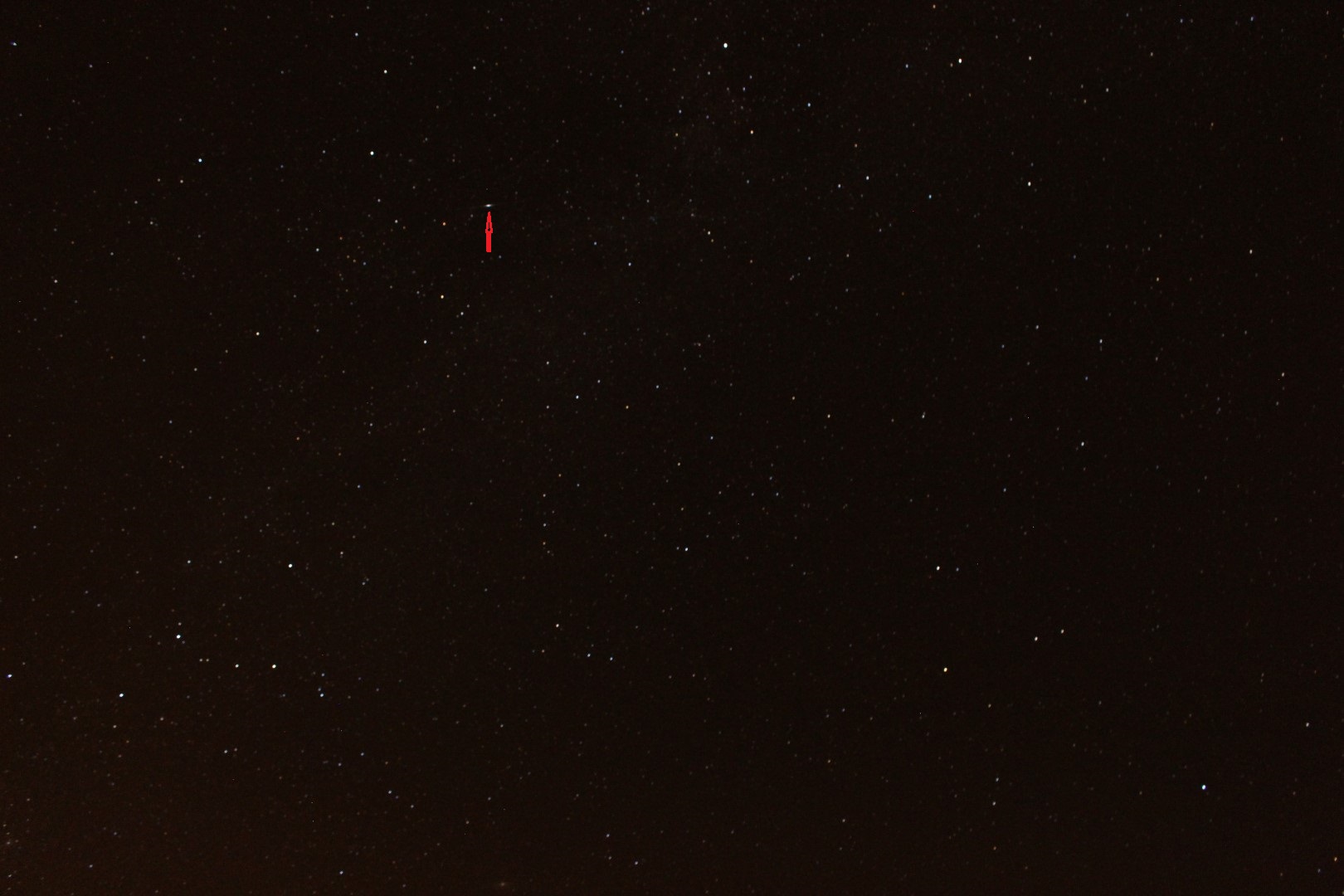
Despite excellent seeing conditions, the air was cool’ish and therefore prone to quickly form dew on the camera lens after just 20 minutes or so. At the time it didn’t seem as though I had captured anything of interest, however, looking at the images subsequently on the computer, I was excited to find a bright flash appearing between two of the pictures pictures – what could this be, it seemed too short to be a Perseid?  Whatever it is was had gone in the next image 5 seconds later.  I discovered the anomaly whilst flicking from one picture to the next when suddenly a bright point stood out from the otherwise unchanging starry sky by blinking – a characteristic of something unusual taking place.

I posted a query on SGL and the overwhelming consensus has been that it is most likely to be a satellite or debris flare from the aforementioned space junk – either a spinning satellite or debris that briefly produced a reflection as it passed through the field of vision.  Looking closely the bright spot does seem to be elongated from left to right, suggesting movement, though I am still perplexed why it has therefore not produced a more significant trace given the 30-second exposure being used – for a moment I even thought it might be a Super Nova!

Notwithstanding,  it’s an interesting effect, though sadly seems to confirm the extent to which mankind has already made a mess of the space around our planet.

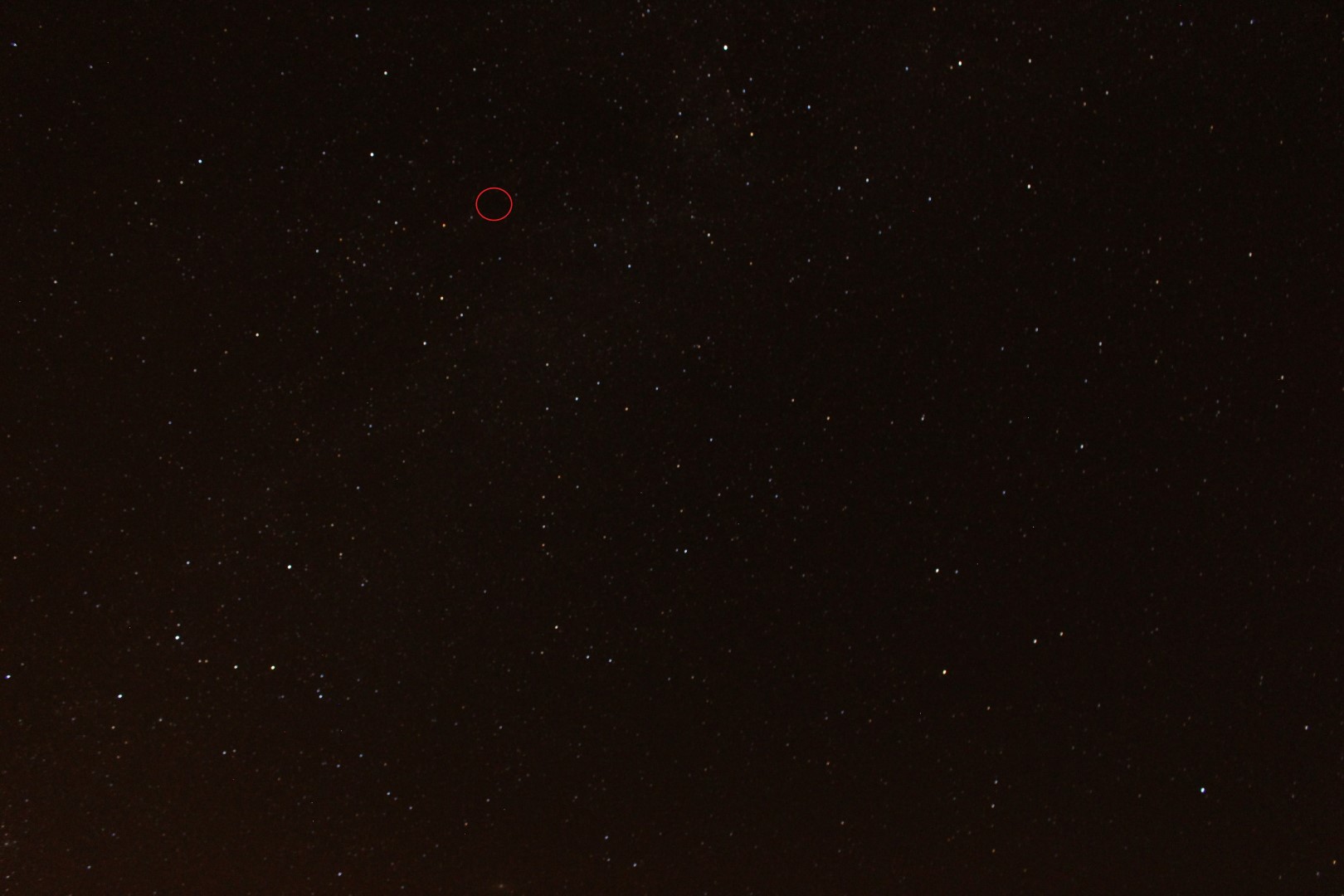
Image before the solar flare appears - red circle indicates the area of interest.

Image before the satellite flare appears – red circle indicates the area of interest.

Solar flare, indicated by the red arrow?

+ 5 seconds later a satellite / debris flare, indicated by the red arrow?

Notes: The pictures were taken at 10.37pm on 16th August, looking north east, at about +70o inclination using a Canon EOS 700D + 18-55 lens, at 18mm and f5.6. Both images are 30 secs exposure at ISO1,600 with an interval of 5-seconds.  The area of interest is indicated with a red ring in the first image, with the white ‘object’ appearing in the following image shown by a red arrow.

180 Degrees

Viewing from Fairvale Observatory is far from ideal but I have no choice and need to make the most of it:

(i) Without going down the garden (which is not practical and would then totally obscure the southerly view) my house blocks the entire northern sky, critically including Polaris;

(ii) We have very high +/-12ft hedges surrounding the garden;

(iii) Directly east is a large house that completely obscures the horizon;

(iv) South east and south are very large trees;

(v) To the west is a wooded hill, thus blocking the horizon in that direction, and

(vi) Some 7-miles to the south is Gatwick Airport which produces significant light pollution, as well as aircraft that regularly fly through my images as well as others from Heathrow, also not far away.

It’s a miracle I am able to undertake any astrophotography and I long for the day I live somewhere with better conditions.

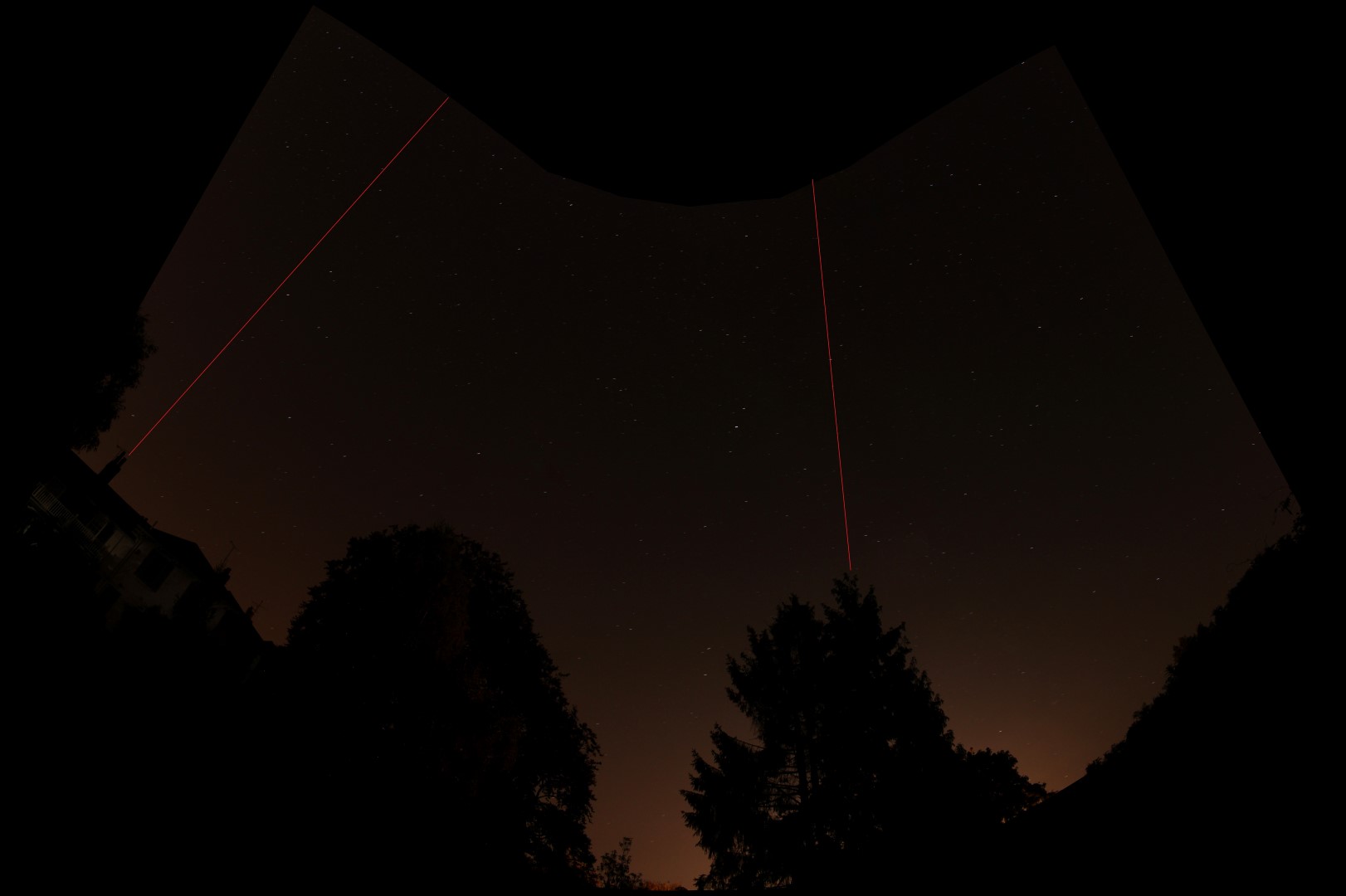
In the meantime I have to make do with the 180o I have available.  For the record and with great skies and good weather, this week I compiled a photo mosaic of the aforesaid view – which illustrates some of the aforementioned problems and is in itself an interesting picture. The scene is stitched together from six DSLR shots that encompass most of the east to west panorama but in order to achieve this, the resulting photograph becomes severely distorted.

The principal view is directly south, with the Meridian pretty much straight ahead.  Low angle viewing and imaging is almost completely impossible but depending on the timing and some crafty shooting, the mid-angle objects can be accessed as they pass between the trees. The best imaging is therefore mostly restricted to a 20o range between about 65o and 85o and within +/- 20o of the Meridian; high angle east and west views are feasible but seeing in these directions is impacted by the greater atmospheric distance through which the light has to travel.

For now this is my night time playground: it is challenging and can be frustrating but with clear skies, preparation and patience it’s good fun and much can still be achieved.

Night sky panorama from Fairvale Observatory + obstacles: the tree on the left is very large +200 year-old copper beech, the coniferous trees  due south are closer to the property boundary - thus increasing their impact   on seeing.  The red line on the left approximately marks the East and the central red line is the Meridian.

180 degree night sky panorama from Fairvale Observatory + obstacles: the tree on the left is a very large +200 year-old copper beech, the coniferous trees due south are closer to the property boundary – thus increasing their impact on seeing. The red line on the left approximately marks the East and the central red line is the Meridian.

Equivalent Cartes du Ceil planetarium view at the same time.

Equivalent Cartes du Ceil planetarium view at the same time.

Canon Koppernigk’s Conjunction

This time of the year is something of a fallow period for astronomers: short nights combined by with the complete absence of astronomical darkness and fewer DSOs.  I have personally found this year more difficult than usual as since April 25th, following an operation to replace my left knee, I have been physically unable to set-up Fairvale Observatory and undertake astronomy of any sort.  Notwithstanding, once over the initial few weeks of pain, I have tried to use the extra time afforded me usefully.

download

I have been reading Arthur Koestler’s excellent book The Sleepwalkers, which charts the history of man’s understanding of the universe and astronomy.  Speaking of fallow periods, in the book I’m just past the very long period of inactivity and general superstition regarding the cosmos that occurred during the Middle Ages, which followed the more enlightened thinking of the Greeks, particularly Pythagoras; taking account of the Greek’s progress in understanding the Universe, our astronomical knowledge might have been 1,500 years more advanced today were it not for this prolonged medieval hiatus!  Fortunately Copernicus (his better known Latin name) finally initiated what has become today’s heliocentric model of the Solar System, although his seminal work On the Revolutions of the Heavenly Spheres was only published just a few hours before his death after a delay of 30-years, such was his reluctance to put forwards such thoughts at that time.

Next, I have just completed the 6-week AstroTech MOOC course organised by Edinburgh University, which covered the scientific logic behind astronomical discoveries and the technology that lies behind them.  This was my third astronomy MOOC and provided some interesting insight into telescope and imaging technology, as well as filling time during my recovery.

Finally, as my (limited) mobility has slowly started to improve, the night sky has recently provided a fascinating show of its own that did not require the observatory’s paraphernalia and, furthermore, beautifully demonstrated the principles originally outlined by Copernicus in 1543.

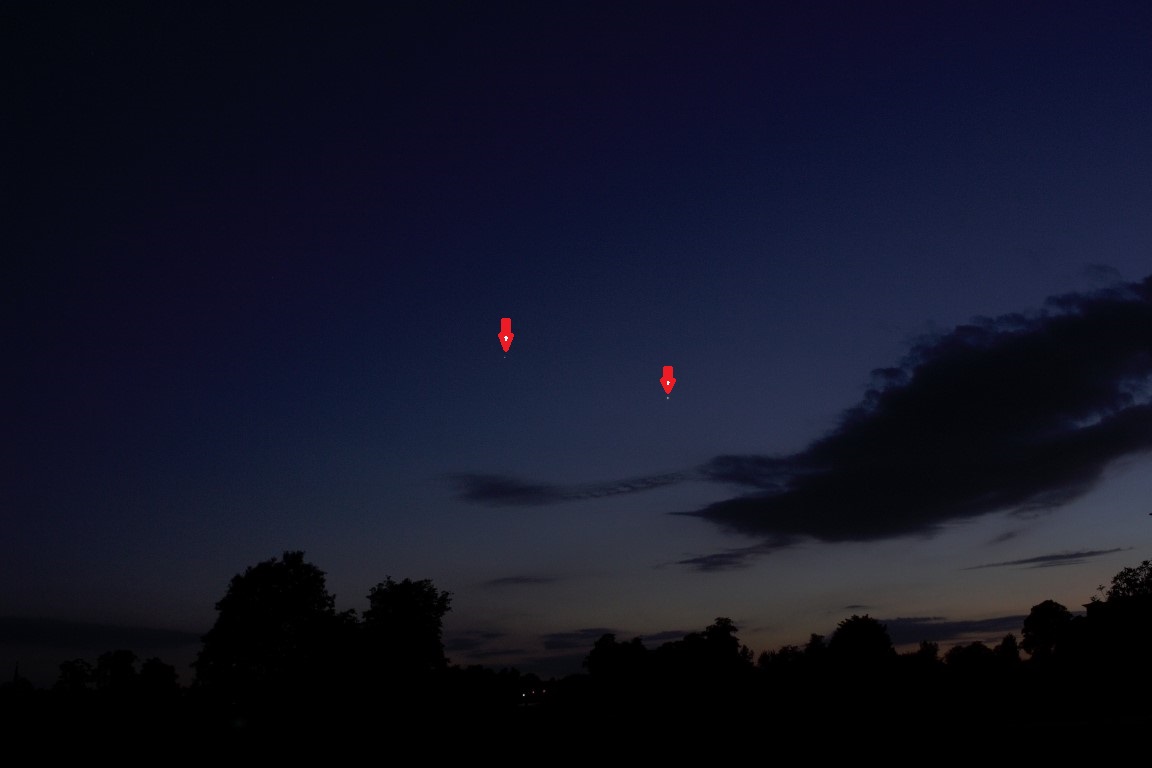
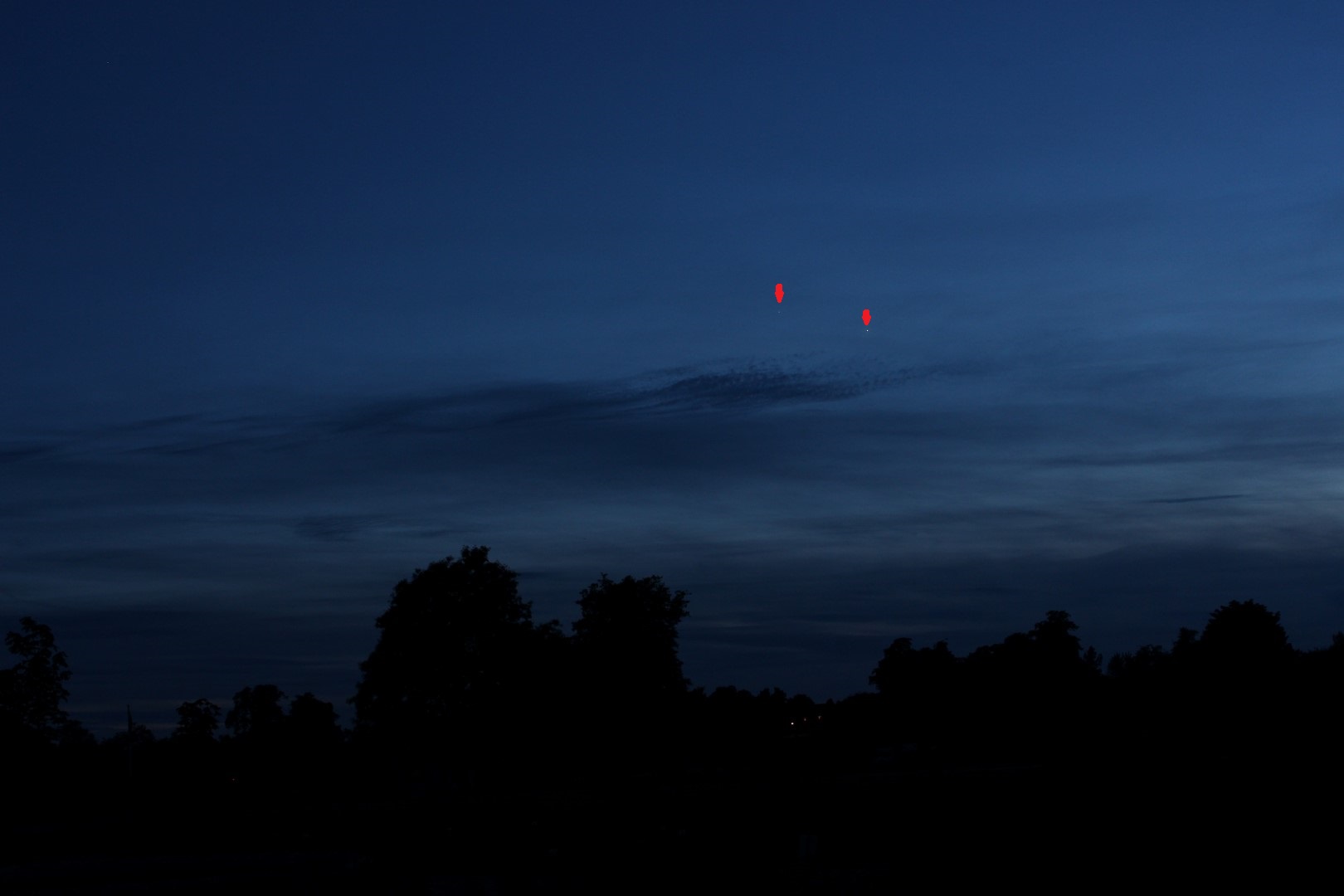
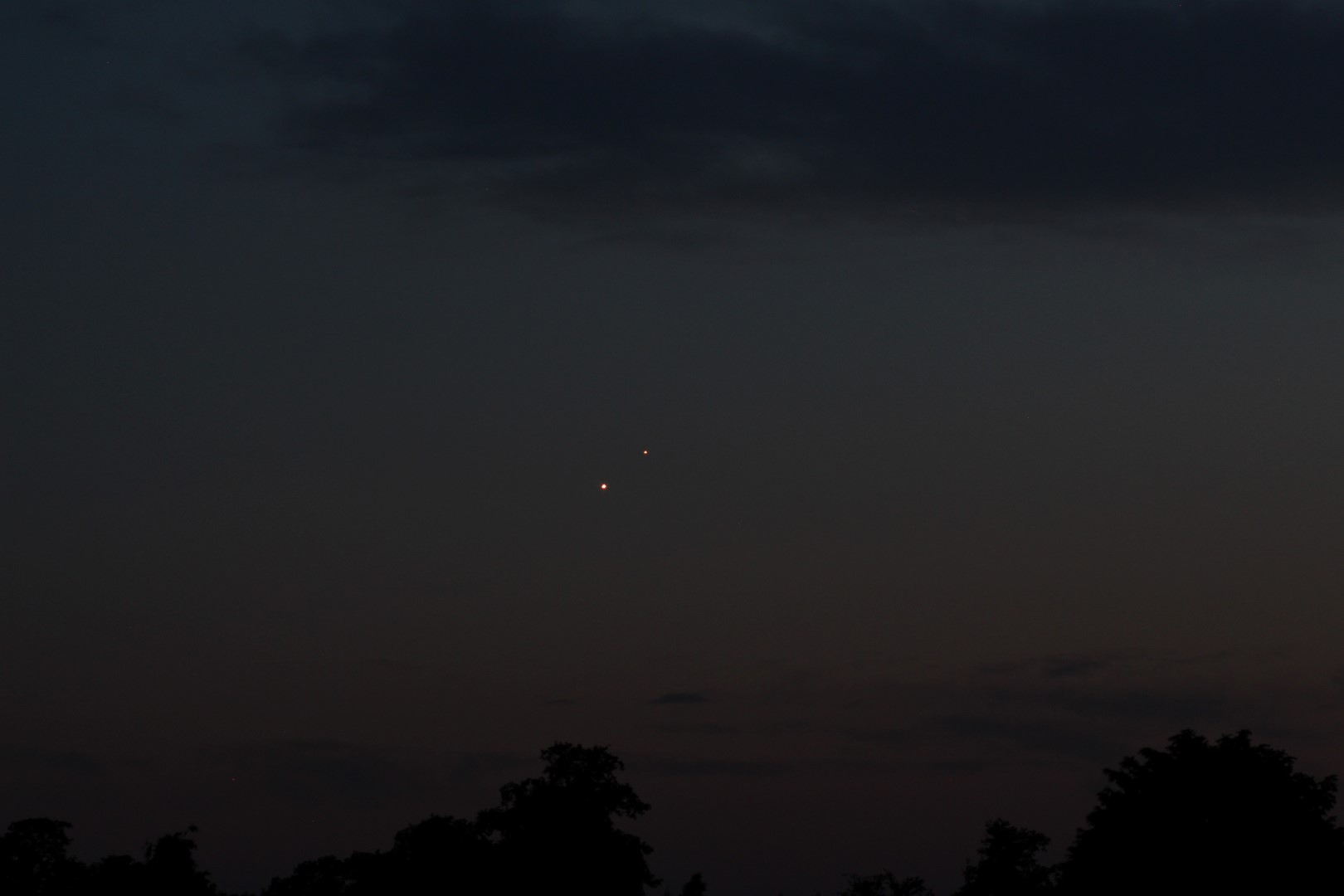
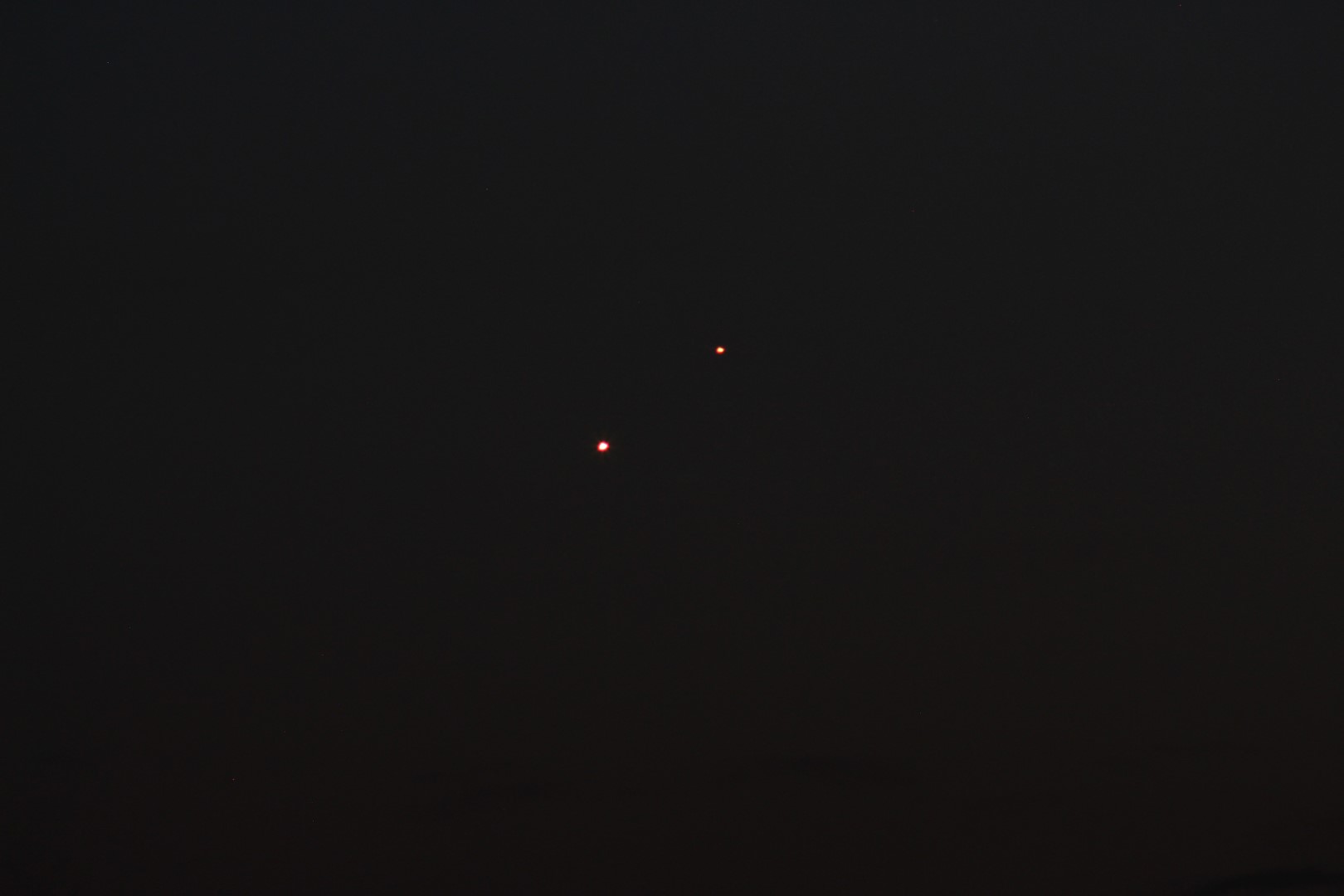
During the latter part of June Venus and Jupiter moved inexorably towards very close conjunction by the end of the month.  Reaching just under ¾ of a degree separation on 30th June and 1st July this is a rare event, which with a clear sky could be easily viewed with the naked eye.  Better still, I set out to photograph the two planet’s journey during the preceding 12 days, thus illustrating Copernicus’ revolutions around the sun of these two heavenly spheres.  Whilst any school child will today understand this process, it is a frightening thought that belief in such a mechanism could once have led to the death penalty!

Obscured from view at Fairvale Observatory as Venus was just 17 ½o above the western horizon, I had to travel to a nearby location which provided a clearer westerly viewpoint of both planets at their low attitude.  In order to obtain a series of comparable images and thus show the real spatial changes occurring up to conjunction, all pictures were taken from exactly the same location.  With my Canon EOS 700D fixed on a photographic tripod I shot a series of images over a 50 minute period using either the 18mm or 55mm telephoto settings, playing with ISO and speed settings as darkness progressed; this was roughly the time the two planets took to disappear below the Earth’s horizon after achieving Civil Darkness.

The resulting photographs show Jupiter apparently advancing on Venus before at conjunction ‘passing’ close by on the aforementioned days.  Whilst Jupiter is the third brightest object in the night sky (after the Moon & Venus) and nearly 12 times the size of Venus or 1,400 times by volume, the planet looks very small by comparison to Venus.  This of course is the effect of perspective, with Jupiter currently some 565 million miles distance from Earth, whereas Venus is only 48 million miles; furthermore although at -1.8 the apparent magnitude (brightness) of Jupiter is high, at -4.4 Venus is much brighter.

18th June 2015: Jupiter left, Venus right - trees on the horizon provide a reference scale as the planets move towards each other during the month in subsequent photographs

18th June 2015: Jupiter left, Venus right – trees on the horizon provide a reference scale as the planets move towards each other during the month in subsequent photographs.

25th June 2015 + 7-days

25th June 2015 + 7-days

30th June 2015 + 5 days.  Nothing - dark thunder clouds completely obscure the western sky during conjunction!!!

30th June 2015 + 5 days. Nothing – dark thunder clouds completely obscure the western sky during conjunction!!!

1st July 2015. Bingo = conjunction; though one day later Jupiter has now moved to the right of Venus.

1st July 2015. Bingo = conjunction; though one day later Jupiter has now moved to the right of Venus.

1st July 2015. Close-up of the conjunction using 55mm telephoto setting and ISO 400 - Venus now left & Jupiter right.

1st July 2015. Conjunction close-up using 55mm telephoto setting and ISO 400 – Venus now left & Jupiter right.

Unfortunately I am expecting it will be at least another month before I have recovered sufficiently to consider setting-up Fairvale Observatory again, by which time Astronomical Darkness will thankfully be slowly returning.  In the meantime I’m looking forwards to the next section of The Sleepwalkers which covers Kepler and Galileo and hopefully exciting developments from the New Horizon Pluto fly-by and more from the Rosetta Mission and the re-awakening of its Philea lander.  Given clear skies there should also still be plenty to see without the observatory: The Perseids, Saturn and of course at the centre of our Solar System as determined by Copernicus, the Sun, which will be at aphelion on 6th July – though you wouldn’t think so judging by the high temperatures currently prevailing in the UK and Europe!


Big Cat Hunting

As we move closer to the Spring Equinox, the winter sky is already rapidly disappearing towards the western horizon and I have been left wondering what next?  I was concerned that after successfully imaging the Orion constellation and all its spectacular parts over the past four months, it would be a difficult act to follow, I needn’t have worried.  Already starting to appear from late-evening, a series of constellations are about to proceed across the night sky over the next few months which will provide an equally spectacular but different kind of show to Orion.

sky-spring

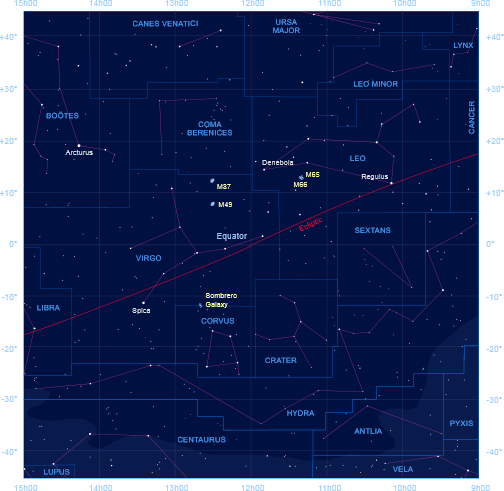
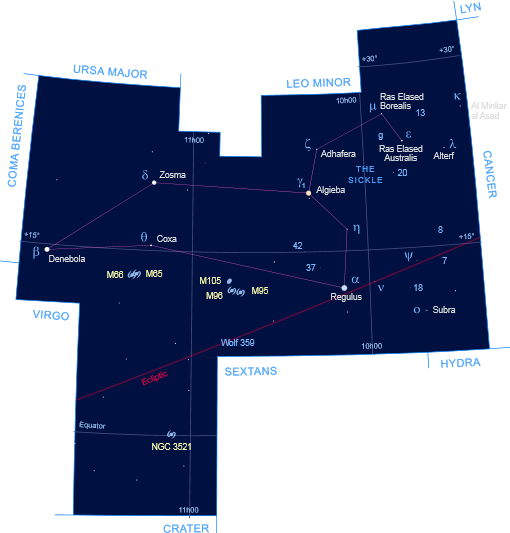
First of these is the constellation Leo, the celestial Lion, which it turns out is packed with galaxies and double stars.  The asterism of Leo is in the shape of a lion which, being dominated by various groups of galaxies holds much imaging promise, with my 81mm telescope providing an ideal field of view.

leo

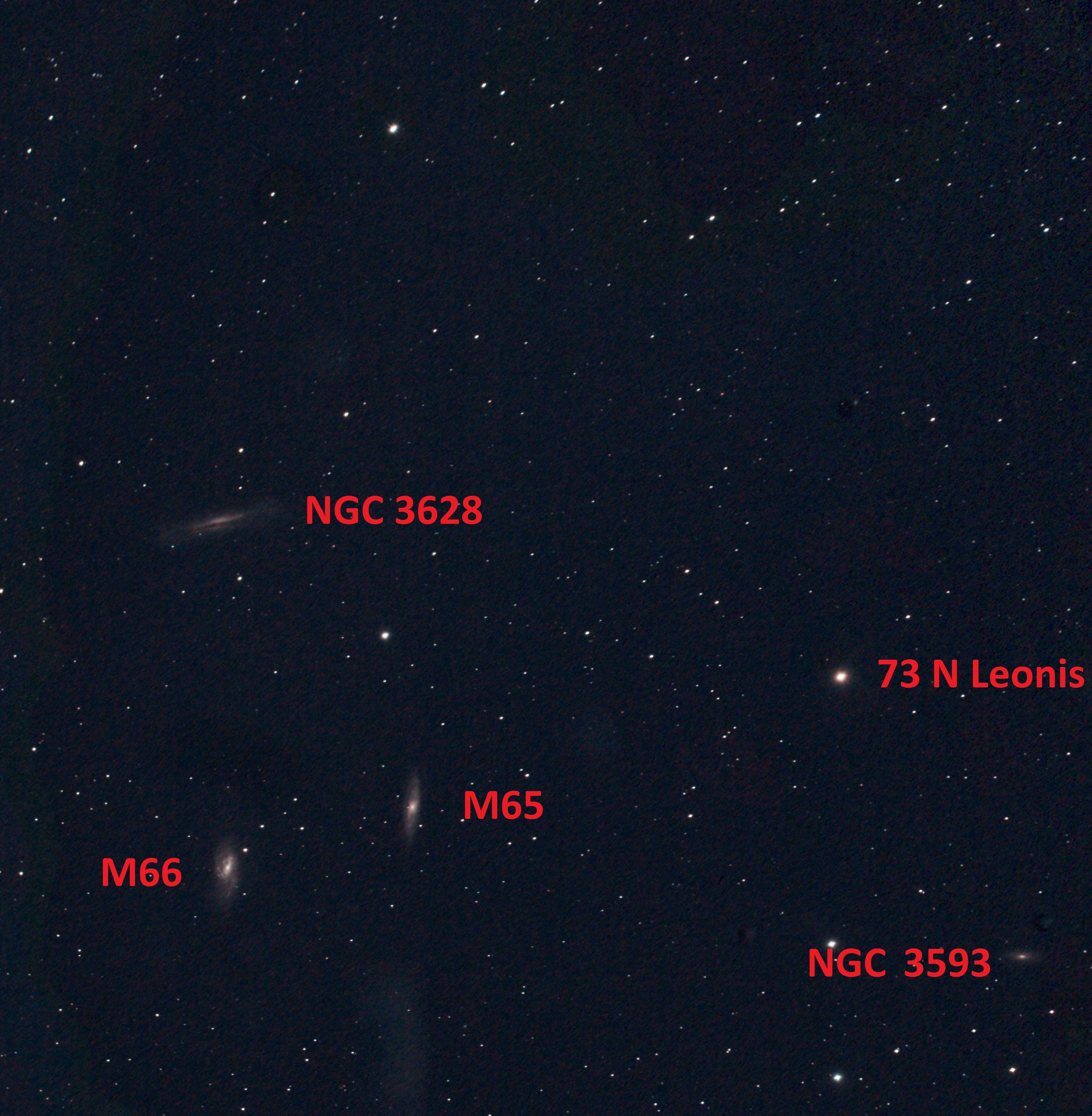
Located behind Leo’s rear ‘leg’ is the best of these, known as the Leo Triplet or M66 Group, which consists of three galaxies: M66, M65 and NGC 3628.  Evidence suggests that these are linked in a gravitational dance with each other which, in the case of NGC 3628, has created a disturbed, unbarred galaxy with a faint 300,000 light-year star to the east.  M66 is an intermediate spiral galaxy, with a diameter of about 95,000 light-years and is the largest and brightest of the trio.  M65 is a smaller, barred intermediate galaxy.  The field of view has also captured other galaxies as well as the orange giant star 73 N Leonis.  All-in-all a wonderful image which I hope to return to in order to achieve even better detail using longer exposures, guiding and hopefully a larger telescope one day.

Leo Triplet: M66, M65 & NGC 3628 WO GT81 + modded Canon 550D & FF | 10 x 180 secs + calibration @ ISO1,600 | 21st February 2015

Leo Triplet: M66, M65 & NGC 3628
WO GT81 + modded Canon 550D & FF | 10 x 180 secs + calibration @ ISO1,600 | 21st February 2015

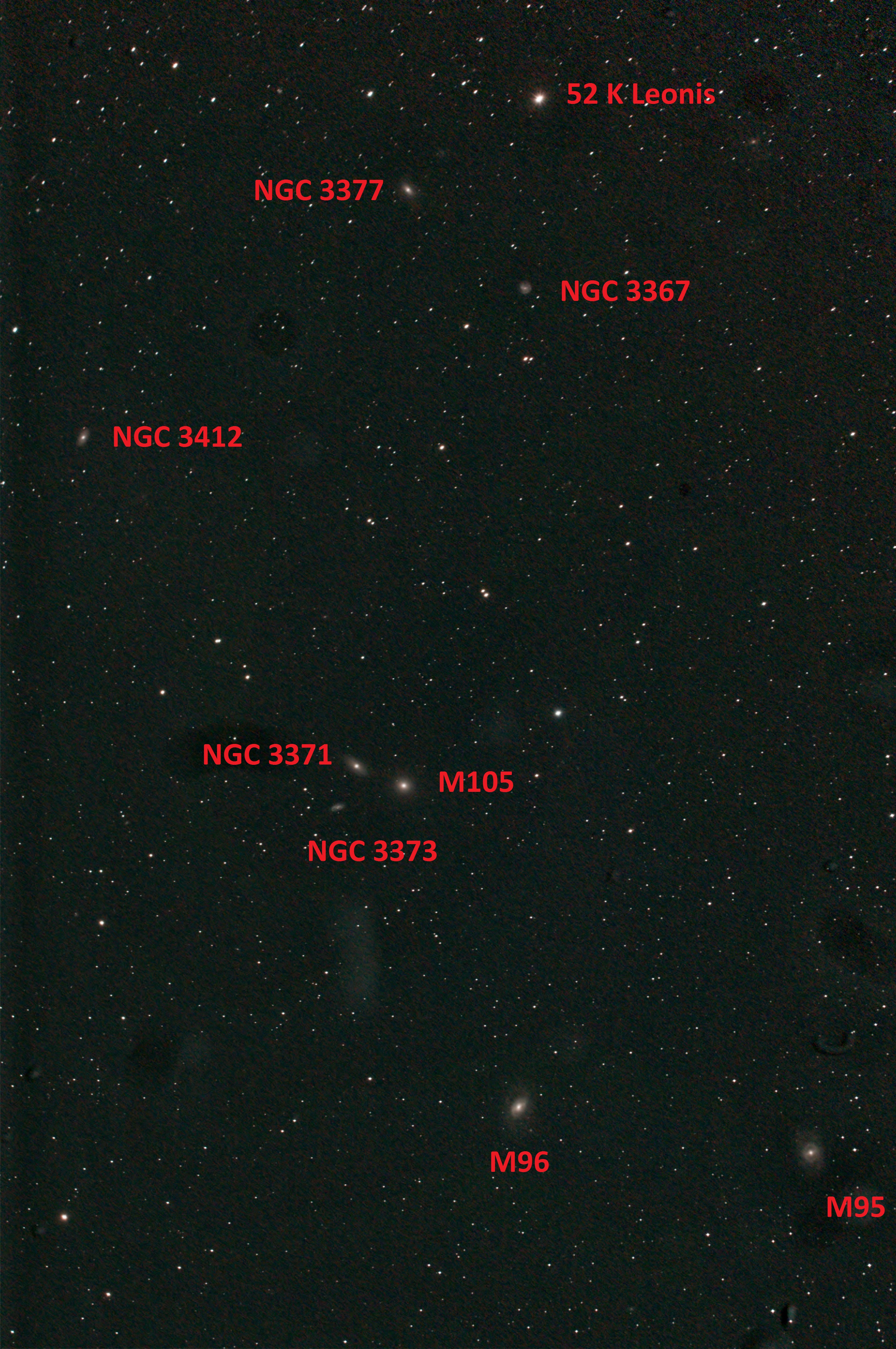
To the west of the Leo Triplet, in the direction of Leo’s dominant star Regulus, is another triple collection of galaxies called the M96 Group.  While a little fainter that the Leo Triplet, the M96 Group nonetheless makes a wonderful image accompanied, as it is, by numerous other galaxies and stars.  Of the latter, the giant orange 52 K Leonis star dominates the scene.

M69 Group: M105, NGC 3373 & NGC 3371 + other galaxies and orange giant 52 K Leonis WO GT81 + modded Canin 550D & FF | 10 x 180 secs & calibration @ ISO 1,600 @ 21st February 2015

M96 Group: M95, M96, M105, NGC 3373 & NGC 3371 + other galaxies and orange giant 52 K Leonis
WO GT81 + modded Canon 550D & FF | 10 x 180 secs & calibration @ ISO 1,600 @ 21st February 2015

It’s fair to say that the results of my big cat hunting around the constellation Leo have been a pleasant and successful surprise, with further promise still to come as Spring develops.  Watch this space!
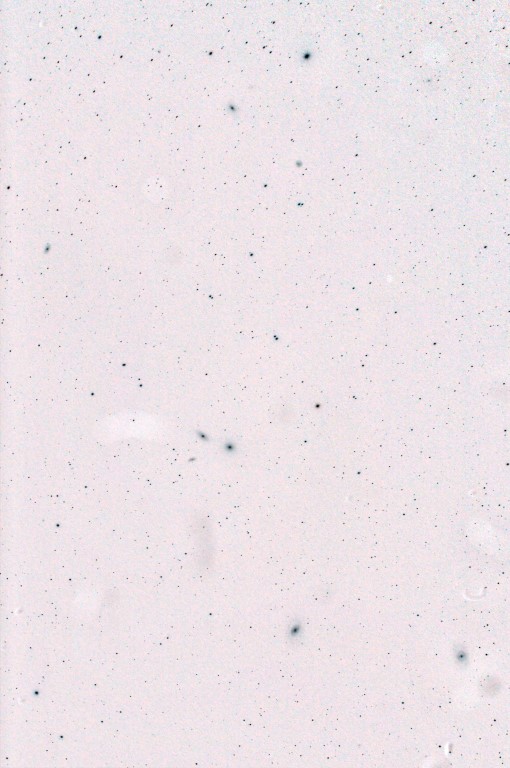
Inverting the M96 Group image helps show better the galaxies and other significant features.

Inverting the M96 Group image helps show better the galaxies and other significant features.

Orion in Perspective

Perspective:

  • The appearance of objects relative to each other, as determined by their distance from the viewer, or the effects of this distance on their appearance – The Free Dictionary.
  • Noun: The art of representing three-dimensional objects on a two-dimensional surface so as to give the right impression on their height, width, depth and position in relation to each other – Oxford English Dictionary

I have just finished an Open University MOOC (Massive Open Online Course) on Orion, which it has to be said was mixed in its content and quality.  Notwithstanding, the course provided a useful basic understanding of objects in the Universe, particularly Orion, how they related to each other and as a whole. Through my professional experience I am used to viewing and understanding objects in 3D, all the more so since computer modelling has provided a tool with which to visually illustrate such spatial shapes and relationships.  Although it is obvious that such relationships also describe the astronomical space in which we exist i.e. the Universe, and commonly describe the location of stars and other heavenly bodies by their distance, RA and DEC, I have seen very few of these objects visually modelled for common asterisms or constellations.

The constellation of Orion is probably the main feature of the winter night sky and it is certainly my favourite, particularly when looking at its rich content: M42 the Great Orion Nebula, the Running Man Nebula, the Horsehead and Flame Nebulae, M78, Barnard’s Loop and many more.  Sadly after more than 4-months imaging these objects for the first time, Orion is now starting to rise very early in the evening and by 11pm is well past the Meridian – it will not be long before this magnificent feature will be gone for another year, until on the very early mornings of next October it will reappear again, can’t wait!

orion

With my new found interest in astroimaging I have almost exclusively used a DSLR camera and focused my attention on DSO features, using a telescope and GoTo mount, somewhat neglecting the use of the camera for basic widefield photography.  Apart from the attraction of playing with my new toys, I was put off by the lack of a suitable camera attachment and a wide angle lens; because of the inherent crop factor associated with the cropped digital sensors employed in most DSLR cameras (except very expensive full frame cameras), the real focal length of a camera lens will be extended and hence the field-of-view narrowed – in my case with a x1.61 crop factor, a 50mm lens operates at an apparent focal length of 80mm!  However, using the top off an old camera tripod I recently I managed to jerry rig the camera onto the GoTo mount, thus providing tracking and enabling longer exposures.  It’s only a start but there is great promise in such photography, as seen on this excellent website, and I intend to pursue more of these images with a better way of attaching the camera and decent wide-angle lens when I can.

As a result, on Christmas Eve I obtained my first reasonable image of the whole Orion constellation, which with better exposure shows the detail, beauty and context of the numerous DSO items contained within and images previously noted.

The Orion Constellation Canon 700D | 27 x 10 secs @ ISO 1,600 & calibration | 24th December 2014

The Orion Constellation
Canon 700D & Telephoto 200 mm | 27 x 10 secs @ ISO 1,600 & calibration | 24th December 2014

In the early days of my astroimaging about 12 months ago, I found focussing something of a challenge but, with the assistance of the wonderful Bahtinov mask and Live View on-screen computer focusing, I thought that had become a thing of the past, unfortunately not!  Guided by the infinity mark on the camera lens for focussing, I set out to image some of Orion’s more elusive nebulosity, in particular Barnard’s Loop, with which I am fascinated – its enormous size of some 10o or 600 arcminutes and complete absence from ordinary view are both intriguing, exciting and challenging.  I had tried to photograph this feature before, which completely envelops Orion’s Sword and extends up towards Betelgeuse, but to no avail.  With my bodged but useable camera set-up I tried again two weeks ago.  This time the problem was once again focussing; it turns out that with widefield astroimaging using a standard camera lens, infinity does not necessarily mean infinity, as there is some leeway either side.  The out-of-focus images that resulted could therefore not be stacked but, using a single image, calibration and extensive post-process stretching in Photoshop, Barnard’s Loop was finally revealed and even Lambda Orionis above Betelgeuse and Bellatrix, albeit very noisy and out of focus.  Notwithstanding, I am pleased with this enticing glimpse and will return another day to rectify the problems.


The Orion Constellation & Barnard's Loop (up / north is left) AZ-EQ6 Mount + Canon 550D & 200mm Telephoto | 180 secs @ ISO 1,600 & calibration | 22nd January 2015

The Orion Constellation & Barnard’s Loop (up / north is left)
AZ-EQ6 Mount + Canon 550D & Telephoto 200 mm | 180 secs @ ISO 1,600 & calibration | 22nd January 2015

Since my first decent image of the Great Orion Nebula on a very early morning at the beginning of last October, I have had hours of fun and some frustration imaging various parts of the Orion Constellation.  But despite my new familiarity with the Orion constellation, 3D modelling and, I’d like to think, good spatial awareness, I was still pleasantly surprised and impressed by this wonderful 3D video of the constellation produced by the Space Telescope Science Institute for NASA and used during the aforementioned Open University course, which really does put it all into perspective: The True Shape of Orion.

Lovejoy Part-2

I first became acquainted with C/2014 Q2 Comet Lovejoy just before Christmas and have since been keen to obtain my own image of the object from Fairvale Observatory; at the time I was fortunate to obtain a photograph of the comet from a fellow astronomer in La Palma.  Despite the comet reaching its best positon on January 7th, some 44 million miles from Earth and with the apparent magnitude (brightness) improving throughout January to less than +4.0, unfortunately nature and life prohibited me from attempting this task: Christmas, New Year, travel, bad weather, full Moon etc.  A couple of clear skies did present a good visual sighting through binoculars but no image.

Last week, on Thursday evening, I eventually got my first opportunity but due to very strong winds (hence the clear sky) was unable to even set-up the equipment.  The following evening a cold but clear sky again occurred and this time I took my chance.

Photographing and processing a comet is not straightforward.  Since my last post, Comet Lovejoy has tracked west (to the right) of the Orion constellation and at the time of imaging was located just above the western end of Taurus, before it passes west of Pleiades on 19th January.  The first problem is therefore obvious – it’s travelling very fast, about 82,000 mph.  Fortunately Livecometdata.com provides real time information on the comet’s journey, which is both impressive (how does it do this?) and very useful.  Inputting the real time RA and DEC location data into the SynScan handset, the mount slewed straight to the comet, which was just off-centre of the field of view.  And thus I had my first, proper live view of a comet – fantastic! Now for the tricky part: how to get an image?

I had already posed this question on Stargazers Lounge and had a number of useful suggestions. Of course, whilst the mount tracks the celestial sphere, the comet is making its own way through the sky, which is not the same path as the stars seen from Earth; I believe it is possible to track the actual comet but that’s too difficult for me. Therefore, it is necessary to err towards lots of shorter exposures to avoid blurring; the longer the exposure the more likely it is the comet’s tail can also be captured in the image but it is a fine line between achieving this and blurring.  In the end I took two sets of images at 20 seconds and 60 seconds – probably too cautious but I was happy with the result and will be better prepared for my next comet, whenever that is.

Then came the next obstacle – stacking and processing.  I had not thought about this before but in the world of stacking, the software is unable to distinguish the comet from stars.  As a result it is necessary to identify the comet in each light frame by manually tagging it; at this point I regretted taking x40 exposures! Deep Sky Stacker will then stack using one of three procedures which basically prioritises either the comet or the stars or a combination of both – I chose the latter.  As usual post processing in Photoshop is then used to improve the final image.

C/2014 Q2 Comet Lovejoy WO GT81 + Canon 550D (modded) & FF | 40 x 20secs @ ISO1,600 + darks | 16th January 2014

C/2014 Q2 Comet Lovejoy
WO GT81 + Canon 550D (modded) & FF | 40 x 20secs @ ISO1,600 + darks | Fairvale Observatory 16th January 2015

Whilst I am very excited to have successfully photographed Comet Lovejoy, I was less than impressed by the stacked image and actually prefer the original.  Processing comet images takes the dark art of processing to a new level and I feel I’ve only reached the learning foothills so far.

Lovejoy will be in the sky for some weeks to come as it tracks across Andromeda and Perseus during February and into Cassiopeia in March.  Whilst the best may be almost past, I certainly hope to follow its progress and, subject to conditions, might even attempt to image it once again before it continues its 8,000 year orbit into deep space.  However, for now I’ve got my comet and am well satisfied – I will spend the intervening winter days practicing my comet stacking.

Comet Lovejoy WO GT81 + Canon 550D & FF | 15 x 60 secs @ ISO1,600 + darks| 16th January 2015

Comet Lovejoy
WO GT81 + Canon 550D (modded) & FF | 15 x 60 secs @ ISO1,600 + darks| Fairvale Observatory 16th January 2015

Christmas Comet

C/2014 Q2 Comet Lovejoy is a long-period comet, only recently discovered by Terry Lovejoy in August; it is the fifth comet discovered by Terry. By December 2014 the comet had brightened to a magnitude of +7.4 and by mid-December had become visible to the naked eye with dark skies.  This weekend on 28th and 29th December,  the comet will pass 1/3° from the globular cluster M79, subsequently brightening in January  to a magnitude of +4.0 to +5.0, as it moves west of Orion and onwards towards Aries and Triangulum, thereby becoming one of the brightest comets for years. On 7th January 2015 the comet will be at its closest to Earth at a distance of 43,600,000 miles.

C/2014 Q2 Comet Lovejoy Transit

C/2014 Q2 Comet Lovejoy Projected Track

Before entering the planetary region in the 1950s epoch, C/2014 Q2 had an orbital period of 11,500 years, after leaving the planetary region in the 2050 epoch it will have an orbital period of about 8,000 years. Thus, unbeknownst to me, it has been with me since I was born and will remain with me for the rest of my life!

I have not seen the comet yet but have just been sent an excellent picture just taken from Joan’s Tacande Observatory in La Palma , which I visited earlier this year.  Of course, I’ll be looking out for C/2014 Q2 at the weekend and hope to follow its journey during the next few weeks and beyond.  Well done Terry and thanks again Joan.

C/2014 Q2 Comet Lovejoy  R120 Canon 350D |  180 secs @ ISO 400 | taken by Joan Genebriera at Tacande Observatory, La Palma, 23rd December 2014

C/2014 Q2 Comet Lovejoy
R120 + Canon 350D | 180 secs @ ISO 400 | Taken by Joan Genebriera at Tacande Observatory in La Palma, 23rd December 2014