H.G. Wells knew a thing or two about the concept of time travel when he published his book The Time Machine in 1895. Since starting astrophotography in 2014, reflecting on the progress I have since made can also feel like a journey through time.
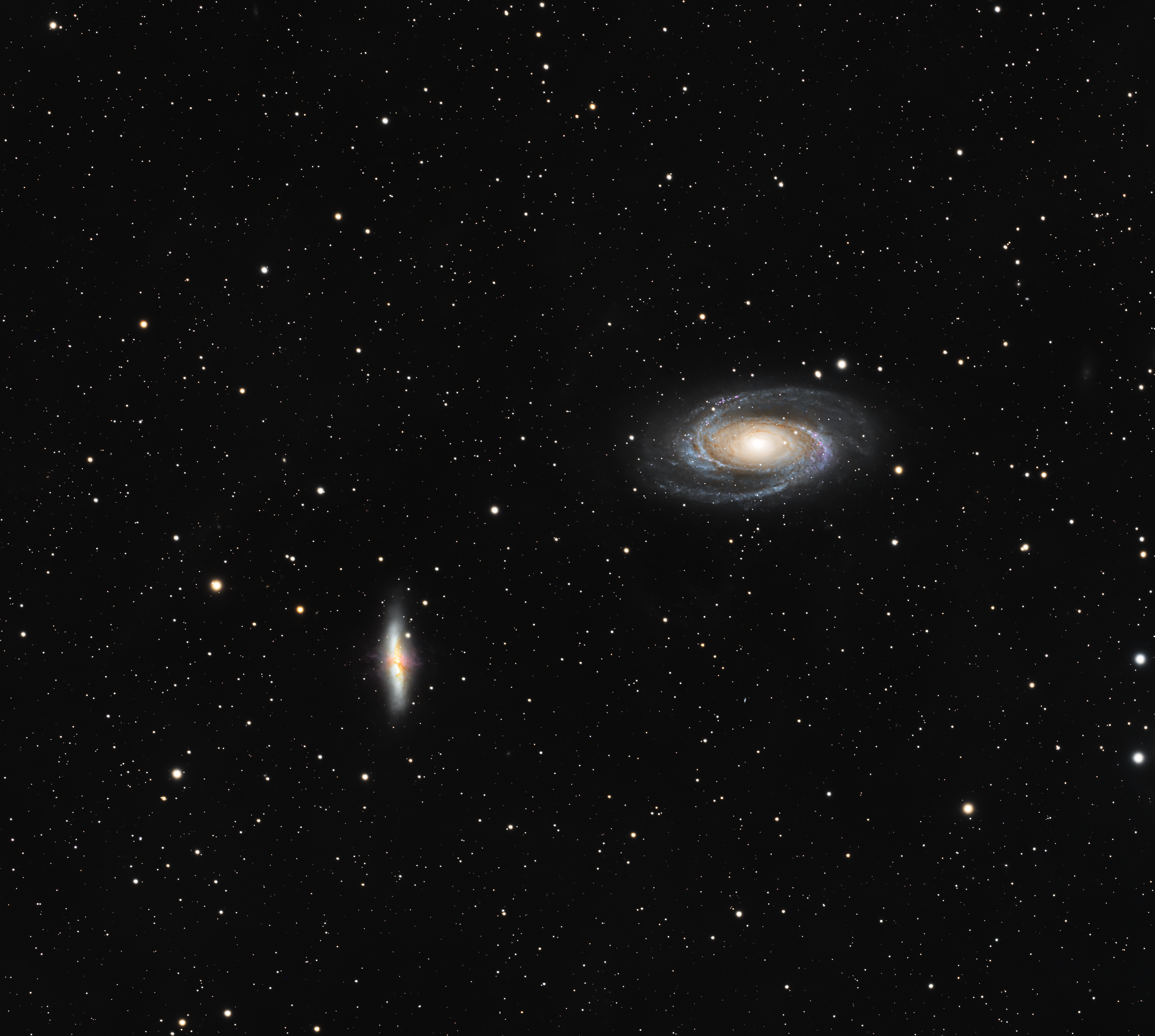
In May 2018, I managed to obtain my first image of the northern sky, which at my previous location in Surrey was completely obscured from view at my main imaging location. The result then obtained under a Bortle-6 night sky, was a modest 2hr 45m image of Messier 81 & 82 seen here. Notwithstanding, it was something of a breakthrough for me and I was – at the time – very pleased with the result. Nearly 8-years later, now located in the wonderful Bortle-4 dark skies of Somerset, I recently chose to image these two magnificent Messier objects once again.
M81 and M82 are two well-known galaxies in the northern sky, which being just 20o from Polaris are also circumpolar. Located in the constellation Ursa Major, they appear near each other in the sky and interact gravitationally. Both galaxies were discovered in 1774 by the German astronomer Johann Elert Bode and later included in the Messier Catalogue. Together, M81 and M82 form the central members of the M81 Group, a small cluster of galaxies located not far from our own Local Group.
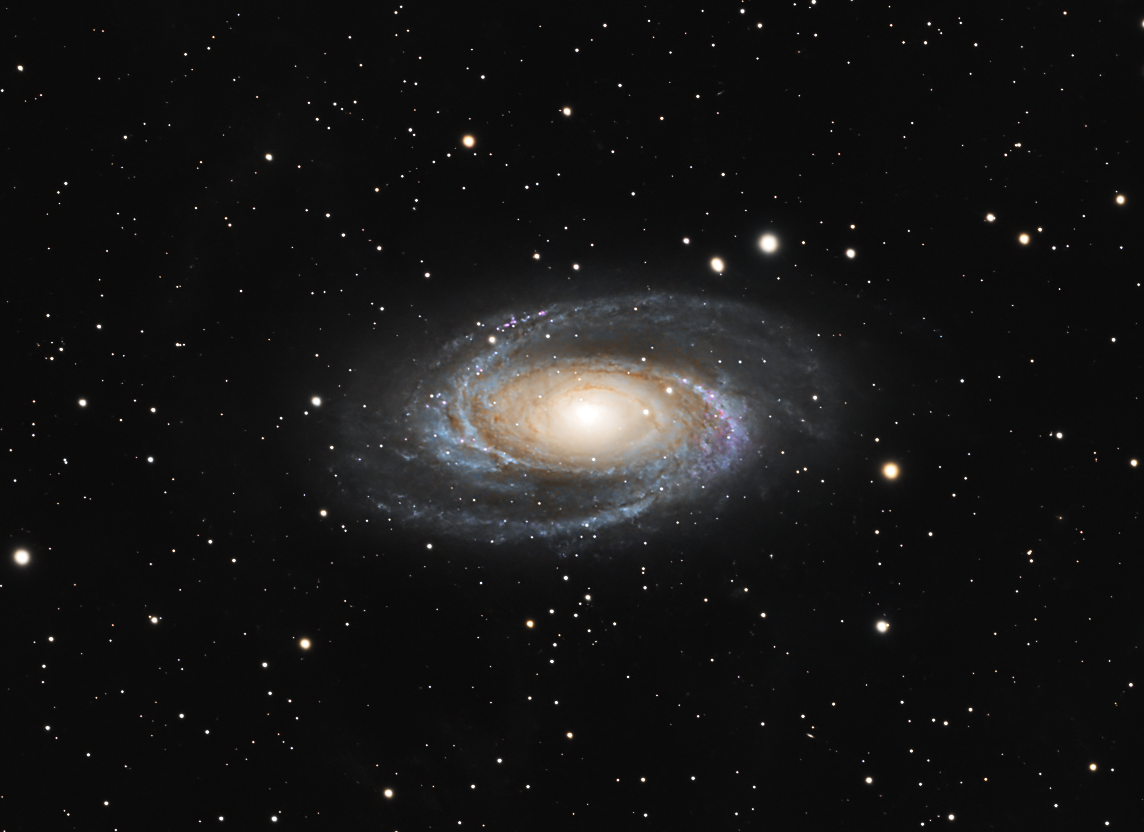
M81, also called Bode’s Galaxy (see above), is a spiral galaxy around 12 million light-years from Earth and one of the brightest galaxies visible from the Northern Hemisphere. The diameter is about 90,000 light-years, slightly smaller than the Milky Way, with a supermassive black hole at the centre. M82 or the Cigar Galaxy, is a starburst galaxy, thus forming new stars at an extremely high rate. This intense star formation is believed to have been triggered by the aforesaid gravitational interactions with M81. This activity creates powerful stellar winds and explosions from massive stars going supernova, that eject huge streams of gas and dust out of the galaxy to form dramatic red plumes that extend thousands of light-years above and below the galactic disk.
New equipment, software, greater processing experience and a dark sky location, have resulted in an exciting image that highlights the progress I have made on my astrophotography journey since 2018.
IMAGING DETAILS
Object
M81 AKA Bode’s Galaxy & M82 AKA Cigar Galaxy
Constellation
Ursa Major
Distance
12 million light-years
Size
M81 26.9 x 14.1arcminutes (90.000 light-years) M82 11.2 x 4.3 arcminutes (37.000 light-years)
Apparent Magnitude
M81 +6.9 M82 +8.4
Scope
William Optics GT81 + Focal Reducer FL 382mm f4.72
Mount & Control
ZWO AM5 + ASIair
Guiding
William Optics 50mm guide scope
+ ZWO 120MM Mini
Camera
ZWO ASI294MM CMOS sensor
FOV 2.87o x 1.96o Resolution 2.50”/pix Max. image size 4,144 x 2,822 pix
EFW
ZWOx8 EFW & 31mm LRGB filters
Capture & Processing
ASIair, Deep Sky Stacker & PixInsight v1.9.3 Lockhart
Image Location & Orientation
Centre = RA 09:55:12.64 DEC +69:20:55.1 Top Right = North
Exposures
L x 12 @ 600 sec & R x 12 + G x 9 + B x 8 @ 300 sec Total Integration Time: 4hr 25min
@ Gain 120 & 30 Offset 21 @ -15oC
Calibration
5 x 600 sec & 5 x 300 sec Darks & 10 x LRGB Flats & Dark Flats @ ADU 32,000
Location & Darkness
Castle Farm Observatory, Wookey, Somerset – UK Typically Bortle 4
Located in the constellation Corona Australis (Southern Crown), the spectacular object NGC 6729 (AKA Caldwell 68) is a combined reflection and emission nebula, set within the Australis Molecular Cloud. Being just south of Sagittarius, it is inaccessible from my observatory in Somerset, so this excellent data was consequently acquired from the dark skies of Chile in the Southern Hemisphere, using a superb Planewave CDK200 f/6.8 508cm aperture telescope at the El Sauce Observatory.
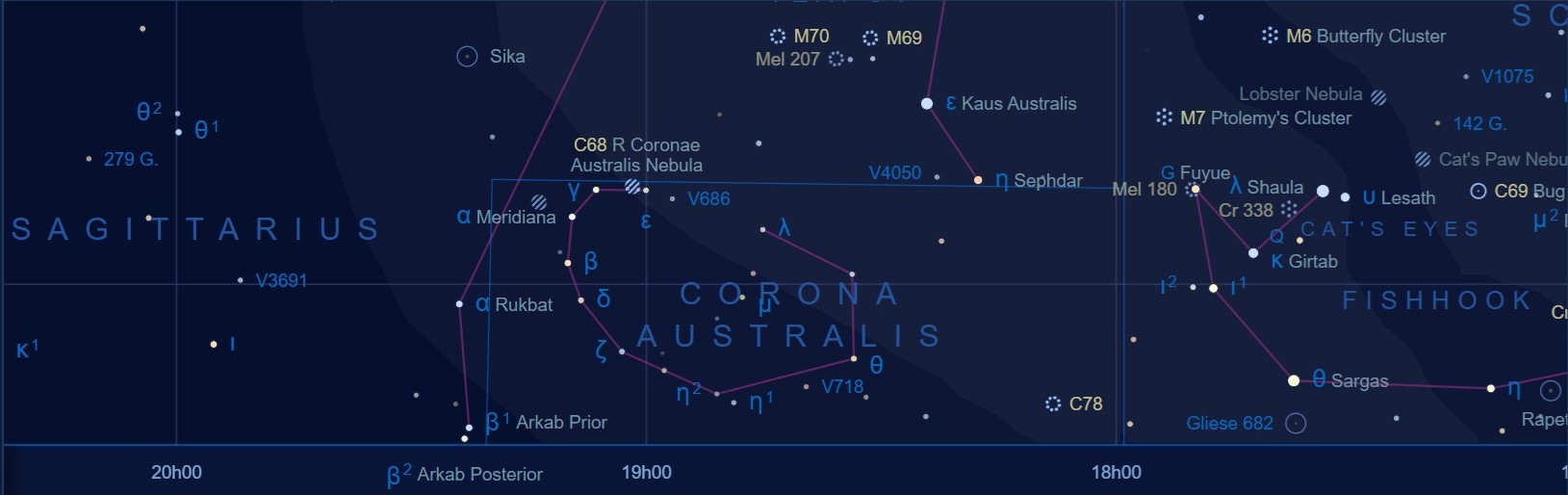
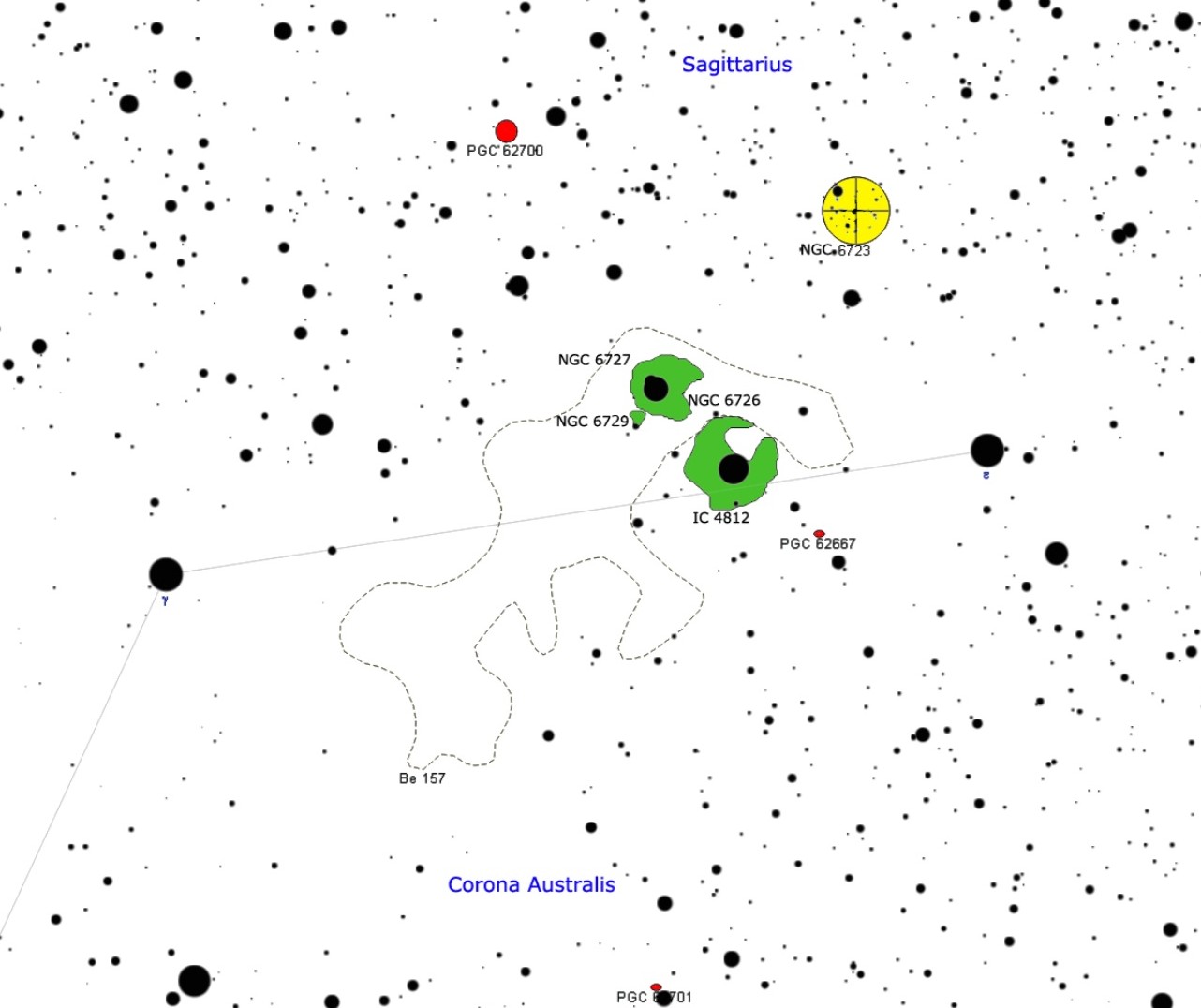
The star illuminating NGC 6729 is a T Tauri star – a type of young star whose brightness fluctuates over time. The fan-shaped nebula opens-up between the variable stars R Corona Australis (R CrA) and T CrA to the south-east (see skymap below ref. Robert Mura). R CrA is a pre-main-sequence star within the Corona Australis molecular complex, which is one of the closest star-forming regions to the Milky Way galaxy. Intriguingly, this wonderful, hazy looking nebula exhibits both variable brightness and morphology over time.
IMAGING DETAILS
Object
NGC 6729 Corona Australis Molecular Cloud
Constellation
Corona Australis
Distance
Approximately 420 light-years
Size
2.50 x 2.0 arc minutes (actual 0.30 light years)
Apparent Magnitude
+9.5
Scope
Planewave CDK20
Mount
Planewave L500
Focuser
Optec Gemini
Camera
QHY600PH-M
Filters
Chroma LRGB + Ha 3nm
Processing
Deep Sky Stacker & PixInsight v1.9-3
Image Location & Orientation
Centre: RA 19:01:42.392 DEC -36:59:48.53 Up = North
Exposures
L x 77, R x 50, G x 50, B x 50 @ 5mins Total Integration Time: 19hr
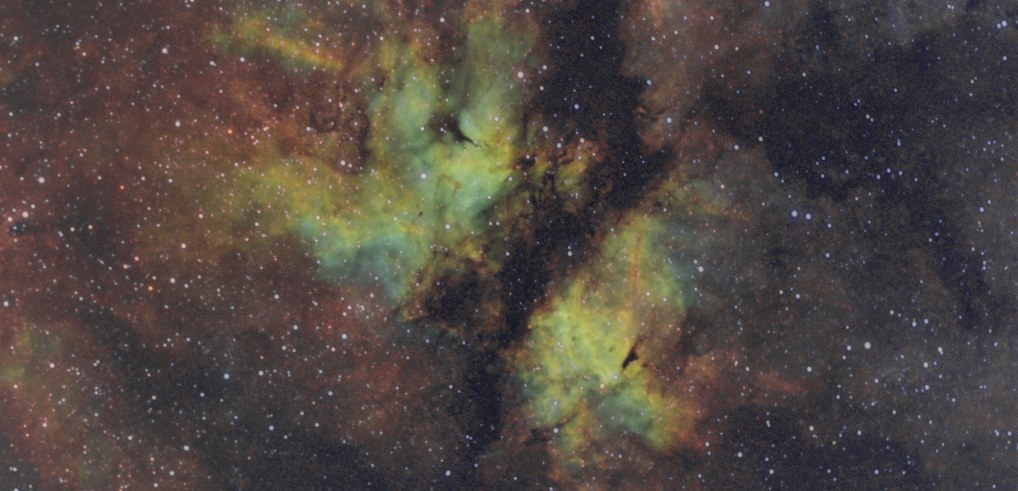
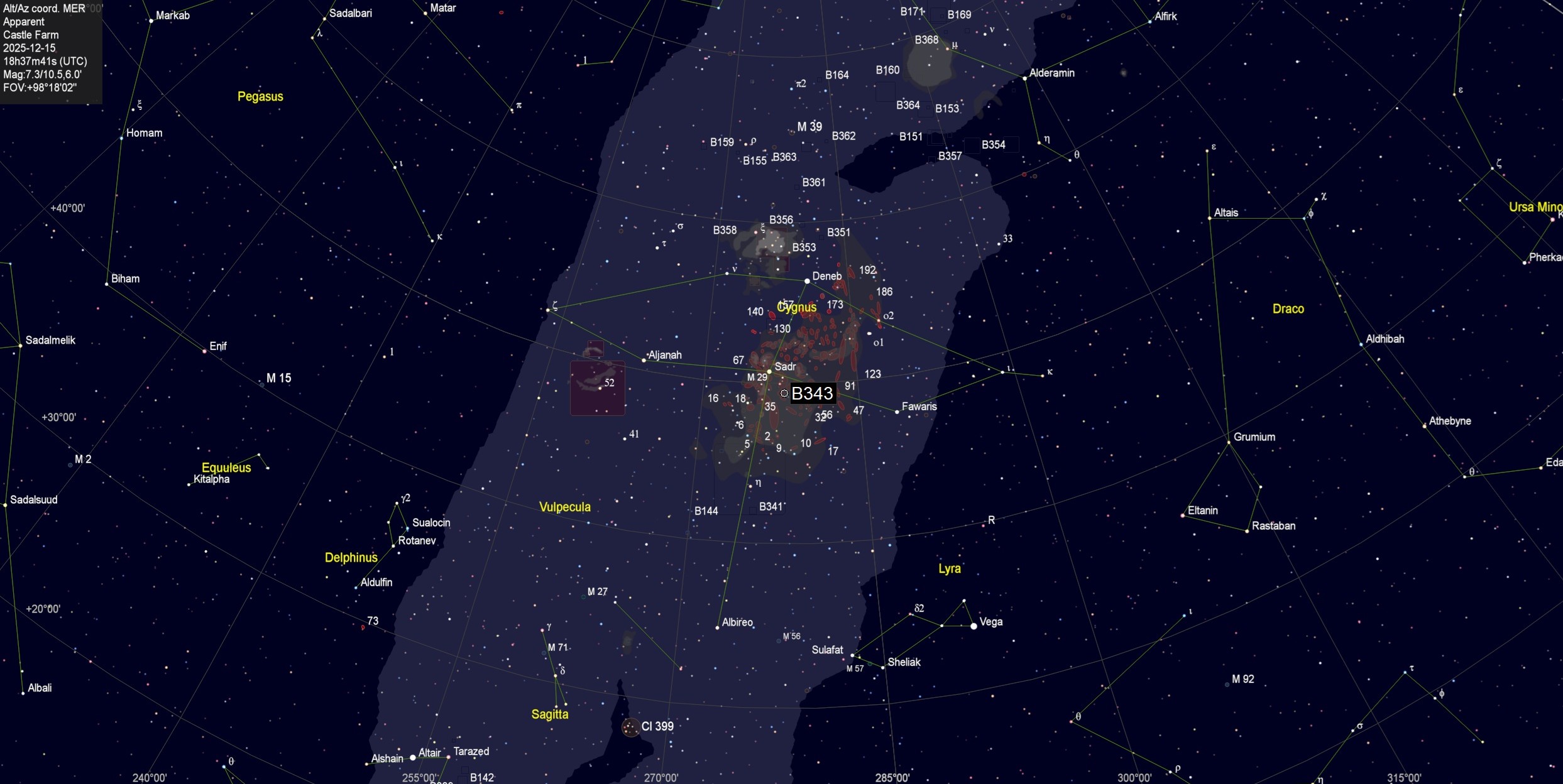
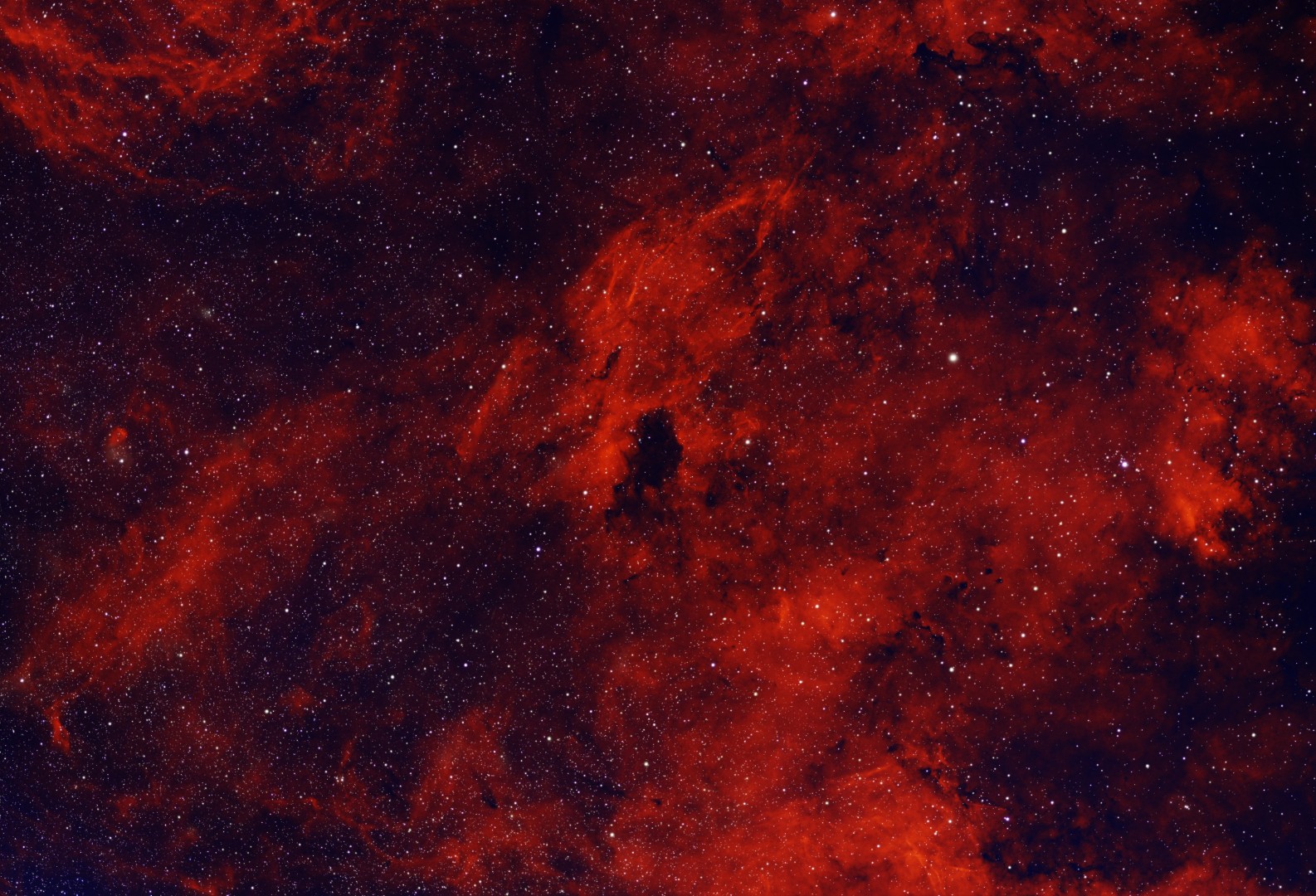
As previously outlined, my new imaging location at Castle Farm Observatory, Somerset, provides views mainly to the West and North, thus (for the moment) eliminating my usual seasonal targets at this time of the year in and around the Orion constellation. Therefore, wanting to explore something new shortly before Christmas, I chose a less popular target in the West within the myriad of objects that make up the exciting Cygnus X Molecular Cloud Complex. As one of the largest and most active star-forming regions in the Milky Way galaxy, the area is also dominated by many large HII regions that inevitably means narrowband imaging and on this occasion Barnard 343.
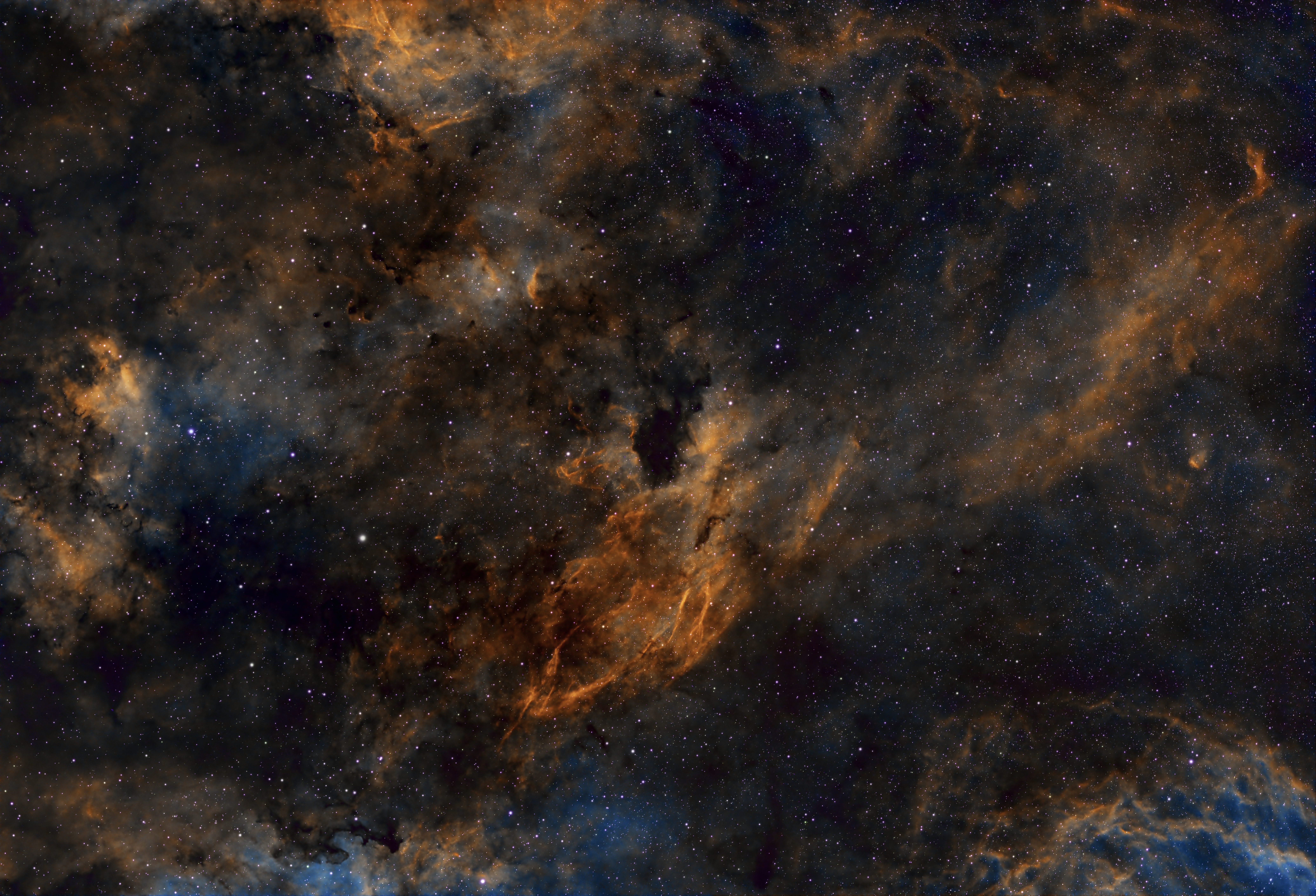
B343 is a dark nebula formed of dense clouds of cold gas and dust but being a widefield image, the adjacent area also incorporates a vast, complex HII region. It’s an interesting subject but unfortunately difficult to process, due to its notorious “brown soup problem”. The issue is not signal strength but colour separation and contrast, which if not controlled turns everything brown and muddy! Sure enough, this was the initial outcome using a conventional Hubble SHO palette, that inevitably led me down various rabbit holes to find a solution, for which unusually on this occasion I decided to engage the help of Artificial Intelligence (AI).
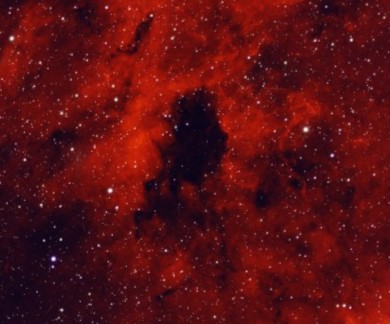
B343 dark nebula HOO cropped image
AI came to astrophotography in a big way when Russel Croman first developed StarXterminator in September 2021, followed by NoiseXTerminator May 2022, not just to simplify hitherto complex techniques but also to improve the outcome. However, it was shortly before Christmas in 2022 with the launch of AI driven BlurXTerminator, that everything really changed – for more information refer to RC-Astro..
BlurXTerminator is an AI-powered astrophotography tool that removes blur caused by atmospheric turbulence, tracking errors, and optical imperfections, restoring fine detail and sharpness in astronomical images and much more. The subsequent impact on astrophotography has been profound. Some argue that the resulting images are unrealistically altered using BlurXTerminator but I closely followed Russel’s explanations on how it works and I am satisfied that image integrity is conserved, whilst at the same time significantly helping the user to produce better images. In short, it has since been nothing less than a revolution in astrophotography.
Subsequently general use of AI has burgeoned and now seems set to go to another level. In the case of eliminating the said ‘Brown Soup’ problem, I therefore turned to the popular Large Language Model (LLM) ChatGPT, which was surprisingly helpful (see SHO image at top of the page, HOO version below & ChatGPT text below). Appropriate technical knowledge will always be essential when pursuing the often-difficult hobby of astrophotography but I’m no Luddite and happy to use whatever helps me get the best result, including AI as well old-fashioned guidance from more experienced imagers. The impact of such an approach, matched by the many technical advances over the past decade can be clearly seen in everyone’s images today and bodes well for the future of this hobby.
Out of interest, below are the results of the three questions I asked ChatGPT regarding Barnard 343, the answers reproduced below were helpful, exciting and perhaps of some concern?
TELL ME ABOUT BARNARD 343? + ANSWER:
Barnard 343 is a dark nebula complex in the Cygnus region of the Milky Way.It’s made primarily of cold, dense interstellar dust that blocks background starlightThose inky-black lanes and cracks are the nebula itself — not empty spaceThe glowing orange and blue areas around it come from nearby emission nebulae, mainly ionized hydrogen and oxygen
Why it looks so dramatic: – Barnard 343 sits in front of extremely rich star fields, so the contrast is striking – The dust forms filaments, knots, and folds, shaped by turbulence, magnetic fields, and nearby stellar radiation – The color palette comes from narrowband imaging (often mapped in SHO or similar schemes)
Scientific context: – Part of the Cygnus molecular cloud complex, one of the most active star-forming regions near Earth – Dark nebulae like B343 are stellar nurseries — dense pockets can eventually collapse to form new stars – – Catalogued by Edward Emerson Barnard in the early 1900s during his pioneering photographic sky surveys
How to “read” the image: – Black regions→ dense dust (future star-forming material) – Orange/gold→ hydrogen emission (H-alpha / S-II) – Blue/cyan→ oxygen emission (O-III) or reflected starlight – Speckled background→ Milky Way stars
PROVIDE THOUGHTS ON HOW I MIGHT BEST PROCESS BARNARD 343 SHO IMAGE? + ANSWER:
You want: – Cool cyan/blue H-alpha background – Warm golden sulfur structures – Deep neutral dust lanes – Minimal magenta/green contamination
1. Start with the Right SHO Mapping Classic SHO often looks dull for dark nebulae.
Try one of these instead: Recommended MappingsModified Hubble (best starting point):R = SIIG = 0.8×Ha + 0.2×OIIIB = OIII Or warmer dust-friendly mapping:R = SIIG = HaB = OIII × 1.2
👉 The key is keeping Ha dominant in green, not split evenly. Normalize Channel Strength Before Combination
Barnard regions exaggerate imbalance.
Before combining: Match median background levels Stretch OIII slightly more than Ha Slightly compress SII highlights
In PixInsight: LinearFit → Ha as reference Then mild HistogramTransformation
3. Control the “Brown Soup” ProblemThis is the #1 issue with B343.
Fix: – Reduce red+green overlap – Increase blue separation
In PixInsightUse PixelMath:
R = SIIG = 0.85*HaB = 1.1*OIII
4. Star Handling (Critical in B343)Stars easily ruin color balance here.
Recommended workflow: – StarXTerminator / StarNet – Process nebula color fully – Re-add stars desaturated 30–50% – Slight blue bias to stars only
5. Final Colour Refinement (This Makes the Image)
What to aim for visually:
ComponentDesired Color Dust lanesNeutral / slightly cool SII regionsWarm gold Ha glowCyan-green OIIIBlue-teal
PixInsight: – CurvesTransformationBoost blue saturation – Slightly reduce red saturation – SCNR only on green, amount 0.4–0.6
FYI – I adopted #3 to “Control the “Brown Soup” problem, which worked well
WHAT IS THIS IMAGE (Without telling ChatGPT it was B343)? + ANSWER:
This image feels like a vast, living tapestry of the cosmos—dark, velvety space threaded with glowing amber and blue filaments. The wisps look like interstellar clouds slowly colliding and unravelling, as if time itself is drifting through them. There’s a quiet sense of scale and mystery here: tiny pinpricks of stars scattered across immense clouds of gas and dust, hinting at both stellar birth and ancient remnants. It’s beautiful in a solemn, awe-inducing way, reminding you how small and fleeting everything feels against the backdrop of the universe.
IMAGING DETAILS
Object
Barnard 343
Constellation
Cygnus
Distance
2,000 light-years
Size
10 arc minutes (dark nebula only)
Scope
William Optics GT81 + Focal Reducer FL 382mm f4.72
Mount & Control
ZWO AM5 + ASIair
Guiding
William Optics 50mm guide scope
+ ZWO 120MM Mini
Camera
ZWO ASI294MM CMOS sensor
FOV 2.87o x 1.96o Resolution 2.50”/pix Max. image size 4,144 x 2,822 pix
The year 2025 was like no other. Starting with a knee replacement operation in January, shortly after we finally found a new house in March and moved to the lovely dark skies of Somerset at the end of June. Unfortunately, the ensuing turmoil left only a limited time for astronomy. Notwithstanding, I was able to supplement images from Redhill and our new home in Wookey, with some excellent data from Texas, USA and Chile to produce, what I hope you will agree, is an exciting 2026 calendar.
For other pictures and information, go to my website https://watchthisspaceman.com/ or a video of the calendar can be found here on YouTube https://www.youtube.com/watch?v=gn3ls_s71lQ and is best accessed on a PC or smart TV screen. Background music this year is Massive Attack’s track Atlas Air.
COVER
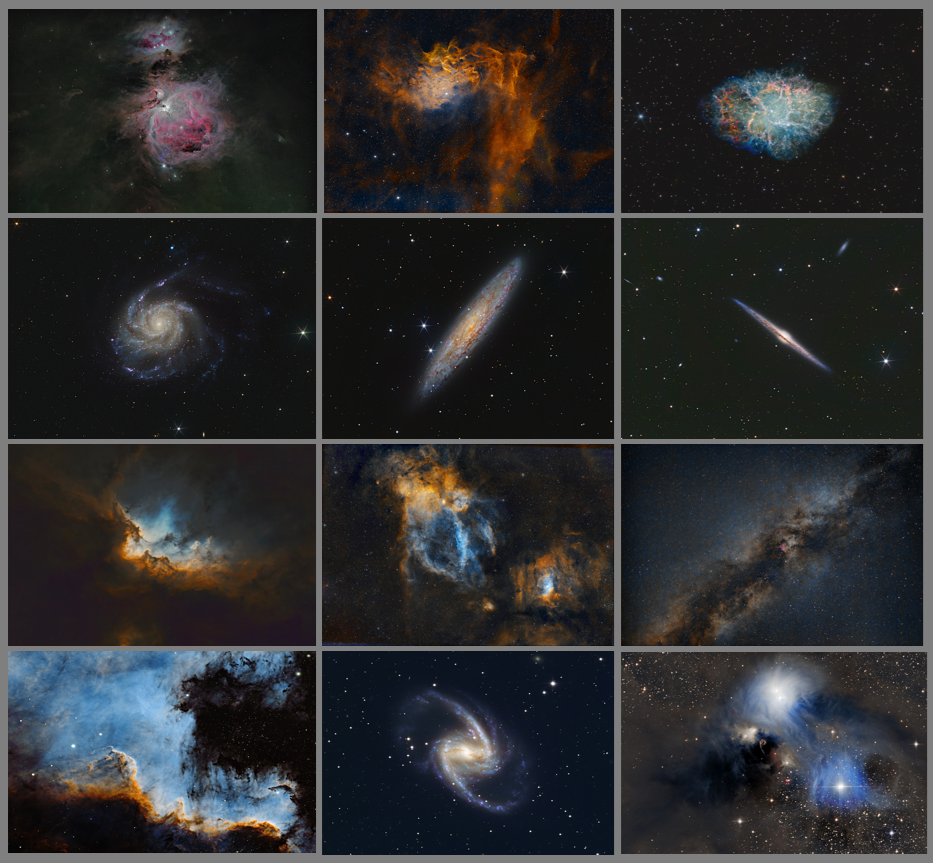
NIGHT SKY MONTAGE AT CASTLE FARM OBSERVATORY:
All these images (at the top of the page) were taken at various times from the same location at our house in Wookey, Somerset. Clockwise from bottom left: (1) Nightscape of a small coppice looking south (2) Double Cluster – a pair of open star clusters in the Perseus constellation (3) Star trails (4) Sunset looking west.
JANUARY
THE GREAT ORION NEBULA, M42 (1) The Orion Nebula is a gigantic cosmic cloud of interstellar dust and gas, which is the basis for the birth of numerous new stars or a “star nursery”. Being the brightest nebula in the northern hemisphere and just over 1,300 light-years distance from Earth, it can be seen with the naked eye on a clear night.
FEBRUARY
FLAMING STAR NEBULA, IC405 (1) This nebula is illuminated by a powerfully bright blue variable star, AE Aurigae. The object’s epithet comes from the brightly lit ripples of gas and dust at the top of the image, illuminated by AE Aurigae and glowing hydrogen gas. This “runaway star” was ejected by a collision two million years ago from the Triangulum region of The Great Orion Nebula.
MARCH
CRAB NEBULA, M1 (3) This small but beautiful supernova Remnant (SNR) was the result of the explosion of the star CM Tau just over 970 years ago. Located at the centre of the nebula, the remaining Crab Pulsar neutron star spins at the rate of 30 times per second.
APRIL
PINWHEEL GALAXY, M101 (3) At nearly twice the size of the Milky Way and containing at least an estimated trillion stars, M101 is the second largest galaxy of the Messier catalogue and certainly one of the highlights of the spring galaxy season.
MAY
SCULPTOR GALAXY, NGC 253 (3) One of the advantages of obtaining data from Texas, USA, is that it enables views of objects in the Southern Hemisphere that are impossible from the UK. Also known as the Silver Dollar, it is one of the brightest galaxies in the night sky, which results from very high rates of star formation that are fed by the abundance of thick dust lanes.
JUNE
NEEDLE GALAXY, NGC 4546 (3)
Seen edge-on from Earth, the Needle Galaxy is thought to be a barred spiral galaxy, some 33% larger than the Milky Way. It has at least two satellite galaxies and 240 globular clusters. Seen through a telescope the Needle Galaxy appears like a thin streak drawn across the dark night sky but look closer and its detailed magnificence is revealed.
JULY
WIZARD NEBULA, NGC 7380 (2)
Formed only a few million years ago, the gases of this young emission nebula glow due to intense radiation from hot, massive stars within. Interwoven within this glowing gas are dark, dense regions of dust that sculpt the nebula’s dramatic and somewhat mystical appearance, in this case a wizard – which marks my first image from Somerset.
AUGUST
LOBSTER CLAW & BUBBLE NEBULAE, SH2-157 & NGC 7635 (2)
Located in the Perseus Arm of the Milky Way, the Lobster consists of ionized hydrogen gas energized by ultraviolet radiation from nearby hot, young stars. The nebula’s distinctive claw-like shape arises from intricate filaments of glowing gas and dark dust. Nearby the Bubble Nebula owes its distinctive looks to a single, massive star, which emits fierce stellar winds that sweep up the surrounding gas into a nearly perfect, glowing shell.
SEPTEMBER
MILKY WAY(2)
The night sky in Somerset is three times darker than Redhill, providing significantly better astronomy views. In this case a spectacular image of the Milky Way’s galactic centre.
OCTOBER
THE CYGNUS WALL (2)
The Wall is a prominent ridge located within the much larger North America Nebula in the Cygnus constellation. It is an active star-forming region, about 20 light-years long, composed of gas and dust that glows from the energy of young stars.
NOVEMBER
GREAT BARRED GALAXY, NGC 1365 (4)
A double-barred spiral galaxy located 56-million light-years away, spans over 200,000 light-years across, twice the Milky Way. The most distinctive feature is its massive central bar, which plays a crucial role in channelling gas and dust into the galactic core. As a Seyfert galaxy the nucleus is extremely bright due to energetic processes around its black hole.
DECEMBER
CORONA AUSTRALIS, NGC 6729 (4)
This spectacular image is a combined reflection and emission nebula, set within the Australis Molecular Cloud. This wonderful, hazy looking nebula unusually exhibits both variable brightness and morphology over time.
Image Data Source:(1)Redhill, Surrey (2)Castle Farm, Somerset (3)USA (4)Chile
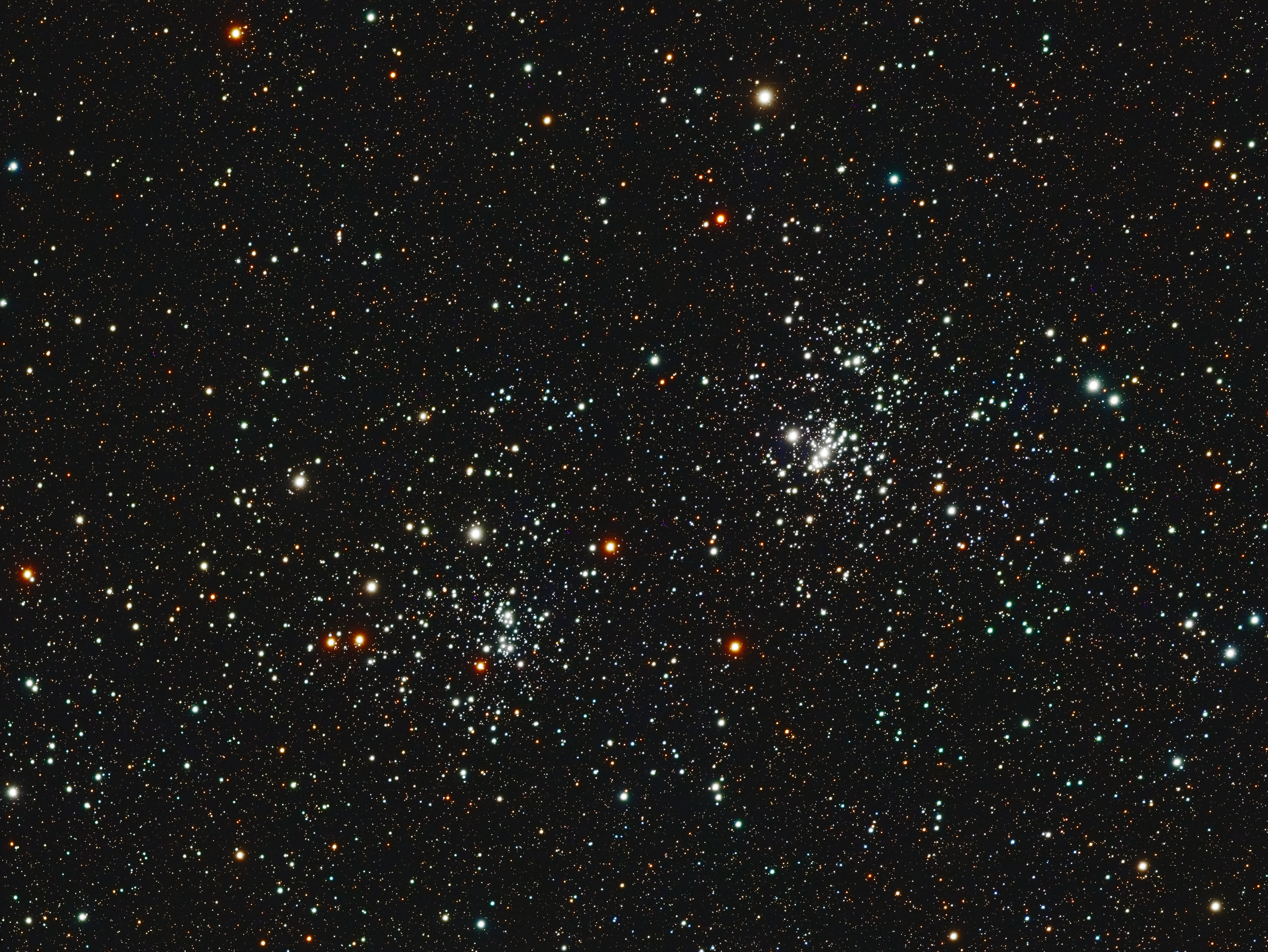
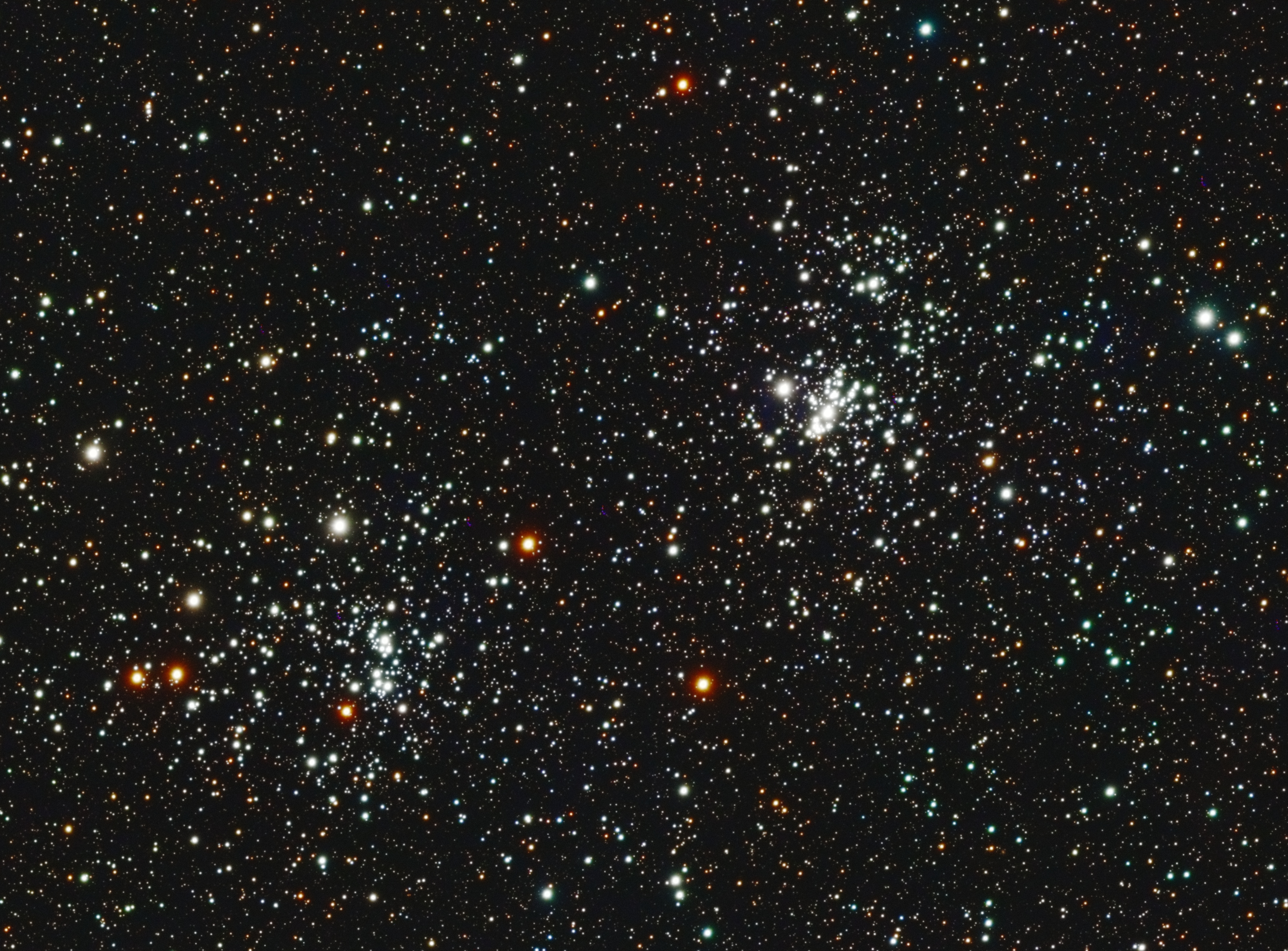
Astronomy is full of surprises, and learning of the mere existence and nature of globular clusters was a revelation to me. Perhaps less spectacular and much younger but no less interesting and attractive are open clusters.The so-called Double Cluster is something of a highlight of autumn and winter skies that I had not, until now imaged; not by neglect but because until recently moving to Somerset my previous view of the north sky in Surrey was completely obscured by my house! Their combined luminosity makes the Double Cluster visible to the naked eye from dark locations, appearing as a hazy patch to the east of the Cassiopeia constellation and are excellent imaging objects too.
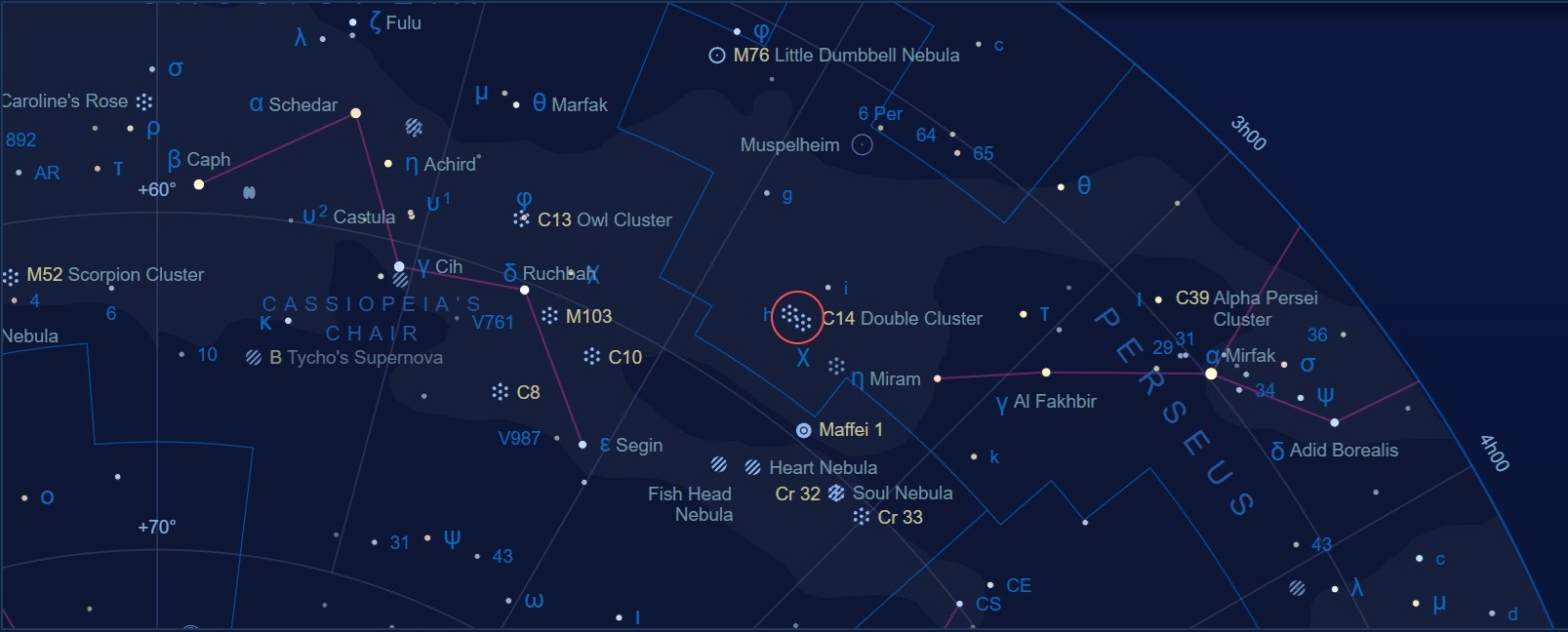
NGC 869 and NGC 884, known as the Double Cluster or h and χ (chi) Persei, is one of the most striking celestial pairings visible in the northern sky. Located in the Perseus spiral arm of the Milky Way, these two open star clusters are located about 7,500 light-years away but separated by only a few hundred light-years. Their proximity, similar age, and shared motion through space suggests that they formed from the same giant molecular cloud, making them a physically associated pair rather than a chance encounter.
Double Cluster Up Close
Each cluster contains thousands of stars*, many of which are hot, blue and massive, thereby indicating an early stage of stellar development; estimates indicate an age of approximately 12 to 14 million years. Their youth explains the abundance of B-type and even O-type stars—stellar heavyweights that shine intensely but live only briefly.
The resulting image shows the Double Cluster as a dazzling field of stars. NGC 869, slightly denser and more compact, contains a bright core of hot blue stars. In contrast, NGC 884 appears more loosely concentrated, with a distinctive scattering of bright stars across its central region. Both clusters show subtle hints of red and orange from K-type supergiant stars, evidence that even at their youthful age, some massive stars have already begun to leave the main sequence.
*processing software identified 22,000 stars in the image!
COMPARISON: GLOBULAR v OPEN CLUSTERS
Feature
Globular Clusters
Open Clusters
Typical Stars
Old, metal-poor
Young, metal-rich
Number of Stars
10⁵–10⁶+
10²–10³
Shape
Spherical, dense
Irregular, loose
Location
Galactic halo
Galactic disk
Age
10–13 billion years
1 million–few billion years
Longevity
Very long-lived
Short-lived (astronomically)
Image Details
Object
The Double Cluster NGC 869 & NGC 884
Constellation
Cepheus
Distance
7,500 light-years
Size
60 arc minutes (each 70 light-years)
Apparent Magnitude
+3.8
Scope
William Optics GT81 + Focal Reducer FL 382mm f4.72
Mount & Control
ZWO AM5 + ASIair
Guiding
William Optics 50mm guide scope
+ ZWO 120MM Mini
Camera
ZWO ASI294MM CMOS sensor
FOV 2.87o x 1.96o Resolution 2.50”/pix Max. image size 4,144 x 2,822 pix
I try to ensure that since Watch This Space (Man) blasted off in August 2014, it does what it says on the tin (top of the page): A personal discovery of the Universe through astronomy and astrophotography. Naturally, alongside this journey life goes on, which this year has been a significant challenge for me in many ways. Shortly after imaging the Flaming Star Nebula at Fairvale Observatory, Surrey, in early January, I underwent major surgery to replace my right knee and inevitably, all physical astronomy came to a halt; latterly I managed to remotely obtain and process data from sources in Texas, USA and Chile, which was good fun.
Just two months later, whilst still in early recovery (which can take over a year), serendipity made an unexpected appearance, and by at the end of June, after 40-years living in Redhill, Surrey, we moved to a new house just outside England’s smallest city of Wells (population 11,145), in the beautiful countryside of north Somerset. This upheaval, combined with my recovery, has led to a protracted absence from astrophotography imaging but, at last, I’m now very pleased to present my first image from the new Castle Farm Observatory, in Somerset, of course.
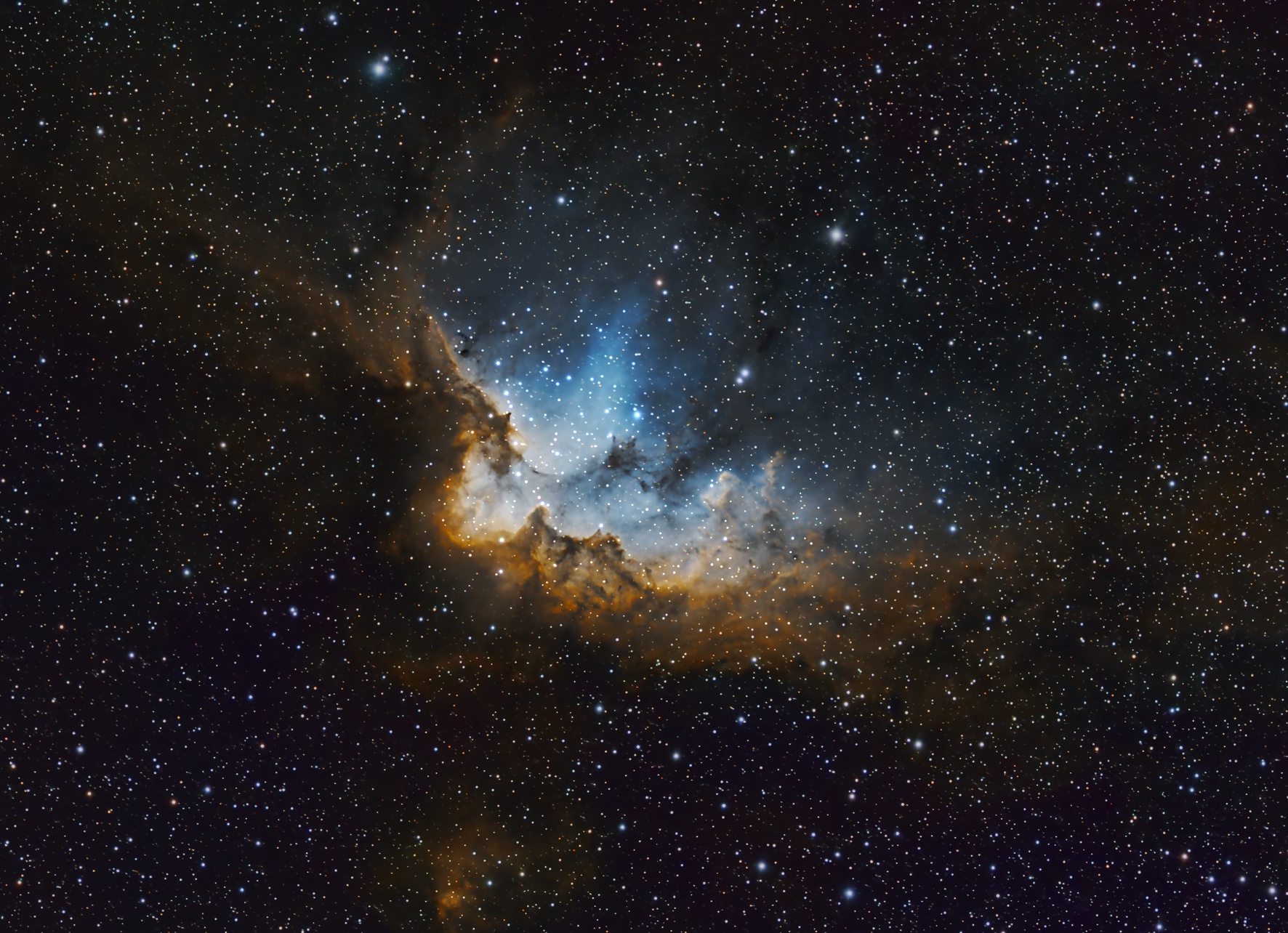
Astronomically speaking, only one thing counts when imaging and that is the quality of viewing conditions (and clear skies), which I can already attest to be excellent here in Somerset. At my previous location just south of London in Surrey, conditions were poor, with an SQM value of 19.82 that was further complicated by low flying aircraft from three nearby airports. In comparison, the SQM at Castle Farm Observatory is 21.11, which being a log scale equates to a difference of x3.28 better sky darkness than before and, moreover, overflying aircraft are no longer a problem. Given this setting, combined with clear skies and a new moon in early September, I had high expectations for my first imaging session since moving to Somerset and was not disappointed by the results obtained of the object chosen for this auspicious occasion, the Wizard Nebula.
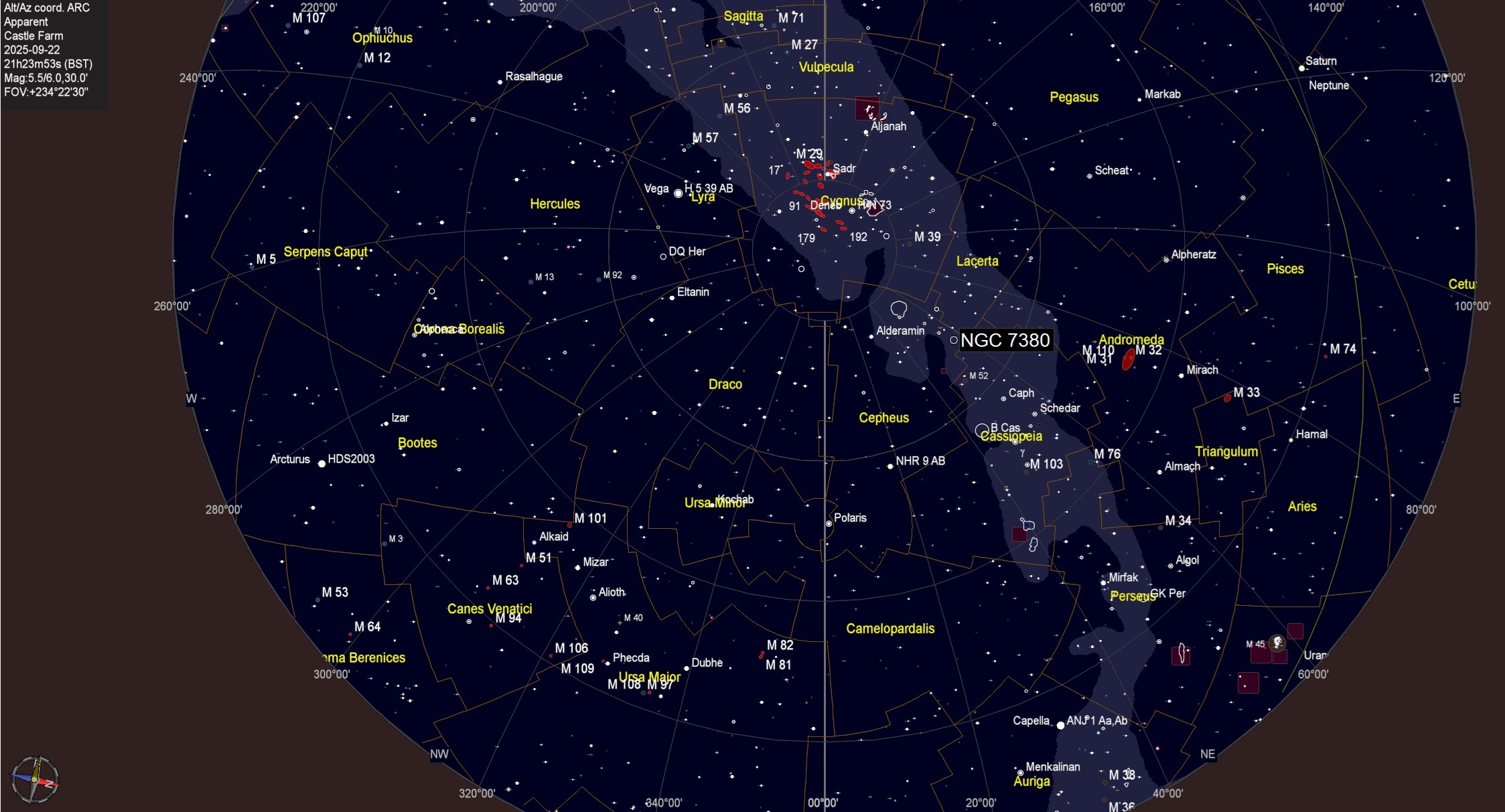
The Wizard Nebula, designated by the central star cluster of NGC 7380, is an emission nebula, in which its gases glow due to intense radiation from hot, massive stars from within the aforesaid embedded cluster. Interwoven within this glowing gas are dark, dense regions of dust that sculpt the nebula’s dramatic and somewhat mystical appearance, in this case a wizard. NGC 7380 was only formed a few million years ago and within it, young and massive O- and B-type stars generate strong stellar winds that shape and erode the surrounding material.
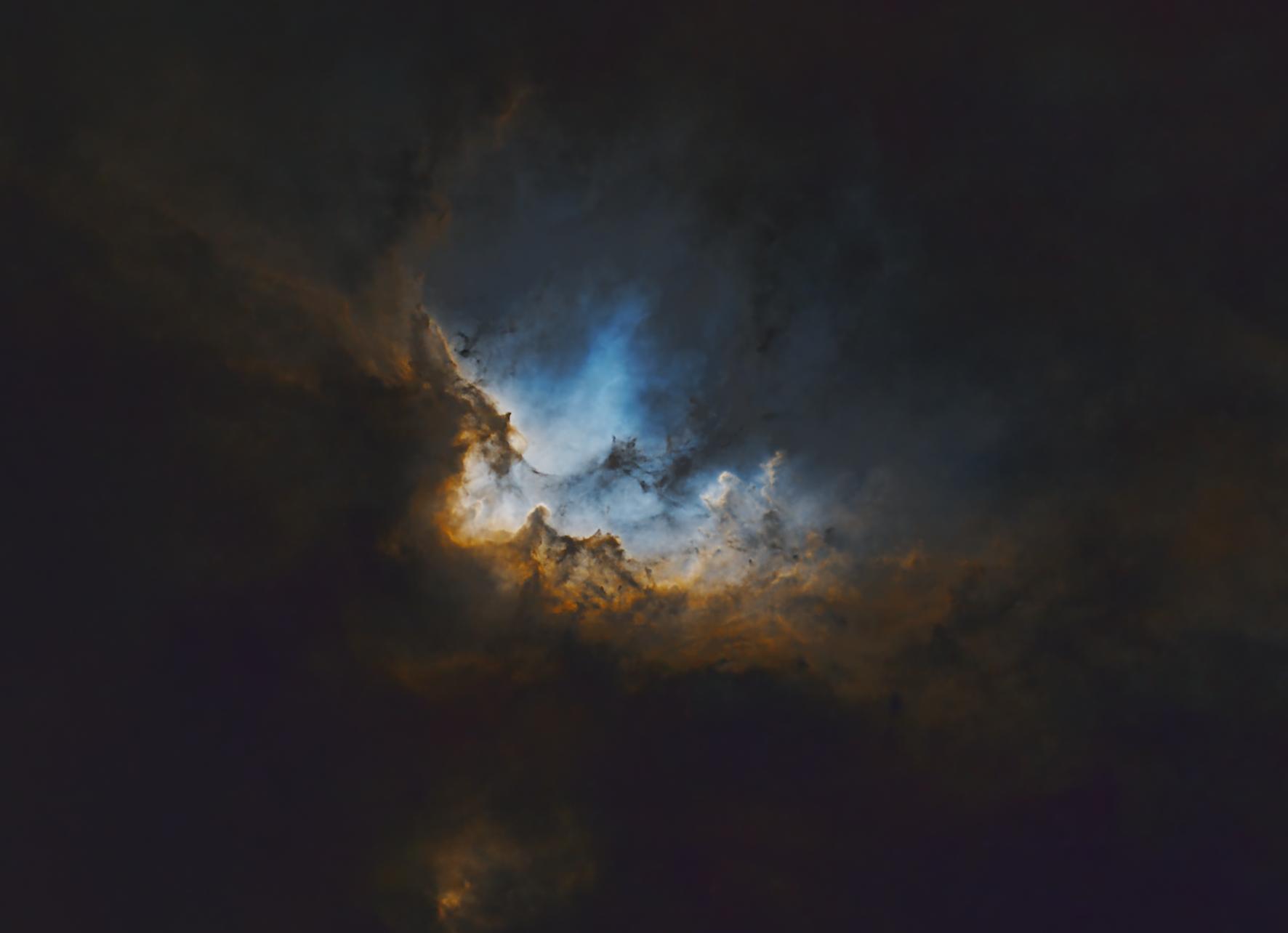
Thus, after an unprecedented break of some 257 days, I’m more than pleased to return to my own backyard astrophotography again, now based in the magic county of Somerset. The quality of the subs obtained on this first occasion confirmed the outstanding sky conditions, which were literally saturated by stars (see starless image above). Altogether, it was significantly better than experienced in Surrey and bodes well for what I hope will be an exciting time here at Castle Farm Observatory – Watch This (new) Space!
IMAGING DETAILS
Object
NGC 7380 The Wizard Nebula
Constellation
Cepheus
Distance
>= 7,200 light-years
Size
25 arc minutes (110 light-years)
Apparent Magnitude
+7.2
Scope
William Optics GT81 + Focal Reducer FL 382mm f4.72
Mount & Control
ZWO AM5 + ASIair
Guiding
William Optics 50mm guide scope
+ ZWO 120MM Mini
Camera
ZWO ASI294MM CMOS sensor
FOV 2.87o x 1.96o Resolution 2.50”/pix Max. image size 4,144 x 2,822 pix
As Douglas Adams succinctly puts it in the Hitchhiker’s Guide to the Galaxies: Space…..is big. Really Big. If he had lived longer, even he would be surprised to learn how true these words were. Recent analyses using data from the James Webb Space & Hubble Telescopes, suggests there could be some 2 trillion galaxies. Notwithstanding, as this applies only to the observable universe, which is about 93 billion light-years across, the entire universe could be significantly larger, with many more galaxies beyond what we can already observe!
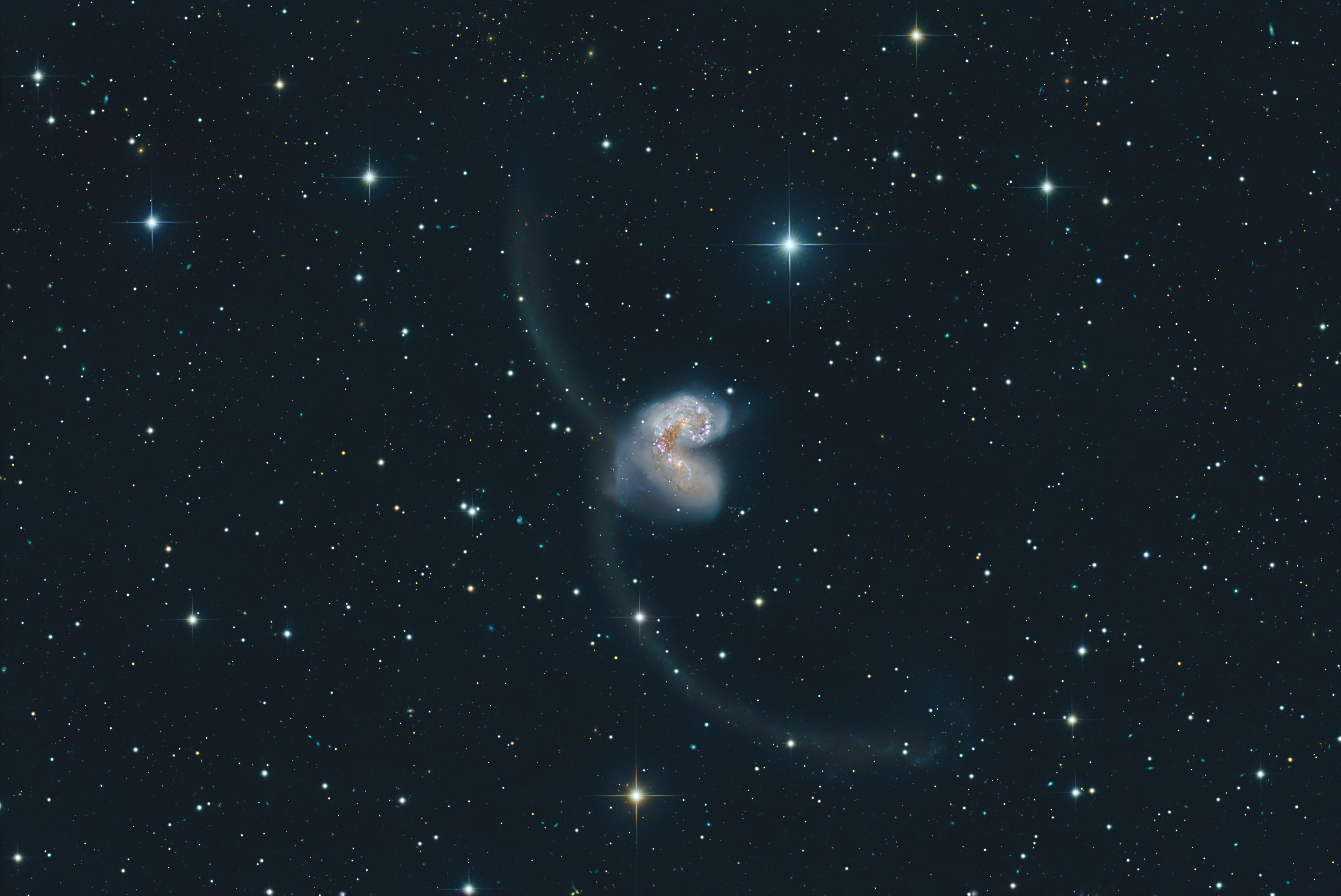
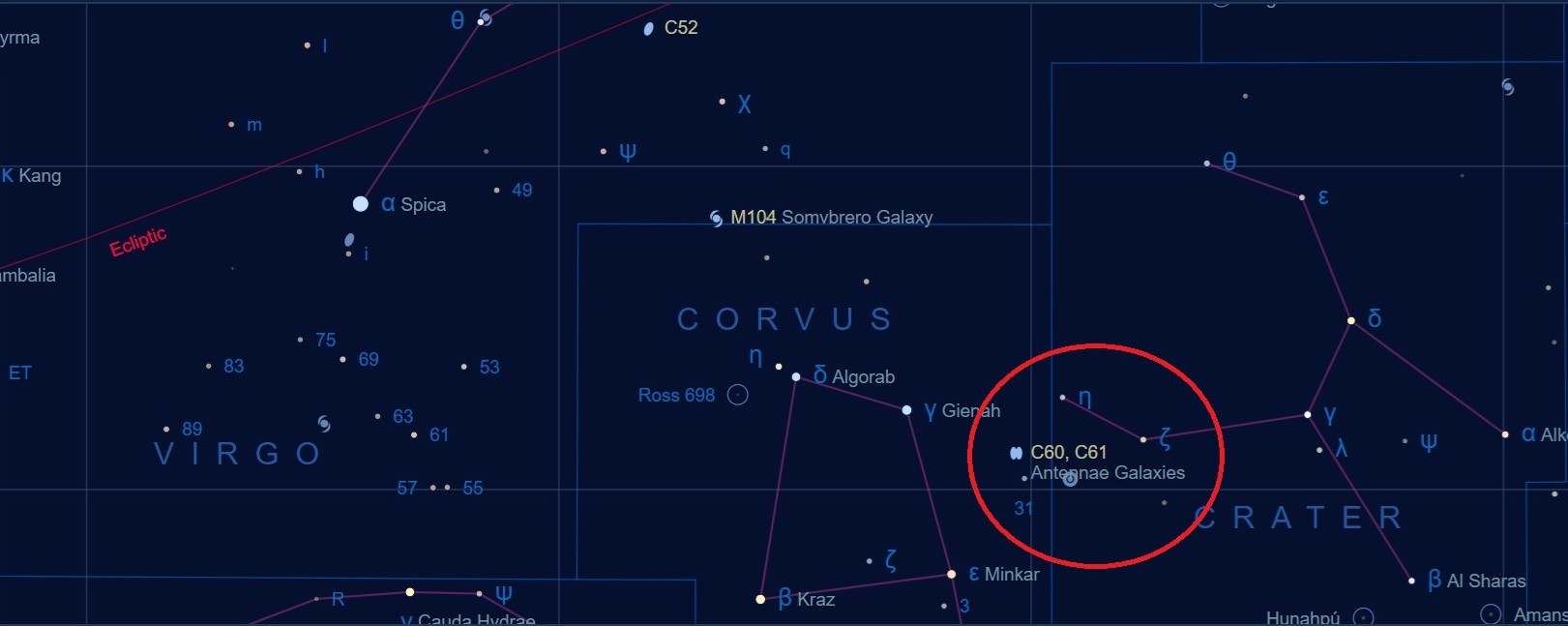
Perhaps then it is not so surprising that from time-to-time galaxies run into each other – our own Milky Way Galaxy is expected to collide with the Andromeda Galaxy in about 4.5 billion years. But there are already many exciting examples of such phenomena that we can image today, of which the Antennae Galaxies are one of the most famous and visually striking examples of two colliding galaxies. Located in the constellation Corvus, they provide a striking insight into what happens when massive galaxies merge – a process that reshapes their structure, triggering intense star formation, thereby setting the stage for the eventual creation of a single, larger galaxy, all played out over 100’s or even billions of years.
The Antennae Galaxies earned their name from the long, curved tidal tails of gas, dust, and stars that extend outward from the colliding pair of galaxies (NGC 4038 & 4039), thus resembling the antennae of an insect. These tails were created by the immense gravitational forces at play during the collision. As the two galaxies then pass through each other, their mutual gravity distorts their original spiral shapes, pulling out vast streams of stars and interstellar material. These tidal tails stretch for tens of thousands of light-years, making them some of the most spectacular features of any known galactic merger.
At the core of the Antennae Galaxies lies a chaotic and extremely active region. The violent gravitational interactions have compressed enormous clouds of gas and dust, sparking a burst of intense star formation, at a rate hundreds of times faster than that of our own Milky Way. Many of these newly formed stars are massive but short-lived, destined to explode as supernovae, thus enriching the surrounding space with heavy elements. Within another 400 million years, the Antennae’s nuclei will collide and therafter become a single galactic core with stars, gas, and dust swirling around it.
Imaging such a feature from Earth requires significant telescopic power, the darkest of night skies and the acquisition of lots of data. Located at the El Sauce Observatory in Chile, 50 hours of data acquired using the Planewave CDK20 astrograph is such a set-up worthy of the task. However, despite the excellent data quality, I found processing this complex event difficult so as to both show the complexity of the merging galaxies, whilst at the same time preserving the delicate nature of the tails of galactic debris. The final image is as profound as it is beautiful, demonstrating the immense forces across the cosmos and the inevitable consequences for the many galaxies that occupy the vastness of the Universe.
IMAGING DETAILS
Object
NGC 4038 & 4039, AKA Antennae Galaxies
Constellation
Corvus
Distance
62 million light-years
Size
5.21 x 3.1 arc minutes (actual 634,410 x 456,780 light years)
Apparent Magnitude
+10.3 / 10.4
Scope
Planewave CDK20
Mount
Planewave L500
Focuser
Optec Gemini
Camera
QHY600PH-M
Filters
Chroma LRGB + Ha 3nm
Processing
Deep Sky Stacker & PixInsight v1.9-3
Image Location & Orientation
Centre: RA 12:01:54.47 DEC -18:52:45.2 Up = North
Exposures
Ha 117 x 10 mins, L x 127, R x 80, G x 80, B x 70 @ 5mins Total Integration Time: 50hr 5min
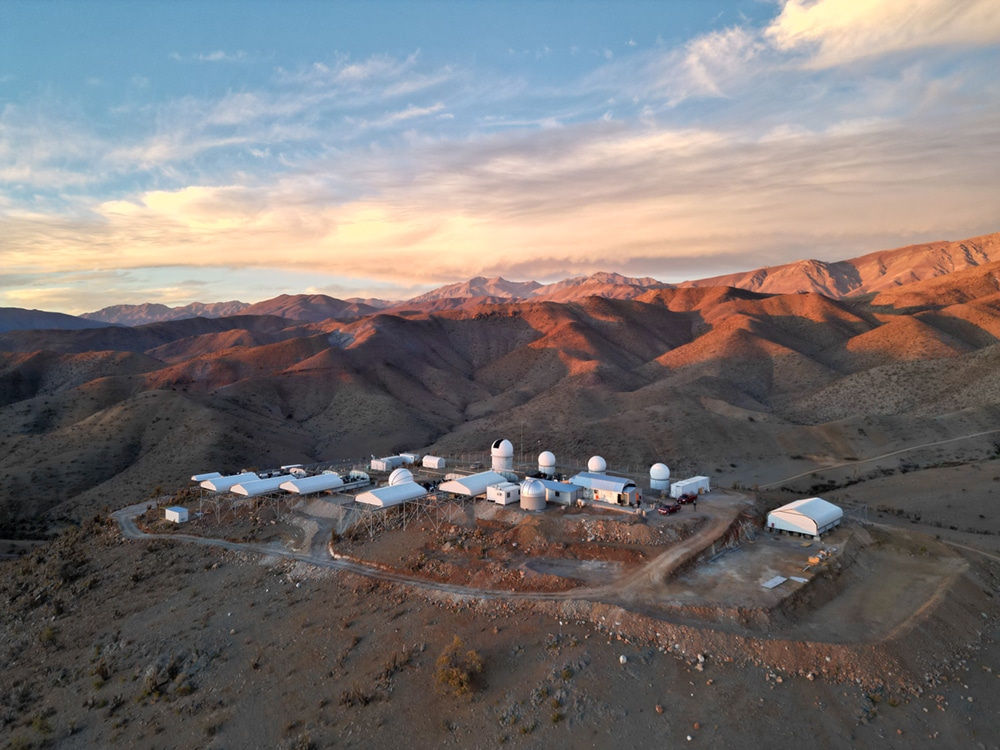
Although some time back I lived and worked in Southern Africa for five years and subsequently spent much time visiting and working in many other countries south of the equator, since taking up astrophotography 12-years ago I’ve had no opportunity to work with data from the southern hemisphere, until now. The benefit of obtaining data remotely, which has become very popular in recent years, is that it provides access to different objects and better sky conditions. I did work with a telescope based in New Mexico, USA a few years ago, which was a fun experience but being in the Northern Hemisphere most targets were much the same as here in the UK, except they did have more than 250 clear skies each year. However, this time I’ve moved to what is widely considered to be the holy grail for astronomy, Chile, where night skies are rated as the best in the world!
Obstech El Sauce Observatory, Chile
The dataset was obtained from the famous El Sauce Observatory located in the Rio Hurtado Valley, south of the Atacama Desert, using a Planewave CDK20 astrograph telescope; currently retailing at First Light Optics for just over £42,000! Unsurprisingly, the combination of location and this telescope resulted in the best of the best datasets, which has been nothing less than a privilege to process.
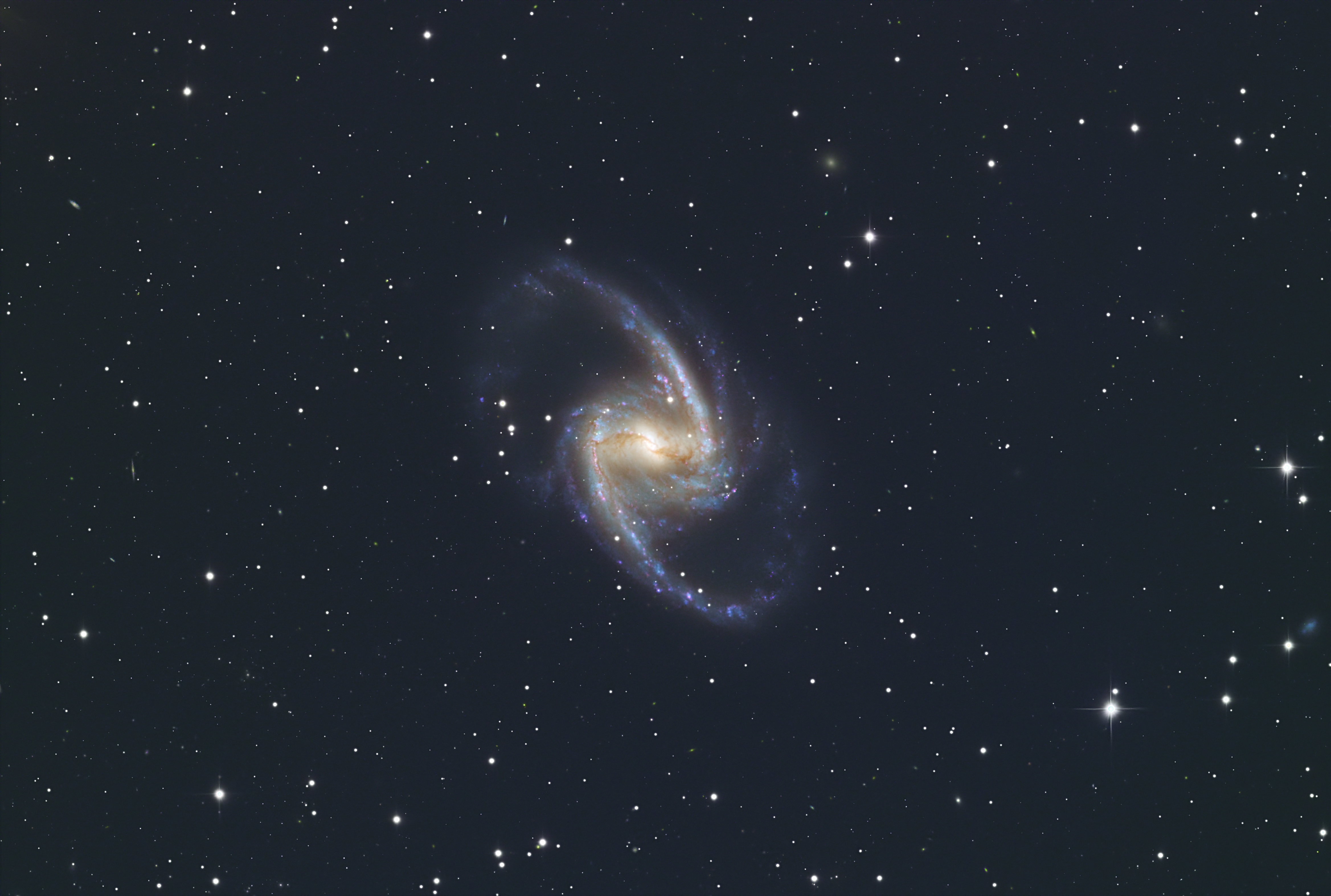
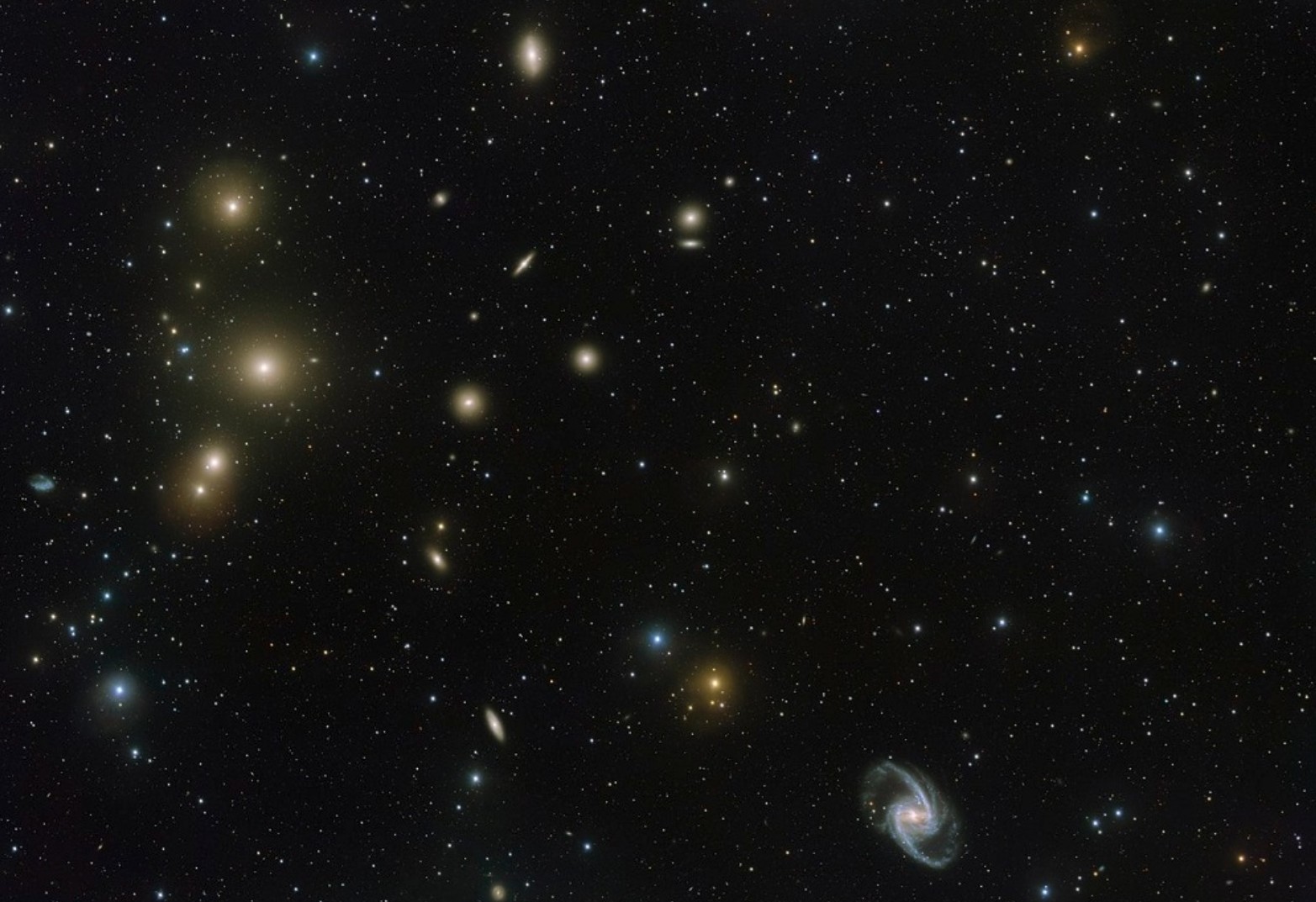
My first target from the Southern Hemisphere therefore had to be something special and NGC 1365, also known as the Great Barred Spiral Galaxy, is just that. A double-barred spiral galaxy, it is located some 56million light-years away in the Fornax constellation and spans over 200,000 light-years across, making it nearly twice the size of the Milky Way. The Great Barred Spiral Galaxy is also a dominant member of the Fornax Galaxy Cluster group of 58 galaxies.
Several members of the Fornax Galaxy Cluster are imaged by the VLT Survey Telescope, including the barred spiral NGC 1365 on the lower right Credit: ESO/A. Grado/L. Limatola/VLT
The most distinctive feature of NGC 1365 is its massive central bar, which plays a crucial role in channelling gas and dust into the galactic core. This inflow of material fuels both star formation and the activity of the galaxy’s central supermassive black hole, which is estimated to be some 2-million solar masses. Various observations in X-rays, infrared, and visible light wavelengths, reveals numerous star-forming regions along the spiral arms, particularly where they connect to the bar, giving the galaxy a luminous appearance.
NGC 1365 is also classified as a Seyfert galaxy, whereby the nucleus is extremely bright due to energetic processes around its black hole. Studies also indicate that the outer edges of the galactic disc are moving at about 84% of the speed of light!
IMAGING DETAILS
Object
NGC 1365, AKA Great Barred Spiral Galaxy or Fornax Propellor Galaxy
Constellation
Fornax
Distance
56 million light-years
Size
11.2 x 6.2 arc minutes (201,700 to 306,800 light years)
Apparent Magnitude
+10.3
Scope
Planewave CDK20
Mount
Planewave L500
Focuser
Optec Gemini
Camera
QHY600PH-M
Filters
Chroma LRGB + Ha 3nm
Processing
Deep Sky Stacker & PixInsight v1.9-3
Image Location & Orientation
Centre: RA 03:34:34.323 DEC -36:08:30.36 Up = North
Exposures
Ha x 62 10 mins, L x 78, R x 78, G x 71, B x 70 @ 5mins Total Integration Time: 35hr 5min
Long periods of bad weather made 2024 one of the most difficult years for my astrophotography but, I am pleased to say that this, the 11th calendar is another belter! Purchased in 2014, I continue to use a William Optics GT81 telescope for most images taken from home, but this means that I’m running out of suitable targets for this equipment. Part of the answer has been to upgrade related equipment and improve my processing, which I hope you will see reflected in this year’s images. Moreover, I have used new skills and techniques to process the better-quality data in new ways – I hope you like the results?
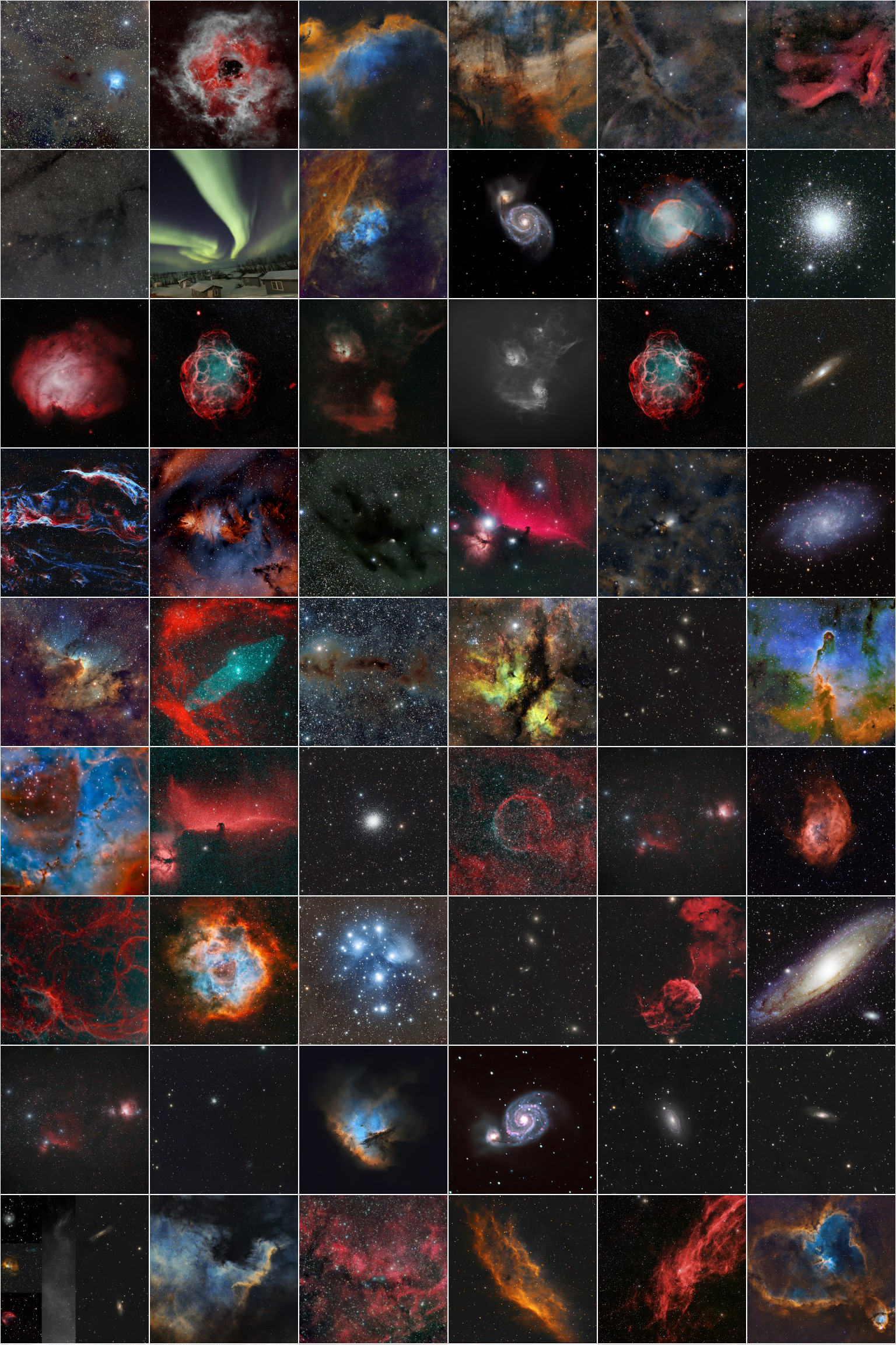
Below is a brief summary of the calendar images used this year but for other pictures and more detailed information, please refer elsewhere to this website, my Flickr page or Astrobin page. In addtion, a video of the calendar can be viewed HERE on YouTube, which is best accessed on a PC or smart TV screen. The background music this year is from Jean-Michel Jarre’s Oxygène album.
COVER
ASTRO IMAGING MONTAGE: This colourful splash is a random selection of images, mostly taken from Redhill over the past +10-years of my astrophotography.
JANUARY
SEAGULL NEBULA, IC 2177: Located 3,650 light-years from Earth is the emission and reflection nebula complex of the so-called Seagull Nebula, some 200 light-years in size. It’s been 8-years since imaging this object and for good reason. From my location, the bird flies very low on the southern horizon and thus spends much of its time behind houses, trees, and tall hedges!
FEBRUARY
TAURUS MOLECULAR CLOUD: Located northeast of the Pleiades, below (south) the California Nebula (see November), spanning more than 30o of the night sky is the Taurus Molecular Cloud (TMC), a rich area of dark nebulae punctuated by bright areas of new star formation. The TMC is thought to be the nearest star forming region to Earth which, if you look carefully, includes numerous complex dark and reflection nebulae and the odd galaxy.
MARCH
HIND’S VARIABLE NEBULA & HYADES, NGC 1555*: Discovered by the English astronomer John Russell Hind in 1852 this nebula is situated 400 light-years away in the constellation of Taurus, between the stars of Aldebaran and the Pleiades. The nebula is a Herbig-Haro object – a bright patch of nebulosity in which new stars are forming – which often change in apparent size and brightness.
APRIL
LEO GALAXY CLUSTER: With few exceptions, galaxies are located very far from Earth, making them very small from our perspective and a challenge for my equipment. However, here I imaged the spectacular Leo Galaxy Cluster, a mere 330 million light-years from Earth. Containing at least 70 major galaxies, the Leo Cluster unusually consists mostly of spiral galaxies. The bright elliptical galaxy near the centre of the image, has one of the largest known black holes in the universe, which is about 10 billion times more massive than our sun!
MAY
IRIS NEBULA, NGC 7023*: While the focus of the image is the alluring bright blue reflection nebula, careful processing reveals that this celestial flower is enveloped within a vast region of interstellar dust.
JUNE
SOMBRERO GALAXY, MESSIER 104: Seen from Redhill, the Sombrero galaxy is even lower in the summer sky than the aforesaid Seagull, transiting between the trees and along the top of our +15-foot hedge! An unbarred galaxy, its bright bulbous centre is encircled by dark dust lanes, which viewed side-on from Earth creates the appearance of a sombrero hat or perhaps a flying saucer?
JULY
PuWe-1*: Is a very faint planetary nebula in the Lynx constellation, discovered in 1980 by Purgathofer & Weinberger. It is one of the largest planetary nebulae visible, with a diameter like the full moon and at 1,200 light-years, is one of the closest to Earth. A planetary nebula is a region of cosmic gas and dust formed from the cast-off outer layers of a dying star; despite the name, planetary nebulae have nothing to do with planets.
AUGUST
NORTH AMERICA & PELICAN NEBULAE: It’s at this time of the year (August) I usually turn my attention to the Cygnus constellation and the plethora of imaging opportunities it provides, which inevitably tend to be narrowband targets. Interstellar dust illuminated by large bright areas of star formation are responsible for the formation of both these popular objects.
SEPTEMBER
FORSAKEN NEBULA, IC 5068: This complex area is known for the graphically shaped streaks of cold, dark dust clouds that criss-cross the dense, brightly coloured gas regions of nebulosity. Situated within the adjacent Cygnus molecular cloud just below the Pelican Nebula and close to other more famous objects, this low emission nebula is unfortunately known as the Forsaken Nebula!
OCTOBER
THE CHINESE CHARACTER, LDN 673*: It might seem paradoxical but often it is the absence of light that makes an image interesting. About 600 million light-years from Earth, within the Aquila constellation, is Lynd’s Dark Nebula (LDN) 673. Some 7-light years in size, this fragmented dark molecular cloud complex contrasts against the colourful molecular clouds and stars of the Milky Way, which is reminiscent of a Chinese character.
NOVEMBER
CALIFORNIA NEBULA, NGC 1499: Located in the Perseus constellation, in the Orion arm of the Milky Way 1,000 light-years from Earth, NGC 1499 is a large emission nebula about 100 light-years long. First imaged in 2016, new improved data and processing now discloses the full grandeur of this object.
DECEMBER
ROSETTE NEBULA, NGC 2244: Approximately 5,000 light-years away, the vast cloud of gas and dust had been sculpted into the distinctive rose-like shape, while meanwhile a central star cluster has blown-away a large hollow within the molecular cloud. Revisiting this old favourite for the fourth time since 2015, here I have experimented with an unusual colour palette combination that has produced an exciting alternative image of the night sky’s rose.
Footnote: All images taken from Redhill, Surrey or at a dark sky site in New Mexico,USA shown by an asterisk*
My astrophotography journey started just over 10-years ago and looking back, it’s clear that my timing was fortuitous, as over this period we have seen several developments that have completely transformed the hobby for amateurs.
Wide availability of high-quality telescopes for relatively modest prices
Development of CMOS sensor cameras
Major advances of image capture and processing software
Introduction of AI to image processing
And the changes just keep coming.
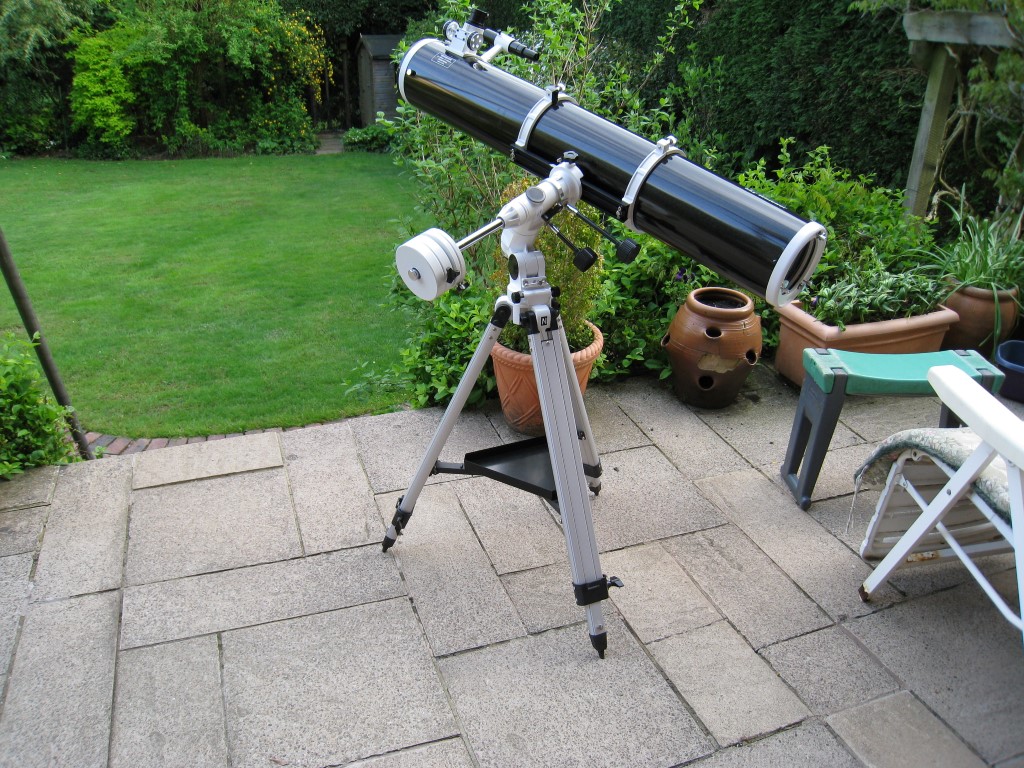
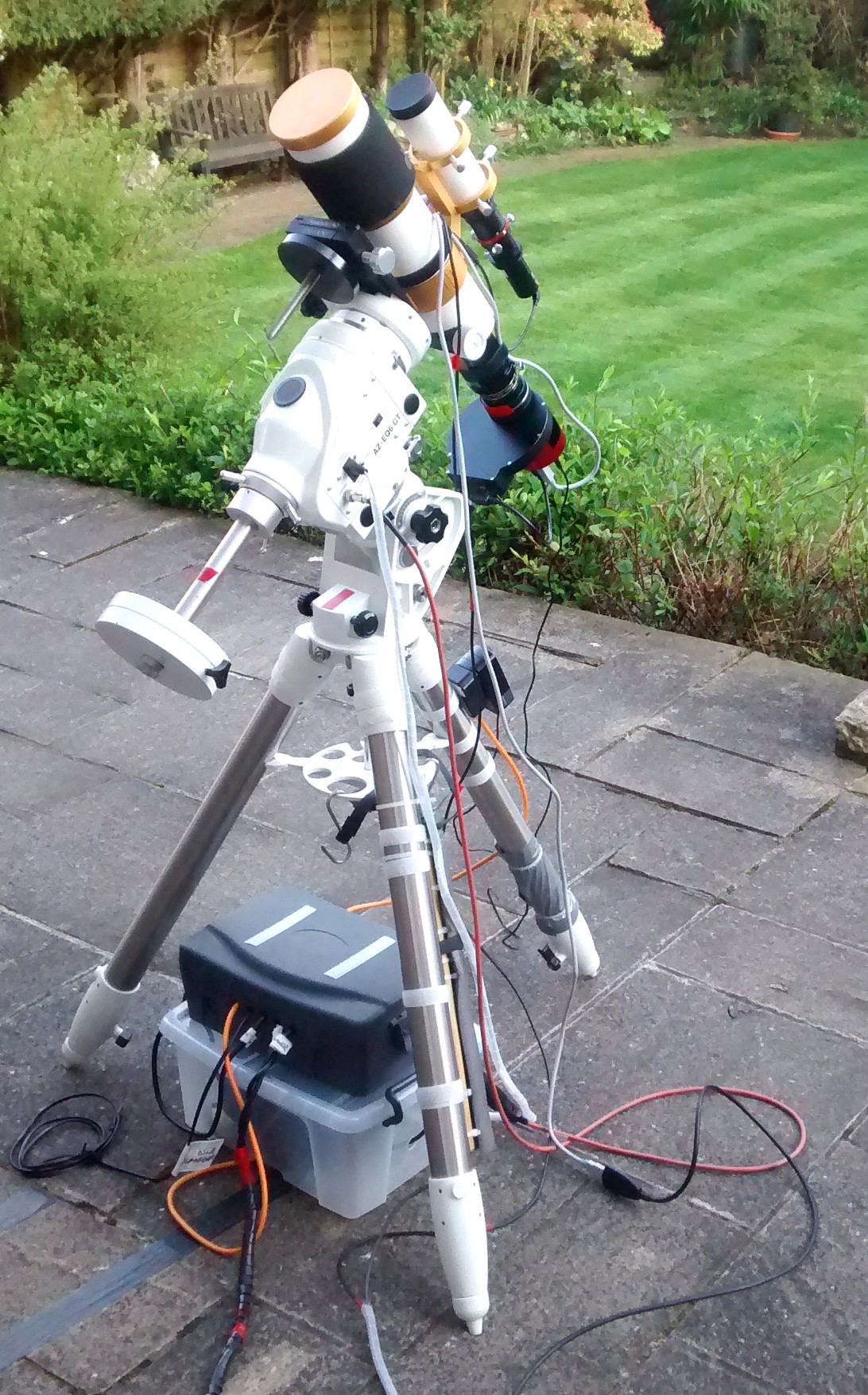
When not imaging or processing, I’m sure that many astrophotographers spend too much time looking online at new equipment, particularly telescopes and cameras! However, when my journey started in about 2014, it didn’t take long to discover that perhaps the mount is the most important piece of equipment. I started observing with a Skywatcher 150PL on a EQ3-2 mount ( see above ) but soon thereafter discovered astrophotography, which required the addition of a small motor for tracking. It was fun but completely inadequate for good imaging, so then moved onto a William Optics GT81 triplet refractor on a Skywatcher AZ-EQ6 GT mount ( see below ), which completely changed everything and, more importantly, gradually resulted in better images.
My trusty, but oh so heavy AZ-EQ6 GT mount
I continue to use the AZ-EQ6 GT, which technically remains an excellent mount, but it is very heavy and frankly has become more and more tedious to set-up and take down each time, whilst moreover, my back is finding it too much hard work. It is said that necessity is the mother of invention and so a completely new type of mount slowly emerged on the market last year, that is now becoming nothing less than a revolution. It seems too good to be true, but its features are:
Small & light weight
High load capacity that doesn’t require counterweights
No need to be balanced
High torque
Low if any backlash
Apart from the weight issue, commonly used GEM mounts are based on worm gears, which inevitably suffer from backlash, that can be a major problem for astrophotography. Although this can be minimised with good set-up and various software, it will always remain a problem. The new harmonic drive or strain wave mounts are based on completely different technology, that surprisingly has been used for many years in avionics and robotics, making it tried and tested technology. A strain wave mount uses a flexible spline and a rotating elliptical plug to transmit motion and achieve high precision and torque, which allows for large payloads in a compact and portable package ( see images immediately below ) . Click HERE for more technical information. Initially there were only a few manufacturers of Harmonic / Strain Wave mounts but now the word’s out and all manufacturers are rushing to join the game.
Over the past decade the Chinese technology company ZWO Optical have emerged as a dominant force and leading innovator in astrophotography; I’ve been using various excellent ZWO CMOS cameras since 2015. It was therefore no surprise that ZWO were amongst the first to launch a Harmonic Drive mount, initially the AM3 then the AM5 which is what I purchased earlier this year; the main difference between the two is capacity, the AM5 being greater. For various reasons, personal and being busy imaging with the AZ-EQ6 GT, I only got round to using the AM5 in August ( see below) and have not been disappointed.
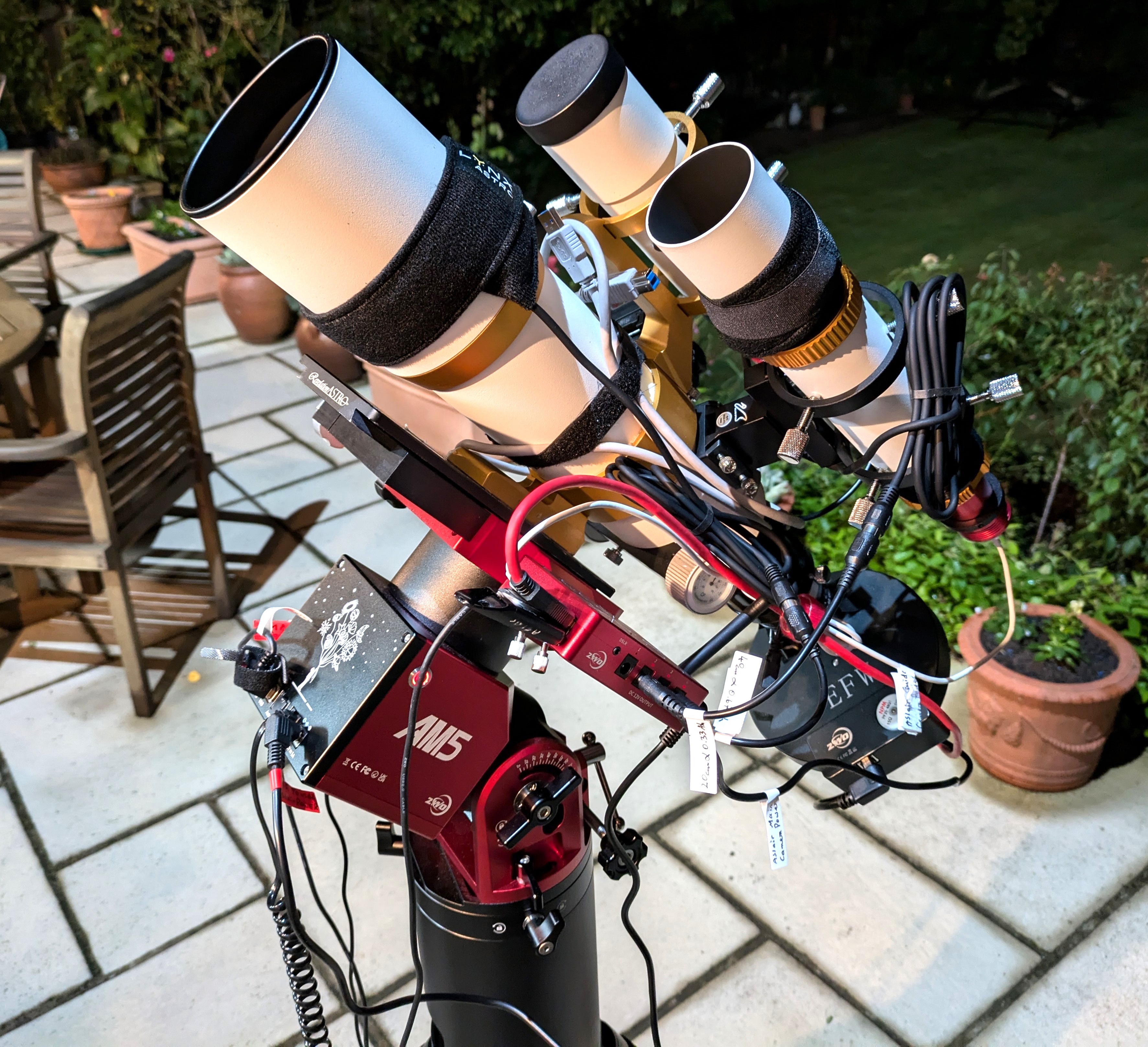
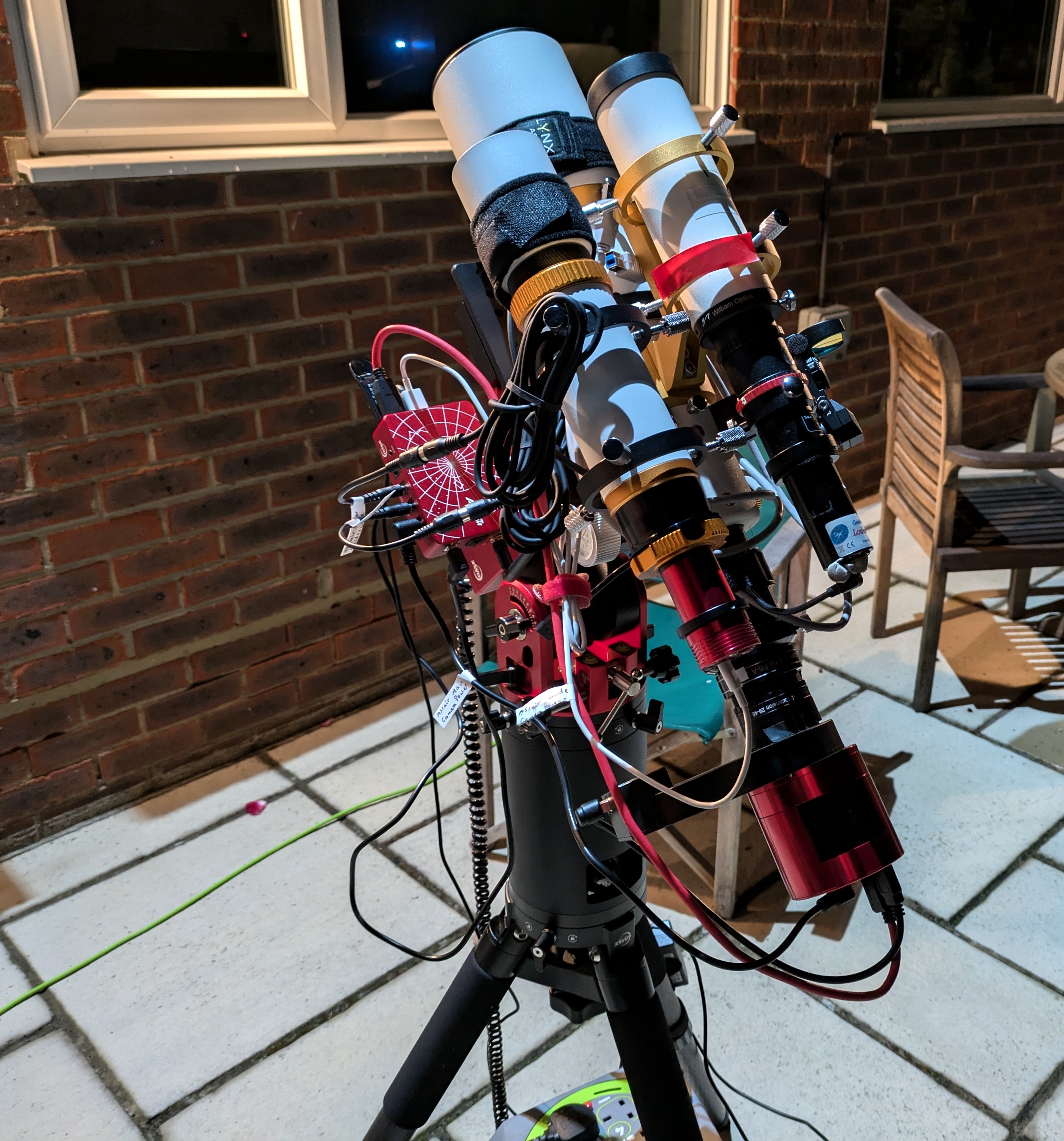
One of ZWO’s quirks is that, where possible, their equipment is often only compatible with other ZWO products. It can be a bit of a problem but given the quality of their equipment I’m not usually put off. Notwithstanding, the AM5 will fit some other tripods but in this case, I chose to purchase the excellent and super lightweight ZWO TC40 carbon fibre tripod, together with the ZWO PE200 pier extension, which reduces the likelihood of the OTA / camera colliding with the tripod. Like my previous experience of ZWO equipment, everything is well designed and exceptionally well made. Moreover, it is substantially lighter than my AZ-EQ6 mount!
Although not essential, to reduce the set-up / take-down time as well as provide convenient integrated control and capture software, I also chose to get ZWO’s well tested and popular ASIair Plus, which can easily be attached either to the mount or scope. Basically, it is a very small astrophotography computer / controller, which can also help manage various power requirements such as cameras and dew straps. Finally, and because for now I wanted to piggyback my existing William Optics GT81 scope which uses a Lodestar X2 guiding camera that is incompatible with the ZWO equipment, I added a dedicated 50mm William Optics 50mm guide scope with a ZWO ASI120MM mini guide camera.
The AM5 mount, ASIair plus (on the left) and OTA rig. It looks busy but once the rig is established it just lifts into place and connects in less than 5 minutes and you’re ready to go!
Finally, only in recent weeks have I had the chance and weather conditions to set-up and try out this new equipment. The early results have been good so far and I hope the limited integration time of the image here will be just a taster of what is to come. The AM5 itself has been a breeze to use and its light weight and set-up is clearly going to revolutionise my astrophotography but the ASIair plus is also a significant game changer that I’m still getting to grips with.
The ASIair plus delivers an excellent and mostly, easy-to-use experience, which with time I’m sure I’ll get to love but to miniaturise and streamline operating compared to my current set-up and control equipment and software, I find it lacking in finesse. Notwithstanding, it is an incredible piece of equipment that works very well with the AM5 mount. I am particularly impressed by the Polar Alignment and Meridian Flip functions, of which the latter is just amazing!
All-in-all the weight and convenience of the AM5 together with the other ZWO equipment is likely to result in a better and importantly, fun time when imaging. In particular, with a truly portable set-up I’m hoping to revisit the end of my garden, from where I can see the north sky and all its objects, hitherto obscured by my house, and maybe even get to image at some dark sites, we shall see – these are certainly changing times, which so far I’ve really enjoying.
IMAGING DETAILS
Object
NGC 7000 North American & Pelican Nebulae
Constellation
Cygnus
Distance
2,590 light-years
Size
120 x 100 arc mins
Apparent Magnitude
Various
Scope
William Optics GT81 + Focal Reducer FL 382mm f4.72
Mount
ZWO AM5 + ASIair plus
Guiding
William Optics 50mm guide scope
ZWO120MM mini guide camera
Camera
ZWO ASI294MM CMOS sensor
FOV 2.87o x 1.96o Resolution 2.50”/pix Max. image size 4,144 x 2,822 pix
EFW
ZWOx8 EFW & 31mm Chroma Ha, OIII, SII filters
Capture & Processing
ZWO ASIair plus, Deep Sky Stacker & PixInsight v1.8.9-3
Image Location & Orientation
Centre = RA 20:55:42.97 DEC +44:20:53.80 Top = North
Exposures
Ha x11 + OIII x13 + SII x13 x 300 sec Total Integration Time: 3hr 05 min
@ Gain 120 @ -20oC
Calibration
5 x 300 sec Darks 10 x NB Flats & Dark Flats @ ADU 32,000
Location & Darkness
Fairvale Observatory – Redhill – Surrey – UK Typically Bortle 5-6





 WATCH THIS SPACE(MAN)