Core Blimey

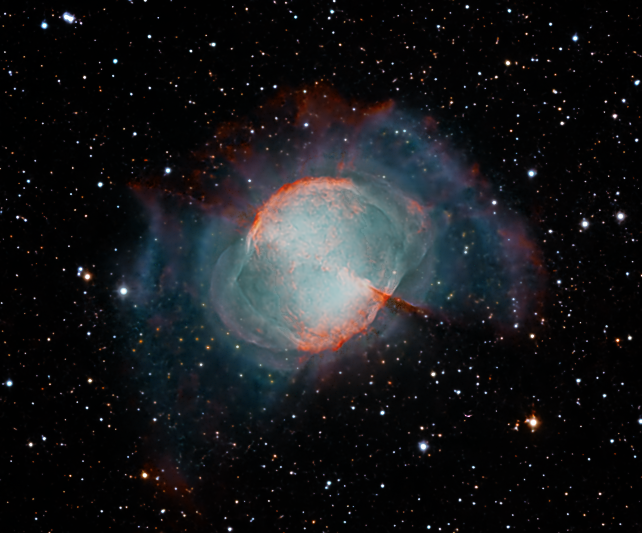
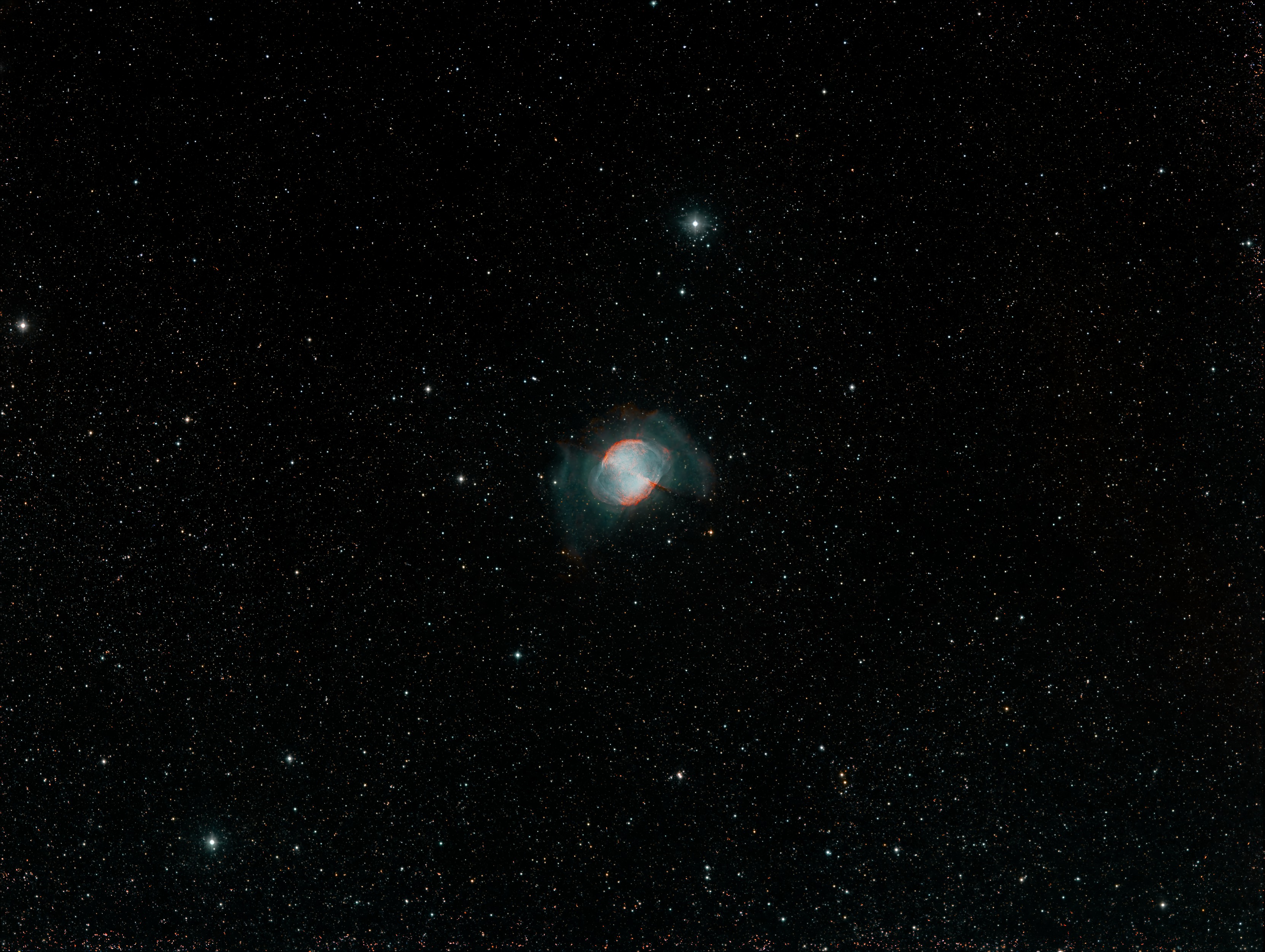
A popular object at this time of the year, the planetary nebula M27 consists of a glowing shell of ionized gas, which has been ejected from a red giant star in its late stage of its life to become a white dwarf.  Like many planetary nebulae, the main inner shell exhibits numerous dark and light knots, of which red ionized hydrogen areas form two bright lobes that together make the shape of an apple- core / dumbbell, which are M27’s two nicknames. There also seems to be different bi-polar influences occuring, that have resulted in complex Ha (red) and OIII (blue) fans around the outer regions and a pulsar-like beam transecting the nebula (see cropped version at the top of the page). 

Despite the good data quality and long integration time, the complicated nature of the planetary nebula made processing very difficult, in particular, teasing out the aforesaid but very faint outer fans.  In this case it was necessary to carry out individual soft stretches of the Ha and OIII stacks before combining them into an HOO image, from which a starless colour image was created and then processed further to bring out the fans.  Thereafter, Pixelmath was used to amalgamate this image with two other starless HOO and RGB versions that emphasized the main part of the nebula, before finally adding back RGB stars and finishing off. 

After considerable experimentation to obtain this result, I’m happy with the final image, which I hope shows off the said apple core / dumbbell and its outer fans to good effect (see above).


 IMAGING DETAILS
ObjectM27 AKA Dumbbell or Apple Core Nebula or NGC 6853
ConstellationVulpecula
Distance1,360 light-years
Size 8.0 x 5.7 arc-minutes (core) 15 arc-minutes (total) or 5 light-years (actual)
Apparent Magnitude+7.5
  
Scope Takahashi FSQ 106  FL 530mm  f/5  +  Moonlight Nightcrawler focuser  
MountParamount MyT
GuidingYes
CameraQSI 683-WSG8    KAF-8300 full frame CCD sensor   5.4nm pixels  
 FOV 1.94o x 1.46o   Resolution 2.1”/pix.   Image array 3326 x 2,507 pix   
ProcessingDeep Sky Stacker,  PixInsight v1.8.9-1
Image Location              & OrientationCentre – RA 19:59:35.363      DEC +22:42:54.383                    Up = North  Left = East
ExposuresHa x28 & OIII x 35 x20min + R x12, G x22, B x14 x10min @ -20C Total Integration Time: 29hrs      
Calibration24 x 20min & 30 x 10 min Darks   x60 Bias & x20 Ha, OIII & RGB Flats  
Location & DarknessDeep Sky West – amateur hosting facility near Rowe, New Mexico  – USA    SQM Typically >= 21.7
DateQ2 2019    

Seeing Stars

Of all the incredible features that constitute the Universe, located relatively close to home, I always marvel at the nature of globular clusters.  Largely unknown by the lay person and myself until I took-up astronomy, more than 150 of these incredible objects orbit around the Milky Way in the form of a spherical halo both above and below the galactic disc.  Between galaxy season (March – April) and the appearance of the Sagittarius arm of the Milky Way in the summer, is the globular so-called cluster season, which is heralded by the arrival of M3, one of the brightest and most popular of the clusters.

M3 was discovered by Charles Messier in 1764 but only correctly identified as a globular cluster twenty years later by William Herschel.  Consisting of more than 500,000 million stars, of which at least 274 are variable stars, it is estimated to be over 11-billion years old, thus being some of the oldest stars in the Universe.

Using data gathered remotely from a Takahashi 106 FSQ situated in the dark skies of New Mexico, USA, the resulting image shows this spectacular object in all its glory.  Apart from the marvellous star details within the cropped version of M3 (see top of the page), there’s also much to see and enjoy in the original widefield image (see above), that is also bountiful of colourful stars as well as several galaxies.  Altogether I’m very pleased with the final image, which is probably my best globular cluster so far.

 IMAGING DETAILS
ObjectM3 Globular Cluster AKA NGC 5272
ConstellationCanes Venatici
Distance34,000 light-years
Size 18 arc minutes, which spans approx. 180 light-years
Apparent Magnitude+6.2
  
Scope Takahashi FSQ 106  FL 530mm  f/5  +  Moonlight Nightcrawler focuser  
MountParamount MyT
GuidingYes
CameraQSI 683-WSG8    KAF-8300 full frame CCD sensor   5.4nm pixels  
 FOV 1.94o x 1.46o   Resolution 2.1”/pix.   Image array 3326 x 2,507 pix   
ProcessingDeep Sky Stacker,  PixInsight v1.8.9-1
Image Location              & OrientationCentre – RA 13:42:12.768      DEC +28:23:5.03                       
ExposuresL x12, R x12, G x19, B x12 x 300 secs  @ -20C Total Integration Time: 4hr 35min     
Calibration30 x 300 secs Darks   x56 Bias & x20 LRGB Flats   
Location & DarknessDeep Sky West – amateur hosting facility near Rowe, New Mexico  – USA    SQM Typically >= 21.7
Date & TimeMay 2018    

Glactic Waltz

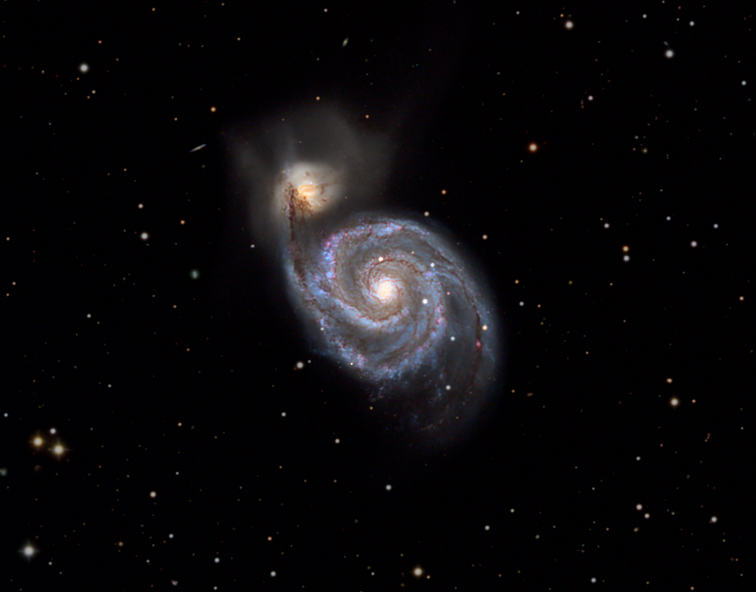
The size and diversity of the cosmos produces many wonderful features, of which M51 the Whirlpool Galaxy ranks highly amongst astrophotographers and is certainly one of my favourites.  Unfortunately, it is at the limit for my equipment and location, though in 2020 I was fortunate to capture over 16-hours integration time and a reasonable image (see here).  Whilst currently in the summer doldrums of limited darkness, I chose to process M51 data previously obtained using a Takahashi FSQ 106 located at Deep Sky West in New Mexico, USA.

Seen face-on from Earth, the balanced arms of this grand design galaxy contains dark dust lanes, blue star clusters and numerous pink star-forming regions rich in hydrogen gas.  But it is the cosmic dance taking place between M51 and its companion dwarf galaxy NGC 5195 that makes this such an exciting and popular object.

The most popular theory of what’s happening, is that the smaller galaxy is passing behind M51 and the joint gravitational forces are interacting between the two, resulting in the misalignment of stars and unusually bright blue and pink areas across the M51 galaxy.  Though not certain, it seems that their fates are inextricably linked and might eventually merge.  Whatever the process taking place, it will take millions of years if not longer to play out and is likely to provide this exciting spectacle for many generations of astrophotographers yet to come!

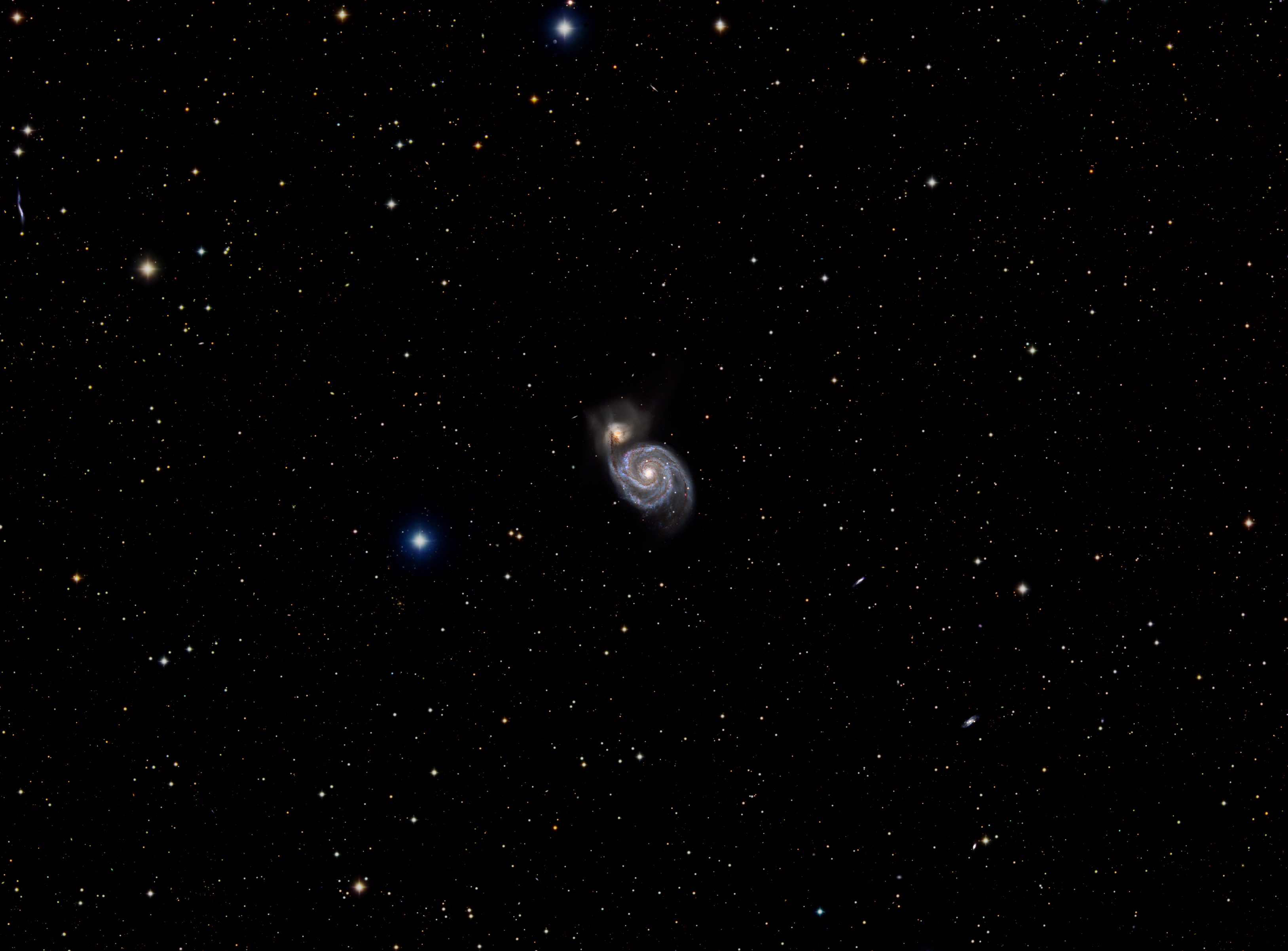
Whilst I was satisfied with my image obtained here in Surrey at Fairvale Observatory in 2020, there’s no denying that the data set from New Mexico is in a different league and was a pleasure to process.  Given the short focal length of both telescopes, Takahashi FSQ 106 (530mm f5) and William Optics GT 81 (382mm f4.72), out of the camera both set-ups inevitably produce a wide FOV but nonetheless pleasing images (see image above).  However, the quality of the DSW data holds up much better when cropping out M51 and its dance partner, thus showing off the aforesaid details of this dynamic and colourful scene to great effect (see top of page).   


 IMAGING DETAILS
ObjectM51 Whirlpool Galaxy & NGC 5195
ConstellationCanes Venatici
Distance23 million light-years
Size Approx. 77,000 light-years (M51 only) ~10 arc minutes
Apparent Magnitude-+8.4
  
Scope Takahashi FSQ 106  FL 530mm  f/5  +  Moonlight Nightcrawler focuser  
MountParamount MyT
GuidingYes
CameraQSI 683-WSG8    KAF-8300 full frame CCD sensor   5.4nm pixels  
 FOV 1.94o x 1.46o   Resolution 2.1”/pix.   Image array 3326 x 2,507 pix   
ProcessingDeep Sky Stacker, PixInsight v1.8.9-1
Image Location              & OrientationCentre – RA 13:29:55.31      DEC +47:11:41.608 Top Left = North                   
ExposuresL x 16, R x 18, G x 16, B x 17 @ 900 sec & -20o C Total Integration Time: 16hr 45min     
Calibration48 x 900 secs Darks   x47 Bias & x20 LRGB Flats   
Location & DarknessDeep Sky West – amateur hosting facility near Rowe, New Mexico  – USA    SQM Typically >= 21.7
Date & TimeJanuary 2018    

Monkey Business

Constellation names mostly originated from ancient Middle Eastern, Greek, and Roman cultures, when they identified groups of stars and named them after their gods, goddesses, animals, and objects that were important to them.  Other world-wide groups and throughout time – Native American, Asian, and African – have also made and named similar pictures from star groups based on their cultures and related beliefs.  Given the number of stars observed when looking up into a clear dark sky, it is obviously helpful to ‘construct’ familiar patterns and adopt memorable names, which can then be used to identify areas of the sky in a way that can be easily identified by all.  I have no problem with this long and well-established convention, which despite their antiquity works just as well in the modern world but I do have an issue with nicknames.

I’ve smiled at some of the nicknames given to popular, usually deep sky objects that have been well established by astronomers, but despite the possible use of describing their form, I am increasingly finding them a distraction when considering the merit of astrophotography images: Seagull Nebula, Running Man Nebula, Pelican Nebula etc.  The problem is that they absolutely do look like the object they’re meant to depict but, like an earworm is to music, once seen they are difficult to view any other way.

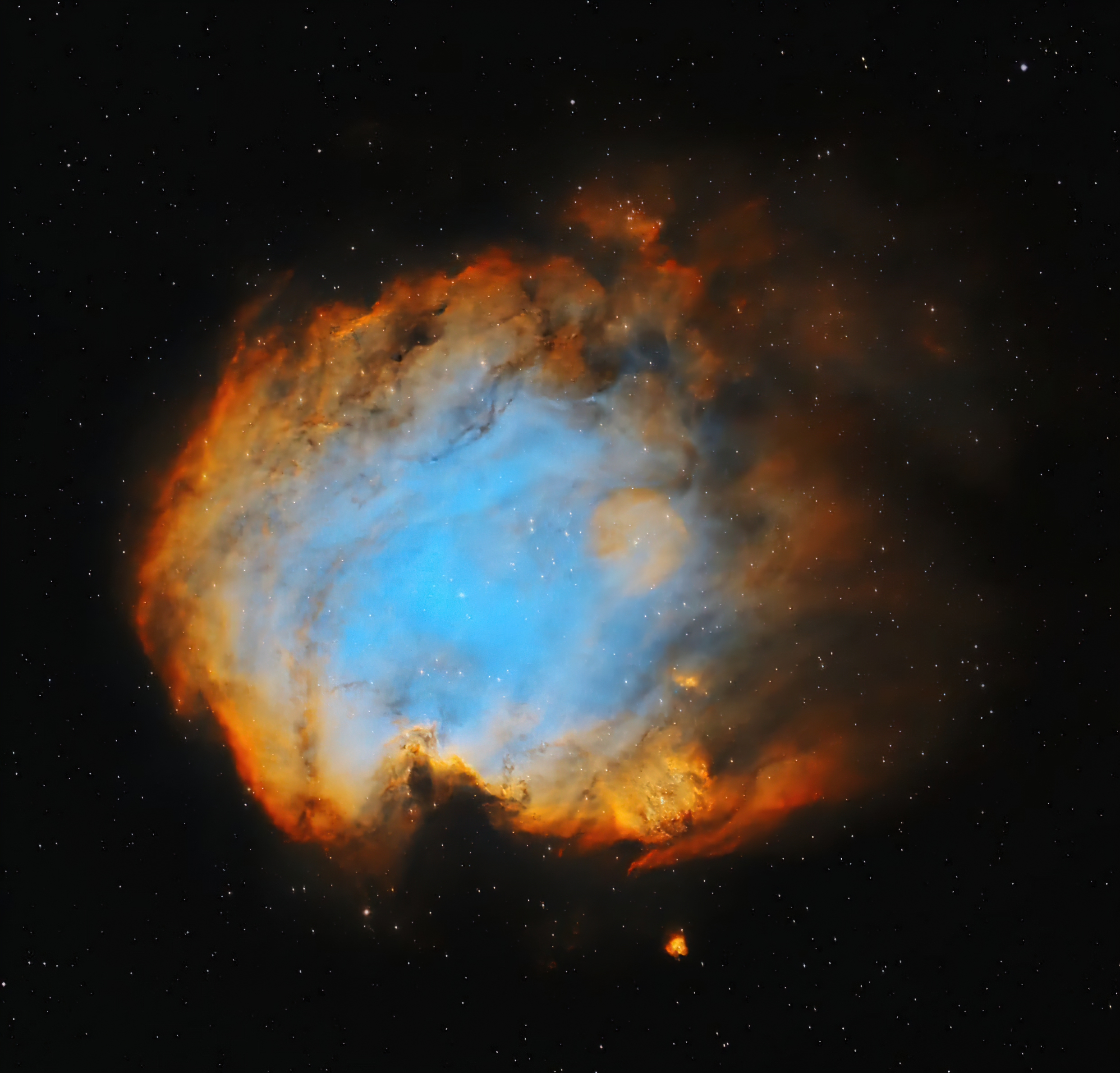
With this partly in mind, for the first time in seven years I recently chose to image NGC 2174 again.  I previously used the William Optics GT81 with a modded Canon 550D DSLR camera, which resulted in an image that wasn’t too bad, except it looked like a monkey!  Given its nickname of the Monkey Head Nebula, this was to be expected but unfortunately, thereafter the picture of a monkey has remained with me ever since when I view NGC 2174 images.  The challenge on this occasion was therefore to limit the monkey’s impact on the image, thereby showing the object for what it really is – an emission nebula.

Using the same OTA but with a mono CMOS camera and a good set of filters, the new data set obtained was much improved, and with better processing experience it was time to see the monkey (or not) in a new light.  The first thing to do was present the image in an orientation that produces a more favourable perspective (less monkey like).  Using a basic SHO palette in PixInsight the initial image was promising (see below) but with an alternative PixelMath dynamic SHO palette* and then processing with autocolor script, color saturation, Russell Croman’s XT-suites and other tweaks, I was pleased to see that the monkey was nowhere to be seen in the final image (see image at the top-of-the-page), or at least to my eye.

At last, it is now possible to look at NGC 2147 and see the inherent features of this interesting emission nebula, where new stars are being born at a rapid rate. Moreover, the inner details can now be clearly viewed within, thus also showing the associated open star cluster NGC 2175 and more.  As a result of this monkey make-over, the NGC 2174 image now not only looks much better but critically, I no can longer see the ape!  Now where’s that Seagull?

 IMAGING DETAILS
ObjectNGC 2174
ConstellationOrion
Distance6,400 light-years
Size 40 arc secs
Apparent Magnitude+6.80  
  
Scope William Optics GT81 + Focal Reducer FL 382 mm f4.72
MountSW AZ-EQ6 GT + EQASCOM computer control & Cartes du Ciel
GuidingWilliam Optics 50mm guide scope
 + Starlight Xpress Lodestar X2 camera & PHD2 guiding
CameraZWO ASI294MM CMOS sensor
 FOV 2.87o x 1.96o Resolution 2.50”/pix  Max. image size 4,144 x 2,822 pix   
EFWZWOx8 EFW & 31mm Chroma HSO & LRGB filters 
Capture & ProcessingAstro Photography Tool + PHD2 + Deep Sky Stacker, PixInsight v1.8.9-1, Photoshop CS3
Image Location              & OrientationCentre = RA 6:09:39.801      DEC +20:29:12.851                         Right = North        Up = East     
*Image PI Processing: Dynamic Pixel Math  R = (O^~O)*S+~(O^~O)*H
G = ((O*H)^~(O*H))*H+~((O*H)^~(O*H))*O
B = O
ExposuresHa 36 x 300 sec (3hr), OIII 30 x 300 sec (2hr 30m), SII 32 x 300 sec (2hr 40m) Total Integration Time: 8hr 10 min     
 @ 120 Gain   30 Offset @ -15oC    
Calibration5 x 300 sec Darks  15 x  HSO Flats & Dark Flats         @ ADU 32,000
Location & DarknessFairvale Observatory – Redhill – Surrey – UK        Typically Bortle 5-6
Date & Time25th + 26th February + 2nd March 2023 @ +19.00h  
WeatherApprox. < 3oC   RH >=65%                  🌙 +25 to +50%

Icelandic Aurora

It’s just over 6-years since my last arctic adventure, which was a trip along the Norwegian coast by ship from Bergen to Kirkenes and back, stopping along the way for deliveries and pick-ups at 30-ports.  On that occasion we had good views of the Aurora Borealis whilst at sea somewhere north of the Arctic Circle and with some difficulty, I was eventually able to obtain some images (see below). Standing outside on ther deck at +70o North latitude in February was incredibly cold, making camera operation difficult, whilst the ship’s movement from side-to-side and up-and-down was hardly conducive to photography of the night sky!

This time, I’m just back from circumnavigating the island of Iceland by car from mid to late-March, which is described more fully on my other website Round The Bend here.  It was timed to avoid the worst of winter conditions and, with darkness quickly disappearing as Spring / Summer beckoned, maybe still get a chance to see and image the Northern Lights again – this time on terra firma.  Despite such planning, severe snow, ice and very strong winds were common for much of the time but, when it was clear the scenery was spectacular and, on a couple of evenings later in the trip, the Aurora Borealis put on a great show.

Situated just below the Arctic Circle, mostly between 64o and 66o latitude, Iceland is well known both for its geology and sightings of the Aurora Borealis or Northern Lights.  As a geologist, I travelled to Iceland primarily to view the rocks and though it was getting late in the season, I was also keen to see the Aurora again if possible.  Given the days of bad weather it was therefore fortunate to have clear skies and good views of the Northern Lights on two separate evenings whilst on the south coast, first at Gerdi near Jökulsárlόn and later just south of Kirkjubaejarkklaustur.

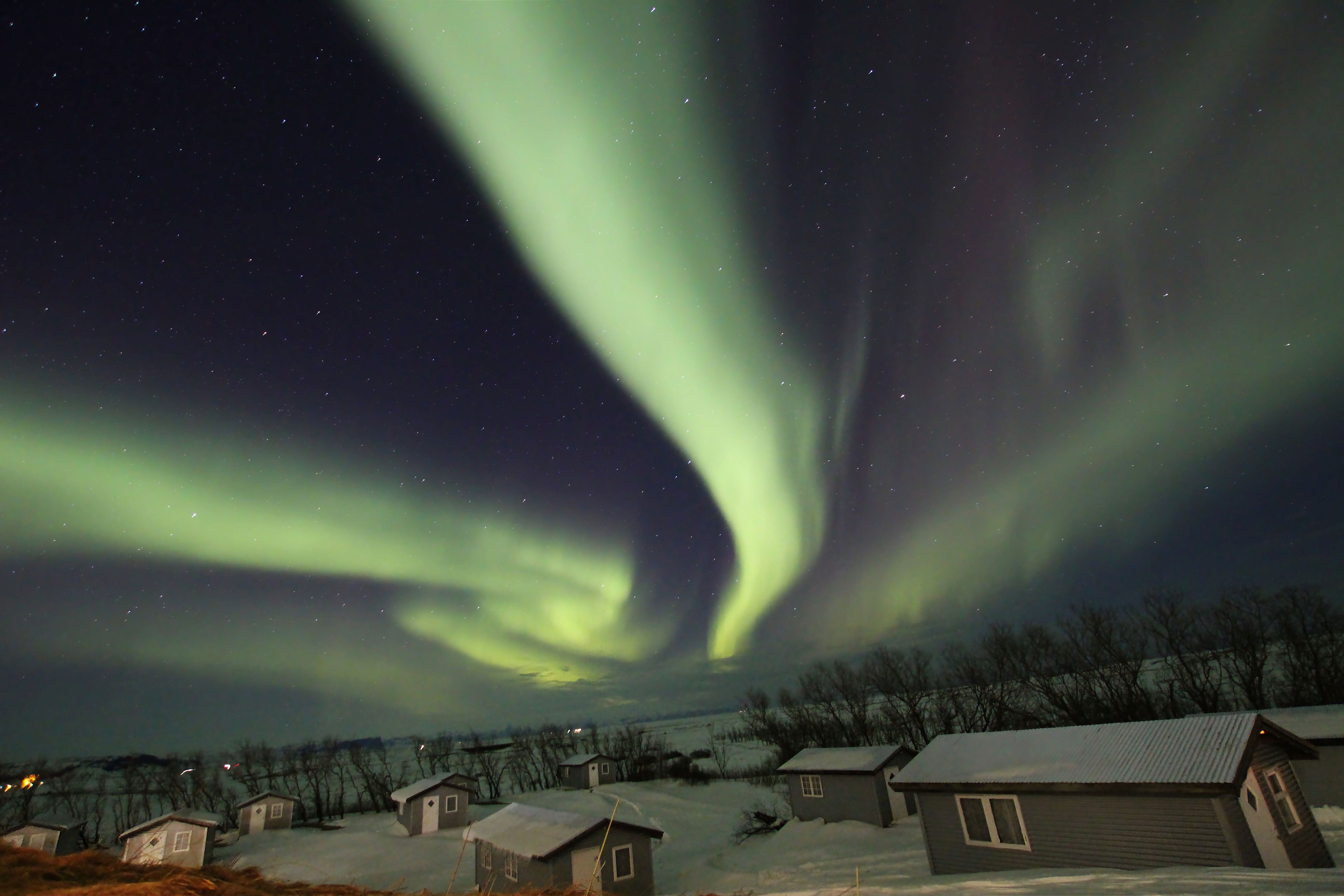
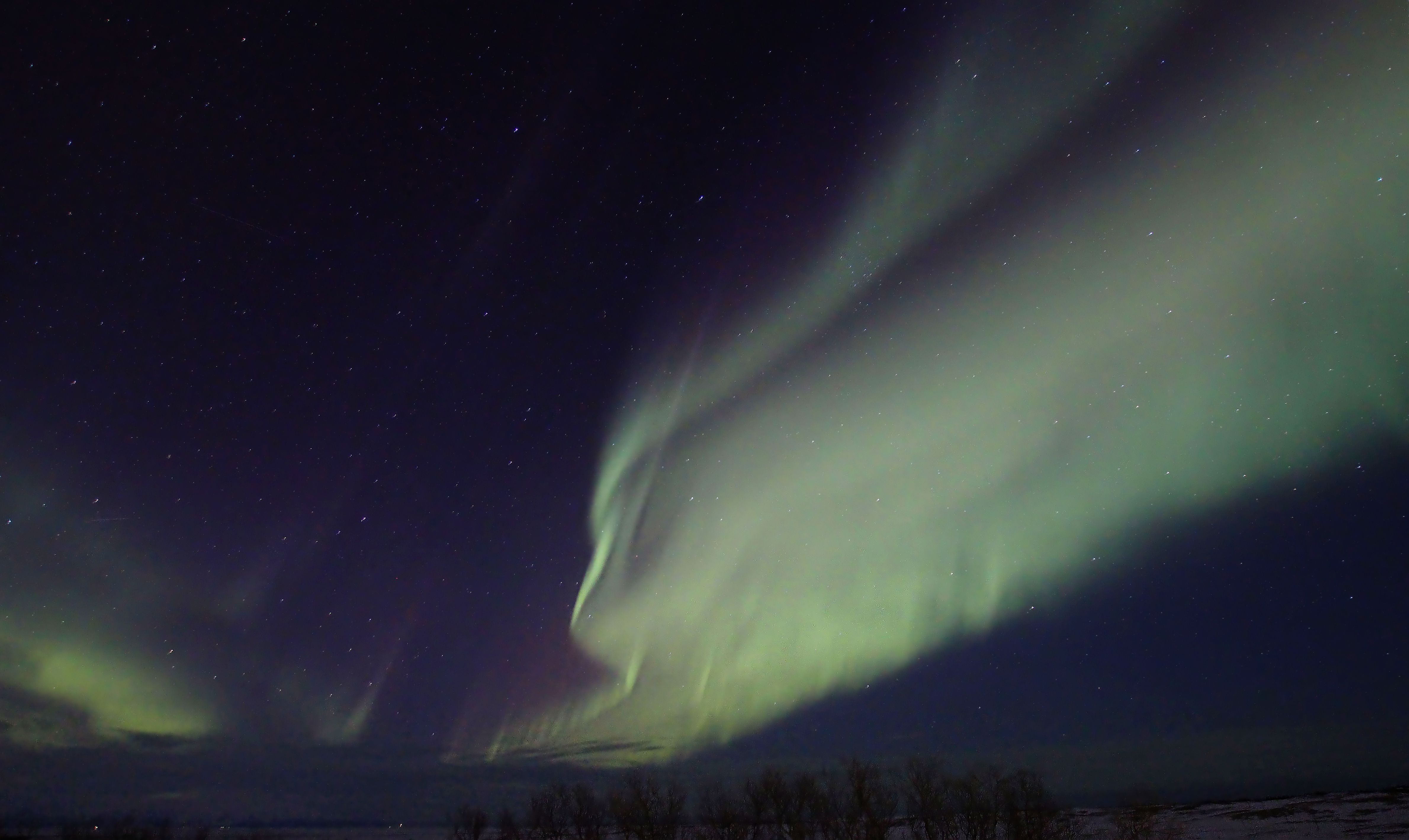
Despite my previous experience, each aurora is different and on this occasion I found using a Canon 700D DSLR mounted on a Gorilla Pod, using a Sigma wide-angle lens set at a focal length of 10mm f3.5 + ISO 3,200 and 10 second exposures generally produced a good image.  It seemed that we were on the southern edge of the aurora on the first night at Gerdi (see top of the page), which was therefore weaker but exhibited a striking purple colour (helium).  The following night the aurora was much stronger, this time mostly green (oxygen) with red and purple fringing (nitrogen & helium) and generally much more active, resulting in some great views with the naked eye and even better images (see below).

The Flame & Frogs

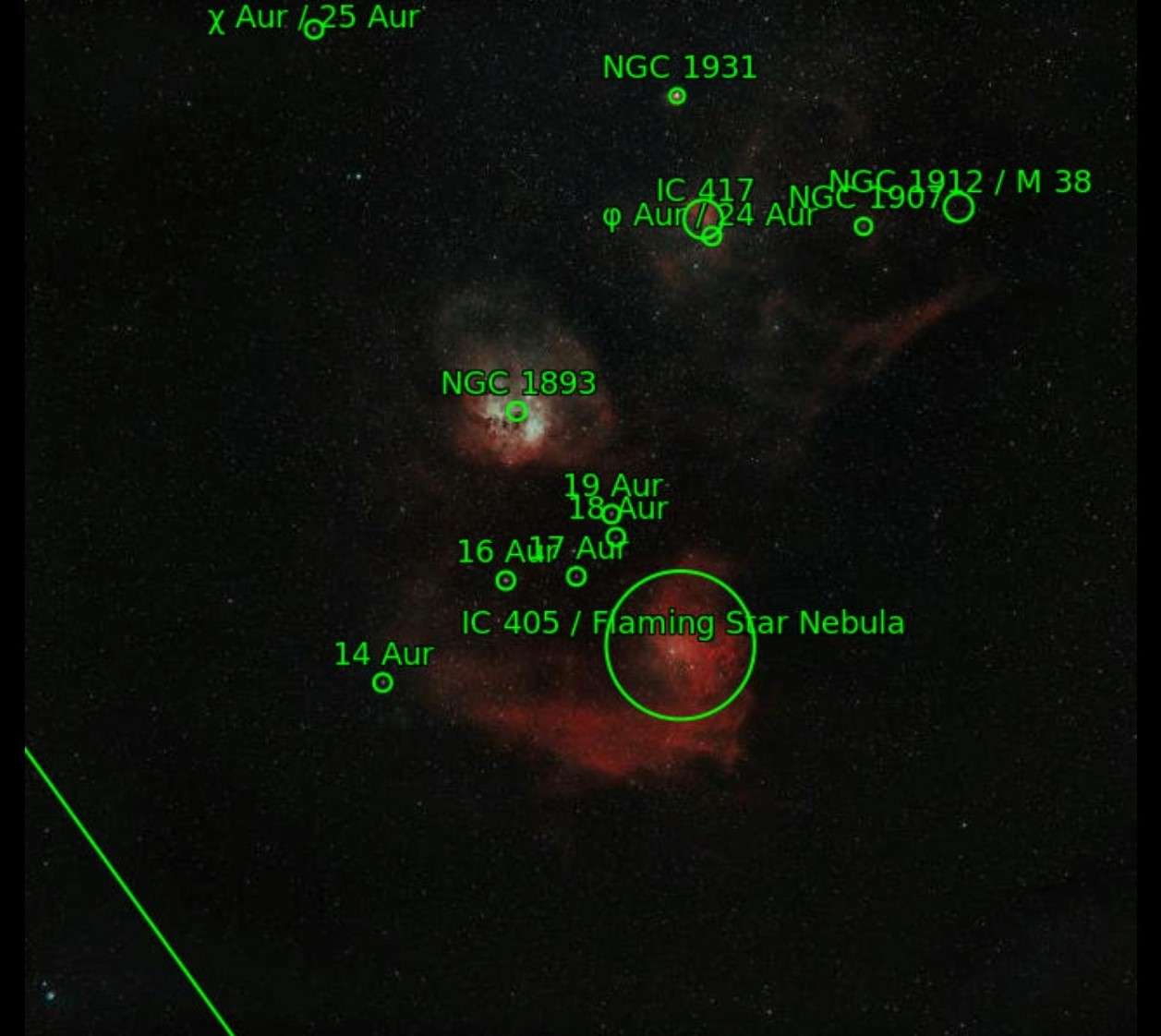
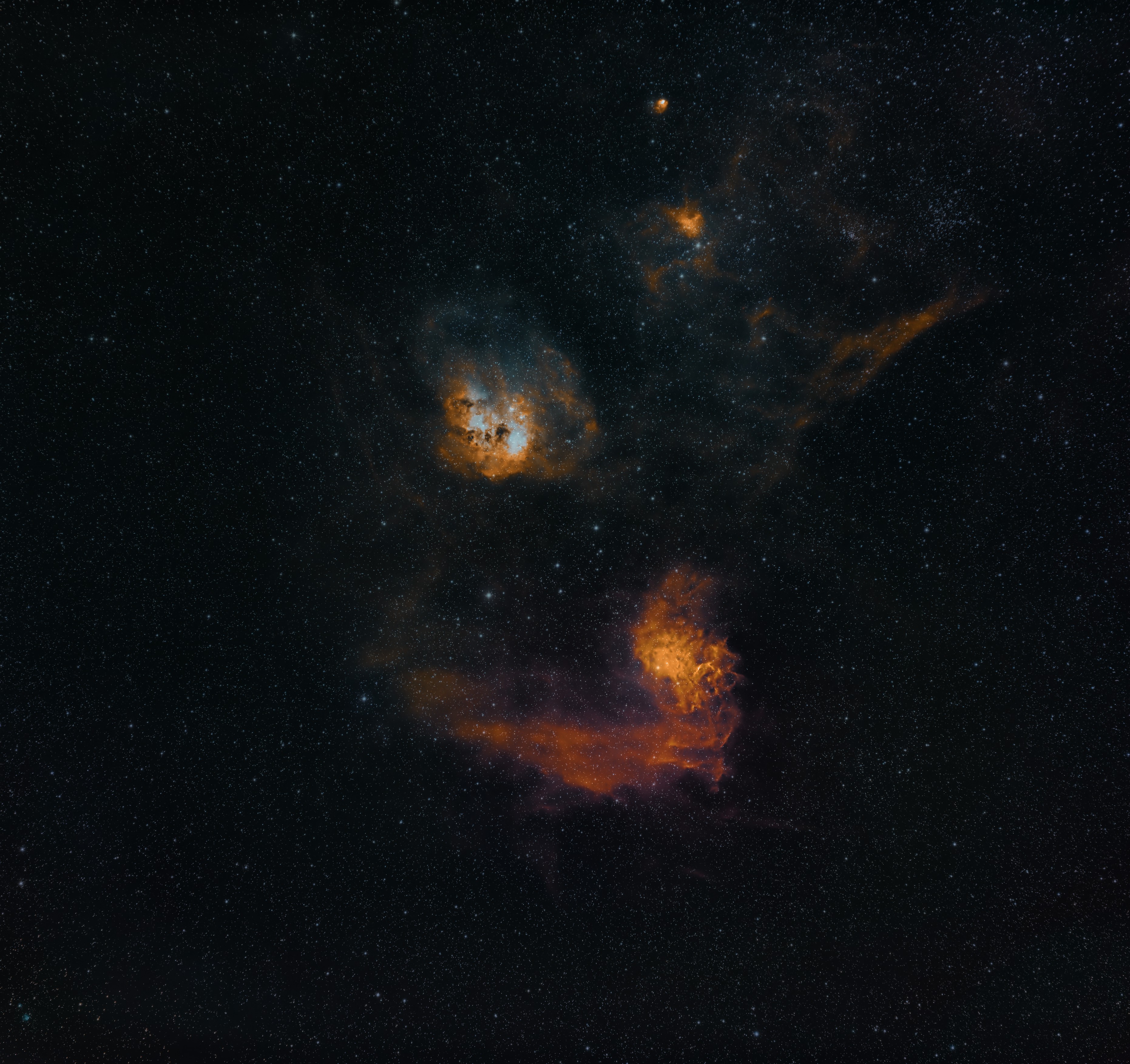
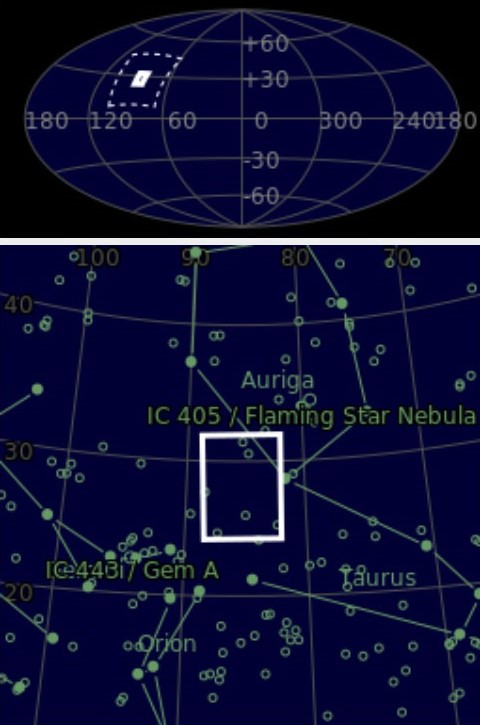
There’s a lot going on in and around the Auriga constellation and this winter I’ve been mainly imaging in this region, almost exclusively using the Samyang 135 widefield rig.  Here with the whopping 7.50o x 5.67o field-of-view this set-up provides, it easily incorporates both emission nebulae IC405, AKA the Flaming Star Nebula and it’s nearby (visually) neighbour IC410, the Tadpoles Nebula, as well as much more.

  • Hydrogen gas ionized by the central AE Auriga star produces the dominant strong red colour, which combined with the rippling dust and gas lanes that run through the head of IC405 leads to a ‘flame affect’ and thus the nebula’s popular nickname.
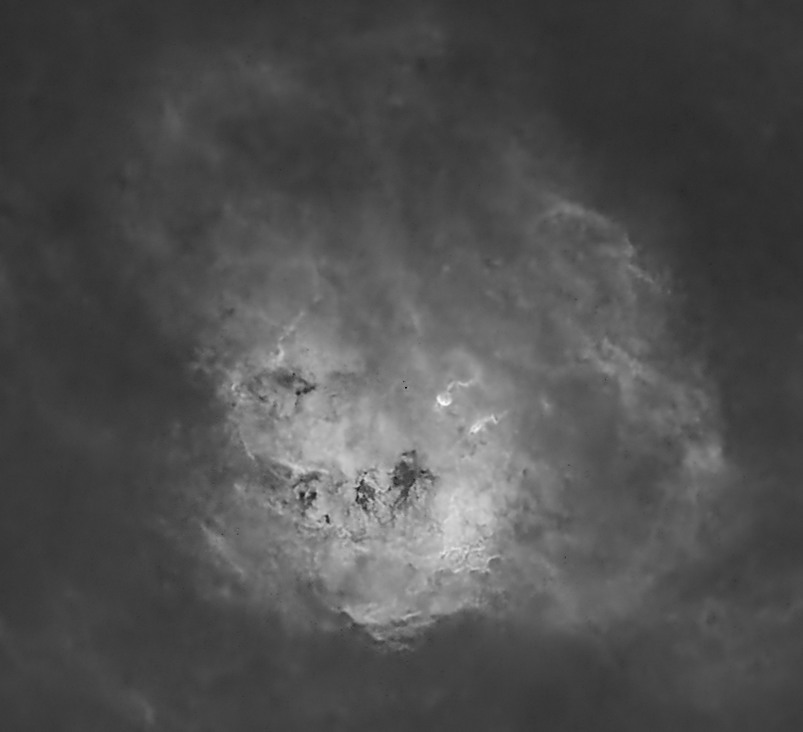
  • The structures in IC410 are illuminated by radiation from the open star cluster NGC1893, located at the centre of the nebula.  Hot, massive, young stars abound, especially around Simeis 129 & 130, the two tadpoles.  These structures are ‘wriggling away’ from the centre of the nebula, because of the prevailing stellar winds and radiation pressure from the stars in NGC 1893.

This image is the cornerstone of a series of covering a wider area completed during January, which I intend to first present individually before, hopefully, bringing them together as an HOO mosaic later.

This image has been processed as two SHO versions of the Hubble Palette: (i) a basic mix above and (ii) using a dynamic mix ( main cropped image at top-of-the page).  Once more I have been impressed by the ability of this small camera lens to produce exceptional detail and colours, but especially here with the starless Ha version of IC410, where the signature features or so-called tadpoles have been captured to great effect (see cropped starless Ha version of IC410 below).

 IMAGING DETAILS
ObjectIC 405 The Flaming Star Nebula + IC 410 The Tadpoles Nebula
ConstellationAuriga
Distance1,500 & 12,000 light-years
Size  Approx. 37’ x 10’ & 40’ x 30’
Apparent Magnitude+6.0 & +10
  
Scope  / LensSamyang 135 @f2.8  
MountSW AZ-EQ6 GT + EQASCOM computer control & Cartes du Ciel  
GuidingSky-Watcher EvoGuide 50ED
 + Starlight Xpress Lodestar X2 camera & PHD2 guiding
CameraZWO1600MM-Cool mono  CMOS sensor
 FOV 7.5o x 5.67o Resolution 5.81”/pix  Max. Image Size 4,656 x 3,520 pix   
EFWZWOx8 EFW & 31mm ZWO LRGB & 7nm Narrowband filters  
Capture & ProcessingAstro Photography Tool + PHD2 + PixInsight v1.8.9-1  
Image Location              & OrientationCentre: RA 05:19:54.329      DEC +33:47:12.699                         Right = North   Top = East 
Exposures24 x 300 sec Ha & OIII, 18 x 300 sec SII Total Integration Time: 5 hr 30 min     
 @ 139 Gain   21 Offset @ -15oC    
Calibration10 x 300 sec Darks 20 x Flats & Flat Darks  
Location & DarknessFairvale Observatory – Redhill – Surrey – UK        Typically Bortle 5 – 6  
Date & Time2nd & 9th January 2023 @ +18.30h   
WeatherApprox. <=2oC   RH >=80%                  🌙 +80%  

Supernova Sensation

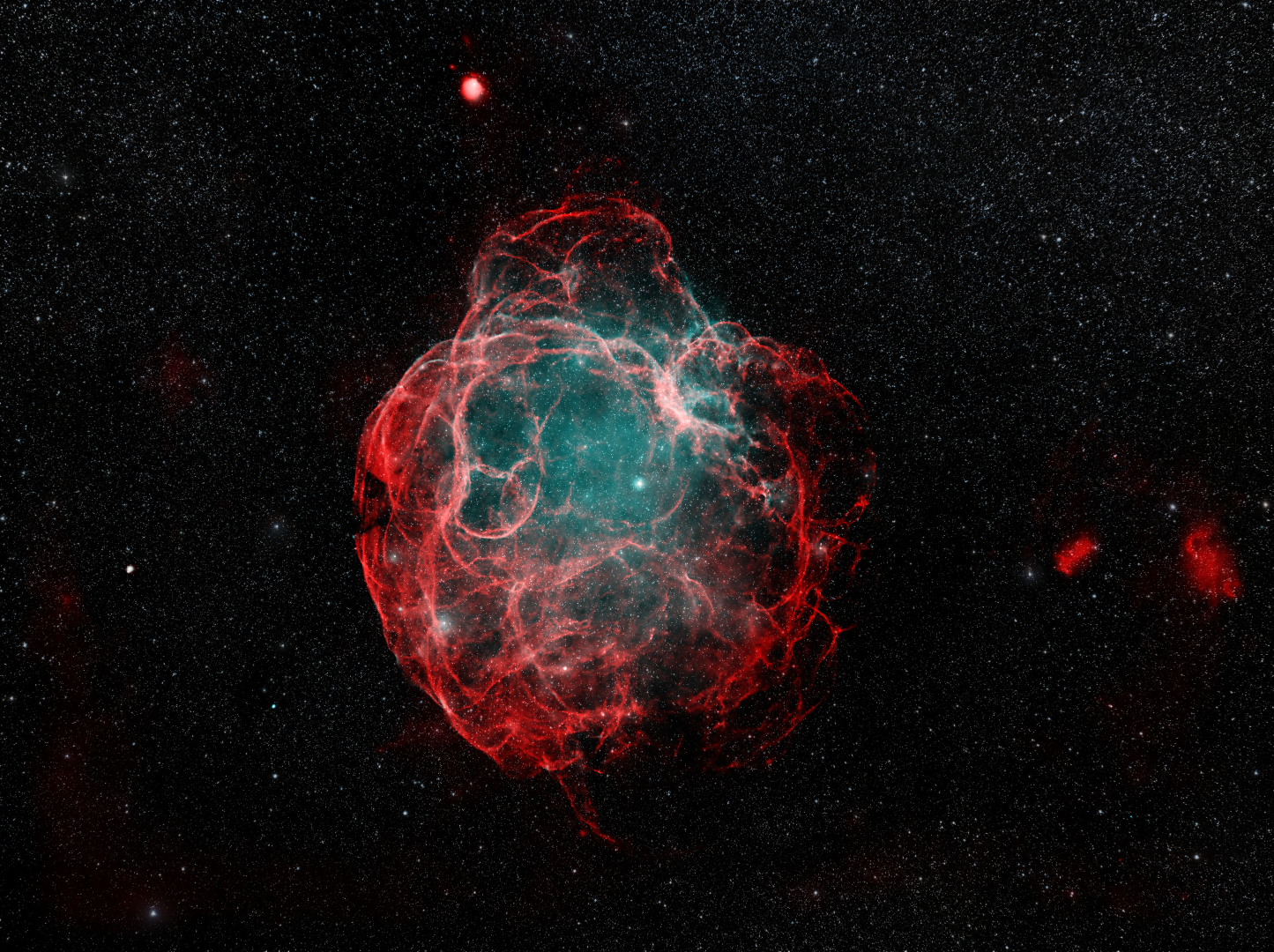
Straddling the boundary of Taurus and Auriga, is the giant supernova remnant (SNR) Simeis-147 AKA SH2-240 or the Spaghetti Nebula.  It is believed that the stellar explosion that created Simeis-147 occurred some 40,000 years ago, leaving behind a rapidly spinning neutron star or pulsar at the core of the now complex, expanding SNR; the nebulous area has an almost spherical shell consisting of numerous filamentary structures.  With an apparent diameter of 3o the SNR spans some 160 light-years, making it a very large astrophotography target.  

I’ve long admired the spectacular SNR Simeis-147 AKA Spaghetti Nebula, which I first imaged with my standard William Optics GT81 scope in January 2022.  The outcome (see image below) was pleasing but with the limited FOV it had to be just a nibble of this large object – something of an appetiser you might say.  Therefore, ever since putting my Samyang rig together last summer I’ve had only one object in mind with this excellent widefield set-up, which had to be the full menu version of Simeis-147!

Apart from its size, Simeis-147 is very faint, making long exposure time essential, which is always difficult in the UK.  However, a rare spell of cold, clear nights this January provided sufficient opportunity over five nights to obtain just over 20-hours integration and a complete image of this truly magnificent SNR.

Notwithstanding the favourable conditions and long-time achieved – a record for me at this location – the faint nature of this object made image processing difficult too.  After experimenting, I eventually adopted a tone mapping technique: pre-processing each individual wavelength stack before removing the stars, stretching and processing each of the starless Ha and OIII images before combining using Pixel Math in the ratio: R – (Ha*1.70) + G – (OIII*0.80)+(Ha*0.20) + B- (OIII*0.80)+(Ha*0.20). 

With further processing of the HOO starless combination I was able to obtain the desired result of marvellous SNR detail, together with pleasing Ha (red) and especially OIII (blue/green) colours, that altogether with the addition of the stars and some final tweaking produced a striking image with good depth.  Moreover, I feel the widefield setting achieved using the Samyang 135 lens produces a striking setting for this fascinating object.


 IMAGING DETAILS
ObjectSimeis 147 / SH2-240  AKA Spaghetti Nebula
ConstellationTaurus
Distance3,000 light-years
Size  Approx. 3.0o
Apparent MagnitudeExtremely faint  
  
Scope  / LensSamyang 135 @f2.8  
MountSW AZ-EQ6 GT + EQASCOM computer control & Cartes du Ciel  
GuidingSky-Watcher EvoGuide 50ED
 + Starlight Xpress Lodestar X2 camera & PHD2 guiding
CameraZWO1600MM-Cool mono  CMOS sensor
 FOV 7.5o x 5.67o Resolution 5.81”/pix  Max. Image Size 4,656 x 3,520 pix   
EFWZWOx8 EFW & 31mm ZWO LRGB & 7nm Narrowband filters  
Capture & ProcessingAstro Photography Tool + PHD2 + PixInsight v1.8.9-1  
Image Location              & OrientationCentre: RA 05:41:15.081      DEC +28:05:32.778                         Right = North   Top = East 
Exposures60 x 600 sec Ha, 62 x 600 sec OIII Total Integration Time: 20 hr 20 min     
 @ 139 Gain   21 Offset @ -15oC    
Calibration5 x 600 sec Darks 20 x Flats & Flat Darks  
Location & DarknessFairvale Observatory – Redhill – Surrey – UK        Typically Bortle 5 – 6  
Date & Time12th 17th 18th 19th & 21st January 2023 @ +18.30h   
WeatherApprox. <=0oC   RH >=80%                  🌙 70% to 0o New Moon  


Feel The Space

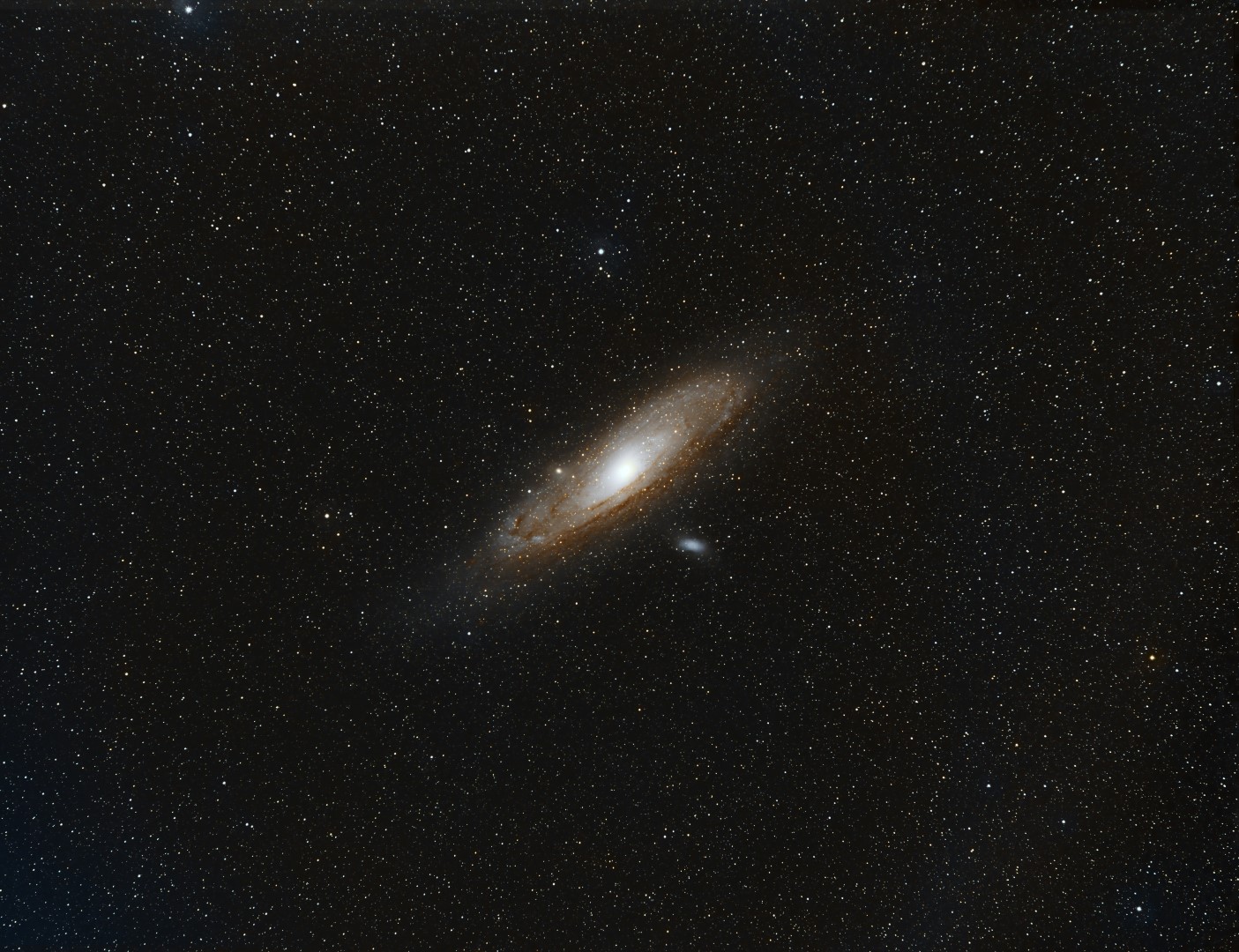
As our closest galactic neighbour, I’ve imaged M31 the Andromeda Galaxy five times since beginning my personal astrophotography journey in 2014, each time using my William Optics GT81 apo refractor – first with a DSLR, then a ASI1600mm-Cool and most recently ASI294MM cameras.  Andromeda is perhaps the perfect object for my equipment, as it just fits the field-of-view of the aforesaid set-up, which produces something of an up-close-and-personal image of this alluring galaxy. But despite the success of these images, perhaps there’s an alternative view?

This year, I therefore deployed my Samyang 135 + ASI1600MM-Cool rig to capture 6 ½ hours of Andromeda, the result of which shows a whole new perspective of M31.  The widefield format of this lens produces greater context than previous images, whilst still obtaining excellent details and colours of the galaxy itself.  As a result, this final image (see above) better reveals the galaxy in its true glory deep in space, which in some ways I believe can be more powerful than the more popular close-up renditions of this impressive object (M31 with star reduction applied to the image below).   

 IMAGING DETAILS
ObjectM31 Andromeda Galaxy
ConstellationAndromeda
Distance2.5 million light-years
Size  3.2o x 1or 220,000 light-years           
Apparent Magnitude+3.44  
  
Scope  / LensSamyang 135 @f2.8  
MountSW AZ-EQ6 GT + EQASCOM computer control & Cartes du Ciel
Guiding Sky-Watcher EvoGuide 50ED
 + Starlight Xpress Lodestar X2 camera & PHD2 guiding
CameraZWO1600MM-Cool mono  CMOS sensor
 FOV 7.5o x 5.67o Resolution 5.81”/pix  Max. Image Size 4,656 x 3,520 pix   
EFWZWOx8 EFW & 31mm ZWO LRGB & 7nm Narrowband filters 
Capture & ProcessingAstro Photography Tool + PHD2 + Deep Sky Stacker, PixInsight v1.8.8-12, Photoshop CC, Topaz Denoise
Image Location              & OrientationCentre:  RA 00:42:34.682      DEC +41:14:06.324                         Right = North   Top = East 
ExposuresL 75 x 60 sec, R 27x  G27x B22 x 180 sec, Ha 17 x 300 sec Total Integration Time: 6hr 28 min     
 @ 139 Gain   21  Offset @ -15oC    
CalibrationDarks, Flats & Flat Darks   
Location & DarknessFairvale Observatory – Redhill – Surrey – UK        Typically Bortle 5-6
Date & Time17th, 21st & 22nd November 2022  @ +20.00h  
WeatherApprox. <=5oC   RH >= 85%                  🌙 approx. New Moon

Diaphanous Delectation

Following my routine summer break from astrophotography, I restarted in early August first using my new Samyang 135 + ZWO ASI1600MM-Cool rig, which immediately demonstrated its ability to produce excellent widefield images of very large objects, in this case the Cygnus Loop.  However, also in late spring I had rejigged my William Optics GT81 telescope with the addition of a new ASI294MM camera, the successor to the ASI1600 which had been redeployed to the aforesaid Samyang rig.  Having constructed, tested and briefly obtained First Light with this new combination, I then had to wait for the return of astronomical darkness and more suitable objects.  Once again, I turned to the Cygnus Loop but this time concentrating on the western and central areas, generally known as the Western Veil and Pickering’s Triangle.

Cygnus Loop Morphology, ID &
Approximate Image Location (Red Box)

Located 1,500 light-years from Earth within the plane of the Milky Way in the constellation of Cygnus, this large supernova remnant (SNR) occurred between 5,000 and 8,000 years ago.  In its entirety the debris cloud has been sculpted by the shock wave from the star’s explosion, to form the Cygnus Loop object that we see today.  The coloured light is created by the excitement of hydrogen (red) and oxygen(blue) gasses of the SNR, which is still expanding at about 100 km (60 miles) per second; image integration times for OIII & Ha wavelengths are in the ratio of 2:1 to enhance the weaker oxygen signal.  More than twice the width of the full moon and spanning 35 light-years, this section of SNR only just fits into my field-of-view but with careful framing it works perfectly.

Western Veil (NGC 6960) Detail
Pickering’s Triangle Detail

The resulting image successfully brings out the exquisite nature of this exciting SNR, in particular highlighting the abundant waveforms that run throughout the entirety of this dynamic object.  Furthermore, the combination of the new ASI294MM camera and 3nm Chroma filters, has produced a vibrant red-blue colour palette that further enhances the said structures.  Altogether this diaphanous delectation convincingly demonstrates the power and beauty of the Universe whilst, moreover, pointing to a new level for my astrophotography.          

Image Location & Orientation
 IMAGING DETAILS
ObjectCygnus Loop Section: Western Veil Nebula (NGC 6960),  
Pickering’s Triangle, NGC 6979 & 6974
ConstellationCygnus
Distance1,500 light-years
Size  ~2.9o total
Apparent Magnitude+7.0  
  
Scope William Optics GT81 + Focal Reducer FL 382mm  f4.72
MountSW AZ-EQ6 GT + EQASCOM computer control & Cartes du Ciel
GuidingWilliam Optics 50mm guide scope
 + Starlight Xpress Lodestar X2 camera & PHD2 guiding
CameraZWO ASI294MM  CMOS sensor
 FOV 2.87o x 1.96o Resolution 2.50”/pix 
Max. image size 4,144 x 2,822 pix   
EFWZWOx8 EFW & 31mm Chroma LRGB filters 
Capture & ProcessingAstro Photography Tool + PHD2 + Deep Sky Stacker,
PixInsight v1.8.8-12, Photoshop CC v23.5.0
Image Location &      OrientationCentre = RA 20:48:47.0      DEC +31:00:54.7                         Left = North     
ExposuresHa 41 x 300 sec (3hr 25m), OIII 82 x 300 sec (6hr 50m) Total Integration Time: 10hr 15 min     
 @ 120 Gain   30 Offset @ -15oC    
Calibration5 x 300 sec Darks  15 x  LRGB Flats & Dark Flats         @ ADU 32,000
Location & DarknessFairvale Observatory – Redhill – Surrey – UK        Typically Bortle 5-6
Date & Time27th + 29th + 30th + 31st August 2022  @ +21.00h  
WeatherApprox. <18oC   RH >=65%                  🌙 0% New

Shrinking The Universe

Hitherto, most of my astrophotography has concentrated on a variety of specific objects that work within the 2.65o x 2.0o field-of-view provided by the combination of my William Optics GT81 refractor and ZWO ASI1600MM-Cool camera.  After recently pairing the aforesaid ZWO mono camera with a Samyang 135 lens (often marketed elsewhere as the Rokinon 135) my astrophotography world has expanded dramatically to an enormous 7.50o x 5.67o, some x8 larger than before.  As a result, this excellent lens that also captures great detail, provides new opportunities to image some of the very large features that abound throughout the Universe without having to resort to a mosaic imaging; this a great advantage when working in UK weather conditions which usually provides less imaging time than required. 

Above, Cygnus-X Region & notable nearby objects: The red box appproximately outlines the image area, which in this plan is presented upside-down compared to the main image. The numerous red shapes define the location of the HII objects that make up the DWB catalogue (19 is the Crescent nebula). Just beyond to the left is the North America Nebula (NGC7000) and below the SNR Cygnus Loop, AKA the Veil Nebula (NGC 6960 & 6992).

In this case I chose to frame the image in such a way as to encompass some familiar objects, such as the Butterfly Nebula (IC1318) and the Crescent Nebula (NGC6888) anchored by Sadr, the yellow-white supergiant star that stands out from within the very large Cygnus-X region.  Processed here in HOO, with 6-hours integration time and full calibration (darks, flats & flat darks), the final image provides a magnificent view of this large, interesting region that augurs well for future widefield imaging with this new rig.  I’m particulalry intrigued by the bluish feature at about 8.0 o’clock of the Crescent Nebula, which I now believe to be associated with WR-134: a bubble-like structure some 50 light-years in diameter consisting of OIII rich light formed by an intense wind emanating from the Wolf-Rayet star at it’s centre. The breadth of view it provides can encompass myriad of objects in exceptional detail, thereby providing a wider context that is simply awe-inspiring to see – it’s just like shrinking the Universe!


Astrometry image plan
 IMAGING DETAILS
ObjectSadr Region
ConstellationCygnus
Distance+5,000 light-years
Size Full FOV – see below            
Apparent Magnitude+/- 7.0
  
Scope  / LensSamyang 135 @f2.8  
MountSW AZ-EQ6 GT + EQASCOM computer control & Cartes du Ciel
GuidingSky-Watcher EvoGuide 50ED
 + Starlight Xpress Lodestar X2 camera & PHD2 guiding
CameraZWO1600MM-Cool mono  CMOS sensor
 FOV 7.5o x 5.67o Resolution 5.81”/pix  Max. Image Size 4,656 x 3,520 pix   
EFWZWOx8 EFW & 31mm ZWO LRGB & 7nm Narrowband filters 
Capture & ProcessingAstro Photography Tool + PHD2 + Deep Sky Stacker, PixInsight v1.8.8-12, Photoshop CC, Topaz Denoise
Image Location & OrientationCentre  RA 20:16:40.452      DEC +38:50:14.404                         Right = North   Top = East 
Exposures36 x 500 sec Ha, 36 x 300 sec OIII Total Integration Time: 6hr      
 @ 139 Gain   21  Offset @ -10oC    
Calibration5 x 300 sec Darks  15 x Flats & Flat Darks
Location & DarknessFairvale Observatory – Redhill – Surrey – UK        Typically Bortle 5-6
Date & Time10th & 12h August 2022  @ +22.00h  
WeatherApprox. 25oC   RH 50 – 60%                  🌙 100% Full Moon