The Flame & Frogs

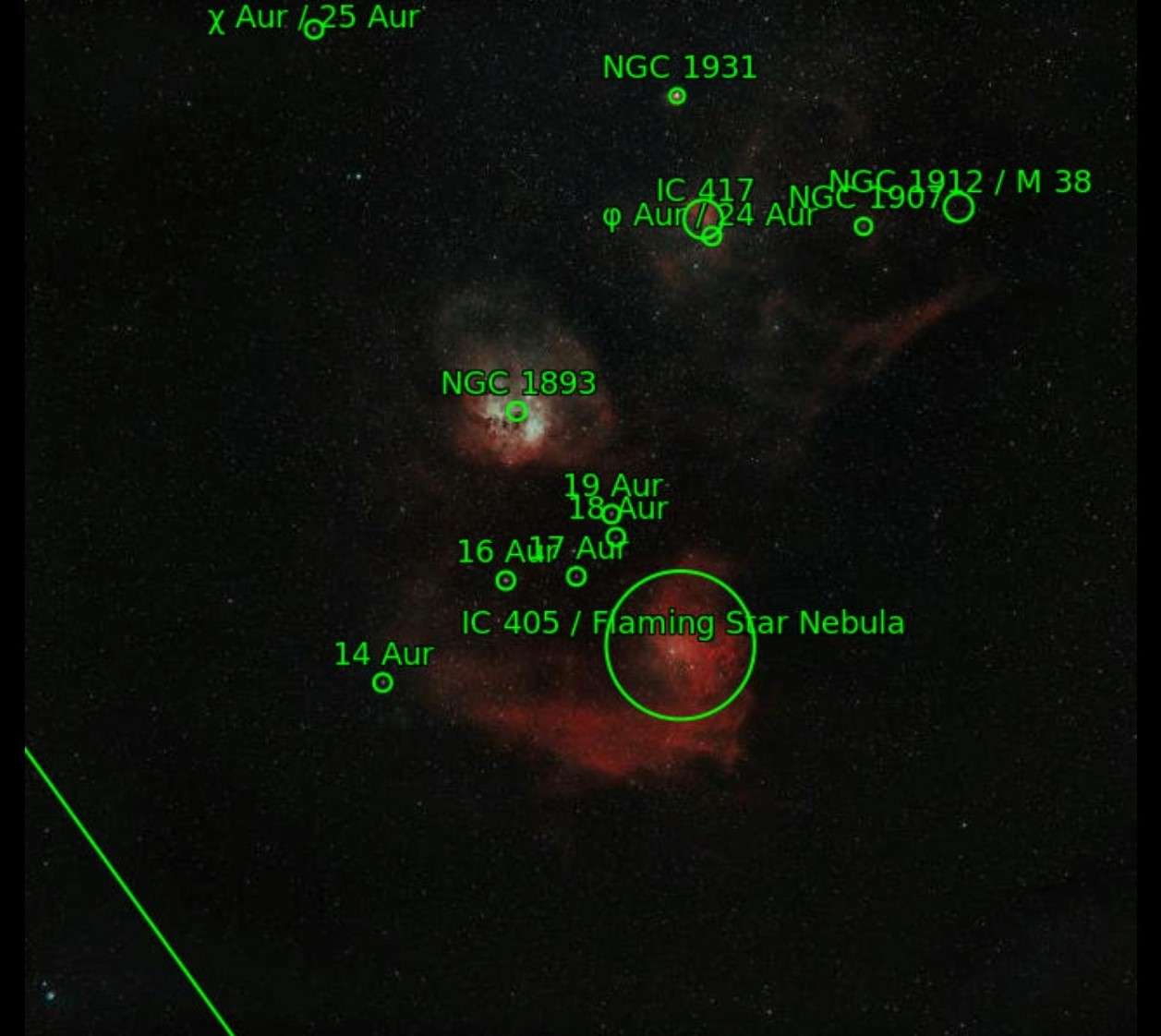
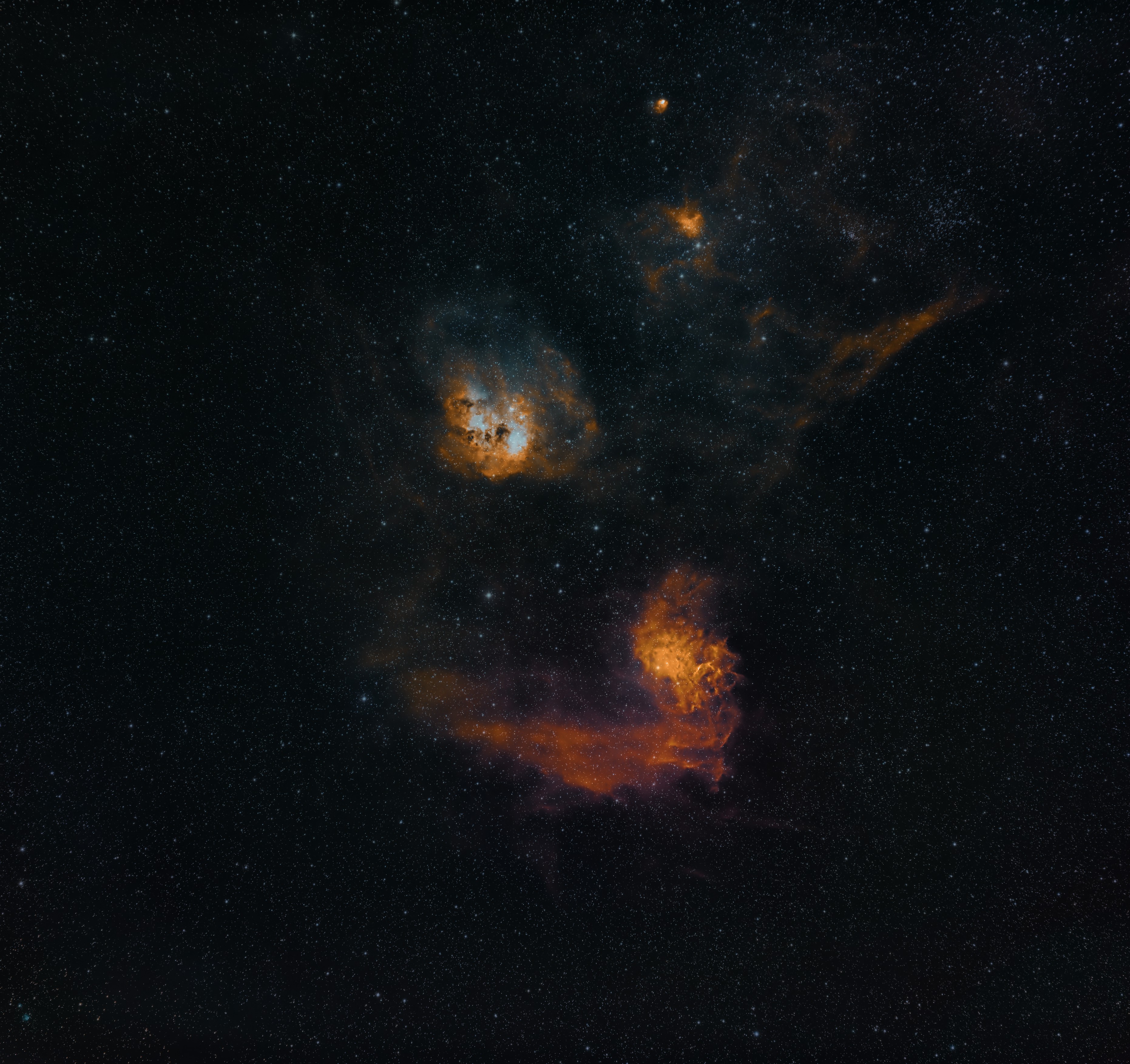
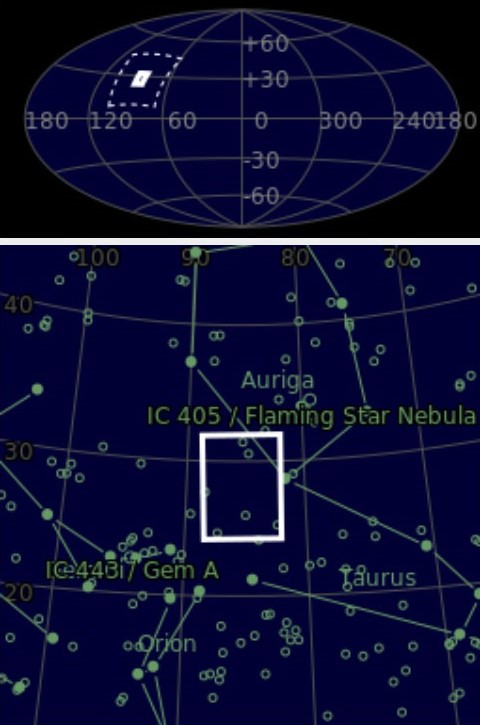
There’s a lot going on in and around the Auriga constellation and this winter I’ve been mainly imaging in this region, almost exclusively using the Samyang 135 widefield rig.  Here with the whopping 7.50o x 5.67o field-of-view this set-up provides, it easily incorporates both emission nebulae IC405, AKA the Flaming Star Nebula and it’s nearby (visually) neighbour IC410, the Tadpoles Nebula, as well as much more.

  • Hydrogen gas ionized by the central AE Auriga star produces the dominant strong red colour, which combined with the rippling dust and gas lanes that run through the head of IC405 leads to a ‘flame affect’ and thus the nebula’s popular nickname.
  • The structures in IC410 are illuminated by radiation from the open star cluster NGC1893, located at the centre of the nebula.  Hot, massive, young stars abound, especially around Simeis 129 & 130, the two tadpoles.  These structures are ‘wriggling away’ from the centre of the nebula, because of the prevailing stellar winds and radiation pressure from the stars in NGC 1893.

This image is the cornerstone of a series of covering a wider area completed during January, which I intend to first present individually before, hopefully, bringing them together as an HOO mosaic later.

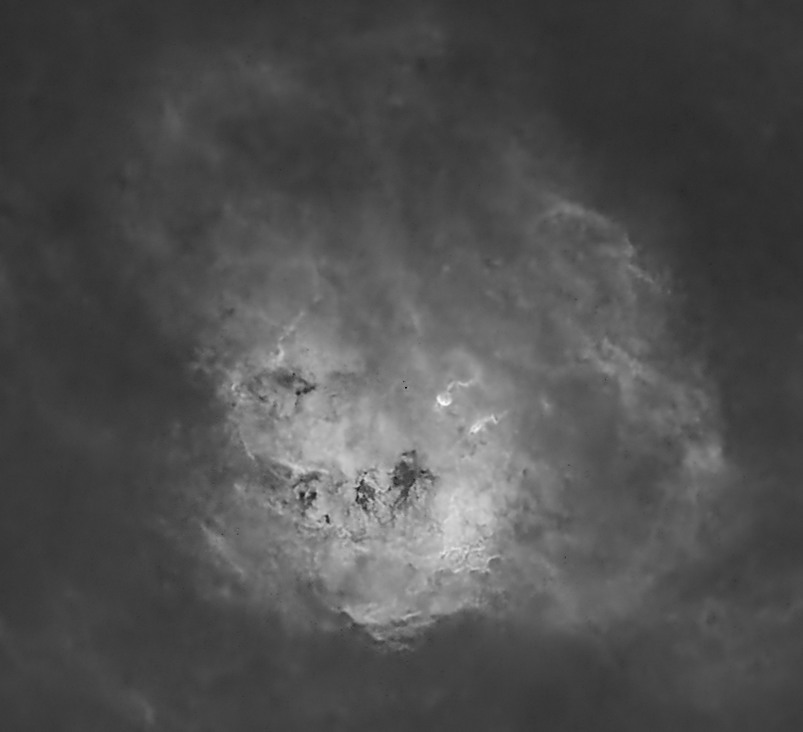
This image has been processed as two SHO versions of the Hubble Palette: (i) a basic mix above and (ii) using a dynamic mix ( main cropped image at top-of-the page).  Once more I have been impressed by the ability of this small camera lens to produce exceptional detail and colours, but especially here with the starless Ha version of IC410, where the signature features or so-called tadpoles have been captured to great effect (see cropped starless Ha version of IC410 below).

 IMAGING DETAILS
ObjectIC 405 The Flaming Star Nebula + IC 410 The Tadpoles Nebula
ConstellationAuriga
Distance1,500 & 12,000 light-years
Size  Approx. 37’ x 10’ & 40’ x 30’
Apparent Magnitude+6.0 & +10
  
Scope  / LensSamyang 135 @f2.8  
MountSW AZ-EQ6 GT + EQASCOM computer control & Cartes du Ciel  
GuidingSky-Watcher EvoGuide 50ED
 + Starlight Xpress Lodestar X2 camera & PHD2 guiding
CameraZWO1600MM-Cool mono  CMOS sensor
 FOV 7.5o x 5.67o Resolution 5.81”/pix  Max. Image Size 4,656 x 3,520 pix   
EFWZWOx8 EFW & 31mm ZWO LRGB & 7nm Narrowband filters  
Capture & ProcessingAstro Photography Tool + PHD2 + PixInsight v1.8.9-1  
Image Location              & OrientationCentre: RA 05:19:54.329      DEC +33:47:12.699                         Right = North   Top = East 
Exposures24 x 300 sec Ha & OIII, 18 x 300 sec SII Total Integration Time: 5 hr 30 min     
 @ 139 Gain   21 Offset @ -15oC    
Calibration10 x 300 sec Darks 20 x Flats & Flat Darks  
Location & DarknessFairvale Observatory – Redhill – Surrey – UK        Typically Bortle 5 – 6  
Date & Time2nd & 9th January 2023 @ +18.30h   
WeatherApprox. <=2oC   RH >=80%                  🌙 +80%  

Supernova Sensation

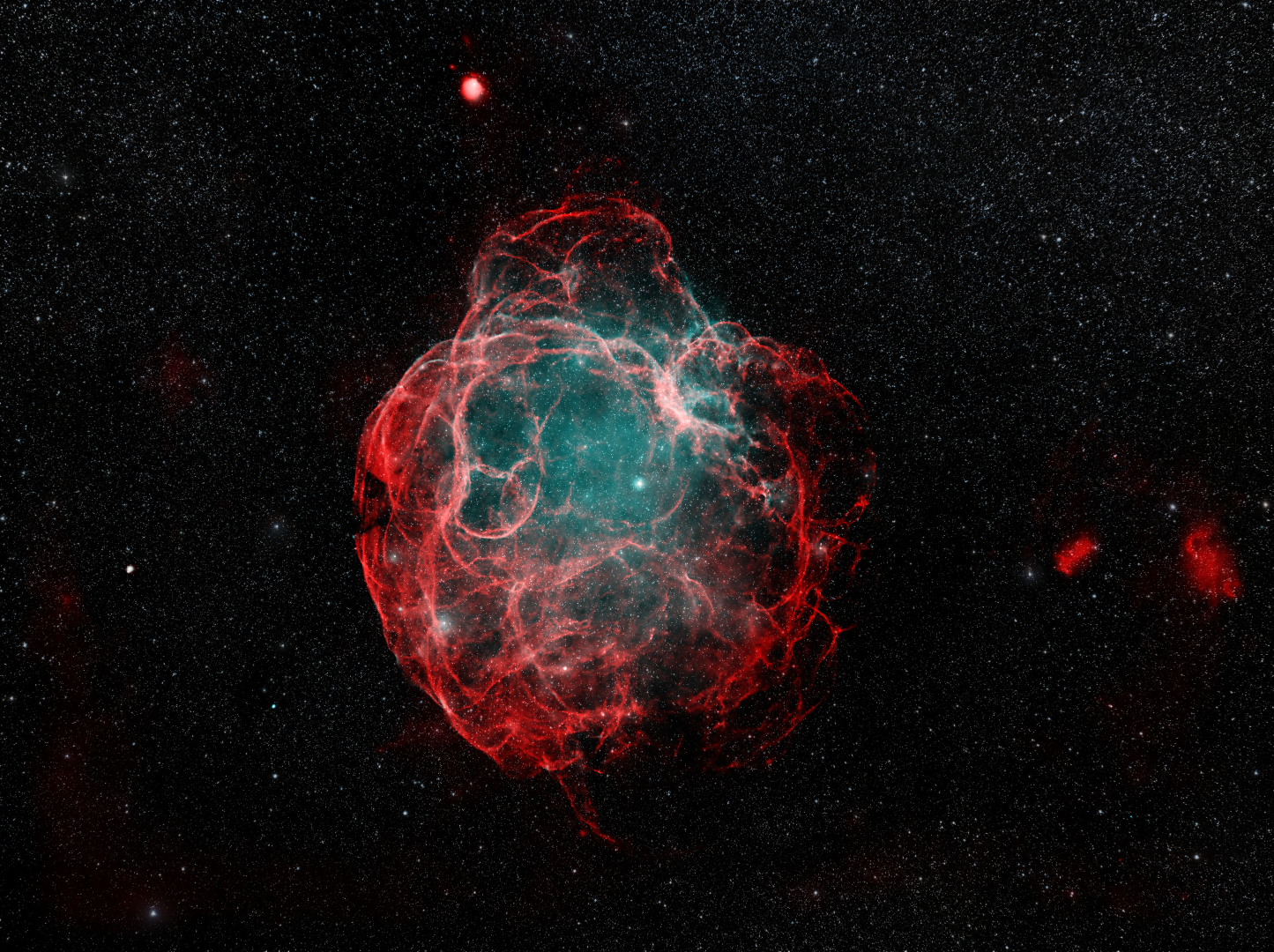
Straddling the boundary of Taurus and Auriga, is the giant supernova remnant (SNR) Simeis-147 AKA SH2-240 or the Spaghetti Nebula.  It is believed that the stellar explosion that created Simeis-147 occurred some 40,000 years ago, leaving behind a rapidly spinning neutron star or pulsar at the core of the now complex, expanding SNR; the nebulous area has an almost spherical shell consisting of numerous filamentary structures.  With an apparent diameter of 3o the SNR spans some 160 light-years, making it a very large astrophotography target.  

I’ve long admired the spectacular SNR Simeis-147 AKA Spaghetti Nebula, which I first imaged with my standard William Optics GT81 scope in January 2022.  The outcome (see image below) was pleasing but with the limited FOV it had to be just a nibble of this large object – something of an appetiser you might say.  Therefore, ever since putting my Samyang rig together last summer I’ve had only one object in mind with this excellent widefield set-up, which had to be the full menu version of Simeis-147!

Apart from its size, Simeis-147 is very faint, making long exposure time essential, which is always difficult in the UK.  However, a rare spell of cold, clear nights this January provided sufficient opportunity over five nights to obtain just over 20-hours integration and a complete image of this truly magnificent SNR.

Notwithstanding the favourable conditions and long-time achieved – a record for me at this location – the faint nature of this object made image processing difficult too.  After experimenting, I eventually adopted a tone mapping technique: pre-processing each individual wavelength stack before removing the stars, stretching and processing each of the starless Ha and OIII images before combining using Pixel Math in the ratio: R – (Ha*1.70) + G – (OIII*0.80)+(Ha*0.20) + B- (OIII*0.80)+(Ha*0.20). 

With further processing of the HOO starless combination I was able to obtain the desired result of marvellous SNR detail, together with pleasing Ha (red) and especially OIII (blue/green) colours, that altogether with the addition of the stars and some final tweaking produced a striking image with good depth.  Moreover, I feel the widefield setting achieved using the Samyang 135 lens produces a striking setting for this fascinating object.


 IMAGING DETAILS
ObjectSimeis 147 / SH2-240  AKA Spaghetti Nebula
ConstellationTaurus
Distance3,000 light-years
Size  Approx. 3.0o
Apparent MagnitudeExtremely faint  
  
Scope  / LensSamyang 135 @f2.8  
MountSW AZ-EQ6 GT + EQASCOM computer control & Cartes du Ciel  
GuidingSky-Watcher EvoGuide 50ED
 + Starlight Xpress Lodestar X2 camera & PHD2 guiding
CameraZWO1600MM-Cool mono  CMOS sensor
 FOV 7.5o x 5.67o Resolution 5.81”/pix  Max. Image Size 4,656 x 3,520 pix   
EFWZWOx8 EFW & 31mm ZWO LRGB & 7nm Narrowband filters  
Capture & ProcessingAstro Photography Tool + PHD2 + PixInsight v1.8.9-1  
Image Location              & OrientationCentre: RA 05:41:15.081      DEC +28:05:32.778                         Right = North   Top = East 
Exposures60 x 600 sec Ha, 62 x 600 sec OIII Total Integration Time: 20 hr 20 min     
 @ 139 Gain   21 Offset @ -15oC    
Calibration5 x 600 sec Darks 20 x Flats & Flat Darks  
Location & DarknessFairvale Observatory – Redhill – Surrey – UK        Typically Bortle 5 – 6  
Date & Time12th 17th 18th 19th & 21st January 2023 @ +18.30h   
WeatherApprox. <=0oC   RH >=80%                  🌙 70% to 0o New Moon  


Feel The Space

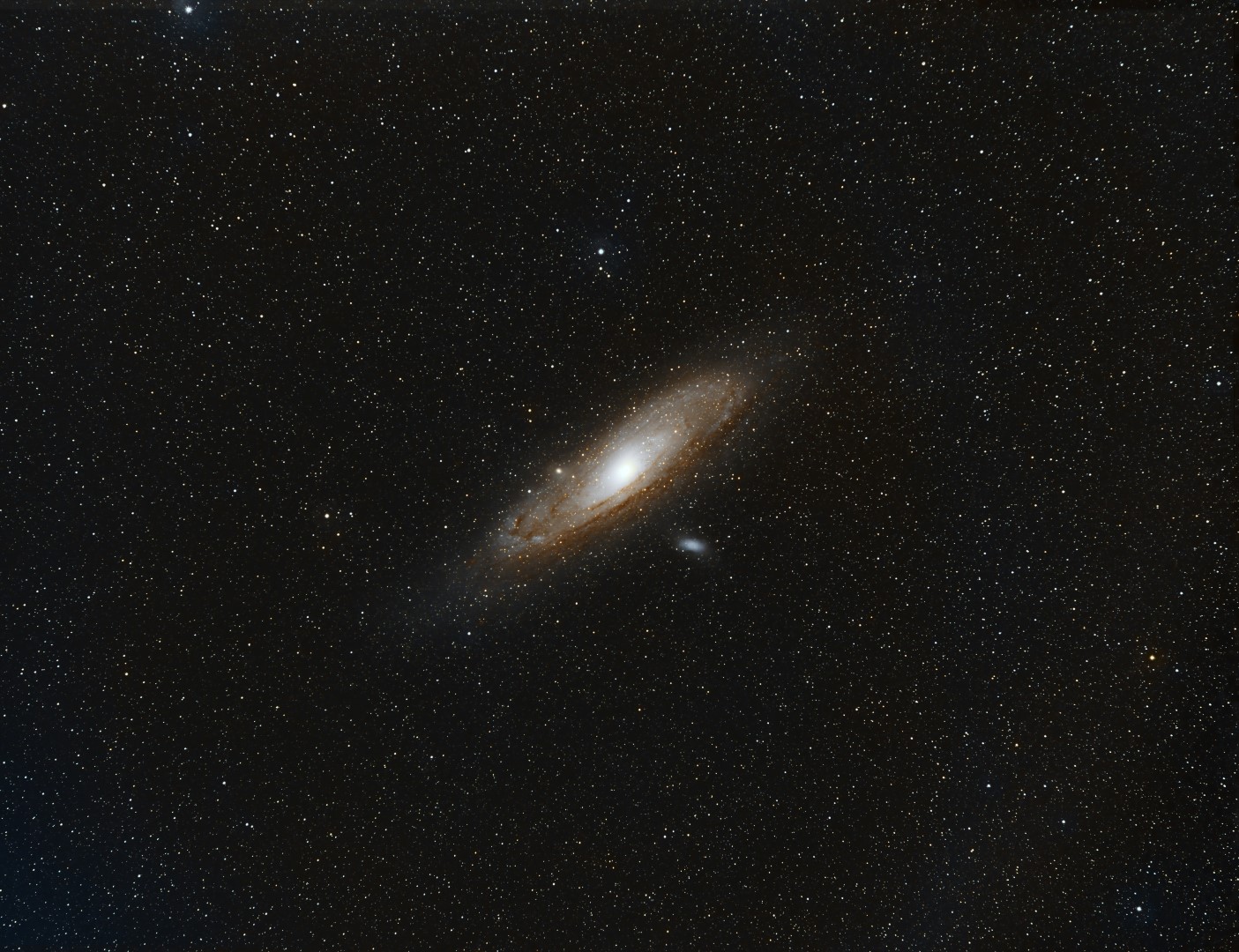
As our closest galactic neighbour, I’ve imaged M31 the Andromeda Galaxy five times since beginning my personal astrophotography journey in 2014, each time using my William Optics GT81 apo refractor – first with a DSLR, then a ASI1600mm-Cool and most recently ASI294MM cameras.  Andromeda is perhaps the perfect object for my equipment, as it just fits the field-of-view of the aforesaid set-up, which produces something of an up-close-and-personal image of this alluring galaxy. But despite the success of these images, perhaps there’s an alternative view?

This year, I therefore deployed my Samyang 135 + ASI1600MM-Cool rig to capture 6 ½ hours of Andromeda, the result of which shows a whole new perspective of M31.  The widefield format of this lens produces greater context than previous images, whilst still obtaining excellent details and colours of the galaxy itself.  As a result, this final image (see above) better reveals the galaxy in its true glory deep in space, which in some ways I believe can be more powerful than the more popular close-up renditions of this impressive object (M31 with star reduction applied to the image below).   

 IMAGING DETAILS
ObjectM31 Andromeda Galaxy
ConstellationAndromeda
Distance2.5 million light-years
Size  3.2o x 1or 220,000 light-years           
Apparent Magnitude+3.44  
  
Scope  / LensSamyang 135 @f2.8  
MountSW AZ-EQ6 GT + EQASCOM computer control & Cartes du Ciel
Guiding Sky-Watcher EvoGuide 50ED
 + Starlight Xpress Lodestar X2 camera & PHD2 guiding
CameraZWO1600MM-Cool mono  CMOS sensor
 FOV 7.5o x 5.67o Resolution 5.81”/pix  Max. Image Size 4,656 x 3,520 pix   
EFWZWOx8 EFW & 31mm ZWO LRGB & 7nm Narrowband filters 
Capture & ProcessingAstro Photography Tool + PHD2 + Deep Sky Stacker, PixInsight v1.8.8-12, Photoshop CC, Topaz Denoise
Image Location              & OrientationCentre:  RA 00:42:34.682      DEC +41:14:06.324                         Right = North   Top = East 
ExposuresL 75 x 60 sec, R 27x  G27x B22 x 180 sec, Ha 17 x 300 sec Total Integration Time: 6hr 28 min     
 @ 139 Gain   21  Offset @ -15oC    
CalibrationDarks, Flats & Flat Darks   
Location & DarknessFairvale Observatory – Redhill – Surrey – UK        Typically Bortle 5-6
Date & Time17th, 21st & 22nd November 2022  @ +20.00h  
WeatherApprox. <=5oC   RH >= 85%                  🌙 approx. New Moon

Diaphanous Delectation

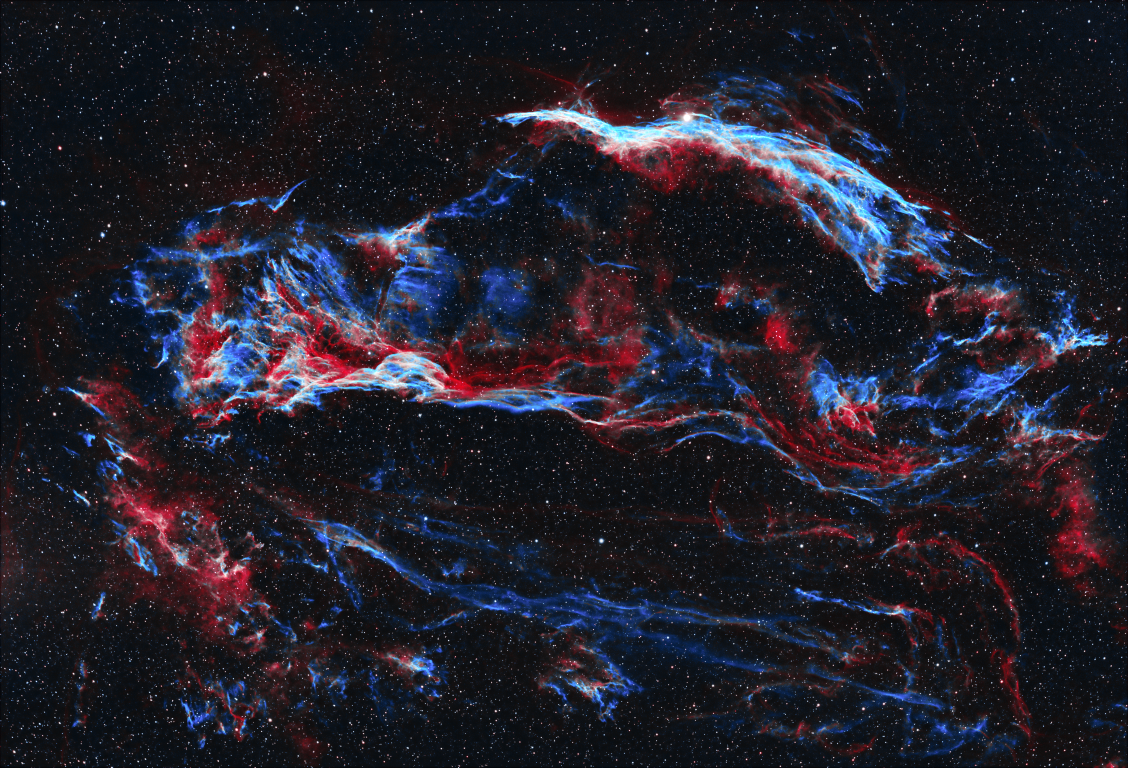
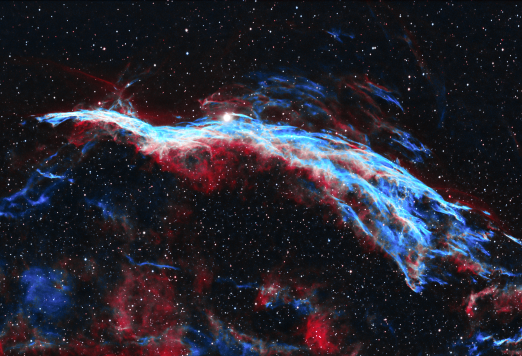
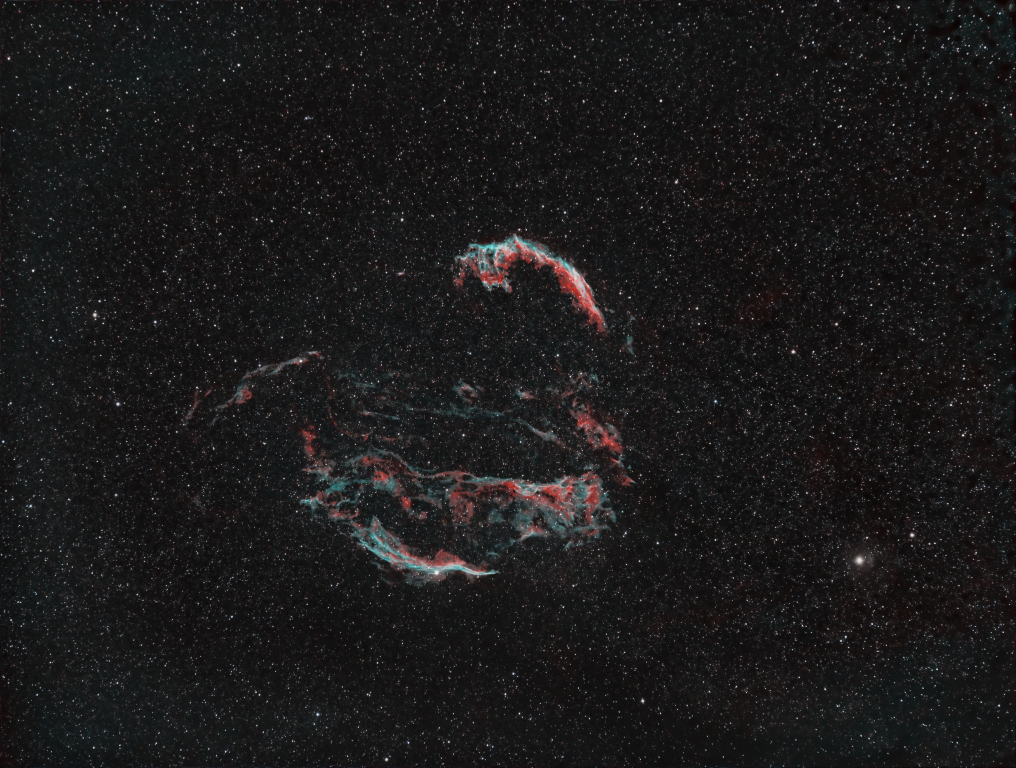
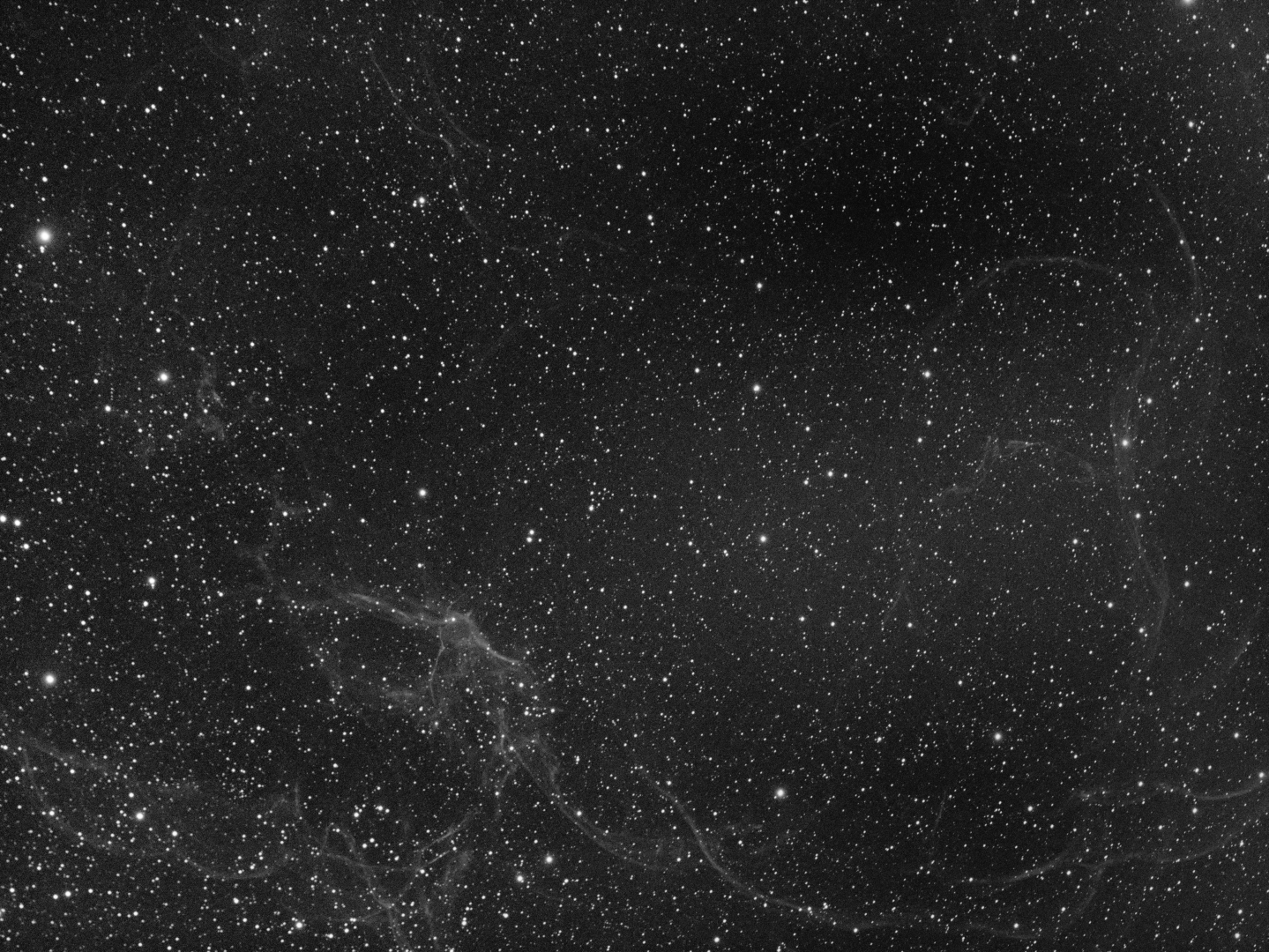
Following my routine summer break from astrophotography, I restarted in early August first using my new Samyang 135 + ZWO ASI1600MM-Cool rig, which immediately demonstrated its ability to produce excellent widefield images of very large objects, in this case the Cygnus Loop.  However, also in late spring I had rejigged my William Optics GT81 telescope with the addition of a new ASI294MM camera, the successor to the ASI1600 which had been redeployed to the aforesaid Samyang rig.  Having constructed, tested and briefly obtained First Light with this new combination, I then had to wait for the return of astronomical darkness and more suitable objects.  Once again, I turned to the Cygnus Loop but this time concentrating on the western and central areas, generally known as the Western Veil and Pickering’s Triangle.

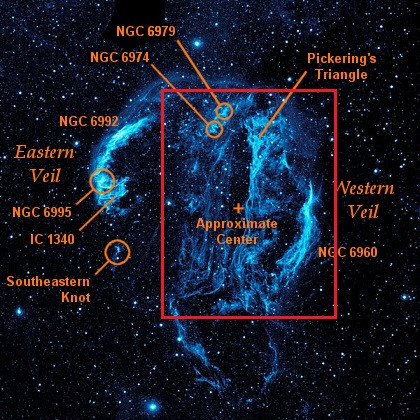
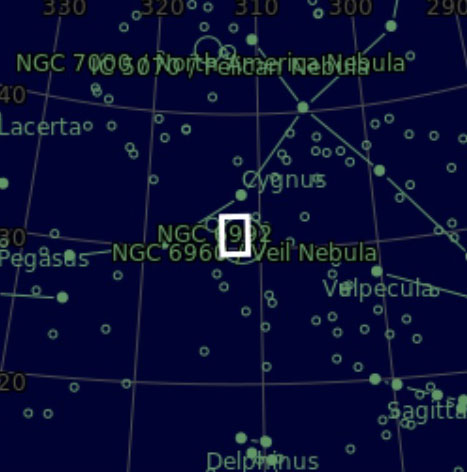
Cygnus Loop Morphology, ID &
Approximate Image Location (Red Box)

Located 1,500 light-years from Earth within the plane of the Milky Way in the constellation of Cygnus, this large supernova remnant (SNR) occurred between 5,000 and 8,000 years ago.  In its entirety the debris cloud has been sculpted by the shock wave from the star’s explosion, to form the Cygnus Loop object that we see today.  The coloured light is created by the excitement of hydrogen (red) and oxygen(blue) gasses of the SNR, which is still expanding at about 100 km (60 miles) per second; image integration times for OIII & Ha wavelengths are in the ratio of 2:1 to enhance the weaker oxygen signal.  More than twice the width of the full moon and spanning 35 light-years, this section of SNR only just fits into my field-of-view but with careful framing it works perfectly.

Western Veil (NGC 6960) Detail
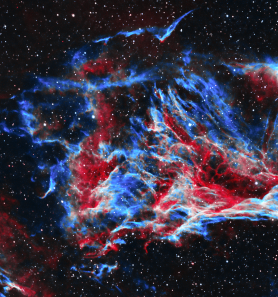
Pickering’s Triangle Detail

The resulting image successfully brings out the exquisite nature of this exciting SNR, in particular highlighting the abundant waveforms that run throughout the entirety of this dynamic object.  Furthermore, the combination of the new ASI294MM camera and 3nm Chroma filters, has produced a vibrant red-blue colour palette that further enhances the said structures.  Altogether this diaphanous delectation convincingly demonstrates the power and beauty of the Universe whilst, moreover, pointing to a new level for my astrophotography.          

Image Location & Orientation
 IMAGING DETAILS
ObjectCygnus Loop Section: Western Veil Nebula (NGC 6960),  
Pickering’s Triangle, NGC 6979 & 6974
ConstellationCygnus
Distance1,500 light-years
Size  ~2.9o total
Apparent Magnitude+7.0  
  
Scope William Optics GT81 + Focal Reducer FL 382mm  f4.72
MountSW AZ-EQ6 GT + EQASCOM computer control & Cartes du Ciel
GuidingWilliam Optics 50mm guide scope
 + Starlight Xpress Lodestar X2 camera & PHD2 guiding
CameraZWO ASI294MM  CMOS sensor
 FOV 2.87o x 1.96o Resolution 2.50”/pix 
Max. image size 4,144 x 2,822 pix   
EFWZWOx8 EFW & 31mm Chroma LRGB filters 
Capture & ProcessingAstro Photography Tool + PHD2 + Deep Sky Stacker,
PixInsight v1.8.8-12, Photoshop CC v23.5.0
Image Location &      OrientationCentre = RA 20:48:47.0      DEC +31:00:54.7                         Left = North     
ExposuresHa 41 x 300 sec (3hr 25m), OIII 82 x 300 sec (6hr 50m) Total Integration Time: 10hr 15 min     
 @ 120 Gain   30 Offset @ -15oC    
Calibration5 x 300 sec Darks  15 x  LRGB Flats & Dark Flats         @ ADU 32,000
Location & DarknessFairvale Observatory – Redhill – Surrey – UK        Typically Bortle 5-6
Date & Time27th + 29th + 30th + 31st August 2022  @ +21.00h  
WeatherApprox. <18oC   RH >=65%                  🌙 0% New

Shrinking The Universe

Hitherto, most of my astrophotography has concentrated on a variety of specific objects that work within the 2.65o x 2.0o field-of-view provided by the combination of my William Optics GT81 refractor and ZWO ASI1600MM-Cool camera.  After recently pairing the aforesaid ZWO mono camera with a Samyang 135 lens (often marketed elsewhere as the Rokinon 135) my astrophotography world has expanded dramatically to an enormous 7.50o x 5.67o, some x8 larger than before.  As a result, this excellent lens that also captures great detail, provides new opportunities to image some of the very large features that abound throughout the Universe without having to resort to a mosaic imaging; this a great advantage when working in UK weather conditions which usually provides less imaging time than required. 

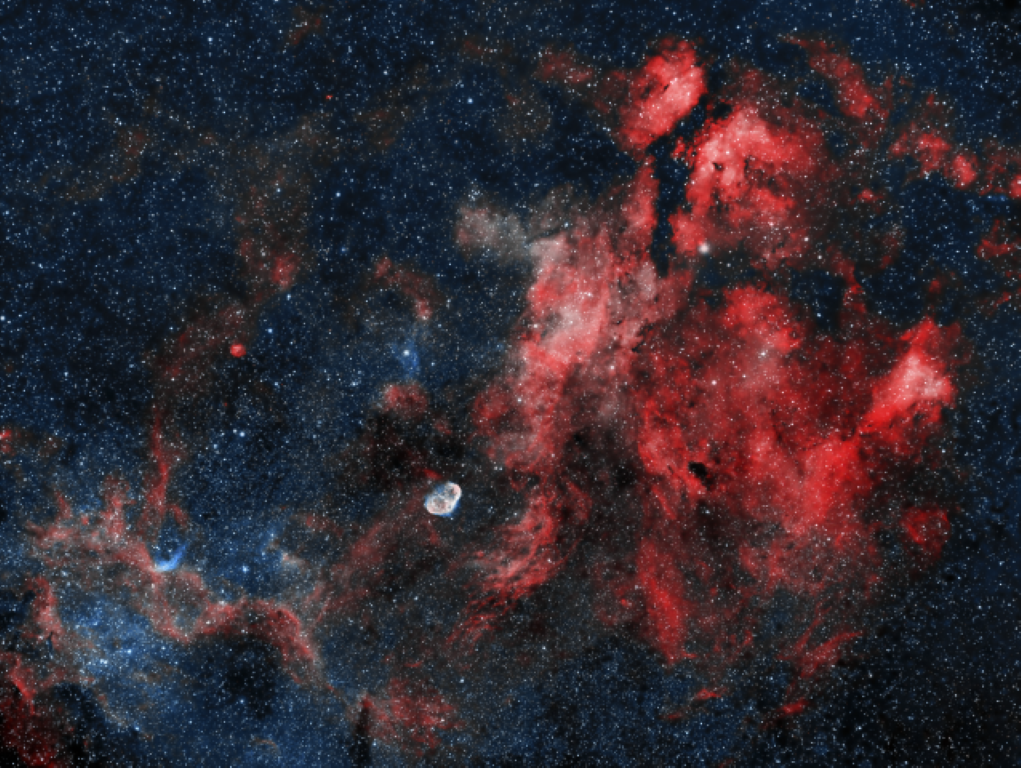
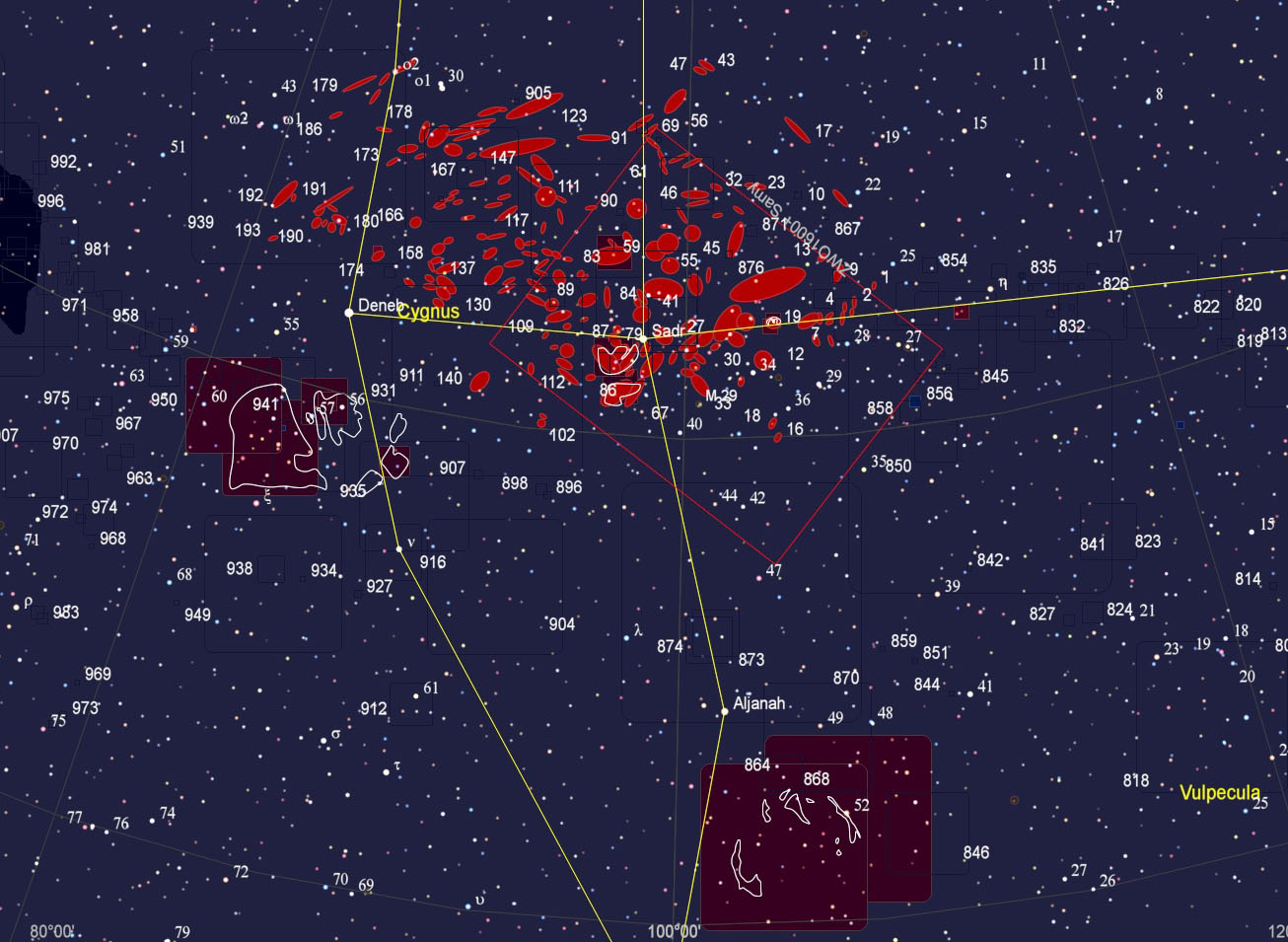
Above, Cygnus-X Region & notable nearby objects: The red box appproximately outlines the image area, which in this plan is presented upside-down compared to the main image. The numerous red shapes define the location of the HII objects that make up the DWB catalogue (19 is the Crescent nebula). Just beyond to the left is the North America Nebula (NGC7000) and below the SNR Cygnus Loop, AKA the Veil Nebula (NGC 6960 & 6992).

In this case I chose to frame the image in such a way as to encompass some familiar objects, such as the Butterfly Nebula (IC1318) and the Crescent Nebula (NGC6888) anchored by Sadr, the yellow-white supergiant star that stands out from within the very large Cygnus-X region.  Processed here in HOO, with 6-hours integration time and full calibration (darks, flats & flat darks), the final image provides a magnificent view of this large, interesting region that augurs well for future widefield imaging with this new rig.  I’m particulalry intrigued by the bluish feature at about 8.0 o’clock of the Crescent Nebula, which I now believe to be associated with WR-134: a bubble-like structure some 50 light-years in diameter consisting of OIII rich light formed by an intense wind emanating from the Wolf-Rayet star at it’s centre. The breadth of view it provides can encompass myriad of objects in exceptional detail, thereby providing a wider context that is simply awe-inspiring to see – it’s just like shrinking the Universe!


Astrometry image plan
 IMAGING DETAILS
ObjectSadr Region
ConstellationCygnus
Distance+5,000 light-years
Size Full FOV – see below            
Apparent Magnitude+/- 7.0
  
Scope  / LensSamyang 135 @f2.8  
MountSW AZ-EQ6 GT + EQASCOM computer control & Cartes du Ciel
GuidingSky-Watcher EvoGuide 50ED
 + Starlight Xpress Lodestar X2 camera & PHD2 guiding
CameraZWO1600MM-Cool mono  CMOS sensor
 FOV 7.5o x 5.67o Resolution 5.81”/pix  Max. Image Size 4,656 x 3,520 pix   
EFWZWOx8 EFW & 31mm ZWO LRGB & 7nm Narrowband filters 
Capture & ProcessingAstro Photography Tool + PHD2 + Deep Sky Stacker, PixInsight v1.8.8-12, Photoshop CC, Topaz Denoise
Image Location & OrientationCentre  RA 20:16:40.452      DEC +38:50:14.404                         Right = North   Top = East 
Exposures36 x 500 sec Ha, 36 x 300 sec OIII Total Integration Time: 6hr      
 @ 139 Gain   21  Offset @ -10oC    
Calibration5 x 300 sec Darks  15 x Flats & Flat Darks
Location & DarknessFairvale Observatory – Redhill – Surrey – UK        Typically Bortle 5-6
Date & Time10th & 12h August 2022  @ +22.00h  
WeatherApprox. 25oC   RH 50 – 60%                  🌙 100% Full Moon

A New Perspective

It’s been nearly two years since acquiring my Samyang 135 lens but since then it’s unfortunately only had limited use in combination with my modded 550D DSLR.  Whilst impressed with the results from this set-up, my main objective has always been to combine it with my ASI1600 mono camera for some serious widefield astrophotography but as that was being used with my William Optics refractor it just didn’t happen, until now.  After upgrading to a ASI294MM Pro camera in May, at last I was finally able spend the early part of this summer working on a new Samyang 135 + ASI1600 rig and now that astronomical darkness is (just) back I recently managed to catch a few photons with this new set-up of the large SNR Cygnus Loop.

I originally purchased a x2-ring Astrokraken 3D-printed clamping system for the lens + DSLR combination from Philippe in France but since then he’s tweaked the design.  In particular x3 built-in M4 nuts have been incorporated on either side of each of the two main lens clamping rings, for the purpose of attaching ancillary equipment, which for me has been a game changer.  I therefore bought a new x3-ring Astrokraken bracket, with the said bolt holes, around which to build my new rig: 

  • The two main clamping rings that hold the lens have a shoe immediately above the lens, to which I’ve fitted a Sky-Watcher EvoGuide 50ED guidescope (not yet working), with the rear third ring holding the ASI1600 mono camera & EFW. 
  • I swapped the Canon lens bayonet adapter for a bespoke M42 screw adapter, in order to ensure a more secure attachment, thus reducing any potential lens-camera movement at this critical point of the image train.  
  • I’m continuing to use the excellent Astrokraken micro-focuser, which consists of a ring that clamps onto to the lens’ focus ring, with two small bolts above that make contact with either side of the guidescope shoe, so that when turned the focus ring can be adjusted either way to obtain focus, which is then locked when completed.  So far I’ve found the micro-focuser to work very well with this lens, assisted by the addition of an Astrokraken Bahtinov mask which is inserted into the front of the lens casing.  
  • Using this lens with the ZWO ASI1600MM-Cool camera and EFW, the backfocus guideline is 44mm, which I was able to achieve by adding an Altair T2 variable locking extension ring set to 17.5mm = 44mm minus 26.5 (camera + EFW).  
  • With my Chroma filters now being used with the new ASI294MM Pro camera, I purchased another ZWO 31mm x8 EFW and brought my ZWO 31mm filters out of retirement. 
  • Finally, using the new M4 nut holes I’ve added a Baader Skysurfer III RDF on the left-hand side of the Astrokraken bracket system to help with sky navigation and framing. 

After bolting the Astrokraken with the lens, camera and said components to a Losmandy plate it makes a very nice compact rig, that is easy to handle and store.  Notwithstanding, as they say – the proof of the pudding is in the eating: SEE top-of-the page for original image & below for 50% crop.  

Whilst the recent heatwave produced clear skies, it was far from ideal here for astronomy and was further hampered by a full moon.  However, with only just over two hours integration time and a few Dark calibration files, I’m still impressed with the outcome of this quite amazing lens.  It is very pleasing to capture the entire Cygnus Loop comfortably sitting within the lens’ FOV – for information on this FOV and comparisons go to this previous WTSM blog HERE.  For me context is important with astrophotography and in this regard the astronomical perspective this lens produces is outstanding, no wonder it is so popular.  I just love working with this FOV and can’t wait for better conditions for greater integration time and more widefield targets to point this wicked little lens at.

 IMAGING DETAILS
ObjectCygnus Loop
ConstellationCygnus
Distance2,400 light-years
Size  3.0o
Apparent Magnitude+7.0  
  
Scope  / LensSamyang 135 @f2.8  
MountSW AZ-EQ6 GT + EQASCOM computer control & Cartes du Ciel
Guiding – Not UsedSky-Watcher EvoGuide 50ED
 + Starlight Xpress Lodestar X2 camera & PHD2 guiding
CameraZWO1600MM-Cool mono  CMOS sensor
 FOV 7.5o x 5.67o Resolution 5.81”/pix  Max. Image Size 4,656 x 3,520 pix   
EFWZWOx8 EFW & 31mm ZWO LRGB & 7nm Narrowband filters 
Capture & ProcessingAstro Photography Tool + PHD2 + Deep Sky Stacker, PixInsight v1.8.8-12, Photoshop CC, Topaz Denoise
Image Location        & OrientationCentre  RA 20:52:28.01      DEC +31:14:56.186                         Right = North   Top = East 
Exposures27 x 180 sec Ha, 20 x 180 sec OIII Total Integration Time: 4hr 21 min     
 @ 139 Gain   21  Offset @ -10oC    
Calibration5 x 180 sec Darks  
Location & DarknessFairvale Observatory – Redhill – Surrey – UK        Typically Bortle 5-6
Date & Time9th & 10h August 2022  @ +22.00h  
WeatherApprox. 27oC   RH <=50%                  🌙 96% Full Moon

Veil Of Darkness

Just northeast of the Pleiades star cluster within the northern Milky Way, lies the dark region of the Taurus Molecular Cloud (TMC), which at 430 light years is the nearest star-forming region to Earth.  Consisting of hundreds of solar masses of primordial hydrogen and helium gas, as well as heavier elements, this vast area of dense stardust obscures almost all light from behind.  As such it forms an alluring target for astrophotography, with the complex rift-like dark structure of the TMC set against the broad starry background of the Taurus constellation. 

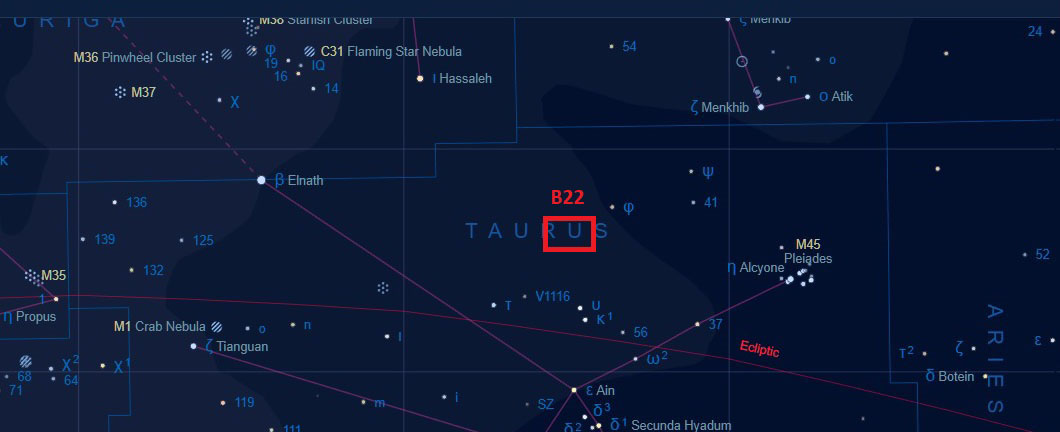
Approximate Image Location

Notwithstanding, perhaps because of the more popular objects that abound throughout its neighbour the Orion constellation, the TMC is somewhat neglected by astronomers; to be fair the TMC is also a more challenging imaging target than many of those found in Orion.  Early this year, for the first time I decided to image the dark nebula Barnard 22, an iconic section of the TMC formed by a complex mass of dark stardust that appears to hang within the vast surrounding starfield.

Approaching the new moon in late January I obtained almost 11 hours of LRGB subs, though sadly was unable to incorporate another 6-hours of 10-minute luminance exposures which proved to be too bright to use: note-to-self – check settings for new objects before embarking on long imaging programme! To achieve a balance between the large black smudge that is B 22 and the brilliance of the surrounding stars processing was tricky but the final outcome satisfying.  Also noteworthy in the image, just off centre is the small flame-shaped reflection nebula IC 2087, the light from which just manages to emerge from behind the otherwise dominant, though beguiling form of Barnard 22, which like night itself seems to casts a dark veil over the cosmos.

 IMAGING DETAILS
ObjectsBarnard 22 dark nebula & IC 2087 reflection nebula
ConstellationTaurus
DistanceApprox.. 430 light years
Size
Apparent MagnitudeVaries  
  
Scope William Optics GT81 + Focal Reducer FL 382mm  f4.72
MountSW AZ-EQ6 GT + EQASCOM computer control & Cartes du Ciel
GuidingWilliam Optics 50mm guide scope
 + Starlight Xpress Lodestar X2 camera & PHD2 guiding
CameraZWO1600MM-Cool mono  CMOS sensor
 FOV 2.65o x 2.0o Resolution 2.05”/pix  Max. image size 4,656 x 3,520 pix   
EFWZWOx8 EFW & 31mm Chroma LRGB filters 
Capture & ProcessingAstro Photography Tool + PHD2 + Deep Sky Stacker, PixInsight v1.8.8-12, Photoshop CC, Topaz AI DeNoise
Image Location &     OrientationCentre  RA 04:39:00.365      DEC +26:00:13.426                         Lower Left = North     
Exposures120 x 180 sec L, 19 x 300 sec R, 20 x 300 sec G & B Total Integration Time: 10hr 55 min     
 @ 139 Gain   21  Offset @ -20oC    
Calibration10 x 60 sec Darks  15 x  LRGB Flats & Dark Flats         @ ADU 25,000
Location & DarknessFairvale Observatory – Redhill – Surrey – UK        Typically Bortle 5-6
Date & Time27th 29th 31st January + 4th & 6th February 2022 @ +18.30h  
WeatherApprox. <4oC   RH >=75%                  🌙 around New Moon

Cosmic Spaghetti

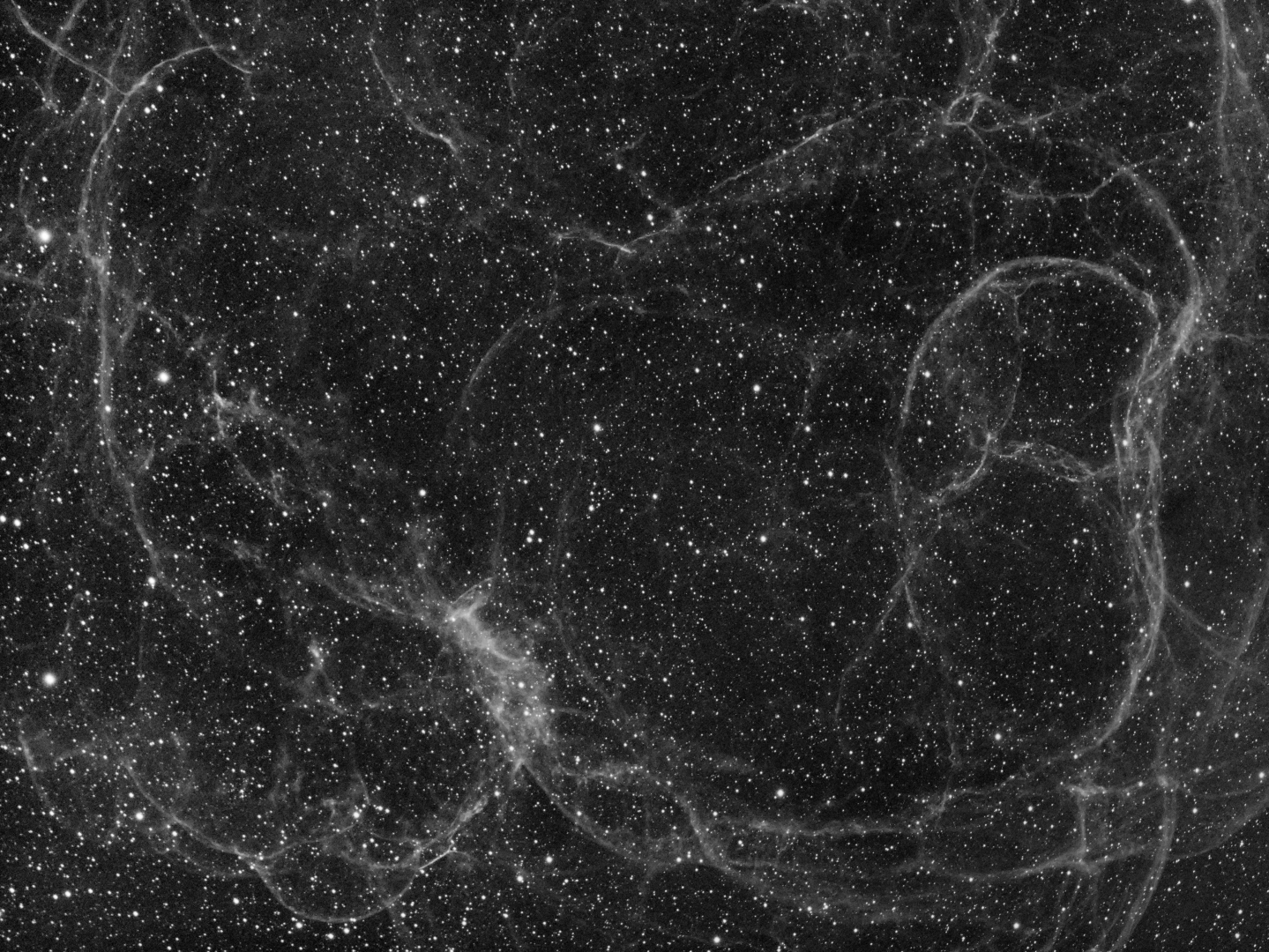
Long on my to-do list has been the spectacular Simeis 147, also known as SH2-240 or the Spaghetti Nebula.  A large supernova remnant (SNR) spanning the border between the Taurus and Auriga constellations, which despite its size is one of the faintest objects in the night sky and therefore not an easy astrophotography target.  Moreover, given my equipment’s field-of-view the large size of the SNR would require a mosaic to fully image, which is generally out of the question here at Fairvale Observatory with the limited clear sky conditions that prevail hereTherefore, for the moment I’ve concentrated on a close-up area of the southern lobe, imaged and processed in HOO narrowband to highlight the beautiful complexity of this cosmic cataclysm that is the product of a massive stellar explosion that took place some 40,000 years ago.

Simeis 147 Location

Furthermore, imaging was not helped by the presence of a waning full moon and even with 10-minute exposures, only very limited detail was evident in the Ha wavelength and none in OIII, thus also making framing tricky.  However, with over 12-hours integration time eventually obtained over four nights and very careful processing, my first image of this wonderful SNR does not disappoint.  I hope to return to this magnificent object again in the future to add more exposures – you really cannot have too many – and perhaps eventually capture this bowl of cosmic spaghetti in its entirety one day too.

Ha Stack 6-hours 30 mins
OIII Stack 5-hours 40 mins
 IMAGING DETAILS
ObjectSimeis 147  AKA SH2-240 or Spaghetti Nebula
ConstellationTaurus
Distance3,000 light-years
Size Total object +3.0o
Apparent MagnitudeExtemely faint
  
Scope William Optics GT81 + Focal Reducer FL 382mm  f4.72
MountSW AZ-EQ6 GT + EQASCOM computer control & Cartes du Ciel
GuidingWilliam Optics 50mm guide scope
 + Starlight Xpress Lodestar X2 camera & PHD2 guiding
CameraZWO1600MM-Cool mono  CMOS sensor
 FOV 2.65o x 2.0o Resolution 2.05”/pix  Max. image size 4,656 x 3,520 pix   
EFWZWOx8 EFW & 31mm Chroma 3nm Ha, OPIII & SII filters 
Capture & ProcessingAstro Photography Tool + PHD2 + Deep Sky Stacker, PixInsight v1.8.8-12, Photoshop CC, Topaz AI Denoise
Image Location              & OrientationCentre  RA 05:41:28.486      DEC +28:01:51.616                      Left = North  Top = West    
Exposures39 x 10 min Ha, 34 x 10 min & 9 x 10 min SII Total Integration Time: 12 hr 10 min     
 @ 139 Gain   21  Offset @ -20oC    
Calibration5 x 10 min Darks, 15 x  Ha, OIII, SII flats and Flat Darks      @ ADU 25,000
Location & DarknessFairvale Observatory – Redhill – Surrey – UK        Typically Bortle 5-6
Date & Time21st December 2021 + 4th, 5th & 6th January 2022  @ +19.00h  
WeatherApprox. <2oC   RH >=80%              🌙 96% → 21%

2021 The Year In Pictures

Every year since 2014 I’ve published a retrospective blog of my astrophotgraphy year just ending called Reflections. It’s been a useful task that enables me to bring together the best and sometimes the worst of my images, in order to consider the good and bad points + progress made + set some objectives for the coming year. Eight years on, after which I believe I’ve now reached at least a respectable level of imaging and processing, I’ve decided to stop this format for the time being.

Notwithstanding, at this time of the year I also produce an astrophotography calendar for members of my family, which consists of the better images from the year just ending; I think they like them and certainly all use the calendar during the coming year. Moreover, I also recently started to compile a video of the said calendar images set to appropriate music, which we all watch together prior to seeing the actual calendar. It’s a great way to present the images, which look really stunning on today’s large Smart TV’s and is fun to watch with the family too.

The video for this last year 2021 can be viewed on YouTube HERE and below is a brief very general overview of each image. More detailed background information and imaging details for those interested can be found in relevant blogs posted on this site during the past year.

2022 CALENDAR

A new set of filters, improved processing techniques and access to data from a telescope at a dark sky site in New Mexico, USA (shown by an asterisk *) contributed to an exciting astrophotography year in 2021.                  

FRONT COVERThe Carnival of Animals: Special processing of the inner region of the Rosette Nebula highlights the ‘animals’ or Bok Globules – clouds of dust undergoing gravitational collapse as part of the process of new star formation.  
JANUARYLDN-1250 Dark Nebula*: Dark or absorption nebulae are a type of interstellar cloud which are so dense they obscure or absorb visible light emitted from objects behind or within and thereby contrast with the general light flux of the Universe as dark areas.  
FEBRUARYCTB-1 Supernova Remnant*: The overall structure of this supernova remnant is that of a circular shell, with a conspicuous rupture towards the north (lower right of image).  The main red Ha-shell is composed of multiple interlocking filament limbs, with a blue / green OIII arc along one side.  
MARCHJellyfish Nebula: Locatedin the Gemini constellation some 5,000 light years from Earth, this is a remnant of a supernova that took place during the past 30,000 years. With a diameter of 70 light-years, the object is visually speaking nearly twice the size of a full moon.     
APRILMarkarian’s Chain: The Virgo cluster consists of more than 2,000 galaxies, within which Markarian’s Chain forms a J-curve string of bright galaxies that share a common motion through space.    
MAYM13 Great Globular Cluster of Hercules*: Consisting of several hundred thousand stars and 145 light-years in diameter, M13 is considered to be the finest cluster in the Northern Hemisphere.  
JUNECave Nebula*: Located along the plane of the Milky Way is the diffuse emission nebula referred to as the Cave Nebula.  The Cave at the centre is critically located at the boundary of the Cepheus molecular cloud and the hot, young stars which ionize the surrounding gases to great effect.  
JULYOrion Widefield: Framed around the area of Orion’s Belt, the Horsehead Nebula and the Great Orion Nebula, look hard and the refection nebula M78 can also be seen in the lower left corner.    
AUGUSTElephant’s Trunk Nebula*: A very large emission nebula, the so-called Elephant’s Trunk Nebula is rightly viewed as one of astrophotography’s most iconic images. The ‘trunk’ itself dominates the centre of this image and is illuminated from behind by a bright star forming region.  
SEPTEMBERM31 Andromeda Galaxy: The full benefit of new filters, improved guiding, clear skies over 6-nights and extensive use of new processing techniques can be seen in my best image yet of Andromeda.      
OCTOBERButterfly Nebula: Situatedwithin the Orion Arm of the Milky Way is the Gamma Cygni nebula, a diffuse emission nebula surrounding the star Sadr.  Either side of the dark rift which divides the image from top to bottom are two large bright areas that together form the so-called Butterfly.  
NOVEMBERM33 Triangulum Galaxy: Like it’s neighbour Andromeda, better data and processing has produced an exciting new image of M33 this year, the red areas highlight Ha-rich star-forming regions  
DECEMBERFlying Bat & Giant Squid Nebula*: This very faint OIII emission nebula Ou4 required an imaging time of 40-hours.  For obvious reasons Ou4 has become known as the Giant Squid Nebula which, moreover, lies within the much larger SH2-129 HII emission region or the Flying Bat Nebula.     

HAPPY NEW YEAR + CLEAR SKIES IN 2022

Reach For The Stars

Preceding the arrival of what is for many astronomers the highlight of the year, the Orion constellation and all it’s objects, is the appearance of the majestic Pleiades open star cluster (Messier 45) in the constellation of Taurus.  The so-called Seven Sisters consists of hot blue luminous stars that formed during the past 100 million years, which are expected to last another 250 million years and can be easily observed with the naked eye even here at Fairvale Observatory (Bortle 5/6).  

I have imaged this exciting star cluster before but with astrophotography and especially iconic objects such as the Pleiades, one is always drawn back for another try.  Now armed with Chroma filters and a growing list of PixInsight skills acquired since last imaged late in 2018, I wanted to tease out more details of the fine wispy dust cloud through which the Sisters are passing and forms the signature of all good Pleiades’ images.  Furthermore, with longer exposures and total integration time greater than before, maybe I could also capture something of the abundant interstellar dust that is present across the wider background?  

I am therefore very pleased that the final image (top of the page + cropped version above) which has more than achieved these objectives and marks a significant improvement on my previous attempts – it’s always worth trying that little bit more.

 IMAGING DETAILS
ObjectM45 The Pleiades AKA Seven Sisters
ConstellationTaurus
Distance444 light-years
Size110’
Apparent Magnitude+1.6
  
Scope William Optics GT81 + Focal Reducer FL 382mm  f4.72
MountSW AZ-EQ6 GT + EQASCOM computer control
GuidingWilliam Optics 50mm guide scope
 + Starlight Xpress Lodestar X2 guide camera & PHD2 control
CameraZWO1600MM-Cool (mono)   CMOS sensor
 FOV 2.65o x 2.0o Resolution 2.05”/pix  Max. image size 4,656 x 3,520 pix   
EFWZWO x8 EFW & Chroma 31mm LRGB filters 
Capture & ProcessingAstro Photography Tool + Deep Sky Stacker PixInsight v 1.8.8-11,  Photoshop CS3, Topaz AI Denoise
Image Location & Orientation Centre: RA 03:47:03  DEC 24:03:08  Top = North   Right = West   
Exposures12 x 300 sec LRGB   Total time: 4 hours   
 @ 139 Gain   21  Offset @ -20oC    
Calibration5 x 300 sec Darks  15 x Flats & Dark Flats LRGB    @ ADU 25,000  
Location & DarknessFairvale Observatory – Redhill – Surrey – UK        Typically Bortle 5
Date & Time6th  December 2021 @ +19.15h  
Weather & MoonApprox. <=4oC      RH >=85%          🌙 New Moon