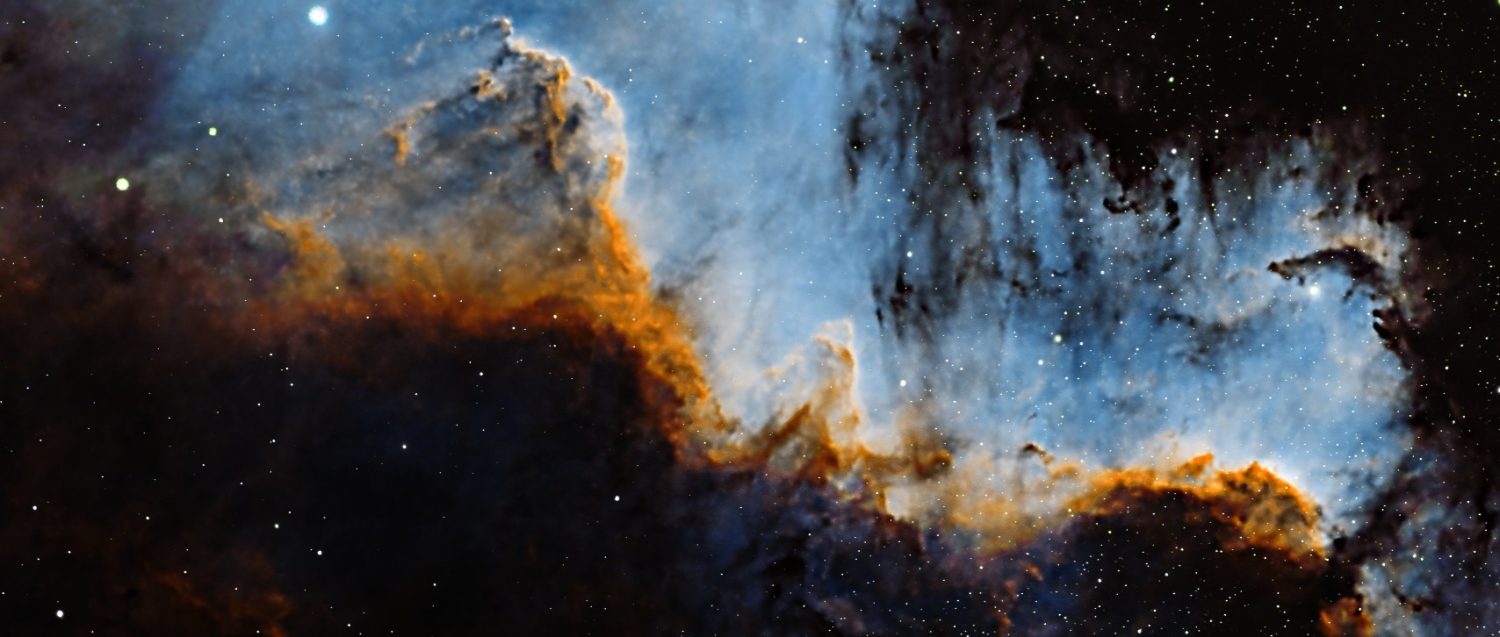
2025 The Year In Pictures

The year 2025 was like no other.  Starting with a knee replacement operation in January, shortly after we finally found a new house in March and moved to the lovely dark skies of Somerset at the end of June.  Unfortunately, the ensuing turmoil left only a limited time for astronomy.  Notwithstanding, I was able to supplement images from Redhill and our new home in Wookey, with some excellent data from Texas, USA and Chile to produce, what I hope you will agree, is an exciting 2026 calendar. 
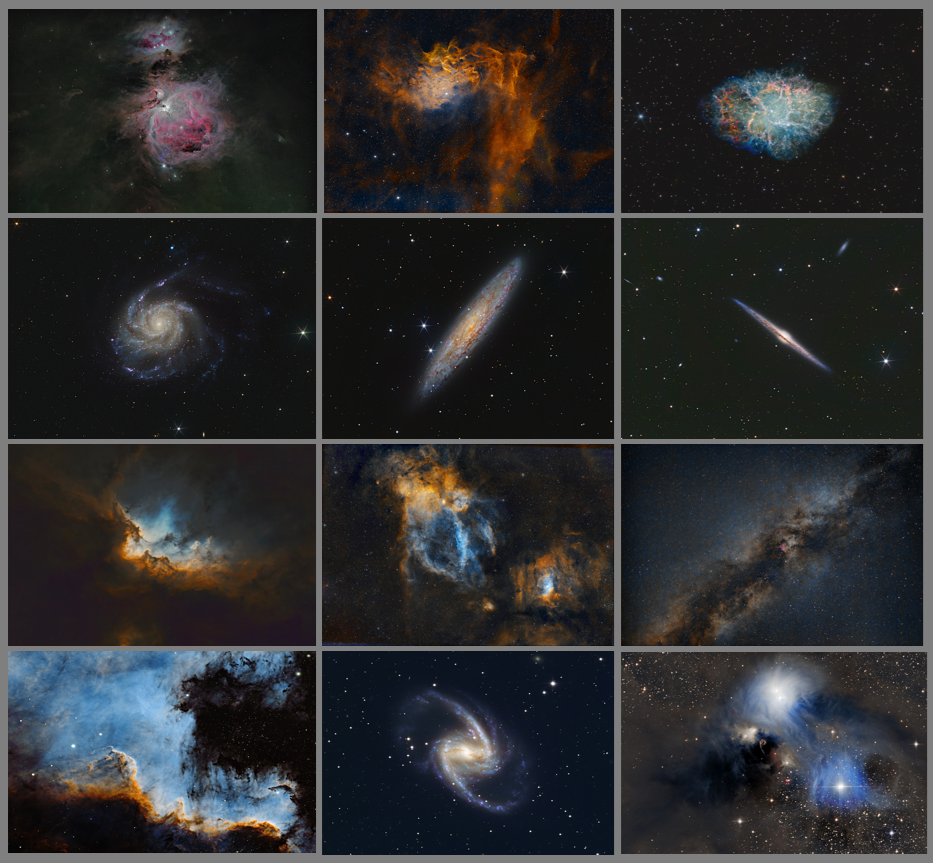
For other pictures and information, go to my website https://watchthisspaceman.com/ or a video of the calendar can be found here on YouTube https://www.youtube.com/watch?v=gn3ls_s71lQ   and is best accessed on a PC or smart TV screen. Background music this year is Massive Attack’s track Atlas Air.

 COVERNIGHT SKY MONTAGE AT CASTLE FARM OBSERVATORY:

All these images (at the top of the page) were taken at various times from the same location at our house in Wookey, Somerset.  Clockwise from bottom left: (1) Nightscape of a small coppice looking south (2) Double Cluster – a pair of open star clusters in the Perseus constellation (3) Star trails (4) Sunset looking west. 

JANUARYTHE GREAT ORION NEBULA, M42 (1)
 
The Orion Nebula is a gigantic cosmic cloud of interstellar dust and gas, which is the basis for the birth of numerous new stars or a “star nursery”.  Being the brightest nebula in the northern hemisphere and just over 1,300 light-years distance from Earth, it can be seen with the naked eye on a clear night.
FEBRUARYFLAMING STAR NEBULA, IC405 (1)
 
This nebula is illuminated by a powerfully bright blue variable star, AE Aurigae. The object’s epithet comes from the brightly lit ripples of gas and dust at the top of the image, illuminated by AE Aurigae and glowing hydrogen gas. This “runaway star” was ejected by a collision two million years ago from the Triangulum region of The Great Orion Nebula.
MARCHCRAB NEBULA, M1 (3)
 
This small but beautiful supernova Remnant (SNR) was the result of the explosion of the star CM Tau just over 970 years ago.  Located at the centre of the nebula, the remaining Crab Pulsar neutron star spins at the rate of 30 times per second.        
 
APRILPINWHEEL GALAXY, M101 (3)
 
At nearly twice the size of the Milky Way and containing at least an estimated trillion stars, M101 is the second largest galaxy of the Messier catalogue and certainly one of the highlights of the spring galaxy season. 
MAY SCULPTOR GALAXY, NGC 253 (3)
 
One of the advantages of obtaining data from Texas, USA, is that it enables views of objects in the Southern Hemisphere that are impossible from the UK.  Also known as the Silver Dollar, it is one of the brightest galaxies in the night sky, which results from very high rates of star formation that are fed by the abundance of thick dust lanes.
 
JUNENEEDLE GALAXY, NGC 4546 (3)
 
Seen edge-on from Earth, the Needle Galaxy is thought to be a barred spiral galaxy, some 33% larger than the Milky Way. It has at least two satellite galaxies and 240 globular clusters. Seen through a telescope the Needle Galaxy appears like a thin streak drawn across the dark night sky but look closer and its detailed magnificence is revealed.

JULYWIZARD NEBULA, NGC 7380 (2)
 
Formed only a few million years ago, the gases of this young emission nebula glow due to intense radiation from hot, massive stars within. Interwoven within this glowing gas are dark, dense regions of dust that sculpt the nebula’s dramatic and somewhat mystical appearance, in this case a wizard – which marks my first image from Somerset.
 
AUGUSTLOBSTER CLAW & BUBBLE NEBULAE, SH2-157 & NGC 7635 (2)

Located in the Perseus Arm of the Milky Way, the Lobster consists of ionized hydrogen gas energized by ultraviolet radiation from nearby hot, young stars. The nebula’s distinctive claw-like shape arises from intricate filaments of glowing gas and dark dust. Nearby the Bubble Nebula owes its distinctive looks to a single, massive star, which emits fierce stellar winds that sweep up the surrounding gas into a nearly perfect, glowing shell.

SEPTEMBERMILKY WAY (2)
 
The night sky in Somerset is three times darker than Redhill, providing significantly better astronomy views.  In this case a spectacular image of the Milky Way’s galactic centre. 

OCTOBERTHE CYGNUS WALL (2)
 
The Wall is a prominent ridge located within the much larger North America Nebula in the Cygnus constellation. It is an active star-forming region, about 20 light-years long, composed of gas and dust that glows from the energy of young stars.
  
NOVEMBERGREAT BARRED GALAXY, NGC 1365 (4)

A double-barred spiral galaxy located 56-million light-years away, spans over 200,000 light-years across, twice the Milky Way. The most distinctive feature is its massive central bar, which plays a crucial role in channelling gas and dust into the galactic core. As a Seyfert galaxy the nucleus is extremely bright due to energetic processes around its black hole. 
 
DECEMBERCORONA AUSTRALIS, NGC 6729 (4)

This spectacular image is a combined reflection and emission nebula, set within the Australis Molecular Cloud. This wonderful, hazy looking nebula unusually exhibits both variable brightness and morphology over time.

 Image Data Source: (1)Redhill, Surrey (2)Castle Farm, Somerset (3)USA (4)Chile               
HAPPY NEW YEAR + CLEAR SKIES FOR 2026

Icelandic Aurora

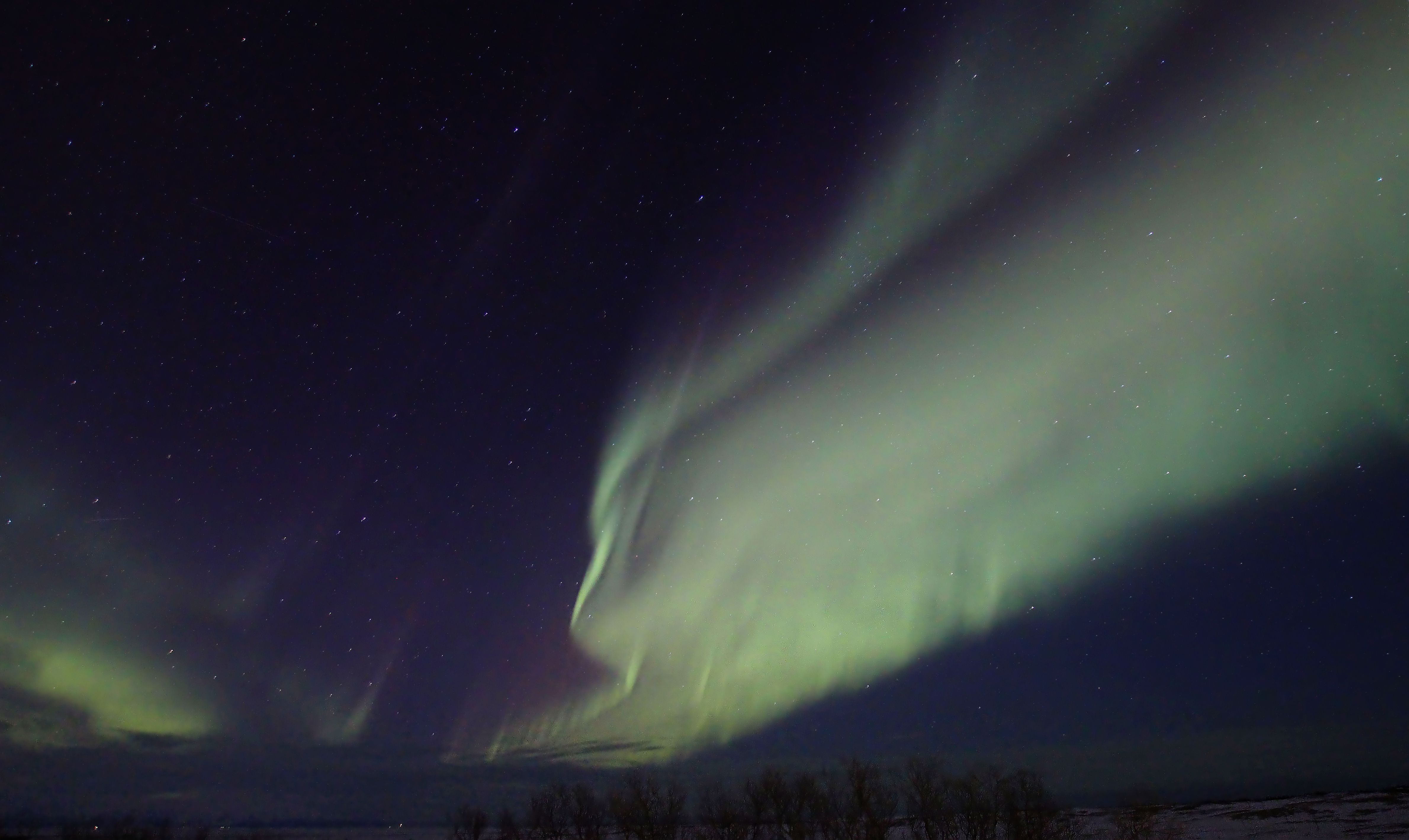
It’s just over 6-years since my last arctic adventure, which was a trip along the Norwegian coast by ship from Bergen to Kirkenes and back, stopping along the way for deliveries and pick-ups at 30-ports.  On that occasion we had good views of the Aurora Borealis whilst at sea somewhere north of the Arctic Circle and with some difficulty, I was eventually able to obtain some images (see below). Standing outside on ther deck at +70o North latitude in February was incredibly cold, making camera operation difficult, whilst the ship’s movement from side-to-side and up-and-down was hardly conducive to photography of the night sky!

This time, I’m just back from circumnavigating the island of Iceland by car from mid to late-March, which is described more fully on my other website Round The Bend here.  It was timed to avoid the worst of winter conditions and, with darkness quickly disappearing as Spring / Summer beckoned, maybe still get a chance to see and image the Northern Lights again – this time on terra firma.  Despite such planning, severe snow, ice and very strong winds were common for much of the time but, when it was clear the scenery was spectacular and, on a couple of evenings later in the trip, the Aurora Borealis put on a great show.

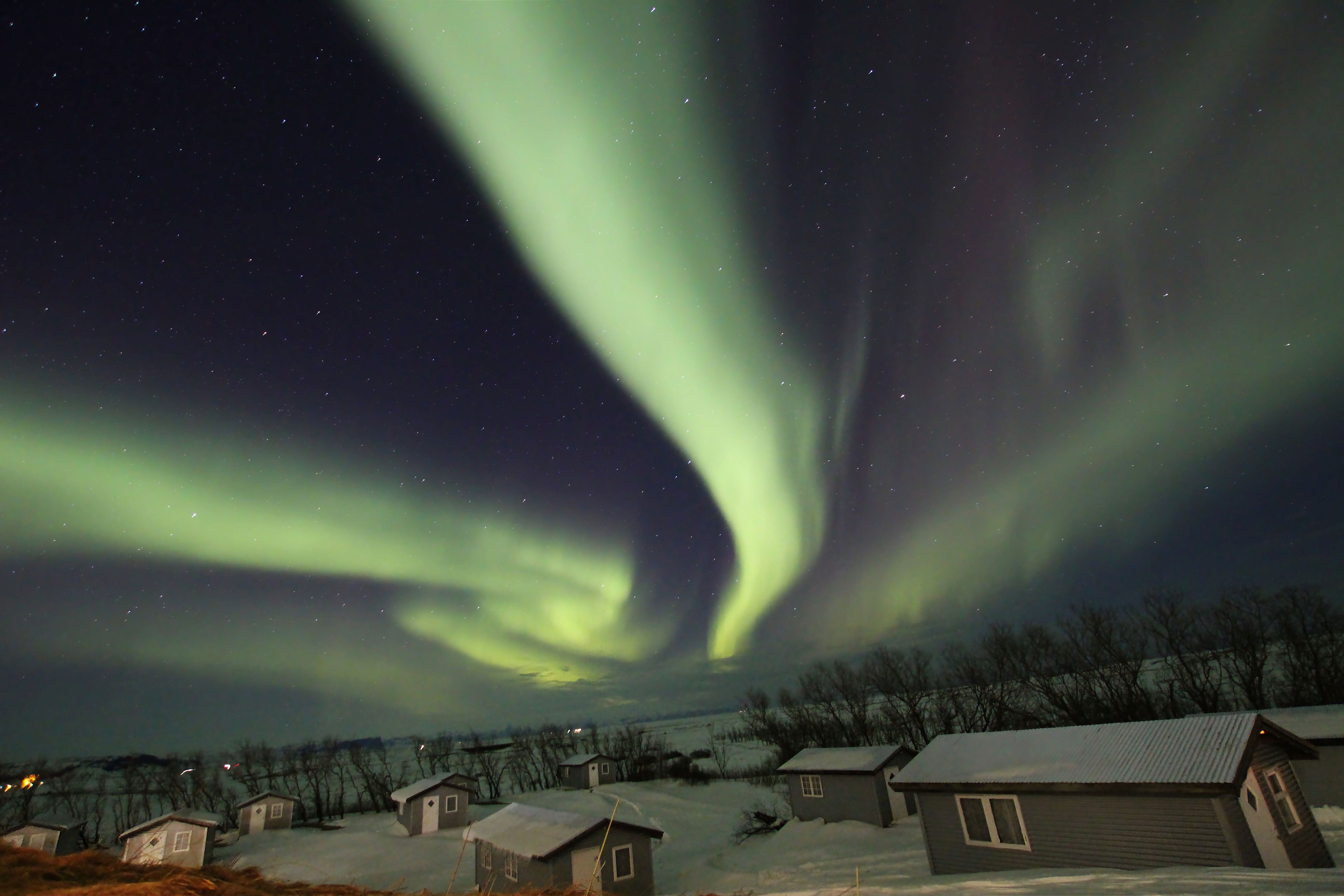
Situated just below the Arctic Circle, mostly between 64o and 66o latitude, Iceland is well known both for its geology and sightings of the Aurora Borealis or Northern Lights.  As a geologist, I travelled to Iceland primarily to view the rocks and though it was getting late in the season, I was also keen to see the Aurora again if possible.  Given the days of bad weather it was therefore fortunate to have clear skies and good views of the Northern Lights on two separate evenings whilst on the south coast, first at Gerdi near Jökulsárlόn and later just south of Kirkjubaejarkklaustur.

Despite my previous experience, each aurora is different and on this occasion I found using a Canon 700D DSLR mounted on a Gorilla Pod, using a Sigma wide-angle lens set at a focal length of 10mm f3.5 + ISO 3,200 and 10 second exposures generally produced a good image.  It seemed that we were on the southern edge of the aurora on the first night at Gerdi (see top of the page), which was therefore weaker but exhibited a striking purple colour (helium).  The following night the aurora was much stronger, this time mostly green (oxygen) with red and purple fringing (nitrogen & helium) and generally much more active, resulting in some great views with the naked eye and even better images (see below).

Orion In A New Light

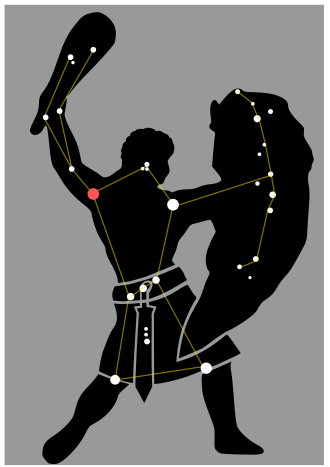
In ancient history Orion’s stars were considered to form a pattern that resembled a hunter holding a club above with his right arm and a shield in front with his left.  The appearance of Orion each year marks the highlight of the astronomy for many including me but for the second year running months of continuous cloud have precluded any astronomy since October; I note from comments online far-and-wide that this phenomenon has prevailed across much of the northern hemisphere, no doubt resulting in a lot of unhappy astronomers.

The Anantomy of Orion

Finally the clouds briefly relented over Fairvale Observatory in February but only for a few hours each time, thus eliminating the possibility of imaging with a CMOS mono camera.  Faced with these problems I therefore returned to my somewhat neglected modded Canon 550D camera and suitable lenses for appropriate widefield compositions, in order to image some classic targets around the Orion constellation in a broader context.  Having first whetted my appetite with the Samyang 135 f2 and its large 9.45o x 6.30o FOV to successfully image the iconic area that encompasses Orion’s belt, the Horsehead Nebula and M42 (see Going Big), it was time to go really big in order to capture the entire constellation literally and figuratively in a new light.

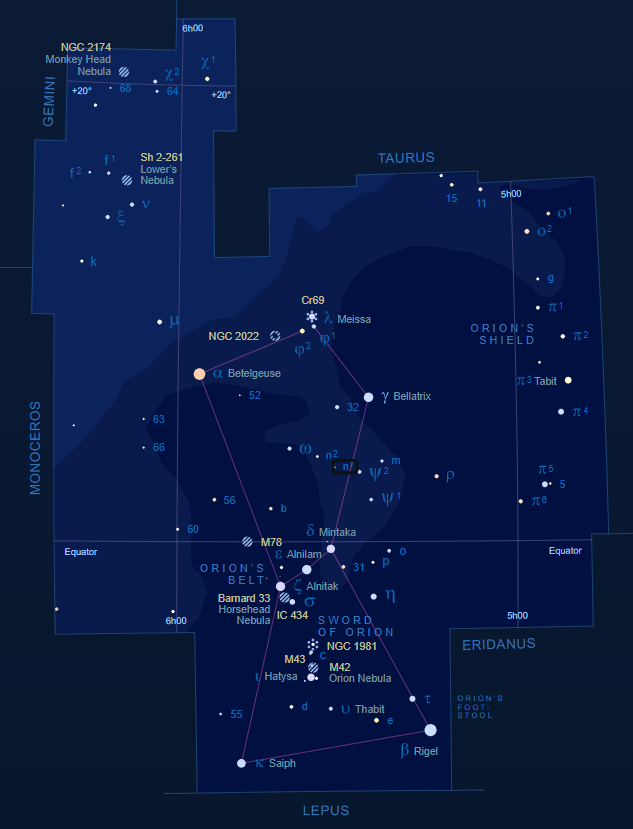
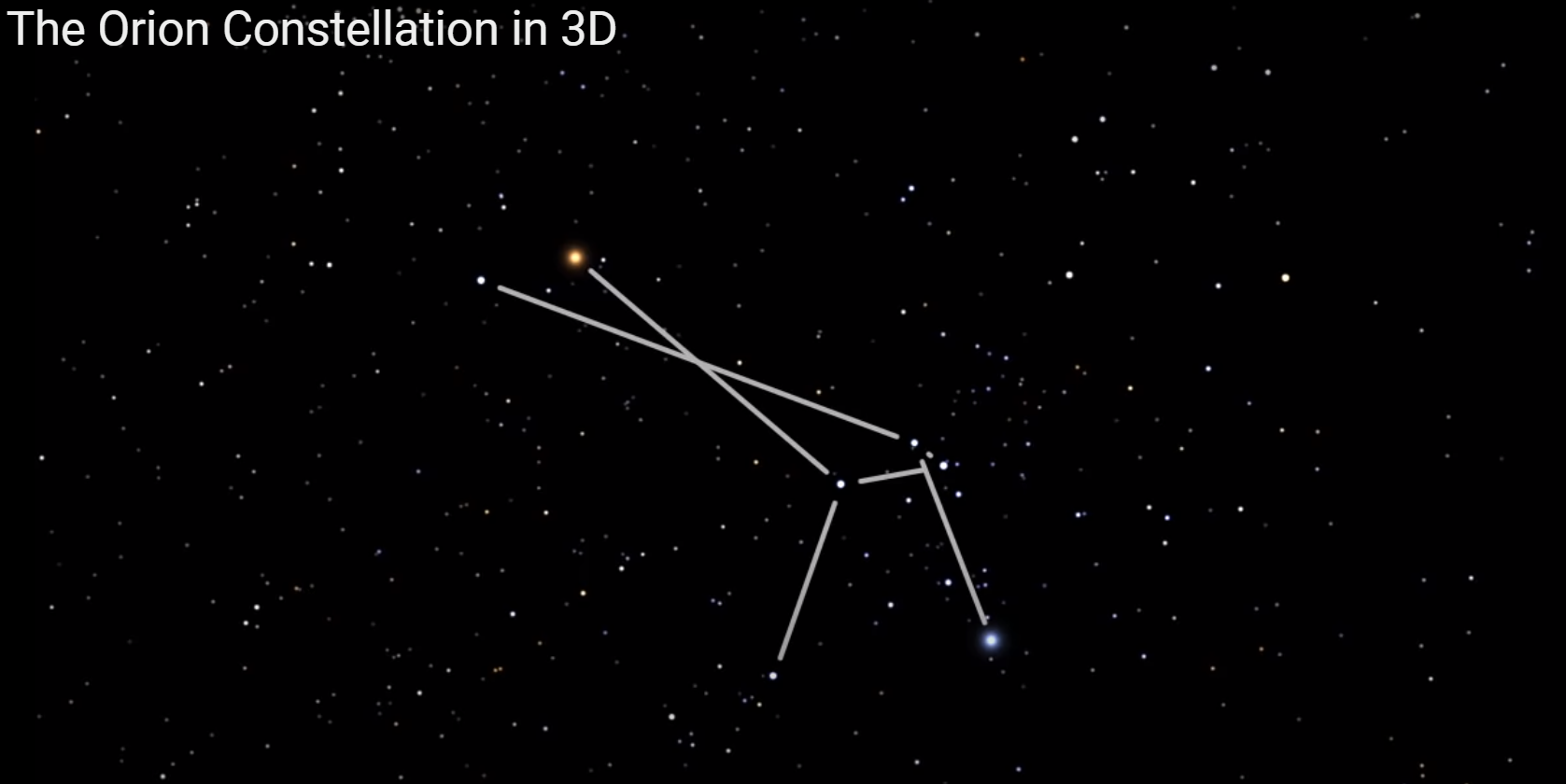
Seven bright stars define the area which outlines the torso and upper legs of Orion the Hunter: Betelgeuse, Bellatrix, Rigel and Saiph at the top and bottom, connected across the centre by his ‘belt’ formed from Alnitak, Alnilam and Mintaka.  The H-shape thus created by these stars is a familiar sight over the winter months but like so many asterisms of the night sky all is not what it seems.  Plotting the distance from Earth of each star it is immediately obvious that their spatial relationship significantly changes the shape of the constellation compared to what as we perceive by eye.  It is a sobering thought that with the passage of time those asterisms familiar to astronomers today will look very different in the future as the stars move though space and therefore continue to change their relative positions, look and shape.          

StarBetelgeuseBellatrixRigelSaiphAlnitakAlnilamMintaka
Distance from Earth* (light years)  643  243  772  724  800  1,359  900
*Source: Royal Greenwich Observatory

Click HERE for annotated version of the Orion Constellation in 3D ref. Space Science Telescope Instititue

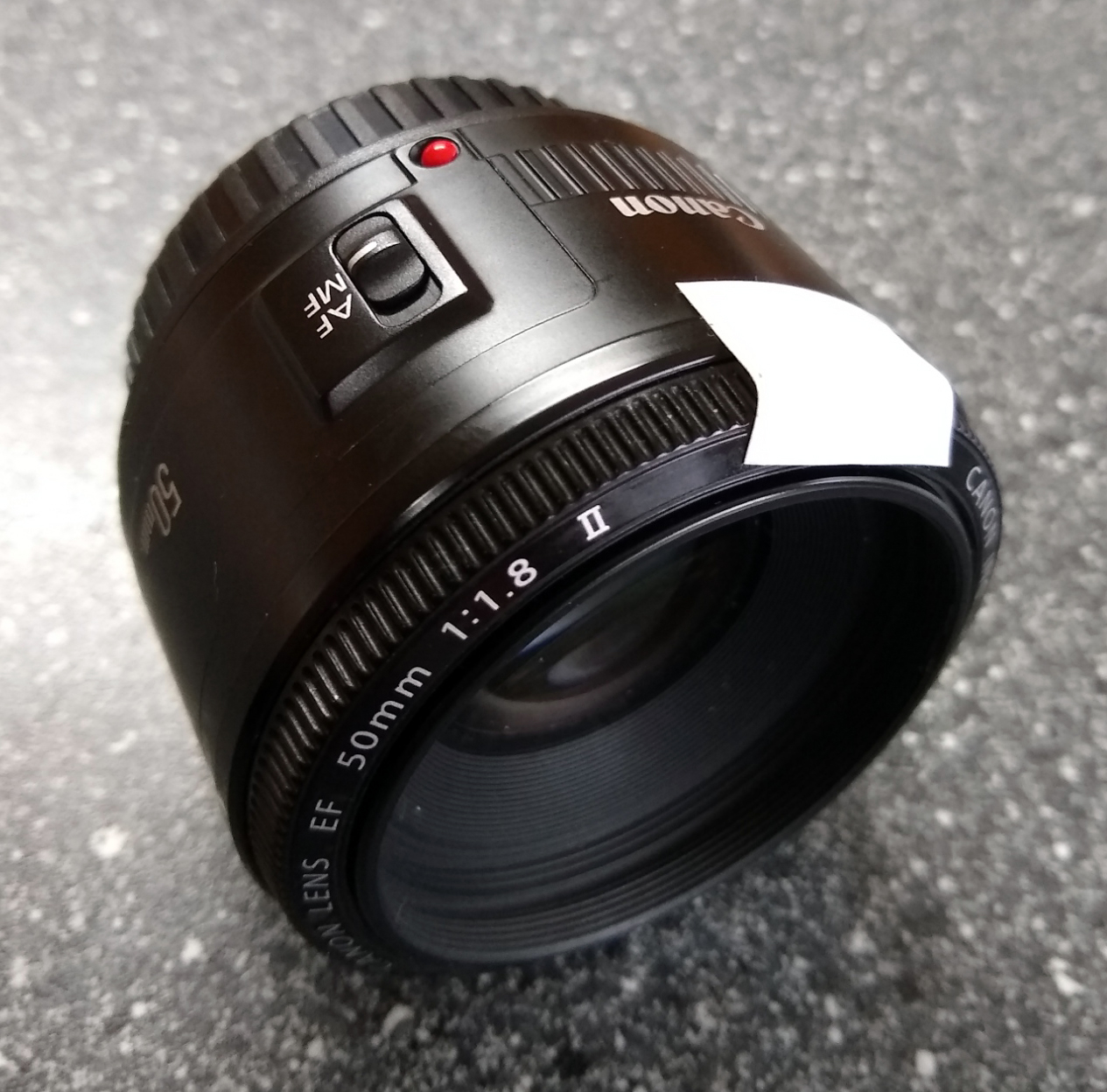
The Canon ‘Nifty Fifty’ 50mm f1.8 fixed aperture lens is perfect for an ultra widefield image of Orion. Whilst the glass is excellent, focus leaves a lot to be desired and once achieved needs to be secured with tape

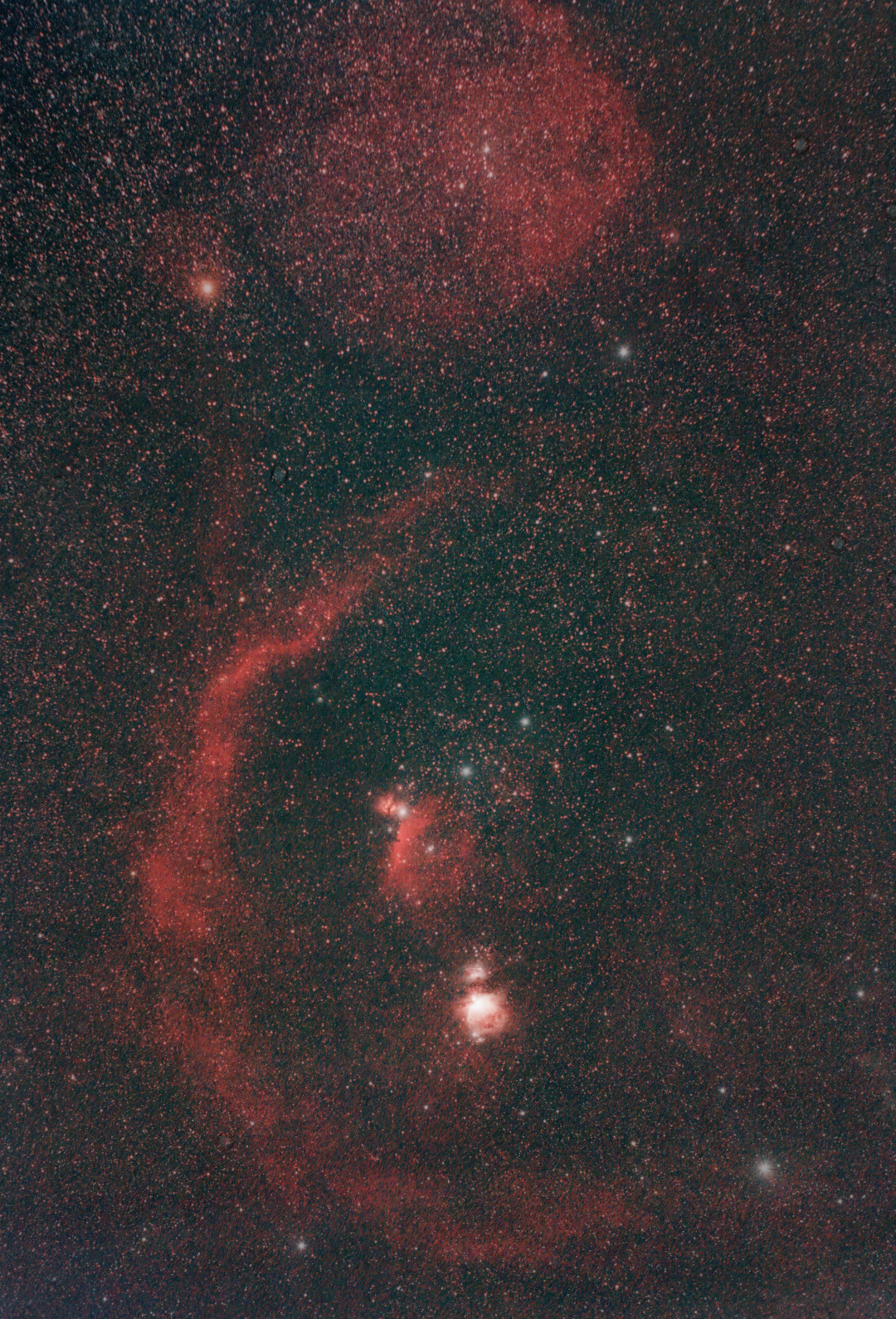
Aside from the said visual perspective of Orion, like so much of space we only see a fraction of what is really present in the Universe but can nevertheless often be disclosed by astrophotography.  And so I next decided to image the entirety of Orion, this time with a basic Canon 1.8 50mm lens – the so called “nifty fifty”- with the purpose of capturing in one shot the constellation with which we are all familiar, together with vast spectacular HII-regions that encompass much of the constellation but usually remain unseen. This camera-lens combination provides an enormous 25.5o x 17.0o field-of-view (x7 > Samyang lens, x83 William Optics GT81!) albeit with lower resolution, which perfectly encompasses most of Orion and therefore the entire arc of Barnard’s Loop on the left and the Angelfish Nebula (Orion’s “head”) located above and between Betelgeuse and Bellatrix. 

Above: Orion constellation from Fairvale Observatory 24th December 2014 (Left) compared with long exposure image + modded camera 10th February 2020 (right)

Barnard’s Loop is an emission nebula, forming part of the Orion Molecular Cloud Complex which also contains the dark Horsehead and bright Great Orion Nebulae M42.  The Loop is believed to have originated from a supernova explosion about 2 million years ago, which is now ionized by stars from within and around the Orion Nebula and takes the form of a large arc centred approximately on the Orion Nebula. Discovered and photographed by E. E. Barnard in 1894, this vast feature extends over some about 600 arcminutes when viewed from Earth or physically up to 300 light years across, depending on the distance from Earth.

The Angelfish Nebula SH2-264 is centred on the young star cluster of Lamda Orionis, of which Meissa is the brightest. An HII-region with an apparent size of 5 degrees and actual size of 150 light years, it is also an emission nebula that is energised by the aforesaid star cluster and is considered to form the so-called head of Orion.

Having previously imaged notable parts throughout Orion, I’ve long wanted to capture the full extent of this wonderful constellation in all its glory and am very pleased with the outcome on this occasion.

DSLR IMAGING DETAILS*
ObjectOrion Constellation
ConstellationOrion
Distance243 to 1,360 light-years
Size594o2
Apparent MagnitudeVaries
  
Lens / Scope Canon 50mm f1.8  
MountSW AZ-EQ6 GT + EQASCOM computer control & Cartes du Ciel
GuidingNo Guiding
CameraCanon 550D modified
 FOV 25.5o x 17.7o Resolution 17.72”/ pixel      
Capture & ProcessingAstro Photography Tool + PHD2 Deep Sky Stacker, PixInsight, Photoshop CS3 & Topaz Denoise AI
Image Location &        OrientationCentre  RA 05:37:37.3      DEC +00:48:50.26         
Top = North    Right = West     
Exposures & Aperture42 x 120 sec  @ ISO800 Total: 1hr 24 min F1.8   
Calibration5 x 120’ Darks,  20 x 1/4000 sec Bias  20 x Flats         
Location & DarknessFairvale Observatory – Redhill – Surrey – UK        Typically Bortle 5-6
Date & Time10th February 2021  @ +21.00h  
WeatherApprox. <=0oC   RH <=65%                  🌙 NEW MOON

*For higher resolution and plate-solving data go to Astrobin HERE and click on image

Going Big – Widefield Imaging

After considering the limitations created by UK weather, I chose to purchase a Samyang 135 f/2 lens last year, rather than typically moving to a larger aperture / focal length scope.  Unfortunately because of the aforesaid poor weather conditions that have since prevailed its use has so far been restricted.  However, after literally months at last the clouds briefly relented over Surrey recently and I was able to get a couple of hours imaging the Orion constellation.

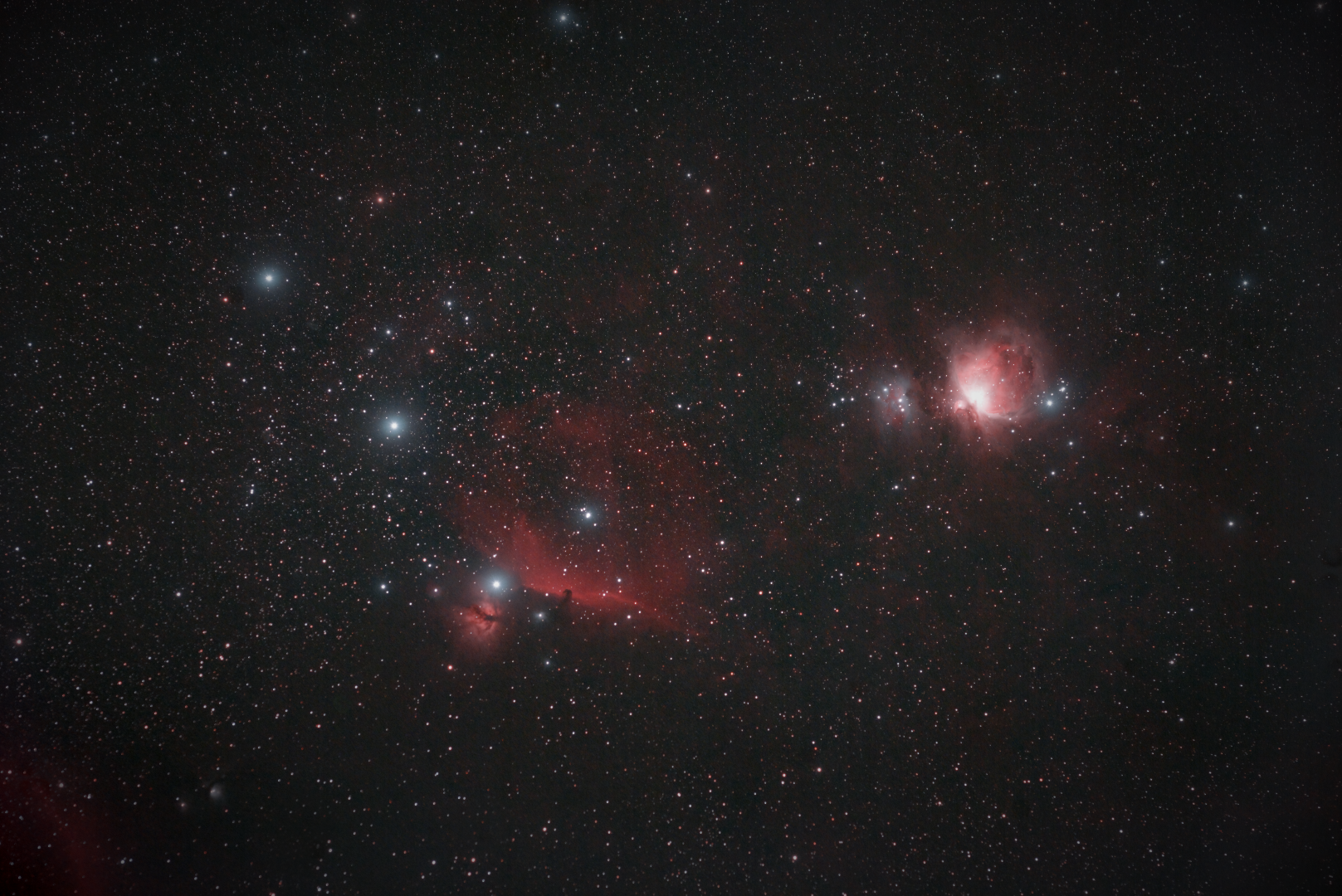
I really enjoy the widefield aspect of astrophotography, particularly without resorting to a mosaic which is too often impractical given the lack of favourable imaging conditions in the UK.  Such images can produce another perspective of favourite targets previously imaged with a telescope or are just fascinating in their own right.  For the moment I’m using the Samyang lens at f2.8 with a modded Canon 550D, manual focus and no guiding but eventually intend to pair it with a mono CMOS camera.  This combination results in a whopping 9.45o x 6.30o field-of-view, no-less than 11x that of my standard William Optics GT81 and ZWO1600 set-up.  Whilst using the lens at its maximum f/2.0 aperture would be even better, stopping down to f2.8 improves focus quality and removes any possibility of vignetting.

In this instance I chose to frame the image around the area of Orion’s Belt and the Great Orion Nebula M42 but such is the lens’ extensive field-of-view that M78 and part of Barnard’s Loop have also sneaked into the lower left corner.  Even though this was something of a ‘quick & dirty’ session resulting in just 112 minutes integration time, looking closer at M42 (see cropped version) the detail and colours achieved with this lens has far exceeded my expectations.   As well as the detail of M42 and the Horsehead Nebula, I’m also impressed at how well the lens has dealt with the usually difficult large bright stars of Orion’s Belt & others in the image. 

The quality produced with this small lens is quite extraordinary and it is definitely one of my star astronomy purchases.  Going forwards the challenge will be to find suitable targets that can fill its very large field-of-view, as well the inevitable wait for clear skies!

DSLR IMAGING DETAILS*
ObjectOrion: M42, Horsehead, M78 & Barnard’s Loop
ConstellationOrion
Distance243 to 1,360 light-years
Size594o2
Apparent MagnitudeVaries
  
Lens / Scope Samyang 135 f/2  
MountSW AZ-EQ6 GT + EQASCOM computer control & Cartes du Ciel
GuidingNo Guiding
CameraCanon 550D modified
 FOV 9.45o x 6.30o Resolution 6.45”/pix      
Capture & ProcessingAstro Photography Tool + PHD2 Deep Sky Stacker, PixInsight, Photoshop CS3 & Topaz Denoise AI
Image Location  &             OrientationCentre  RA 05:36:48      DEC -03:11:30.4               
Right = North   Top = West     
Exposures & Aperture56 x 120 sec  @ ISO800 Total: 1hr 52 min F2.8   
Calibration5 x 120’ Darks,  20 x 1/4000 sec Bias  20 x Flats         
Location & DarknessFairvale Observatory – Redhill – Surrey – UK        Typically Bortle 5-6
Date & Time3rd February 2021  @ +22.00h  
WeatherApprox. 6oC   RH +85%                  🌙 67% waning
*For high resoluton image go to Astrobin HERE and click on image