Constellation names mostly originated from ancient Middle Eastern, Greek, and Roman cultures, when they identified groups of stars and named them after their gods, goddesses, animals, and objects that were important to them. Other world-wide groups and throughout time – Native American, Asian, and African – have also made and named similar pictures from star groups based on their cultures and related beliefs. Given the number of stars observed when looking up into a clear dark sky, it is obviously helpful to ‘construct’ familiar patterns and adopt memorable names, which can then be used to identify areas of the sky in a way that can be easily identified by all. I have no problem with this long and well-established convention, which despite their antiquity works just as well in the modern world but I do have an issue with nicknames.
I’ve smiled at some of the nicknames given to popular, usually deep sky objects that have been well established by astronomers, but despite the possible use of describing their form, I am increasingly finding them a distraction when considering the merit of astrophotography images: Seagull Nebula, Running Man Nebula, Pelican Nebula etc. The problem is that they absolutely do look like the object they’re meant to depict but, like an earworm is to music, once seen they are difficult to view any other way.
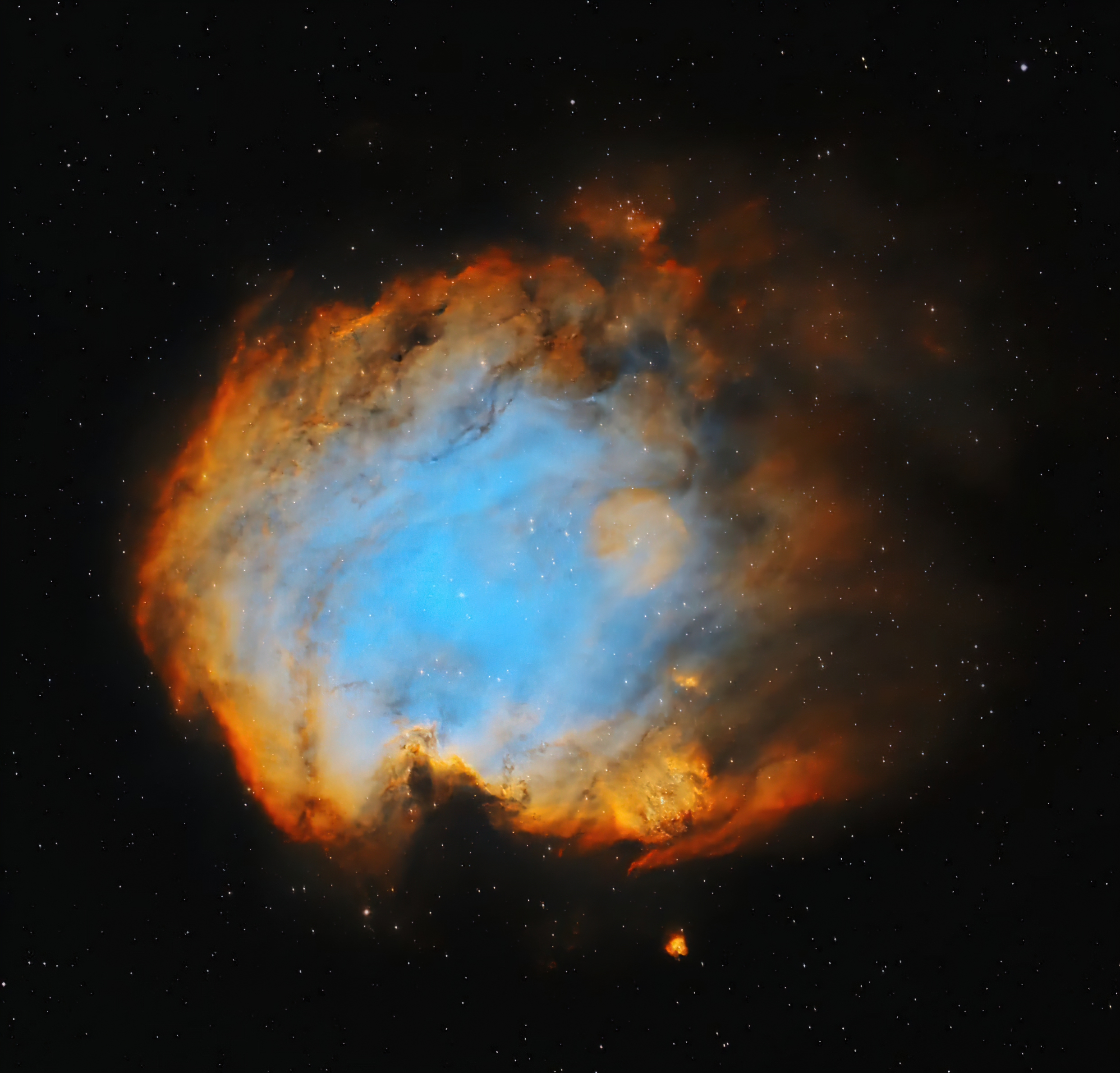
With this partly in mind, for the first time in seven years I recently chose to image NGC 2174 again. I previously used the William Optics GT81 with a modded Canon 550D DSLR camera, which resulted in an image that wasn’t too bad, except it looked like a monkey! Given its nickname of the Monkey Head Nebula, this was to be expected but unfortunately, thereafter the picture of a monkey has remained with me ever since when I view NGC 2174 images. The challenge on this occasion was therefore to limit the monkey’s impact on the image, thereby showing the object for what it really is – an emission nebula.
Using the same OTA but with a mono CMOS camera and a good set of filters, the new data set obtained was much improved, and with better processing experience it was time to see the monkey (or not) in a new light. The first thing to do was present the image in an orientation that produces a more favourable perspective (less monkey like). Using a basic SHO palette in PixInsight the initial image was promising (see below) but with an alternative PixelMath dynamic SHO palette* and then processing with autocolor script, color saturation, Russell Croman’s XT-suites and other tweaks, I was pleased to see that the monkey was nowhere to be seen in the final image (see image at the top-of-the-page), or at least to my eye.
At last, it is now possible to look at NGC 2147 and see the inherent features of this interesting emission nebula, where new stars are being born at a rapid rate. Moreover, the inner details can now be clearly viewed within, thus also showing the associated open star cluster NGC 2175 and more. As a result of this monkey make-over, the NGC 2174 image now not only looks much better but critically, I no can longer see the ape! Now where’s that Seagull?
IMAGING DETAILS
Object
NGC 2174
Constellation
Orion
Distance
6,400 light-years
Size
40 arc secs
Apparent Magnitude
+6.80
Scope
William Optics GT81 + Focal Reducer FL 382 mm f4.72
Mount
SW AZ-EQ6 GT + EQASCOM computer control & Cartes du Ciel
Guiding
William Optics 50mm guide scope
+ Starlight Xpress Lodestar X2 camera & PHD2 guiding
Camera
ZWO ASI294MM CMOS sensor
FOV 2.87o x 1.96o Resolution 2.50”/pix Max. image size 4,144 x 2,822 pix
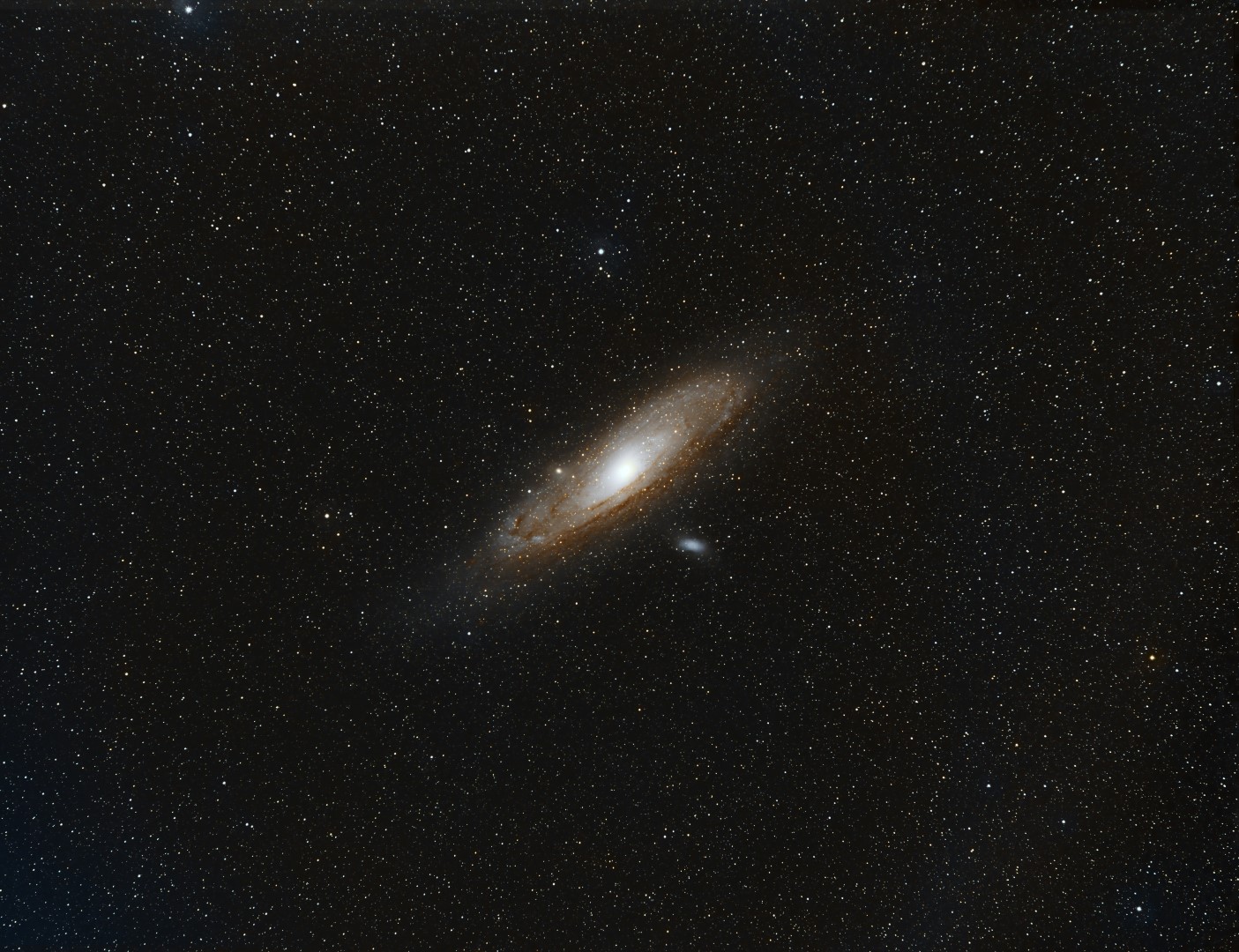
As our closest galactic neighbour, I’ve imaged M31 the Andromeda Galaxy five times since beginning my personal astrophotography journey in 2014, each time using my William Optics GT81 apo refractor – first with a DSLR, then a ASI1600mm-Cool and most recently ASI294MM cameras. Andromeda is perhaps the perfect object for my equipment, as it just fits the field-of-view of the aforesaid set-up, which produces something of an up-close-and-personal image of this alluring galaxy. But despite the success of these images, perhaps there’s an alternative view?
This year, I therefore deployed my Samyang 135 + ASI1600MM-Cool rig to capture 6 ½ hours of Andromeda, the result of which shows a whole new perspective of M31. The widefield format of this lens produces greater context than previous images, whilst still obtaining excellent details and colours of the galaxy itself. As a result, this final image (see above) better reveals the galaxy in its true glory deep in space, which in some ways I believe can be more powerful than the more popular close-up renditions of this impressive object (M31 with star reduction applied to the image below).
IMAGING DETAILS
Object
M31 Andromeda Galaxy
Constellation
Andromeda
Distance
2.5 million light-years
Size
3.2o x 1o or 220,000 light-years
Apparent Magnitude
+3.44
Scope / Lens
Samyang 135 @f2.8
Mount
SW AZ-EQ6 GT + EQASCOM computer control & Cartes du Ciel
Guiding
Sky-Watcher EvoGuide 50ED
+ Starlight Xpress Lodestar X2 camera & PHD2 guiding
Camera
ZWO1600MM-Cool mono CMOS sensor
FOV 7.5o x 5.67o Resolution 5.81”/pix Max. Image Size 4,656 x 3,520 pix
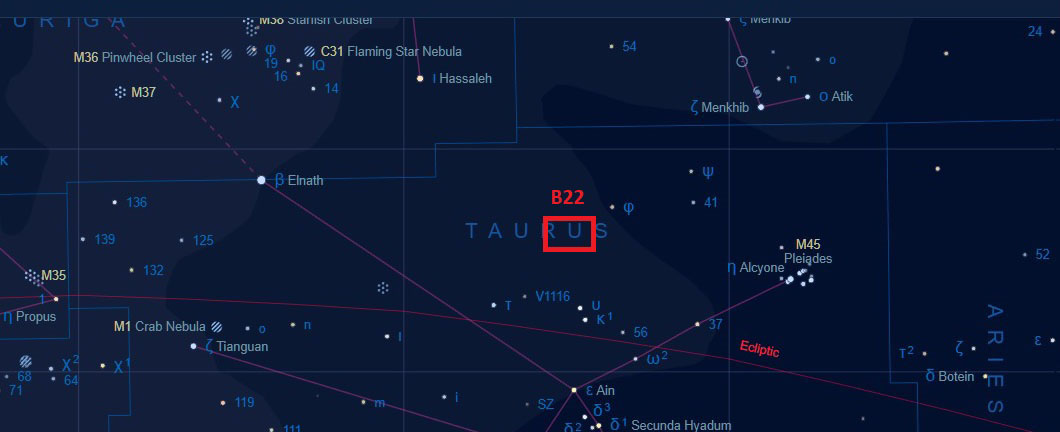
Just northeast of the Pleiades star cluster within the northern Milky Way, lies the dark region of the Taurus Molecular Cloud (TMC), which at 430 light years is the nearest star-forming region to Earth. Consisting of hundreds of solar masses of primordial hydrogen and helium gas, as well as heavier elements, this vast area of dense stardust obscures almost all light from behind. As such it forms an alluring target for astrophotography, with the complex rift-like dark structure of the TMC set against the broad starry background of the Taurus constellation.
Approximate Image Location
Notwithstanding, perhaps because of the more popular objects that abound throughout its neighbour the Orion constellation, the TMC is somewhat neglected by astronomers; to be fair the TMC is also a more challenging imaging target than many of those found in Orion. Early this year, for the first time I decided to image the dark nebula Barnard 22, an iconic section of the TMC formed by a complex mass of dark stardust that appears to hang within the vast surrounding starfield.
Approaching the new moon in late January I obtained almost 11 hours of LRGB subs, though sadly was unable to incorporate another 6-hours of 10-minute luminance exposures which proved to be too bright to use: note-to-self– check settings for new objects before embarking on long imaging programme! To achieve a balance between the large black smudge that is B 22 and the brilliance of the surrounding stars processing was tricky but the final outcome satisfying. Also noteworthy in the image, just off centre is the small flame-shaped reflection nebula IC 2087, the light from which just manages to emerge from behind the otherwise dominant, though beguiling form of Barnard 22, which like night itself seems to casts a dark veil over the cosmos.
IMAGING DETAILS
Objects
Barnard 22 dark nebula & IC 2087 reflection nebula
Constellation
Taurus
Distance
Approx.. 430 light years
Size
–
Apparent Magnitude
Varies
Scope
William Optics GT81 + Focal Reducer FL 382mm f4.72
Mount
SW AZ-EQ6 GT + EQASCOM computer control & Cartes du Ciel
Guiding
William Optics 50mm guide scope
+ Starlight Xpress Lodestar X2 camera & PHD2 guiding
Camera
ZWO1600MM-Cool mono CMOS sensor
FOV 2.65o x 2.0o Resolution 2.05”/pix Max. image size 4,656 x 3,520 pix
EFW
ZWOx8 EFW & 31mm Chroma LRGB filters
Capture & Processing
Astro Photography Tool + PHD2 + Deep Sky Stacker, PixInsight v1.8.8-12, Photoshop CC, Topaz AI DeNoise
Image Location & Orientation
Centre RA 04:39:00.365 DEC +26:00:13.426 Lower Left = North
Exposures
120 x 180 sec L, 19 x 300 sec R, 20 x 300 sec G & B Total Integration Time: 10hr 55 min
@ 139 Gain 21 Offset @ -20oC
Calibration
10 x 60 sec Darks 15 x LRGB Flats & Dark Flats @ ADU 25,000
Location & Darkness
Fairvale Observatory – Redhill – Surrey – UK Typically Bortle 5-6
Date & Time
27th 29th 31st January + 4th & 6th February 2022 @ +18.30h
Every year since 2014 I’ve published a retrospective blog of my astrophotgraphy year just ending called Reflections. It’s been a useful task that enables me to bring together the best and sometimes the worst of my images, in order to consider the good and bad points + progress made + set some objectives for the coming year. Eight years on, after which I believe I’ve now reached at least a respectable level of imaging and processing, I’ve decided to stop this format for the time being.
Notwithstanding, at this time of the year I also produce an astrophotography calendar for members of my family, which consists of the better images from the year just ending; I think they like them and certainly all use the calendar during the coming year. Moreover, I also recently started to compile a video of the said calendar images set to appropriate music, which we all watch together prior to seeing the actual calendar. It’s a great way to present the images, which look really stunning on today’s large Smart TV’s and is fun to watch with the family too.
The video for this last year 2021 can be viewed on YouTubeHERE and below is a brief very general overview of each image. More detailed background information and imaging details for those interested can be found in relevant blogs posted on this site during the past year.
2022 CALENDAR
A new set of filters, improved processing techniques and access to data from a telescope at a dark sky site in New Mexico, USA (shown by an asterisk *) contributed to an exciting astrophotography year in 2021.
FRONT COVER
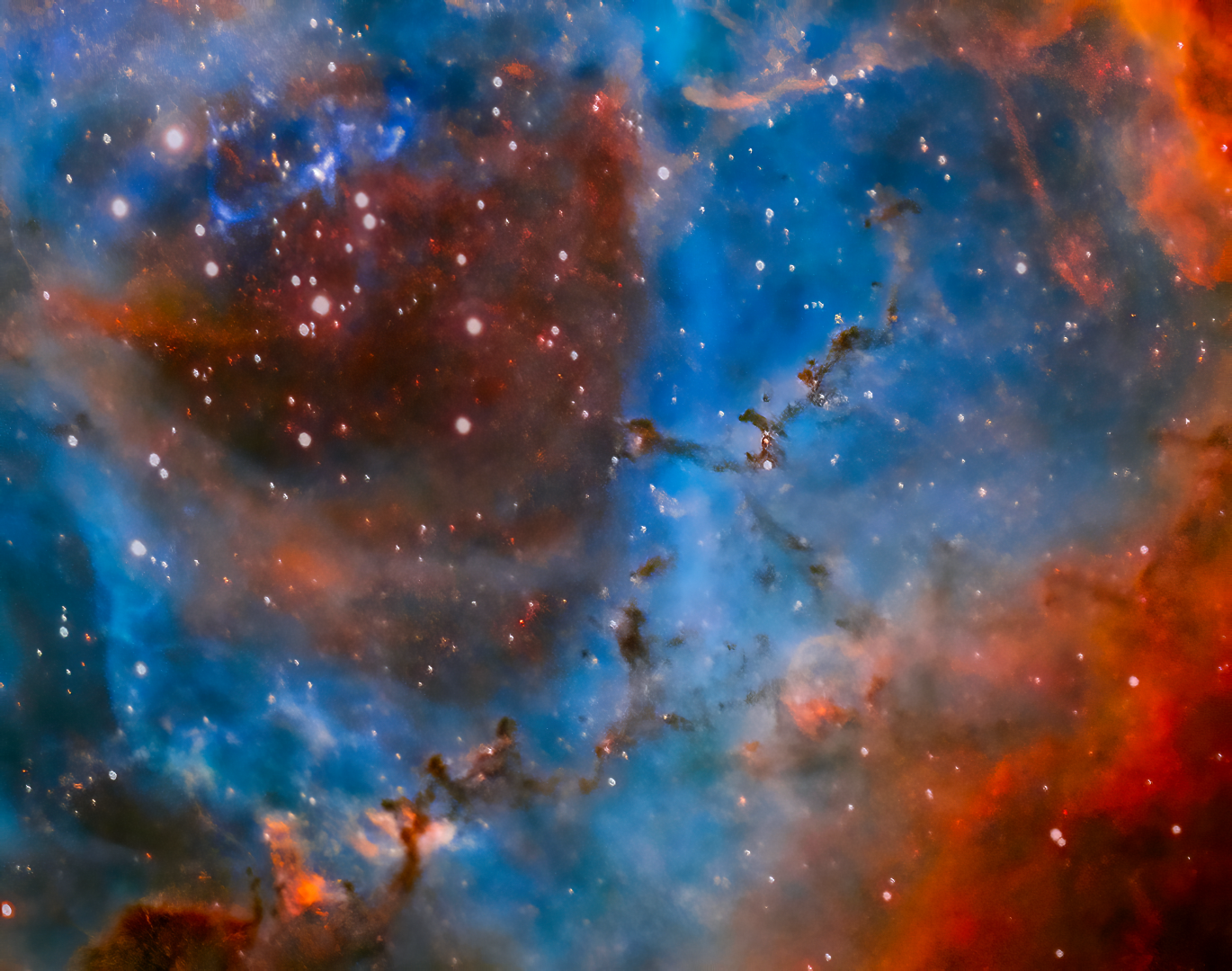
The Carnival of Animals: Special processing of the inner region of the Rosette Nebula highlights the ‘animals’ or Bok Globules – clouds of dust undergoing gravitational collapse as part of the process of new star formation.
JANUARY
LDN-1250 Dark Nebula*: Dark or absorption nebulae are a type of interstellar cloud which are so dense they obscure or absorb visible light emitted from objects behind or within and thereby contrast with the general light flux of the Universe as dark areas.
FEBRUARY
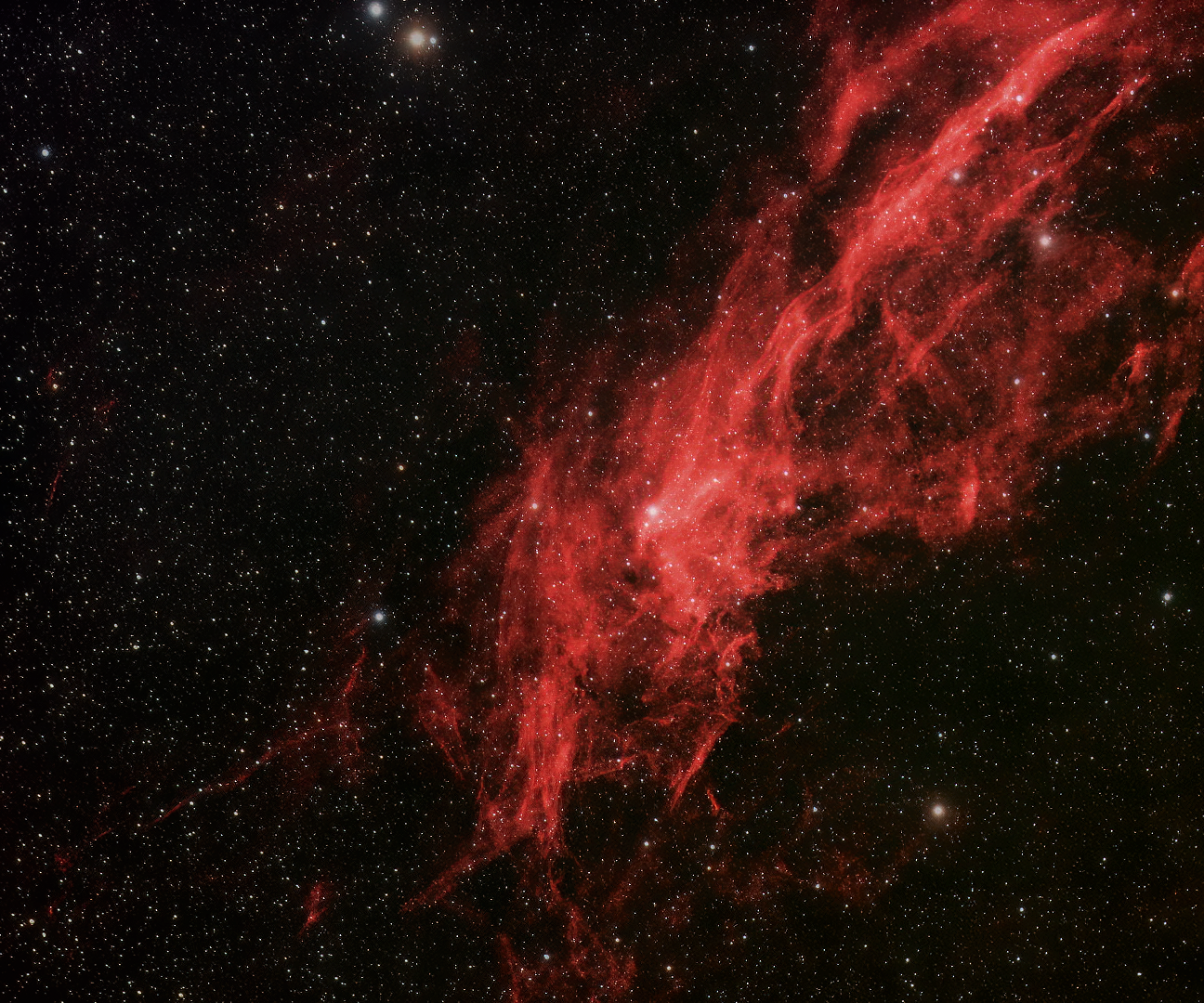
CTB-1 Supernova Remnant*: The overall structure of this supernova remnant is that of a circular shell, with a conspicuous rupture towards the north (lower right of image). The main red Ha-shell is composed of multiple interlocking filament limbs, with a blue / green OIII arc along one side.
MARCH
Jellyfish Nebula: Locatedin the Gemini constellation some 5,000 light years from Earth, this is a remnant of a supernova that took place during the past 30,000 years. With a diameter of 70 light-years, the object is visually speaking nearly twice the size of a full moon.
APRIL
Markarian’s Chain: The Virgo cluster consists of more than 2,000 galaxies, within which Markarian’s Chain forms a J-curve string of bright galaxies that share a common motion through space.
MAY
M13 Great Globular Cluster of Hercules*: Consisting of several hundred thousand stars and 145 light-years in diameter, M13 is considered to be the finest cluster in the Northern Hemisphere.
JUNE
Cave Nebula*: Located along the plane of the Milky Way is the diffuse emission nebula referred to as the Cave Nebula. The Cave at the centre is critically located at the boundary of the Cepheus molecular cloud and the hot, young stars which ionize the surrounding gases to great effect.
JULY
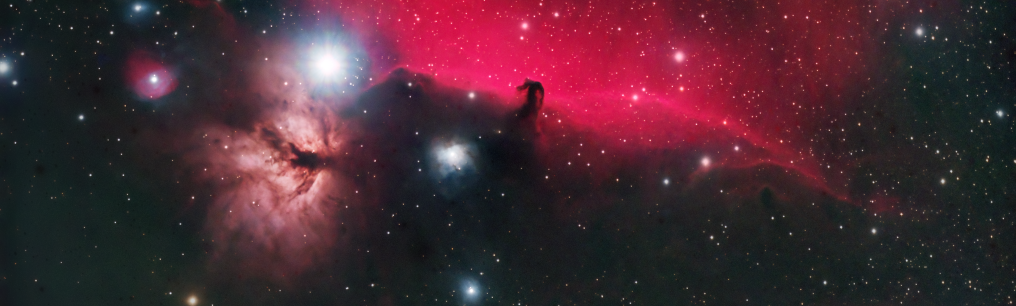
Orion Widefield: Framed around the area of Orion’s Belt, the Horsehead Nebula and the Great Orion Nebula, look hard and the refection nebula M78 can also be seen in the lower left corner.
AUGUST
Elephant’s Trunk Nebula*: A very large emission nebula, the so-called Elephant’s Trunk Nebula is rightly viewed as one of astrophotography’s most iconic images. The ‘trunk’ itself dominates the centre of this image and is illuminated from behind by a bright star forming region.
SEPTEMBER
M31 Andromeda Galaxy: The full benefit of new filters, improved guiding, clear skies over 6-nights and extensive use of new processing techniques can be seen in my best image yet of Andromeda.
OCTOBER
Butterfly Nebula: Situatedwithin the Orion Arm of the Milky Way is the Gamma Cygni nebula, a diffuse emission nebula surrounding the star Sadr. Either side of the dark rift which divides the image from top to bottom are two large bright areas that together form the so-called Butterfly.
NOVEMBER
M33 Triangulum Galaxy: Like it’s neighbour Andromeda, better data and processing has produced an exciting new image of M33 this year, the red areas highlight Ha-rich star-forming regions
DECEMBER
Flying Bat & Giant Squid Nebula*: This very faint OIII emission nebula Ou4 required an imaging time of 40-hours. For obvious reasons Ou4 has become known as the Giant Squid Nebula which, moreover, lies within the much larger SH2-129 HII emission region or the Flying Bat Nebula.
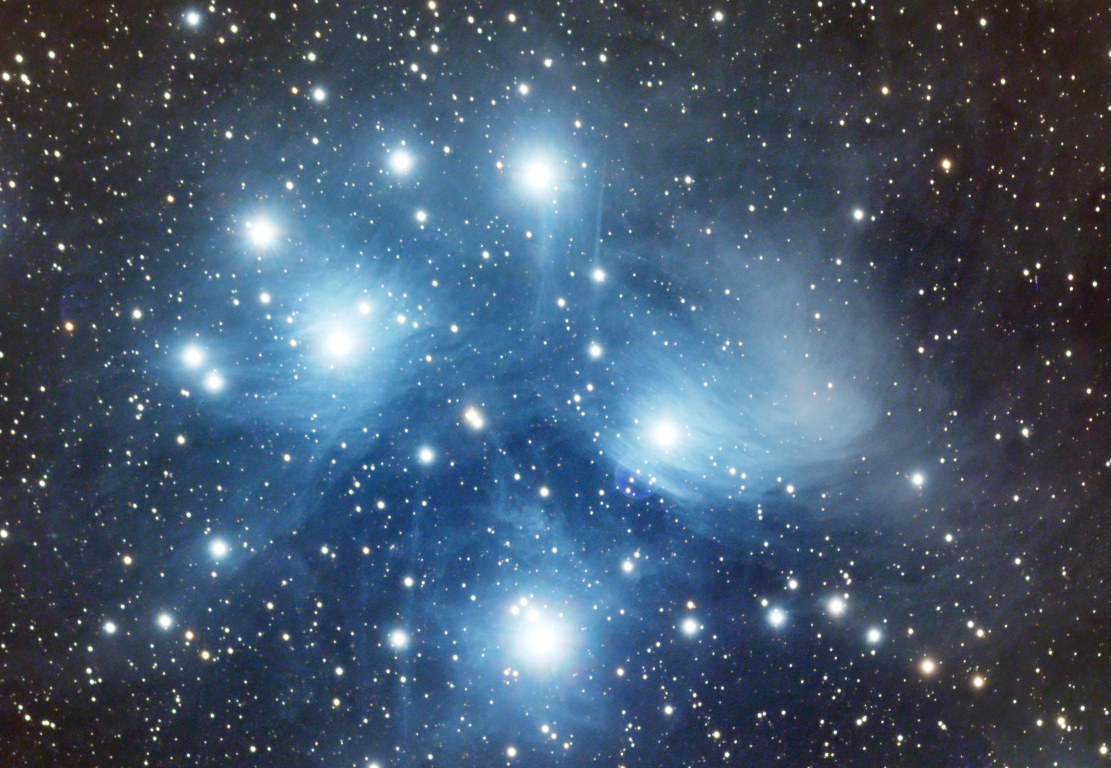
Preceding the arrival of what is for many astronomers the highlight of the year, the Orion constellation and all it’s objects, is the appearance of the majestic Pleiades open star cluster (Messier 45) in the constellation of Taurus. The so-called Seven Sisters consists of hot blue luminous stars that formed during the past 100 million years, which are expected to last another 250 million years and can be easily observed with the naked eye even here at Fairvale Observatory (Bortle 5/6).
I have imaged this exciting star cluster before but with astrophotography and especially iconic objects such as the Pleiades, one is always drawn back for another try. Now armed with Chroma filters and a growing list of PixInsight skills acquired since last imaged late in 2018, I wanted to tease out more details of the fine wispy dust cloud through which the Sisters are passing and forms the signature of all good Pleiades’ images. Furthermore, with longer exposures and total integration time greater than before, maybe I could also capture something of the abundant interstellar dust that is present across the wider background?
I am therefore very pleased that the final image (top of the page + cropped version above) which has more than achieved these objectives and marks a significant improvement on my previous attempts – it’s always worth trying that little bit more.
IMAGING DETAILS
Object
M45 The Pleiades AKA Seven Sisters
Constellation
Taurus
Distance
444 light-years
Size
110’
Apparent Magnitude
+1.6
Scope
William Optics GT81 + Focal Reducer FL 382mm f4.72
Mount
SW AZ-EQ6 GT + EQASCOM computer control
Guiding
William Optics 50mm guide scope
+ Starlight Xpress Lodestar X2 guide camera & PHD2 control
Camera
ZWO1600MM-Cool (mono) CMOS sensor
FOV 2.65o x 2.0o Resolution 2.05”/pix Max. image size 4,656 x 3,520 pix
EFW
ZWO x8 EFW & Chroma 31mm LRGB filters
Capture & Processing
Astro Photography Tool + Deep Sky Stacker PixInsight v 1.8.8-11, Photoshop CS3, Topaz AI Denoise
Image Location & Orientation
Centre: RA 03:47:03 DEC 24:03:08 Top = North Right = West
Exposures
12 x 300 sec LRGB Total time: 4 hours
@ 139 Gain 21 Offset @ -20oC
Calibration
5 x 300 sec Darks 15 x Flats & Dark Flats LRGB @ ADU 25,000
Location & Darkness
Fairvale Observatory – Redhill – Surrey – UK Typically Bortle 5
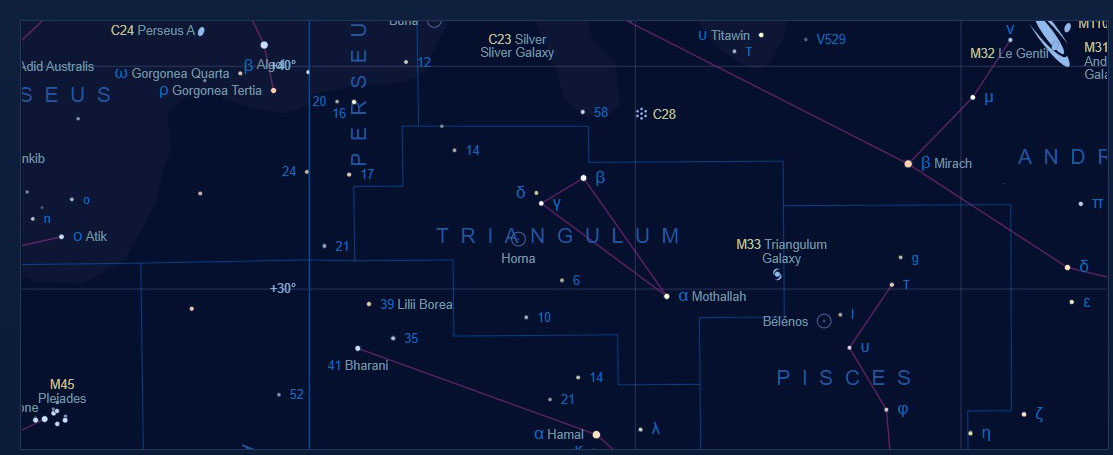
After successfully imaging M31 the Andromeda galaxy at new moon in early October, I was lucky that the next moon cycle in early November also provided good conditions and it seemed appropriate to just shift attention to Andromeda’s closest neighbour, which at this time of the year occupies a favourable part of the eastern sky in the early evening. Only 15o from M31, M33 AKA the Triangulum Galaxy is the third-largest member of the Local Group of galaxies after Andromeda and the Milky Way. Although very faint, in very good dark night sky conditions M33 can apparently be viewed with the naked eye. Along with our own Milky Way, this group travels together in the universe, as they are gravitationally bound.
Andromeda is eight times brighter and nearly four times larger than Triangulum, which for various reasons I have previously found difficult to image, despite its relative proximity to us. On this occasion I was therefore very pleased to obtain a good data set over three nights that included 3-hours of 10-minute Ha exposures. The result is definitely my best image yet of this tricky but attractive target, which in particular highlights the numerous red star-forming regions that abound throughout the galaxy’s arms. I’ll almost certainly be back again another day but for now I am at last satisfied with the result.
IMAGING DETAILS
Object
M33 Triangulum Galaxy
Constellation
Triangulum
Distance
Approx. 2.7 million light-years
Size
71’ x 42’ ~ 60,000 light-years
Apparent Magnitude
+5.72
Scope
William Optics GT81 + Focal Reducer FL 382mm f4.72
Mount
SW AZ-EQ6 GT + EQASCOM computer control
Guiding
William Optics 50mm guide scope
+ Starlight Xpress Lodestar X2 guide camera & PHD2 control
Camera
ZWO1600MM-Cool (mono) CMOS sensor
FOV 2.65o x 2.0o Resolution 2.05”/pix Max. image size 4,656 x 3,520 pix
EFW
ZWO x8 EFW & 31mm LRGB + 3nm Ha Chroma filters
Capture & Processing
Astro Photography Tool, Deep Sky Stacker, PixInsight v 1.8.8-9, Photoshop CS3, Topaz Ai Denosie
Image Location & Orientation
Centre: RA 01:33:53.6 DEC 30:39:18.9 Top = North Right = West
Exposures
15 x 300 sec LRGB + 18 x 600 sec Ha Total time: 8 hours
@ 139 Gain 21 Offset @ -20oC
Calibration
5 x 300 sec & 5 x 600 sec Darks + 15 x LRGBHa Flats & Dark Flats @ ADU 25,000
Location & Darkness
Fairvale Observatory – Redhill – Surrey – UK Typically Bortle 5
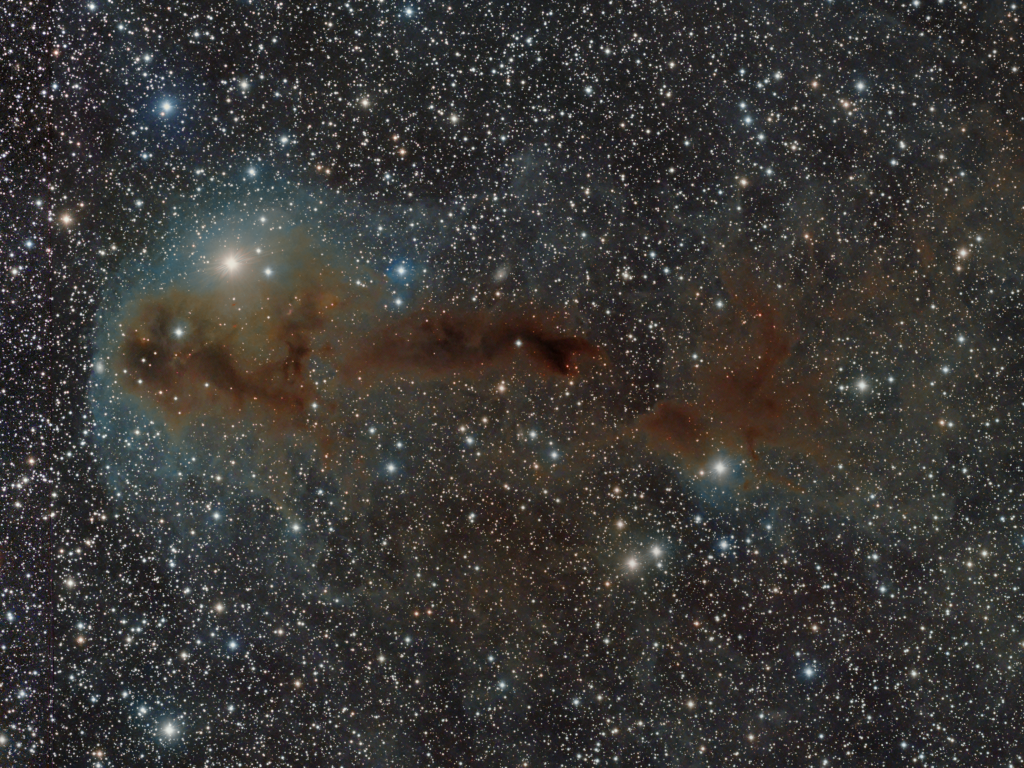
Somewhat tongue-in cheek, astrophotography is often referred to as something of a dark art and to be fair it sometimes seems that way, particularly when it comes to processing. My main interests in astrophotography are Deep Sky Objects such as emission nebulae, galaxies and planetary nebula but have long aspired to capture a more elusive category that abounds throughout the Universe – dark nebula.
Popular with astrophotographers, emission nebulae consist of vast clouds of ionised gases and regions of interstellar dust which reflect light from the said gases and or from stars and stellar nurseries that lie within – depending on their make-up the results are colourful in both broadband and narrowband wavelengths. Dark or absorption nebulae are also a type of interstellar cloud but are so dense they completely obscure and / or soak-up visible light emitted from objects behind or within, which as a result contrasts with general light flux of the Universe forming large dark regions. Because of their darkness they are usually faint, hard to see and moreover, difficult to image, especially from locations with light pollution.
The Horsehead Nebula is a dark nebula that has formed a part of my previous images but I’ve only imaged an isolated dark nebula once before – Barnard 142-3, which for obvious reasons is also known as the E-nebula (see above & here). Larger more complex dark nebulae require much darker skies to image than prevail at Fairvale Observatory, such as in New Mexico, USA where the Deep Sky West observatory is located and on this occasion has produced my first ‘serious’ image of a stand-alone dark nebula.
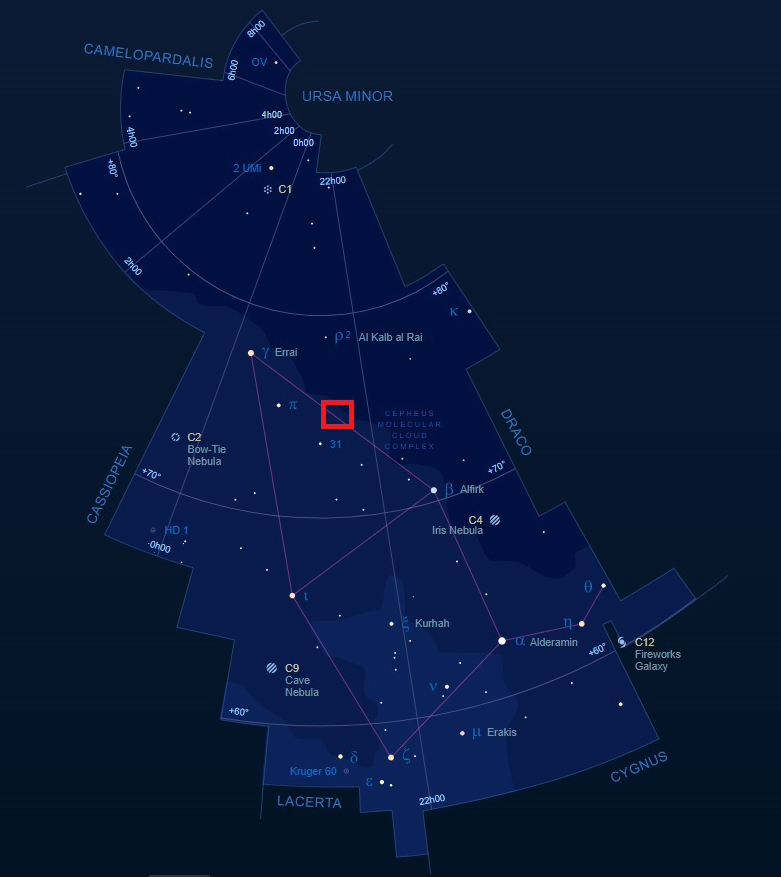
Cepheus & the aproximate location of LDN 1250 image indicated by the red square
Lynds Dark Nebula (LDN) catalogue of dark nebulae was compiled by the eponymous Beverly T. Lynds in 1962 and is based on the study of red and blue photographic prints from the National Geographic-Palomar Observatory Sky Atlas. Situated in the north close to Polaris, the constellation of Cepheus has a number of dark nebulae, of which LDN 1250 is part of a huge complex of dark nebula surrounded by dust and scattered light from the stars of Cepheus.
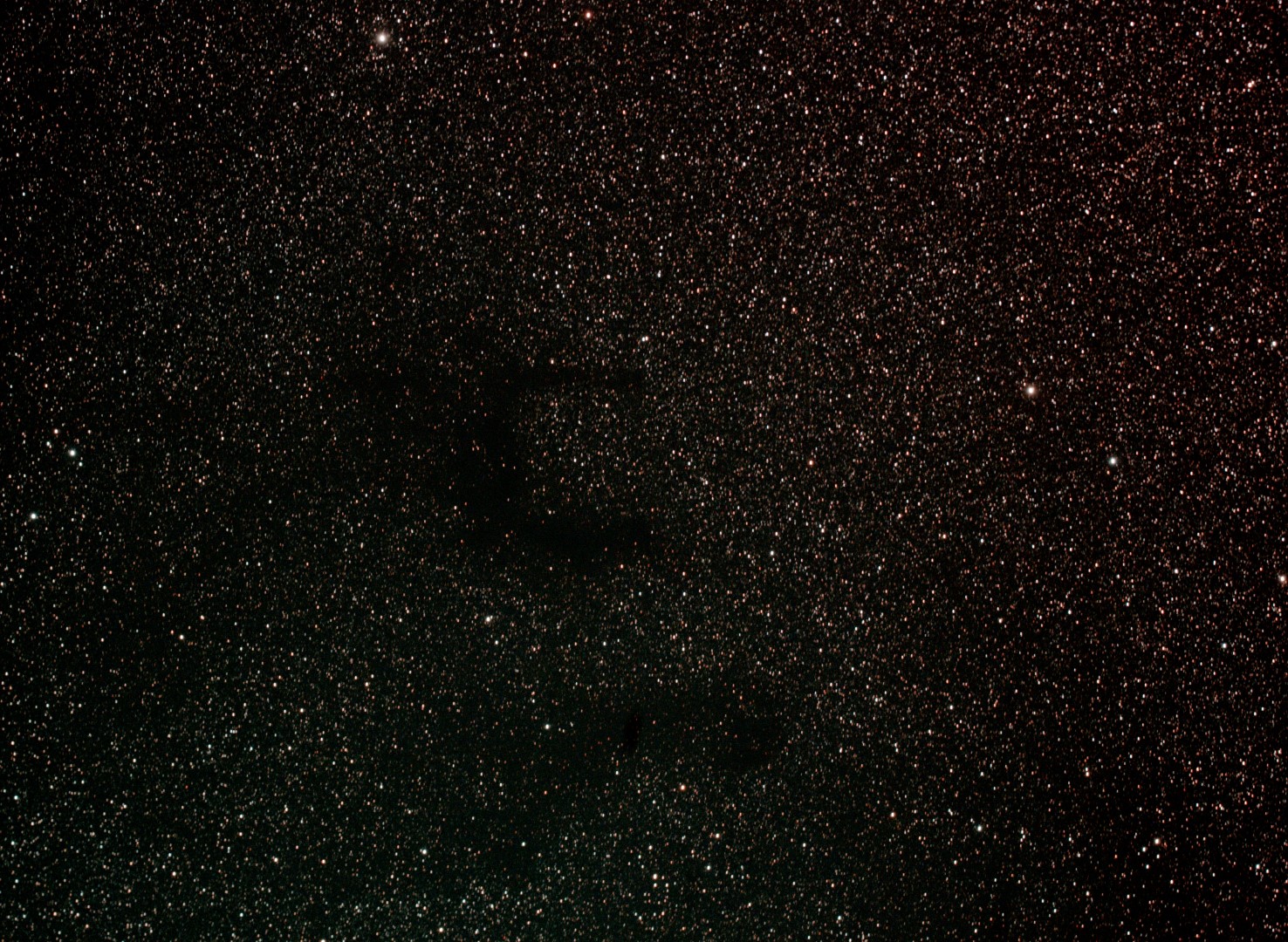
LDN 1250 luminance – RGB wavelengths are also strong
Imaged here in LRGB the features come out well in all wavelengths, however, such are the subtleties of the dark nebula components I found processing difficult and required plenty of ‘dark art’ techniques. The final image at the top of the page shows to good effect the main dark nebula, togeher with widespread but less opaque nebulosity and star colours, as well as some distant galaxies lurking in the background that together has produced a satisfying and very interesting outcome.
For good reason spring is known as “galaxy season” by astronomers but during this period, shortly before astronomical darkness inevitably disappears for summer, there’s also another show in town. Closer to home in the denser extremities of our galaxy, over 150 globular clusters have so far been identified orbiting above and below the plane of the Milky Way within the galactic halo. Globular clusters consist of hundreds of thousands of tightly packed stars that are surely one of the more enigmatic features of astronomy, as we now know that similar clusters also are associated with other galaxies throughout the Universe. Whilst the formation of globular clusters is poorly understood, we do know that at 10.0 to 13.5 billion years they are very old. Given their age, location and density, it seems that globular clusters formed under very different circumstances to the more recent dispersed star clusters.
Image Setting / Location
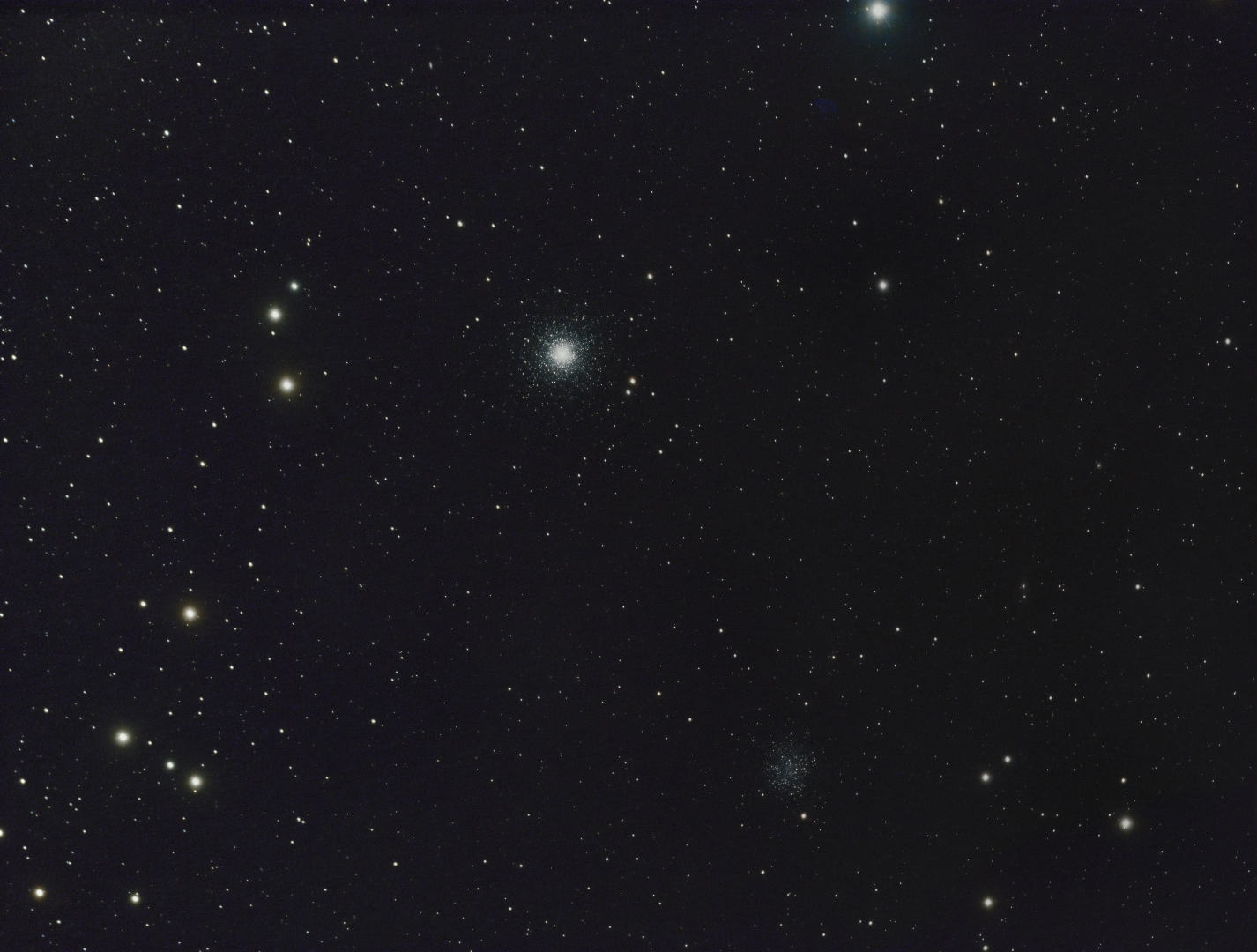
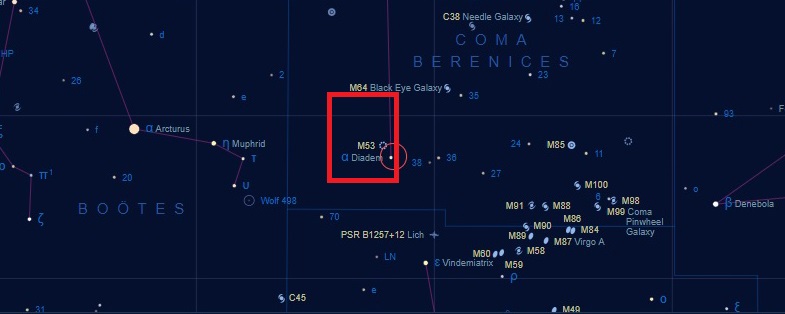
Sagittarius and Ophiuchus brim with globular clusters but at the higher latitude here at Fairvale Observatory it is necessary to view those around the regions of Canes Venatici, Virgo or Coma Berenices; the Great Cluster of M13 and others such as M92 and NGC 6229 located in the aforesaid Hercules constellation move into a better view later during early summer. Having previously imaged a number of these clusters in the past, this spring I looked around for something new and different, which I found in the name of M53 (Above + left of centre – main image top of the page) . In this case it turned out to be two for the price of one, as with careful framing it was possible to include a second globular cluster, NGC 5053 (Below + right of centre – main image top of the page).
Located in the southern area of the Coma Berenices constellation, M53 (Above left of centre – main image, top of the page) is some 58,000 light years from Earth. Containing some 500,000 metal-poor stars, the cluster equates to 13 arc minutes of sky or about 220 light years in diameter, with an estimated age of 12.67 billion years. Just over 1o east of M53, NGC 5053 is 53,500 light-years away, with an apparent size of 10.5 arc minutes or 160 light-years. Although classified as a globular cluster, NGC 5053 is more irregular and dispersed in nature without a distinct bright core and is therefore dimmer than its neighbour, making it more difficult to image.
M35 Full Crop
All-in-all I believe these two globular clusters, combined with the star studded background that just includes the binary Diadem star (Upper edge + right of middle – main image, top of the page) southwest of M53, altogether makes for a rich and interesting final image.
IMAGINGDETAILS
Object
M53 & NGC 5053
Constellation
Coma Berenices
Distance
Approx.. 58,000 & 53,000 light-years
Size
13.0 & 10.5 arc minutes
Apparent Magnitude
+8.33 & +10.00
Scope
William Optics GT81 + Focal Reducer FL 382mm f4.72
Mount
SW AZ-EQ6 GT + EQASCOM computer control & Cartes du Ciel
Guiding
William Optics 50mm guide scope
+ Starlight Xpress Lodestar X2 camera & PHD2 guiding
Camera
ZWO1600MM-Cool mono CMOS sensor
FOV 2.65o x 2.0o Resolution 2.05”/pix Max. image size 4,656 x 3,520 pix
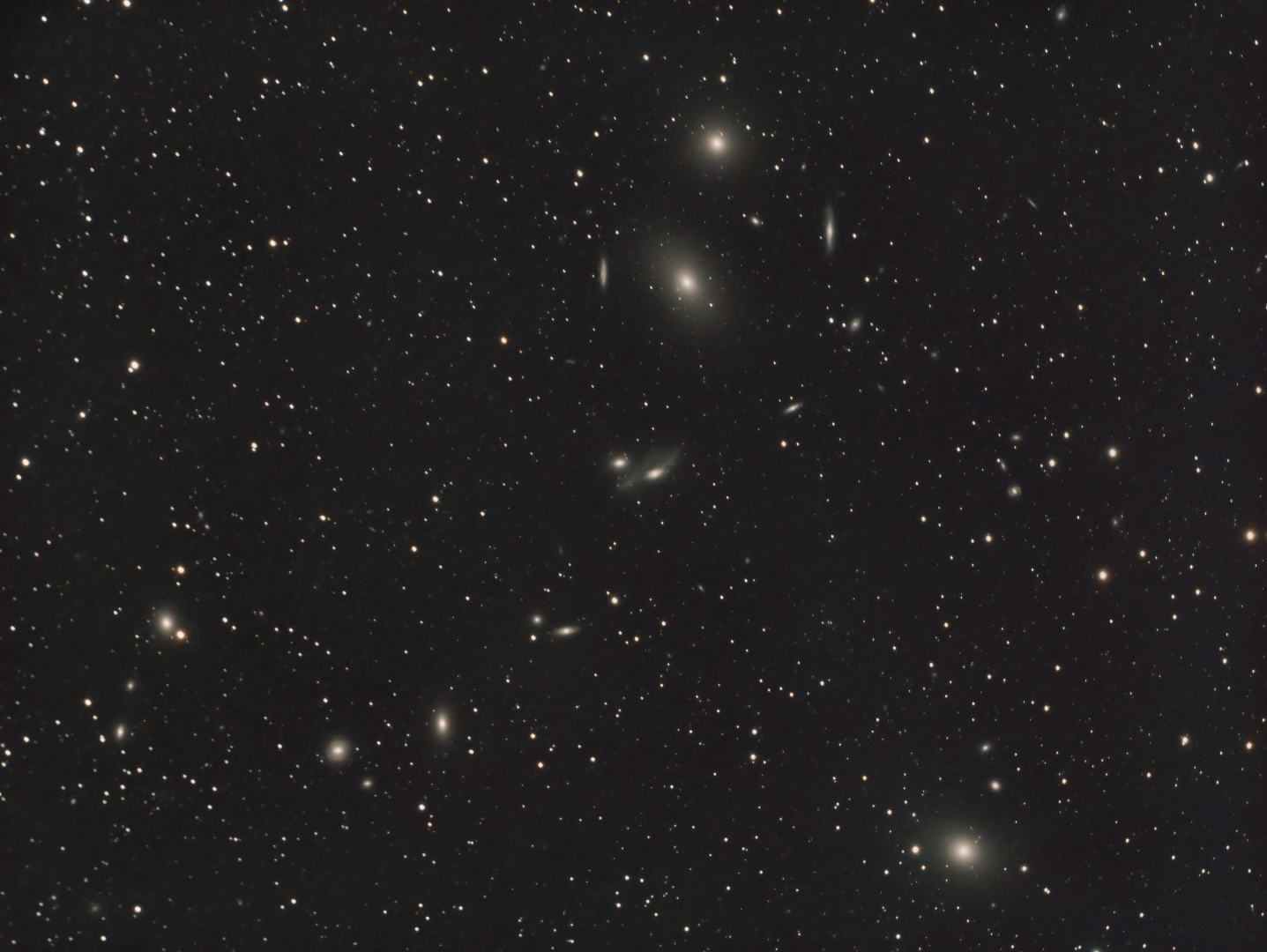
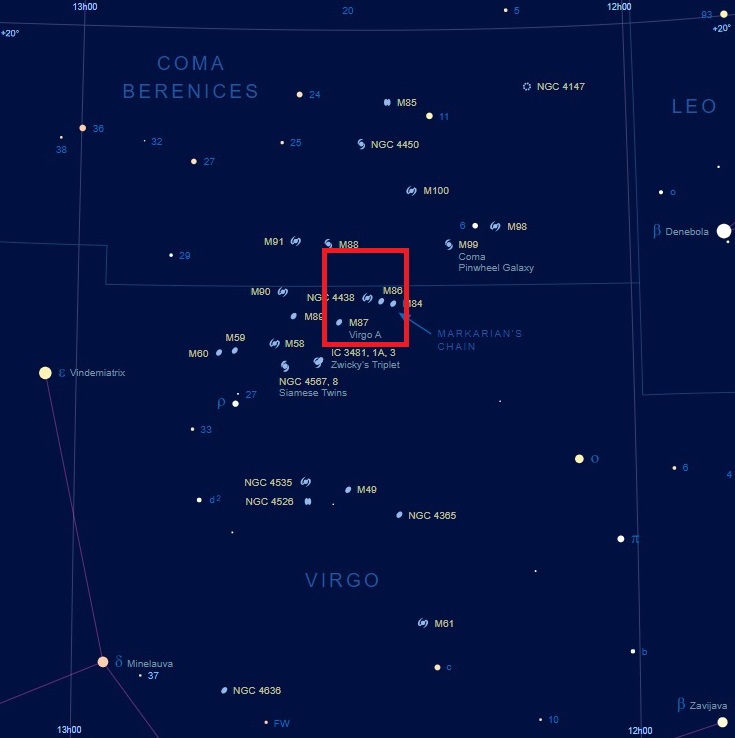
The Virgo Cluster consists of more than 2,000 galaxies, which unfortunately are optically too much for my small William Optics GT81 telescope individually. However, one of several sub-groups within the Virgo Cluster forms a striking J-curve shape that does make for a pleasing LRGB image. Discovered and named after the Armenian astrophysicist Benjamin Markarian, Markarian’s Chain is a string of bright galaxies that share a common motion through space. I first imaged the Chain in April 2015 using a modded DSLR and then again in April 2017, as my first LRGB image with the then new ZWO ASI1600MM-Cool camera but with integration times of less than 1-hour on both occasions, the resulting images were far from ideal. On this occasion using my new Chroma LRGB filters for the first time I was determined to do better.
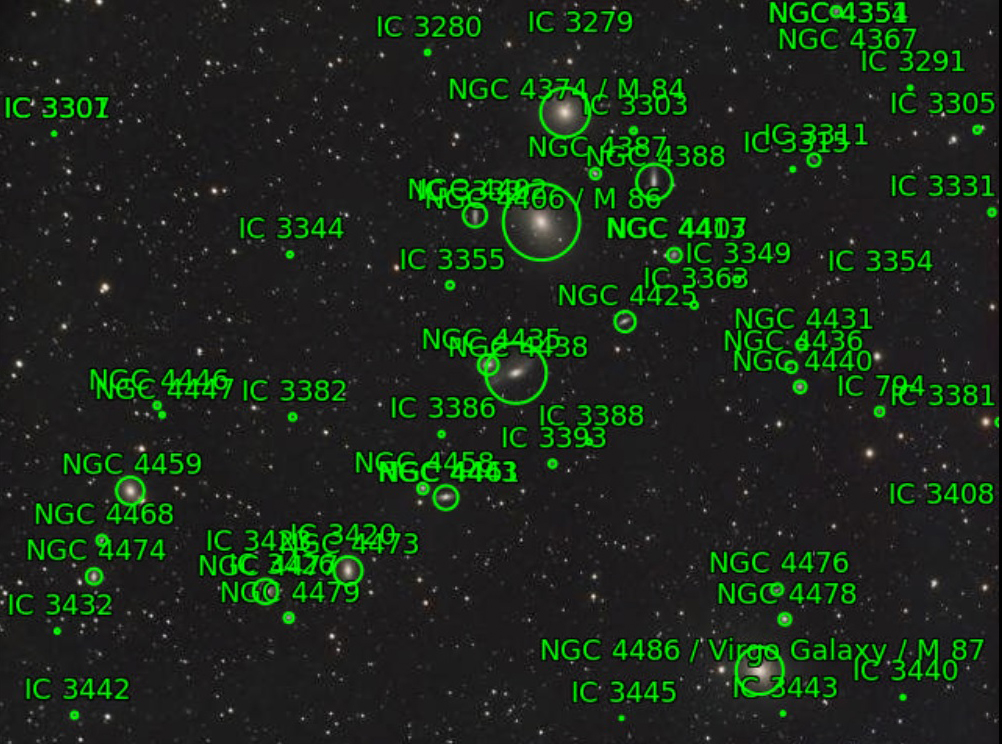
The new filters and nearly 7-hours integration time has resulted in a much more dynamic and detailed image, which I believe now does justice to this spectacular group of galaxies. Analysis of the image using Astrometry.netshows just how crowded this area of Virgo is with galaxies (see annotated image above) but it is Markarian’s Chain that inevitably stands out together with a few other adjacent galaxies.
Large 10th magnitude M84 & M86 galaxies at the western end of the Chain dominate the image. M84 is the object with the highest blue shift in the Messier catalogue, which is a result of its rapid movement (244km/sec) towards the centre of the Virgo Cluster and us. At the centre of M84 is a 1.5 billion solar mass black hole.
NGC 4420 & NGC 4388 – by comparison these edge-on galaxies together with even smaller NGC 4413 & NGC 4425 seem to frame the larger M84 and M86.
Next along the Chain is a pair of interacting galaxies, the smaller round shaped NGC 4435 and NGC 4438 with its distorted disk, known as “The Eyes”.
As the Chain starts to turn, some 20’ along is NGC 4458 and its partner, the 11th magnitude elliptical NGC 4461.
The final section of the Chain consists first of NGC 4473, its brightness generated by a supermassive black hole – at 100 million solar masses its diameter of 4.46au which would stretch from the Sun to the asteroid belt! Thereafter the 11.4 magnitude barred lenticular galaxy NGC 4477 defines the north eastern extremity of Markarian’s Chain.
As previously noted, there are many other galaxies in this part of the Virgo Cluster. Perhaps most notable though is M87, from which the first ever image of a black hole was the obtained in 2019 – consisting of some 6.5 billion solar masses.
All-in-all Markarian’s Chain makes for a rewarding image using my small telescope combined with the new Chroma filters. Such is the nature of the image the galaxies might also suggest a string of pearls or perhaps galactic stepping stones – metaphorically leading to the next phase of my astroimaging journey.
IMAGING DETAILS
Object
Markarian’s Chain
Constellation
Virgo & Coma Berenices
Distance
50 – 55 million light-years
Size
~2.5o total
Apparent Magnitude
Varies +10 to +12 approx.
Scope
William Optics GT81 + Focal Reducer FL 382mm f4.72
Mount
SW AZ-EQ6 GT + EQASCOM computer control & Cartes du Ciel
Guiding
William Optics 50mm guide scope
+ Starlight Xpress Lodestar X2 camera & PHD2 guiding
Camera
ZWO1600MM-Cool mono CMOS sensor
FOV 2.65o x 2.0o Resolution 2.05”/pix Max. image size 4,656 x 3,520 pix
After starting astronomy in 2014, Watch This Space (Man) was launched shortly thereafter as a personal record of my then nascent astronomy journey. Apart from the main blog about my progress or otherwise, links to other astrophotographers, astronomy tools, astronomy weather, scientific papers etc. can also be found on this website; I was suprised to see that to-date 152 items have been published on this site.
I always like to hear from others – comments, questions, help or just to say hello – and can be contacted via: graham.s.roberts@gmail.com or just leave a comment at the end of any item if you prefer.
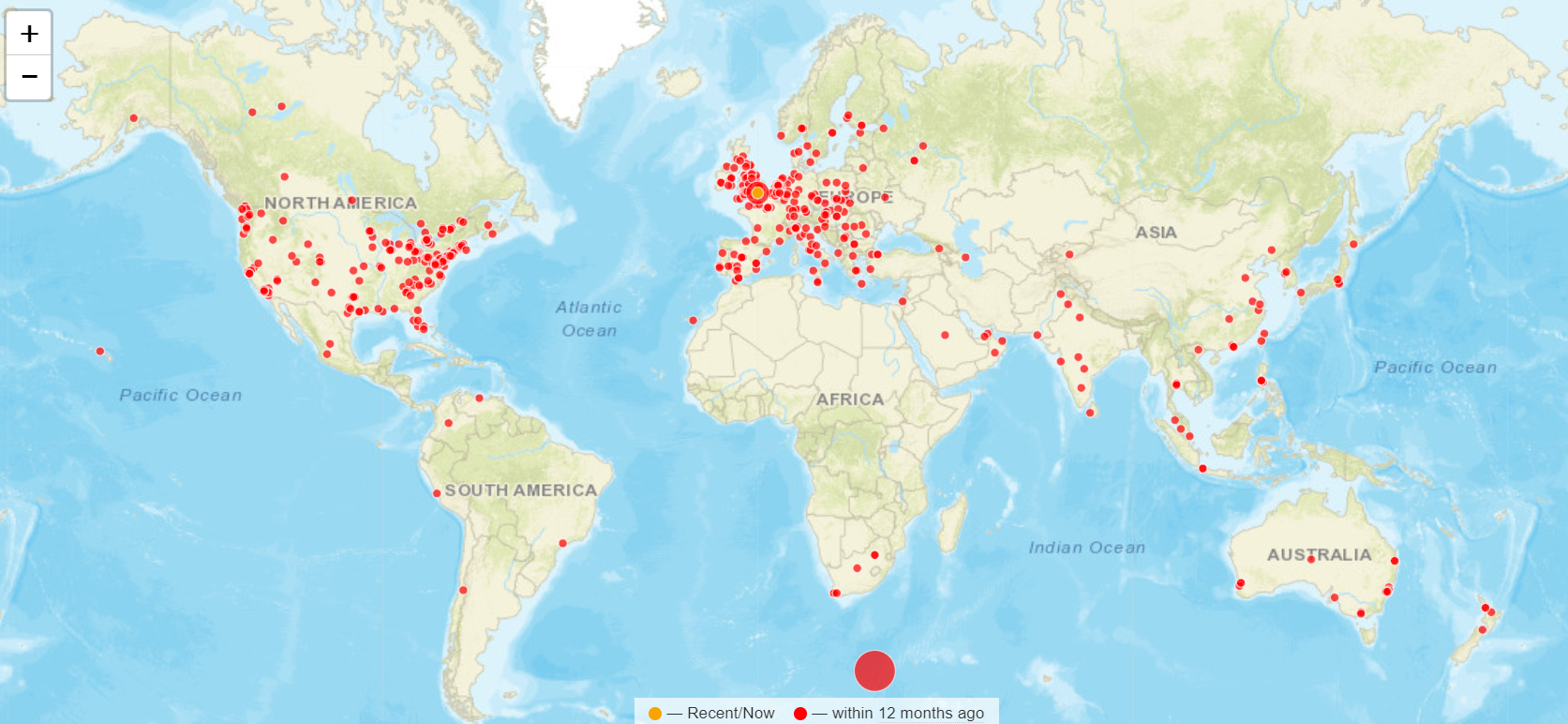
Vistor map 2020: In this most difficult of years for everyone, it’s especially heartening to see so much interest from all corner’s of the world and hope to see you and others again in 2021 – Clear Skies!
REFLECTIONS is a review of my astronomy and astrophotography during the past year, together with some thoughts on possible future developments.
2020 Overview, Images & Goals for 2021
For the world 2020 was a year like no other. Notwithstanding the obvious problems and dire consequences of Covid-19 for everyone, there have been surprising benefits for astronomy. Although I am retired, under lockdown there was even more time available for hobbies. Furthermore, as I live close to Gatwick and Heathrow airports + underneath numerous high altitude long-haul overflight paths, a massive reduction in air travel resulted in a very obvious improvement in seeing conditions, which was confirmed by guiding results. Located in a Bortle 5 to 6 area I ordinarily achieve at best average RMS error guiding of 0.90” to 1.50”/pixel, guiding improved markedly during lockdown to between 0.50” to 0.75”/ pixel. Of course such seeing conditions also resulted in better quality imaging itself and on a number of occasions I was able to achieve integration times of 10-hours or much more over a number of nights. The result was better images but less of them and inevitably, a lot more cloud throughout the rest of the year!
Having previously got to grips with plate solving, using the new CdC planning function I intended to develop the use of mosaics this year. However, such is the weather in the UK (see above) that it’s obvious to me that creating mosaics is probably not the best use of what imaging time we get. Undeterred, during January I planned and shot a 15x panel mosaic of Barnard’s Loop in Ha-wavelength. Unfortunately the unpredictable occurrence of patchy cloud invalidated some of the panels, though I was finally able to compile a 7x panel mosaic of the upper easterly section of Barnard’s Loop – see below. Notwithstanding, there were lessons learned: (i) restrict mosaics to one or two panels and / or (ii) where wider view images are required use a wide FOV set-up rather than a large mosaic.
Most of my other objectives for 2020 turned out to be pipedreams e.g. a new observatory or perhaps a larger telescope or dual rig. Despite this there were important developments on other fronts.
After eventually coming to the conclusion that mosaics were probably an unwise way to go considering UK conditions, it became clear that a suitable high-quality camera lens might produce similar coverage with less imaging time and hassle. Thus also inspired by the images of others on the SGL Forum using such equipment, I set out to build a new rig based around the excellent Samyang 135 f2 lens. This project remains work-in-progress but so far using the lens with a bespoke 3D printed rig and micro focuser made by Astrokraken and a modded DSLR, it’s apparent that this lens produces excellent widefield images in a relatively short time.
Initial Samyang 135 f2 set-up with modded DSLR
With the time and ‘opportunity’ afforded by lockdown throughout most of the year, I finally decided to do something about improving my processing, namely learning PixInsight. Unfortunately the rumours were correct – it is a steep learning curve and altogether a less than user friendly software. However, after many weeks of toil and expletives I’m pleased to say I can now process an entire image with PixInsight, the impact of which has been nothing less than profound. However, whilst PixInsight is an excellent processing facility, I’ve come to the conclusion that it is often best used together with other process software where appropriate for specific tasks:
Deep Sky Stacker for calibration, alignment and stacking; the equivalent PixInsight process is just too complicated and time consuming;
Photoshop can be very helpful finessing colours and stretching (Levels & Curves);
Starnet++ is useful for creating starless images, which then help to get the best from processing nebula separately before re-combining with the stars;
Topaz AI Denoise has been very effective and easy to use for noise reduction and sharpening at any point during the workflow.
This combination for processing has turned out to be something of a game changer and almost certainly was the most important astrophotography development of the year for me, which augurs well for 2021 and beyond.
Favourite Images
Continuing with the theme of less is more, I imaged just 13 objects this year – of which three were experimental & three with a DSLR – but still with a total integration time of 80 hours (2019 17 objects & 65 hours, 2018: 25 objects & 43 hours). Having worked through many of the astronomer’s favourites by now, images in 2020 consisted of: a new approach to old favourites, difficult / small objects for my equipment e.g. galaxies or less popular and widefield targets.
I’m pleased to say that most of these images turned out well and it’s difficult to choose a favourite. The so-called ‘favourites’ below therefore represent those images from this year that portray an important development in my astrophotography journey. More detailed reviews of these and all other images from 2020 can be found in specific articles that can be accessed using the links found below or via the Blog Index, located under the dropdown menu ABOUT.
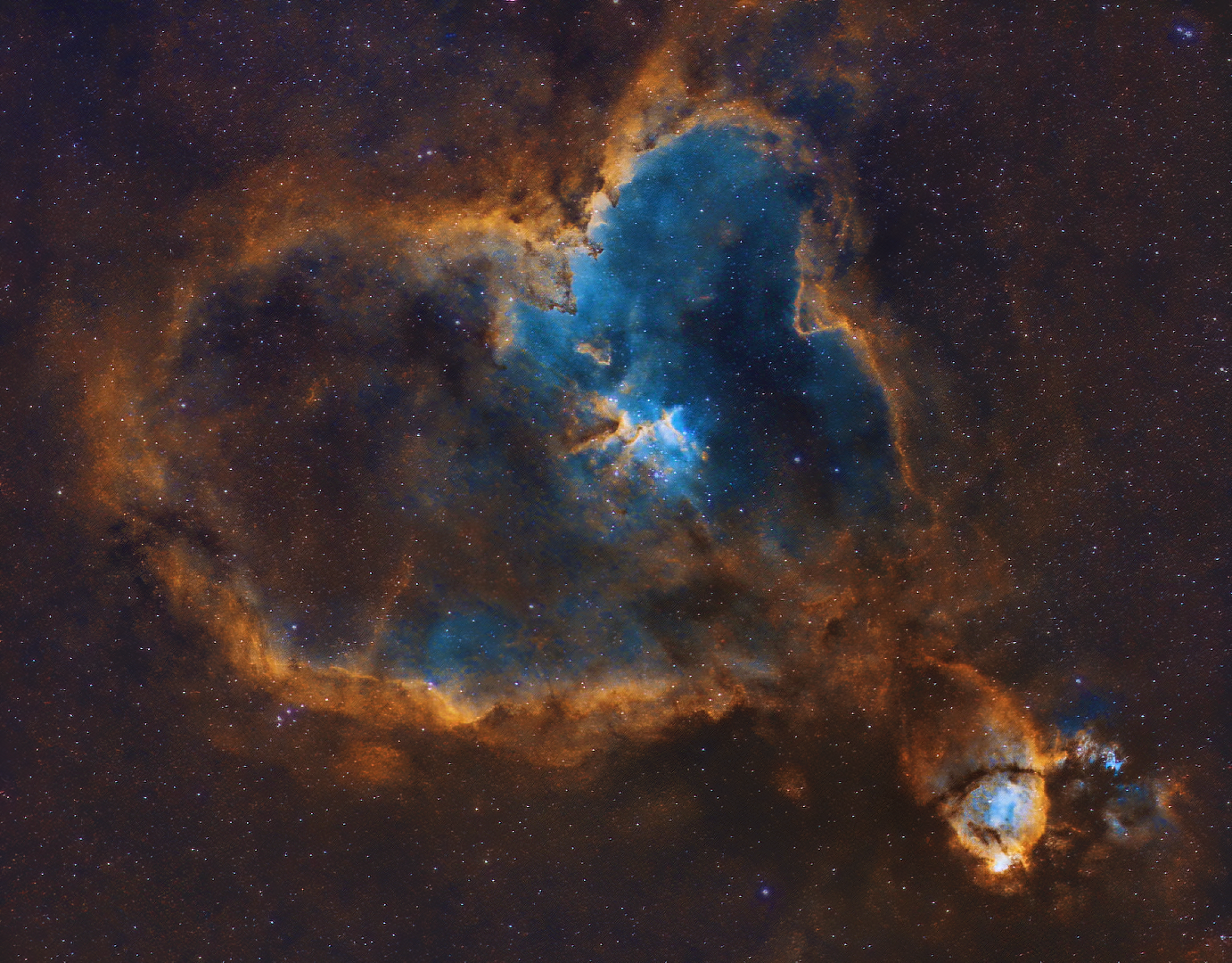
Heart Nebula: Although imaged in 2018, this version has been re-processed using mainly PixInsight, thus transforming the original SHO Hubble Palette image from something rather dull to one with warm, vibrant colours, as well as much great detail – demonstrating the significant impact of my new PixInsight based processing abilities.
LBN 325: Numerous emission nebulae populate this small part of a very extensiveHII-Region, which forms an exciting LRGB image. Processing was complex and difficult, in order to bring out exciting features that abound in this spectacular but less popular area of the Cygnus constellation. Integration time of 10-hours was obtained over three nights and is my first LRGB image processed using PixInsight.
M63 Sunflower Galaxy: At 12.6’ x 7.2’and apparent magnitude of +9.3,this small flocculent galaxy in the Canes Venatici constellation is a challenge for my equipment. However, with 8 hours 20 minutes exposure over three nights in April and careful processing, the all-important detail within the galactic disc is clear. Topaz Denoise AI and Gigapixel software played an important role in maintaining the colour and delicate detail in this +50% cropped image.
Taken from last year’s REFLECTIONS 2019:
“Although you never know, I don’t see any major breakthroughs in the coming year”. Just goes to show what I know, fewer but better images were obtained in 2020:
RECORD CARD 2020
Goal
Specifics / Results
Outcome
Improve image capture
Further Improvements in overall quality + much longer integration times + better guiding accuracy = less but better images.
MUCH BETTER
Better processing
Using PixInsight software combined with Photoshop, Starnet++ and Topaz Denoise AI has led to major processing improvements and much better final images.
MUCH MUCH BETTER
Widefield Imaging
Initial results from new imaging rig based around Samyang 135 f2 lens were very promising but there’s more to do.
BETTER
My main objectives for 2020 were largely fulfilled (see above), so what about 2021?
Imaging: Other than maintaining the aforesaid improvements achieved over the past two years – guiding & longer integration times – two items that still need to be addressed are: (i) upgrade filters to remove star bloating and all round better images, (ii) improved focussing.
Widefield: Complete Samyang-rig build and switch from DSLR to CMOS mono camera.
Consolidate processing improvements: Whilst the move to PixInsight and other software was very successful in 2020, I’m still only scratching the surface of what’s possible.
Upgrade mono camera – there’s a new generation of colour CMOS cameras starting to appear, hopefully soon to be followed by their mono equivalents !
Hardly a year I and the rest of the world will want to remember, though more than ever astrophotography played a big role in providing relief from the trauma going on around us all.
The major increase of integration times achieved and the use of PixInsight has proved transformative for my astrophotography and will justify returning to reimage some old favourites in future years. I had often thought about upgrading my OTA to something bigger but given the lack of a permanent observatory here at Fairvale Observatory, combined with long periods of bad / cloudy weather, the penny finally dropped and I now have high hopes for the little wonder that is the Samyang 135 f2 lens when I complete its set-up in 2021.
Looking back I have to be happy with my astrophotography in 2020 but more importantly, look forwards to an even better year which holds great promise building on the positive developments of the past 24-months. Moreover, I hope for the sake of everyone that we will be able to deal with Covid-19 soon and return to something of a normal life once again. These are big ambitions and I hope that WTSM’s Reflections 2021 will record such success.
Watch this space!
ASTROPHOTOGRAPHY INDEX OF 2020
To access each blog, click on the title required below highlighted in RED: