Perspective: A wider view of the Universe

Earlier this year we went to the island of La Palma in the Canary Islands, which is recognised as the best astronomy site in Europe, where more than twelve major observatories have been built at an altitude of 2,396 meters on Roque de los Muchachos http://en.wikipedia.org/wiki/Roque_de_los_Muchachos_Observatory.  One of the engineers responsible for building and maintaining some of these observatories was Joan Genebriera, who subsequently went on to build his own private observatory on the island, which I reviewed in an earlier post https://watchthisspaceman.wordpress.com/2014/08/06/la-palma-nice-one-joan/.  Our trip was in order to undertake a week-long astronomy course with Joan and as part of this, develop (no pun intended) and fast track our knowledge of astrophotography.

Joan’s basic telescope and imaging set-up is, as you would expect, spectacular, with equally outstanding tracking:

  • Catadioptric Cassegrain-Relay 400mm telescope f5.6 (Larrose)
  • APO 120mm refractor f6.5 (Vixen)
  • Camera SBIG ST8300M
  • Camera SBIG CCD ST8XE
  • Camera Starlight Xpress CCD MX716 for use with spectrograph
  • Camera Canon 350 D DSLR

Of course this is just a list of equipment – it is what you do with it that matters and Joan’s expertise more than matched the quality of the equipment.  Over a number if evenings we undertook a series of photographic exercises using the 400mm Cassegrain-Relay telescope and the SBIG ST8XE CCD camera with RGB filters.  At the same time we rigged a Canon 350D camera on the refractor telescope to produce a contrasting, wide-field photograph to compare with the higher powered SBIG configuration.  We brought some of the unprocessed data / images back from La Palma but have unfortunately been unable to process the SBIG ones yet as they as FITS format, for which I have not yet found suitable software (more on this another time).  However, the Canon 350 D photographs are of equal but different beauty, which through the wide-field format show larger areas of sky, sometimes revealing vast groups of galaxies – amazing!

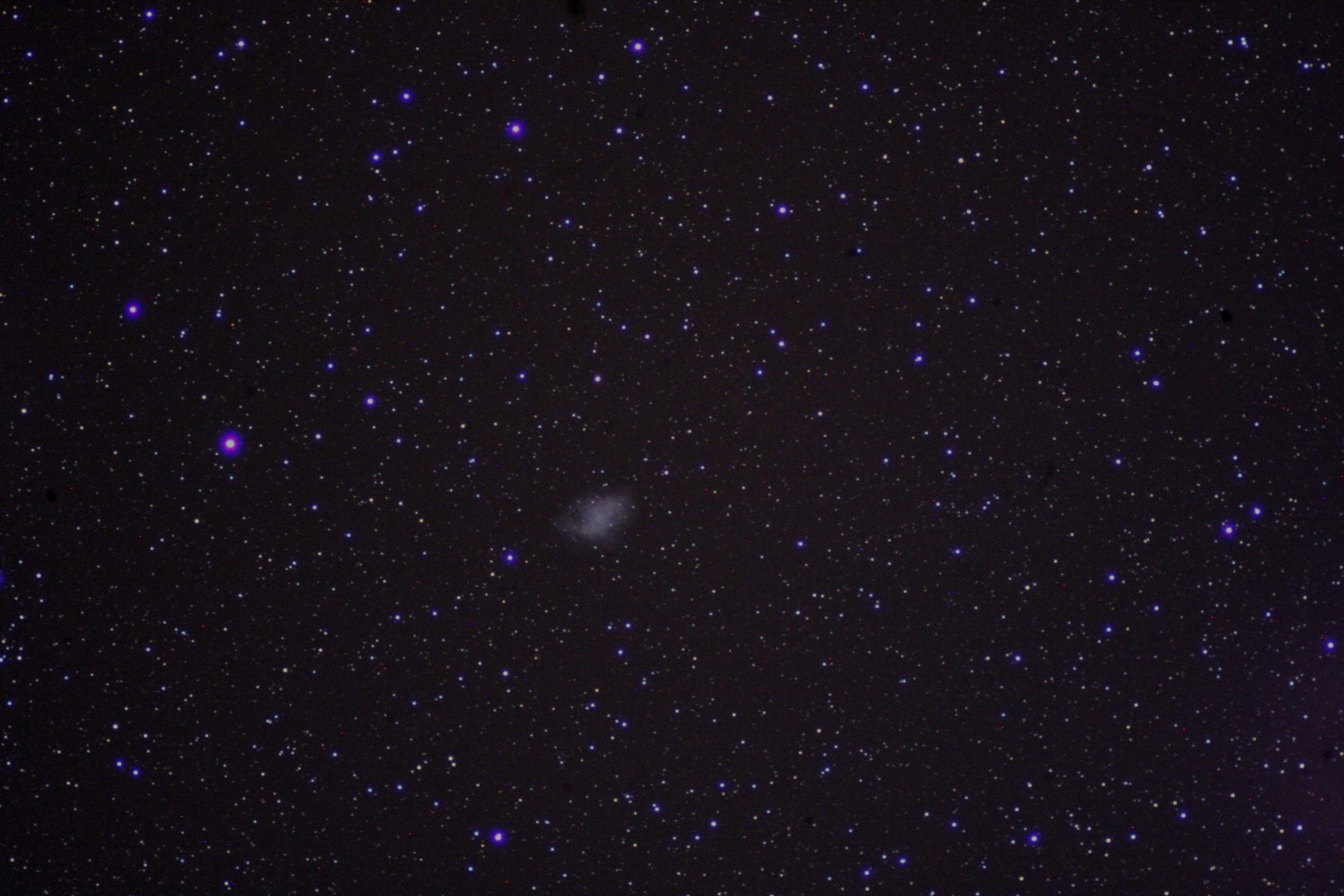
M1 The Crab Nebula Canon 350 D  | 240 secs @ ISO800

M1 The Crab Nebula
Canon 350 D | 240 secs @ ISO800

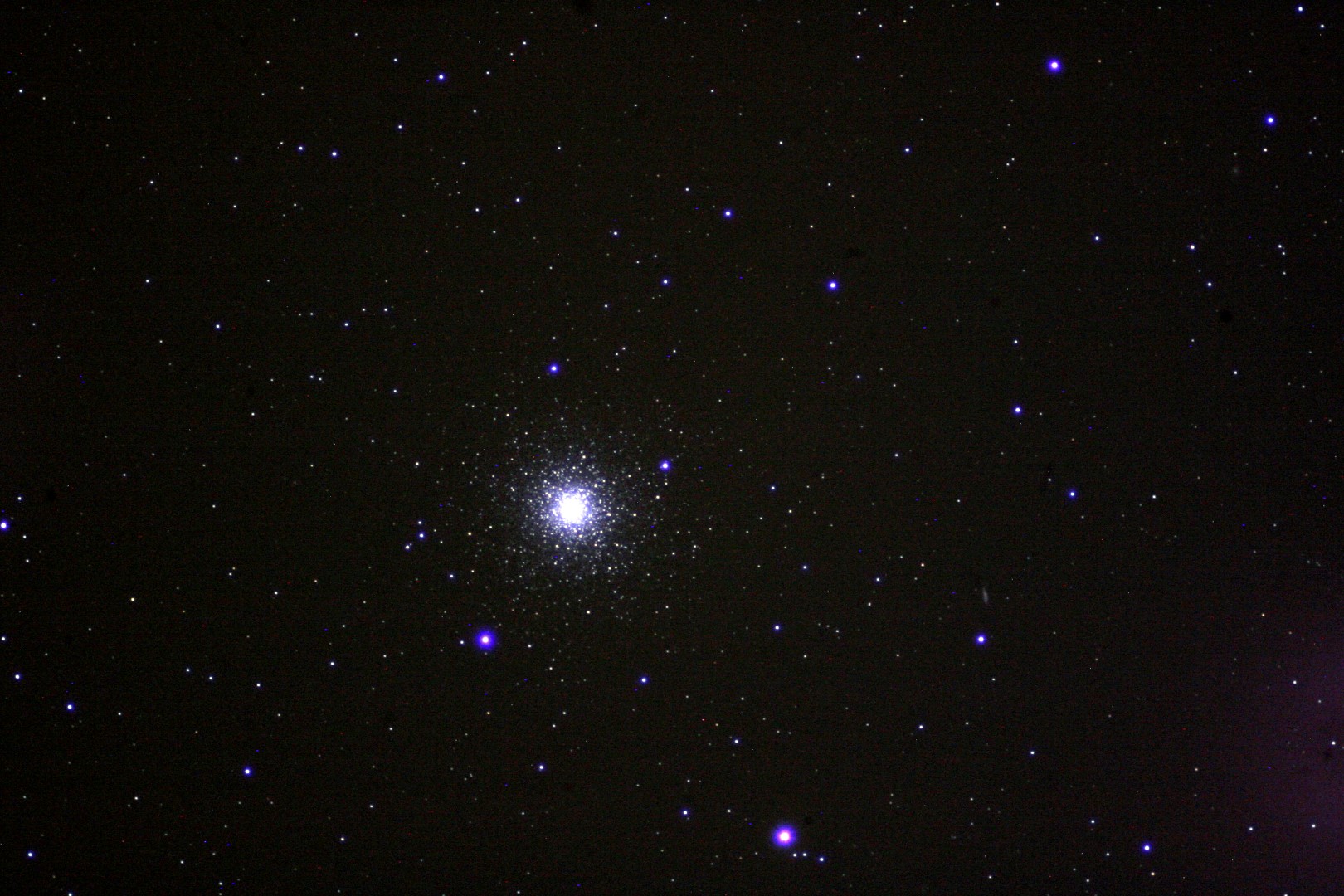
M3 a globular cluster in the constellation of Canes Venatici Canon 350 D | 240 secs @ ISO800

M3 a globular cluster in the constellation of Canes Venatici
Canon 350 D | 240 secs @ ISO800

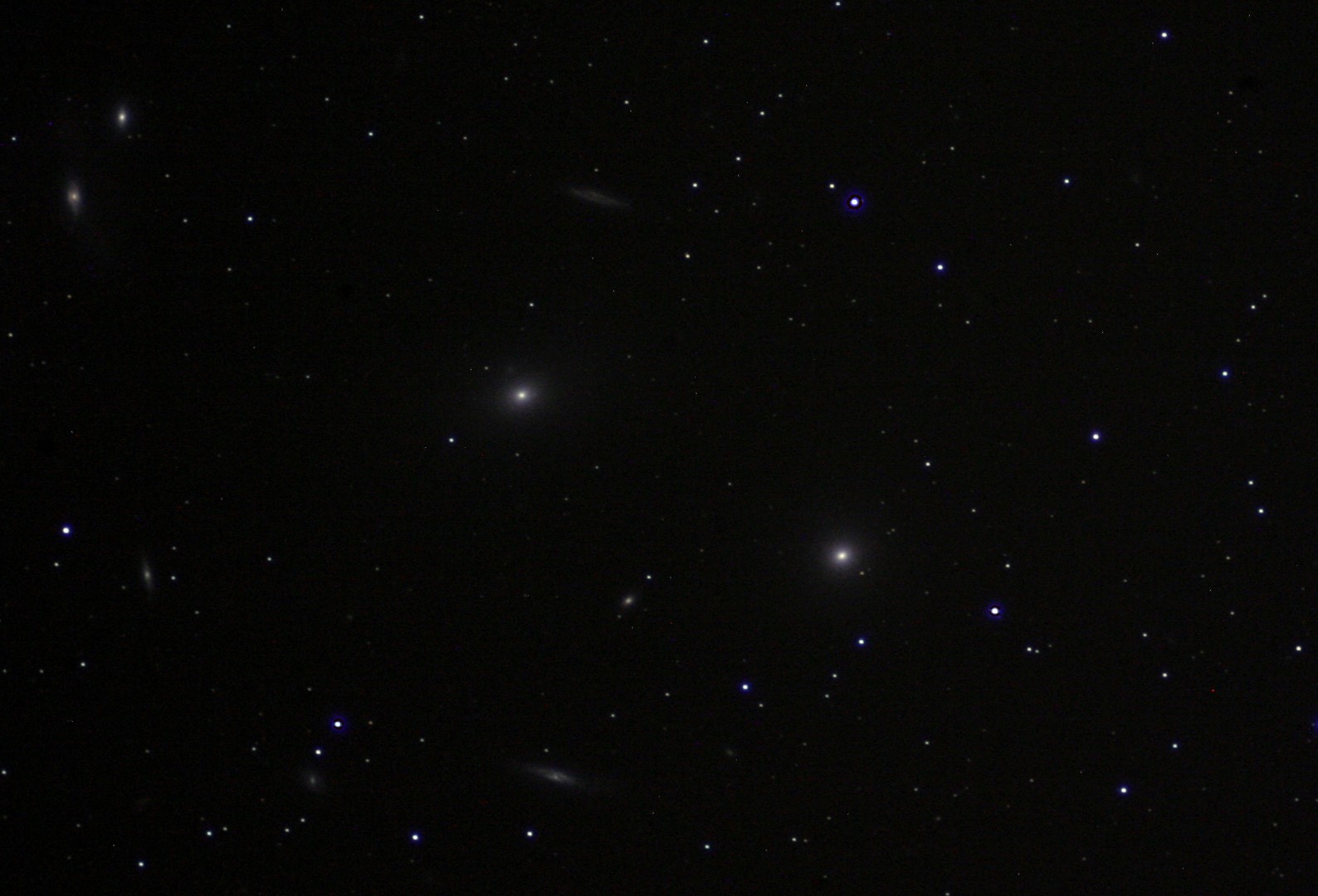
M84 a lenticular or elliptical galaxy located in the inner core of the Virgo Cluster of Galaxies Canon 350 D | 240secs @ ISO 800

M84 a lenticular or elliptical galaxy located in the inner core of the Virgo Cluster of Galaxies
Canon 350 D | 240secs @ ISO 800

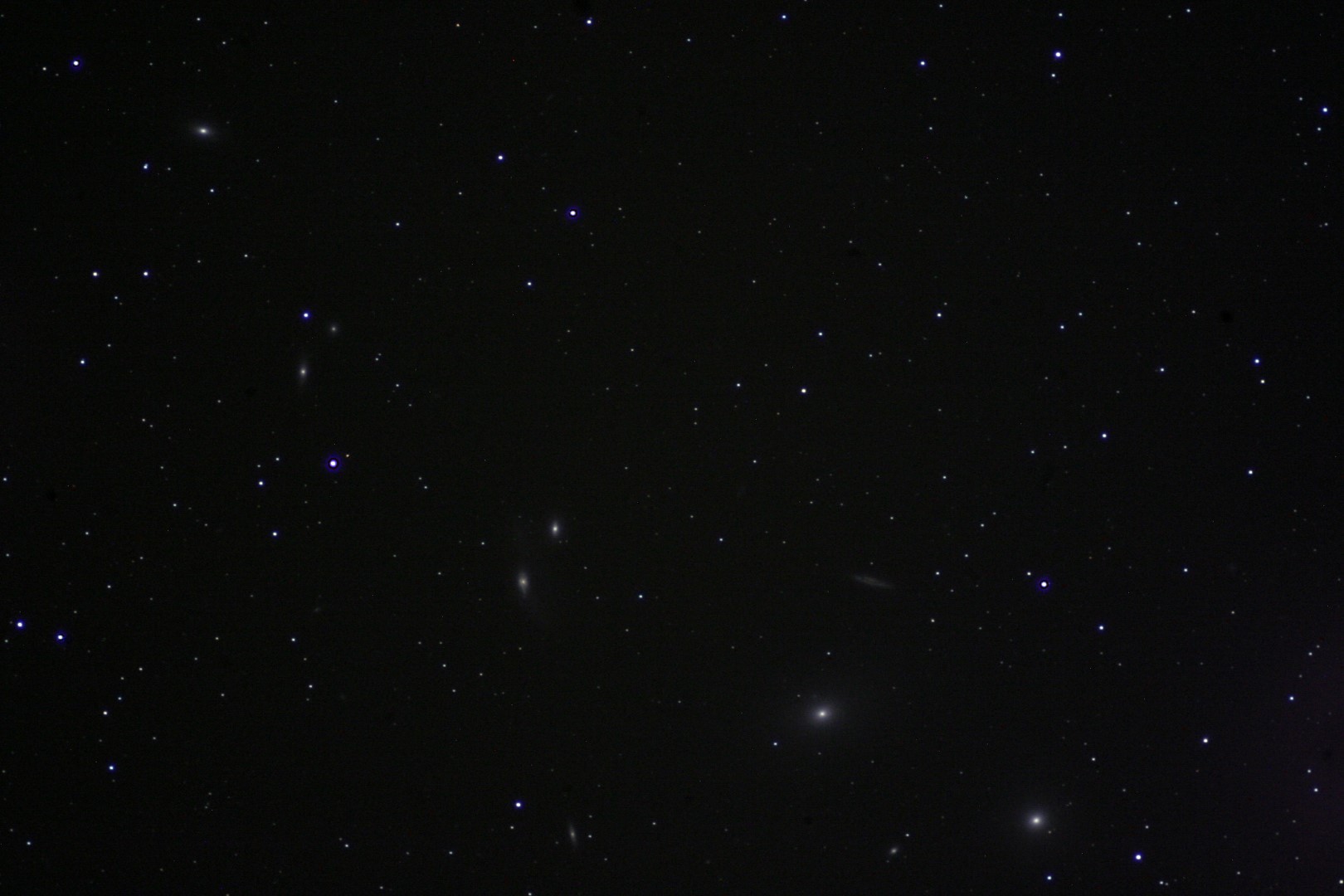
Virgo Group of Galaxies - a field of nine galaxies in the western part of the cluster group of over 2,000 galaxies! Canon 350 D | 240secs @ ISO800

Virgo Group of Galaxies – a field of nine galaxies in the western part of the cluster group of over 2,000 galaxies!
Canon 350 D | 240secs @ ISO800

Meet the neighbours

Earlier this week we were fortunate to have good sky conditions at Fairvale Observatory and I was therefore able to locate and image a new nebula, M27 the Dumbbell or Apple Core Nebula https://watchthisspaceman.wordpress.com/2014/08/20/astronomers-do-it-in-the-dark/ and for the first time, a galaxy.  As the birthplace of stars nebulae are almost beyond our comprehension, with their almost ethereal nature making them somewhat intangible to mere humans.  By comparison a galaxy has taken on what might seem a corporeal form, something that strangely seems more familiar and it should do, it is where we live.

It is for this this reason that I have been keen to capture a picture of my first galaxy from Fairvale Observatory; the picture at the top of the Home page on this site, which shows the Sombrero Galaxy, was taken in La Palma earlier this year so doesn’t count https://watchthisspaceman.wordpress.com/2014/08/06/la-palma-nice-one-joan/.  I’m not sure why but despite my enthusiasm for galaxies they have until now proved elusive; maybe the 150PL just wasn’t up to it or more likely, I was just finding them difficult to locate in the sky.  The Synscan feature on my new AZ-EQ6 mount has put an end to that, just dial it up!  And so it was that this week I got to meet the neighbours, in this case the closest spiral galaxy to our own Milky Way Galaxy, the Andromeda Galaxy.

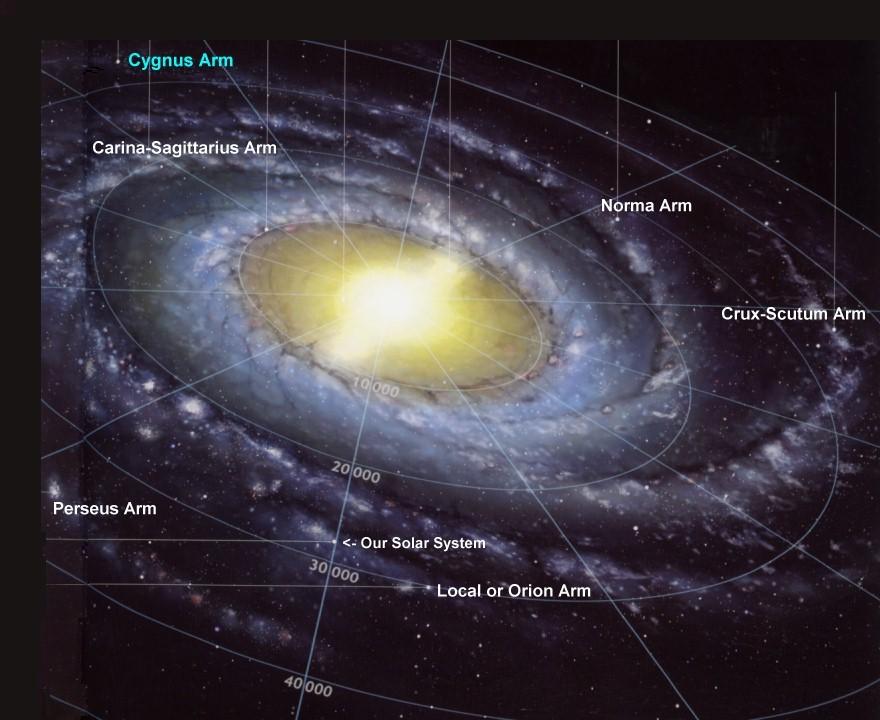
As previously discussed, Earth is located on the edge of the spiral Orion Arm of the Milky Way, about 25,000 light-years from the centre. 

The Milky Way & Location of the Solar System i.e Earth

The Milky Way & Location of the Solar System i.e Earth

Some 2.5 million light-years away is the similar and beautiful spiral form of Andromeda, or M31.  Andromeda is the largest spiral galaxy of the so-called Local Group, a group of 54 galaxies, with its gravitational centre somewhere between the Milky Way and Andromeda and herein lies a problem.  Andromeda is approaching the Milky Way at 110 k per second or 300 k per second relative to our Sun i.e. us, due to its orbit around the centre of our galaxy – thus also making it one of the few blueshifted galaxies we observe on Earth.  As a consequence we are destined to get to know our neighbour Andromeda a lot better in the future, as both galaxies are likely to collide and merge in about 4 billion years, forming a giant elliptical galaxy.

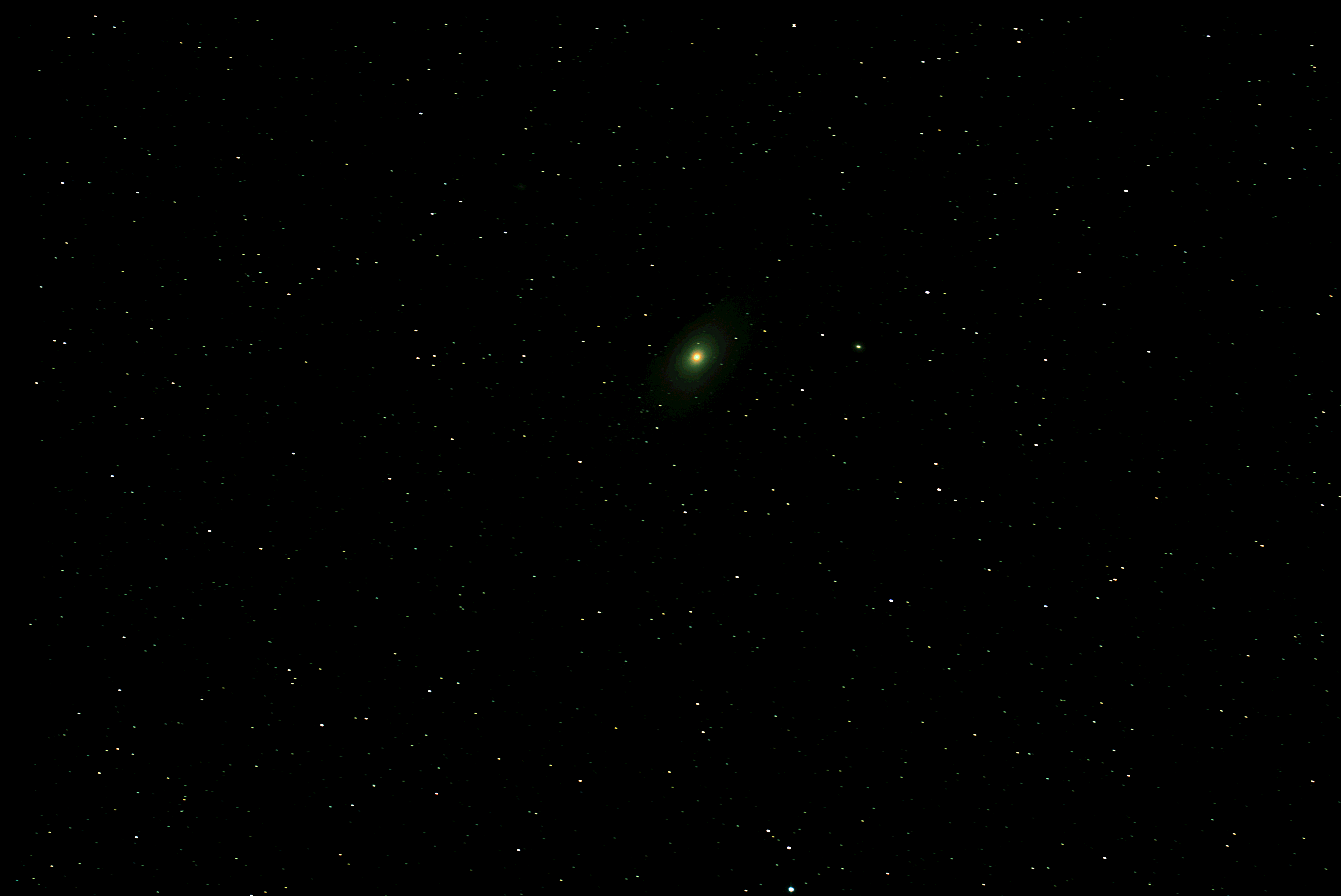
M31 - Andromeda Galaxy Canon 700D | WO GT81 + FF | 10x30sec @ ISO800

M31 – Andromeda Galaxy                                                                         Canon 700D | WO GT81 + FF | 10x30sec @ ISO800


In the meantime enjoy this great spectacle in the night sky.  From Fairvale Observatory Andromeda has only just become visible in the eastern night sky at about midnight, so I am hopeful that as it moves across the sky over the coming months I will get even better opportunities to image the galaxy; by which time I have hopefully improved my alignment, tracking and exposure abilities and thus can obtain greater photographic detail of this beautiful galaxy.

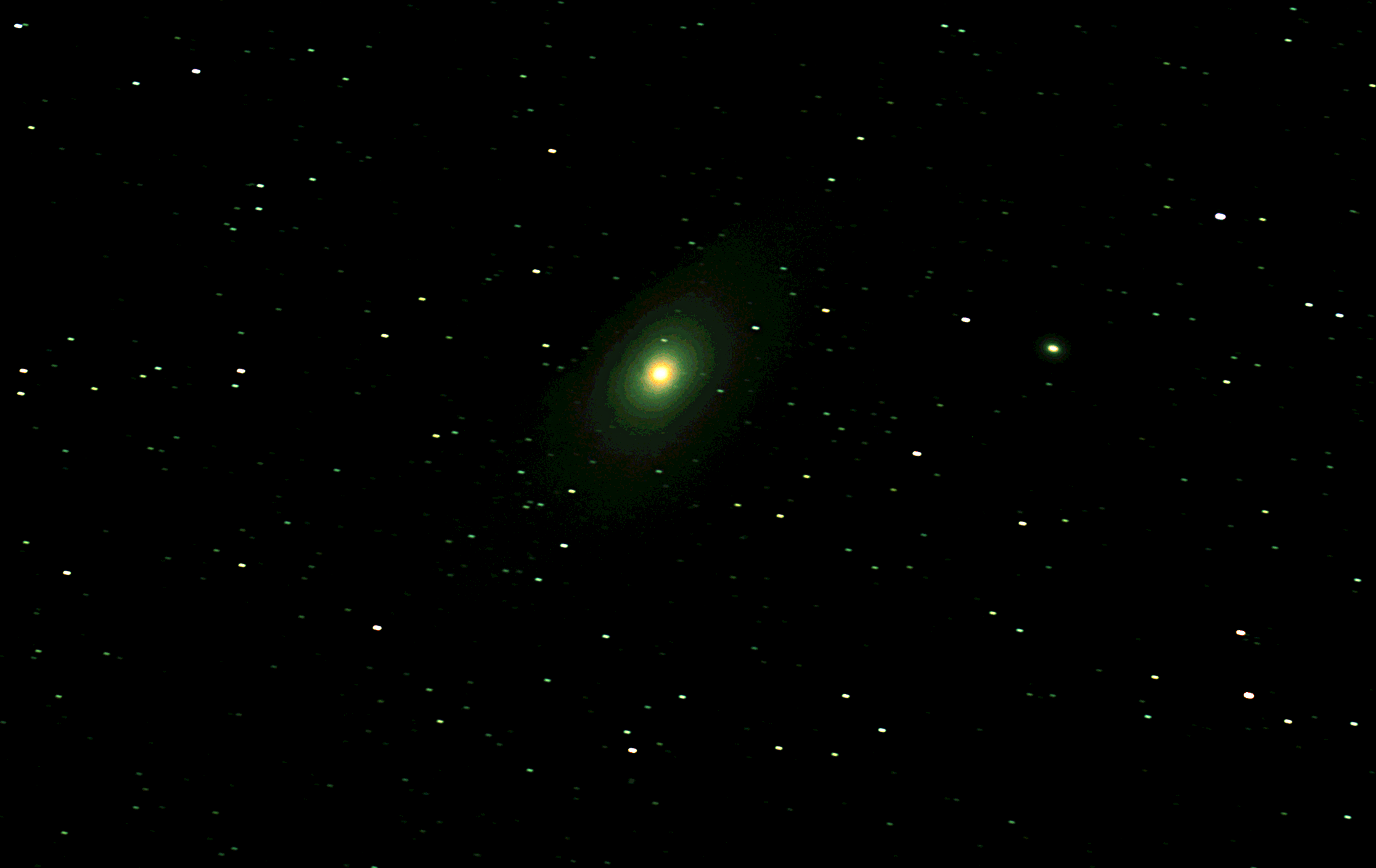
M31 Andromeda Galaxy - Cropped & 'stretched' in GIMP from main picture

M31 Andromeda Galaxy – Cropped & ‘stretched’ in GIMP from main picture

Astronomers do it in the dark

We are lucky to have dark sky parks in the UK, which are defined as: an area, usually surrounding a park or observatory that is kept free of artificial light e.g. Exmoor National Park, Galloway Forest Park and Kielder Forest, Northumberland.  The transformation of the sky through the absence of man-made light is truly incredible – apart from the greatly increased clarity with which the stars can be better seen, it is the emergence of otherwise feint or nearly invisible DSO objects experienced in these conditions that is exciting for astronomers.

During my life I have been fortunate to see a number of really exceptional ‘dark skies’ around the world, which in my opinion significantly beat the dark sky parks here in the UK.  The most memorable were in the Kalahari Desert and the middle of the Red Sea during a scuba diving trip, which were to use a phrase straight from the sixties (I was there but can’t remember it!) – mind blowing!  Living on Earth probably the most striking feature of a dark sky is the ability to look clearly through the Milky Way galaxy in all its wonder, which thus appears as a creamy band crossing the sky – we are in fact looking edge-on through the millions of stars that make up our galaxy.  Without wishing to overly digress at this point, our Solar system within which we live is on the edge of the spiral Orion Arm, located about two thirds of the way from the centre of the galaxy – 25,000 light years away. http://www.universetoday.com/65601/where-is-earth-in-the-milky-way/

Given such an amazing setting it is disappointing to live in South East England here at Fairvale Observatory, with London just to the north and Gatwick airport to the south, thus significantly reducing the light quality of the sky and making astronomy hard work.  Just to make matters worse, I have to contend with houses and trees obscuring the sightline in almost every direction, passing aircraft (see previous blog on the ISS) and the ubiquitous street light.  Furthermore, even on a clear night for much of the month the Moon poses a significant obstacle to astronomy as it floods the sky with its reflected sun light.

Notwithstanding, good nights (relatively) do occur and last Sunday was one of them.  It was completely clear from dusk until late in the night, the Moon (last quarter) obligingly did not rise until almost midnight and, thanks to the aforementioned houses and trees, did not impact on Fairvale Observatory until after 1.00 a.m.  Furthermore, as the temperature was unseasonably cool as a result of dominant northerly winds, the air was still; which all added up to a great night for astronomy and imaging in particular.  And so it was that I set about trying to image my next set of targets with mixed but generally good results.  I have learnt that planning is everything in astrophotography, so using Stellarium I previously sought out those objects that would be high in the sky and were located on or about the celestial meridian; such a position reduces the thickness of the Earth’s atmosphere through which the light has to pass on its way to the camera sensor and thus improves the image quality.

I tried, once again unsuccessfully, to image NGC 7000, the North American Nebula – not through lack of photographic prowess but, I think, because I had not located it properly in the sky – another day then? Similarly I failed to capture NGC 6888, the Crescent Nebula.  However, against what was a good, dark sky at Fairvale Observatory I had better luck with M27, the Dumbbell Nebula and, photographed my first galaxy, at last! I will deal with the galaxy in my next blog so, for now, will focus (pun intended!) on M27.

My first image of a nebula taken by DSLR was only a couple of weeks ago, M57 or the Ring Nebula.  This time the target M27 was another Planetary Nebula (nothing to do with planets) of similar size but at 1,360 ly distance is almost 1,000 ly closer to Earth than M57, providing better imaging conditions; that’s 1,000 ly the light does not have to travel before reaching the camera.  At the moment I am still experimenting with the new equipment and seeking out new objects just for fun and, as a result, mostly taking a small set of short exposures (<=60 seconds) subs (pictures) and darks before stacking  and processing – in this case about 10 each.  The resulting picture quality leaves plenty of room for improvement when I eventually get the guide scope working, together with other planetary and alignment software but in the meantime I am very happy and excited by these results.  The wider, original photograph perhaps shows the Nebula best, which is also known as the Apple Core Nebula, a form that is just discernible from these images.  For the moment, my quest to capture new objects is going well, assisted greatly by the dark skies we are fortunate to have at the moment here at Fairvale Observatory.
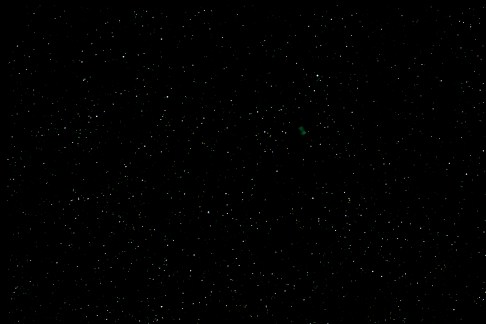
Wide sky view - M27 the Dumbbell or Apple Core Nebula is located just off-centre at about 2 o'clock

Wide sky view – M27 the Dumbbell or Apple Core Nebula is located just off-centre at about 2 o’clock  Canon 700D | EO GT81 + FF | 10x40secs @ ISO 800
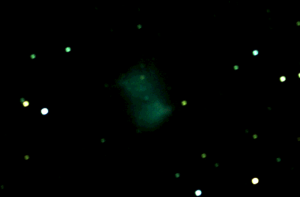
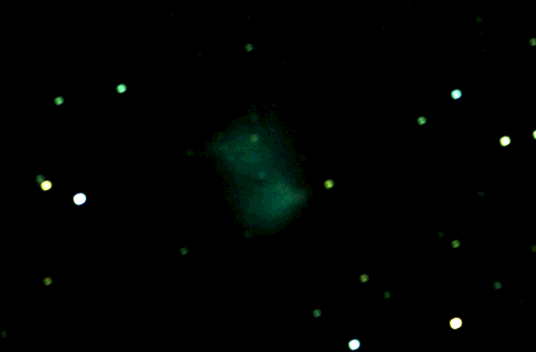
M27 cropped from previous photograph; it will be interesting to see how much clearer pictures can eventually be obtained with better alingment and longer exposures

M27 cropped from previous photograph; it will be interesting to see how much clearer pictures can eventually be obtained with better alignment and longer exposures
Zen and the art of Nebulae astrophotography

Wow, the title should get your attention. Of course it’s a corruption of Robert Pirsig’s famous book, Zen and the art of motorcycle maintenance, which in turn formed the basis of a new philosophy, that of the Metaphysics of Quality. Heavy eh?

The link is Cosmology or the metaphysical study of the origin and nature of the universe and, in this case, capturing evidence of what might be going on out there in the form of astrophotography. Unfortunately, whilst this blog might have high ambitions, you will not find the answer here to – Life the Universe and Everything.  However, my first half-decent picture of the M57, the Ring Nebula, does make you think.  Of all the features in the universe I find these most fascinating.  As the end and beginning of stars and other matter, they are, as far as we can know the origin of life itself ultimately. OK I am getting carried away but just look at the Wikipedia description of M57:

The Ring Nebula (also catalogued as Messier 57, M57 or NGC 6720) is a planetary nebula in the northern constellation of Lyra.[5] Such objects are formed when a shell of ionized gas is expelled into the surrounding interstellar medium by a red giant star, which was passing through the last stage in its evolution before becoming a white dwarf.


That in itself is mind boggling and last week I was able to capture some of its photons on my camera in Redhill; sureal even, except it’s not. Nebulae are somewhat elusive, look at NGC 7000 the North American Nebula in the earlier post; look up and there’s nothing – apply some technology and PING, out jumps a nebula. In time I hope to capture far bigger and wonderful such features buried deep in the universe but this is my first, so it’s special.

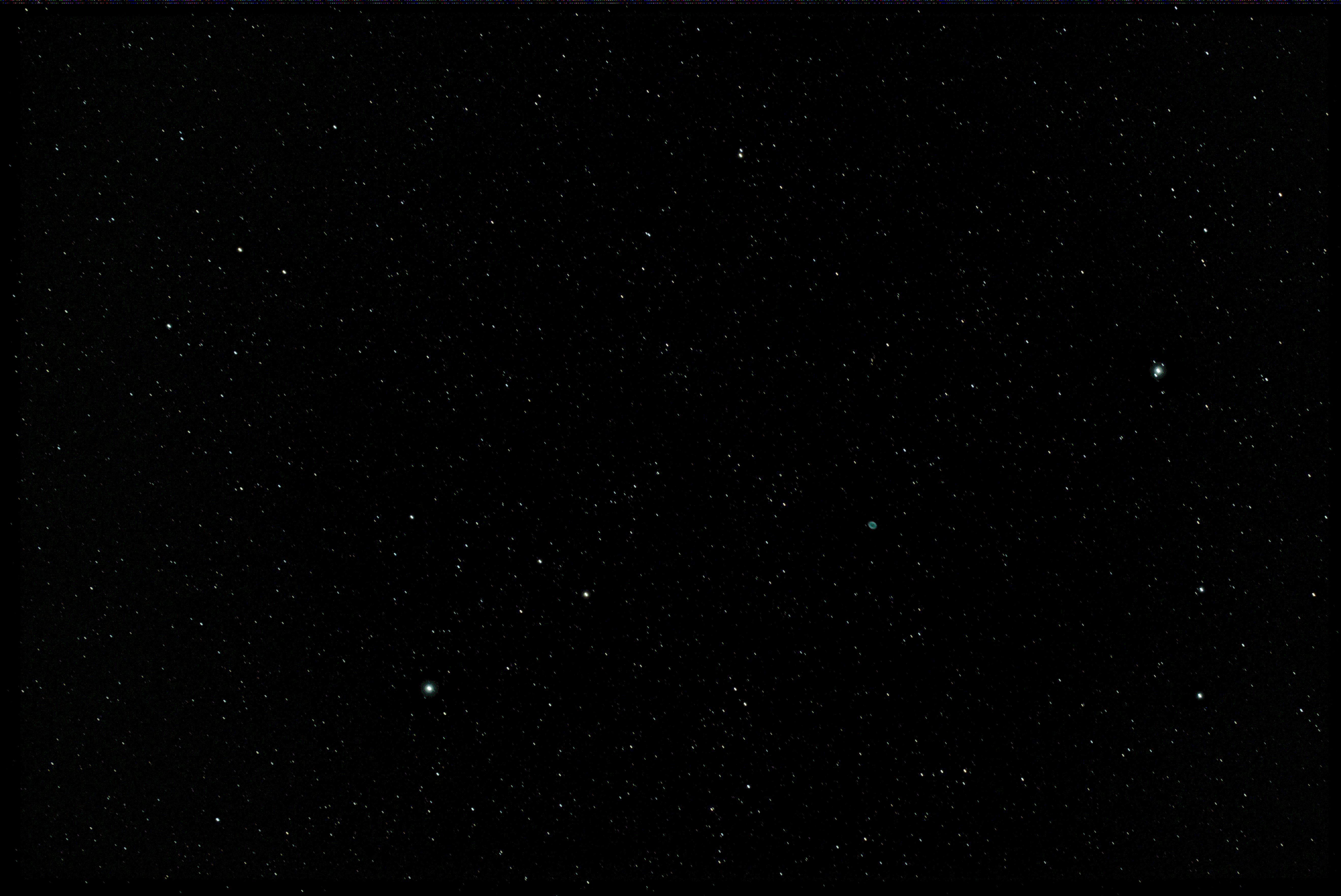
On taking the initial images and only on close inspection on the computer screen, could I see a small but clear and yet anomalous blue spot. It could, at first glance, be another blue earthly like planet, except it is M57 in the constellation of Lyra some 2,283 ly from earth, with a diameter of 2.6 ly, that’s 15,280,000,000,000 miles, a temperature of 125,000K and is 200 times more luminous than our Sun.  However, through the vast distance of space it is insignificant to the eye.

M57 The Ring Nebula. WO GT81 + FF 10x30 sec at ISO 800

M57 The Ring Nebula, just to the right of centre of the two stars at 2.00 o’clock and 8.00 o’clock.
Canon 700D ; WO GT81 + FF ; 10×30 sec at ISO 800

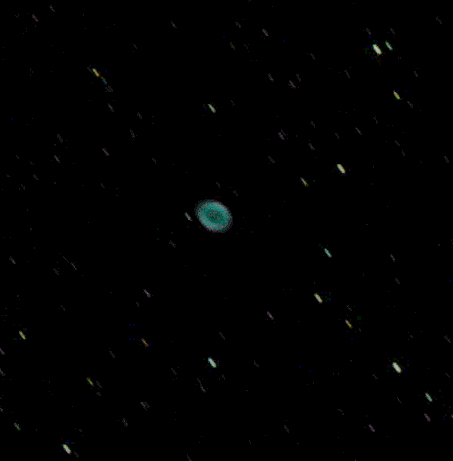
A bit more work by Mr GIMP and all is revealed:

M57 The Ring Nebula, cropped from the main image above.

M57 The Ring Nebula, cropped from the main image above.


Every picture tells a story

I have been playing around with Deep Sky Stacker (DSS) and GIMP this week.  It’s amazing what these programmes can do and highlights the massive data collected by a DSLR sensor and image potential hidden therein; it is as they say – a whole new ballgame.  At the same time I read this post on SGL which was not unlike my own actions a couple of nights ago http://stargazerslounge.com/topic/221951-ngc7000-almost-fell-off-my-chair/, except in my case I gave up, partially as I couldn’t see that I was getting anything and, to be fair, the cloud was rolling in!

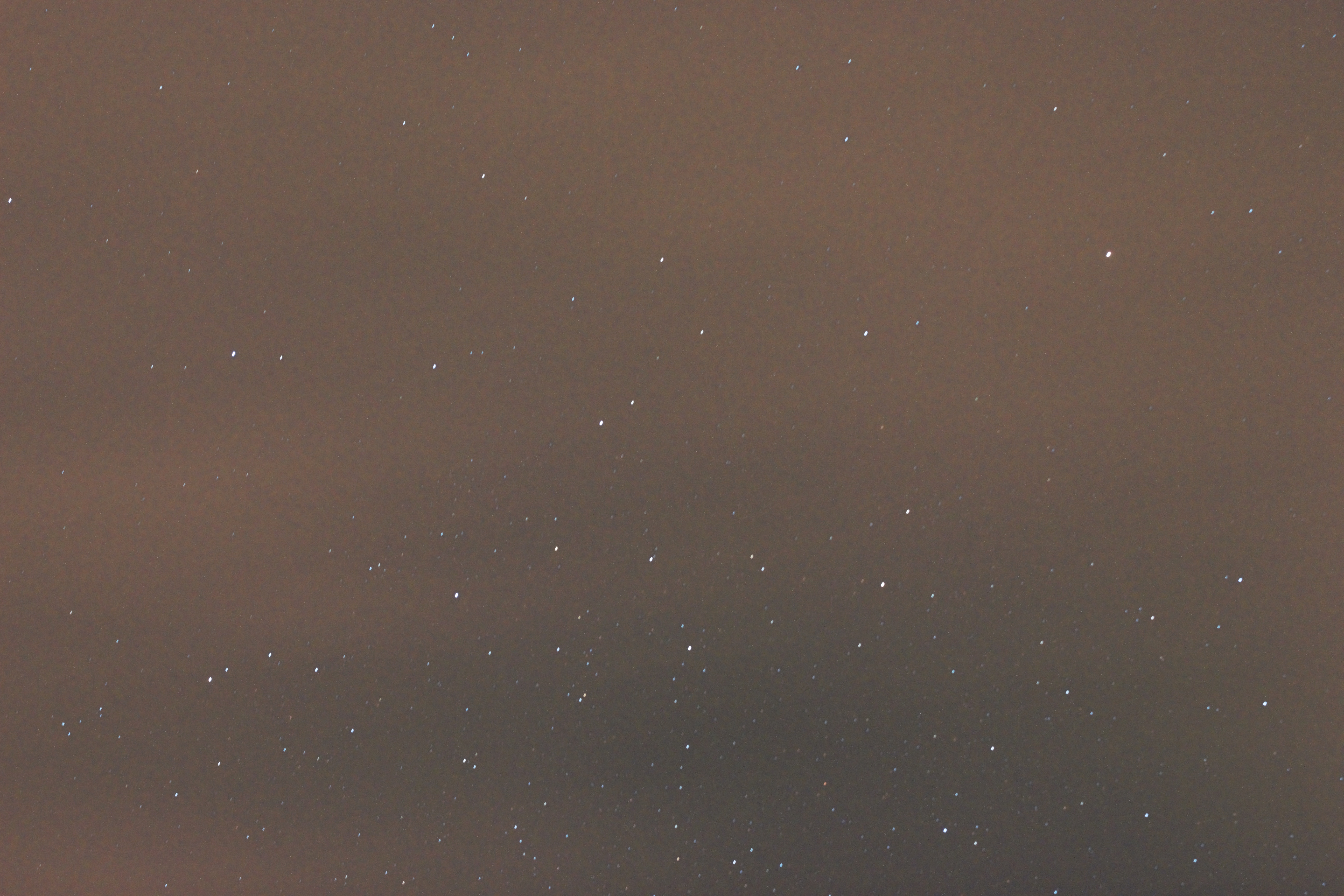
I had just successfully imaged the M13 star cluster and seemed to have most things working quite well. I therefore thought I’d slew round to NGC7000 or the North American Nebula, as it is otherwise known, just to see if I could register the feature on camera.  The result after a few shots at varying experimental settings, rubbish.

NGC 7000 the North American Nebula, or so I had hoped

NGC 7000 North American Nebula, or so I had hoped       WO GT81 + FF 2x40sec ISO 800


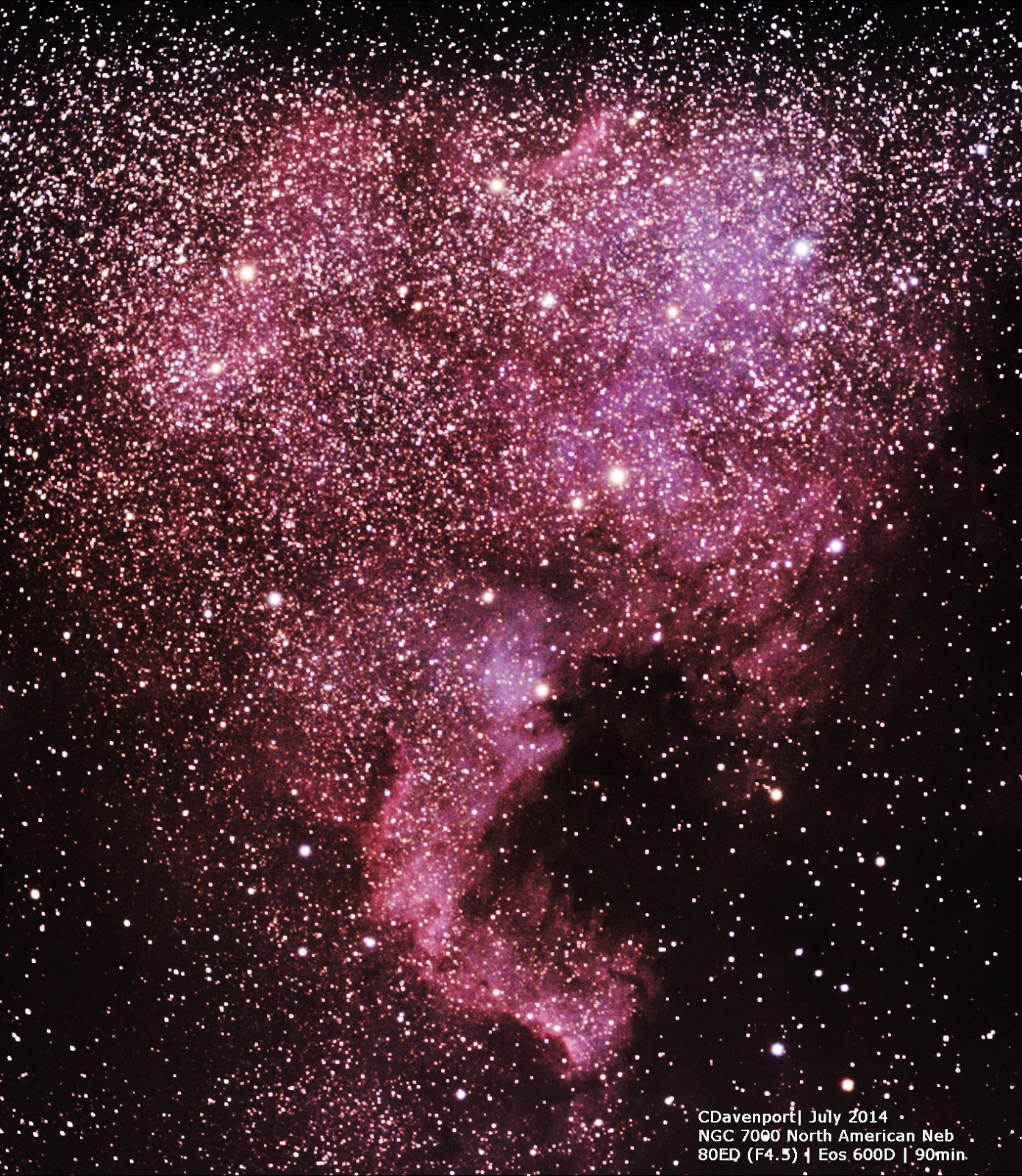
Which might have looked at least a bit like this had I persevered like Christopher Davenport did to get this great picture from a not dissimilar starting point;  OK looks like he knows what he’s doing + has a few more gizmos working and took a lot more images of greater exposure:

NGC 7000 in all its glory - I'll get it yet!

NGC 7000 in all its glory – I’ll get it yet!

Notwithstanding, I went back to my couple of shots at the top of this post – yes just two, too short and no darks – so I made up a couple – and put them through DSS and then GIMP. The result, though not as spectacular as Chris’s indicates that the nebula appears to be lurking at the top of the image afterall!

NGC7000

Focus is everything

FOCUS: The state or quality of having or producing clear visual definition – Oxford English Dictionaries.

Splashed the cash and got the equipment, done the reading and asked all the right questions on the astronomy forums, got a clear night, time to catch those images – what can go wrong? Having recently purchased and got a new AZ-EQ6 mount and WO scope working OK visually, it was time to embark on my new DSO photographic quest. Not for the first time I unfortunately underestimated just how difficult this astrophotography is; forgetting that I’d already battled before to image with the Newtonian 150PL using both the DSLR and ZWO webcam (more on that another time).

This time the challenge was using the new WO Field Flattener http://www.williamoptics.com/accessories/flattener6A_features.php. So – set up scope, align mount/scope, find object, centre and visually focus.  Then attach the field flattener (FFL) to the DSLR and slide directly into the focus tube, focus and take images – easy?  No! Even now I am not sure what went wrong but after three evenings and numerous questions on the Stargazers Lounge forum (SGL), I was completely unable to get a clear picture through the camera, let alone an image.  Initially I just thought the set up was wrong (whilst all the WO various equipment is excellent, none of it comes with instructions.  I am told this is par for astronomy but, when you are forking out this kind of money I find that quite unacceptable) or I needed yet another piece of equipment to achieve focus (surprisingly the ‘expert’ dealer from where I bought it wasn’t even sure on this!), spacers perhaps? By now I was very concerned.

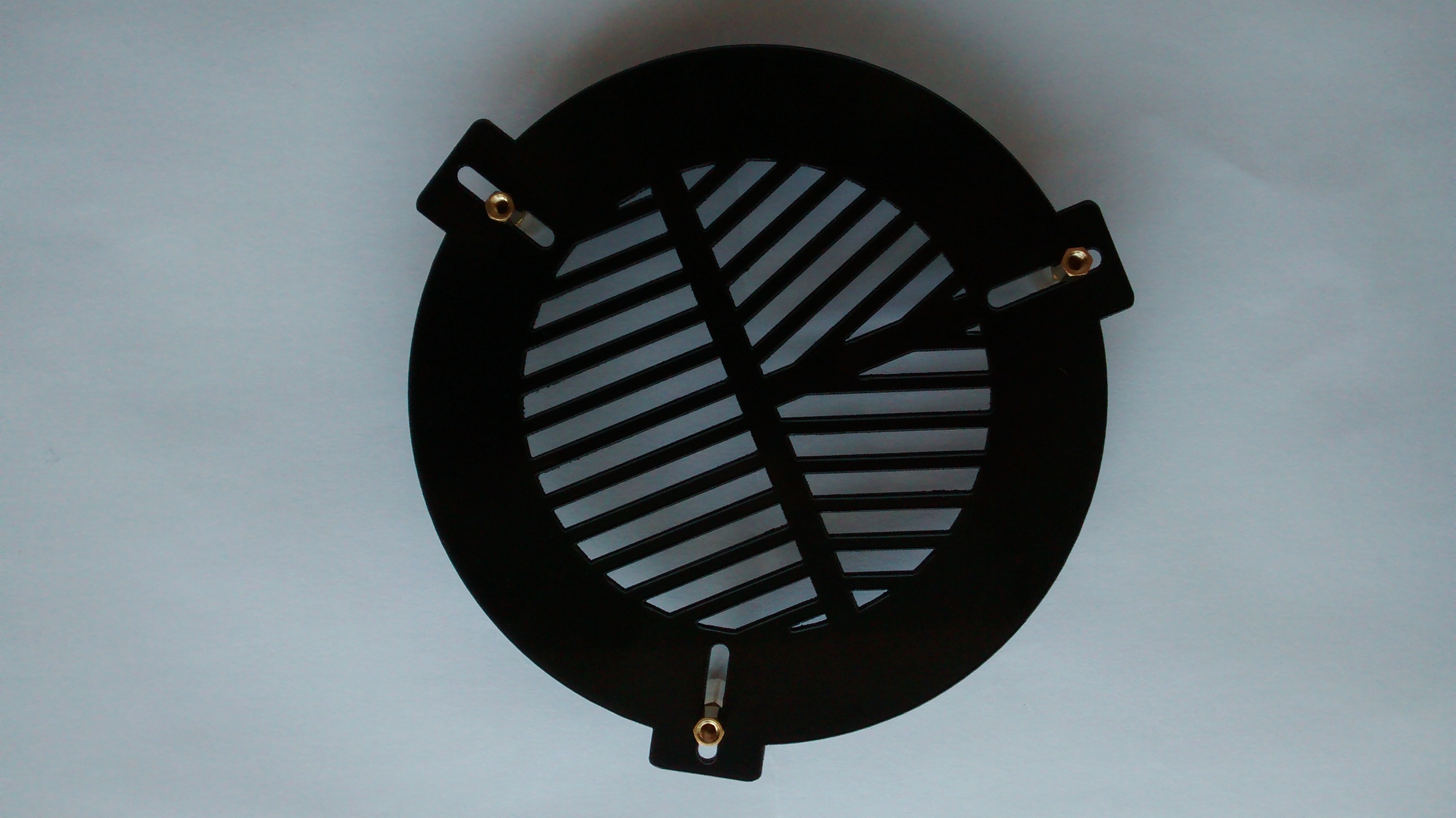
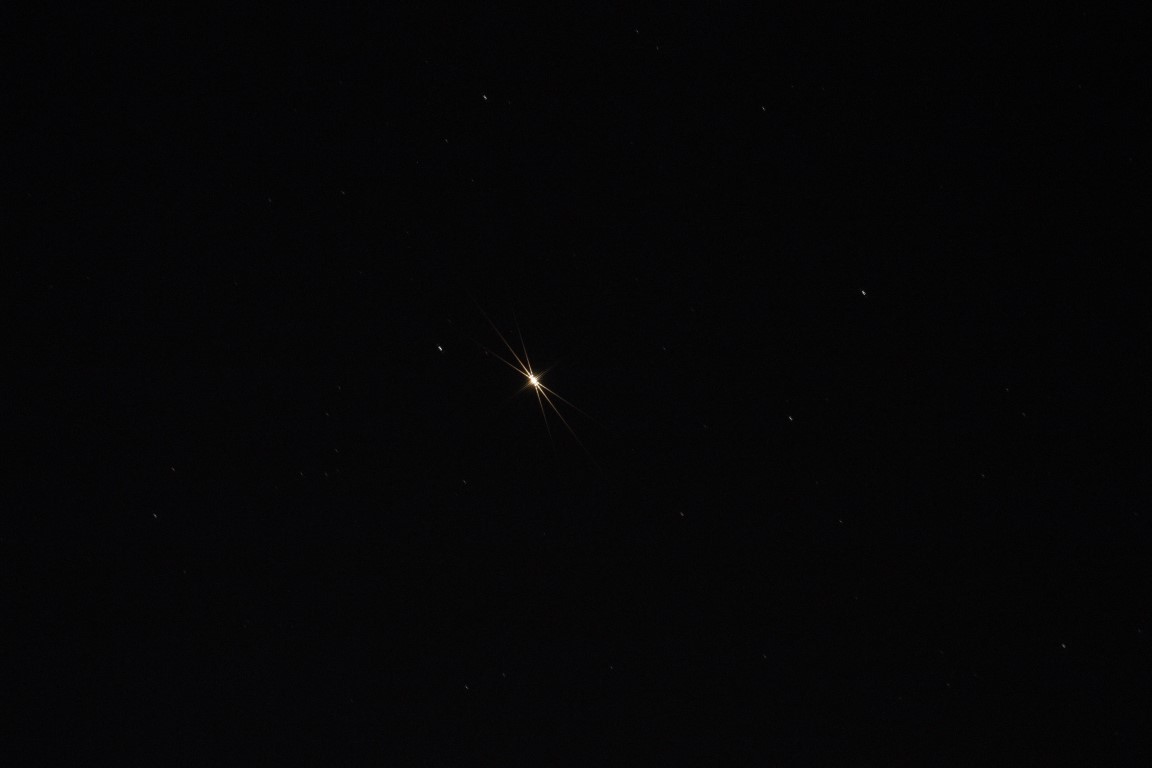
Another clear warm night soon came and with perseverance low and behold a result.  This time I was much more meticulous: visually focusing on the bright star Arcturus, then switching to the DSLR + FF.  Using the Canon EOS Utility and Live View, with the ISO set very high I was at last able to see something on the screen, which with very fine adjustment came into focus as a small, very bright dot. Placing my other recently discovered brilliant invention, the Bahtinov mask http://en.wikipedia.org/wiki/Bahtinov_mask

Bahtinov mask

over the objective lens I was able to refine the focus perfectly:

Bahtinov Focused Image(Medium)

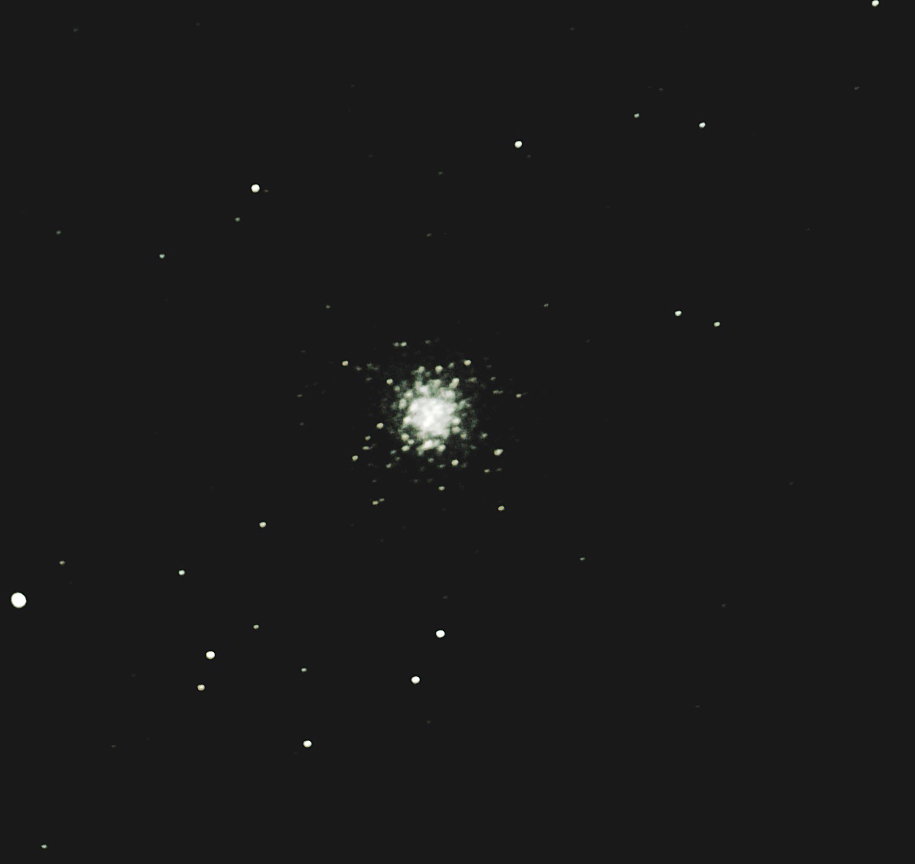
Now carefully transferring the scope and refining the position via Live View I was ready for a serious attempt on my first DSO, M13 The Great Globular Cluster in the constellation of Hercules:

M13 DSS Final 300714 cropped

WO GT 81 + FF 10x16sec at ISO800

Bingo + what a relief! Like my first crude afocal image of the Orion Nebula last year, getting the picture was exhilarating.  OK it’s not brilliant and I have seen the image in numerous publications and online but, it was mine, having captured those photon’s which had been travelling for the past  25,000 light-years on my camera, just outside my back door. WOW!

http://apod.nasa.gov/apod/ap120614.html

I hope to improve on this one day, once I have mastered all the other software, guidescope etc but I doubt I’ll feel quite the same next time.  In the end, focus was everything, it is very difficult to achieve and only goes to show just how difficult this astrophotography is but after the light spent so long getting here, the least I can do is focus it right on my camera sensor, which requires a fraction of a millimeter accuracy.

Later on the same night I also captured M57, the Ring Nebula (more another time).  Apart from refining this process (which I can see will take what ever’s left of my lifetime) my next ambition is to capture a galaxy out my back door, I can’t wait!

One Year On

After one year I am slowly making progress with, most recently, undertaking my first solar viewing and imaging and, with great difficulty, last week obtained my first DSO images – this time of M13 and M57.  Not the best images ever but a very satisfying achievement nonetheless.  There’s still a very long way to go, in the next six months I want to try and tackle: better alignment, computer mount control, establish auto guiding etc as a result of which I hope to better tackle some of the great features of the winter skies. This will inevitably require further purchases but, then again, it is only 141 days until Christmas!

M13 DSS Final 300714 cropped