Reflections – 2014

2014 has been my first full year of astronomy and I thought it would be useful (for me) to recap, thereby hopefully providing some encouragement and momentum for 2015. It’s been a good year which I have enjoyed but it only gets a little easier, slowly, and I can see many challenges ahead.

reflect2

JANUARY TO MARCH

IMG_2431 Stitch (Medium)

At the start of the year I was still getting to grips with my original basic equipment, purchased in 2013 as an introduction to astronomy to see if I liked it: EQ3-2 mount, Skywatcher 150PL telescope and two basic Plössl eyepieces and Barlow.  Though good, the shortcomings of the equipment quickly became apparent even for modest viewing tasks, so I soon made some important additions.  In no particular order these were: RA and DEC motor drives, a Telrad finder and two better quality, wide-angle eyepieces.  All of these items made a noticeable improvement to my astronomy and eventually my growing interest in astrophotography.

As a result, at the start of the New Year I decided to purchase a Canon 700D DSLR camera, which has since opened up a whole new world, literally.  I have considerable SLR experience and had been using a compact digital camera for some years but the need to understand and use the technology embodied in a DSLR for astrophotography is, as they say, a whole new ball game.

At this stage, my approach to astronomy was to try and learn the basics first by using basic equipment, thereby understanding the nuts and bolts of astronomy before moving on to more technical processes and software driven equipment. Moreover, I hoped such an approach would provide a good, long-term foundation of knowledge to undertake more ambitious tasks one day; walk before you run.

Although a member of the Flamsteed Society, its location at Greenwich does not lend itself to regular, on-the-ground astronomy from which I might otherwise learn first-hand from other members. Unfortunately more local clubs are also absent, so the learning curve has been steep and mostly personal and hands-on, though I must recognise the extensive and generally excellent help gleaned from the internet and various astronomy blogs, noteworthy of which has been Stargazers Lounge.  I have often been disappointed by some of the retailers who, in my experience don’t relate well to customers and / or provide clear, helpful guidance or adequate aftersales support.  My interpretation is that they consist of persons who have probably started astronomy shops as an extension of what was previously a hobby and often lack the commercial and personal skills required for such a business. Thankfully there are exceptions and it is they who I shall return to with my business in the future, whenever possible.

  Date Object* Feature  / Name
Feb Jupiter Afocal Images
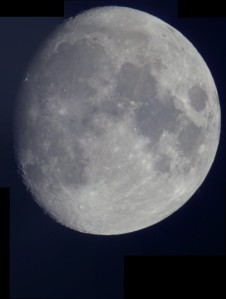
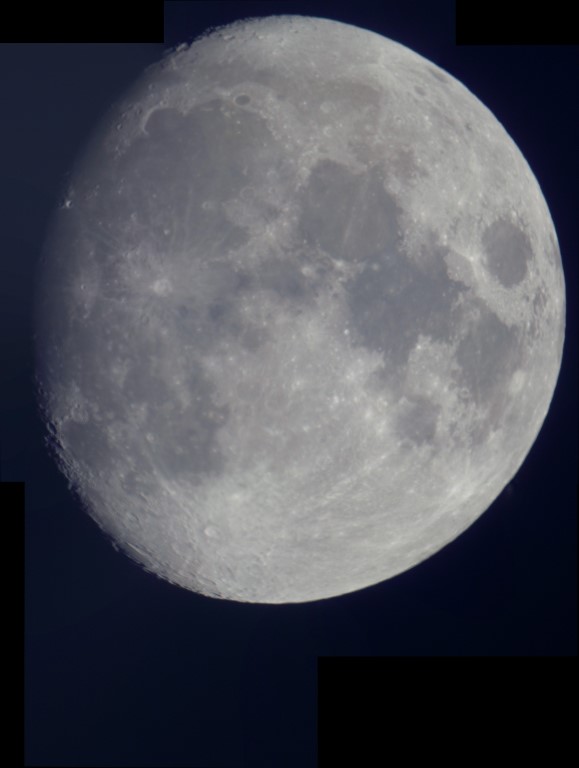
Moon DSLR mosaic
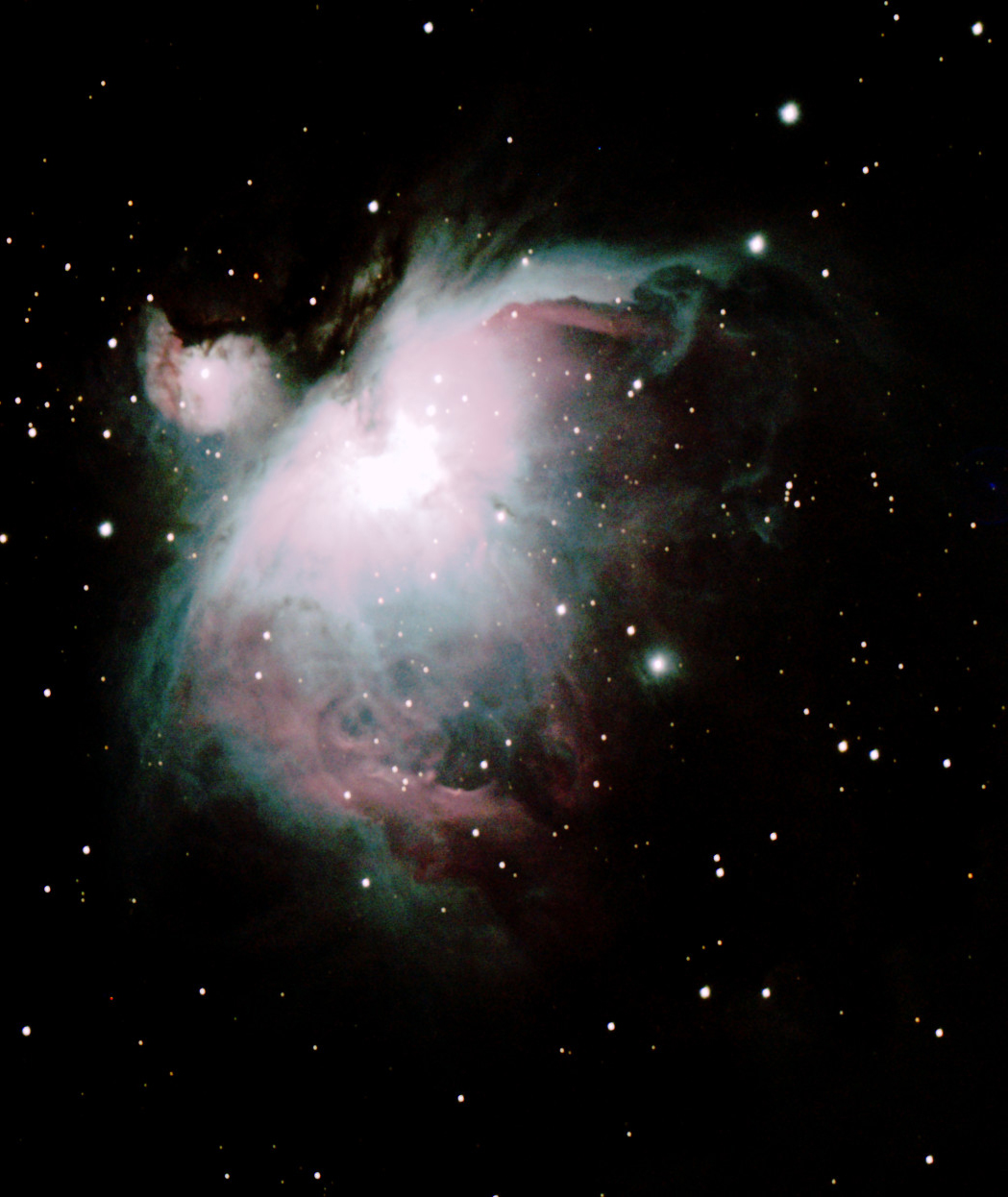
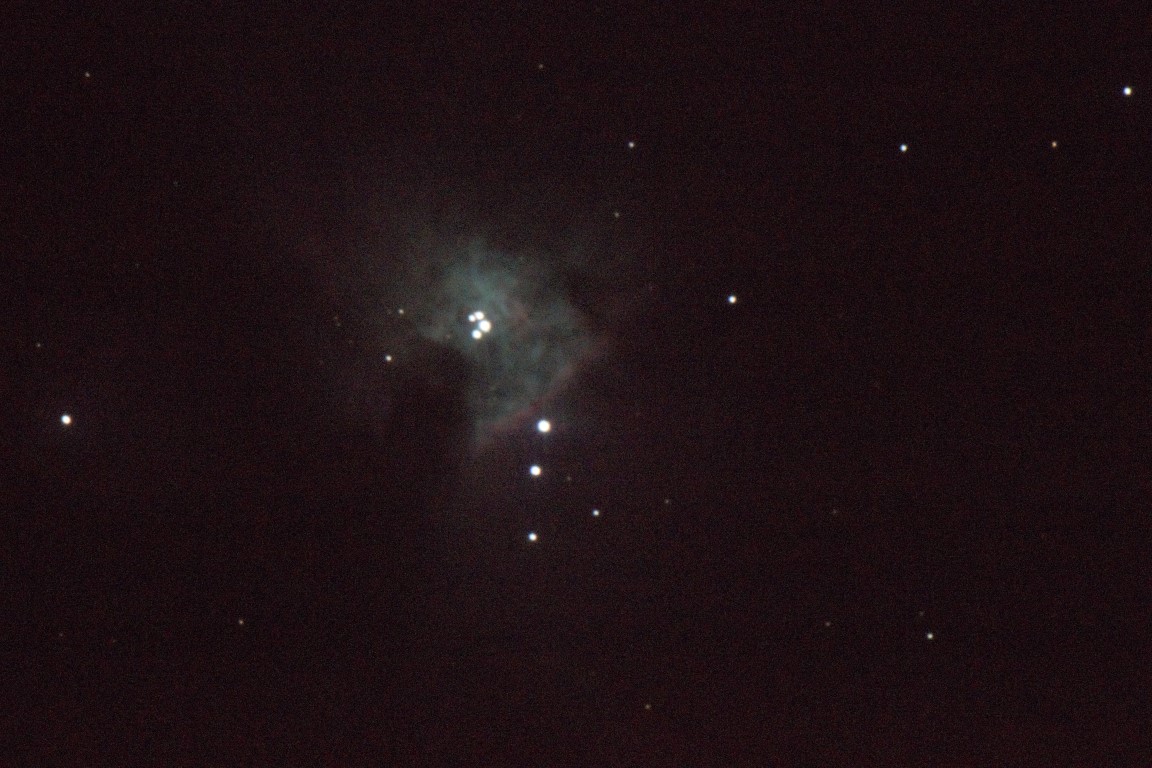
Greta Orion Nebula Afocal Images

*Record of photographic images taken in 2014

APRIL TO JUNE

By now I knew I wanted to pursue astronomy as a hobby and, in order to fast track my learning process and experience the subject at a higher level, I undertook a one week astronomy course at the private Tacande observatory in La Palma. The equipment there was outstanding and so was the night sky and guidance provided by the owner, Joan Genebriera.  Afterwards I was hooked and my aspirations were sky high, literally.
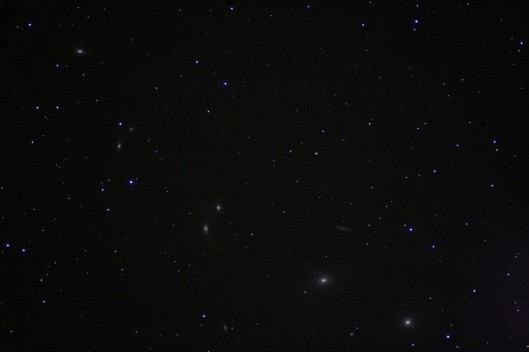
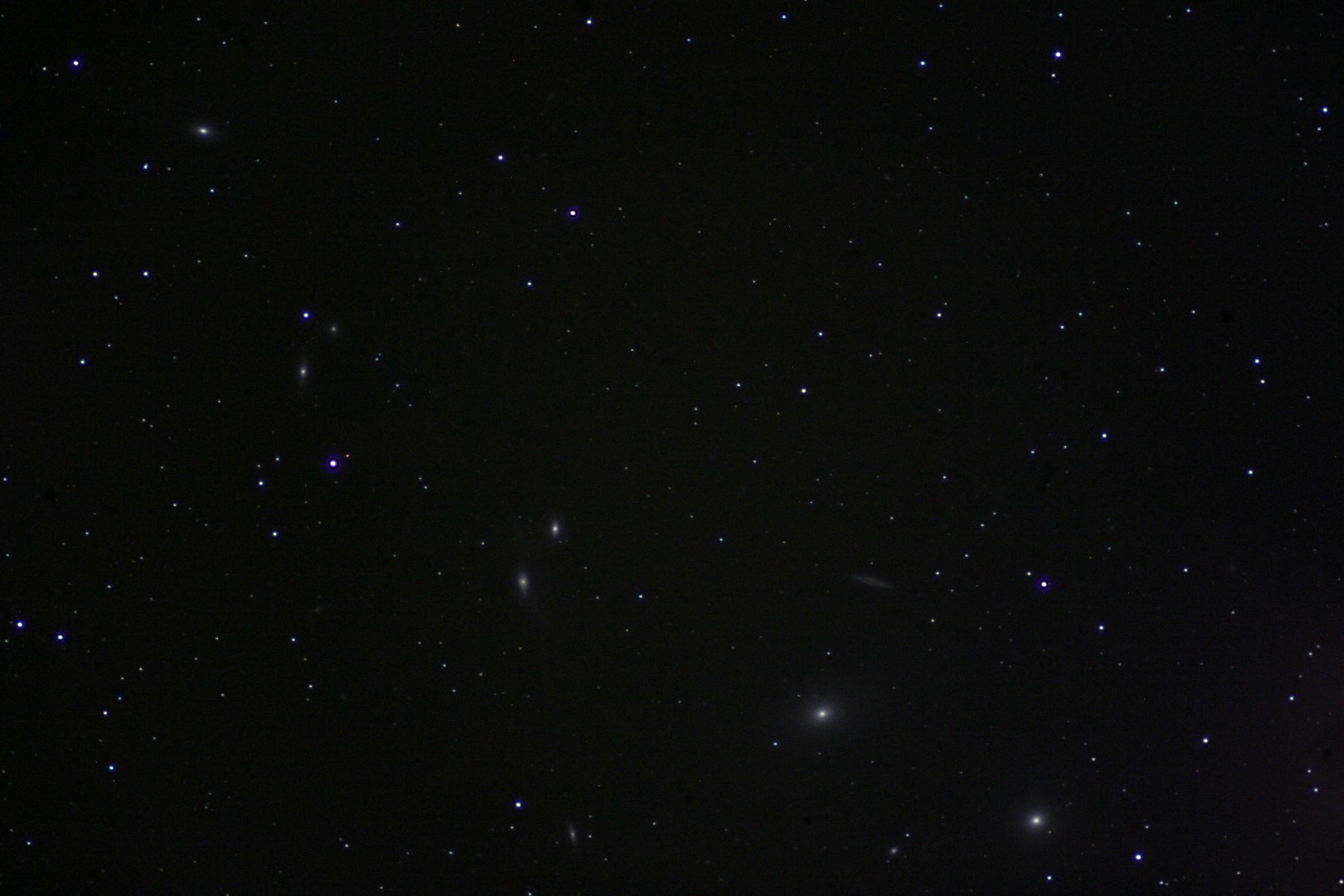
Virgo Group

Virgo Group – Galaxy Supercluster| Canon 350D from Tacande Observatory, La Palma

Returning from La Palma brought me back down to Earth, however, undeterred I felt it was time to try my hand at webcam planetary imaging. On the face of it easy but, as usual, looks can be deceiving. Online advice indicated that it was possible to adapt and rig-up an old webcam for such purposes but my attempts to do so using a spare Logitech webcam only ended in misery.  I therefore decided to bite-the-bullet and purchase a more suitable, off-the shelf one. The Holy Grail for entering webcam imaging is apparently the Philips Toucam but alas it is no longer made and finding one second-hand is very difficult.  I therefore soon realised that it would be necessary to purchase a new webcam and, furthermore, it made sense to get one which was specifically made for astrophotography, the theory being it would work out-the-box.  As a result I purchased the ZWO ASI 034 MC colour webcam but, despite my best efforts was unable to get a picture and decided to visit the retailer in person, determined to find out if it was me or the camera; as it turned out it was neither.

The first problem turned out to be the camera software SharpCap, which despite assurances, would not work with the camera.  Next, for reasons I still don’t understand, the alternative FireCapture software would also not work until a more up-to-date version was downloaded.  Notwithstanding, it also became evident that the camera would not work through a USB 3.0 port – though at the time this was not specified anywhere in the accompanying literature.  Finally, with the camera plugged in to the USB 2.0 port and the up-to-date version of FireCapture, it worked!  Getting to this point took me countless hours at home, a long trip to the retailer (who was very helpful) and then still some 2-hours to get it working.  So much for working out-the box!  This again seems to be a feature of astronomy.

From this and other experiences with equipment, software and manufacturers I have concluded that the world of astronomy is fraught with unnecessary problems often arising from just inadequate advice (see previous comment). It is assumed, by others: manufacturers, retailers or more technically minded astronomers, that the user will possess similar skills to make things work but, as many /most of us are newcomers this is, to say the least, an unhelpful assumption.  I have therefore learned that the internet is your friend.  Through the use of various online sites and blogs, other astronomers have given their very helpful and often not inconsiderable time and advice, for which I am eternally grateful.

Whilst this was all happening at the retailer, I took the time to review the camera I had purchased more closely and at the last moment decided to exchange it for the inevitably more expensive ZWO ASI 120 MC version, which unlike the 034 MC version can be used for autoguiding – I hoped futureproofing the purchase, time will tell.  It is interesting to note that the current version of this camera (a) comes with different software and (b) has been upgraded to work with USB 3.0 – well why wouldn’t it in the first place, as most computers now use this specification?  This suggests to me: did they really think about the camera’s design and operation properly at the beginning?  However, following this breakthrough using the webcam for imaging was still to provide its own problems, which I am still grappling with.
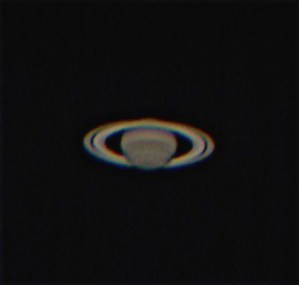
SW 150PL x2 Barlow & ZWO ASI 120 MC

SW 150PL x2 Barlow & ZWO ASI 120 MC

Using the ZWO ASI 120 MC I first started imaging Saturn, with some success. However, using the EQ3-2 mount to find, focus and image was very difficult, especially when I tackled Mars. In this case the size of the planet makes all the aforementioned issues even more difficult but, after lots of attempts I managed to get an image – altogether with plenty of room for improvement but satisfying nonetheless. I subsequently discarded the webcam in favour of the DSLR, with which I am more comfortable and due to the lack of suitable, mostly planetary objects through the summer period.  With the return of Jupiter in recent weeks and the prospect of using the ZWO webcam for autoguiding, I have returned to using it again but given the time that has since elapsed, I need to relearn its use all over again!

At this point I had concluded that I wanted to pursue astronomy and astrophotography.  I was also drawn inexorably towards astroimaging DSO objects; they provide numerous, albeit more difficult targets at all times of the year and I have found their combination of otherworldly beauty and science fascinating – I am now on a slippery slope that I feel will last for years!  The implications of this conclusion and based on what I had learned over the preceding year about my basic equipment had only one consequence, I needed better equipment.  There are astronomers who will say this hobby can be done cheaply, frankly I don’t believe it.  Even buying second hand and generally making-do, the need for another piece of equipment never seems to stop – ask my wife.

Resigned to this course of action and the inevitable extensive analysis of what equipment was best suited, I reached a conclusion of what equipment I needed surprisingly quickly, though still prevaricating over innumerable makes and models available.  In the end I purchased an AZ-EQ6 GT mount and William Optics GT81 FPL3 triplet achromatic refractor.  I could have shaved £400 to £500 off the cost by purchasing other very good but cheaper makes and models but the WO is a beautifully tactile piece of obviously very well made equipment, which is a pleasure to own and use.  I had originally intended to purchase an HEQ5 mount but on taking the long view (no pun intended) and considering the superior and critical payload capacity decided to move up to the EQ6, which then became the AZ-EQ6 GT for its superior belt driven mechanism and even better payload.

Date Object* Feature / Name
April M104 Sombrero Galaxy
M1 Crab Nebula
M3 Globular Cluster
M84 Lenticular Galaxy
M95 & M96 Group Spiral Galaxy
Virgo Group Supercluster of Galaxies
NGC 4435/38 The Eyes (Nonet) Galaxies
May The Moon
Mars
Saturn

JULY TO DECEMBER

The absence of good astronomical darkness approaching the Summer Solstice at the end of June and onwards until later in August, makes imaging difficult at this time of the year.  Furthermore, the summer skies are generally less interesting and altogether provide limited opportunities.  As a result the one object remaining, that hopefully dominates the sky at this time of the year, is the Sun.  It was therefore time to start solar astronomy.

Given the obvious dangers I approached the task carefully, getting a made-to-measure Baader Astro Solar filter for use with the Skywatcher 150PL.  Rightly or wrongly, at this initial stage I decided to use the 150PL as I figured the larger, open design of the Newtonian reflector would help cooling.  The result was fascinating, with sun spots and general surface granulation clearly visible. However, the set-up has two drawbacks: (i) the resulting FOV is small and requires six or more images to cover the whole of the Sun, and (ii) such a filter only produces a view of white light, not allowing the more spectacular features evident at a other wavelengths, such as prominences, to be viewed.  For this a considerably more expensive solar telescope or highly specialized filters are required – such is the fascination of our local star I can see the time I will want to pursue this branch of astronomy further.
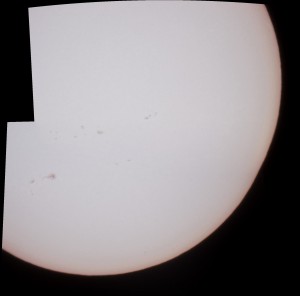
Sun Mosaic SW 150PL + Baader Astro Solar Filter + Barlow x2 | Canon 700D DSLR

Sun Mosaic
SW 150PL + Baader Astro Solar Filter + Barlow x2 | Canon 700D DSLR

Having since used the new equipment for nearly six months now I have no regrets – you get what you pay for.  However, as usual there have been problems to overcome.  The mount is very solid and was a real pleasure to use but from the outset I have faced one big problem – polar alignment.  With no view of Polaris or any of the northern sky, as my house is in the way, combined with restricted views to the south, east and west due to adjacent housing and trees, the only options were drift alignment or the polar alignment routine that I latterly discovered in the SynScan handset. For the moment the SynScan method has become my preferred technique but it can still be problematical, as it is quite fiddly and often the stars chosen by SynScan are not always visible e.g. it is not uncommon that at times all the alignment stars provided by Synscan are located in the northern sky and cannot be seen because of the aforementioned problems.  However, I am getting better and with diligence and patience can now get to within 30” or less of true polar alignment, which has allowed exposures of up to 180 seconds.  I have tried drift alignment a few times but have difficulty finding suitable stars on the horizon, as I basically don’t have an horizon! Going forwards I am considering the use of Alignmaster software, which looks very useful for this purpose, though the lack of a northerly view might still be a problem.  In addition, I hope the ultimate goal of autoguiding should further enhance tracking accuracy even without perfect polar alignment – we shall see.

The second problem initially encountered was achieving an image when using the William Optics field flattener / focal reducer.  Try as I may, I could not get an image with the William Optics GT81 + field flattener + camera combination and after a few evenings trying became desperate.  How could it be so difficult?  All this money for top-end equipment and not even a lousy image, let alone a good picture. With the help and encouragement from members of Stargazers Lounge, I had another go.  This time I was more diligent with the set-up and at first using a very bright, easy to see star, was at last able to achieve a camera image and good focus using a Bahtinov mask.  In a nutshell, the problem was that the point of focus is very, very critical, just a fraction of a millimetre out and the image disappears.  Now I know this it’s quite easy but nobody points this out, least of all the manufacturer or retailer, who provided little to no instructions – I am learning this is also something common in the world of astronomy, which I find quite unacceptable.

So, after some weeks of trials and tribulations, the new equipment is mostly working very well and I have been able to successfully image a wide variety of objects.  There’s plenty of room for improvement but I have obtained some enjoyable and often quite exciting photographs.  Now for the next challenge, which has just started: computer control and autoguiding.
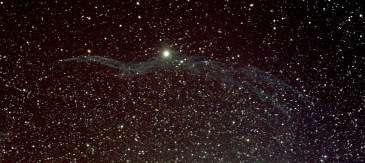
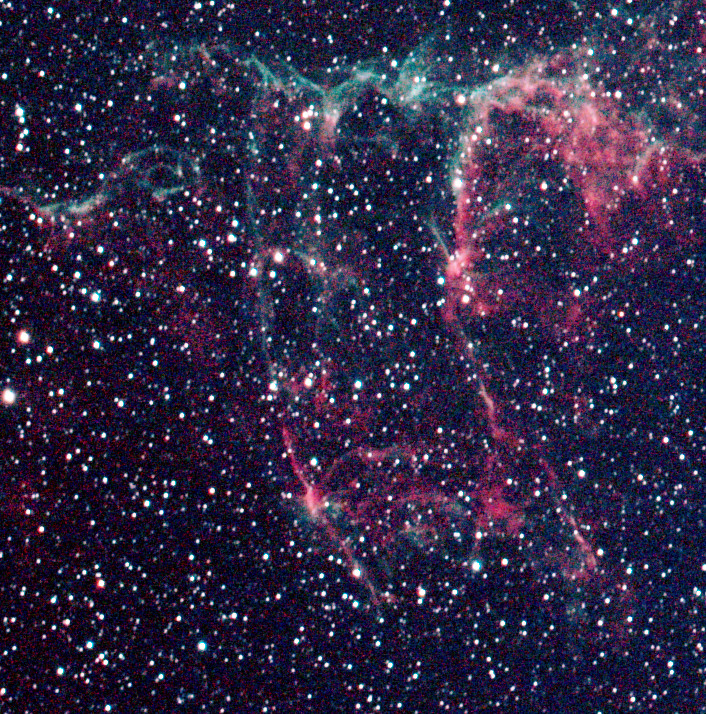
NGC 6960 AKA The Witch's Broom Canon 700D | 20x90 sec + darks.bias/ flats @ ISO 800

NGC 6960 AKA The Witch’s Broom
Canon 700D | 20×90 sec + darks.bias/ flats @ ISO 800

With DSLR or CCD / webcam imaging, processing is at least equally important as the original image capture.  In the later part of the year I have therefore also started to tackle this dark art.  Whilst compilation software such as Deep Sky Stacker and Registax requires some understanding to set-up, it is with post-processing that the final image can be made or lost.  As a result I am using the extra time indoors to try and master the various techniques, with mixed success.

I should also note that during this period my elder daughter, Alison, persuaded and then helped me set-up this website.  It has proved a useful discipline for organising my thoughts and images.  I am very grateful for her help and have surprisingly enjoyed recording my astronomy endeavours. Although intended as a personal record, I note from the underlying website provider that it has been read far-and-wide across the world – 36 countries this year – which is also gratifying.  I would love to hear from anybody via the WTSM site: questions, what are you doing, comments & feedback etc?

Date Object* Feature / Name
July M57 Ring Nebula
M13 Globular Cluster
M15 Globular Cluster
Aug M27 Dumbbell Nebula
M31 Andromeda Galaxy
M11 Wild Duck Cluster
ISS International Space Station
NGC 6888 Crescent Nebula
The Sun
Sept NGC 7000 North America Nebula
NGC 6960 Western Veil Nebula & Witch’s Broom
NGC 7380 Wizzard Nebula
M31 Andromenda Galaxy
IC 1396 Elephant’s Trunk Nebula
M2 Globular Cluster
Oct M45 Pleiades Open Star Cluster
Uranus
M33 The Pinwheel Galaxy
NGC 6992 Eastern Veil Nebula
NGC 6995 Bat Nebula
M42 & M43 Great Orion Nebula
NGC 7320 Stephen’s Quintet (Galaxies)
NGC 7331 Deer Lick Group (Galaxies)
NGC 7814 Spiral Galaxy
Nov NGC 1909 Witch Head Nebula
IC 434 Horsehead Nebula
NGC 2024 Flame Nebula
NGC 1973/75/77 Running Man Nebula
Dec M1 Crab Nebula
ISS International Space Station
NGC 2264 Christmas Tree Cluster & Cone Nebula etc.
NGC 2261 Hubble’s Variable Nebula
NGC 19818 Open Star Cluster
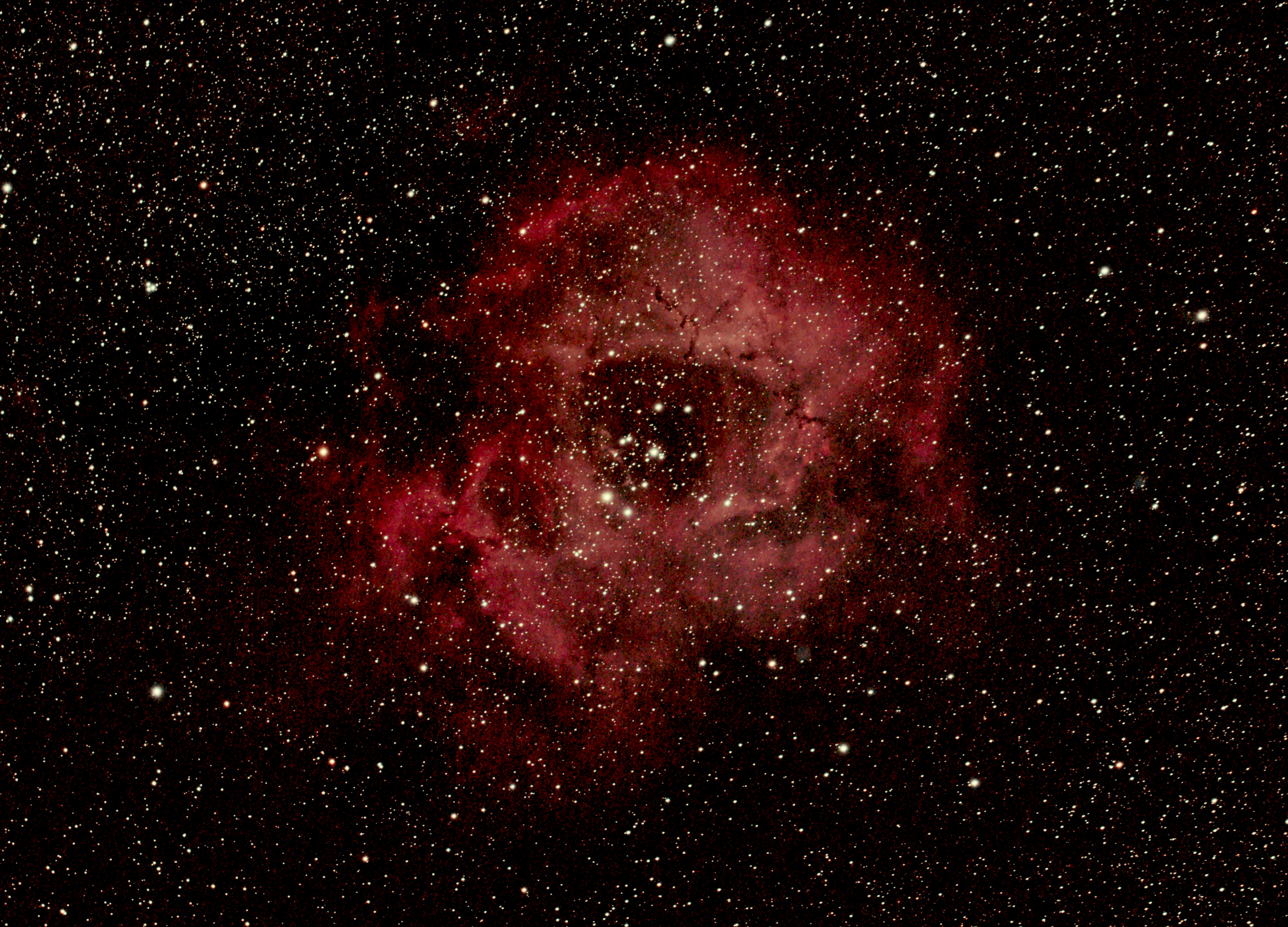
NGC 2244 Rosette Nebula
M35 Open Star Cluster
M78 Reflection Nebula

??????????????

Goals for 2015 are:

  • Transfer the mount to EQMOD computer control – I have already linked the equipment indoors, together with Cartes du Ciel, but have yet to use it outside live.
  • Upgrade camera control software – again I am already trialling Astrophotography Tool (APT) indoors, which looks good and provides lots of flexibility, though in some ways I still like the EOS Utility software, which uses more simple and therefore reliable control choices.
  • For astrophotography this is the Holy Grail and, if successful, should enable significantly longer exposures and thus better detail and sharper images to be achieved.  At the time of upgrading my equipment in the summer I also purchased a William Optics 50 mm guidescope – all I need to do is get it working! This will require two further pieces of software: (i) Push Here Dummy or PHD, which is responsible for controlling the interaction between the guidecope and the mount, and (ii) Astro Tortilla, which undertakes a process called ‘plate solving’, whereby using actual pictures taken at the time of set-up, it then recognises the section of the sky it (the telescope) is looking at, identifies the object in the field of view and using this information ensures that the telescope (and thus camera) are pointing exactly towards the chosen object by iteratively interacting with the other guiding software.  As a fan of the KISS principle, I must admit to being somewhat intimidated by all this but am assured by others that it is not so bad to use  (famous last words) and once up and running, will have a major impact.  We shall see!

Even at this stage, I can already see the need for additional equipment.  With numerous Ha-emitting nebulae a modified DSLR camera is beginning to seem essential and probably a more powerful computer for image processing.  I am sure this list will grow as the year progresses.

All-in-all, I am pleased with my progress during the past year, with a noticeable improvement since acquiring the new equipment.  There have been more highs than lows and, I suppose, that’s a result in itself.  It is very exciting when you first see Saturn, Jupiter or Mars and then image them but I have discovered that my metier and main enjoyment comes from DSOs, in particular nebulae.  I find their very nature beguiling; beautiful to view, challenging but very rewarding to image and scientifically fascinating.  I am therefore sure that in 2015 they will remain my main targets but, notwithstanding, there are many other objects worthy of attention, including in the UK a partial eclipse of the Sun in March.

Watch this space! 
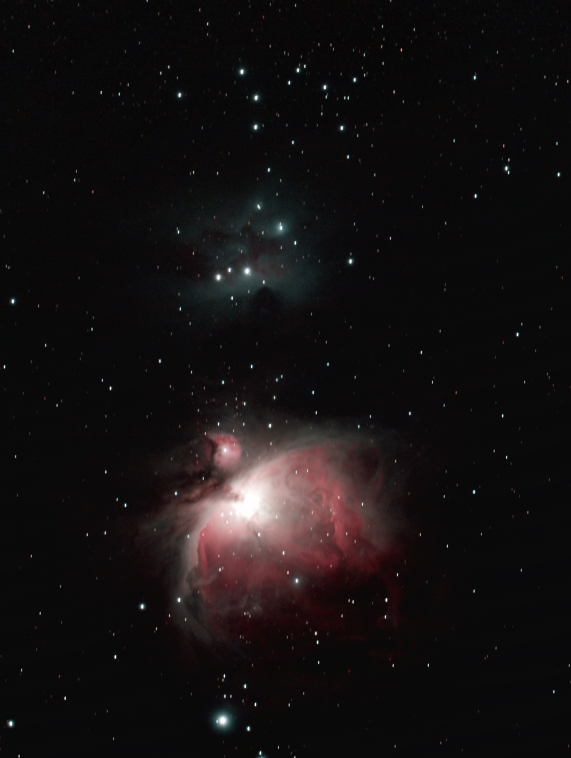
Orions Sword. Top to bottom: NGC 1981 Open Star Cluster, NGC 1973/75/77 Nebulae, M42 & M43 Great Orion Nebula & the binary star Hatsya. WO GT81, Canon 700D + FF | 30 x 120 secs + darks/bias/flats @ ISO 800

My picture of the year: Orions Sword. Top to bottom: NGC 1981 Open Star Cluster, NGC 1973/75/77 Nebulae, M42 & M43 Great Orion Nebula & the binary star Hatsya.
WO GT81, Canon 700D + FF | 30 x 120 secs + darks/bias/flats @ ISO 800
 

It’s Christmas Time

pic-2-xmas-star-crscriptoriusrex-580x463

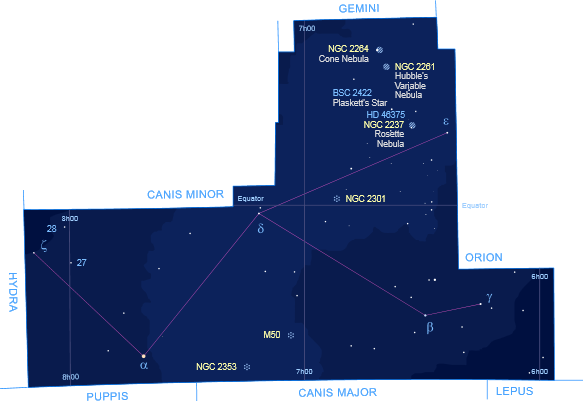
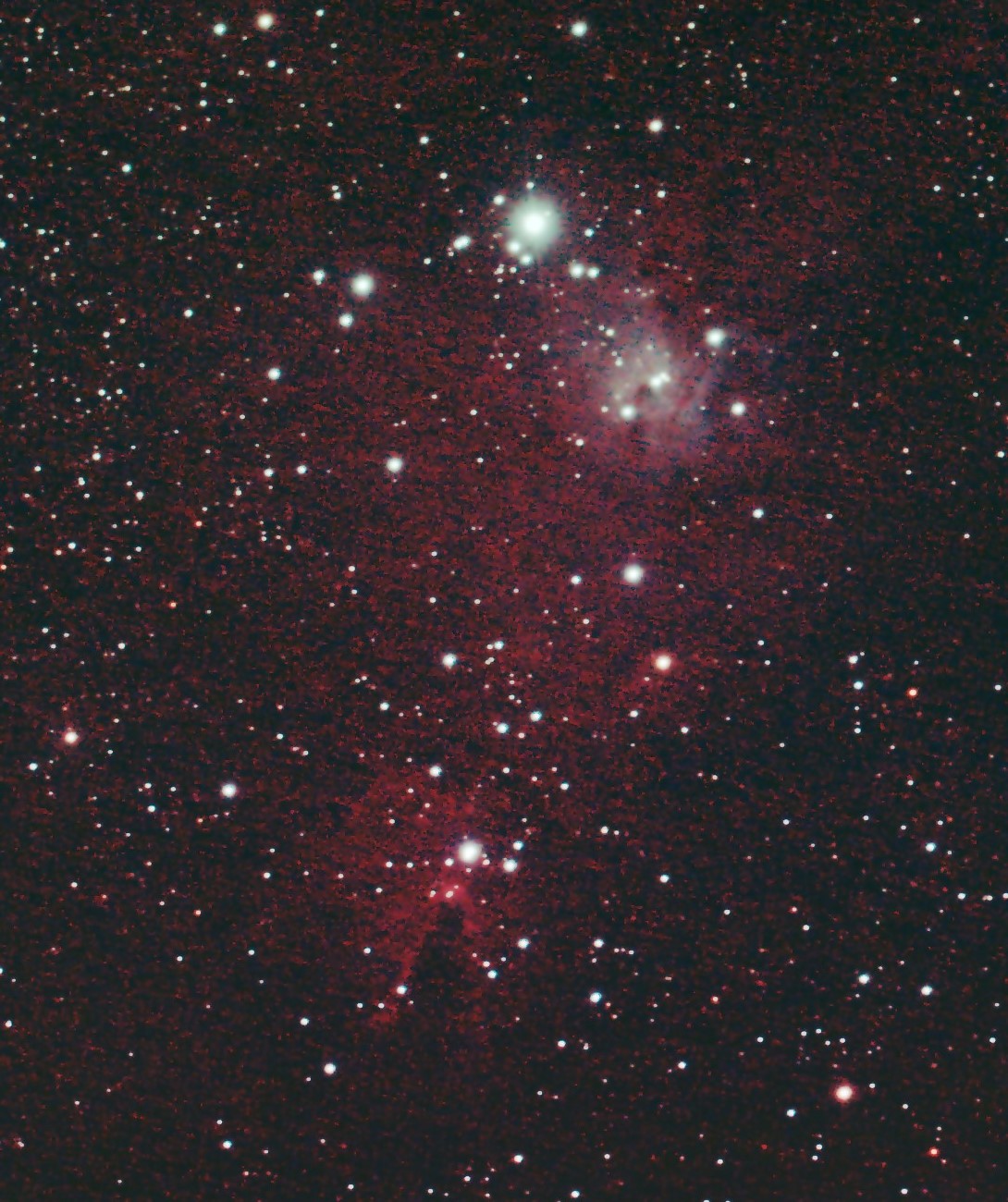
Being that time of the year and with my new interest in astronomy, the possibility of imaging the Christmas Star seemed like a good idea.  However, looking into the matter it becomes apparent that there is much controversy over what the actual object might have been: a star, a supernova, a shooting star (meteor), Venus or Jupiter etc.  Furthermore, it even seems that we don’t know for sure when Jesus was born. Apparently due to an error by a Church cleric hundreds of years later, it is thought the birth could be up to 4 years later than believed and almost certainly was not on December 25th! This is all news to me and makes a timely image of the night sky difficult but then, on a rare clear night last Friday, I turned the telescope and camera on NGC 2264 in the constellation Monoceros, or the Unicorn, itself within the Orion arm of the Milky Way Galaxy. Monoceros Constellation Situated on the Celestial Equator to the east of Orion and above Canis Major, Monoceros is something of a new name to me. Considered a ‘modern’ constellation, since being discovered more recently than many others in the 17th Century, it turns out to be abundant with many exciting objects.  But at this time of the year it has to be NGC 2264 or the Christmas Tree Cluster which is most worthy of attention.

At first, whilst the images from the camera looked very promising and the ‘tree’ showed up well, it’s equally interesting partners were nowhere to be seen – notably the Cone Nebula and Fox Fur Nebula.  Notwithstanding, following more aggressive processing adjustments they appeared, albeit smaller in my image than expected and very noisy.  Technically, lessons arise from this: (i) whilst the William Optics GT81 is a great telescope with outstanding optics, it is a small telescope, and only the very largest features will fill the image (ii) in this case and probably more importantly, in order to achieve an acceptable signal to noise ratio, only longer exposures will work – I am currently working on this, with the goal of starting to autoguide as soon as possible in the New Year.  Furthermore, the nebulosity is mostly Hydrogen Alpha (Ha) emission type, which my unmodded sensor therefore responds  to poorly due to its inbuilt UV/IR filter; something else to deal with in the future.

Notwithstanding, I am still pleased with the result which in the end does show most of the main features, albeit with plenty of room for improvement; I also know how but getting there will not be easy. For obvious reasons the star of the show (no pun intended) is the Christmas Tree Cluster. The bright star at the bottom of the picture is Monocerotis 15 or S Monocerotis, which forms the tree’s ‘pot’ and is a quadruple system of four brilliant white stars.  A little confusing, the view we get from earth of the ‘tree’ is upside down, so the following image has been inverted and is before post-processing, so as to make the stars that form the outline of the tree more clear.

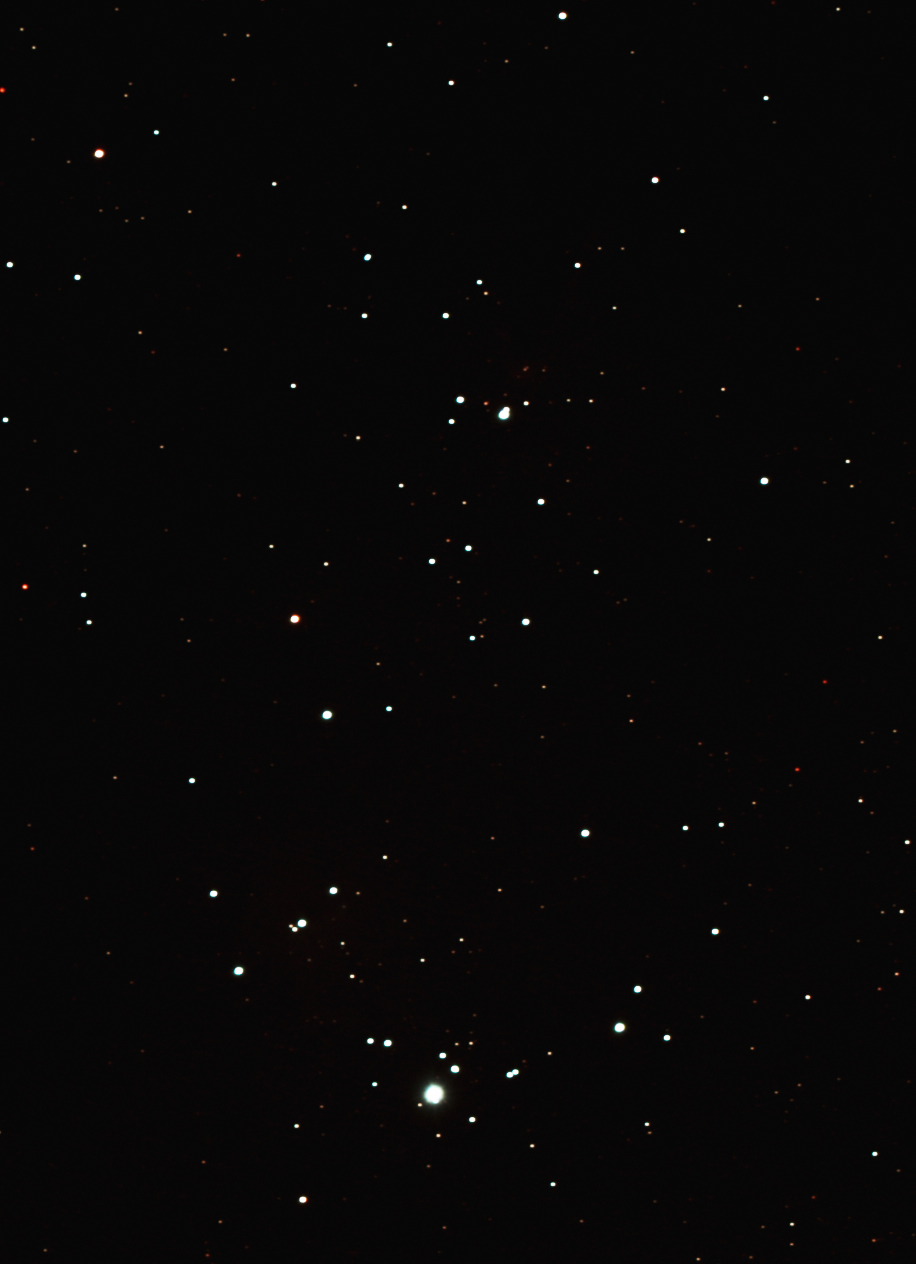
NGC 2264 Christmas Tree Cluster - inverted to better show the 'tree' shape i.e the top is south

NGC 2264 Christmas Tree Cluster, before post-processing and inverted to show the ‘tree’ shape i.e the top is south. The large, bright star, 15 Moncerotis, marks the base of the ‘tree’.

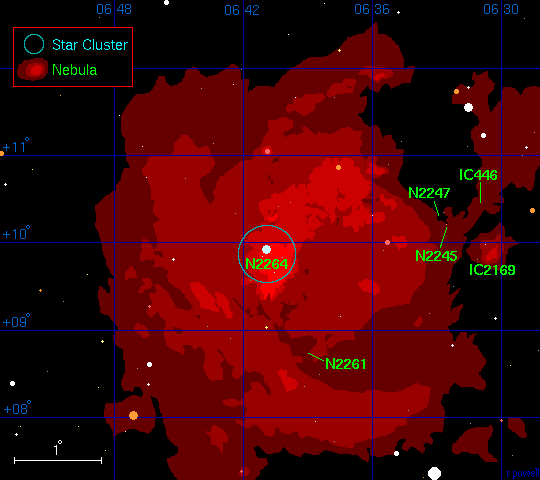
However, the Christmas Tree Cluster is only part of NGC 2264’s glorious nature, most notable of which is probably the Cone Nebula.  Located below (south) of the Christmas Tree, the Cone Nebula is a towering, triangular shaped column of cold, dark molecular hydrogen gas and dust, which appears to be flowing out from the young stars located close to the top of the cone. Some 2,200 light-years distant from Earth and 900 light-years further than the Orion Nebula, the Cone is quite small in the original picture but is in fact 60 arc seconds or 40 light-years in size!

NGC 2264, actual orientation: Cone Nebula at the bottom, Monocerotis 15 at the top with the Fox Fur Nebula to right but not  clear, outline of the main stars and numbla defines the (invered) Chriostmas Tree Cluster WO G T81, Canon 700D + FF | 30 x 120 secs + darks/bias/flats @ ISO 800

NGC 2264 (actual orientation): Cone Nebula at the bottom, Monocerotis 15 now at the top, with the Fox Fur Nebula to the right but not visible.  The outline of the main stars and associated nebulosity defines the (upside down) Christmas Tree Cluster – 15 Monocerotis is now at the top. 
WO G T81, Canon 700D + FF | 30 x 120 secs + darks/bias/flats @ ISO 800

Map of Cone Nebula

Map of Cone Nebula

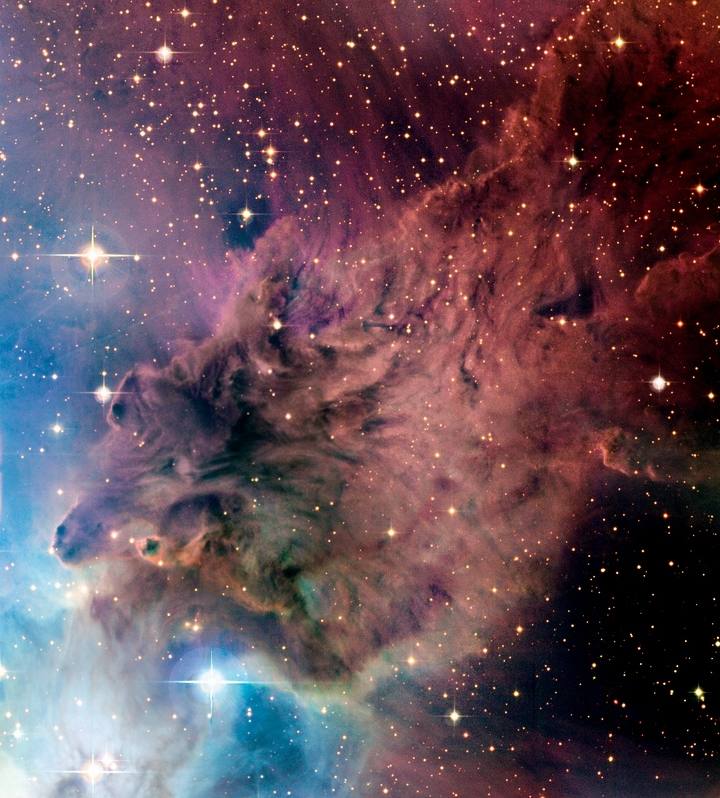
Also included in the NGC 2264 region is the wonderfully named Fox Fur Nebula, so called as it is said to look like the head of a stole made from red fox fur.  Combined with the aforementioned Ha light issue, my equipment cannot do this feature justice at the moment but, using an image from elsewhere, when viewed close-up (and you get your eye in) it is a very convincing feature.

Fox Fur Nebula

Fox Fur Nebula

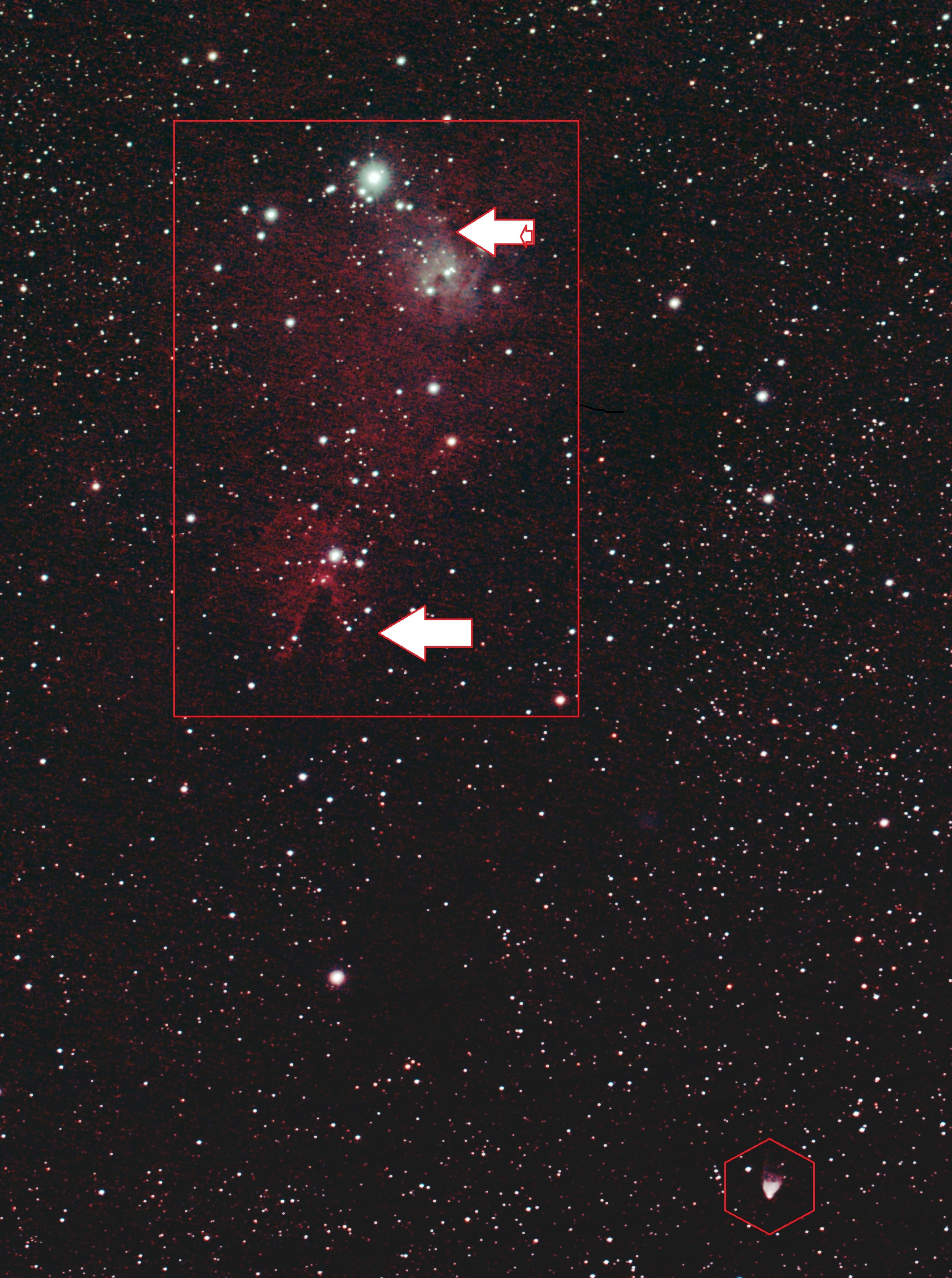
In addition to the above, NGC 2261 or Hubble’s Variable Nebula is worthy of mention.  Located nearby to NGC 2264 this fan shaped nebula is illuminated by the star R Moncerotis.

NGC 2264 Christmas Tree Nebula shown by red box. Lower arrow points to the Cone Nebula, upper arrow  indicates location of the Fox Fur Nebula.  NGC 2261 Hubble's Variable Nebula shown by red hexagon.

NGC 2264 Christmas Tree Nebula shown by red box. Lower arrow points to the Cone Nebula, upper arrow indicates location of the Fox Fur Nebula. NGC 2261 Hubble’s Variable Nebula shown by red hexagon.

NGC 2261 Hubble's Variable Nebula

NGC 2261 Hubble’s Variable Nebula, illuminated by R Monocerotis star

Altogether there are more than seven nebulae to be found in this region of the sky, which has turned out to be something of a pleasant surprise to me and will be revisiting once I can achieve longer exposures and deal with Ha light better. The constellation of Monoceros is also itself something of a surprise, with the prospect of some other great images that deserve further attention in the New Year – can’t wait for Christmas to finish.

Sunset at Fairvale Observatory on the evening before the Winter Solstice

Sunset later the same day at Fairvale Observatory, the evening before the Winter Solstice

Lace up the Nikes

There is no doubt in my mind that the Orion Constellation is the most spectacular of the year and right now comes into imaging view at Fairvale Observatory at about 11pm, about the same time the waxing Moon disappears over the horizon; for once the timing is perfect.  So before the presence of the Full Moon later this week rules out astrophotography, last Saturday evening provided an excellent opportunity.

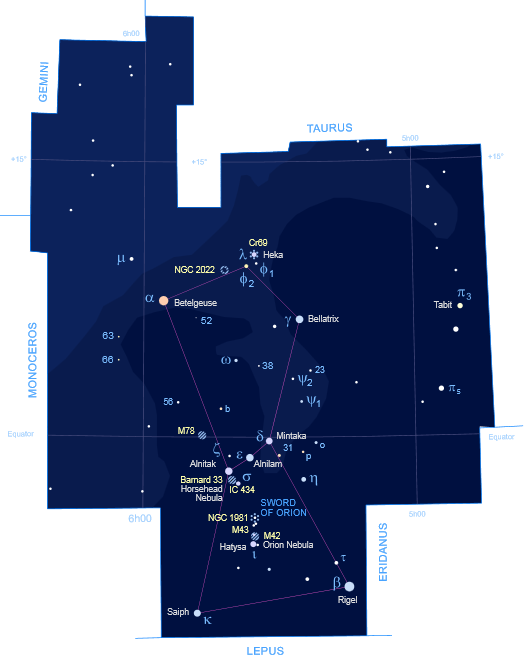
The Orion Constellation

The more I look at the Orion Constellation the more there is to see and image, as well as some other attractive objects that will be around until at least the New Year and in some cases well beyond.  One lesson I have learned early on with astrophotography is the need for good planning: what’s around to image? when is it in the best location i.e. near the Meridian? what equipment is needed and is it working? set it up in good time and ensure good alignment.  Given the aforementioned favourable conditions and the arrival of Orion, my list of objects this month is considerable:

Early evening: M32 Andromeda Galaxy & NGC 1499 California Nebula.

Late evening / midnight: Orion Constellation – NGC 2024 Flame Nebula, IC 434 Horsehead Nebula, M42 & M 43 Great Orion Nebula, NGC 1977 Nebula, NGC 1981 Emission Nebula, NGC 1909 Witch Head Nebula, SH 2-276 Barnards Loop, SH 2-264 Angelfish Nebula, M78 reflection nebula and more.  Other – M1 Crab Nebula, Hyades (Taurus), M77 barred spiral galaxy and Jupiter, which together with its four moons is also looking very nice after 1 a.m. at the moment.

With such an array of possibilities it can be difficult to know where to start but having recently achieved good images of the Great Orion Nebula and the Flame and Horsehead Nebulae, the next target was an easy choice – it had to be NGC 1977, which with the William Optics GT81 field-of-view also takes in NGC 1981 and M42, three for the price of one!

Orions Sword. Top to bottom: NGC 1981 Open Star Cluster, NGC 1973/75/77 Nebulae, M42 & M43 Great Orion Nebula & the binary star Hatsya. WO GT81, Canon 700D + FF | 30 x 120 secs + darks/bias/flats @ ISO 800
Orion’s Sword. Top to bottom: NGC 1981 Open Star Cluster, NGC 1973/75/77 Nebulae, M42 & M43 Great Orion Nebula & the binary star Hatysa.
WO GT81, Canon 700D + FF | 30 x 120 secs + darks/bias/flats @ ISO 800

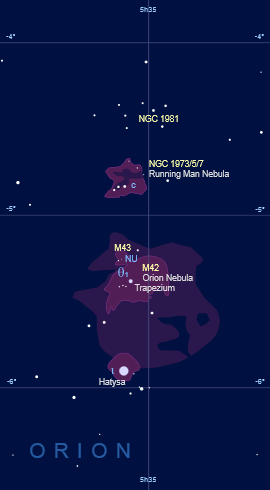
There is so much going on in this photograph that merits attention.  The view encapsulates all the major components that form Orion’s Sword, notably from top to bottom: the open star cluster NGC 1981, the star Theta Orionis C in the Trapezium cluster – itself within M42 and the star Hatysa (Iota Orionis), which forms the tip of the sword.  Obviously M42, The Great Orion Nebula dominates the scene but two other major features are worthy of attention too.

Orion's Sword - detail

Orion’s Sword – detail

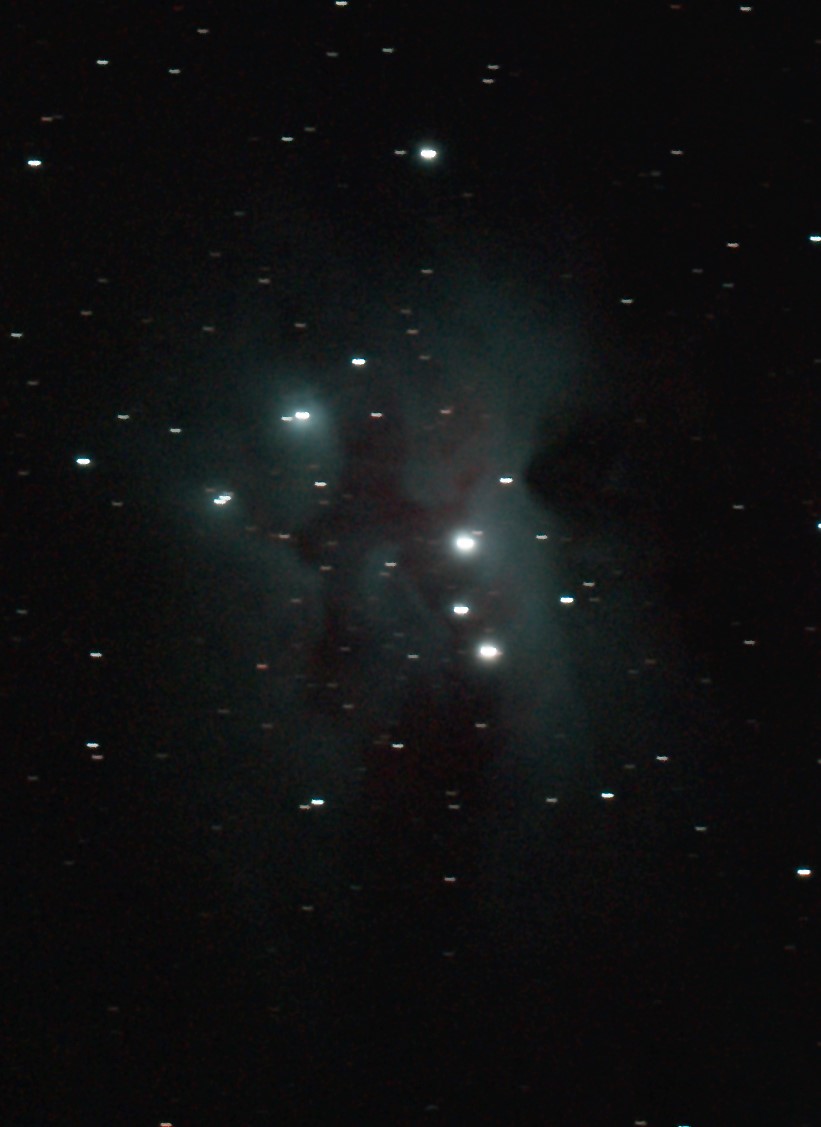
The aforementioned NGC 1981 is an open cluster of about 20 stars located 40 light years closer to Earth than M42.  But it is what’s between M42 and NGC 1981 that was my main target this time:  the reflection nebulae of NGC 1977 and related NGC 1973 & 1975, AKA the Running Man Nebula, so named because it looks like a running man!  The three nebulae are illuminated by the blue light shining from young stars that are forming within each area of nebulosity, which are separated by dark zones of interstellar dust in the form of a man running – not unlike Eadweard Muybridge’s pioneering photographic images of motion taken at the end of the 19th Century, I am sure he would have appreciated the analogy.

NGC 1973/75/77 The Running Man Nebula (rotated - North is left)

NGC 1973/75/77 The Running Man Nebula                     (rotated – North is left)

Eadweard Muybridge's photographic studies of a running man, late-19th Century

Eadweard Muybridge’s photographic studies of a running man, late-19th Century

The Horse & Flame

With the full moon early in the month and some truly awful weather, I have been unable to get out at Fairvale Observatory since October 31st!  Notwithstanding , this has been an opportunity to spend time learning more about the dark art of processing, which can sometimes be more important than image capture itself, so is hopefully time well spent.  Apart from the usual assistance of Mr Google, I have purchased the excellent online ‘book’ of Jerry Lodriguss, Photoshop for Astrophotographers – which I am slowly working through, and watched the equally excellent YouTube tutorials by Doug German on the same matter.  It is often said that a picture is worth a thousand words, and Doug’s tutorials are probably the easiest and most accessible way into the use of Photoshop for astrophotography – I also enjoy his dry sense of humour.  Finally, I am currently trialling Russell Croman’s Gradient Exterminator, which is intended to remove the external light gradient that inevitably creeps into even the best of images; it’s early days but I think I like it – it’s tricky to use and Doug German’s video tutorial is very helpful in this regard too.

The extended absence of clear night skies for astronomy also benefits subsequent viewing as the sky has changed, in this case a lot.  We have now moved on to winter skies, which are best exemplified by the constellation of Orion here in the northern hemisphere.  I was initially successful in imaging the iconic Orion Nebula early in October but only by getting up very, very early.  At Fairlvale Observatory it now comes into view at about 10pm and after 11pm can be imaged.  With clear skies finally arriving last Sunday evening, albeit accompanied by very cold temperatures, I was finally able to get out again – this time to spend more time with Orion.

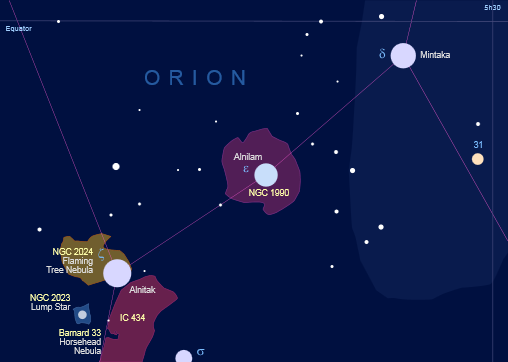
In my ignorance, what has surprised me about Orion is the extensive presence of spectacular nebulae throughout the constellation: M42 Orion Nebula, M43 De Mairan’s Nebula, NGC 1973/5/7 The Running Man nebula, M78 between Alnitak and Betelguese etc, etc.  But, I had also somehow overlooked the ‘Horse & Flame’, located above the Orion Nebula nearby the lower end of Orion’s belt: Mintaka – Alnilam – Alnitak.  In close proximity to Alnitak (a triple star), which with an apparent  magnitude between  +2.0 and +4.0  is a problem for imaging, the sky is full of spectacular nebulae – notably  the Flame Nebula and the iconic Horsehead  Nebula.  Having latterly learnt of their presence in the same part of the sky, I had to try and image them.

orionsbelt

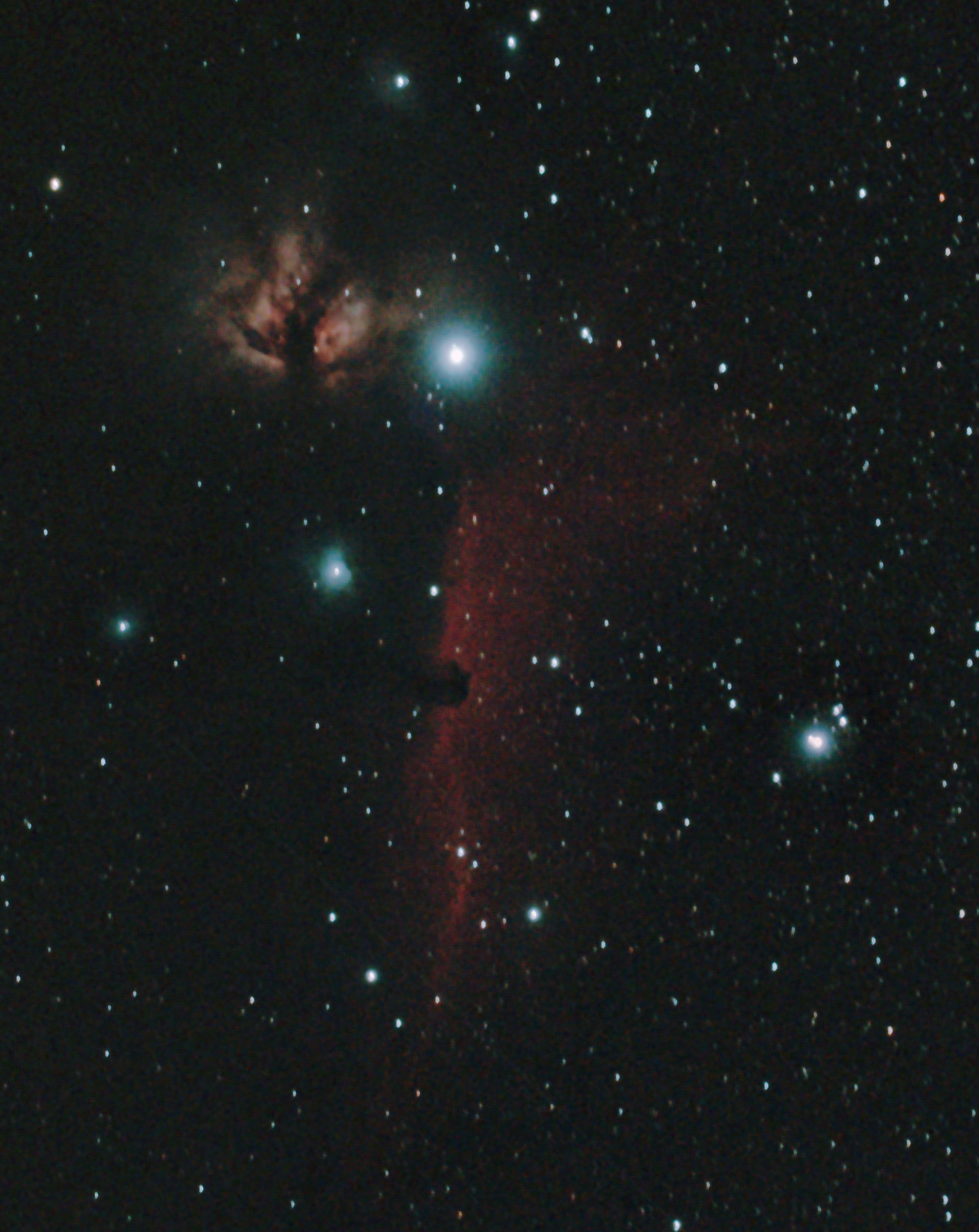
The Horsehead  Nebula is a cloud of interstellar dust and gas that, as a result of it’s density, appears dark against the surrounding red nebulous ‘curtains’.  The resulting shape looks like, well a horse’s head and has therefore become an iconic and well known image.  However, located on the other north-eastern side of Alnitak is perhaps the real star (no pun intended) of the show, the Flame Nebula – NGC 2024.  A combination of dark gas and dust with glowing hydrogen gas, energised by ultraviolet light emitted from Alnitak.  Such is the form of these materials that the resulting effect is that of a burning flame.  I was therefore thrilled that after my enforced indoor sojourn to be able to capture the Horse and Flame (sounds like a pub I’d like to visit!) together in one beautiful picture.

The Horsehead and Flame Nebulae. The Horse is located directly below (south) the large bright star Altinak triple star which forms the eastern end of Orion's belt, about half way down the image, sticking its 'head' into the red curtain nebulosity. The Flame is just to the left (east) of Altinak. WO GT81, Canon 700D + FF | 28 x 90 secs + darks/bias/flats ISO 1,000 | Photoshop processed + Gradient Exterminator

The Horsehead and Flame Nebulae. The Horse is located directly below (south) the large bright Alnitak triple star which forms the eastern (left) end of Orion’s belt, about half way down the image, sticking its ‘head’ into the red curtain of nebulosity. The Flame is just to the left (east) of Alnitak.
WO GT81, Canon 700D + FF | 28 x 90 secs + darks/bias/flats ISO 1,600 | Photoshop processed + Gradient Exterminator

Time Travel

In my opinion the current 12th Time Lord, Peter Capaldi, is one of the best doctors yet but it’s all just a good yarn, isn’t it?  At the level of quantum physics the potential of time travel has recently been shown to be feasible and even the paradox of Schrödinger’s cat has now been experimentally demonstrated at a quantum level i.e. the same thing can exist in two places at the same time.  Still, intuitively time travel seems unlikely but nevertheless last week I travelled back 400 million years without moving from Fairvale Observatory!

As a result of good viewing conditions and excellent alignment of the mount and telescope, I sought to capture light that left on its journey 300 million years ago.  This time marks the end of the late Carboniferous era, taking its name from the period of worldwide formation of coal deposits, which resulted in the highest atmospheric oxygen levels the Earth has ever experienced (35%) and lead to an abundance of giant insects and amphibians as the first reptiles also appeared on Earth.

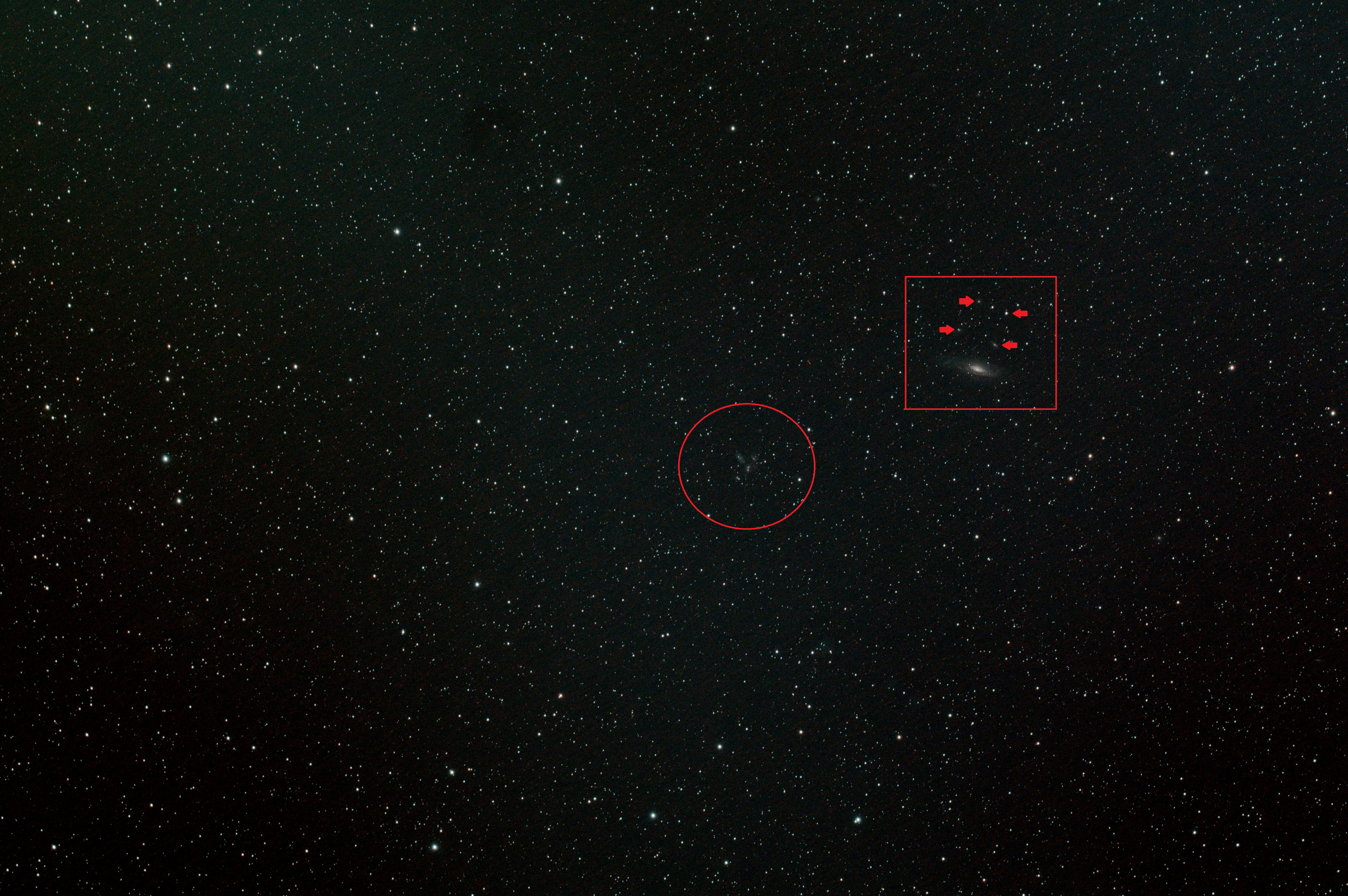
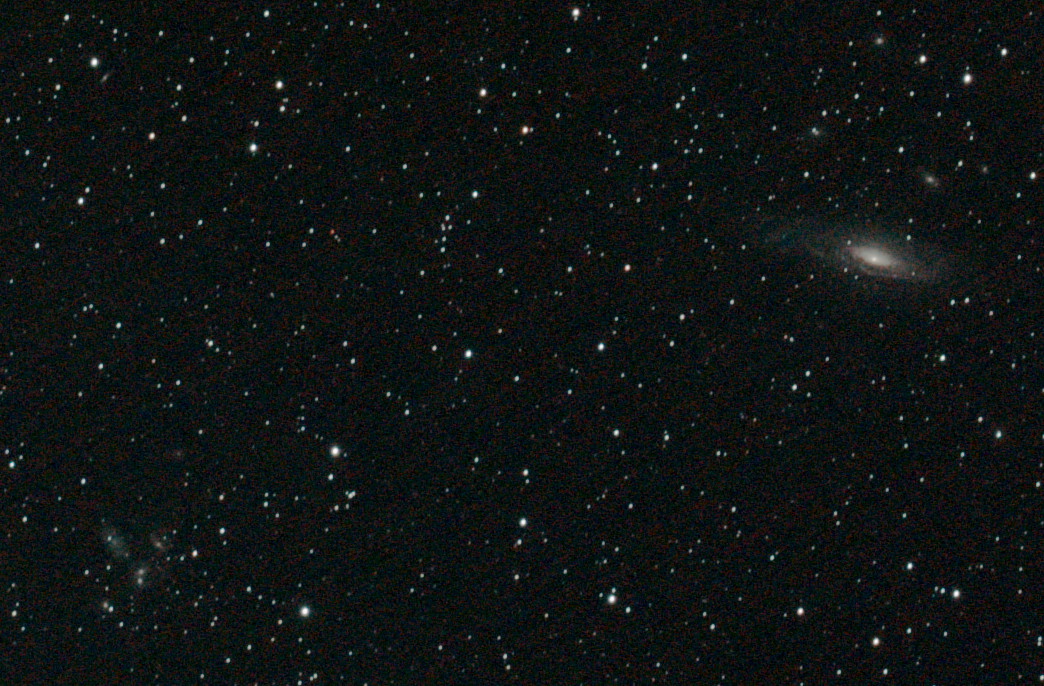
Widefield view of Stephan's Quintet (red circle) and NGC7331 + Deer Lick Group (red box) WO GT81, Canon 700D + FF | 20 x 120 secs + darks/bias/flats @ ISO 1,600

Widefield view of Stephan’s Quintet (red circle) and NGC7331 + Deer Lick Group (red box)
WO GT81, Canon 700D + FF | 20 x 120 secs + darks/bias/flats @ ISO 1,600

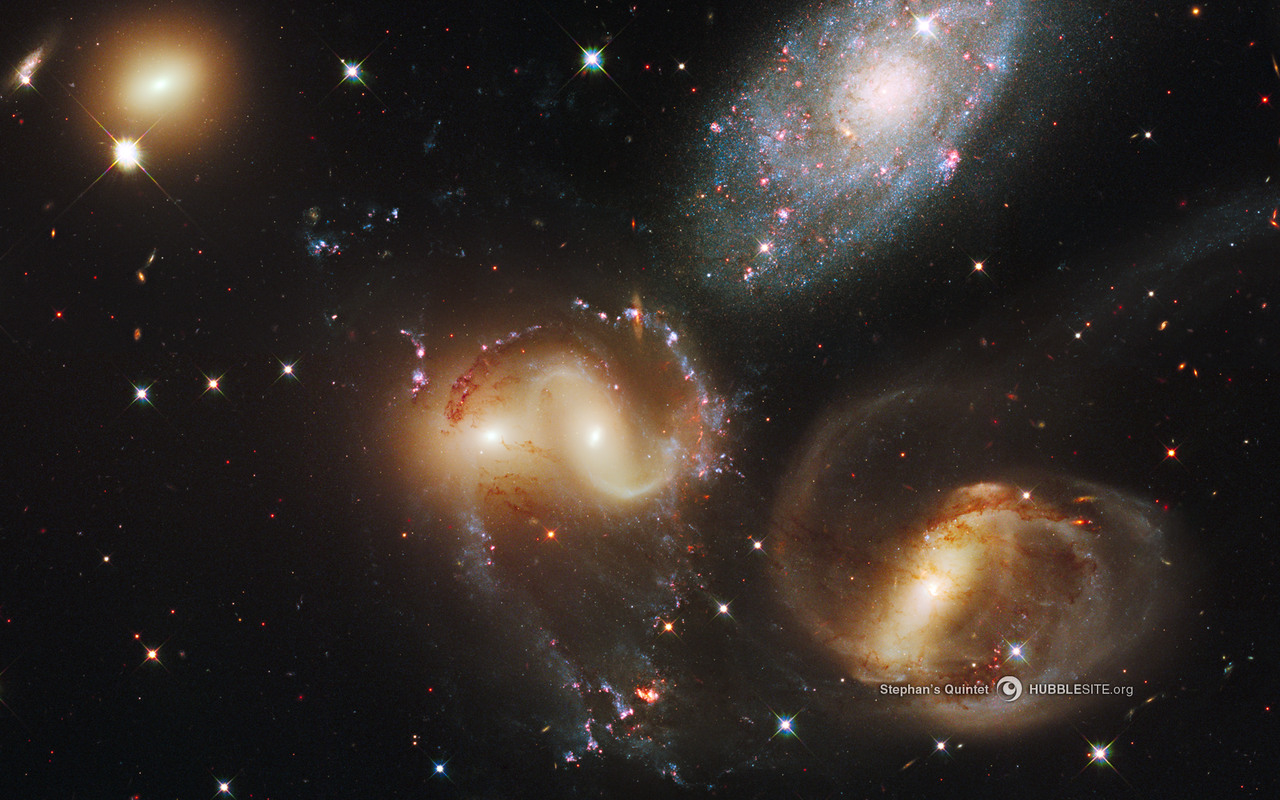
Located in the constellation of Pegasus, Stephan’s Quintet is a group of four galaxies whose respective gravities lock them in a cosmic dance with each other that will inevitably lead to their coalescence.  The fifth and brightest member of the group, NGC 7320, is in fact just 40 million light years away but viewed from Earth appears to be spatially associated with the aforementioned group and thus makes up the fifth member of the quintet. Unfortunately my 80 mm telescope only shows a smudge of light from Stephan’s Quintet but it is light that has just arrived here at Fairvale Observatory after making a 300 million year journey, it is literally looking back in time.  A more substantial Hubble image shows us exactly what was happening to these galaxies at that moment – it seems probable that they have by now come together but we’ll have to wait another 300 million years to see that.

Stephan's Quintet taken by the Hubble telescope

Stephan’s Quintet taken by the Hubble telescope

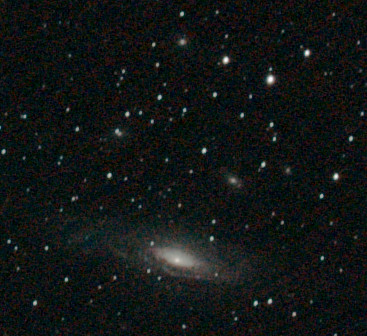
Stephan's Quintet (bottom left) and NGC 7331 & Deer Lick Group (top left)

Stephan’s Quintet (bottom left) and NGC 7331 + Deer Lick Group (top right)

One advantage of the smaller 80mm William Optics refractor telescope is that its field of view is quite large and whilst seeking to capture Stephan’s Quintet, I also inadvertently managed to image another group of galaxies.  In this case the dominant NGC 7331 galaxy with, apparently close-by but actually located up to ten times further away, the Deer Lick Group of galaxies.  The magnificent NGC 7331 is a mere 50 million light years from Earth and is thought to be similar to our very own Milky Way.  The Deer Lick Group (indicated by four red arrows in the main picture above) is however some 400 million light years* away – thus corresponding to the mid-Devonian period or the Age of Fishes; named after the red rocks first identified in Devon, UK and particularly known for its plethora of fish that developed at this time.  I am quite sure that even The Doctor would be impressed by the time travelled by the light from these objects as it arrives here on Earth after such a long journey and provides us with a glimpse of the past, today.

NGC 7331 spiral galaxy (foreground) and Deer Lick Group above (see main anotated picture for detailed location).  Light form the Deer Lick Group of galaxies is 400 million years old.

NGC 7331 spiral galaxy (foreground) and Deer Lick Group above (see main anotated picture for detailed location). Light from the Deer Lick Group of galaxies is over 400 million years old.

* For the record, light travels 670 million miles in one hour or 6 trillion miles in one year.

The Bat

It’s Halloween time of the year and I don’t like it.  My problem is that in the UK this used to be a minor event, treated as a bit of fun for some and ignored by most.  However, it’s been given the North American makeover and pumped up as a big deal, mainly on commercial grounds. Grrrrr!

Less seasonable has been the weather, which thankfully continues to be warm and sunny with occasional clear night skies. Hooray!  A great combination enhanced further by the appearance of winter astronomy objects and since last weekend’s change of clocks 1-hour backwards, darkness from early evening.  What’s not to like for the astronomer?  Starting at 6 pm I was therefore able to spend more than 7 hours on Monday night imaging a procession of DSOs as they approached and passed the meridian.  Moreover, I achieved almost perfect alignment and for the first time was able to obtain good exposures of between 120 and 180 seconds; had I tried I suspect even longer periods could have been achieved.

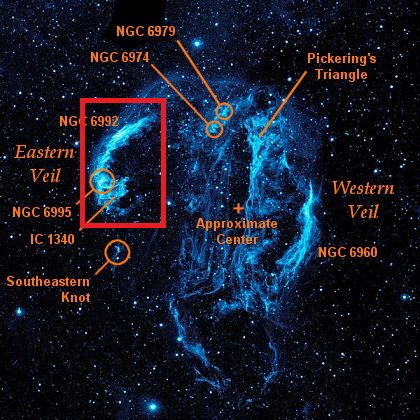
First off the rank was the Veil Nebula, part of the even larger Cygnus Loop, a massive supernova remnant.  Located about 1,470 light years away and between 5,000 and 8,000 years old, much of this this emission nebula is not in the visible spectrum and what is is feint and difficult to image.  I have already obtained a good photograph of the Western Veil of the nebula, also known as NGC 6960 or the Witch’s Broom https://watchthisspaceman.wordpress.com/2014/10/04/the-witchs-broom/ .  Now with such good conditions and my best ever alignment, I decided to turn my attention to the Eastern Limb, or NGC 6992 and NGC 6995.

Cygnus Loop (Veil Nebula)  in untraviolet light. Image area of the Western Veil highlighted by red box.

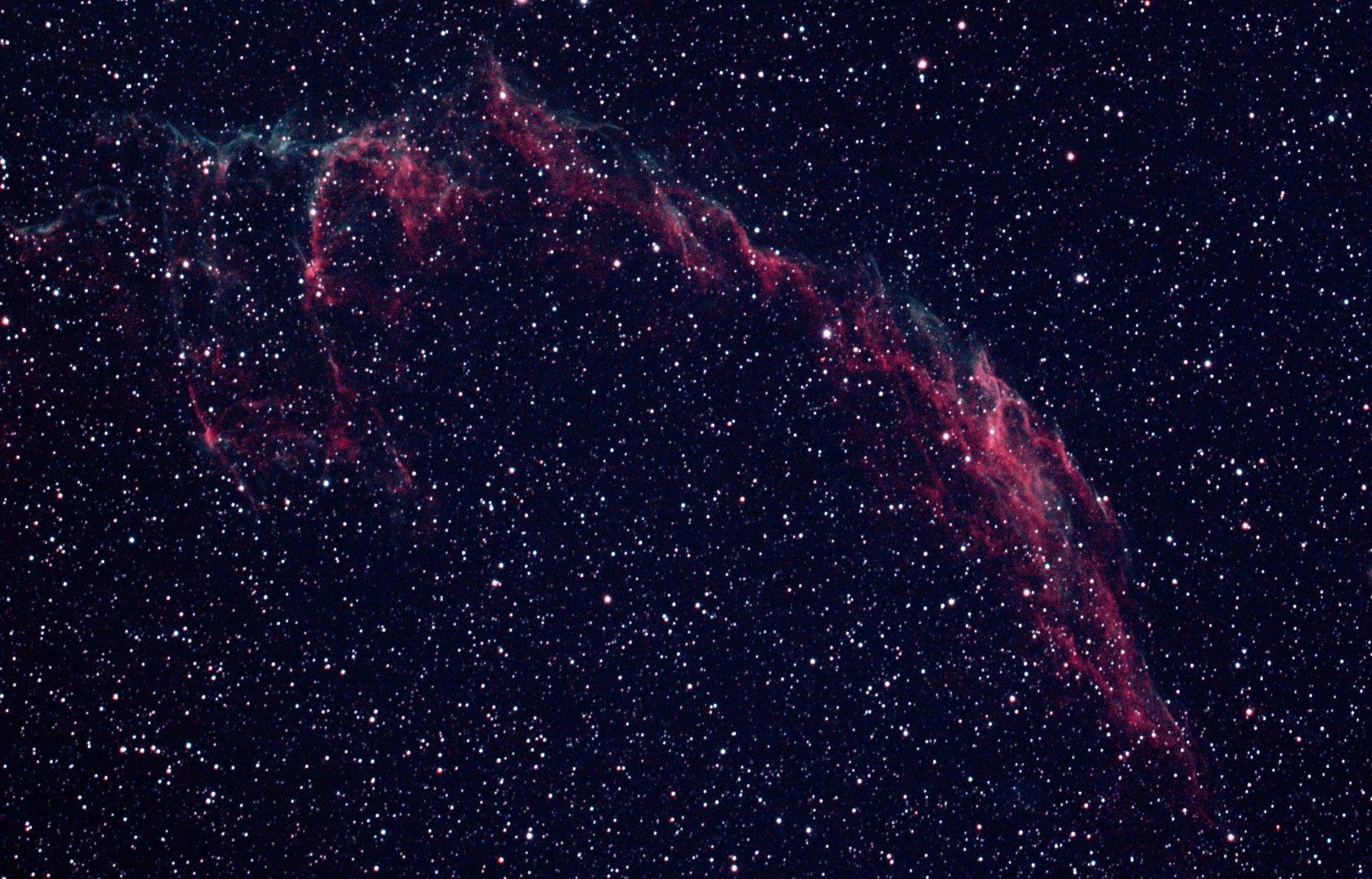
Cygnus Loop (Veil Nebula) in untraviolet light. Image area of the Eastern Veil highlighted by red box.

Using the new CLS light pollution filter and 30 x 120 second exposures, the resulting image from the camera immediately showed the full extent of this magnificent object, even before processing. Post processing the feature really comes to life, with large billowing waves of nebulous ionized gas and interstellar dust. The brighter, right-hand side (northern) of NGC 6992 trails off to the left (southerly) section of NGC 6995, also known as the Bat Nebula – well it is Halloween!

Eastern Veil Nebula - NGC  6992 (right) & NGC 6995 (left). WO GT81 + Canon 700D & FF | 29 x 120 secs + darks/bias?flats @ ISO 1,600

Eastern Veil Nebula – NGC 6992 (right) & NGC 6995 (left).
WO GT81 + Canon 700D & FF | 29 x 120 secs + darks/bias/flats @ ISO 1,600

NGC 6995 AKA The Bat Nebula (look carefully and you'll see him!)

NGC 6995 AKA The Bat Nebula (look carefully and you’ll see him!)

Gotcha!

Two of astronomy’s most iconic images are Saturn and the Orion Nebula, M42 – one a highly distinctive planet of our Solar System, the other a trade mark of the winter sky as part of the Orion Constellation.  Both therefore seem quite familiar but still need to be seen or better still captured on camera to personally experience their magic.

The Orion Nebula or Great Orion Nebula, is a diffuse nebula located just south of Orion’s belt in the constellation of Orion.  It is approximately 1,344 light-years from earth and 24 light-years in diameter, which with an apparent magnitude of +4.0 is visible from Earth.  Studies of the nebula have revealed much about how new stars and planetary systems are formed, indeed it is considered a stellar nursery for new ‘baby’ stars, typically only a few hundred thousand years old.  Some 700 stars have been identified as formed from this nebula, most notably the ‘Trapezium’ asterism in the centre of the nebula, consisting of six bright stars. Spectacular red colours arise from hot hydrogen gas, whilst dust reflects the blue light from hot blue stars within the nebula.

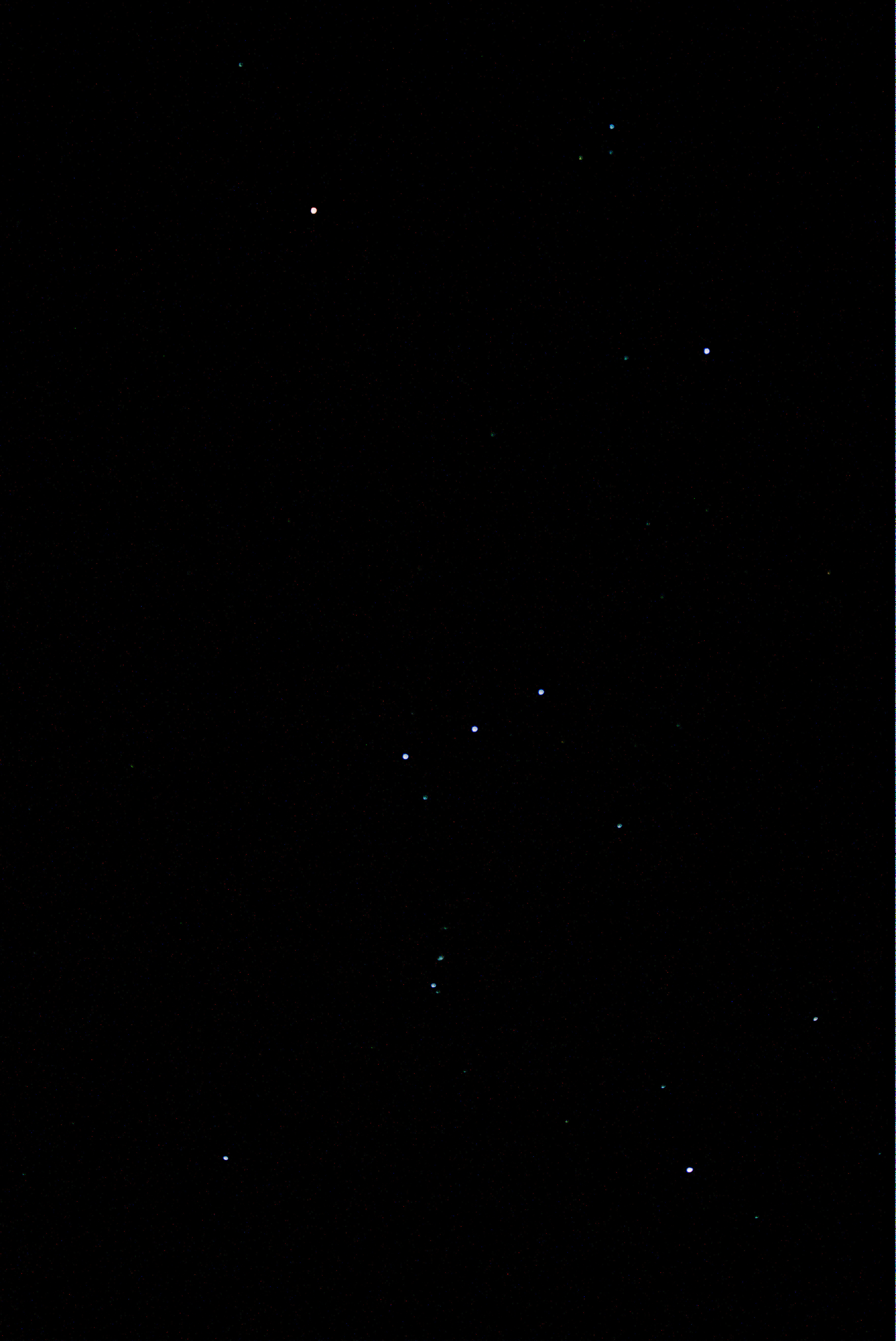
The Orion Constellation from Fairvale Observatory last year  - the Orion Nebula is just below the three central stars (Orion's belt) in the centre of the three lower stars

The Orion Constellation from Fairvale Observatory last year – the Orion Nebula is just below the three central stars (Orion’s belt) in the centre of the three lower stars (Orion’s sword)

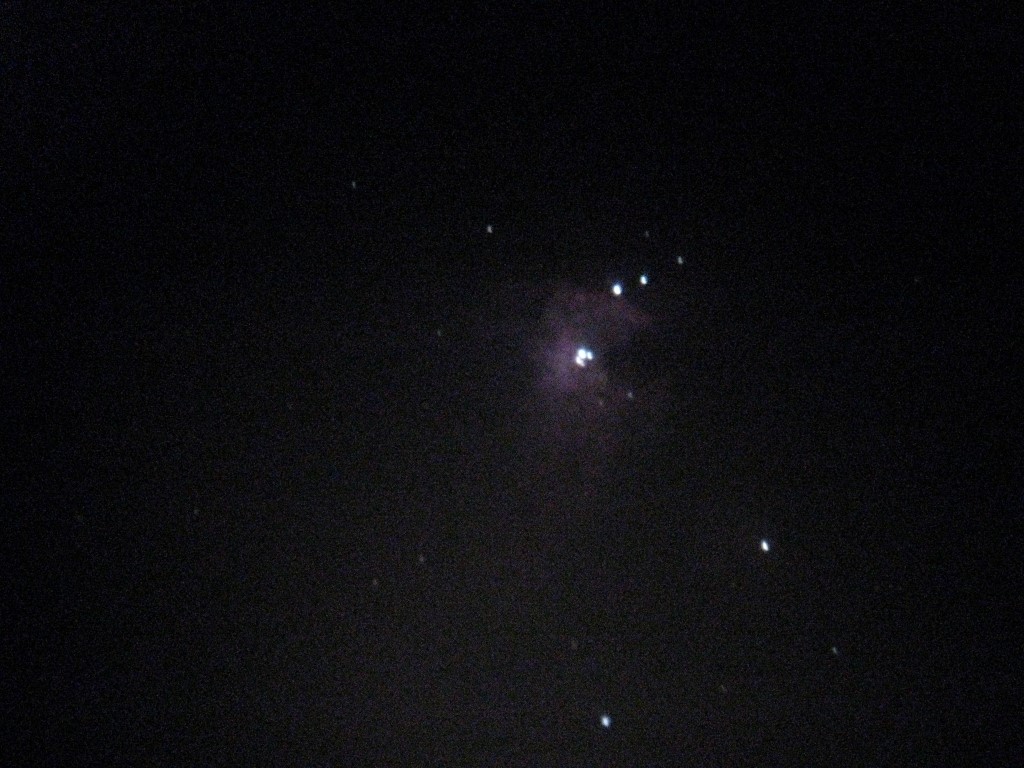
Due to its sheer beauty and notoriety I have previously dabbled with attempts to image the Orion Nebula before, initially by compact camera and subsequently by DSLR on the Skywatcher 150PL telescope, with limited success.  Notwithstanding, the colours of the nebula were evident and even four of the main stars of the Trapezium could be seen – at the time I was quite pleased but equally frustrated as I was unable to capture this magnificent object at its best.

Afocal image of the Orion Nebula in 2013: I was pleased at the time with the colour is showed and even the Trapazium stars

Afocal image of the Orion Nebula in 2013: I was pleased at the time with the colour it showed and even the Trapezium stars

Orion Nebula later in 2013: DSLR & Skywatcher 150PL, single photograph, shows better colour and detail of the Trapezium

Orion Nebula later in 2013: DSLR & Skywatcher 150PL, single photograph, shows better colour and detail of the Trapezium

One year on, new equipment, new skills and a dark sky and all that has changed.  Very early on last Sunday morning I succeeded in imaging the Orion Nebula in all its glory, in what must be my very best astro photograph to date. Gotcha!

The Orion Nebula October 2014 - the secondary feature in the top left corner is another nebula, M43.  Orientated with equatorial North up and East to the left. Canon 700D unguided | 20 x 90 secs + darks/bias/flats @ ISO 800
The Orion Nebula October 2014 – the secondary feature in the top left corner is another nebula, M43.   Orientated with equatorial North up and East to the left.
WO GT 81 Canon 700D  + FF unguided | 20 x 90 secs + darks/bias/flats @ ISO 800
 

Seven Sisters

“I have all the all the seven sisters that I need.

I am from Finsbury Park and am having a lark.”

Public Image Ltd (John Lydon et al), This is PiL 2012

220px-PiL_This_Is_PiL

The Seven Sisters chalk cliffs on the Sussex Heritage Coast, one of Britain’s finest unspoilt coastlines.

IMG_2138 (Small)

Seven Sisters London underground station on the Victoria line, in the borough of Haringey

800px-Seven_Sisters_stn_Victoria_line_roundel

Seven sisters – seven major oil companies, which formed the “Consortium for Iran” cartel that dominated the global petroleum industry from the mid-1940s to the 1970s.

fig_002


What is it with seven sisters?  Mr Google returns 1,490,000 search results.

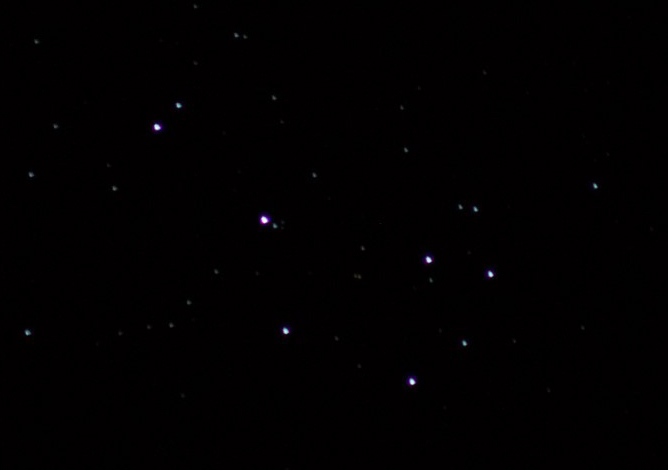
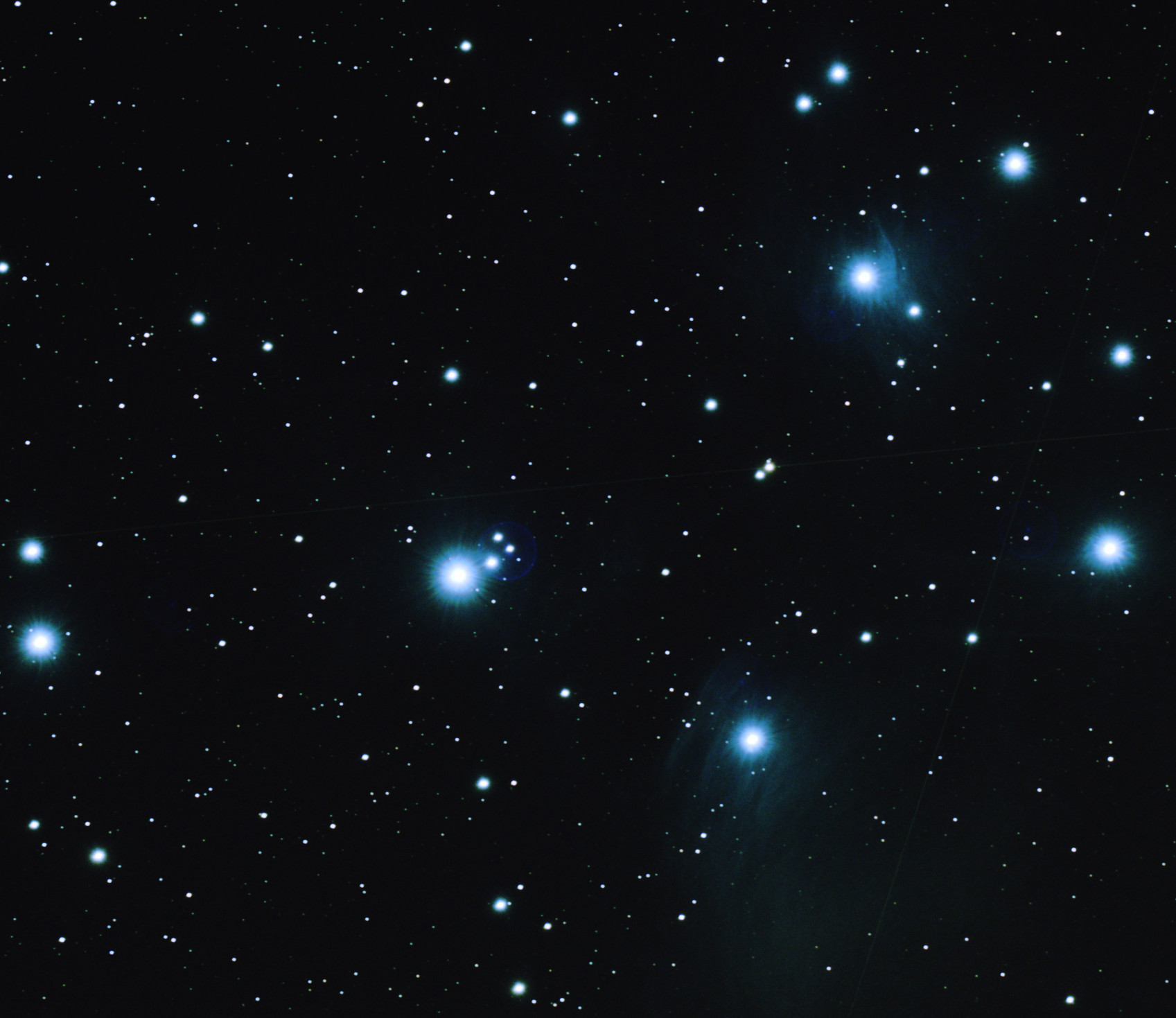
444 light years from Earth in the constellation of Taurus, with an apparent magnitude of +1.6, M45 or The Pleiades is one of the most prominent objects in the sky.  To the naked eye, the Pleiades look like a Little Dipper style asterism and with good eyesight it is possible to identify seven particularly bright blue stars.  This ‘young’ open star cluster actually contains over 1,700 stars, dominated by hot, blue stars.  M45 is currently passing through an interstellar dust cloud within the Milk Way, with the blue light from the brighter stars reflected off the dust, thus forming a distinctive blue nebulosity that can be seen surrounding the cluster.

M45 is generally considered to be a winter object in the Northern Hemisphere but, having just passed the Autumn Equinox at the end of September, it can already be seen in the late night / early morning sky.  Furthermore, as we leave the astronomical twilight of summer behind, the darkening skies are a real benefit to astro photographers; pity about the moon at the moment, which lingers until about 2.30am but thereafter leaves a still black sky, perfect for imaging.

Saturday night was the first time I have had to photograph the Pleiades using the new equipment so, given the prospect of a night long clear sky, there was no alternative but to get up early, very early – but it was worth the effort to capture this beautiful star group at its best: M45, the Pleiades AKA the Seven Sisters.

M45, The Pleiades or Seven Sisters star cluster Canon 700D unguided | 26 x 90 secs darks/bias/flats @ ISO 800

M45, Pleiades or Seven Sisters star cluster
Canon 700D unguided | 26 x 90 secs darks/bias/flats @ ISO 800
 

The Witch’s Broom

With polar alignment and tracking now working quite well, I have been hunting around for potential new targets before moving on to the next challenges of computer control and auto-guiding.  Within the constraints of my limited sight lines, light pollution, weather and a rapidly encroaching full moon, I decided to tackle the somewhat elusive Veil Nebula.  Although the apparent magnitude of 7.0 is not unduly challenging, the delicate nature and low surface brightness of this very large ionized gas cloud can make it difficult to image.

Located in the Cygnus constellation, the Veil Nebula is a very large but feint supernova remnant about 1.400 ly from Earth that exploded between 5,000 and 8,000 years ago i.e. quite recently.  The Veil Nebula, Cirrus and Filamentary Nebula usually refer to those parts that can be viewed, the rest of the feature not being in the visible spectrum; the Veil is one of the largest, brightest features in the x-ray sky.  So big is the Veil that various sections are recorded as separate NGC numbers: 6960, 6992, 6995, 6974, 6979 and IC 1340.

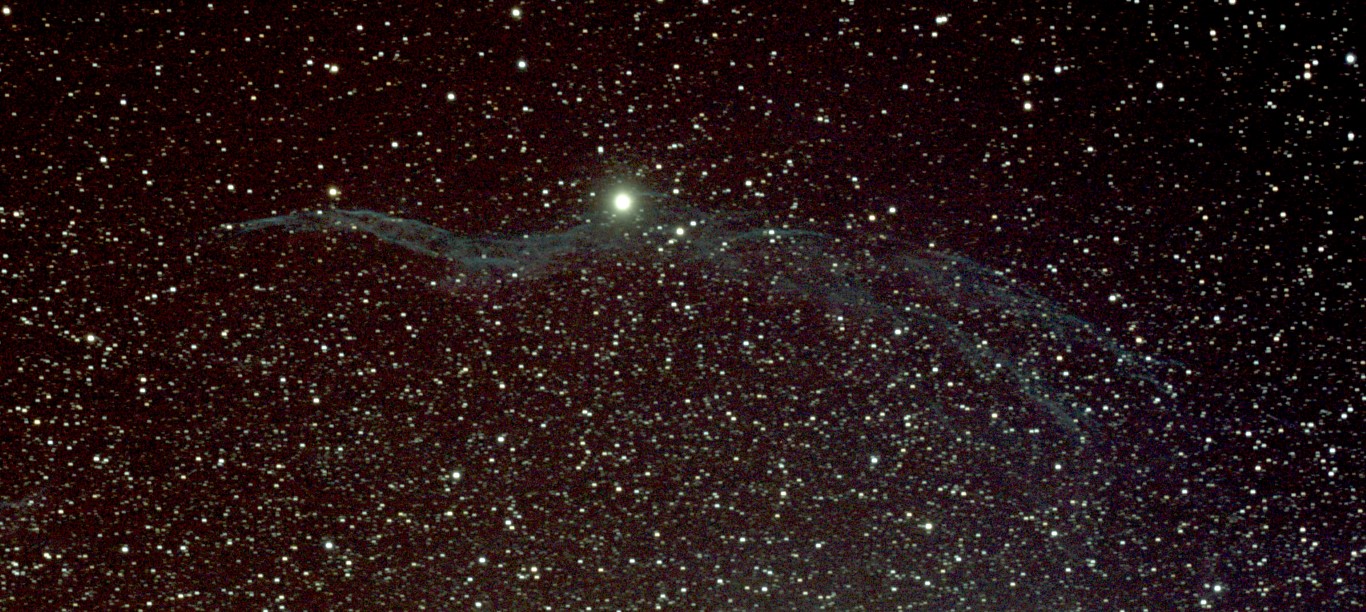
Located close to the binary star system 52 Cygni, the classic view is of the Western Veil or NGC 6960, AKA the “Witch’s Broom”, “Finger of God or “Filamentary Nebula”, which spans across 35 light-years and I therefore set out to photograph.  Following the recent success of the North America Nebula I undertook a test shot at the same settings: 90 seconds at ISO 1,600.  However, the resulting picture looked excessively washed out and so changed to 90 seconds at ISO 800, which seemed to work better – though you never really know until the late stages of post-processing.  Despite forecasts to the contrary, the cloud rolled in after just six shots but two hours later and still tracking, the clouds parted leaving a clear sky and just enough time to take another twenty shots.

Initial processing was not encouraging.  Truth be told there’s still a lot to learn with this part of astro-imaging but, with some difficulty and courtesy of Mrs G, a good image of the Witch’s Broom was eventually teased from the data.

NGC 6960 AKA The Witch's Broom Canon 700D | 20x90 sec + darks.bias/ flats @ ISO 800
NGC 6960 AKA The Witch’s Broom
Canon 700D | 20 x 90 sec + darks/bias/ flats @ ISO 800
 

Star wars

A big surprise to me since starting astronomy has been star clusters, which I was strangely unaware of before.  They come in two basic varieties – globular and open – their general nature is, as so many things astronomical, mind blowing.  The Milky Way has about 160 globular clusters, with highly elliptical orbits to the galaxy, whilst more distant galaxies such as M87 have over 13,000.  Each globular cluster typically contains hundreds or even millions of stars held together by gravitational forces in a roughly spherical form, generally packed into regions of ‘just’ 10 ly to 30 ly diameter.

Globular cluster stars are considered to be some of the oldest known objects in the Universe, formed just a few hundred million years after the formation of the Universe itself, and appear to be some of the first produced during galaxy formation.  Most of the stars are red and yellow Population II stars or ‘metal poor’, which have formed after a supernova.  More rare blue stars, known as blue stragglers, may also exist in globular clusters and are thought to be formed in the dense inner regions of stellar mergers.  Notwithstanding, the origin of globular star clusters is still poorly understood but research suggests they may be survivors of galactic mayhem 13 billion years ago.

http://www.mpa-garching.mpg.de/mpa/institute/news_archives/news1202_aaa/news1202_aaa-en-print.html

No known globular clusters display active star formation today, which is consistent with the view that globular clusters are typically among the oldest objects in the Universe and were some the first collection of stars to form.

And so the other evening I turned the camera on a globular cluster, M15 or NGC 7078, located by the constellation of Pegasus.  Estimated at 12 billion years old, it is one of the oldest globular clusters, 33,000 ly from Earth and one of the more densely packed clusters in the Milky Way,  containing some 100,000 stars.  Notably M15 contains a number of variable stars, pulsars, one neutron star and also unusually, a planetary nebula.  All-in-all quite a catch though I am still mystified and intrigued by their occurrence!

M15 Globular Cluster Canon 700D unguided | 20 x 90 secs + darks /   bias / flats @ ISO 800
M15 Globular Cluster
Canon 700D unguided | 20 x 90 secs + darks / bias / flats @ ISO 800