
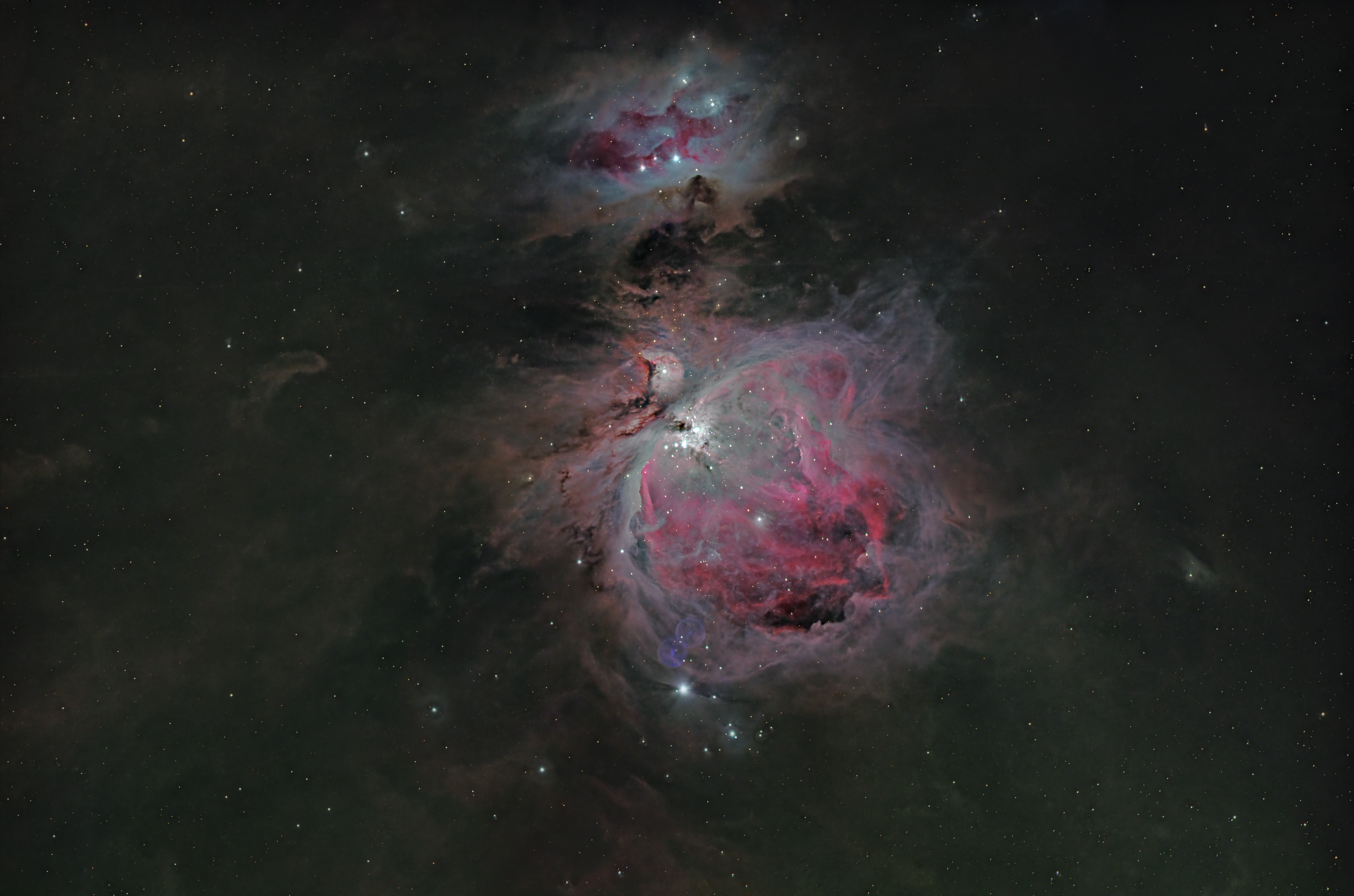
I get a warm feeling at the first view of the Orion constellation each year. Just viewed with the naked eye, late at night against a clear black sky it is a wonderful sight that somehow seems strangely reassuring but for the astronomer and especially astrophotographers, there are many exciting targets that hold great promise, principal of which is M42 the Great Orion Nebula. This winter my first view of Orion was last October, rising from the eastern horizon in the early morning, just as I was about to go to bed after a late-night imaging session. Unfortunately, it was more than two months before the weather relented and I was finally able to snatch an albeit brief image of the said Orion Nebula.
M42 and other nearby diffuse & reflection nebula (M43 & NGC1975 AKA the Running Man Nebula) is one of the most famous star-forming regions, which being the brightest nebula in the northern hemisphere and just over 1,300 light years distance from Earth, can itself also been seen with the naked eye on a clear night. To my surprise, I hadn’t imaged this beguiling object for 6-years, during which much had changed: a new mount, camera & filters + I had learned a few more processing tricks.
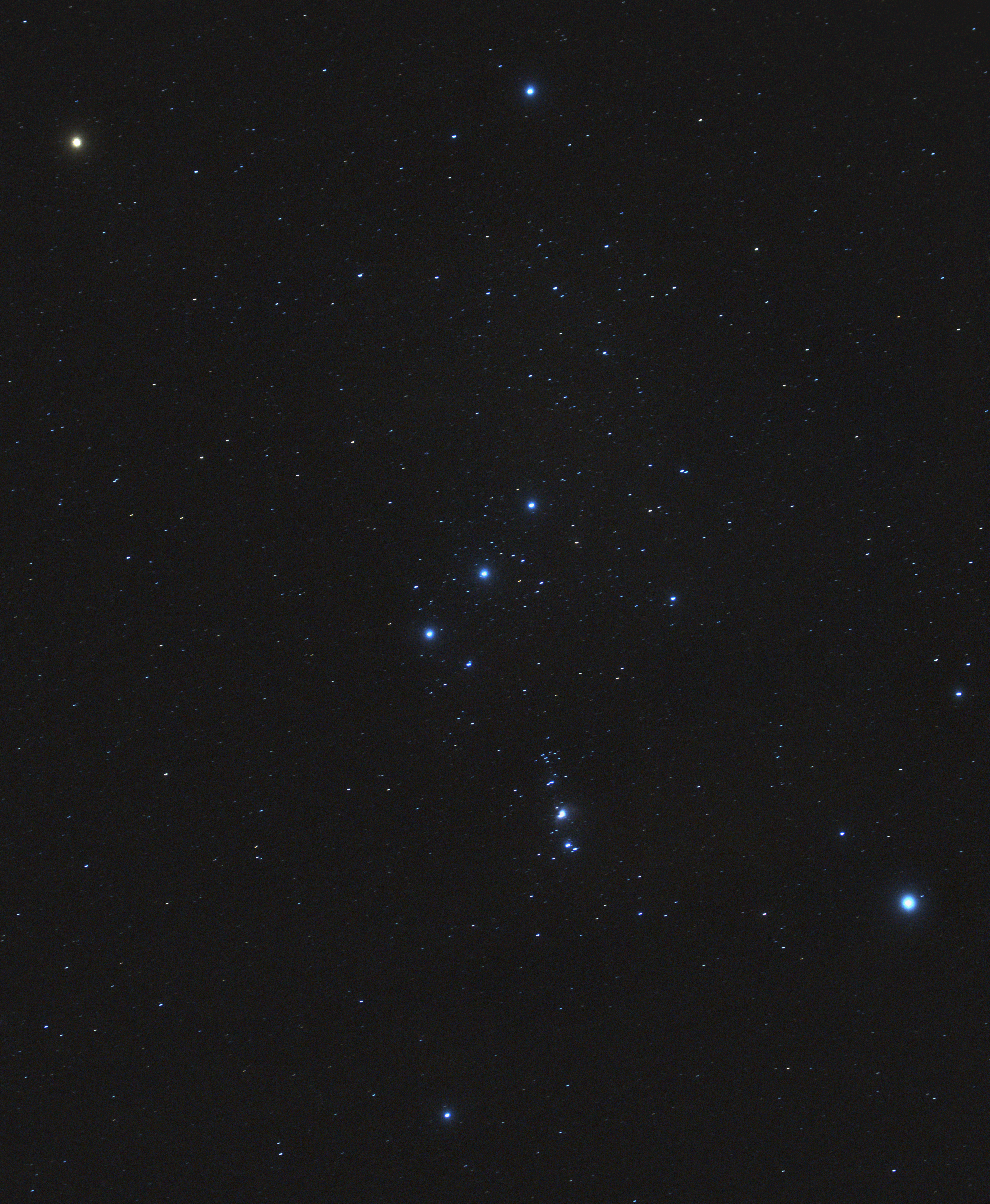

Left – Orion constellation from Fairvale Observatory, Redhill; Right – NB image from same location
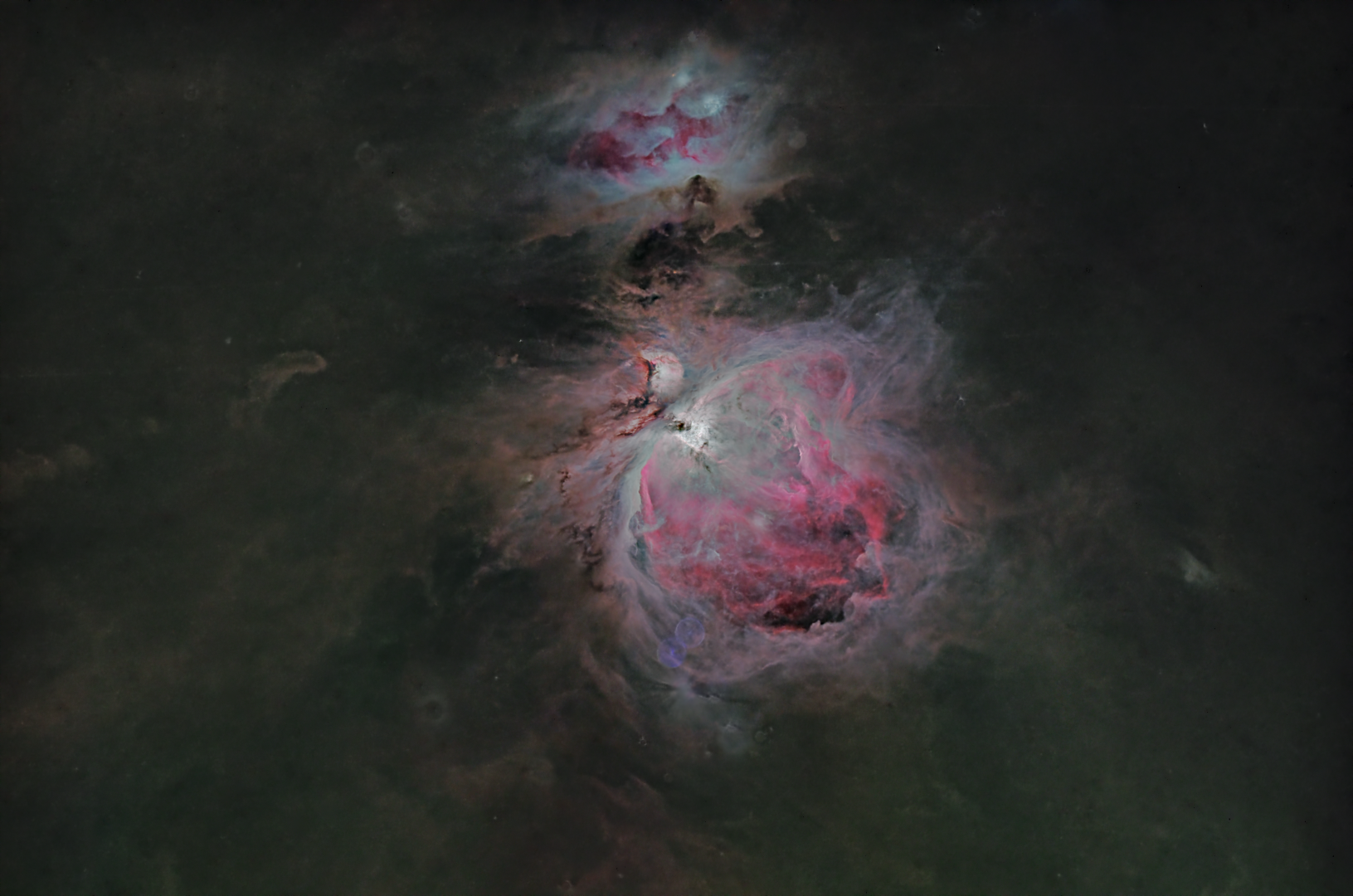
The Orion Nebula is a gigantic cosmic cloud of interstellar dust and gas, which is the basis for the birth of numerous new stars or a “star nursery” (see starless image below) . Moreover, these powerful, young stars unleash vast streams of ultraviolet radiation that sculpt the nebula into a myriad of fantastic shapes, further highlighted by a red tint that arises due to the presence of hydrogen gas. For astronomers, such activities reveal much about the processes of how stars and planetary systems are formed from collapsing clouds of gas and dust.
Known as the Trapezium, four stars tightly located at the centre of M42 are very difficult to image, because of the overpowering bright white light that obscures this area from sight. However, for astrophotographers the elusive nature of the Triangulum is therefore considered to be the ultimate measure of a good Orion Nebula image. To overcome this problem, the key is to image the nebula across a range of exposures, from very short to long, which can then be compiled into a single final photograph that equally captures details of bright and darker areas alike.
Although poor weather conditions limited the shoot to a relatively short integration time, I’m pleased to say that the subsequent application of various new processing techniques (*see footnote for details) has created an exciting final image, full of detail and colour, as well as the aforesaid Triangulum, that I believe does justice to this magnificent object that is surely the real star of the winter night sky.
Processing Footnotes:
In addition to using the conventional LRGB processing workflow, to uncover the exciting detail that lies within the Great Orion Nebula on this occasion it was necessary to apply some additional processes. First, after ensuring perfect star alignment of all images, the three 180, 60 & 15 second exposure stacks are combined using HR Composition. At first the bright areas of the combined image still look blown-out but, as if by magic, careful application of HDR Multiscale Transformation then reveals the underlying details such as the Triangulum. Thereafter it’s all downhill, except in this case I was further assisted by the use of three new scripts that I can highly recommend:
- Blemish Blaster by Seti Astro – helps remove inevitable blemishes of the starless image created by StarXTerminator process, which I found much easier to use than PixInsight’s Clone Stamp mostly with better results too;
- Star Stretch also by Seti Astro – Makes the often-tricky action of stretching star images from StarXTerminator a complete doddle;
- Astro Image Detail by Hidden Light Photography – An excellent script that makes a great job of teasing out detail from the nebula, that results in a really exciting final image.
| IMAGING DETAILS | |
| Object | M42 & more |
| Constellation | Orion |
| Distance | 1,344 light-years |
| Size | 65 x 60 arc minutes excluding The Running Man |
| Apparent Magnitude | +4.0 |
| Scope | William Optics GT81 + Focal Reducer FL 382mm f4.72 |
| Mount | ZWO AM5 + ASIair plus |
| Guiding | William Optics 50mm guide scope |
| ZWO120MM mini | |
| Camera | ZWO ASI294MM CMOS sensor |
| FOV 2.87o x 1.96o Resolution 2.50”/pix Max. image size 4,144 x 2,822 pix | |
| EFW | ZWOx8 EFW & 31mm Chroma LRGB filters |
| Capture & Processing | ASIair plus, Deep Sky Stacker & PixInsight v1.9.2 |
| Image Location & Orientation | Centre = RA 05:35:26.25 DEC -05:25:21.10 Top = North |
| Exposures | L x25, R x14, G x14, B x10 @ 180 sec = 3hr 9min L x16, R x5, G x8, B x8, @ 60 sec = 20 min L x24, R x12, G x 12, B x12 @ 15 sec = 15 min Total lntegration Time: 3hr 44 min |
| @ Gain 120 @ -15oC | |
| Calibration | 10 x 180 sec Darks 20 x BB Flats & Dark Flats @ ADU 32,000 |
| Location & Darkness | Fairvale Observatory – Redhill – Surrey – UK Typically Bortle 5-6 |
| Date & Time | 2nd January 2025 @ +20.00h |
| Weather | Approx. <5oC RH >=65% 🌙 Waxing 8% |
 WATCH THIS SPACE(MAN)