The big picture unveiled

About this time last year I successfully imaged first NGC 6960 the Western Veil, AKA the Witch’s Broom Nebula and shortly afterwards NGC 6992 the Eastern Veil, which includes NGC 6995 AKA the Bat Nebula.  In themselves they are both wonderful parts of the larger but perhaps more elusive (photographically speaking) Veil Nebula.  Located in the constellation Cygnus, the Veil Nebula or Cygnus Loop is formed from the remains of a supernova that exploded in our galaxy about ten thousand years ago and at a distance of almost 1,500 light-years, now spans a 3o area of the sky or 80 light-years in diameter.  At the time I struggled to get these images but was very pleased with the outcome.

cygnus

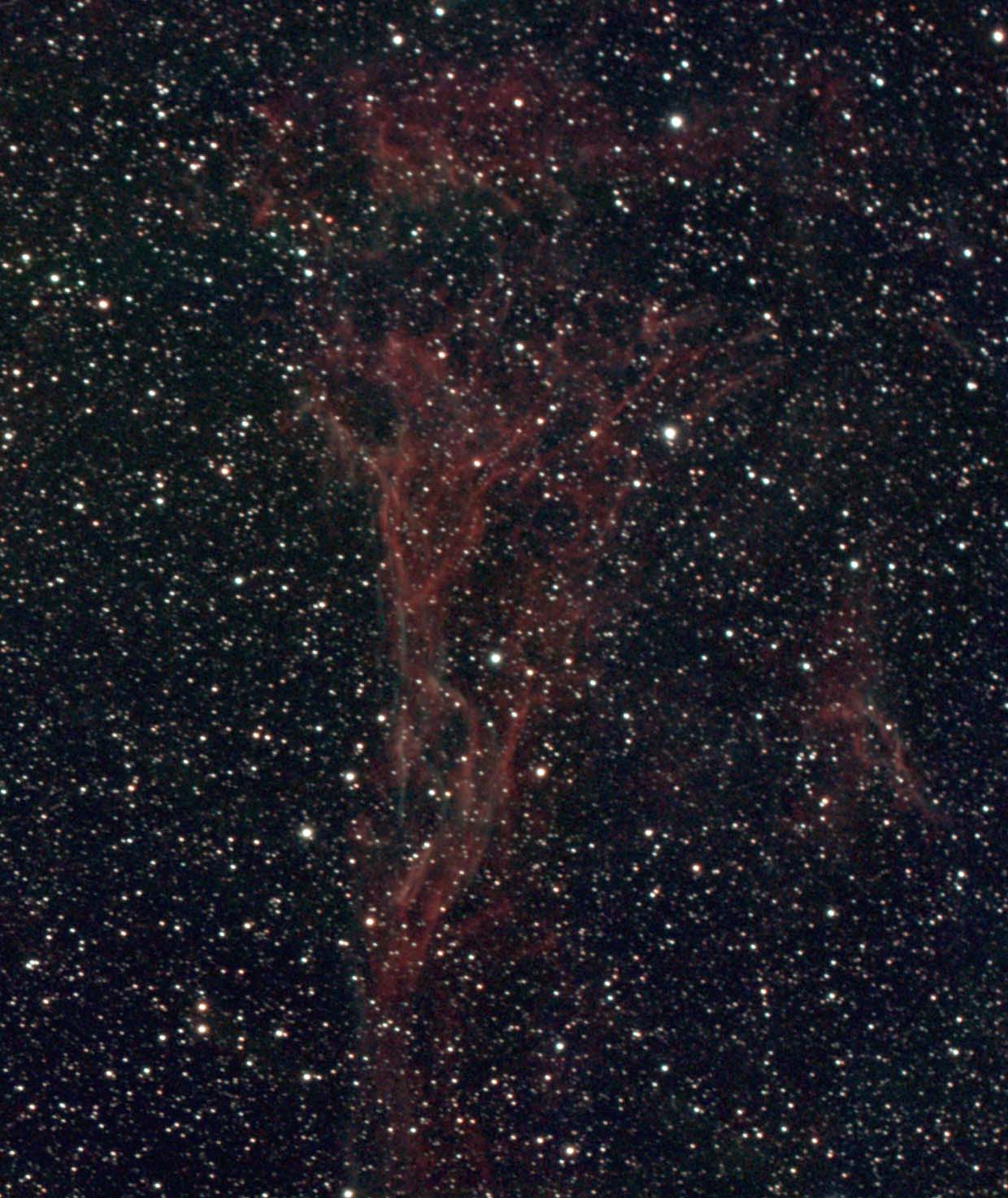
One year on and I was now thinking about other parts of the Veil, in particular Pickering’s Triangle.  The Triangle might be thought of as the third central section of the Veil, situated between the Eastern and Western Veils but slightly further north.  At some 52 x 35 arcminutes it is itself a significant feature, which surprisingly does not have an NGC catalogue number of its own.

Pickering's Triangle

Pickering’s Triangle

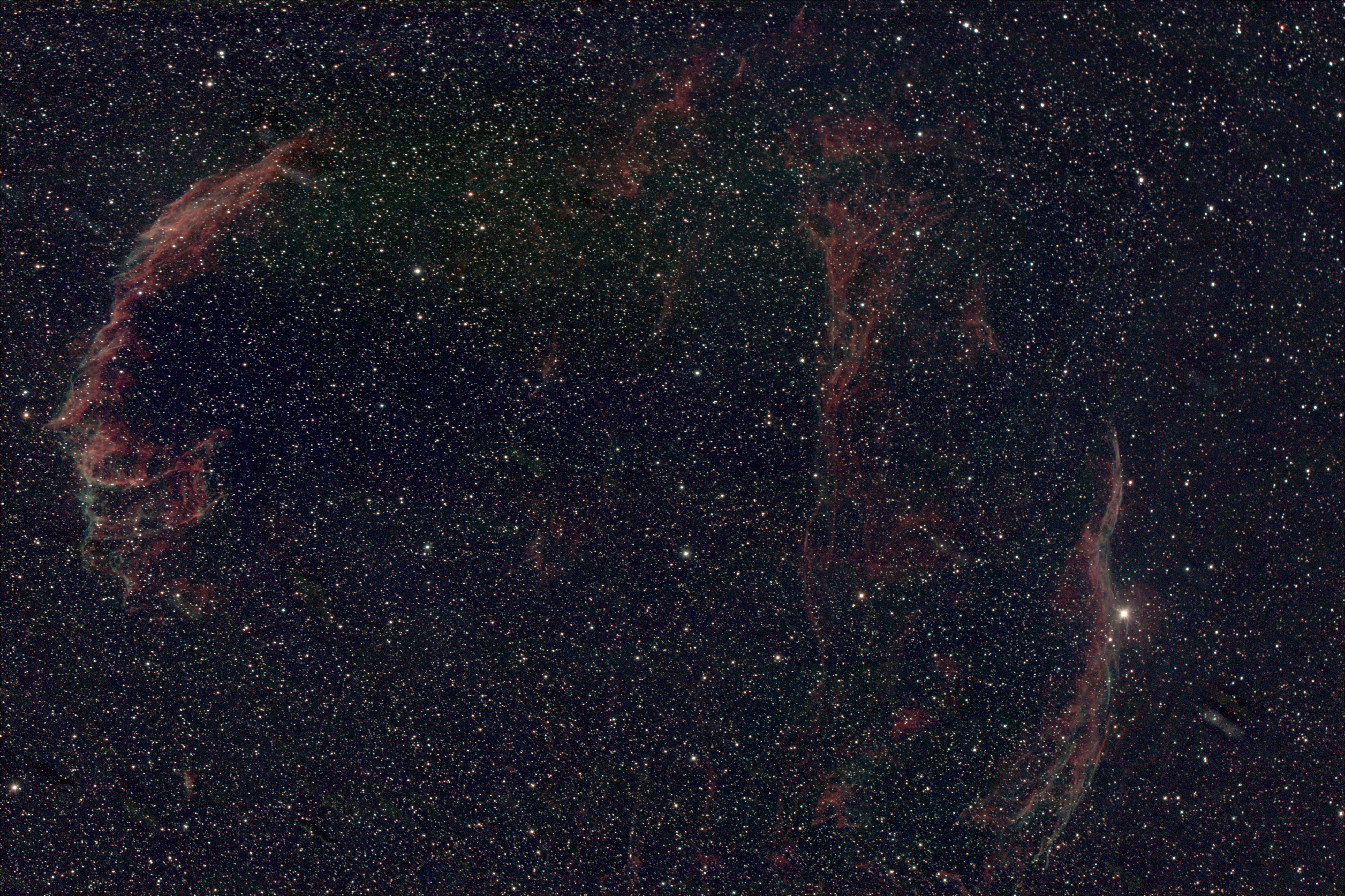
Notwithstanding the success of Pickering’s Triangle, in the end I got much more than I bargained for.  This time using a modded camera, I was able to capture the entire Veil Nebula in one photograph – progress indeed.

The Veil Nebula AKA Cygnus Loop: Ultraviolet view ref. NASA

The Veil Nebula AKA Cygnus Loop: Ultraviolet view ref. NASA

Light from the bulk of the Veil Nebula is very faint and notoriously difficult to image, whilst furthermore much of it is Ha in nature – hence this time finding its way to the camera’s sensor having had the IR filter removed.  The result is a staggering view of the entire supernova, with the Witch’s Broom in the west (right), the Eastern Veil (left) and Pickering’s Triangle nestled in between.  However, in addition extensive regions of delicate, wispy nebulous filaments can be seen flowing everywhere in between – hence the name of Veil.

Veil Nebula / Cygnus Loop WO GT81 & modded Canon 550D + FF | 30 x 180 sec exposures @ ISO 1,600 | 19th September 2015

Veil Nebula / Cygnus Loop
WO GT81 & modded Canon 550D + FF | 30 x 120 sec @ ISO 1,600 | 19th September 2015

Whilst I am very pleased with the resulting photograph, there’s still more to achieve another time.  Apart for the added potential that would be gained from longer, guided exposures, the use of Ha and OIII filters would also uncover even more of the Veil’s diaphanous beauty.


At the limit

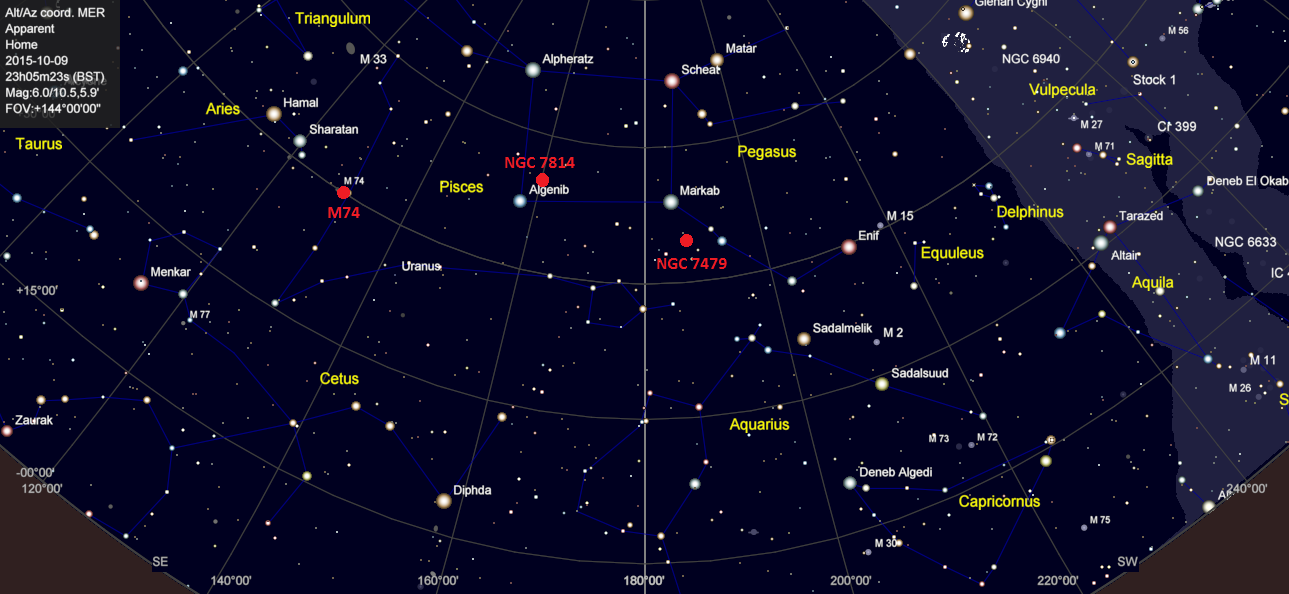
Earlier this month the weather and clear skies produced particularly good imaging conditions that resulted in some excellent pictures; it’s already a distant memory as the weather has since turned cold and cloudy day-after-day – or at least every night except when there’s a full Moon!  With these images knowingly in the bag and the telescope well aligned, I took the opportunity to indulge in a short session imaging some galaxies that happened to be around the Meridian at this time which, as it turned out, were located in proximity to the constellation of Pegasus.

pegasus ANOTATE

Two of the objects (M74 & NGC 7814) were confined to just ten shots and the third fifteen, all at 180 seconds exposure and ISO 1,600.  For such dim and distant objects this in itself was obviously insufficient but still it was fun to experiment.  As expected the resulting images are feint and noisy but the object’s form can be clearly seen and, in the case NGC 7814 – the Little Sombrero, even the edge-on dust lanes are evident.

In order to better understand the limits of the equipment, a comparison of the images with the objects’ physical information given side-by-side illustrates the problems and possibilities for the future.  The truth is that these are all at or beyond the realistic limit of my current set-up but I was interested to see what results could be achieved and I always enjoy their beauty, even if imperfectly captured.

Picture3

Apart from the obvious problem of size, mainly a function of distance in this case, their apparent magnitude is also challenging.  It is interesting to consider that using the 18 megapixel Canon 550D and WO GT81, each camera pixel which measures 4.30μm samples just 1.855 arc seconds per pixel and therefore even the largest of these objects (M74) spans an area of just about one tenth of a degree (0.10o).  Better alignment and longer exposure should tease out more detail but as the recorded image of each object is no more than 2% of the total image the reality is that I am pushing my luck.

Still it is fun and I have managed to capture a few of the photons that left these galaxies so long ago.  As my equipment, techniques and knowledge continue to improve then hopefully so will the limits.  Watch this space!


Rock On!

Due to my viewing limitations at Fairvale Observatory planning is essential, with the best imaging range mainly restricted to a zone between 65o and 85o and within +/-20o of the Meridian.  Furthermore, as I am mostly using the William Optics GT81 telescope at the moment, imaging targets should preferably be large – something between 1o & 2o is perfect, such as  the Rosetta Nebula at 1.3o or Andromeda Galaxy at 190’ x 60’.  As luck would have it these conditions are favourable for a number of objects at the moment and I have been somewhat spoilt for choice: North America Nebula, Veil Nebula and Andromeda.

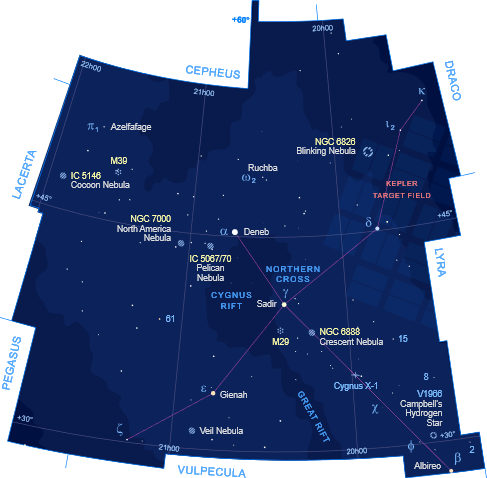
Notwithstanding, for some reason I have until now overlooked the Sadr Region IC 1318, which is also large and in a similar part of the sky as the aforementioned North America and Veil Nebulae but perhaps overshadowed by their notoriety.  In reality it is an enormous area of nebulosity containing many features worthy of imaging which are perfect at this time of the year from my location.

cygnus

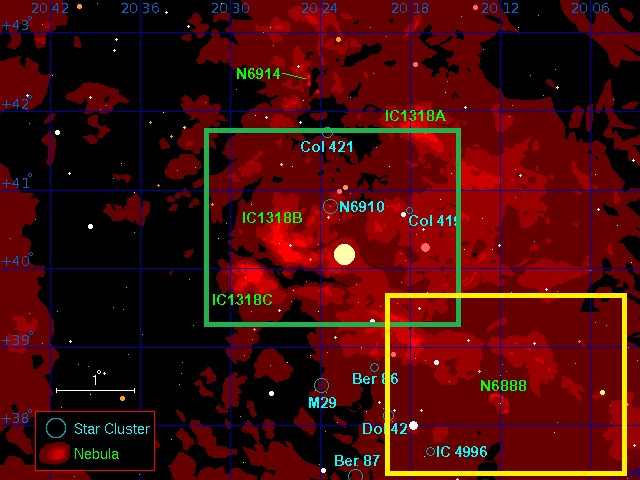
Sadr Region: green rectangle indicates the approximate area of IC 1318 image, yellow rectangle the NGC 6888 Crescent Nebula. image

Sadr Region: green rectangle indicates the approximate area of IC 1318 image, yellow rectangle the NGC 6888 Crescent Nebula image.

IC 1318 is a diffuse emission nebula surrounding the star Sadr or Gamma Cygni, which is at the centre of the Cygnus Cross and on the plane of the Milky Way.  The Sadr region is located deep within the Orion arm of the Milky Way about 3,000 light-years from Earth, with Gamma Cygni actually situated closer in the foreground. Such is the size of IC 1318 that its three constituent parts, A – B – C, extend over some 200 light-years or about 4 degrees, which is well beyond the FOV of the WO GT81; how could I have overlooked his enormous area of nebulosity before?  As a result of its size and complexity I also chose to image two other interesting features nearby.

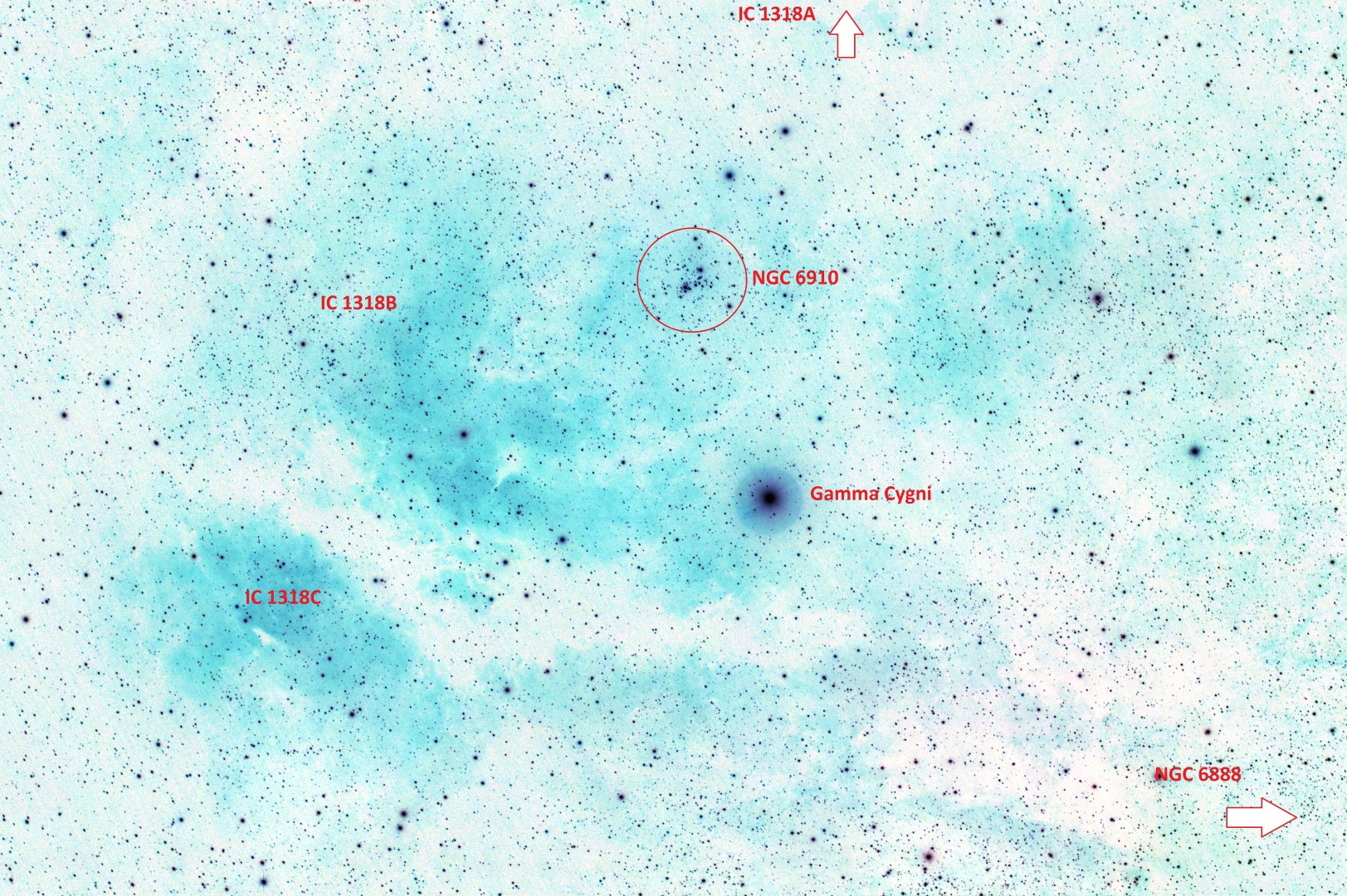
IC 1318 Sadr Region - image inverted & annotated

IC 1318 Sadr Region – image inverted & annotated

IC 1318 Sadr Region WO GT81 + modded Canon 550D & FF | 30 x 120 secs @ ISO 1,600 | 30th September 2015

IC 1318 Sadr Region
WO GT81 + modded Canon 550D & FF | 30 x 120 secs @ ISO 1,600 | 30th September 2015

Situated just above Sadr is the small star cluster of NGC 6910 AKA Rocking Horse Cluster.  Although only 10’ in size the cluster is visually quite prominent, though I struggle to see the little horse that others have identified.  Notwithstanding, it is an interesting and attractive part of the Sadr region.

NGC 6910 The Rocking Horse Nebula as recorded by StarObersever.eu - located just above Gamma Cygni in the previous image.

NGC 6910 The Rocking Horse Nebula as recorded by StarObersever.eu – located just above Gamma Cygni in the previous image.

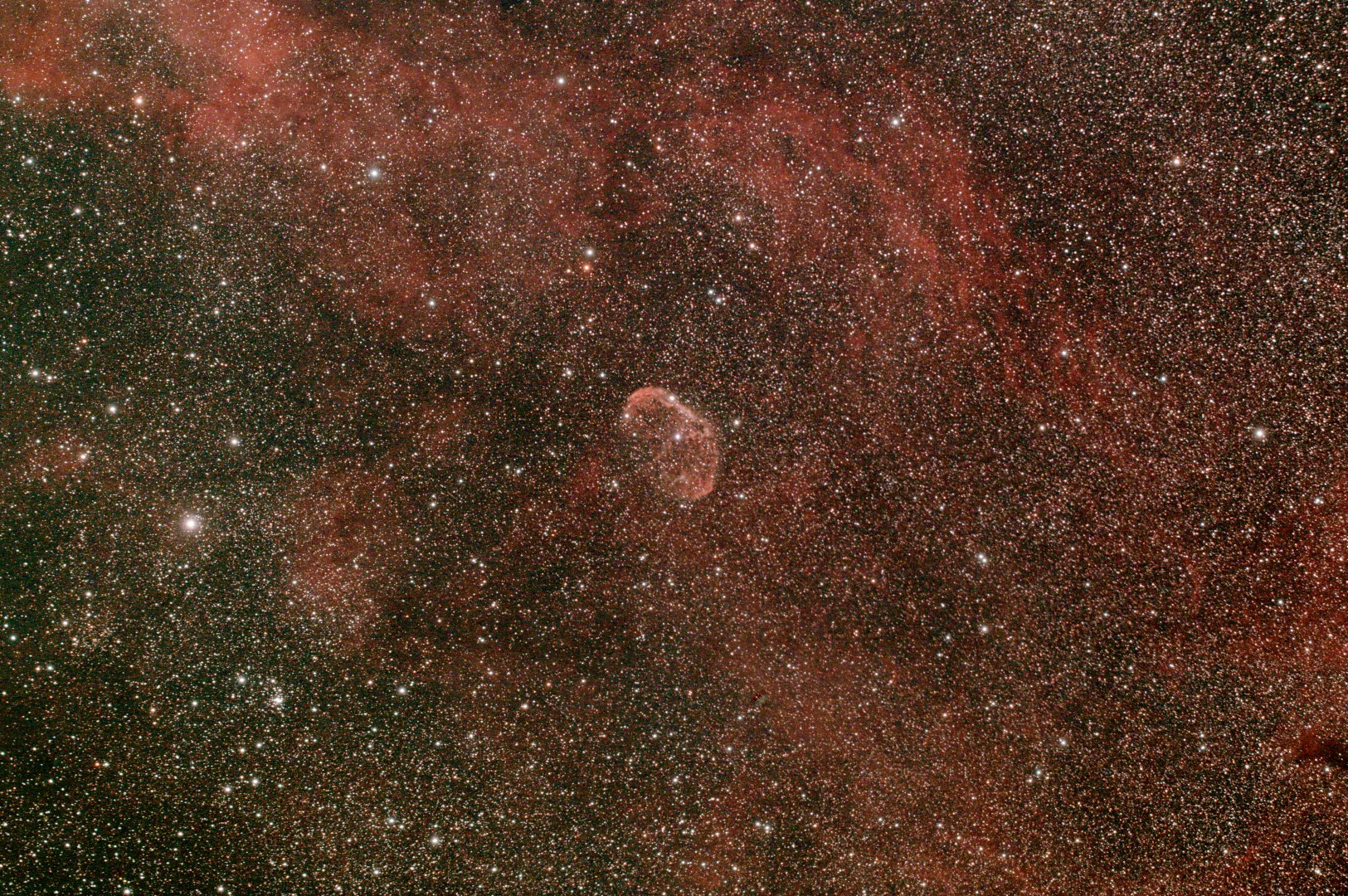
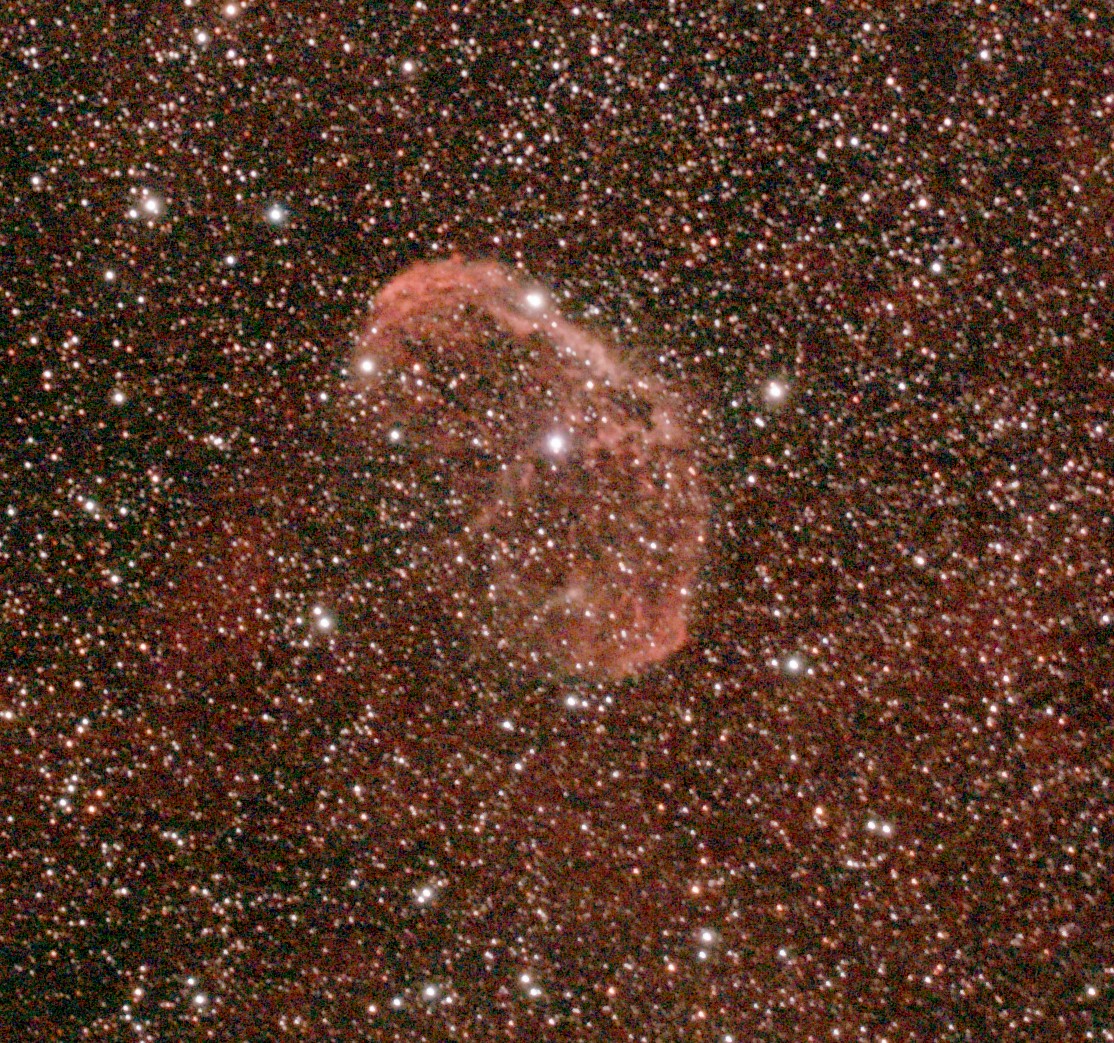
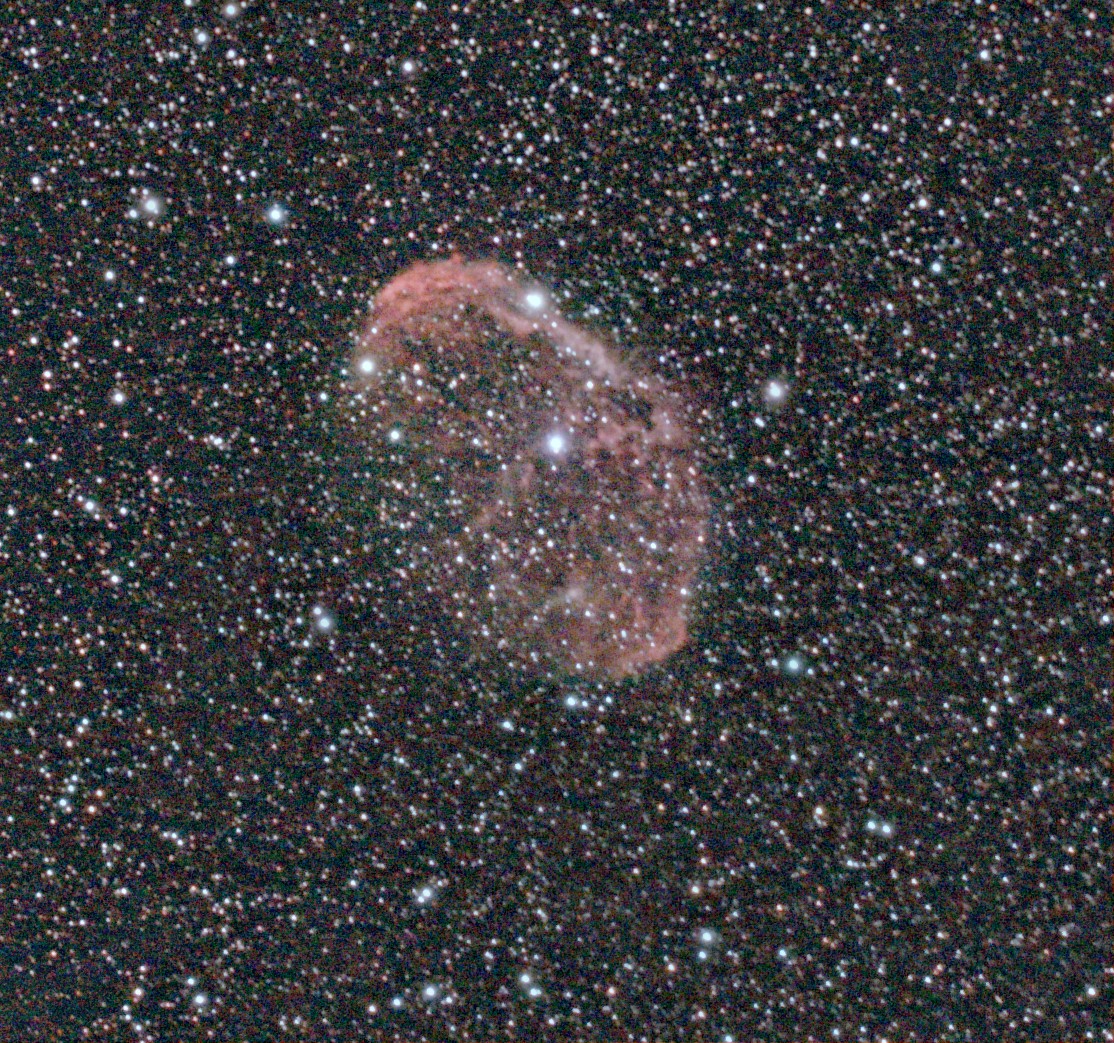
Located about 2 degrees south west of Sadr is the Crescent Nebula NGC 6888, which is not unlike the Jellyfish Nebula in appearance but is younger in its evolution.  An emission nebula, NGC 6888 is formed by a stellar wind from the Wolf-Rayet star WR 126 colliding with a slower moving wind ejected when the star previously became a red giant. The result is an illuminated shell-like feature consisting of two shock waves, one moving inward and the other outward, producing this amazing spectacle which measures some 25 light-years across.  Near the end of its existence, the star will eventually end its life in a spectacular supernova explosion – now that would be an image.

NGC 6888 Crescent Nebula WO GT81 + modded Canon 550D & FF | 20 x 180 secs @ ISO 1,600 | 9th October 2015

NGC 6888 Crescent Nebula
WO GT81 + modded Canon 550D & FF | 20 x 180 secs @ ISO 1,600 | 9th October 2015

Crescent Nebula - cropped

Crescent Nebula – cropped

Crescent Nebula - cropped + GradientXTerminator applied

Crescent Nebula – GradientXTerminator applied

Whilst IC 1318 has proved to be an excellent and productive imaging target for my equipment, it has become clear that it represents a much, much larger area of nebulosity that incorporates or is at least immediately adjacent to NGC 7000, the North America Nebula.  At a rough estimate this larger area spans a distance of some 2,000 light-years and is some 50-times bigger than the Sadr region.  Like other major areas of nebulosity (Barnard’s Loop) such a scale is way beyond the ability of my equipment and most others without resorting to a mosaic technique.

However, my interest in seeing and potentially imaging the bigger picture has been piqued and I have recently purchased a Vixen Polarie tracking mount, which can be fixed onto a camera tripod with a standard camera and lens in order to take long exposures without forming star trails. This set-up has two advantages over prime focus + telescope imaging: (i) it is highly portable and can easily be taken anywhere in a rucksack, and (ii) by using a camera lens of say <=50mm focal length it is possible to achieve a much wider FOV and thus photograph some of these very large nebulous areas in one image.

Alas the Sadr region is now moving on and it is probably too late to tackle using the Polarie mount but it will be something to look forwards to again next autumn and meanwhile Orion is just round the corner.  Watch this space for developments!

Harvest Time

Thanks to Copernicus and Kepler et al, astronomical events are highly predictable; unfortunately the same cannot be said about the weather.  Since taking up astronomy and despite favourable predictions of clear skies, I have frequently been thwarted by incoming cloud or worse.  When communicating with each other astronomer’s often use the closing of “Clear Skies”, no wonder given the continuous battle we have just to see the sky at night, let alone image it!

Such was my experience in 1982.  At the time I lived and worked in northern South Africa, close to the border with Botswana and the Kalahari Desert.   A lunar eclipse was forecast and in this part of the world there was usually a good chance of a clear sky.  Unfortunately, it was not to be this time either.  We saw glimpses of the eclipse through brief gaps in the otherwise thick cloud that was blowing across the sky.  I’ve missed other eclipses for the same reason, lunar and solar, and as a result have developed a somewhat resigned mindset towards such events, with the probability that the sky would most likely not be clear.  And so despite encouraging forecasts, my expectation for this week’s lunar eclipse was more of the same.

The lunar eclipse of 28th September was very unusual.  At mid-eclipse the Moon was just one hour past its closest approach to Earth in 2015, creating an effect now popularly termed a ‘Supermoon’.  Moreover, the rare combination of this and a full eclipse at the same time results in a distinctive red moon at totality.

I have learnt the hard way that in astronomy Rule-1 is perseverance.  I therefore carried out all the necessary research on the eclipse, undertook a dry run the previous evening and set-up all the equipment in the early evening before heading for forty winks – it was after all hopefully going to be a long night.  The weather had been clear and sunny earlier in the day but was forecast to cloud over shortly after midnight, just before umbral contact!  The sky was clear when I went out later but ominously there were clouds in the west.  Notwithstanding, the sky remained clear all night and the eclipse was nothing less than spectacular.

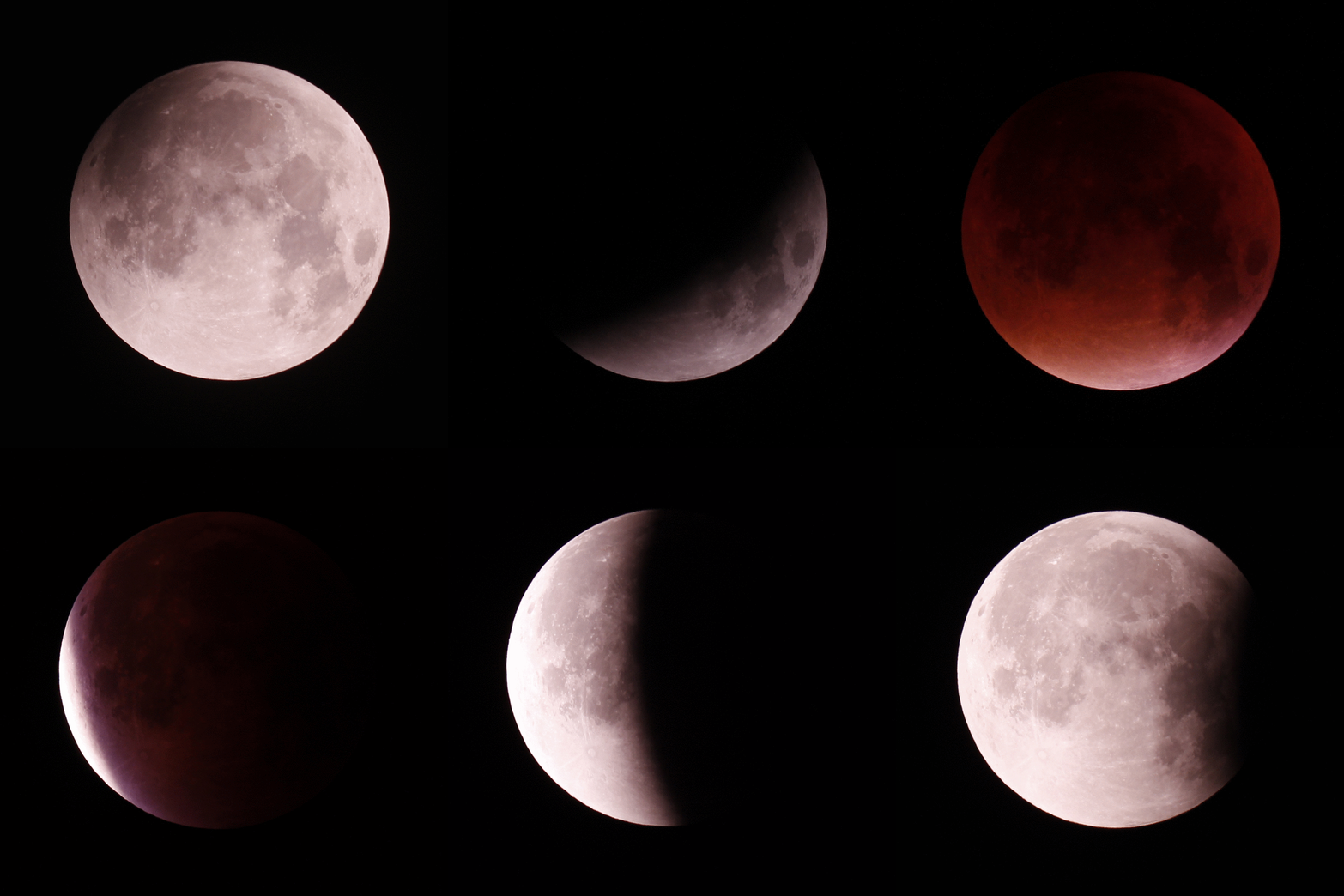
Total Lunar Eclipse 18th September 2015

Total Lunar Eclipse 18th September 2015

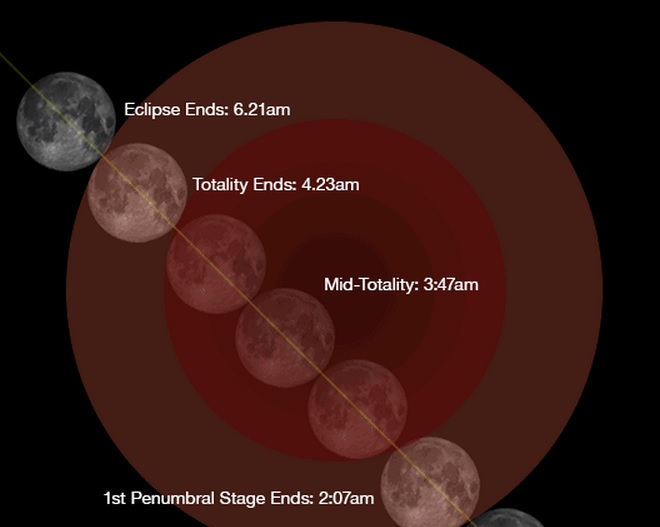
The precision with which astronomical events are plotted is incredible and, guided by various articles and charts all was in place well before the end of the penumbral stage at 2.07am.  Shortly before darkness started to show on the top, eastern edge of the Moon and then exactly at 2.07am the eclipse shadow touched and then crept inexorably across the Moon’s surface.  This was the main phase of the eclipse when the Moon enters the central, dark part of the shadow called the umbra, eventually reaching totality at 3.11am.

Totality lasted 1 hour 12 minutes, during which I just watched through a pair of 10 x 50 binoculars, which probably was the best way of actually viewing the Moon throughout the eclipse.  Of course, with the brightness of the full Moon obscured by the eclipse during this time, the rest of the night sky was plunged into blackness, thus bringing the stars, nebulae and galaxies back to life.  As the Moon was passing through the lower part of the Earth’s umbral shadow, the southerly edge appeared relatively bright during much of totality.  Totality finished promptly at 4.23am as the light started to move across the Moon’s surface once again like an unstoppable wave.  The Moon finally exited the umbra at 5.27am and the show was over until October 2033, on which occasion the Supermoon eclipse will unfortunately not be visible from the UK – I did say it was rare.   However, there will be another total lunar eclipse in July 2018, so it’s not all bad news.

Given my history, this was naturally my first time imaging a lunar or any other eclipse and I am very pleased with the results.  Other than requiring a clear sky, as usual preparation was the key: understanding the timing and dynamics of the event and considering the imaging possibilities.  The most obvious problems to overcome were the Moon’s tracking and movement of the eclipse itself, with its associated impact on changing brightness and contrast for imaging.

The previous evening had also been clear, so I tested a basic DSLR + tripod set-up using an intervalometer to trigger the shots at 5-minute intervals.  With the 200mm telephoto lens 8 pictures were successfully recorded as the Moon tracked across the image frame, at 100mm this increased to 12 pictures; however, the track tended to move out of the side of the frame early as the Moon follows an inclined rather than horizontal track.  Altogether it was a successful and useful experiment for the next evening.

On the night I used the William Optics GT81, with a Canon 550D camera and field flattener, which continuously tracked the Moon and eclipse,  imaging at 1-minute intervals throughout the period inward and outward of the umbra and manually during totality.  Using a fixed ISO 100, it was necessary to continually change the exposure time every five or so minutes in order to compensate for the aforesaid changing light conditions.  In addition, I again used the intervalometer with the Canon 700D and the 55- 250 mm telephoto lens on a camera tripod.

Eclipse: Inward sequence from umbral contact to totality WO GT81 + Canon 700D + FF | 1/500 to 1/3 sec @ ISO 100 | 18th September 2015
Eclipse: Inward sequence from umbral contact to totality
WO GT81 + Canon 550D + FF | 1/500 to 1/3 sec @ ISO 100 | 28th September 2015

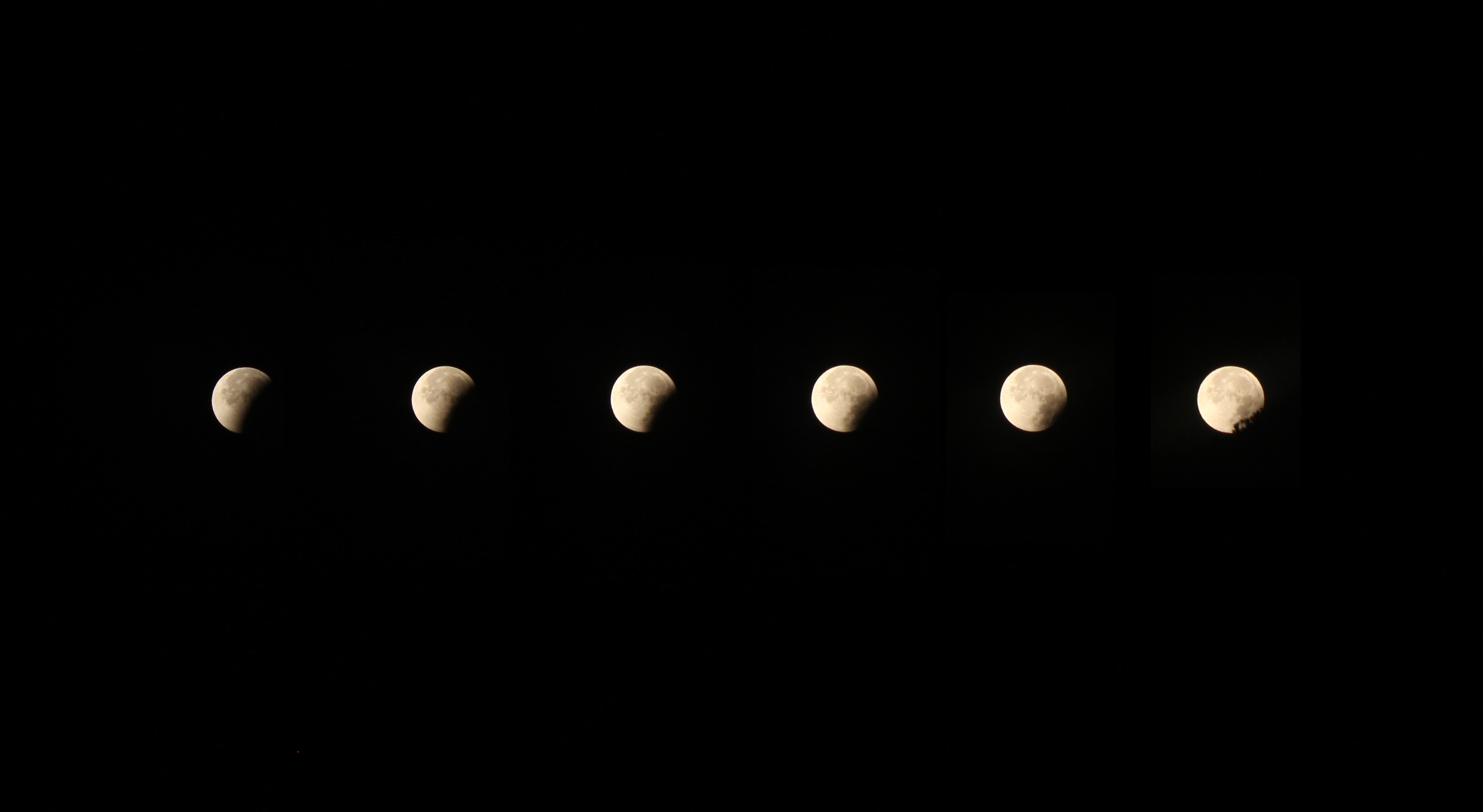
Eclipse: Exit sequence to full Moon Canon 550D + tripod | >=1/160 sec @ ISO 400

Eclipse: Exit sequence to full Moon
Canon 700D + tripod | >=1/160 sec @ ISO 400

Eclipse animation

Eclipse animation

The results from both methods turned out well.  With superior optics and tracking, the WO telescope images were naturally better in quality and magnification.  However, the alternative simple camera set-up also produced a pleasing record of the eclipse, perhaps in some way capturing the mood better?

The entire event lasted just over 3-hours, during which found it necessary to look away from the imaging process at times just to enjoy this unusual and exciting spectacle.  The name Harvest Moon is given to the full moon closest to the Autumn Equinox, recognising the time of year at which the crops have been gathered and can itself be an attractive sight.  The coincidence with an eclipse makes for a rare and dramatic occasion, which this time I was able to enjoy completely cloud free from beginning to end – well that’s a first.

Harvest Moon at Totality WO + Canon 700D + FF | 1/3rd Sec @ ISO 400 | 28th September 2015

Harvest Moon at Totality
WO + Canon 550D + FF | 1/3rd Sec @ ISO 400 | 28th September 2015

180 Degrees

Viewing from Fairvale Observatory is far from ideal but I have no choice and need to make the most of it:

(i) Without going down the garden (which is not practical and would then totally obscure the southerly view) my house blocks the entire northern sky, critically including Polaris;

(ii) We have very high +/-12ft hedges surrounding the garden;

(iii) Directly east is a large house that completely obscures the horizon;

(iv) South east and south are very large trees;

(v) To the west is a wooded hill, thus blocking the horizon in that direction, and

(vi) Some 7-miles to the south is Gatwick Airport which produces significant light pollution, as well as aircraft that regularly fly through my images as well as others from Heathrow, also not far away.

It’s a miracle I am able to undertake any astrophotography and I long for the day I live somewhere with better conditions.

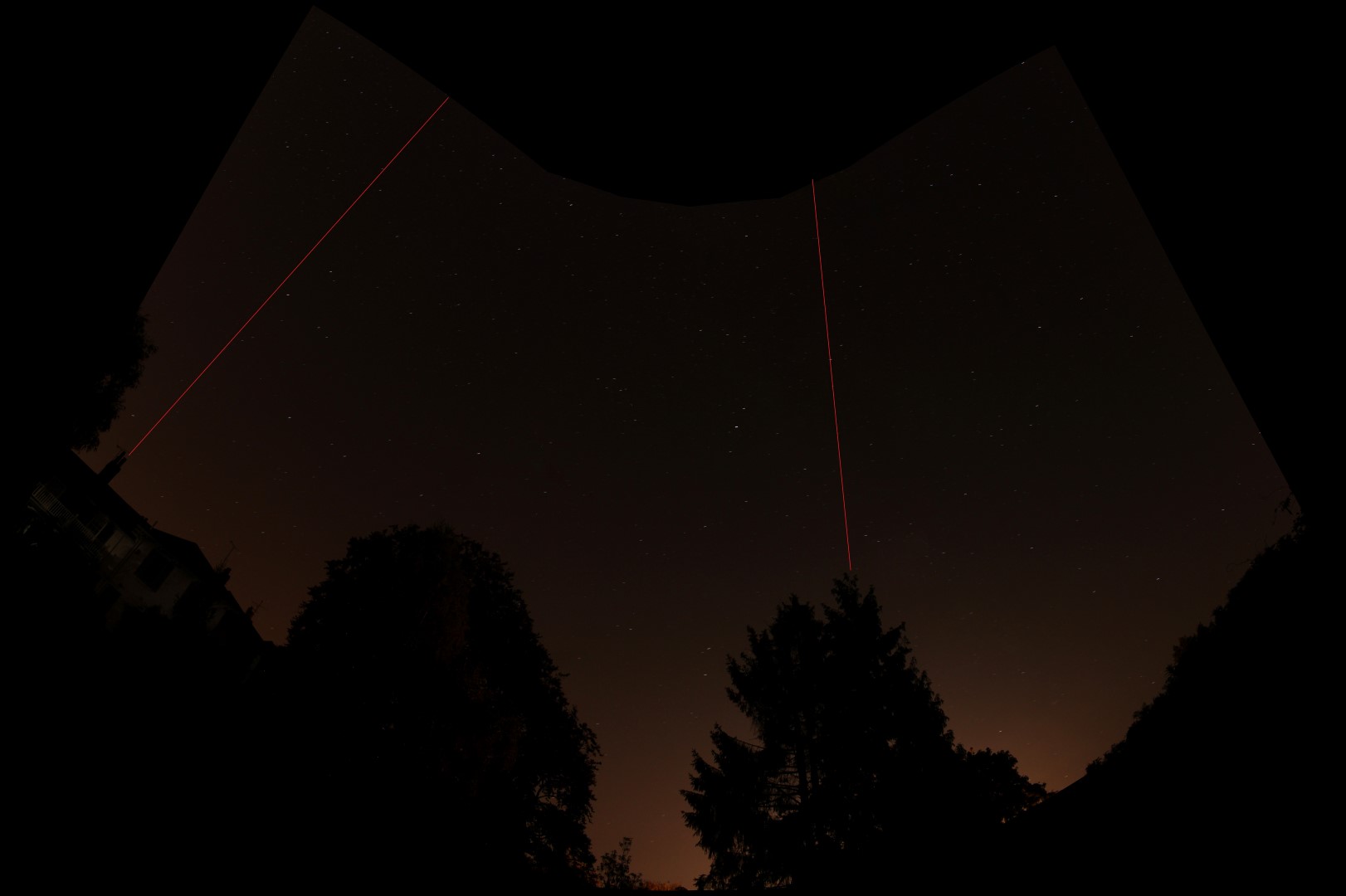
In the meantime I have to make do with the 180o I have available.  For the record and with great skies and good weather, this week I compiled a photo mosaic of the aforesaid view – which illustrates some of the aforementioned problems and is in itself an interesting picture. The scene is stitched together from six DSLR shots that encompass most of the east to west panorama but in order to achieve this, the resulting photograph becomes severely distorted.

The principal view is directly south, with the Meridian pretty much straight ahead.  Low angle viewing and imaging is almost completely impossible but depending on the timing and some crafty shooting, the mid-angle objects can be accessed as they pass between the trees. The best imaging is therefore mostly restricted to a 20o range between about 65o and 85o and within +/- 20o of the Meridian; high angle east and west views are feasible but seeing in these directions is impacted by the greater atmospheric distance through which the light has to travel.

For now this is my night time playground: it is challenging and can be frustrating but with clear skies, preparation and patience it’s good fun and much can still be achieved.

Night sky panorama from Fairvale Observatory + obstacles: the tree on the left is very large +200 year-old copper beech, the coniferous trees  due south are closer to the property boundary - thus increasing their impact   on seeing.  The red line on the left approximately marks the East and the central red line is the Meridian.

180 degree night sky panorama from Fairvale Observatory + obstacles: the tree on the left is a very large +200 year-old copper beech, the coniferous trees due south are closer to the property boundary – thus increasing their impact on seeing. The red line on the left approximately marks the East and the central red line is the Meridian.

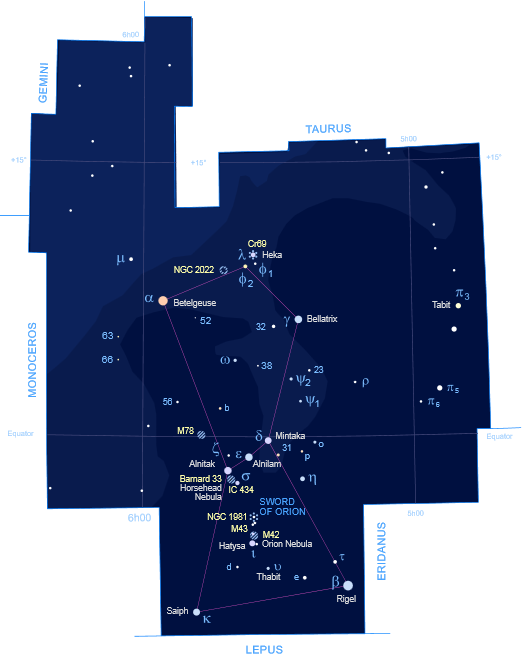
Equivalent Cartes du Ceil planetarium view at the same time.

Equivalent Cartes du Ceil planetarium view at the same time.

Orion in Perspective

Perspective:

  • The appearance of objects relative to each other, as determined by their distance from the viewer, or the effects of this distance on their appearance – The Free Dictionary.
  • Noun: The art of representing three-dimensional objects on a two-dimensional surface so as to give the right impression on their height, width, depth and position in relation to each other – Oxford English Dictionary

I have just finished an Open University MOOC (Massive Open Online Course) on Orion, which it has to be said was mixed in its content and quality.  Notwithstanding, the course provided a useful basic understanding of objects in the Universe, particularly Orion, how they related to each other and as a whole. Through my professional experience I am used to viewing and understanding objects in 3D, all the more so since computer modelling has provided a tool with which to visually illustrate such spatial shapes and relationships.  Although it is obvious that such relationships also describe the astronomical space in which we exist i.e. the Universe, and commonly describe the location of stars and other heavenly bodies by their distance, RA and DEC, I have seen very few of these objects visually modelled for common asterisms or constellations.

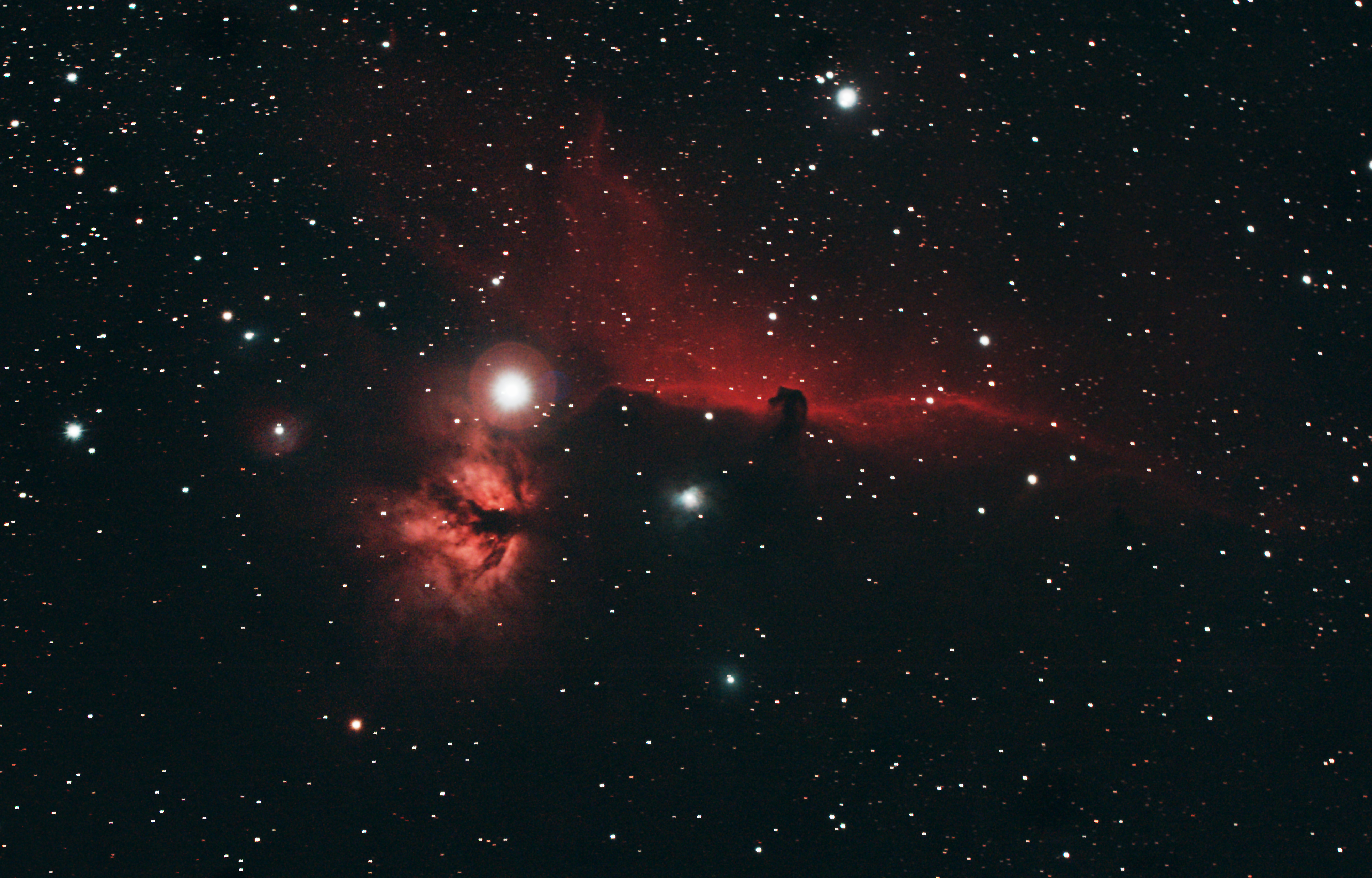
The constellation of Orion is probably the main feature of the winter night sky and it is certainly my favourite, particularly when looking at its rich content: M42 the Great Orion Nebula, the Running Man Nebula, the Horsehead and Flame Nebulae, M78, Barnard’s Loop and many more.  Sadly after more than 4-months imaging these objects for the first time, Orion is now starting to rise very early in the evening and by 11pm is well past the Meridian – it will not be long before this magnificent feature will be gone for another year, until on the very early mornings of next October it will reappear again, can’t wait!

orion

With my new found interest in astroimaging I have almost exclusively used a DSLR camera and focused my attention on DSO features, using a telescope and GoTo mount, somewhat neglecting the use of the camera for basic widefield photography.  Apart from the attraction of playing with my new toys, I was put off by the lack of a suitable camera attachment and a wide angle lens; because of the inherent crop factor associated with the cropped digital sensors employed in most DSLR cameras (except very expensive full frame cameras), the real focal length of a camera lens will be extended and hence the field-of-view narrowed – in my case with a x1.61 crop factor, a 50mm lens operates at an apparent focal length of 80mm!  However, using the top off an old camera tripod I recently I managed to jerry rig the camera onto the GoTo mount, thus providing tracking and enabling longer exposures.  It’s only a start but there is great promise in such photography, as seen on this excellent website, and I intend to pursue more of these images with a better way of attaching the camera and decent wide-angle lens when I can.

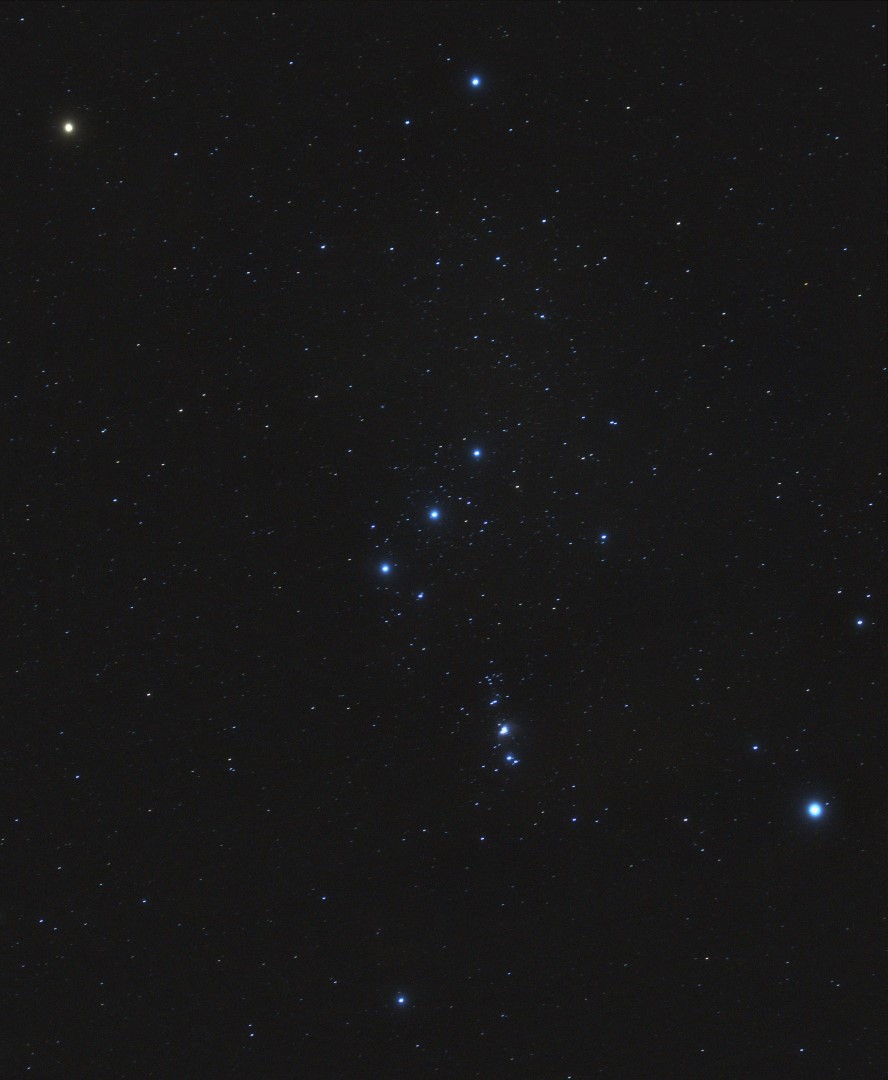
As a result, on Christmas Eve I obtained my first reasonable image of the whole Orion constellation, which with better exposure shows the detail, beauty and context of the numerous DSO items contained within and images previously noted.

The Orion Constellation Canon 700D | 27 x 10 secs @ ISO 1,600 & calibration | 24th December 2014

The Orion Constellation
Canon 700D & Telephoto 200 mm | 27 x 10 secs @ ISO 1,600 & calibration | 24th December 2014

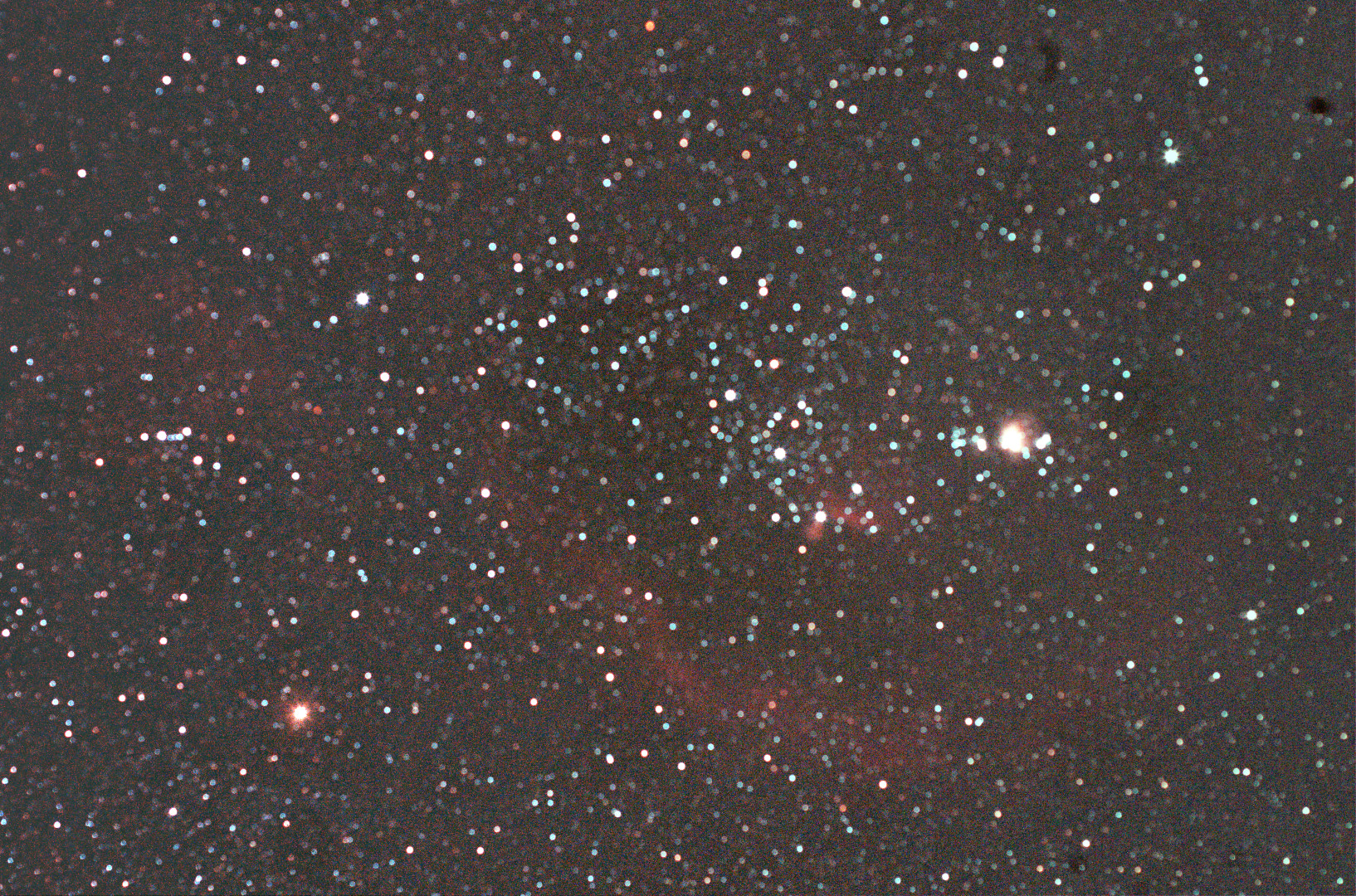
In the early days of my astroimaging about 12 months ago, I found focussing something of a challenge but, with the assistance of the wonderful Bahtinov mask and Live View on-screen computer focusing, I thought that had become a thing of the past, unfortunately not!  Guided by the infinity mark on the camera lens for focussing, I set out to image some of Orion’s more elusive nebulosity, in particular Barnard’s Loop, with which I am fascinated – its enormous size of some 10o or 600 arcminutes and complete absence from ordinary view are both intriguing, exciting and challenging.  I had tried to photograph this feature before, which completely envelops Orion’s Sword and extends up towards Betelgeuse, but to no avail.  With my bodged but useable camera set-up I tried again two weeks ago.  This time the problem was once again focussing; it turns out that with widefield astroimaging using a standard camera lens, infinity does not necessarily mean infinity, as there is some leeway either side.  The out-of-focus images that resulted could therefore not be stacked but, using a single image, calibration and extensive post-process stretching in Photoshop, Barnard’s Loop was finally revealed and even Lambda Orionis above Betelgeuse and Bellatrix, albeit very noisy and out of focus.  Notwithstanding, I am pleased with this enticing glimpse and will return another day to rectify the problems.


The Orion Constellation & Barnard's Loop (up / north is left) AZ-EQ6 Mount + Canon 550D & 200mm Telephoto | 180 secs @ ISO 1,600 & calibration | 22nd January 2015

The Orion Constellation & Barnard’s Loop (up / north is left)
AZ-EQ6 Mount + Canon 550D & Telephoto 200 mm | 180 secs @ ISO 1,600 & calibration | 22nd January 2015

Since my first decent image of the Great Orion Nebula on a very early morning at the beginning of last October, I have had hours of fun and some frustration imaging various parts of the Orion Constellation.  But despite my new familiarity with the Orion constellation, 3D modelling and, I’d like to think, good spatial awareness, I was still pleasantly surprised and impressed by this wonderful 3D video of the constellation produced by the Space Telescope Science Institute for NASA and used during the aforementioned Open University course, which really does put it all into perspective: The True Shape of Orion.

Seeing Red

It was towards the end of last year I realised what I was missing in my images. Hydrogen alpha (Ha) is a deep-red spectral line created by energised hydrogen gas, with a wavelength of 656.28nm, such light is a dominant feature of emission nebulae. However, terrestrial cameras are made with an infra-red (IR) filter placed over the sensor in order to achieve the red-green-blue colours that typify what the human eye see as life on Earth.  Unfortunately by filtering out some of the red wavelengths this has a negative impact on DSO astroimaging, as it will block the aforementioned Ha light. The result is that imaging such Ha features with a DSLR camera, as I have been doing with a Canon 700D, can significantly reduce the colour and even detail – in some cases where Ha is the principal light source the camera sensor may almost completely fail to register the object at all.

I had been aware of this problem from the outset when I purchased the Canon 700D but decided to make-do in order to see, (a) how I got on, and (b) if I even liked astrophotography.  Nearly one year on and maybe I made a mistake then but I also enjoy using the camera for terrestrial photography.  Here’s the catch: to improve the camera’s sensitivity to Ha it is necessary to remove the IR filter, to become what is then known colloquially as a modded camera, however, in doing so the camera becomes useless for terrestrial photography. Removing the IR filter allows more red light wavelengths to reach the sensor and, as a result, terrestrial pictures then acquire an overall pink-red hue! There are some ways round this but, as always with implications – but it was now clear I needed a modded camera.

There are three basic ways to ‘restore’ a modded camera for terrestrial use:

  1. Adjust the custom white balance – each time the white balance needs to be set manually, depending on the type of prevailing light and subject. It will work but, in my opinion, makes the process of day-to-day photography something of a chore and certainly reduces the scope for spontaneity, something I like when I am out-and-about photographing.
  1. Restore the colour balance during post-processing – basically this requires adjusting each photograph individually using processing software, such as Photoshop, to remove excess red that is reaching the sensor without the IR filter.
  1. Use an OWB (Original White Balance) filter – like the CLS light pollution filter I already use, this filter fits snuggly in front of the mirror / behind the camera lens (if fitted) and essentially acts like the original IR filter that has now been removed for astrophotography. Although quite expensive, this is by far the most convenient solution but there’s a problem: the back-focus section of the standard Canon EF-S lens I use is too long to accommodate the filter. An EF or other manufacture’s lens would overcome this problem (at further expense) and I was about to go down this route when serendipity paid a visit.

Not to be taken literally, but sometimes I would rather be lucky than smart.  Whilst researching the aforementioned issues and seeking out other possible solutions, such as purchasing an already modded camera, I registered on the excellent Astronomy Shed forum and posted a question on how to deal with my problem. By the next morning, together with other advice on how to proceed, my attention was drawn to a Canon 550D for sale that had just been posted on the forum that very moment.  Furthermore, the price was good and the seller would modify the camera for a small charge; it requires a degree of expertise to carry this out but, as a professional photographer with an interest in astronomy, the seller had undertaken this successfully many times before, though I obtained references to be sure.  Therefore, after a few online exchanges, I became the new owner of a modified Canon 550d camera, together with some other bits and pieces – leads, intervalometer and a Canon battery grip.

Apart from the fact that this was a good camera, at a good price, it had one other very useful attraction – it is a close relation of my other camera, the Canon 700D (about three years older in development terms) and thus I immediately knew my way around and, furthermore, all my existing accessories would fit.  Like I said, I had just got lucky – in more than one way.  It’s early days but, with a clear sky last Friday and plenty to image at the moment, I just had to try it out and was not disappointed.

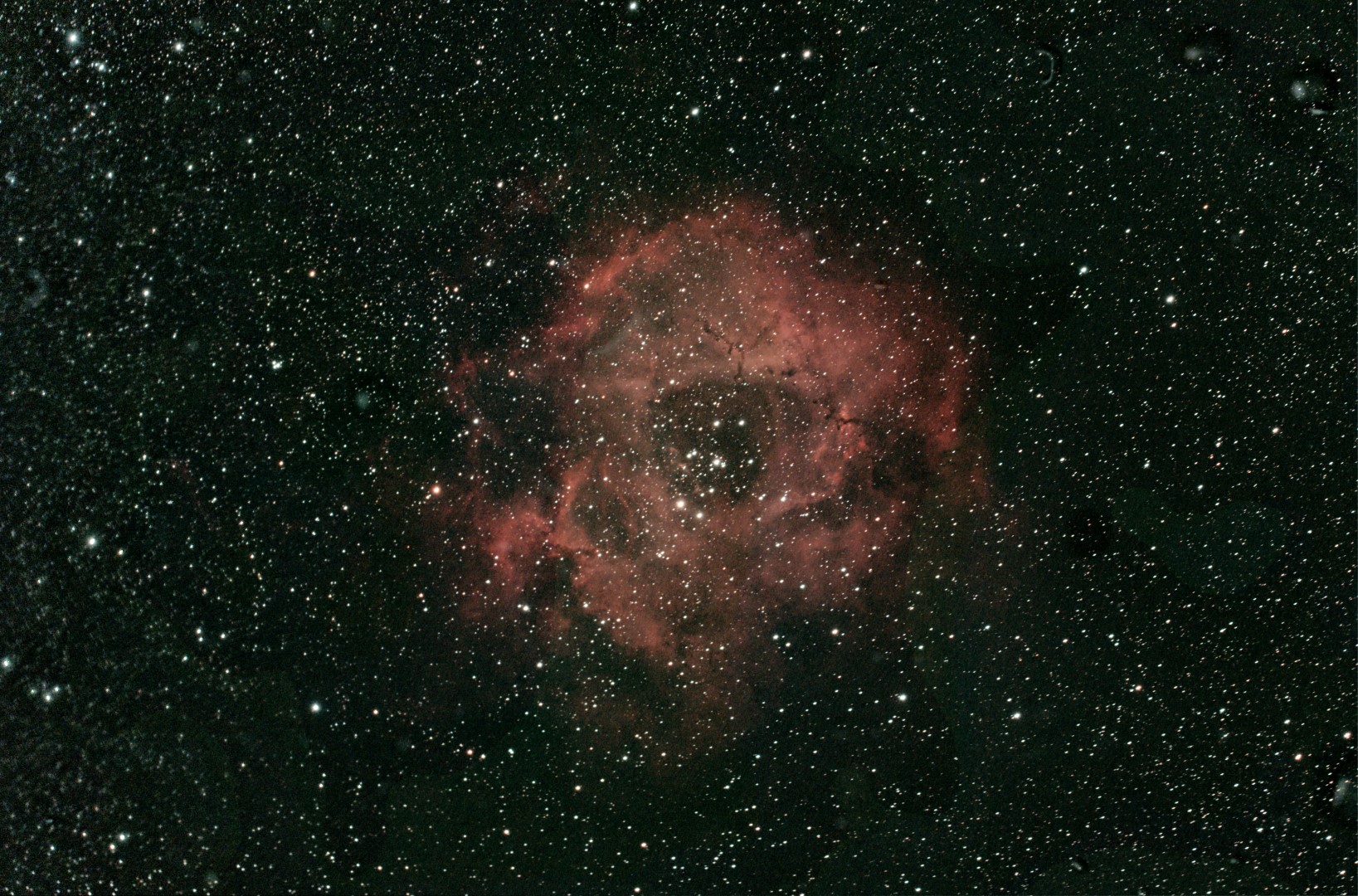
Rosette Nebula WO GT81 + Canon 550d (modded) + FF | 15 x 120secs @ ISO1,600 + darks/bias/flats | 16th January 2015

Rosette Nebula
WO GT81 + Canon 550d (modded) + FF | 15 x 120secs @ ISO1,600 + darks/bias/flats | 16th January 2015

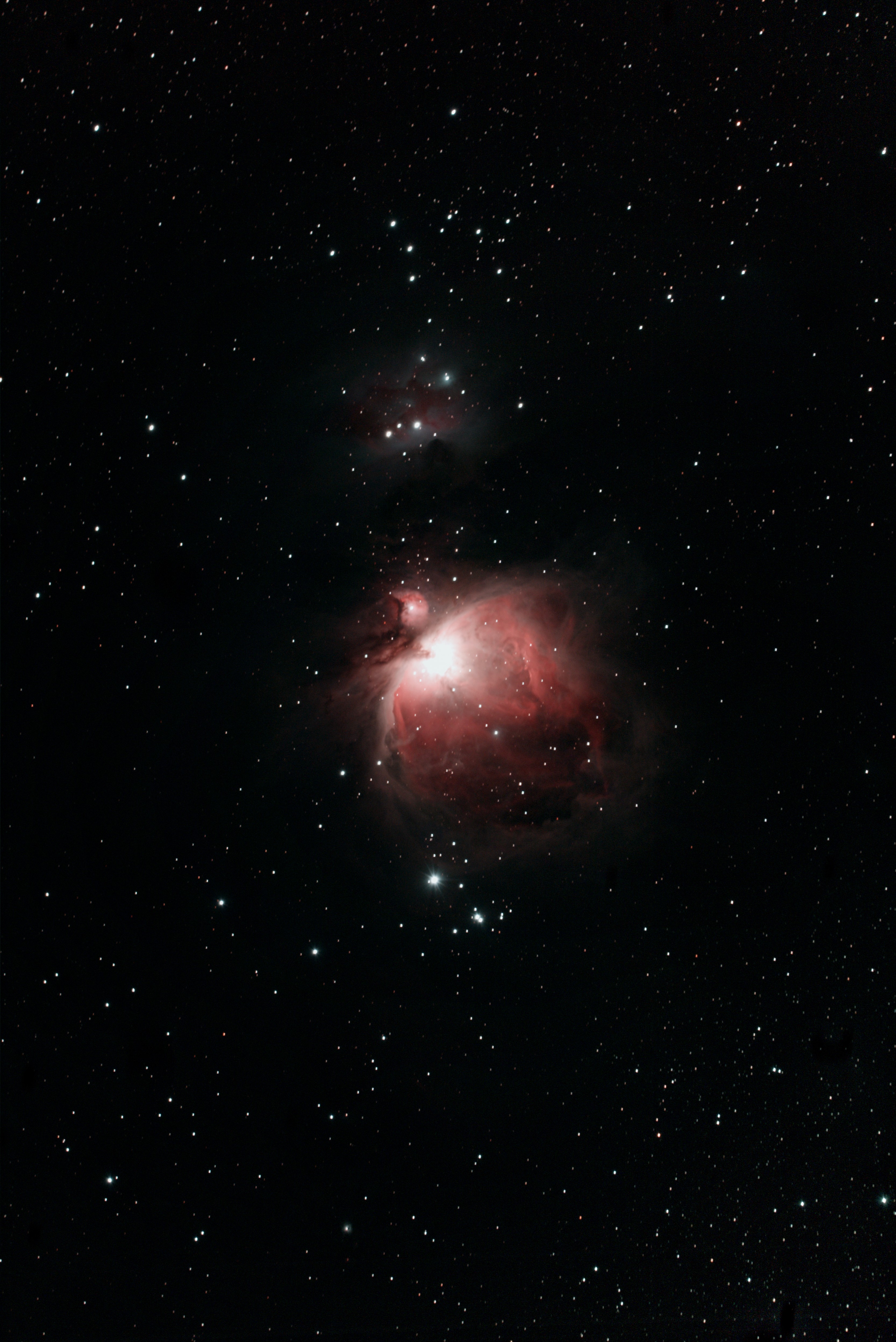
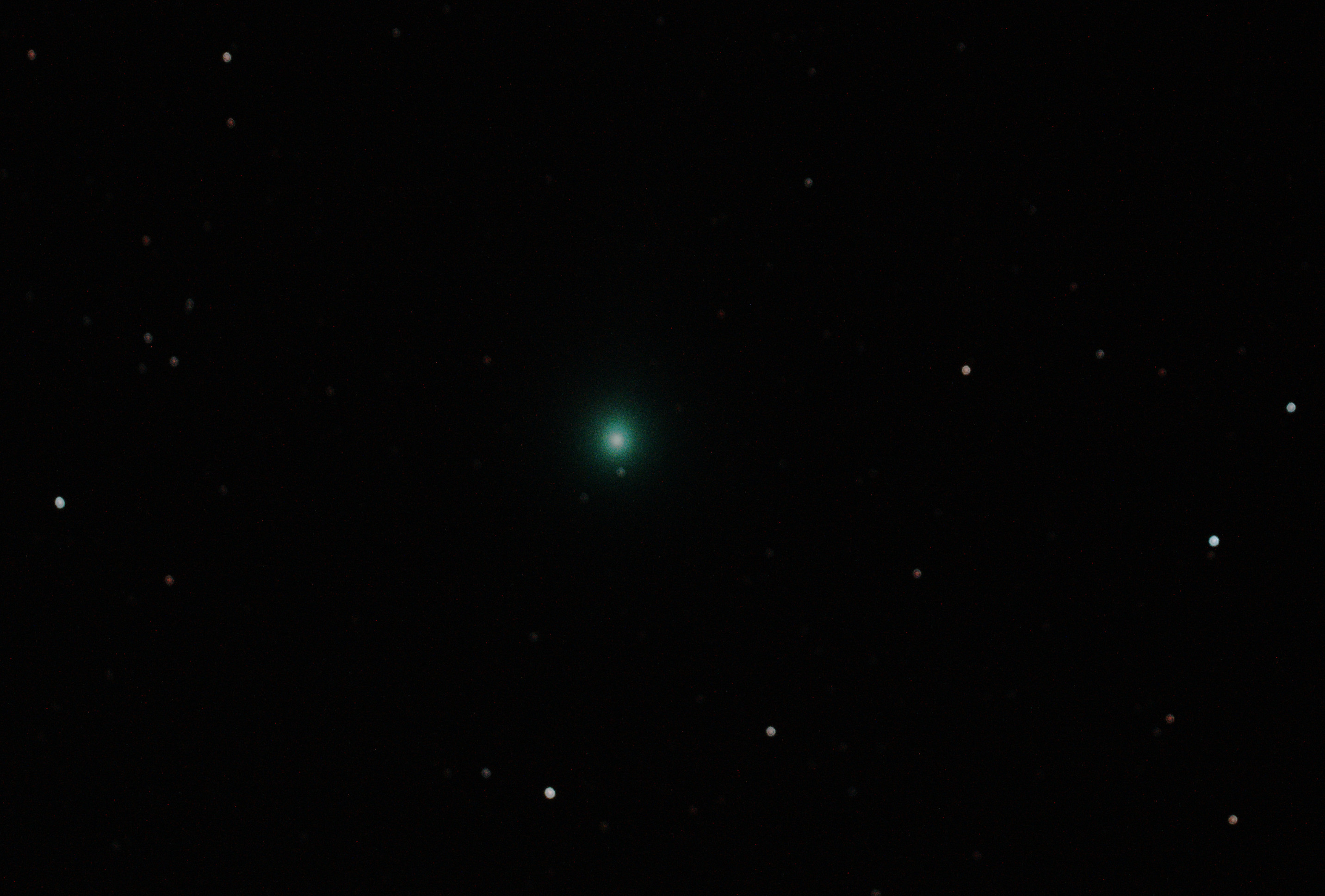
The evening’s targets were Comet Lovejoy, The Rosette Nebula and the Great Orion Nebula, of which the latter two showed off the camera’s new capabilities best. The difference was there to see immediately with the images straight out the camera and stacked, with a noticeable increase of red colour present.  The benefit after post processing is perhaps more subtle but, I suspect, will become more apparent when I move on to objects where Ha is more abundant, such as NGC 2264 AKA The Christmas Tree Cluster & Cone Nebula, which when imaged just before Christmas showed just what I was missing – a shortage of red light and thereby significant detail of these beguiling astronomical objects.  Hopefully this issue will now become a thing of the past and in the future I will be literally seeing red, for all the right reasons.

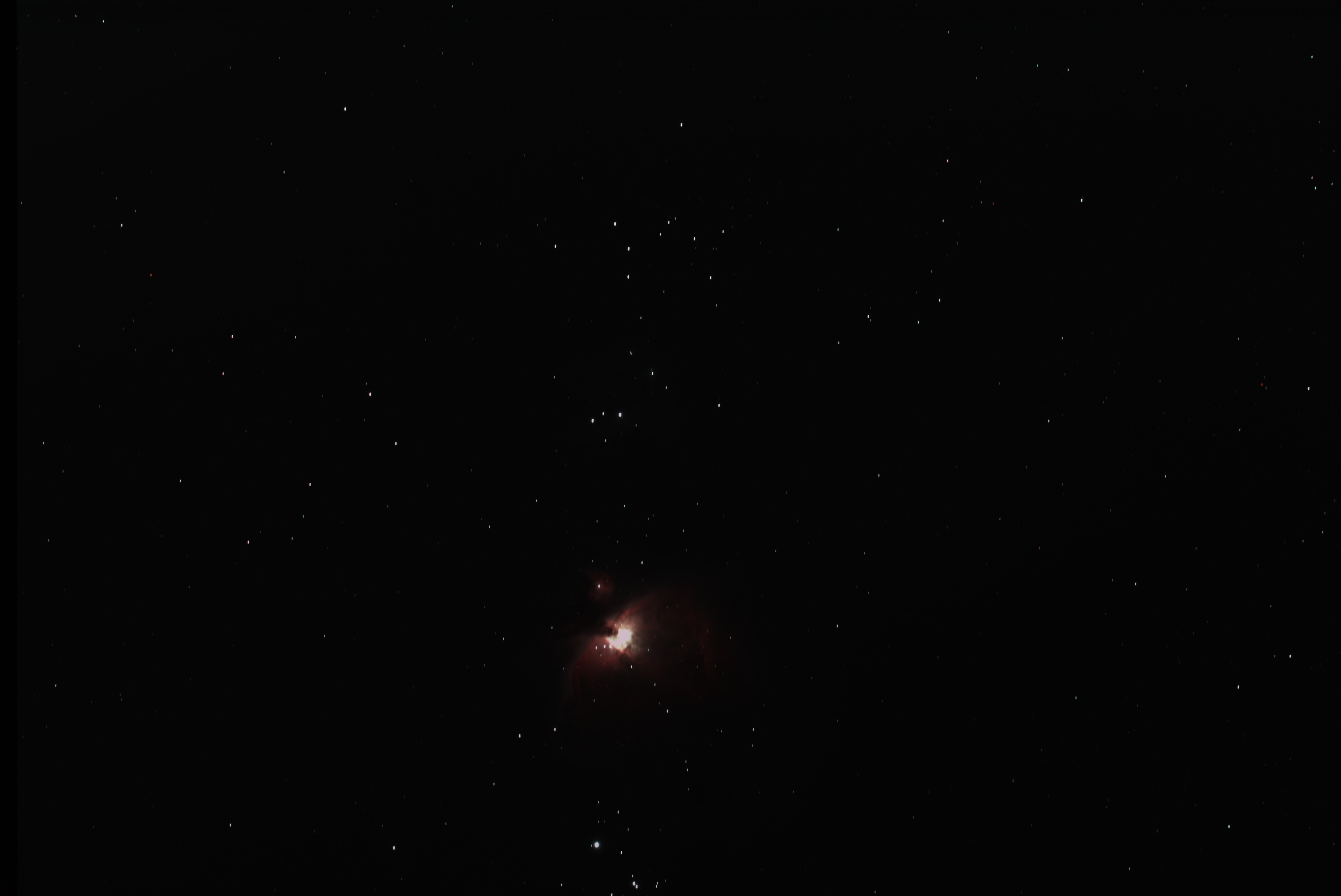
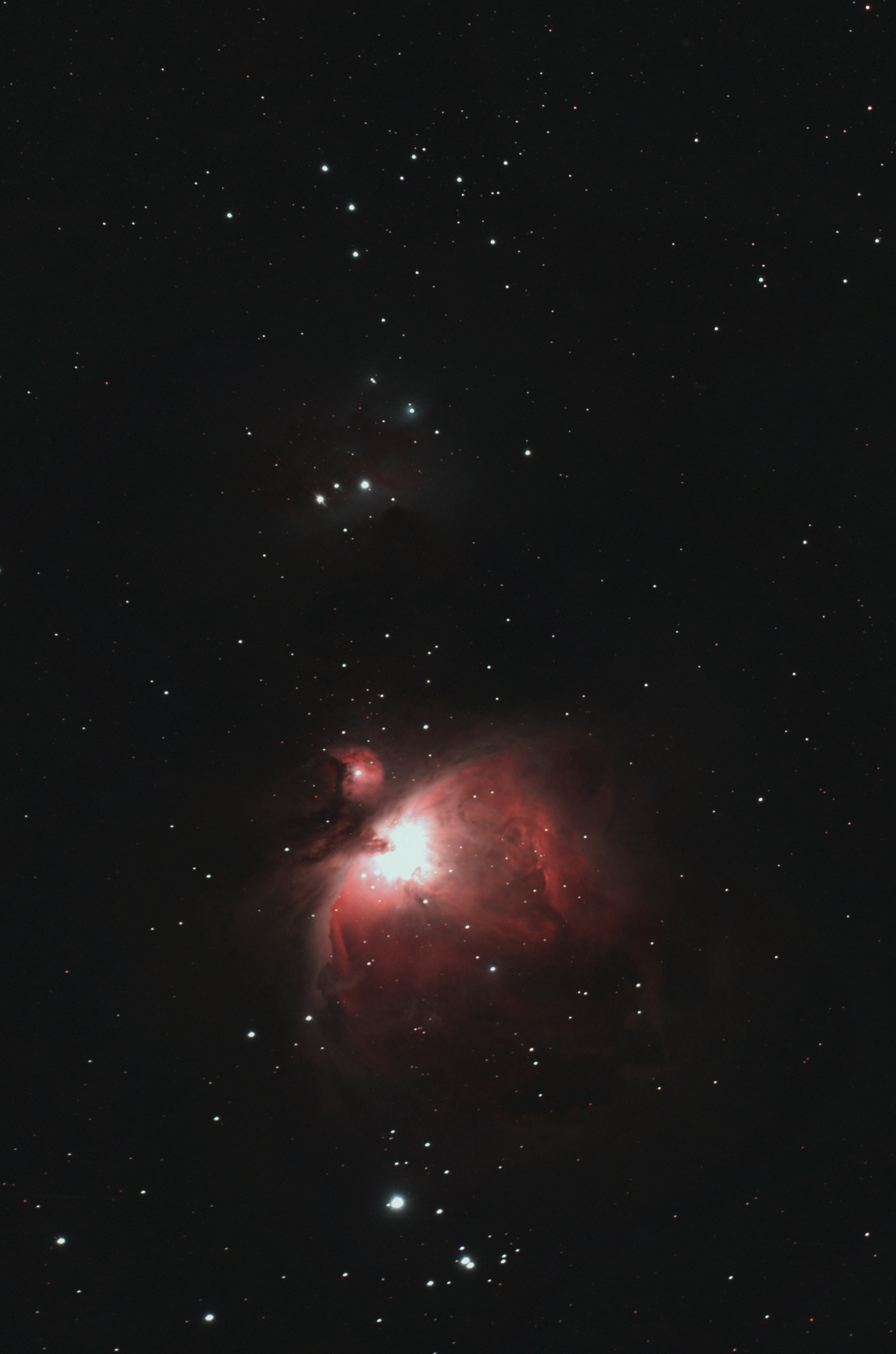
M42 & NGC 1977 After DSS stacking only WO GT81 + Canon 700D (unmodded) + FF | 15 x 120secs @ ISO800 darks/bias/flats

M42 & NGC 1977 After DSS stacking only
WO GT81 + Canon 700D (unmodded) + FF | 15 x 120secs @ ISO800 darks/bias/flats

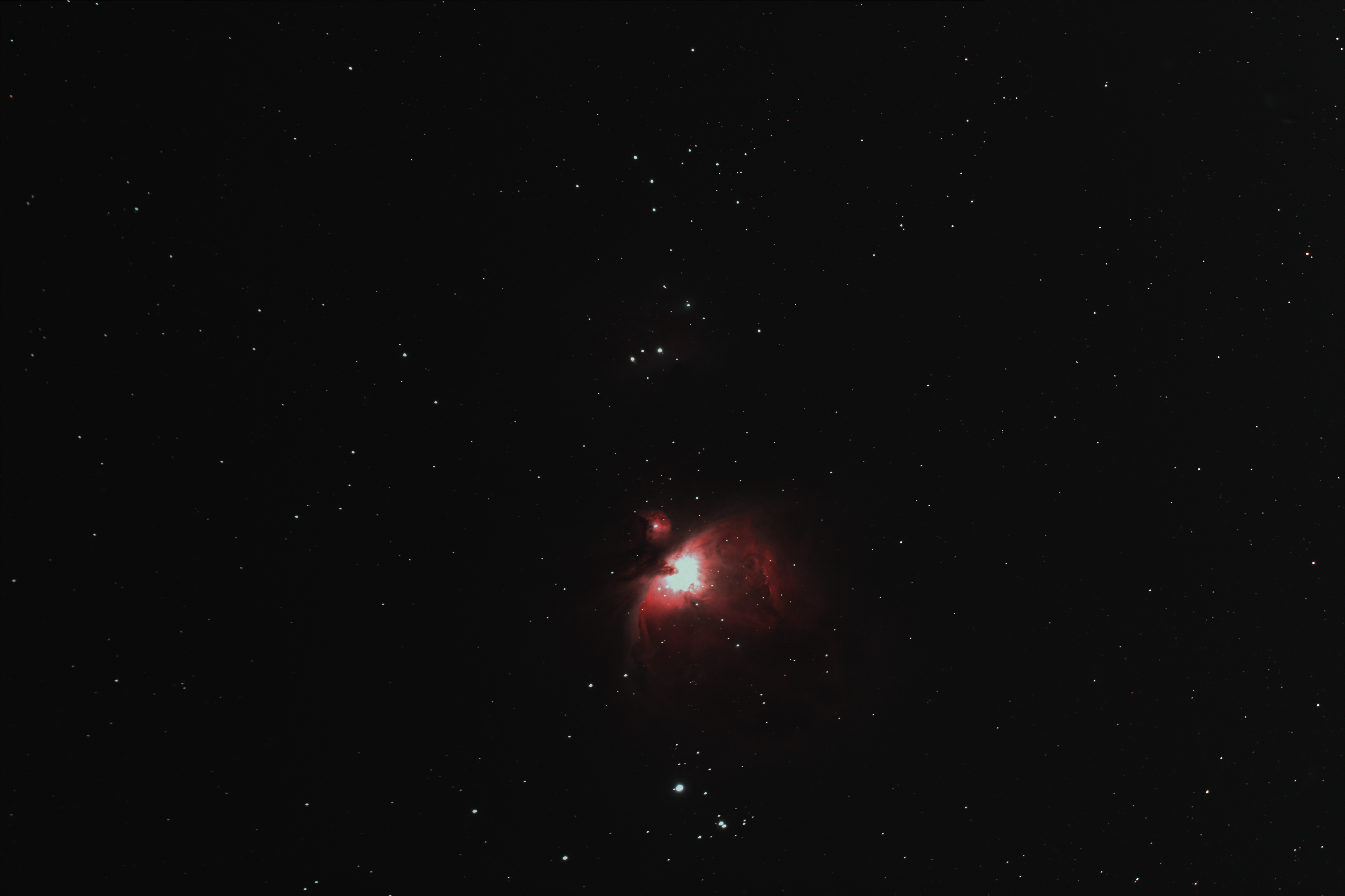
M42 + NGC 1977 After DSS stacking WO GT81 + Canon 550D (modded) + FF | 5 x 120secs @ISO1,600  + darks

M42 + NGC 1977 After DSS stacking
WO GT81 + Canon 550D (modded) + FF | 5 x 120secs @ISO1,600 + darks

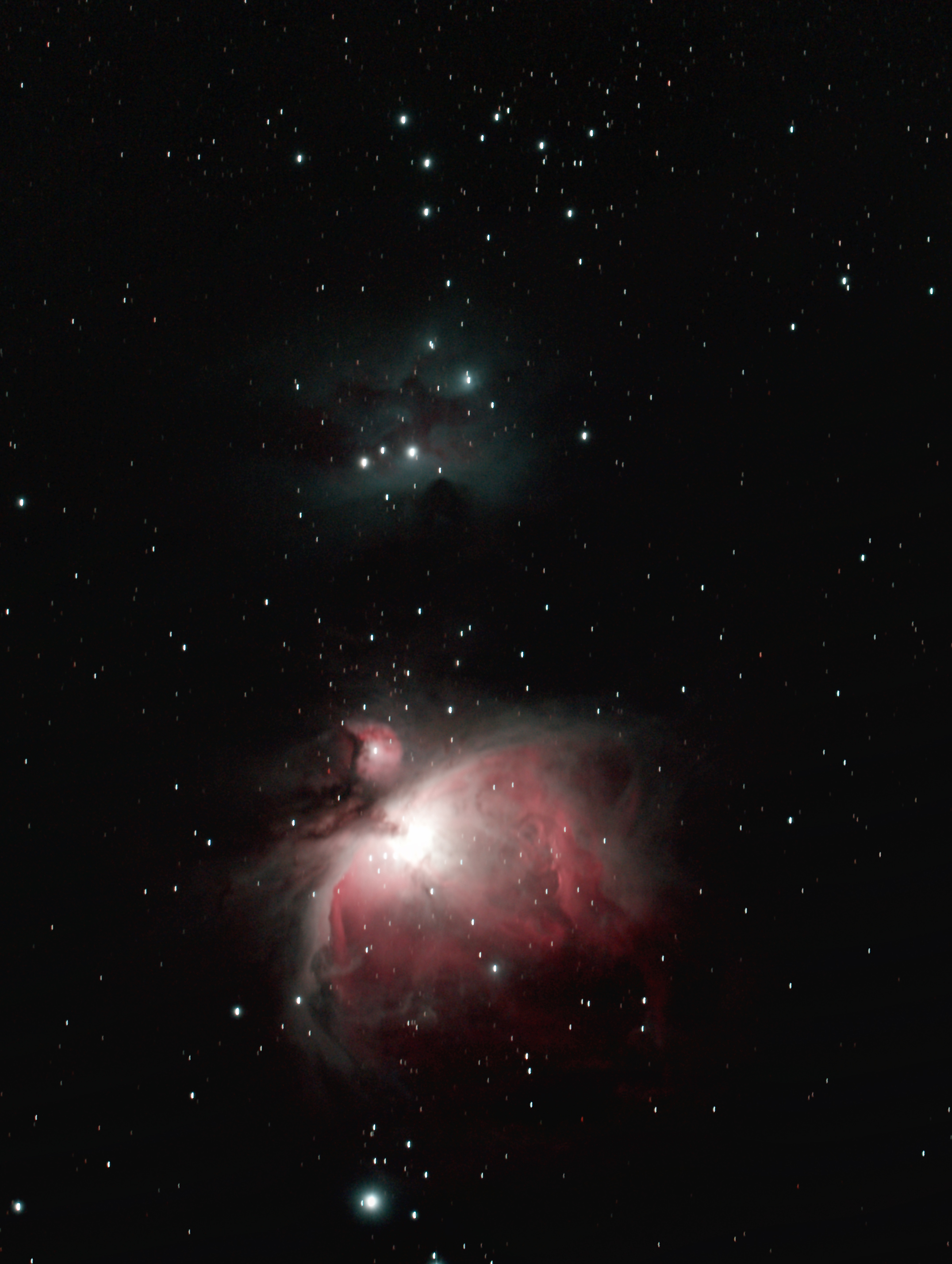
The above stacked, pre-post processing images are the same objects shot with unmodded (Canon 700D) and modded (Canon 550D) cameras, showing a marked increased in red light using the modded camera following the removal of the IR filter. Below, the same images after post-processing.    

Final, post-processing image from unmodded camera

Final, post-processing image from unmodded camera

Final, post processing image using modified camera

Final, post-processing image using modified camera