Star On The Run: IC405

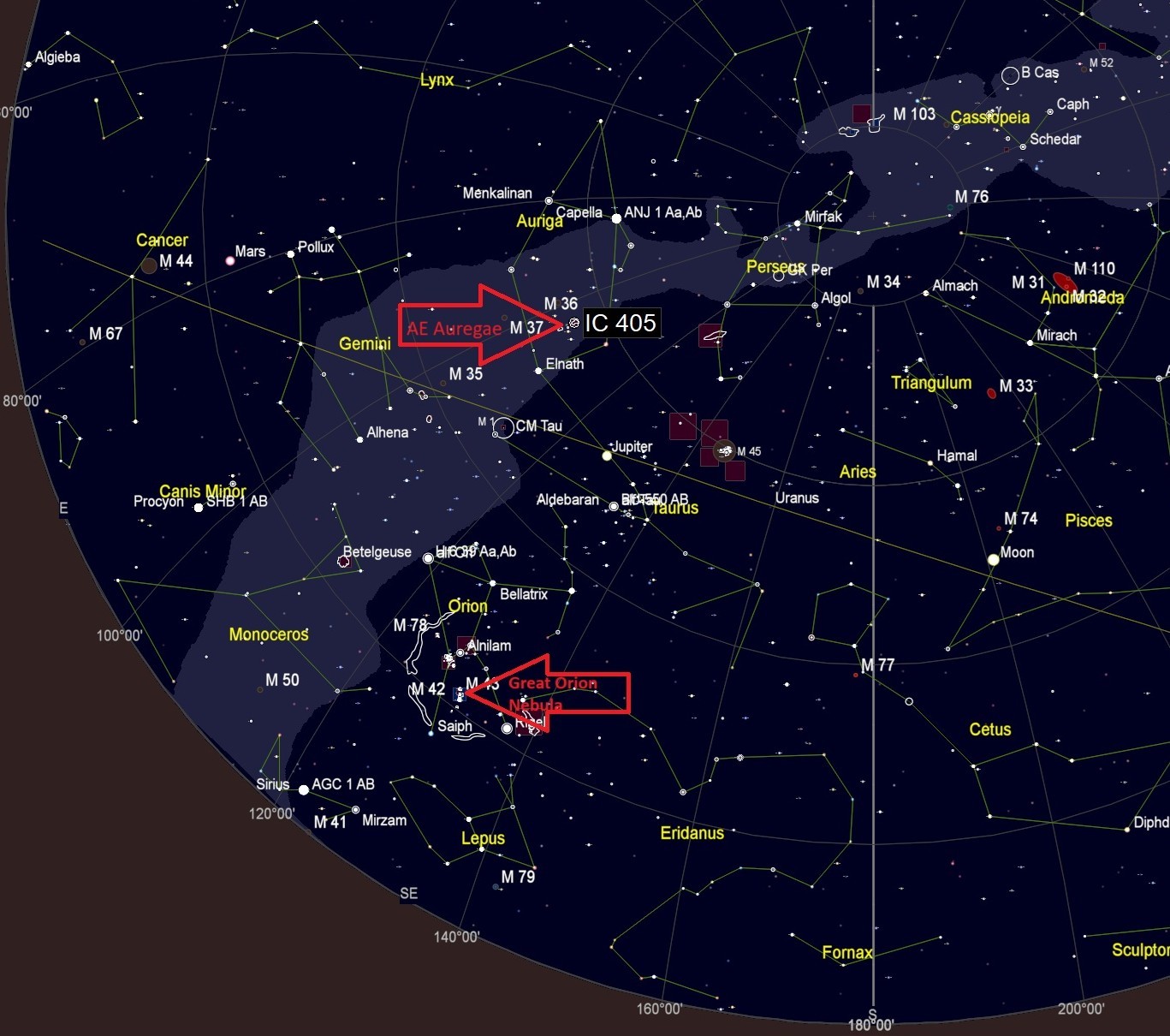
At this time of the year various objects within the Orion Constellation are perhaps the most popular astrophotography targets.  Notwithstanding, a few days after imaging The Great Orion Nebula myself early in the New Year, I slewed my camera some 65o further north to the Auriga constellation, location of many other fascinating objects, some of which two years ago I captured in a two panel widefield mosaic.  This time it was time to concentrate on just one of those objects, the exciting IC405 AKA the Flaming Star Nebula.      
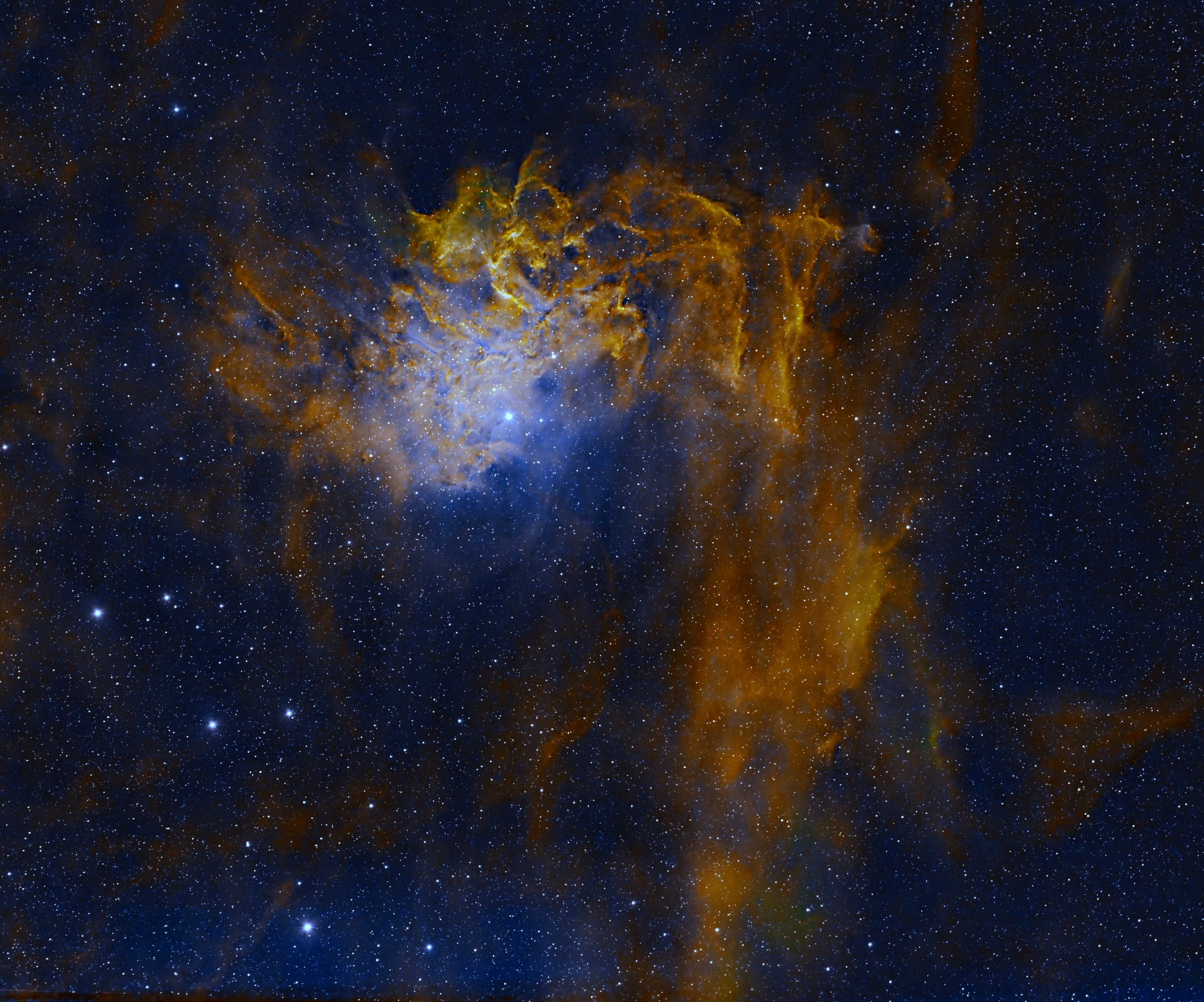
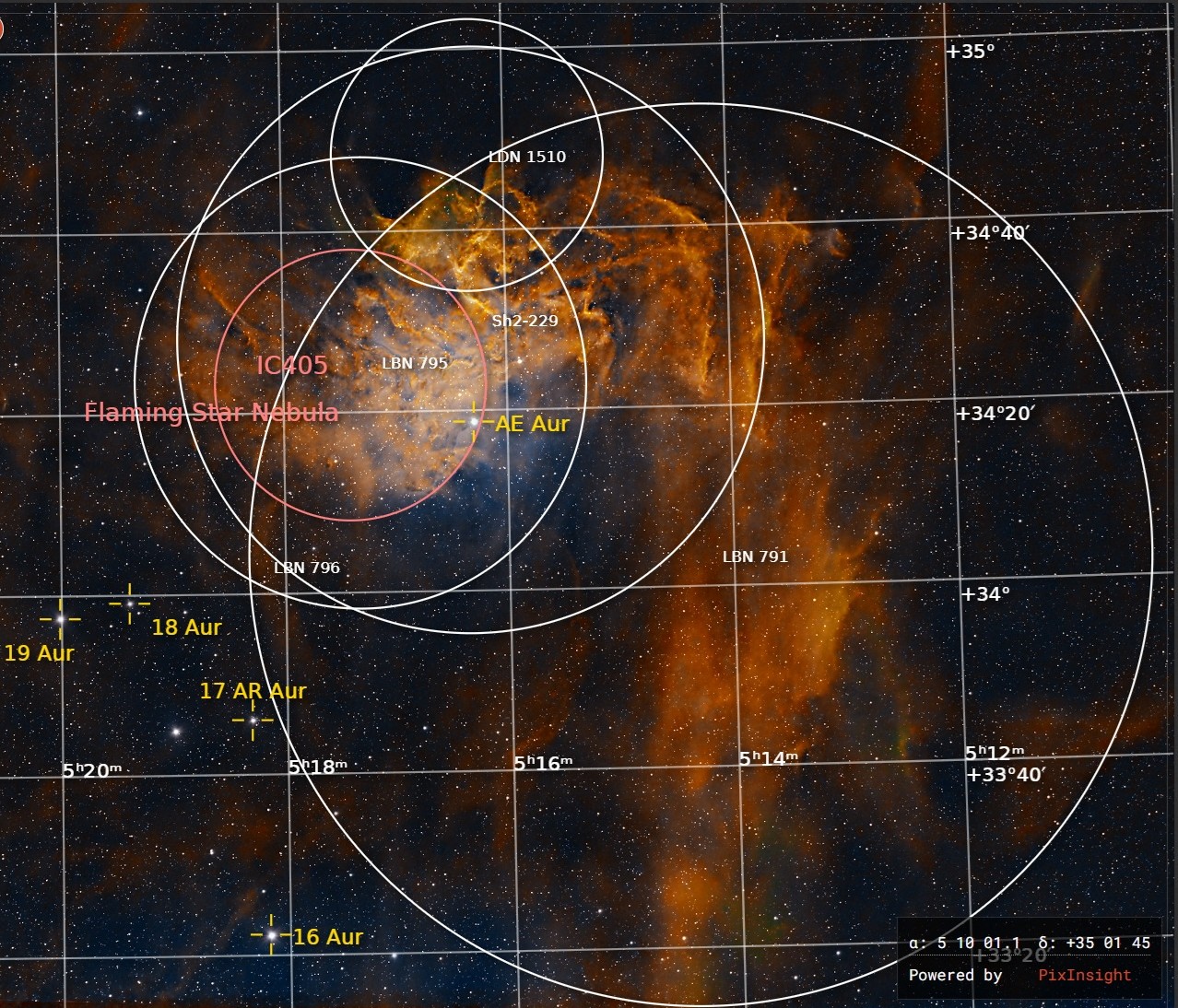
This emission and reflection nebula is a glowing cloud of gas and dust that is illuminated by a  powerfully bright blue variable star, AE Aurigae.  The object’s epithet arises from the brightly lit ripples of gas and dust at the top of the image, illuminated by the aforesaid AE Aurigae and glowing hydrogen emission.  By reducing the dominant reddish hydrogen glow in the image, the full impact bright blue light from AE Aurega can be better appreciated (see image below).   
Though some considerable distance from Orion, studies now indicate that the star AE Auriga was probably itself ejected after a collision two million years ago from the Triangulum region of The Great Orion Nebula and, as a runaway star has now made its way to Auriga – what a small world!
2024 The Year In Pictures

Long periods of bad weather made 2024 one of the most difficult years for my astrophotography but, I am pleased to say that this, the 11th calendar is another belter!  Purchased in 2014, I continue to use a William Optics GT81 telescope for most images taken from home, but this means that I’m running out of suitable targets for this equipment.  Part of the answer has been to upgrade related equipment and improve my processing, which I hope you will see reflected in this year’s images.  Moreover, I have used new skills and techniques to process the better-quality data in new ways – I hope you like the results?

Below is a brief summary of the calendar images used this year but for other pictures and more detailed information, please refer elsewhere to this website, my Flickr page or Astrobin page. In addtion, a video of the calendar can be viewed HERE on YouTube, which is best accessed on a PC or smart TV screen. The background music this year is from Jean-Michel Jarre’s Oxygène album.

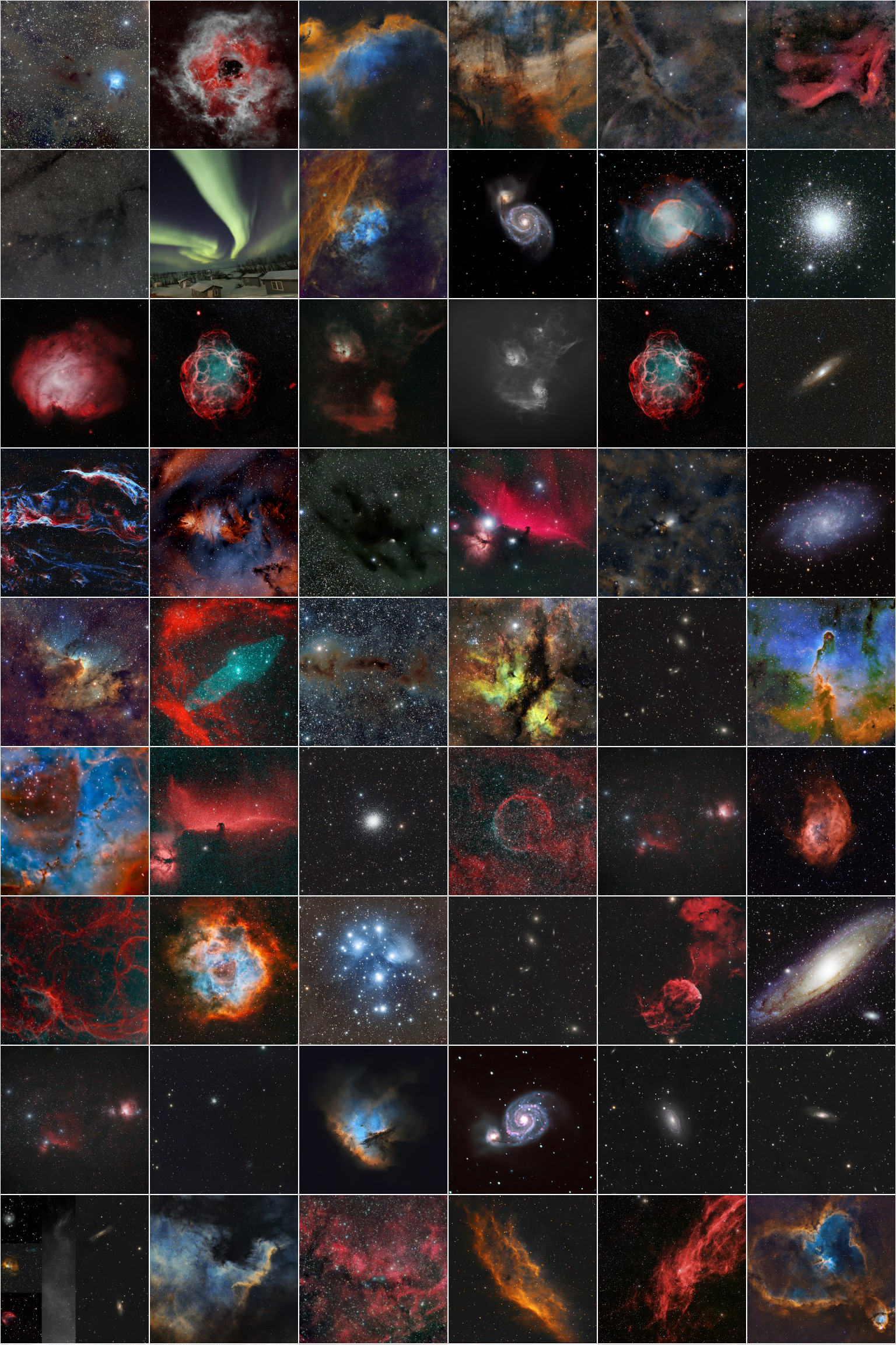
 COVERASTRO IMAGING MONTAGE: This colourful splash is a random selection of images, mostly taken from Redhill over the past +10-years of my astrophotography.
JANUARYSEAGULL NEBULA, IC 2177:  Located 3,650 light-years from Earth is the emission and reflection nebula complex of the so-called Seagull Nebula, some 200 light-years in size.  It’s been 8-years since imaging this object and for good reason.  From my location, the bird flies very low on the southern horizon and thus spends much of its time behind houses, trees, and tall hedges!
FEBRUARYTAURUS MOLECULAR CLOUD:  Located northeast of the Pleiades, below (south) the California Nebula (see November), spanning more than 30o of the night sky is the Taurus Molecular Cloud (TMC), a rich area of dark nebulae punctuated by bright areas of new star formation.  The TMC is thought to be the nearest star forming region to Earth which, if you look carefully, includes numerous complex dark and reflection nebulae and the odd galaxy.
MARCHHIND’S VARIABLE NEBULA & HYADES, NGC 1555*:  Discovered by the English astronomer John Russell Hind in 1852 this nebula is situated 400 light-years away in the constellation of Taurus, between the stars of Aldebaran and the Pleiades.  The nebula is a Herbig-Haro object – a bright patch of nebulosity in which new stars are forming – which often change in apparent size and brightness.
 
APRILLEO GALAXY CLUSTER:  With few exceptions, galaxies are located very far from Earth, making them very small from our perspective and a challenge for my equipment.  However, here I imaged the spectacular Leo Galaxy Cluster, a mere 330 million light-years from Earth. Containing at least 70 major galaxies, the Leo Cluster unusually consists mostly of spiral galaxies.  The bright elliptical galaxy near the centre of the image, has one of the largest known black holes in the universe, which is about 10 billion times more massive than our sun!
MAY IRIS NEBULA, NGC 7023*:  While the focus of the image is the alluring bright blue reflection nebula, careful processing reveals that this celestial flower is enveloped within a vast region of interstellar dust.
 
JUNESOMBRERO GALAXY, MESSIER 104:  Seen from Redhill, the Sombrero galaxy is even lower in the summer sky than the aforesaid Seagull, transiting between the trees and along the top of our +15-foot hedge!  An unbarred galaxy, its bright bulbous centre is encircled by dark dust lanes, which viewed side-on from Earth creates the appearance of a sombrero hat or perhaps a flying saucer?
JULYPuWe-1*:  Is a very faint planetary nebula in the Lynx constellation, discovered in 1980 by Purgathofer & Weinberger.  It is one of the largest planetary nebulae visible, with a diameter like the full moon and at 1,200 light-years, is one of the closest to Earth.  A planetary nebula is a region of cosmic gas and dust formed from the cast-off outer layers of a dying star; despite the name, planetary nebulae have nothing to do with planets.
AUGUSTNORTH AMERICA & PELICAN NEBULAE: It’s at this time of the year (August) I usually turn my attention to the Cygnus constellation and the plethora of imaging opportunities it provides, which inevitably tend to be narrowband targets. Interstellar dust illuminated by large bright areas of star formation are responsible for the formation of both these popular objects.
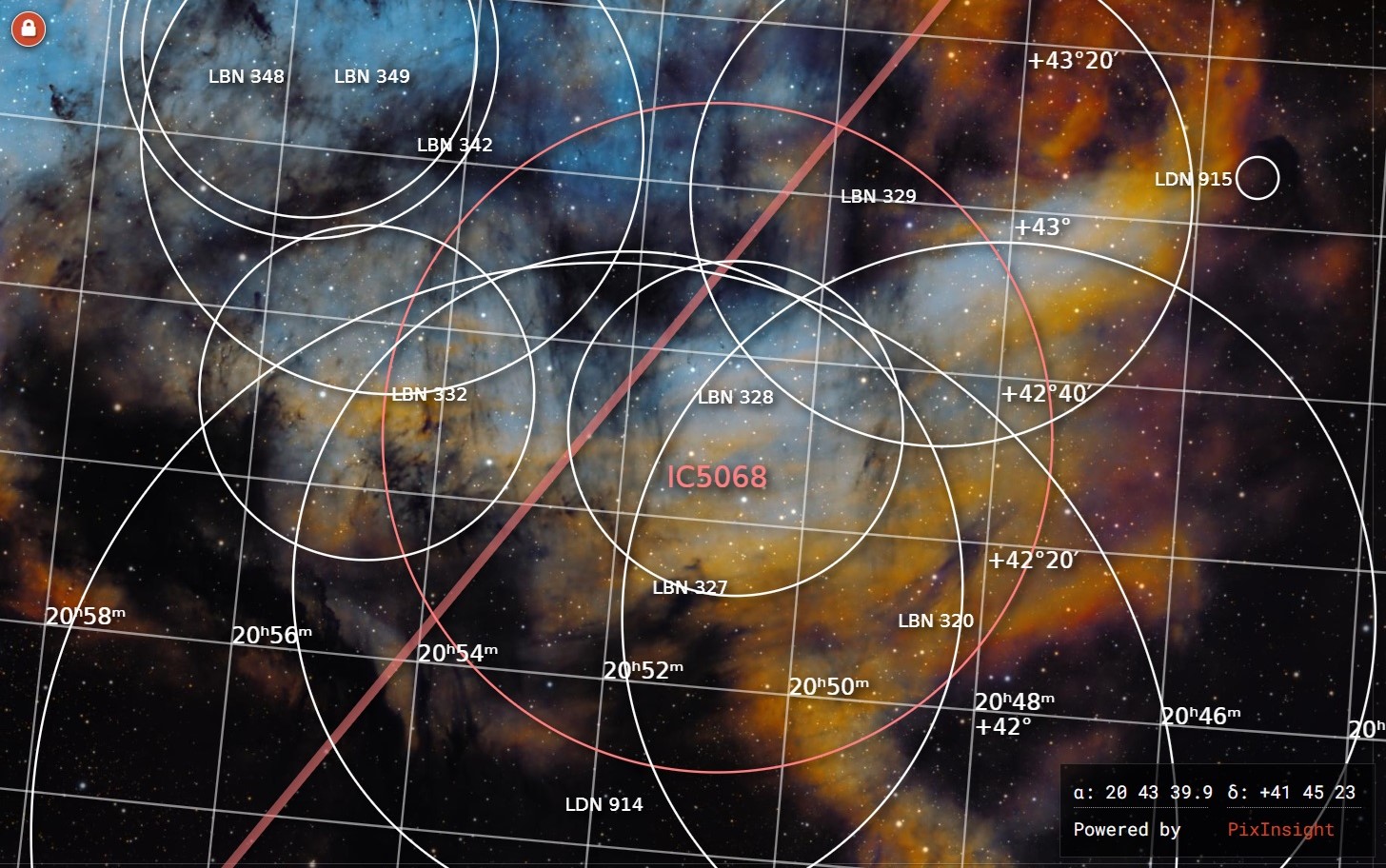
SEPTEMBERFORSAKEN NEBULA, IC 5068:  This complex area is known for the graphically shaped streaks of cold, dark dust clouds that criss-cross the dense, brightly coloured gas regions of nebulosity.  Situated within the adjacent Cygnus molecular cloud just below the Pelican Nebula and close to other more famous objects, this low emission nebula is unfortunately known as the Forsaken Nebula!
OCTOBERTHE CHINESE CHARACTER, LDN 673*:  It might seem paradoxical but often it is the absence of light that makes an image interesting.  About 600 million light-years from Earth, within the Aquila constellation, is Lynd’s Dark Nebula (LDN) 673.  Some 7-light years in size, this fragmented dark molecular cloud complex contrasts against the colourful molecular clouds and stars of the Milky Way, which is reminiscent of a Chinese character.
  
NOVEMBERCALIFORNIA NEBULA, NGC 1499:  Located in the Perseus constellation, in the Orion arm of the Milky Way 1,000 light-years from Earth, NGC 1499 is a large emission nebula about 100 light-years long.  First imaged in 2016, new improved data and processing now discloses the full grandeur of this object.
 
DECEMBERROSETTE NEBULA, NGC 2244: Approximately 5,000 light-years away, the vast cloud of gas and dust had been sculpted into the distinctive rose-like shape, while meanwhile a central star cluster has blown-away a large hollow within the molecular cloud.  Revisiting this old favourite for the fourth time since 2015, here I have experimented with an unusual colour palette combination that has produced an exciting alternative image of the night sky’s rose.
                 Footnote: All images taken from Redhill, Surrey or at a dark sky site in
          New Mexico, USA shown by an asterisk*
HAPPY NEW YEAR + CLEAR SKIES FOR 2025

Heavenly Art

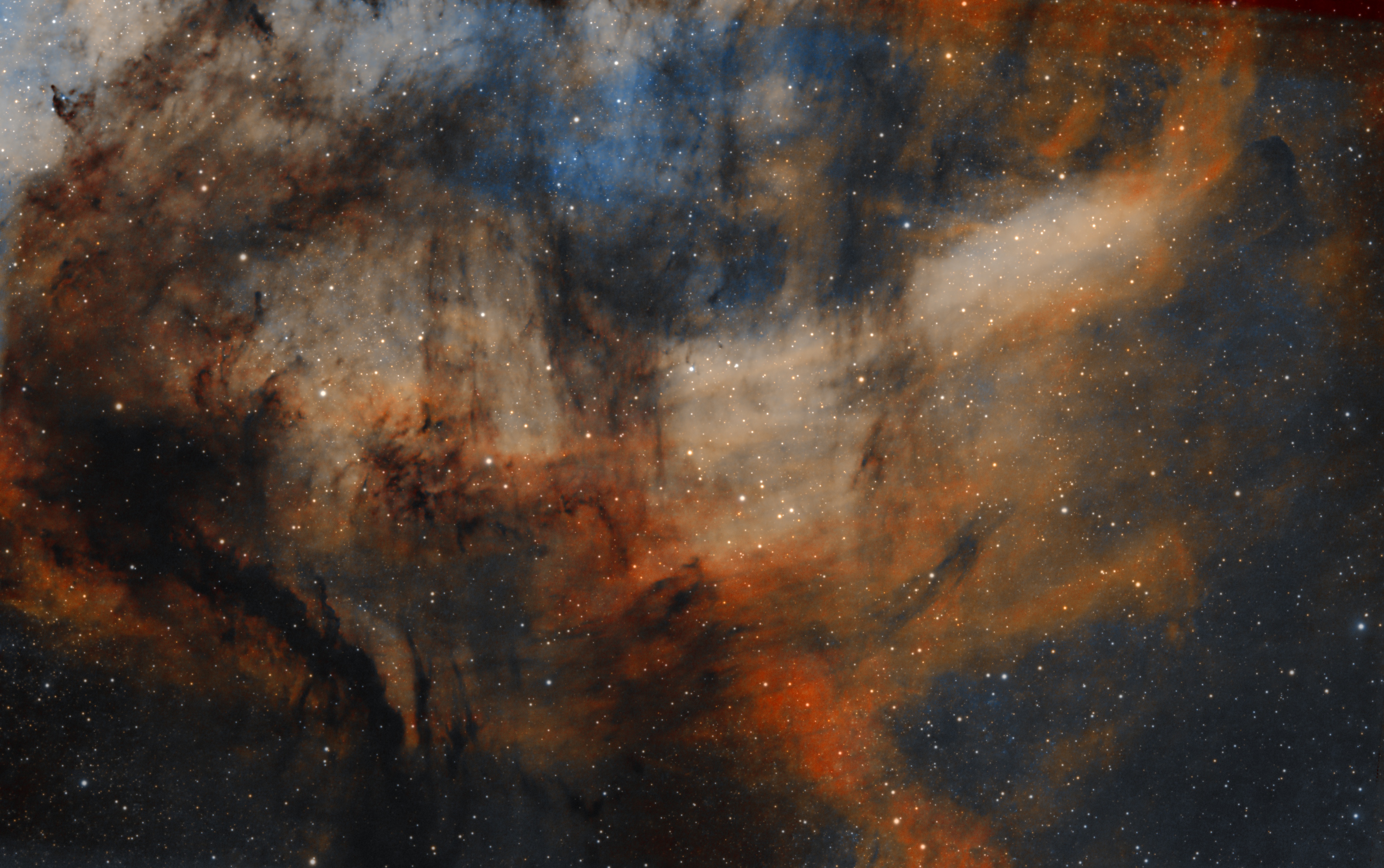
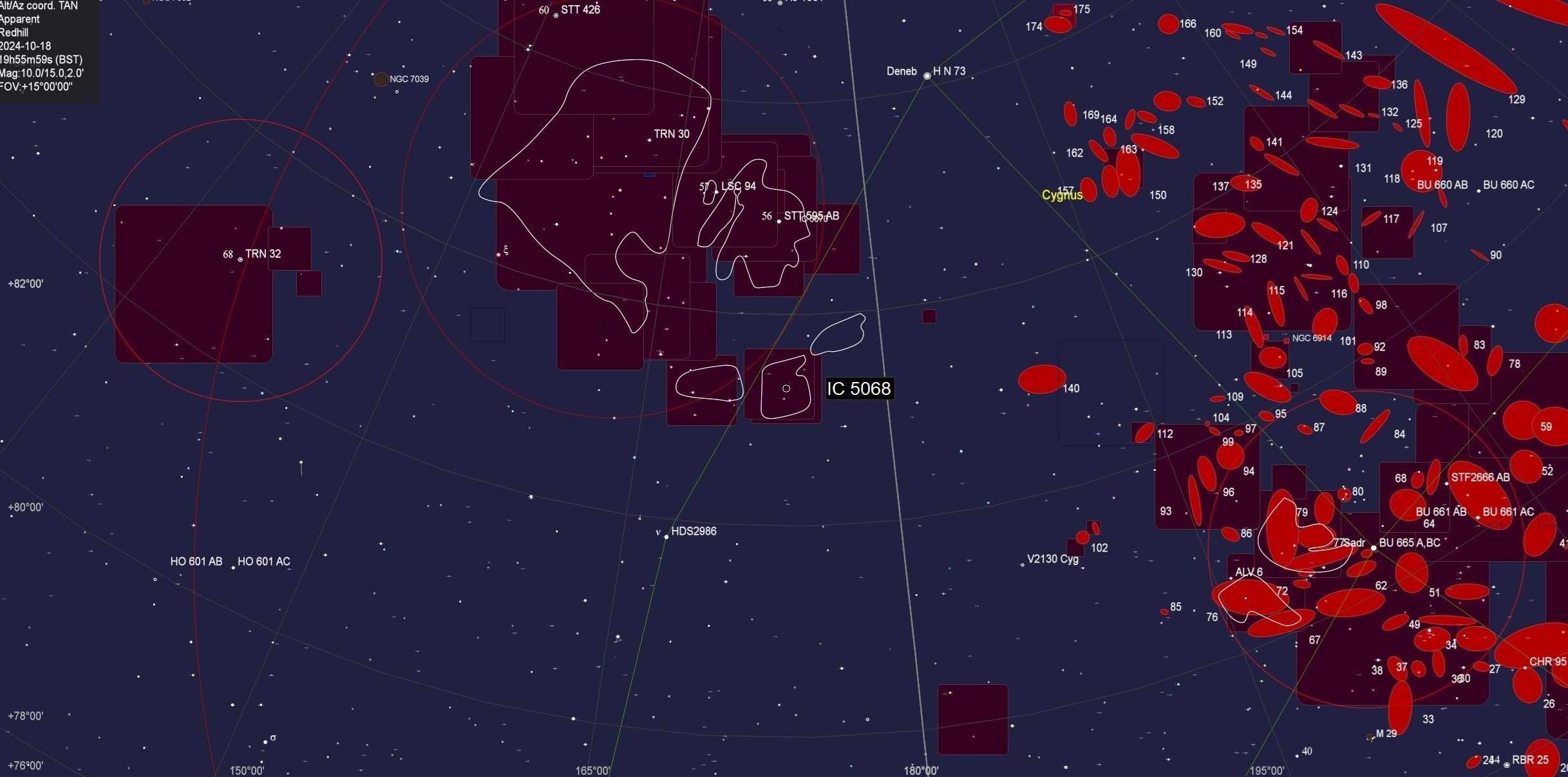
It’s at this time of the year I turn my attention to Cygnus and the plethora of imaging opportunities it provides, which inevitably tend to be narrowband targets. This year it is IC 5068, a low emission nebula often overlooked because of its location near the more popular North American and Pelican nebulae, as well as many other fabulous targets within the adjacent Cygnus molecular cloud, and as a result is unfortunately known as the Forsaken Nebula

Located just below the Pelican Nebula and close to the blue supergiant Deneb star (see above), this complex area is known for the graphically shaped streaks of cold, dark dust clouds that criss-cross the dense, brightly coloured gas regions of nebulosity.

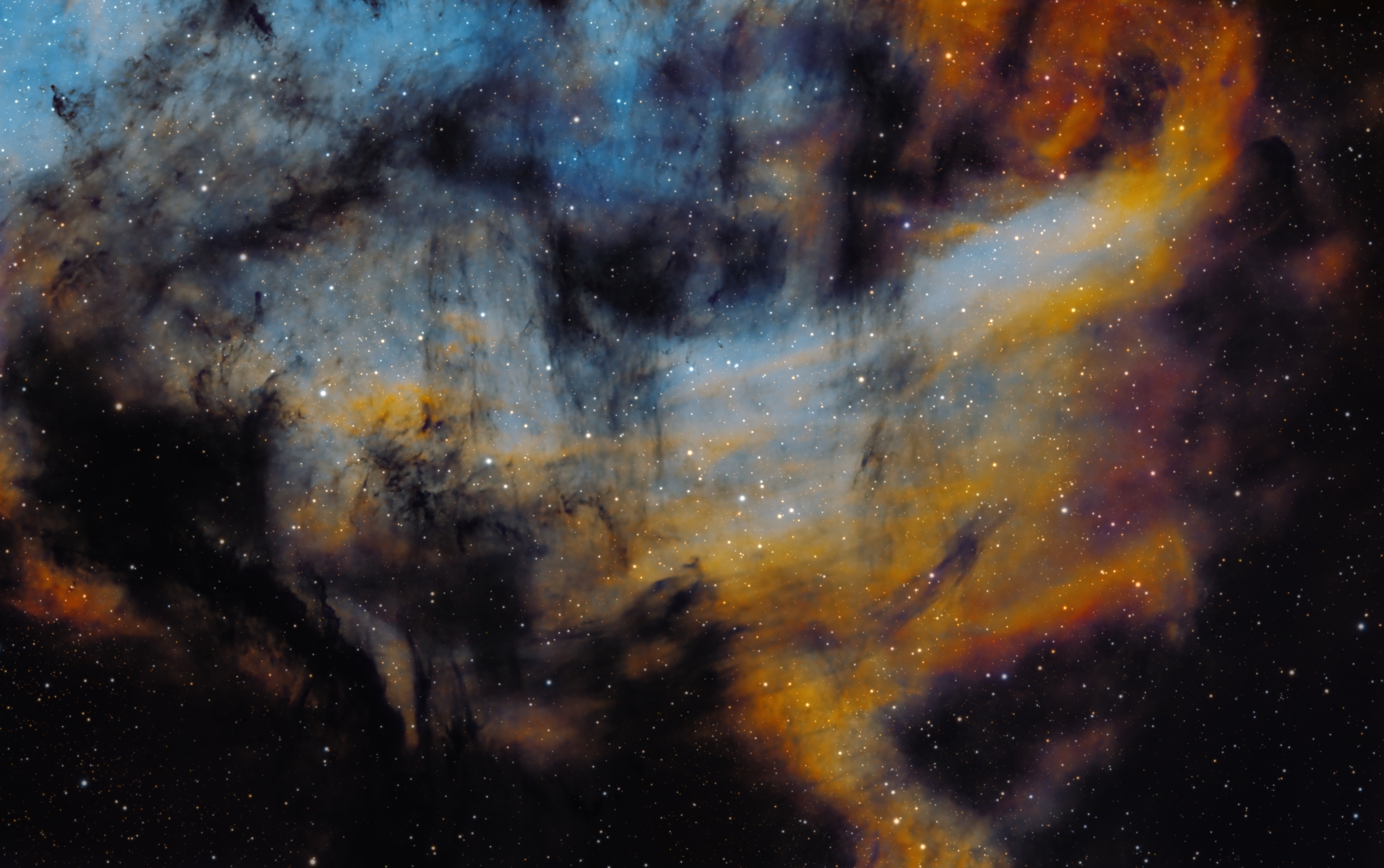
As a narrowband target my initial choice of image processing was the traditional Hubble Palette SHO configuration, which as envisaged, resulted in an exciting and colourful rendition of the busy IC 5068 (see image below).  Notwithstanding, having recently discovered some other, fairly new Pixinsight processing techniques (NB Color Mapper & NB Image Blend), I decided to give them a try to produce an alternative blended HOO–S image.  Though still very much recognisable as IC 5068, the resulting (warm) colours and details reveal a very different and perhaps more dynamic image (see image at the top of the page).

Narrowband images leave much to the imagination when processing and often take on a stirring look when completed.  In the case of IC 5068, each of the images produced seem to have the feel of abstract art, whilst at the same time posing many questions regarding the origin of many unusual features.  I believe this exciting region deserves much greater attention and should belong in the pantheon of popular Cygnus objects such as the North American, Pelican & Veil nebulae.  Moreover, the so-called Foresaken Nebula warrants a name more befitting of its exciting beauty.