Heart Of Darkness

HHOO hlvg (Large)

Aside from all the paraphernalia required for astrophotography, two other critical items are essential to start imaging: clear skies and darkness.  This year astronomical darkness ceased on 25th May at Fairvale Observatory and remained absent for the next 8-weeks  whilst Earth performed its annual summer gyration about the Sun, culminating on 21st June with the solstice.  As a result this period is typically quite a barren time for astronomers, especially for those in the higher latitudes where the sun does not set for the entire 24-hour day.  Some options during this time are:  give up, stop imaging and use the time to sort out equipment, if you have the right equipment change to solar astronomy or just enjoy what happens to be about in the less than dark sky.  This year I chose the latter, during what has been a very hot summer, often with continuously clear skies for days-on-end.
Planets June 2018

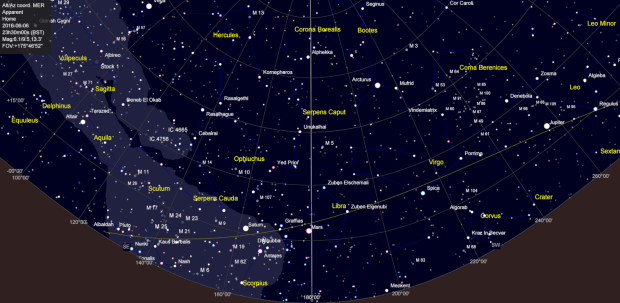
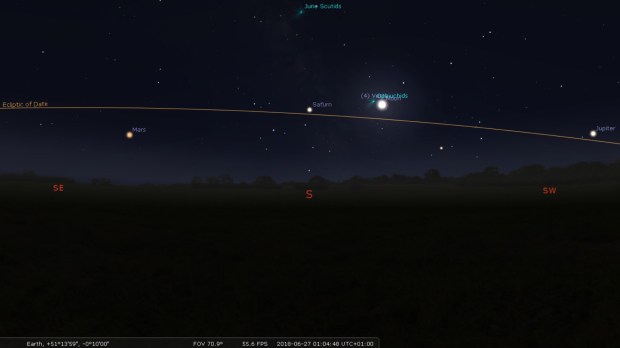
From the early evening we’ve been treated to views of all the planets of the Solar System, as during the short nights one-by-one they transited along the ecliptic, though were relatively low in the sky seen from the UK.  In order of appearance, the main show (see above) each night has been that of Jupiter, followed by Saturn and finally at about 2.00 a.m. (June) Mars – which this year was an unusually large, unusually bright  red disc as it reached its closest orbit relative to Earth for almost 60,000 years – all of which could be clearly seen with the naked eye.  Unable to sleep in the hot weather, night after night I was able to view and sometimes imaged the aforesaid planets with a DSLR camera as they moved across the night sky.

Shortly after darkness started to return on 20th July came two further special events.  First on 27th July a lunar eclipse, that despite all the previous clear nights was ironically obscured by cloud cover over most of the UK!  Fortunately, clear skies returned for 13th August and the annual Perseids meteor shower, which on this occasion produced some of the best meteor trails I have personally experienced.

And so, with astronomical darkness back and the chance to return to the recently established Fairvale Observatory South AKA The Shed Observatory, it was time to resume my hitherto brief imaging experience of the northern sky again.  As a newcomer to this part of the night sky there were considerable new imaging possibilities to explore but only one I now wanted to capture – the Heart Nebula or IC 1805 (also known as the Running Dog Nebula when viewed from a different angle).
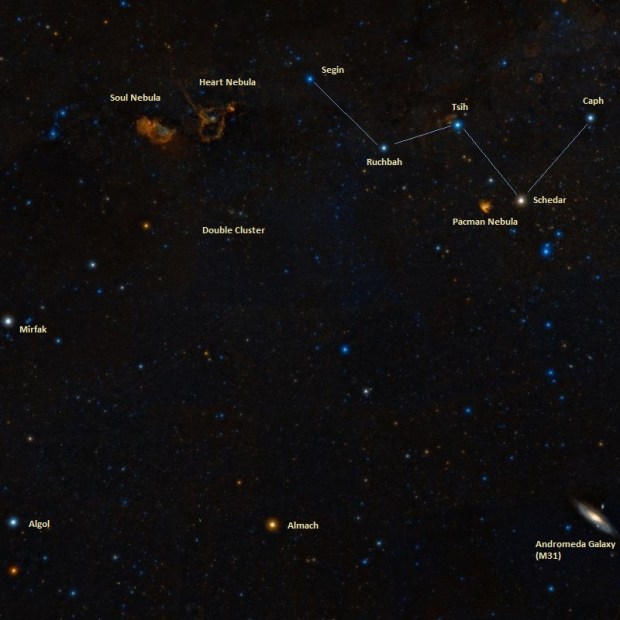
Heart-and-Soul-location The Heart and nearby Soul Nebula are situated in a busy region of the sky (see above – from Wikisky), which also contains seven open clusters of young stars, as well as the Pacman Nebula and galaxies of Maffei 1 & 2 and M31 Andromeda.  The discovery of a bright fish-shaped HII object – known as the Fishhead Nebula IC 1795 or NGC 896 at the edge of the main object – preceded that of the Heart Nebula itself in 1787 by William Herschel.  The Heart Nebula has a red glow, a result of intense radiation emanating from a small cluster of large, hot, young (1.5 My) bright-blue stars at the centre known as Melotte-15.  The stellar wind and stream of charged particles that flow out from these newborn stars then creates the characteristic heart-shape of the nebula from the stellar dust and hydrogen gas clouds.
Picture saved with settings embedded.

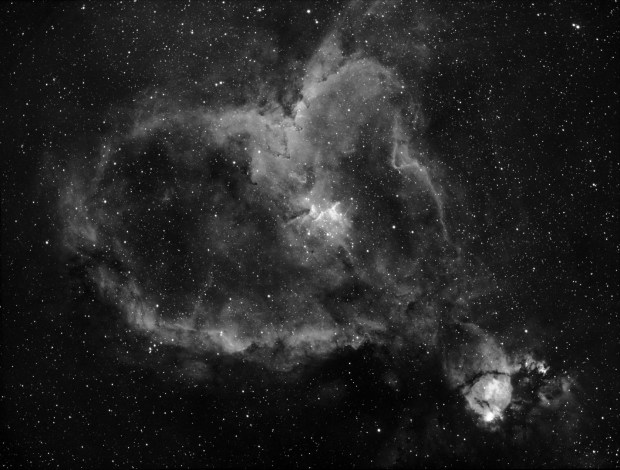
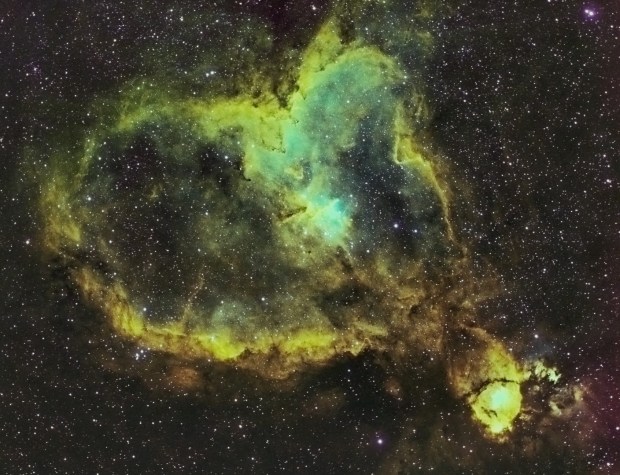
Located in the Perseus arm of the Milky Way in the Cassiopeia constellation, this large emission nebula is an excellent object for narrowband imaging at all wavelengths and is also well framed in the field-of-view of my telescope-camera combination; the images presented here are rotated 180 degrees to achieve the correct orientation to see the heart shape, with the Fishhead Nebula located in the bottom right corner.  Not surprisingly this large HII object produces strong Ha subs, which make a pleasing stand-alone image (above section). But the OIII and especially SII wavelengths are also very good, resulting in very good HHOO bi-colour (top-of-the-page) and SHO (below) images too.
SHO end3Final (Large)

The limited time I’ve had to image the northern sky for the first time this year has already proved to be exciting and bodes well for the future.  On this occasion I’ve been very pleased with my first imaging results of the Heart Nebula, which is a superb object for my equipment and am sure to return next year given suitably clear skies and, of course, darkness.

IMAGING DETAILS
Object Heart Nebula IC 1805    AKA Running Dog Nebula   Sharpless 2-190
Constellation Cassiopeia
Distance 7,500 light-years
Size 150’ x 150’  =  2.5o or 200 light-years
Apparent Magnitude +18.3
 
Scope  William Optics GT81 + Focal Reducer FL 382mm  f4.72
Mount SW AZ-EQ6 GT + EQASCOM computer control
Guiding William Optics 50mm guide scope
  + Starlight Xpress Lodestar X2 guide camera & PHD2 control
Camera ZWO1600MM-Cool (mono)   CMOS sensor
  FOV 2.65o x 2.0o Resolution 2.05”/pix  Max. image size 4,656 x 3,520 pix   
EFW ZWOx8 + ZWO LRGB & Ha OIII SII 7nm filters 
Capture & Processing Astro Photography Tool + PS2,  Deep Sky Stacker & Photoshop CS2, HLVG
Image Location             & Orientation Centre  RA 02:33:09    DEC 61:24:23 

Top = South   Right = West   Bottom = North   Left = East  

Exposures 20 x 300 sec Ha + 10×300 sec OIII & SII  (Total time: 200 minutes)   
  @ 139 Gain   21  Offset @ -20oC    
Calibration 5 x 300 sec Darks  20 x 1/4000 sec Bias  10 x Flats Ha-OIII-SII  @ ADU 25,000  
Location & Darkness Fairvale Observatory – Redhill – Surrey – UK        Typically Bortle 5
Date & Time 16th & 17th  August 2018 @ +23.30h  
Weather Approx. 12oC   RH <=95%


The Eagle Has Landed

“It is never wise to let a piece of 
electronic equipment know that you are in a hurry” (Murphy’s Law)

Following months of unusually protracted cloud cover during the winter and a short, though productive imaging period that can be measured in weeks, I have been unable to carry out any astrophotography since early May, when for inexplicable reasons everything went pear-shaped!  The problem started on the 9th May and it’s taken me 3-months to solve!  This and other events have therefore resulted in a noticeable paucity of WTSM activity – sorry.

After an earlier successful dry-run with the equipment in preparation for Mercury’s solar transit, a few days later at the very moment the transit started when I switched on the camera, Cartes du Ciel and EQMOD-ASCOM froze and, despite my best efforts, could not be restarted i.e. no images.  With the next transits not due until 2019 and thereafter 2032, this was a missed opportunity at best but as subsequent efforts failed to rectify the problem I’ve reached moments of despair.

I have used the same equipment and software successfully for nearly two years, in particular assigning the same USB COM-ports to avoid potential conflicts; experience of others shows ASCOM can be particularly fickle with the assignment of a COM port.  After some discussion via the EQMOD Yahoo forum group there was consensus that the problem was probably a software conflict or driver issue.  Somehow this didn’t seem right to me given the background described but with no alternative ideas I reluctantly set out to clean up the laptop and update all relevant software and drivers: ASCOM, Cartes du Ciel, EOS Utility etc.  Unfortunately there was no improvement, so I checked and checked again, including all connections and wires but with no success.

I had only queried the problem with the EQMOD Yahoo group convinced that this was where the problem existed and these were after all the experts.  With by now the limited darkness of summertime  nights upon us, despair setting in and my daughter’s wedding to attend to, I put everything aside for a few weeks: (a) for practical reasons, and (b) in order to restore some enthusiasm – hopefully.  At this point, somewhat late in the day, I decided to post a query on Stargazers Lounge; can’t think why I didn’t try before but there you go – the experience and help on SGL has almost always been very helpful and positive.

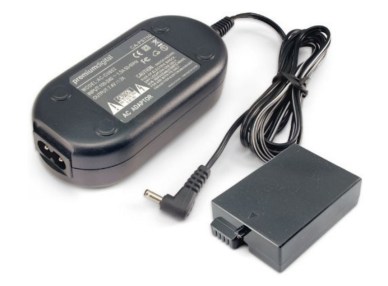
Almost immediately ‘Smudgeball (AKA Neil) from Scotland responded with a similar experience that turned out to be a very small break in the DSLR mains adapter insulation.  On inspection I could find no such damage to my adapter but it was worth a try, though holiday travel then delayed acquiring a replacement for another few weeks.  Immediately on my return I obtained a new adapter which on testing indoors with the equipment produced a successful outcome – BINGO!  Soon after I was able to get outside once again and at last undertake some astrophotography, phew.  Despite my resolve and perseverance there have been times I’ve really felt like giving up completely and I am still getting over the frustration of these drawn out events.

acdc

AC/DC DSLR power adapter: How can something as basic as this cause so much disruption?

Whilst this was going on I did manage to carry out some planetary observing – with Jupiter, Mars and Saturn all around it was too good to miss.  For a while I have been aware that astrophotography has been distracting me from looking at the night sky itself; it seems strange but you get so tied-up with imaging and forget to look up – I hope to avoid this trap in the future.  Unfortunately the re-awakening of my observing interest only served to highlight the poor quality and range of some of my eyepieces.

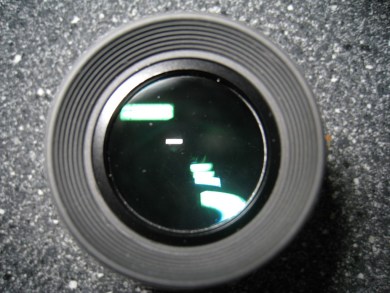
After some research and another query on SGL I purchased an Explore Scientific 20mm 68o Maxvision eyepiece, which I thought would fit well in between my existing 32mm and 6mm eyepieces. The Maxvision is very well made but like many high-end eyepieces nowadays is quite bulky. However, the eyepiece has an unusual rubber twist-up eyecup, which though ingenious limits eye relief for those, such as myself, wearing spectacles and narrows the field-of-view.  As a result I exchanged the Maxvison eyepiece for Explore Scientific 5-element 20mm and 10mm 70o eyepieces, which provide much better eye relief and is therefore more suitable for my circumstances.  At this time I have not used either of these but as they are more conventional in design, with good access to the top lens for viewing, I am very hopeful they will do a good job.

IMG_2532 (Medium)

Explore Scientific 20mm eyepiece – good access to the wide angle top lens element provides good eye relief and full use of 70 degree FOV

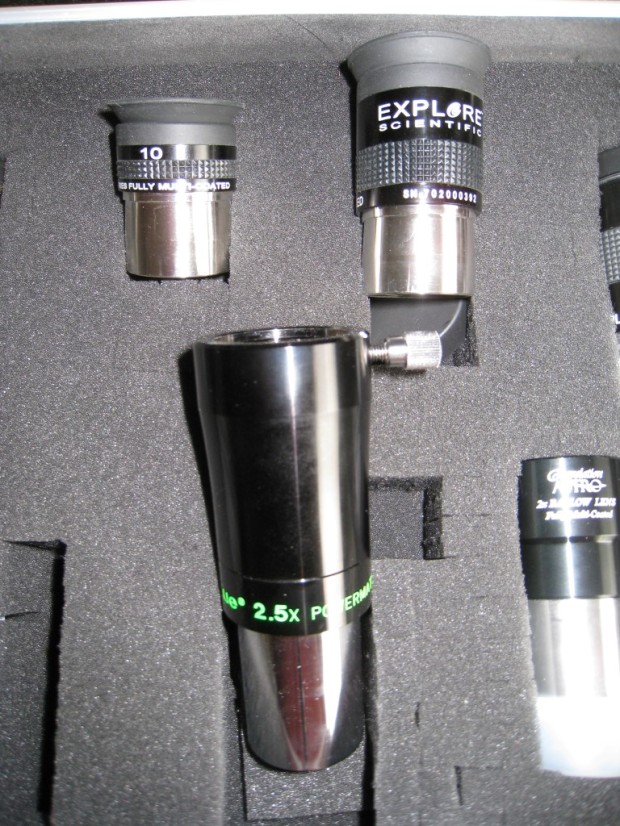
I routinely watch second-hand equipment on the SGL and UK Astronomy Buy & Sell websites, which has resulted in some timely purchases in the past, including my modded Canon 550D camera and Vixen Polarie.  From experience I find it pays to know exactly what you might be looking for and what a good price might be, in order to act quickly if necessary.  There is great demand for popular items such as the Polarie which tend to go very quickly.  Buoyed by much positive online comments I was recently lucky to see and successfully acquire a Tele Vue 2.5x Powermate, just 3-minutes after it was posted!  I’ve only had brief use so far but it’s already obvious that this is an excellent piece of kit; being parfocal vignetting is eliminated and with great optics it’s noticeably a quantum improvement on a Barlow.

IMG_2534 (Medium)

Additions to the family: Explore Scientific 10mm & 20mm eyepieces and 2.5x Powermate

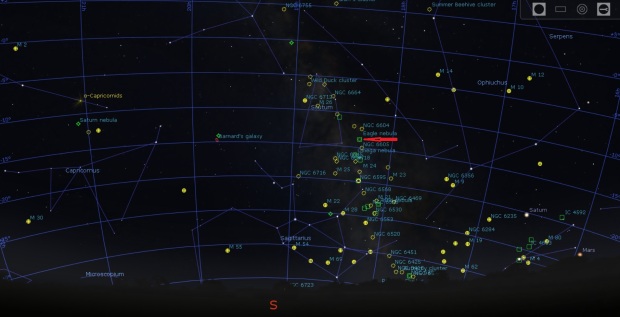
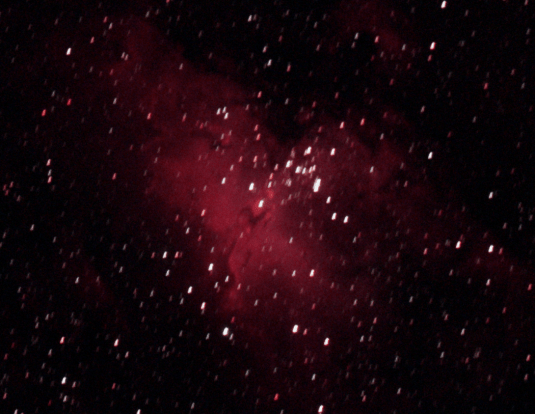
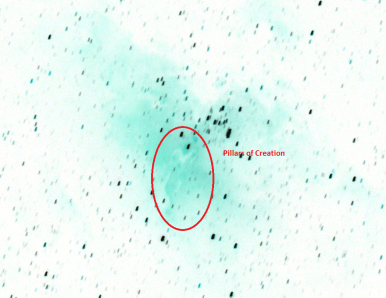
With the return of astronomical darkness on July 20th and the prospect of Fairvale Observatory able to function again, I have been keen to get back out.  Imaging targets are mixed at this time of the year but I’ve just managed to bag three exciting new objects.  The so-called Pillars of Creation are perhaps the iconic image of modern astronomy, inevitably captured best by the Hubble telescope.  These towering columns of illuminated cosmic dust are situated within M16 or Eagle Nebula, in the constellation of Serpens, which at this time of the year is located low in the southern sky, just above the ecliptic at about 25o – not an ideal but too tantalising not to give it a try.

M16stellcrop

At 7-arcseconds in size and +6.0 apparent magnitude, the Eagle is a decent target for the William Optics GT81.  Unfortunately as it’s been some time since the last session and my old nemesis of polar alignment wasn’t too good on this occasion, which combined with its low altitude and lack of guiding was always going to be a challenge.  Notwithstanding I manged to get a reasonable sequence of images that show the shape of the ‘bird’ and even the general nature of the Pillars at the centre of the nebula, though inevitably exposures were short and minor star trails are evident.

M16 Stacked 070816cropL2GX2SLpcrop copy

M16 The Eagle Nebula: William Optics GT81 & modded Canon 550D + FF | 15 x 180 sec @ ISO 1,600 + darks | 7th August 2016

M16 Stacked 070816cropL2GX2SLpcropinverse copytxt

After all the trauma of the past few months it was a satisfying result and later that night I was able to capture two more interesting objects, more of which another time – watch this space.   It’s fair to say that for now the eagle had in more than one way well and truly landed, though given the preceding difficulties and eventual solution it was more like Apollo 13 than 11!

apollo11apollo13

Summertime Blues

IMG_5435

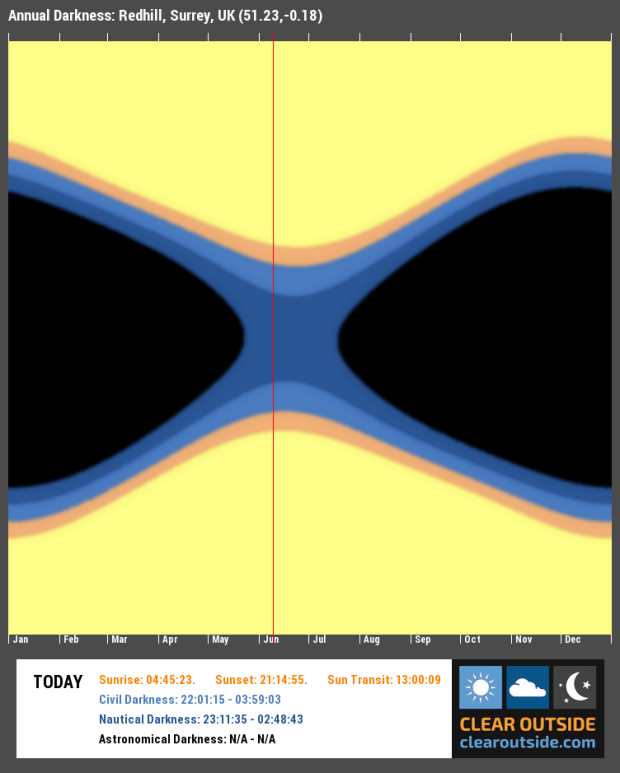
This year the Summer Solstice falls on 20th June at 23.34 BST, meaning the Sun will have reached its furthest point north; as a result from 22nd of May to 19th July 2014 there is a state of permanent Astronomical Twilight AKA Nautical Darkness at Fairvale Observatory. This means there is a complete lack of Astronomical Darkness for imaging, which when combined with short nights poses various problems for astronomy in general.  Notwithstanding, there are benefits and other opportunities which are worth exploiting.

annual_darkness

Annual darkness at Fairvale Observatory 2016

To turn the problem around an obvious solution at this time is viewing and imaging the Sun.  However, following the initial success of testing my equipment in preparation for Mercury’s transit of the Sun on 9th May, the actual event proved disastrous for solar imaging.  I have subsequently re-checked the equipment and software set-up and the problem has continued but without any obvious reason.  Popular opinion on the EQMOD Forum is that it is a software issue – drivers, EQMOD, EOS Utilities – so when time allows over the summer I will reinstall and test everything, hopefully ready for the return of astronomical darkness on 20th July.  Murphy’s Law will likely mean it’s something else but for the moment this seems to be the only way forwards, or is it backwards?  Having just managed to get guiding to work, I had been looking forwards to a new imaging era but that’s astrophotography!

Although the nights are now short the temperatures have been pleasantly warm; after the long dark but cold nights of winter (and spring this year) it’s been a real pleasure to be outside in summer clothing and without the threat of condensation on the equipment.  Notwithstanding, ever present cloud and inevitably the Moon has continued to thwart my efforts until recently, as I have at last just managed a couple of very enjoyable evenings.

At the moment the three major planets of Jupiter, Mars and Saturn can all be seen at various times between 10.00 pm to nearly 3.00 am, when the early morning light then becomes evident. After putting on a great show during May, Jupiter still remains high in the sky just after sunset.  Mars and Saturn are at a much lower declination of between 10o   and 17o but provide very good views in the right seeing conditions, especially Mars which with an apparent dimension of 18.6o has recently looked excellent, even to the naked eye.

060616 Sky

With such opportunities I decided to try out the Skywatcher 150PL and the ZWO ASI120MC once again.  It is almost two years since I used this telescope, preferring instead the superior William Optics GT81 for viewing and imaging.  However, with a focal length of 1,200mm and 150mm aperture (f8) the Newtonian scope is better suited to planetary objects; this was also the first time I rigged the scope for use on the AZ-EQ6 GT mount, thus providing better control than the EQ3-2 I have previously used.

Sure enough the views of each planet were very good but also being unaccustomed to the ZWO webcam through lack of use, I failed to obtain any images!  Pity but the lesson learned is that I cannot just dabble with this equipment and need to dedicate more time in the future if I am to learn how to use properly again.  Nonetheless, it was fun re-acquainting myself with these planets.  As an unexpected bonus the ISS also flew right over Fairvale Observatory for over 7 minutes.  This time the station was noticeably brighter than previously observed, which I put down to Nautical Darkness and the relative position of the Sun that results, thus producing greater reflection and therefore better illumination of the ISS when viewed from the ground?

All-in-all after months of difficulties and inactivity it was a good night and at midnight I therefore decided to swap to the William Optics GT81 for some DSO imaging.  After setting-up the scope I looked up and, as if from nowhere, broken cloud had rolled in obscuring much of the sky and putting an end to any DSO imaging.  Oh well, I had had a good time before and was at least able to get to bed at a civilised time – one of the other drawbacks of summer astronomy.  As luck would have it the weather was also good on the following night, probably even better than before and this time I concentrated on bagging some DSO images as the planets again marched across the sky from east to west.

As a result of the aforementioned equipment and software problems I have resorted to the trusty SynScan handset again for alignment and mount control.  Impressive though EQMOD and all the other paraphernalia are, so far I have found it all to be somewhat fickle and from my personal experience often unreliable.  However, after last year’s enforced astronomy hiatus following my operation and the almost farcical lack of observing conditions over winter and now spring, I’ve become a little rusty with the set-up and as a result, on this occasion encountered my old nemesis – polar alignment – to be something of a problem once again.

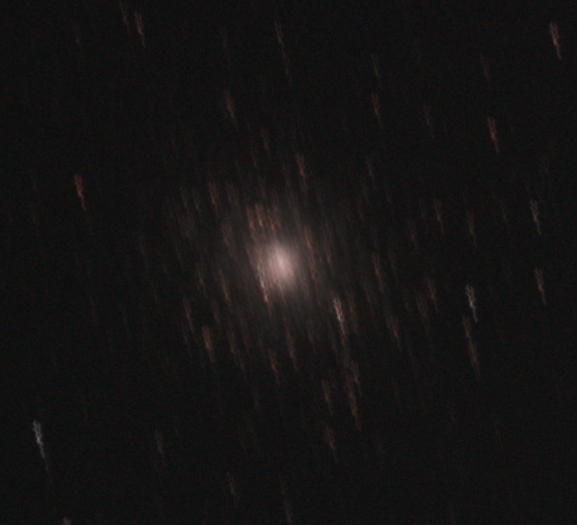
Amongst the types of DSO objects, I find globular star clusters to be particularly intriguing; I had not even heard of such features until taking up astronomy in 2013.  Some 158 of these ancient star clusters are known to orbit around the main disc of the Milky Way.  At about 11bn to 13bn years old they are very old and despite what so-called experts might say, it seems to me their origin remains something of a mystery; it’s interesting that such clusters are also associated with other galaxies.

At this time of the year a number of globular and open clusters feature across the night sky and form excellent imaging targets.  First up at about 11.00pm was M5 and immediately I discovered the shortcomings of my polar alignment, further aggravated by the decision to try 4.00 minute exposures = big mistake; ironically prior test shots  turned about better!

Picture saved with settings embedded.

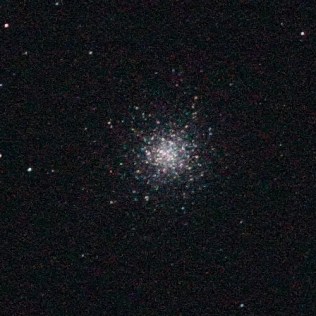
M5 globular cluster + excess trailing! WO GT81 Canon 700D + FF | 9 x 240 secs @ ISO 800 + darks | 6th June 2016

IMG_0026crop

M5 test shot: 10 sec @ ISO 6,400

IMG_0023crop

M5 test shot: 15 sec @ ISO 6,400

Following on from M5 shortly after midnight, M13 appears at a much higher altitude, thus helping to reduce the impact of star trails.  Furthermore, as I was by now fully aware of the polar alignment error, I reduced the exposure time from 4.00 to 2.00 minutes; it helped but nonetheless could not hide the impact on the resulting images.  Note to self: always ensure good polar alignment.  An EQMOD – ASCOM – CdC alignment model would be much better but until I can correct the aforesaid problem it’s down to SynScan and hopefully in the interim I can return to globular clusters once more during summer.

Picture saved with settings embedded.

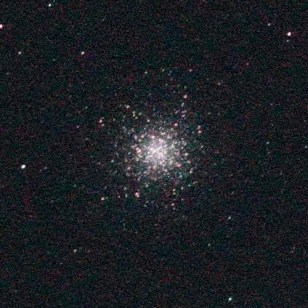
M13 with less but still noticeable trails! | WO GT81 & Canon 700D + FF | 19 x 120 secs @ ISO 800 + darks | 7th June 2016

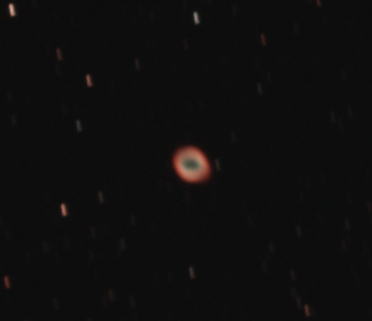
Before going to bed I couldn’t resist a few quick shots of an old summer favourite, M57 or the Ring Nebula, itself also very high above Fairvale Observatory by this time of night.  Considering the alignment problems the image wasn’t too bad, however, the first half of 2016 has really been a case of one step forwards, two back.  I hope the next 6-months will be more positive, they will inevitably be darker and colder.

Picture saved with settings embedded.

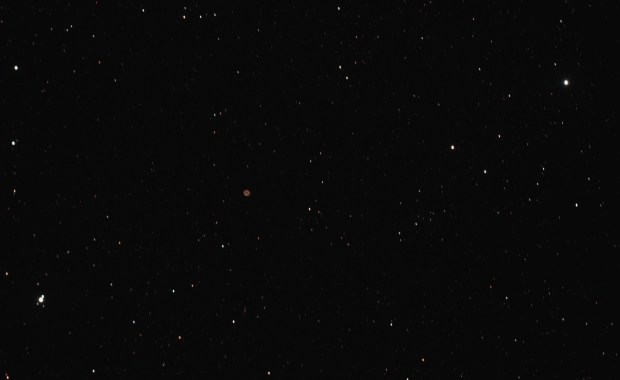
M57 Ring Nebula (left of centre) + Sulafat (left) & Sheliak (right) | WO GT81 & Canon 700D + FF | 13 x 120 secs @ ISO 800 | 7th June 2016

Picture saved with settings embedded.

M57 – Ring Nebula, cropped.

Two’s Company

During the late 20th Century planetary relationships took on a new meaning as a metaphor for the difference between men and women, following the publication of John Gray’s book Men Are From Mars, Women Are From Venus.  Making a beautiful view at the moment, Venus is currently flirting with Mars in the early evening sky, for a very brief period low on the western horizon just after sunset. Its appulse with Mars can be easily seen with the naked eye but the view from Fairvale Observatory lasts only about 20 minutes and therefore requires good seeing conditions and quick action to get a picture.

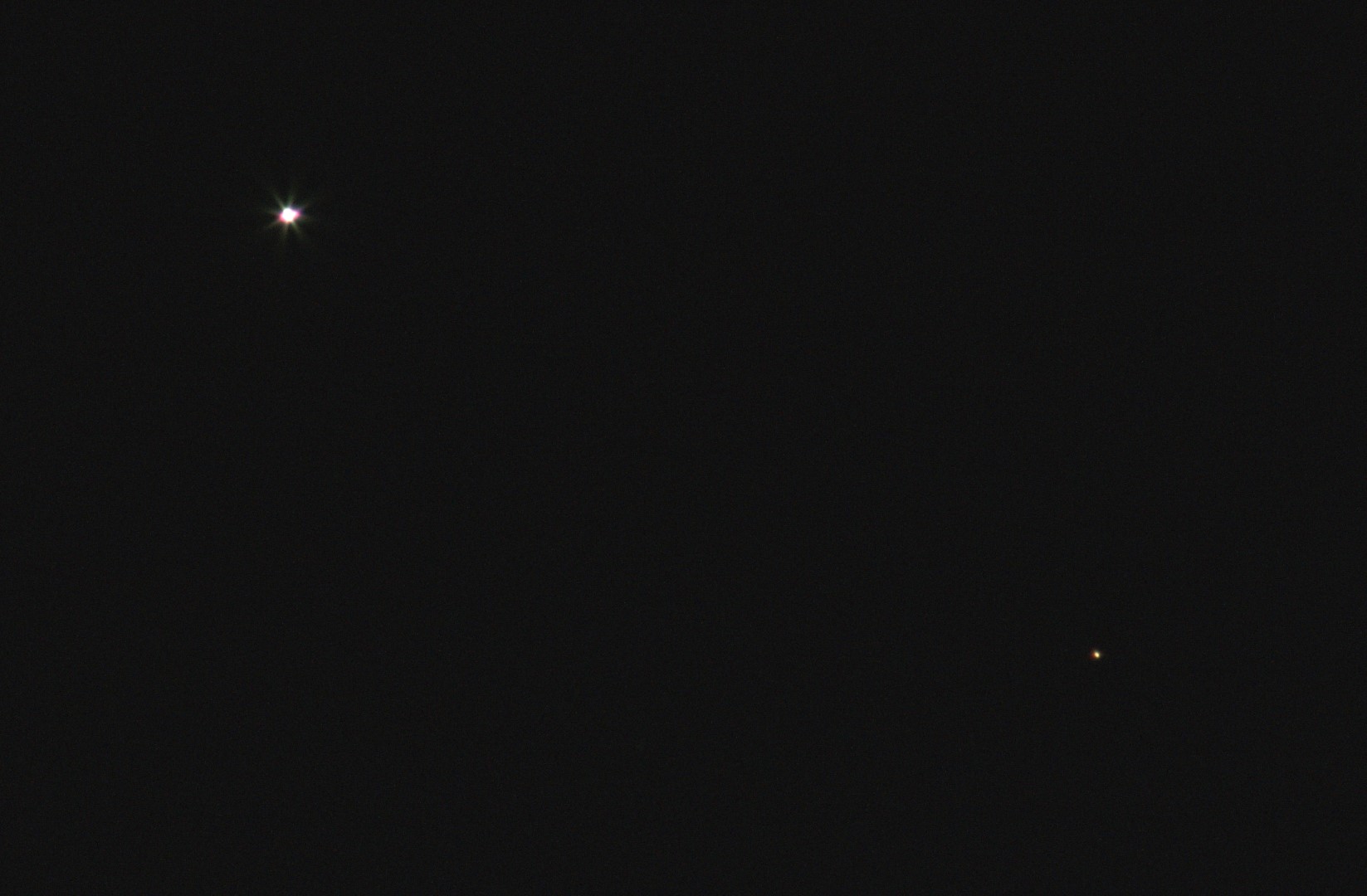
At the weekend the view was even better, with the crescent of the New Moon adjacent to the field of view of Venus and Mars at the same time but my camera was not ready. Ideally I would like to image its apparition with a telescope but having to act quickly, last night I managed to get a quick photograph of the two planets using a DSLR camera and a 600 mm telephoto lens; the International Space Station flew by shortly afterwards but unfortunately too late get a photograph combining all three, timing is everything.

Later in the month the apparition of Venus will also include Uranus, making an even better show but will definitely not be a case of two’s company, three’s a crowd!

Picture saved with settings embedded.

Shining brilliant white, magnitude -3.9 Venus – top left & the smaller, faint magnitude +1.3, red planet of Mars – bottom right

STOP PRESS!

Another good evening sky this evening and tonight I manged to set-up the telescope to take this beautiful picture of Venus and Mars:

IMG_4731crop (Large)

Copernicus was right!

OK it’s not news but a tribute to the man who opened our eyes to the way the Solar System works.

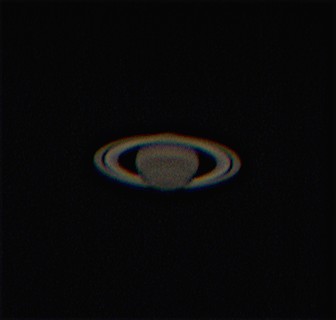
Like most newcomers to astronomy viewing and imaging starts at home and that is the Solar System. So it was with my Skywatcher 150PL Newtonian scope last year – first the Moon (of course) and then on to the planets, in this case it had to be Saturn – surely the most exciting / beautiful planet? Despite my growing years it was only in April 2013 I got to see Saturn for the first time through the 13″ Astrographic Refractor at Herstmonceaux  http://www.the-observatory.org/telescopes. WOW I am hooked and following much previous prevarication over what to buy now rapidly sought to purchase my first telescope in the form of the aforementioned 150PL with a basic EQ3-2 mount.

The early summer of 2013 was very good for viewing Saturn and so it was I spent many late nights and early mornings gazing at this wonderful planet. Of course I had to get a photograph but this was easier said than done. Despite years of SLR photography I did not own a DSLR, considering them too bulky and inconvenient for day-to-day use, I therefore resorted to my trusty Canon Ixus 860IS to try my hand at afocal photogrpahy i.e. holding the camera up to the eyepiece.  The results were awful so I purchased a camera bracket that clamped to the eyepiece and held the camera more steady, unfortunately this too was little better. I came to the conclusion that this wasn’t going to work and in some shape or other I would need to take a video instead, with subsequent processing through Registax (more about this another time) which is able to sort and stack the best frames to produce a final, single image.

I tried the cheap route first by adapting an old Logitech webcam I already had (this involves removing the front lens so the light fall directly on the sensor) but could not get an image and therefore in the end decided to purchase a ZWO 120 MC http://www.365astronomy.com/zwo-asi120mc-colour-13-cmos-usb20-camera-with-autoguider-port-p-3536.html which also provides an autoguiding function, as yet not tested. Again I encountered major problems getting an image but after visiting the retailer Zoltan at 365 Astronomy, who also had great difficulty getting it to work by using a more up-to-date version of Firecapture, I was finally up and running – all I needed was a clear sky and an object to image. Of course, it had to be Saturn.

As I have now learnt every facet of astrophotography is difficult and this was no exception. The problems this time fell into two categories: the general capture settings and that old thorn in the side, focus.  It took a while but eventually I had Saturn  on film which, after some Registax processing I successfully turned into a picture.

ZWO 120MC

ZWO 120MC

Still plenty of scope for improvement but it is clearly Saturn and to my eyes looks great.

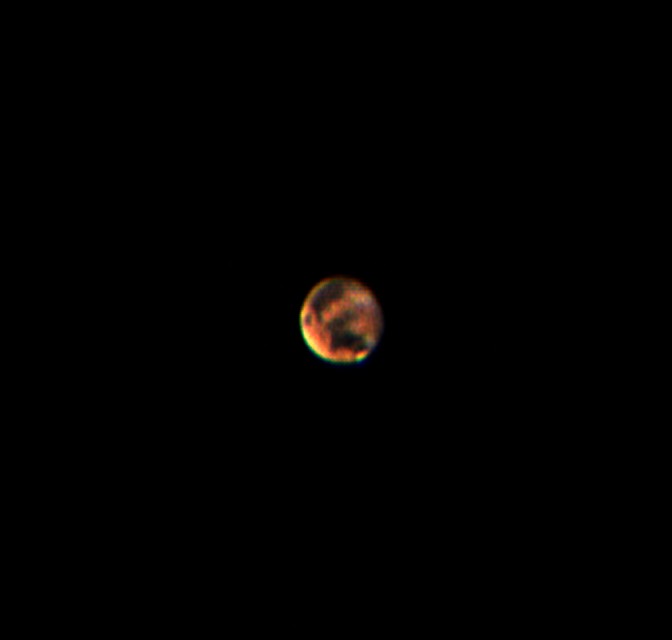
With this success under my belt, earlier this year I tried Mars which, as I was to find, is a notoriously difficult subject – the problem being size i.e. it is small. Depending on their respective orbits relative to Earth, the angular diameter  http://en.wikipedia.org/wiki/Angular_diameter of Saturn varies from 14.5″ to 20.1″, with Mars 3.5 to 25.1″.  Notwithstanding, I eventually managed to capture some video, which looked awful, but thanks to Registax emerged looking like, well ….Mars!  It has been described as ‘pizza looking’ but for the moment I’m happy.

223242_castr

ZWO 120 MC + Registax

I had hoped to get Jupiter too but for various reasons (which I can’t remember) it didn’t happen, so that’s on the ‘to-do’ list next time it comes around.  And thanks to Nicolaus Coperincus we will be able to predict when that is.