2025 The Year In Pictures

The year 2025 was like no other.  Starting with a knee replacement operation in January, shortly after we finally found a new house in March and moved to the lovely dark skies of Somerset at the end of June.  Unfortunately, the ensuing turmoil left only a limited time for astronomy.  Notwithstanding, I was able to supplement images from Redhill and our new home in Wookey, with some excellent data from Texas, USA and Chile to produce, what I hope you will agree, is an exciting 2026 calendar. 

For other pictures and information, go to my website https://watchthisspaceman.com/ or a video of the calendar can be found here on YouTube https://www.youtube.com/watch?v=gn3ls_s71lQ   and is best accessed on a PC or smart TV screen. Background music this year is Massive Attack’s track Atlas Air.

 COVERNIGHT SKY MONTAGE AT CASTLE FARM OBSERVATORY:

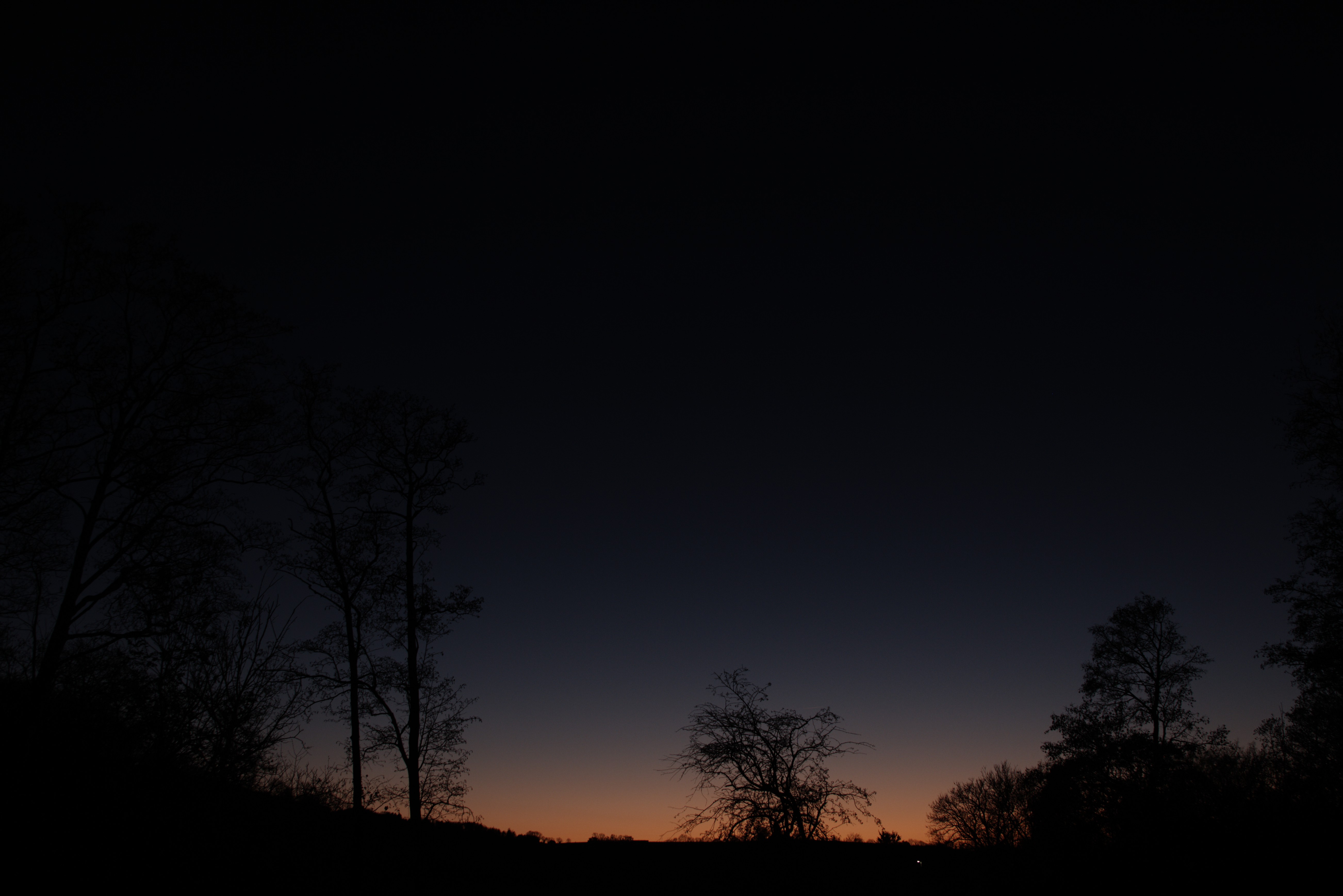
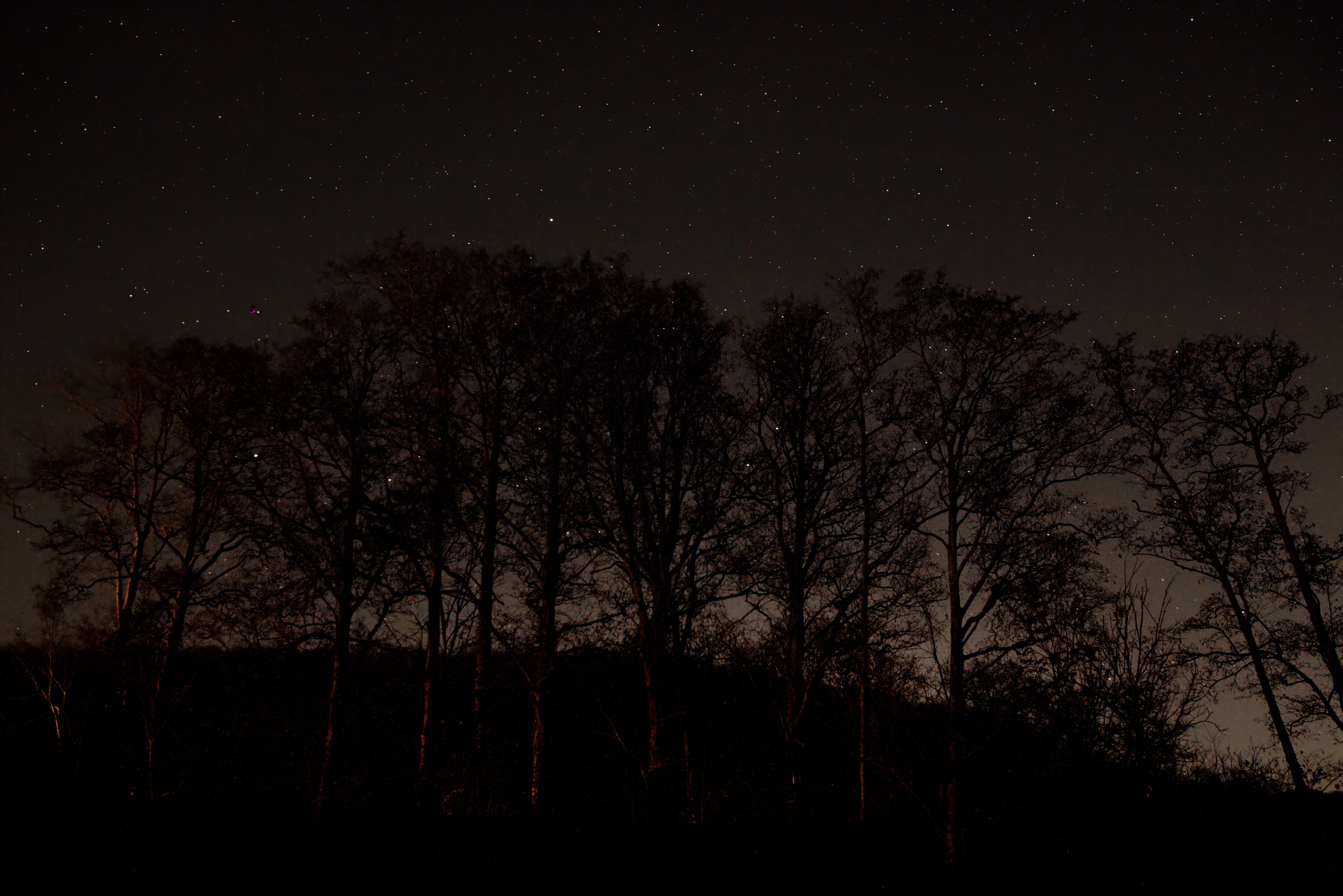
All these images (at the top of the page) were taken at various times from the same location at our house in Wookey, Somerset.  Clockwise from bottom left: (1) Nightscape of a small coppice looking south (2) Double Cluster – a pair of open star clusters in the Perseus constellation (3) Star trails (4) Sunset looking west. 

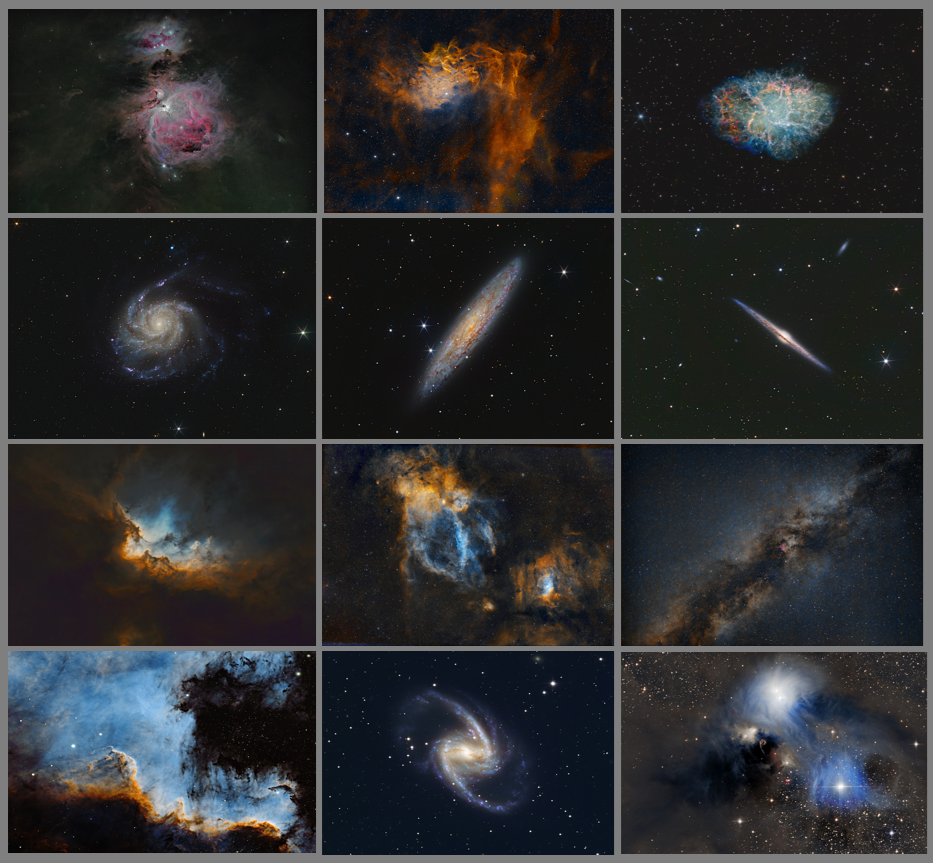
JANUARYTHE GREAT ORION NEBULA, M42 (1)
 
The Orion Nebula is a gigantic cosmic cloud of interstellar dust and gas, which is the basis for the birth of numerous new stars or a “star nursery”.  Being the brightest nebula in the northern hemisphere and just over 1,300 light-years distance from Earth, it can be seen with the naked eye on a clear night.
FEBRUARYFLAMING STAR NEBULA, IC405 (1)
 
This nebula is illuminated by a powerfully bright blue variable star, AE Aurigae. The object’s epithet comes from the brightly lit ripples of gas and dust at the top of the image, illuminated by AE Aurigae and glowing hydrogen gas. This “runaway star” was ejected by a collision two million years ago from the Triangulum region of The Great Orion Nebula.
MARCHCRAB NEBULA, M1 (3)
 
This small but beautiful supernova Remnant (SNR) was the result of the explosion of the star CM Tau just over 970 years ago.  Located at the centre of the nebula, the remaining Crab Pulsar neutron star spins at the rate of 30 times per second.        
 
APRILPINWHEEL GALAXY, M101 (3)
 
At nearly twice the size of the Milky Way and containing at least an estimated trillion stars, M101 is the second largest galaxy of the Messier catalogue and certainly one of the highlights of the spring galaxy season. 
MAY SCULPTOR GALAXY, NGC 253 (3)
 
One of the advantages of obtaining data from Texas, USA, is that it enables views of objects in the Southern Hemisphere that are impossible from the UK.  Also known as the Silver Dollar, it is one of the brightest galaxies in the night sky, which results from very high rates of star formation that are fed by the abundance of thick dust lanes.
 
JUNENEEDLE GALAXY, NGC 4546 (3)
 
Seen edge-on from Earth, the Needle Galaxy is thought to be a barred spiral galaxy, some 33% larger than the Milky Way. It has at least two satellite galaxies and 240 globular clusters. Seen through a telescope the Needle Galaxy appears like a thin streak drawn across the dark night sky but look closer and its detailed magnificence is revealed.

JULYWIZARD NEBULA, NGC 7380 (2)
 
Formed only a few million years ago, the gases of this young emission nebula glow due to intense radiation from hot, massive stars within. Interwoven within this glowing gas are dark, dense regions of dust that sculpt the nebula’s dramatic and somewhat mystical appearance, in this case a wizard – which marks my first image from Somerset.
 
AUGUSTLOBSTER CLAW & BUBBLE NEBULAE, SH2-157 & NGC 7635 (2)

Located in the Perseus Arm of the Milky Way, the Lobster consists of ionized hydrogen gas energized by ultraviolet radiation from nearby hot, young stars. The nebula’s distinctive claw-like shape arises from intricate filaments of glowing gas and dark dust. Nearby the Bubble Nebula owes its distinctive looks to a single, massive star, which emits fierce stellar winds that sweep up the surrounding gas into a nearly perfect, glowing shell.

SEPTEMBERMILKY WAY (2)
 
The night sky in Somerset is three times darker than Redhill, providing significantly better astronomy views.  In this case a spectacular image of the Milky Way’s galactic centre. 

OCTOBERTHE CYGNUS WALL (2)
 
The Wall is a prominent ridge located within the much larger North America Nebula in the Cygnus constellation. It is an active star-forming region, about 20 light-years long, composed of gas and dust that glows from the energy of young stars.
  
NOVEMBERGREAT BARRED GALAXY, NGC 1365 (4)

A double-barred spiral galaxy located 56-million light-years away, spans over 200,000 light-years across, twice the Milky Way. The most distinctive feature is its massive central bar, which plays a crucial role in channelling gas and dust into the galactic core. As a Seyfert galaxy the nucleus is extremely bright due to energetic processes around its black hole. 
 
DECEMBERCORONA AUSTRALIS, NGC 6729 (4)

This spectacular image is a combined reflection and emission nebula, set within the Australis Molecular Cloud. This wonderful, hazy looking nebula unusually exhibits both variable brightness and morphology over time.

 Image Data Source: (1)Redhill, Surrey (2)Castle Farm, Somerset (3)USA (4)Chile               
HAPPY NEW YEAR + CLEAR SKIES FOR 2026

New World

It’s early days at my new Castle Farm Observatory and I’m still feeling my way into the benefits of Somerset’s superior darkness, which is noticeably better than my previous home in Surrey.  But my new Bortle 4 location is not without some issues: there are a couple of nearby streetlights that can now find its way to my observatory since autumn leaves have fallen, occasional vehicle lights pass by and, inevitably, sections of the sky are obscured by our house and trees. 

Westerly view from Castle Farm Observatory

After more than 12-years of imaging almost exclusively looking south, I must now adjust imaging plans looking southwest or north, which are my main sightlines in Somerset. This might seem a minor issue but as the sky moves around an axis defined in the north by the Polaris star, it thus follows an inclined equatorial grid relative to Earth and the impact on potential imaging plans can be quite profound. Previously looking southwards, the transit of objects during the night (and day) was from the east to west horizons, which on a clear night enabled up to 6-hours imaging of a single object, compared with a westerly view which only catches the latter period of the aforesaid transit.  As a result, objects I used to image say from November onwards now only appear in the available (western) section of sky two or three months later. On a more positive note, I am now able to image circumpolar objects looking high and northwards for the first time, which has literally opened new world of possibilities.

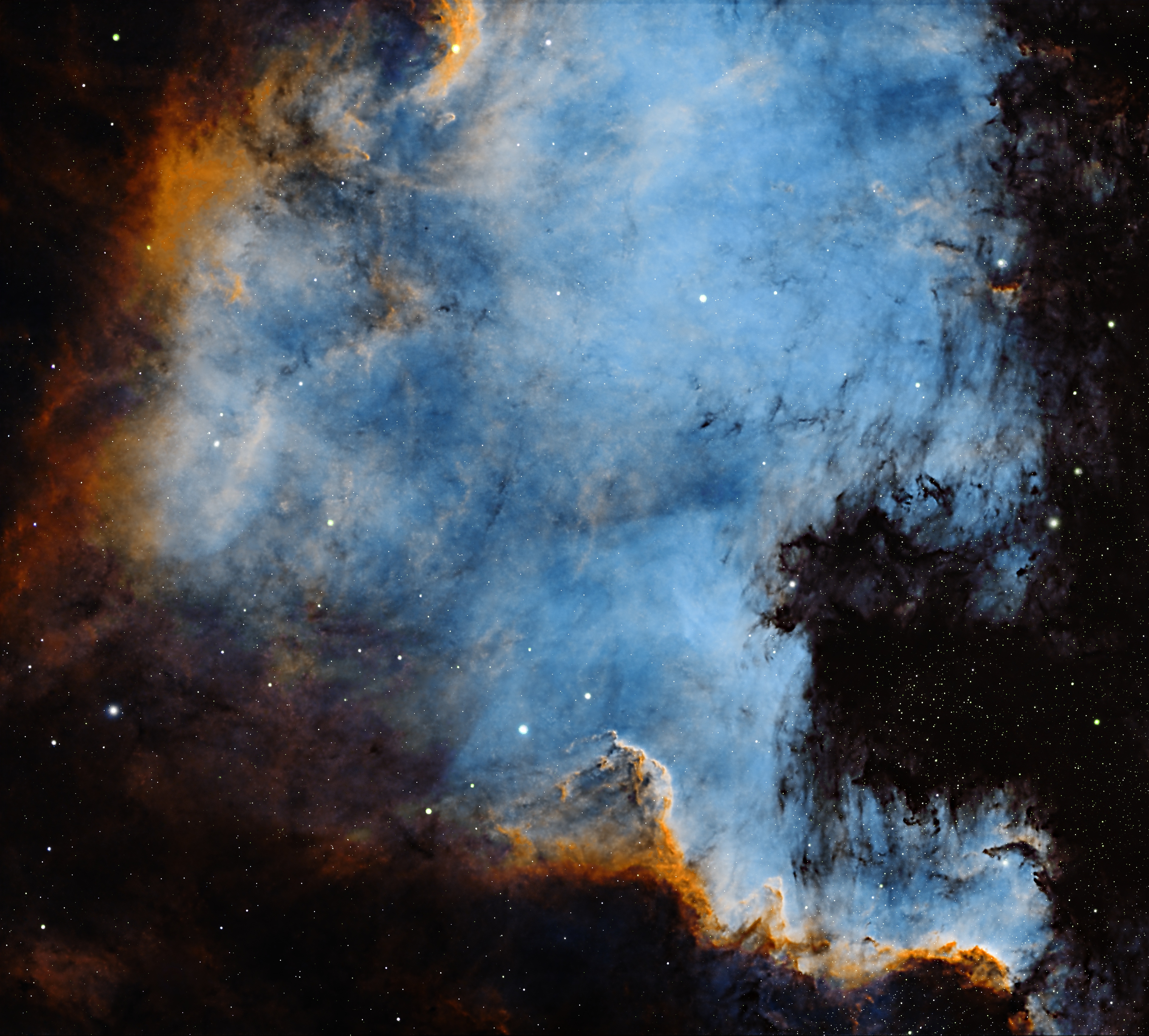
Given the aforesaid issues, I recently chose to image an old favourite which is currently in a favourable position at this time of the year, the North America Nebula (NAN), located high in the early evening night sky looking due west. Spanning some 100 light-years, NAN is a great narrowband object, which by using the Hubble SHO palette always results in an exciting and colourful image.

Over two nights I manged to obtain nearly 9-hours of good data, which at my previous Bortle 6 Surrey observatory would probably be the equivalent of more than 12 hours.  The final processed SHO image brings all three channels into a delicate balance: vibrant without being garish, detailed without overwhelming noise. The iconic “Gulf of Mexico” region forms a deep void in the nebula, which becomes even more pronounced with the various gradients of blue converging around its dark centre.  But on this occasion, I was particularly keen to emphasize details of the fabulous Cygnus Wall (see cropped image below), situated in the lower right corner of the main image i.e. ‘West Texas and Mexico’!

The Cygnus Wall is a striking, heavily sculpted region within the North America Nebula, which itself is worthy of image, which would require a larger telescope. The dense ridge of gas and dust glows brightly as nearby young, massive stars bombard it with intense ultraviolet radiation, causing it to ionize and shine.  Its dramatic pillars, ridges, and cavities resemble a cosmic coastline, shaped by stellar winds and ongoing star formation. For some reason it’s been 8-years since I last imaged NAN, except with my Samyang widefield rig, but with the excellent night skies of Somerset I feel sure I’ll be back sooner next time, perhaps with a bigger telescope?


Heavenly Art

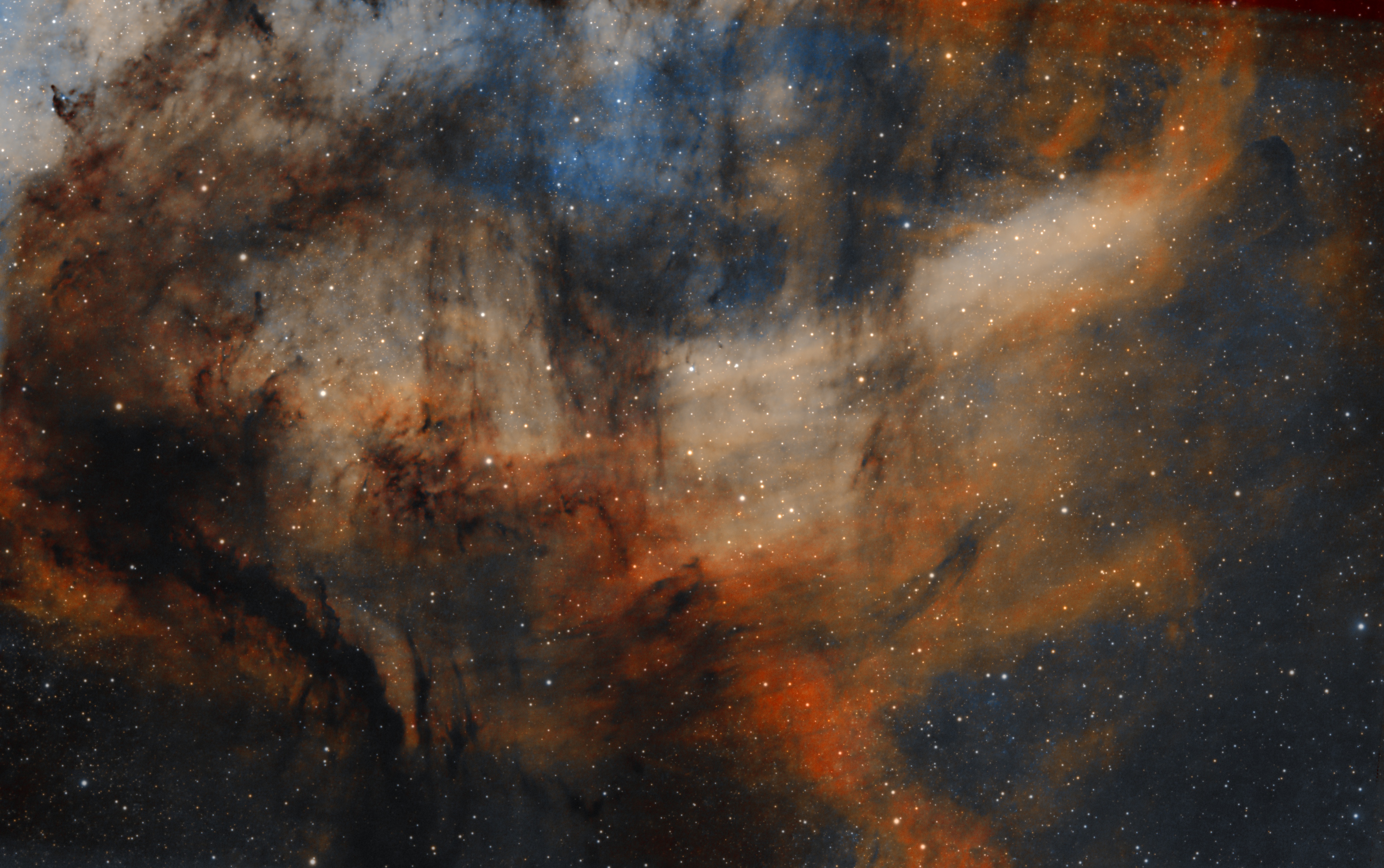
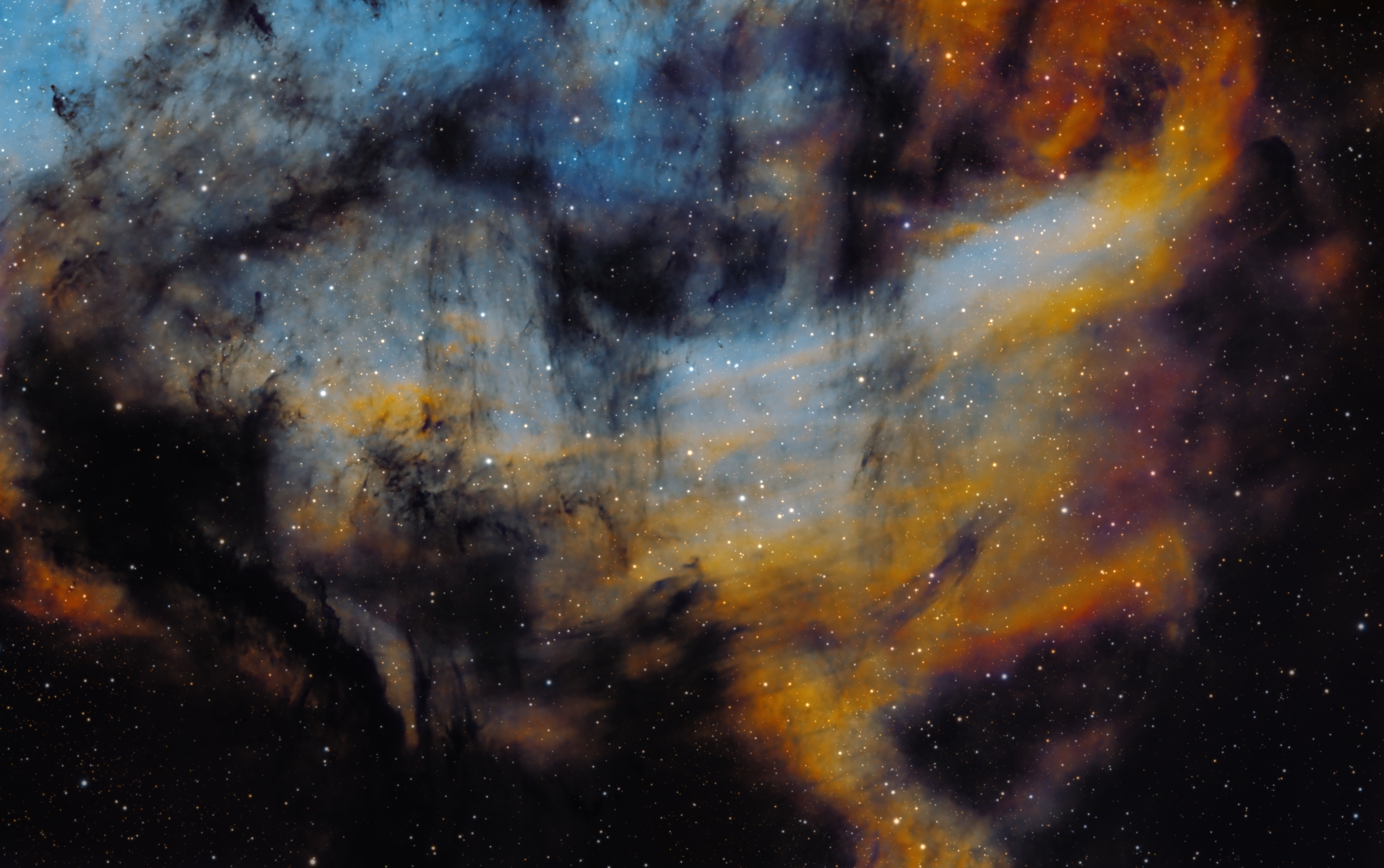
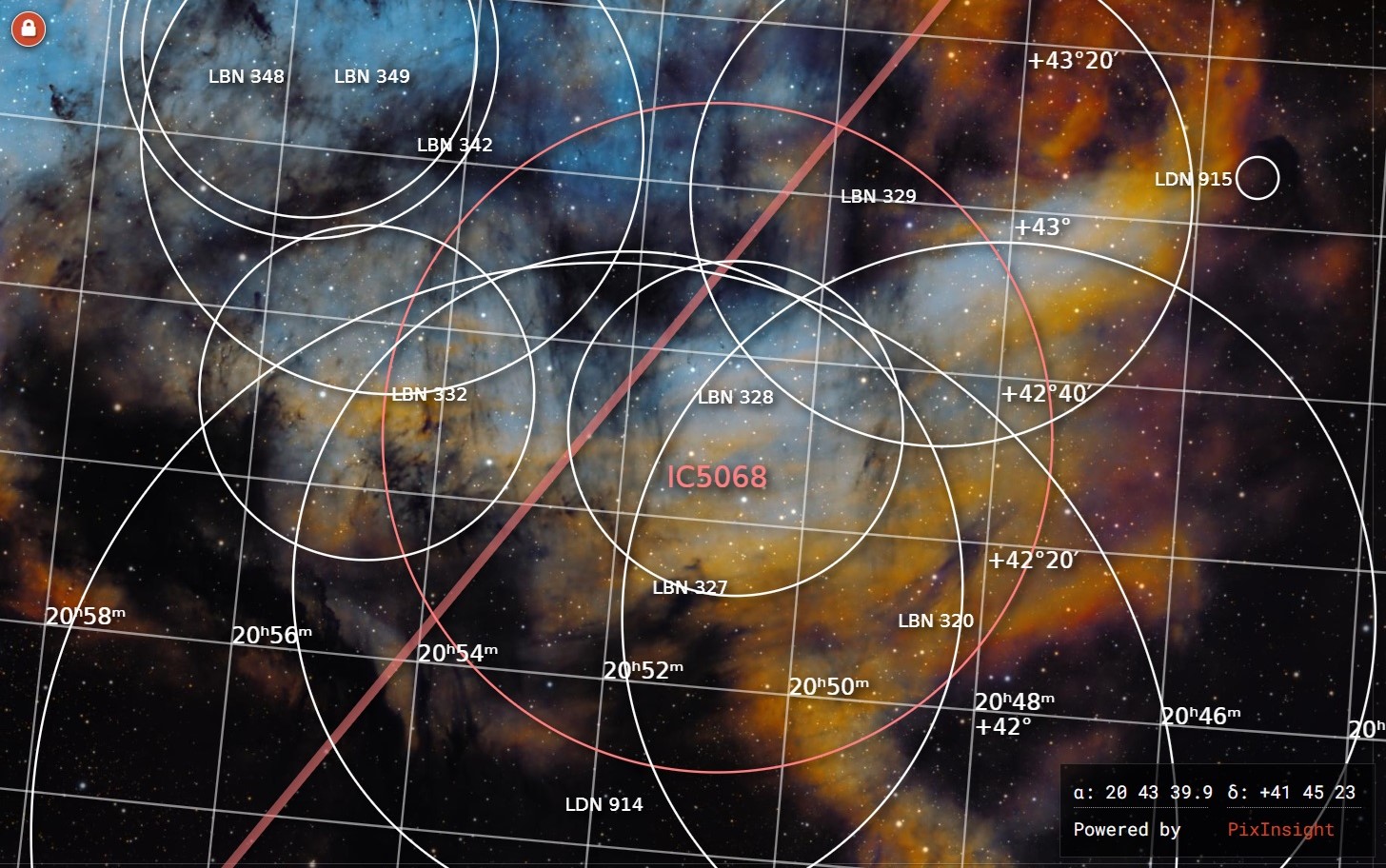
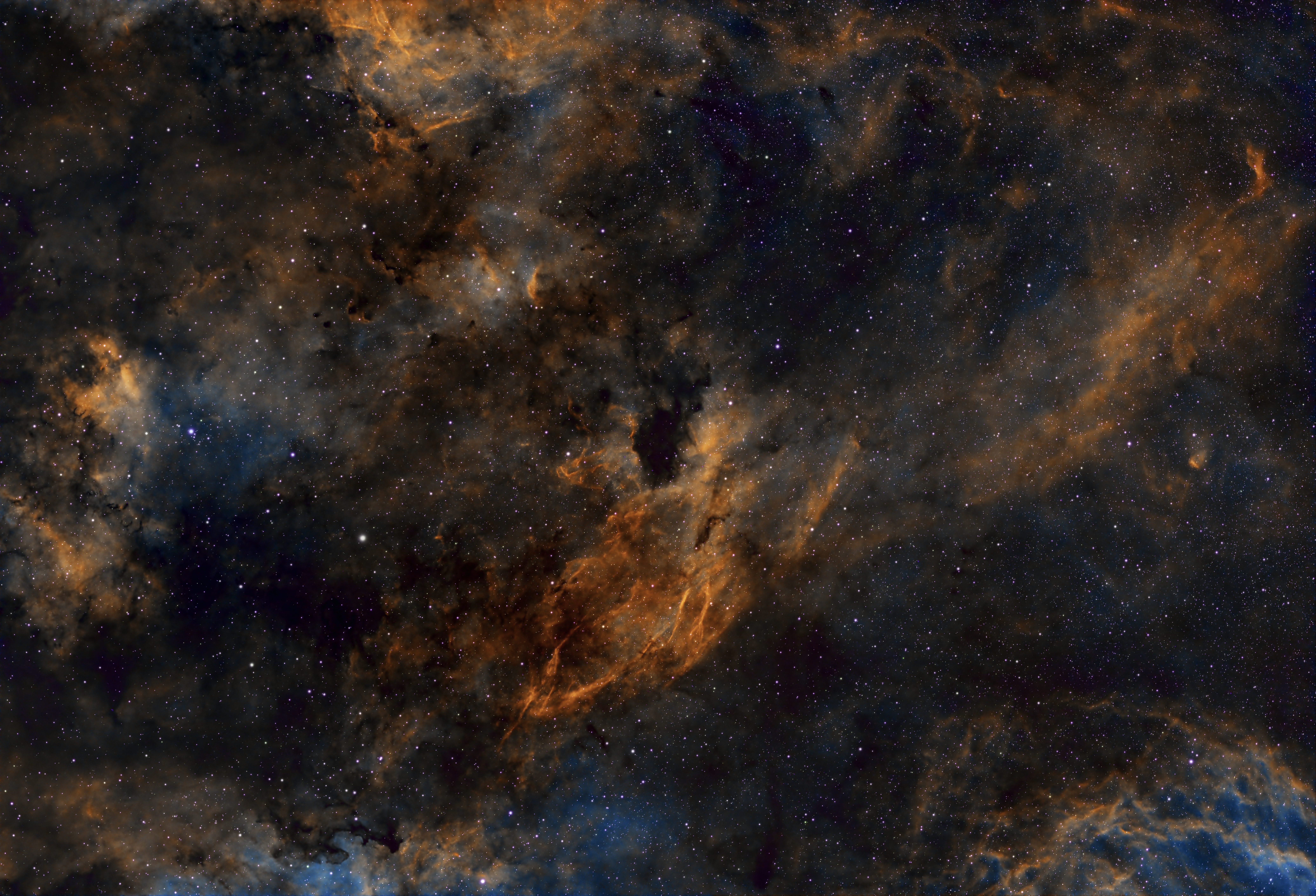
It’s at this time of the year I turn my attention to Cygnus and the plethora of imaging opportunities it provides, which inevitably tend to be narrowband targets. This year it is IC 5068, a low emission nebula often overlooked because of its location near the more popular North American and Pelican nebulae, as well as many other fabulous targets within the adjacent Cygnus molecular cloud, and as a result is unfortunately known as the Forsaken Nebula

Located just below the Pelican Nebula and close to the blue supergiant Deneb star (see above), this complex area is known for the graphically shaped streaks of cold, dark dust clouds that criss-cross the dense, brightly coloured gas regions of nebulosity.

As a narrowband target my initial choice of image processing was the traditional Hubble Palette SHO configuration, which as envisaged, resulted in an exciting and colourful rendition of the busy IC 5068 (see image below).  Notwithstanding, having recently discovered some other, fairly new Pixinsight processing techniques (NB Color Mapper & NB Image Blend), I decided to give them a try to produce an alternative blended HOO–S image.  Though still very much recognisable as IC 5068, the resulting (warm) colours and details reveal a very different and perhaps more dynamic image (see image at the top of the page).

Narrowband images leave much to the imagination when processing and often take on a stirring look when completed.  In the case of IC 5068, each of the images produced seem to have the feel of abstract art, whilst at the same time posing many questions regarding the origin of many unusual features.  I believe this exciting region deserves much greater attention and should belong in the pantheon of popular Cygnus objects such as the North American, Pelican & Veil nebulae.  Moreover, the so-called Foresaken Nebula warrants a name more befitting of its exciting beauty.


Cygnus Hat-Trick

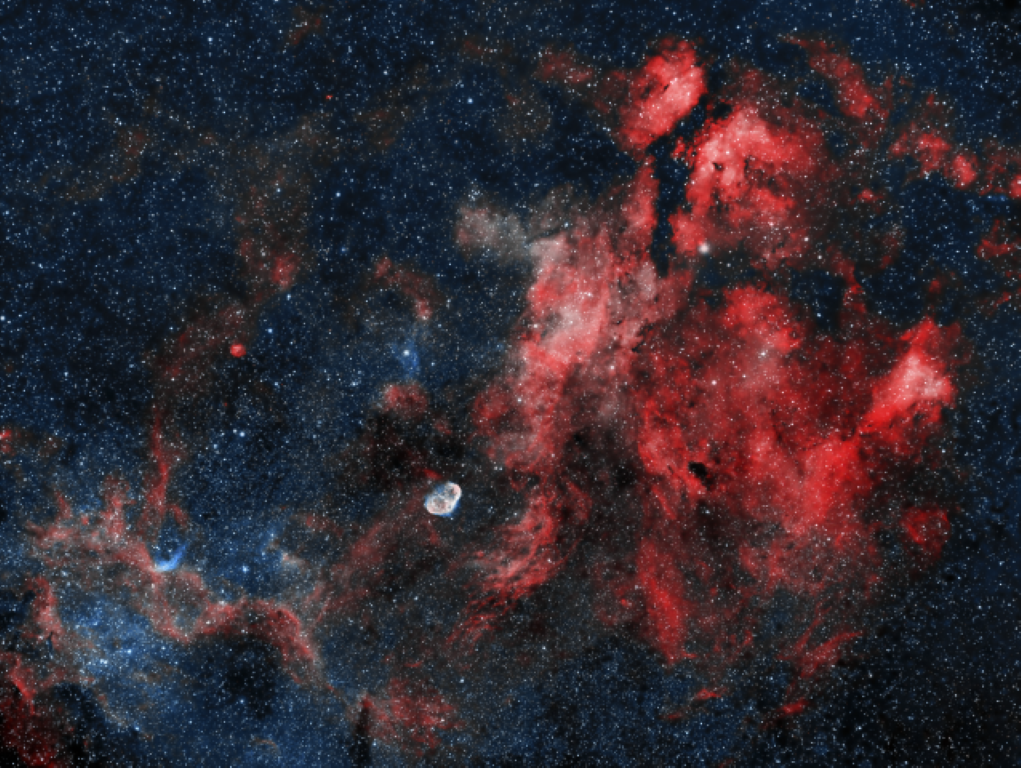
The Cygnus constellation is rich in potential astrophotography targets and since the return of astronomical darkness I’ve bagged three objects from this area with my new widefield Samyang 135 rig: Cygnus Loop, Sadr Region & Crescent Nebula, and the Western Veil & Pickering’s Triangle. As the Cygnus season now draws to a close – in my case disappearing northwards behind my house – I was ready to snap one final Cygnus object using my main William Optics GT81 rig but then looked closer and realised using the Samyang 135 rig with careful framing there was another a more ambitious possibility. 

The original object in question was SH2-119 AKA the Clamshell nebula, an emission nebula somewhat overlooked by photographers.  Nevertheless, imaged in narrowband there’s plenty of structure to see throughout the nebulosity that makes up the two ‘shells’, whilst the bright magnitude +5 star 68 Cygni might be likened to the pearl at the centre, which would work well with the 81mm William Optics field-of-view.  But deploying with care the much wider field-of-view of the Samyang 135 and it’s possible to include the North America and Pelican nebulae as well, just! 

With some difficulty (weather) I finally managed to obtain 13-hours integration time over 6-nights, which has resulted in a pleasing SHO image (see main image at the top of the page – below is a dynamic version processed using PI PixelMath), once again demonstrating the capacity of this small but powerful lens.  Personally, I find bringing all three objects together within a much larger field-of-view creates greater context, resulting in a more interesting image overall – in football parlance you might call it a hat-trick of nebulae! 


 IMAGING DETAILS
ObjectsNorth America Nebula (NGC7000) + Pelican Nebula (IC5070 & IC5067) + Clamshell Nebula (SH2-119)
ConstellationCygnus
Distanceapprox. 2,600 light-years
Size  3.0o
Apparent Magnitudeapprox. +4 to 8  
  
Scope  / LensSamyang 135 @f2.8  
MountSW AZ-EQ6 GT + EQASCOM computer control & Cartes du Ciel
GuidingSky-Watcher EvoGuide 50ED
 + Starlight Xpress Lodestar X2 camera & PHD2 guiding
CameraZWO1600MM-Cool mono  CMOS sensor
 FOV 7.5o x 5.67o Resolution 5.81”/pix  Max. Image Size 4,656 x 3,520 pix   
EFWZWOx8 EFW & 31mm ZWO LRGB & 7nm Narrowband filters 
Capture & ProcessingAstro Photography Tool + PHD2 + Deep Sky Stacker, PixInsight v1.8.8-12, Photoshop CC, Topaz Denoise
Image Location  &         OrientationCentre  RA 21:06:17.698      DEC +43:58:35.414                         Left = North   Top =West  (original rotated 90o)
ExposuresHa 61 x 300 sec, OIII 54 x 300 sec, SII 41 x 300 sec Total Integration Time: 13hr 00 min     
 @ 139 Gain   21  Offset @ -10oC    
CalibrationDarks 10 x 300 sec,  15 x Ha OIII SII flats & flat darks  
Location & DarknessFairvale Observatory – Redhill – Surrey – UK        Typically Bortle 5-6
Date & Time24th 28th 29th September 2nd 5th 6th October 2022  @ +20.30h  
WeatherApprox. <=12oC  RH  >=75%                  🌙 +80%

Diaphanous Delectation

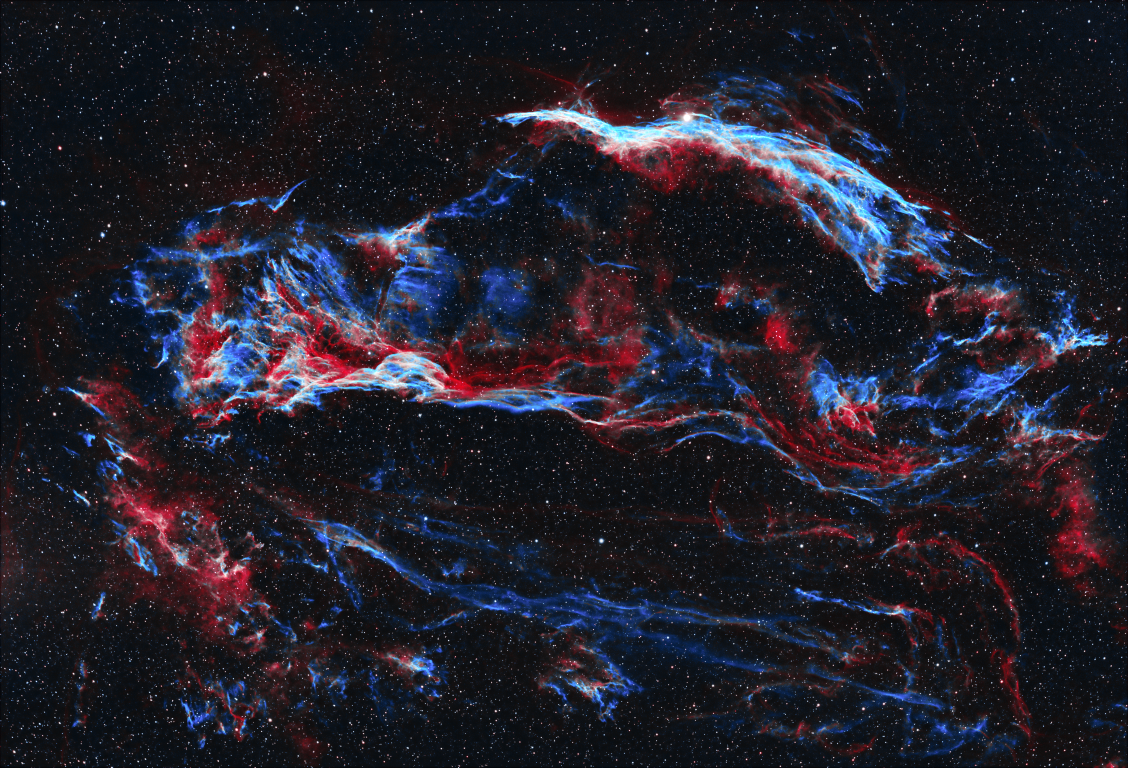
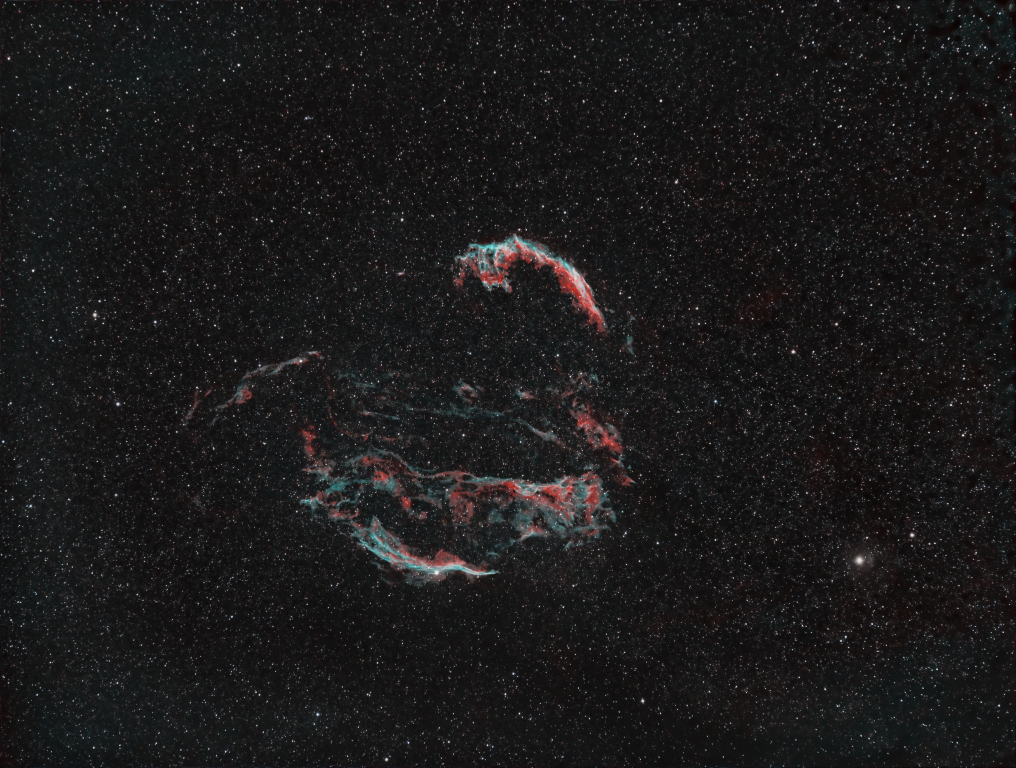
Following my routine summer break from astrophotography, I restarted in early August first using my new Samyang 135 + ZWO ASI1600MM-Cool rig, which immediately demonstrated its ability to produce excellent widefield images of very large objects, in this case the Cygnus Loop.  However, also in late spring I had rejigged my William Optics GT81 telescope with the addition of a new ASI294MM camera, the successor to the ASI1600 which had been redeployed to the aforesaid Samyang rig.  Having constructed, tested and briefly obtained First Light with this new combination, I then had to wait for the return of astronomical darkness and more suitable objects.  Once again, I turned to the Cygnus Loop but this time concentrating on the western and central areas, generally known as the Western Veil and Pickering’s Triangle.

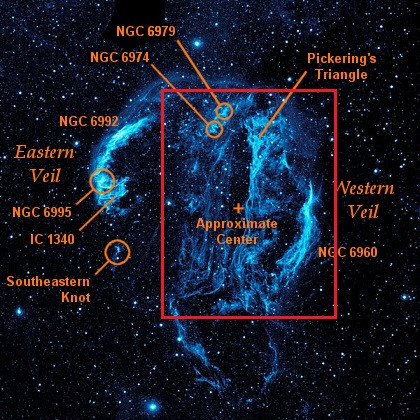
Cygnus Loop Morphology, ID &
Approximate Image Location (Red Box)

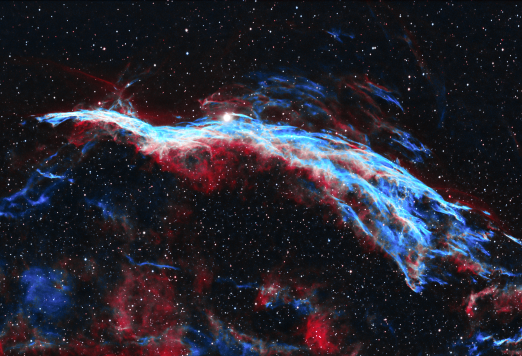
Located 1,500 light-years from Earth within the plane of the Milky Way in the constellation of Cygnus, this large supernova remnant (SNR) occurred between 5,000 and 8,000 years ago.  In its entirety the debris cloud has been sculpted by the shock wave from the star’s explosion, to form the Cygnus Loop object that we see today.  The coloured light is created by the excitement of hydrogen (red) and oxygen(blue) gasses of the SNR, which is still expanding at about 100 km (60 miles) per second; image integration times for OIII & Ha wavelengths are in the ratio of 2:1 to enhance the weaker oxygen signal.  More than twice the width of the full moon and spanning 35 light-years, this section of SNR only just fits into my field-of-view but with careful framing it works perfectly.

Western Veil (NGC 6960) Detail
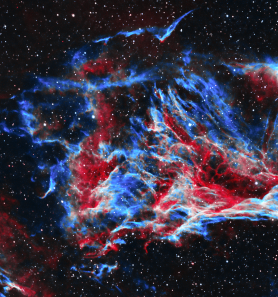
Pickering’s Triangle Detail

The resulting image successfully brings out the exquisite nature of this exciting SNR, in particular highlighting the abundant waveforms that run throughout the entirety of this dynamic object.  Furthermore, the combination of the new ASI294MM camera and 3nm Chroma filters, has produced a vibrant red-blue colour palette that further enhances the said structures.  Altogether this diaphanous delectation convincingly demonstrates the power and beauty of the Universe whilst, moreover, pointing to a new level for my astrophotography.          

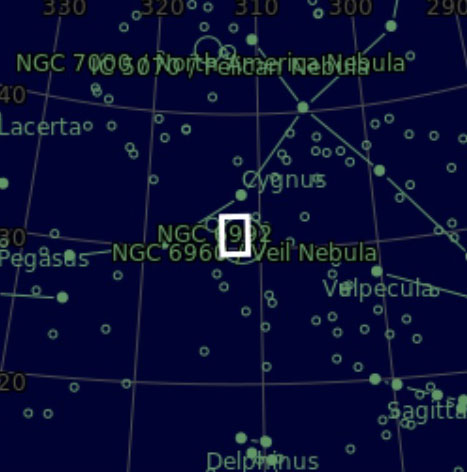
Image Location & Orientation
 IMAGING DETAILS
ObjectCygnus Loop Section: Western Veil Nebula (NGC 6960),  
Pickering’s Triangle, NGC 6979 & 6974
ConstellationCygnus
Distance1,500 light-years
Size  ~2.9o total
Apparent Magnitude+7.0  
  
Scope William Optics GT81 + Focal Reducer FL 382mm  f4.72
MountSW AZ-EQ6 GT + EQASCOM computer control & Cartes du Ciel
GuidingWilliam Optics 50mm guide scope
 + Starlight Xpress Lodestar X2 camera & PHD2 guiding
CameraZWO ASI294MM  CMOS sensor
 FOV 2.87o x 1.96o Resolution 2.50”/pix 
Max. image size 4,144 x 2,822 pix   
EFWZWOx8 EFW & 31mm Chroma LRGB filters 
Capture & ProcessingAstro Photography Tool + PHD2 + Deep Sky Stacker,
PixInsight v1.8.8-12, Photoshop CC v23.5.0
Image Location &      OrientationCentre = RA 20:48:47.0      DEC +31:00:54.7                         Left = North     
ExposuresHa 41 x 300 sec (3hr 25m), OIII 82 x 300 sec (6hr 50m) Total Integration Time: 10hr 15 min     
 @ 120 Gain   30 Offset @ -15oC    
Calibration5 x 300 sec Darks  15 x  LRGB Flats & Dark Flats         @ ADU 32,000
Location & DarknessFairvale Observatory – Redhill – Surrey – UK        Typically Bortle 5-6
Date & Time27th + 29th + 30th + 31st August 2022  @ +21.00h  
WeatherApprox. <18oC   RH >=65%                  🌙 0% New

Shrinking The Universe

Hitherto, most of my astrophotography has concentrated on a variety of specific objects that work within the 2.65o x 2.0o field-of-view provided by the combination of my William Optics GT81 refractor and ZWO ASI1600MM-Cool camera.  After recently pairing the aforesaid ZWO mono camera with a Samyang 135 lens (often marketed elsewhere as the Rokinon 135) my astrophotography world has expanded dramatically to an enormous 7.50o x 5.67o, some x8 larger than before.  As a result, this excellent lens that also captures great detail, provides new opportunities to image some of the very large features that abound throughout the Universe without having to resort to a mosaic imaging; this a great advantage when working in UK weather conditions which usually provides less imaging time than required. 

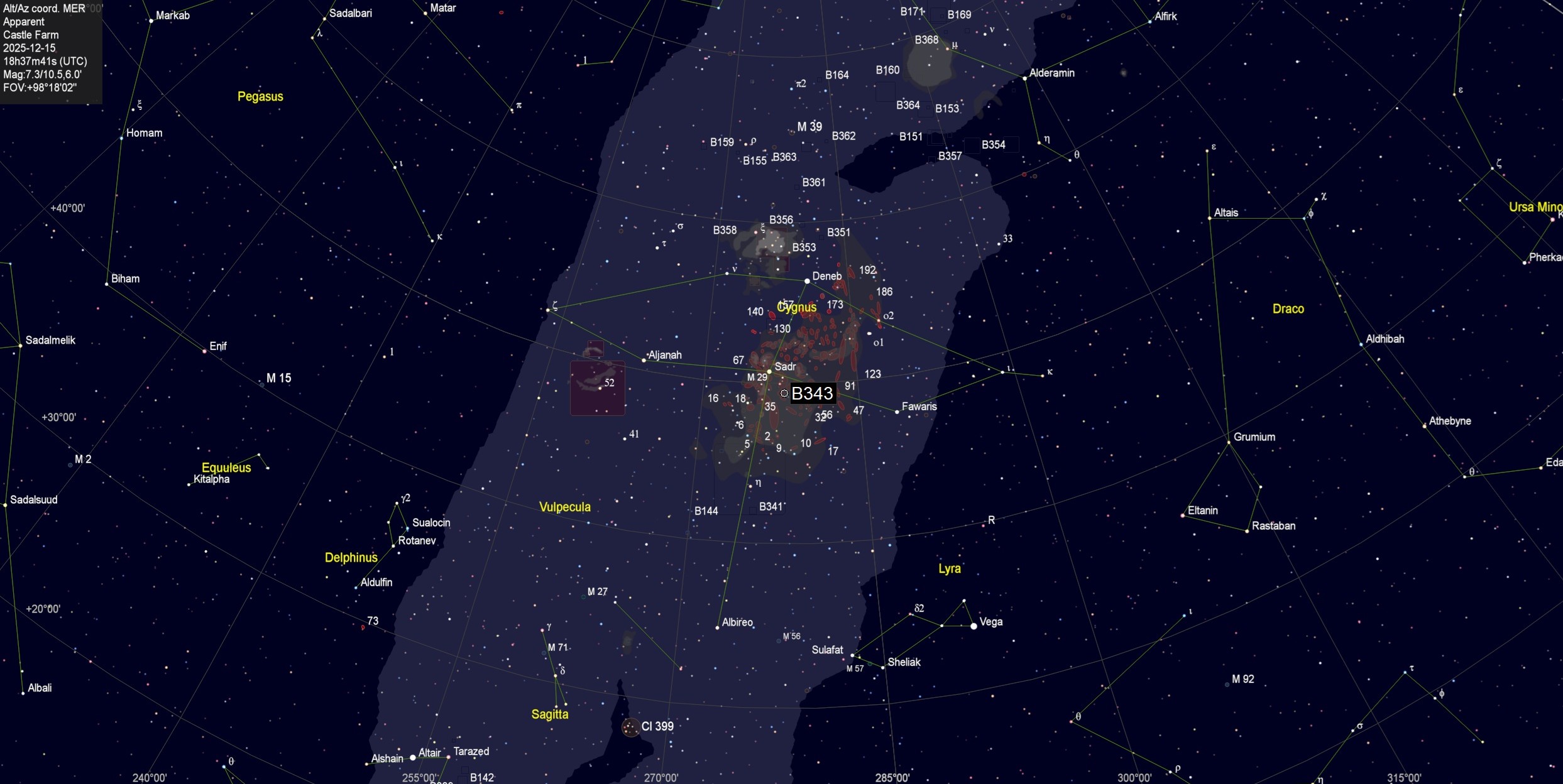
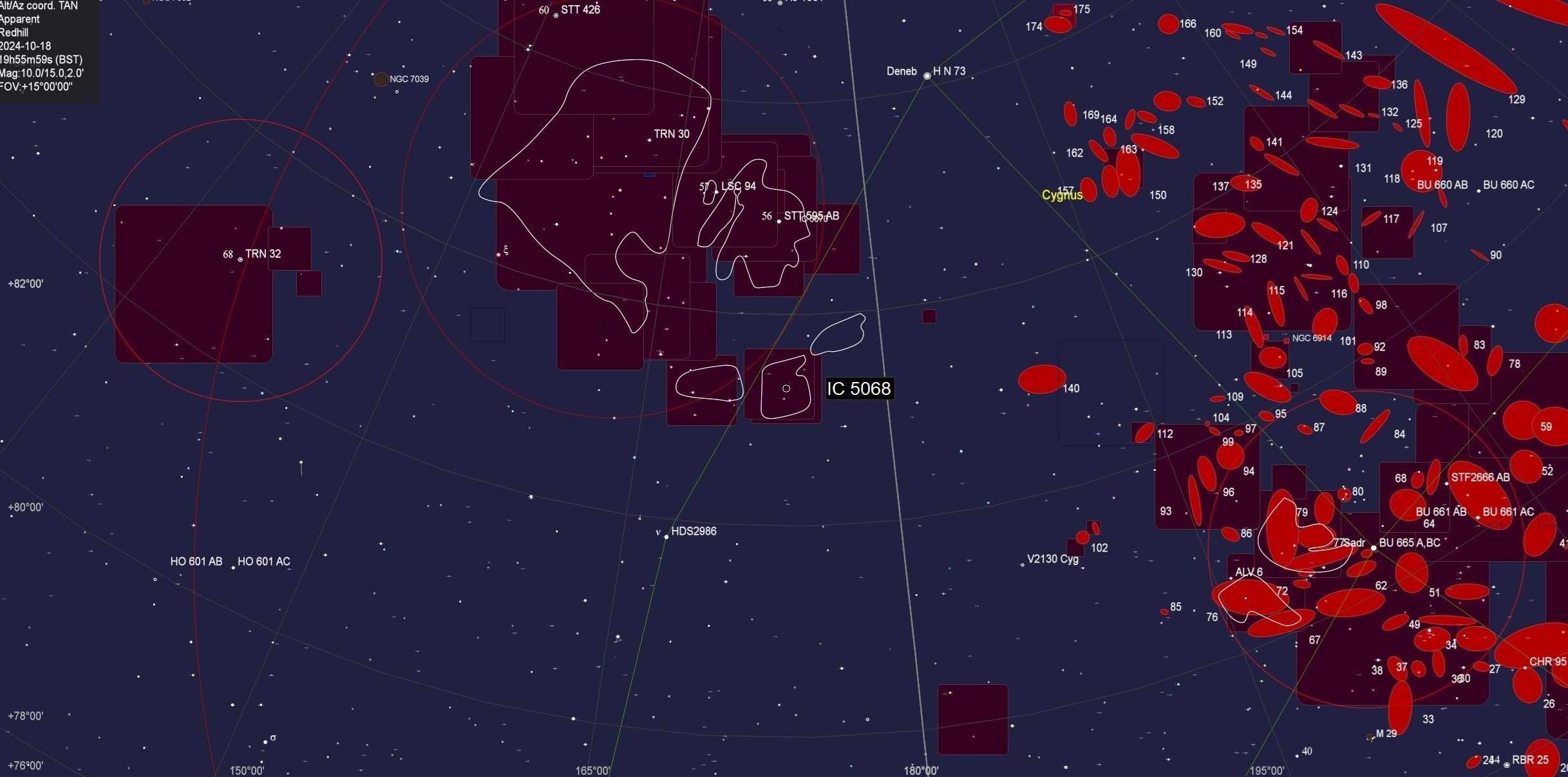
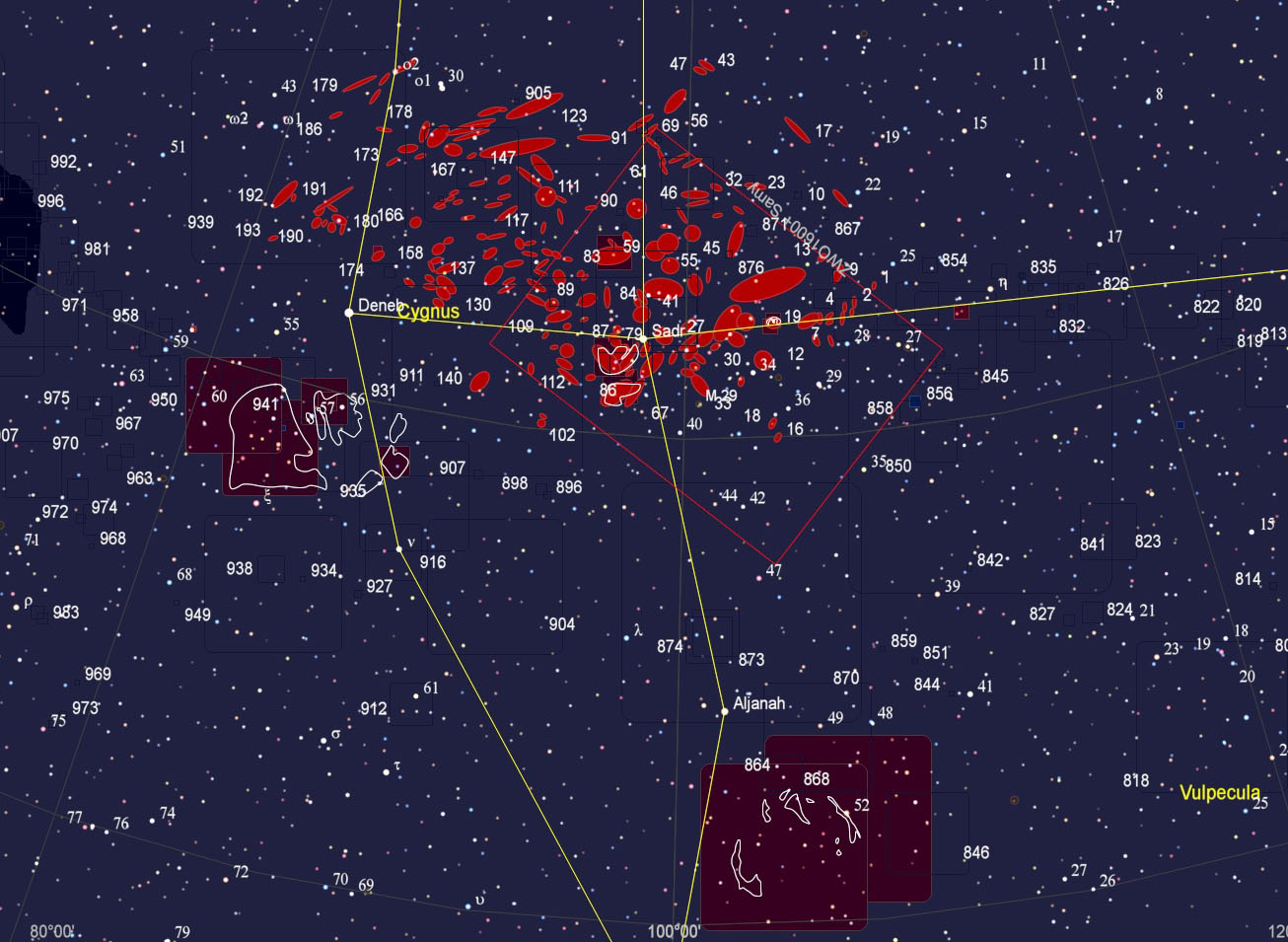
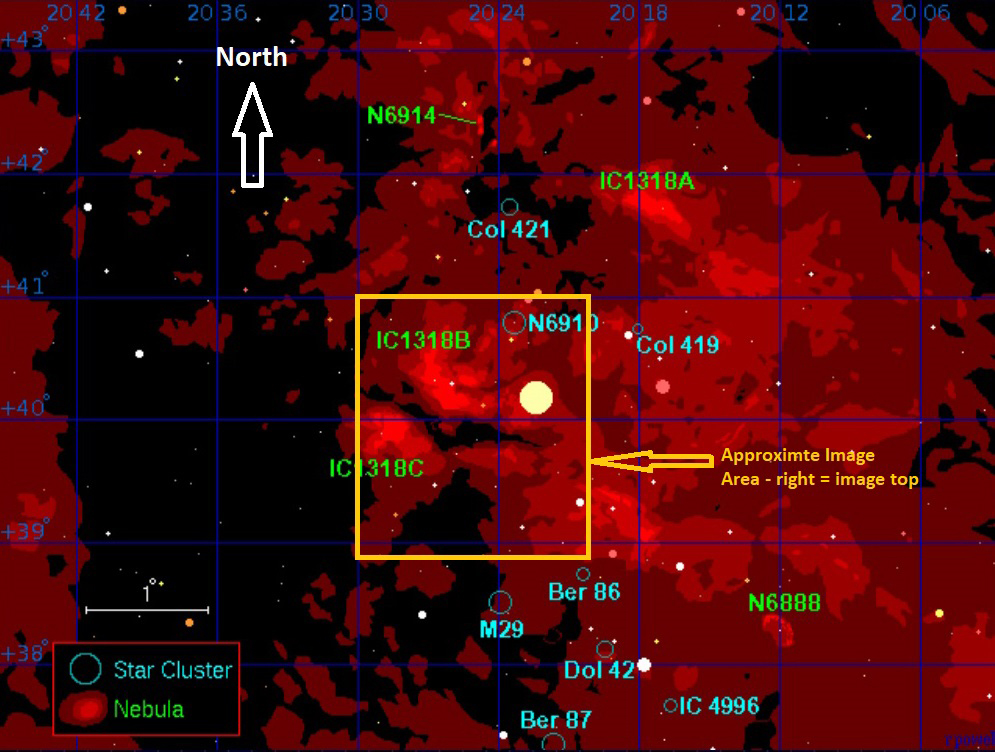
Above, Cygnus-X Region & notable nearby objects: The red box appproximately outlines the image area, which in this plan is presented upside-down compared to the main image. The numerous red shapes define the location of the HII objects that make up the DWB catalogue (19 is the Crescent nebula). Just beyond to the left is the North America Nebula (NGC7000) and below the SNR Cygnus Loop, AKA the Veil Nebula (NGC 6960 & 6992).

In this case I chose to frame the image in such a way as to encompass some familiar objects, such as the Butterfly Nebula (IC1318) and the Crescent Nebula (NGC6888) anchored by Sadr, the yellow-white supergiant star that stands out from within the very large Cygnus-X region.  Processed here in HOO, with 6-hours integration time and full calibration (darks, flats & flat darks), the final image provides a magnificent view of this large, interesting region that augurs well for future widefield imaging with this new rig.  I’m particulalry intrigued by the bluish feature at about 8.0 o’clock of the Crescent Nebula, which I now believe to be associated with WR-134: a bubble-like structure some 50 light-years in diameter consisting of OIII rich light formed by an intense wind emanating from the Wolf-Rayet star at it’s centre. The breadth of view it provides can encompass myriad of objects in exceptional detail, thereby providing a wider context that is simply awe-inspiring to see – it’s just like shrinking the Universe!


Astrometry image plan
 IMAGING DETAILS
ObjectSadr Region
ConstellationCygnus
Distance+5,000 light-years
Size Full FOV – see below            
Apparent Magnitude+/- 7.0
  
Scope  / LensSamyang 135 @f2.8  
MountSW AZ-EQ6 GT + EQASCOM computer control & Cartes du Ciel
GuidingSky-Watcher EvoGuide 50ED
 + Starlight Xpress Lodestar X2 camera & PHD2 guiding
CameraZWO1600MM-Cool mono  CMOS sensor
 FOV 7.5o x 5.67o Resolution 5.81”/pix  Max. Image Size 4,656 x 3,520 pix   
EFWZWOx8 EFW & 31mm ZWO LRGB & 7nm Narrowband filters 
Capture & ProcessingAstro Photography Tool + PHD2 + Deep Sky Stacker, PixInsight v1.8.8-12, Photoshop CC, Topaz Denoise
Image Location & OrientationCentre  RA 20:16:40.452      DEC +38:50:14.404                         Right = North   Top = East 
Exposures36 x 500 sec Ha, 36 x 300 sec OIII Total Integration Time: 6hr      
 @ 139 Gain   21  Offset @ -10oC    
Calibration5 x 300 sec Darks  15 x Flats & Flat Darks
Location & DarknessFairvale Observatory – Redhill – Surrey – UK        Typically Bortle 5-6
Date & Time10th & 12h August 2022  @ +22.00h  
WeatherApprox. 25oC   RH 50 – 60%                  🌙 100% Full Moon

A New Perspective

It’s been nearly two years since acquiring my Samyang 135 lens but since then it’s unfortunately only had limited use in combination with my modded 550D DSLR.  Whilst impressed with the results from this set-up, my main objective has always been to combine it with my ASI1600 mono camera for some serious widefield astrophotography but as that was being used with my William Optics refractor it just didn’t happen, until now.  After upgrading to a ASI294MM Pro camera in May, at last I was finally able spend the early part of this summer working on a new Samyang 135 + ASI1600 rig and now that astronomical darkness is (just) back I recently managed to catch a few photons with this new set-up of the large SNR Cygnus Loop.

I originally purchased a x2-ring Astrokraken 3D-printed clamping system for the lens + DSLR combination from Philippe in France but since then he’s tweaked the design.  In particular x3 built-in M4 nuts have been incorporated on either side of each of the two main lens clamping rings, for the purpose of attaching ancillary equipment, which for me has been a game changer.  I therefore bought a new x3-ring Astrokraken bracket, with the said bolt holes, around which to build my new rig: 

  • The two main clamping rings that hold the lens have a shoe immediately above the lens, to which I’ve fitted a Sky-Watcher EvoGuide 50ED guidescope (not yet working), with the rear third ring holding the ASI1600 mono camera & EFW. 
  • I swapped the Canon lens bayonet adapter for a bespoke M42 screw adapter, in order to ensure a more secure attachment, thus reducing any potential lens-camera movement at this critical point of the image train.  
  • I’m continuing to use the excellent Astrokraken micro-focuser, which consists of a ring that clamps onto to the lens’ focus ring, with two small bolts above that make contact with either side of the guidescope shoe, so that when turned the focus ring can be adjusted either way to obtain focus, which is then locked when completed.  So far I’ve found the micro-focuser to work very well with this lens, assisted by the addition of an Astrokraken Bahtinov mask which is inserted into the front of the lens casing.  
  • Using this lens with the ZWO ASI1600MM-Cool camera and EFW, the backfocus guideline is 44mm, which I was able to achieve by adding an Altair T2 variable locking extension ring set to 17.5mm = 44mm minus 26.5 (camera + EFW).  
  • With my Chroma filters now being used with the new ASI294MM Pro camera, I purchased another ZWO 31mm x8 EFW and brought my ZWO 31mm filters out of retirement. 
  • Finally, using the new M4 nut holes I’ve added a Baader Skysurfer III RDF on the left-hand side of the Astrokraken bracket system to help with sky navigation and framing. 

After bolting the Astrokraken with the lens, camera and said components to a Losmandy plate it makes a very nice compact rig, that is easy to handle and store.  Notwithstanding, as they say – the proof of the pudding is in the eating: SEE top-of-the page for original image & below for 50% crop.  

Whilst the recent heatwave produced clear skies, it was far from ideal here for astronomy and was further hampered by a full moon.  However, with only just over two hours integration time and a few Dark calibration files, I’m still impressed with the outcome of this quite amazing lens.  It is very pleasing to capture the entire Cygnus Loop comfortably sitting within the lens’ FOV – for information on this FOV and comparisons go to this previous WTSM blog HERE.  For me context is important with astrophotography and in this regard the astronomical perspective this lens produces is outstanding, no wonder it is so popular.  I just love working with this FOV and can’t wait for better conditions for greater integration time and more widefield targets to point this wicked little lens at.

 IMAGING DETAILS
ObjectCygnus Loop
ConstellationCygnus
Distance2,400 light-years
Size  3.0o
Apparent Magnitude+7.0  
  
Scope  / LensSamyang 135 @f2.8  
MountSW AZ-EQ6 GT + EQASCOM computer control & Cartes du Ciel
Guiding – Not UsedSky-Watcher EvoGuide 50ED
 + Starlight Xpress Lodestar X2 camera & PHD2 guiding
CameraZWO1600MM-Cool mono  CMOS sensor
 FOV 7.5o x 5.67o Resolution 5.81”/pix  Max. Image Size 4,656 x 3,520 pix   
EFWZWOx8 EFW & 31mm ZWO LRGB & 7nm Narrowband filters 
Capture & ProcessingAstro Photography Tool + PHD2 + Deep Sky Stacker, PixInsight v1.8.8-12, Photoshop CC, Topaz Denoise
Image Location        & OrientationCentre  RA 20:52:28.01      DEC +31:14:56.186                         Right = North   Top = East 
Exposures27 x 180 sec Ha, 20 x 180 sec OIII Total Integration Time: 4hr 21 min     
 @ 139 Gain   21  Offset @ -10oC    
Calibration5 x 180 sec Darks  
Location & DarknessFairvale Observatory – Redhill – Surrey – UK        Typically Bortle 5-6
Date & Time9th & 10h August 2022  @ +22.00h  
WeatherApprox. 27oC   RH <=50%                  🌙 96% Full Moon

The Well & The Butterfly

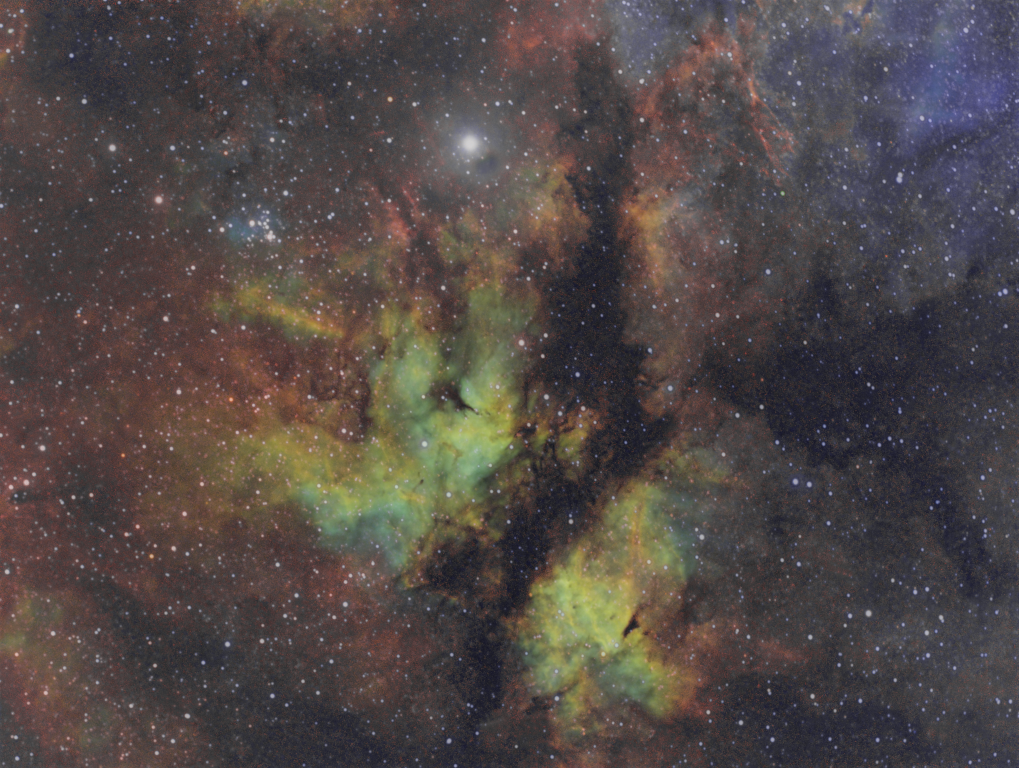
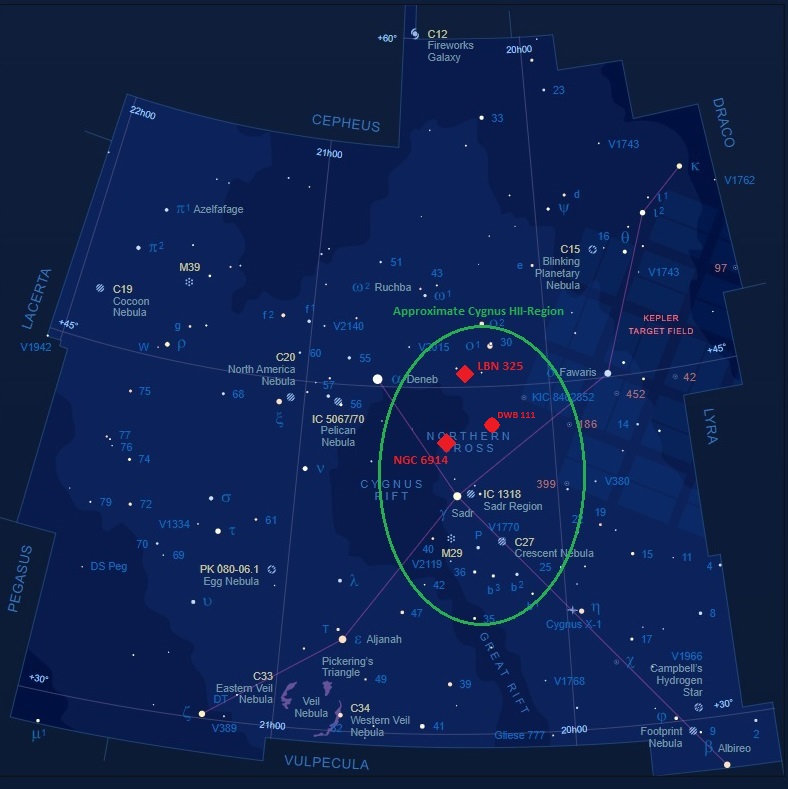
Located within the Orion Arm of the Milky Way galaxy is the Gamma Cygni nebula, a diffuse emission nebula that surrounds the star of the same name, otherwise better known as Sadr.  Moreover, this large area forms part of an even bigger HII-region that is mainly (80%) located in the north and east quadrants of the so-called Cygnus Cross, which is defined by the stars Deneb – Sadr – Delta Cygni – Albireo – Aljanah (see below). 

This vast area passes directly high overhead at this time the year before disappearing behind the house roofline in the early morning hours and has already provided many exciting imaging opportunities for me in the past.  The heart (not the centre) of the region is the supergiant star Sadr and I first imaged this area in autumn 2015 using my modded DSLR camera.  A return visit was therefore long overdue and this time I set out to better capture the so-called Butterfly Nebula in narrowband wavelengths.

The resulting data has been processed to good effect as an SHO image (see top-of-the-page) using the Hubble Palette techniques.  Other than the dominant supergiant star Sadr and widespread colourful nebulosity, two significant features are worthy of note in the final image.  Either side of the almost central dark rift that divides the image laterally, are two large bright areas which together form the ‘wings’ of the so-called Butterfly Nebula IC 1318-C (right = south) and IC 1318-B (left = north).  Furthermore, just beyond the Butterfly’s left wing north of Sadr is the young, bright open star cluster NGC 6910.

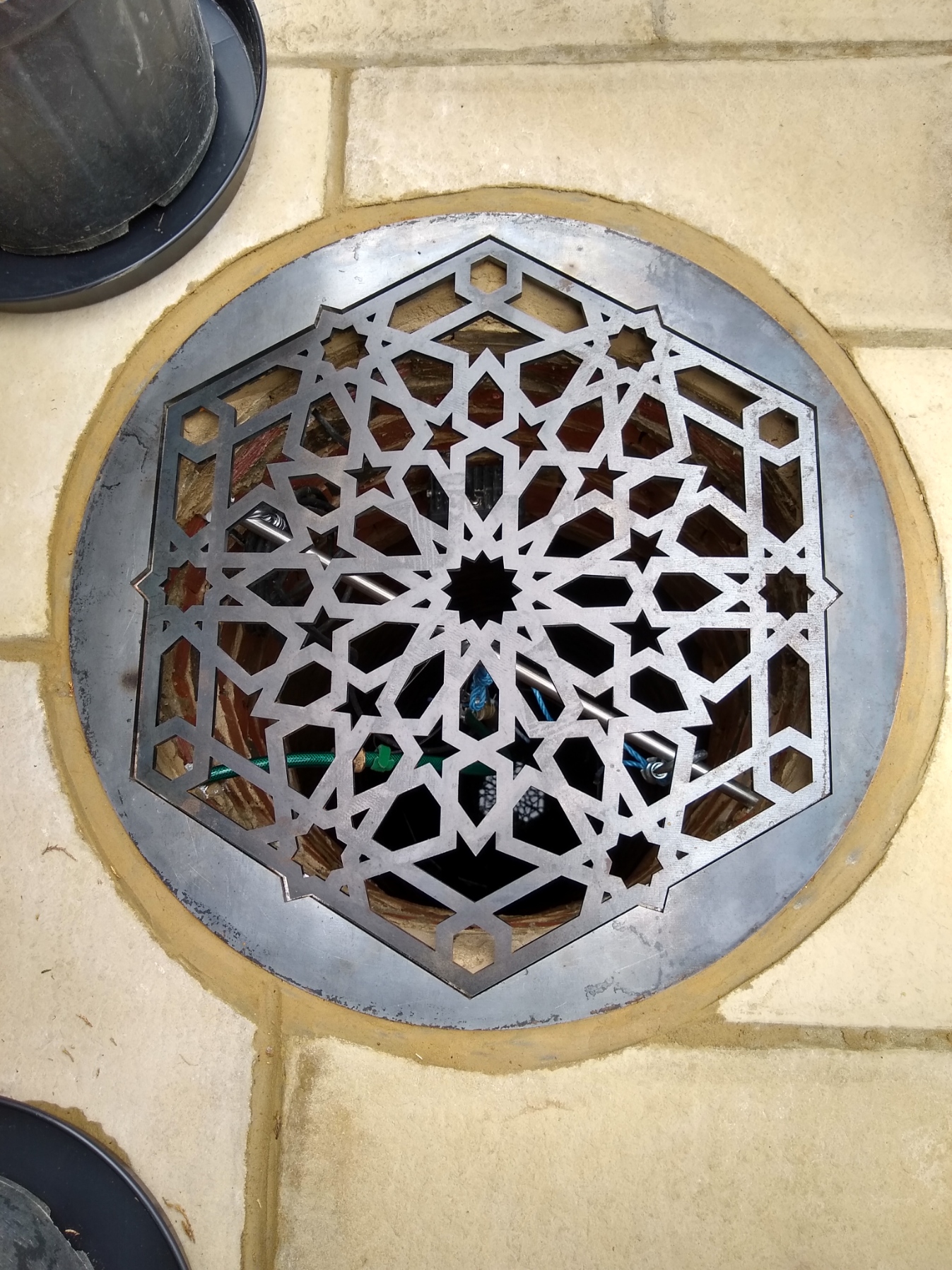
Finished well with submersible water pump & floodlight (turned off for astronomy!)

I’m very pleased with this image, which is my first since the end of March, in part because nowadays I take an astronomy break during the long late spring / summer days when astronomical darkness is largely absent. However, this year the pause has been protracted as the patio on which Fairvale Observatory is situated was re-laid, during which a hitherto unknown water well was discovered. Thereafter one thing led to another and turned into a summer project to recommission the well, thus delaying completion of the patio.  As a result I’ve only recently been able to reinstate the astronomy equipment, a job that is still ongoing. The new patio is firm and flat, providing a much better surface for the mount than before and I’m hopeful that once recalibration is completed will result in improved tracking results – watch this space!

 IMAGING DETAILS
ObjectIC1318-B & IC1318-C  Gamma Cygni  Nebula or Butterfly Nebula NGC 6910 Open cluster
ConstellationCygnus
Distance3,700 light-years
Size 1Approximately 100 light-years
Apparent MagnitudeVaries  
  
Scope William Optics GT81 + Focal Reducer FL 382mm  f4.72
MountSW AZ-EQ6 GT + EQASCOM computer control & Cartes du Ciel
GuidingWilliam Optics 50mm guide scope
 + Starlight Xpress Lodestar X2 camera & PHD2 guiding
CameraZWO1600MM-Cool mono  CMOS sensor
 FOV 2.65o x 2.0o Resolution 2.05”/pix  Max. image size 4,656 x 3,520 pix   
EFWZWOx8 EFW & 31mm Chroma LRGB filters 
Capture & ProcessingAstro Photography Tool + PHD2 +  Deep Sky Stacker, PixInsight v1.8.8-8, Photoshop CS3, Topaz Denoise
Image Location              & OrientationCentre  RA 20:25:20.492      DEC +40:11:20.970                      Left = North     
Exposures21 x 300 sec Ha, OIII, SII Total Integration Time: 5hr 15 min     
 @ 139 Gain   21  Offset @ -20oC    
Calibration5 x 300 sec Darks 15 x  Flats & 10 x Dark Flats  Ha, OIII, SII  @ ADU 25,000
Location & DarknessFairvale Observatory – Redhill – Surrey – UK        Typically Bortle 5-6
Date & Time6th & 7th September  2021  @ +21.00h  
WeatherApprox. >=17oC   RH >=45%                  🌙 New Moon


Swan Adventures

I first visited the constellation of Cygnus soon after starting astrophotography, inevitably to image the Veil Nebula and North America (NAN) & Pelican Nebula, or parts thereof.   As my abilities and equipment improved I’ve often returned to each of these popular targets, in the hope of obtaining a better image each time and I’m sure I will continue in this pursuit.  However, such is the draw of these iconic objects that it’s easy to overlook other equally exciting targets within the same constellation.  

Last year (2019) my attention was drawn to such a target in the form of DWB 111 or the Propeller Nebula, which I successfully imaged and thereby ignited my interest in the rich, very large HII-region of Cygnus (see above), within which imaging possibilities are almost endless.  I therefore recently went back during this September to image two less popular targets located within the aforesaid HII-region; I had already imaged the NAN and Veil Nebula again in early September, on which occasion using my new Samyang 135mm f2 lens set-up to obtain wide-field shots.

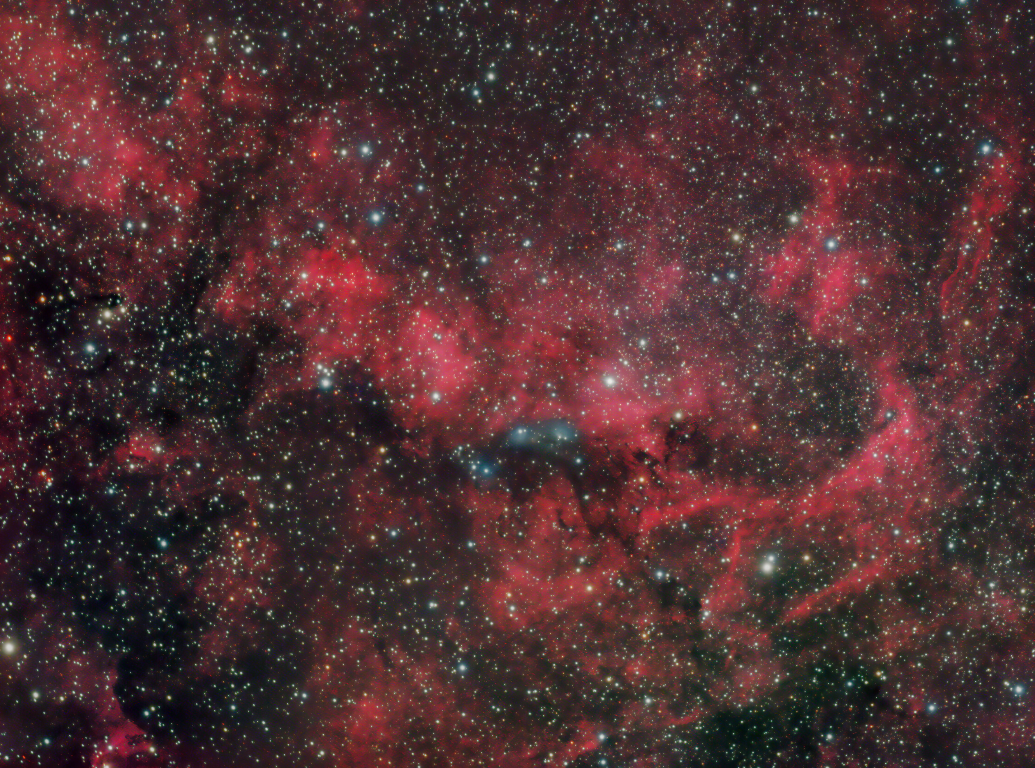
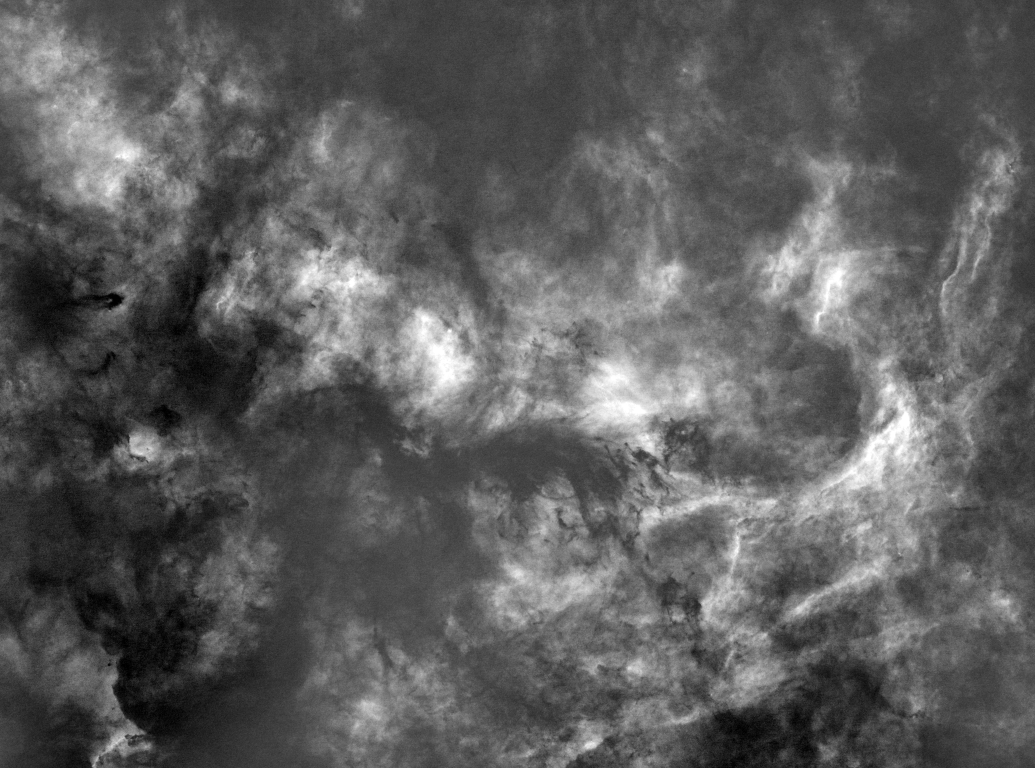
After first imaging LBN 325 and other emission nebulae across the adjacent area, I turned my attention to a neighbouring part of the said HII-region of Cygnus, likewise found in the quadrant of Cygnus defined by the stars Deneb – Sadr – Delta Cygni.  Similarly this area is full of numerous emission nebulae but furthermore here strikingly intercalated with dark nebula, star clusters and in particular reflection nebulae.  Most prominent of these near the centre of the image is NGC 6914, vdB 131 & vdB32 (Main image top-of-the-page), which are conspicuously highlighted by associated bright blue nebulosity.  Dotted throughout the rest of the image the use of HaLRGB picks out many other blue and rare yellow refection nebula and stars that all together make for an exciting image (Ha starless image above).  Such is the quality and vastness of this part of Cygnus for potential image targets that I feel sure I’ll be coming back to this region for many years to come.

 IMAGING DETAILS
Category / Object Reflection Nebula  NGC 6914
ConstellationCygnus
Distance6,000 light-years
Size2.5o x 1.90o
Apparent Magnitude?
  
Scope William Optics GT81 + Focal Reducer FL 382mm  f4.72
MountSW AZ-EQ6 GT + EQASCOM computer control & Cartes du Ciel
GuidingWilliam Optics 50mm guide scope
 + Starlight Xpress Lodestar X2 camera & PHD2 guiding
CameraZWO1600MM-Cool mono  CMOS sensor
 FOV 2.65o x 2.0o Resolution 2.05”/pix  Max. image size 4,656 x 3,520 pix   
EFWZWOx8 + ZWO LRGB & Ha OIII SII 7nm filters 
Capture & ProcessingAstro Photography Tool + PHD2 +  Deep Sky Stacker + PixInsight + Photoshop CS3 + Topaz AI Denoise
Image Location              & OrientationCentre:   RA 20h 25’ 23.097”       DEC +42o 22’ 41.092”                      Top of image = approximately North     
Exposures36 @ 300 sec Ha  +  37 x LGB  36 x R @ 180 sec Time: Ha 3hr LRGB  7hr 21min  =  Total 10hr 21 min   
 @ 139 Gain   21  Offset @ -20oC    
Calibration5 x 300 sec Ha + 10 X 180’ LRGB  Darks,  20 x 1/4000 sec Bias  10 x  HaLRGB Flats               @ ADU 25,000
Location & DarknessFairvale Observatory – Redhill – Surrey – UK        Typically Bortle 5-6
Date & Time17th 20th 21st September 2020  @ +21.00h  
WeatherApprox. 15oC   RH = 45- 70%                  🌙 New – 22% waxing

Reach For The Sky

In September I returned to the Cygnus constellation, popular for The North America and Veil Nebula at this time of the year but elsewhere often overlooked by astrophotographers.  In particular the vast HII-region that is located around the Deneb-Sadr area which contains an abundance of exciting imaging opportunities, this time my target was LBN325 which contains numerous Ha emission nebulae, a dark nebula and a supernova remnant. To capture these features at their best, I chose to shoot, process and then combine separate HaOO narrowband and RGB images for the first time.     

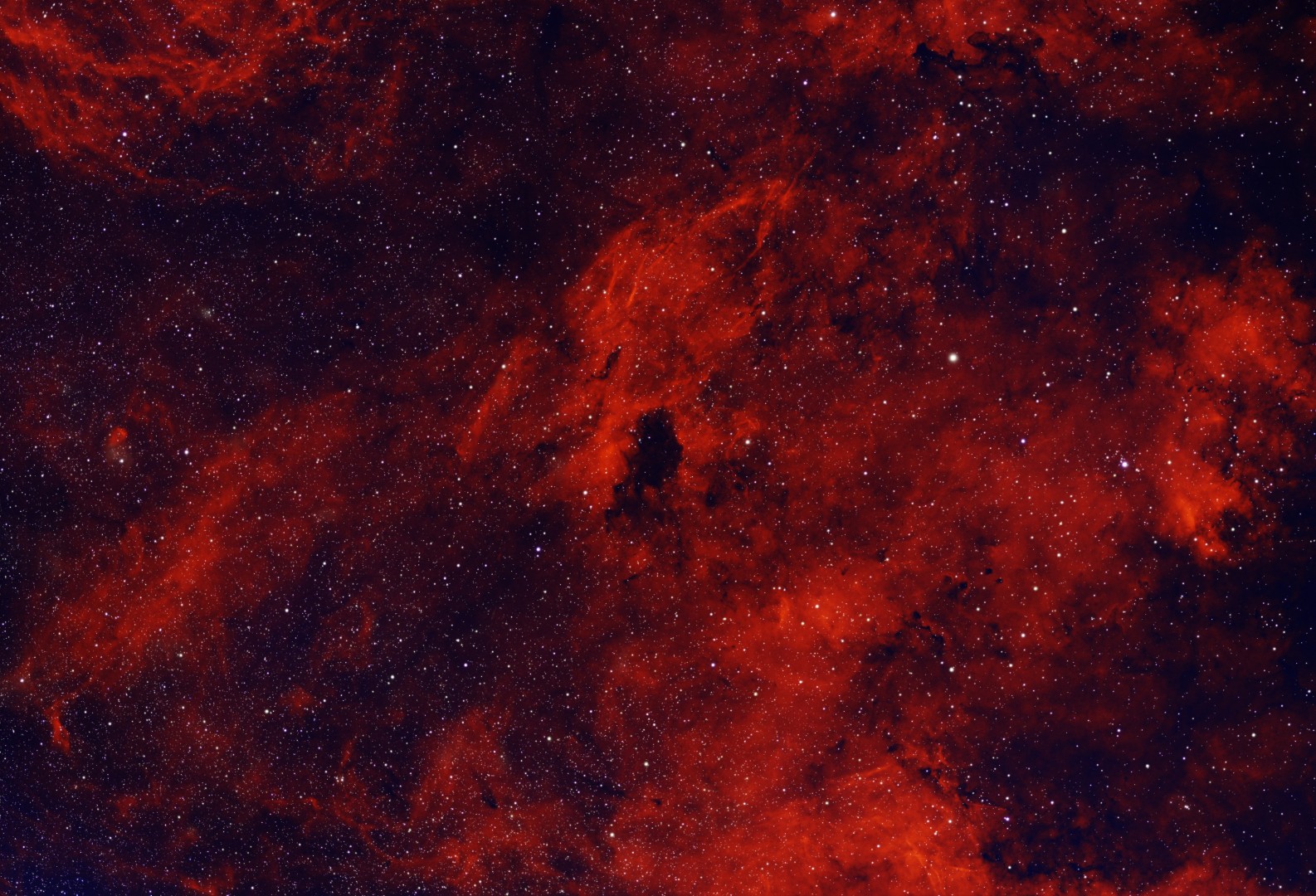
Integrating RGB data for better star colours and narrowband data for nebulosity turned out to be tricky but by removing the stars from the narrowband nebulosity and then processing the starless image before combining with RGB image manually eventually worked out well (see top-of-the-page image).  However, the narrowband and broadband data had respectively been taken either side of the Meridian without plate solving and unfortunately my manual alignment was on this occasion poor.  However, with careful cropping I was eventually able to able to align and combine each of the images, though at the cost of losing 25% of the overall field-of-view which did not overlap; see full size Ha-image below with interesting features along left and right edges which had to be cropped out to align the final narrowband and broadband images.

In addition to LBN325 there are a large number of other notable features (see Image Details table at the end & Nico Carver’s annotated image below – green outline delineates areas of my image).  In addition to the many Ha emission nebulae, the most noteworthy are the dark nebula Barnard 345 and a large section of the Supernova Remnant G082.2+53.  Some 100 light-years in total diameter, this OIII-rich feature is unfortunately too faint to be picked out in my image, which would require significantly more OIII data to be seen.  Looking further afield of the image the continuing richness of the adjoining area cannot be overstated, which is beautifully seen in Nico Carver’s accompanying image (Northwestern Cygnus by Nico Carver is licensed under a CC BY-SA 4.0 License) – an 8-pannel 46-hour mosaic!  I can only dream of such work but certainly hope to return to this area again when possible, in order to enjoy more of the exquisite objects that can be found across this truly exciting area of Cygnus.  But for now there’s another story about this image.

For some time I’ve known that I had to improve my processing skills and to this end purchased PixInsight software at the beginning of the year. Very few of the best astrophotographers do not use this processing software but PixInsight has a notoriously steep learning curve and no doubt like many others I gave up after a few days!  I can unequivocally say that PixInsight is by far the most user unfriendly software I’ve come across in nearly four decades; there’s no denying it’s abilities but the developers clearly gave very little thought to its users.  Nonetheless, spurred on by the need to improve my images and the ‘opportunity’ of more time that Covid-19 has provided us all recently, I returned to PixInsight a number of times over the summer and slowly made progress.

Cropped HaLRGB M101 practice image from scratch – using Pixel Math to add Ha has worked within the galaxy but unfortunately seems to have spread into other areas too!

Using my existing data for M101, I first spent many days working through the calibration and integration process, which can only be described as exhausting!  Undeterred and in an effort to speed up matters, I moved on to Batch Processing, which though helpful only partially assists the overall task of pre-processing and inevitably put PixInsight aside again in order to find renewed enthusiasm to continue.  From this initial experience I had already come to one conclusion – that I would not be using PixInsight for calibration and integration, continuing for now with Deep Sky Stacker and possibly later switching to either Astro Pixel Processor (APP) or Astro Art, both of which get good user reviews.

From the results of others it’s clear that PixInsight is a route to better images and there is no shortage of online tutorials and books but hitherto I’d not found one that worked well for me.    Online tutorials by Light Vortex Astronomy are an excellent learning aid but tricky to work with on screen and Harry’s Astro Shed video tutorials were also helpful but I needed a book on the matter to read, thumb through and casually refer to when needed.  Then I got lucky!

It was my good fortune that in May a new text by Rogelio Bernal Andreo (AKA ‘RBA’) Mastering PixInsight became first digitally available and then in September was published as a book. The work is divided into two well thought out and presented volumes:

  • A comprehensive, easy-to-follow and understand description of how to use PixInsight
  • A reference guide providing more in-depth information on specific PixInsight processes

The two volumes come as a boxed set, are well bound and illustrated and for the first time (from my point-of-view) form an accessible, easy to use and helpful text on PixInsight.  RBA deserves every success with this outstanding book(s) which I believe will transform the otherwise torrid experience of learning PixInsight.  Armed with RBA’s Mastering PixInsight, Light Vortex Astronomy online tutorials, Harry’s Astro Shed and a other online videos, I’m pleased to say that I am now at last able to use PixInsight for processing and LBN325 is my first image; I should also mention Shawn Nielsen’s excellent Visible Dark YouTube channel, which demonstrates a number of very useful techniques.

As my first attempt to use PixInsight for processing, I’m pleased with the outcome of LBN 325 but realise there’s still much more to learn and, aside from the framing error, it’s clear that even more integration time is needed to get the best of LBN325 and its companions.  Going forwards PixInsight and Photoshop both have their respective strengths and weaknesses and judicious use of various techniques from each is probably going to yield the best results.  For now, at least, I feel the considerable time put into learning PixInsight is starting to pay off and I’ve finally turned a corner with my processing.

 IMAGING DETAILS
ObjectLBN325 & 326 +  Barnard 345 &  SNR G082.2+5.3 DWB 156, 167, 165, 168, 170, 176,
ConstellationCygnus
Distance5,000 light-years?
Size>2o
Apparent MagnitudeNA
  
Scope William Optics GT81 + Focal Reducer FL 382mm  f4.72
MountSW AZ-EQ6 GT + EQASCOM computer control & Cartes du Ciel
GuidingWilliam Optics 50mm guide scope
 + Starlight Xpress Lodestar X2 camera & PHD2 guiding
CameraZWO1600MM-Cool mono  CMOS sensor
 FOV 2.65o x 2.0o Resolution 2.05”/pix  Max. image size 4,656 x 3,520 pix   
EFWZWO x8 + ZWO LRGB & Ha OIII SII 7nm filters 
Capture & ProcessingAPT + PHD2 +  DSS + PixInsight +  Photoshop CS3 + Topaz Denoise AI
Image Location            Centre  RA 20h 18’ 42.55”     DEC +46 25’ 03.12”        
ExposuresNB 300 sec x 53 Ha & x 38 OIII       BB 60 sec x 49 R, x 35 G & x 50 B Time: NB 7hr 58 min   BB 2hr 14 min  TOTAL 9hr  49 min   
 @ 139 Gain   21  Offset @ -20oC    
CalibrationDarks 5 x 300 sec & 10 X 60’    20 x 1/4000 sec Bias   5 x Ha & OIII Flats  10 x LRGB Flats     @ ADU 25,000
Location & DarknessFairvale Observatory – Redhill – Surrey – UK        Typically Bortle 5-6
Date & Time9th 13th & 14th September 2020  @ +21.00h  
WeatherApprox. 15-20oC   RH <=60%                  🌙 20% waning