Perspective: A wider view of the Universe

Earlier this year we went to the island of La Palma in the Canary Islands, which is recognised as the best astronomy site in Europe, where more than twelve major observatories have been built at an altitude of 2,396 meters on Roque de los Muchachos http://en.wikipedia.org/wiki/Roque_de_los_Muchachos_Observatory.  One of the engineers responsible for building and maintaining some of these observatories was Joan Genebriera, who subsequently went on to build his own private observatory on the island, which I reviewed in an earlier post https://watchthisspaceman.wordpress.com/2014/08/06/la-palma-nice-one-joan/.  Our trip was in order to undertake a week-long astronomy course with Joan and as part of this, develop (no pun intended) and fast track our knowledge of astrophotography.

Joan’s basic telescope and imaging set-up is, as you would expect, spectacular, with equally outstanding tracking:

  • Catadioptric Cassegrain-Relay 400mm telescope f5.6 (Larrose)
  • APO 120mm refractor f6.5 (Vixen)
  • Camera SBIG ST8300M
  • Camera SBIG CCD ST8XE
  • Camera Starlight Xpress CCD MX716 for use with spectrograph
  • Camera Canon 350 D DSLR

Of course this is just a list of equipment – it is what you do with it that matters and Joan’s expertise more than matched the quality of the equipment.  Over a number if evenings we undertook a series of photographic exercises using the 400mm Cassegrain-Relay telescope and the SBIG ST8XE CCD camera with RGB filters.  At the same time we rigged a Canon 350D camera on the refractor telescope to produce a contrasting, wide-field photograph to compare with the higher powered SBIG configuration.  We brought some of the unprocessed data / images back from La Palma but have unfortunately been unable to process the SBIG ones yet as they as FITS format, for which I have not yet found suitable software (more on this another time).  However, the Canon 350 D photographs are of equal but different beauty, which through the wide-field format show larger areas of sky, sometimes revealing vast groups of galaxies – amazing!

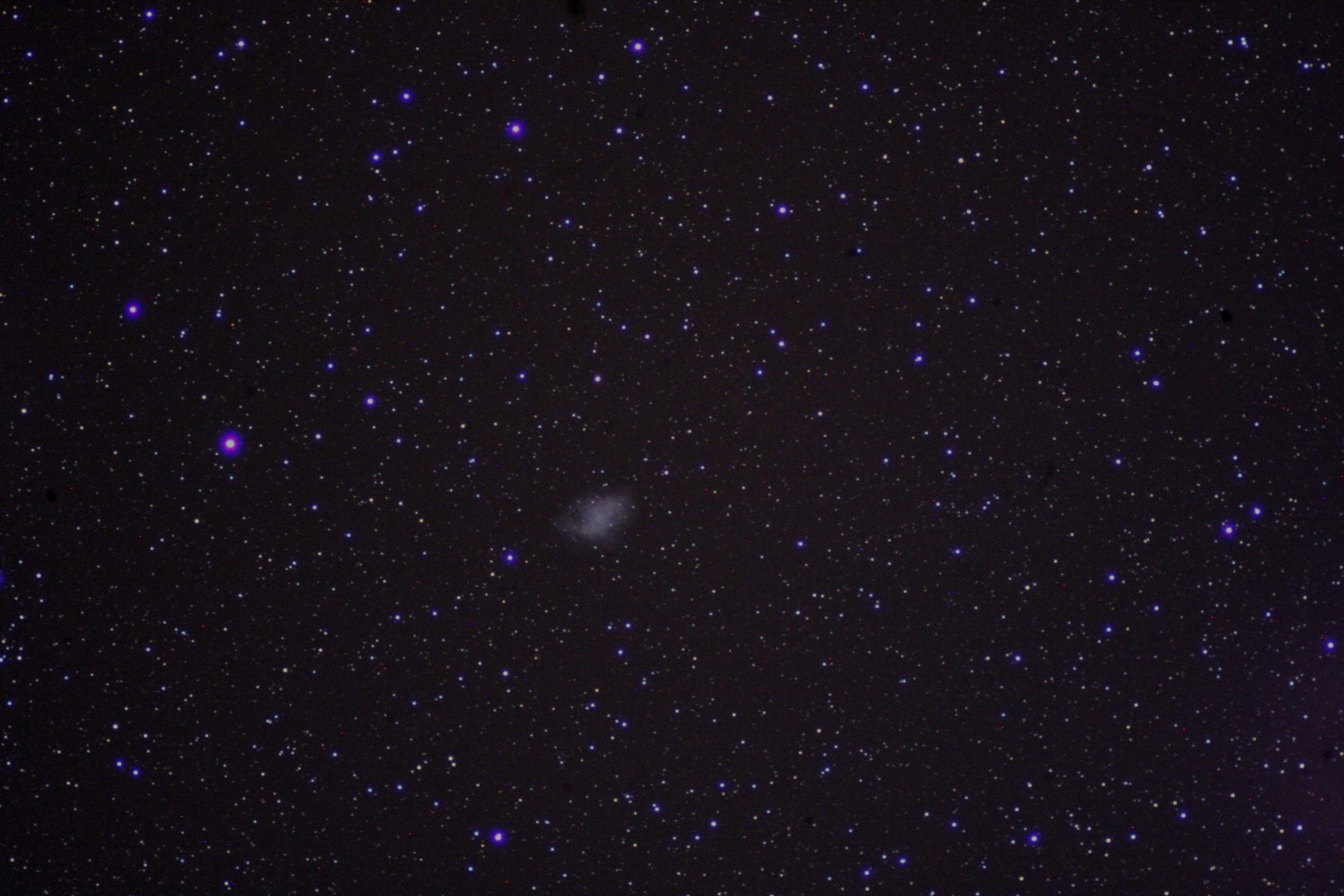
M1 The Crab Nebula Canon 350 D  | 240 secs @ ISO800

M1 The Crab Nebula
Canon 350 D | 240 secs @ ISO800

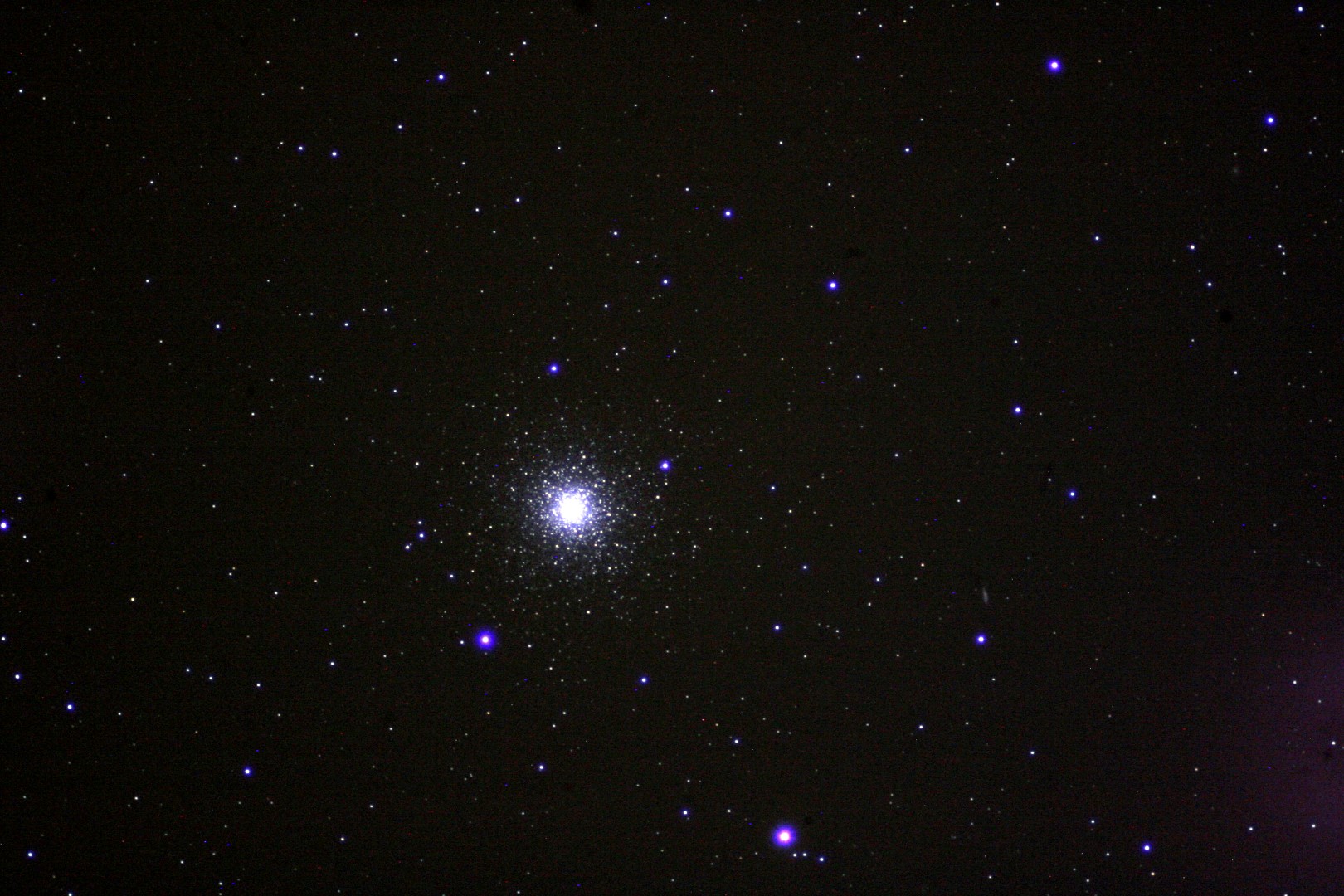
M3 a globular cluster in the constellation of Canes Venatici Canon 350 D | 240 secs @ ISO800

M3 a globular cluster in the constellation of Canes Venatici
Canon 350 D | 240 secs @ ISO800

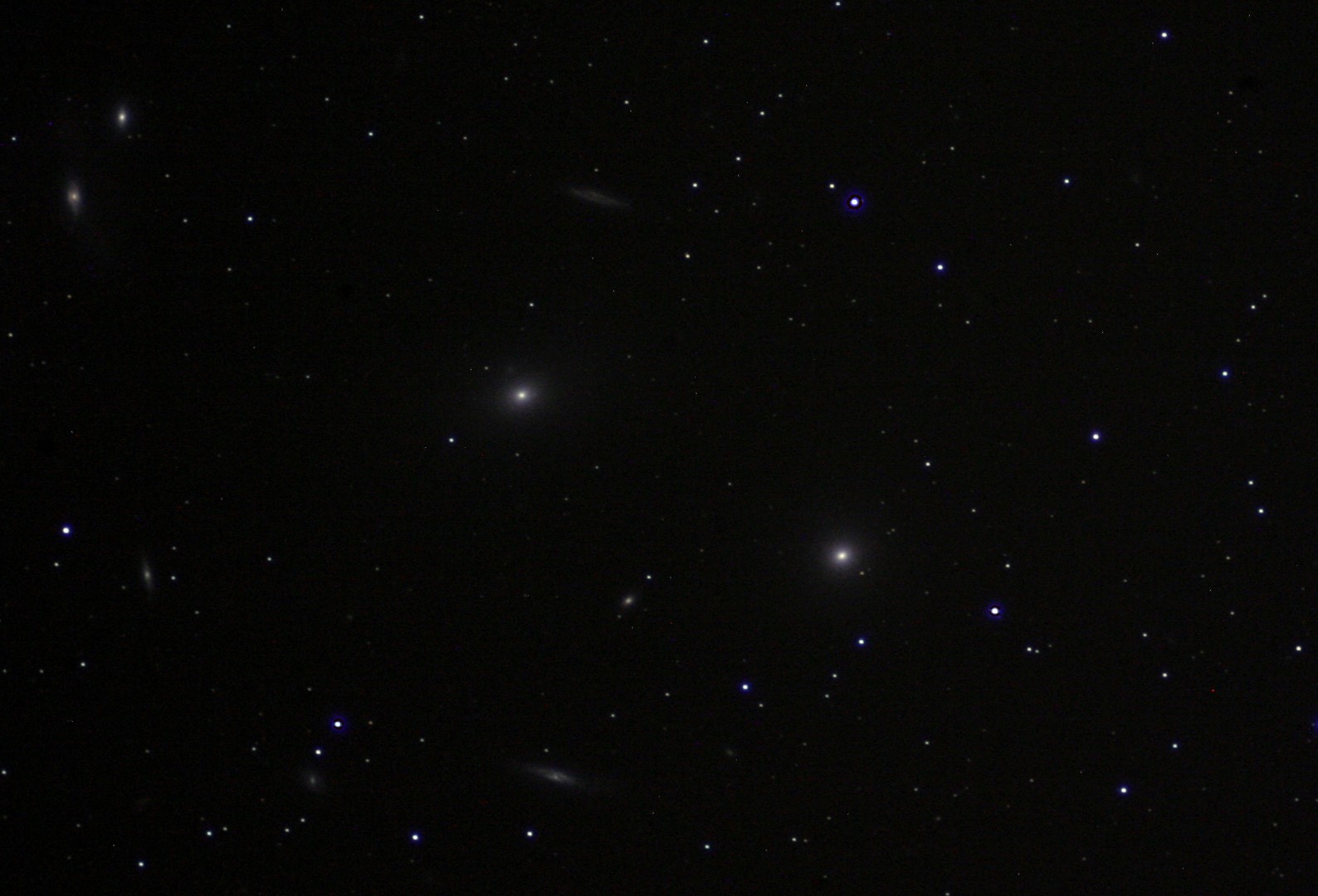
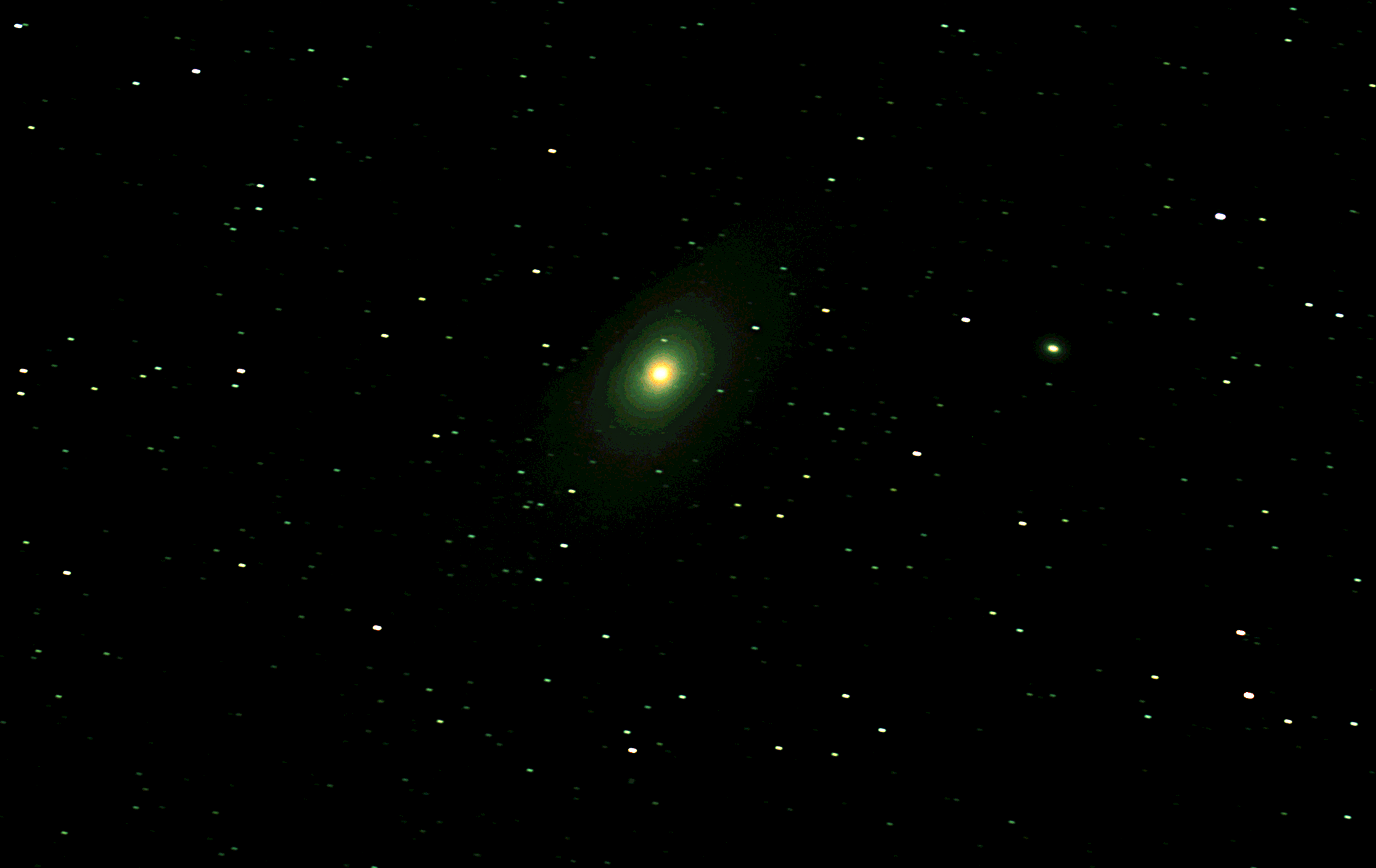
M84 a lenticular or elliptical galaxy located in the inner core of the Virgo Cluster of Galaxies Canon 350 D | 240secs @ ISO 800

M84 a lenticular or elliptical galaxy located in the inner core of the Virgo Cluster of Galaxies
Canon 350 D | 240secs @ ISO 800

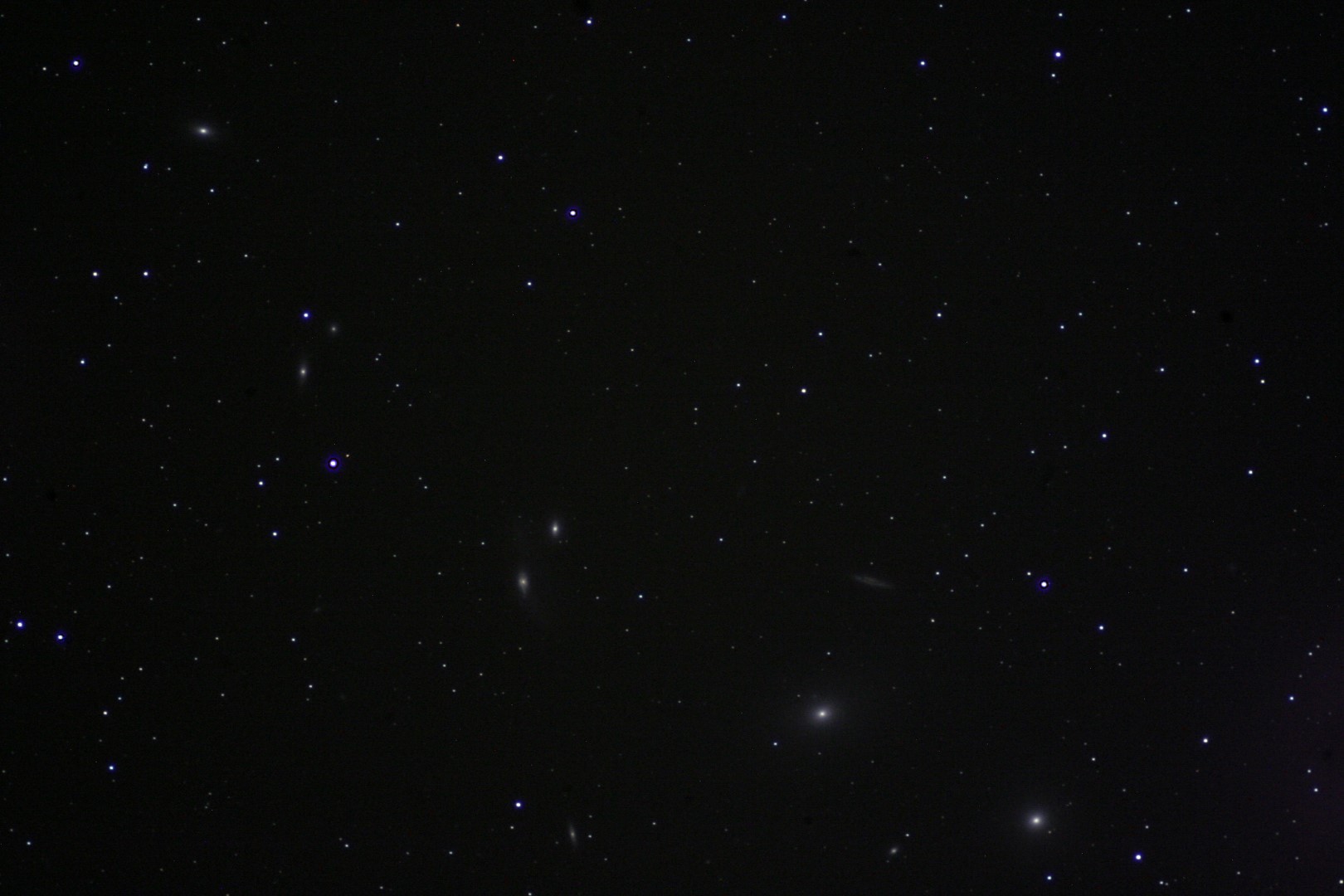
Virgo Group of Galaxies - a field of nine galaxies in the western part of the cluster group of over 2,000 galaxies! Canon 350 D | 240secs @ ISO800

Virgo Group of Galaxies – a field of nine galaxies in the western part of the cluster group of over 2,000 galaxies!
Canon 350 D | 240secs @ ISO800

Moving through space

Astrophotography is difficult, very difficult but probably one problem stands out above all others.  The platform we are taking the images from, Earth, is moving at about 67,000 mph on its way around the sun every 365 days and just over 1,000 mph rotating on its axis every 24 hours, which is tilted at approximately 23o relative to its orbit around the sun.  Over a year the annual journey around the sun, combined with the planet’s tilt provides us with the seasons and the astronomer with a different views of the universe, which despite the overall velocity does not unduly affect imaging over short periods measured in seconds or even minutes.  However, the rotation of the Earth every 24 hours is another matter, particularly when photographing objects over any period of time greater than a few seconds, which is required for most objects, especially more distant DSO.

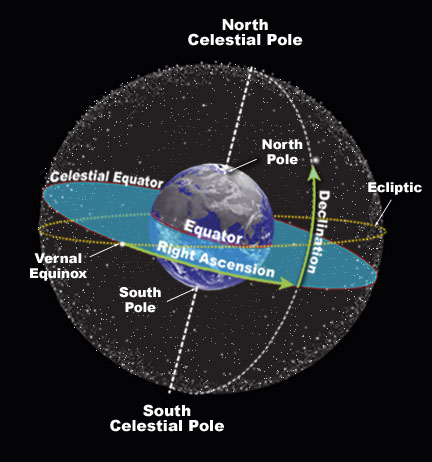
In understanding how this last movement impacts on the nature of the sky we see and in order to photograph objects – as well as forming a basis for navigation around the night sky – we have developed a system that is analogous to that used for navigating across the globe i.e. Longitude and Latitude but now called Right Ascension or RA and Declination or DEC.

For the purpose of establishing lines of RA and DEC a celestial sphere must be imagined of an arbitrarily large radius, concentric with a celestial body – in this case Earth.  In a similar way to Earth, a celestial equator is likewise established, this being in the same plane as the Earth’s equator but projected upwards onto the celestial sphere – as a result if the Earths tilt, it too is inclined at 23.4o with respect to the elliptical plane.  Having established the sphere and the equator, RA is then described as the angular distance along the celestial equator and DEC measures the distance above or below the celestial equator along any RA line in degrees.  This imaginary framework can then be used to describe the positon of any object or its relative position over time in space in the sky that we see from Earth.

The Celestial Sphere - a grid of RA & DEC lines across the sphere can be used to define the position of objects in the sky. Looking south in the Northern Hemisphere, the Celestial Equator is inclined across the sky from east to west and bisected vertically due south by the Meridian line -  the optimal RA line for astromimaging

The Celestial Sphere – a grid of RA & DEC lines across the sphere can be used to define the position of objects in the sky. Looking south in the Northern Hemisphere, the Celestial Equator is inclined across the sky from east to west and bisected vertically due south by the Meridian line (not shown) – the optimal RA line for astroimaging

In order to follow an object for imaging it is necessary to hold the telescope / camera in a stationary position relative to the movement of the object; remember that we are at the same time spinning at 1,000mph relative to space.  This is very difficult but in astrophotography is usually achieved by the means of an Equatorial Mount which, through some very sophisticated software that computes the relative movements of the object and the telescope, gently slews the mount-telescope-camera combination using gears and belts in such a way that the telescope and hence camera, remain fixed upon the chosen object.  The result, when undertaken with care, will be a wonderful sharp image of an almost endless number of features in the night sky, which is the subject of many of the posts on this website

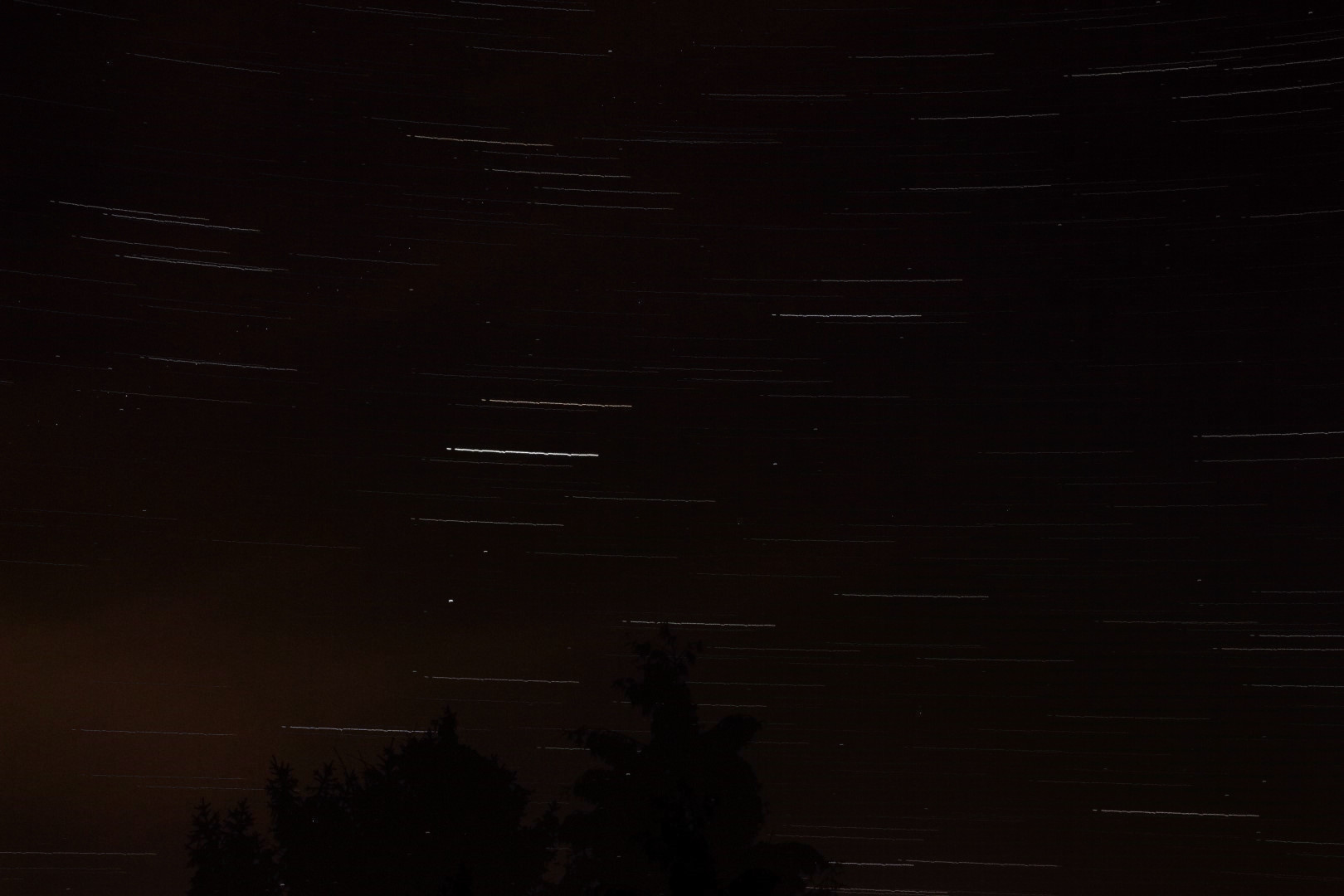
Conversely, what happens if we deliberately do not follow the sky’s objects in this way but hold the camera effectively still relative to the sky’s movement, created by Earth’s daily rotation.  The answer is Star trails, which I set out to obtain the other evening.  In order to achieve such a picture, the DSLR camera is fixed on a tripod and using an intervalometer, a long exposure of the night sky above is taken; alternatively a large series of shorter exposures can be made over a long period of time and then stacked to produce a better quality final image.  As a result the stars trace their respective paths of light across the camera’s sensor, as the Earth moves at 1,000 mph on its axis.  Such movement is normally indiscernible over short periods of time but through this process it is clear to see in the form of wonderful star trails.  Of course the stars haven’t moved at all (at least not in a normal visual sense) it’s us that are moving, very fast.  It is beautiful and clear evidence that we on Earth are continually moving through space!

Startrail Canon 700D | 20 minutes  f4 @ ISO 800

Star trails (inverted colour)
Canon 700D | 20 minutes f4 @ ISO 800

Startrail Canon 700D | 39x30secs f4 @ ISO 400

Star trails
Canon 700D | 39x30secs f11 @ ISO 400


Meet the neighbours

Earlier this week we were fortunate to have good sky conditions at Fairvale Observatory and I was therefore able to locate and image a new nebula, M27 the Dumbbell or Apple Core Nebula https://watchthisspaceman.wordpress.com/2014/08/20/astronomers-do-it-in-the-dark/ and for the first time, a galaxy.  As the birthplace of stars nebulae are almost beyond our comprehension, with their almost ethereal nature making them somewhat intangible to mere humans.  By comparison a galaxy has taken on what might seem a corporeal form, something that strangely seems more familiar and it should do, it is where we live.

It is for this this reason that I have been keen to capture a picture of my first galaxy from Fairvale Observatory; the picture at the top of the Home page on this site, which shows the Sombrero Galaxy, was taken in La Palma earlier this year so doesn’t count https://watchthisspaceman.wordpress.com/2014/08/06/la-palma-nice-one-joan/.  I’m not sure why but despite my enthusiasm for galaxies they have until now proved elusive; maybe the 150PL just wasn’t up to it or more likely, I was just finding them difficult to locate in the sky.  The Synscan feature on my new AZ-EQ6 mount has put an end to that, just dial it up!  And so it was that this week I got to meet the neighbours, in this case the closest spiral galaxy to our own Milky Way Galaxy, the Andromeda Galaxy.

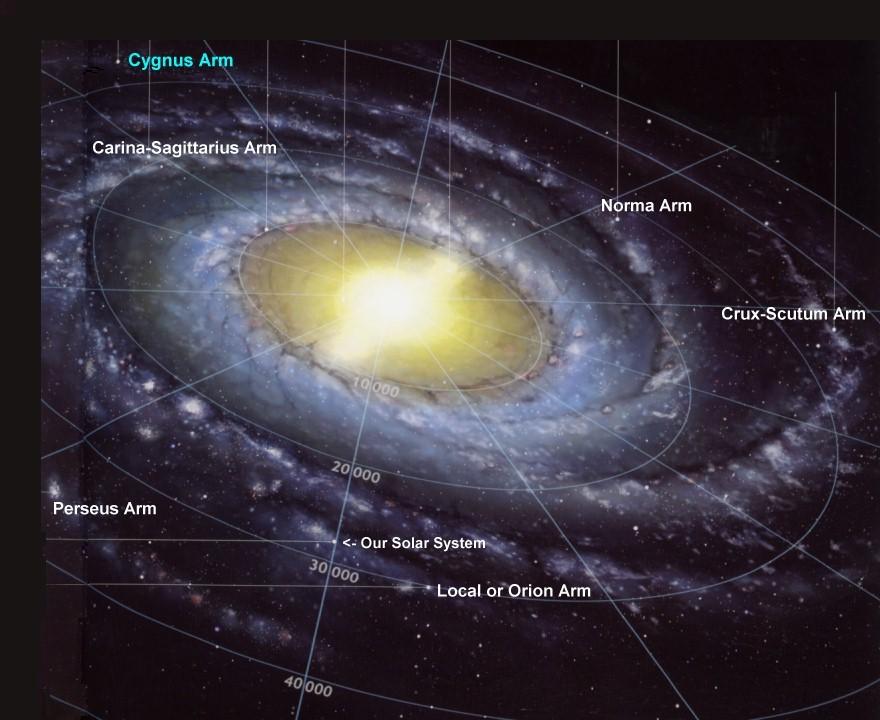
As previously discussed, Earth is located on the edge of the spiral Orion Arm of the Milky Way, about 25,000 light-years from the centre. 

The Milky Way & Location of the Solar System i.e Earth

The Milky Way & Location of the Solar System i.e Earth

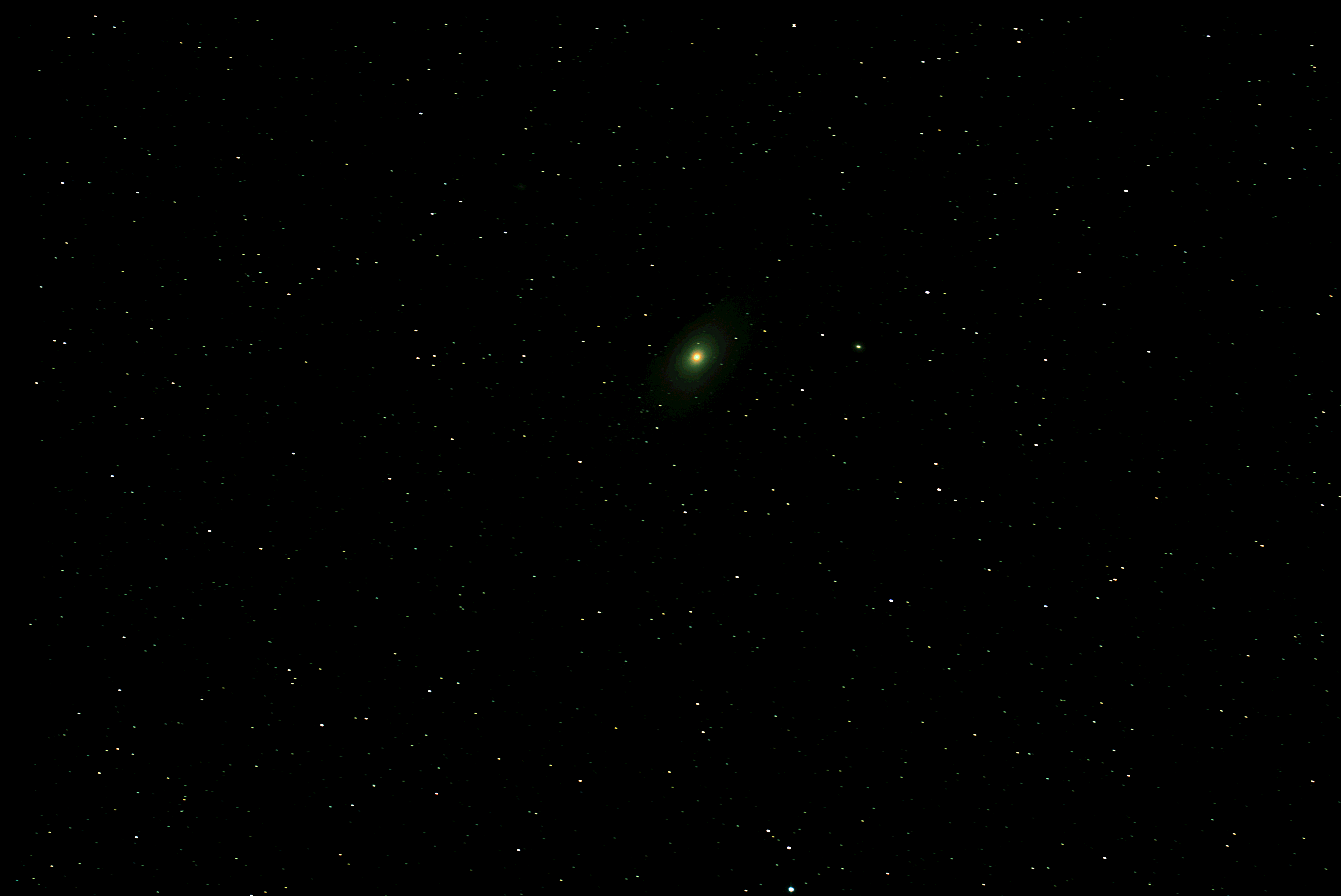
Some 2.5 million light-years away is the similar and beautiful spiral form of Andromeda, or M31.  Andromeda is the largest spiral galaxy of the so-called Local Group, a group of 54 galaxies, with its gravitational centre somewhere between the Milky Way and Andromeda and herein lies a problem.  Andromeda is approaching the Milky Way at 110 k per second or 300 k per second relative to our Sun i.e. us, due to its orbit around the centre of our galaxy – thus also making it one of the few blueshifted galaxies we observe on Earth.  As a consequence we are destined to get to know our neighbour Andromeda a lot better in the future, as both galaxies are likely to collide and merge in about 4 billion years, forming a giant elliptical galaxy.

M31 - Andromeda Galaxy Canon 700D | WO GT81 + FF | 10x30sec @ ISO800

M31 – Andromeda Galaxy                                                                         Canon 700D | WO GT81 + FF | 10x30sec @ ISO800


In the meantime enjoy this great spectacle in the night sky.  From Fairvale Observatory Andromeda has only just become visible in the eastern night sky at about midnight, so I am hopeful that as it moves across the sky over the coming months I will get even better opportunities to image the galaxy; by which time I have hopefully improved my alignment, tracking and exposure abilities and thus can obtain greater photographic detail of this beautiful galaxy.

M31 Andromeda Galaxy - Cropped & 'stretched' in GIMP from main picture

M31 Andromeda Galaxy – Cropped & ‘stretched’ in GIMP from main picture

Astronomers do it in the dark

We are lucky to have dark sky parks in the UK, which are defined as: an area, usually surrounding a park or observatory that is kept free of artificial light e.g. Exmoor National Park, Galloway Forest Park and Kielder Forest, Northumberland.  The transformation of the sky through the absence of man-made light is truly incredible – apart from the greatly increased clarity with which the stars can be better seen, it is the emergence of otherwise feint or nearly invisible DSO objects experienced in these conditions that is exciting for astronomers.

During my life I have been fortunate to see a number of really exceptional ‘dark skies’ around the world, which in my opinion significantly beat the dark sky parks here in the UK.  The most memorable were in the Kalahari Desert and the middle of the Red Sea during a scuba diving trip, which were to use a phrase straight from the sixties (I was there but can’t remember it!) – mind blowing!  Living on Earth probably the most striking feature of a dark sky is the ability to look clearly through the Milky Way galaxy in all its wonder, which thus appears as a creamy band crossing the sky – we are in fact looking edge-on through the millions of stars that make up our galaxy.  Without wishing to overly digress at this point, our Solar system within which we live is on the edge of the spiral Orion Arm, located about two thirds of the way from the centre of the galaxy – 25,000 light years away. http://www.universetoday.com/65601/where-is-earth-in-the-milky-way/

Given such an amazing setting it is disappointing to live in South East England here at Fairvale Observatory, with London just to the north and Gatwick airport to the south, thus significantly reducing the light quality of the sky and making astronomy hard work.  Just to make matters worse, I have to contend with houses and trees obscuring the sightline in almost every direction, passing aircraft (see previous blog on the ISS) and the ubiquitous street light.  Furthermore, even on a clear night for much of the month the Moon poses a significant obstacle to astronomy as it floods the sky with its reflected sun light.

Notwithstanding, good nights (relatively) do occur and last Sunday was one of them.  It was completely clear from dusk until late in the night, the Moon (last quarter) obligingly did not rise until almost midnight and, thanks to the aforementioned houses and trees, did not impact on Fairvale Observatory until after 1.00 a.m.  Furthermore, as the temperature was unseasonably cool as a result of dominant northerly winds, the air was still; which all added up to a great night for astronomy and imaging in particular.  And so it was that I set about trying to image my next set of targets with mixed but generally good results.  I have learnt that planning is everything in astrophotography, so using Stellarium I previously sought out those objects that would be high in the sky and were located on or about the celestial meridian; such a position reduces the thickness of the Earth’s atmosphere through which the light has to pass on its way to the camera sensor and thus improves the image quality.

I tried, once again unsuccessfully, to image NGC 7000, the North American Nebula – not through lack of photographic prowess but, I think, because I had not located it properly in the sky – another day then? Similarly I failed to capture NGC 6888, the Crescent Nebula.  However, against what was a good, dark sky at Fairvale Observatory I had better luck with M27, the Dumbbell Nebula and, photographed my first galaxy, at last! I will deal with the galaxy in my next blog so, for now, will focus (pun intended!) on M27.

My first image of a nebula taken by DSLR was only a couple of weeks ago, M57 or the Ring Nebula.  This time the target M27 was another Planetary Nebula (nothing to do with planets) of similar size but at 1,360 ly distance is almost 1,000 ly closer to Earth than M57, providing better imaging conditions; that’s 1,000 ly the light does not have to travel before reaching the camera.  At the moment I am still experimenting with the new equipment and seeking out new objects just for fun and, as a result, mostly taking a small set of short exposures (<=60 seconds) subs (pictures) and darks before stacking  and processing – in this case about 10 each.  The resulting picture quality leaves plenty of room for improvement when I eventually get the guide scope working, together with other planetary and alignment software but in the meantime I am very happy and excited by these results.  The wider, original photograph perhaps shows the Nebula best, which is also known as the Apple Core Nebula, a form that is just discernible from these images.  For the moment, my quest to capture new objects is going well, assisted greatly by the dark skies we are fortunate to have at the moment here at Fairvale Observatory.

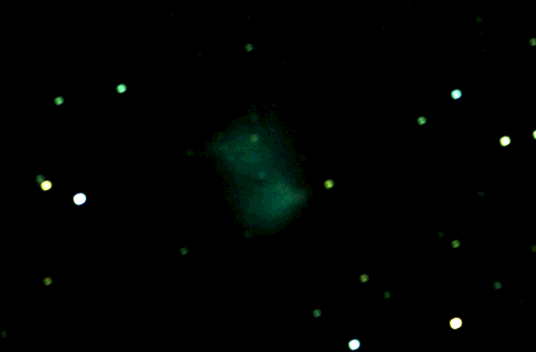
Wide sky view - M27 the Dumbbell or Apple Core Nebula is located just off-centre at about 2 o'clock

Wide sky view – M27 the Dumbbell or Apple Core Nebula is located just off-centre at about 2 o’clock  Canon 700D | EO GT81 + FF | 10x40secs @ ISO 800

M27 cropped from previous photograph; it will be interesting to see how much clearer pictures can eventually be obtained with better alingment and longer exposures

M27 cropped from previous photograph; it will be interesting to see how much clearer pictures can eventually be obtained with better alignment and longer exposures

Fairvale Observatory Part-1: Initial Equipment Set-up

The so called ‘observatory’ is unfortunately the back patio of my house – Fairvale is the house name.  In itself OK but with the house completely blocking the view to the north and houses, hedges and some large trees blocking much of the horizon looking east, south and west, it’s a wonder I get to see anything in the sky.  Furthermore, we are located just outside the M25 London orbital motorway, with Gatwick airport to the south about 8 miles away – hardly perfect light conditions.  However, for the moment it’s what I have to work with and I thought I’d start a series on the background of my equipment, how it has evolved and what I’ve learned from using it.  In Part-1 I’ll review my starter set-up purchased second hand just over a year ago.
The view East
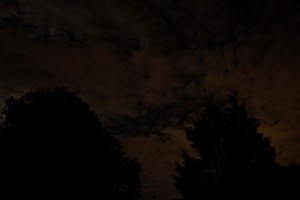
The view East

The view south, note light pollution form Gatwick

The view south, note light pollution from Gatwick airport

As described in the section About Me, after years of prevaricating about which scope to buy, I was finally stung into action in April 2013 by my first ever view of Saturn and a feeling by now that there were too many answers to the question, which scope? So best just get on with it. My philosophy for the first year was to experience astronomy and, if possible imaging, in order to: (i) see if I enjoyed it (ii) learn the basics with basic equipment and (ii) learn from my mistakes for a small financial outlay before spending the big bucks, if indeed that was to be my next move (as it was – see Part-2 later). In the end I went for a Skywatcher 150PL with an EQ3-2 mount, which all things considered turned out well and has certainly whetted my appetite for bigger and better stuff (the retailers will be pleased to know).
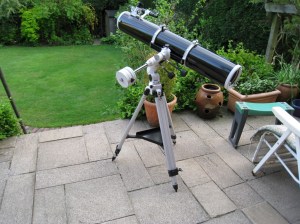
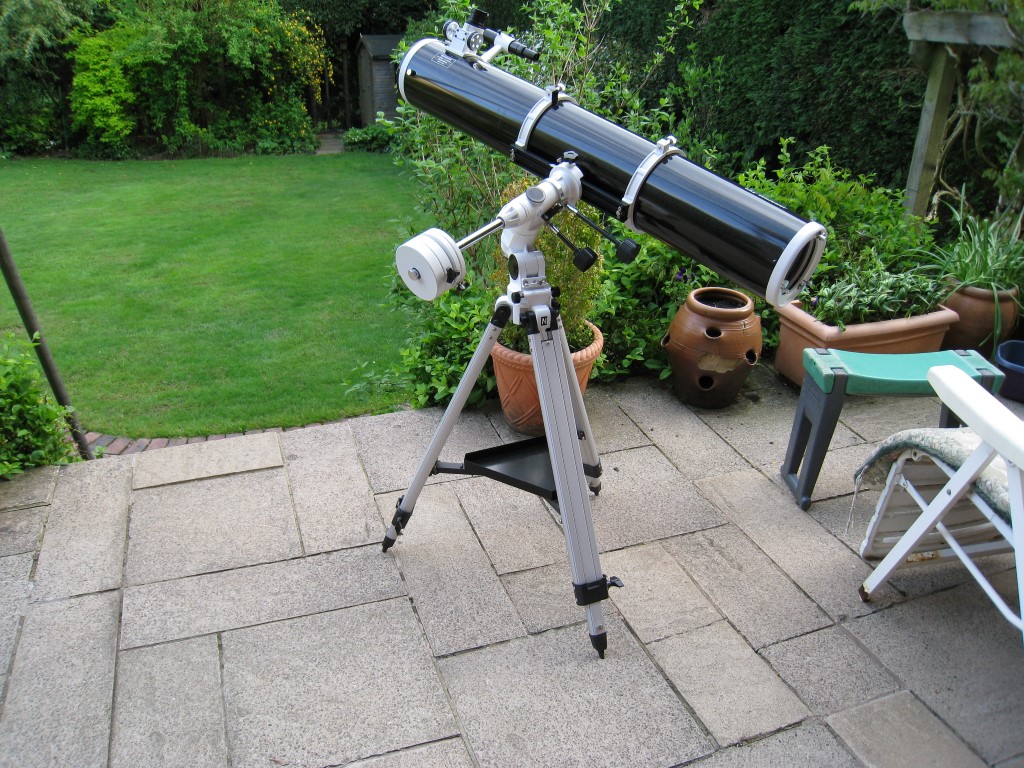
Skywatcher 150PL (pre-motor drives) & Eq3-2 Mount

Skywatcher 150PL (pre-motor drives) & EQ3-2 Mount

It is clear that there has been something of a revolution in amateur astronomy in recent years, mainly I suspect (like so many other aspects of western life) through the development and manufacture of affordable high-spec equipment in the Far East, mainly China. This equipment is generally well made and now incorporates many technical features that an amateur astronomer could have only dreamt about 10-years ago; technology itself seems to have developed at an almost exponential rate, particularly in the field of astrophotography and related computing and processing, no doubt partly led by Hubble’s success and subsequent spin-off developments.

The OTA (optical telescope assembly) – Skywatcher 150PL

You get a lot of bangs for your bucks with a Newtonian refractor, making them a great starter telescope. In this case the OTA is just over a metre long, with a focal length of 1,200mm and an aperture of 150mm, which is a pretty decent size to start with – it certainly looks impressive! The ‘speed’ of the scope or f-number is calculated by dividing the focal length by the aperture, which in this case gives a number of f8.  Anything smaller i.e. higher than about 4 or 5 is considered to be a ‘fast’ scope (the terminology derives from photography but is not directly comparable) and anything over about 10 is ‘slow’ – as a rule of thumb, each being generally better suited (fast or slow) to either DSO or planetary astronomy respectively.  Therefore in my case this scope errs towards planetary work best, hence the suffix PL.  The physical size of the 150PL is something of an encumbrance at times but, as already indicated, the Newtonian is difficult to beat on price as a starter scope with a decent size aperture, which results in better light capture.

The OTA has no lenses but two mirrors to bounce the light up and down the OTA and into the eyepiece for viewing or photography, which is conveniently located on the side http://en.wikipedia.org/wiki/Newtonian_telescope.  From time-to-time it is good practice to make sure these mirrors are correctly aligned through a process of collimation, ensuring thereby the light path is perfectly set from the centre of each mirror to the centre of the eyepiece.  I am ashamed to say I have yet done this once, which is no doubt the source of some of my subsequent alignment and imaging problems! Oh well.

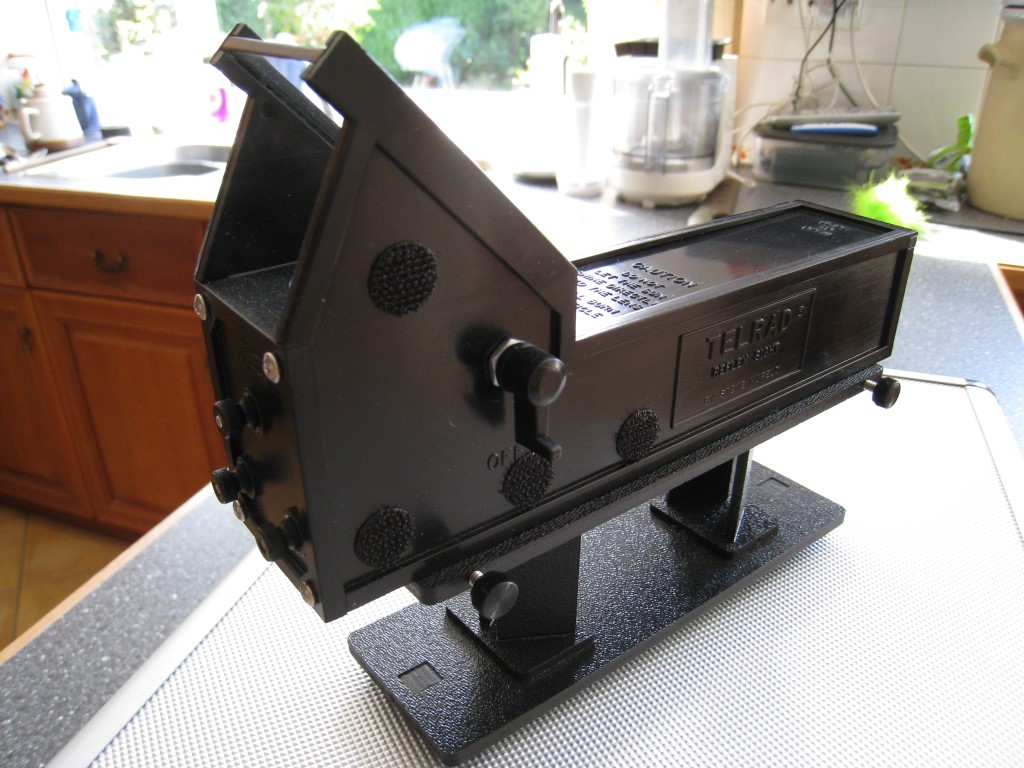
I should say that the scope also comes with a 30mm finderscope, which I have found to be of limited use, in particular since getting the wide angle eyepiece (see below) and a Telrad.  In the absence of GoTo facilities and even when you know and can clearly see the astronomical target feature in the night sky, it is still difficult to line up the OTA for viewing.  Strapping a Telrad to the OTA has virtually solved this problem. The Telrad is essentially a form of red dot finder, whereby a small red circle is projected onto a piece of 45o inclined glass through which you look and can therefore see the desired target feature. By then manually moving the OTA and thus moving the red circle until it coincides with the target, the scope is lined-up perfectly every time.
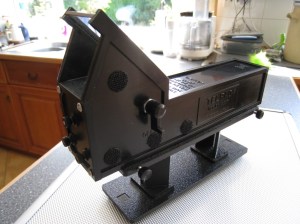
The wonderful Telrad RDF
The wonderful Telrad RDF

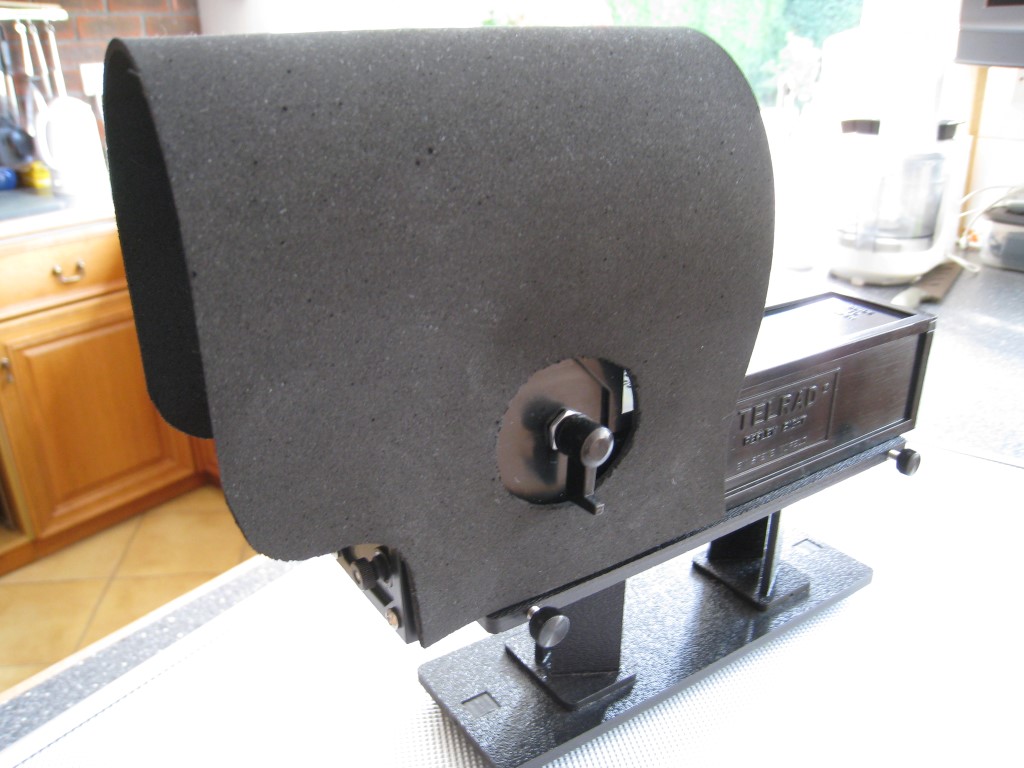
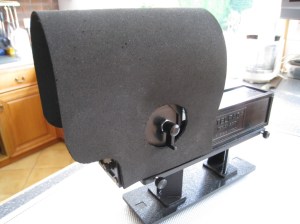
Telrad + homemade dew shield, using 3mm compressed foam
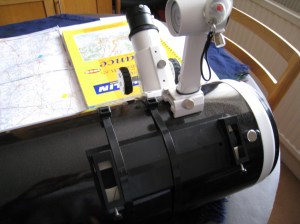
Telrad + homemade dew shield, using 3mm compressed foam

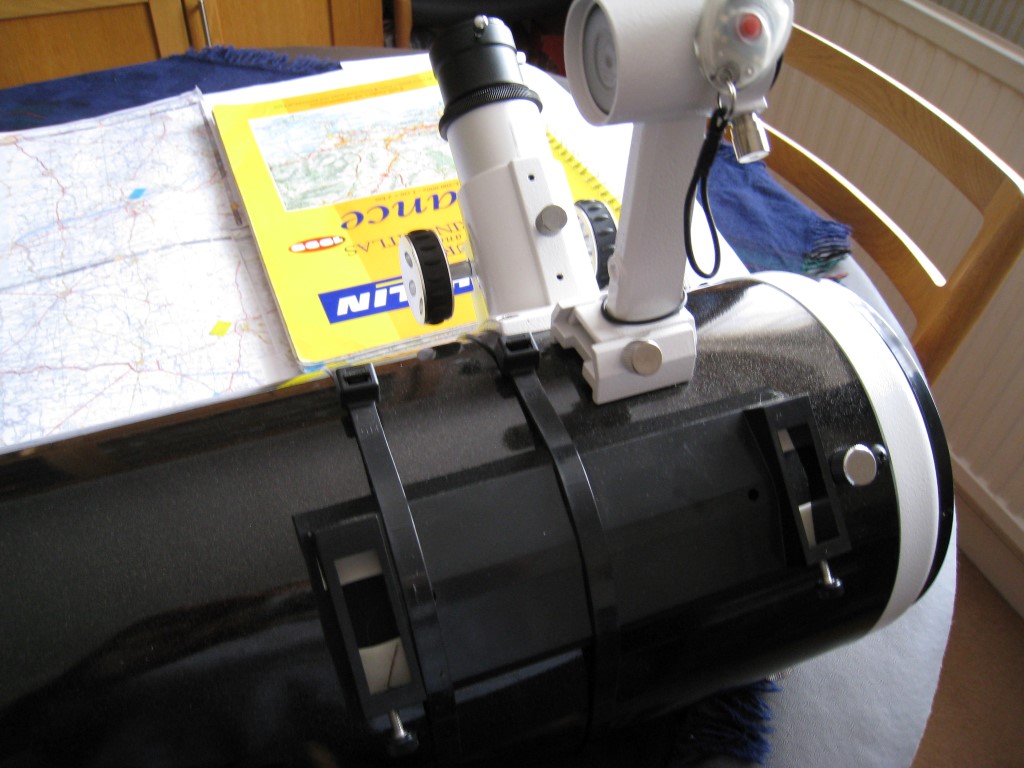
The Telrad loctes and screws quickly onto a base (available at different heights) fixed by cable ties alongside the finderscope.

The Telrad locates and screws quickly onto a base (available at different heights) fixed by cable ties alongside the finderscope.

Focus, Eyepieces & Filters    

One of the major problems throughout my introduction to astronomy has been focussing which, in the case of the 150PL, has been compounded by the low quality of the focus mechanism. In this case the 1.25” focus tube and fitting is a simple rack and pinion, which unfortunately has little finesse. As I have found to my frustration, achieving focus for astrophotography can be down to a fraction of a millimetre.  Due to the coarse nature of the 150PL focus mechanism, such tolerances are difficult to achieve and good focus is more by luck than design with this mechanism.

More so than the OTA, the importance of good eyepieces cannot be overestimated. The 150PL came with two basic Plössl x25mm & x10mm 1.25” eyepieces and a x2 Barlow. I subsequently added to these with a  x6mm and Ultra Wide Angle (UWA) x32mm lens, which though nowhere near top-of-the range, are noticeably superior to the originals and are now used most of the time in preference to the original eyepieces. They are also both Plössl construction but with better glass and the x32mm has an 82o wide angle field of view, which is a major advantage when first visually locating a feature in the sky before changing to the x6mm or adding the Barlow.  Furthermore, both the ‘new’ eyepieces have a larger eye relief, which for those like me wearing glasses makes observing much more comfortable; the eye relief is the distance the eye has to be beyond the eyepiece lens to achieve focus – a larger / wider distance means the eye can be further away from the lens. I expect to improve this collection of eyepieces further at some time – thinking about a better quality Barlow, a Powermate and perhaps a reticle – we shall see.

Eyepieces tucked up in their storage box with filters, laser pen and lens cleaner.  When working in the dark, literally, it pays ton know where things are.

Eyepieces tucked up in their storage box with filters, laser pen and lens cleaner. When working in the dark, literally, it pays to know where things are.

I was soon introduced to the need for filters when viewing a full moon, which was blindingly white.  As a result I purchased a Moon filter, in this case a Baader 0.9 ND filter, which claims a light reduction factor of 8 (whatever that means) and certainly has made viewing the Moon much more comfortable. Subsequently I indulged in a narrowband UHC filter, which claims to enhance viewing of nebulae by limiting the wavelength to the 400nm to 700nm range (peaking at 500nm), which might typically be associated with the light radiated from a nebula. I have only used this with the Orion Nebula and it did, to a degree, reduce the overall luminosity and produced a sharper, bluish view of the nebula’s stars – you could therefore say, the jury is out on whether this is worthwhile or not, it certainly is not cheap; maybe it’s effectiveness will be more obvious when used under a deent dark sky?  An Oxygen-III is an alternative, similar filter, which some claim is superior to the UHC? Most recently I purchased a Light Pollution Filter, which aims to counteract the light wavelengths emitted by streetlights and similar sources, though as yet I have yet to prove the real benefit of this.

The Mount – Skywatcher EQ3-2

Probably the greatest surprise in my first year of astronomy has been to learn how important the mount is – it is probably the most important item when imaging.  The Skywatcher EQ3-2 is a light mount, which becomes evident when you strap the large 150PL Newtonian on, especially if there’s a breeze.  I deliberately avoided the GoTo mounts (those programmed to move automatically to set features) from the start, in my quest to learn from the bottom up; some might say the hard way, I believe the best way to eventually learn and then later use technical skills is from first principles. As a result following targets whilst viewing (tracking) is not easy to do well manually using the right ascension (RA) and declination (DEC) control knobs and is almost impossible when imaging. Fortunately it is possible to buy a separate ‘strap on’ units that linked to a control box will at least track fairly well – at this stage anyhow. I therefore added both these motor drives with good results, though mostly only used the RA motor, choosing to ‘fine tune’ the less volatile DEC changes manually.
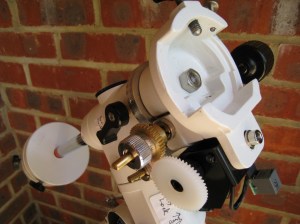
EQ3-2 mount with DEC motor drive fitted; note clutch to disengage and move manually if required
EQ3-2 mount with DEC motor drive fitted; note clutch to disengage and move manually if required

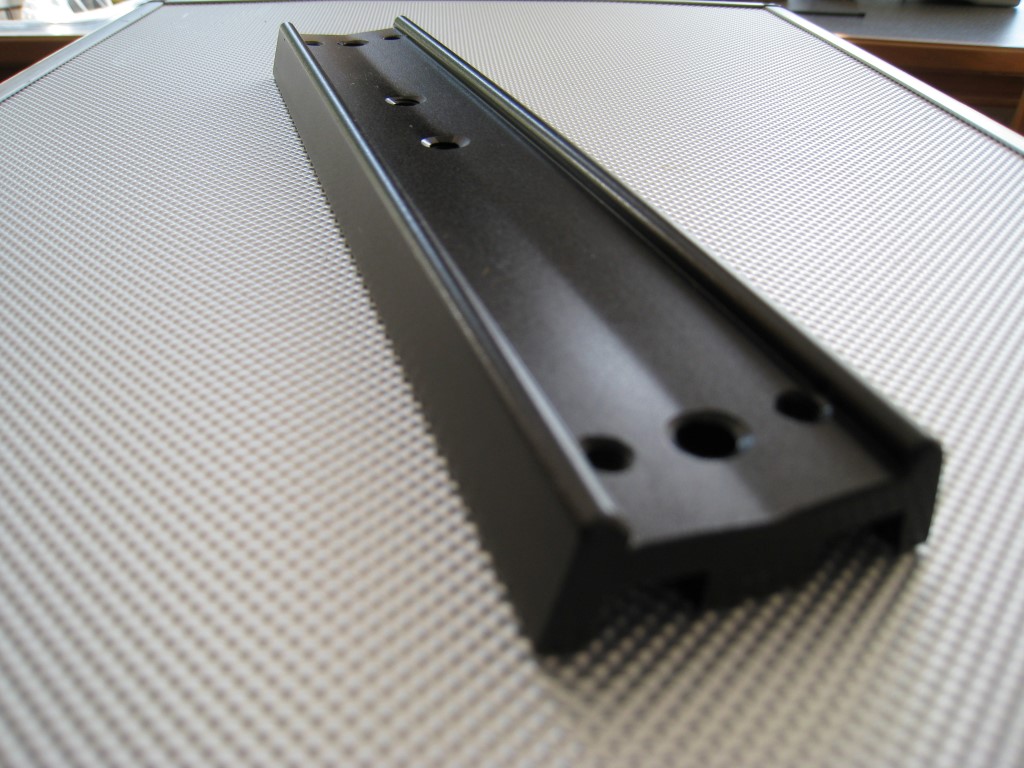
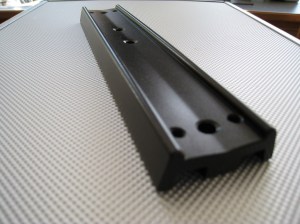
The OTA is fixed onto the mount by a standard Skywatcher dovetale bar, which fits into a matching slot on head of the mount   and is then clamped by screws.

The OTA is fixed onto the mount by a standard Skywatcher dovetale bar, which fits into a matching slot on head of the mount (see previous picture)and is then clamped by screws.
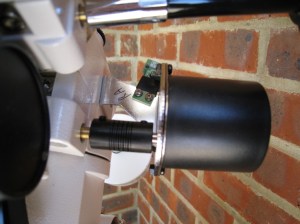
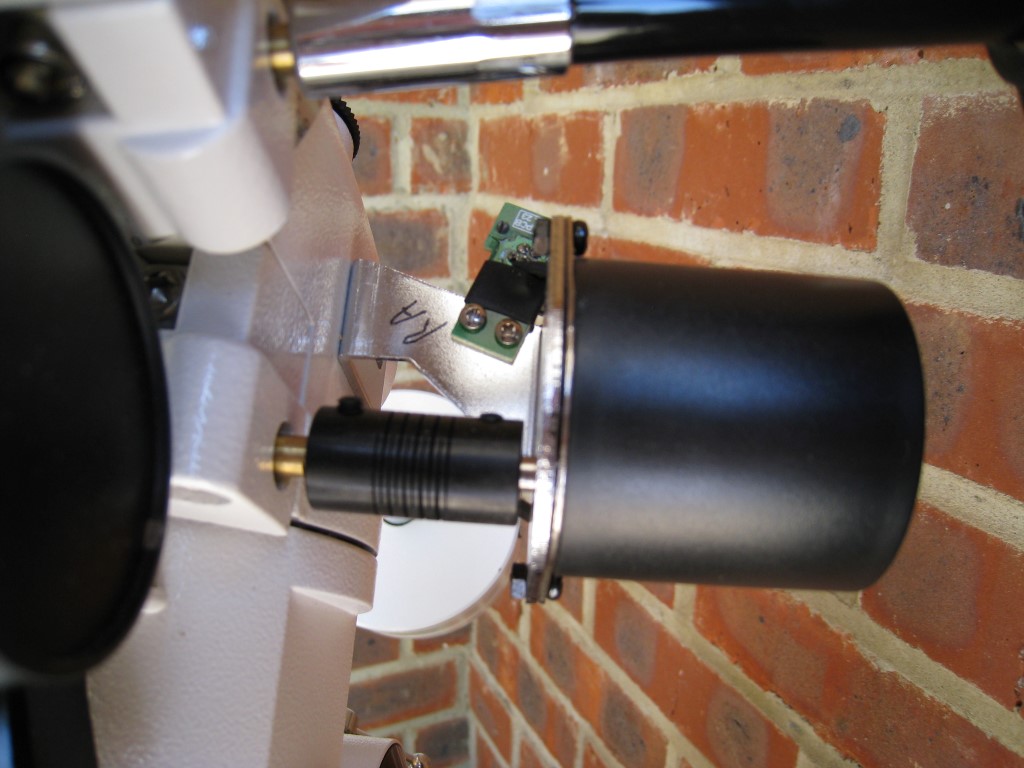
Around the other side is the RA motor drive, which has no clutch.
Around the other side is the RA motor drive, which has no clutch.

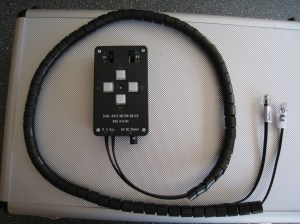
The RA & DEC motor drives are controlled by this handset (battery power unit not shown) which can be set at different tracking speed and for the north or south hemispheres, depending on where you are located.

The RA & DEC motor drives are controlled by this handset (battery power unit not shown) which can be set at different tracking speed and for the north or south hemispheres, depending on where you are located.

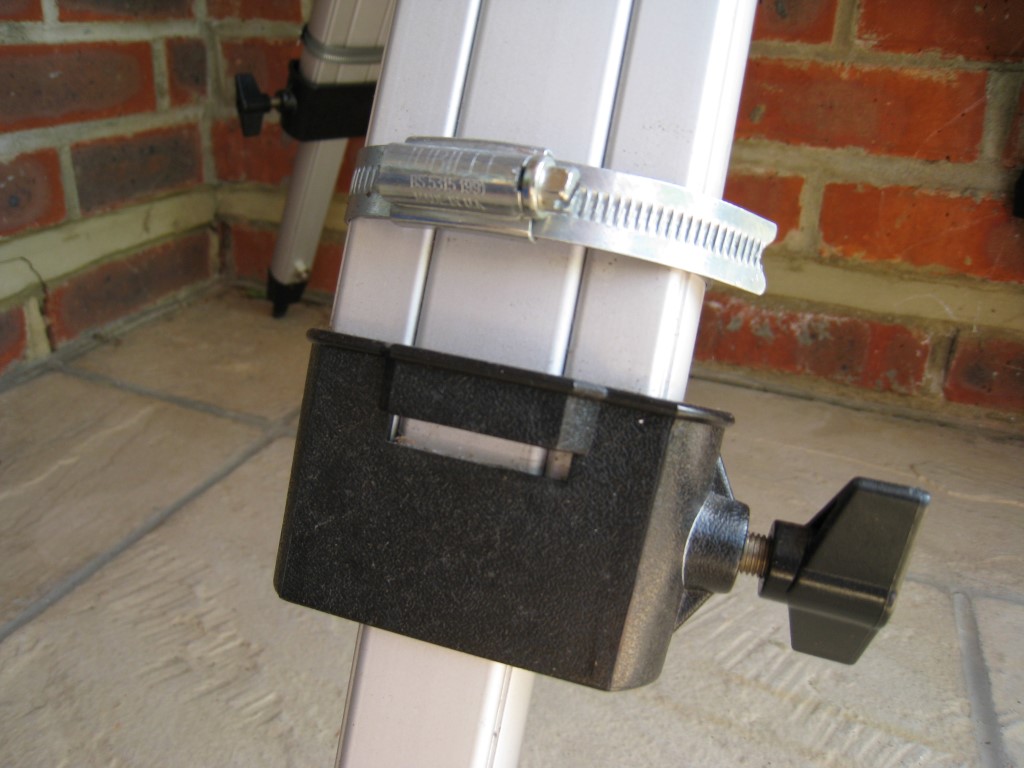
I have to say that the mount is noticeably ‘built to price’, which is particularly evident with the lower clamps necessary to lock the parts of each leg together when they are used to adjust the height.  The clamps are made of plastic with brass ferrules inserted, through which the clamp screw can lock against the internal / adjustable leg section. The instructions do note this should not be overtightened but to achieve a good, secure lock it needs to be firm and this inevitably led to the plastic failing.  The problem was easily and cheaply solved using three large jubilee clamps.  Notwithstanding, why not just make it properly in the first place?
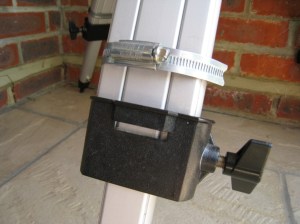
The weak plastic leg clamps have all been supplemented by jubilee clips.

The weak plastic leg clamps have all been supplemented by jubilee clips.

Comments

The mount and scope sit directly on the patio (which I recently relayed to improve stability) and, as the house completely obscures northern views and thus Polaris, which would otherwise be used to align the scope, is aligned using black lines that have been previously marked, pointing due north for the same purpose.  This is far from perfect and I am hoping that with the next Synscan based mount, which incorporates star alignment, combined with drift alignment and eventually the use of a guidescope and various computer guidance and planetarium software, I will one day achieve a tracking accuracy that will enable better viewing and much longer camera exposures and thus better images.  It’s a way off but remains my goal for the next six months.

The biggest bugbear is that all this has to be carried out and back into the house, as well as aligned each time – thus my long time goal is a covered observatory but I’ll need a new house / garden before I can do that, which might take some time!

Overall I have been pleased with this equipment, although it needed some tweaking to get the best out of it.  Operationally, use of the mount and OTA has benefited significantly by the addition of: (i) RA & DEC motor drives, (ii) better quality eyepieces and (iii) the Telrad finder, altogether making it a pleasure to use.  So much so that contrary to my initial intentions, I now intend to keep the OTA for solar work and the mount as a portable set-up, matched with my new, more portable 80mm APO refractor scope, of which more in Part-2.
Copernicus was right!

OK it’s not news but a tribute to the man who opened our eyes to the way the Solar System works.
Like most newcomers to astronomy viewing and imaging starts at home and that is the Solar System. So it was with my Skywatcher 150PL Newtonian scope last year – first the Moon (of course) and then on to the planets, in this case it had to be Saturn – surely the most exciting / beautiful planet? Despite my growing years it was only in April 2013 I got to see Saturn for the first time through the 13″ Astrographic Refractor at Herstmonceaux  http://www.the-observatory.org/telescopes. WOW I am hooked and following much previous prevarication over what to buy now rapidly sought to purchase my first telescope in the form of the aforementioned 150PL with a basic EQ3-2 mount.

The early summer of 2013 was very good for viewing Saturn and so it was I spent many late nights and early mornings gazing at this wonderful planet. Of course I had to get a photograph but this was easier said than done. Despite years of SLR photography I did not own a DSLR, considering them too bulky and inconvenient for day-to-day use, I therefore resorted to my trusty Canon Ixus 860IS to try my hand at afocal photogrpahy i.e. holding the camera up to the eyepiece.  The results were awful so I purchased a camera bracket that clamped to the eyepiece and held the camera more steady, unfortunately this too was little better. I came to the conclusion that this wasn’t going to work and in some shape or other I would need to take a video instead, with subsequent processing through Registax (more about this another time) which is able to sort and stack the best frames to produce a final, single image.

I tried the cheap route first by adapting an old Logitech webcam I already had (this involves removing the front lens so the light fall directly on the sensor) but could not get an image and therefore in the end decided to purchase a ZWO 120 MC http://www.365astronomy.com/zwo-asi120mc-colour-13-cmos-usb20-camera-with-autoguider-port-p-3536.html which also provides an autoguiding function, as yet not tested. Again I encountered major problems getting an image but after visiting the retailer Zoltan at 365 Astronomy, who also had great difficulty getting it to work by using a more up-to-date version of Firecapture, I was finally up and running – all I needed was a clear sky and an object to image. Of course, it had to be Saturn.

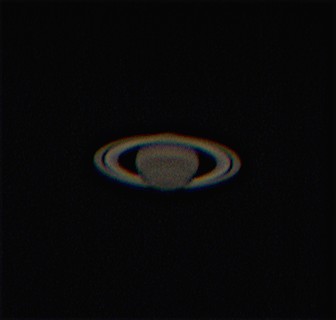
As I have now learnt every facet of astrophotography is difficult and this was no exception. The problems this time fell into two categories: the general capture settings and that old thorn in the side, focus.  It took a while but eventually I had Saturn  on film which, after some Registax processing I successfully turned into a picture.

ZWO 120MC

ZWO 120MC

Still plenty of scope for improvement but it is clearly Saturn and to my eyes looks great.

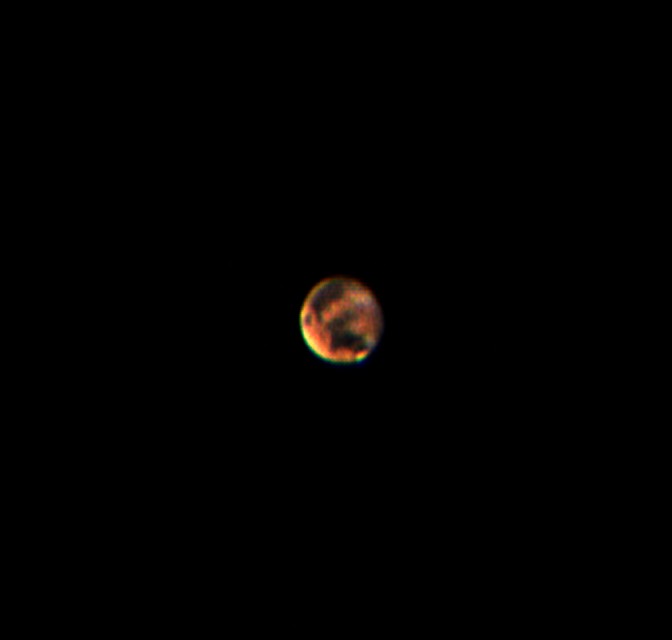
With this success under my belt, earlier this year I tried Mars which, as I was to find, is a notoriously difficult subject – the problem being size i.e. it is small. Depending on their respective orbits relative to Earth, the angular diameter  http://en.wikipedia.org/wiki/Angular_diameter of Saturn varies from 14.5″ to 20.1″, with Mars 3.5 to 25.1″.  Notwithstanding, I eventually managed to capture some video, which looked awful, but thanks to Registax emerged looking like, well ….Mars!  It has been described as ‘pizza looking’ but for the moment I’m happy.

223242_castr

ZWO 120 MC + Registax

I had hoped to get Jupiter too but for various reasons (which I can’t remember) it didn’t happen, so that’s on the ‘to-do’ list next time it comes around.  And thanks to Nicolaus Coperincus we will be able to predict when that is.

The Moon: Up close and personal

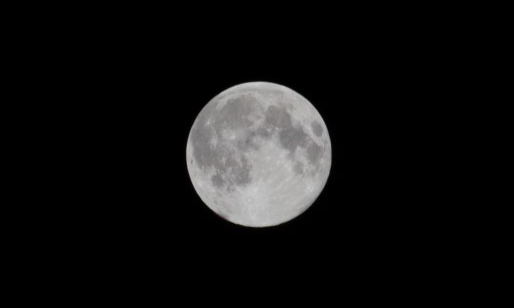
Last night was the so called “Supermoon” of 2014 as, in its eliptical orbit, the Moon passed at its closest point to Earth for this year. Its relative closeness to Earth, plus atmospheric lensing, caused by the Moon’s location in the southern part of the Zodiac, means that for observers in the higher latitudes of the Northern Hemisphere the Moon appears particularly large at Full Moon on 10th August. As a result it is possible to get good photographs without the use of a telescope so, in my case, I shot this using a 200mm telephoto setting:

Supermoon from Fairvale Observatory 10th August 2014 Canon 700D | 200mm telephoto | 1/160th f11 ISO200

Supermoon from Fairvale Observatory 10th August 2014
Canon 700D | 200mm telephoto | 1/160th f11 ISO200

Of course, since getting my telescope last year the Moon has been a frequent subject for viewing and imaging, with some very close-up results in some cases almost seeming to take you there. Viewing the Moon is best during the early stages of a new “waxing” Moon, particularly along the edge where the dark section meets the light section – the so called “terminator”. Views of this can be stunning, with the WO GT81 and a x2 Barlow an 10mm eyepiece it almost seems like you are about to land on the surface!  Very soon after first looking at the Moon I got a Moon filter, which I have found essential as the Full Moon approaches and the light is almost otherwise blinding; the filter reduces the glare and makes observing more comfortable.

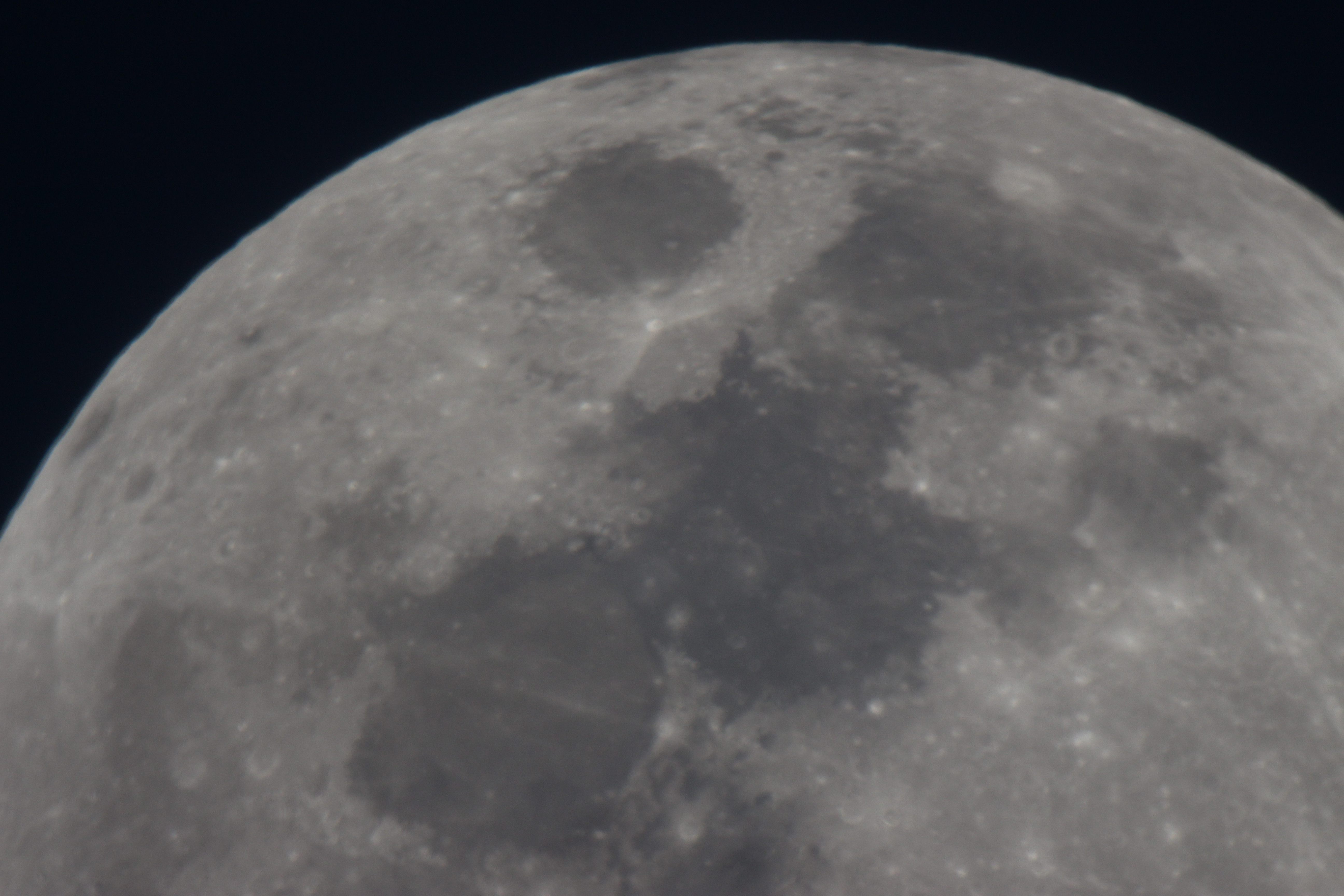
Whilst a good view of the entire Moon can be obtained, such is the optics of the 150PL (and I think the WO GT81) that to get focus the DSLR camera has to be used in conjunction with a Barlow lens. Unfortunately this results in such magnification that the Moon can only be imaged in parts, rather than as a whole but the image is nonetheless exciting:

The Moon 11th February 2014 Canon 700D | SW 150PL 2xBarlow | 1/100th ISO 400

The Moon 11th February 2014
Canon 700D | SW 150PL 2xBarlow | 1/100th ISO 400

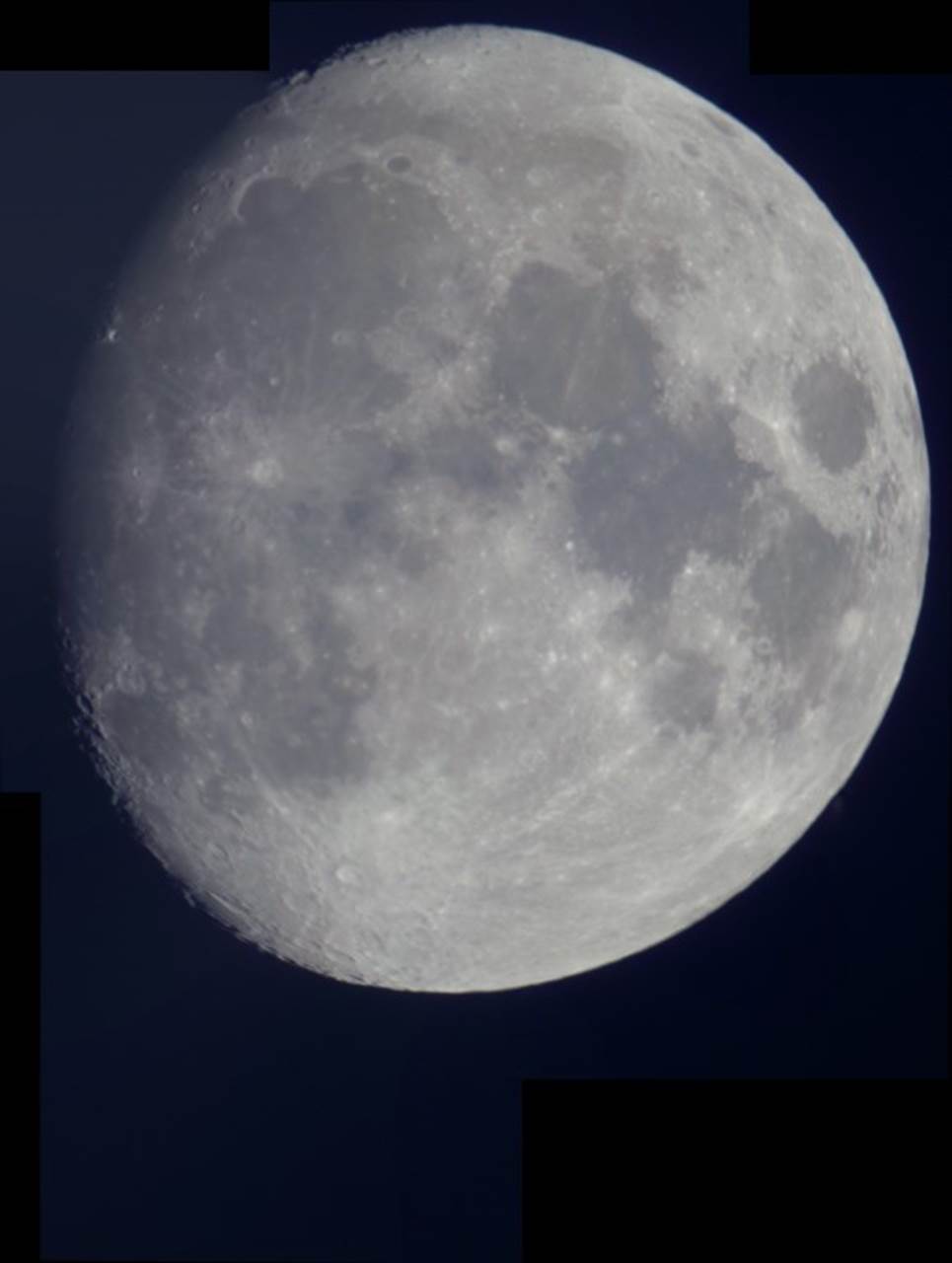
Notwithstanding, using a suitable computer programme these individual images can be stitched together to produce a photo mosaic, such as this one made from x6 separate sections of the Moon.  The result is impressive:

Photo mosaic 11th February 2014

Photo mosaic 11th February 2014

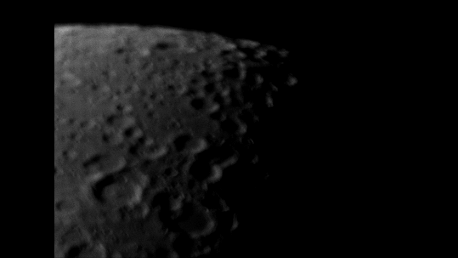
Finally and probably most amazing is using a webcam / CCD to video the Moon.  Once again this needs to be undertaken using a Barlow and the resulting magnification is even higher but with spectacular results as can be seen with this video taken with the ZWO 120 MC in May this year(the shimmering effect is the Earth’s atmosphere): https://www.youtube.com/watch?v=13Nb_lBBaxk&feature=youtu.be

Snapshot of Moon video (see above link) ZWO 120 MC

Snapshot of Moon video (see above link)
ZWO 120 MC


Finding the Sun

As our nearest star, the Sun is an obvious target for astronomy and with all this nice summer weather at the moment, that’s exactly what I’ve been doing.  The statistics of the Sun are, of course, mind boggling and the views can be truly amazing http://http://en.wikipedia.org/wiki/Sunen.wikipedia.org/wiki/Sun .

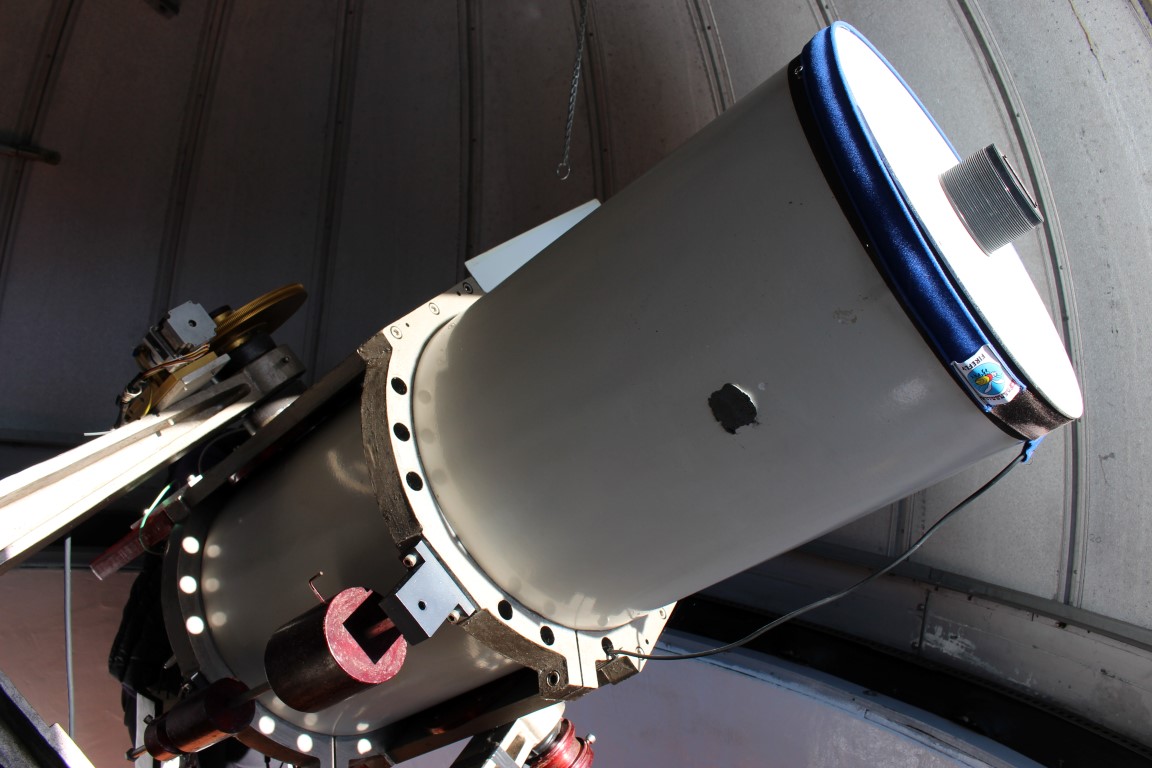
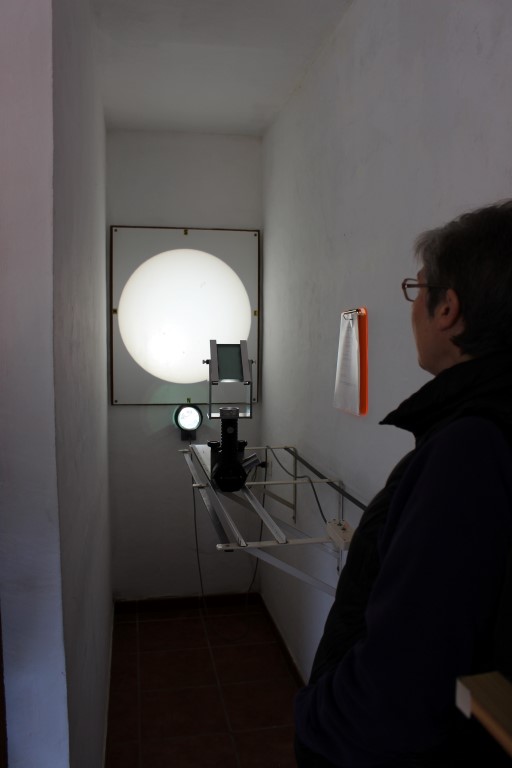
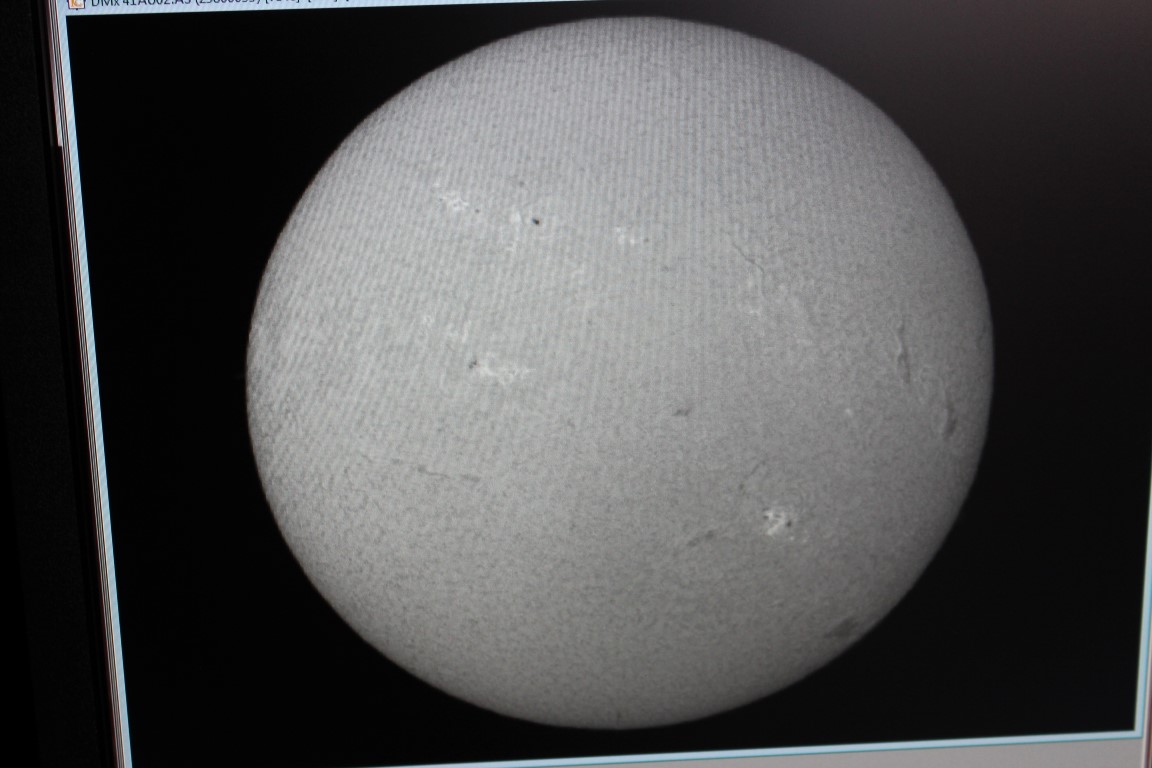
I first saw the sun through a telescope whilst in La Palma earlier this year https://watchthisspaceman.wordpress.com/2014/08/06/la-palma-nice-one-joan/ both using Joan’s 15″ Mak Cassegrain + solar filter and his beautifully constructed helioscope, which bounced the Sun’s light / image from the outside, through a hole in the wall of the observatory, which was then focused perfectly on a screen:

Mak + white light filter

Mak + white light filter

Heliograph focus track after collecting the sun's image outside

Heliograph focus track after collecting the sun’s image outside

Final heliograph image of the Sun's surface

Final heliograph image of the Sun’s surface

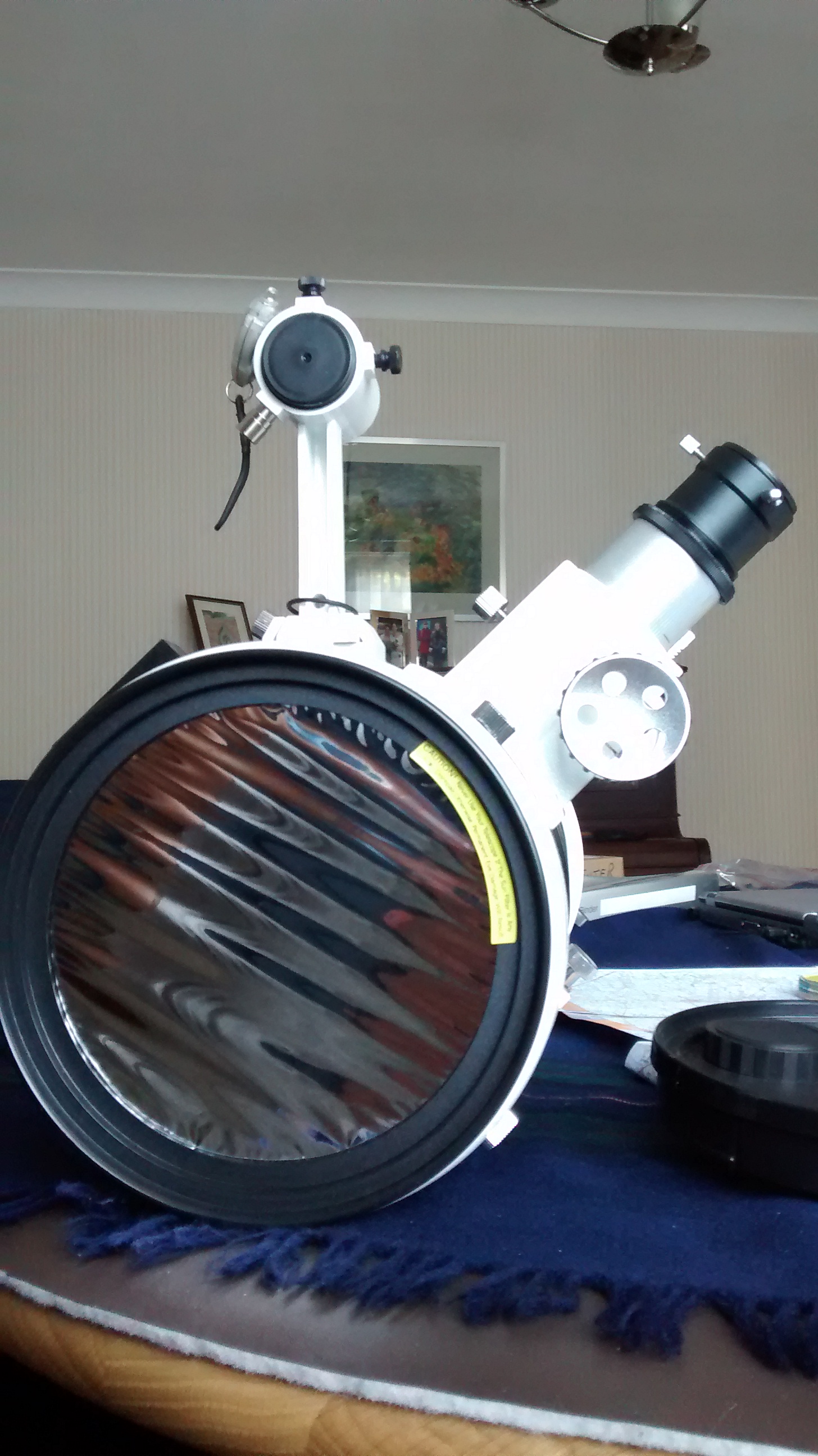
Rightly or wrongly I decided to use my SW 150PL Newtonian to view the sun, with a larger, open OTA there should be better ventilation and it just seems less complicated (& cheaper) than the refractor for the moment. The standard method, which I also used, is to place a Baader Astro Solar Safety Film in front of the OTA. This looks a lot like cooking foil but is much more sophisticated and expensive, basically reducing the light from the Sun to a narrow, harmless wavelength http://www.365astronomy.com/solar-filter-for-150mm-newtonian-telescopes-p-2933.html. You can buy this film in A4 sheets and make your own filter but I bought the type that was already made and fitted snugly into the end of the OTA:

Solar filter fitted inside the 150PL

Solar filter fitted inside the 150PL – also note solar finder in the finderscope bracket (see below for description)

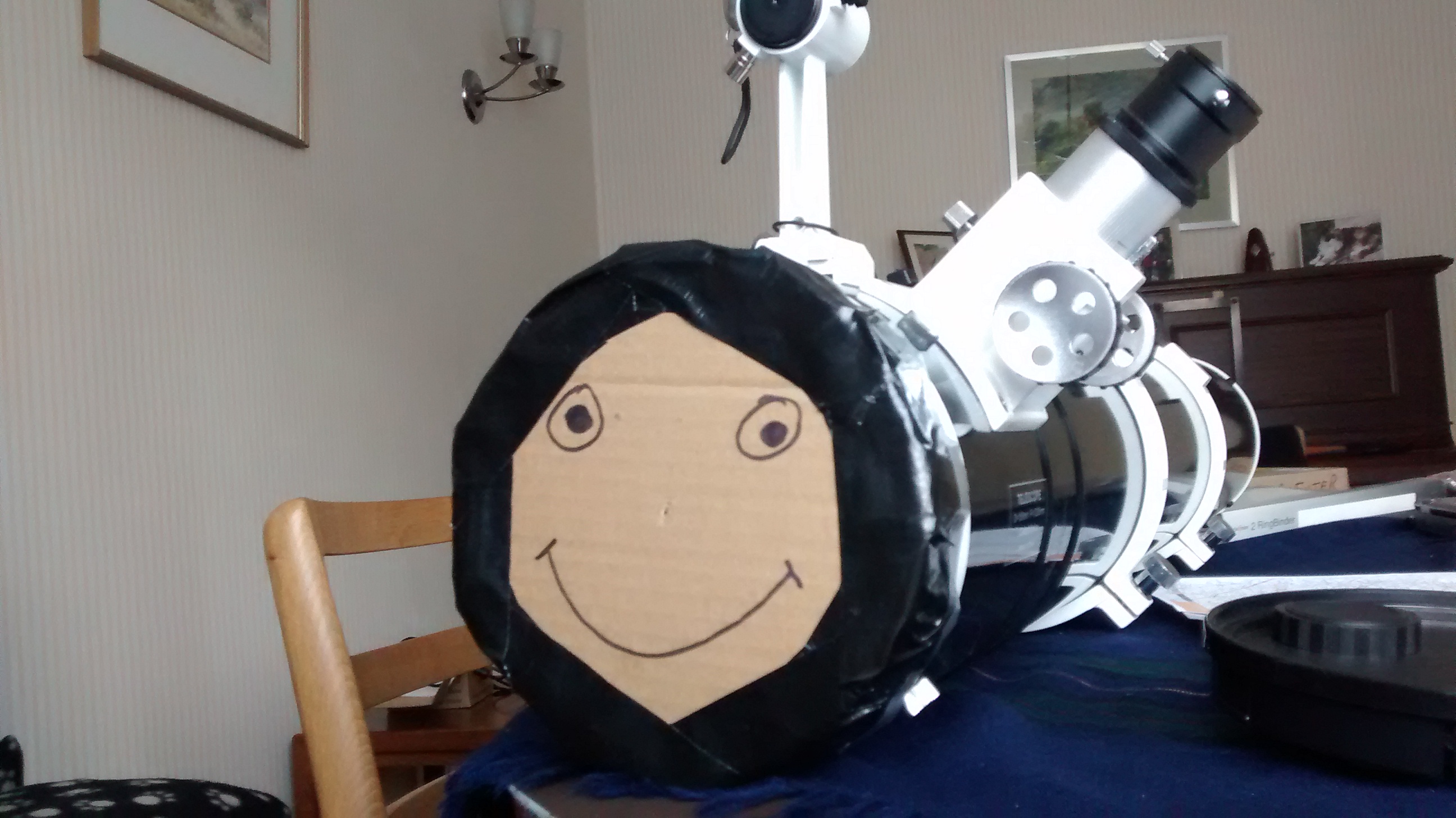
To be honest, I was uneasy at the prospect at looking at the Sun which, if undertaken incorrectly, could result in the loss of sight – so I didn’t want to risk the DIY route.  Whilst on this theme, it is essential to thoroughly check the filter each time before use to check for holes, even a pin prick could be dangerous and result in injury. In addition, whilst in use but not being attended – maybe gone off for a cup of tea – it is said that birds can be attracted to the shinny filter and can peck holes! I have therefore made a cardboard cover to put over the filter whilst away from the scope for this reason:

Crude and cheap but it might save your eyesight!

Crude and cheap cardboard cover but it might save your eyesight!

At this point I realised that finding the sun to view i.e. lining it up, is not as easy as it might seem – after all you cannot just look directly at the sun and point the scope, for obvious reasons. One method is simply to use the OTA’s own shadow, so that when it is lined up with the sun its shadow will be at its minimum. There are also numerous gadgets out there to buy (there always is in astronomy).  However, I came across a DIY version that frankly I think is difficult to beat – it costs nothing and takes seconds to make! This guy deserves an award for such a design http://pembsastronomers.freeforums.org/how-to-make-a-solar-finder-in-three-seconds-t485.html.

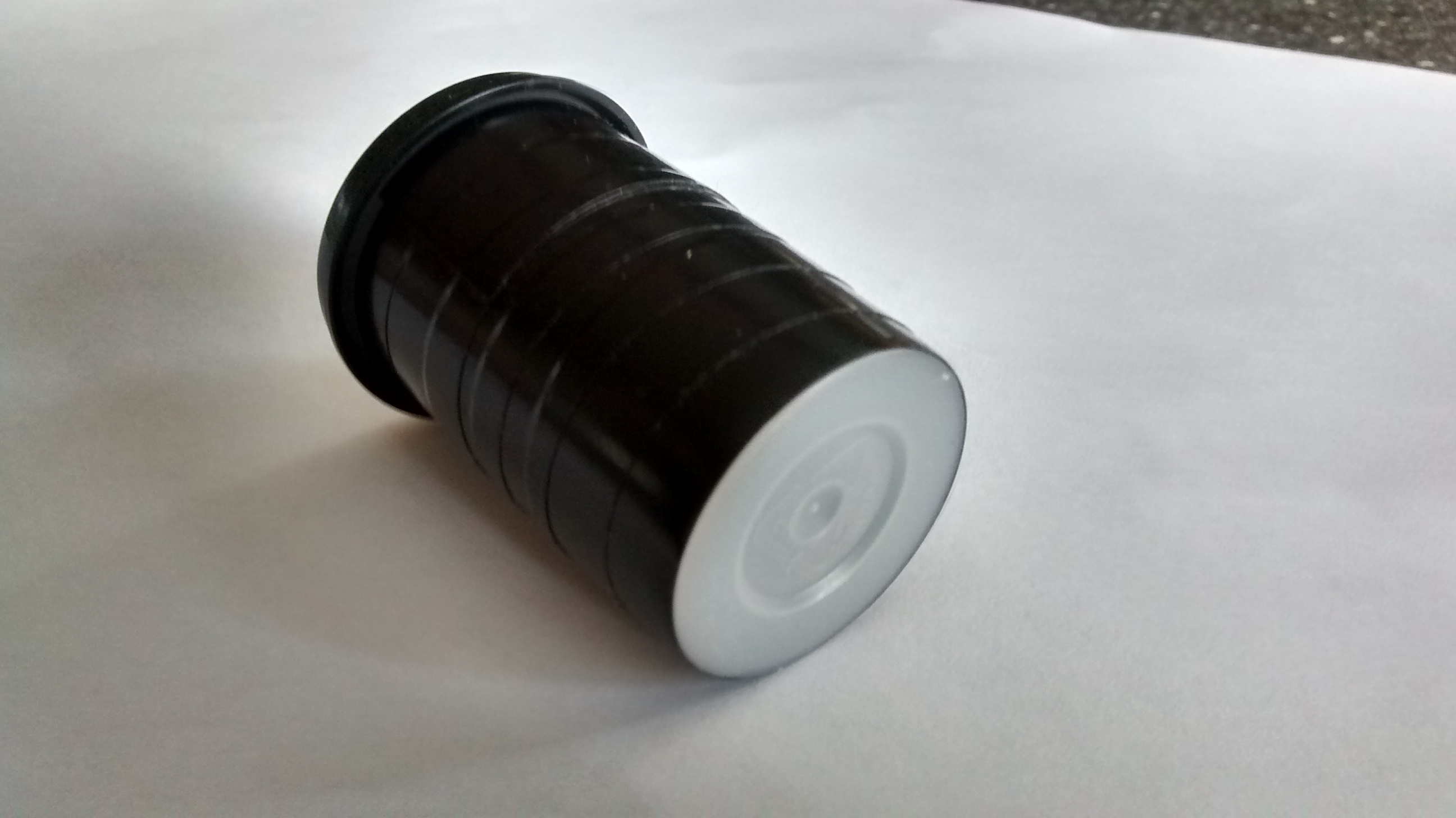
Basically it is a 35mm film canister, with a black top on a clear container: wrap the container in black electric tape and pierce a very small pinhole in the top. In my case it slipped straight into the finderscope bracket (thus also also allowing proper alignment with the scopes viewing axis) and then you manoeuvre the scope until the beam of sunlight that passes though the pinhole, falls directly at the centre of the base of the canister, which acts as a screen. Genius!

35mm canister with small, pinhole in the top

35mm canister with small, pinhole in the top

Using a clear canister wrapped in black tape, the base acts as a screen. Sunlight passes through the pinhole which then appears as a small, bright spot on the base of the canister - moving this to the centre of the base by adjusting the orientation of the scope ensures the scope is directly aligned with the Sun for viewing.

Using a clear canister wrapped in black tape, the base acts as a screen. Sunlight passes through the pinhole which then appears as a small, bright spot on the base of the canister – moving this to the centre of the base by adjusting the orientation of the scope ensures the scope is directly aligned with the Sun for viewing.

Using the Baader Solar Filter produces a white light image, in particular showing sunspots:

The photo mosaic segments would not line up perfectly but the sunspots are clear to see and more prevalent than a couple of weeks ago. Notwithstanding, the 11-years sun spot cycle is not as expected, with the number of spots quite low at the moment.

The DSLR photo mosaic segments would not line up perfectly but the sunspots are clear to see and more prevalent than a couple of weeks ago. Notwithstanding, the 11-years sun spot cycle is not as expected, with the number of spots quite low at the moment.                                             Skywatcher 150PL & 2x Barlow 1/40th sec at ISO100

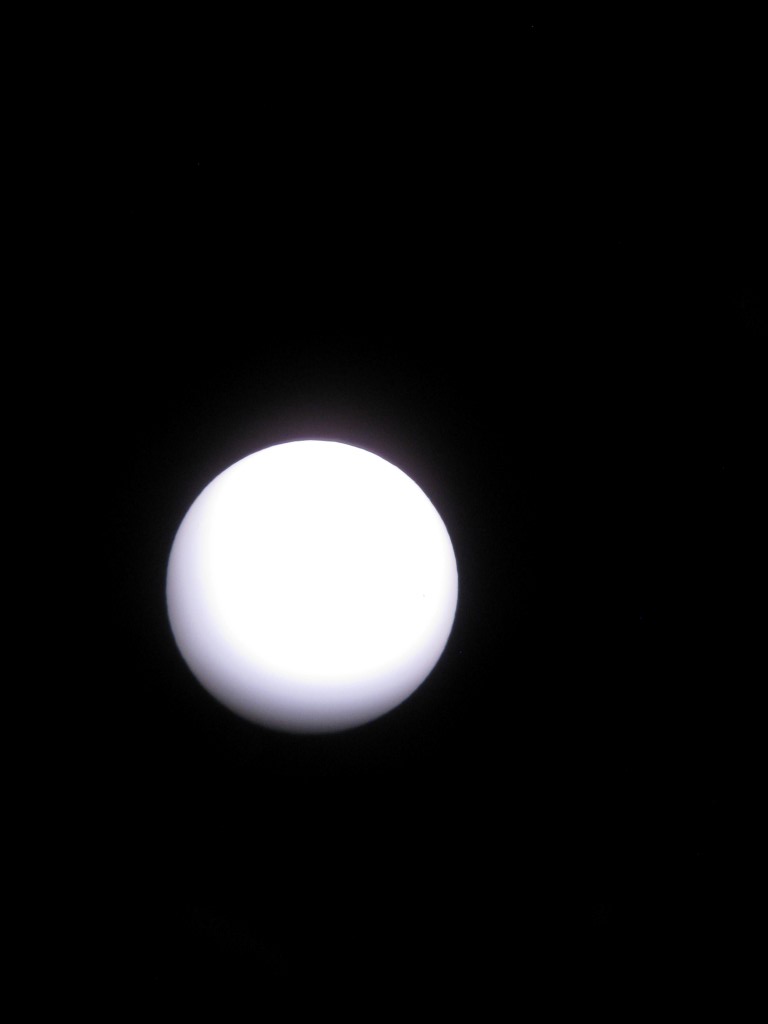
Compact camera afocal image - lacks detail but you get the whole of the sun in the frame.

Compact camera afocal image – lacks detail but you get the whole of the sun in the frame.

For the moment I’m quite pleased with the view but would eventually like to improve things. Still looking at white light, the Herschel Wedge looks like a good attachment that could instead be used with the WO refractor http://en.wikipedia.org/wiki/Herschel_wedge . This deflects most of the light and heat and, supposedly, produces a superior image – it’s inevitably quite a bit more expensive.  The holy grail is a hydrogen-alpha scope, of which the Coronado PST is probably the most popular, not least because it is financially cheaper  http://www.meade.com/products/coronado/coronado-personal-solar-telescope-pst-0-5-angstrom.html but if you are really flush with cash this will do the job nicely http://www.telescopehouse.com/acatalog/Lunt-152mm-H-alpha-OTA—B1800-BF—Feather-T—P-Tuner.html . The point of the H-alpha scope is that it works at a different wavelength that, unlike white light, enables the Sun’s prominences to be seen, dream on.

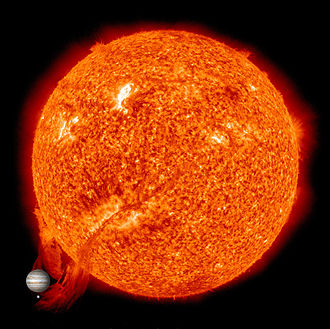
For scale that's Jupiter down there in the lower, left hand corner

For scale that’s Jupiter down there in the lower, left hand corner

Focus is everything

FOCUS: The state or quality of having or producing clear visual definition – Oxford English Dictionaries.

Splashed the cash and got the equipment, done the reading and asked all the right questions on the astronomy forums, got a clear night, time to catch those images – what can go wrong? Having recently purchased and got a new AZ-EQ6 mount and WO scope working OK visually, it was time to embark on my new DSO photographic quest. Not for the first time I unfortunately underestimated just how difficult this astrophotography is; forgetting that I’d already battled before to image with the Newtonian 150PL using both the DSLR and ZWO webcam (more on that another time).

This time the challenge was using the new WO Field Flattener http://www.williamoptics.com/accessories/flattener6A_features.php. So – set up scope, align mount/scope, find object, centre and visually focus.  Then attach the field flattener (FFL) to the DSLR and slide directly into the focus tube, focus and take images – easy?  No! Even now I am not sure what went wrong but after three evenings and numerous questions on the Stargazers Lounge forum (SGL), I was completely unable to get a clear picture through the camera, let alone an image.  Initially I just thought the set up was wrong (whilst all the WO various equipment is excellent, none of it comes with instructions.  I am told this is par for astronomy but, when you are forking out this kind of money I find that quite unacceptable) or I needed yet another piece of equipment to achieve focus (surprisingly the ‘expert’ dealer from where I bought it wasn’t even sure on this!), spacers perhaps? By now I was very concerned.

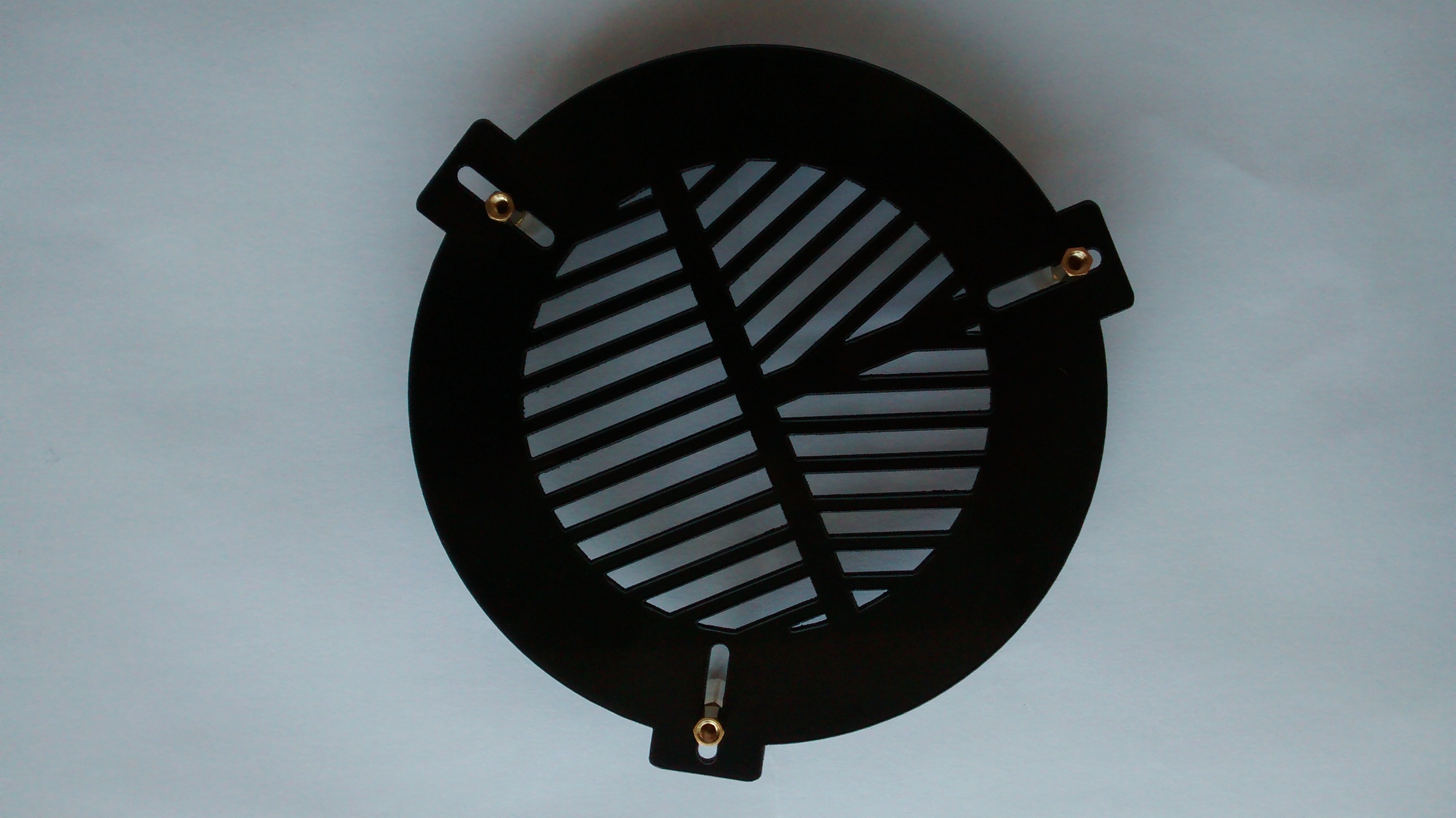
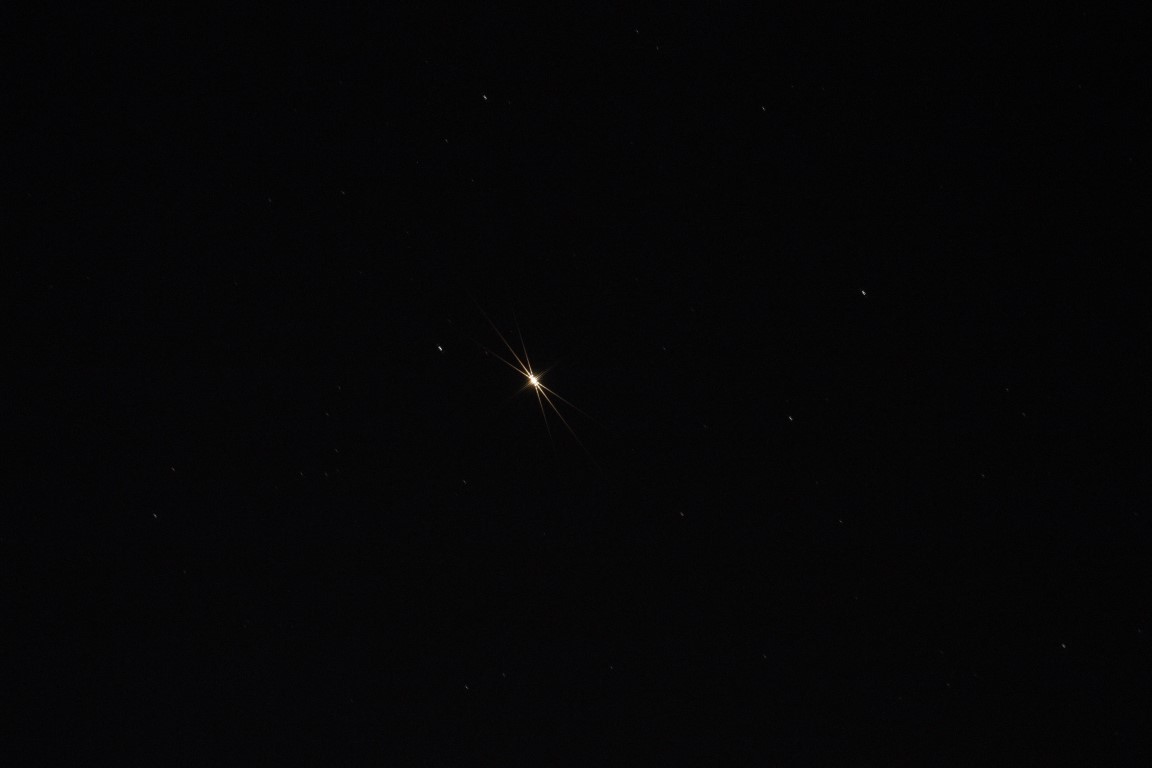
Another clear warm night soon came and with perseverance low and behold a result.  This time I was much more meticulous: visually focusing on the bright star Arcturus, then switching to the DSLR + FF.  Using the Canon EOS Utility and Live View, with the ISO set very high I was at last able to see something on the screen, which with very fine adjustment came into focus as a small, very bright dot. Placing my other recently discovered brilliant invention, the Bahtinov mask http://en.wikipedia.org/wiki/Bahtinov_mask

Bahtinov mask

over the objective lens I was able to refine the focus perfectly:

Bahtinov Focused Image(Medium)

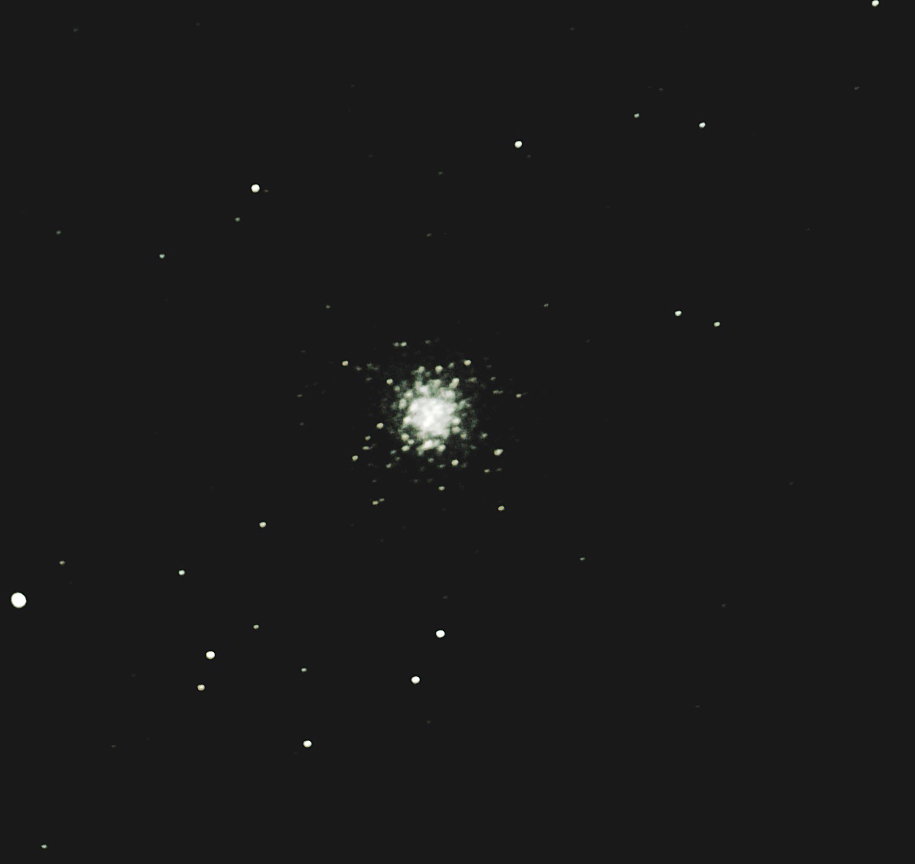
Now carefully transferring the scope and refining the position via Live View I was ready for a serious attempt on my first DSO, M13 The Great Globular Cluster in the constellation of Hercules:

M13 DSS Final 300714 cropped

WO GT 81 + FF 10x16sec at ISO800

Bingo + what a relief! Like my first crude afocal image of the Orion Nebula last year, getting the picture was exhilarating.  OK it’s not brilliant and I have seen the image in numerous publications and online but, it was mine, having captured those photon’s which had been travelling for the past  25,000 light-years on my camera, just outside my back door. WOW!

http://apod.nasa.gov/apod/ap120614.html

I hope to improve on this one day, once I have mastered all the other software, guidescope etc but I doubt I’ll feel quite the same next time.  In the end, focus was everything, it is very difficult to achieve and only goes to show just how difficult this astrophotography is but after the light spent so long getting here, the least I can do is focus it right on my camera sensor, which requires a fraction of a millimeter accuracy.

Later on the same night I also captured M57, the Ring Nebula (more another time).  Apart from refining this process (which I can see will take what ever’s left of my lifetime) my next ambition is to capture a galaxy out my back door, I can’t wait!