It’s all relative

Having missed 6-months astronomy earlier this year following an operation, come September I was desperate to get back to my nascent interest in astronomy and astroimaging.  Apart from some initial operating mishaps, it turned out to be a good month: warm evenings, clear skies and interesting skies.  Since then it’s all gone Pete Tong, with no imaging opportunities here at Fairvale Observatory since early October due either to cloudy skies or the coincidence of the full Moon with clear periods; it was therefore not surprising to learn that November was recorded as the dullest on record, with just 18 hours of sunshine compared to an average of 63 hours.

My antidote to physical incapacity and cloudy skies this year has been the MOOC or Massive Open Online Course – free online courses run by Universities from all over the world, in my case of course I naturally chose various aspects of astronomy:

  • In the night sky: Orion – Monica Grady, Open University. Orion constellation and star evolution.
  • Moons – David Rothery, Open University. Everything about moons; there are 176 moons in the Solar System some bigger than planets and some with the potential for life.
  • AstroTech: The science and technology behind astronomical discovery – Andy Lawrence & Catherine Hymans, Edinburgh University. Does what it says on the tin!
  • Imagining Other Earths – David Spergel, Princeton University. The complete astronomy course and more! Ongoing 24-week course that covers just about everything in astronomy – outstanding.
  • Gravity! – Pierre Binétruy and George Smoot (Nobel Laureate), Paris Centre for Cosmological Physics – Paris University Diderot. Gravity and how it shapes the universe etc.

This week marked the centenary of Einstein’s general theory of relativity and the end of the course Gravity!  At the same time on Thursday ESA launched the LISAPathfinder space mission, that is designed to assess the viability of ground breaking technology which if successful will be used later to study and measure gravitational waves; whilst on this theme I also watched the movie Interstellar.

Whatever gravity is, and it is clear that despite Einstein et al we still don’t really know (no shortage of theories though), its effects clearly shape the Universe in a major way and at all levels.

One such feature is the globular cluster, groups of up to one million very old stars, tightly bound by gravity that orbit a galactic core; over 150 have so far been identified with the Milky Way Galaxy.  I find them to be one of the most interesting and enigmatic features of astronomy and therefore before the clouds rolled in some weeks ago I managed to image such a cluster, M15.

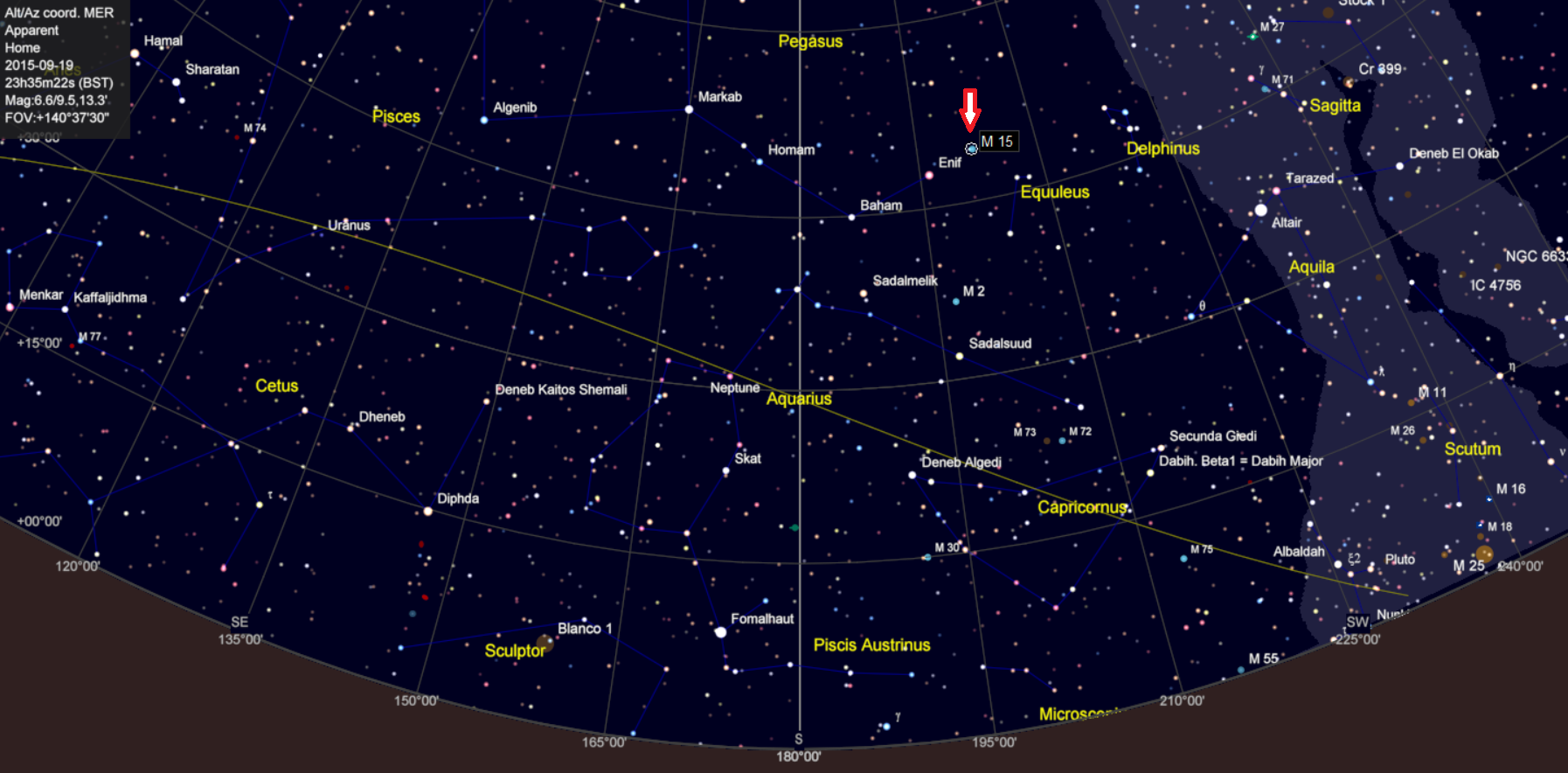
M15 CdC

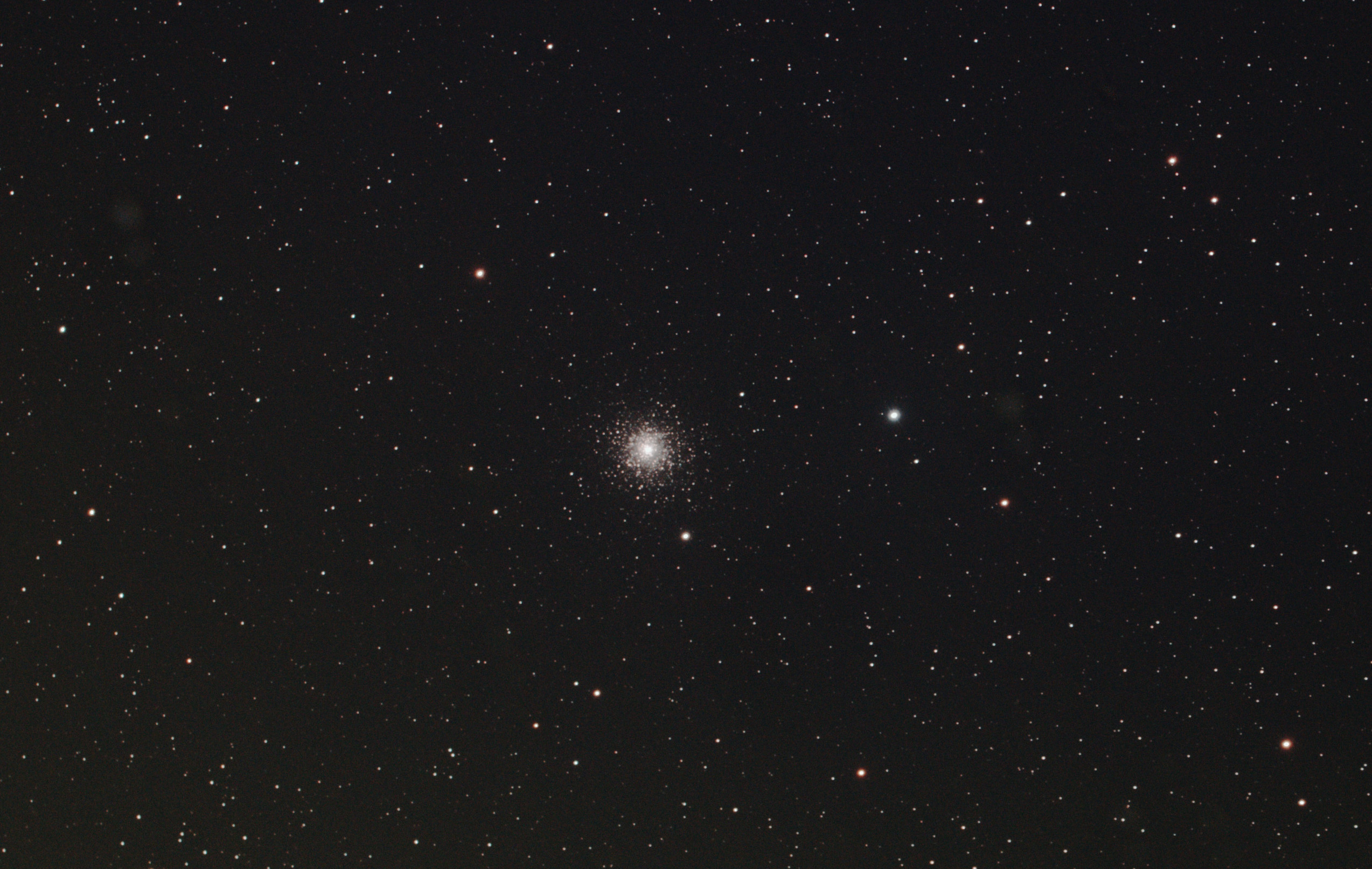
Globular star cluster M15 lies about 33,000 light years away towards the constellation Pegasus, about 4° northwest of Enif, the star at the tip of Pegasus’ nose.  It was discovered by French-Italian astronomer Giacomo Filippo Maraldi in 1746 and rediscovered by Messier in 1764.  At magnitude +6.2, M15 is generally considered to rank amongst the finest objects of its type in the northern sky.

M15 Globular Cluster WO GT81 + modded Canon 550D & FF | 15 x 120 secs @ ISO 1,600 | 19th September 2015

M15 Globular Cluster
WO GT81 + modded Canon 550D & FF | 15 x 120 secs @ ISO 1,600 | 19th September 2015

M15 has a diameter of 120 light years and revolves around the Galaxy once every 250 million years in a prograde orbit, meaning it moves about the galaxy in the same direction as the galaxy’s own rotation.  In 1974, M15 was discovered to be a source of x-ray energy, which may suggest that one or more supernova remnants are buried deep within the cluster.

With such unreliable viewing conditions in the UK it’s essential to find other areas of interest when pursuing astronomy.  I have found MOOCs to be an excellent and accessible source of first rate, up-to-date information that have expanded my knowledge of astronomy significantly, whilst post processing and planning are also both essential tasks that can also often be interesting.  Notwithstanding, with Orion and other exciting features of the winter sky now upon us, I can’t wait to get back outside soon.

The big picture unveiled

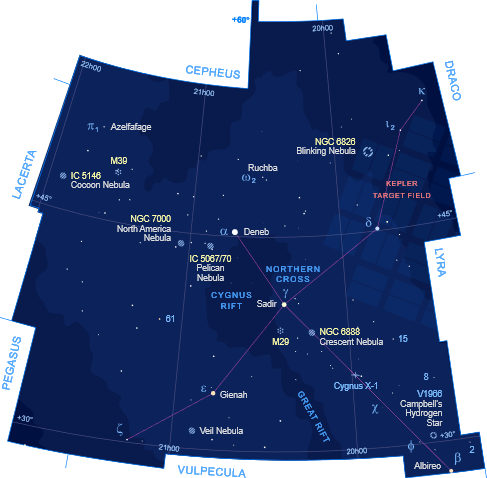
About this time last year I successfully imaged first NGC 6960 the Western Veil, AKA the Witch’s Broom Nebula and shortly afterwards NGC 6992 the Eastern Veil, which includes NGC 6995 AKA the Bat Nebula.  In themselves they are both wonderful parts of the larger but perhaps more elusive (photographically speaking) Veil Nebula.  Located in the constellation Cygnus, the Veil Nebula or Cygnus Loop is formed from the remains of a supernova that exploded in our galaxy about ten thousand years ago and at a distance of almost 1,500 light-years, now spans a 3o area of the sky or 80 light-years in diameter.  At the time I struggled to get these images but was very pleased with the outcome.

cygnus

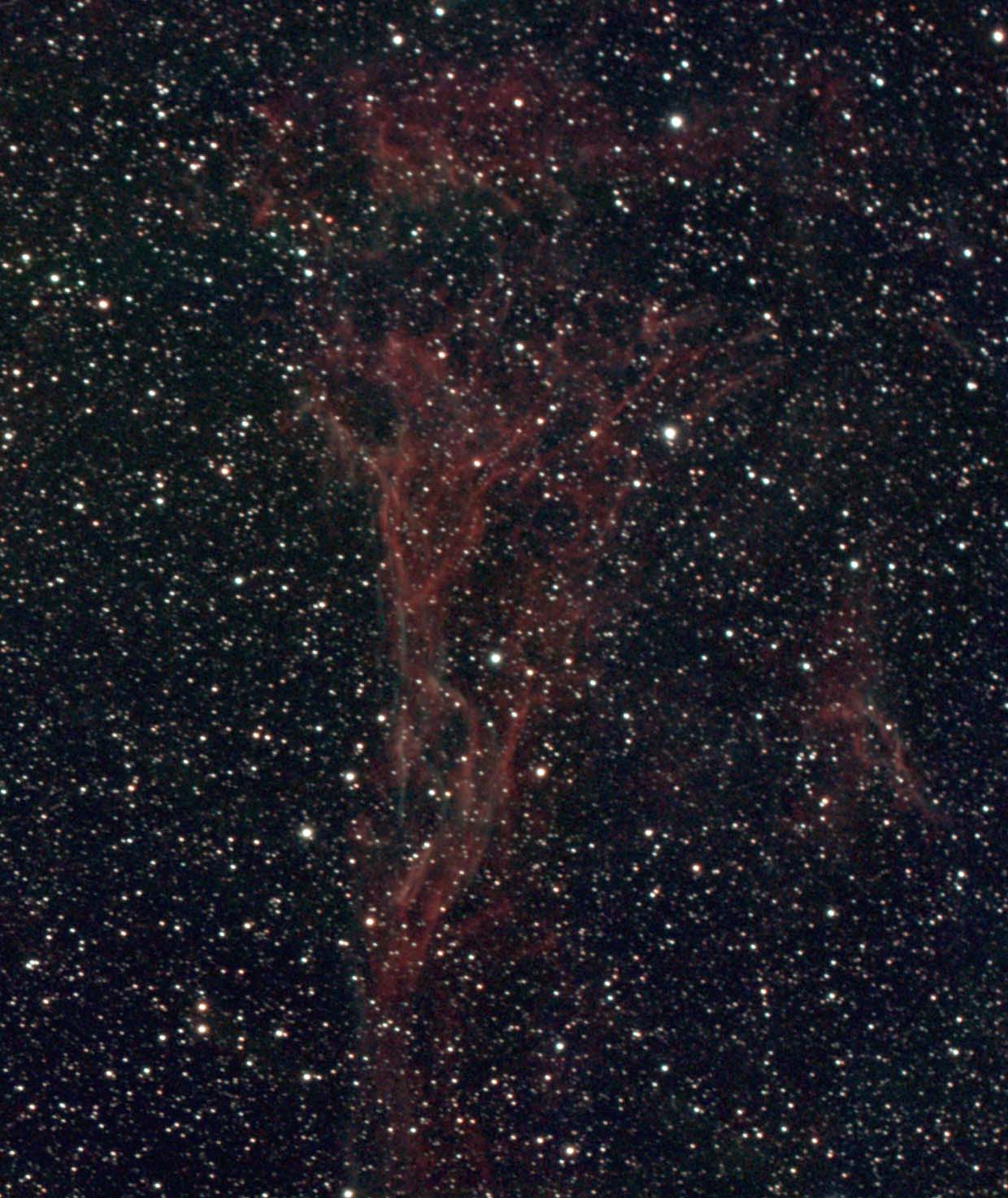
One year on and I was now thinking about other parts of the Veil, in particular Pickering’s Triangle.  The Triangle might be thought of as the third central section of the Veil, situated between the Eastern and Western Veils but slightly further north.  At some 52 x 35 arcminutes it is itself a significant feature, which surprisingly does not have an NGC catalogue number of its own.

Pickering's Triangle

Pickering’s Triangle

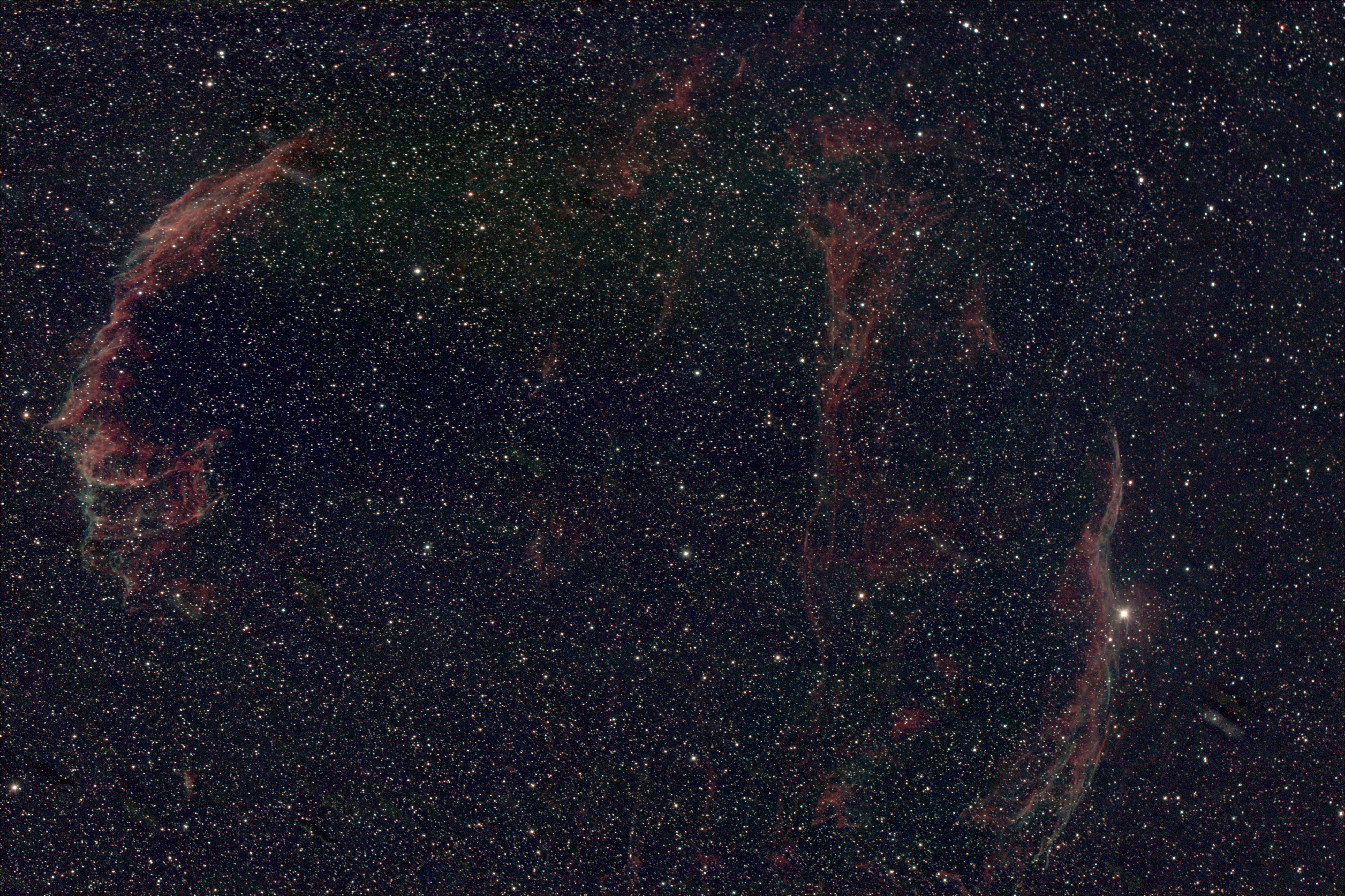
Notwithstanding the success of Pickering’s Triangle, in the end I got much more than I bargained for.  This time using a modded camera, I was able to capture the entire Veil Nebula in one photograph – progress indeed.

The Veil Nebula AKA Cygnus Loop: Ultraviolet view ref. NASA

The Veil Nebula AKA Cygnus Loop: Ultraviolet view ref. NASA

Light from the bulk of the Veil Nebula is very faint and notoriously difficult to image, whilst furthermore much of it is Ha in nature – hence this time finding its way to the camera’s sensor having had the IR filter removed.  The result is a staggering view of the entire supernova, with the Witch’s Broom in the west (right), the Eastern Veil (left) and Pickering’s Triangle nestled in between.  However, in addition extensive regions of delicate, wispy nebulous filaments can be seen flowing everywhere in between – hence the name of Veil.

Veil Nebula / Cygnus Loop WO GT81 & modded Canon 550D + FF | 30 x 180 sec exposures @ ISO 1,600 | 19th September 2015

Veil Nebula / Cygnus Loop
WO GT81 & modded Canon 550D + FF | 30 x 120 sec @ ISO 1,600 | 19th September 2015

Whilst I am very pleased with the resulting photograph, there’s still more to achieve another time.  Apart for the added potential that would be gained from longer, guided exposures, the use of Ha and OIII filters would also uncover even more of the Veil’s diaphanous beauty.


At the limit

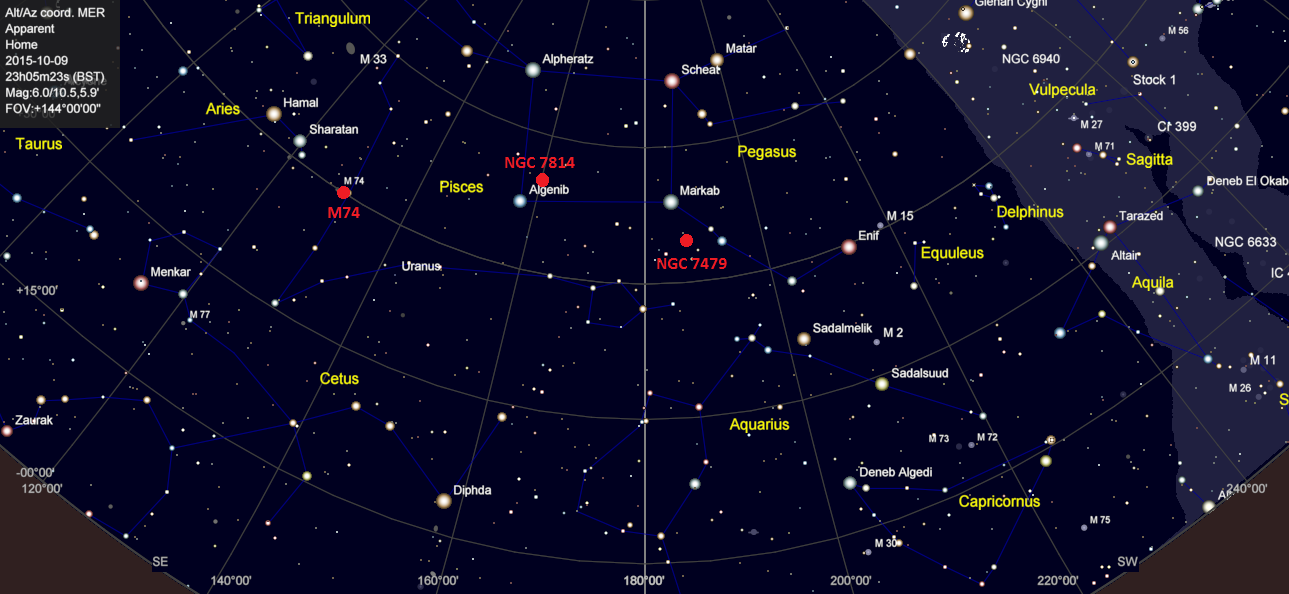
Earlier this month the weather and clear skies produced particularly good imaging conditions that resulted in some excellent pictures; it’s already a distant memory as the weather has since turned cold and cloudy day-after-day – or at least every night except when there’s a full Moon!  With these images knowingly in the bag and the telescope well aligned, I took the opportunity to indulge in a short session imaging some galaxies that happened to be around the Meridian at this time which, as it turned out, were located in proximity to the constellation of Pegasus.

pegasus ANOTATE

Two of the objects (M74 & NGC 7814) were confined to just ten shots and the third fifteen, all at 180 seconds exposure and ISO 1,600.  For such dim and distant objects this in itself was obviously insufficient but still it was fun to experiment.  As expected the resulting images are feint and noisy but the object’s form can be clearly seen and, in the case NGC 7814 – the Little Sombrero, even the edge-on dust lanes are evident.

In order to better understand the limits of the equipment, a comparison of the images with the objects’ physical information given side-by-side illustrates the problems and possibilities for the future.  The truth is that these are all at or beyond the realistic limit of my current set-up but I was interested to see what results could be achieved and I always enjoy their beauty, even if imperfectly captured.

Picture3

Apart from the obvious problem of size, mainly a function of distance in this case, their apparent magnitude is also challenging.  It is interesting to consider that using the 18 megapixel Canon 550D and WO GT81, each camera pixel which measures 4.30μm samples just 1.855 arc seconds per pixel and therefore even the largest of these objects (M74) spans an area of just about one tenth of a degree (0.10o).  Better alignment and longer exposure should tease out more detail but as the recorded image of each object is no more than 2% of the total image the reality is that I am pushing my luck.

Still it is fun and I have managed to capture a few of the photons that left these galaxies so long ago.  As my equipment, techniques and knowledge continue to improve then hopefully so will the limits.  Watch this space!


Rock On!

Due to my viewing limitations at Fairvale Observatory planning is essential, with the best imaging range mainly restricted to a zone between 65o and 85o and within +/-20o of the Meridian.  Furthermore, as I am mostly using the William Optics GT81 telescope at the moment, imaging targets should preferably be large – something between 1o & 2o is perfect, such as  the Rosetta Nebula at 1.3o or Andromeda Galaxy at 190’ x 60’.  As luck would have it these conditions are favourable for a number of objects at the moment and I have been somewhat spoilt for choice: North America Nebula, Veil Nebula and Andromeda.

Notwithstanding, for some reason I have until now overlooked the Sadr Region IC 1318, which is also large and in a similar part of the sky as the aforementioned North America and Veil Nebulae but perhaps overshadowed by their notoriety.  In reality it is an enormous area of nebulosity containing many features worthy of imaging which are perfect at this time of the year from my location.

cygnus

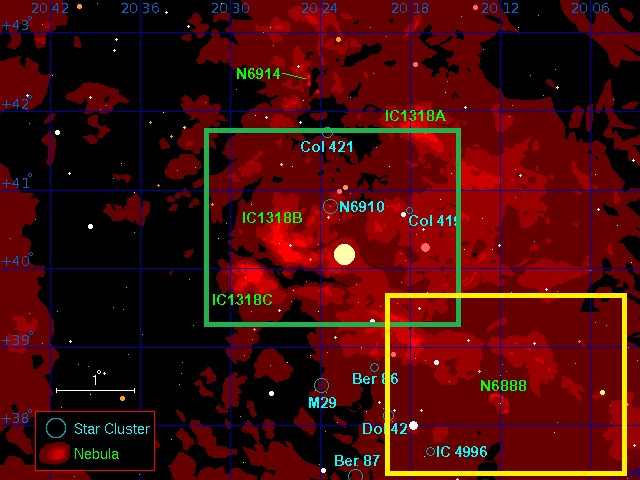
Sadr Region: green rectangle indicates the approximate area of IC 1318 image, yellow rectangle the NGC 6888 Crescent Nebula. image

Sadr Region: green rectangle indicates the approximate area of IC 1318 image, yellow rectangle the NGC 6888 Crescent Nebula image.

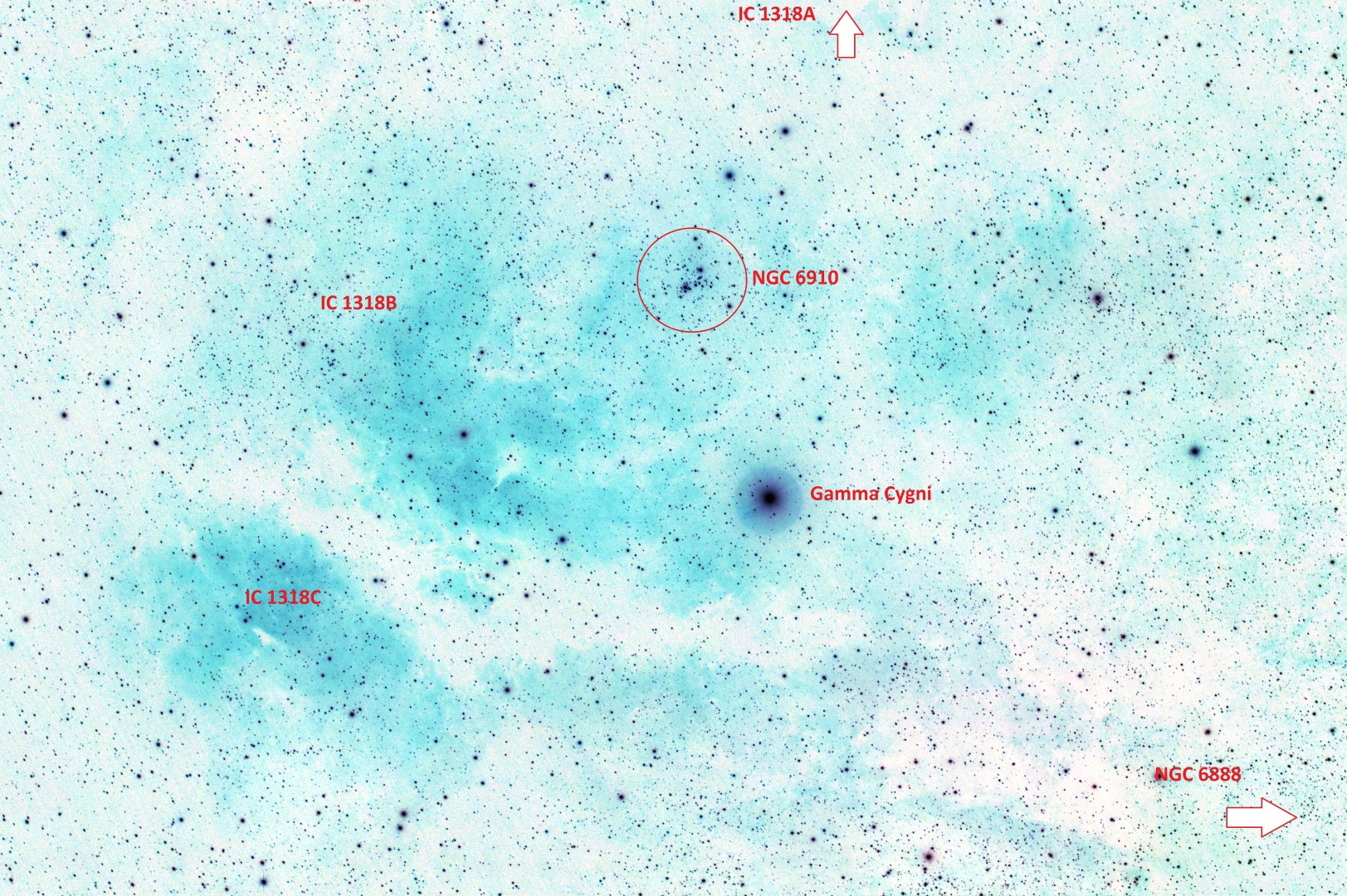
IC 1318 is a diffuse emission nebula surrounding the star Sadr or Gamma Cygni, which is at the centre of the Cygnus Cross and on the plane of the Milky Way.  The Sadr region is located deep within the Orion arm of the Milky Way about 3,000 light-years from Earth, with Gamma Cygni actually situated closer in the foreground. Such is the size of IC 1318 that its three constituent parts, A – B – C, extend over some 200 light-years or about 4 degrees, which is well beyond the FOV of the WO GT81; how could I have overlooked his enormous area of nebulosity before?  As a result of its size and complexity I also chose to image two other interesting features nearby.

IC 1318 Sadr Region - image inverted & annotated

IC 1318 Sadr Region – image inverted & annotated

IC 1318 Sadr Region WO GT81 + modded Canon 550D & FF | 30 x 120 secs @ ISO 1,600 | 30th September 2015

IC 1318 Sadr Region
WO GT81 + modded Canon 550D & FF | 30 x 120 secs @ ISO 1,600 | 30th September 2015

Situated just above Sadr is the small star cluster of NGC 6910 AKA Rocking Horse Cluster.  Although only 10’ in size the cluster is visually quite prominent, though I struggle to see the little horse that others have identified.  Notwithstanding, it is an interesting and attractive part of the Sadr region.

NGC 6910 The Rocking Horse Nebula as recorded by StarObersever.eu - located just above Gamma Cygni in the previous image.

NGC 6910 The Rocking Horse Nebula as recorded by StarObersever.eu – located just above Gamma Cygni in the previous image.

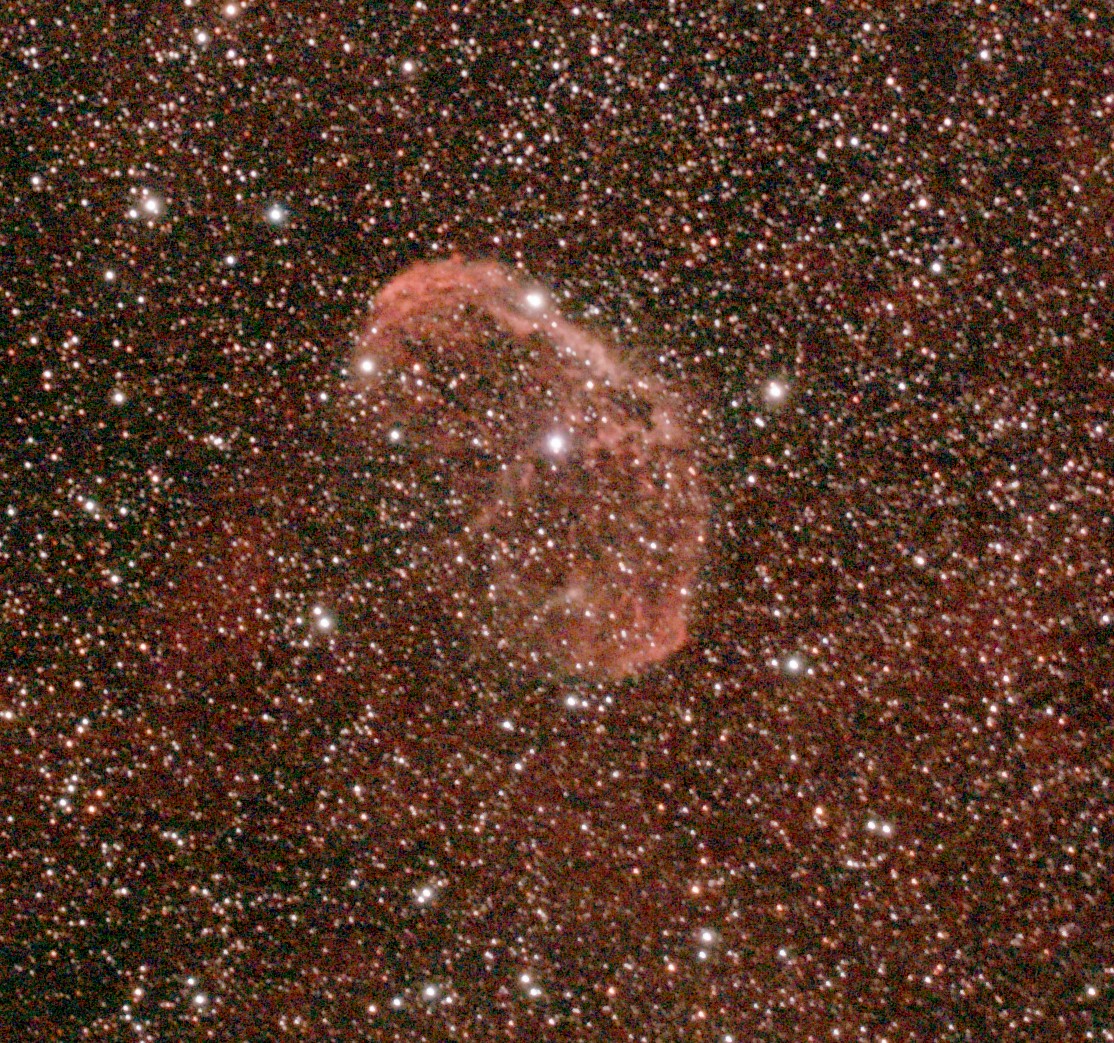
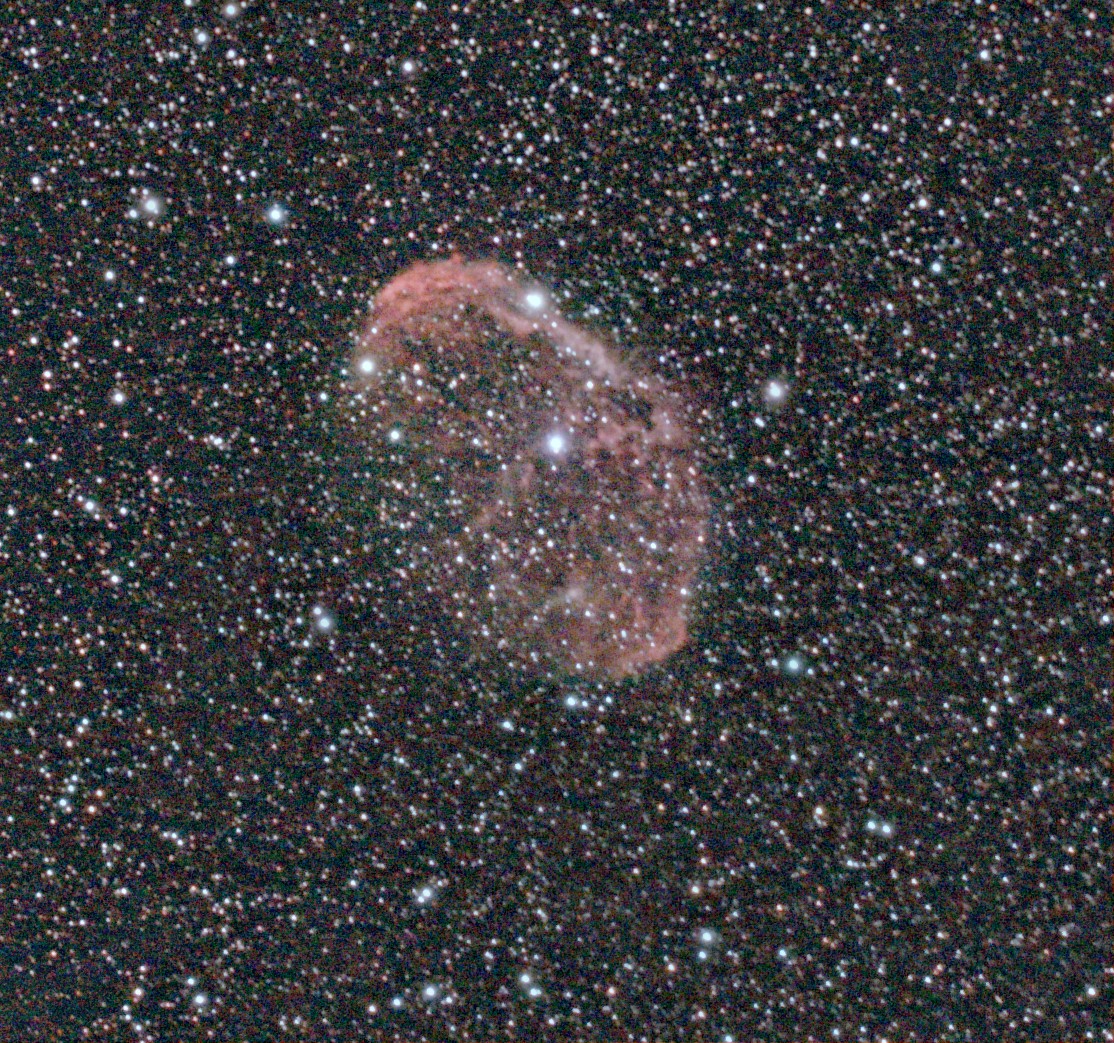
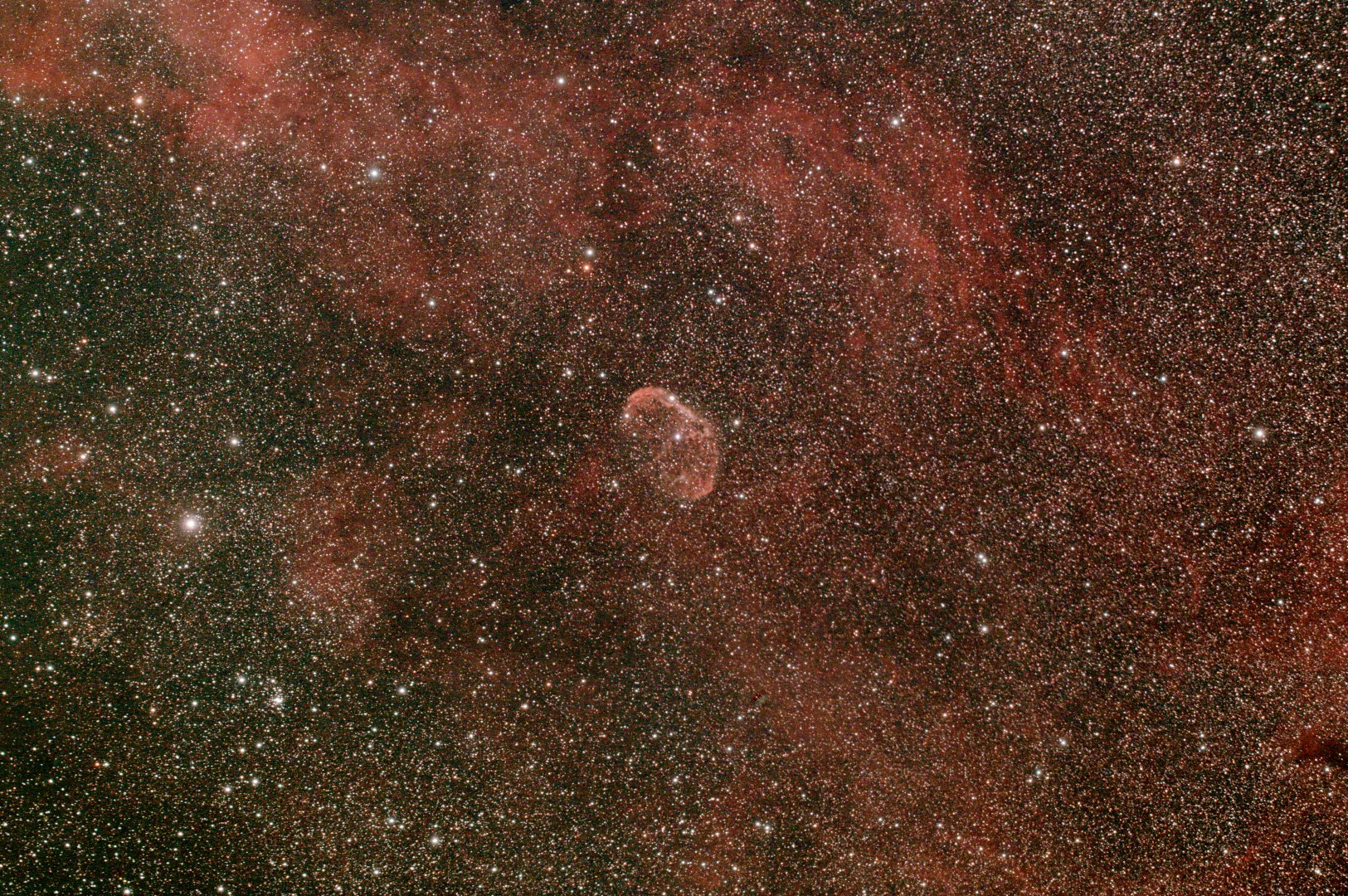
Located about 2 degrees south west of Sadr is the Crescent Nebula NGC 6888, which is not unlike the Jellyfish Nebula in appearance but is younger in its evolution.  An emission nebula, NGC 6888 is formed by a stellar wind from the Wolf-Rayet star WR 126 colliding with a slower moving wind ejected when the star previously became a red giant. The result is an illuminated shell-like feature consisting of two shock waves, one moving inward and the other outward, producing this amazing spectacle which measures some 25 light-years across.  Near the end of its existence, the star will eventually end its life in a spectacular supernova explosion – now that would be an image.

NGC 6888 Crescent Nebula WO GT81 + modded Canon 550D & FF | 20 x 180 secs @ ISO 1,600 | 9th October 2015

NGC 6888 Crescent Nebula
WO GT81 + modded Canon 550D & FF | 20 x 180 secs @ ISO 1,600 | 9th October 2015

Crescent Nebula - cropped

Crescent Nebula – cropped

Crescent Nebula - cropped + GradientXTerminator applied

Crescent Nebula – GradientXTerminator applied

Whilst IC 1318 has proved to be an excellent and productive imaging target for my equipment, it has become clear that it represents a much, much larger area of nebulosity that incorporates or is at least immediately adjacent to NGC 7000, the North America Nebula.  At a rough estimate this larger area spans a distance of some 2,000 light-years and is some 50-times bigger than the Sadr region.  Like other major areas of nebulosity (Barnard’s Loop) such a scale is way beyond the ability of my equipment and most others without resorting to a mosaic technique.

However, my interest in seeing and potentially imaging the bigger picture has been piqued and I have recently purchased a Vixen Polarie tracking mount, which can be fixed onto a camera tripod with a standard camera and lens in order to take long exposures without forming star trails. This set-up has two advantages over prime focus + telescope imaging: (i) it is highly portable and can easily be taken anywhere in a rucksack, and (ii) by using a camera lens of say <=50mm focal length it is possible to achieve a much wider FOV and thus photograph some of these very large nebulous areas in one image.

Alas the Sadr region is now moving on and it is probably too late to tackle using the Polarie mount but it will be something to look forwards to again next autumn and meanwhile Orion is just round the corner.  Watch this space for developments!

Space Odyssey

I have just finished reading Chris Hadfield’s excellent book An Astronaut’s Guide to Life on Earth, which is an entertaining and insightful look at being an astronaut and the lessons it provides for life in general.  Who of us has not at least considered such an adventure ourselves but, of course, it is impossible for all but a few.

51lLw6nsBsL._SX328_BO1,204,203,200_

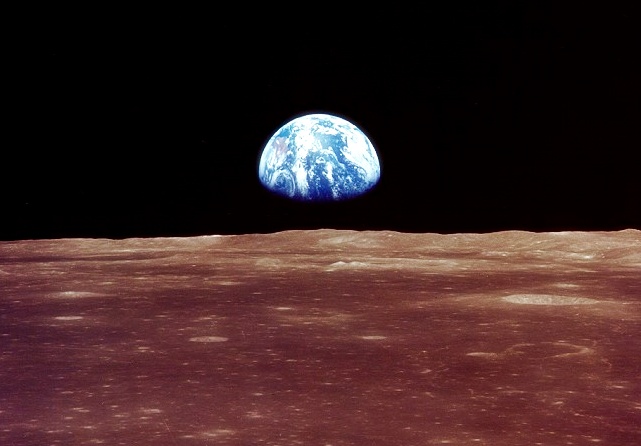
Astronomy is thought provoking enough in itself looking out at the vastness and beauty of the Universe, being in space and looking down on our planet would take such thoughts to a whole different level; from their subsequent accounts it is clear that those who have walked on the Moon became changed people, returning different to the rest of us.

apollo08_earthrise

Ever since following the pioneering space adventures of Yuri Gagarin and Alan Sheppard and especially watching the Apollo 11 Moon landing in 1969, I have been fascinated by space, its science and the human experience of travelling there.  My solution to going into space was to take up scuba diving and since 1976 have had many wonderful diving experiences all over the world.  Of course, it’s not space but it is very much other worldly and the weightless feeling is as close as most of us will get to being in space; the astronauts train extensively underwater for just that reason.  Furthermore, as a geologist and more recently taking up astronomy has altogether provided me with a better understanding of the Universe.

Maldives, Kandooma 2004: the closest I'll get to space!

Maldives, Kandooma 2004: the closest I’ll get to space!

Given my long standing interest in space, it is perhaps surprising that I came late to astronomy itself, so why now?  The best answer is time – in recent years I have had more of it and in the past work, family and extensive travel precluded such a pastime.  Like so many sciences in the modern era, technology has also unlocked major new opportunities for scientists and amateurs alike.  Whilst I enjoy the science itself and especially viewing the night sky, the ability to produce frankly incredible images has been the most important key to my recent personal interest.

The phenomenal imaging improvements that have occurred since the launch of Hubble have made the power and beauty of the Universe even more accessible to us all on Earth.  Digital image capture and processing is now so powerful that pictures of hitherto unimaginable quality can be achieved from Earth.  Furthermore, for a relatively modest cost outlay, such images can be obtained by amateurs like me, literally outside my back door.  More than any other development, this is what has now engaged my interest.  The product of astroimaging can easily be overlooked as just an attractive, often spectacular photograph of the night sky – and they are.  But the equipment and pictures produced are also important tools that can assist our understanding as well as imagination of space.

andromeda

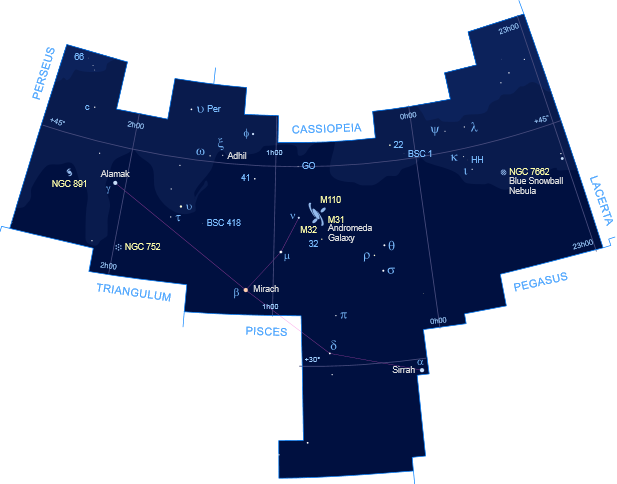
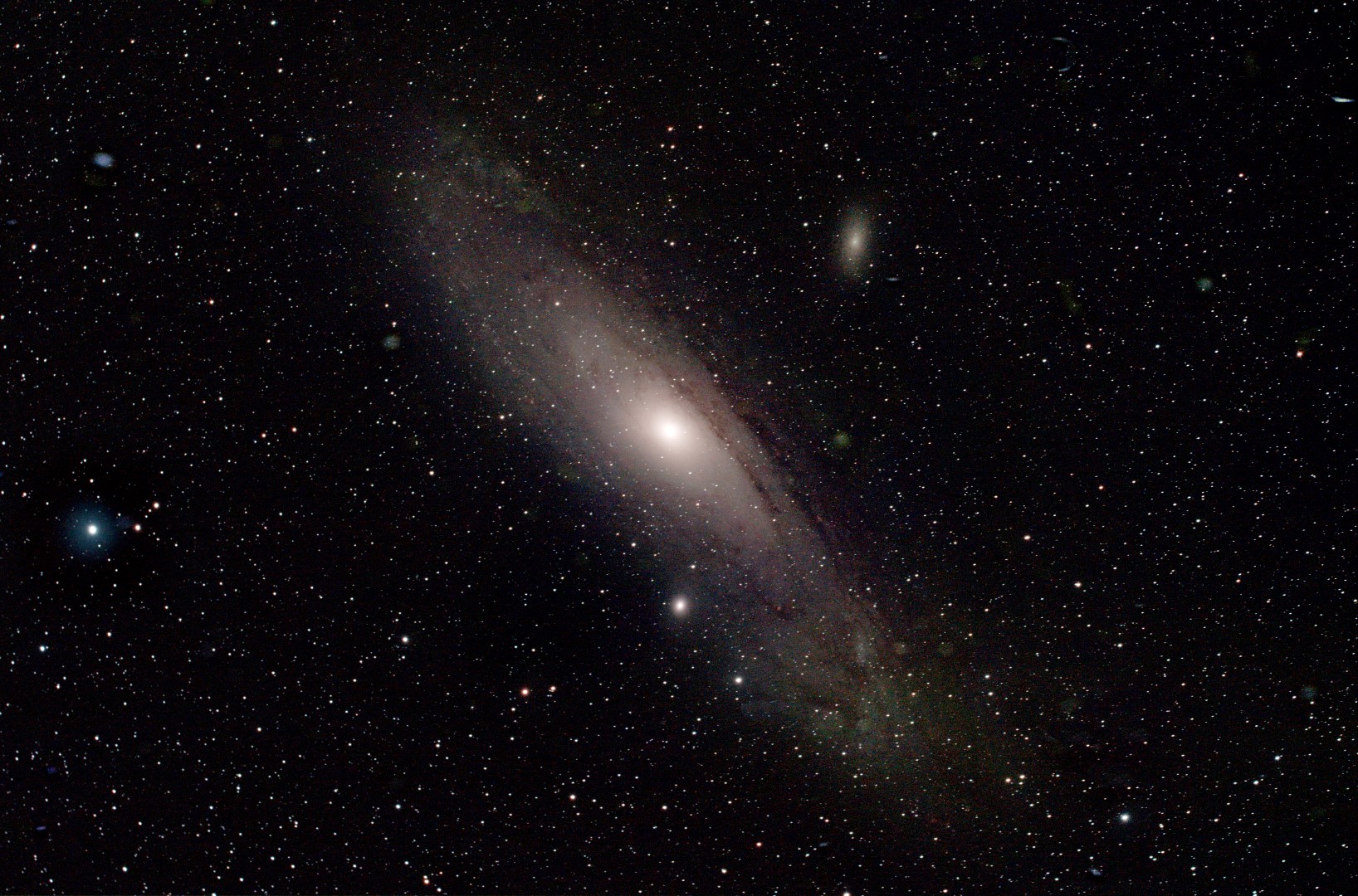
After a forced absence from astroimaging for the past six months, I was recently fortunate to obtain a number of exciting pictures of familiar objects on my first night back, in particular M31 or the Andromeda Galaxy.  As the nearest galaxy to Earth, Andromeda is an obvious target for those new to astroimaging but despite its proximity, it is not to be underestimated as an imaging target.  I have attempted imaging M31 before but, like many others, found it very difficult to coax out the detail which makes it such a beauty.  I am not completely sure what was different this time but the resulting picture at last starts to capture these details; I was even more surprised at the outcome which is the result of just nine 120 second exposures at the end of a long night before heading for bed!

M31 Andromeda Galaxy WO GT 81 + modded Canon 550D + FF | 9 x 120 secs @ ISO 1,600 | 19th September 2015

M31 Andromeda Galaxy
WO GT 81 + modded Canon 550D + FF | 9 x 120 secs @ ISO 1,600 | 19th September 2015

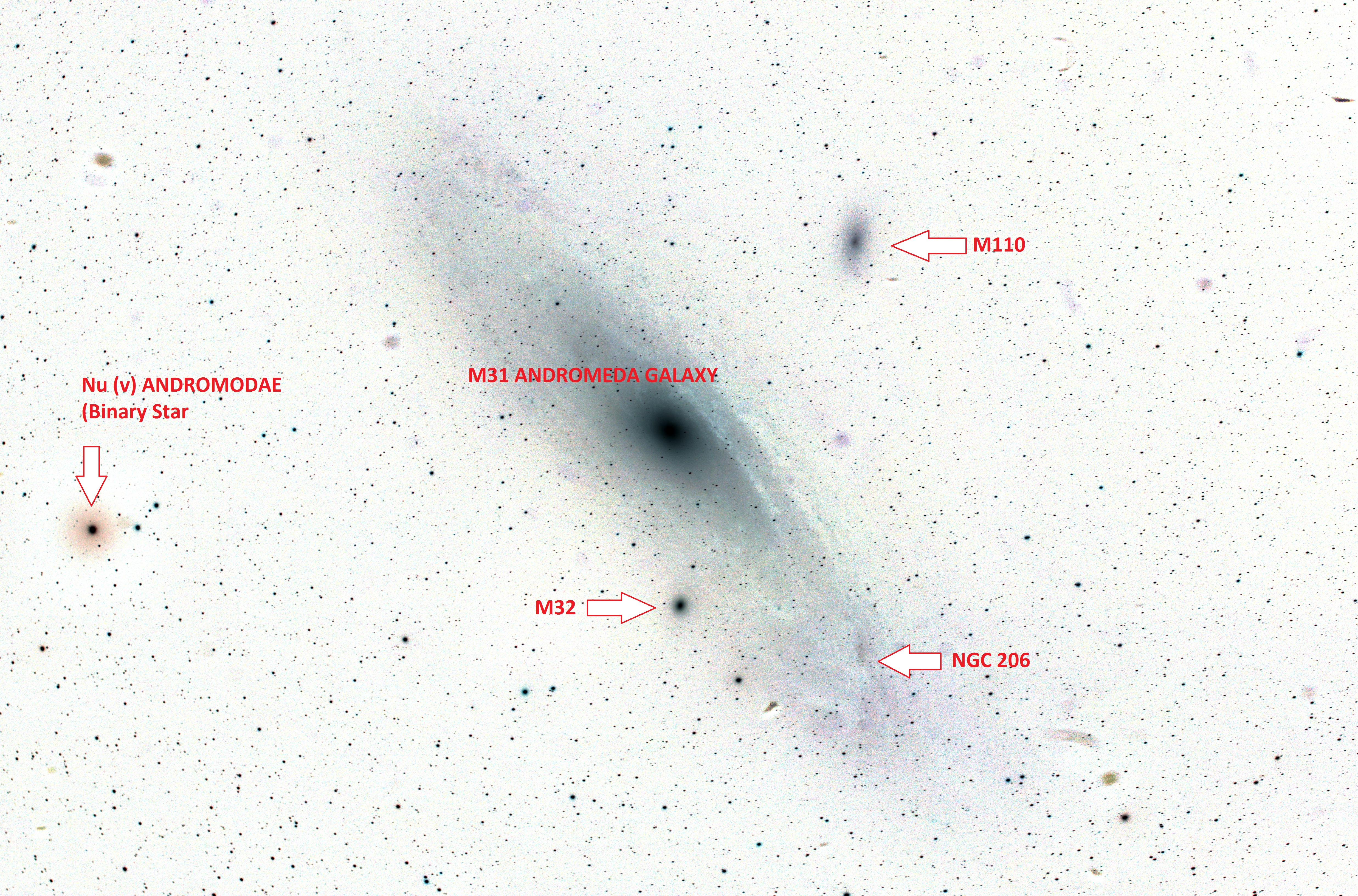
Andromeda poses two main challenges for the photographer: (i) the contrast in brightness between the central area and the rest of the galaxy, and (ii) the need to show the brown dust bands within the main disc, which provide a fascinating insight into the galaxy’s overall structure – that is not unlike out own Milky Way.  The classic technique is to use two sets of images, with camera settings appropriate to the two contrasting areas, subsequently bringing them together during post-processing.  Despite the limited number of prime focus images taken the final picture achieved still came out well.  Though the bright central area is overexposed, the galaxy’s dust bands are clearly evident and for the first time have captured the full character of this magnificent feature. Furthermore, within M31 the NGC 206 is evident, a star formation region of over 300 new stars, whilst in the adjacent sky two other Messier galaxies are shown in the image M32 and M110.

M31 Anfromeda Galaxy: inverted & anotated

M31 Andromeda Galaxy: inverted & annotated

I think it is correct to say that the Andromeda Galaxy is one of the iconic images of the night sky and I feel obtaining such a picture marks another notable point in my personal space odyssey.  I would hope Chris would approve, as well as Major Tom?

Harvest Time

Thanks to Copernicus and Kepler et al, astronomical events are highly predictable; unfortunately the same cannot be said about the weather.  Since taking up astronomy and despite favourable predictions of clear skies, I have frequently been thwarted by incoming cloud or worse.  When communicating with each other astronomer’s often use the closing of “Clear Skies”, no wonder given the continuous battle we have just to see the sky at night, let alone image it!

Such was my experience in 1982.  At the time I lived and worked in northern South Africa, close to the border with Botswana and the Kalahari Desert.   A lunar eclipse was forecast and in this part of the world there was usually a good chance of a clear sky.  Unfortunately, it was not to be this time either.  We saw glimpses of the eclipse through brief gaps in the otherwise thick cloud that was blowing across the sky.  I’ve missed other eclipses for the same reason, lunar and solar, and as a result have developed a somewhat resigned mindset towards such events, with the probability that the sky would most likely not be clear.  And so despite encouraging forecasts, my expectation for this week’s lunar eclipse was more of the same.

The lunar eclipse of 28th September was very unusual.  At mid-eclipse the Moon was just one hour past its closest approach to Earth in 2015, creating an effect now popularly termed a ‘Supermoon’.  Moreover, the rare combination of this and a full eclipse at the same time results in a distinctive red moon at totality.

I have learnt the hard way that in astronomy Rule-1 is perseverance.  I therefore carried out all the necessary research on the eclipse, undertook a dry run the previous evening and set-up all the equipment in the early evening before heading for forty winks – it was after all hopefully going to be a long night.  The weather had been clear and sunny earlier in the day but was forecast to cloud over shortly after midnight, just before umbral contact!  The sky was clear when I went out later but ominously there were clouds in the west.  Notwithstanding, the sky remained clear all night and the eclipse was nothing less than spectacular.

Total Lunar Eclipse 18th September 2015

Total Lunar Eclipse 18th September 2015

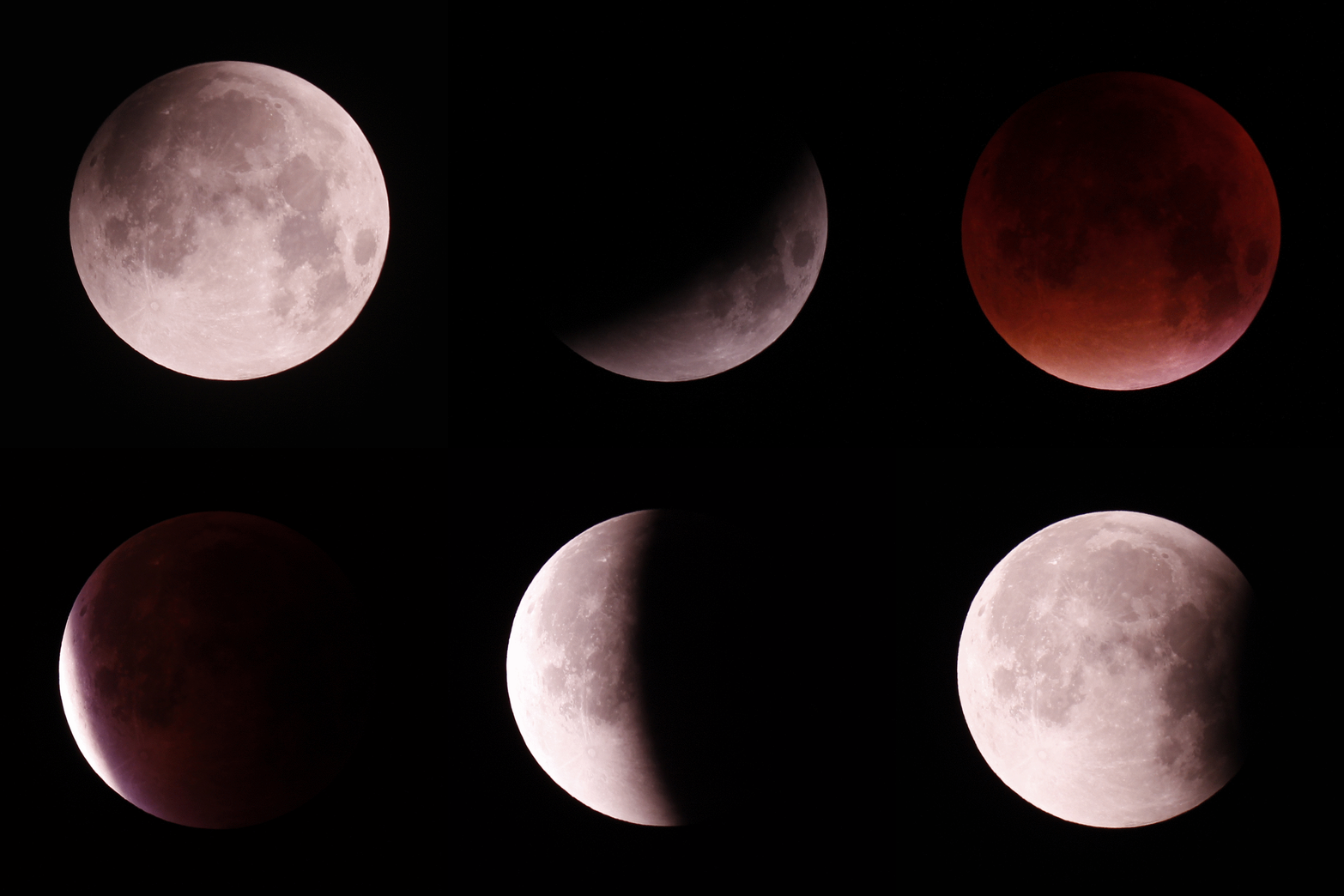
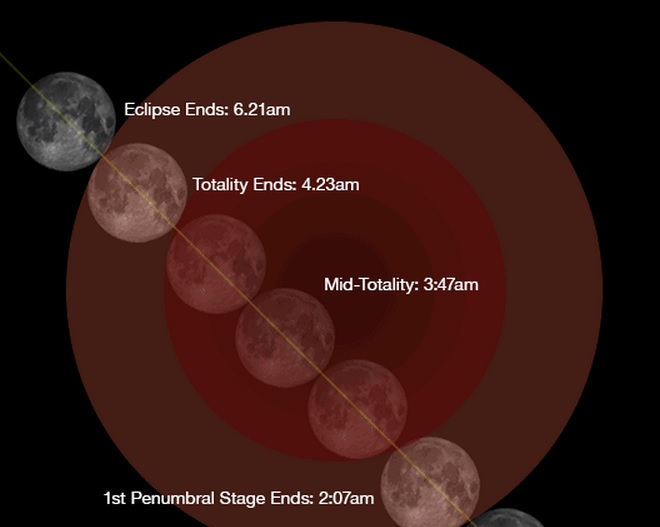
The precision with which astronomical events are plotted is incredible and, guided by various articles and charts all was in place well before the end of the penumbral stage at 2.07am.  Shortly before darkness started to show on the top, eastern edge of the Moon and then exactly at 2.07am the eclipse shadow touched and then crept inexorably across the Moon’s surface.  This was the main phase of the eclipse when the Moon enters the central, dark part of the shadow called the umbra, eventually reaching totality at 3.11am.

Totality lasted 1 hour 12 minutes, during which I just watched through a pair of 10 x 50 binoculars, which probably was the best way of actually viewing the Moon throughout the eclipse.  Of course, with the brightness of the full Moon obscured by the eclipse during this time, the rest of the night sky was plunged into blackness, thus bringing the stars, nebulae and galaxies back to life.  As the Moon was passing through the lower part of the Earth’s umbral shadow, the southerly edge appeared relatively bright during much of totality.  Totality finished promptly at 4.23am as the light started to move across the Moon’s surface once again like an unstoppable wave.  The Moon finally exited the umbra at 5.27am and the show was over until October 2033, on which occasion the Supermoon eclipse will unfortunately not be visible from the UK – I did say it was rare.   However, there will be another total lunar eclipse in July 2018, so it’s not all bad news.

Given my history, this was naturally my first time imaging a lunar or any other eclipse and I am very pleased with the results.  Other than requiring a clear sky, as usual preparation was the key: understanding the timing and dynamics of the event and considering the imaging possibilities.  The most obvious problems to overcome were the Moon’s tracking and movement of the eclipse itself, with its associated impact on changing brightness and contrast for imaging.

The previous evening had also been clear, so I tested a basic DSLR + tripod set-up using an intervalometer to trigger the shots at 5-minute intervals.  With the 200mm telephoto lens 8 pictures were successfully recorded as the Moon tracked across the image frame, at 100mm this increased to 12 pictures; however, the track tended to move out of the side of the frame early as the Moon follows an inclined rather than horizontal track.  Altogether it was a successful and useful experiment for the next evening.

On the night I used the William Optics GT81, with a Canon 550D camera and field flattener, which continuously tracked the Moon and eclipse,  imaging at 1-minute intervals throughout the period inward and outward of the umbra and manually during totality.  Using a fixed ISO 100, it was necessary to continually change the exposure time every five or so minutes in order to compensate for the aforesaid changing light conditions.  In addition, I again used the intervalometer with the Canon 700D and the 55- 250 mm telephoto lens on a camera tripod.

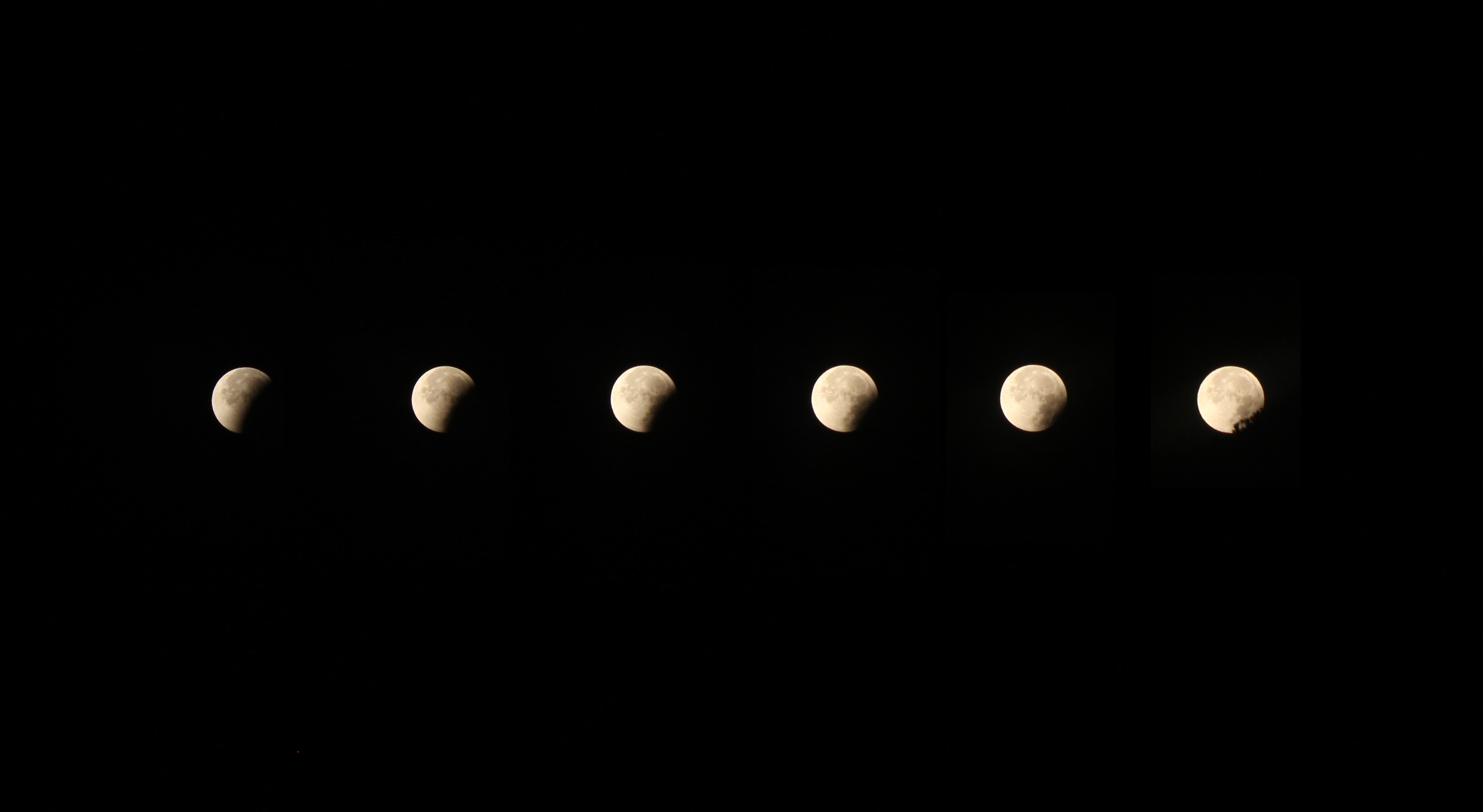
Eclipse: Inward sequence from umbral contact to totality WO GT81 + Canon 700D + FF | 1/500 to 1/3 sec @ ISO 100 | 18th September 2015
Eclipse: Inward sequence from umbral contact to totality
WO GT81 + Canon 550D + FF | 1/500 to 1/3 sec @ ISO 100 | 28th September 2015

Eclipse: Exit sequence to full Moon Canon 550D + tripod | >=1/160 sec @ ISO 400

Eclipse: Exit sequence to full Moon
Canon 700D + tripod | >=1/160 sec @ ISO 400

Eclipse animation

Eclipse animation

The results from both methods turned out well.  With superior optics and tracking, the WO telescope images were naturally better in quality and magnification.  However, the alternative simple camera set-up also produced a pleasing record of the eclipse, perhaps in some way capturing the mood better?

The entire event lasted just over 3-hours, during which found it necessary to look away from the imaging process at times just to enjoy this unusual and exciting spectacle.  The name Harvest Moon is given to the full moon closest to the Autumn Equinox, recognising the time of year at which the crops have been gathered and can itself be an attractive sight.  The coincidence with an eclipse makes for a rare and dramatic occasion, which this time I was able to enjoy completely cloud free from beginning to end – well that’s a first.

Harvest Moon at Totality WO + Canon 700D + FF | 1/3rd Sec @ ISO 400 | 28th September 2015

Harvest Moon at Totality
WO + Canon 550D + FF | 1/3rd Sec @ ISO 400 | 28th September 2015

The Pelican & The Phoenix

As we pass the Autumn Equinox the promise of long and exciting Winter skies is not far off but there are still some wonderful late Summer features around worth imaging before they move away from the Meridian and out of view from Fairvale Observatory.  Following a major operation earlier in the year I’ve been unable to move the heavy equipment outdoors until very recently and have therefore almost completely missed the Summer skies; even as I’ve been getting better in recent weeks, poor skies and other circumstances have stopped my return to astronomy – until now.

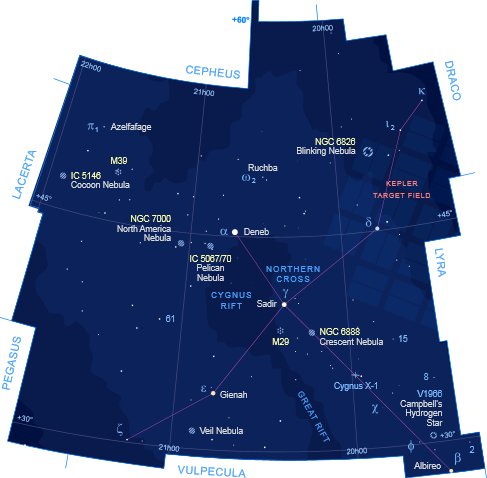
Up until shortly before midnight the Cygnus constellation is favourably located close to the Meridian at the moment and at a very high, southerly altitude – perfect for my location – it was therefore here that I chose to make my long awaited resumption to astroimaging last Saturday.  The weather forecast in the morning showed clear skies for that night but by early evening had changed to cloud and looked like being another lost opportunity; on this basis the Flamsteed Astronomy Society had already cancelled their planned evening astronomy session.  However, unlike previous attempts in recent weeks when clear skies were forecast and the cloud rolled in unannounced, this time the outcome was very different, with a clear moonless sky throughout the night – I sometime wonder if the weather forecasters have windows and bother to look outside!

cygnus

Located northeast of the first magnitude star Deneb and some 1,600 ly from Earth is NGC 7000 or the North America Nebula, an enormous H II region that in outline resembles the North American continent.  I first encountered this emission nebula at a similar time last year, which was my first experience of such a feature and I was therefore thrilled to capture part of it in my picture; my blog title at the time captures my feelings – WOW!  However, taking the image using the longer focal length Skywatcher 150PL with a smaller field-of-view (FOV), the picture only captured part of the ‘USA’ and the ‘Gulf of Mexico’.  Furthermore, using an unmodded camera much of the red H-alpha light that is characteristic of these nebulae was not recorded.

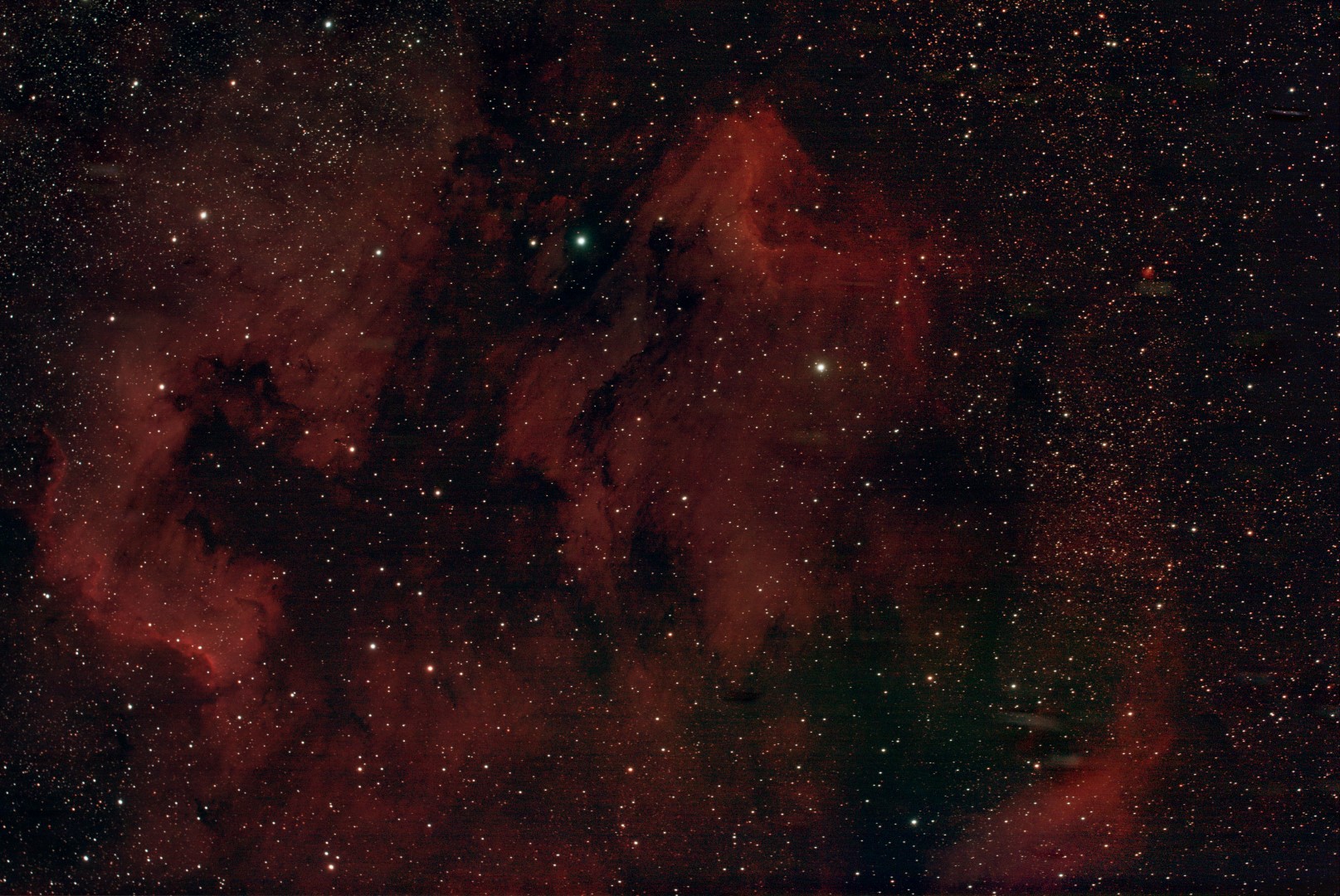
Since then my equipment has changed in a number of important ways, so that the William Optics GT81 with a wider FOV would now enable me to image more of the nebula, whilst using a modded DSLR camera would also record much more of the H-alpha light; an additional year’s experience also helped.  This time my target was the related IC 5070 and IC 5067 H II regions otherwise known as the Pelican Nebula, situated just west of NGC 7000 and close to Deneb.

The Pelican Nebula, IC5070 & IC 5067. WO GT81 & modded Canon 550D + FF | 30 x 120 secs @ ISO 1,600 + calibration | 19th September 2015

The Pelican Nebula, IC5070 & IC 5067
WO GT81 & modded Canon 550D + FF cropped | 30 x 120 secs @ ISO 1,600 + calibration | 19th September 2015

With an apparent magnitude of +8 the Pelican is generally less bright than its larger +4 neighbour but is no less exciting.  The bright double star Cygnus 57 and binary Cygnus 56 shine conspicuously just in front of the ‘bird’ and within the ‘body’ respectively.  In addition a bright area at the northern top of the ‘bird’s head’ is an active area of star formation, which ionizes the gases creating the glowing red area.

Whilst missing the impact of being my first H II nebula last time, the larger image of the North America Nebula now captures most of the ‘continent’ and encompasses ‘Central America’.  As a result the picture clearly shows the Cygnus Wall, another bright area of star formation that runs along ‘Baja California’ / ‘northern Mexico’ area.

NGC 7000 The North America & Pelican Nebulae WO GT81 + modded Canon EOS 550D + FF | 30 x 120 secs @ ISO 1,600 + calibration | 19th September 2015

NGC 7000 The North America & Pelican Nebulae
WO GT81 + modded Canon EOS 550D + FF | 30 x 120 secs @ ISO 1,600 + calibration | 19th September 2015

The combined Pelican and North America Nebulae span some 50 ly across, which when imaged together makes a wonderful picture of these spectacular features.  I would be happy with this image at any time but after nearly six months away from astroimaging it’s a very pleasing result.  I feel re-invigorated, like the phoenix has risen again.

Fly me to the dark side of the Moon

I am still struggling to return to astronomy – no longer hampered since July recovering from my knee operation, which though stiff and painful is slowly improving, but now by the weather, a one-eyed cat, my own incompetence and inevitably the Moon.

Taking care of my daughter’s cat in early August, ruled out astronomy as the unfortunate one-eyed cat is not allowed outdoors, thus making the movement of equipment freely in and out the house very difficult.  The weather then turned bad before it was time for the full Moon at month end, itself an imaging opportunity, except once more for the presence of thick cloud cover.  Shortly afterwards clear nights were forecast but twice after setting-up the equipment under a clear sky the clouds rolled in again.  Finally a week ago under a moonless clear sky, I completed the equipment set-up and turned on the mount in order to start the alignment and camera set-up sequences.

I’ve owned the current equipment since last July and after months of busy use felt I was now familiar with all the basic procedures – wrong.  Because of my operation it’s been five months since using the equipment and after going through the initial SynScan sequence I started the alignment routine, only to find that each time the scope slewed to exactly 900 east of the target star.  I diligently repeated the start-up routine a number of times but with the same result – bizarrely on switching to EQMOD linked with Carte de Ciel, the scope moved correctly to the chosen star.  It seemed there was an obvious answer to the problem but I could not work it out and in the end had to give up, missing a great opportunity as the sky continued clear all night – talk about frustrating!

The next morning I went through the complete mount set-up and SynScan start-up routine again, with a clear head and some guidance from SGL members, it took me about 10-seconds to find the problem – I had input the date as day-month-year instead of month-day-year; in this case 06/09/15 was exactly three months or one quarter earlier than the correct date input of 09/06/15, the sky equivalent of 90o.  Why is it in the 21st Century that an advanced technologically advanced country such as the USA, uses an uncommon date format and imperial units, they even mix-up themselves and as a result lost the Mars Climate Orbiter in 1999!  Notwithstanding, from frequent use I already knew the correct format but after 5-months absence couldn’t see the problem right in front of me, obvious though it was.

In the absence of ‘real’ astronomy I’ve been playing with simple camera-tripod imaging, with some rewarding results; it’s got me thinking about purchasing a smaller, simpler Vixen Polarie or equivalent tracking mount head – watch this space!  The same morning after sorting out the aforementioned date format problem, I took the opportunity to take a look at the sun in the east before turning round to see a beautiful waning crescent Moon in the western sky – who needs the night sky?
Fly me to the Moon

Fly me to the Moon

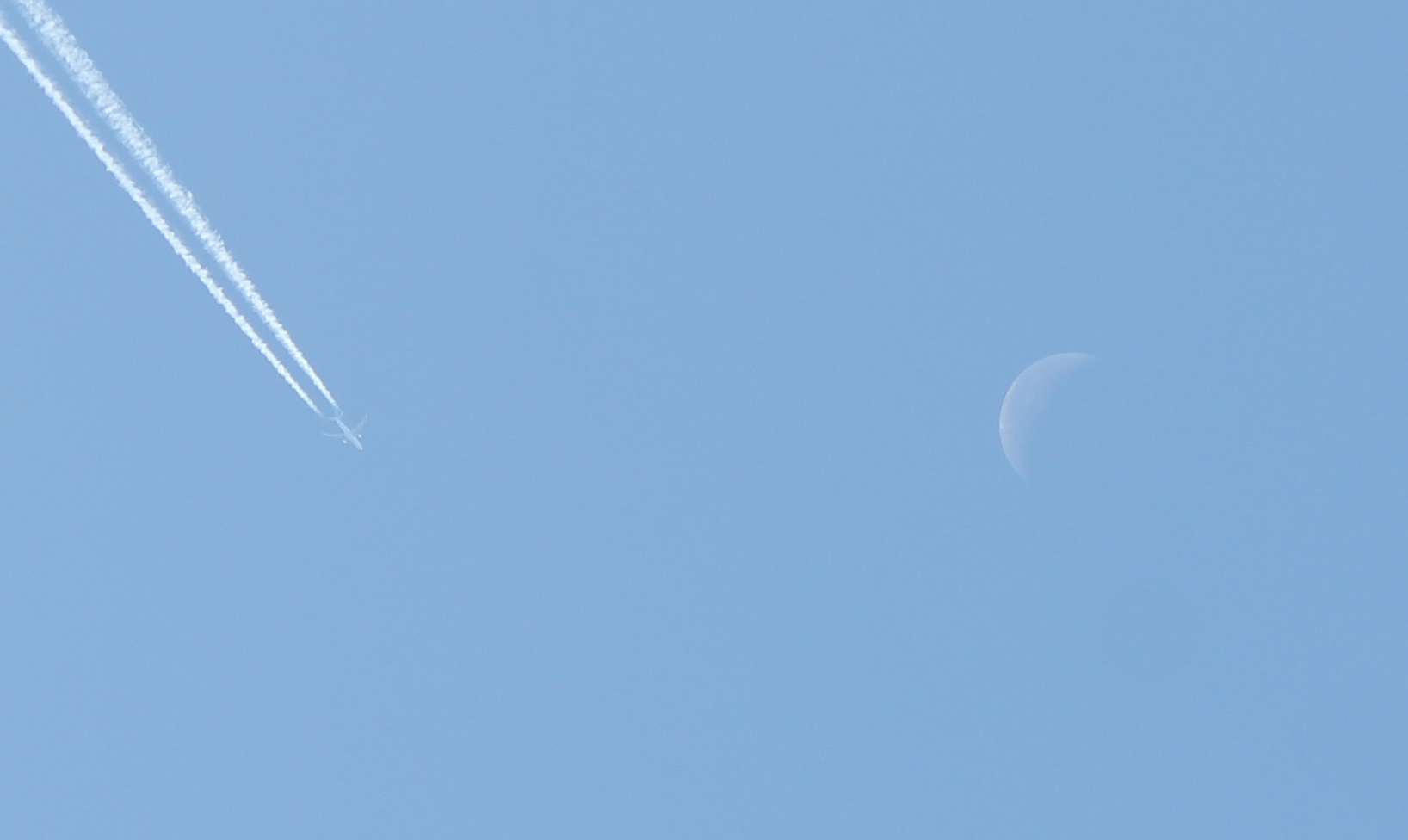
Too good to miss and after the previous evening’s disaster, I managed to get a pleasing sequence of images tracking an aircraft flying past the Moon – this being a case of making the best of what you have: daytime, the Moon and frequent overflying planes from nearby Gatwick airport and further afield.  Being approximately 42,000 further away from Earth the Moon only looks about 4-times larger than the aircraft.

Flight animation

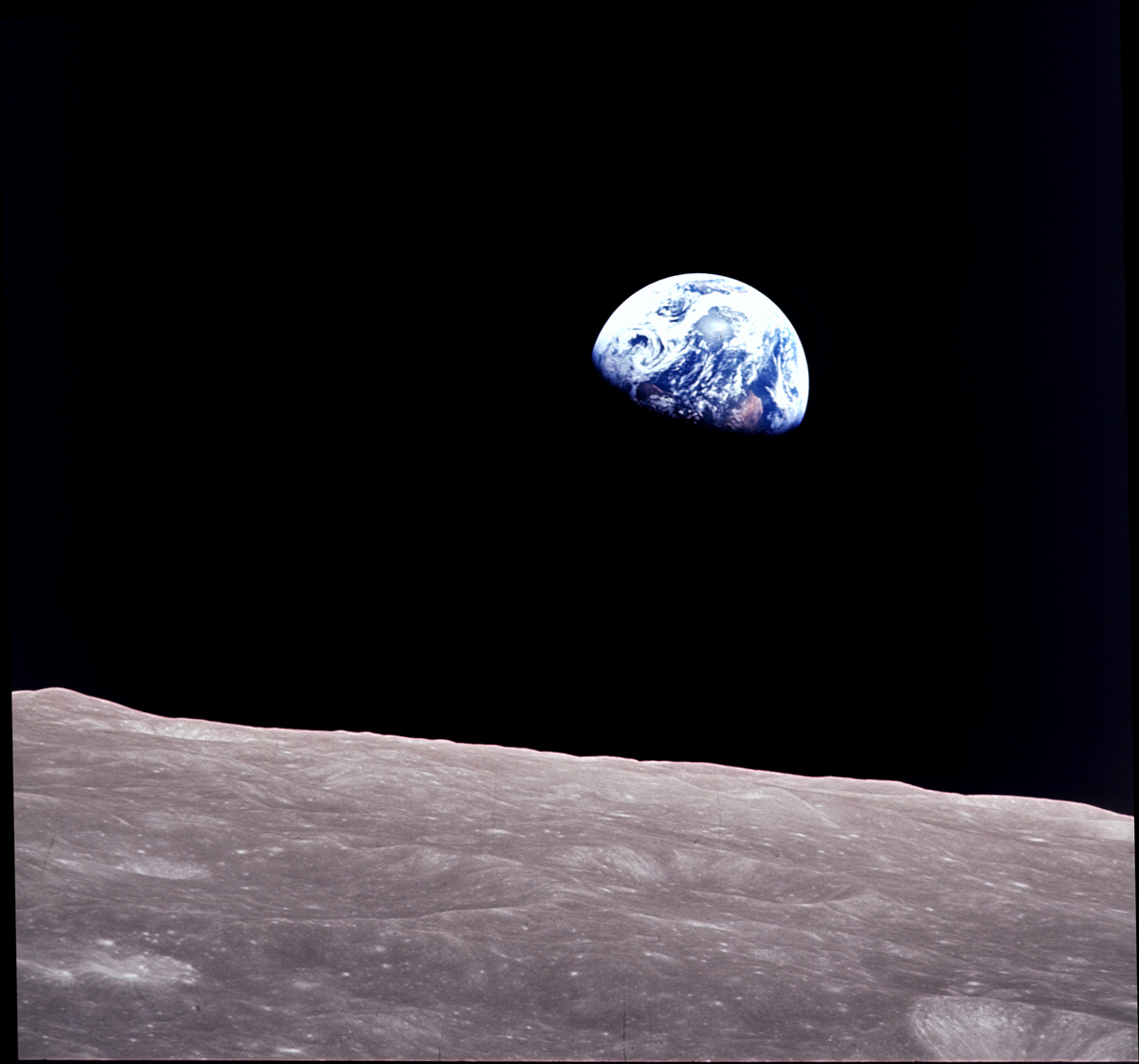
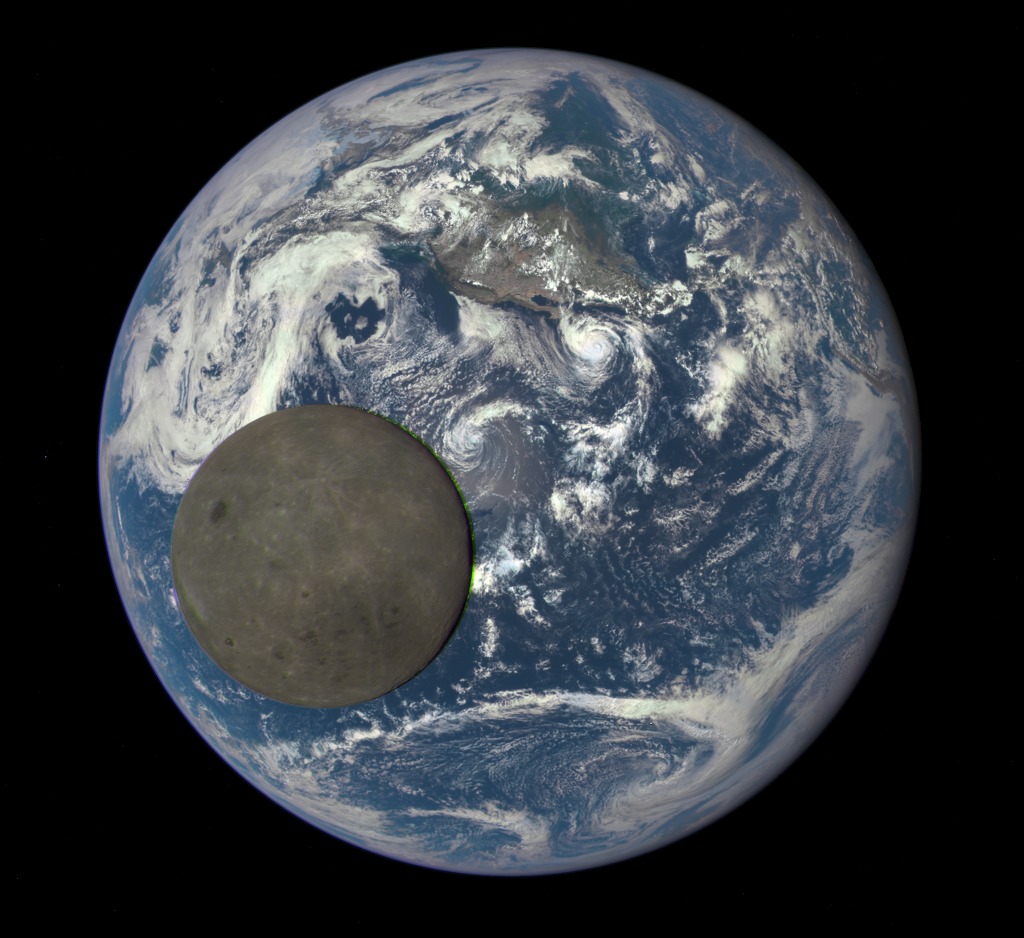
Changing the perspective completely, I was fascinated by last month’s image of the Moon passing in front of Earth, thus also presenting a fabulous view of what we call the dark side of the Moon.  The transit was taken from the Deep Space Climate Observatory orbiting at 930,000 miles from Earth, or nearly four times greater than the Moon.

16th July 2015: The so-called dark side of the Moon, seen from the Deep Space Sky Observatory, as it passes across Earth. From our perspective that day it was a New Moon.

16th July 2015: The so-called dark side of the Moon, seen from the Deep Space Climate Observatory, as it passes across Earth. From our perspective that day it was a New Moon.

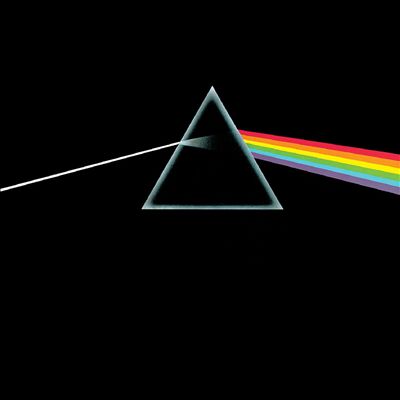
Pink Floyd take note – surely this image needs to replace the iconic cover from their 1973 album – it’s all about changing perspective; apart from being a spectacular photograph the image demonstrates the other side of the Moon is anything but dark!
Pink Floyd's 1973 album cover, now surely obsolete?

Pink Floyd’s 1973 album cover, now surely obsolete?

By Jove

As a visual and photographic spectacle, in my opinion Jupiter comes a close second to Saturn among the planets.  The so-called ‘King of the Planets’, Jupiter is more than twice as massive as all the others combined. Notwithstanding its size, Jupiter has the shortest ‘day’ of any planet, rotating fully in just 9-hours and 50 minutes – as a result creating a significant equatorial bulge that measures 88,760 miles in diameter and 83,082 miles from pole-to-pole.  However, as a gas giant the planet does not rotate en masse, with the outer regions moving slower than the equatorial region leading to a series of distinctive belts and zones, most notable of which is the Great Red Spot – a massive storm on the edge of the South Equatorial Belt.

Partly because of its vast size and resulting gravitational field, Jupiter is thought to have played a dominant role in shaping the present Solar System.  The planet we see today is not alone, with 67 moons so far identified, the four largest discovered by Galileo 400 years ago being easily visible from Earth.  In order of distance from Jupiter the moons of Io, Europa, Ganymede and Callisto are extremely diverse in nature – ranging from the highly volcanic Io to the frozen world of Europa, whilst Ganymede and Callisto may have sub-surface oceans and are bigger than the planet Mercury.


Despite being by far the largest planet in the Solar System and the fourth brightest object after the Sun, Moon and Venus, my attempts to image Jupiter and its Jovian neighbours have so far met with only mixed success.

Most people’s first view of Jupiter is likely to be through binoculars or a basic telescope, which will   show the very bright planet accompanied by a number of its Gallilean moons, depending on their orbital position i.e. when located behind the planet they will, of course, not be visible.  Having viewed Jupiter a few times like this, my first attempt to image the planet and its moons was just such a view simply using the William Optics 81mm refractor, a x2 Barlow and my Canon 700D DSLR.  Compared to Jupiter the moons are not as bright and to capture their presence it is necessary to boost either the ISO or exposure time, which then overexposes the bright planet resulting in loss of detail – in this case the distinctive coloured gas bands. Conversely, with a lower ISO or exposure this detail once again becomes apparent but some or all of the moons are then lost in the image.  The way round is to combine two sets of images taken at different camera settings, thus obtaining the best of both worlds, literally.  For the moment however this remains work in progress.

Jupiter  - overexposed but  shows all four Gallilean moons.

January 2014, Jupiter – overexposed but shows all four Gallilean moons | 1 sec @ ISO 400


upiter - lower exposure shows the gas belts but the moons, though there, are now very difficult to see.  1/3rd sec @ ISO 800

Jupiter – lower exposure shows the gas belts but the moons, though there, are now very difficult to see. 1/3rd sec @ ISO 800

Personally I like the wider view of Jupiter and its moons but inevitably the holy grail has to be a close-up image showing details of the planet’s characteristic gas belts, which requires the use of a CCD video, in my case a ZWO ASI 120MC camera.  Having mostly concentrated on DSO photography to-date using a DSLR, my use of the ZWO camera is limited and with mixed success.  Using this camera and the Skywatcher 150PL reflector telescope I have previously managed images of Saturn, Mars and the Moon but this time I used the William Optics refractor instead.

CCD imaging is a very different technique to DSLR and it’s fair to say that I still have much to learn. Notwithstanding, using Registax for processing I obtained some reasonable first-time Jupiter images but will need more practice to improve the detail; the quality might also be improved using WinJUPOS software during processing, which applies a de-rotational programme to the fast moving planet thus reducing blur – however, I have yet to understand let alone master this software.  Also, whilst the quality of the William Optics telescope is far superior to the Skywatcher 150PL, it is obvious that its relatively short focal length is not really adequate for good planetary imaging.

21st February 2015. Jupiter up close WO 81GT81 | ZWO 120 MC

21st February 2015. Jupiter up close
WO 81GT81 | ZWO 120 MC

So far this year Jupiter had already provided a number of different opportunities for imaging.  Between February and April the planet moved across the southern sky in all its glory, whilst more recently it moved into close conjunction with Venus at the end of June and there’s more to come.

On 26th August from our vantage point on the Earth, Jupiter will appear very close to the Sun in the sky as it passes around the far side of the solar system from the Earth.  At closest approach, Jupiter and the Sun will appear at a separation of only 0°52′, making Jupiter totally unobservable for several weeks while it is lost in the Sun’s glare.  At around the same time, Jupiter will also be at its most distant from the Earth – receding to a distance of 6.40 AU – since the two planets will lie on opposite sides of the solar system.  Over following weeks and months, Jupiter will re-emerge to the west of the Sun, gradually becoming visible for ever-longer periods in the pre-dawn sky. After around six months, it will reach opposition, when it will be visible for virtually the whole night, by which time I have hopefully mastered some new techniques for imaging this Jovian King of the Planets.

Canon Koppernigk’s Conjunction

This time of the year is something of a fallow period for astronomers: short nights combined by with the complete absence of astronomical darkness and fewer DSOs.  I have personally found this year more difficult than usual as since April 25th, following an operation to replace my left knee, I have been physically unable to set-up Fairvale Observatory and undertake astronomy of any sort.  Notwithstanding, once over the initial few weeks of pain, I have tried to use the extra time afforded me usefully.

download

I have been reading Arthur Koestler’s excellent book The Sleepwalkers, which charts the history of man’s understanding of the universe and astronomy.  Speaking of fallow periods, in the book I’m just past the very long period of inactivity and general superstition regarding the cosmos that occurred during the Middle Ages, which followed the more enlightened thinking of the Greeks, particularly Pythagoras; taking account of the Greek’s progress in understanding the Universe, our astronomical knowledge might have been 1,500 years more advanced today were it not for this prolonged medieval hiatus!  Fortunately Copernicus (his better known Latin name) finally initiated what has become today’s heliocentric model of the Solar System, although his seminal work On the Revolutions of the Heavenly Spheres was only published just a few hours before his death after a delay of 30-years, such was his reluctance to put forwards such thoughts at that time.

Next, I have just completed the 6-week AstroTech MOOC course organised by Edinburgh University, which covered the scientific logic behind astronomical discoveries and the technology that lies behind them.  This was my third astronomy MOOC and provided some interesting insight into telescope and imaging technology, as well as filling time during my recovery.

Finally, as my (limited) mobility has slowly started to improve, the night sky has recently provided a fascinating show of its own that did not require the observatory’s paraphernalia and, furthermore, beautifully demonstrated the principles originally outlined by Copernicus in 1543.

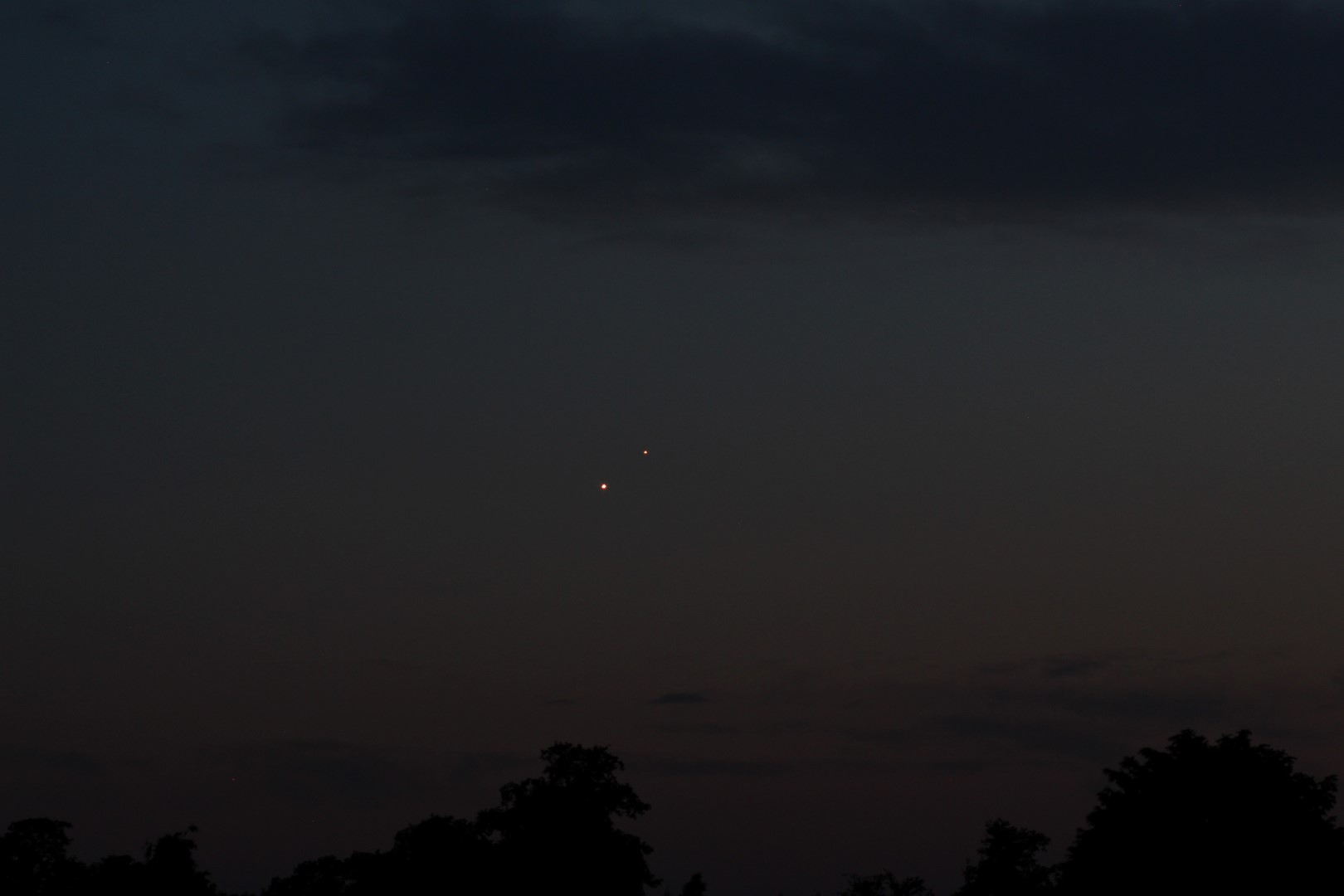
During the latter part of June Venus and Jupiter moved inexorably towards very close conjunction by the end of the month.  Reaching just under ¾ of a degree separation on 30th June and 1st July this is a rare event, which with a clear sky could be easily viewed with the naked eye.  Better still, I set out to photograph the two planet’s journey during the preceding 12 days, thus illustrating Copernicus’ revolutions around the sun of these two heavenly spheres.  Whilst any school child will today understand this process, it is a frightening thought that belief in such a mechanism could once have led to the death penalty!

Obscured from view at Fairvale Observatory as Venus was just 17 ½o above the western horizon, I had to travel to a nearby location which provided a clearer westerly viewpoint of both planets at their low attitude.  In order to obtain a series of comparable images and thus show the real spatial changes occurring up to conjunction, all pictures were taken from exactly the same location.  With my Canon EOS 700D fixed on a photographic tripod I shot a series of images over a 50 minute period using either the 18mm or 55mm telephoto settings, playing with ISO and speed settings as darkness progressed; this was roughly the time the two planets took to disappear below the Earth’s horizon after achieving Civil Darkness.

The resulting photographs show Jupiter apparently advancing on Venus before at conjunction ‘passing’ close by on the aforementioned days.  Whilst Jupiter is the third brightest object in the night sky (after the Moon & Venus) and nearly 12 times the size of Venus or 1,400 times by volume, the planet looks very small by comparison to Venus.  This of course is the effect of perspective, with Jupiter currently some 565 million miles distance from Earth, whereas Venus is only 48 million miles; furthermore although at -1.8 the apparent magnitude (brightness) of Jupiter is high, at -4.4 Venus is much brighter.

18th June 2015: Jupiter left, Venus right - trees on the horizon provide a reference scale as the planets move towards each other during the month in subsequent photographs

18th June 2015: Jupiter left, Venus right – trees on the horizon provide a reference scale as the planets move towards each other during the month in subsequent photographs.

25th June 2015 + 7-days

25th June 2015 + 7-days

30th June 2015 + 5 days.  Nothing - dark thunder clouds completely obscure the western sky during conjunction!!!

30th June 2015 + 5 days. Nothing – dark thunder clouds completely obscure the western sky during conjunction!!!

1st July 2015. Bingo = conjunction; though one day later Jupiter has now moved to the right of Venus.

1st July 2015. Bingo = conjunction; though one day later Jupiter has now moved to the right of Venus.

1st July 2015. Close-up of the conjunction using 55mm telephoto setting and ISO 400 - Venus now left & Jupiter right.

1st July 2015. Conjunction close-up using 55mm telephoto setting and ISO 400 – Venus now left & Jupiter right.

Unfortunately I am expecting it will be at least another month before I have recovered sufficiently to consider setting-up Fairvale Observatory again, by which time Astronomical Darkness will thankfully be slowly returning.  In the meantime I’m looking forwards to the next section of The Sleepwalkers which covers Kepler and Galileo and hopefully exciting developments from the New Horizon Pluto fly-by and more from the Rosetta Mission and the re-awakening of its Philea lander.  Given clear skies there should also still be plenty to see without the observatory: The Perseids, Saturn and of course at the centre of our Solar System as determined by Copernicus, the Sun, which will be at aphelion on 6th July – though you wouldn’t think so judging by the high temperatures currently prevailing in the UK and Europe!