2021 The Year In Pictures

Every year since 2014 I’ve published a retrospective blog of my astrophotgraphy year just ending called Reflections. It’s been a useful task that enables me to bring together the best and sometimes the worst of my images, in order to consider the good and bad points + progress made + set some objectives for the coming year. Eight years on, after which I believe I’ve now reached at least a respectable level of imaging and processing, I’ve decided to stop this format for the time being.

Notwithstanding, at this time of the year I also produce an astrophotography calendar for members of my family, which consists of the better images from the year just ending; I think they like them and certainly all use the calendar during the coming year. Moreover, I also recently started to compile a video of the said calendar images set to appropriate music, which we all watch together prior to seeing the actual calendar. It’s a great way to present the images, which look really stunning on today’s large Smart TV’s and is fun to watch with the family too.

The video for this last year 2021 can be viewed on YouTube HERE and below is a brief very general overview of each image. More detailed background information and imaging details for those interested can be found in relevant blogs posted on this site during the past year.

2022 CALENDAR

A new set of filters, improved processing techniques and access to data from a telescope at a dark sky site in New Mexico, USA (shown by an asterisk *) contributed to an exciting astrophotography year in 2021.                  

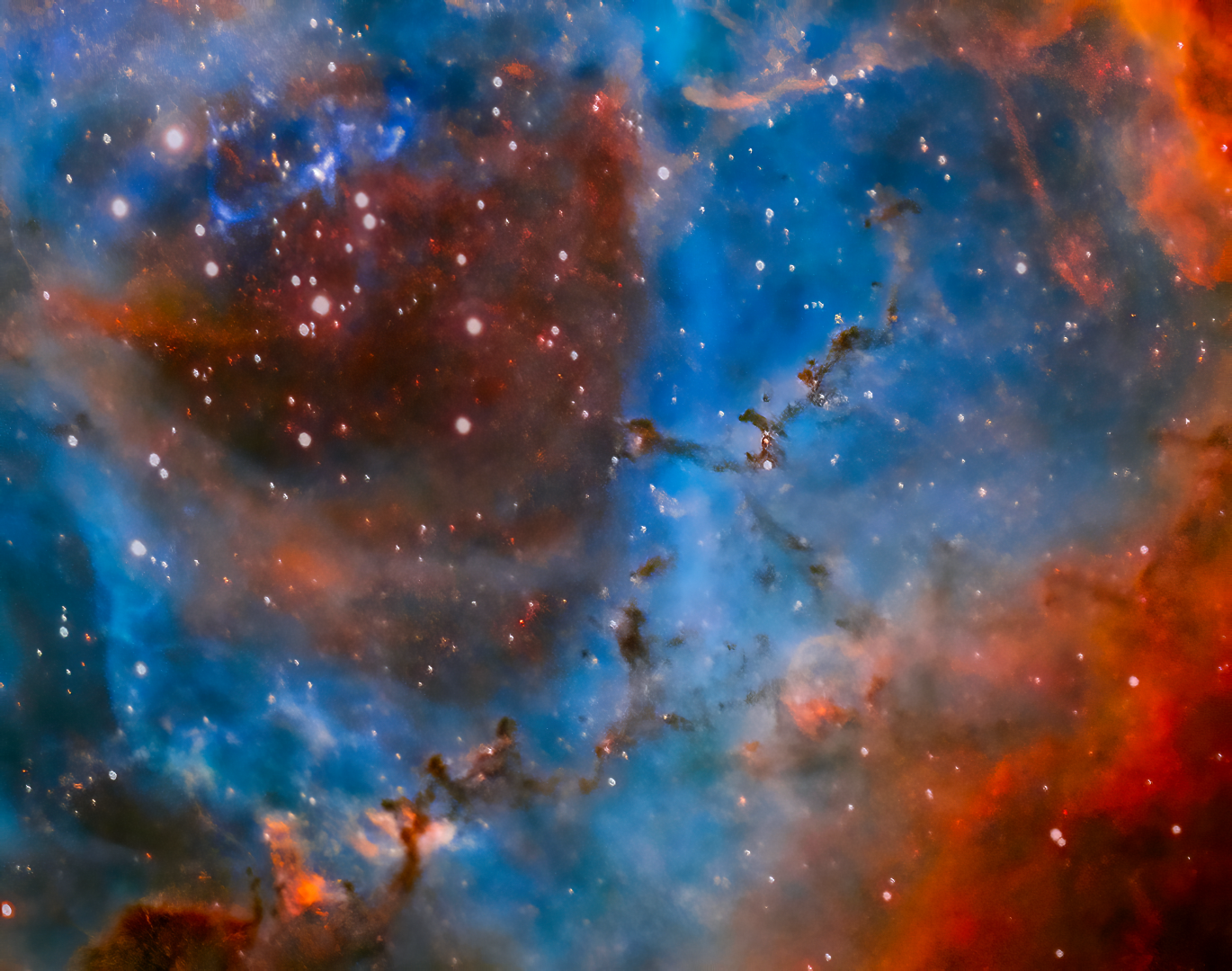
FRONT COVERThe Carnival of Animals: Special processing of the inner region of the Rosette Nebula highlights the ‘animals’ or Bok Globules – clouds of dust undergoing gravitational collapse as part of the process of new star formation.  
JANUARYLDN-1250 Dark Nebula*: Dark or absorption nebulae are a type of interstellar cloud which are so dense they obscure or absorb visible light emitted from objects behind or within and thereby contrast with the general light flux of the Universe as dark areas.  
FEBRUARYCTB-1 Supernova Remnant*: The overall structure of this supernova remnant is that of a circular shell, with a conspicuous rupture towards the north (lower right of image).  The main red Ha-shell is composed of multiple interlocking filament limbs, with a blue / green OIII arc along one side.  
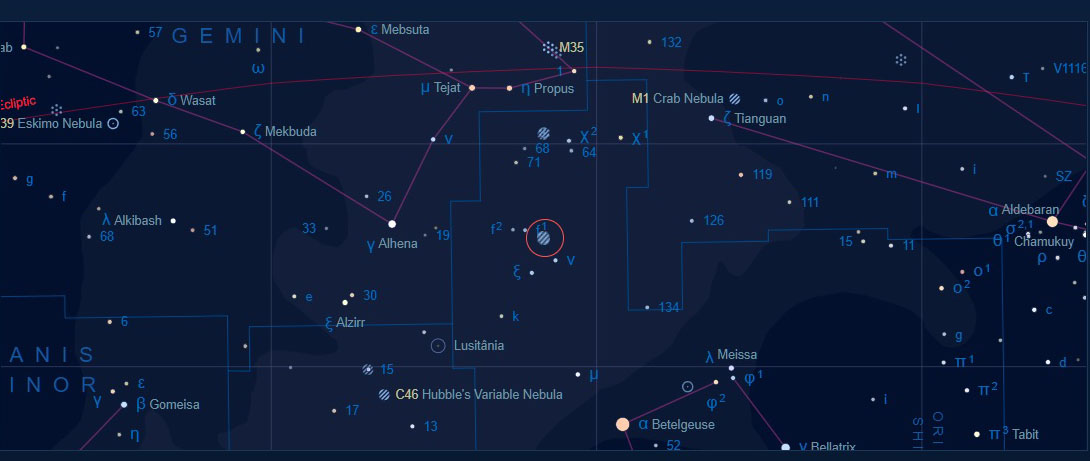
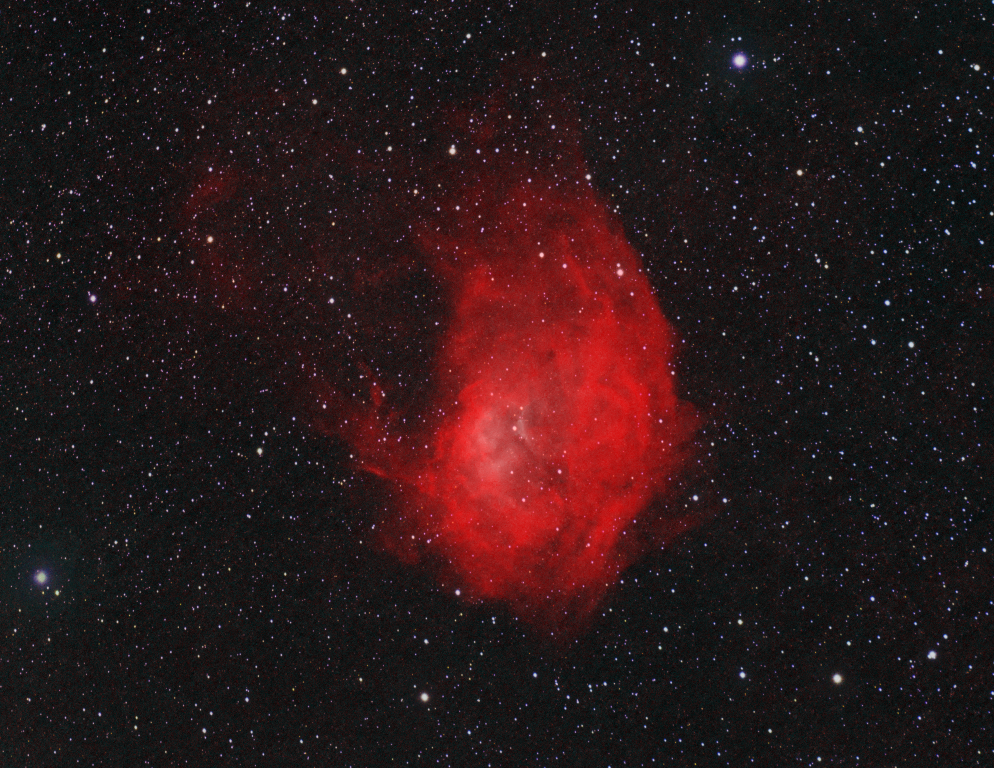
MARCHJellyfish Nebula: Locatedin the Gemini constellation some 5,000 light years from Earth, this is a remnant of a supernova that took place during the past 30,000 years. With a diameter of 70 light-years, the object is visually speaking nearly twice the size of a full moon.     
APRILMarkarian’s Chain: The Virgo cluster consists of more than 2,000 galaxies, within which Markarian’s Chain forms a J-curve string of bright galaxies that share a common motion through space.    
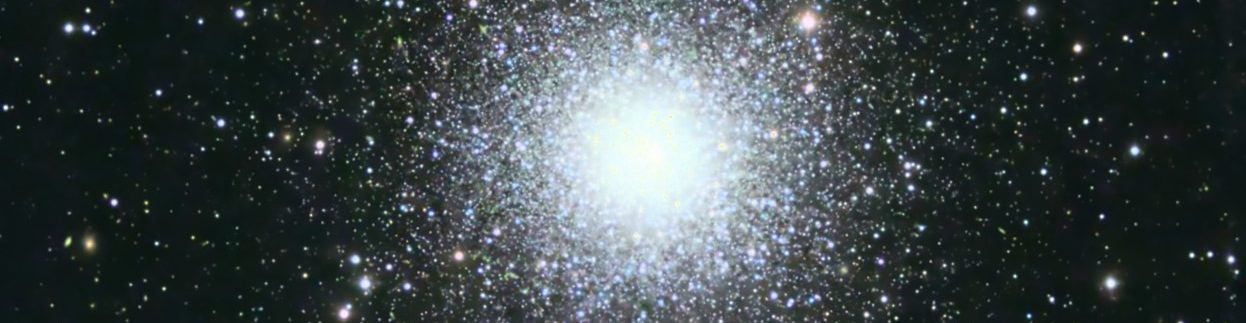
MAYM13 Great Globular Cluster of Hercules*: Consisting of several hundred thousand stars and 145 light-years in diameter, M13 is considered to be the finest cluster in the Northern Hemisphere.  
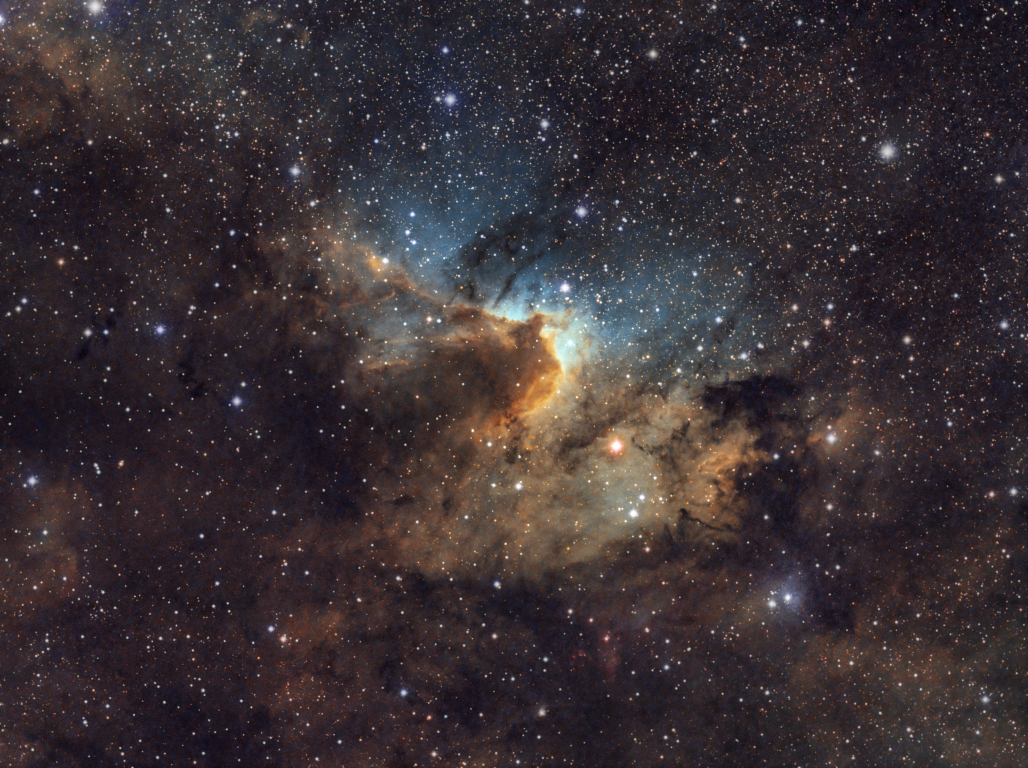
JUNECave Nebula*: Located along the plane of the Milky Way is the diffuse emission nebula referred to as the Cave Nebula.  The Cave at the centre is critically located at the boundary of the Cepheus molecular cloud and the hot, young stars which ionize the surrounding gases to great effect.  
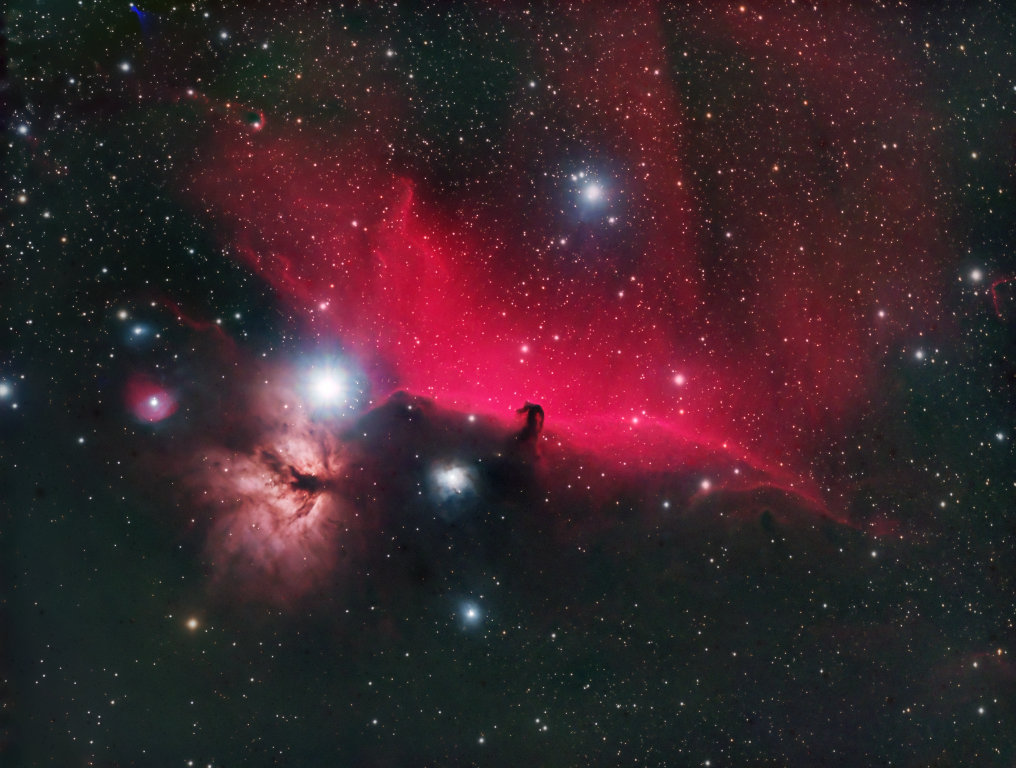
JULYOrion Widefield: Framed around the area of Orion’s Belt, the Horsehead Nebula and the Great Orion Nebula, look hard and the refection nebula M78 can also be seen in the lower left corner.    
AUGUSTElephant’s Trunk Nebula*: A very large emission nebula, the so-called Elephant’s Trunk Nebula is rightly viewed as one of astrophotography’s most iconic images. The ‘trunk’ itself dominates the centre of this image and is illuminated from behind by a bright star forming region.  
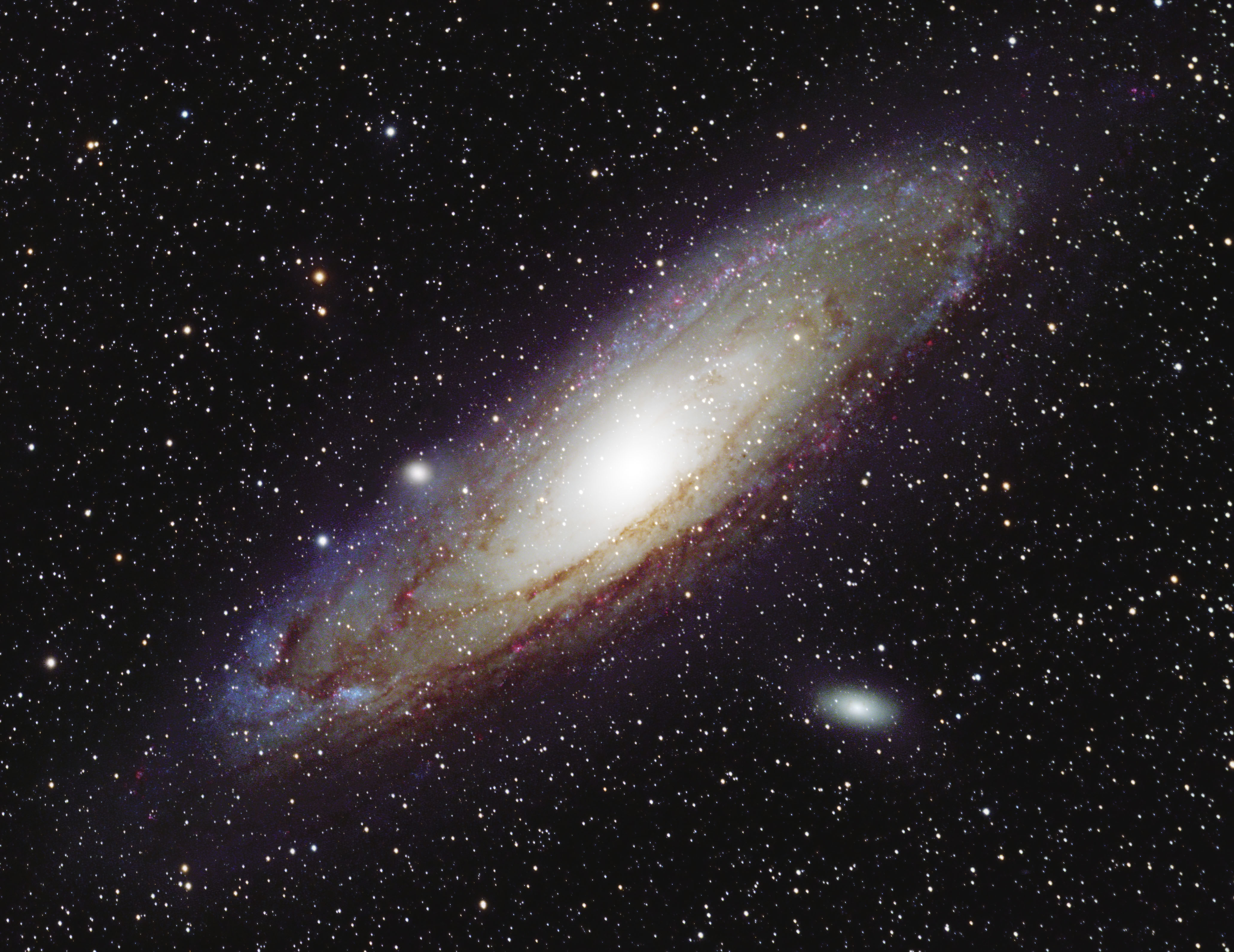
SEPTEMBERM31 Andromeda Galaxy: The full benefit of new filters, improved guiding, clear skies over 6-nights and extensive use of new processing techniques can be seen in my best image yet of Andromeda.      
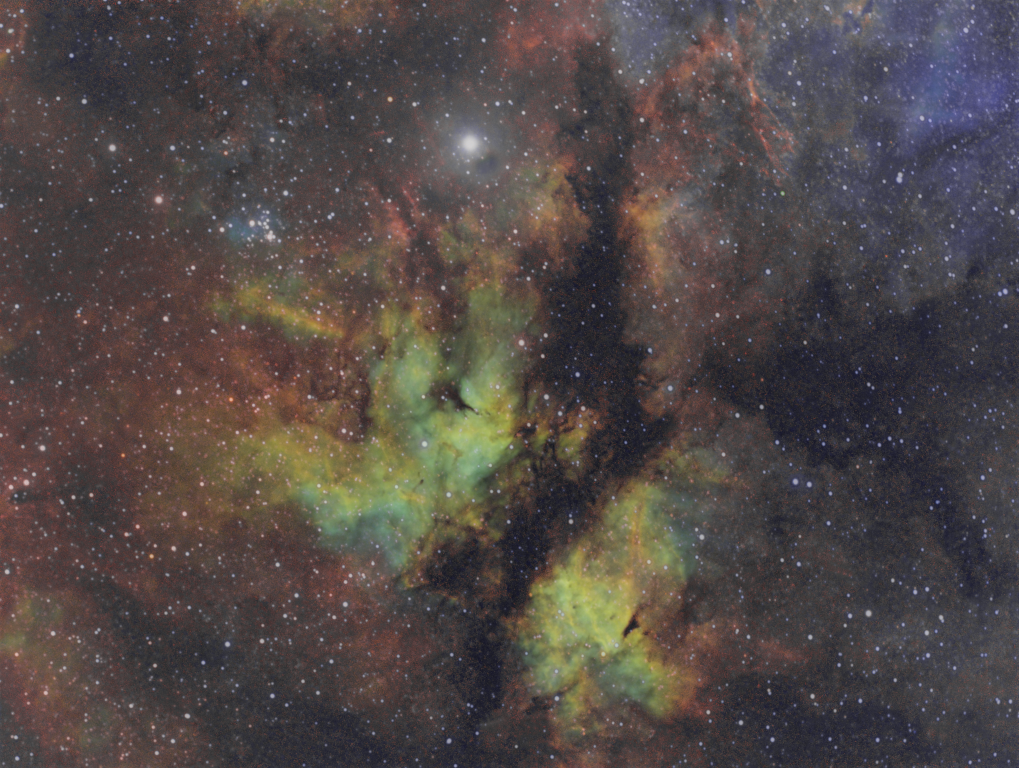
OCTOBERButterfly Nebula: Situatedwithin the Orion Arm of the Milky Way is the Gamma Cygni nebula, a diffuse emission nebula surrounding the star Sadr.  Either side of the dark rift which divides the image from top to bottom are two large bright areas that together form the so-called Butterfly.  
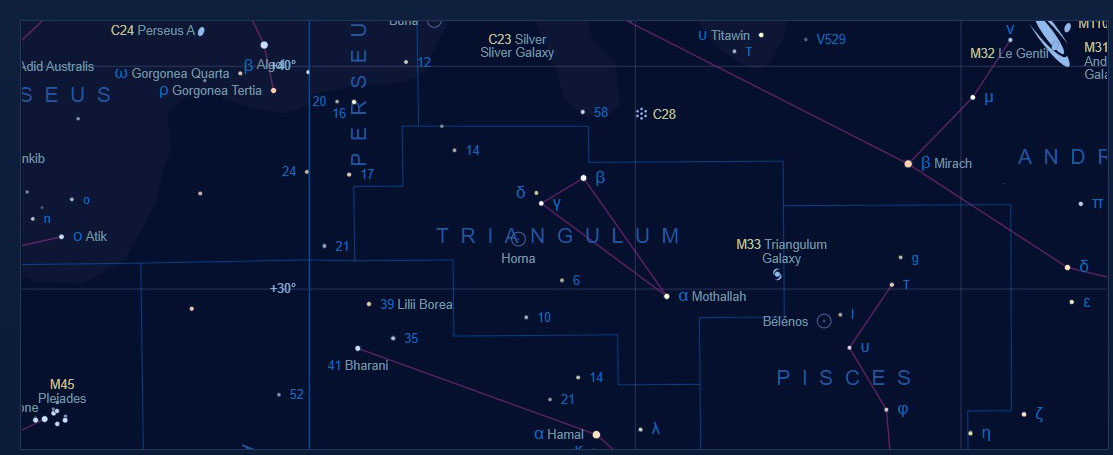
NOVEMBERM33 Triangulum Galaxy: Like it’s neighbour Andromeda, better data and processing has produced an exciting new image of M33 this year, the red areas highlight Ha-rich star-forming regions  
DECEMBERFlying Bat & Giant Squid Nebula*: This very faint OIII emission nebula Ou4 required an imaging time of 40-hours.  For obvious reasons Ou4 has become known as the Giant Squid Nebula which, moreover, lies within the much larger SH2-129 HII emission region or the Flying Bat Nebula.     

HAPPY NEW YEAR + CLEAR SKIES IN 2022

Reach For The Stars

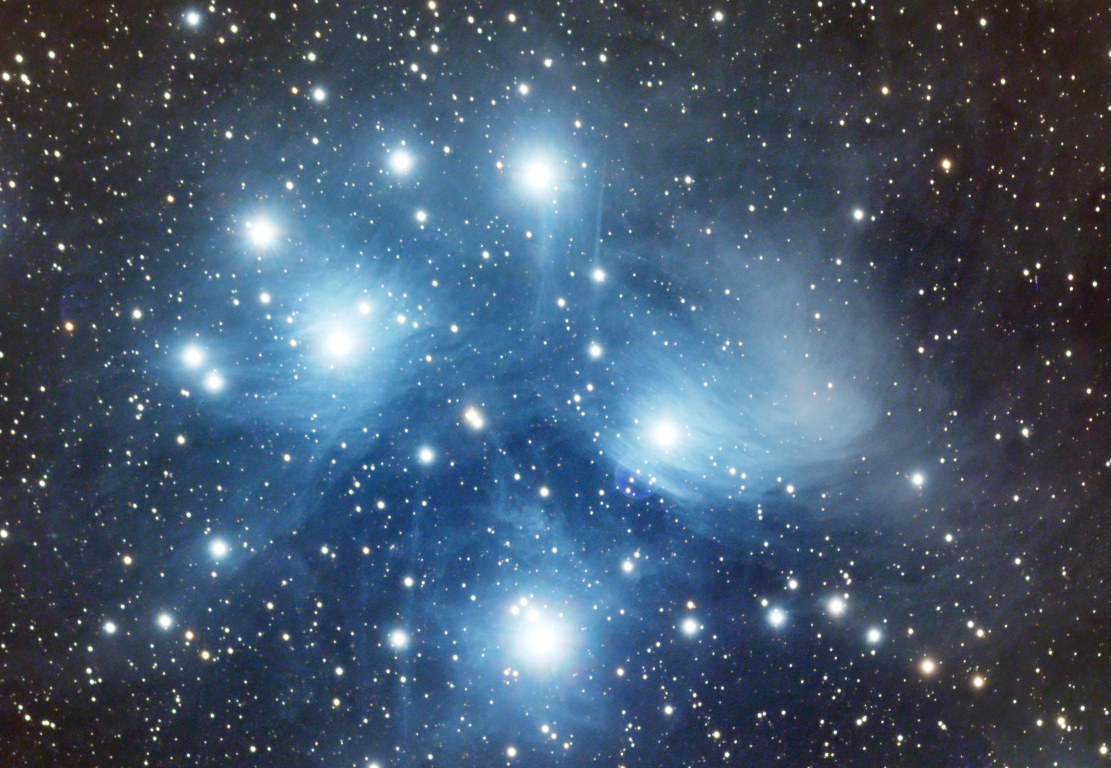
Preceding the arrival of what is for many astronomers the highlight of the year, the Orion constellation and all it’s objects, is the appearance of the majestic Pleiades open star cluster (Messier 45) in the constellation of Taurus.  The so-called Seven Sisters consists of hot blue luminous stars that formed during the past 100 million years, which are expected to last another 250 million years and can be easily observed with the naked eye even here at Fairvale Observatory (Bortle 5/6).  

I have imaged this exciting star cluster before but with astrophotography and especially iconic objects such as the Pleiades, one is always drawn back for another try.  Now armed with Chroma filters and a growing list of PixInsight skills acquired since last imaged late in 2018, I wanted to tease out more details of the fine wispy dust cloud through which the Sisters are passing and forms the signature of all good Pleiades’ images.  Furthermore, with longer exposures and total integration time greater than before, maybe I could also capture something of the abundant interstellar dust that is present across the wider background?  

I am therefore very pleased that the final image (top of the page + cropped version above) which has more than achieved these objectives and marks a significant improvement on my previous attempts – it’s always worth trying that little bit more.

 IMAGING DETAILS
ObjectM45 The Pleiades AKA Seven Sisters
ConstellationTaurus
Distance444 light-years
Size110’
Apparent Magnitude+1.6
  
Scope William Optics GT81 + Focal Reducer FL 382mm  f4.72
MountSW AZ-EQ6 GT + EQASCOM computer control
GuidingWilliam Optics 50mm guide scope
 + Starlight Xpress Lodestar X2 guide camera & PHD2 control
CameraZWO1600MM-Cool (mono)   CMOS sensor
 FOV 2.65o x 2.0o Resolution 2.05”/pix  Max. image size 4,656 x 3,520 pix   
EFWZWO x8 EFW & Chroma 31mm LRGB filters 
Capture & ProcessingAstro Photography Tool + Deep Sky Stacker PixInsight v 1.8.8-11,  Photoshop CS3, Topaz AI Denoise
Image Location & Orientation Centre: RA 03:47:03  DEC 24:03:08  Top = North   Right = West   
Exposures12 x 300 sec LRGB   Total time: 4 hours   
 @ 139 Gain   21  Offset @ -20oC    
Calibration5 x 300 sec Darks  15 x Flats & Dark Flats LRGB    @ ADU 25,000  
Location & DarknessFairvale Observatory – Redhill – Surrey – UK        Typically Bortle 5
Date & Time6th  December 2021 @ +19.15h  
Weather & MoonApprox. <=4oC      RH >=85%          🌙 New Moon          

Galactic Triplets

After successfully imaging M31 the Andromeda galaxy at new moon in early October, I was lucky that the next moon cycle in early November also provided good conditions and it seemed appropriate to just shift attention to Andromeda’s closest neighbour, which at this time of the year occupies a favourable part of the eastern sky in the early evening.  Only 15o from M31, M33 AKA the Triangulum Galaxy is the third-largest member of the Local Group of galaxies after Andromeda and the Milky Way.  Although very faint, in very good dark night sky conditions M33 can apparently be viewed with the naked eye. Along with our own Milky Way, this group travels together in the universe, as they are gravitationally bound.

Andromeda is eight times brighter and nearly four times larger than Triangulum, which for various reasons I have previously found difficult to image, despite its relative proximity to us.  On this occasion I was therefore very pleased to obtain a good data set over three nights that included 3-hours of 10-minute Ha exposures.  The result is definitely my best image yet of this tricky but attractive target, which in particular highlights the numerous red star-forming regions that abound throughout the galaxy’s arms.  I’ll almost certainly be back again another day but for now I am at last satisfied with the result.

 IMAGING DETAILS
ObjectM33 Triangulum Galaxy
ConstellationTriangulum
DistanceApprox. 2.7 million light-years
Size71’ x 42’  ~ 60,000 light-years
Apparent Magnitude+5.72
  
Scope William Optics GT81 + Focal Reducer FL 382mm  f4.72
MountSW AZ-EQ6 GT + EQASCOM computer control
GuidingWilliam Optics 50mm guide scope
 + Starlight Xpress Lodestar X2 guide camera & PHD2 control
CameraZWO1600MM-Cool (mono)   CMOS sensor
 FOV 2.65o x 2.0o Resolution 2.05”/pix  Max. image size 4,656 x 3,520 pix   
EFWZWO x8 EFW & 31mm LRGB + 3nm Ha Chroma filters 
Capture & ProcessingAstro Photography Tool,  Deep Sky Stacker, PixInsight v 1.8.8-9, Photoshop CS3, Topaz Ai Denosie
Image Location              & OrientationCentre:  RA 01:33:53.6    DEC 30:39:18.9                      Top = North   Right = West  
Exposures15 x 300 sec LRGB + 18 x 600 sec Ha   Total time: 8 hours
 @ 139 Gain   21  Offset @ -20oC    
Calibration5 x 300 sec & 5 x 600 sec Darks  + 15 x LRGBHa Flats & Dark Flats @ ADU 25,000  
Location & DarknessFairvale Observatory – Redhill – Surrey – UK        Typically Bortle 5
Date & Time2nd 3rd 4th November 2021 @ +19.00h  
WeatherApprox. <6oC   RH = >=80%      New Moon

The Journey

A year after taking up astronomy as a hobby, at the behest of my elder daughter I started this blog in 2014.  Describing the objective and content of the blog I adopted the strapline “A personal discovery of the Universe through astronomy and astrophotography”, which could also be described as a journey.  In reality it’s been an adventure consisting of two threads: the knowledge and related science of astronomy and the challenge of astrophotography.   As we on Earth pass through space whilst at the same time rotating 360o each year around the sun our view of the night sky changes month-by-month, inevitably returning to the same perspective each 365-days.  Against this background I therefore often return to certain objects every few years hopefully armed with new astrophotography skills in pursuit of an even better image.

Following such a path I’ve already imaged M31 the Andromeda Galaxy on four separate occasions since 2015, each time enthralled by the majesty and beauty of this barred spiral galaxy.  Notwithstanding, it was clear to me that there was significant scope for improvement of the previous images with both better data and processing. Since the last attempt in October 2019 a myriad of positive developments have taken place of which perhaps three stand out: multi-star guiding, the purchase of Chroma filters and in particular the use of PixInsight image for processing – all have been game changers, so much so that reprocessing that image now also looks good – see below.

 However, whilst the said progress has already been transformative to my astrophotography during the past year, inevitabky it is imaging conditions that play the most critical role, especially in England.   Fortunately during this autumn in both October and November for once the new moon coincided with clear skies, providing no less than six nights over which I was able to obtain almost 12-hours of some of perhaps my best ever data.  Based on this I’ve been careful to apply my best new processing skills and am thankful that the final HaLRGB image has turned out very well.  In particular, the dust lanes stand out against the bright core and surrounding blue intergalactic dust and gases, which are themselves punctuated by the bright red regions rich in Ha light. 

In the blogs that accompanied previous Andromeda images I’ve often referred to the galaxy as a neighbour of the Milky Way but really we are part of the same family known as the Local Group.  Some 10-million light years in diameter, more than 30 galaxies form two collections around the two largest galaxies of Andromeda and the Milky Way.  Gravitational forces play the central role in controlling this group, especially Andromeda which is itself moving towards the Milky Way at about 70 miles per second and is destined to merge in about +/- 4 billion years; recent studies indicate that an outer halo of stars extending up to 2-billion light years from Andromeda may be in the influence of the galaxy, suggesting this event may already have started!

Thereby my personal journey of astrophotography is set to continue somewhat in parallel with that of Andromeda, which will I am sure lead to further hopefully even better images of this exciting deep sky object that is perfect for my equipment – after all we’re getting closer at the rate of 2,207,520,000 miles each year!                     

 IMAGING DETAILS
ObjectM31 the Andromeda Galaxy.
ConstellationAndromeda
Distance2.5 million light-years
Size3.2o  x 1o  or 220,000  light-years  
Apparent Magnitude+3.44
  
Scope William Optics GT81 + Focal Reducer FL 382mm  f4.72
MountSW AZ-EQ6 GT + EQASCOM computer control & Cartes du Ciel
GuidingWilliam Optics 50mm guide scope
 + Starlight Xpress Lodestar X2 guide camera & PHD2 guiding
CameraZWO1600M M-Cool mono  CMOS sensor
 FOV 2.65o x 2.0o Resolution 2.05”/pix  Max. image size 4,656 x 3,520 pix   
EFWZWO x8 EFW + Chroma LRGB & Ha OIII SII 3nm filters 
Capture & ProcessingAstro Photography Tool , Deep Sky Stacker, PixInsight 1.8.8-8, Photoshop CS3 & Topaz AI Denoise
Image Location              & OrientationOriginal image centre  RA 00:42:48      DEC 41:15:05                      Final image rotated 180o  i.e. Bottom = North + 5% crop
ExposuresL 71 x 60 sec  R17  G 20  B  27 x 300 sec  Ha 35 x 600 sec Total time: 11hr 46 minutes   
 @ 139 Gain   21  Offset @ -20oC    
CalibrationDarks 5 x 600 sec + 5 x 300 sec + 60 x 60 sec HaLRGB Flats & Dark Flats  x15 each    @ ADU 25,000
Location & DarknessFairvale Observatory – Redhill – Surrey – UK        Typically Bortle 5-6
Date & Time1st 5th 6th 8th 9th  October & 4th November 2021 @ +/-19.00h  
WeatherApprox. 14o to 5oC   RH >=65% to +85%             🌙 New Moon

Night Safari

  A very large emission nebula, the so-called Elephant’s Trunk Nebula in the Cepheus constellation is rightly one of astrophotography’s most iconic images.  Unfortunately my house obscures northern views of the sky from the main observatory and I’ve therefore only imaged this once before in 2018 with some success but definite room for improvement.  However, using a Takahashi FSQ 106 located at the DSW observatory in New Mexico, USA during Q3 there were no such constraints, which has resulted in a 29.5 hour data set that forms the foundation of this exciting HaSHO image.  

 SH2-131 consists of glowing gases illuminated by an open star cluster, which is divided by lanes of dark interstellar dust clouds.  The ‘trunk’ itself, designated IC 1396A, dominates the centre of this image and is spectacularly illuminated from behind by a bright star forming region; a longer focal length combined with the QSI camera and 30% crop has produced much  closer view than previoulsy in 2018. Together with the Cave Nebula, Fyling Bat and Giant Squid Nebula, the dark nebula LDN-1250 and now the Elephant Trunk Nebula, Cepheus, has proved a very productive area for me this year.

 IMAGING DETAILS
ObjectElephant’s Trunk Nebula SH2-131 (IC 1396)
ConstellationCepheus
Distance2,400  light-years
Size45’ Trunk only
Apparent Magnitude+3.5 to 5.7
  
Scope Takahashi FSQ 106  FL 530mm f/5 = Moonlight Crawler focuser
MountParamount MyT
GuidingYes
CameraQSI 683-WSGB   KAF-8300  full frame CCD sensor    5.4nm pixels
 FOV  1.94o x 1.46o   Resolution 2.1”/pix  Image array  3326 x 2507 pix     
ProcessingDeep Sky Stacker,  PixInsight 1.8.8-8, Photoshop CS3 Topaz AI Denoise
Image Location            onCentre  RA 21:34:59.08      DEC +57:28:05.86                             
Exposures22 Ha, 18 SII & 15 OIII x 1,800 sec Total Time:  27hr 30 min   
Calibration4 x 1,800 sec  Darks  34 Ha SII OIII Flats  32 Flat Darks
Location & DarknessDeep Sky West – amateur hosting facility near Rowe, New Mexico, USA SQM typically >= 21.7
Date & Time5th August to 27th September 2021   

Galactic Grotto

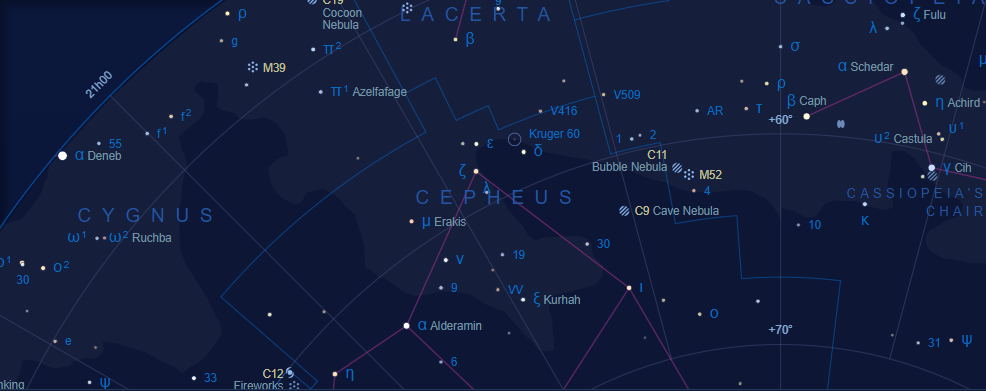
Located along the plane of the Milky Way in the Cepheus constellation is the diffuse emission nebula Sh2-155, commonly referred to as the Cave Nebula.  This widefield view shows the so-called Cave at centre of the image, critically located at the boundary of the massive Cepheus molecular cloud and the hot, young stars of the Cepheus OB-3 association which ionize the surrounding gases to great effect. 

Location of the Cave Nebula

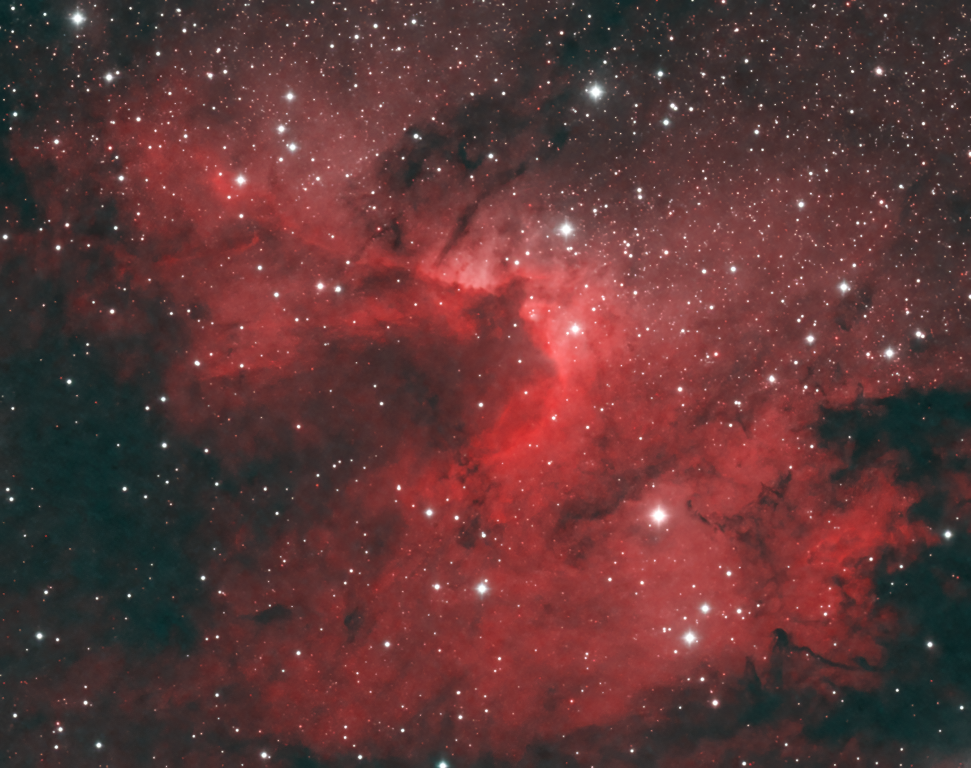
Overall the features are very faint and even with a total integration time of nearly 40-hours for the full data-set the Cave is difficult to capture and process using the Hubble SHO palette but nonetheless has resulted in a striking final image (see top-of-the-page).  An alternative bicolour HOO cropped version (see below) perhaps shows the details of Cave itself better?

 IMAGING DETAILS
ObjectSH2-155 Cave Nebula  AKA Caldwell 9
ConstellationCepheus
Distance2,400  light-years
Size 50 x 30 arc minutes  ~70.0 light-years;  Cave Nebula ~10.0 light- years  
Apparent Magnitude+7.7
  
Scope Takahashi FSQ 106  FL 530mm  f/5  +  Moonlight Nightcrawler focuser  
MountParamount MyT
GuidingYes
CameraQSI 683-WSG8    KAF-8300 full frame CCD sensor   5.4nm pixels  
 FOV 1.94o x 1.46o   Resolution 2.1”/pix.   Image array 3326 x 2,507 pix   
ProcessingDeep Sky Stacker,  PixInsight v1.8.8-7,  Photoshop CS3, Topaz Denoise
Image Location              Centre  –  RA 22:57:37.145      DEC +62:32:54.296                      
Exposures20 Ha  30 OIII  29 SII x 1,800 secs  @ -20C Total Integration Time: 39hr 30min     
Calibration24 x 1,800 secs Darks   x200 Bias  &  x32  Flat Darks  
Location & DarknessDeep Sky West – amateur hosting facility near Rowe, New Mexico  – USA    SQM Typically >= 21.7
Date & TimeQ3  2018    

The Well & The Butterfly

Located within the Orion Arm of the Milky Way galaxy is the Gamma Cygni nebula, a diffuse emission nebula that surrounds the star of the same name, otherwise better known as Sadr.  Moreover, this large area forms part of an even bigger HII-region that is mainly (80%) located in the north and east quadrants of the so-called Cygnus Cross, which is defined by the stars Deneb – Sadr – Delta Cygni – Albireo – Aljanah (see below). 

This vast area passes directly high overhead at this time the year before disappearing behind the house roofline in the early morning hours and has already provided many exciting imaging opportunities for me in the past.  The heart (not the centre) of the region is the supergiant star Sadr and I first imaged this area in autumn 2015 using my modded DSLR camera.  A return visit was therefore long overdue and this time I set out to better capture the so-called Butterfly Nebula in narrowband wavelengths.

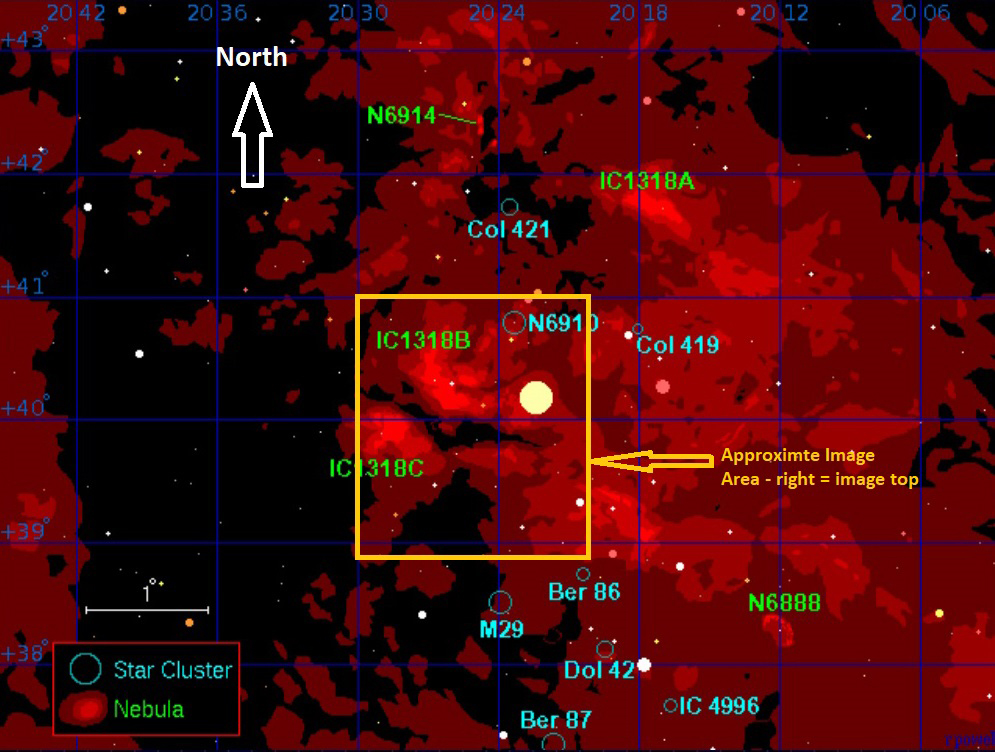
The resulting data has been processed to good effect as an SHO image (see top-of-the-page) using the Hubble Palette techniques.  Other than the dominant supergiant star Sadr and widespread colourful nebulosity, two significant features are worthy of note in the final image.  Either side of the almost central dark rift that divides the image laterally, are two large bright areas which together form the ‘wings’ of the so-called Butterfly Nebula IC 1318-C (right = south) and IC 1318-B (left = north).  Furthermore, just beyond the Butterfly’s left wing north of Sadr is the young, bright open star cluster NGC 6910.

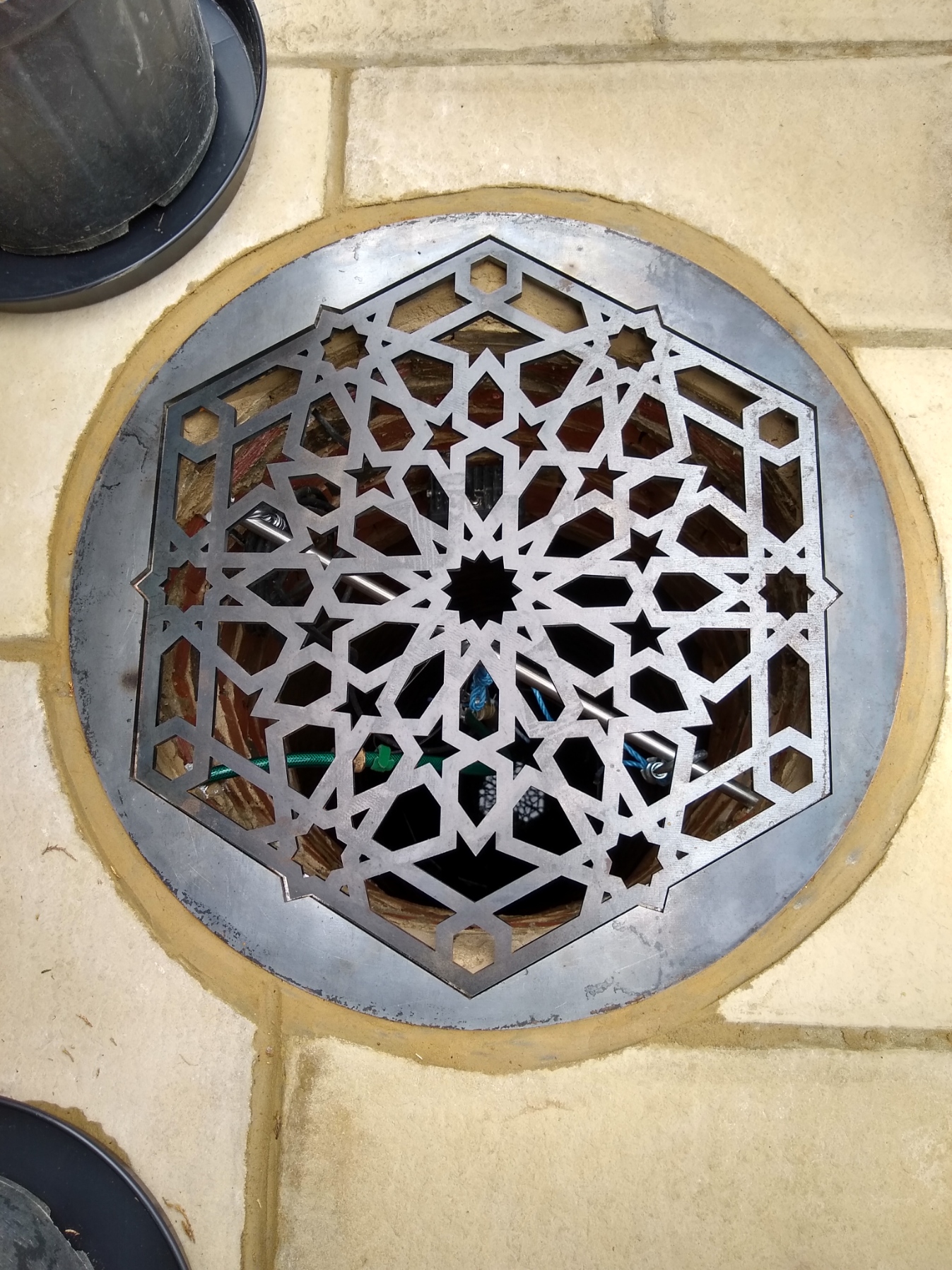
Finished well with submersible water pump & floodlight (turned off for astronomy!)

I’m very pleased with this image, which is my first since the end of March, in part because nowadays I take an astronomy break during the long late spring / summer days when astronomical darkness is largely absent. However, this year the pause has been protracted as the patio on which Fairvale Observatory is situated was re-laid, during which a hitherto unknown water well was discovered. Thereafter one thing led to another and turned into a summer project to recommission the well, thus delaying completion of the patio.  As a result I’ve only recently been able to reinstate the astronomy equipment, a job that is still ongoing. The new patio is firm and flat, providing a much better surface for the mount than before and I’m hopeful that once recalibration is completed will result in improved tracking results – watch this space!

 IMAGING DETAILS
ObjectIC1318-B & IC1318-C  Gamma Cygni  Nebula or Butterfly Nebula NGC 6910 Open cluster
ConstellationCygnus
Distance3,700 light-years
Size 1Approximately 100 light-years
Apparent MagnitudeVaries  
  
Scope William Optics GT81 + Focal Reducer FL 382mm  f4.72
MountSW AZ-EQ6 GT + EQASCOM computer control & Cartes du Ciel
GuidingWilliam Optics 50mm guide scope
 + Starlight Xpress Lodestar X2 camera & PHD2 guiding
CameraZWO1600MM-Cool mono  CMOS sensor
 FOV 2.65o x 2.0o Resolution 2.05”/pix  Max. image size 4,656 x 3,520 pix   
EFWZWOx8 EFW & 31mm Chroma LRGB filters 
Capture & ProcessingAstro Photography Tool + PHD2 +  Deep Sky Stacker, PixInsight v1.8.8-8, Photoshop CS3, Topaz Denoise
Image Location              & OrientationCentre  RA 20:25:20.492      DEC +40:11:20.970                      Left = North     
Exposures21 x 300 sec Ha, OIII, SII Total Integration Time: 5hr 15 min     
 @ 139 Gain   21  Offset @ -20oC    
Calibration5 x 300 sec Darks 15 x  Flats & 10 x Dark Flats  Ha, OIII, SII  @ ADU 25,000
Location & DarknessFairvale Observatory – Redhill – Surrey – UK        Typically Bortle 5-6
Date & Time6th & 7th September  2021  @ +21.00h  
WeatherApprox. >=17oC   RH >=45%                  🌙 New Moon


Dark Art

Somewhat tongue-in cheek, astrophotography is often referred to as something of a dark art and to be fair it sometimes seems that way, particularly when it comes to processing.  My main interests in astrophotography are Deep Sky Objects such as emission nebulae, galaxies and planetary nebula but have long aspired to capture a more elusive category that abounds throughout the Universe – dark nebula.

Popular with astrophotographers, emission nebulae consist of vast clouds of ionised gases and regions of interstellar dust which reflect light from the said gases and or from stars and stellar nurseries that lie within – depending on their make-up the results are colourful in both broadband and narrowband wavelengths.  Dark or absorption nebulae are also a type of interstellar cloud but are so dense they completely obscure and / or soak-up visible light emitted from objects behind or within, which as a result contrasts with general light flux of the Universe forming large dark regions.  Because of their darkness they are usually faint, hard to see and moreover, difficult to image, especially from locations with light pollution.

The Horsehead Nebula is a dark nebula that has formed a part of my previous images but I’ve only imaged an isolated dark nebula once before – Barnard 142-3, which for obvious reasons is also known as the E-nebula (see above & here).  Larger more complex dark nebulae require much darker skies to image than prevail at Fairvale Observatory, such as in New Mexico, USA where the Deep Sky West observatory is located and on this occasion has produced my first ‘serious’ image of a stand-alone dark nebula.

Cepheus & the aproximate location of LDN 1250 image indicated by the red square

Lynds Dark Nebula (LDN) catalogue of dark nebulae was compiled by the eponymous Beverly T. Lynds in 1962 and is based on the study of red and blue photographic prints from the National Geographic-Palomar Observatory Sky Atlas. Situated in the north close to Polaris, the constellation of Cepheus has a number of dark nebulae, of which LDN 1250 is part of a huge complex of dark nebula surrounded by dust and scattered light from the stars of Cepheus.

LDN 1250 luminance – RGB wavelengths are also strong

Imaged here in LRGB the features come out well in all wavelengths, however, such are the subtleties of the dark nebula components I found processing difficult and required plenty of ‘dark art’ techniques.  The final image at the top of the page shows to good effect the main dark nebula, togeher with widespread but less opaque nebulosity and star colours, as well as some distant galaxies lurking in the background that together has produced a satisfying and very interesting outcome.

 IMAGING DETAILS
ObjectLDN 1250 & 1251
ConstellationCepheus
Distance1,000 light years
SizeMain nebula approximately 1o  ~ 17 light-years
Apparent Magnitude–  
  
Scope Takahashi FSQ 106  FL 530mm  f/5  +  Moonlight Nightcrawler focuser  
MountParamount MyT
GuidingYes
CameraQSI 683-WSG8    KAF-8300 full frame CCD sensor   5.4nm pixels  
 FOV 1.94o x 1.46o   Resolution 2.1”/pix.   Image array 3326 x 2,507 pix   
ProcessingDeep Sky Stacker,  PixInsight v1.8.8-7,  Photoshop CS3, Topaz Denoise
Image Location &             OrientationCentre  –  RA 22:28:54.702      DEC +75:09:45.158                    
North = Up
 
Exposures23L  + 18R +  16G + 17B x 900 secs  @ -15C
Total Integration Time: 18hr 30min     
Calibration41 x 900 secs Darks   x 50 Bias  &  x16 LRGB Flats   
Location & DarknessDeep Sky West – amateur hosting facility near Rowe, New Mexico  – USA    SQM Typically >= 21.7
Date & TimeQ4  2020    


Cosmic Eruption

Originally thought to be a planetary nebula, Abell included this object in his catalogue as Abell-85 but later in 1971 it was revised as a supernova remnant (SNR) and renamed CTB-1, thus also denoting it as a radio source.  The overall structure is a circular shell with a conspicuous rupture towards the north (bottom right of image).  The main red Ha-shell is composed of multiple interlocking filament limbs, with a blue / green OIII arc along one side (see main image above).

I experimented extensively processing the data because of its overall complexity and is an interesting object, which is therfore also presented below as greyscale Ha-wavelength only and starless versions.  The main Ha and OIII data is shot at long 1,800 second exposures, which together with RGB adds up to a whopping 29 hours of integration time. However, CTB-1 is an extremely faint object, which probably still requires considerably more time – I’ve seen somebody else’s 61-hour integration which they described as “not enough” and despite the quality of their image I’d probably have to agree.  

CTB-1 is a very exciting object, which might have been what Douglas Adams had in mind when creating Milliways or The Restaurant At The End Of The Universe in the Hitchhiker’s Guide, from which such spectacular events could be ordered to view with your meal! 

 IMAGING DETAILS
ObjectCTB-1  (Abell-85)
ConstellationCassiopeia
Distance10,000  light-years
Size 35 arcminutes ~  100 light-years
Apparent Magnitude–  
  
Scope Takahashi FSQ 106  FL 530mm  f/5  +  Moonlight Nightcrawler focuser  
MountParamount MyT
GuidingYes
CameraQSI 683-WSG8    KAF-8300 full frame CCD sensor   5.4nm pixels  
 FOV 1.94o x 1.46o   Resolution 2.1”/pix.   Image array 3326 x 2,507 pix   
ProcessingDeep Sky Stacker,  PixInsight v1.8.8-8,  Photoshop CS3
Image Location &             OrientationCentre  –  RA 23:59:19.402      DEC +62:25:39.406   
North = bottom right                    
Exposures29 Ha &  20 OIII x 1,800 secs  @ -15C 18 R  17 G  19 B x 300 secs Total Integration Time: 29hr     
Calibration48 x 1,800 secs Darks* x47 Bias  &  x16 HaOIII +LRGB Flats *RGB scaled to 300sec  
Location & DarknessDeep Sky West – amateur hosting facility near Rowe, New Mexico  – USA    SQM Typically >= 21.7
Date & TimeQ3  2020    

The Bat & Squid

Discovered as recently as 2011 by French astronomer Nicolas Outters, is the very faint OIII emission nebula Ou4.  Located in the constellation of Cepheus , this somewhat elusive object requires very long exposures and integration time to successfully image.  For obvious reasons Ou4 has become known more commonly as the Giant Squid Nebula and belongs to the difficult but must-do objects list of astrophotographers.  Moreover, the Squid lies within the much larger SH2-129 HII emission region or the Flying Bat Nebula, only part of which is shown here.  In this case some 40-hours of exposure, of which the Squid is 15-hours, combined with careful processing has produced a wonderful image of both these exciting objects.

Initially considered to be a Planetary Nebula, Ou4 is now thought to be a bipolar outflow that was discharged 90,000 years ago from the hot massive triple star system HR 8119 situated within the Sh 2-129 HII-region, which is also responsible for ionizing the red emission nebula itself.  The Squid consists of two collimated lobes with arc-shaped tips of enhanced OIII emission that resemble bow-shocks seen in stellar outflows and a few bubbles and filamentary arcs. The bipolar Ou4 lobes measure some 50×8 light-years, which though faint forms one of astrophotography’s great spectacles.

 IMAGING DETAILS
ObjectSH2-129  Flying Bat & Giant Squid Nebula
ConstellationCepheus
Distance2,300  light-years
Size Approx. 100.0 arc minutes
Apparent Magnitude–  
  
Scope Takahashi FSQ 106  FL 530mm  f/5  +  Moonlight Nightcrawler focuser  
MountParamount MyT
GuidingYes
CameraQSI 683-WSG8    KAF-8300 full frame CCD sensor   5.4nm pixels  
 FOV 1.94o x 1.46o   Resolution 2.1”/pix.   Image array 3326 x 2,507 pix   
ProcessingDeep Sky Stacker,  PixInsight v1.8.8-7,  Photoshop CS3, Topaz Denoise
Image Location               Centre  –  RA 21:12:37.077      DEC +59:53:50.801                       
Exposuresx51 Ha  & x30 OIII x 1,800 secs  @ -20C Total Integration Time: 40hr 30min     
Calibration24 x 1,800 secs Darks   x70 Bias  &  70 Ha & Flats   
Location & DarknessDeep Sky West – amateur hosting facility near Rowe, New Mexico  – USA    SQM Typically >= 21.7
Date & TimeQ3  2018