
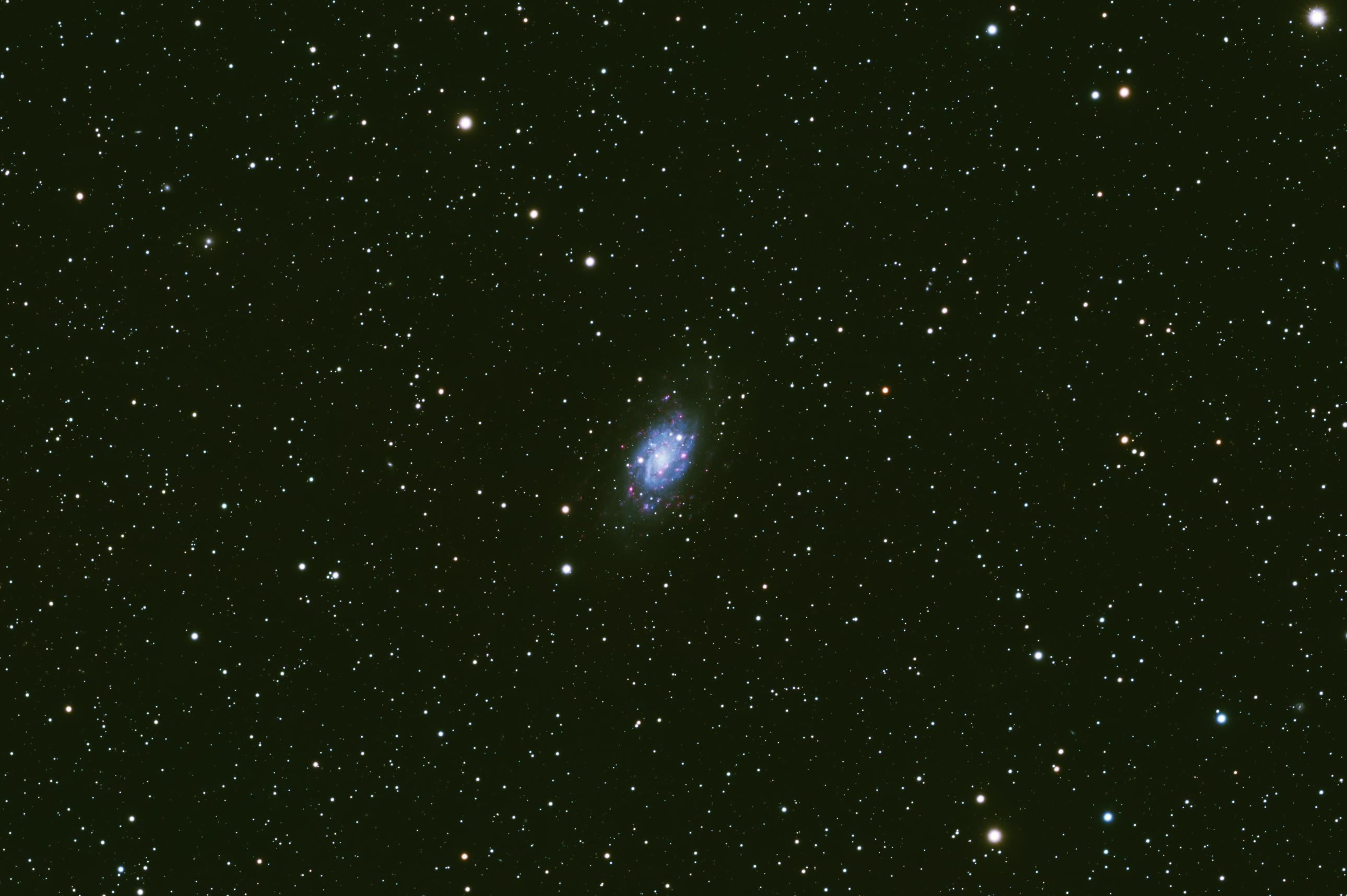
Who doesn’t wonder at the majesty of galaxies and what might exist therein? Unfortunately, with a few exceptions my astrophotography equipment struggles to image most of these beguiling objects of the night sky; galaxies are very, very big but also very far away and thereby, very small from our perspective on Earth. Notwithstanding, the so called ‘galaxy season’ runs from March to May and now being in the darker Bortle 4 skies of Somerset it seemed the right thing to do this year.
In this case NGC 2403, a mid-size spiral galaxy with an apparent magnitude of about 8.9, the 11th brightest in our sky, it is just bright enough for small to mid-sized telescopes and benefits more from darker skies than focal length. Its oblique orientation reveals a wealth of structures: loosely wound spiral arms, over 100 prominent H II regions, a mottled core but lack of distinct dust lanes, not unlike the Triangulum Galaxy M33 in many ways (see close-up image below).
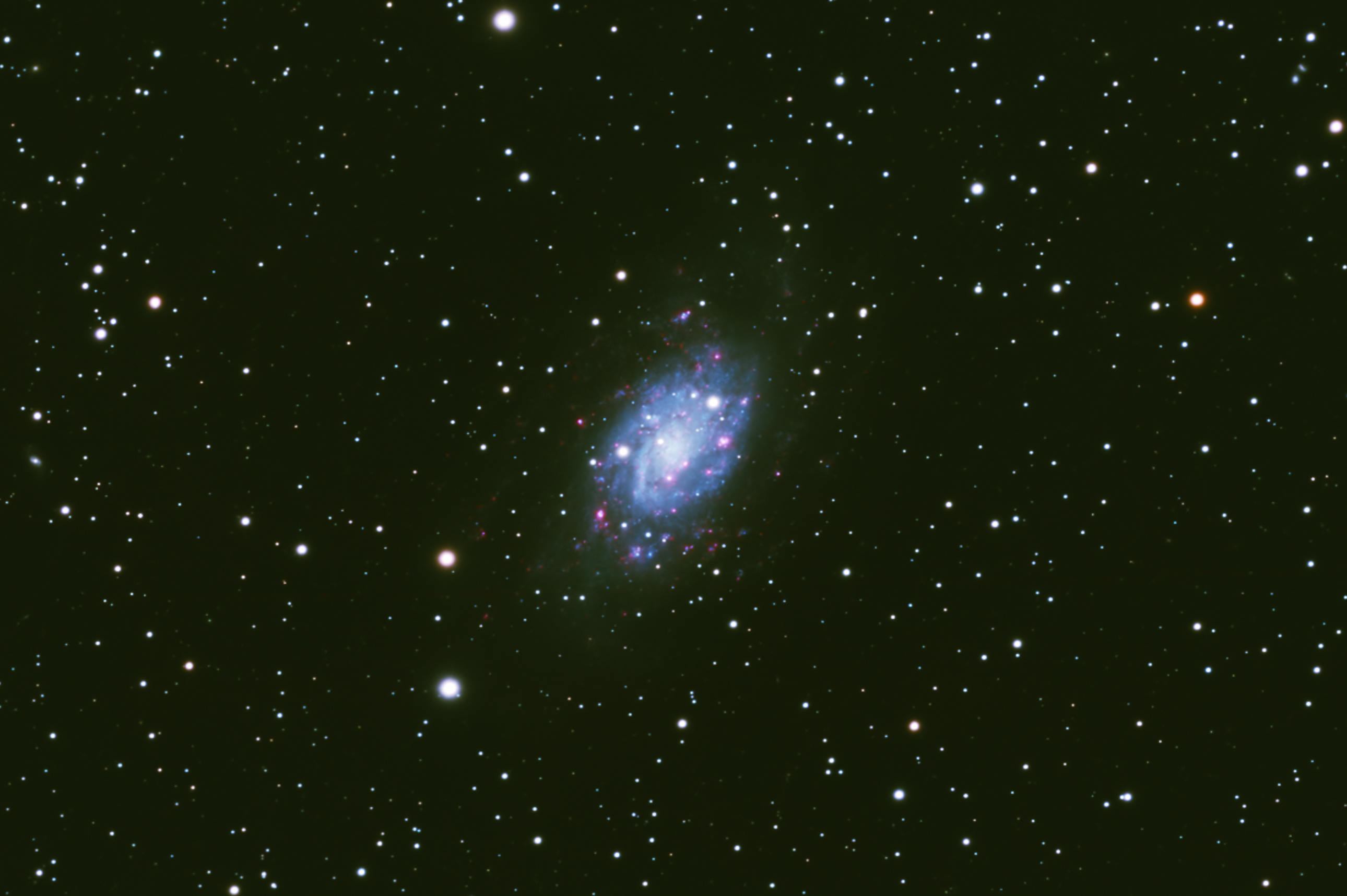
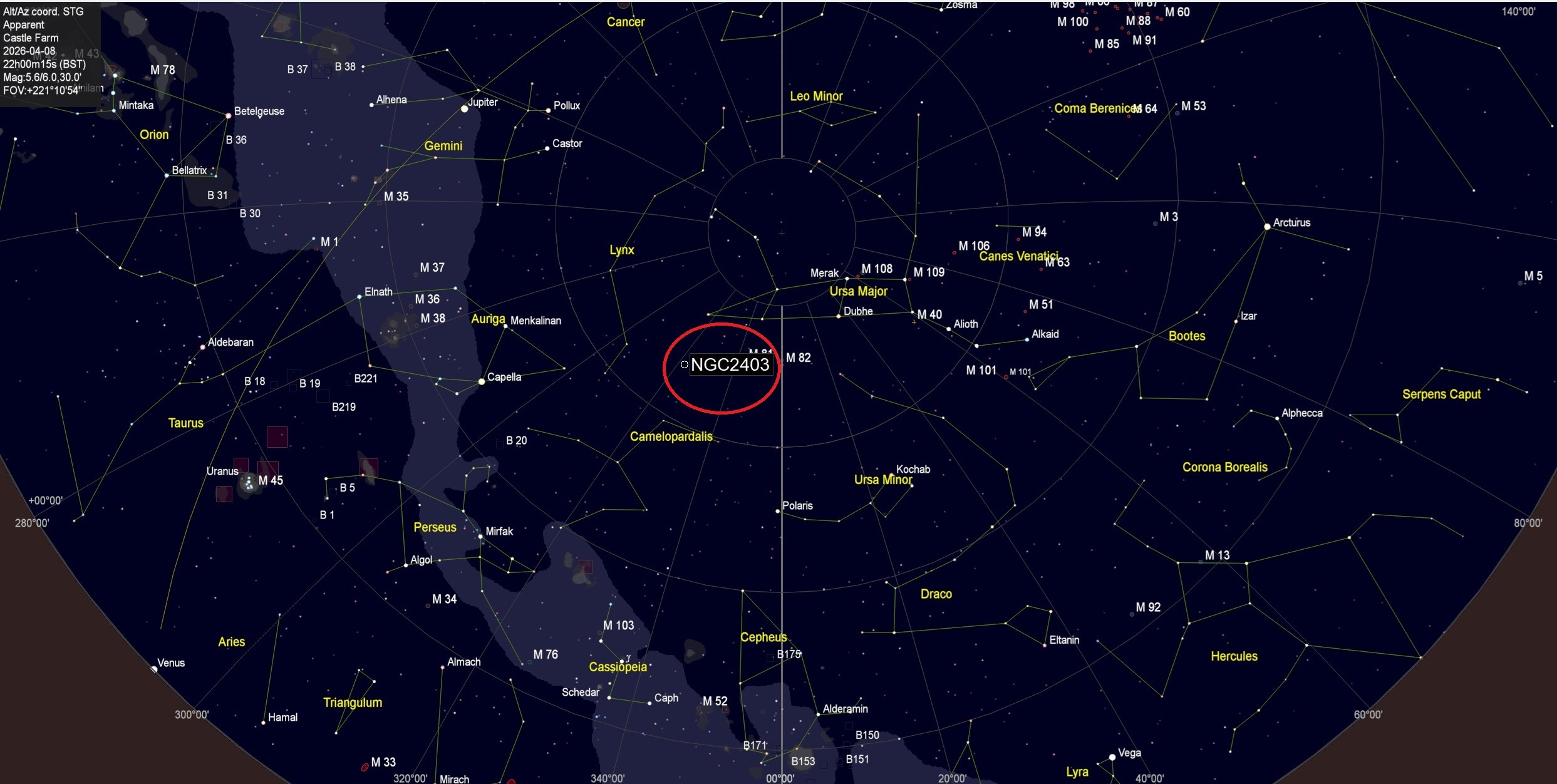
NGC 2403 is in the northern constellation Camelopardalis, approximately 10 million light-years away from Earth, and a member of the M81 Group of galaxies. Numerous bright star-forming regions and nebulae can be observed throughout its spiral arms, which are highlighted in the final image by the addition of Ha wavelength data. One of the most notable features of NGC 2403 is its abundance of supernova remnants, indicating a high rate of stellar birth and death, of which SN 2004dj was a particularly famous event.
This was a difficult object to image and process but helped by Somerset’s excellent dark skies, I was pleased with the result.
| IMAGING DETAILS | |
| Object | NGC 2403 |
| Constellation | Camelopardalis (Giraffe) |
| Distance | 10 million light-years |
| Size | 21.9′ × 12.3′ or 50,000 light-years |
| Apparent Magnitude | +8.9 |
| Scope | William Optics GT81 + Focal Reducer FL 382mm f4.72 |
| Mount & Control | ZWO AM5 + ASIair |
| Guiding | William Optics 50mm guide scope |
| + ZWO 120MM Mini | |
| Camera | ZWO ASI294MM CMOS sensor |
| FOV 2.87o x 1.96o Resolution 2.50”/pix Max. image size 4,144 x 2,822 pix | |
| EFW | ZWOx8 EFW & 31mm Chroma Ha, OIII, SII 3nm & RGB filters |
| Capture & Processing | ASIair, Deep Sky Stacker & PixInsight v1.9.3 Lockhart |
| Image Location & Orientation | Centre = RA 07:37:02.68 DEC +65:35:45.5 Bottom Right = North |
| Exposures | L x13 @ 600sec + R x10, G x10, B x10 @ 300sec + Ha x10 @ 600sec Total Integration Time: 6hr 20min |
| @ Gain 120 & 30 Offset 21 @ -15oC | |
| Calibration | 5 x 600 sec & 5 x 300sec Darks + 10 x Ha LRGB Flats & Dark Flats @ ADU 32,000 |
| Location & Darkness | Castle Farm Observatory, Wookey, Somerset – UK Typically Bortle 4 |
| Date & Time | 5th 6th 8th April 2026 @ +21.30h |
| Weather | Approx. <5oC RH >=<60% 🌙 approx. 90% to 80% waning moon |

