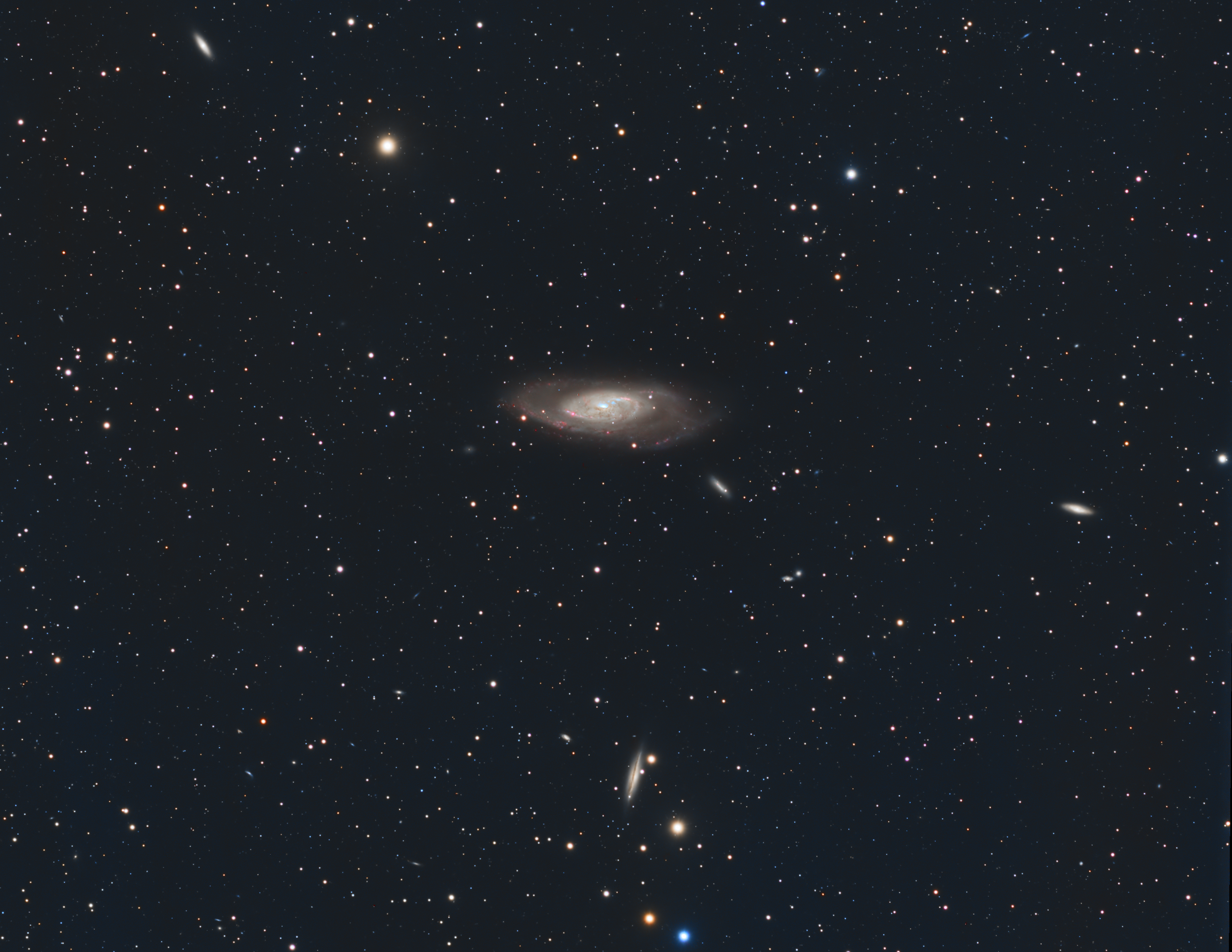
Continuing the galaxy season theme, I returned to image Messier 106 last month, one of the brightest galaxies in the northern sky. Located about 24 million light-years from Earth in the constellation Canes Venatici, it is similar in size and luminosity to the much closer Andromeda Galaxy (2.5 million light-years), which therefore appears much larger. Classified as an active Seyfert galaxy, M106’s core contains a supermassive black and thereby, energetic activity produces unusual arms made of hot glowing gas, which is only visible in radio and X-ray wavelengths.
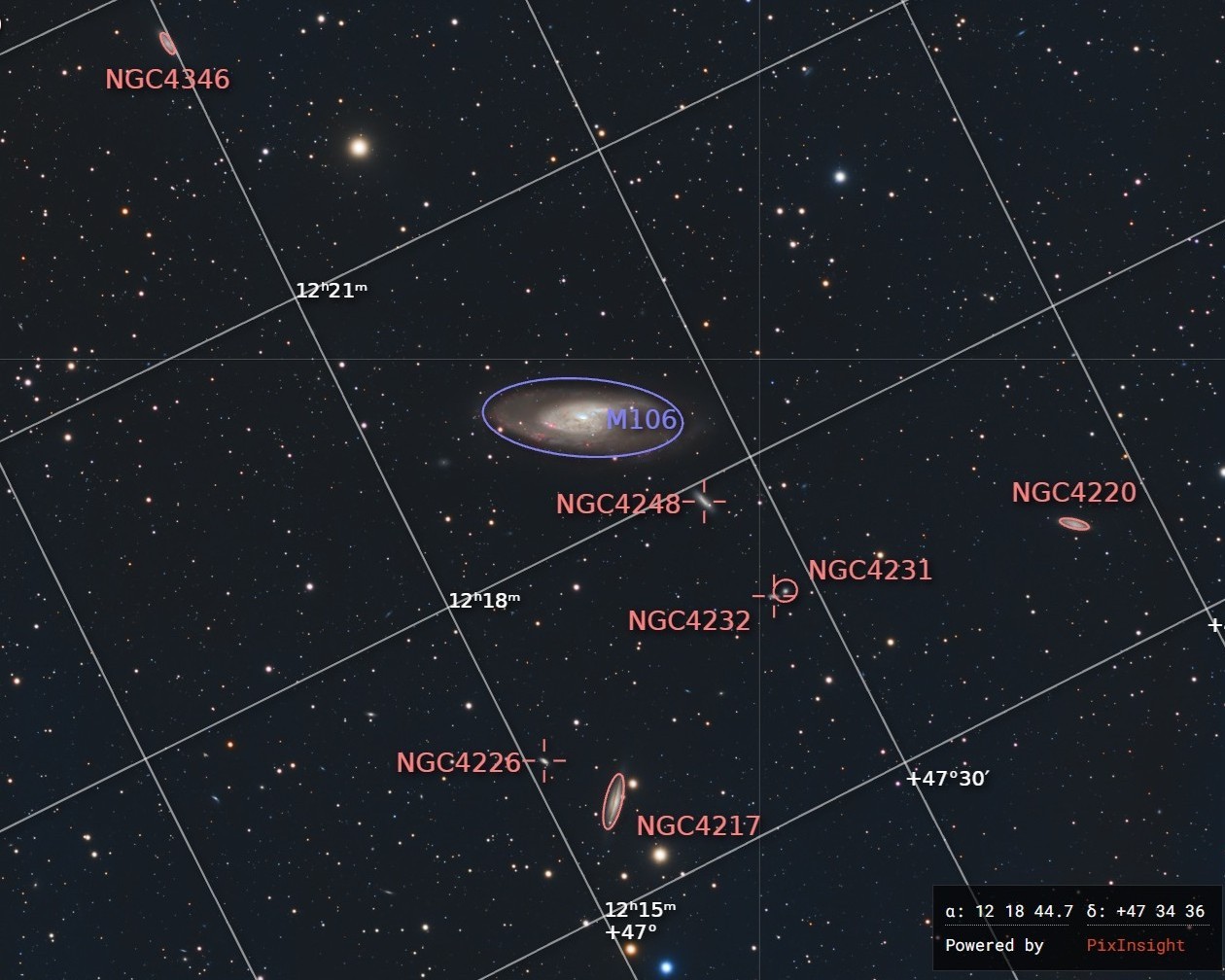
The region around M106 is also very rich with other galaxies, I counted many more. One close companion is NGC 4248, a smaller irregular galaxy gravitationally linked to M106. Nearby in the same field is NGC 4217, an edge-on spiral galaxy appearing thin and elongated through telescopes. More distant background galaxies such as NGC 4220, NGC 4231, and NGC 4232 can also be seen in deep astrophotography images, giving the area a crowded and dramatic appearance.
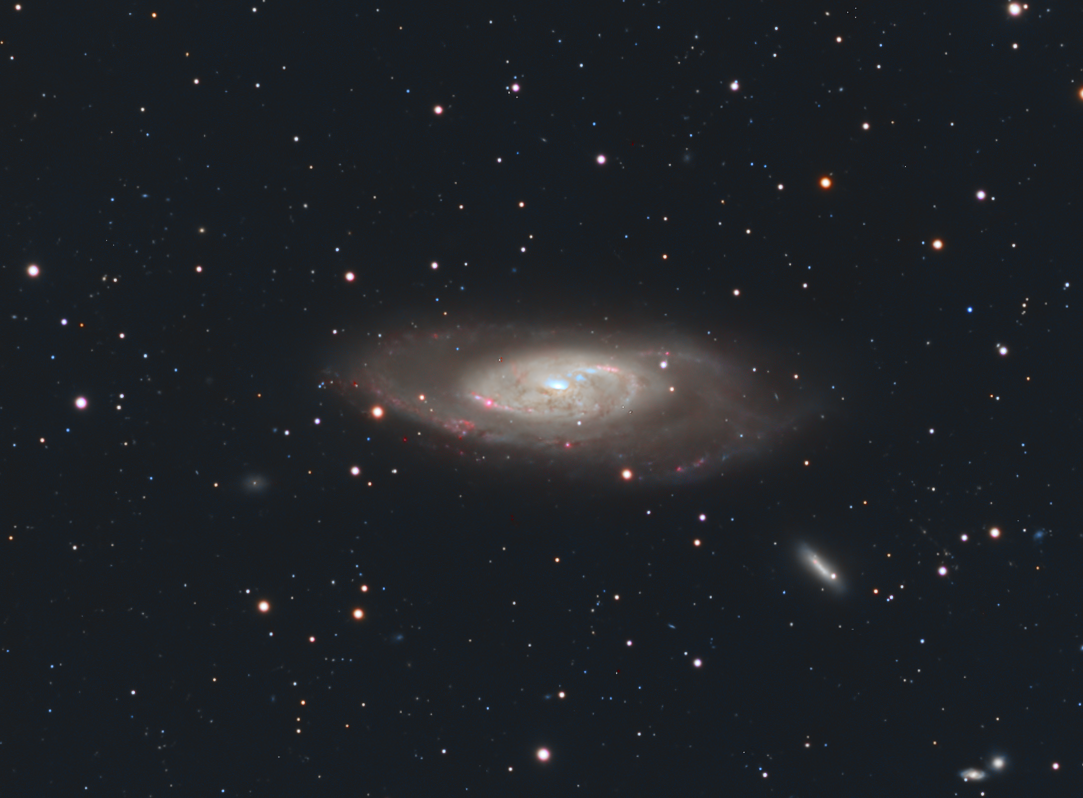
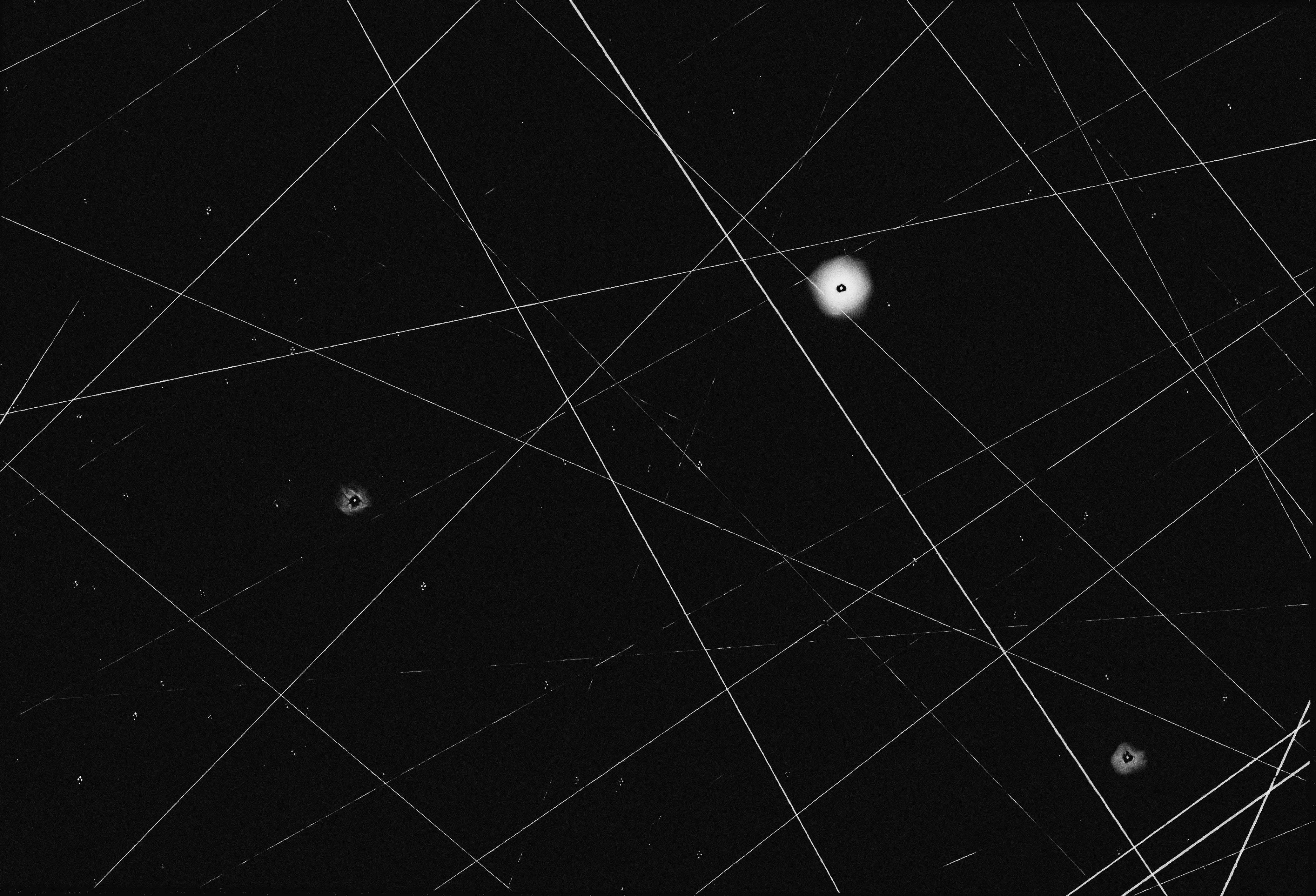
It’s been six years since my first and only image of M106, which can be see here. At the time I was thrilled to capture this exciting galaxy but this time the Bortle-4 sky of Somerset has unveiled much more detail and colour than before; it’s always good to see progress with my imaging. Notwithstanding, it was something of a shock that after pre-processing the data using PixInsight’s WBPP calibration and stacking software, the High Rejection from the luminance revealed numerous satellites that had passed overhead, which does not bode well for astronomers in the future!
FOOTNOTE:
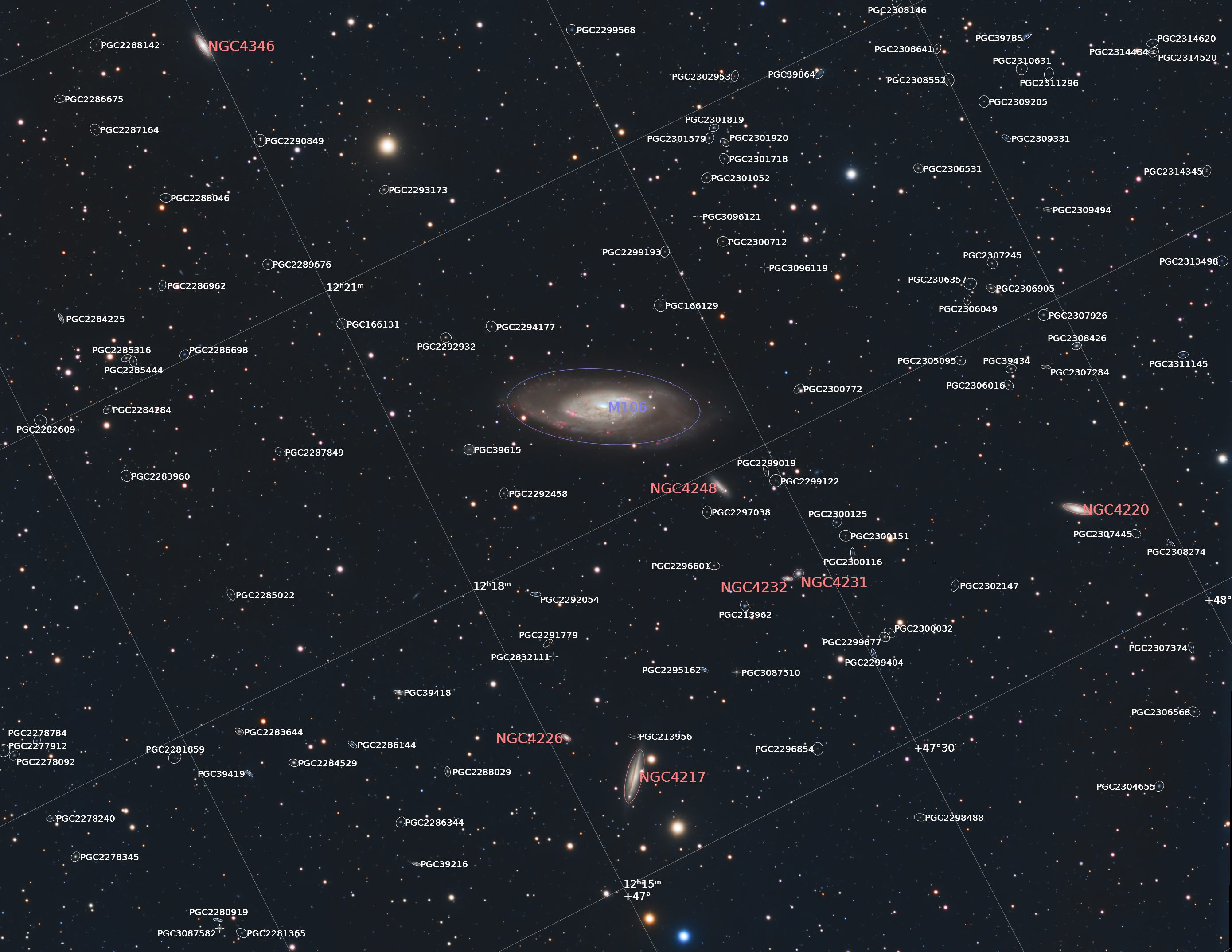
After publishing this image in Stargazers Lounge, a number of people commented that there were a lot more galaxies in this image than I had initially suggested (x7). I therefore returned to Pixinsight and with Image Solver + Annotate Image (which included the main catalogues & added the Principal Galaxy Catalogue), created a more detailed illustrated image shown below. This indicates there are 109 galaxies in the image! Now I really feel even smaller.
| IMAGING DETAILS | |
| Main Objects | M106 etc |
| Constellation | Canes Venatici |
| Distance | 24 million light-years |
| Size | 18.6’ x 7.2’ actual diameter approx. 135,000 light years |
| Apparent Magnitude | +8,4 |
| Scope | William Optics GT81 + Focal Reducer FL 382mm f4.72 |
| Mount & Control | ZWO AM5 + ASIair |
| Guiding | William Optics 50mm guide scope |
| + ZWO 120MM Mini | |
| Camera | ZWO ASI294MM CMOS sensor |
| FOV 2.87o x 1.96o Resolution 2.50”/pix Max. image size 4,144 x 2,822 pix | |
| EFW | ZWOx8 EFW & 31mm Chroma HLRGB filters |
| Capture & Processing | ASIair, Deep Sky Stacker & PixInsight v1.9.3 Lockhart |
| Image Location & Orientation | Centre = RA 12:18:20.84 DEC +47:16:25.3 North = Bottom Left |
| Exposures | Ha x 8 X 600 Sec + L x 43, RGB x14 each @ 300 sec Total Integration Time: 8hr 25min |
| @ Gain 120 & 30 Offset 21 @ -15oC | |
| Calibration | 5 x 600 sec & 5 x 300 sec Darks + 20x Flats & Dark Flats @ ADU 32,000 |
| Location & Darkness | Castle Farm Observatory, Wookey, Somerset – UK Bortle 4 |
| Date & Time | 8th 9th 12th & 13th April 2026 @ +21.30h |
| Weather | Approx. <6oC RH >=>70% 🌙 <= 65% to 30% waning |