Cosmic Spaghetti

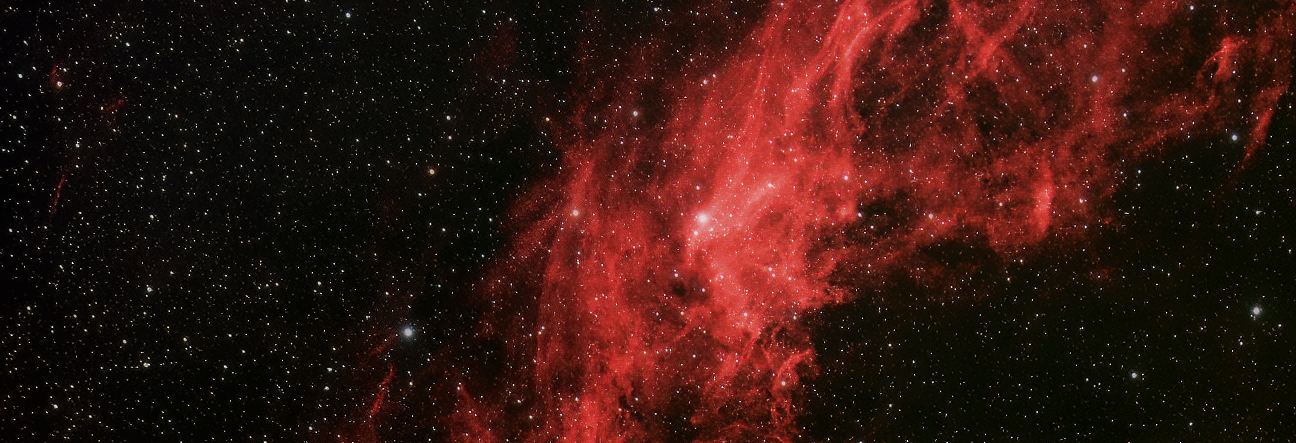
Long on my to-do list has been the spectacular Simeis 147, also known as SH2-240 or the Spaghetti Nebula.  A large supernova remnant (SNR) spanning the border between the Taurus and Auriga constellations, which despite its size is one of the faintest objects in the night sky and therefore not an easy astrophotography target.  Moreover, given my equipment’s field-of-view the large size of the SNR would require a mosaic to fully image, which is generally out of the question here at Fairvale Observatory with the limited clear sky conditions that prevail hereTherefore, for the moment I’ve concentrated on a close-up area of the southern lobe, imaged and processed in HOO narrowband to highlight the beautiful complexity of this cosmic cataclysm that is the product of a massive stellar explosion that took place some 40,000 years ago.

Simeis 147 Location

Furthermore, imaging was not helped by the presence of a waning full moon and even with 10-minute exposures, only very limited detail was evident in the Ha wavelength and none in OIII, thus also making framing tricky.  However, with over 12-hours integration time eventually obtained over four nights and very careful processing, my first image of this wonderful SNR does not disappoint.  I hope to return to this magnificent object again in the future to add more exposures – you really cannot have too many – and perhaps eventually capture this bowl of cosmic spaghetti in its entirety one day too.
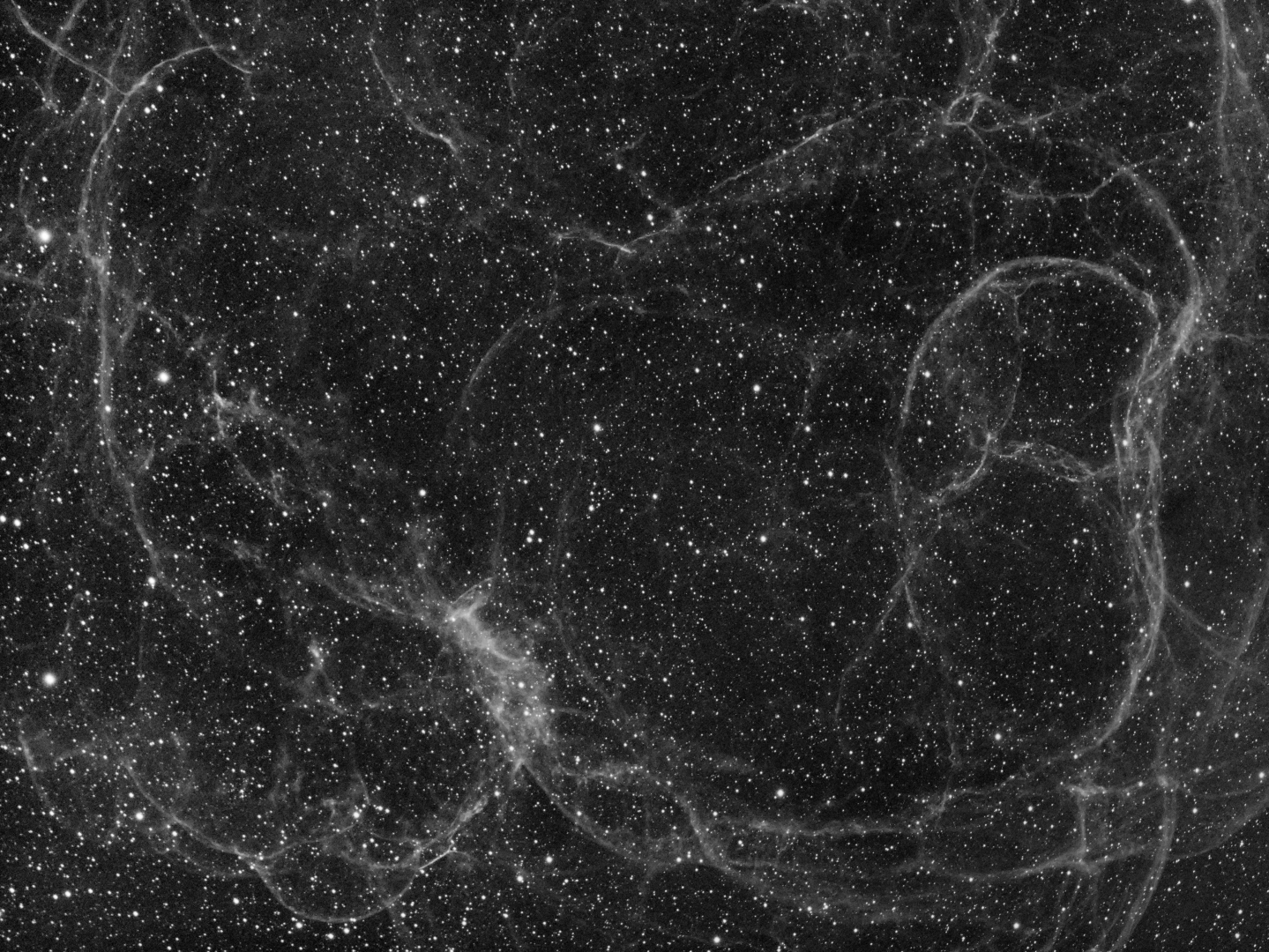
Ha Stack 6-hours 30 mins
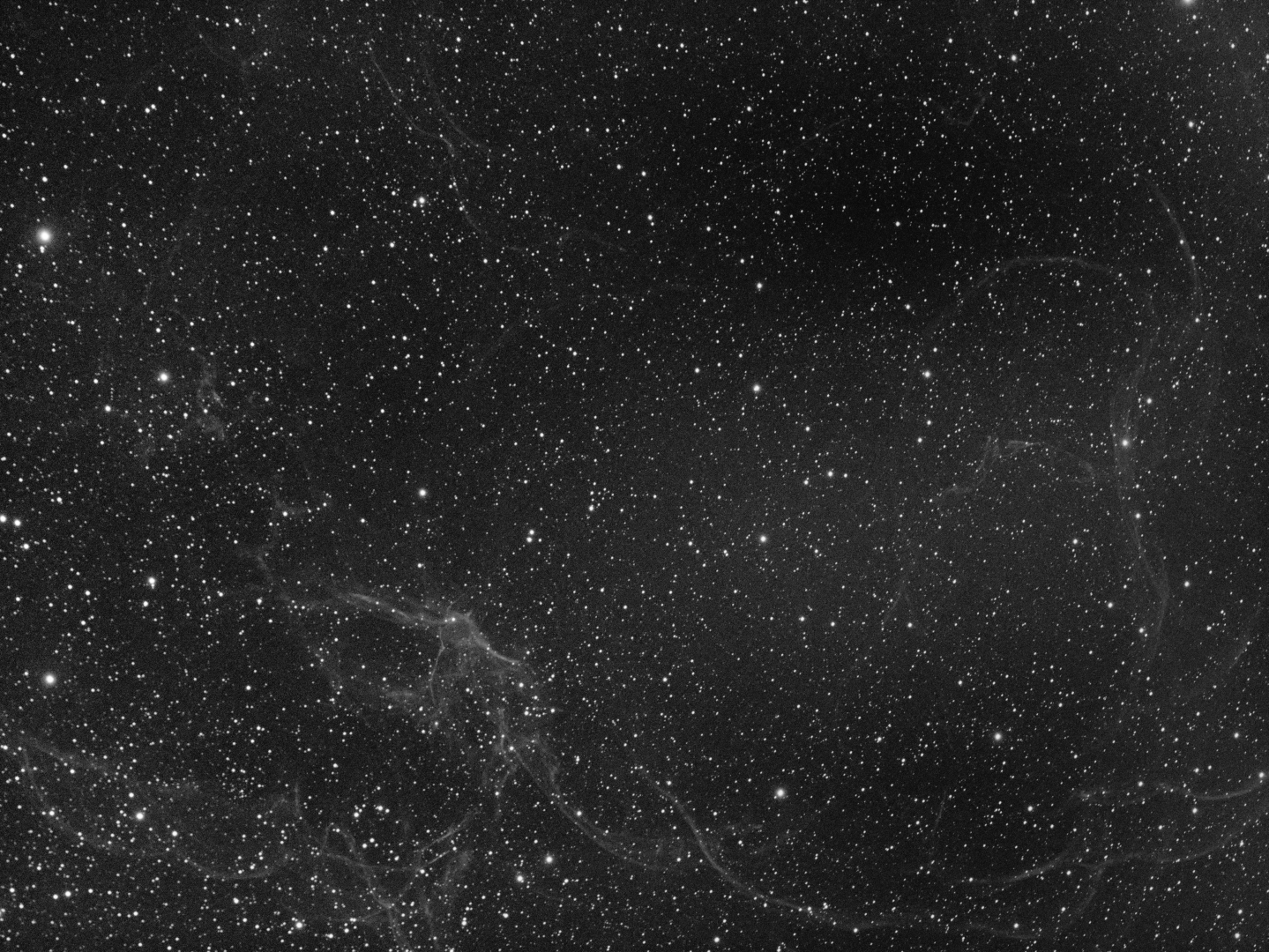
OIII Stack 5-hours 40 mins
 IMAGING DETAILS
ObjectSimeis 147  AKA SH2-240 or Spaghetti Nebula
ConstellationTaurus
Distance3,000 light-years
Size Total object +3.0o
Apparent MagnitudeExtemely faint
  
Scope William Optics GT81 + Focal Reducer FL 382mm  f4.72
MountSW AZ-EQ6 GT + EQASCOM computer control & Cartes du Ciel
GuidingWilliam Optics 50mm guide scope
 + Starlight Xpress Lodestar X2 camera & PHD2 guiding
CameraZWO1600MM-Cool mono  CMOS sensor
 FOV 2.65o x 2.0o Resolution 2.05”/pix  Max. image size 4,656 x 3,520 pix   
EFWZWOx8 EFW & 31mm Chroma 3nm Ha, OPIII & SII filters 
Capture & ProcessingAstro Photography Tool + PHD2 + Deep Sky Stacker, PixInsight v1.8.8-12, Photoshop CC, Topaz AI Denoise
Image Location              & OrientationCentre  RA 05:41:28.486      DEC +28:01:51.616                      Left = North  Top = West    
Exposures39 x 10 min Ha, 34 x 10 min & 9 x 10 min SII Total Integration Time: 12 hr 10 min     
 @ 139 Gain   21  Offset @ -20oC    
Calibration5 x 10 min Darks, 15 x  Ha, OIII, SII flats and Flat Darks      @ ADU 25,000
Location & DarknessFairvale Observatory – Redhill – Surrey – UK        Typically Bortle 5-6
Date & Time21st December 2021 + 4th, 5th & 6th January 2022  @ +19.00h  
WeatherApprox. <2oC   RH >=80%              🌙 96% → 21%

2021 The Year In Pictures

Every year since 2014 I’ve published a retrospective blog of my astrophotgraphy year just ending called Reflections. It’s been a useful task that enables me to bring together the best and sometimes the worst of my images, in order to consider the good and bad points + progress made + set some objectives for the coming year. Eight years on, after which I believe I’ve now reached at least a respectable level of imaging and processing, I’ve decided to stop this format for the time being.

Notwithstanding, at this time of the year I also produce an astrophotography calendar for members of my family, which consists of the better images from the year just ending; I think they like them and certainly all use the calendar during the coming year. Moreover, I also recently started to compile a video of the said calendar images set to appropriate music, which we all watch together prior to seeing the actual calendar. It’s a great way to present the images, which look really stunning on today’s large Smart TV’s and is fun to watch with the family too.

The video for this last year 2021 can be viewed on YouTube HERE and below is a brief very general overview of each image. More detailed background information and imaging details for those interested can be found in relevant blogs posted on this site during the past year.

2022 CALENDAR

A new set of filters, improved processing techniques and access to data from a telescope at a dark sky site in New Mexico, USA (shown by an asterisk *) contributed to an exciting astrophotography year in 2021.                  

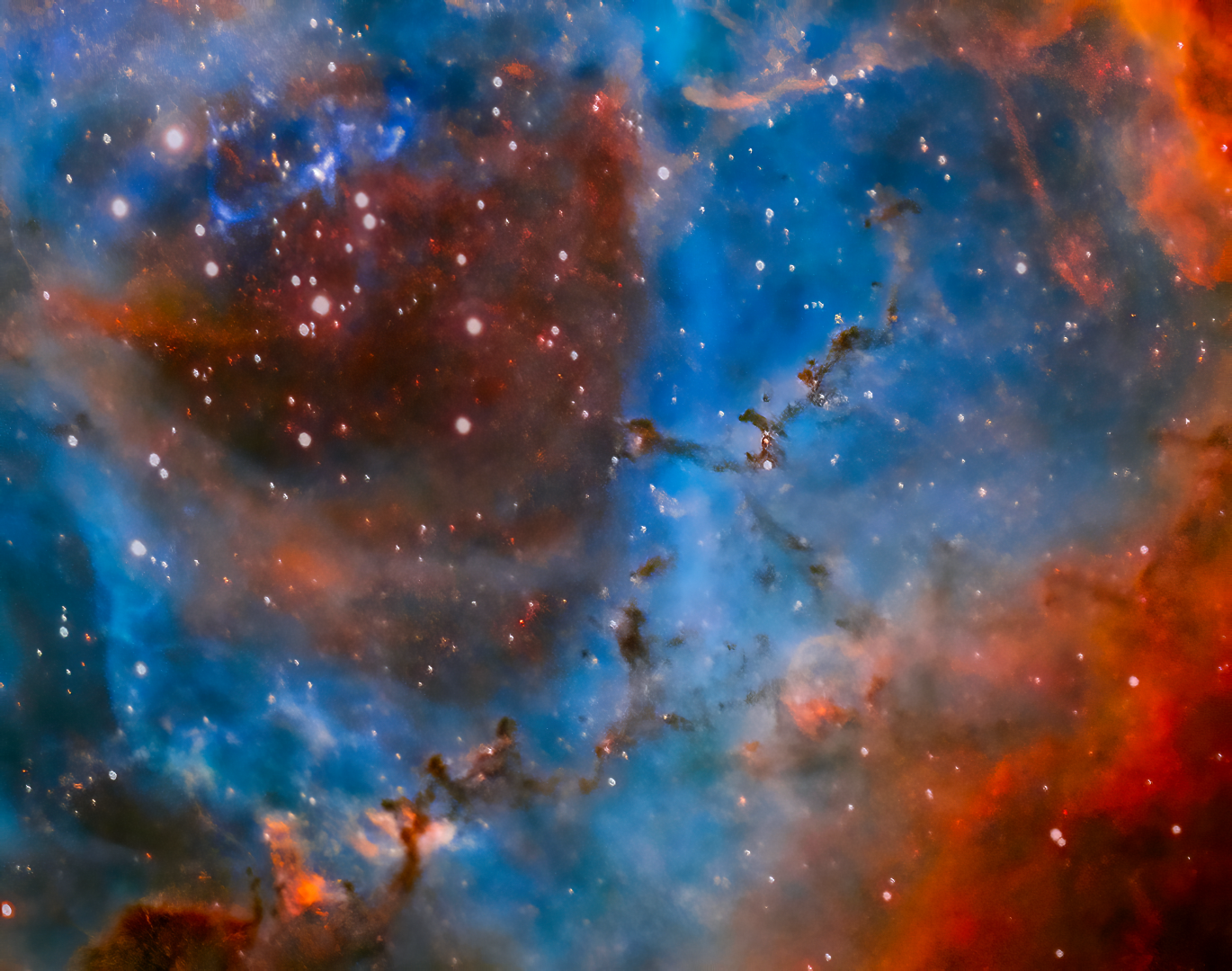
FRONT COVERThe Carnival of Animals: Special processing of the inner region of the Rosette Nebula highlights the ‘animals’ or Bok Globules – clouds of dust undergoing gravitational collapse as part of the process of new star formation.  
JANUARYLDN-1250 Dark Nebula*: Dark or absorption nebulae are a type of interstellar cloud which are so dense they obscure or absorb visible light emitted from objects behind or within and thereby contrast with the general light flux of the Universe as dark areas.  
FEBRUARYCTB-1 Supernova Remnant*: The overall structure of this supernova remnant is that of a circular shell, with a conspicuous rupture towards the north (lower right of image).  The main red Ha-shell is composed of multiple interlocking filament limbs, with a blue / green OIII arc along one side.  
MARCHJellyfish Nebula: Locatedin the Gemini constellation some 5,000 light years from Earth, this is a remnant of a supernova that took place during the past 30,000 years. With a diameter of 70 light-years, the object is visually speaking nearly twice the size of a full moon.     
APRILMarkarian’s Chain: The Virgo cluster consists of more than 2,000 galaxies, within which Markarian’s Chain forms a J-curve string of bright galaxies that share a common motion through space.    
MAYM13 Great Globular Cluster of Hercules*: Consisting of several hundred thousand stars and 145 light-years in diameter, M13 is considered to be the finest cluster in the Northern Hemisphere.  
JUNECave Nebula*: Located along the plane of the Milky Way is the diffuse emission nebula referred to as the Cave Nebula.  The Cave at the centre is critically located at the boundary of the Cepheus molecular cloud and the hot, young stars which ionize the surrounding gases to great effect.  
JULYOrion Widefield: Framed around the area of Orion’s Belt, the Horsehead Nebula and the Great Orion Nebula, look hard and the refection nebula M78 can also be seen in the lower left corner.    
AUGUSTElephant’s Trunk Nebula*: A very large emission nebula, the so-called Elephant’s Trunk Nebula is rightly viewed as one of astrophotography’s most iconic images. The ‘trunk’ itself dominates the centre of this image and is illuminated from behind by a bright star forming region.  
SEPTEMBERM31 Andromeda Galaxy: The full benefit of new filters, improved guiding, clear skies over 6-nights and extensive use of new processing techniques can be seen in my best image yet of Andromeda.      
OCTOBERButterfly Nebula: Situatedwithin the Orion Arm of the Milky Way is the Gamma Cygni nebula, a diffuse emission nebula surrounding the star Sadr.  Either side of the dark rift which divides the image from top to bottom are two large bright areas that together form the so-called Butterfly.  
NOVEMBERM33 Triangulum Galaxy: Like it’s neighbour Andromeda, better data and processing has produced an exciting new image of M33 this year, the red areas highlight Ha-rich star-forming regions  
DECEMBERFlying Bat & Giant Squid Nebula*: This very faint OIII emission nebula Ou4 required an imaging time of 40-hours.  For obvious reasons Ou4 has become known as the Giant Squid Nebula which, moreover, lies within the much larger SH2-129 HII emission region or the Flying Bat Nebula.     

HAPPY NEW YEAR + CLEAR SKIES IN 2022