Talk The Talk

“He who can, does. He who cannot, teaches.” 1903, George Bernard Shaw

At the end of last year I was contacted by a member of the Aperture Club, a photography group based in Purely – Surrey, who had come across this website and asked if I could give a presentation to the club’s members on astrophotography.  Ordinarily I might have rejected the request – after all what do I know about astrophotography after only 18-months – but then again why not? Once I sat down and compiled some initial thoughts it was surprising just how far I had come and learnt already, albeit with still a long way to go.  In the end I agreed and decided to take a two-fold approach to the talk: (i) a basic overview of astrophotography, and (ii) in this context my personal journey so far.
TTT Cover

The final structure adopted was like this, which I hoped would be both technically and aesthetically engaging and provide some insight into the challenges for astrophotography when compared to their day-to-day terrestrial pursuits:

  • Types of astrophotography
  • Astrophotography Methods
  • Light
  • Telescopes
  • Imaging
  • Cameras
  • Image Capture
  • Processing
  • Post Processing

I gave my talk to the club at the end of March, which lasted about 1-hour and I believe was well received; there was a good turn-out and subsequent Q&A session – which is always a good sign.  I had also been asked to compile some related tasks for the members to undertake afterwards and after a break presented a second, shorter talk on some possible assignments.  Copies of the talks can be accessed via the links here:

Astro Lecture PDF

Astro Assignments PDF

I would not be so arrogant to undertake such a presentation to other astrophotographers, at least not yet, but enjoyed introducing members of the Aperture Club to my hobby.  Furthermore, through compiling the presentations I benefited from the process, which required me to think and understand the subjects more thoroughly than I might otherwise have done, making me think that Shaw was wrong.  Good teaching requires a good understanding of the subject, the skill to impart that knowledge to the audience and the ability to apply the knowledge. I’ve previously walked the walk and in this instance I’d like to think I was able to talk the talk – I found the experience rewarding and I hope members of The Aperture Club did too?


Transit

13147537_10154089139076772_6724120884346003381_o

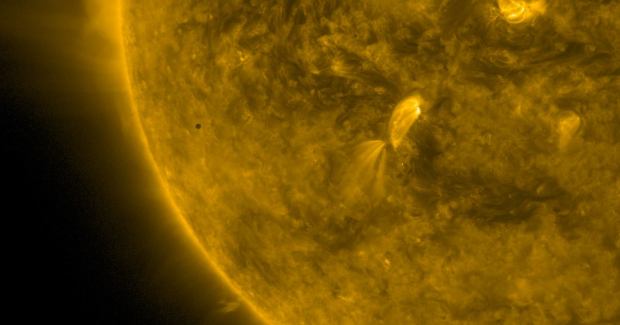
Unfortunately not my image: Mercury starting its transit across the Sun today, photo by NASA.

The transit of Mercury across the face of the Sun takes place about thirteen times each century and today was one of those occasions; the next is on 11th November 2019.  With months of bad weather I’ve been unable to undertake very little astronomy for some time but albeit late, spring actually arrived last week and I took the opportunity to shake-down my equipment and experiment with settings for solar imaging in the hope of capturing Mercury’s transit.  Using a Baader solar filter and both the William Optics GT 81 and Skywatcher 150PL, I have successfully imaged the Sun before.   Of course, inevitably I aspire to a dedicated Lunt or Coronado solar telescope one day in order to image details of the chromosphere and prominences, which are not visible using a white-light solar filter.

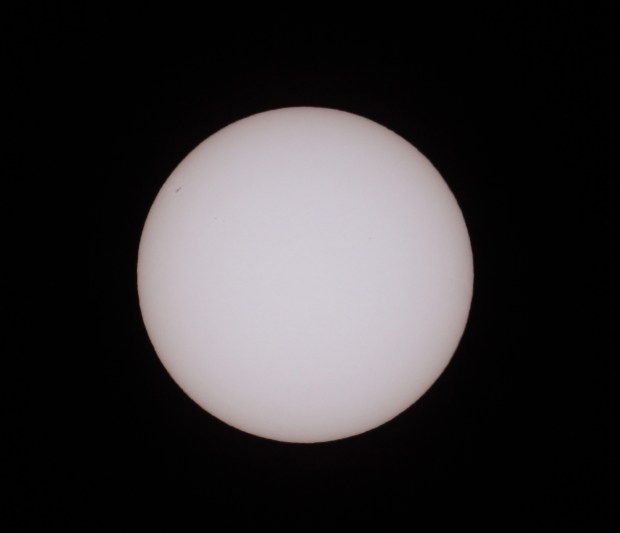
Sun spot activity is limited at the moment but the Baader filter and WO GT81 do a reasonable job, although I find achieving focus of the Sun quite difficult.  Using the DSLR I experimented with the field flattener and an alternative basic 1/ 1.25” nosepiece, which produced a preferable result of a slightly larger and sharper image.  I also tried the ZWO ASI 120MC webcam but as I don’t use this very often struggled to get the settings right for any sort of image – I’ll experiment more with that over the summer. I also put EQMOD-ASCOM and the newly acquired gamepad control through their paces which both worked well, so I was ready for the transit – weather permitting.

IMG_0016crop

Last week’s test image of the Sun, with sun spot top left: WO GT81 + 1.25″ nosepiece | 1 / 2,500 sec @ ISO 100

After days of sunshine, albeit with high cloud that has continued to prohibit astrophotography at night, I was nonetheless hopeful of seeing at least some of the transit today.  Notwithstanding, Sods law arrived in the form of a belt of cloud over south east England last night!  Not to be defeated I watched the sky and cloud forecasts which suggested a glimpse of the transit might still be possible.

In hopeful anticipation I set up the equipment just before contact at 12.12 pm BST and shortly afterwards obtained a good view of Mercury as it started its transit across the face of the Sun. For the next three hours I managed glimpses of the planet as it continued its journey.  It is very, very small but forms a distinct, sharp black dot against the background of the Sun when compared to the more diffuse, grey nature of the sunspots.  It was an exciting experience and despite the drawbacks – cloud has now completely covered the sky for the rest of the transit – it was very enjoyable; so what’s the problem?

Despite all my preparation for imaging everything that could go wrong did and I was unable to obtain even a single photograph:

  • On setting up the camera and starting to focus the EQMOD-ASCOM tracking stopped and Carte du Ciel froze. Despite re-starting the set-up numerous times the tracking would not work!
  • Finally after resorting to the Synscan handset for tracking control, for some completely inexplicable reason I could not get any sort of image on the camera, that otherwise was working OK!

As I have learned many times before, the art of astronomy is patience and persistence but I am very disappointed not to have imaged Mercury during its transit today.  Ironically once the cloud put an end to further activity, I tested the EQMOD-ASCOM tracking once again and it worked fine.  Perplexed does not describe my feelings – oh well, 3-years to prepare for the next transit!

hair-tearing

How I felt after today’s imaging!!! The transit view was still very good and I’m grateful for the breaks in the cloud.