Pinwheel Galaxy

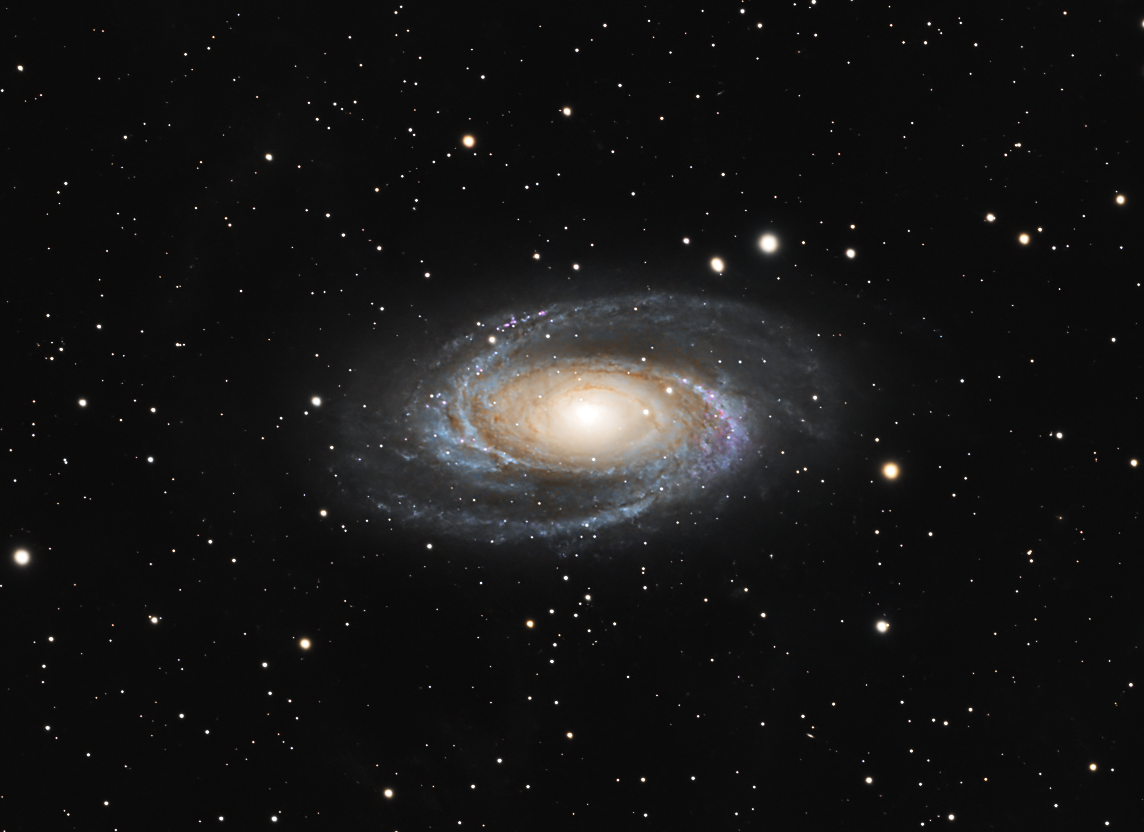
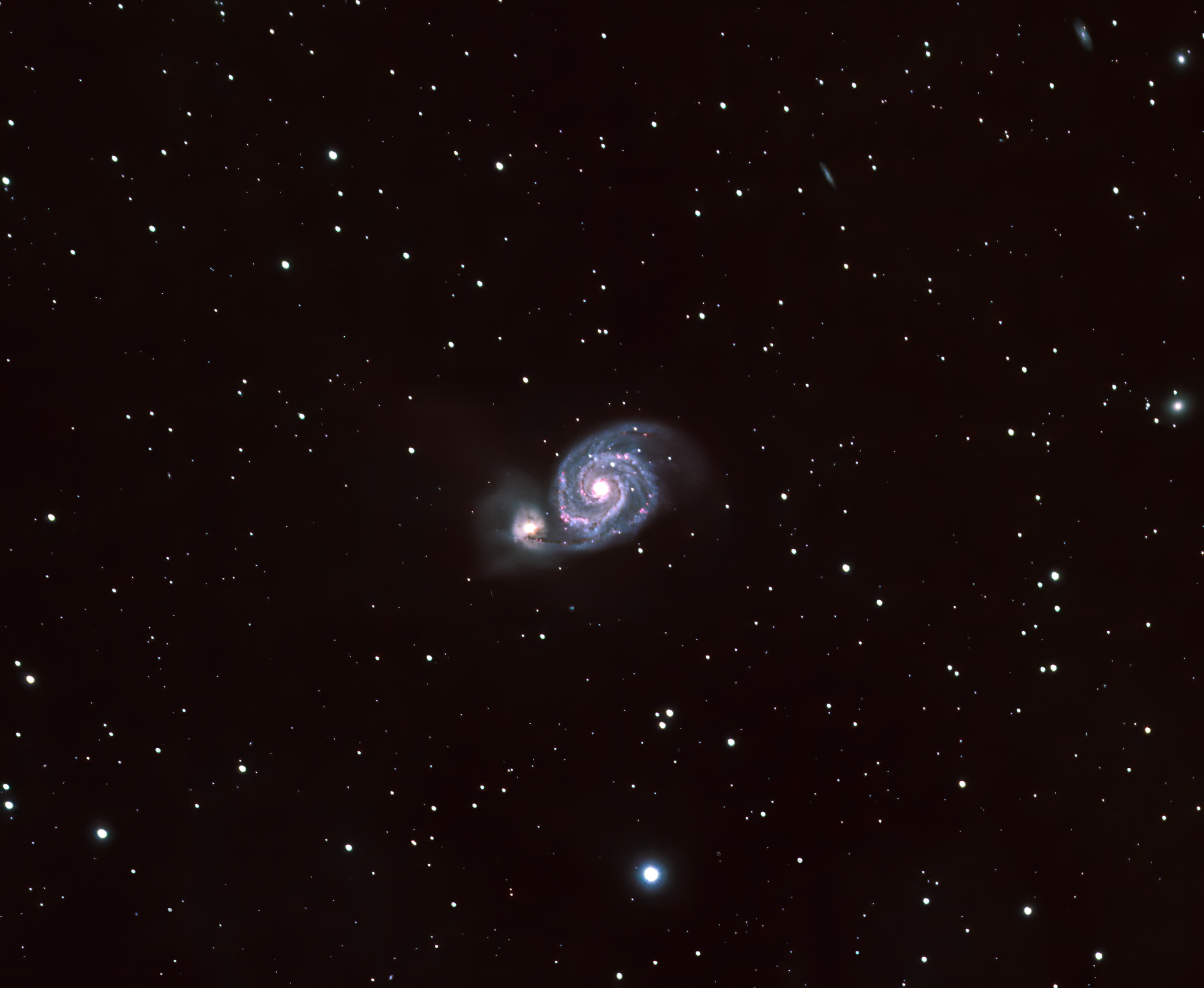
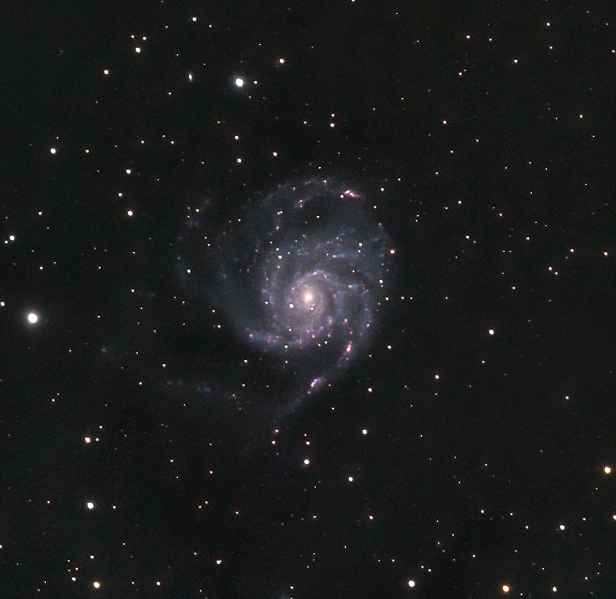
This time of the year is perfect to observe the spectacular face-on spiral M101 or Pinwheel galaxy.  At nearly twice the size of the Milky Way and containing at least an estimated trillion stars, M101 is the second largest galaxy of the Messier catalogue and certainly one of the highlights of the spring galaxy season.

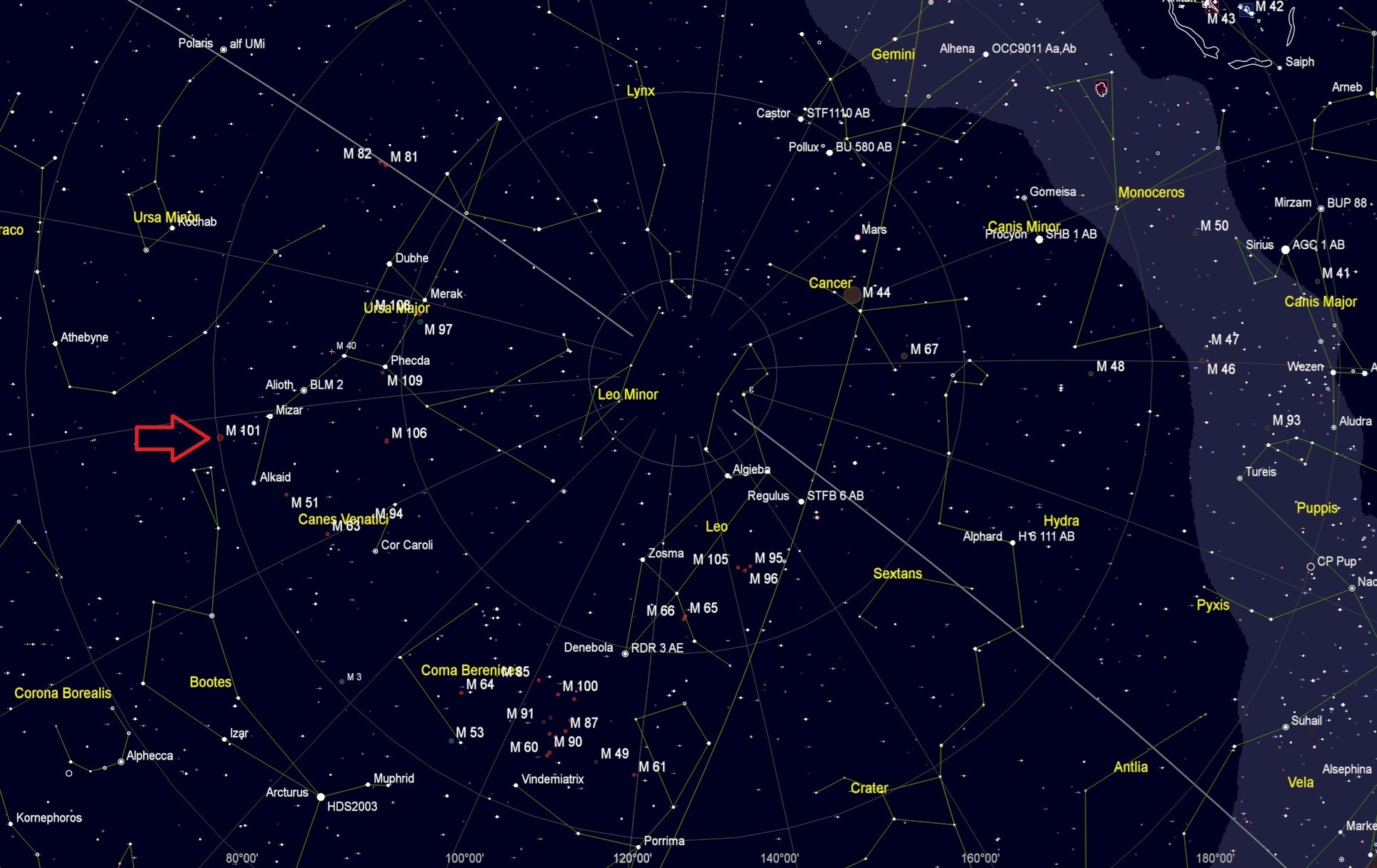
A loosely bound cluster of galaxies known as the M101 Group, primarily located in the Ursa Major constellation, is also dominated by the Pinwheel Galaxy, which moreover, is considered to form part of a larger structure within the Virgo Supercluster.  Many of the other galaxies in this group are companions to M101, orbiting and interacting with it gravitationally.

Despite its size, M101 is challenging for my William Optics GT81, though I did manage a reasonable image in March 2019.  On this occasion using nearly 17 hours of data from the much larger MOANA 10” Newtonian based at the Dark Sky Observatory in Texas, USA, the resulting image shows the galaxy’s beauty to good effect.

Footnote & credit: Following a recent knee replacement I’m currently unable to set-up and use my astronomy equipment, fortunately I’m still able to continue processing using the excellent public amateur data from the MOANA project located near Fort Davis, Texas  https://erellaz.com/moana/. Many thanks to its creator Elleraz.


Canine Capers

Following a very poor winter period, spring has been nothing less than spectacular and provided many clear nights for astronomy, ironically made all the better by the covid-19 lockdown.  With the near absence of road traffic and especially aircraft – Fairvale Observatory is badly affected by flights from nearby Gatwick, Heathrow and Redhill aerodrome – it has resulted in noticeably better seeing, as well as a quieter and more enjoyable environment overall; it’s worth noting that after experimenting with Deep Sky Stacker (DSS), increasing the Kappa-Sigma clipping parameter from 2.0 to 2.50 for the light subs, in all but the worst cases eliminated aircraft tracks in the final stacked image.  Resulting from these favourable conditions, I’ve recently been able to image four otherwise difficult targets, amounting to some 40-hours total integration time, literally unprecedented conditions in the +30 years I’ve lived here.

CanVen Map

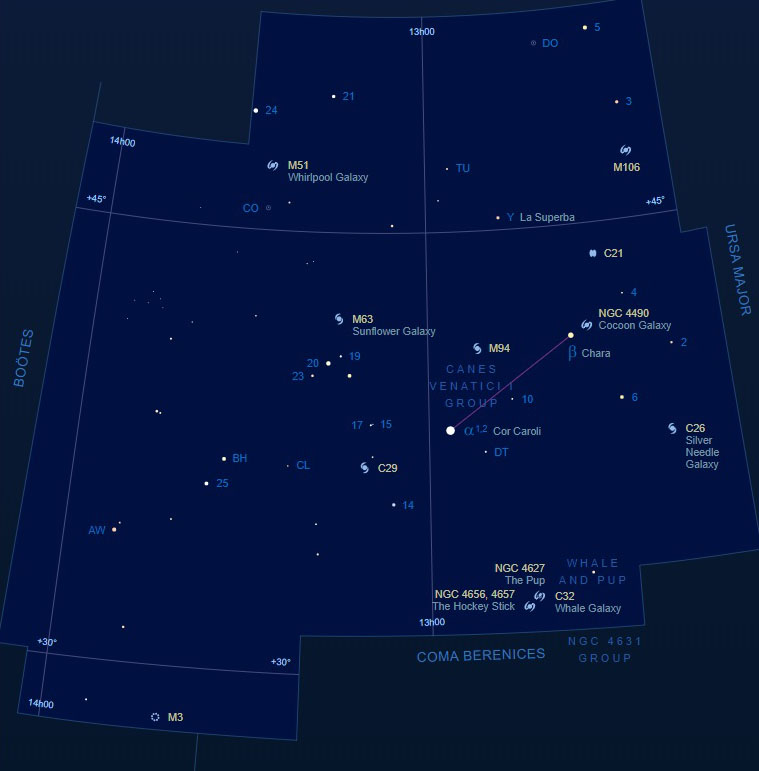
Apart from a brief diversion imaging the Leo Triplet, my attention has otherwise been centered on the constellation of Canes Venatici, AKA the Hunting Dogs.  At this time of the year the constellation starts to come into view high overhead from the east at about 10 p.m. and crosses the meridian about three hours later.  Located below Ursa Major and above Bootes, the relatively small Canes Venatici hosts five Messier objects, four of which are galaxies and it is these I’ve been drawn to.  From earlier test shots I determined that the M94 galaxy was unlikely to be suitable for my equipment but I did obtain and have already described images of first M106 and then M63.  Notwithstanding, I had unfinished business with the last of the four galaxies, which I therefore now turned to.

In 2019 I was pleased to acquire my first ever image of the wonderful M51Whirlpool Galaxy and its smaller companion, NGC 5195.  However, I noted then that the final LRGB image still needed much more integration time than just 2hr 18min. achieved, plus the addition of Ha-subs and that I hoped to return to the Whirlpool and its neighbour as soon as possible for this purpose.

M51 HaLRGBFinal-denoise-denoise

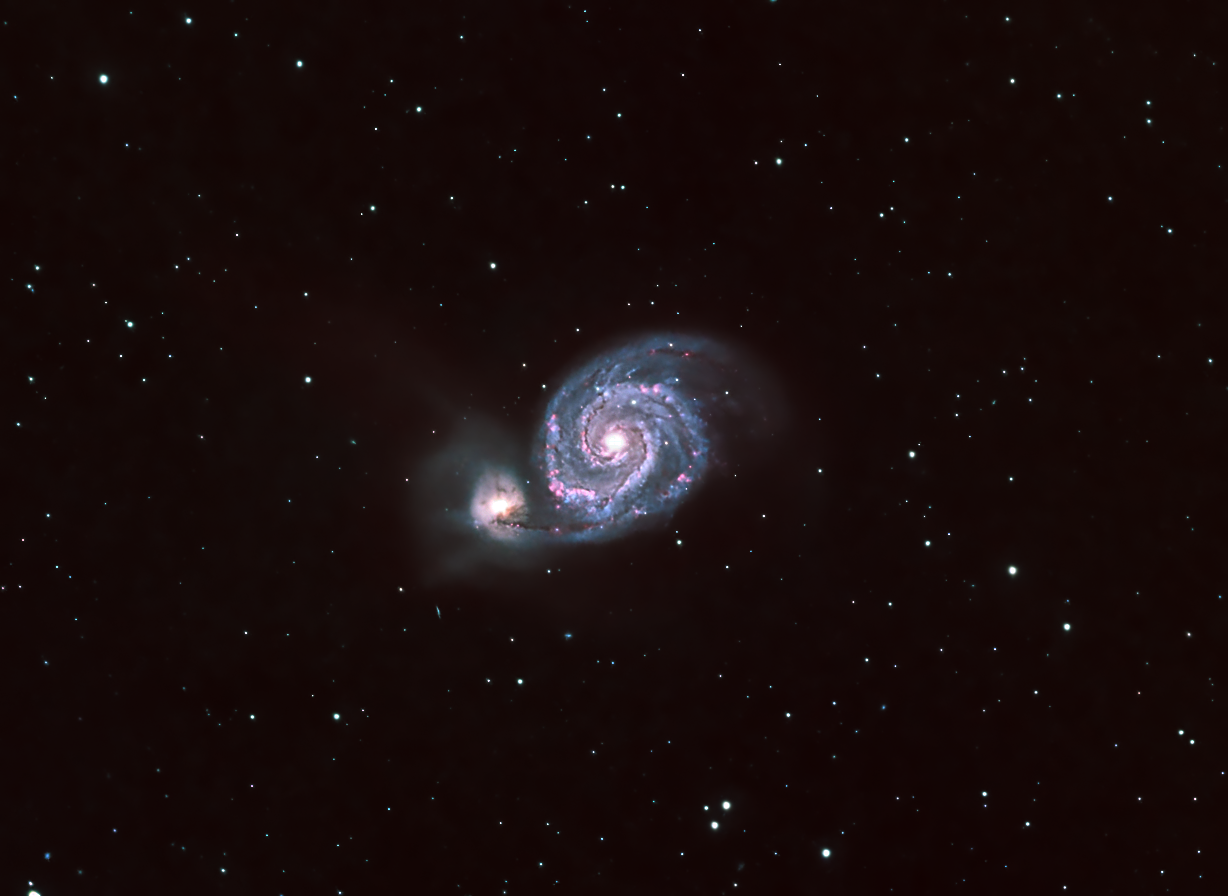
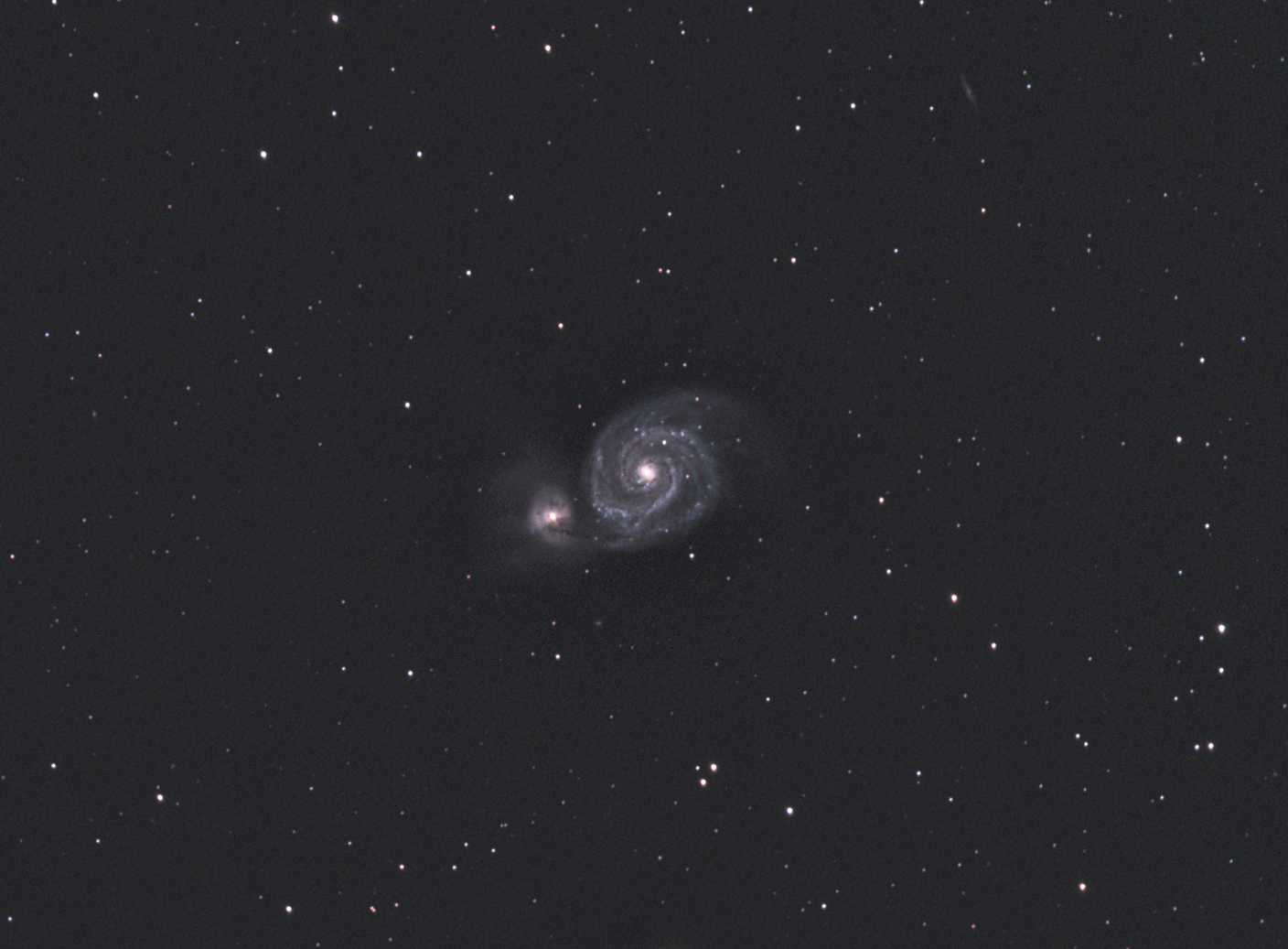
It was therefore a great pleasure to image M51 over no less than seven nights in March and April this spring, which combined with last year’s data resulted in over 16 hours integration time, substantially longer than any previous image I’ve compiled before.  Moreover, the quality of seeing also benefitted SNR and guiding quality, thus achieving RMS errors of at least 0.80 arc seconds or better.  I did encounter some plate solving issues and had to resort to manual framing on a few nights but fortunately DSS software dealt with alignment OK and the final image is all I could have hoped for (see above + top-of-the-page cropped).  Naturally the interaction of the two galaxies is the signature feature of this image but it is the improvement in general colour, detail and addition of Ha-subs highlighting regions of new star formation, that have been most transformative in portraying these objects in all their glory.

Using my current set-up it seems unlikely that the image would benefit significantly from any further data acquisition but I’d like to think I’ll return another day using a larger telescope and higher resolution with which to capture and enjoy even more detail of all these exciting objects of Canes Venatici.  It is said that “it’s an ill wind that blows no good” and I am doubtful we’ll ever have such good conditions here again but for now I was delighted to be able to positively exploit this otherwise difficult time in lockdown.

  IMAGING DETAILS
Object M51 The Whirlpool Galaxy & NGC 5951
Constellation Canes Venatici
Distance 23 million light-years
Size 11.2’ x 6.9’   77,000 light-years (M51 only)
Apparent Magnitude +8.4
   
Scope  William Optics GT81 + Focal Reducer FL 382mm  f4.72
Mount SW AZ-EQ6 GT + EQASCOM computer control & Cartes du Ciel
Guiding William Optics 50mm guide scope
  + Starlight Xpress Lodestar X2 camera & PHD2 guiding
Camera ZWO1600MM-Cool mono  CMOS sensor
  FOV 2.65o x 2.0o Resolution 2.05”/pix  Max. image size 4,656 x 3,520 pix   
EFW ZWO x8 ZWO LRGB & Ha OIII SII 7nm filters 
Capture & Processing Astro Photography Tool + PHD2 +  Deep Sky Stacker & Photoshop CS3
Image Location              & Orientation Centre  RA 13:30:03      DEC 47:11:43  (approx.)                   Top  = South  Bottom = North 
Exposures L x 95   R x 62   G x58   B x 66   Ha x 46 = 327 x 180 sec                                                         Total Integration Time: 16hr 21 minutes   
  @ 139 Gain   21  Offset @ -20oC    
Calibration 10 x 180 sec  Darks  20 x 1/4000 sec Bias  10 x  HaLRGB Flats                             @ ADU 25,000
Location & Darkness Fairvale Observatory – Redhill – Surrey – UK        Typically Bortle 5-6
Date & Time 10th April 2019 +23rd 24th 25th 27th March & 20th 21st 22nd April 2020@ +22.00h
Weather Approx. 6oC   RH <=60%                  🌙 New Moon approx.

Ancient Light

M106 HaLRGB final2 (Large)

Having last year discovered that I could see parts of the zenith region of the sky at Fairvale Observatory (North), in particular Ursa Major and adjacent constellations for short periods during the spring galaxy season, it was an obvious location to return to this year.  Furthermore, a protracted period of good weather for most of 12-days coinciding with a New Moon provided an unprecedented opportunity to obtain long integration times on a number of smaller galaxies that abound there.

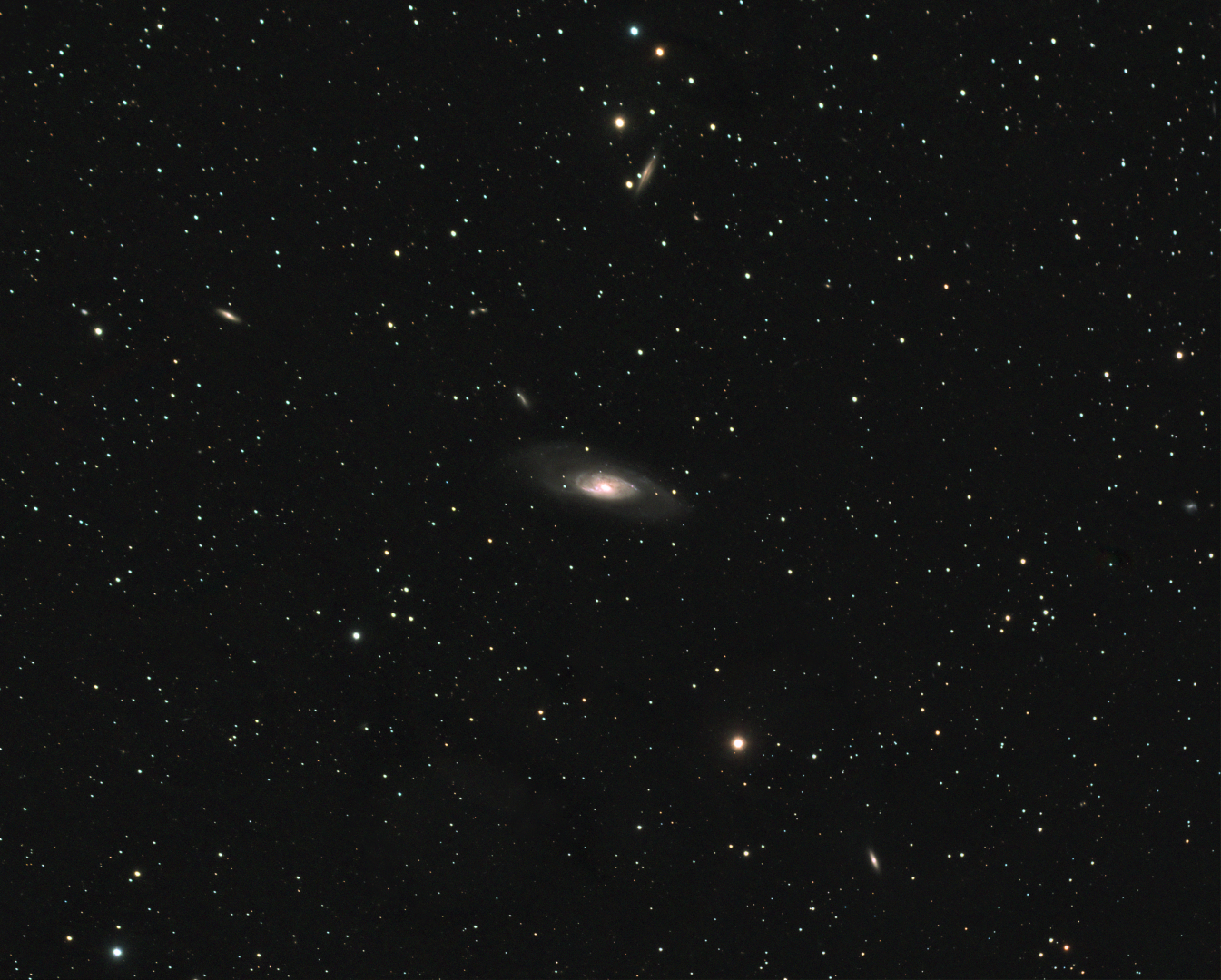
Following the aforementioned discovery, I was pleased to successfully image M101 AKA the Pinwheel Galaxy in 2019.  On this occasion I decided to start with M106 in the adjacent Canes Venatici (“the Hunting Dogs”) constellation, an intermediate galaxy thought to have a supermassive black hole at its centre (see location map and image orientation above).  Smaller than M101 with a slightly warped disc and viewed obliquely, it is not an easy target with my equipment but the area also teems with other galaxies and colourful stars that make for an attractive composition; it is intriguing that M106 is of similar size and luminosity to the Andromeda Galaxy M31 but is much further away.

M106 Astromet Names

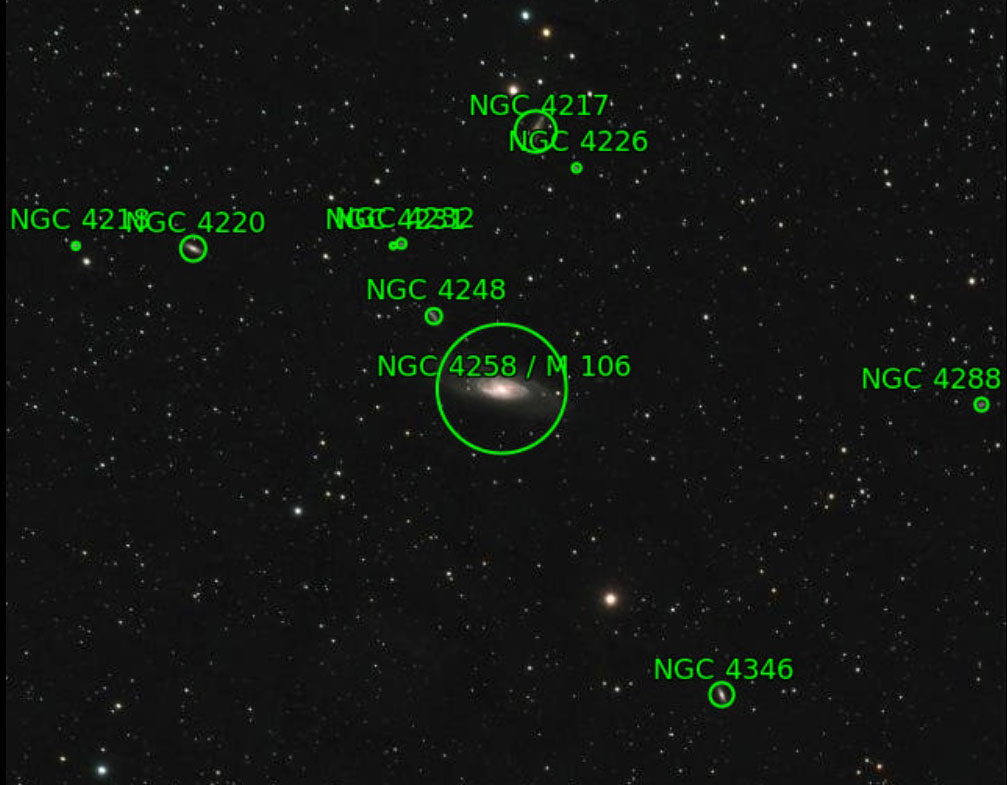
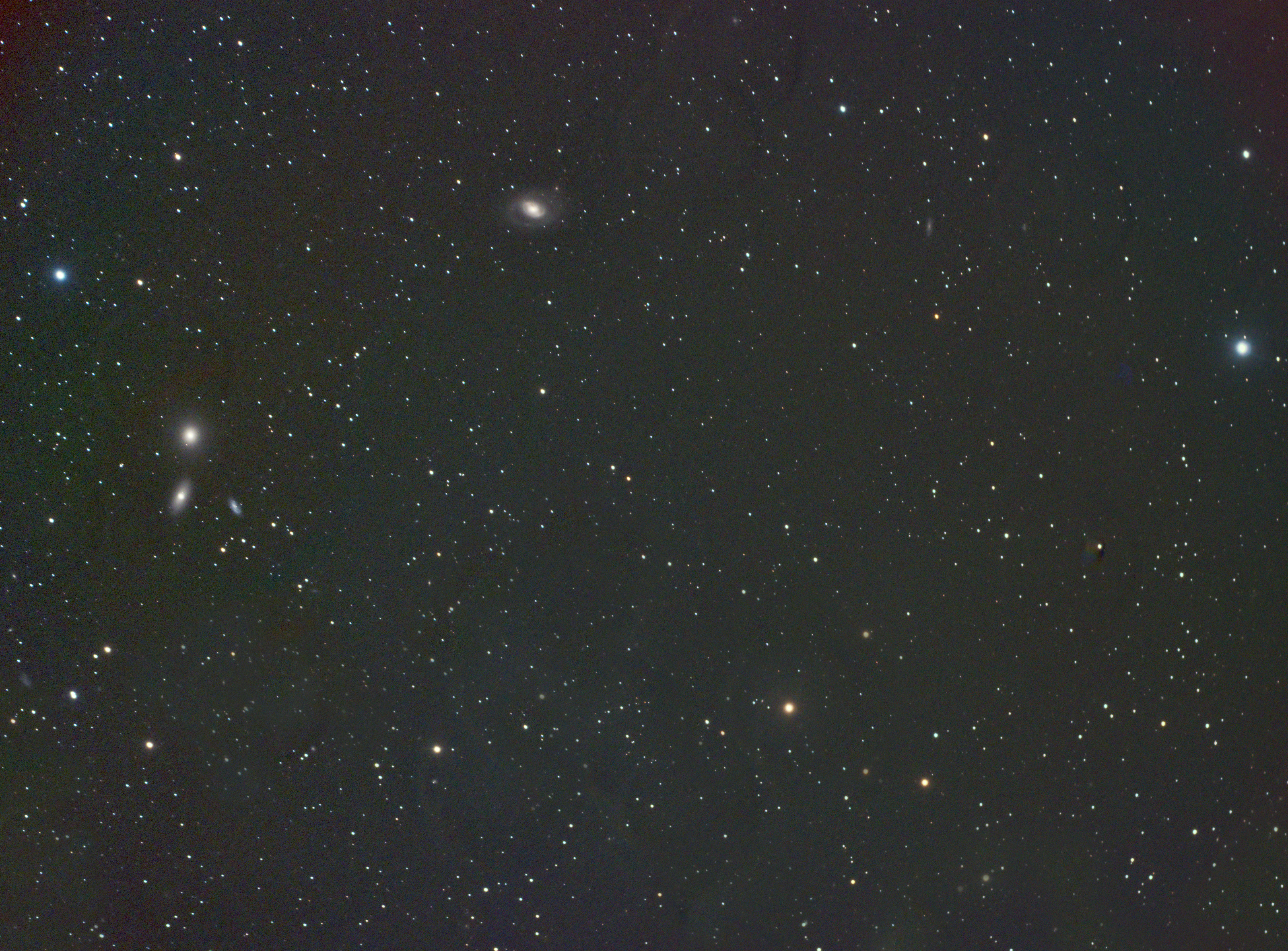
Taken over five evenings, the final HaLRGB image integration time of nearly 10 hours is the longest I’ve achieved to-date, producing a pleasing image of M106 with good colours and detail throughout the surrounding area (see image at the top-of-the-page).  Moreover, across the wider field-of-view a number of other galaxies can be seen clearly, thereby framing the centrally placed M106 and making for a more dramatic image (see annotated kimage above).

Most of the other galaxies vary in age between 20 to 60 million years old, with the edge-on spiral galaxy NGC 4217 thought to possibly be a companion galaxy of M106, however, it is NGC 4226 that I am most excited by.  Close to NGC 4217 and resolved only as a small blurred area with my equipment, nonetheless the light from this galaxy has travelled for 334 million years before reaching my camera. The time it left the galaxy we know as the Carboniferous period, when the major coal measures and rocks of the Yorkshire and the Mendip Hills were laid down, a long time before even dinosaurs roamed the Earth – ancient photons from amongst the furthest distance I’ve ever managed to capture on my sensor!

IMAGING DETAILS
Object M106     AKA NGC 4258
Constellation Canes Venatici
Distance 24 million light-years
Size 18.6’ x 7.2’    Diameter 135,000 light-years
Apparent Magnitude +8.4
 
Scope  William Optics GT81 + Focal Reducer FL 382mm  f4.72
Mount SW AZ-EQ6 GT + EQ-ASCOM computer control & Cartes du Ciel
Guiding William Optics 50mm guide scope
  + Starlight Xpress Lodestar X2 camera & PHD2 guiding
Camera ZWO1600MM-Cool mono  CMOS sensor
  FOV 2.65o x 2.0o Resolution 2.05”/px  Max. image size 4,656 x 3,520 px   
EFW ZWOx8 + ZWO LRGB & Ha OIII SII 7nm filters 
Capture & Processing Astro Photography Tool + PHD2 +  Deep Sky Stacker & Photoshop CS3
Image Location              & Orientation Centre  RA 12:18:58      DEC +47:18:14                        

North = Left    West = Top     

Exposures L x 58  R x 36 G x 36 B x 39 Ha x 20 x 180 secs

Total Time: 9hr 27 min   

  @ 139 Gain   21  Offset @ -20oC    
Calibration 10 x 180 sec x HaLRGB Darks   20 x 1/4000 sec Bias   10 x  HaLRGB Flats            @ ADU 25,000
Location & Darkness Fairvale Observatory – Redhill – Surrey – UK        Typically Bortle 5-6
Date & Time x5 nights 16th – 27th March 2020  @ +21.00h  
Weather Approx. <=5oC   RH 45-65%                  🌙 <=10% waning

Other Worlds

LRGB Image FINALX2 (Large)

Being galaxy season it was appropriate that the BAA spring meeting this year on 27th April was all about – galaxies.  This was my first BAA meeting and I’m pleased to say it was well attended and very worthwhile, I especially enjoyed the following presentations:

  • Prof. Richard Ellis: The Quest for “Cosmic Dawn”;
  • Prof. Chris Impey: Einstein’s Monsters: Black Holes at the Heart of Galaxies;
  • Stewart Moore: Galaxies: A Brief History of Discovery, and
  • Owen Brazell: Observing Galaxy Clusters.

It seems incredible that just 100-years ago the prevailing view was that Universe consisted entirely of the Milky Way, though that was soon about to change.  Whilst Immanuel Kant had proposed the possibility of galaxies outside our own as long ago as 1755, it was not until Edwin Hubble’s work at the Mount Wilson Observatory, California that the existence of other worlds, in the form of galaxies, was proven and accepted during the period between 1924 and 1929.

Following Copernicus’s controversial theory in 1543 that the Earth orbited the Sun, the evidence this time that there was much, much more beyond the Milky Way was equally profound in its implications, if not more so.  However, I was surprised to learn that it was Vesto Slipher and not Hubble who discovered the redshift of galaxies that was fundamental to understanding that galaxies existed outside the Milky Way that were moving away from us – it would seem to me that he deserves much greater credit as well as Hubble for this work.  The current estimate is that there are some 100 to 200 billion galaxies in the observable universe but new research now estimates that the total number is likely to be at least ten times greater!  Either way there are many other worlds out there.

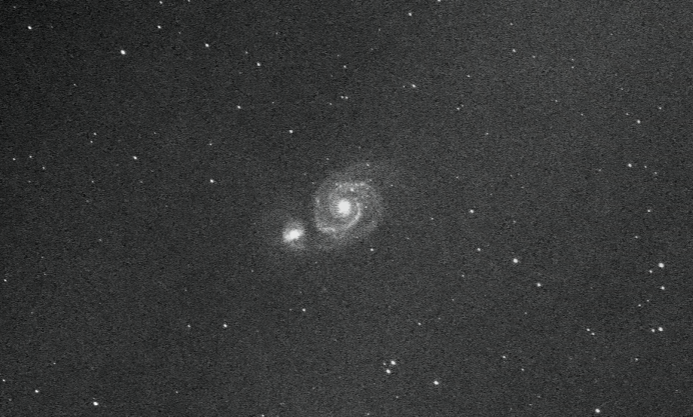
After recently learning that I could after all see and image a few larger galaxies from Fairvale Observatory  in-and-around the Ursa Major constellation, it was to my great delight when I then discovered that one of them was M51 AKA the Whirlpool Galaxy.  I’ve seen many images of this wonderful object and was frustrated that it seemed to be completely out of sight from here but thankfully that is not the case.  Armed with this knowledge, following an imaging session of M101 at the end of March, I therefore went on and immediately grabbed a single Luminance test sub of M51 (below) before it disappeared behind the roof of my house, (a) because I could, and (b) to see how it looked with my equipment.  The answer was that it was almost certainly a viable target for another night when more time was available.

M51 KStar

While located just above the star Alkaid in Ursa Major, M51 is now included within the nearby constellation Canes Venatici; created by Johannes Hevelius in the 17th Century, M51 was previously in Ursa Major.  One of the more famous grand-design spiral galaxies i.e. with prominent well-defined spiral arms, the Whirlpool Galaxy forms a striking image as it interacts and distorts the dwarf galaxy NGC 5195 located at the tail of its outer second arm.  The exquisite structure of M51 is further enhanced by large star-forming regions along the spirals, which are picked out by the associated hydrogen alpha gases.

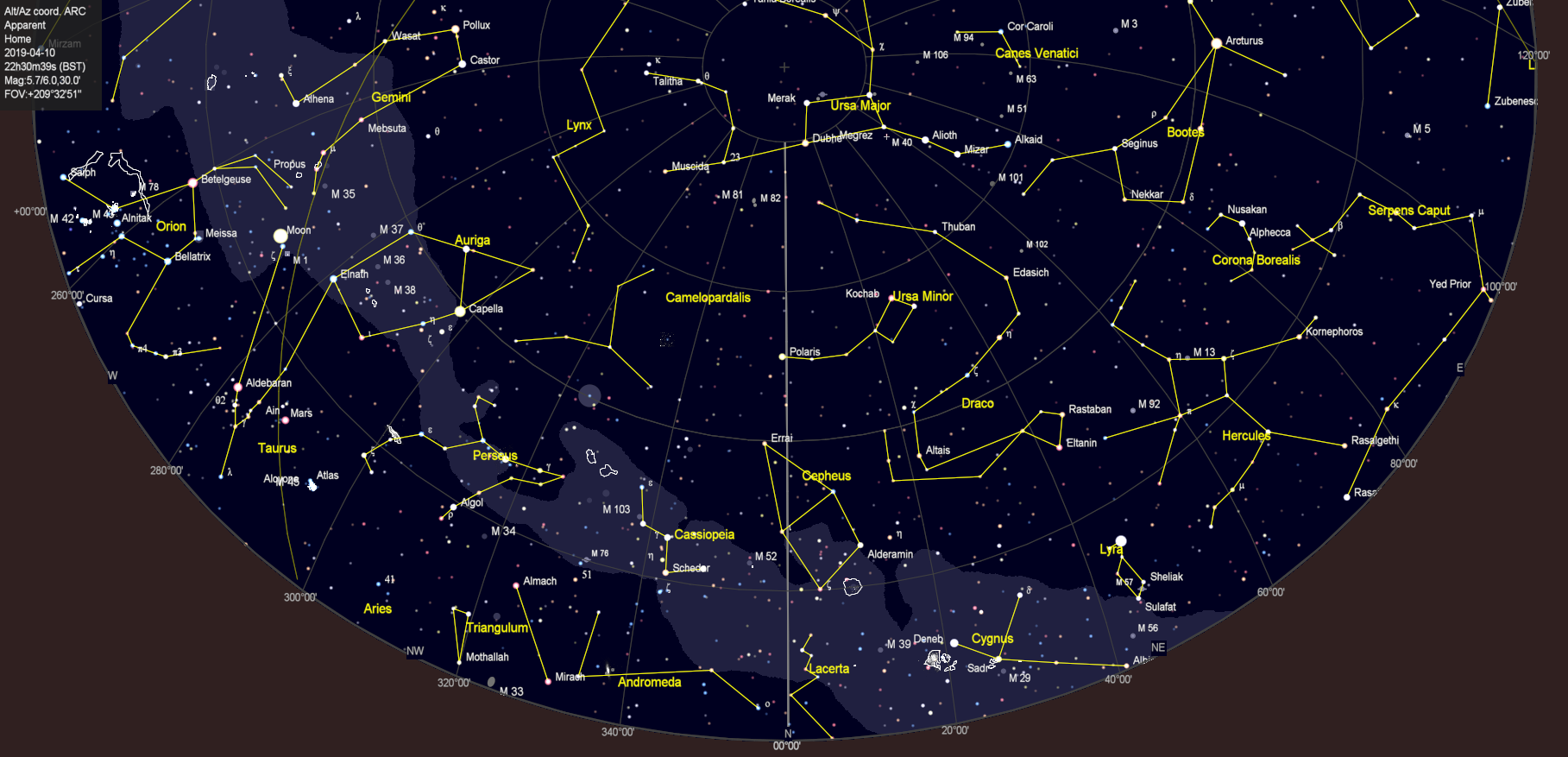
CdC M51 location 100419 10pm

Timing is everything: M51 is in a tricky position seen from Fairvale Observatory, obscured for much of the time at the north viewing location by the house and from the south location by a 20ft hedge – in between there’s a maximum window of no more than 2.5 hours for imaging!

The smaller dimensions of the M51 galaxy would normally place it at the limit of my equipment for imaging but is helped by its aforementioned clear-cut features, strong colours, favourable apparent magnitude and its location towards the zenith immediately above my observatory.  This has long been in my top-10 ‘must-do’ imaging list but hitherto was thought to be out of view.  Unlike M101, which lies below Alkaid i.e. south, being further north the imaging time of M51 from Fairvale Observatory North is even shorter before it too retreats behind the rooftop.  However, this year I decided to move early to the summer location at the bottom of the garden – Fairvale Observatory South – where it was possible to gain a slightly longer view, though still only just over two hours before it disappears for the night, this time behind the adjacent 20-foot hedge!

It’s clear that the final LRGB image would be greatly enhanced with further integration time and the addition of Ha-wavelength but for now I’m content that at last I’ve managed to capture this spectacular object on camera.  Skies permitting I hope to return to the Whirlpool and its companion NGC 5195 as soon as possible.

IMAGING DETAILS
Object M51 The Whirlpool Galaxy & NGC 5951
Constellation Canes Venatici
Distance 23 million light-years
Size 11.2’ x 6.9’  or 43,000 light-years (M51 only)
Apparent Magnitude +8.4
 
Scope  William Optics GT81 + Focal Reducer FL 382mm  f4.72
Mount SW AZ-EQ6 GT + EQASCOM computer control & Cartes du Ciel
Guiding William Optics 50mm guide scope
  + Starlight Xpress Lodestar X2 camera & PHD2 guiding
Camera ZWO1600MM-Cool mono  CMOS sensor
  FOV 2.65o x 2.0o Resolution 2.05”/pix  Max. image size 4,656 x 3,520 pix   
EFW ZWO x8 ZWO LRGB & Ha OIII SII 7nm filters 
Capture & Processing Astro Photography Tool + PHD2 +  Deep Sky Stacker & Photoshop CS3
Image Location              & Orientation Centre  RA 13:30:03      DEC 47:11:43                     

Top  = South  Bottom = North 

Exposures (A)    L 18 x 180 sec  RG 9×180 sec  B 10 x 180                                                        (Total time: 2hr 18 minutes)   
  @ 139 Gain   21  Offset @ -20oC    
Calibration 10 x 180 sec  Darks  20 x 1/4000 sec Bias  10 x  HaLRGB Flats                                        @ ADU 25,000
Location & Darkness Fairvale Observatory – Redhill – Surrey – UK        Typically Bortle 5-6
Date & Time 10th April 2019 @ +22.00h  
Weather Approx. 6oC   RH 60%                  🌙 ¼ waxing

Fireworks


HaLRGB final-denoise2-denoise-PS (Large)

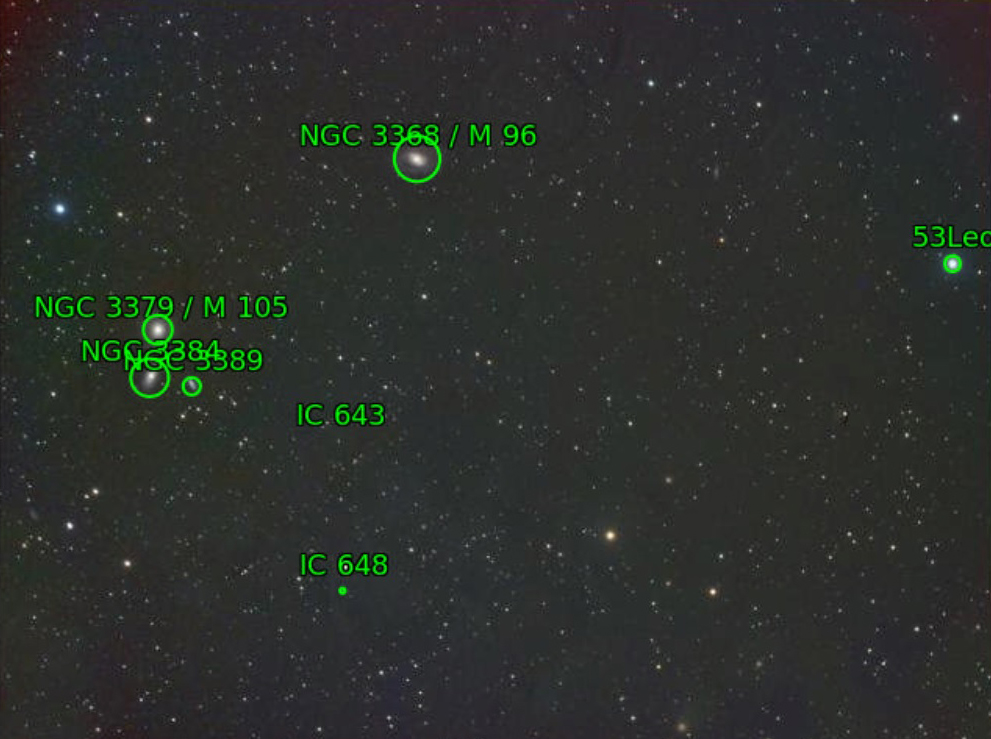
At Fairvale Observatory North it’s normal that I struggle to find suitable objects when the so-called Galaxy Season arrives in late winter through spring.  Despite the abundance of galaxies my William Optics 81mm aperture rules out all but a few for imaging as they are mostly just too small.  However, smaller galaxies that make up features such as Markarian’s Chain and the Leo group do produce a pleasing widefield image full of the so-called faint-fuzzies but hitherto with the exception of M31 the Andromeda galaxy I’ve struggled to obtain the real thing – a decent, full-on spiral galaxy – they are there of course but are either obscured to the north by my house and trees or, as indicated, are too small for my equipment to resolve properly.

LRGB.png

M95_96 Anotated

Nonetheless, this year after playing around imaging the aforesaid Leo Group (see above), I looked directly above the observatory and to my surprise discovered a new world of galaxies close to the Zenith that were just visible, briefly transiting along the southern edge of the house roof, which included a few large classics in-and-around the constellation Ursa Major.  After 2-hours imaging the Leo group time was too short for a serious attempt at any of these galaxies but nonetheless was sufficient to experiment with what looked like a potential target, the wonderful M101 the Pinwheel Galaxy, which at over 28 arc seconds showed real potential with only 42 minutes of subs before it disappeared out of sight for the night.  Moreover, large parts of Ursa Major and nearby galaxies also briefly appeared at other times on the night from behind the roof, tracking close to the gutter for nearly 2.5 hours before returning behind the roof in a similar manner to M101.  Thus assuming full set-up could be achieved earlier in the evening, this seemed to provide a window of opportunity that I grasped over two subsequent evenings with a very satisfactory outcome.

With nearly 5-hours of subs, processing of M101 would be a challenge in order to bring out the galaxy’s colours and perhaps highlight the stellar nursery areas that are found along the spiral arms and are rich in Ha-light.  To do this I first changed the RGB image stack to Lab Colour in Photoshop, increased the saturation in the (a) and (b) channels before returning to RGB mode.  This had the desired effect of successfully enhancing the colours, which can otherwise look washed-out after stacking, stretching and combining.  After this I split the RGB channels and pasted the Ha-stack into the Red channel, before re-combining again into an RGB image, at which point the H II regions along the spiral arms just lit up!  These were both new processing techniques for me that greatly improved the final image and hold great promise for processing HaLRGB objects in the future.

M101 closeup data crop

M101 widefield data crop

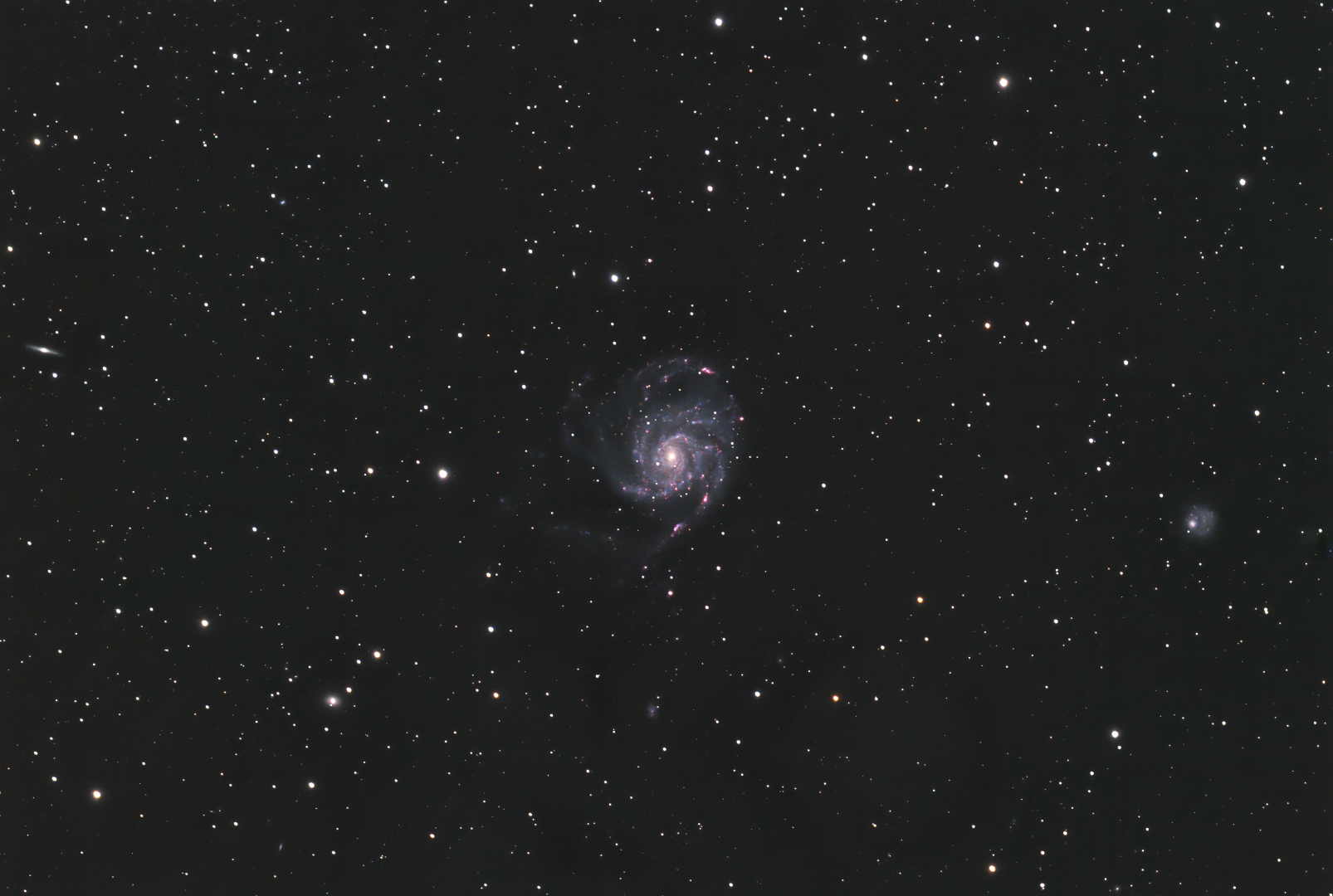
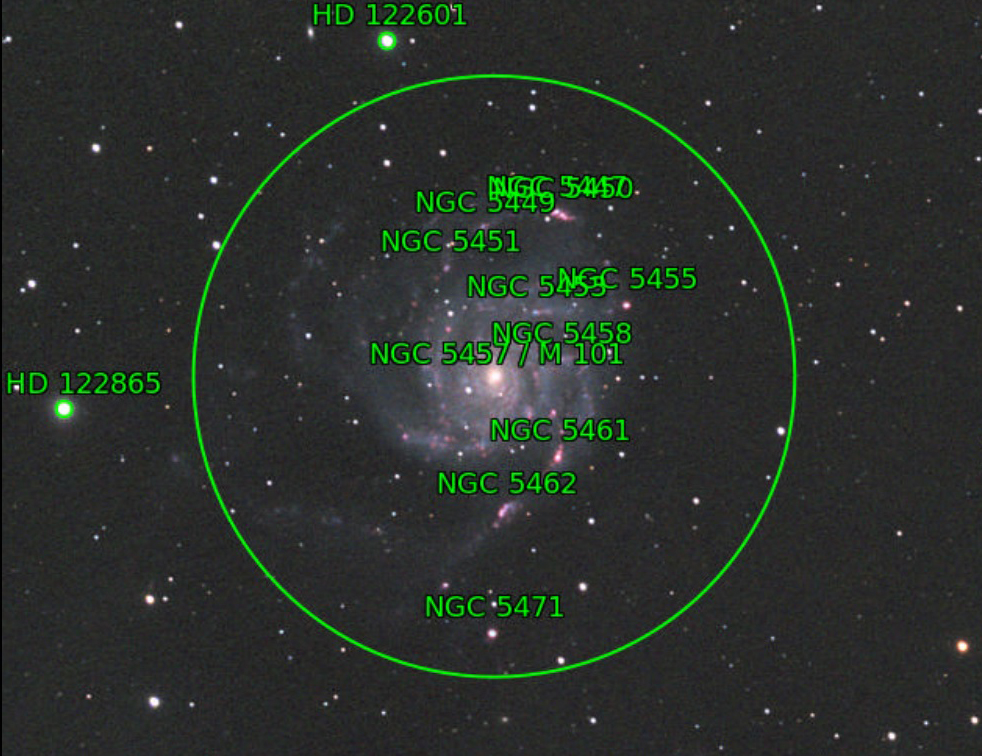
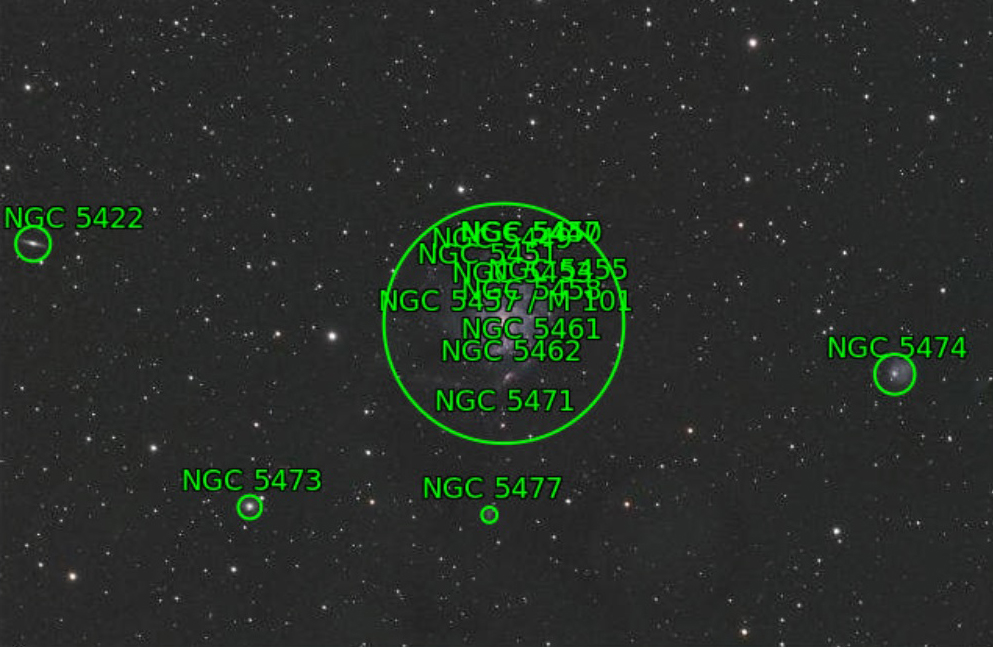
The final image (top of the page + crop below) far exceeded my expectations in detail and colour, showing off much of the galaxy’s wonderful structure and the aforementioned HII regions. There’s no doubt that further integration time will benefit the faint extremities of the galaxy but for now it was a very satisfying outcome of a spectacular object that hitherto I thought was beyond my seeing at Fairvale Observatory.  Also noteworthy, the image has caught a plethora of companion galaxies close to and around M101 (see annotated images above), most conspicuous of which is the classic side-view of NGC 5422 (left of M101) and the more unusual dwarf spiral galaxy NGC 5474 (right of M101),  which has been noticeably distorted by gravitational interaction with the Pinwheel itself.  All-in-all a fine display of galactic fireworks worthy of November 5th.

M101 HaLRGB crop-denoise-denoisePS


IMAGING DETAILS
Object M101  Pinwheel galaxy
Constellation Ursa Major
Distance 20.9 million light-years
Size 28.8’ x  26.9’  or 170,000 light-years  
Apparent Magnitude +7.86
 
Scope  William Optics GT81 + Focal Reducer FL 382mm  f4.72
Mount SW AZ-EQ6 GT + EQASCOM computer control & Cartes du Ciel
Guiding William Optics 50mm guide scope
  + Starlight Xpress Lodestar X2 camera & PHD2 guiding
Camera ZWO1600MM-Cool mono  CMOS sensor
  FOV 2.65o x 2.0o Resolution 2.05”/pix  Max. image size 4,656 x 3,520 pix   
EFW ZWOx8 + ZWO LRGB & Ha OIII SII 7nm filters 
Capture & Processing Astro Photography Tool + PHD2 +  Deep Sky Stacker & Photoshop CS3
Image Location              & Orientation Centre  RA 14:03:15      DEC 54:20:46                     

Top = North  

Exposures (A)    L 31 x 180 sec  HaRGB each 16×180 sec                                                                  (Total time:4hr 45 minutes)   
  @ 139 Gain   21  Offset @ -20oC    
Calibration 10 x 180 sec & 15 x 60 sec Darks  20 x 1/4000 sec Bias  10 x  HaLRGB Flats               @ ADU 25,000
Location & Darkness Fairvale Observatory – Redhill – Surrey – UK        Typically Bortle 5-6
Date & Time 29th & 31st March 2019  @ +22.00h  
Weather Approx. 8oC   RH <=70%                  🌙  ¼ waning