Tangled In Space

As Douglas Adams succinctly puts it in the Hitchhiker’s Guide to the Galaxies: Space…..is big. Really Big.  If he had lived longer, even he would be surprised to learn how true these words were.  Recent analyses using data from the James Webb Space & Hubble Telescopes, suggests there could be some 2 trillion galaxies.  Notwithstanding, as this applies only to the observable universe, which is about 93 billion light-years across, the entire universe could be significantly larger, with many more galaxies beyond what we can already observe!

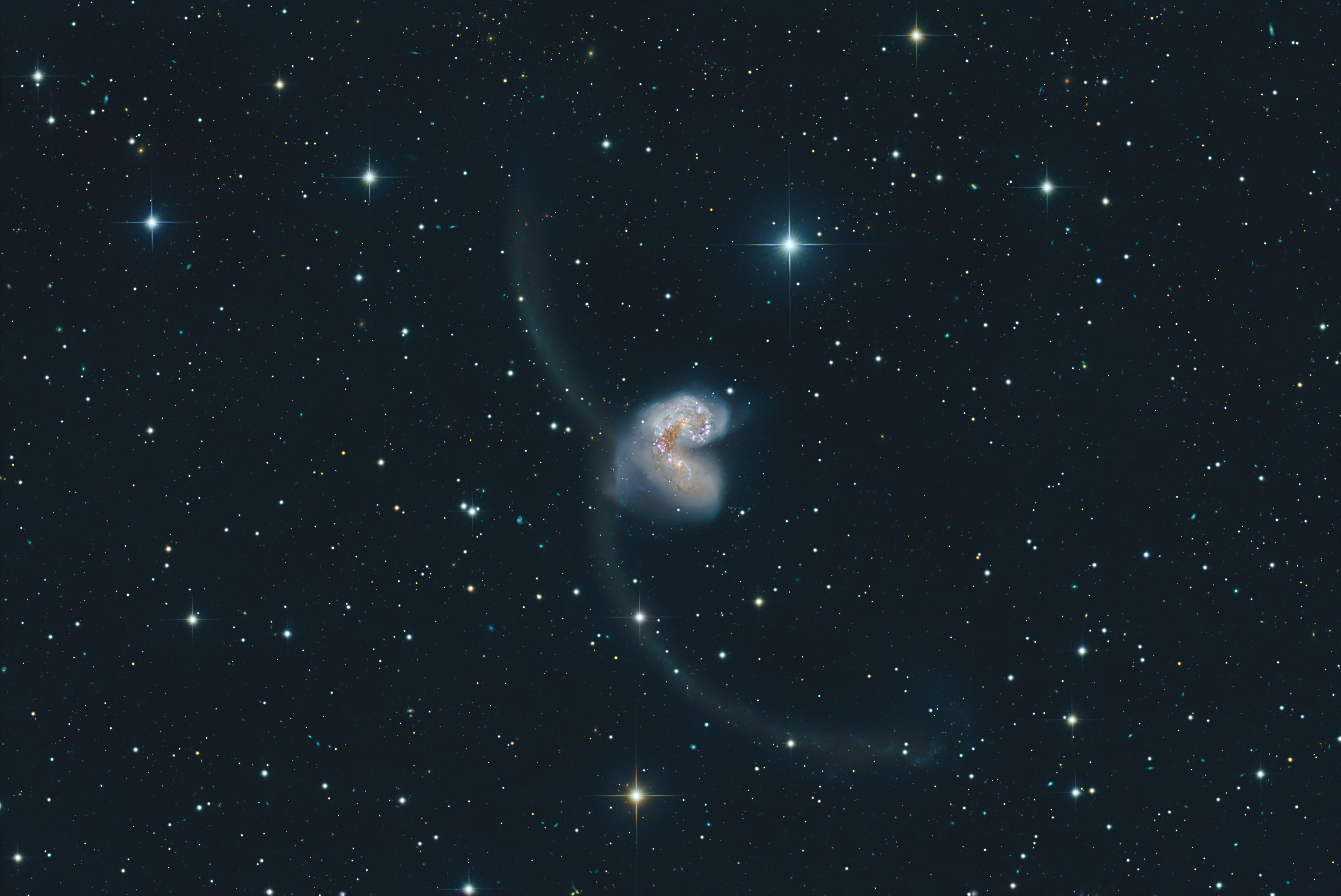
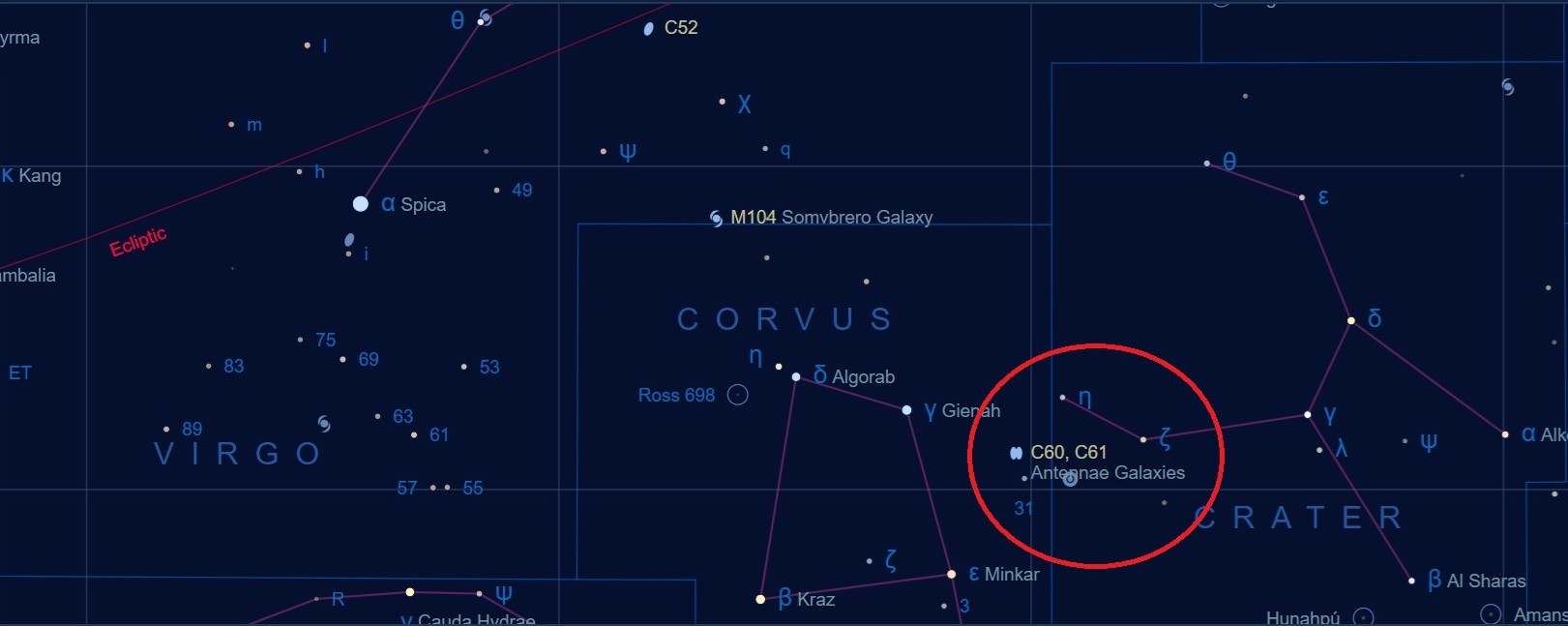
Perhaps then it is not so surprising that from time-to-time galaxies run into each other – our own Milky Way Galaxy is expected to collide with the Andromeda Galaxy in about 4.5 billion years.  But there are already many exciting examples of such phenomena that we can image today, of which the Antennae Galaxies are one of the most famous and visually striking examples of two colliding galaxies.  Located in the constellation Corvus, they provide a striking insight into what happens when massive galaxies merge – a process that reshapes their structure, triggering intense star formation, thereby setting the stage for the eventual creation of a single, larger galaxy, all played out over 100’s or even billions of years.
The Antennae Galaxies earned their name from the long, curved tidal tails of gas, dust, and stars that extend outward from the colliding pair of galaxies (NGC 4038 & 4039), thus resembling the antennae of an insect. These tails were created by the immense gravitational forces at play during the collision. As the two galaxies then pass through each other, their mutual gravity distorts their original spiral shapes, pulling out vast streams of stars and interstellar material. These tidal tails stretch for tens of thousands of light-years, making them some of the most spectacular features of any known galactic merger.

At the core of the Antennae Galaxies lies a chaotic and extremely active region. The violent gravitational interactions have compressed enormous clouds of gas and dust, sparking a burst of intense star formation, at a rate hundreds of times faster than that of our own Milky Way. Many of these newly formed stars are massive but short-lived, destined to explode as supernovae, thus enriching the surrounding space with heavy elements. Within another 400 million years, the Antennae’s nuclei will collide and therafter become a single galactic core with stars, gas, and dust swirling around it. 

Imaging such a feature from Earth requires significant telescopic power, the darkest of night skies and the acquisition of lots of data.  Located at the El Sauce Observatory in Chile, 50 hours of data acquired using the Planewave CDK20 astrograph is such a set-up worthy of the task.  However, despite the excellent data quality, I found processing this complex event difficult so as to both show the complexity of the merging galaxies, whilst at the same time preserving the delicate nature of the tails of galactic debris.  The final image is as profound as it is beautiful, demonstrating the immense forces across the cosmos and the inevitable consequences for the many galaxies that occupy the vastness of the Universe.


The Needle Galaxy

Perspective is everything – in life and so it is, with astronomy.  Hipparchus first pointed the way in 127 BC when he described the procession of the equinoxes and, as they say one thing led to another as,  Nicolas Copernicus (1473-1543), Tycho Brahe (1546-1601), Galileo Galilei (1564-1642), Johannes Kepler (1571–1630), Johannes Hevelius (1611–1687), Giovanni Cassini (1625-1712), John Flamsteed (1646-1719) and others opened our eyes to the night sky and what lay beyond Earth. Notwithstanding, it was Edwin Hubble’s discovery of galaxies in 1924 that ultimately led to mankind’s recognition that there was much, much more, that we now take for granted to be the Universe.  However, even to the experienced modern astronomer the scale, complexity and beauty of the Universe can be somewhat overwhelming, like when we consider that the observable Universe may consist of 2 trillion galaxies!

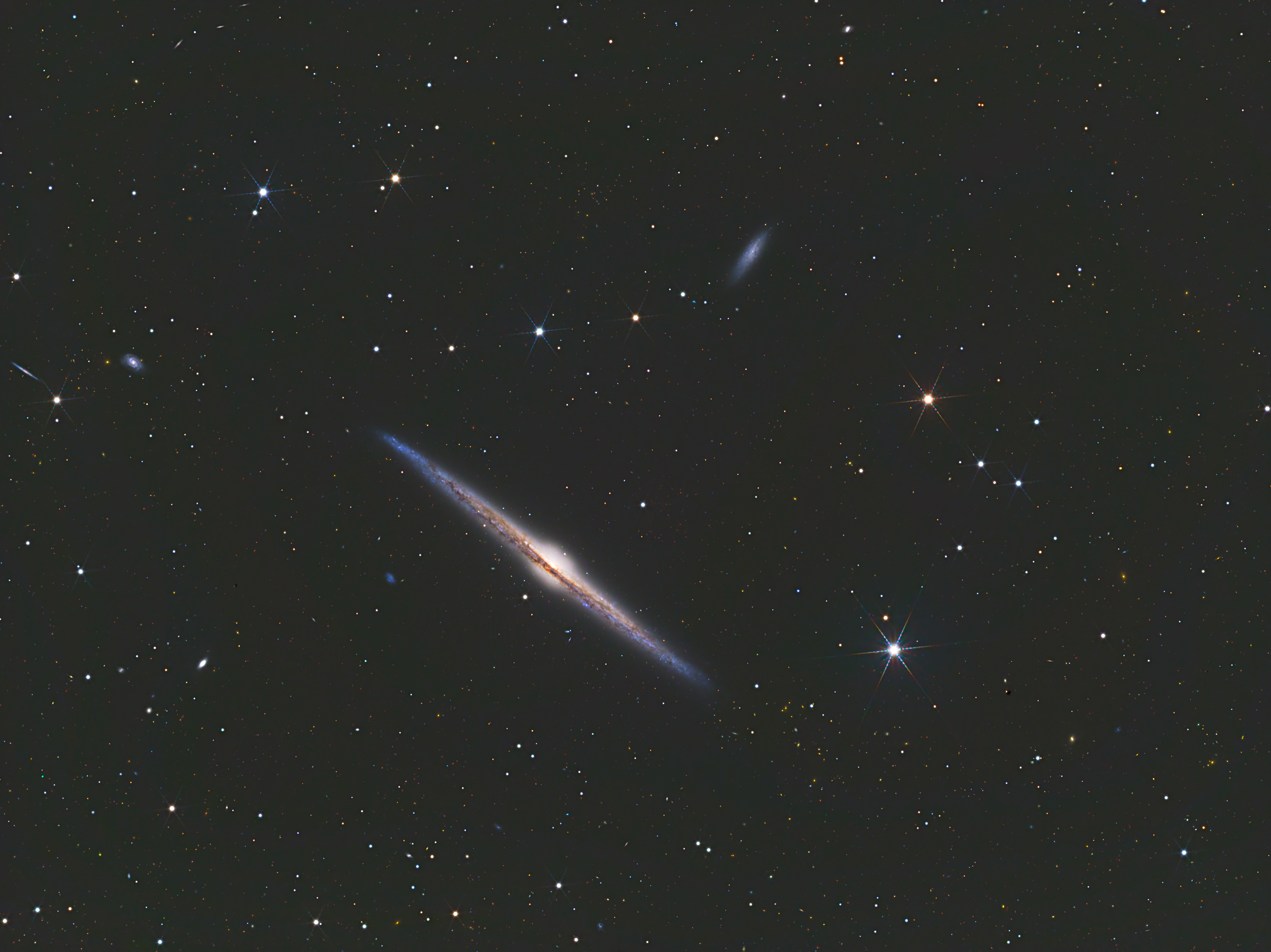
Since Hubble’s work we have become familiar with many types of galaxies, which the average person might describe as a colourful spinning firework-like disc, consisting of vast gravitationally bound systems of stars, stellar remnants, interstellar gas, dust and dark matter.  This stereotypic impression arises because most galaxy images are viewed face-on or at an inclined angle, so that we can see the structures and processes that have created it.  However, given the number of galaxies and therefore the many possible views, it is not surprising that some can only be seen edge-on from our perspective on Earth, the Needle Galaxy AKA NGC 4546 is one of these.

Thought to be a barred spiral galaxy, NGC 4546 is some 33% larger than the Milky Way.  It has at least two satellite galaxies, about 240 globular clusters (Milky Way ~ 150) and is the brightest of the Coma 1 Group of galaxies.  Seen through a telescope or when imaged the Needle Galaxy it appears like a thin streak drawn across the dark night sky but look closer and its magnificence is revealed, as in the image above.

Here ribbons of dust can be seen criss-crossing along the edge of the thin galactic disc, thereby blocking much of the from light behind.  However, it is the bright central bulge that inevitably catches the eye but remains something of an enigma, as little can be seen from within.  This excellent data set obtained using the MOANA 10” Newtonian telescope located in Texas’ dark skies, reveals such exquisite details that are provided by the less common edgewise perspective of this intriguing galaxy.   

Footnote & credit: Following a knee replacement I’m currently unable to set-up and use my astronomy equipment, fortunately I havve been able to continue processing using this excellent public amateur data from the MOANA project located near Fort Davis, Texas  https://erellaz.com/moana/. Many thanks to its creator Elleraz.

Starry Messenger

The first galaxies were identified in the 17th Century by the French astronomer Charles Messier, although at the time he did not know what they were.  It was only when in 1924 American astronomer Edwin Hubble measured the distance to the Andromeda galaxy using cepheid variables, that the existence of other galaxies was finally established.  One hundred years on it’s now estimated that there are between 200 billion and 2 trillion galaxies in the Universe; as Douglas Adams said in the Hitchhikers Guide to the Galaxy, “Space…….is really big”! 

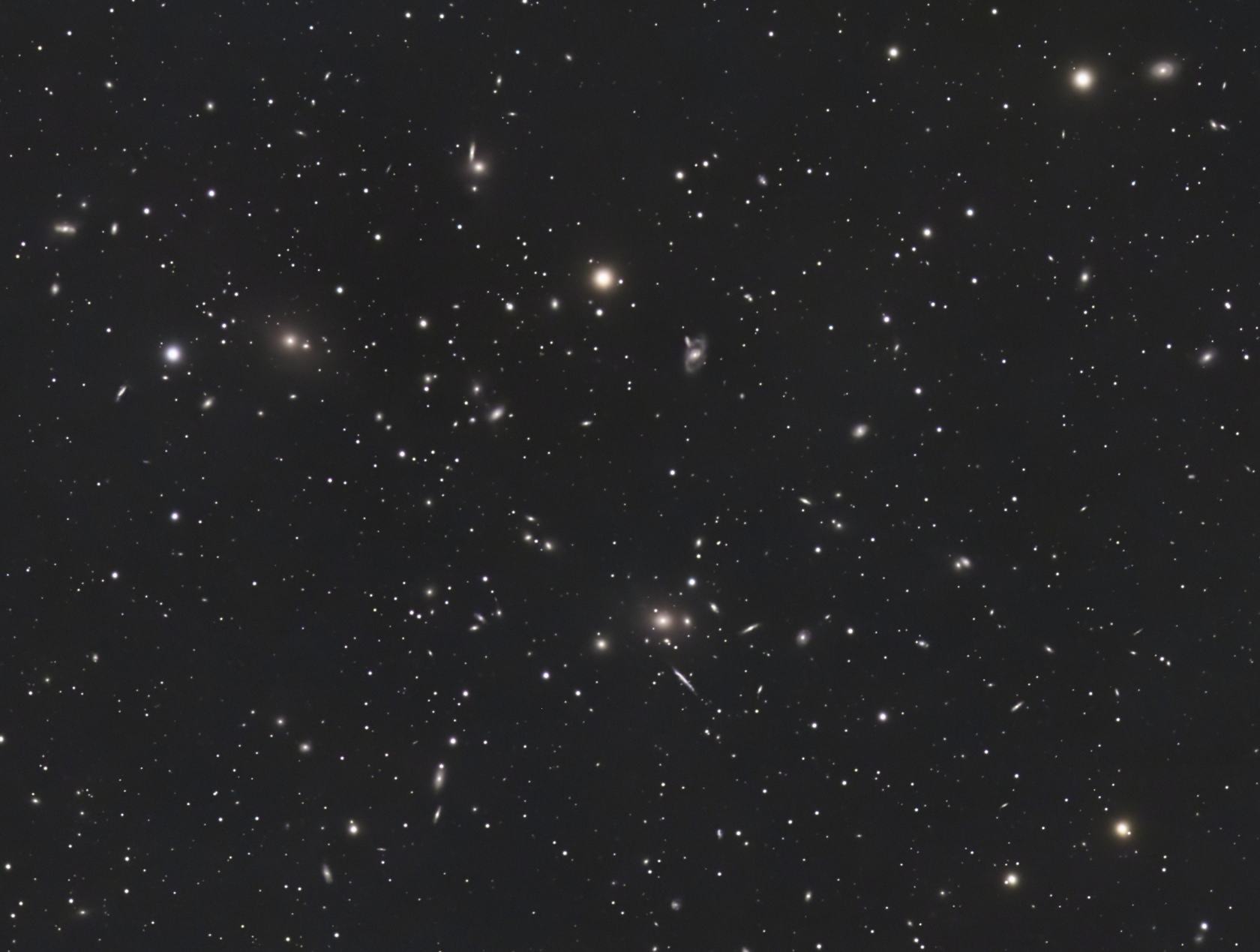
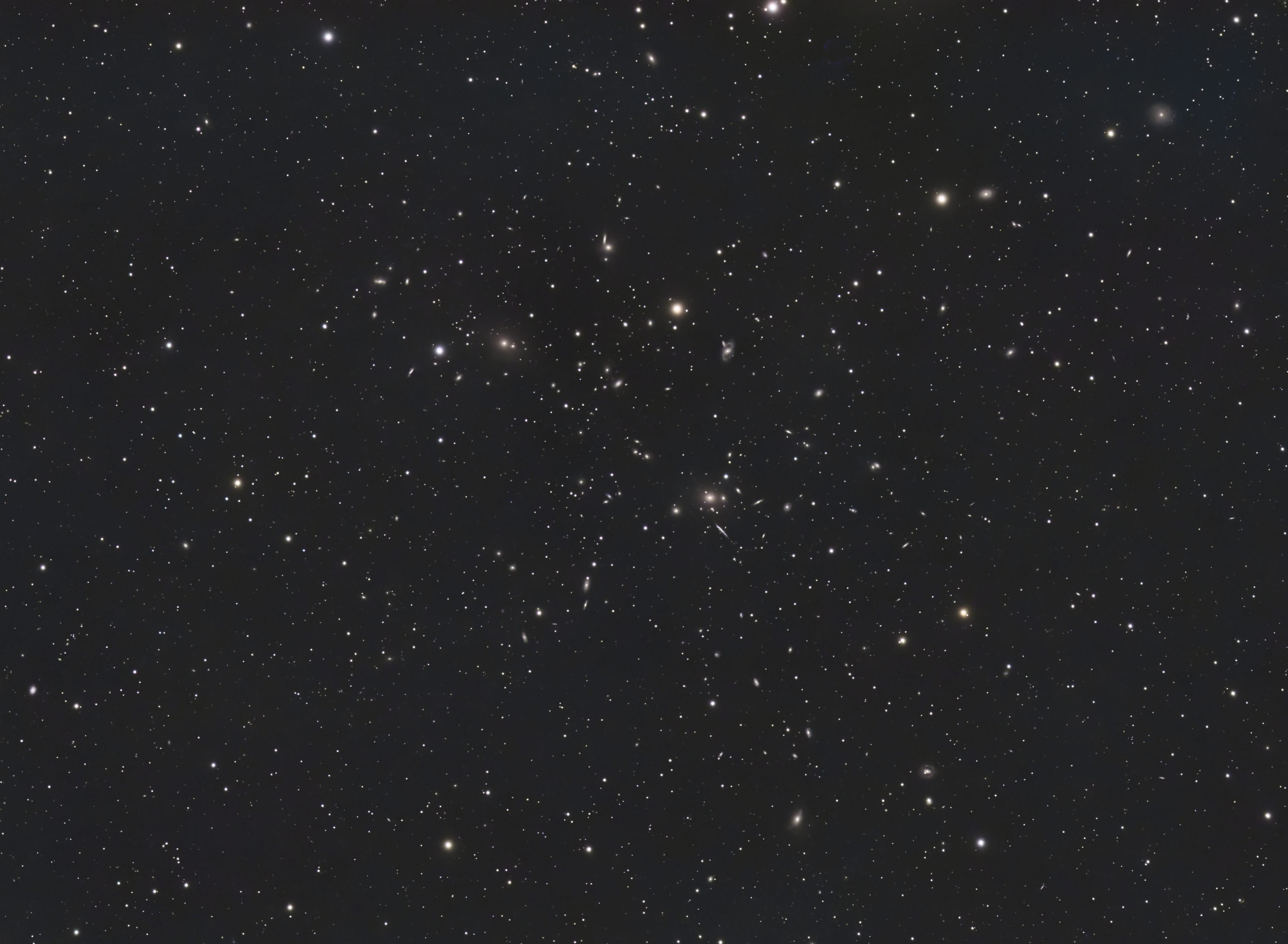
For astronomers this time of the year is generally referred to the ‘Galaxy Season’, as our view of the Milky Way from Earth changes from the winter sky of the Orion Spur and Perseus Arm to the summer view with Cygnus overhead down to Sagittarius in the south, in between we’re looking into deep space.  With very few exceptions, galaxies are located very far from Earth, which from our perspective makes them small and therefore a challenge for my imaging equipment.  However, this Spring I’ve been imaging the spectacular Leo Galaxy Cluster, a mere 330 million light-years from Earth (see cropped version of cluster at the top of the page).

Containing at least 70 major galaxies, the Leo Cluster unusually consists mostly of spiral galaxies, which are best seen here cropped from the original widefield image.  The bright elliptical galaxy near the centre of the image, NGC 3842, has one of the largest known black holes in the universe, which is about 10 billion times more massive than our sun! 

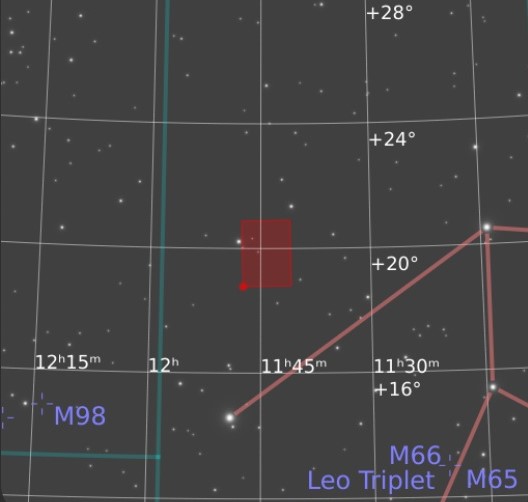
We have come a long way since Galileo Galilei published his astronomical treatise Sidereus Nuncius AKA Starry Messenger in 1610, the first scientific publication based on observations made through a telescope. Galileo’s work completely changed the way humanity understood the night sky and, by extension, our place in space, later leading to the acceptance of the heliocentric model of the planets.  Profound as that was, our understanding of the Universe since 1924 has even greater implications.  Moreover, the ability for an amateur to image something like the Leo Cluster from my back garden is exciting and very rewarding (see widefield version above + image location + orientation where the red dot = top left of image).