Veil Of Darkness

Just northeast of the Pleiades star cluster within the northern Milky Way, lies the dark region of the Taurus Molecular Cloud (TMC), which at 430 light years is the nearest star-forming region to Earth.  Consisting of hundreds of solar masses of primordial hydrogen and helium gas, as well as heavier elements, this vast area of dense stardust obscures almost all light from behind.  As such it forms an alluring target for astrophotography, with the complex rift-like dark structure of the TMC set against the broad starry background of the Taurus constellation. 
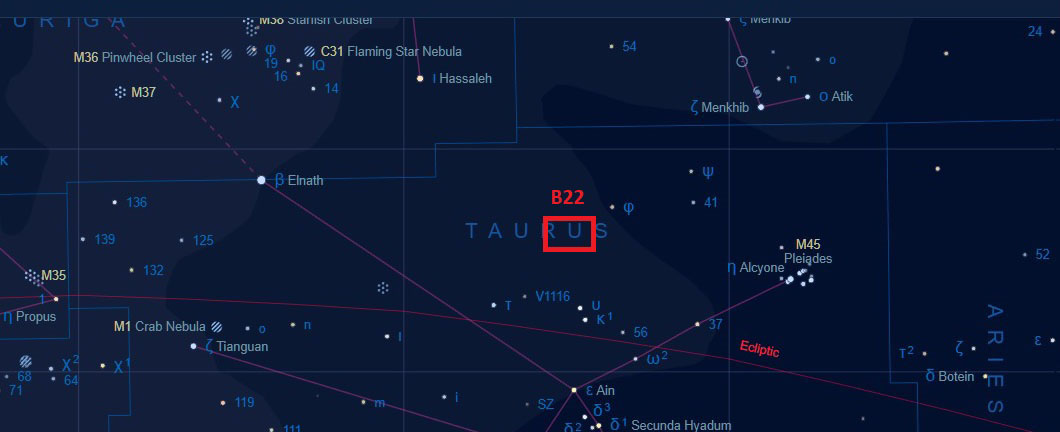
Approximate Image Location

Notwithstanding, perhaps because of the more popular objects that abound throughout its neighbour the Orion constellation, the TMC is somewhat neglected by astronomers; to be fair the TMC is also a more challenging imaging target than many of those found in Orion.  Early this year, for the first time I decided to image the dark nebula Barnard 22, an iconic section of the TMC formed by a complex mass of dark stardust that appears to hang within the vast surrounding starfield.

Approaching the new moon in late January I obtained almost 11 hours of LRGB subs, though sadly was unable to incorporate another 6-hours of 10-minute luminance exposures which proved to be too bright to use: note-to-self – check settings for new objects before embarking on long imaging programme! To achieve a balance between the large black smudge that is B 22 and the brilliance of the surrounding stars processing was tricky but the final outcome satisfying.  Also noteworthy in the image, just off centre is the small flame-shaped reflection nebula IC 2087, the light from which just manages to emerge from behind the otherwise dominant, though beguiling form of Barnard 22, which like night itself seems to casts a dark veil over the cosmos.

 IMAGING DETAILS
ObjectsBarnard 22 dark nebula & IC 2087 reflection nebula
ConstellationTaurus
DistanceApprox.. 430 light years
Size
Apparent MagnitudeVaries  
  
Scope William Optics GT81 + Focal Reducer FL 382mm  f4.72
MountSW AZ-EQ6 GT + EQASCOM computer control & Cartes du Ciel
GuidingWilliam Optics 50mm guide scope
 + Starlight Xpress Lodestar X2 camera & PHD2 guiding
CameraZWO1600MM-Cool mono  CMOS sensor
 FOV 2.65o x 2.0o Resolution 2.05”/pix  Max. image size 4,656 x 3,520 pix   
EFWZWOx8 EFW & 31mm Chroma LRGB filters 
Capture & ProcessingAstro Photography Tool + PHD2 + Deep Sky Stacker, PixInsight v1.8.8-12, Photoshop CC, Topaz AI DeNoise
Image Location &     OrientationCentre  RA 04:39:00.365      DEC +26:00:13.426                         Lower Left = North     
Exposures120 x 180 sec L, 19 x 300 sec R, 20 x 300 sec G & B Total Integration Time: 10hr 55 min     
 @ 139 Gain   21  Offset @ -20oC    
Calibration10 x 60 sec Darks  15 x  LRGB Flats & Dark Flats         @ ADU 25,000
Location & DarknessFairvale Observatory – Redhill – Surrey – UK        Typically Bortle 5-6
Date & Time27th 29th 31st January + 4th & 6th February 2022 @ +18.30h  
WeatherApprox. <4oC   RH >=75%                  🌙 around New Moon

Cosmic Spaghetti

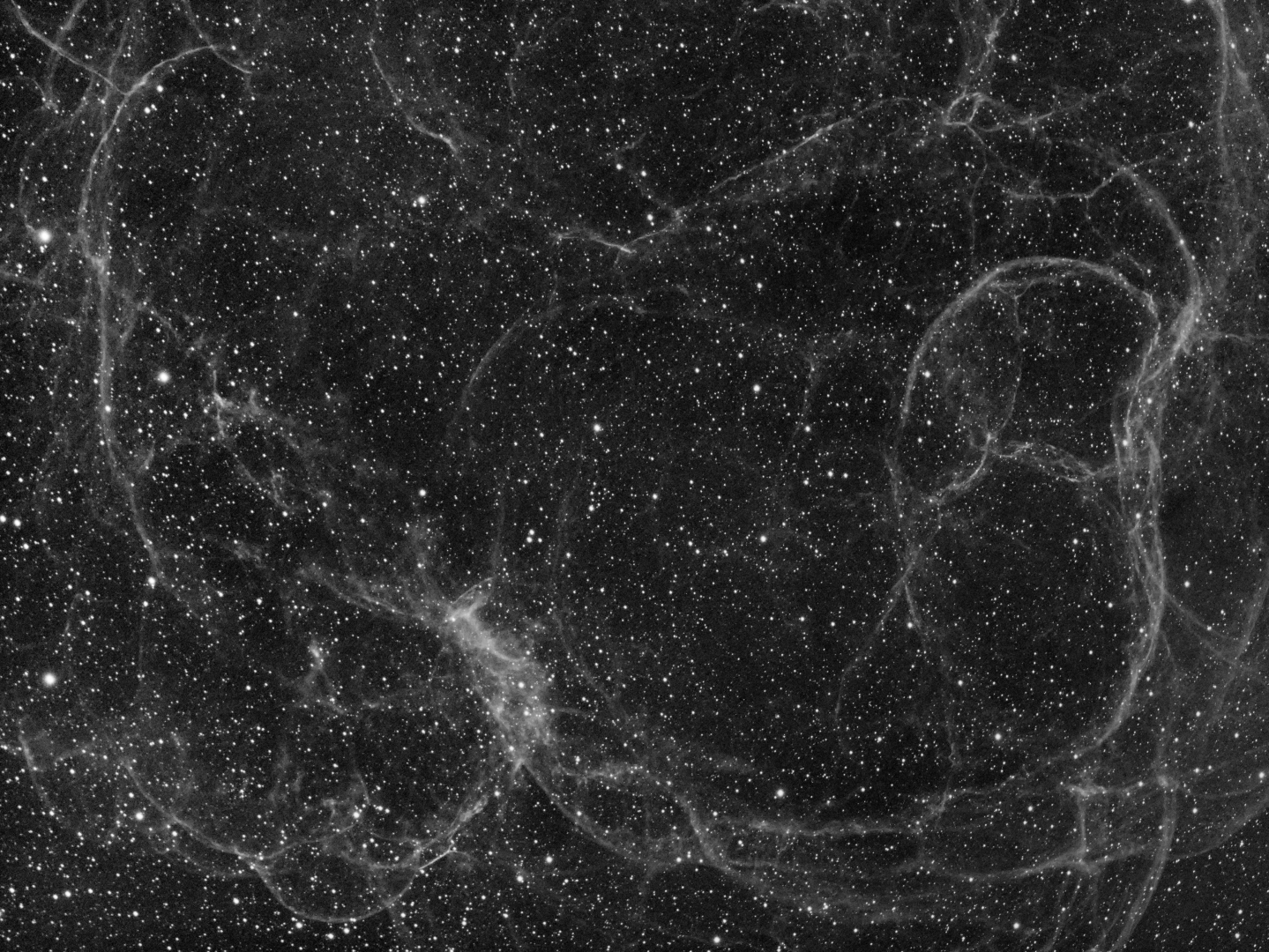
Long on my to-do list has been the spectacular Simeis 147, also known as SH2-240 or the Spaghetti Nebula.  A large supernova remnant (SNR) spanning the border between the Taurus and Auriga constellations, which despite its size is one of the faintest objects in the night sky and therefore not an easy astrophotography target.  Moreover, given my equipment’s field-of-view the large size of the SNR would require a mosaic to fully image, which is generally out of the question here at Fairvale Observatory with the limited clear sky conditions that prevail hereTherefore, for the moment I’ve concentrated on a close-up area of the southern lobe, imaged and processed in HOO narrowband to highlight the beautiful complexity of this cosmic cataclysm that is the product of a massive stellar explosion that took place some 40,000 years ago.

Simeis 147 Location

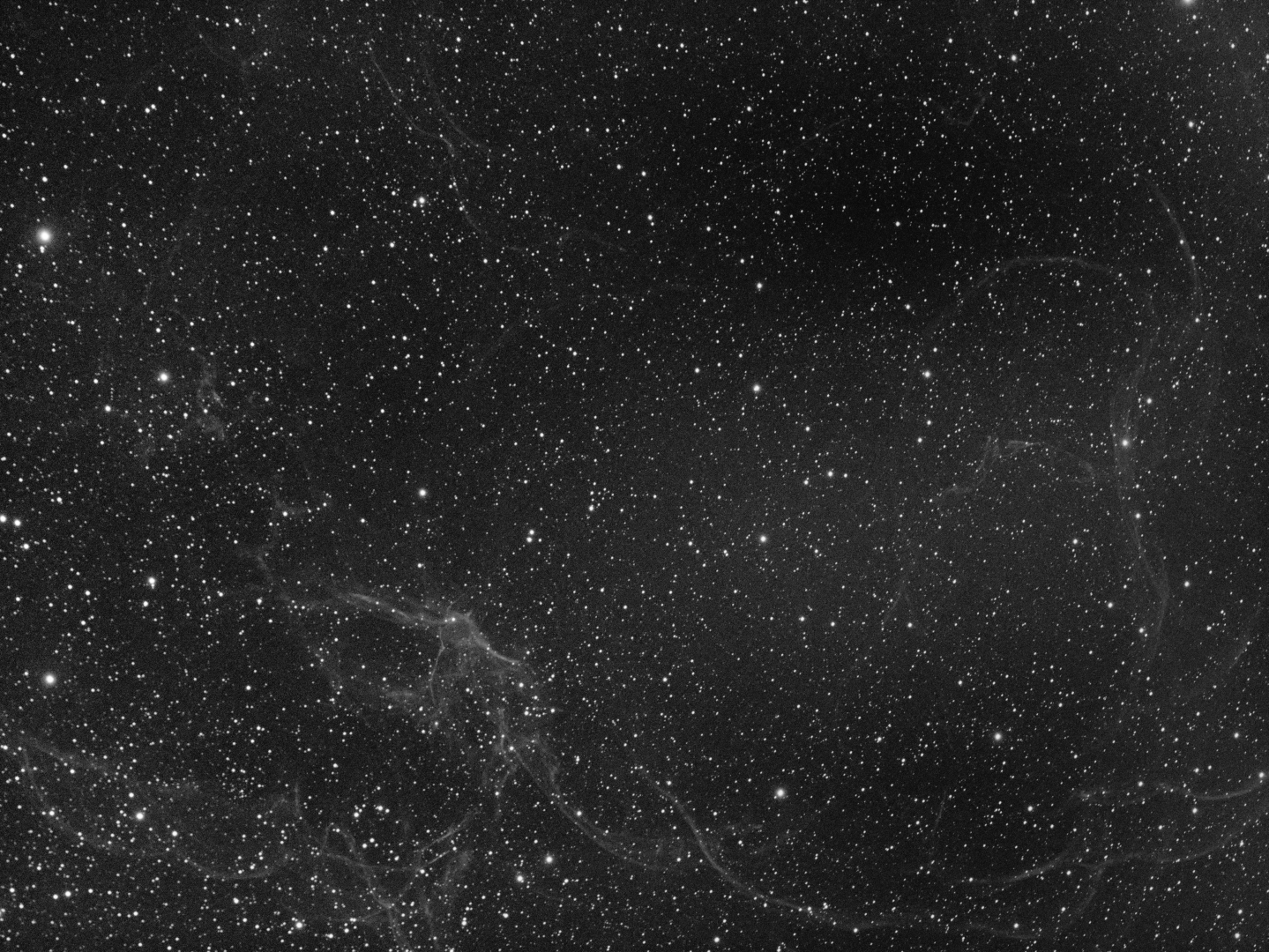
Furthermore, imaging was not helped by the presence of a waning full moon and even with 10-minute exposures, only very limited detail was evident in the Ha wavelength and none in OIII, thus also making framing tricky.  However, with over 12-hours integration time eventually obtained over four nights and very careful processing, my first image of this wonderful SNR does not disappoint.  I hope to return to this magnificent object again in the future to add more exposures – you really cannot have too many – and perhaps eventually capture this bowl of cosmic spaghetti in its entirety one day too.

Ha Stack 6-hours 30 mins
OIII Stack 5-hours 40 mins
 IMAGING DETAILS
ObjectSimeis 147  AKA SH2-240 or Spaghetti Nebula
ConstellationTaurus
Distance3,000 light-years
Size Total object +3.0o
Apparent MagnitudeExtemely faint
  
Scope William Optics GT81 + Focal Reducer FL 382mm  f4.72
MountSW AZ-EQ6 GT + EQASCOM computer control & Cartes du Ciel
GuidingWilliam Optics 50mm guide scope
 + Starlight Xpress Lodestar X2 camera & PHD2 guiding
CameraZWO1600MM-Cool mono  CMOS sensor
 FOV 2.65o x 2.0o Resolution 2.05”/pix  Max. image size 4,656 x 3,520 pix   
EFWZWOx8 EFW & 31mm Chroma 3nm Ha, OPIII & SII filters 
Capture & ProcessingAstro Photography Tool + PHD2 + Deep Sky Stacker, PixInsight v1.8.8-12, Photoshop CC, Topaz AI Denoise
Image Location              & OrientationCentre  RA 05:41:28.486      DEC +28:01:51.616                      Left = North  Top = West    
Exposures39 x 10 min Ha, 34 x 10 min & 9 x 10 min SII Total Integration Time: 12 hr 10 min     
 @ 139 Gain   21  Offset @ -20oC    
Calibration5 x 10 min Darks, 15 x  Ha, OIII, SII flats and Flat Darks      @ ADU 25,000
Location & DarknessFairvale Observatory – Redhill – Surrey – UK        Typically Bortle 5-6
Date & Time21st December 2021 + 4th, 5th & 6th January 2022  @ +19.00h  
WeatherApprox. <2oC   RH >=80%              🌙 96% → 21%

Reach For The Stars

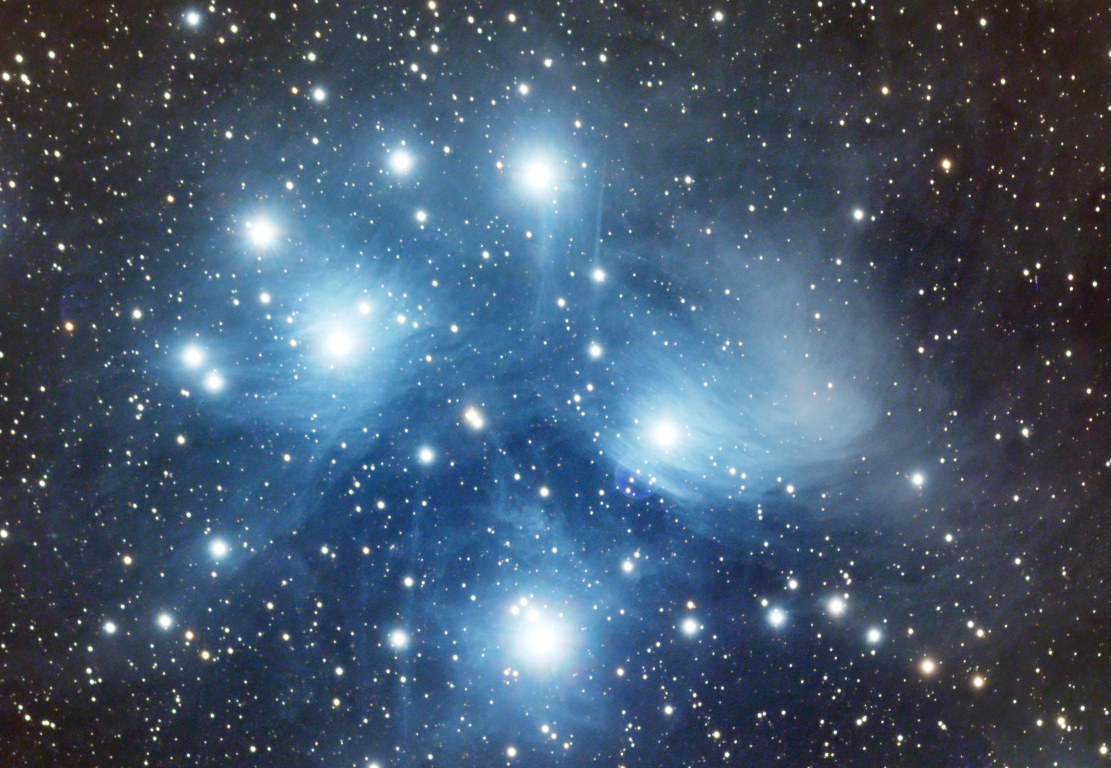
Preceding the arrival of what is for many astronomers the highlight of the year, the Orion constellation and all it’s objects, is the appearance of the majestic Pleiades open star cluster (Messier 45) in the constellation of Taurus.  The so-called Seven Sisters consists of hot blue luminous stars that formed during the past 100 million years, which are expected to last another 250 million years and can be easily observed with the naked eye even here at Fairvale Observatory (Bortle 5/6).  

I have imaged this exciting star cluster before but with astrophotography and especially iconic objects such as the Pleiades, one is always drawn back for another try.  Now armed with Chroma filters and a growing list of PixInsight skills acquired since last imaged late in 2018, I wanted to tease out more details of the fine wispy dust cloud through which the Sisters are passing and forms the signature of all good Pleiades’ images.  Furthermore, with longer exposures and total integration time greater than before, maybe I could also capture something of the abundant interstellar dust that is present across the wider background?  

I am therefore very pleased that the final image (top of the page + cropped version above) which has more than achieved these objectives and marks a significant improvement on my previous attempts – it’s always worth trying that little bit more.

 IMAGING DETAILS
ObjectM45 The Pleiades AKA Seven Sisters
ConstellationTaurus
Distance444 light-years
Size110’
Apparent Magnitude+1.6
  
Scope William Optics GT81 + Focal Reducer FL 382mm  f4.72
MountSW AZ-EQ6 GT + EQASCOM computer control
GuidingWilliam Optics 50mm guide scope
 + Starlight Xpress Lodestar X2 guide camera & PHD2 control
CameraZWO1600MM-Cool (mono)   CMOS sensor
 FOV 2.65o x 2.0o Resolution 2.05”/pix  Max. image size 4,656 x 3,520 pix   
EFWZWO x8 EFW & Chroma 31mm LRGB filters 
Capture & ProcessingAstro Photography Tool + Deep Sky Stacker PixInsight v 1.8.8-11,  Photoshop CS3, Topaz AI Denoise
Image Location & Orientation Centre: RA 03:47:03  DEC 24:03:08  Top = North   Right = West   
Exposures12 x 300 sec LRGB   Total time: 4 hours   
 @ 139 Gain   21  Offset @ -20oC    
Calibration5 x 300 sec Darks  15 x Flats & Dark Flats LRGB    @ ADU 25,000  
Location & DarknessFairvale Observatory – Redhill – Surrey – UK        Typically Bortle 5
Date & Time6th  December 2021 @ +19.15h  
Weather & MoonApprox. <=4oC      RH >=85%          🌙 New Moon