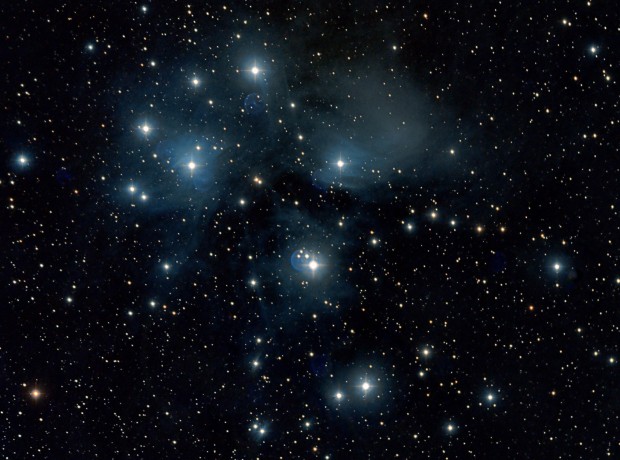
Vanguard Of The Winter Night Sky

RGB2 GxFinalX (Large)

Each year whilst the Earth rotates around the Sun, we are also moving through the Milky Way and the Universe itself.  In time, measured by millions of years, the pattern of the night sky will change but for now, measured on a human scale it appears fixed and as a result has become very familiar, so much so that it has formed the basis of navigation for millennia.  For astronomers this affect also results in a predictable pattern of changes during the year, so that every 12-months we first anticipate and then revisit old ‘friends’, none more so than the winter night sky which contains some of the most exciting objects of the year.
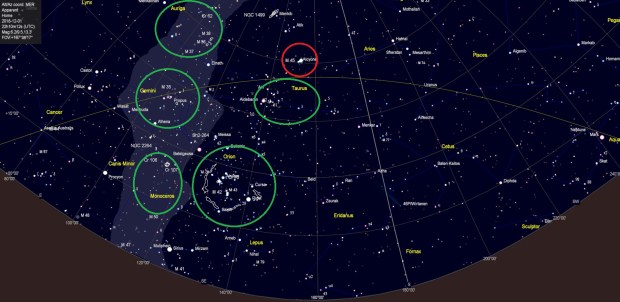
Winter Sky Surprisingly it is possible to obtain an early glimpse of these objects just before dusk at the end of a night’s viewing in the late summer but the real show begins during November, when they start to appear more conveniently in the darkness of the early evening.  With this in mind I recently set out to image the vanguard of the winter night sky, Messsier 45 or the Pleiades, an open cluster dominated by bright blue stars.  Located at the ‘front’ of the Taurus constellation, this group of stars heralds the arrival of Orion, perhaps the most spectacular and certainly most imaged constellation of the year, followed by Monoceros, Gemini and Auriga with their own wonderful deep sky objects – but first Pleiades.
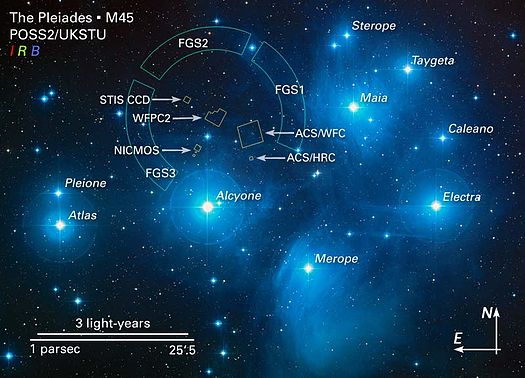
525px-M45map

The Pleiades star cluster is visible from almost every part of the globe, from the North Pole to beyond the southernmost tip of South America.  The cluster consists of over 1,000 young stars, although only 14 can be seen with the naked eye, of which seven make up the Pleiades asterism or so-called Seven Sisters.  The Sisters can usually be seen in light polluted skies but in a dark sky, such as I recently experienced at the Les Granges Observatory in southern France, they form a very distinct group of brilliant stars that literally seem to pierce the blackness of the night sky (top-centre image below).
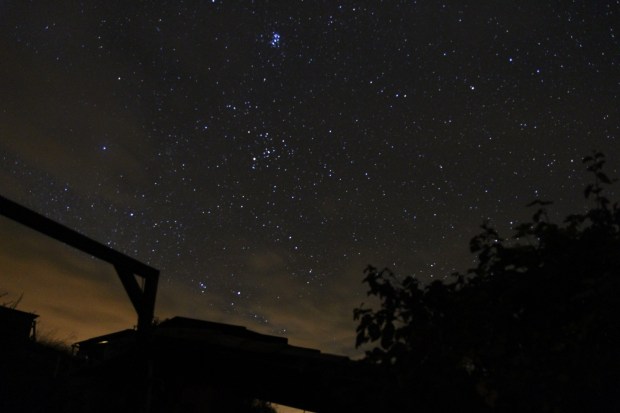
IMG_1111 (Large)

I have successfully imaged the Pleiades before with a DSLR camera but this was the first serious attempt to capture their elusive charm with a more sensitive mono camera.  When imaging the Sisters the objectives are two-fold – to capture: (i) their brilliance and colour, and (ii) the delicate interplay of their light illuminating the interstellar gas and dust behind which they are currently moving. It is this latter effect that forms their characteristic signature which differentiates them from other open star clusters.

Given the brightness of the Pleiades stars I chose short 60-second LRGB exposures at Unity setting.  Such is the subtle nature of the interstellar illumination against the intensity of the large, bright Pleiades stars, that post-processing needs to be especially careful in order to tease out the contrasting nature of the two features.  The result is a beautiful image (top-of-the-page) that captures the power and beauty of this special group of stars which precedes Orion later in the evening at this time of the year and which with luck, will once again provide further exciting opportunities as we continue to move through the rich period of the winter night sky of which the appearance of Pleiades foretells.

IMAGING DETAILS
Object M45 Pleiades
Constellation Taurus
Distance 444 light-years
Size 110’
Apparent Magnitude +1.6
 
Scope  William Optics GT81 + Focal Reducer FL 382mm  f4.72
Mount SW AZ-EQ6 GT + EQASCOM computer control
Guiding William Optics 50mm guide scope
  + Starlight Xpress Lodestar X2 guide camera & PHD2 control
Camera ZWO1600MM-Cool (mono)   CMOS sensor
  FOV 2.65o x 2.0o Resolution 2.05”/pix  Max. image size 4,656 x 3,520 pix   
EFW ZWOx8 + ZWO LRGB & Ha OIII SII 7nm filters 
Capture & Processing Astro Photography Tool + PS2,  Deep Sky Stacker & Photoshop CS2, HLVG
Image Location              & Orientation Centre  RA 03:47:06    DEC 24:13:04                     

Top = North West   

Exposures 50 x 60 sec L & 45 x 60 sec RGB  (Total time: 185 minutes)   
  @ 139 Gain   21  Offset @ -20oC    
Calibration 15 x 60 sec Darks  20 x 1/4000 sec Bias  10 x Flats LRGB    @ ADU 25,000  
Location & Darkness Fairvale Observatory – Redhill – Surrey – UK        Typically Bortle 5
Date & Time 17th  November 2018 @ +21.30h  
Weather & Moon Approx. 6oC      RH <=80%          🌙 Half Waxing Gibbous          


Summertime Blues

IMG_5435

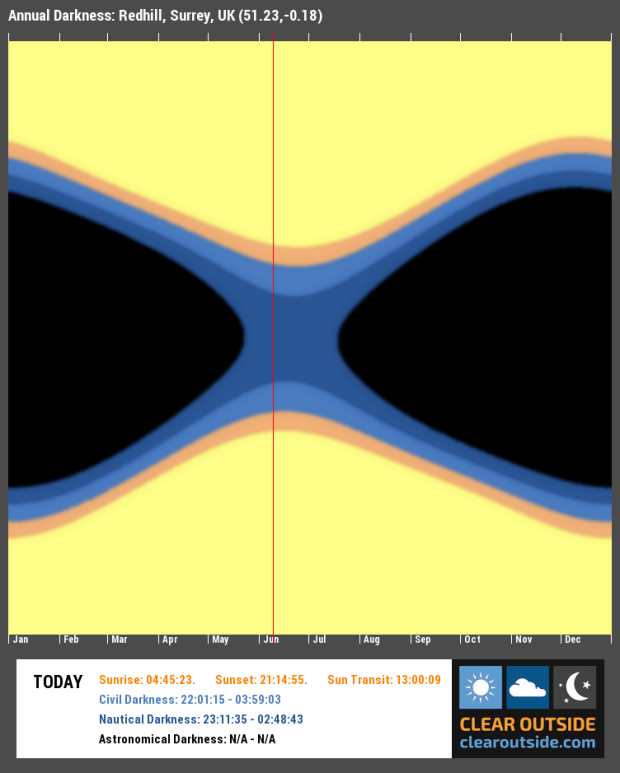
This year the Summer Solstice falls on 20th June at 23.34 BST, meaning the Sun will have reached its furthest point north; as a result from 22nd of May to 19th July 2014 there is a state of permanent Astronomical Twilight AKA Nautical Darkness at Fairvale Observatory. This means there is a complete lack of Astronomical Darkness for imaging, which when combined with short nights poses various problems for astronomy in general.  Notwithstanding, there are benefits and other opportunities which are worth exploiting.

annual_darkness

Annual darkness at Fairvale Observatory 2016

To turn the problem around an obvious solution at this time is viewing and imaging the Sun.  However, following the initial success of testing my equipment in preparation for Mercury’s transit of the Sun on 9th May, the actual event proved disastrous for solar imaging.  I have subsequently re-checked the equipment and software set-up and the problem has continued but without any obvious reason.  Popular opinion on the EQMOD Forum is that it is a software issue – drivers, EQMOD, EOS Utilities – so when time allows over the summer I will reinstall and test everything, hopefully ready for the return of astronomical darkness on 20th July.  Murphy’s Law will likely mean it’s something else but for the moment this seems to be the only way forwards, or is it backwards?  Having just managed to get guiding to work, I had been looking forwards to a new imaging era but that’s astrophotography!

Although the nights are now short the temperatures have been pleasantly warm; after the long dark but cold nights of winter (and spring this year) it’s been a real pleasure to be outside in summer clothing and without the threat of condensation on the equipment.  Notwithstanding, ever present cloud and inevitably the Moon has continued to thwart my efforts until recently, as I have at last just managed a couple of very enjoyable evenings.

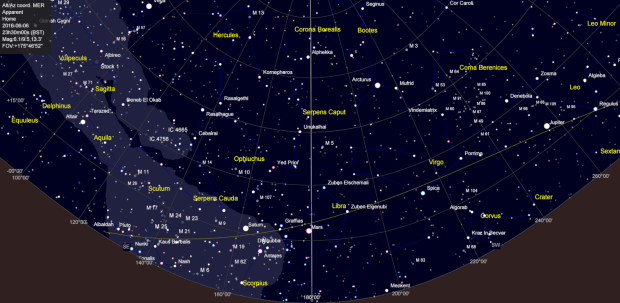
At the moment the three major planets of Jupiter, Mars and Saturn can all be seen at various times between 10.00 pm to nearly 3.00 am, when the early morning light then becomes evident. After putting on a great show during May, Jupiter still remains high in the sky just after sunset.  Mars and Saturn are at a much lower declination of between 10o   and 17o but provide very good views in the right seeing conditions, especially Mars which with an apparent dimension of 18.6o has recently looked excellent, even to the naked eye.

060616 Sky

With such opportunities I decided to try out the Skywatcher 150PL and the ZWO ASI120MC once again.  It is almost two years since I used this telescope, preferring instead the superior William Optics GT81 for viewing and imaging.  However, with a focal length of 1,200mm and 150mm aperture (f8) the Newtonian scope is better suited to planetary objects; this was also the first time I rigged the scope for use on the AZ-EQ6 GT mount, thus providing better control than the EQ3-2 I have previously used.

Sure enough the views of each planet were very good but also being unaccustomed to the ZWO webcam through lack of use, I failed to obtain any images!  Pity but the lesson learned is that I cannot just dabble with this equipment and need to dedicate more time in the future if I am to learn how to use properly again.  Nonetheless, it was fun re-acquainting myself with these planets.  As an unexpected bonus the ISS also flew right over Fairvale Observatory for over 7 minutes.  This time the station was noticeably brighter than previously observed, which I put down to Nautical Darkness and the relative position of the Sun that results, thus producing greater reflection and therefore better illumination of the ISS when viewed from the ground?

All-in-all after months of difficulties and inactivity it was a good night and at midnight I therefore decided to swap to the William Optics GT81 for some DSO imaging.  After setting-up the scope I looked up and, as if from nowhere, broken cloud had rolled in obscuring much of the sky and putting an end to any DSO imaging.  Oh well, I had had a good time before and was at least able to get to bed at a civilised time – one of the other drawbacks of summer astronomy.  As luck would have it the weather was also good on the following night, probably even better than before and this time I concentrated on bagging some DSO images as the planets again marched across the sky from east to west.

As a result of the aforementioned equipment and software problems I have resorted to the trusty SynScan handset again for alignment and mount control.  Impressive though EQMOD and all the other paraphernalia are, so far I have found it all to be somewhat fickle and from my personal experience often unreliable.  However, after last year’s enforced astronomy hiatus following my operation and the almost farcical lack of observing conditions over winter and now spring, I’ve become a little rusty with the set-up and as a result, on this occasion encountered my old nemesis – polar alignment – to be something of a problem once again.

Amongst the types of DSO objects, I find globular star clusters to be particularly intriguing; I had not even heard of such features until taking up astronomy in 2013.  Some 158 of these ancient star clusters are known to orbit around the main disc of the Milky Way.  At about 11bn to 13bn years old they are very old and despite what so-called experts might say, it seems to me their origin remains something of a mystery; it’s interesting that such clusters are also associated with other galaxies.

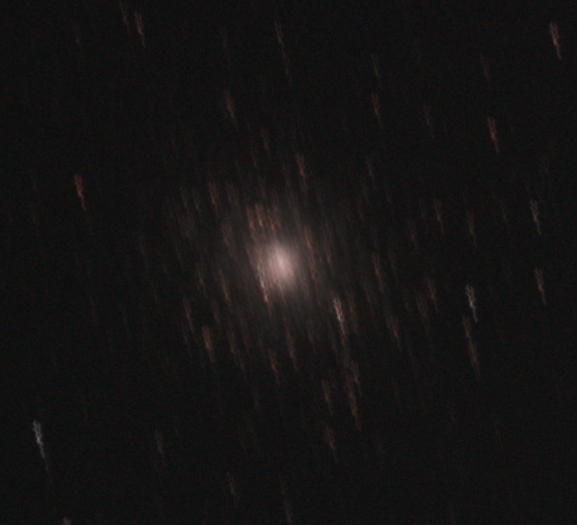
At this time of the year a number of globular and open clusters feature across the night sky and form excellent imaging targets.  First up at about 11.00pm was M5 and immediately I discovered the shortcomings of my polar alignment, further aggravated by the decision to try 4.00 minute exposures = big mistake; ironically prior test shots  turned about better!

Picture saved with settings embedded.

M5 globular cluster + excess trailing! WO GT81 Canon 700D + FF | 9 x 240 secs @ ISO 800 + darks | 6th June 2016

IMG_0026crop

M5 test shot: 10 sec @ ISO 6,400

IMG_0023crop

M5 test shot: 15 sec @ ISO 6,400

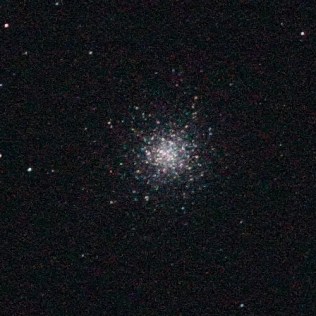
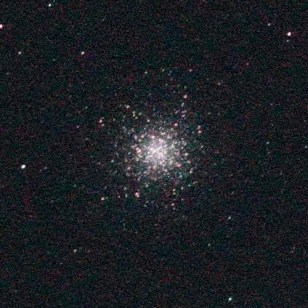
Following on from M5 shortly after midnight, M13 appears at a much higher altitude, thus helping to reduce the impact of star trails.  Furthermore, as I was by now fully aware of the polar alignment error, I reduced the exposure time from 4.00 to 2.00 minutes; it helped but nonetheless could not hide the impact on the resulting images.  Note to self: always ensure good polar alignment.  An EQMOD – ASCOM – CdC alignment model would be much better but until I can correct the aforesaid problem it’s down to SynScan and hopefully in the interim I can return to globular clusters once more during summer.

Picture saved with settings embedded.

M13 with less but still noticeable trails! | WO GT81 & Canon 700D + FF | 19 x 120 secs @ ISO 800 + darks | 7th June 2016

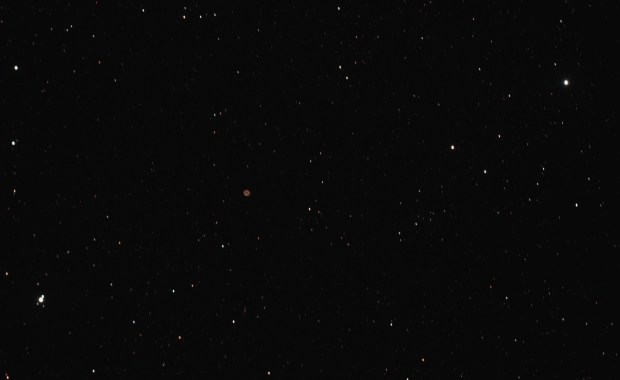
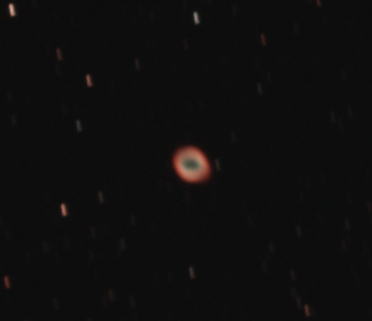
Before going to bed I couldn’t resist a few quick shots of an old summer favourite, M57 or the Ring Nebula, itself also very high above Fairvale Observatory by this time of night.  Considering the alignment problems the image wasn’t too bad, however, the first half of 2016 has really been a case of one step forwards, two back.  I hope the next 6-months will be more positive, they will inevitably be darker and colder.

Picture saved with settings embedded.

M57 Ring Nebula (left of centre) + Sulafat (left) & Sheliak (right) | WO GT81 & Canon 700D + FF | 13 x 120 secs @ ISO 800 | 7th June 2016

Picture saved with settings embedded.

M57 – Ring Nebula, cropped.

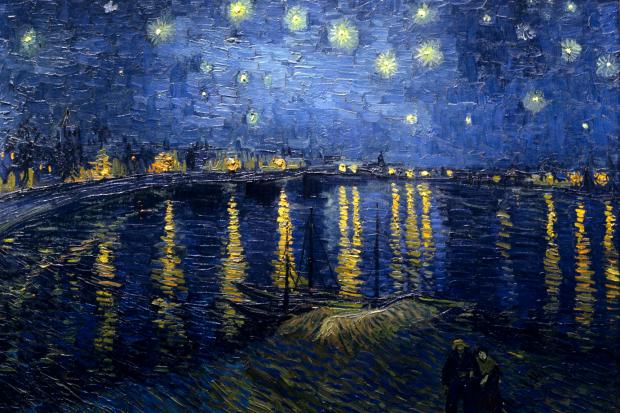
It’s all in the stars

Starry_Night_Over_the_Rhone

After 24-weeks I have just completed Imagining Other Earths, a Coursera MOOC presented by David Spergel, Charles A. Young Professor of Astronomy at Princeton University – soon to become Director of the new Computational Centre of Astrophysics, NY – and cannot speak too highly of the course.  In my quest to better understand what I am seeing and imaging, I have participated in five astronomy courses and this is by a country mile the best; how many country miles in a parsec I wonder?  There was very little not covered about astronomy in the course, including related geology and life itself but it was outstanding for three reasons:

  • Frequent use of easy-to-understand equations to explain and link various processes responsible for the Universe and everything in it;
  • It is very comprehensive, thorough and well produced, and…
  • David’s lecturing is just very good – easy to understand and well delivered.

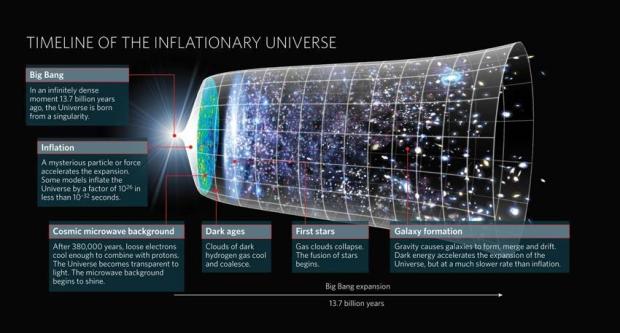
For some while now the trend in my astrophotography has been increasingly directed towards seeing the big picture and by coincidence the course followed a similar scientific theme in order to Imagine Other Earths throughout the Universe; a metaphor for life itself and possibilities across the Universe.

download

The ultimate question starts at the beginning – where do we come from?  Moby and astrophysicists seem to have the answer: we are all made of stars.  How we get from that to here may be an even bigger question and like the philosophers in The Hitchhikers Guide to the Galaxy looking for the meaning of life (answer = 42!), should keep many astrophysicists gainfully employed for aeons.

inflation

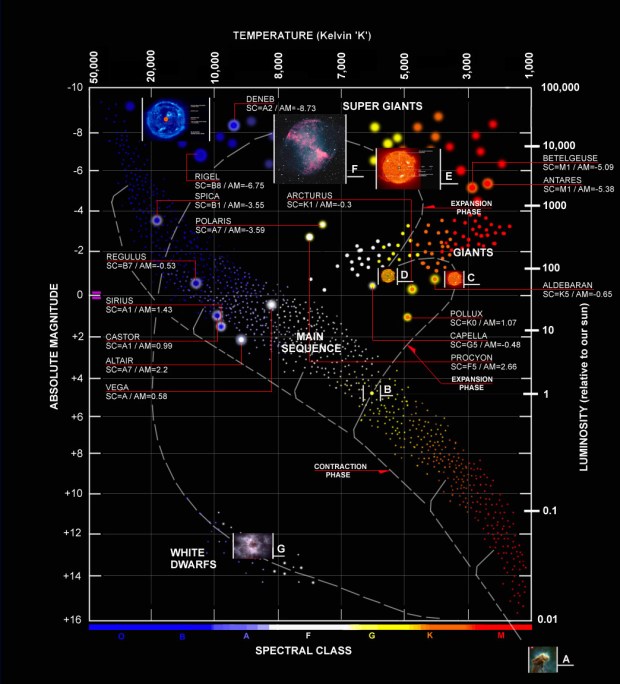
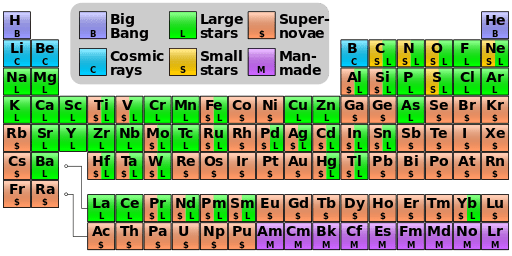
In the meantime there is strong evidence that we do indeed come from stars and their evolution through the process of nucleosynthesis, which is responsible for all but a few man-made elements that we find on Earth.  Through the action of nuclear fusion a star burns its way through the periodic table, first from hydrogen to helium then carbon-oxygen-magnesium-silicon and eventually iron.  Thereafter the other, heavier elements require even more extreme conditions – heat & pressure – that can only be found in the late or final stage of a star’s life such as a Super Nova.

hr_fancy

When the Periodic Table was initially formulated in 1863 by Dimitri Mendeleev there were 53 elements, which through subsequent discovery have now grown to 118.  I find it wonderful and exciting that almost all of these can be attributed to stellar evolution, which can be viewed and imaged in the night sky.

Nucleosynthesis_periodic_table.svg

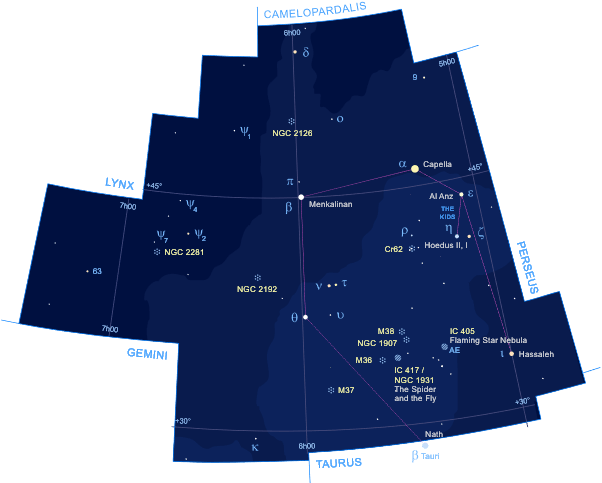
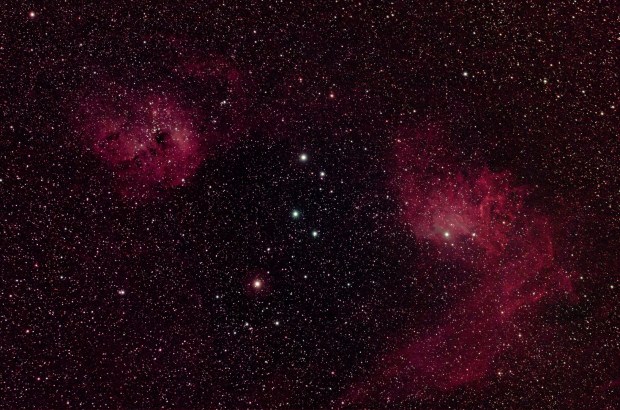
At this time of the year the Milky Way is a dominant feature passing across the winter night sky which provides numerous, sometimes spectacular objects that are favourable for imaging.  Located close to the western edge of the Milky Way in the constellation of Auriga about 1,500 light-years from Earth, is IC 405 or Flaming Star Nebula and nearby (visually) IC 410 or Tadpole Nebula, itself at 12,000 light-years distance.   Located across the central area between these objects is a star field, notable of which and actually within the IC 405 is the O-type blue variable star of AE Aurigae, that is responsible for illuminating the nebulae.

auriga

IC 405 is formed of two sections, consisting of an emission and reflection nebula. Radiation from the variable star AE Aurigea, that is located in the lower part of upper-east (left) lobe, excites the hydrogen gas of the nebula which then glows red, while carbon-rich dust also creates a blue reflection from the same star.

Picture saved with settings embedded.

IC 405 (right)-The Flaming Star Nebula inc AE Aurigae varibale star & IC 405-The Tadpole Nebula: WO GT81 & modded Canon 550D + FF | 15 x 180 sec @ ISO 1,600 & full calibration | 8th December 2015

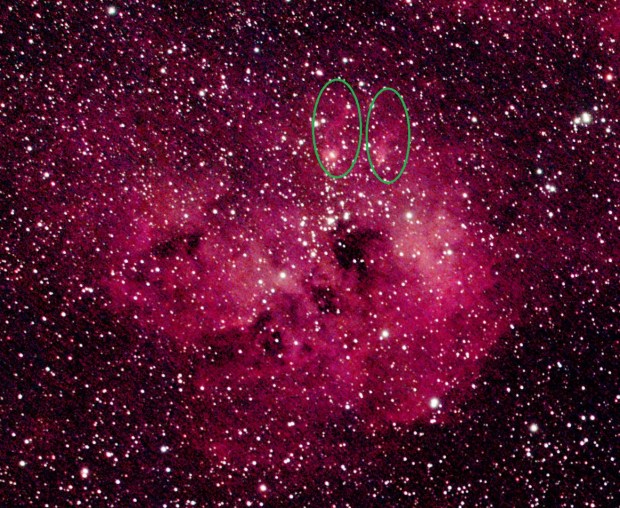
Located within the nebula IC 410 and partly responsible for its illumination is an open cluster of massive young stars, NGC 1893.  Being just 4-million years old these bright star clusters are the site of new star formation and therefore are just starting their creation of new elements.  The so named ‘tadpoles’ are filaments of cool gas and dust about 10 light-years long.

IC 410Canotate (Large)

IC 410-The Tadpole Nebula: Illuminated from within by the NGC 1839 star cluster.  Image cropped and forced to highlight the two ‘tadpoles’, which can just be seen indicated in the green ellipses (‘tails’ upwards)

Each nebula is large, respectively 30’ x 20’ and 40’ x 30’, with an apparent magnitude of +6.0, which combined with the star AE Aurigae makes an excellent target for the William Optics GT81.  I find it thrilling to consider the processes taking place in these objects that I have captured in the photograph, which surely represents the ultimate Big Picture?

Rock On!

Due to my viewing limitations at Fairvale Observatory planning is essential, with the best imaging range mainly restricted to a zone between 65o and 85o and within +/-20o of the Meridian.  Furthermore, as I am mostly using the William Optics GT81 telescope at the moment, imaging targets should preferably be large – something between 1o & 2o is perfect, such as  the Rosetta Nebula at 1.3o or Andromeda Galaxy at 190’ x 60’.  As luck would have it these conditions are favourable for a number of objects at the moment and I have been somewhat spoilt for choice: North America Nebula, Veil Nebula and Andromeda.

Notwithstanding, for some reason I have until now overlooked the Sadr Region IC 1318, which is also large and in a similar part of the sky as the aforementioned North America and Veil Nebulae but perhaps overshadowed by their notoriety.  In reality it is an enormous area of nebulosity containing many features worthy of imaging which are perfect at this time of the year from my location.

cygnus

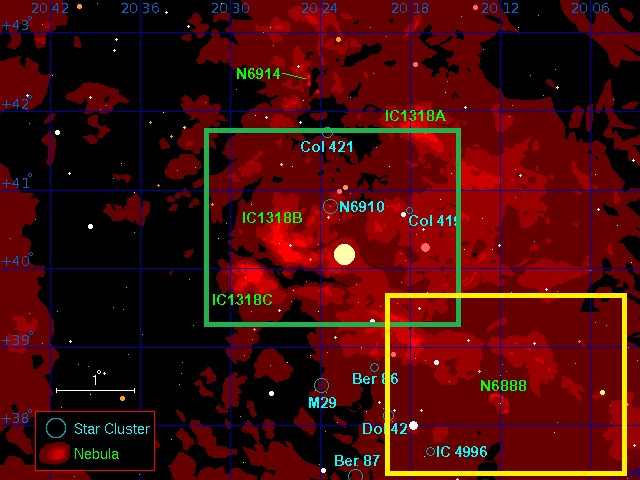
Sadr Region: green rectangle indicates the approximate area of IC 1318 image, yellow rectangle the NGC 6888 Crescent Nebula. image

Sadr Region: green rectangle indicates the approximate area of IC 1318 image, yellow rectangle the NGC 6888 Crescent Nebula image.

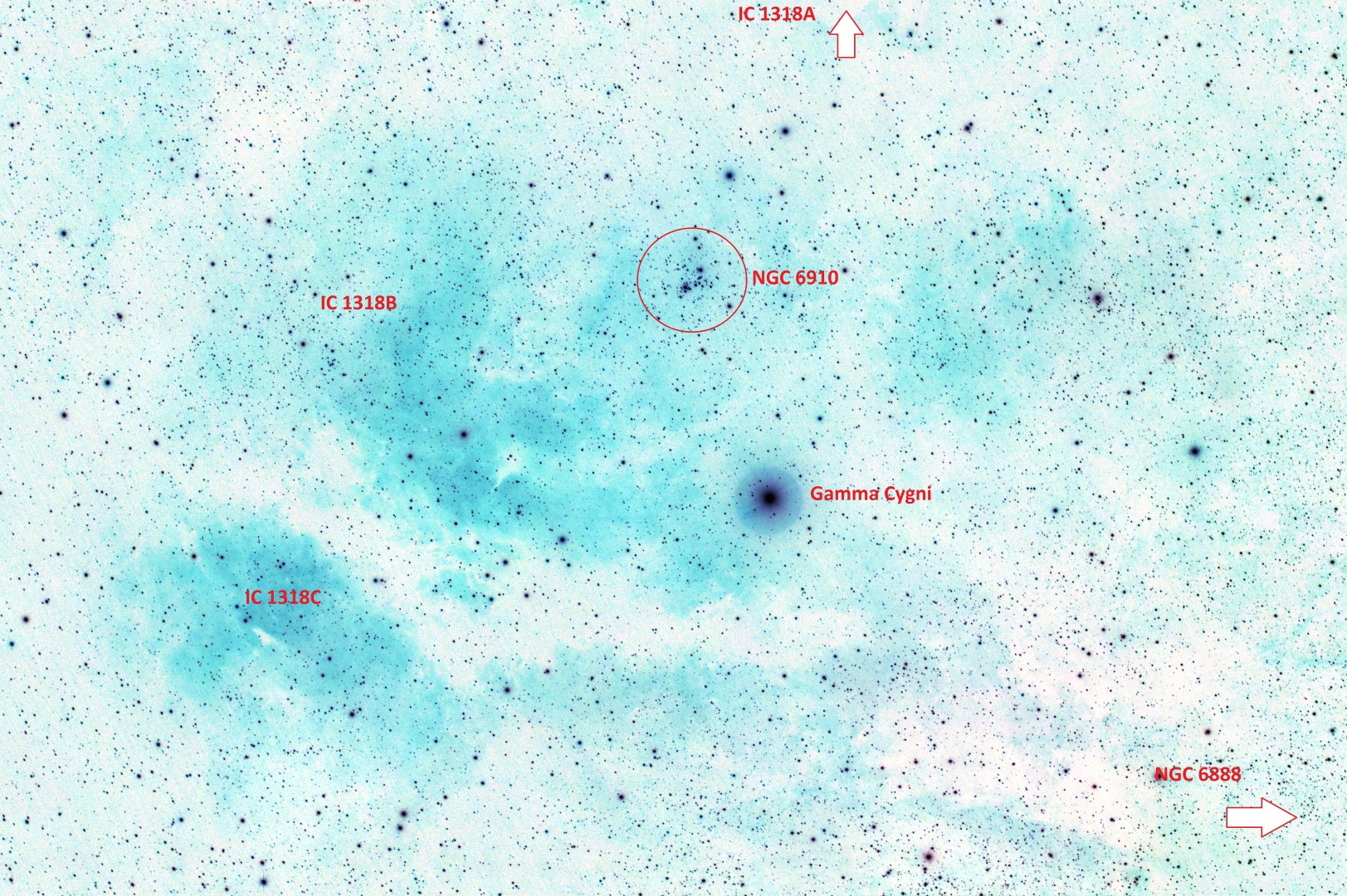
IC 1318 is a diffuse emission nebula surrounding the star Sadr or Gamma Cygni, which is at the centre of the Cygnus Cross and on the plane of the Milky Way.  The Sadr region is located deep within the Orion arm of the Milky Way about 3,000 light-years from Earth, with Gamma Cygni actually situated closer in the foreground. Such is the size of IC 1318 that its three constituent parts, A – B – C, extend over some 200 light-years or about 4 degrees, which is well beyond the FOV of the WO GT81; how could I have overlooked his enormous area of nebulosity before?  As a result of its size and complexity I also chose to image two other interesting features nearby.

IC 1318 Sadr Region - image inverted & annotated

IC 1318 Sadr Region – image inverted & annotated

IC 1318 Sadr Region WO GT81 + modded Canon 550D & FF | 30 x 120 secs @ ISO 1,600 | 30th September 2015

IC 1318 Sadr Region
WO GT81 + modded Canon 550D & FF | 30 x 120 secs @ ISO 1,600 | 30th September 2015

Situated just above Sadr is the small star cluster of NGC 6910 AKA Rocking Horse Cluster.  Although only 10’ in size the cluster is visually quite prominent, though I struggle to see the little horse that others have identified.  Notwithstanding, it is an interesting and attractive part of the Sadr region.

NGC 6910 The Rocking Horse Nebula as recorded by StarObersever.eu - located just above Gamma Cygni in the previous image.

NGC 6910 The Rocking Horse Nebula as recorded by StarObersever.eu – located just above Gamma Cygni in the previous image.

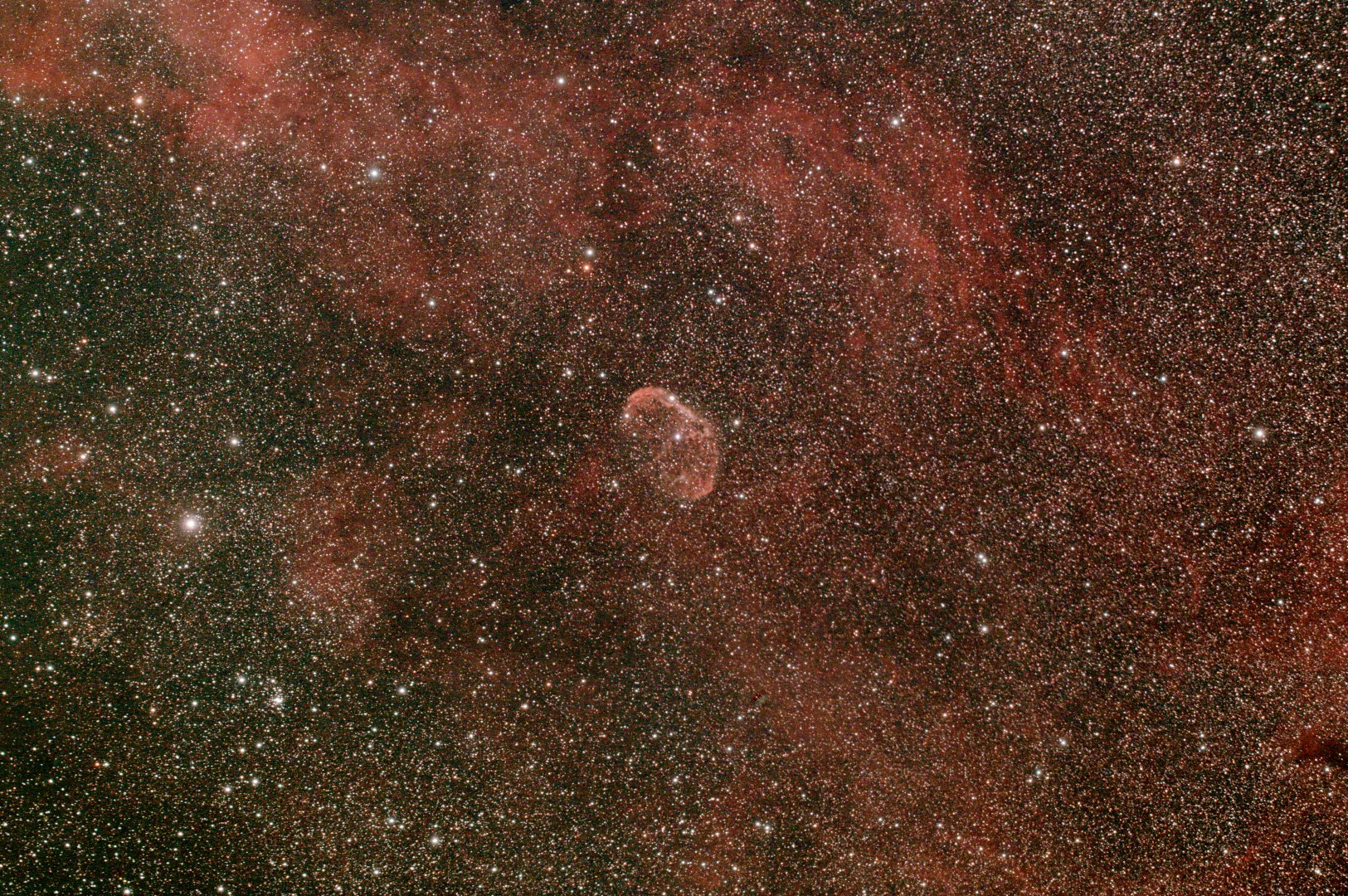
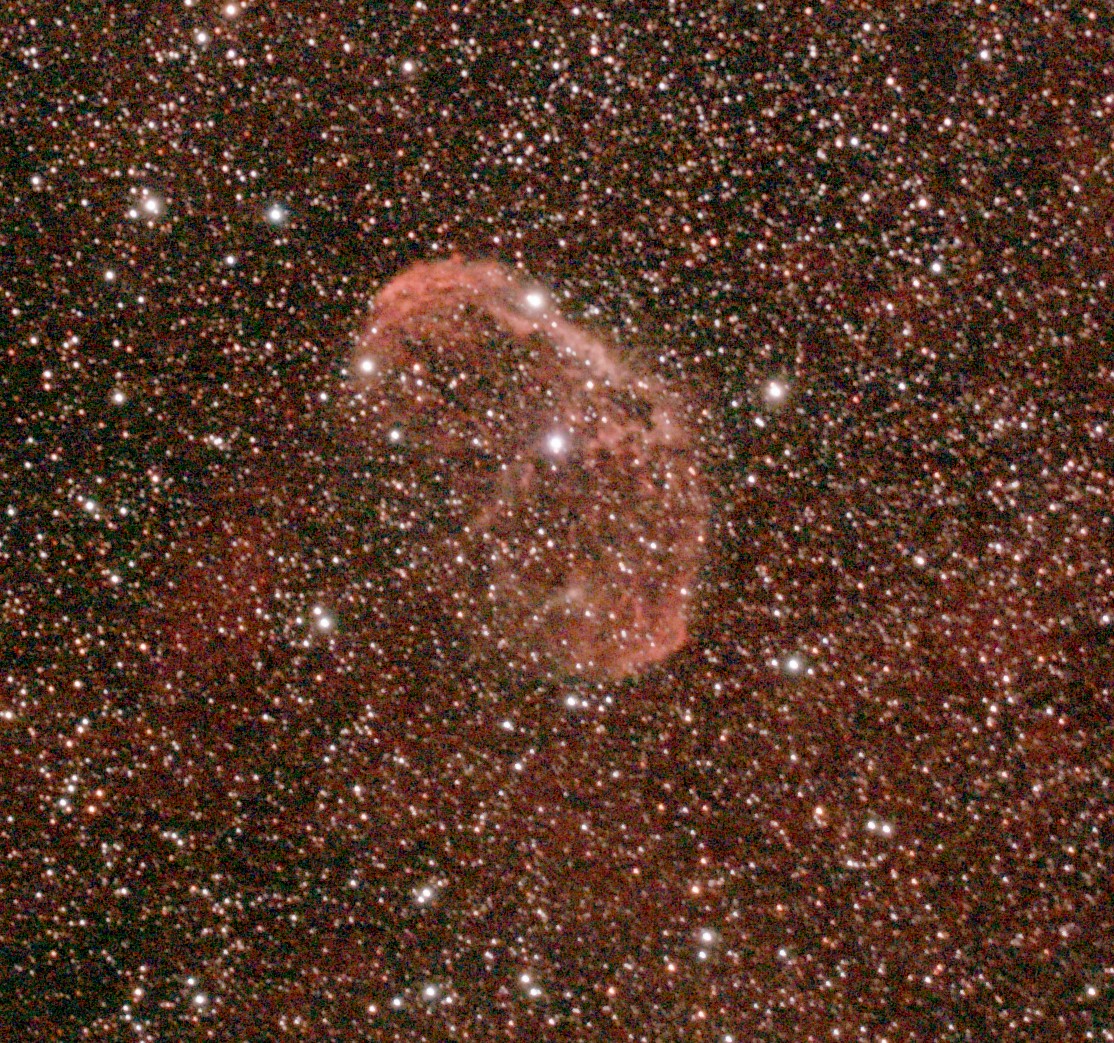
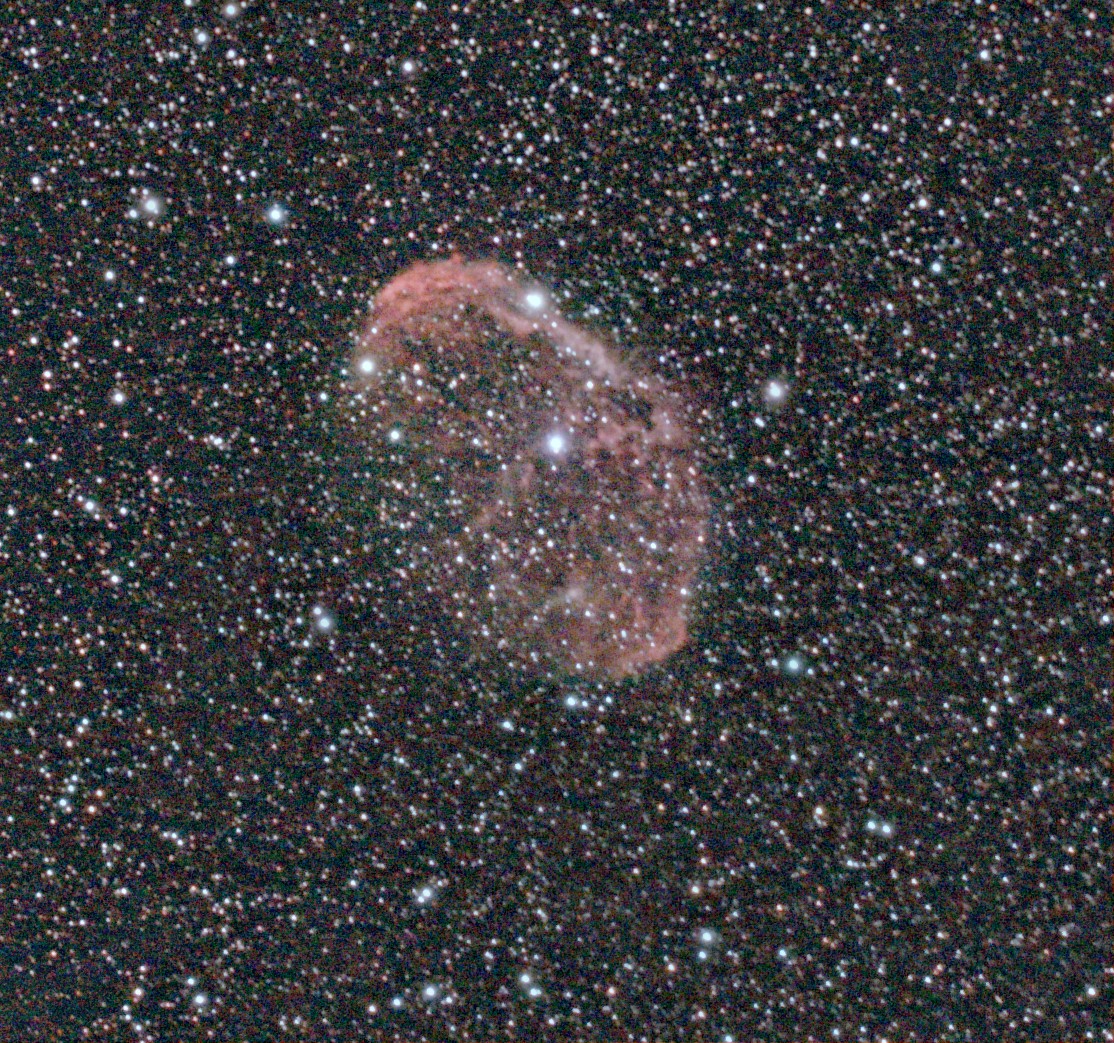
Located about 2 degrees south west of Sadr is the Crescent Nebula NGC 6888, which is not unlike the Jellyfish Nebula in appearance but is younger in its evolution.  An emission nebula, NGC 6888 is formed by a stellar wind from the Wolf-Rayet star WR 126 colliding with a slower moving wind ejected when the star previously became a red giant. The result is an illuminated shell-like feature consisting of two shock waves, one moving inward and the other outward, producing this amazing spectacle which measures some 25 light-years across.  Near the end of its existence, the star will eventually end its life in a spectacular supernova explosion – now that would be an image.

NGC 6888 Crescent Nebula WO GT81 + modded Canon 550D & FF | 20 x 180 secs @ ISO 1,600 | 9th October 2015

NGC 6888 Crescent Nebula
WO GT81 + modded Canon 550D & FF | 20 x 180 secs @ ISO 1,600 | 9th October 2015

Crescent Nebula - cropped

Crescent Nebula – cropped

Crescent Nebula - cropped + GradientXTerminator applied

Crescent Nebula – GradientXTerminator applied

Whilst IC 1318 has proved to be an excellent and productive imaging target for my equipment, it has become clear that it represents a much, much larger area of nebulosity that incorporates or is at least immediately adjacent to NGC 7000, the North America Nebula.  At a rough estimate this larger area spans a distance of some 2,000 light-years and is some 50-times bigger than the Sadr region.  Like other major areas of nebulosity (Barnard’s Loop) such a scale is way beyond the ability of my equipment and most others without resorting to a mosaic technique.

However, my interest in seeing and potentially imaging the bigger picture has been piqued and I have recently purchased a Vixen Polarie tracking mount, which can be fixed onto a camera tripod with a standard camera and lens in order to take long exposures without forming star trails. This set-up has two advantages over prime focus + telescope imaging: (i) it is highly portable and can easily be taken anywhere in a rucksack, and (ii) by using a camera lens of say <=50mm focal length it is possible to achieve a much wider FOV and thus photograph some of these very large nebulous areas in one image.

Alas the Sadr region is now moving on and it is probably too late to tackle using the Polarie mount but it will be something to look forwards to again next autumn and meanwhile Orion is just round the corner.  Watch this space for developments!

All in a spin

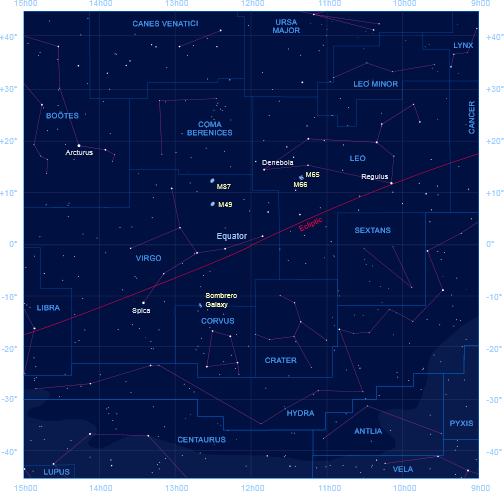
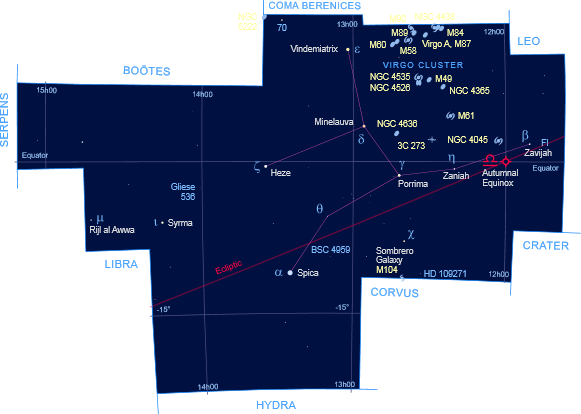
It is now just over six months since acquiring my new astronomy equipment and therefore the first time I have experienced imaging DSO objects of the Spring night sky.  Following the passage of Leo, the main show has now well and truly arrived as the constellations of first Coma Berenices and then Virgo pass overhead, bringing with them a virtual fireworks type display of spectacular stellar features. sky-12h00 comaberenices virgo To DSO fans Spring means one thing – galaxies – too many to comprehend, making it difficult to know where to start.  In my case the detailed beauty of these galaxies will need to wait until I have a substantially larger telescope and can achieve much, much longer exposures.  In the meantime I just marvel at the spectacle and have been trying to image some of the more iconic of these springtime beauties.  Both constellations seem abound with galaxies but two groups are particularly exciting: the Coma Cluster and Virgo Cluster, within which there a large number of fine examples to choose from.

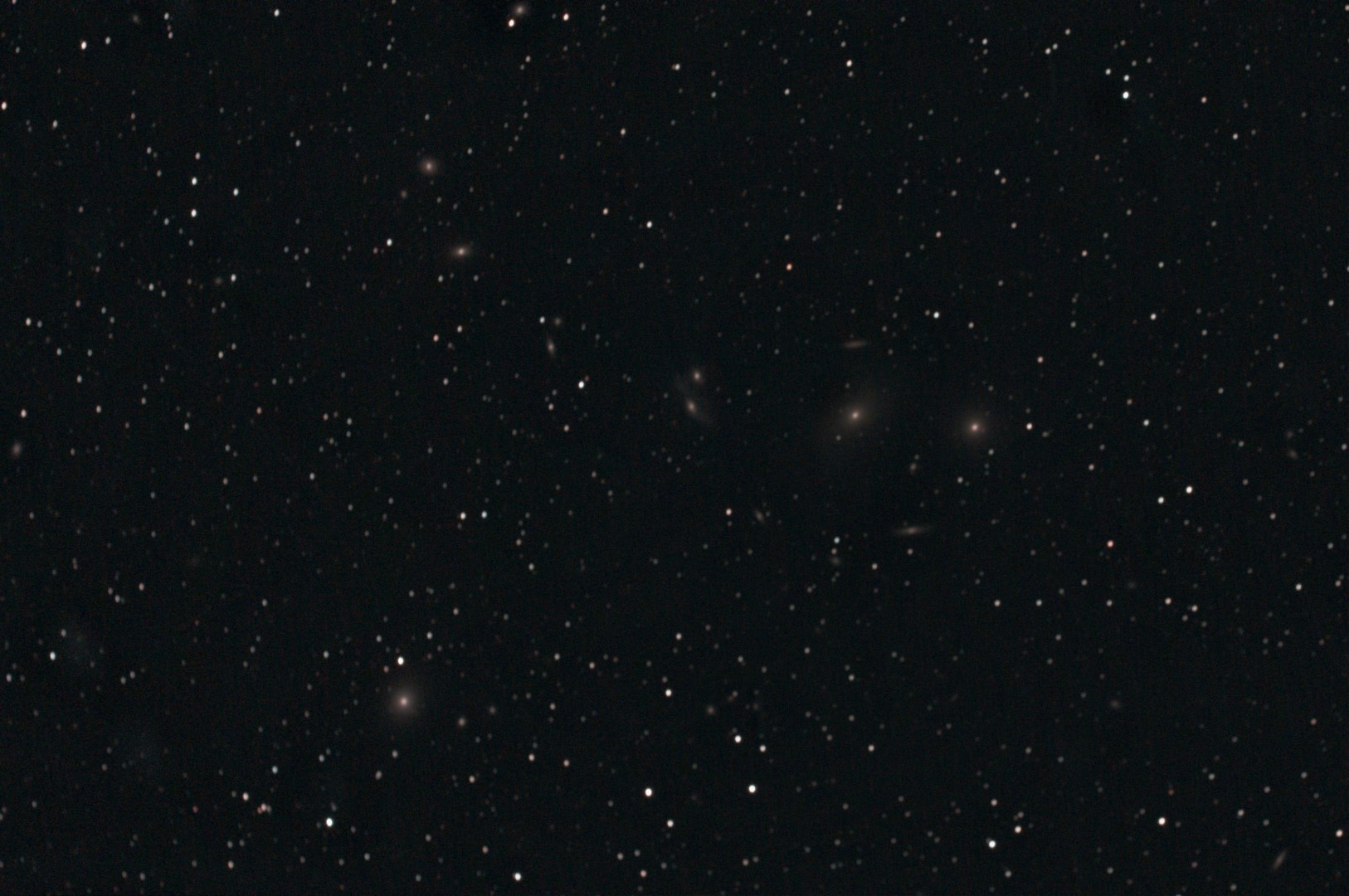
Just the tip of the iceberg: part of the Virgo Cluster that is crowded by galaxies.

Just the tip of the iceberg: part of the Virgo Cluster crowded with thousands of galaxies.

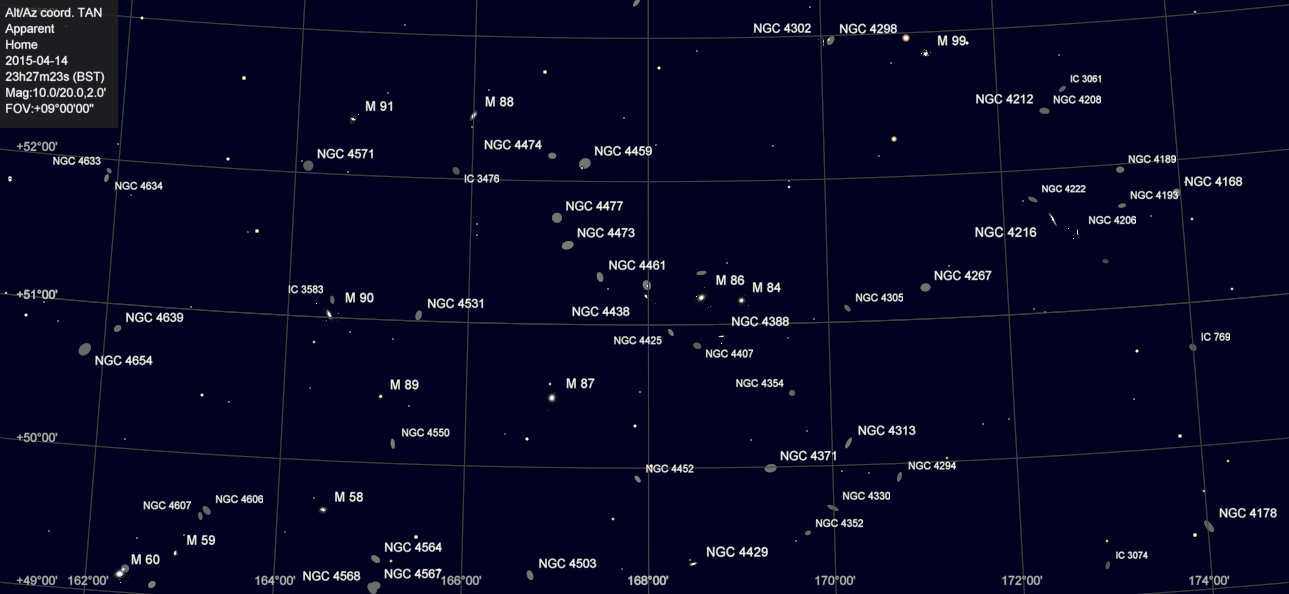
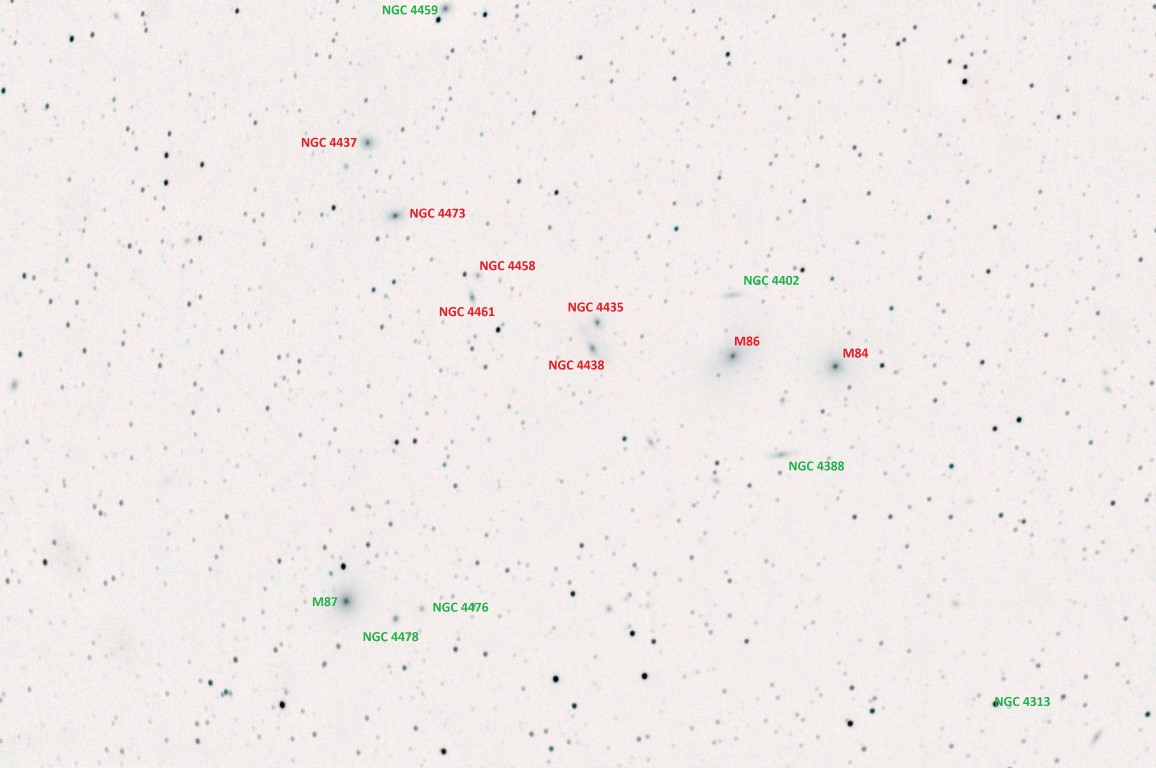
I was first drawn to Markarain’s Chain in the Virgo Cluster, a string of galaxies that form a gentle curve.  Stretched over some x ly the chain includes two Messier Objects – M86 & M84, together with NGC 4438, NGC 4435, NGC 4461, NGC 4458, NGC 4473 & NGC 4477 amongst many others.  In fact this entire part of the sky contains literally thousands of galaxies, of which Markarain’s Chain is just a small but interesting part.

Markarain's Chain WO GT81 & Canon 550D + FF | 15 x 180 secs @ ISO 1,600 | 26th March 2015

Markarian’s Chain
WO GT81 & Canon 550D + FF | 15 x 180 secs @ ISO 1,600 | 26th March 2015

Markarian's Chain (red)  &  some other galaxies (green) inverted.

Markarian’s Chain (red) & some other galaxies (green) – inverted image.

Busy Bees

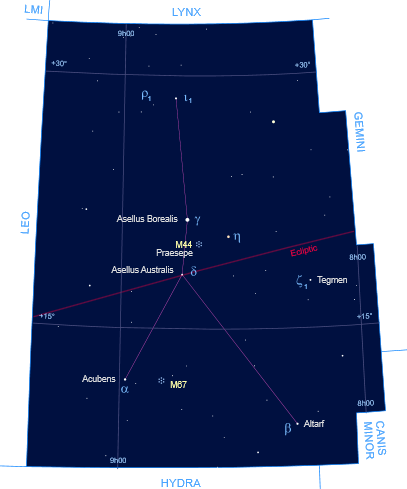
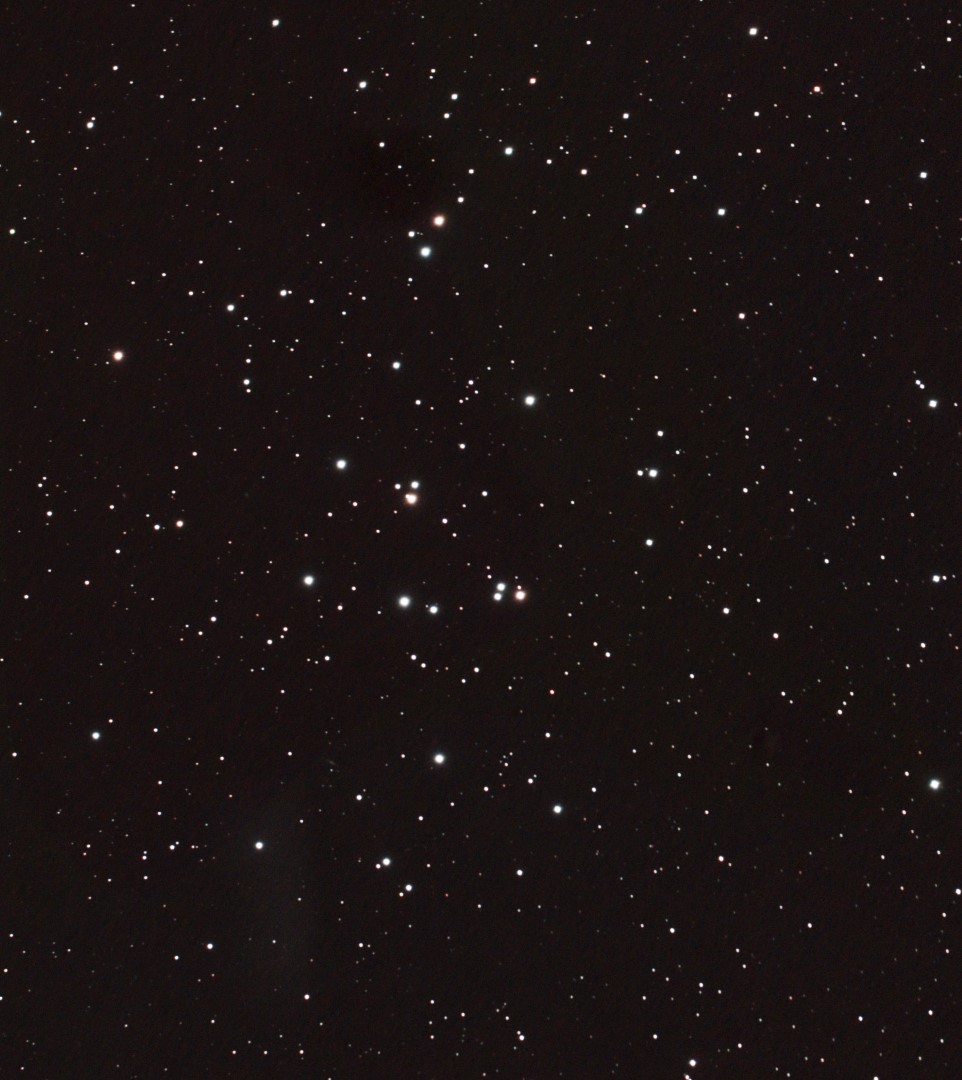
Cancer AKA the Crab, is the dimmest of the zodiacal constellations and generally lacking in notable objects except, at its centre, lying almost on the Ecliptic just 600 light-years from Earth, M44 is one of the closest star clusters to the Solar System.  More engagingly, M44 derives its alternative name from its appearance as a swarm of stars dancing actively like bees i.e. the Beehive Cluster.  Its Latin equivalent, Praesepe means hive, manger or crib.

cancer

At 600 million years old its dancing stars must be considered quite youthful compared to our Sun’s 4.5 billion years and are thought to have been created from the same, very large molecular cloud as Hyades in the constellation of Taurus.  An open cluster of some 1,000 stars, M44 spans 15 light-years across or about 1.5o.  A few but distinctive yellow-orange tinted red giants stand out,  scattered amongst the brighter hot blue stars, making an attractive image, one I expect to return to during the next three or more months as The Crab shuffles westwards across the night sky before giving way to views of a Spring and Summer nature.

M44 The Beehive Cluster. WO GT 81 + Canon 550D & FF | 20 x 120 secs & calibration @ ISO 1,600 | 24th January 2015

M44 The Beehive Cluster
WO GT 81 + Canon 550D & FF | 20 x 120 secs & calibration @ ISO 1,600 | 24th January 2015

2 for 1

Whilst I know of Gemini I have limited knowledge about this constellation that, like Monoceros, starts to play a more prominent part in the night sky here after 10 pm at this time of the year.  Located immediately above Monoceros and north east if Orion, Gemini is Latin for twins and its asterism appropriately forms two stickmen whose ‘heads’ are formed by the stars of Castor and Pollux, also suitably twin brothers from Greek mythology.

Gemini

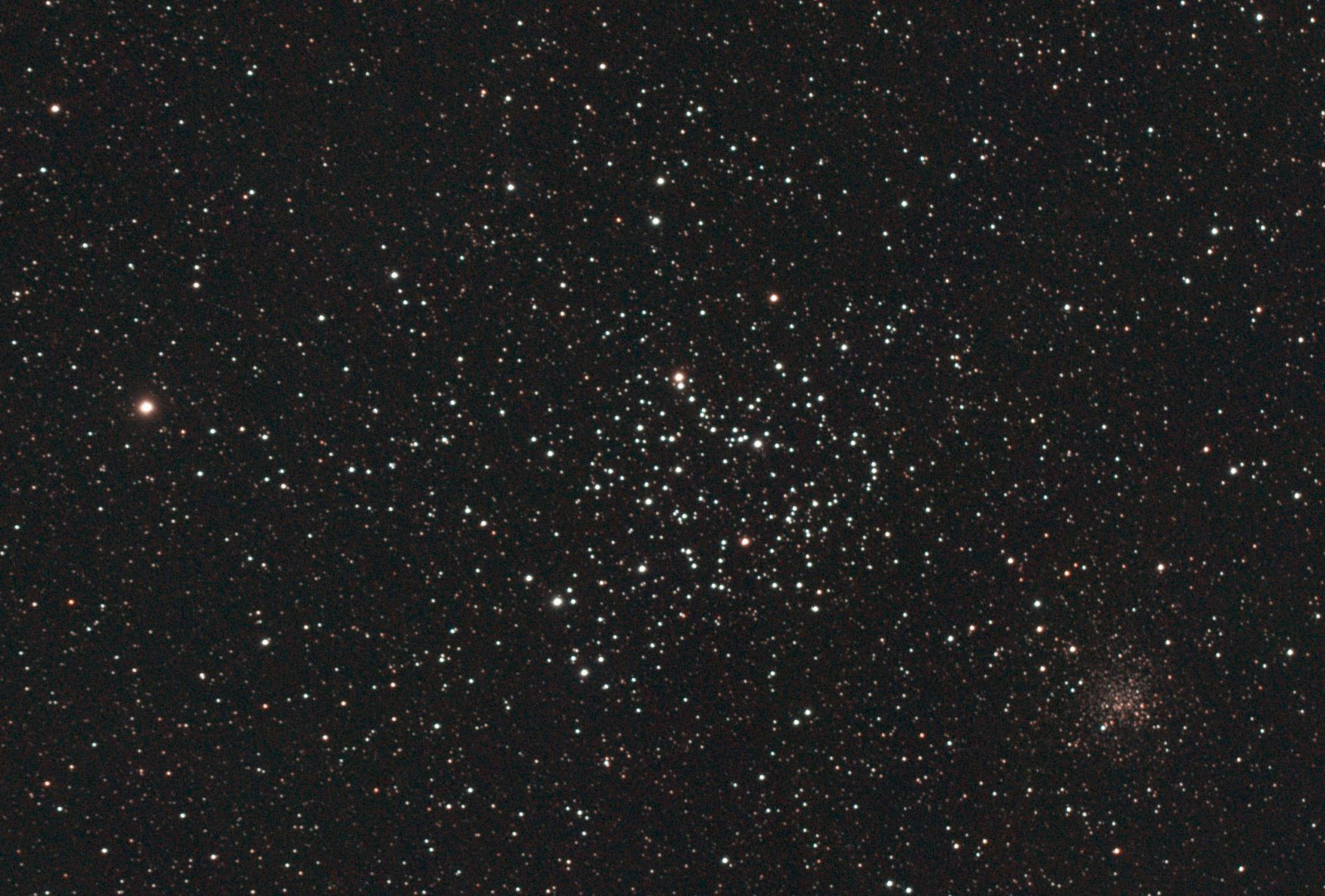
At the western extremity of Gemini, beyond Tejat Posterior (which means back foot), just above the ‘left foot’ of the upper stickman, lies the open cluster M35.  Located at the heart of the Milky Way and 2,700 light-years from Earth, M35 is formed of some 2,700 young stars of between 100 and 200 million years old.  On the same clear, cold evening I recently photographed the Rosette Nebula, I also produced an interesting image of M35 with good colours, including some yellow-orange stars.

Because of its short focal length, the relatively wide field-of-view of the William Optics GT81 can be both a good and sometimes a bad feature, depending on the size of the object being viewed.  From experience so far, it seems that the scope and DSLR camera produces good to fair resolution for objects down to about 5 arcminutes.  Whilst objects below this size can be identified, the power of the scope and sensitivity of the camera sensor can usually only show the presence of such features without providing useful detail.  However, at other times this set-up is perfect for wider but still detailed images that sometimes lead to me other, unexpected objects in the same picture.  The image of M35 is just such an example.

At the time of imaging, the less-than clear initial RAW images from the camera, with a dark blue hue from the CLS light pollution filter, nevertheless indicated that M35 was nicely positioned at the centre of the picture, with good resolution of the component stars.  However, it was evident that there were also some other bright features away from the M35 open cluster which I had not anticipated. Notable amongst these was what seemed like a pale yellow smudge to the immediate west, the importance of which only became apparent after stacking and post processing.

M35 & NGC 2158 Open Clusters WO GT81 + Canon 700D (unmodded) | 15 x 120 secs @ ISO 1,600 & calibration

M35 (Centre) & NGC 2158 (Lower right) Open Clusters
WO GT81 + Canon 700D (unmodded) | 15 x 120 secs @ ISO 1,600 & calibration

It turns out that M35’s neighbour, 20 arcminutes to the south-west, is no less than NGC 2158 – another cluster. To the eye NGC 2158 seems to form an attractive, golden globular cluster.  In fact it too is an open cluster but located more than 9,000 light-years beyond M35 and at 2 billion years, is much older.  As they say, with age comes beauty, and I find this feature to be the more interesting of the two, all the more so as I was not expecting to see anything there, instead I got 2 for 1.

One Year On

After one year I am slowly making progress with, most recently, undertaking my first solar viewing and imaging and, with great difficulty, last week obtained my first DSO images – this time of M13 and M57.  Not the best images ever but a very satisfying achievement nonetheless.  There’s still a very long way to go, in the next six months I want to try and tackle: better alignment, computer mount control, establish auto guiding etc as a result of which I hope to better tackle some of the great features of the winter skies. This will inevitably require further purchases but, then again, it is only 141 days until Christmas!

M13 DSS Final 300714 cropped