Two’s Company


230658_castr2hp2-copy

The night sky is full of wonderful worlds, which themselves consist of amazing objects and features.  I was originally drawn to astronomy by viewing Saturn through a telescope, which to this day retains a fascination and beauty for me.  Of course it is Saturn’s rings that make it stand out as perhaps the iconic object of the night sky; even to the lay person their nature and colour tell us something special is taking place.  The rings and associated shepherd moons indicate that something is happening to bring all the particles and objects precisely together in a disc that rotates around the planet – gravity. Perhaps surprisingly this force remains a mystery to science, although it is now clear that it has an overarching impact on the development of the Universe itself.

Another fascinating feature of gravity is the formation of globular clusters, which I find both beautiful and bewildering.  Bound tightly by gravity, each cluster is made of at least several hundred thousand very old stars, typically between 8 to 10 billion years, which usually orbit at a far distance outside and at right angles to the galactic disc.  So far about 158 globular clusters have been identified around the Milky Way and we now know such objects are also commonly associated with other galaxies.  During the summer and autumn many of these enigmatic star clusters can be seen across the sky, which form wonderful imaging targets.
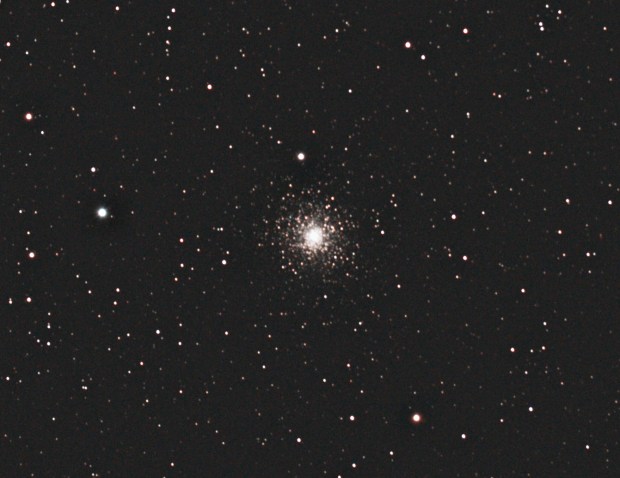
Picture saved with settings embedded.

M15: 12bn light-years old globular star cluster | Constellation Pegasus, 33,600 ly from Earth, apparent mag. +6.2, size 18.0′ (diameter 176 ly) | WO GT81 + modded Canon 550D & FF | 10 x 300 sec @ ISO 800 & full calibration | 22nd October 2016

Although I have previously spent time observing and imaging Saturn and various globular clusters, as well as notable single stars such as Betelgeuse and Altair, for some reason I have neglected their binary relations.  And so in early autumn this year I turned the telescope and camera towards two of the better examples of these double or binary stars. So-called Doubles consist of two stars orbiting around a barycentre, captured by each other’s gravity.  The challenge is to ‘split’ the stars, thereby differentiating each star as individual features and if relevant by colour, either by observing though the telescope or in an image.
albireo-sky

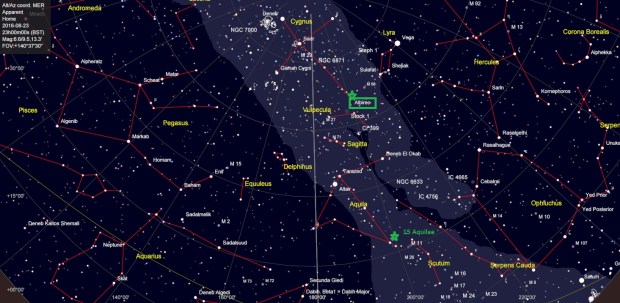
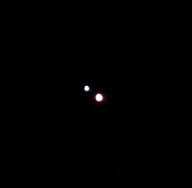
My initial target was the beautiful Albireo (below), a double star consisting of the mag. +3.1 gold coloured Beta Cygni A and its mag. +5.1 bright blue partner Beta Cygni-B.  At a distance of 430 light-years from Earth and separated by 35 arc seconds, the stars have an implied orbital period of at least 100,000 years.  Together with Deneb, Sadr, Gienah and Delta Cygni, Albireo forms the Northern Cross asterism, which lies almost overhead at midnight during the late summer months in the Northern Hemisphere. Situated at the head of the Cygnus (Swan) constellation, Albireo is also known as the “beak star”.  The contrasting colours of the two stars form one of the most beautiful doubles of the summer sky and forms an attractive imaging target.
albeiro-img_0042

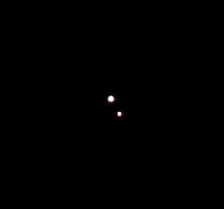
Located in the nearby constellation of Aquila but less notable than Albeiro, is the double 15 Aquilae (below). Some 4-billion years old and a hot 11,000oC in temperature, the larger mag. +5.4 orange giant star is located some 190 light-years from Earth.  Its smaller partner is a cooler white mag. +7.7 star, situated 38 arc seconds away but ‘only’ 4,400oC hot.  Such features abound in the Aquila constellation and I hope to return to this region of the sky again next year for more double fun!
15-aquila-img_0050

Doubles are a real treasure of the night sky that are surprisingly common but are easy to overlook.  They are often interesting as well as beautiful to observe and image – I can’t think why it’s taken me so long to get round to them?

 

Overspill

images-1

After months of cloud followed by 3-months of lost imaging time due to a mysterious camera / mount control problem, I was on the verge of throwing in the towel by August.  But then I sorted the problem, started guiding and as if by magic, with a prolonged spell of good weather managed 7-nights of astronomy between 23rd August and 13th September; such was the intensity I was able to work over consecutive nights and by the end quite exhausted but happy.

Under clear skies and warm nights I could operate in just shorts and a T-shirt, a hitherto unknown experience at Fairvale Observatory.  In such comfort I was also able to experiment and optimize the equipment set-up further – oh, if it could only be like this always.  Of course I did not miss the opportunity to chase some night sky objects as well, imaging 11 targets all-in-all, sometimes on more than one occasion.  It was a glorious time which has since taken time to organise and process.

Top left – NGC 6905 Blue Flash Nebula in Delphinus constellation 42″ x 35″ mag +11 26th August; Bottom left – NGC 6781 planetary nebula in Aquila constellation 1.8′ +mag 11.8 23rd August; Middle M57 Ring Nebula Lyra constellation 1.4′ x 1.1′ mag +8.8 13th September; Right M57 23rd August

A number of these images have already been reviewed in Forbidden Fruit and The future is not what it used to be but, such was productivity that for the record I’ve collected the overspill here.  Inevitably targets reflected what was about and in sight from this location at the time but were nonetheless diverse in nature, ranging from the Witch’s Broom to planetary nebulae, the Andromeda galaxy and, making use of the otherwise frustrating monthly occurrence, the Moon.  Features such as M57 and NGC 6781 are intrinsically too small for the William Optics GT81 and Canon 550D, filling significantly less than 1% of the original image but after cropping both are evident in the final picture.

Top Left – M15 Globular cluster Pegasus constellation 29th August; Top Right – Q1 Moon 23rd August; Middle Right – NGC 6960 Witch’s Broom Western Veil Nebula; Bottom – M31 Andromeda Galaxy 26th August

These images are not particularly memorable but it was a fun time and I will remember the enjoyable experience for a long while.  Of course, the cloud has now returned and since passing the autumn equinox night temperatures have plunged into single figures.  On the plus side, Orion is on its way together with all the other photogenic objects that characterize the winter night sky – can’t wait!

It’s all relative

Having missed 6-months astronomy earlier this year following an operation, come September I was desperate to get back to my nascent interest in astronomy and astroimaging.  Apart from some initial operating mishaps, it turned out to be a good month: warm evenings, clear skies and interesting skies.  Since then it’s all gone Pete Tong, with no imaging opportunities here at Fairvale Observatory since early October due either to cloudy skies or the coincidence of the full Moon with clear periods; it was therefore not surprising to learn that November was recorded as the dullest on record, with just 18 hours of sunshine compared to an average of 63 hours.

My antidote to physical incapacity and cloudy skies this year has been the MOOC or Massive Open Online Course – free online courses run by Universities from all over the world, in my case of course I naturally chose various aspects of astronomy:

  • In the night sky: Orion – Monica Grady, Open University. Orion constellation and star evolution.
  • Moons – David Rothery, Open University. Everything about moons; there are 176 moons in the Solar System some bigger than planets and some with the potential for life.
  • AstroTech: The science and technology behind astronomical discovery – Andy Lawrence & Catherine Hymans, Edinburgh University. Does what it says on the tin!
  • Imagining Other Earths – David Spergel, Princeton University. The complete astronomy course and more! Ongoing 24-week course that covers just about everything in astronomy – outstanding.
  • Gravity! – Pierre Binétruy and George Smoot (Nobel Laureate), Paris Centre for Cosmological Physics – Paris University Diderot. Gravity and how it shapes the universe etc.

This week marked the centenary of Einstein’s general theory of relativity and the end of the course Gravity!  At the same time on Thursday ESA launched the LISAPathfinder space mission, that is designed to assess the viability of ground breaking technology which if successful will be used later to study and measure gravitational waves; whilst on this theme I also watched the movie Interstellar.

Whatever gravity is, and it is clear that despite Einstein et al we still don’t really know (no shortage of theories though), its effects clearly shape the Universe in a major way and at all levels.

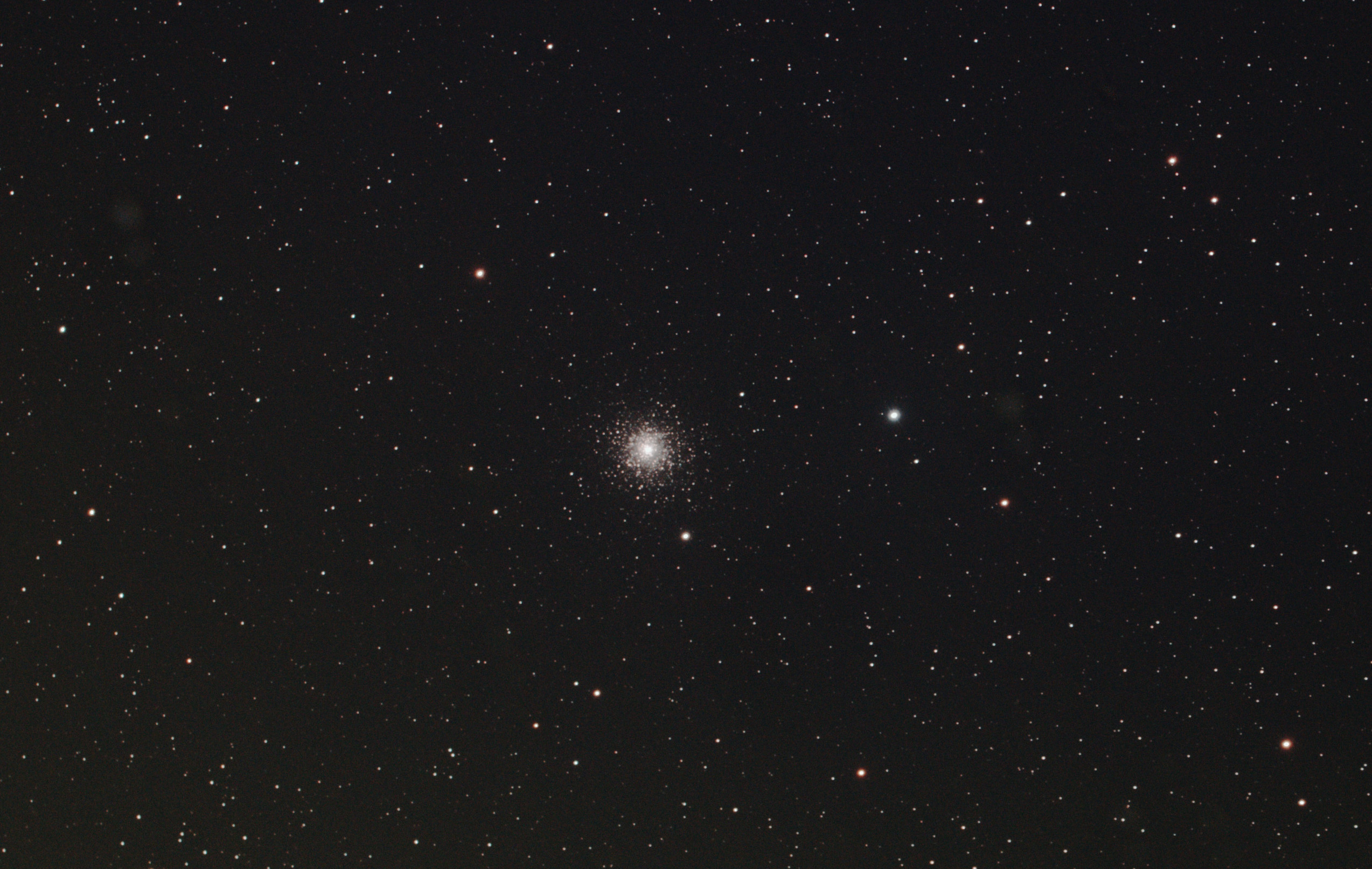
One such feature is the globular cluster, groups of up to one million very old stars, tightly bound by gravity that orbit a galactic core; over 150 have so far been identified with the Milky Way Galaxy.  I find them to be one of the most interesting and enigmatic features of astronomy and therefore before the clouds rolled in some weeks ago I managed to image such a cluster, M15.

M15 CdC

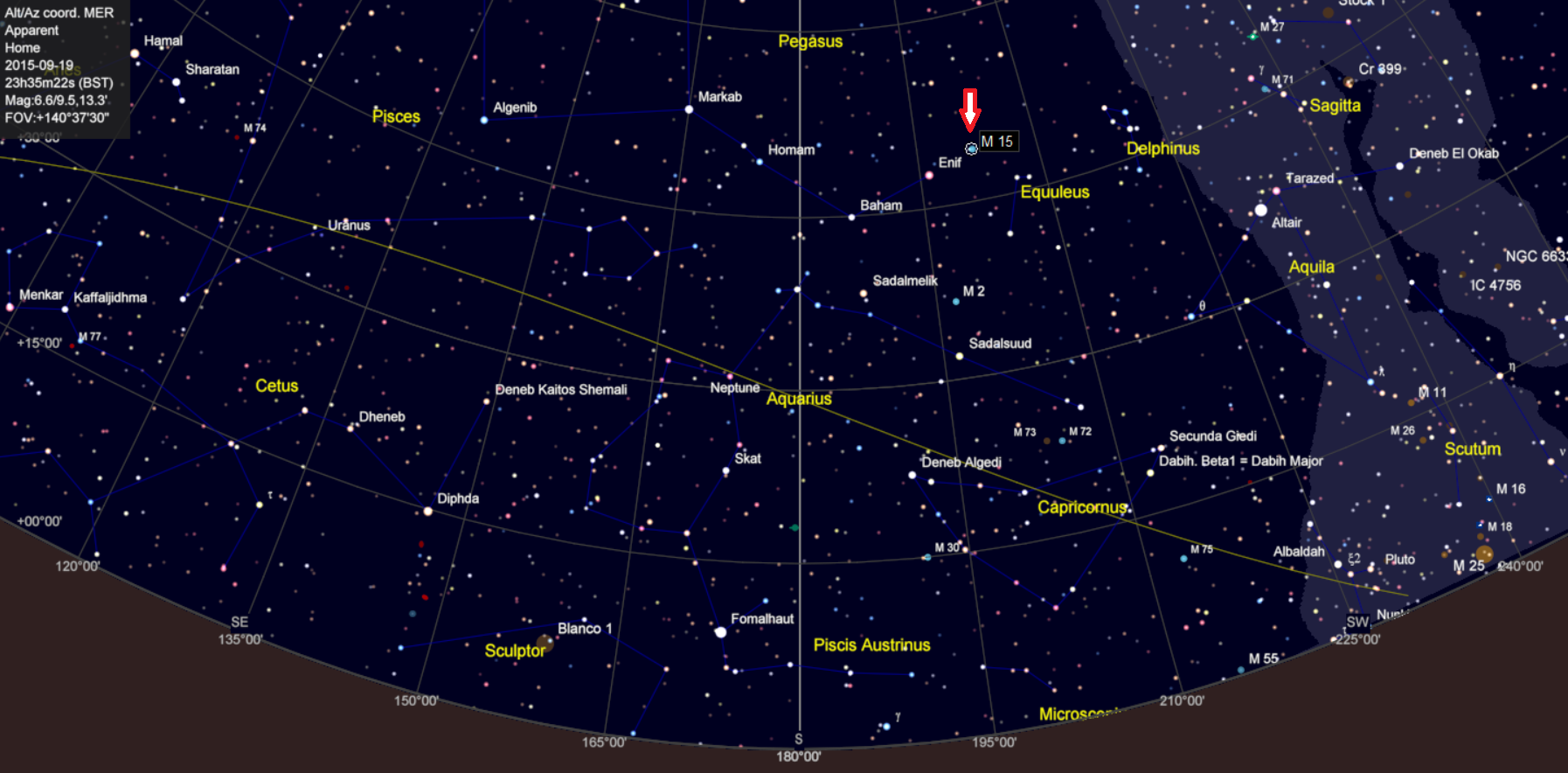
Globular star cluster M15 lies about 33,000 light years away towards the constellation Pegasus, about 4° northwest of Enif, the star at the tip of Pegasus’ nose.  It was discovered by French-Italian astronomer Giacomo Filippo Maraldi in 1746 and rediscovered by Messier in 1764.  At magnitude +6.2, M15 is generally considered to rank amongst the finest objects of its type in the northern sky.

M15 Globular Cluster WO GT81 + modded Canon 550D & FF | 15 x 120 secs @ ISO 1,600 | 19th September 2015

M15 Globular Cluster
WO GT81 + modded Canon 550D & FF | 15 x 120 secs @ ISO 1,600 | 19th September 2015

M15 has a diameter of 120 light years and revolves around the Galaxy once every 250 million years in a prograde orbit, meaning it moves about the galaxy in the same direction as the galaxy’s own rotation.  In 1974, M15 was discovered to be a source of x-ray energy, which may suggest that one or more supernova remnants are buried deep within the cluster.

With such unreliable viewing conditions in the UK it’s essential to find other areas of interest when pursuing astronomy.  I have found MOOCs to be an excellent and accessible source of first rate, up-to-date information that have expanded my knowledge of astronomy significantly, whilst post processing and planning are also both essential tasks that can also often be interesting.  Notwithstanding, with Orion and other exciting features of the winter sky now upon us, I can’t wait to get back outside soon.

At the limit

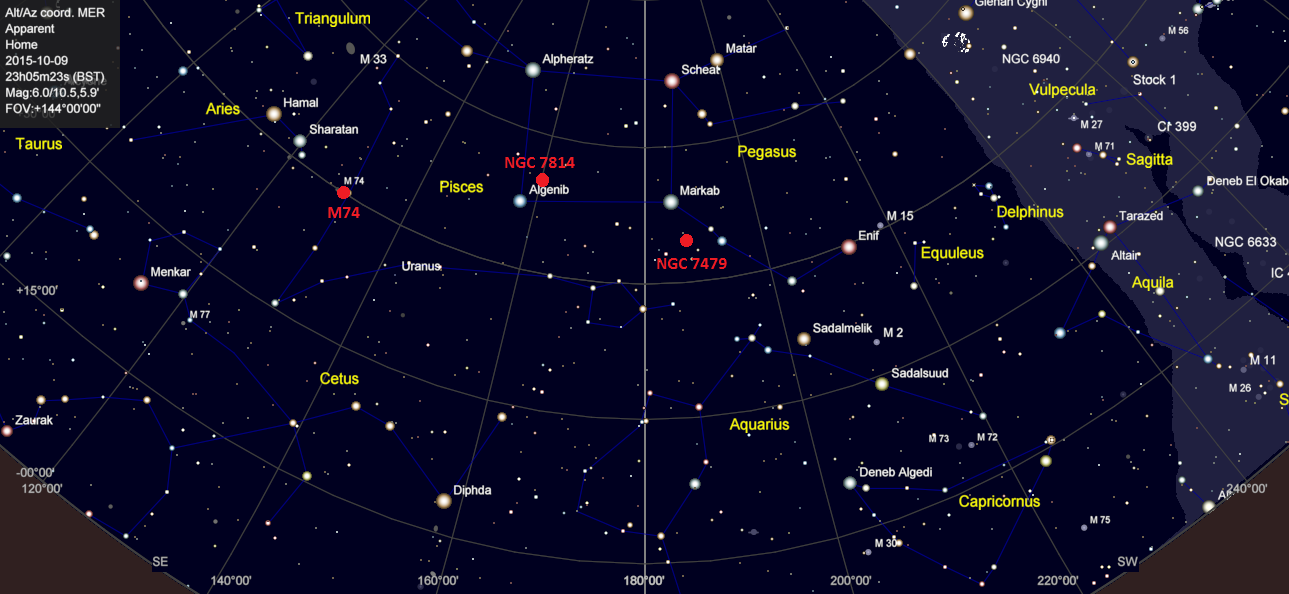
Earlier this month the weather and clear skies produced particularly good imaging conditions that resulted in some excellent pictures; it’s already a distant memory as the weather has since turned cold and cloudy day-after-day – or at least every night except when there’s a full Moon!  With these images knowingly in the bag and the telescope well aligned, I took the opportunity to indulge in a short session imaging some galaxies that happened to be around the Meridian at this time which, as it turned out, were located in proximity to the constellation of Pegasus.

pegasus ANOTATE

Two of the objects (M74 & NGC 7814) were confined to just ten shots and the third fifteen, all at 180 seconds exposure and ISO 1,600.  For such dim and distant objects this in itself was obviously insufficient but still it was fun to experiment.  As expected the resulting images are feint and noisy but the object’s form can be clearly seen and, in the case NGC 7814 – the Little Sombrero, even the edge-on dust lanes are evident.

In order to better understand the limits of the equipment, a comparison of the images with the objects’ physical information given side-by-side illustrates the problems and possibilities for the future.  The truth is that these are all at or beyond the realistic limit of my current set-up but I was interested to see what results could be achieved and I always enjoy their beauty, even if imperfectly captured.

Picture3

Apart from the obvious problem of size, mainly a function of distance in this case, their apparent magnitude is also challenging.  It is interesting to consider that using the 18 megapixel Canon 550D and WO GT81, each camera pixel which measures 4.30μm samples just 1.855 arc seconds per pixel and therefore even the largest of these objects (M74) spans an area of just about one tenth of a degree (0.10o).  Better alignment and longer exposure should tease out more detail but as the recorded image of each object is no more than 2% of the total image the reality is that I am pushing my luck.

Still it is fun and I have managed to capture a few of the photons that left these galaxies so long ago.  As my equipment, techniques and knowledge continue to improve then hopefully so will the limits.  Watch this space!