Nocturnal Bloom

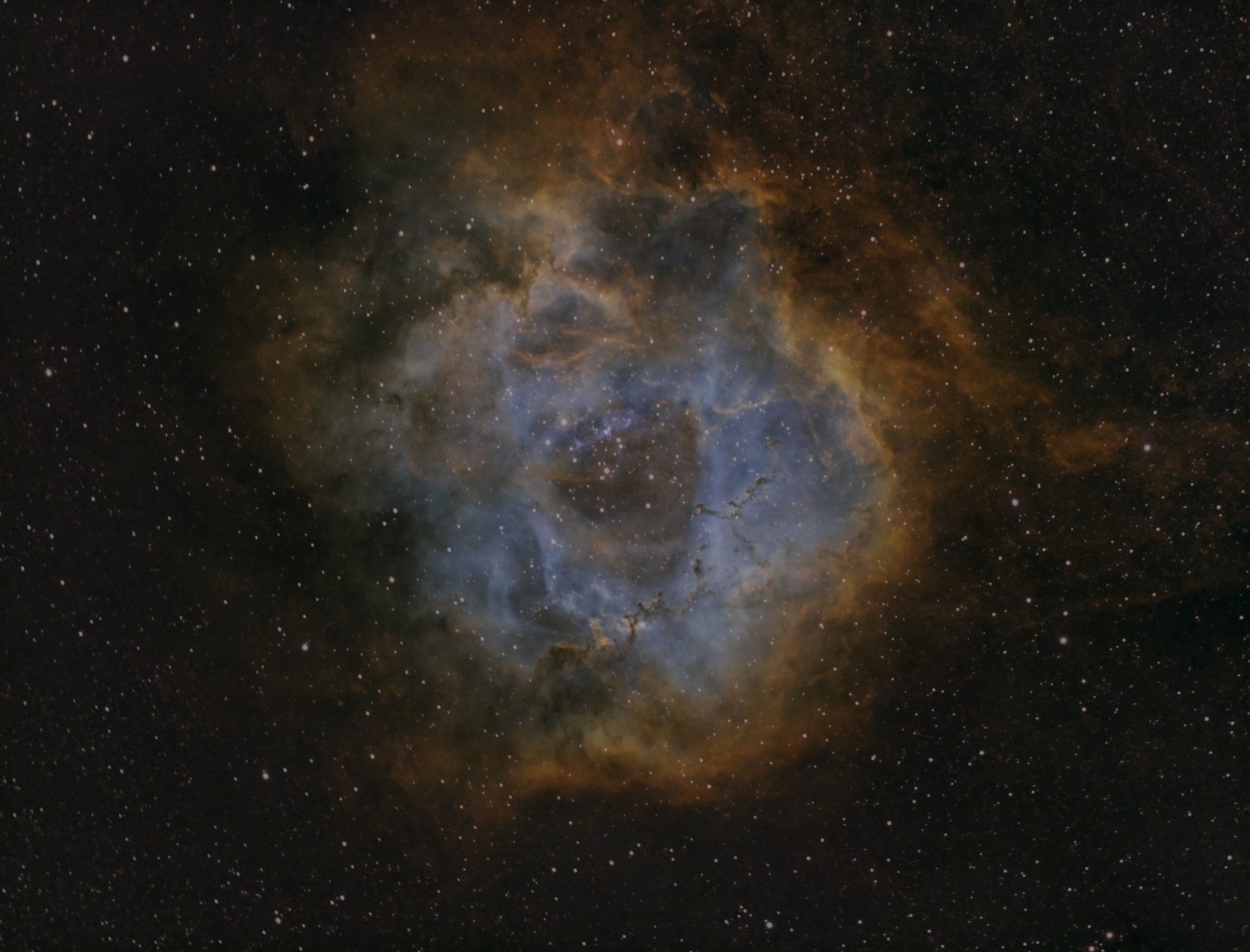
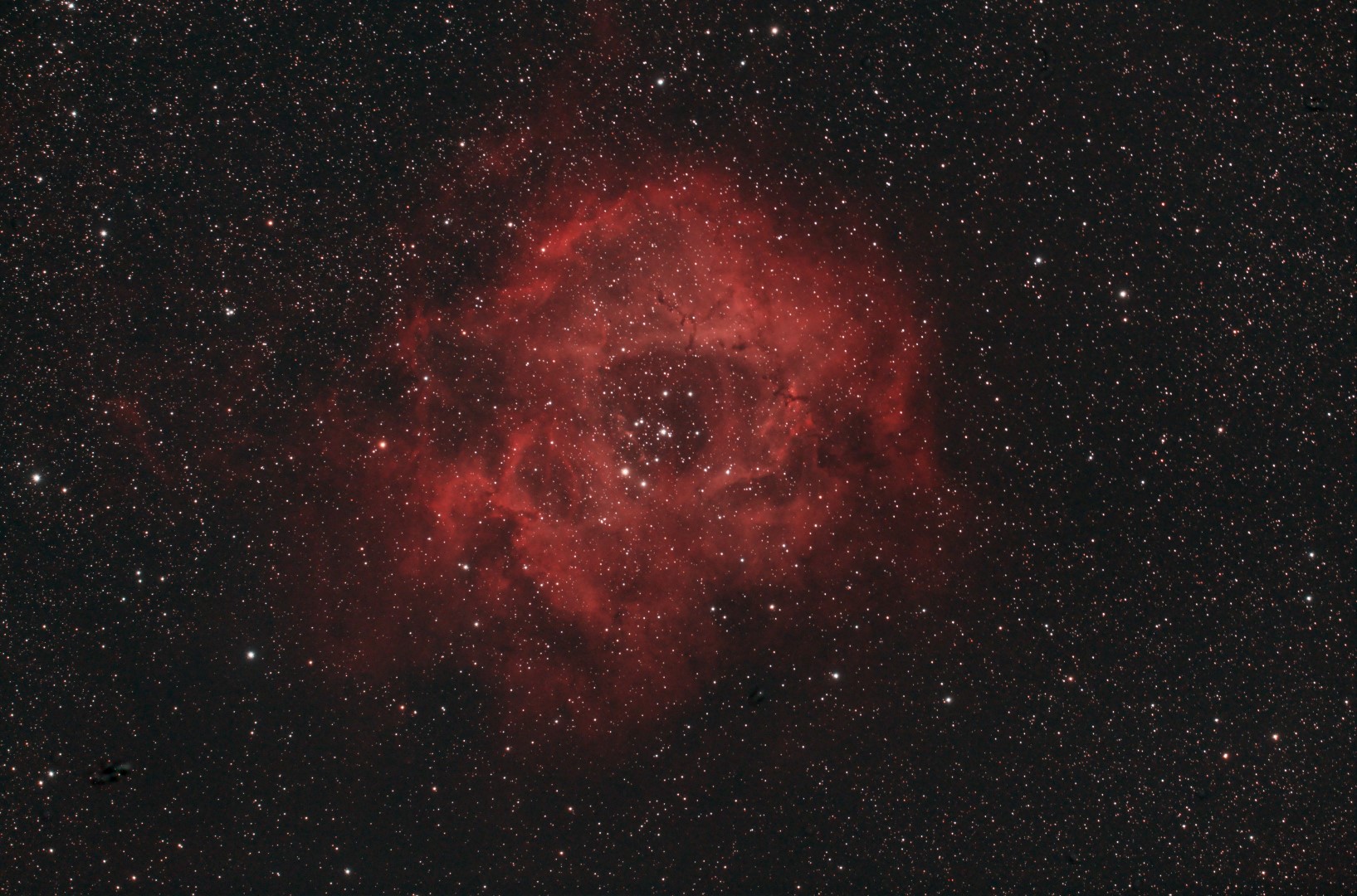
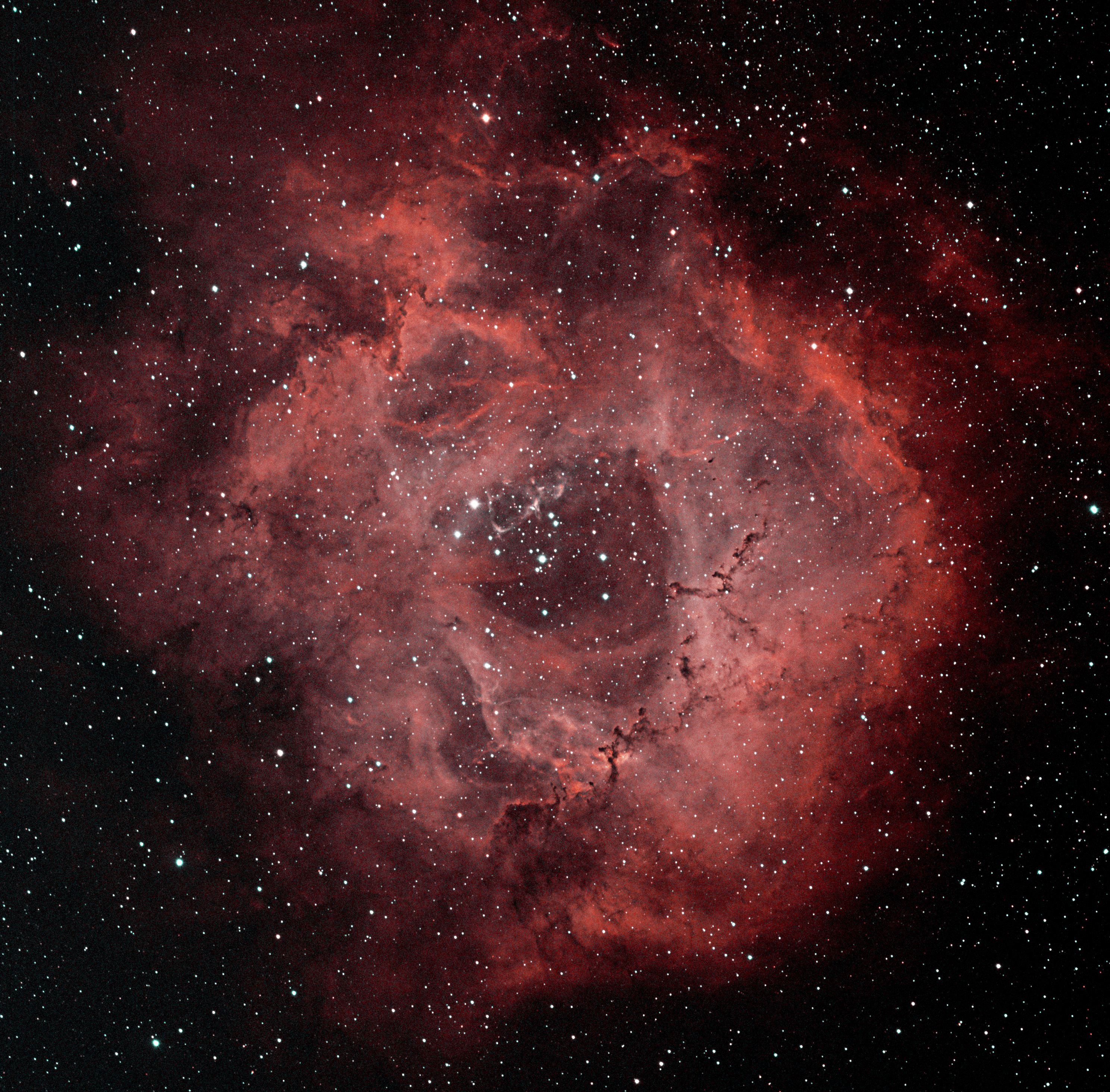
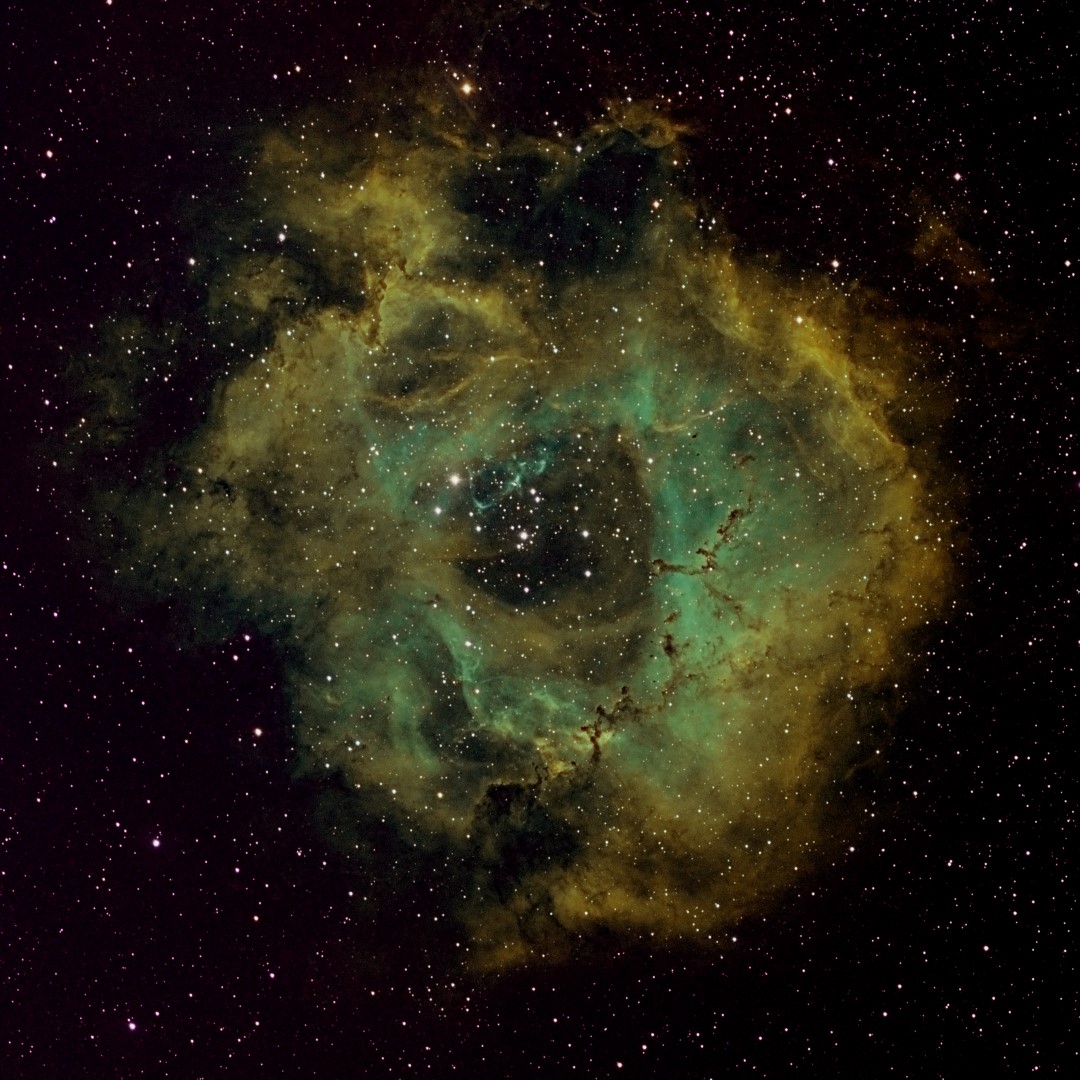
Like many astrophotographers, the Rosette Nebula holds a special attraction for me; it’s size, details and colours produce a perfect narrowband target.  I revisited the old favourite again this year for the fourth time since 2015 (+2017 & 2018), in an attempt to capture even better its unique and dynamic beauty using newer equipment, skills, and techniques.

Located approximately 5,000 light-years away, this vast cloud of gas and dust has been sculpted into a distinctive rose-like shape.  The central star cluster (NGC 2237) has blown-away a large hole within the surrounding molecular cloud (NGC 2244), which all together is some 1.7 degrees or 150 light-years in diameter.  Numerous star-producing dark Bok globules are visible along the upper-left, central quadrant of the nebula, collectively referred to as the “Carnival of Animals”.

The skies this winter have been poor and, as a result, imaging possibilities have been very limited. However, over five nights from January to March I was eventually able to obtain 9-hours of Ha, OIII and SII integration time which, moreover, produced a good data set of 10-minute exposures.

I’m very pleased with the final SHO image (top of the page), which successfully displays the intricate details and colours that arise from the aforesaid make-up and processes that makes the nebula so popular.  Furthermore, experimenting with an HSS palette produced an alternative and exciting image of this rose of night sky (see above), that might be even more in-keeping with its given moniker.  All-in-all, despite this year’s difficulties I’m satisfied that I gave the Rosette my best shot, which is definitely a cut above my previous attempts – though I fully expect to return again in a few years seeking further improvements.


Avian Astronomy: Seagull Nebula

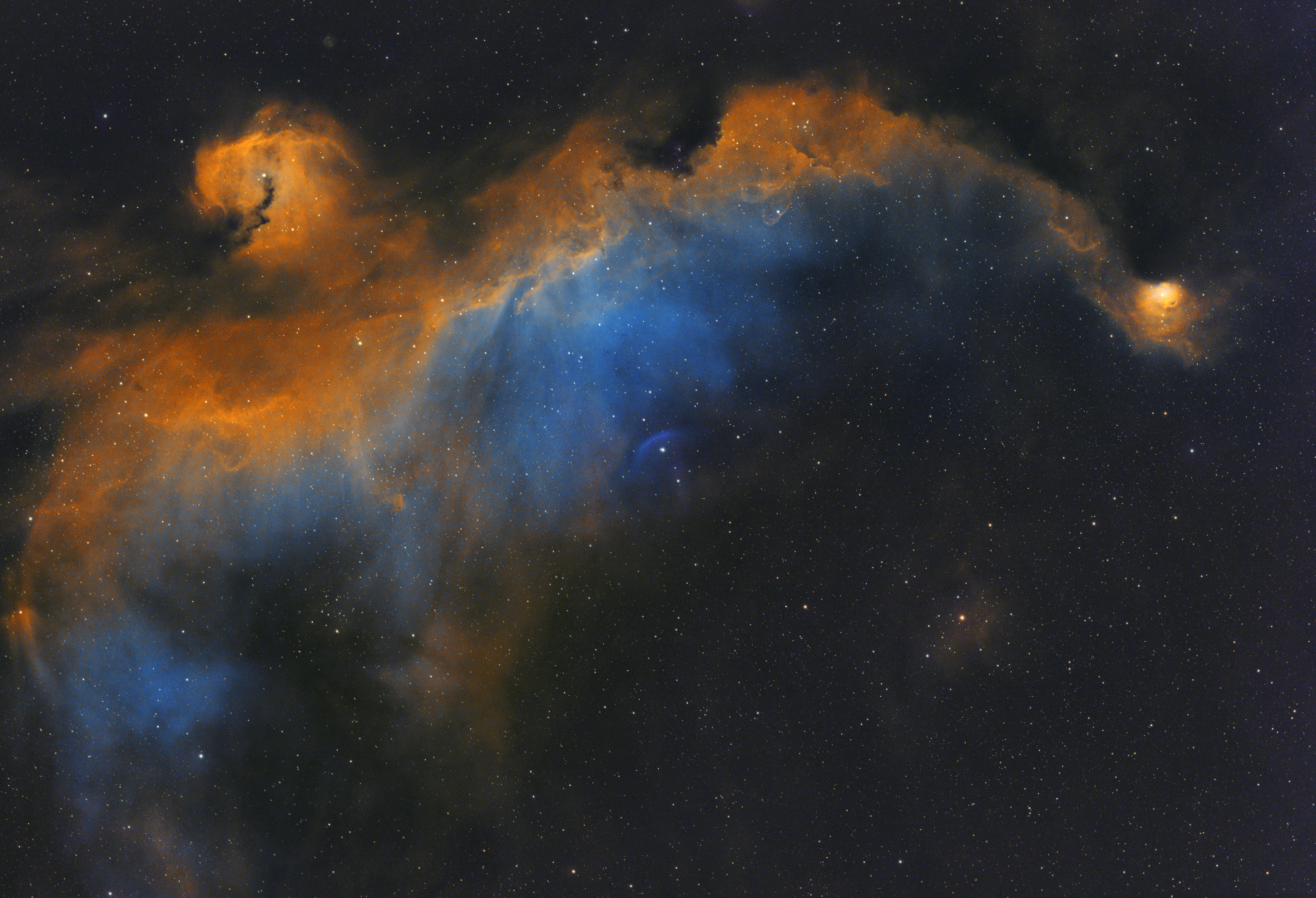
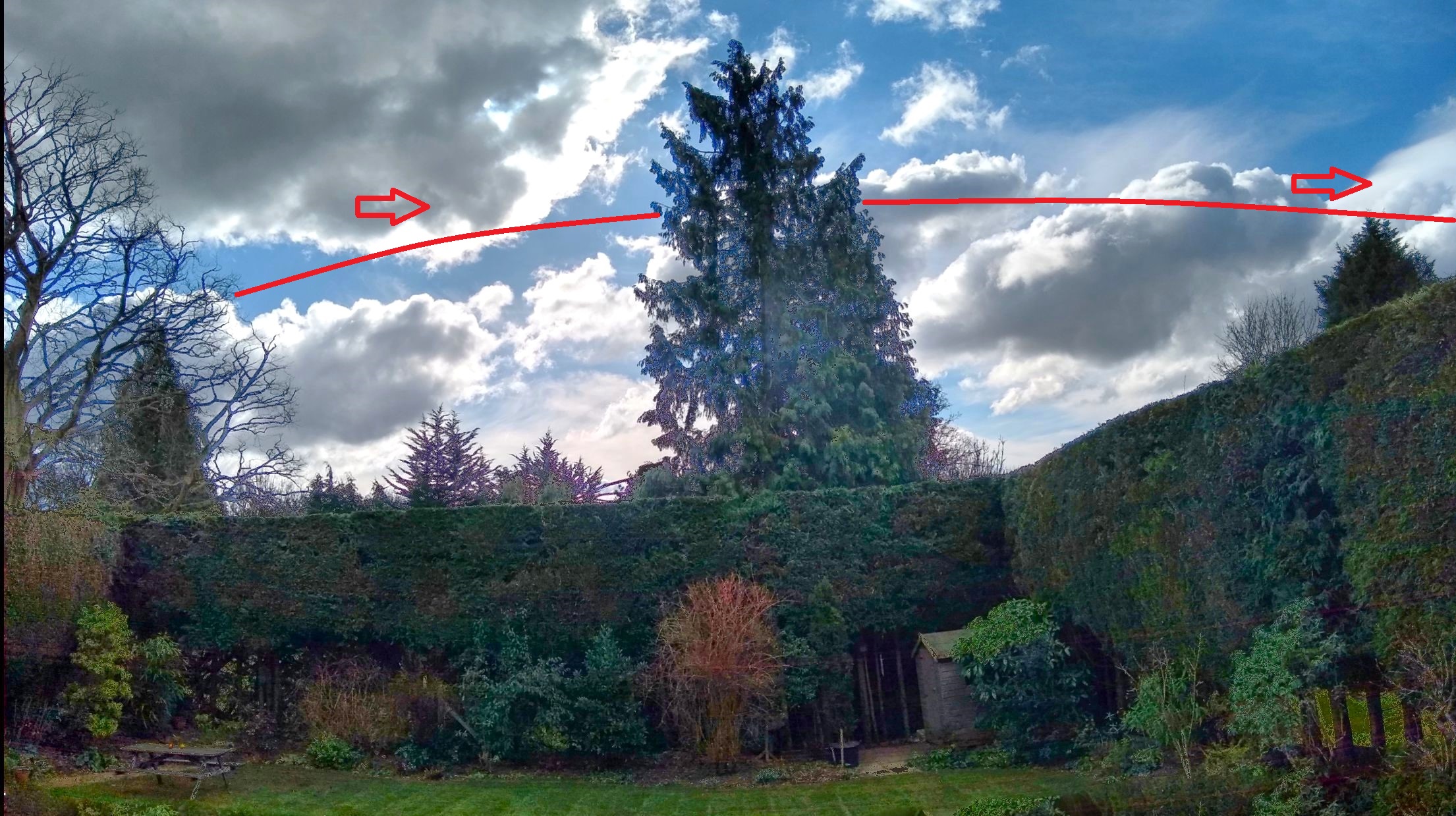
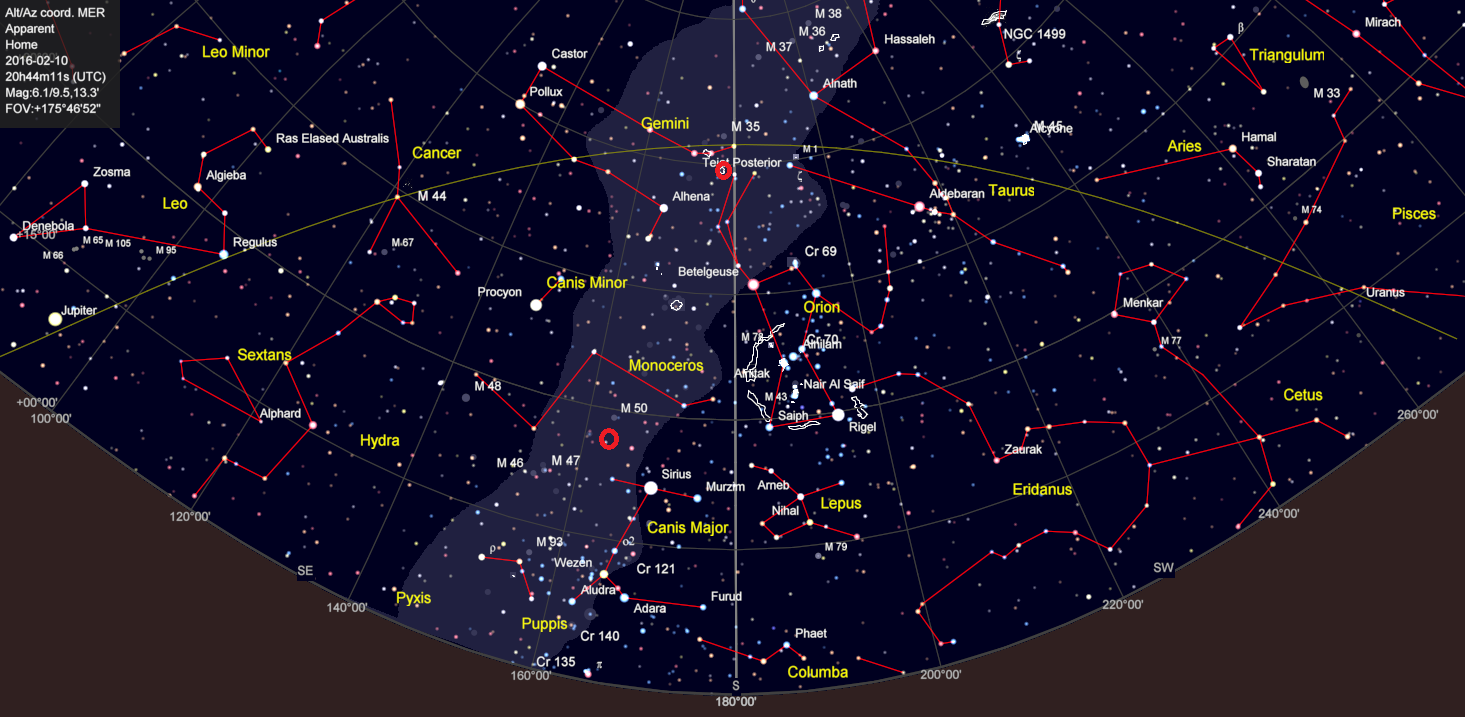
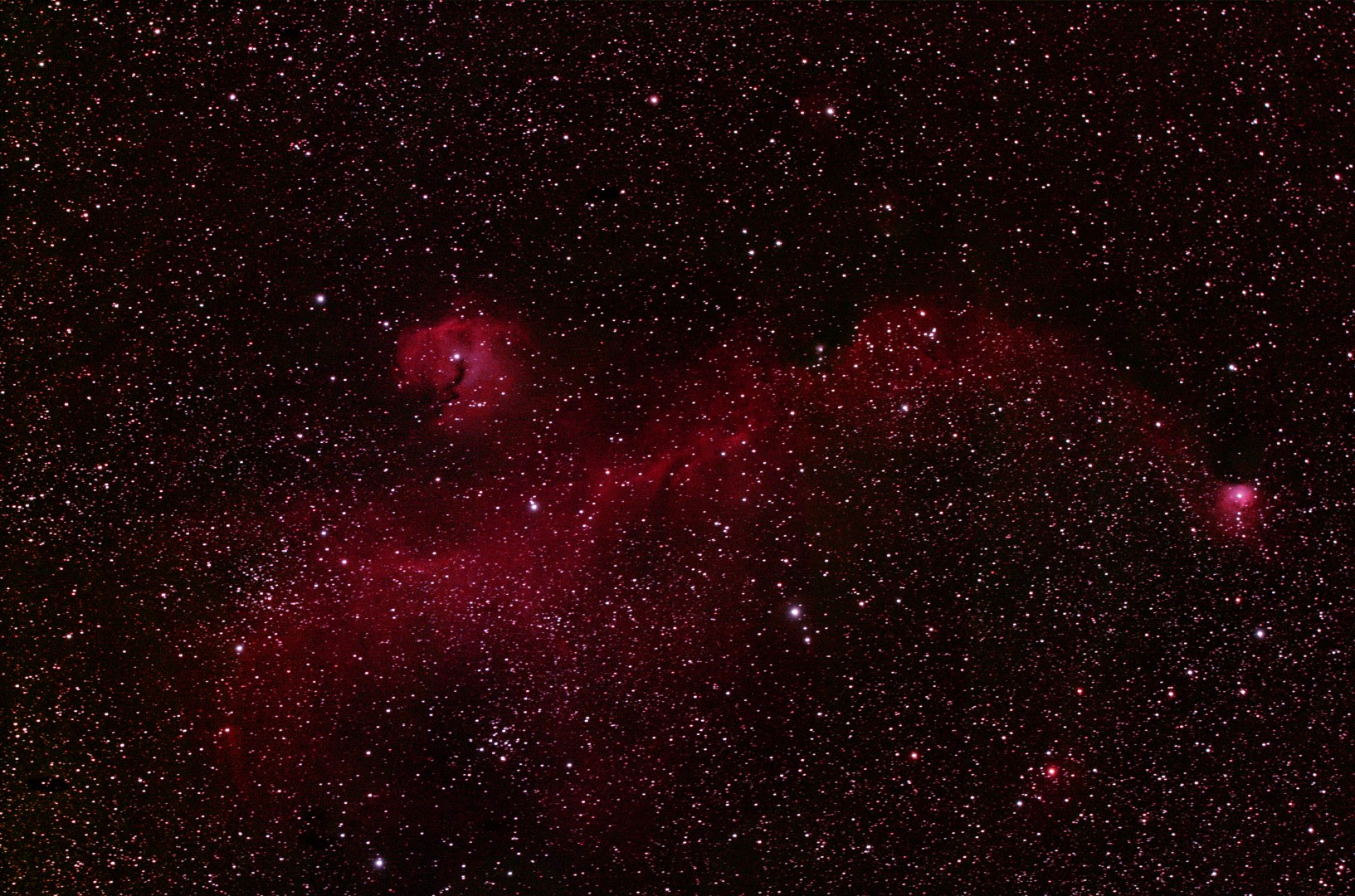
Located 3,650 light-years from Earth, in the area between the Monoceros and Canis Major constellations, is the emission and reflection nebulae complex of the so-called Seagull Nebula.  It’s been 8-years since I last briefly dabbled with imaging this exciting object and for good reason.  From my position, this bird flies at a maximum 28o above the southern horizon (-11 DEC) and, furthermore, spends much of its time behind houses, trees, and tall hedges, thus providing just two short windows for imaging; combined with this winter’s terrible weather it made for a tough but ultimately rewarding target. 


The Seagull’s approximate flight path seen from Fairvale Observatory makes imaging difficult

Whilst popularly known as the Seagull Nebula, the bird consists of a number of fabulous objects spanning some 200 light-years in their entirety: the Seagull’s head (SH2-292) and wings (IC 2177), the large open star cluster along the leading edge of the left wing (NGC 2335) and a smaller cluster on the edge of the right wing (NGC 2327), the nebula at the tip of the right wing (Sh2-297), as well as many other named features (Sharpless and LBN) that are highlighted in the following plate solved image (below).

Despite the difficulties posed by the low transit of the bird in the night sky, each of the Ha, OIII and SII wavelengths are strong, making for good data acquisition and a very pleasing final SHO image.      

The Unicorn’s Finger

SH2-284 is an HII star forming region of dust and gases, sculpted by the radiation and interstellar winds emanating from the young (3 to 4 million years) open star cluster Dolidze 35 located near its centre.  Along the inner edge of the main ring structure are numerous dark dust pillars and Bok Globules, not unlike those of the Elephant’s Trunk nebula, of which the largest seems to resemble a hand with a large bony finger at the end pointing inwards (see cropped + rotated image below).


Despite its close resemblance to the Elephant’s Trunk and the nearby Rosette nebula, the emission nebula SH2-284 is by comparison somewhat overlooked.  Being some x8 times further away it’s apparent size is a good deal smaller and much fainter in nature but still forms an excellent late winter image target.

 IMAGING DETAILS
ObjectSH2-284 or LBN 983
ConstellationMonoceros
Distance18,000 light-years
Size  0.50o
Apparent MagnitudeFaint
  
Scope William Optics GT81 + Focal Reducer FL 382mm  f4.72
MountSW AZ-EQ6 GT + EQASCOM computer control & Cartes du Ciel
GuidingWilliam Optics 50mm guide scope
 + Starlight Xpress Lodestar X2 camera & PHD2 guiding
CameraZWO ASI294MM  CMOS sensor
 FOV 2.87o x 1.96o Resolution 2.50”/pix  Max. image size 4,144 x 2,822 pix   
EFWZWOx8 EFW & 31mm Chroma LRGB filters 
Capture & ProcessingAstro Photography Tool + PHD2 + PixInsight v1.8.9-1  
Image Location              & OrientationCentre = RA 06:45:20.506      DEC +00:18:12.758              Right = North Top = East    
ExposuresHa 53 x 300 sec, OIII 36 x 300 sec, SII 36 x 300sec = 11hr 30 min R 35 x 60 sec, G 35 x 35 sec, B 34 x 60 sec = 1hr 44min Total Integration Time: 13hr 14 min     
 @ 120 Gain   30 Offset @ -15oC    
Calibration5 x 300 sec & 20 x 60 sec Darks + 15 x LRGB & Ha, OIII, SII Flats & Flat Darks           @ ADU 32,000
Location & DarknessFairvale Observatory – Redhill – Surrey – UK        Typically Bortle 5-6
Date & Time6thth + 7th + 8th + 9th + 13th February 2023 @ +19.30h  
WeatherApprox. <=3oC   RH >=70%                  🌙 Full Moon – waning

The Cone, Fox Fur & Christmas Tree

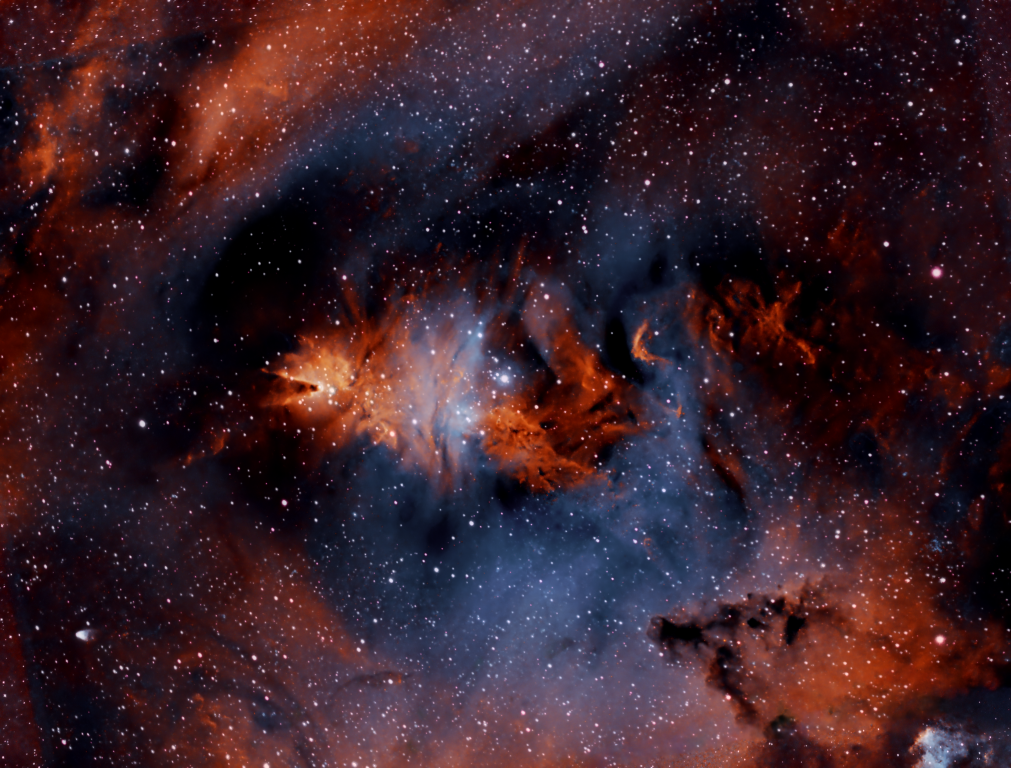
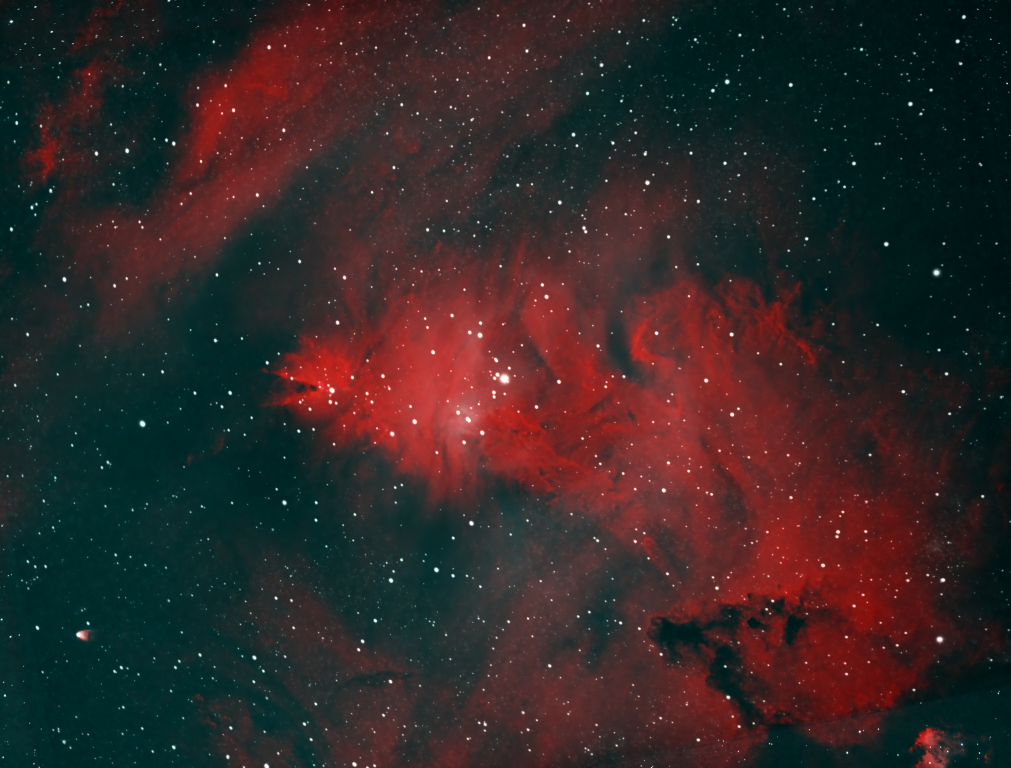
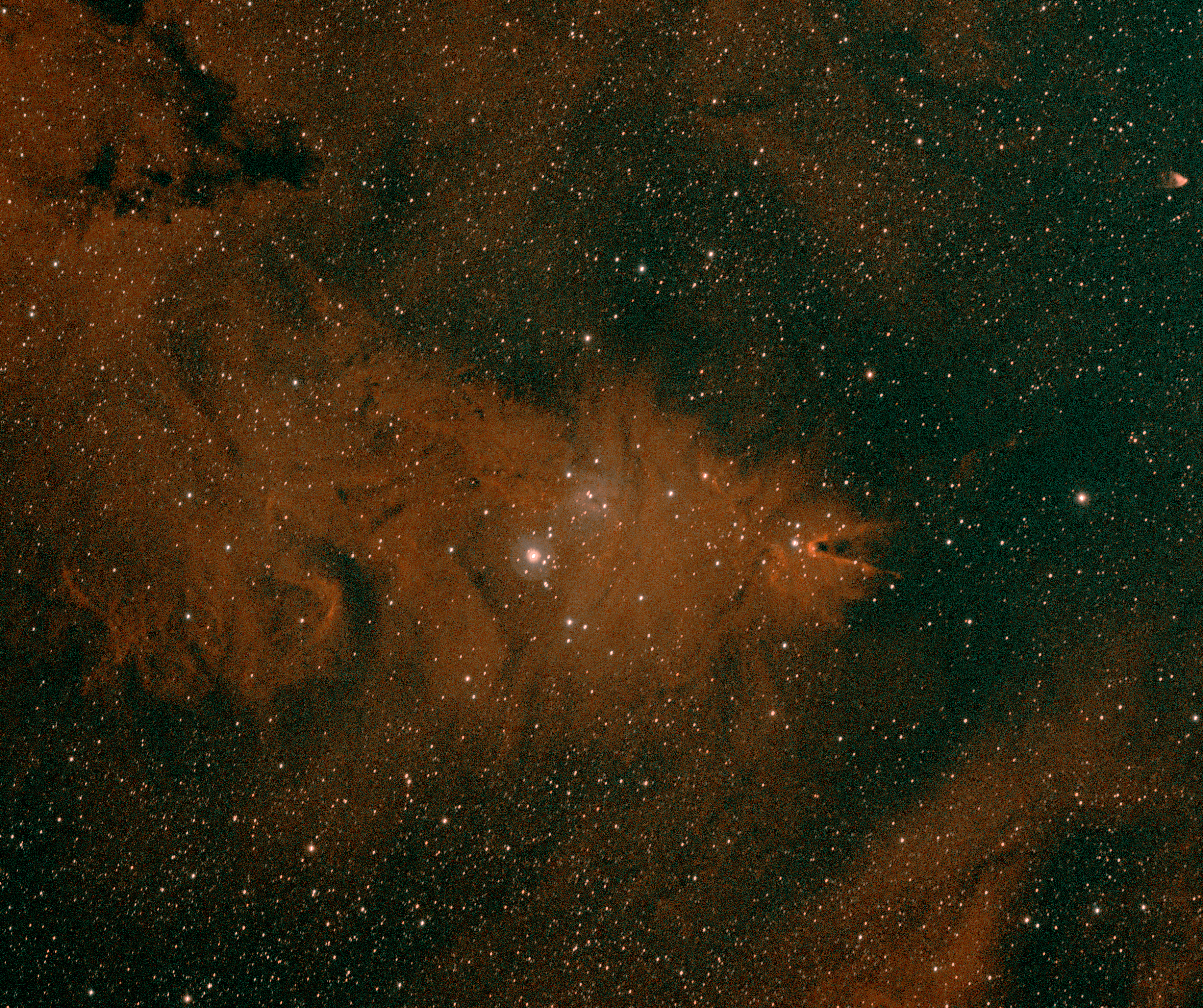
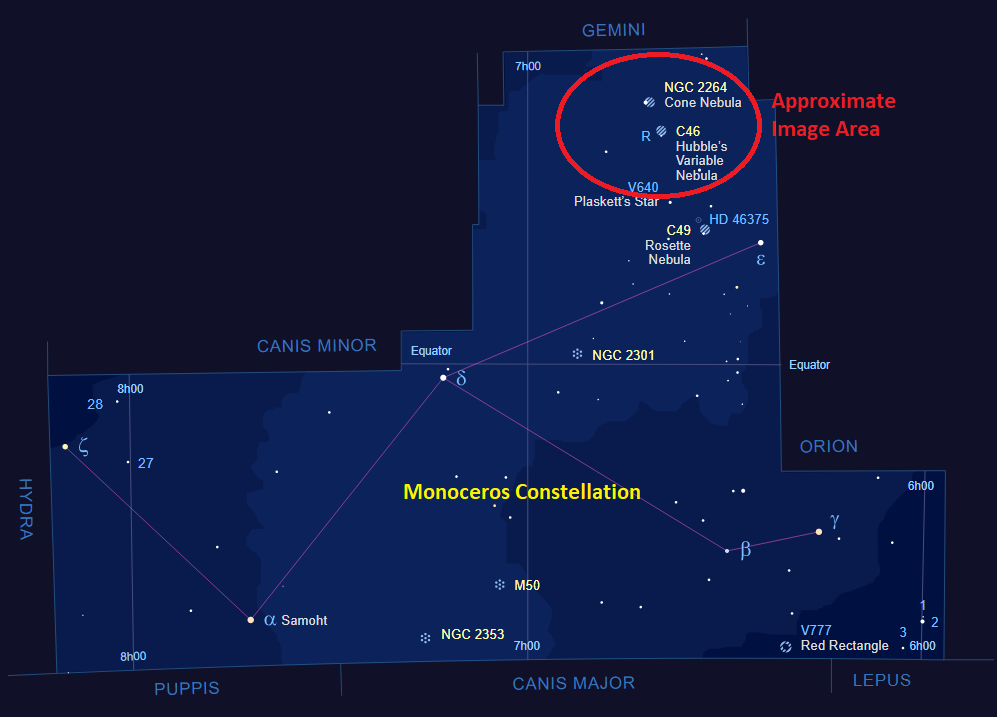
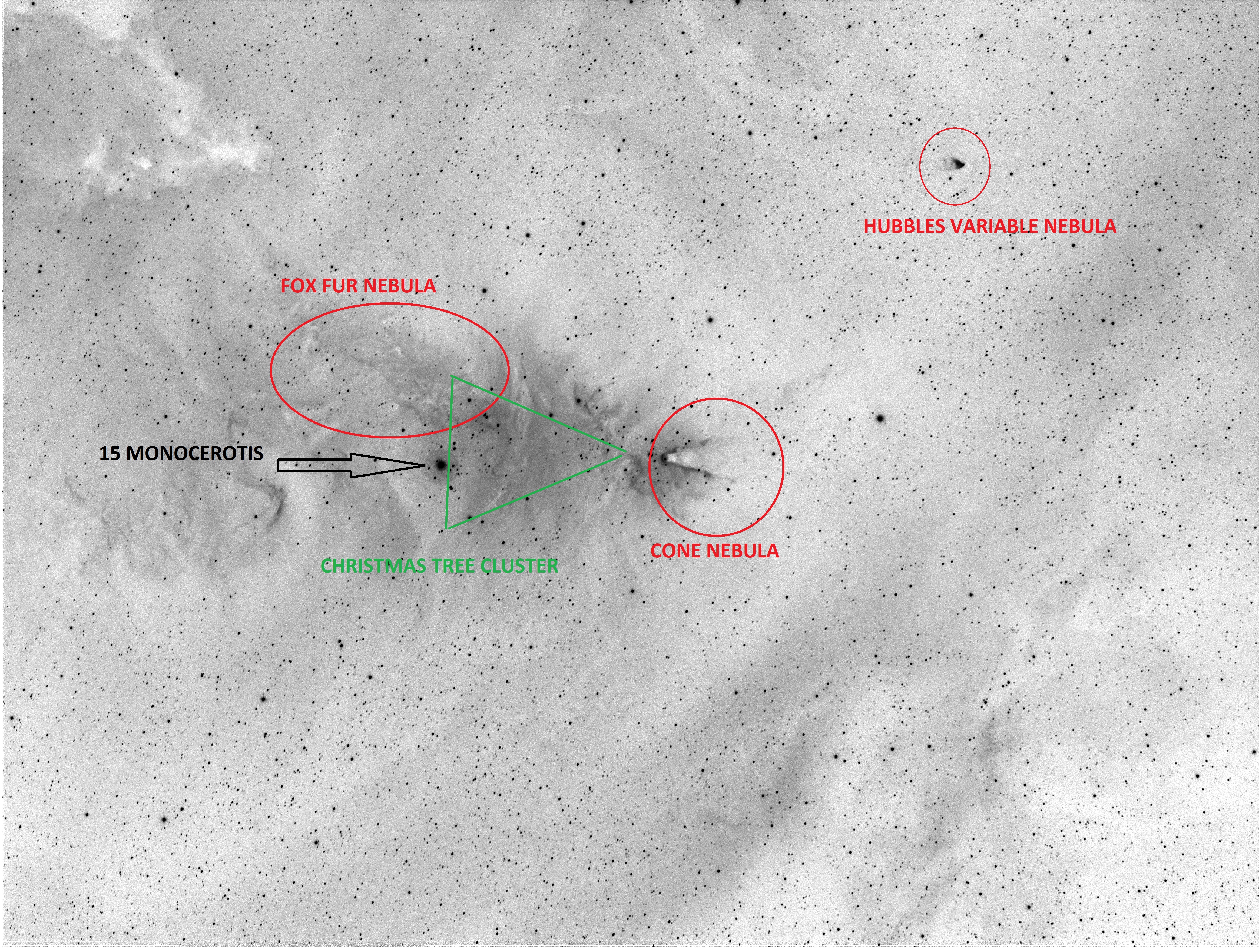
Projecting a line from Bellatrix to Betelgeuse a similar distance beyond to the east (left) by eye, to the northern extremity on Monoceros is one of late winter’s treats.  Located about 2,500 light years from Earth is the star forming region NGC 2264, consisting of the Christmas Tree Cluster (an open cluster), the nearby so-called Cone Nebula and in between the Fox Fur nebula.  I first imaged these objects in 2014 and again in 2018 but now armed with better skills and equipment, a return to this rich area of the night sky which is full of HII, reflection and dark nebula was long overdue + I had a plan to obtain greater detail and colour than was hitherto achieved.

Location of NGC 2264 Christmas Tree Cluster et al based on Wikisky image

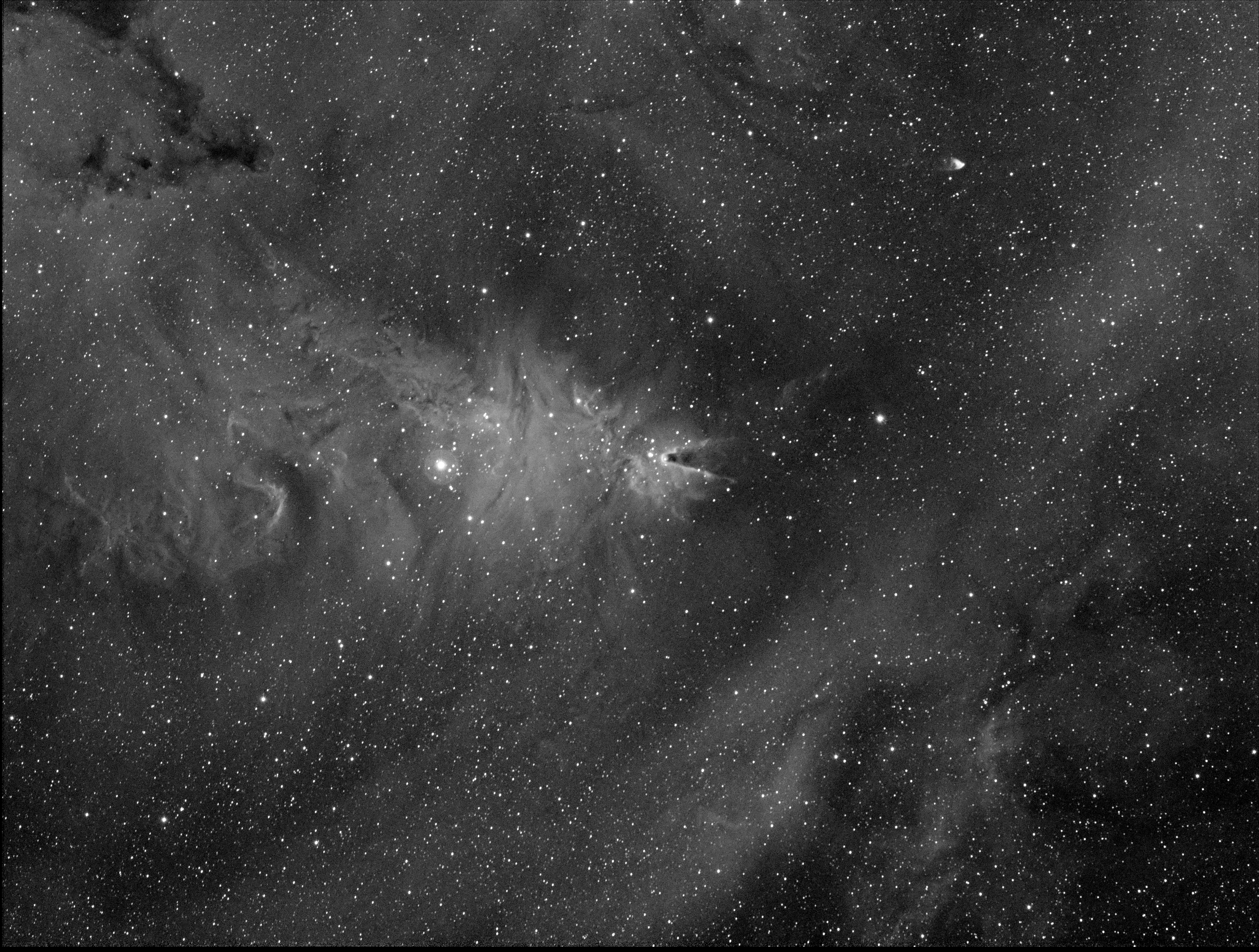
Key to the plan was greater integration time and with 13h 25minutes obtained over three nights at the end of February, this established a solid data foundation.  As ever with all broadband images, there’s an endless choice of permutations combining wavelengths to form a final image and inspired by the work of others, I used the popular SHO Hubble Palette but adapted here by using synthetic SII and OIII channels in PixInsight’s Pixel Math to enhance the related colours: SII = (Ha*0.30+SII*0.70) & OIII (Ha*0.40+SII*0.60+OIII).  The resulting final image has exceeded my expectations, as the colours and details here now successfully highlight the aforesaid central objects as well as the wider complexity and beauty of flowing dust and gases that abounds in this region, which also includes NGC 2261 Hubble’s variable nebula, NGC 2259 open cluster and the emission nebula LBN 902.

NGC 2264 starless version shows detail more clearly
Conventional HOO image version of NGC 2264 widefield

 IMAGING DETAILS
ObjectsNGC 2264 – Christmas Tree Cluster, Cone Nebula, Fox Fur Nebula + NGC 2261 Hubble’s variable nebula, LBN 902 emission nebula & NGC 2259  open star cluster
ConstellationMonoceros
Distance2,500 light-years
Size  ~2.5o total
Apparent MagnitudeVaries    
  
Scope William Optics GT81 + Focal Reducer FL 382mm  f4.72
MountSW AZ-EQ6 GT + EQASCOM computer control & Cartes du Ciel
GuidingWilliam Optics 50mm guide scope
 + Starlight Xpress Lodestar X2 camera & PHD2 guiding
CameraZWO1600MM-Cool mono  CMOS sensor
 FOV 2.65o x 2.0o Resolution 2.05”/pix  Max. image size 4,656 x 3,520 pix   
EFWZWO x8 EFW & 31mm Chroma Ha, SII & OIII filters 
Capture & ProcessingAstro Photography Tool + PHD2 + Deep Sky Stacker, PixInsight v1.8.8-12, Photoshop CC
Image Location              & OrientationCentre  RA 06:40:55.725      DEC +09:53:45.407                         Top is 280o E of N  i.e. Right = approx. North     
Exposuresx39 Ha , x83 OIII,  x39 SII @ 300 sec Total Integration Time: 13hr 25 min     
 @ 139 Gain   21  Offset @ -20oC    
Calibration5 x 300 sec Darks + 15 x Ha, OIII, SII Flats & Dark Flats    @ ADU 25,000
Location & DarknessFairvale Observatory – Redhill – Surrey – UK        Typically Bortle 5-6
Date & Time26th, 27th February & 7th March 2022  @ +19.00h  
WeatherApprox. <4oC   RH >=70%                  🌙 approx.. New Moon

Rosette Nebula – Chroma First Light

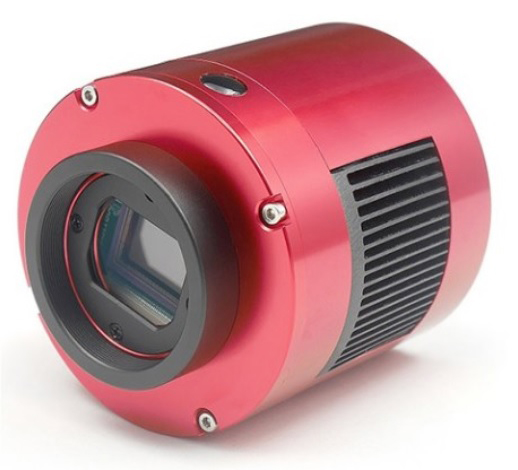
The history of astrophotography will record a period of rapid innovation during the past decade, amongst which one of the stand-out developments has been that of the CMOS sensor based camera, notably the ZWO ASI1600MM-Cool (see below).  Just look at any astrophotography website such as Astrobin and it won’t take long to find an image taken with this camera such is its popularity.  It is this very camera that I was fortunate to purchase in December 2016 shortly after its release and has been the core of my astrophotography set-up ever since. 

I have generally been very happy with the results achieved with the ZWO camera, although an issue sometimes occurs when imaging large stars, so called ‘star bloating’.  There are a number of theories discussed ad nauseam online why this might occur, of which microlensing and / or diffraction seems most likely and probably relates to either – the sensor, sensor cover or filters.  Since beginning with the ZWO camera I’ve used their excellent matching EFW with LRGB and 7nm narrowband filters.  Notwithstanding, the filters are considered to be somewhat ‘low end’ by the aficionados of such things and after living with the ZWO filters for some time, at considerable cost I recently decided to upgrade to a set of Chroma 31mm filters – LRGB + 3nm narrowband.  Together with Astrodon, Chroma filters are generally considered to be the best and my expectations were therefore high.

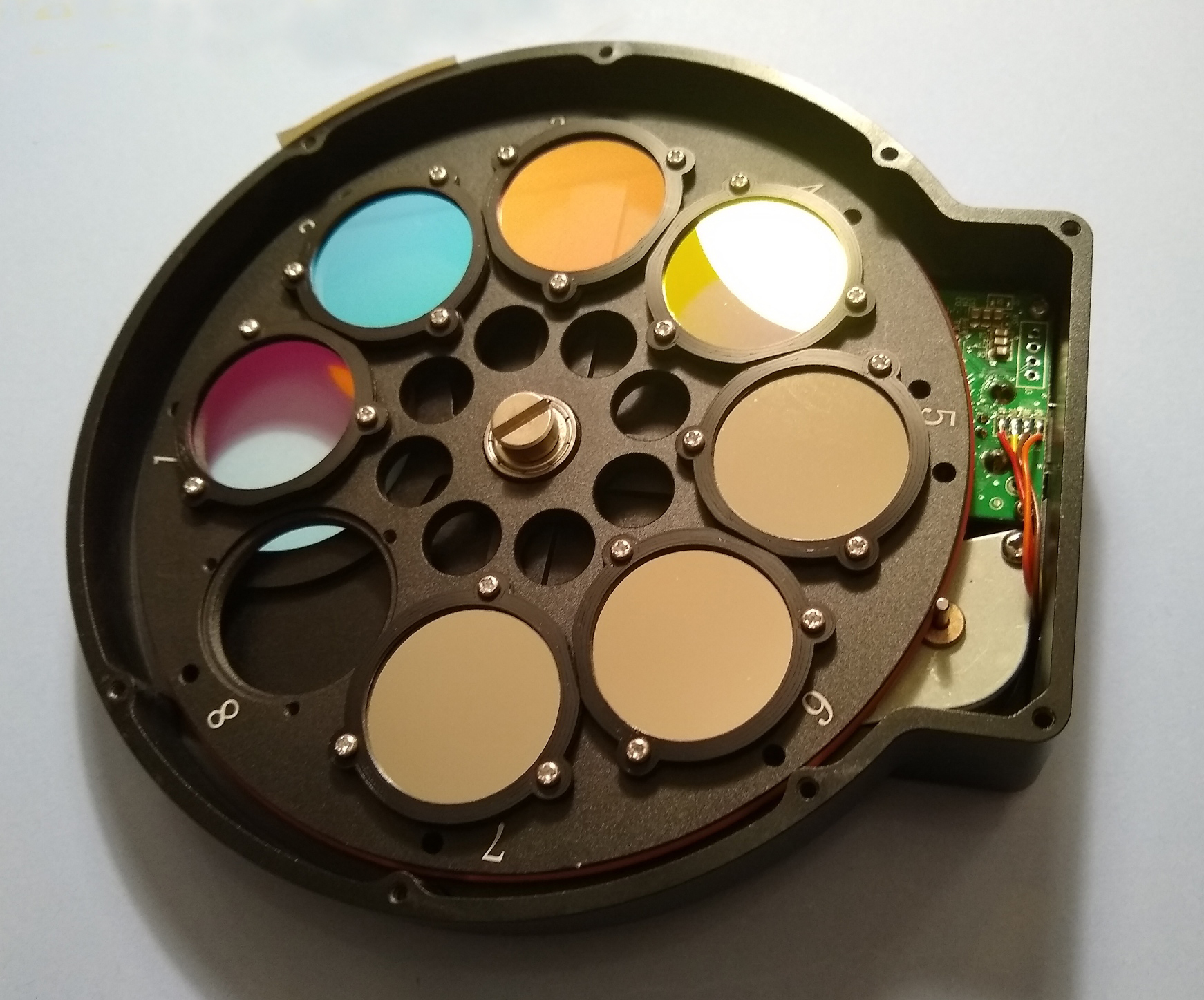
Being unmounted I’d previously found the ZWO filters tricky to install using the small screws and fibre washers supplied.  At 3mm Chroma are physically 1mm thicker than ZWO filters and also need to be fitted in a specific direction, which is ‘letters up’ or with top of the ID letters on the side of the filter facing towards the sensor; this is disputed by the manufacturer but there’s substantial first-hand experience online that suggests otherwise.  With these issues in mind I sought out bespoke filter masks and longer M2 6mm screws to hold the thicker filters firmly in place.  The 3D printed masks from Buckeyestargazer in the USA did a great job securing the filters and are better than those from ZWO – the internal edge of the mask forms an L-shaped ledge into which the filter fits snuggly.  Ready to go, I then had to wait nearly 4-months before the clouds parted to try out these expensive pieces of glass and then it was a full moon – I often wonder if astrophotography is a good hobby to choose in the United Kingdom but it’s too late now?

Chroma filters secured with Buckeyestargazer masks and ready to go

Given the presence of the moon it therefore had to be suitable narrowband target and after three years since I’d last imaged this object it was an opportunity to have another go at NGC 2244 AKA the Rosette Nebula, though being late February there was limited time each night before the object sunk low behind trees on the western horizon; coincidentally the ZWO ASI1600MM-Cool First Light in early 2017 was also the Rosette.  Before starting serious imaging I first tried some test shots to make sure everything worked OK and immediately discovered that the change from 7nm to 3nm had a significant impact on light gathering, thus requiring greater exposure times of an unprecedented 10 minutes.  Not surprisingly this was also apparent when taking flats which increased exposure time of up to x10 longer in duration compared to the ZWO filters; conversely preliminary but limited tests on the broadband filters seem to indicate greater transparency and thus shorter exposures, time will tell if this is correct.

So was it all worth it?  I’m very pleased with the final image which was processed using the SHO Hubble Palette with PixInsight and Photoshop (see top of the page).  There are a number of significant bright stars in and around the Rosette which the Chroma filters have handled well but overall it is the more delicate tone that has been achieved which is most pleasing.  Fundamentally the 3nm filters have produced a more subtle quality to the overall image and in particular the nebulosity.  In addition, applying Hartmut Bornemann’s excellent colour calibration script AutoColor for the first time (see Visible Dark’s video tutorial here) has resulted in a soft but exciting colour palette. 

Subsequently I have focussed on the inner region of the nebula which contains the so-called ‘Carnival of Animals’ (see above), which has been cropped and reprocessed individually to show-off the ‘animals’ or Bok globules –   named after the Dutch-American astronomer Bart Bok, who in 1947 proposed that these dark nebula indicated clouds of dust undergoing gravitational collapse as part of the process of new star formation, which has since been confirmed.  In conclusion I’d therefore say that despite the obstacles, issues and long wait, on the evidence so far the addition of the Chroma filters to my set-up has been very successful – transformative in fact.  Now I wonder if they make something that removes the clouds?  

 IMAGING DETAILS
ObjectNGC 2244 + 2337 + 2238 + 2239 + 2246  AKA the Rosette Nebula
ConstellationMonoceros
Distance5,200 light-years
Size65 light-years
Apparent Magnitude9
  
Scope William Optics GT81 + Focal Reducer FL 382mm  f4.72
MountSW AZ-EQ6 GT + EQASCOM computer control & Cartes du Ciel
GuidingWilliam Optics 50mm guide scope
 + Starlight Xpress Lodestar X2 camera & PHD2 guiding
CameraZWO1600MM-Cool mono  CMOS sensor
 FOV 2.65o x 2.0o Resolution 2.05”/pix  Max. image size 4,656 x 3,520 pix   
EFWZWO EFW + Chroma Ha, OIII & SII 3nm filters 
Capture & ProcessingAstro Photography Tool + PHD2 +  Deep Sky Stacker & Photoshop CS3
Image Location              & OrientationCentre  RA 06:31:52.688      DEC 04:58:11.11                        Top = North     
Exposures12 x 600 sec  Ha & SII  11 x 600 sec OIII Total Time:  5hr 50 min   
 @ 139 Gain   21  Offset @ -20oC    
Calibration5 x 600 sec Ha + OIII + SII   Darks 20 x 1/4000 sec Bias  &  15 x  Ha + OIII + SII Flats & Dark Flats               @ ADU 25,000
Location & DarknessFairvale Observatory – Redhill – Surrey – UK        Typically Bortle 5-6
Date & Time26th 27th 28th February 2021  @ +21.15h  
WeatherApprox. <5oC   RH >=65%                  🌙 100% Full Moon

The Fox & Cone

Cone Ha100 20 15 OIII B CROP

After the fun of December and January provided by the wide choice of exciting DSO objects, February affords a worthy finale to the winter season, in particular within the constellation Monoceros.  After successfully imaging the Rosette Nebula on 9th February, a few days later I was able to move on to another nearby HII-region in the Milky Way, with equally good results.  Surprisingly it’s been just over 3-years since I last imaged the same part of the sky just before Christmas 2014, on that occasion with an unmodded Cannon 700D DSLR.  Now armed with the more capable ZWO1600MM-Cool camera and narrowband filters, the potential for raising the bar was good and the results did not disappoint.

Untitled

Of foremost interest this time was NGC 2264, which officially describes the Cone Nebula and Christmas Tree Cluster but also includes the Snowflake Cluster and Fox Fur Nebula, all set within a large HII-region.  Individually each object is towards the limit of my equipment’s resolution but taken all together makes for an interesting combination when encompassed inside the 2.65o x 2.00o field-of-view.  Like the Rosette I chose to image in narrowband, with a total integration time of 90 minutes; again using 300 second subs at Unity gain proved to be very effective – I suspect that only more subs rather than longer exposures would lead to a better outcome but that will have to wait until I’ve sorted how to plate solve, watch this space!

Picture saved with settings embedded.

I’ve recently been experimenting in Photoshop using star masks and related sharpening and contrast enhancement methods, which for the first time I applied when processing these images to great effect.   Being an HII-region the overall image area is dominated by Ha-light and the processed Ha-subs resulted in a very exciting image at this wavelength, with many subtleties revealed throughout (see below).  On the other hand OIII and especially SII wavelengths are much less prevalent, from which it would seem  that a higher ratio of those subs would be required to better tease out detail at those wavelengths.  Notwithstanding, the resulting Ha-OIII-OIII Bi-Colour image has turned out well (top of the page), with all the aforementioned objects showing clearly.

Picture saved with settings embedded.

The signature object of this image is probably the Cone Nebula.  New stars are forming within a cone shaped dark molecular cloud, itself sculpted by strong stellar winds. However, I consider the Fox Fur Nebula (Sharpless-273) to be the bigger imaging challenge, which I’m therefore pleased to say is starting to show well in these images.  The name derives from the rich, fur-like texture of the nebula which is also shaped by stellar winds; reckon The Fox & Cone would make a good pub name! Below:  Cone Nebula & Christmas Tree Cluster Ha-OIII-OIII before colour mapping.

Cone Ha100 20 15 OIII A crop

But there’s more. A series of stars form an inverted outline shape of the so-called Christmas Tree Cluster above the Cone Nebula (see image above), with the conspicuously bright 15 Monocerotis at its base made of a massive variable star system.  And finally, somewhat off piste, lurking in the top right corner of the main image is NGC 2261 or Hubble’s Variable Nebula.  Discovered by Edwin Hubble in 1949, the nebula is illuminated by the unseen R Monocerotis star and forms a small but distinct bright triangular area.

All-in-all this is a great part of the February sky for imaging.  There’s still more to discover and I won’t leave it as long as 3-years before going back again, with the objectives of increasing integration time and possible addition of RGB subs to enhance the colour potential.

IMAGING DETAILS
Object Fox  & Cone Nebulae  NGC 2264 + Hubble’s Variable Nebula NGC  2261     
Constellation Monoceros
Distance 2,700 light-years
Size Approx. 54’ x 37’
Apparent Magnitude +3.9
 
Scope  William Optics GT81 + Focal Reducer FL 382mm  f4.72
Mount SW AZ-EQ6 GT + EQASCOM computer control
Guiding William Optics 50mm guide scope
  + Starlight Xpress Lodestar X2 guide camera & PHD2 control
Camera ZWO1600MM-Cool (mono)   CMOS sensor
  FOV 2.65o x 2.0o    Resolution 2.05”/pix   Max. image size 4,656 x 3,520 pix   
EFW ZWOx8 + ZWO LRGB & Ha OIII SII 7nm filters 
Capture & Processing Astro Photography Tool,  Deep Sky Stacker & Photoshop CS2
Exposures 12 x 300 sec Ha, 6 x 300 sec  OIII   (Total time: 90 minutes)
  @ 139 Gain  21 Offset @ -20oC  
Calibration 5 x 300 sec Darks  20 x 1/4000 sec Bias  10 x Flats Ha, OIII & SII @ ADU 25,000  
Location & Darkness Fairvale Observatory – Redhill – Surrey – UK        Typically Bortle 5
Date & Time 11th February 2018 @ 21.00h

What Comes Around Goes Around

RGB HaOO XXX2

It’s nearly 4-years since I started astronomy, like so many inspired after observing Saturn through a telescope.  Not just any telescope but the 13” Astrographic Refractor at the Observatory Science Centre in Herstmonceaux.  Built in 1890 specifically to make use of the then new technique of astrophotography, the telescope was first employed as part of the worldwide Carte Du Ciel project to map the entire night sky by photography and subsequently for a crucial test of Einstein’s then new theory of General Relativity.  Soon thereafter I was to view the aforesaid planet once again with my first, newly purchased Skywatcher 150PL Newtonian telescope.  Inevitably something of a lesser view than that at Herstmonceaux it was nonetheless just as exciting, if not more so.  I was hooked!

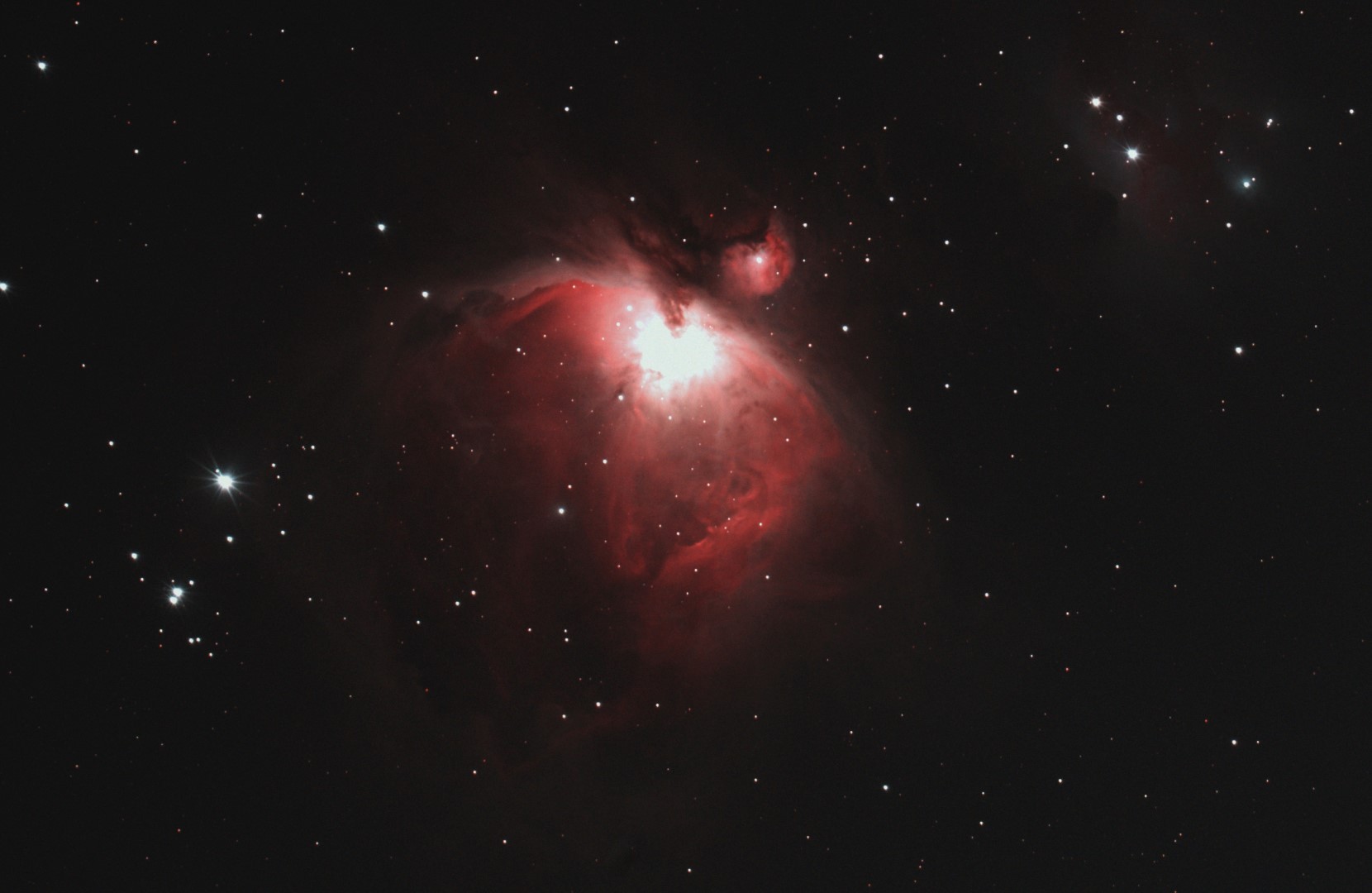
I then attempted afocal imaging using a compact camera held up to the telescope eyepiece but with poor results, except in one respect.  By clamping the camera onto the front of the eyepiece and achieving longer exposures, nebulosity otherwise unseen with the naked eye was revealed in the resulting image, in this case Orion’s Nebula.  As crude as the image was, for me the penny had dropped and I’ve been pursuing images of the hidden beauty of the night sky ever since.
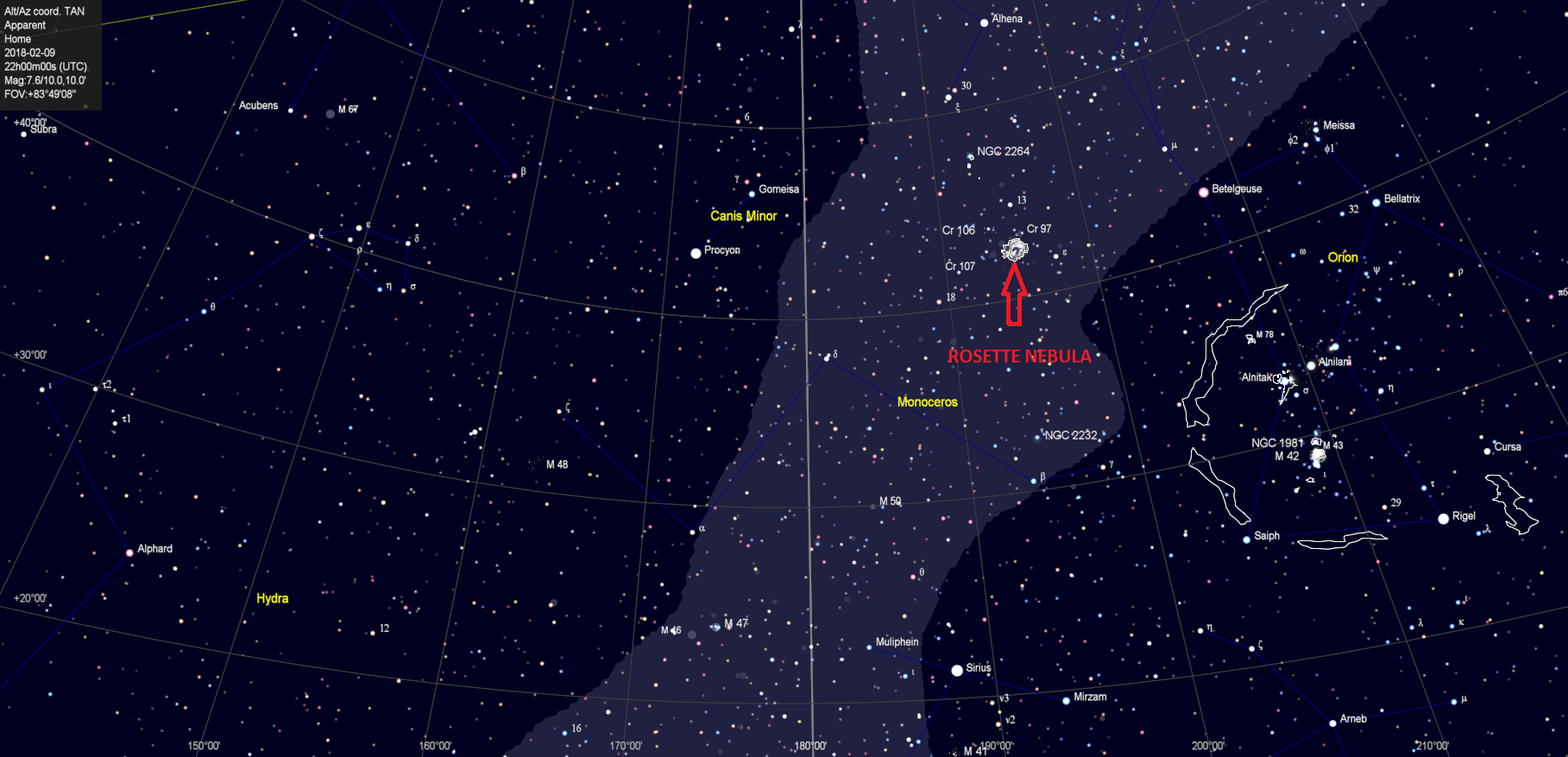
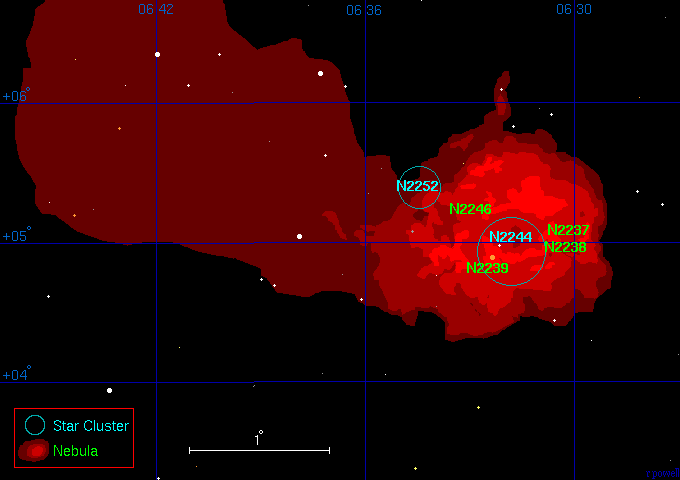
rosette map

ngc2237map

Like mariners, through astronomy I have by now become accustomed to the seasonal procession of the night sky wonders throughout the year, none more so than the Rosette Nebula.  About 100 light-years across and 5,000 light-years from Earth, the Rosette Nebula is surely one of the annual highlights for most astrophotographers?  Located just east of Orion, the Rosette is at its best between December and February, so that I was first able to image this beautiful object myself at the end of 2014.

As a very large HII region the Rosette Nebula emits light mainly at narrowband wavelengths, which produces wonderful but mainly red colours when imaged with a modded DSLR camera.  As my astrophotography and equipment have since developed, it has become a pleasure and challenge to image objects as they return each year such as the Rosette, thereby also charting my own improvements or otherwise from year-to-year.  Its size makes the Rosette an especially attractive target for smaller telescopes such my own with an 81mm aperture, which nicely fills much of the sensor of an APS-C camera.

Despite having purchased a new ZWO1600MM-Cool mono camera at the end of 2016, by the time I was ready to use it at the end of the following March, the Rosette Nebula had almost disappeared over the western horizon for another year.  Notwithstanding, in the limited time remaining I managed to capture a few Ha-OIII-SII subs, thus marking first light for the camera, which ironically resulted in one of my favourite images for 2017.  Using narrowband for the first time it was immediately possible to see the potential of the new camera when imaging this type of object.

Returning from an extended overseas trip at the end of January this year, 10-months had passed since my last encounter with the Rosette Nebula last March and I found myself with the first real opportunity to image the nebula properly with the ZWO1600MM-Cool camera.  Since last year I’d acquired more knowledge and experience with the camera, plus this time the Rosette was now in the south eastern quadrant and provided significantly more imaging time than before.

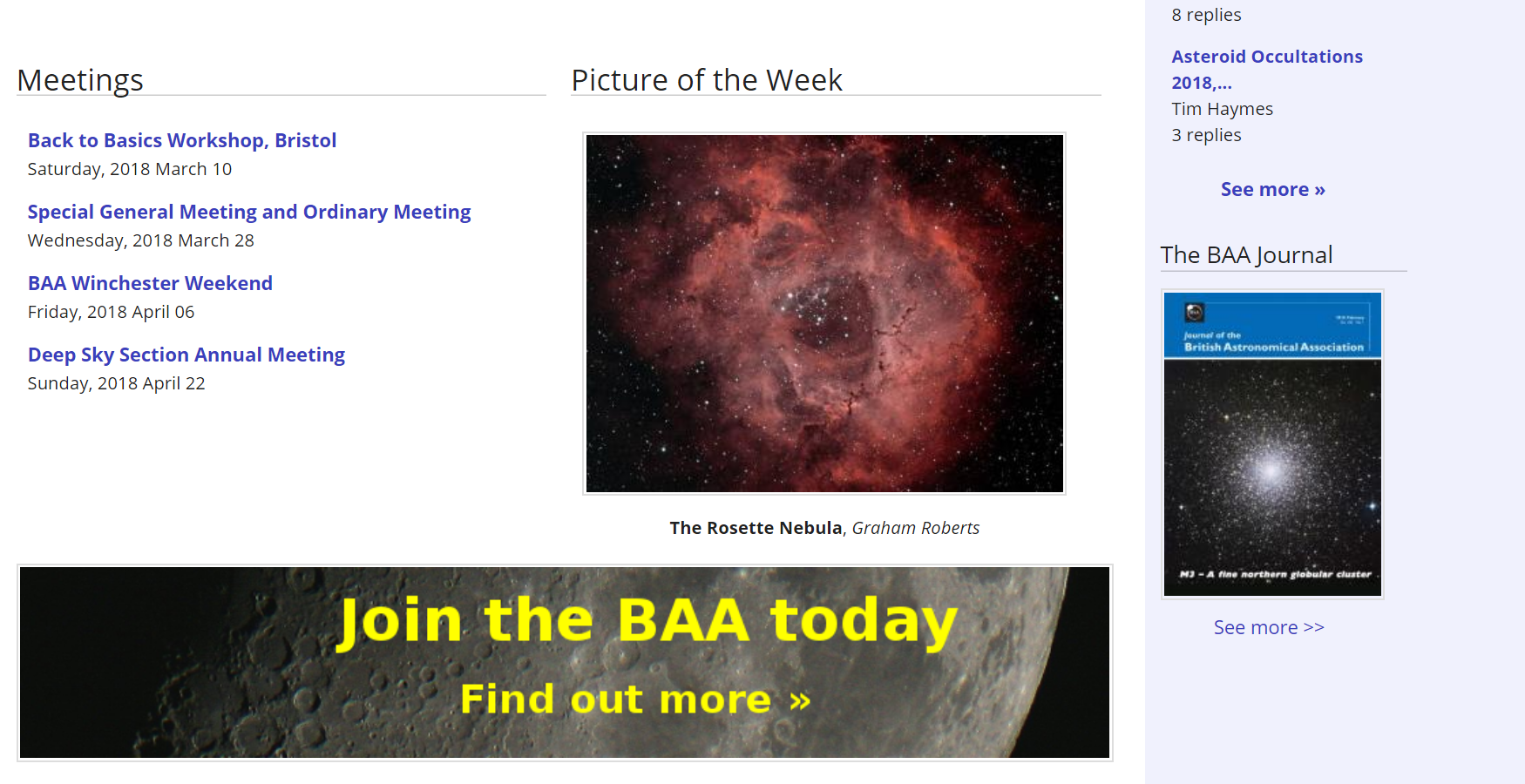
After a break of nearly two months I needed to sort out the equipment, refocus the camera and start a new alignment model in EQASCOM.  For the first time I also decided to use longer exposure times of 300 seconds, which altogether produced a good Ha+OIII Bi-Colour image (top of page – awarded BAA Picture of the Week 4th March 2018); whilst much longer exposures are used with conventional CCD sensors, such is the sensitivity of the CMOS mono sensor in the ZWO camera that 5-minute exposures provide exceptionally good quality data.  Overall the impact of longer exposure, good focus, tracking and much longer total integration time had a noticeably positive impact on noise and overall image quality, though there’s still room for improvement – there always is!

To some extent, even after a year I’m still in the experimental phase with this camera.  For most of 2017 I used a high gain setting of 300 but this time I chose the Unity gain setting of 139 and for interest also imaged at a shorter exposure of 180 seconds.  Comparison between the two settings for Ha images – Unity gain at 300 and 180 seconds – shows that for such a nebulous type of feature as the Rosette, Unity gain works very well at the longer 300 second exposure (first image below) but not 180 seconds (second image below), which is too short to collect sufficient data.
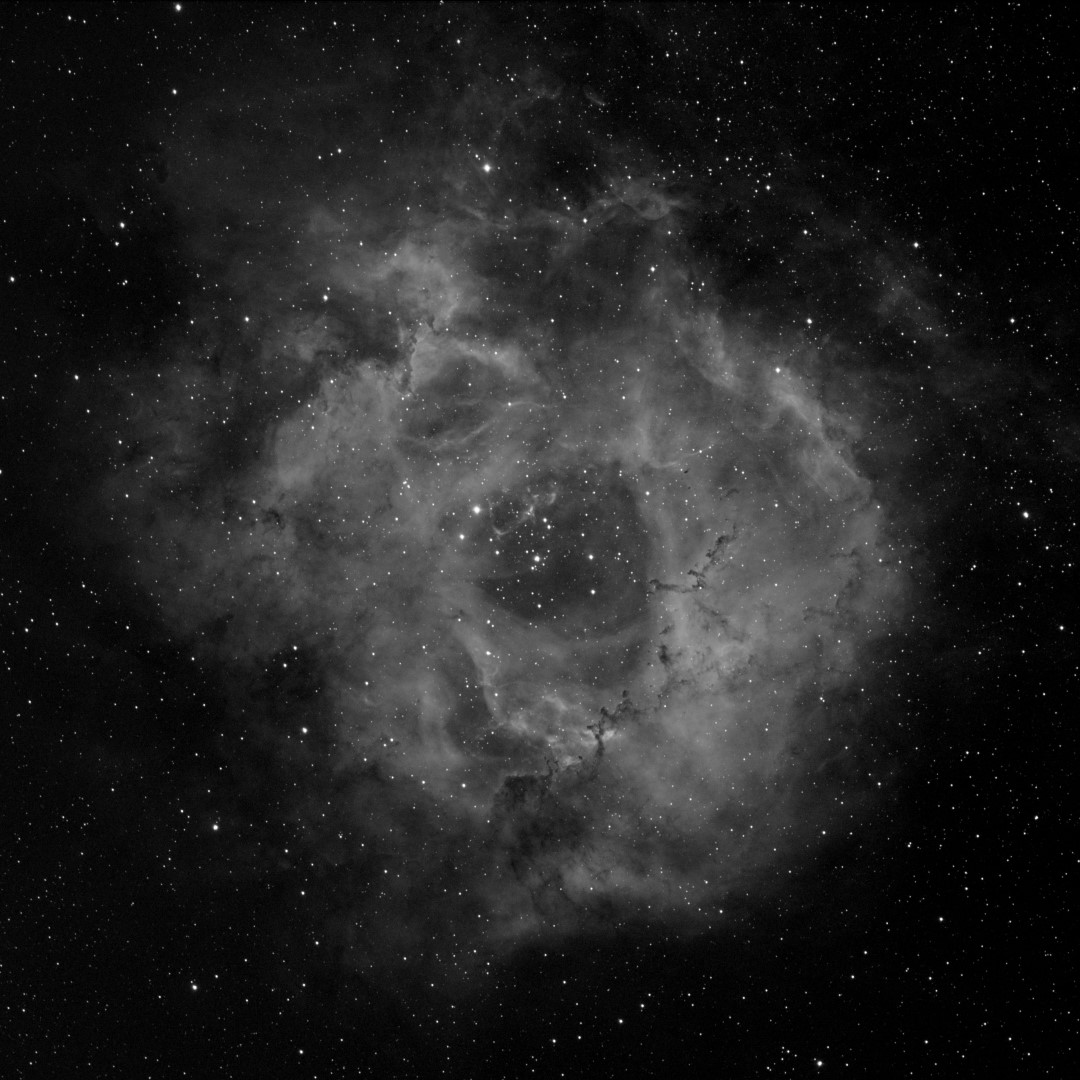
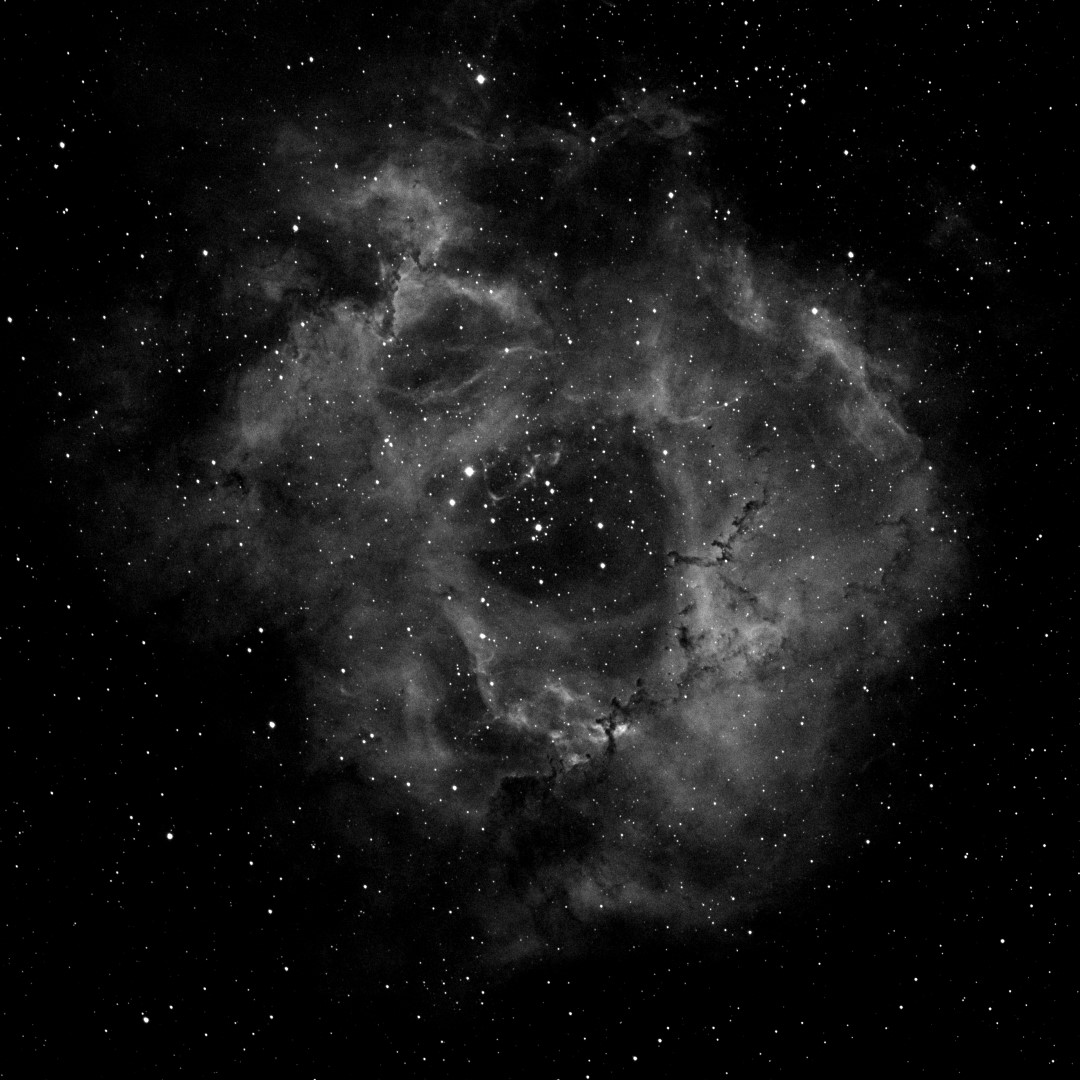
Picture saved with settings embedded.

Picture saved with settings embedded.

Notwithstanding, in the past I have found shorter exposures at Unity or less have generally been more suitable for brighter objects such as star clusters or galaxies like Andromeda.  An alternative SHO Hubble Palette image below of the Rosette Nebula at Unity gain and 300 second exposure also compares more favourably with the same image taken last year using less subs, higher gain and shorter exposure time.
Untitled-2 Crop2 (Large)When the object is right, such as the Rosette Nebula, narrowband imaging using the ZWO camera produces exceptional results.  This is evident in these recent images where it’s now possible to clearly see structural elements of the nebula, as well as the star fields located within.  Frankly I am very excited by these new images and can’t wait for next year to come around again!

Postscript: Research at Leeds University just published suggests that the Rosette Nebula is a disc but I believe my eyes and this image and many others which says otherwise!

IMAGING DETAILS
Object Rosette Nebula     NGC 2244 + 2237, 2238, 2239 & 2246   
Constellation Monoceros
Distance 5,000 light-years
Size Approx. 100 light-years or 1.3o
Apparent Magnitude +9.0
 
Scope  William Optics GT81 + Focal Reducer FL 382mm  f4.72
Mount SW AZ-EQ6 GT + EQASCOM computer control
Guiding William Optics 50mm guide scope
  + Starlight Xpress Lodestar X2 guide camera & PHD2 control
Camera ZWO1600MM-Cool (mono)   CMOS sensor
  FOV 2.65o x 2.0o    Resolution 2.05”/pix   Max. image size 4,656 x 3,520 pix   
EFW ZWOx8 + ZWO LRGB & Ha OIII SII 7nm filters 
Capture & Processing Astro Photography Tool,  Deep Sky Stacker & Photoshop CS2
Exposures 12 x 300 sec Ha, 6 x 300 sec  OIII & SII  (Total time: 120 minutes)
  @ 139 Gain  21 Offset @ -20oC  
Calibration 5 x 300 sec Darks  20 x 1/4000 sec Bias  10 x Flats Ha, OIII & SII @ ADU 25,000  
Location & Darkness Fairvale Observatory – Redhill – Surrey – UK        Typically Bortle 5
Date & Time 9th February 2018 @ 22.00h


It’s All Relative

escher

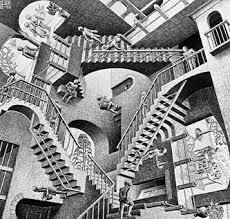
I spent the first half of this year reading Walter Isaacson’s biography of Albert Einstein, which apart from providing a fascinating insight into the man and his work, whetted my appetite to understand better the science.  Following previous success studying astronomy courses online, I set out to find a suitable programme to achieve this goal.  As a result I enrolled for Understanding Einstein: the Special Theory of Relativity run by Professor Larry Lagerstrom of Stanford University, USA, which after two months I have just completed.spacetime

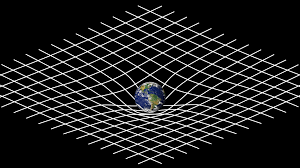
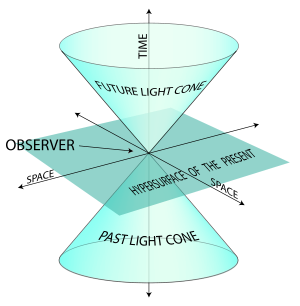
The course is a good mix of qualitative and quantitative information, which at times has been quite challenging but nonetheless proved very worthwhile. The lecturer is very clear and thorough, an essential quality when dealing with this difficult and often bewildering subject.  Einstein’s paper On the Electrodynamics of Moving Bodies outlines the Special Theory and was just one of four published at about the same time in 1905 (“The Miracle Year”) which included: Brownian motion, Mass-energy equivalence (E=Mc2) and The Photoelectric Effect, the latter of which won him the Noble Prize.  At the end I now feel I understand the basics of Einstein’s ground breaking science properly, which apart from being interesting provides valuable insight and understanding of the Universe and related issues of space and time.

300px-world_line-svg

During this period I have also been thinking about how to improve my astrophotography and the way forwards.  I’ll be on the learning curve for years to come and accept that there’s much I can still improve on using current equipment and processes but after more than 2-years astroimaging, mostly with a DSLR camera, I feel I have reached something of a crossroads and need to change tack in order to achieve more meaningful advances once again.  Inevitably this is likely to mean new equipment and most likely a move to LRGB / Narrowband format.  In the interim, whilst I consider the options, I have also been researching suitable capture / sequencing software, post-processing techniques and programmes.  I am concerned that this will result in another level of complexity but I think it has to be done in order to progress – watch this space.

Continuing a trend that’s been apparent for the past year, clear nights have been something of a rarity since mid-September; this is a concern if I am to pursue astrophotography to the next level.  However, high pressure was unusually dominant over Fairvale Observatory during the last days of November and cold, clear skies have provided good conditions for astronomy at last.

img_20161130_234303293

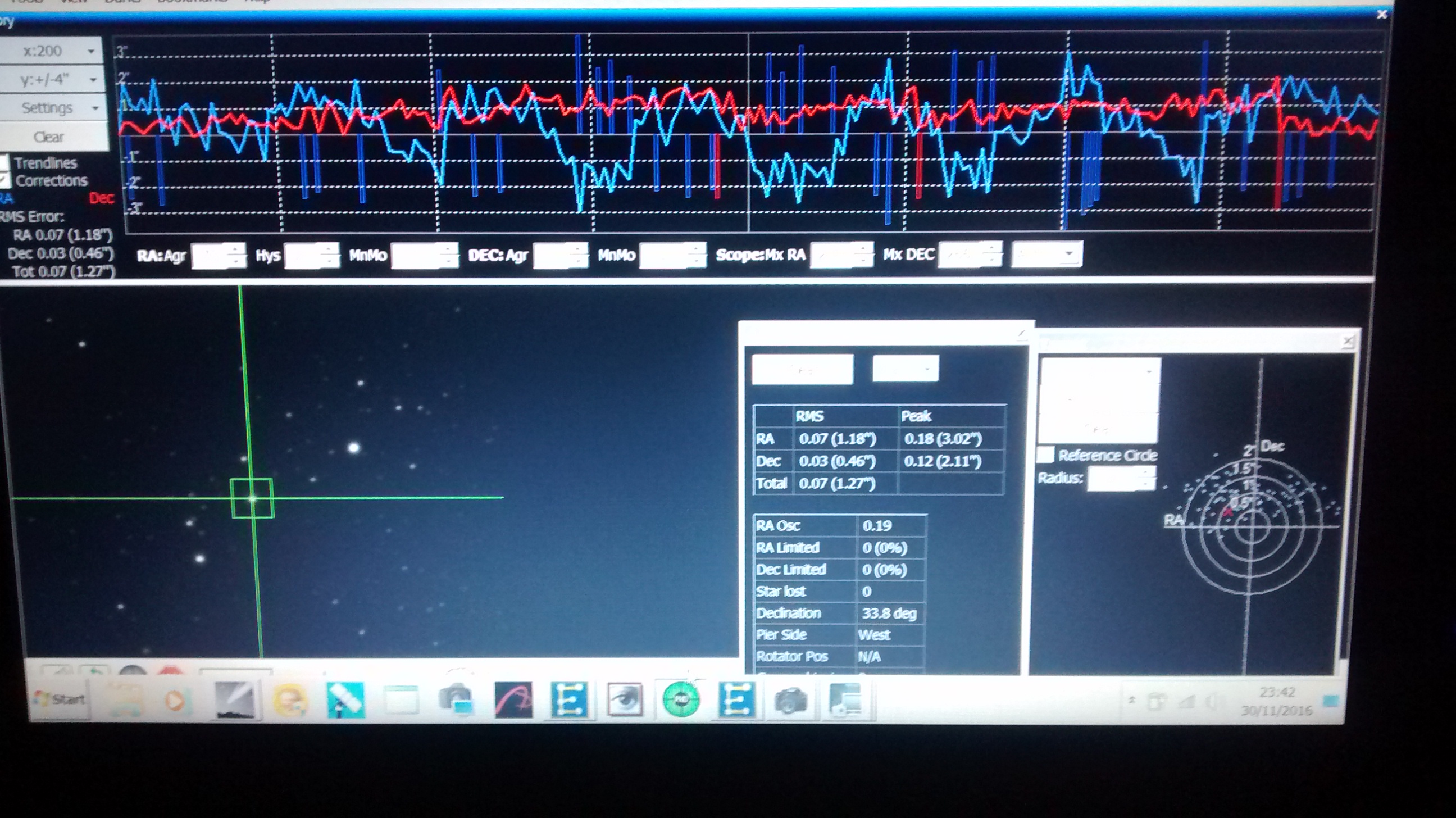
Getting better – PHD2 screen 30th November 2016: DEC is good but room for improvement with the RA settings. The impact on tracking and image quality is noticeable.

Whilst I have certainly not fully mastered guiding I am now routinely using PHD2.  This in itself has probably been the major breakthrough this year, which with the aforementioned clear skies I wanted to take full advantage of.  Hidden within PHD2 I have also discovered and am now starting to experiment with the on-screen drift align routine, with reasonable results; using the gamepad for mount control and a new wireless link with my tablet computer, I can also make focus and alignment adjustments at the mount without returning to the computer each time.

As a result I have dispersed with the SynScan handset for alignment and can now completely set-up and control imaging with the computer and tablet; this is nothing short of a revolution which I am hopeful will greatly increase set-up time as well as improving control and tracking accuracy – yipee!  Even with average guiding results I am now achieving good exposures of 5-minutes or more and therefore decided to put this success to work and re-image some winter wonders over three, yes three, consecutive nights at the end of November.

nov-objects

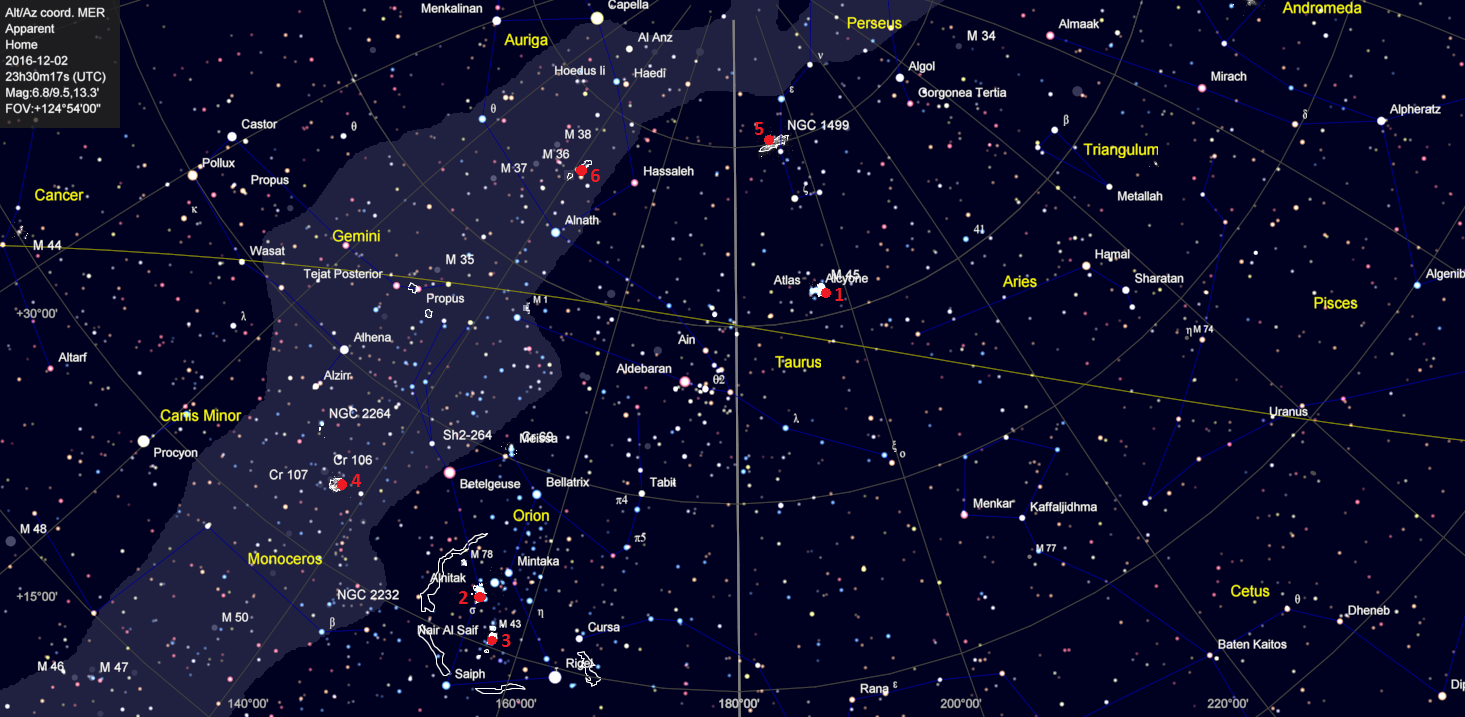
Imaging targets between 28th & 30th of November 2016 – for descriptions & previous images taken of these objects click on the following list of names: (1) M45 Pleiades (2) Barnard 33 The Horsehead Nebula & NGC 2024 Flame Nebula (3) M42 Orion Nebula (4) NGC 2244 Rosette Nebula (5) NGC 1499 California Nebula (6) IC 405 Flaming Star Nebula

The night sky at this time of the year contains many of my favourite objects, but surprisingly I had not imaged some of the chosen targets for more than a year or two and it was both enjoyable and pleasing to reacquaint myself again.  With a new perspective gained from this exercise, the progress I have made with equipment and techniques is more apparent.  Notwithstanding, it’s time to move on – everything’s relative.

Picture saved with settings embedded.

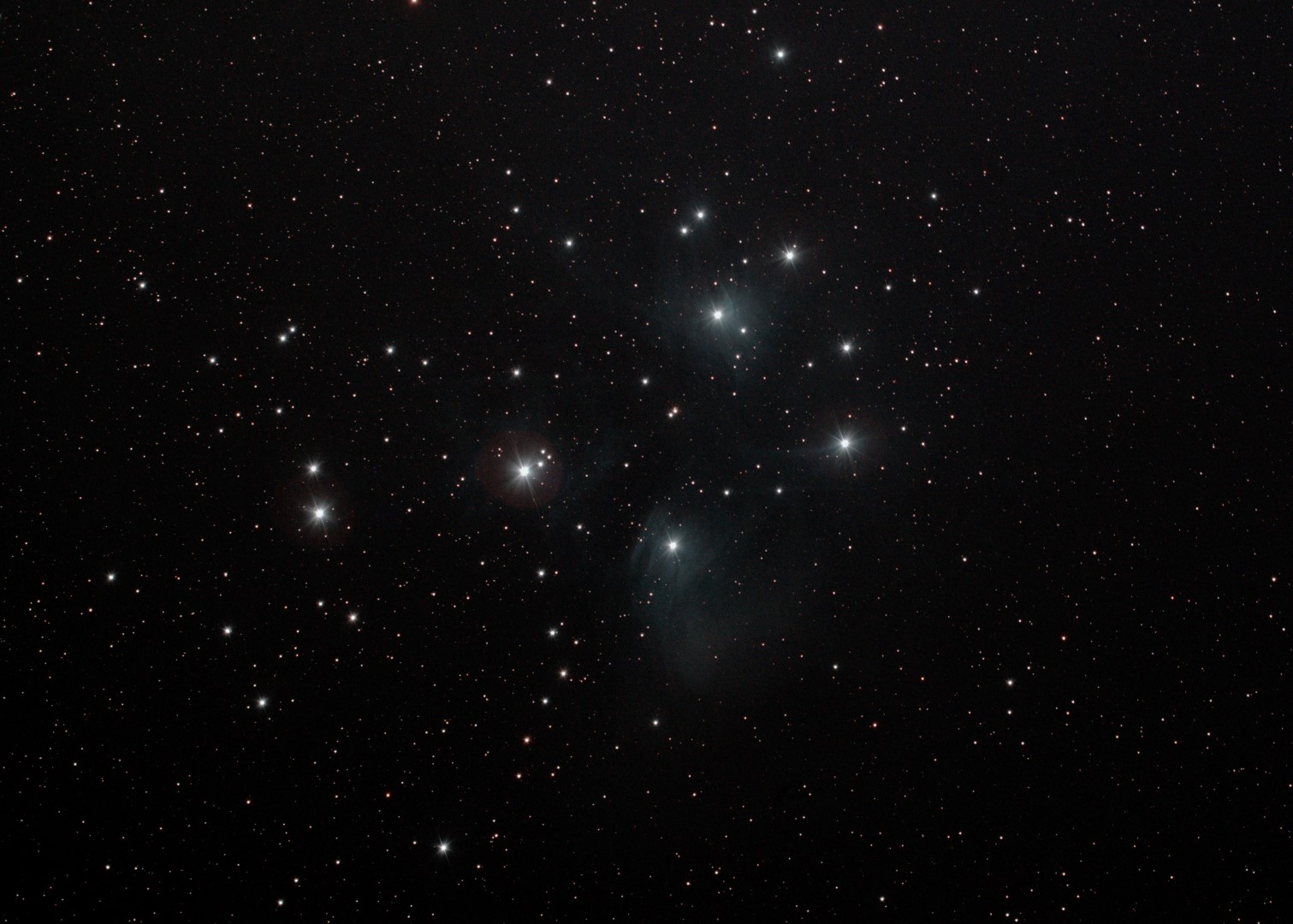
M45 Pleiades, Taurus constellation: 12 x 300 sec @ ISO 800 | 28th November 2016
Picture saved with settings embedded.

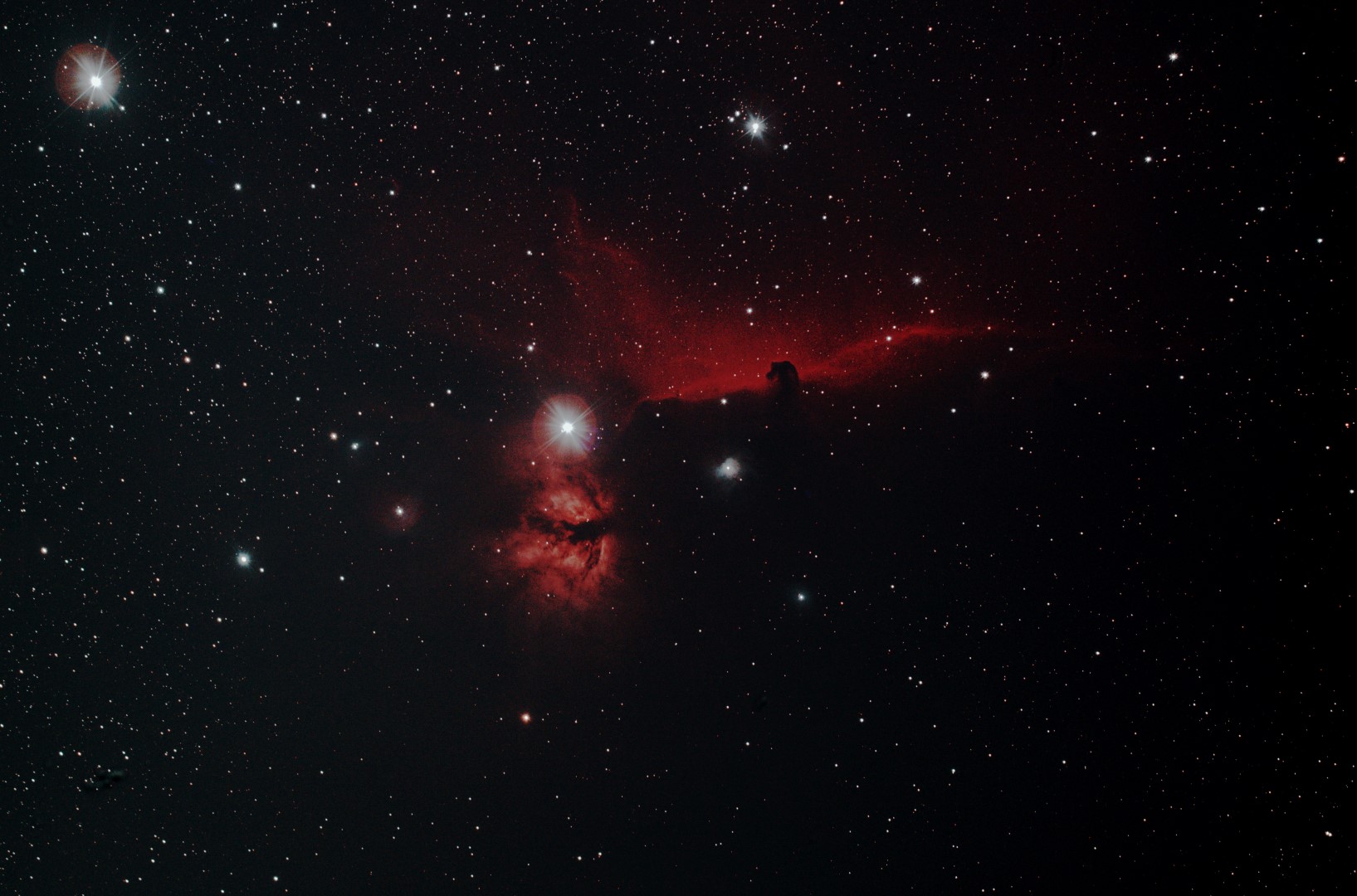
NGC 2014 Flame Nebula & Barnard 33 Horsehead Nebula, Orion constellation: 15 x 300 sec @ ISO 800 | 28th November 2016
Picture saved with settings embedded.

M42 Orion Nebula & M43 De Mairan’s Nebula, Orion constellation: 2 x 300 sec @ ISO 800 | 28th November 2016

Picture saved with settings embedded.

NGC 2244 Rosette Nebula, Perseus arm of Milky Way, Monoceros region: 21 x 300 sec @ ISO 800 | 29th November 2016

Picture saved with settings embedded.

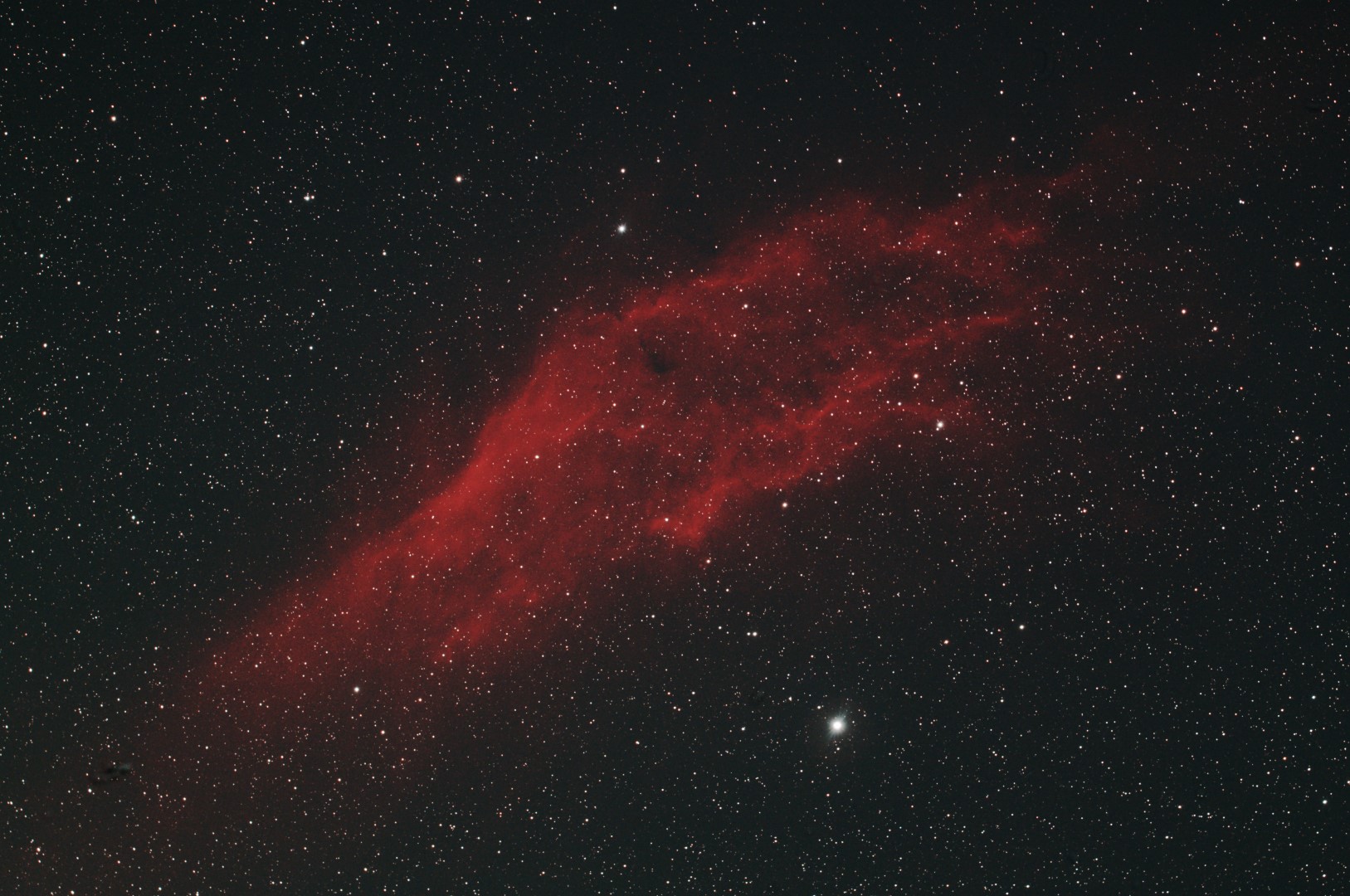
California Nebula, Perseus constellation: 12 x 300 sec @ ISO 800 | 30th November 2016

Picture saved with settings embedded.

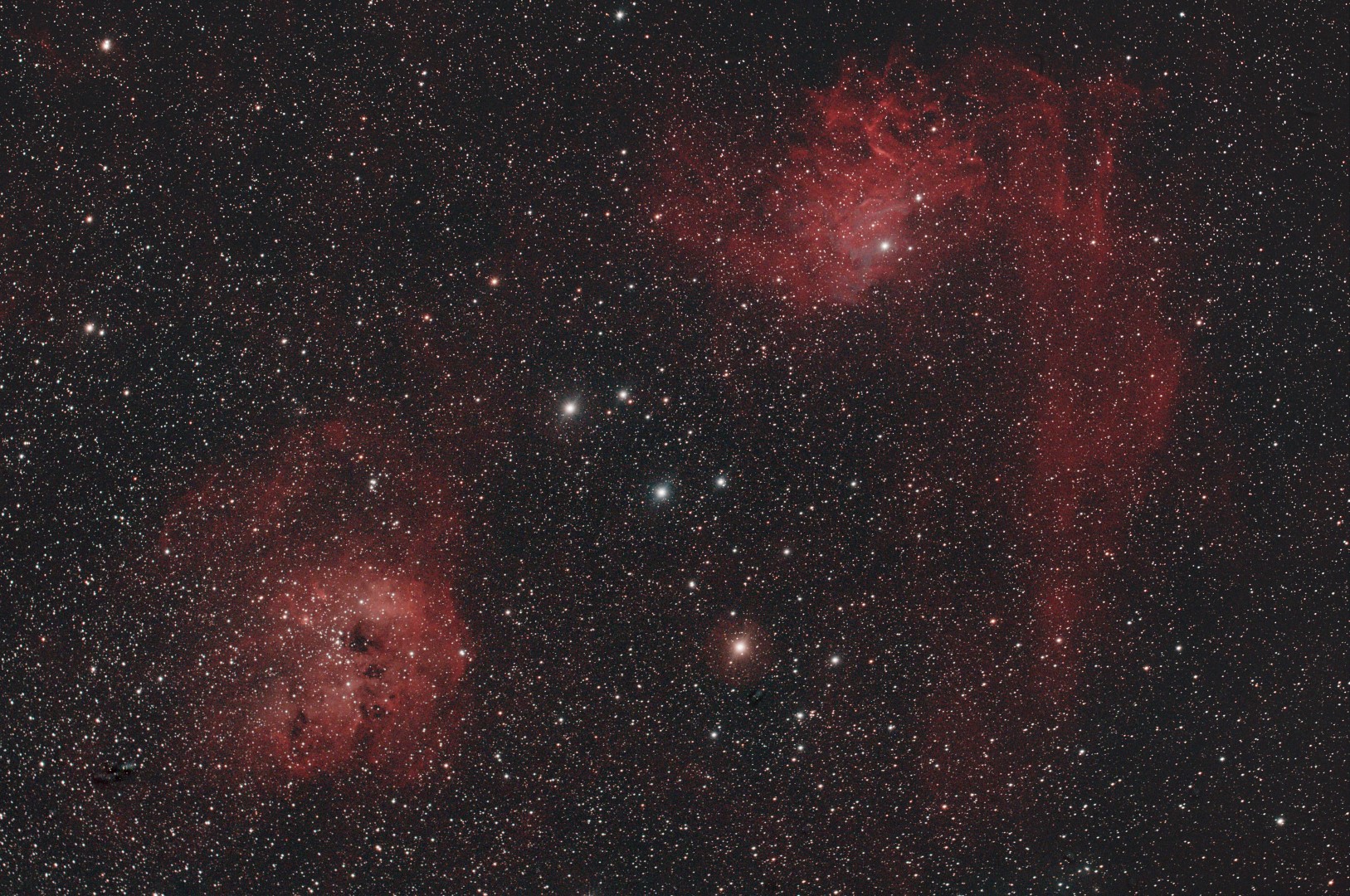
IC 405 & 410 nebulae: 15 x 300 @ ISO 800 | 30th November 2016

Notes: all images taken using a William Optics GT81 refractor telescope + PHD2 guiding + modded Canon 550D DSLR & x0.80 field flattner @ ISO 800 with full darks + bias + flats calibration and processed in Deep Sky Stacker & Photoshop CS2  

Nocturnal Safari

night eyes

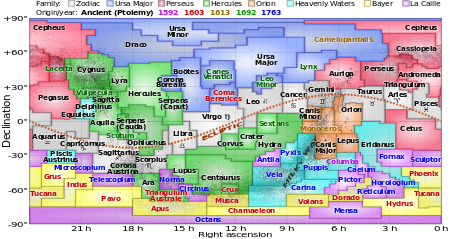
Asterisms of the night sky have long been the basis for astronomy, navigation, astrology, myths, general stories and even religion.  Whilst over millennia their shapes inevitably change, on the scale of human life there is an element of permanence and certainty.  With so many stars it is not difficult to ‘join-the-dots’ in order to arrive at a recognisable shape, thereby making identification easier.  Simplest amongst these are the seasonal often geometric asterisms such as the Summer Triangle, Winter Hexagon and The Plough or Big Dipper.  However, it is the 88 constellations that dominate our definition and description of the night sky.

450px-Constellations_ecliptic_equirectangular_plot.svg

Computer based planetarium usually trace the relevant shapes and often the underlying historical figures from which they were originally derived – though frankly in some cases these can be quite spurious and even misleading.  Of the total constellations: 17 depict humans or mythological figures, 29 inanimate objects and a whopping 42 animals – the night sky might literally be described as something of a zoo!

Despite my cynicism the patterns can be very helpful when initially learning the night sky, as well as for navigating and descriptive purposes.  When starting out in astronomy I deliberately did not purchase a GoTo mount in order to first better master the geography of the night’s celestial sphere.  For this purpose I purchased a planisphere and to a degree (no pun intended) it did initially help but with so many stars, light pollution and the odd cloud it wasn’t always easy when it came to essential star identification and alignment.  I am sure I will forever benefit from the effort but this is 2016 and inevitably I have succumbed to using Google Sky  on my smartphone to identify or at least confirm a star’s identity.  Equally inevitable, I now use an AZ-EQ6 GoTo mount, which when linked to the Cartes du Ciel planetarium software is a quick and powerful combination for locating and tracking objects.

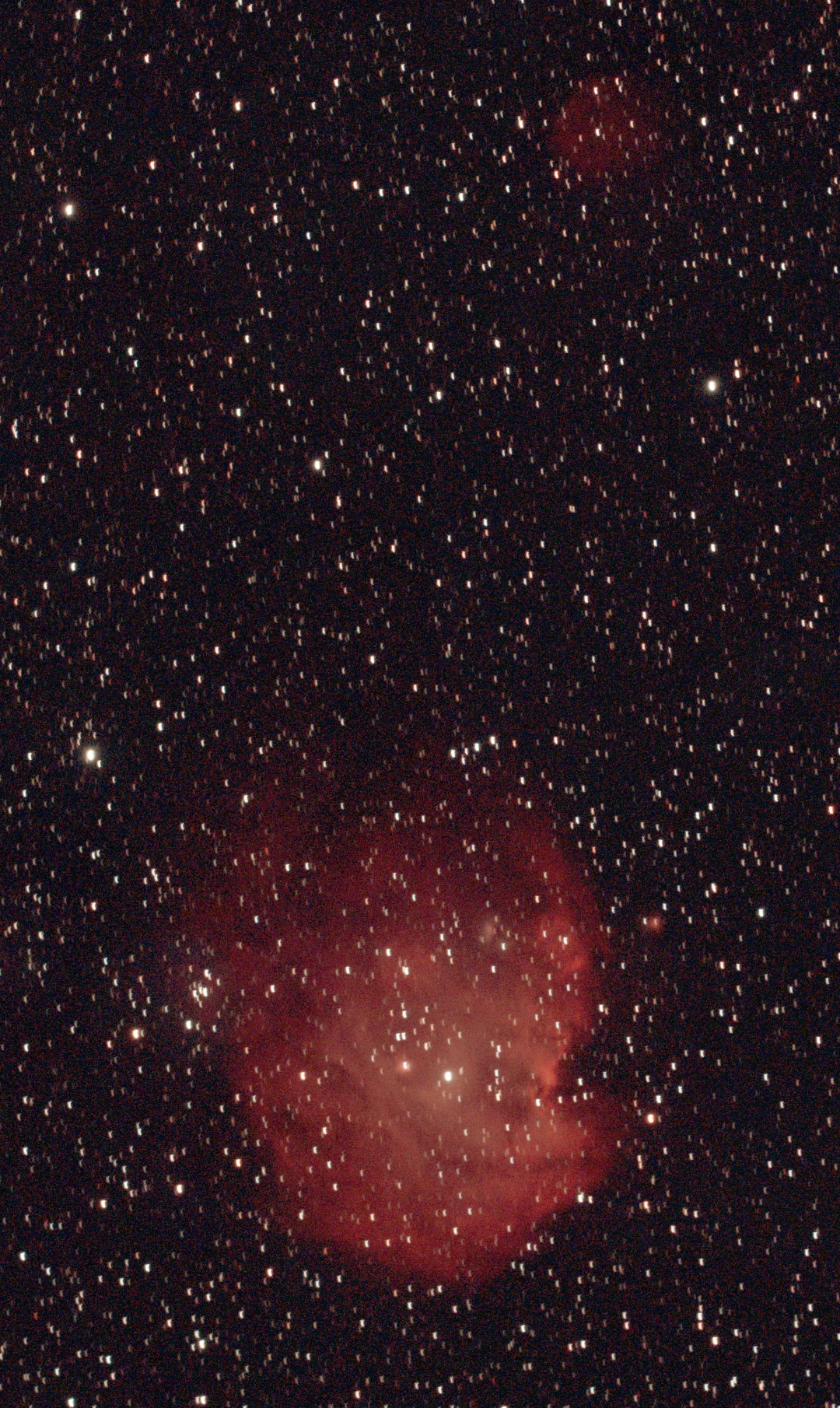
As previously discussed, this winter has been unusually cloudy but I recently managed a rare though decent imaging session in which I was able to capture night animals of a different sort.  Probably like most astronomers I find the mid-winter night sky to be the highlight of the year, making the aforementioned seeing problems all the more frustrating.  I have already imaged various parts of everyone’s favourite, the Orion constellation and so this time was looking for alternative objects in a similar region that would be suitable for the William Optics GT81.  Whilst I find many if not most of the star asterisms unconvincing, there’s no denying that some of the DSO shapes really do look like animals and this time I found two.

animal2

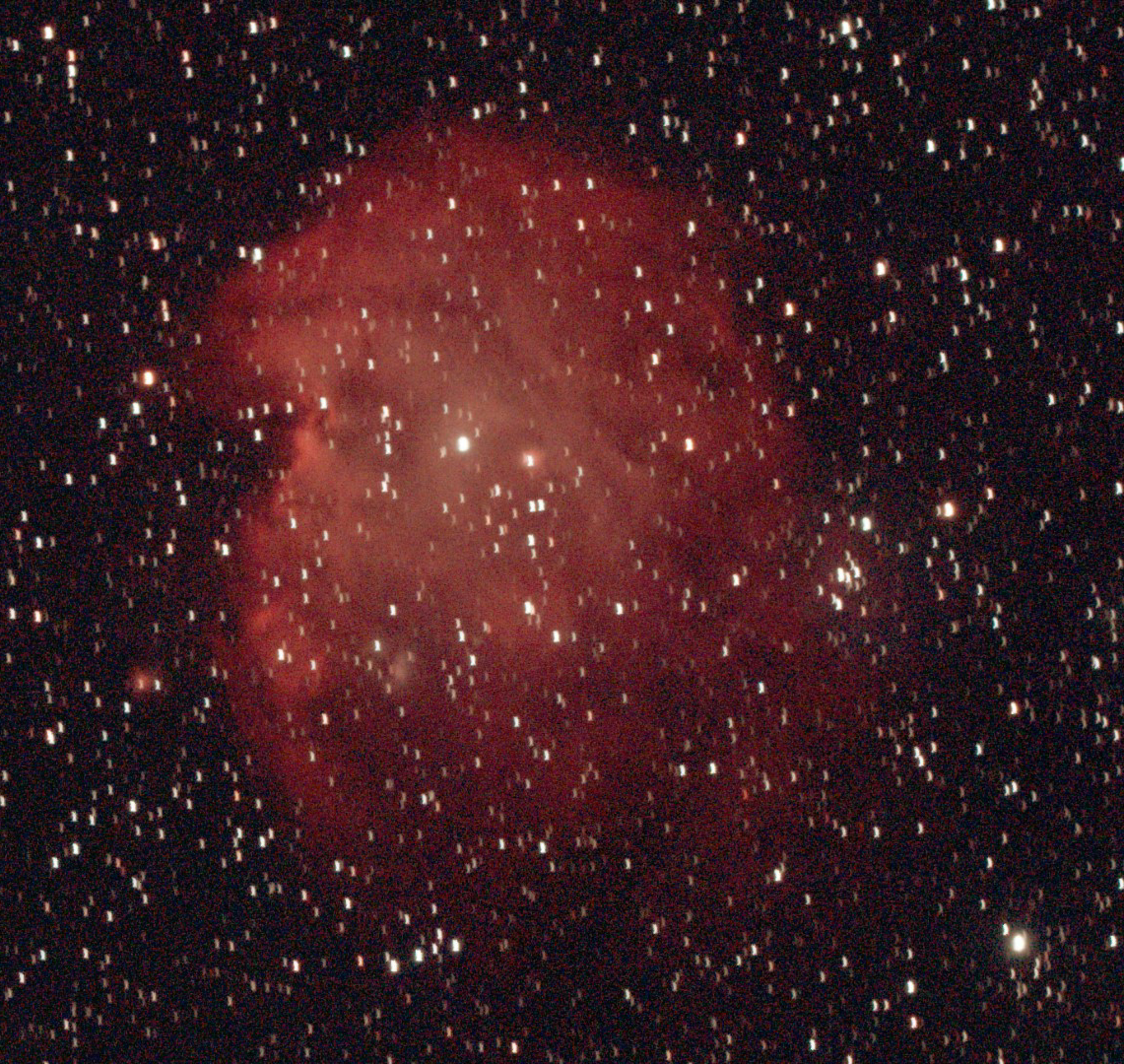
NGC 2174 or the Monkey Head Nebula is located within the Milky Way, between Orion’s club and Castor’s left foot.  An HII emission nebula, with an apparent magnitude of +6.8 and 40’ apparent dimension, it was a good target and a very convincing monkey’s head.  Closer inspection of the image shows another smaller HII nebula north above NGC 2174 called Sh2-247, that is not only connected to the monkey but they are both part of the even larger GEM OB-1 molecular cloud complex which covers a massive region of 570 x 770 light-years!

Picture saved with settings embedded.

NGC 2174 & Sh2-247 nebula above.  WO GT81 & modded Canon 550D + FF | 20 x 180 sec @ ISO 1,600 | 10th February 2016

Picture saved with settings embedded.

NGC 2174 The Monkey Head Nebula, cropped & inverted

In addition, situated between the constellations of Canis Major and Monoceros  is IC 2177 the Seagull Nebula, which is also within the Milky Way but ‘flying’ lower than the Monkey Head Nebula to the left (south-east) of the Orion.  More than 2.5o from wing to wing, a number of bright star clusters are associated with this emission nebula, notable of which is the ‘bird’s head’ designated NGC 2327;  IC 2177 is also known as the Parrot’s Head Nebula, which given the form of NGC 2327 I’m inclined to prefer.

Picture saved with settings embedded.

IC 2177 The Seagull Nebula. WO GT81 & modded Canon 550D + FF | 20 x 180 sec @ ISO 1,600 | 10th February 2016

I’ve previously imaged a number of other animal-like DSO objects: Jellyfish Nebula, Crab Nebula, Pelican Nebula and the famous Horsehead Nebula.  Unlike the constellations they generally but not always, really do resemble the form their names imply.  Now adding to this list the Monkey Head and Seagull (Parrot) Nebulae it sometimes seems like a safari rather than astronomy!

Sky Animalscrop


Spaceship Earth

bbbb

I’m now into my second year of ‘serious’ astronomy and astrophotography, which accompanied by a greater knowledge of the Universe has brought an element of familiarity: with the equipment, with viewing & imaging techniques and space itself.  In the past I have worked underground as a geologist on mines and like to think that I have good spatial awareness.  Through this growing familiarity and knowledge of the night sky, I have become increasingly aware of our place in the Universe and how we on Earth are travelling through space; I also feel a growing empathy other peoples such as mariners who use and relate to the sky and space in a way ordinary people do not.

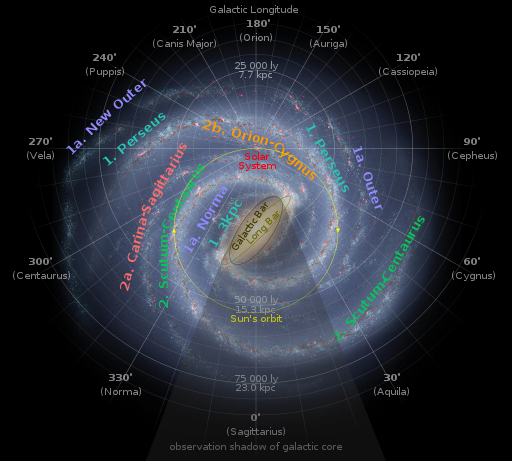
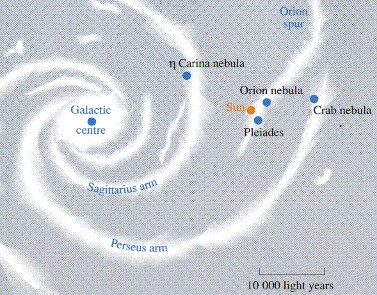
Whilst spinning on its axis at 1,037 mph at the equator (653 mph here at Fairvale Observatory’s higher latitude), the Earth is moving at about 70,000 mph round the Sun.  Furthermore, located in the Orion-Cygnus arm of the Milky Way, the Solar System is also moving around the spiral galaxy at 500,000 mph, resulting in a galactic year of nearly 250,000 Earth years .  Notwithstanding these complex and frankly mind boggling statistics, it thankfully all feels quite serene when outside at night with my telescope at Fairvale Observatory.

Milky_Way_Arms_ssc2008-10


Going back some 5,000 years the constellations might seem to describe the ‘shape’ of space and provide a sense of stability to the sky but this is misleading.  These and other asterisms are 2D patterns that mankind has created for practical use, whereas in reality most of the stars that make up these patterns bear little if any meaningful relationship with each other when viewed in 3D – like this animation showing the true shape of Orion.

spiralArms

Furthermore, under the force of gravity and other as yet unknown influences e.g. dark energy, these too are moving through space in their own way at vast speeds.  In reality the constellations are therefore anything but permanent and through the millennia their apparent shapes change and will eventually be destroyed as far as we on Earth are concerned.  As with my professional subject geology, this is the problem with space – it is very big and the timescales are very, very large, essentially beyond human comprehension, which result in otherwise unimaginable events; this animation wonderfully illustrates the scale and complexity of the known Universe.

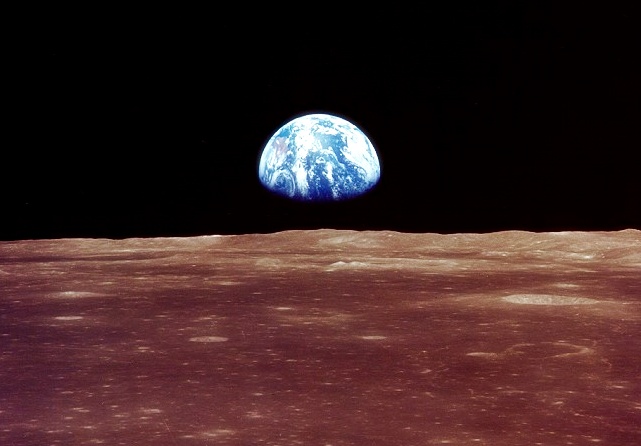
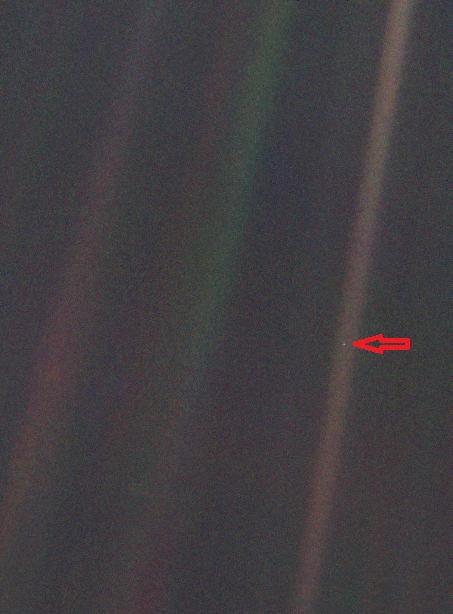
Space selfie - the insignificance of Earth. The Pale Blue Spot photograph of Earth (right side of picture) taken 6 billion kilometers (40.5 AU) away by Voyager-1 on February 14th 1990,

Space selfie = the insignificance of Earth.
The Pale Blue Spot photograph of Earth (right side of picture) taken 6 billion kilometers (40.5 AU) away by Voyager-1 on February 14th 1990,

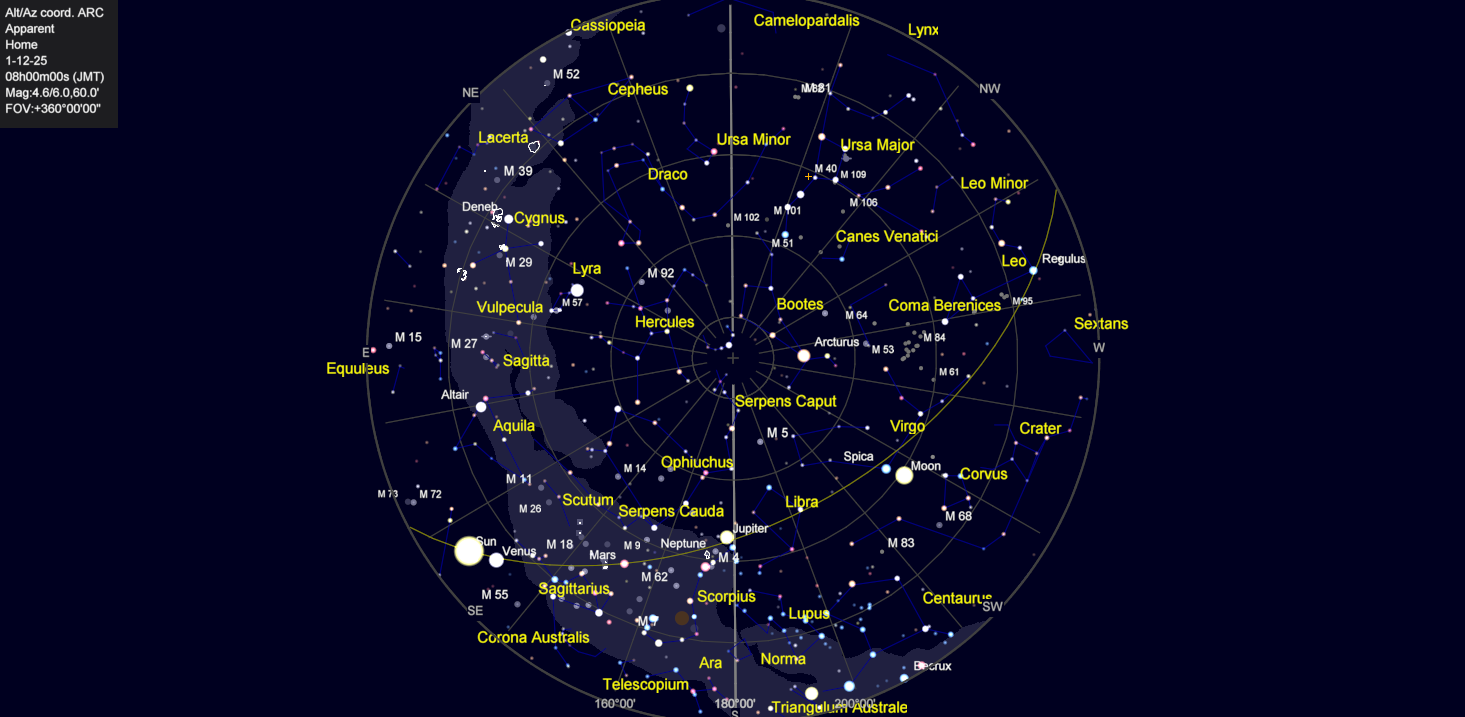
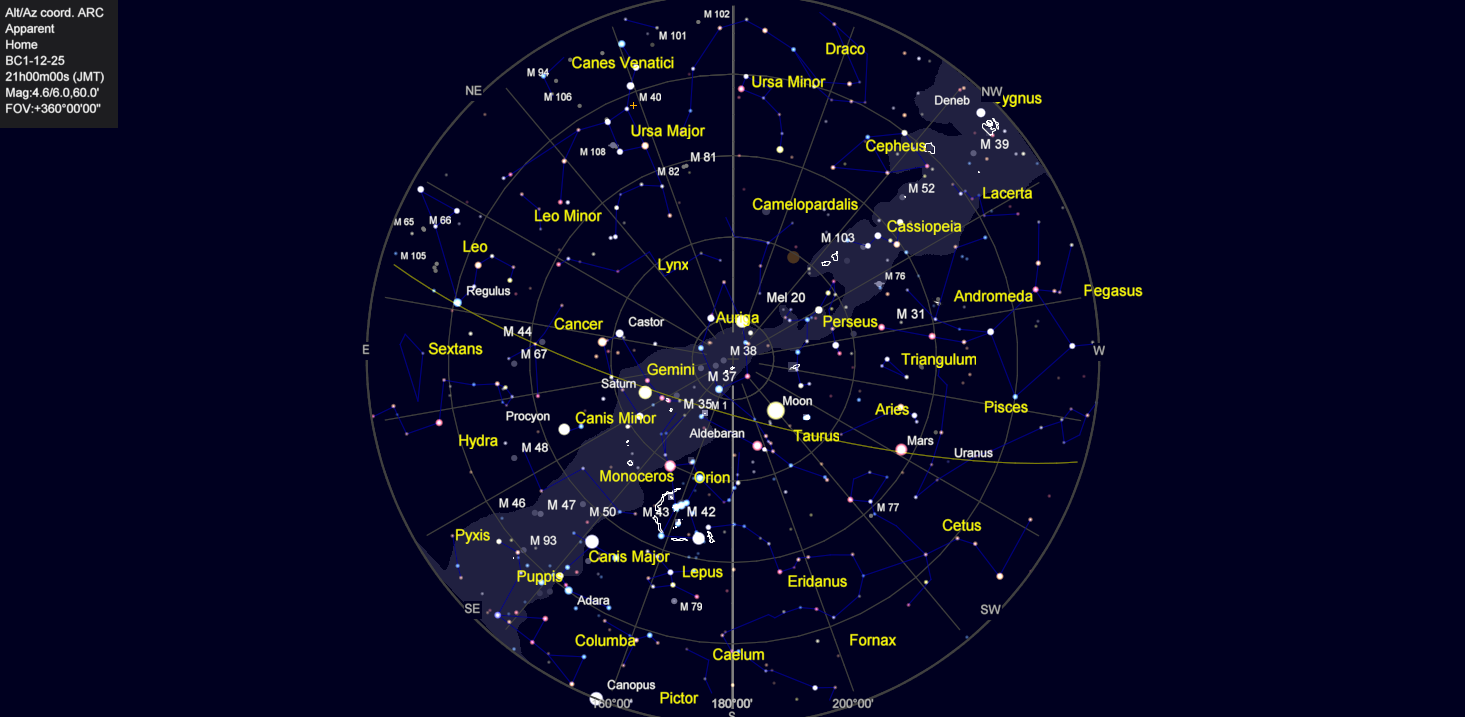
The beauty of such a system is that it can be modelled very accurately, from which it is possible to predict with great certainty the projected position of all these celestial objects, thus making spaceflight and the prediction of astronomical events possible.  Likewise using the same data modelling it is possible to look backwards at past events.  Such computerisation is no longer just the preserve of NASA and University academics but is at our fingertips using a computer based planetarium, in my case Carte du Ciel – incredible!

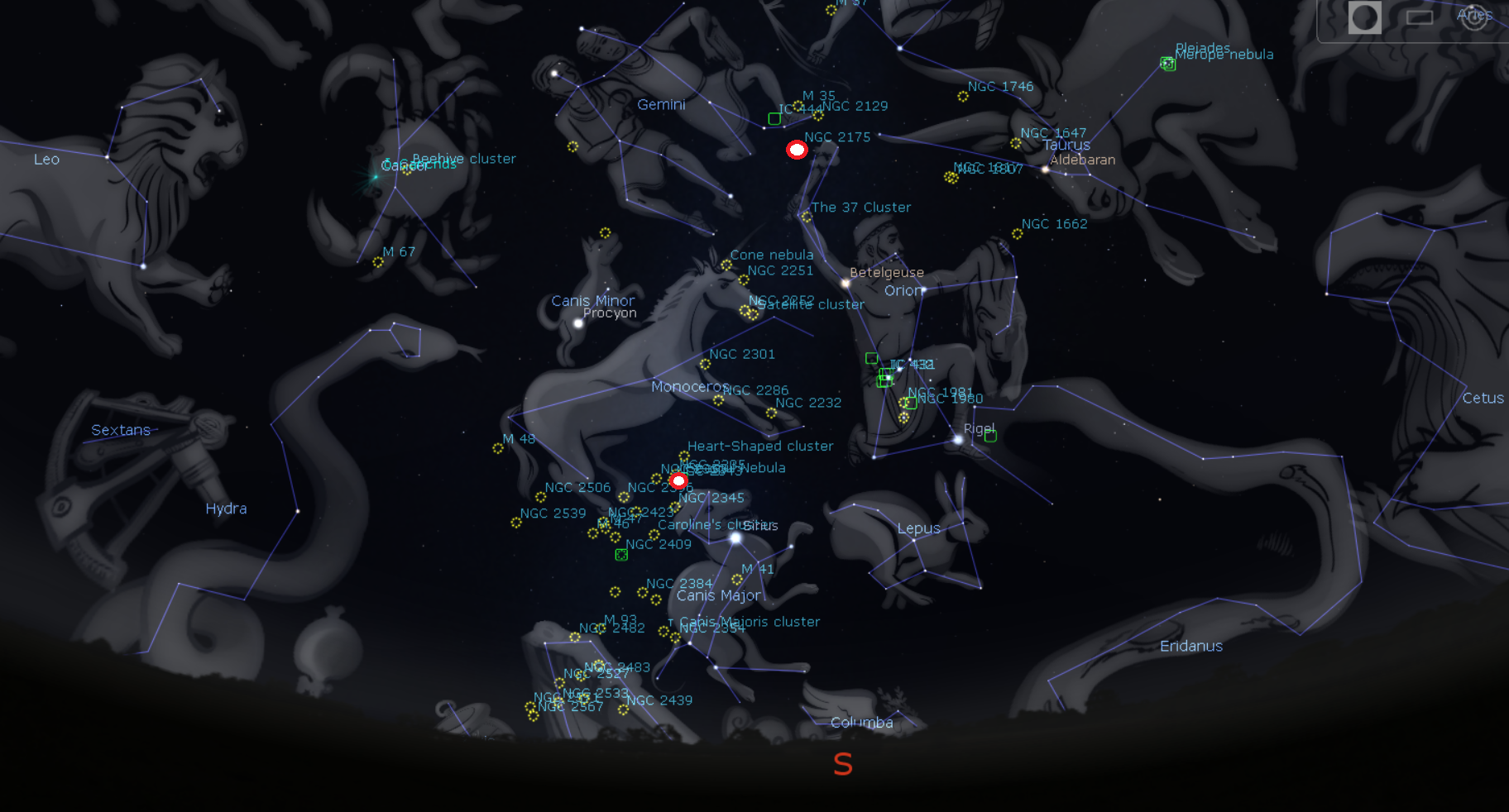
Given the time of year I have therefore used the aforesaid programme to generate a view of the night sky from Bethlehem 2015 years ago on the morning and evening of 25th December.  Even then differences can be seen in the shape of the constellations compared to now.  If we are to believe the story of the Three Wise Men following a bight ‘star’ at this time, it seems it would be most likely to be in the morning when first Jupiter and then Venus are present.  Either way it’s fascinating to be able to model the night sky in this way for any chosen moment in time.

xmas.cdc5


xmas.cdc3


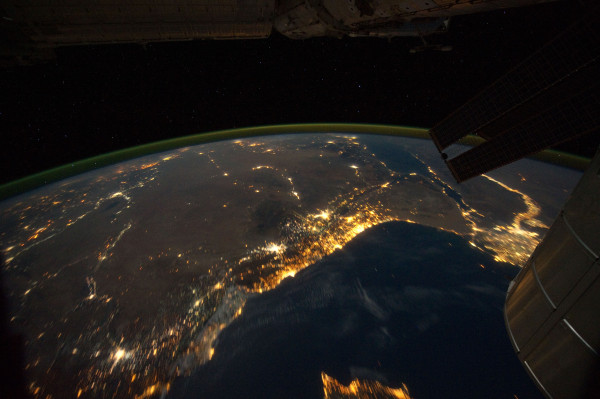
Santa's view of Bethlehem - actually from the ISS on 24th December 2011

Santa’s view of Bethlehem from the ISS on 24th December 2011

After weeks of cloud cover I recently managed to get outside again for what turned out to be a wonderfully clear night, from dawn to dusk, furthermore there was no Moon!  As a result imaging was productive and included some exciting new objects.  However, again given the time of year for the moment I am repeating an object used last Christmas.  One year on the difference is that this time I have used a  modded Canon 550D DSLR camera and thus improved (I think) the red Ha-light detail.

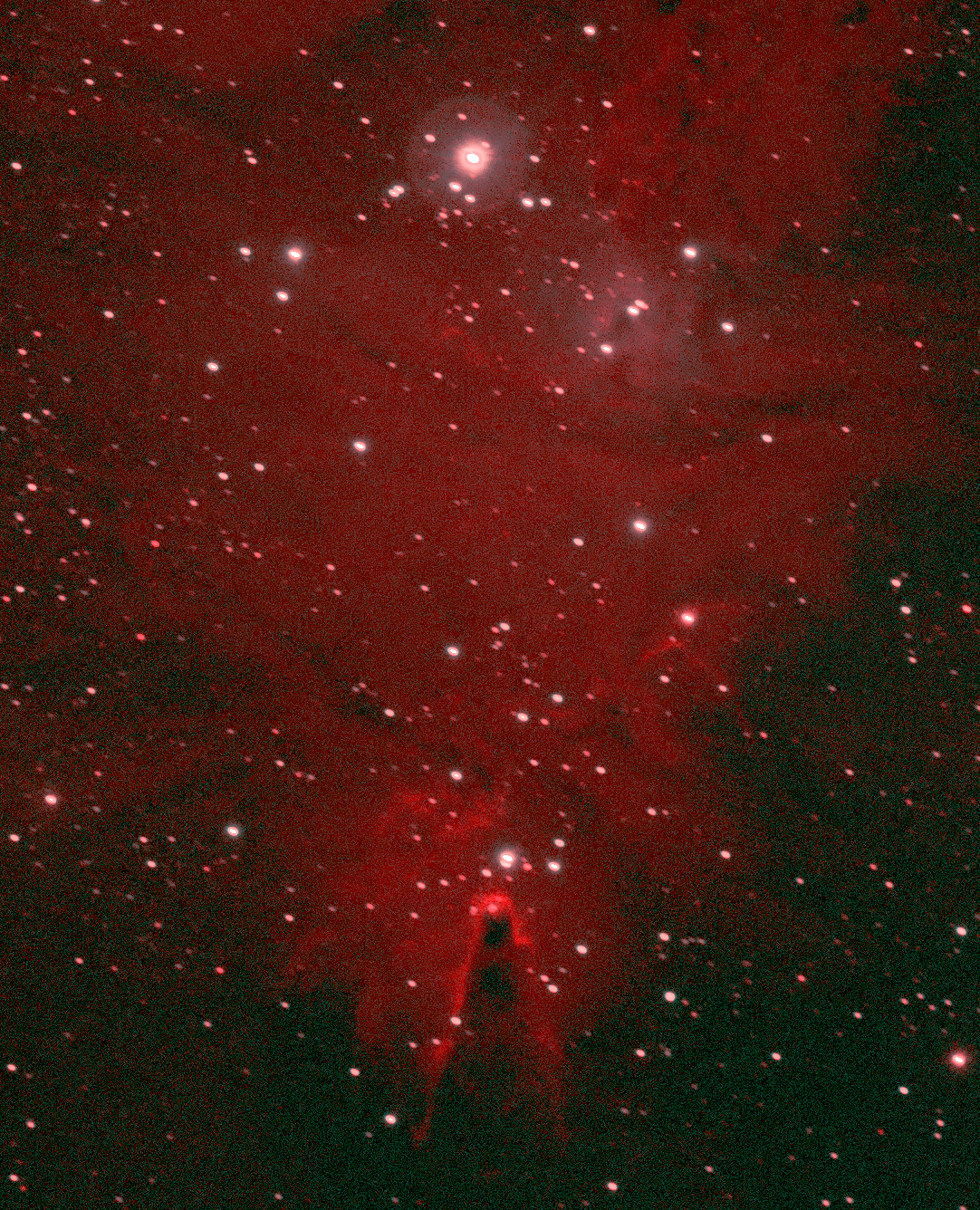
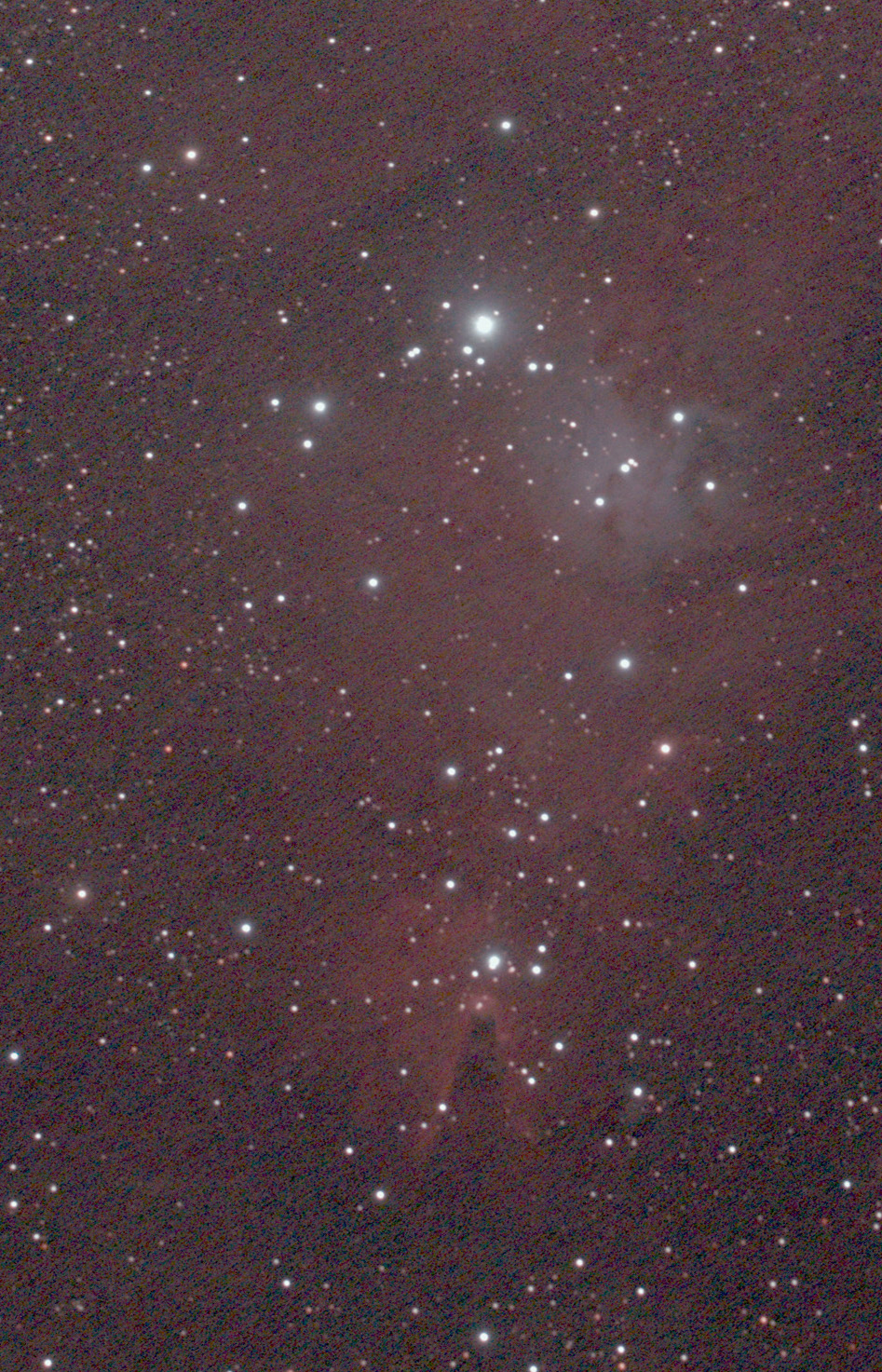
Cone Nebula & Christmas Tree Cluster WO GT81 + Modded Canon 550D & FF | 15 sec @ ISO 1,600 + calibration | 8th December 2015

Cone Nebula & Christmas Tree Cluster – right of centre
WO GT81 + Modded Canon 550D & FF | 15 sec @ ISO 1,600 + calibration | 8th December 2015


Cone Nebula (bottom centre) & Christmas Tree Cluster (inverted)

Cone Nebula (bottom centre) & Christmas Tree Cluster (inverted)

NGC 2264 or Christmas Tree cluster and its neighbour the Cone Nebula are located within the Monoceros AKA Unicorn constellation, which being part of the Milky Way are therefore inextricably linked to a similar destiny as spaceship Earth as it makes its way through space.  Being some 2,700 light-years away we are unlikely to meet, though you never know with space and time!

HAPPY CHRISTMAS

HAPPY CHRISTMAS