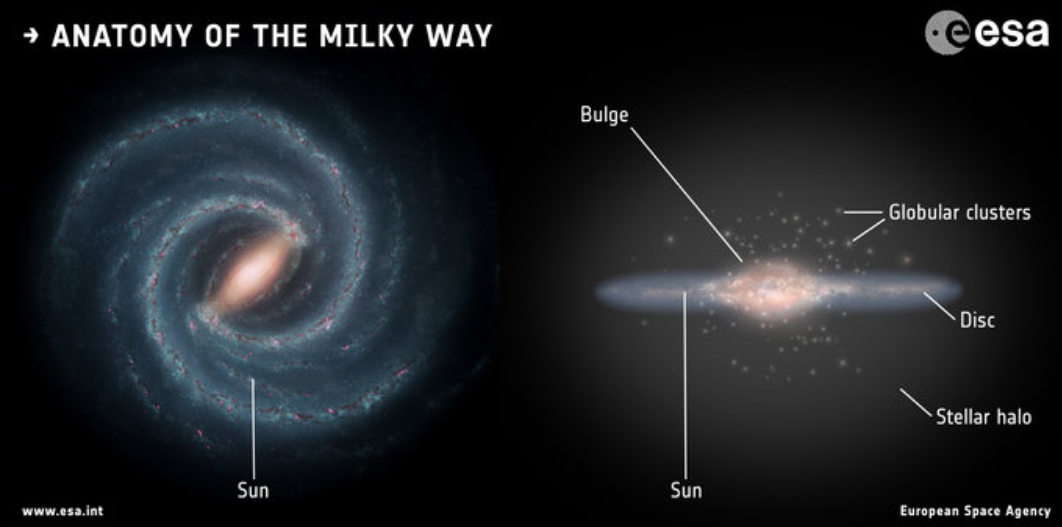
Of all the incredible features that constitute the Universe, located relatively close to home, I always marvel at the nature of globular clusters. Largely unknown by the lay person and myself until I took-up astronomy, more than 150 of these incredible objects orbit around the Milky Way in the form of a spherical halo both above and below the galactic disc. Between galaxy season (March – April) and the appearance of the Sagittarius arm of the Milky Way in the summer, is the globular so-called cluster season, which is heralded by the arrival of M3, one of the brightest and most popular of the clusters.
M3 was discovered by Charles Messier in 1764 but only correctly identified as a globular cluster twenty years later by William Herschel. Consisting of more than 500,000 million stars, of which at least 274 are variable stars, it is estimated to be over 11-billion years old, thus being some of the oldest stars in the Universe.
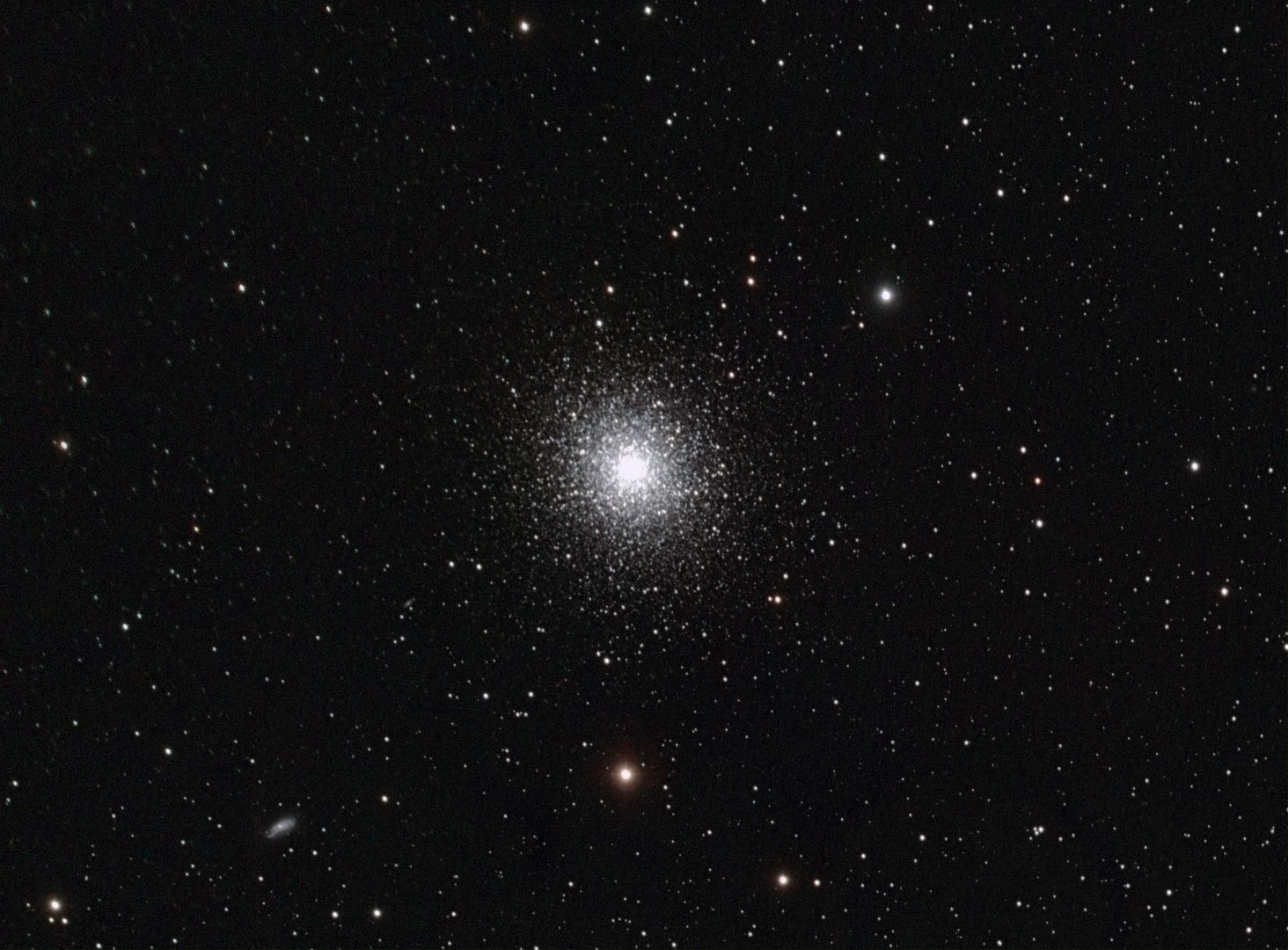
Using data gathered remotely from a Takahashi 106 FSQ situated in the dark skies of New Mexico, USA, the resulting image shows this spectacular object in all its glory. Apart from the marvellous star details within the cropped version of M3 (see top of the page), there’s also much to see and enjoy in the original widefield image (see above), that is also bountiful of colourful stars as well as several galaxies. Altogether I’m very pleased with the final image, which is probably my best globular cluster so far.
IMAGING DETAILS
Object
M3 Globular Cluster AKA NGC 5272
Constellation
Canes Venatici
Distance
34,000 light-years
Size
18 arc minutes, which spans approx. 180 light-years
About this time of the year as astronomical darkness is lost for a few months I tend to take it easy, astronomically speaking. However, this year’s an exception as I have a large backlog of image processing to complete courtesy of the Photon Factory. With continuously bad weather prevailing across Europe back in February, it was more than four months since I’d been able to undertake any astrophotography here at Fairvale Observatory – of course such problems go with the hobby but this was ridiculous and somewhat disheartening. There were three solutions to the situation: continue waiting, give up all together or look further afield where the skies are reliably clear and dark, which like many others nowadays is what I did and thus joined the ever increasing band of remote imagers.
About 2-years ago I considered establishing equipment at one of the growing number of astrophotography host sites in southern Europe. However, after some research I concluded that whilst such a facility would be great to have it was probably too expensive for now and moreover, I first needed to spend more time improving my processing techniques before embarking on such a plan. Thus having since taken steps towards this goal, which included learning PixInsight, I felt the time was right to sign-up with Deep Sky West (DSW) situated in the state of New Mexico, USA. DSW were one of the early remote hosting observatories established and have a good reputation, reasonable prices and a wide choice of quality equipment. I therefore signed up for one year’s imaging with the following set-up:
QSI1683-WSGA camera 5.4 nm pixels & Astrodon 5nm filters
Paramount MyT mount
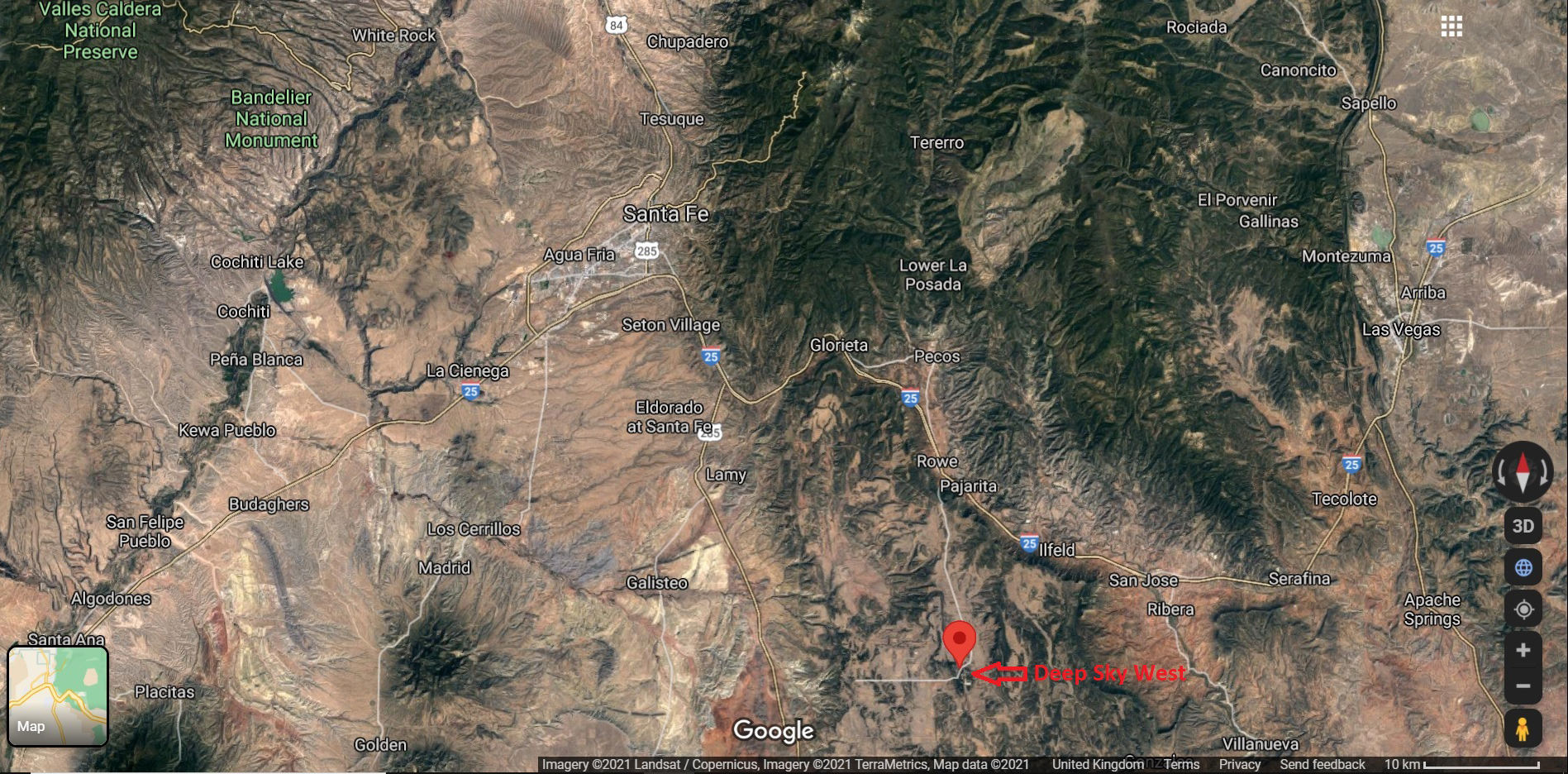
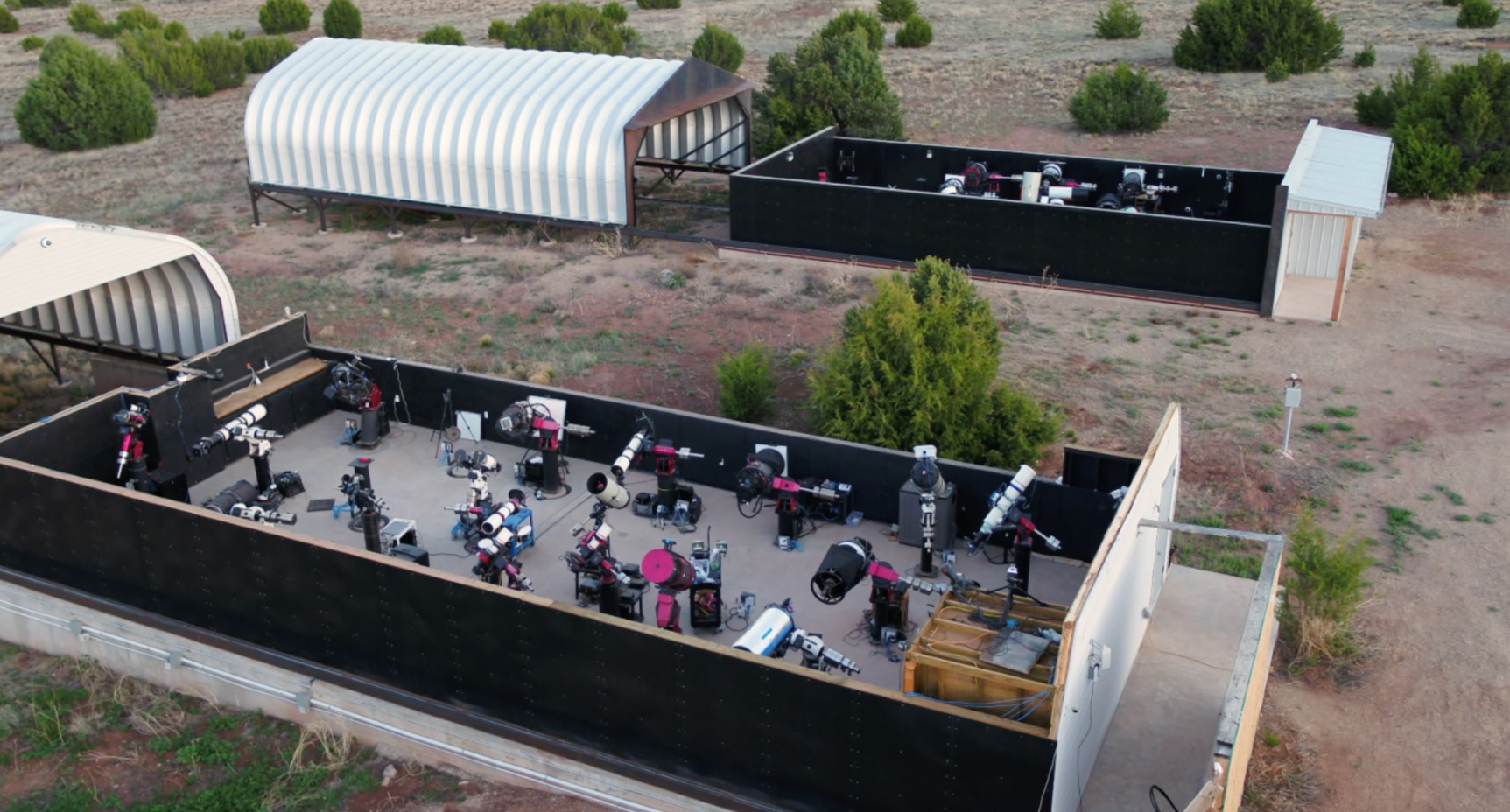
Deep Sky West is located about 35-miles south east of Santa Fe, at an elevation of 7,400ft on the Glorietta Mesa (see above map). Established by Lloyd Smith and Bruce Wright in 2015, there are now two large bespoke roll-off sheds (Alpha & Beta – see picture below) housing up to nearly forty rigs which are used by astrophotographers from across the world – you could call it a photon factory. DSW has since established a premier reputation as an observatory producing high quality data. Building on this success and the burgeoning demand for remote imaging, DSW are now expanding their service into Chile.
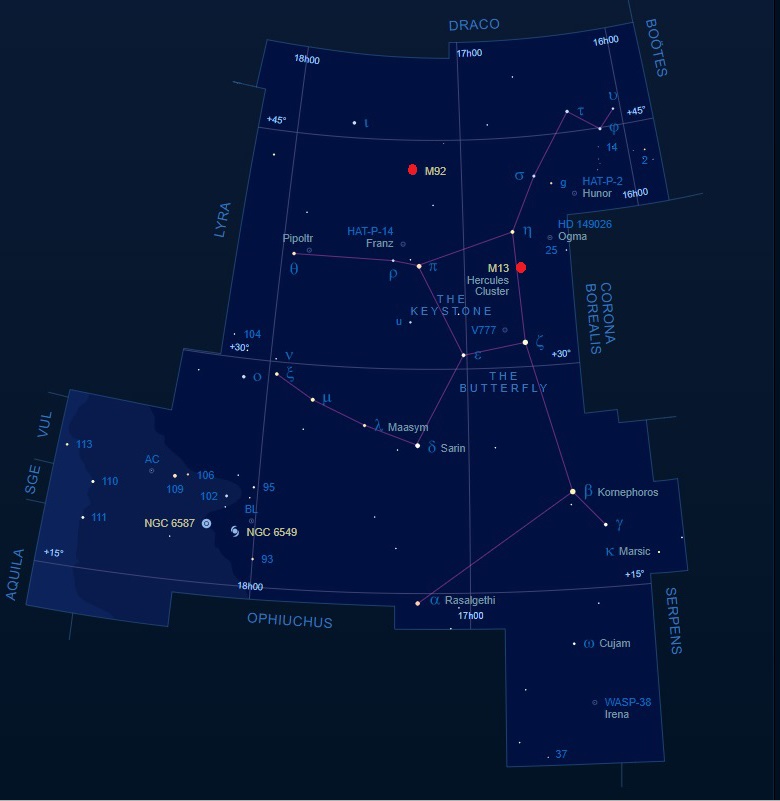
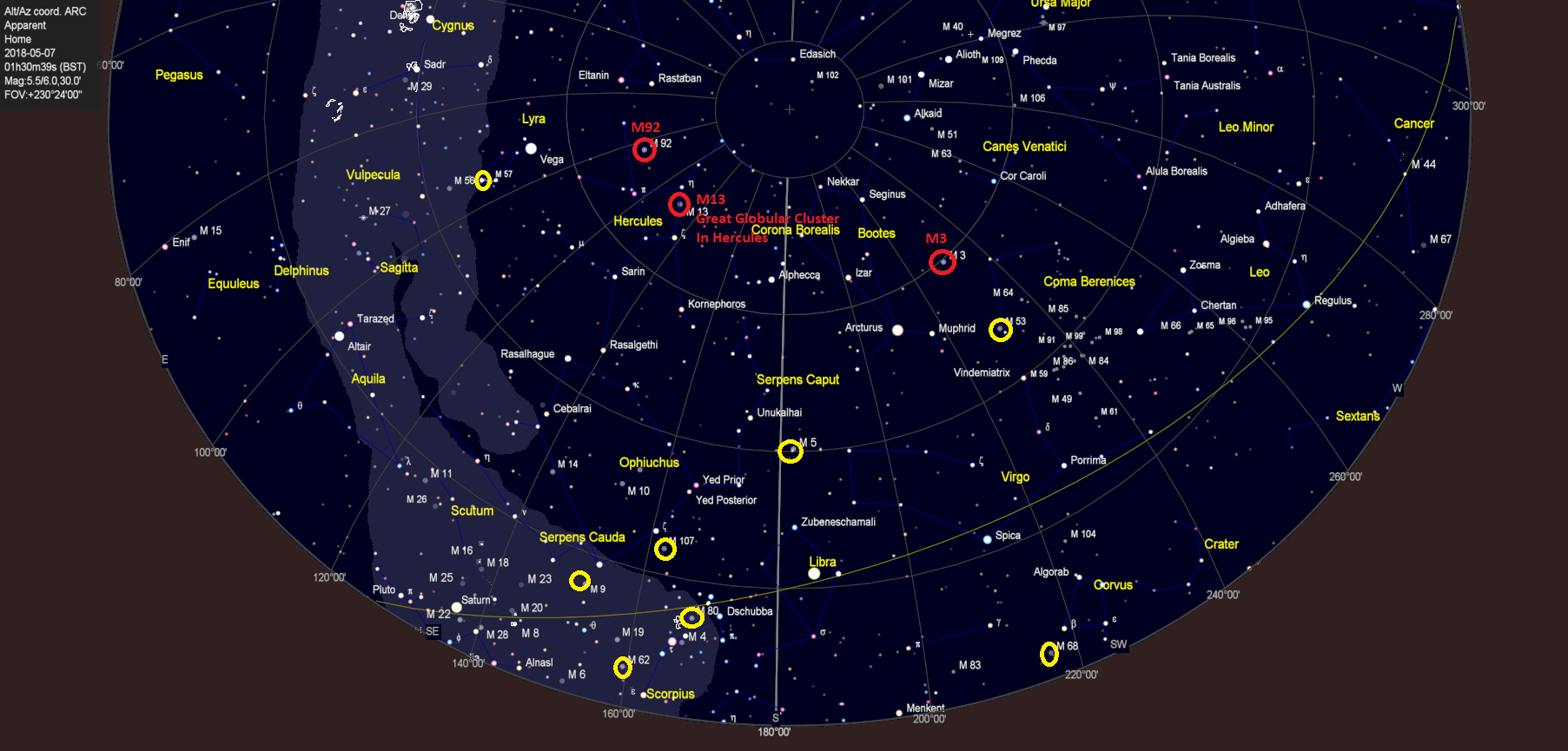
After imaging the globular cluster M53 from Fairvale Observatory in early April, it was opportune to be able to continue the same theme with my first two DSW images taken during Q1 and Q2 – the globular clusters M13 and M92, both located in the constellation of Hercules. With an angular separation of just 9o 33’, spatially the two clusters appear as neighbours but in reality M13 is some 4,560 thousand light-years closer. Spanning some 145 light years in diameter, M13 consists of several hundred thousand stars and as the brightest globular cluster in our galaxy it is generally considered to be the finest in the Northern Hemisphere. Whilst somewhat overshadowed by its more famous neighbour, M92 is still one of the brightest globular clusters orbiting the Milky Way and at +11 billion years is one of the oldest.
Since moving to mono imaging in 2017 I’ve only used a CMOS camera and therefore this is my first experience of working with CCD data, hitherto considered as the best, though more recent development of CMOS sensors suggests this is now likely to be the way forwards for amateur astrophotography. Whilst most of the techniques are the same there are minor differences such as using bias frames instead of dark flats with my CMOS camera for calibration.
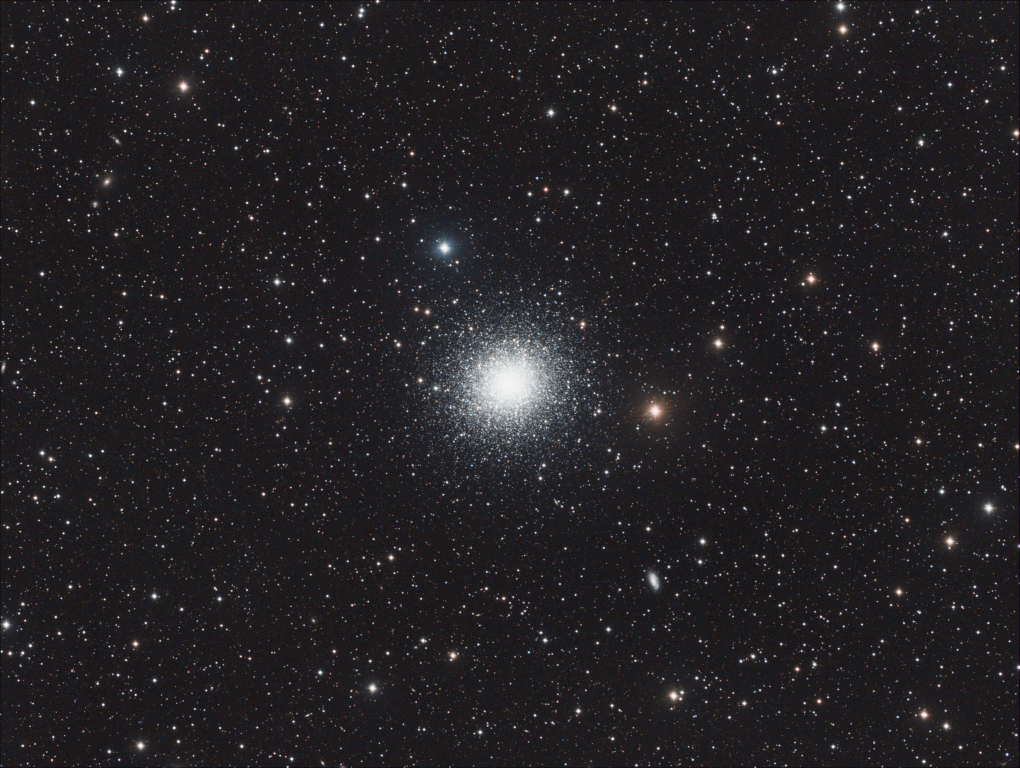
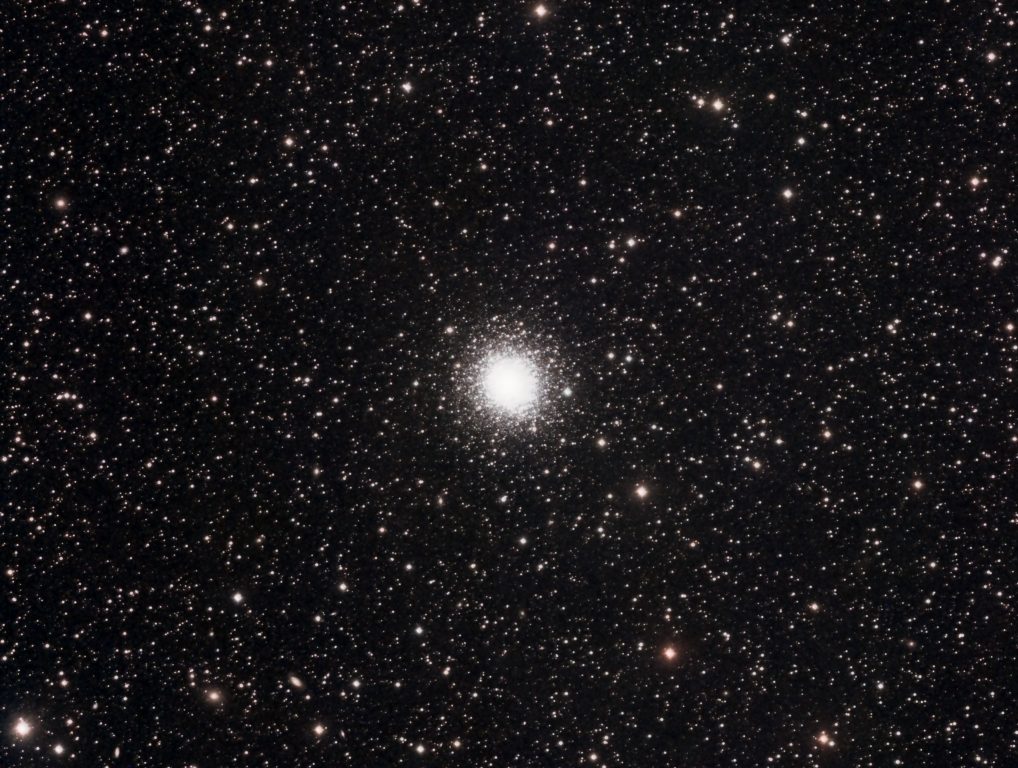
The DSW equipment combination produces a field-of-view nearly 50% less than my equipment at home but with a similar resolution, thus improving the magnification and image details of smaller and/or complex features such as globular clusters. Notwithstanding, I was pleased with my previous image of M13 (above) taken from Fairvale Observatory in 2018, which after cropping compares well with the new DSW version (see main image at the top of the page). This is my first image of M92 (below), which though OK probably needs more attention, as I’m not convinced the combination of the 600 secs + 300 secs + 60 secs data has worked to its full potential.
The Takahashi 106 is one of my dream scopes and with up to 250 clear nights a year historically, the DSW location in New Mexico provides an opportunity to work with top level equipment in outstanding night sky conditions – what’s not to like with remote imaging? However, with a growing cadre of remote imagers this has become a something of a contentious issue amongst astrophotographers – there’s no doubt it produces excellent data which leads to outstanding images but as a hobby it’s still good to be hands-on. So far I’m really enjoying working with the remote data produced under optimum conditions but strangely there’s much to be said for imaging in the backyard even with or perhaps because of the problems it involves. Funny old world!
For good reason spring is known as “galaxy season” by astronomers but during this period, shortly before astronomical darkness inevitably disappears for summer, there’s also another show in town. Closer to home in the denser extremities of our galaxy, over 150 globular clusters have so far been identified orbiting above and below the plane of the Milky Way within the galactic halo. Globular clusters consist of hundreds of thousands of tightly packed stars that are surely one of the more enigmatic features of astronomy, as we now know that similar clusters also are associated with other galaxies throughout the Universe. Whilst the formation of globular clusters is poorly understood, we do know that at 10.0 to 13.5 billion years they are very old. Given their age, location and density, it seems that globular clusters formed under very different circumstances to the more recent dispersed star clusters.
Image Setting / Location
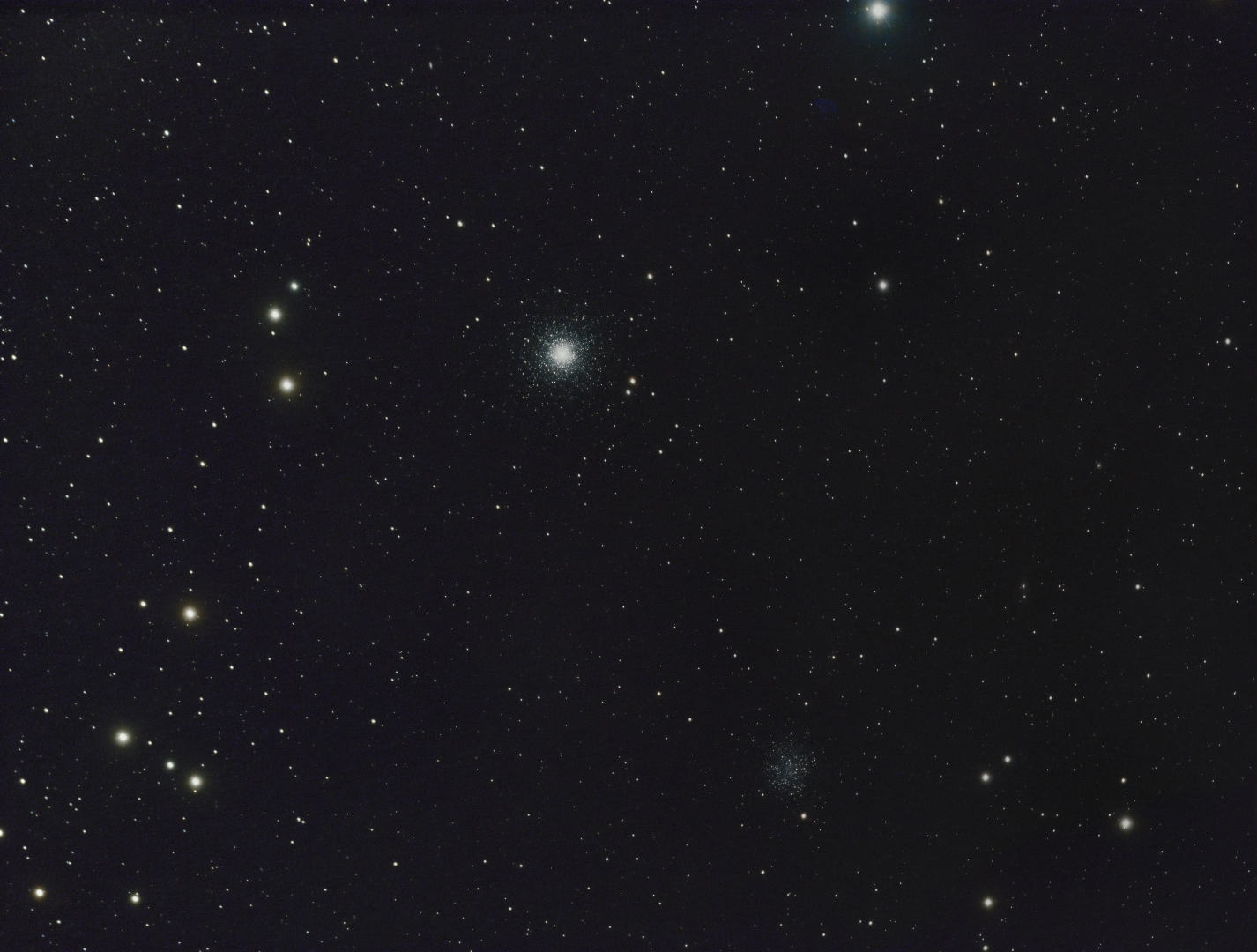
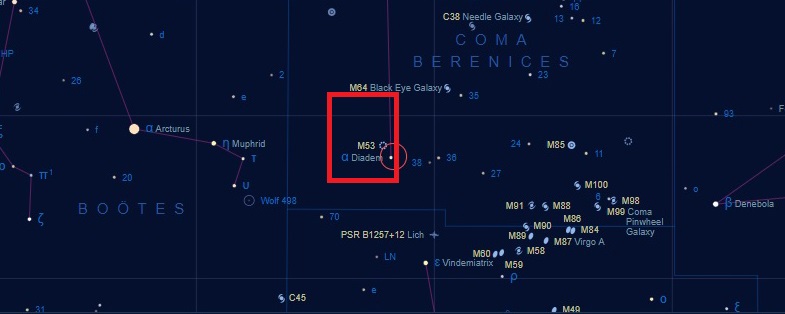
Sagittarius and Ophiuchus brim with globular clusters but at the higher latitude here at Fairvale Observatory it is necessary to view those around the regions of Canes Venatici, Virgo or Coma Berenices; the Great Cluster of M13 and others such as M92 and NGC 6229 located in the aforesaid Hercules constellation move into a better view later during early summer. Having previously imaged a number of these clusters in the past, this spring I looked around for something new and different, which I found in the name of M53 (Above + left of centre – main image top of the page) . In this case it turned out to be two for the price of one, as with careful framing it was possible to include a second globular cluster, NGC 5053 (Below + right of centre – main image top of the page).
Located in the southern area of the Coma Berenices constellation, M53 (Above left of centre – main image, top of the page) is some 58,000 light years from Earth. Containing some 500,000 metal-poor stars, the cluster equates to 13 arc minutes of sky or about 220 light years in diameter, with an estimated age of 12.67 billion years. Just over 1o east of M53, NGC 5053 is 53,500 light-years away, with an apparent size of 10.5 arc minutes or 160 light-years. Although classified as a globular cluster, NGC 5053 is more irregular and dispersed in nature without a distinct bright core and is therefore dimmer than its neighbour, making it more difficult to image.
M35 Full Crop
All-in-all I believe these two globular clusters, combined with the star studded background that just includes the binary Diadem star (Upper edge + right of middle – main image, top of the page) southwest of M53, altogether makes for a rich and interesting final image.
IMAGINGDETAILS
Object
M53 & NGC 5053
Constellation
Coma Berenices
Distance
Approx.. 58,000 & 53,000 light-years
Size
13.0 & 10.5 arc minutes
Apparent Magnitude
+8.33 & +10.00
Scope
William Optics GT81 + Focal Reducer FL 382mm f4.72
Mount
SW AZ-EQ6 GT + EQASCOM computer control & Cartes du Ciel
Guiding
William Optics 50mm guide scope
+ Starlight Xpress Lodestar X2 camera & PHD2 guiding
Camera
ZWO1600MM-Cool mono CMOS sensor
FOV 2.65o x 2.0o Resolution 2.05”/pix Max. image size 4,656 x 3,520 pix
Of all the things I’ve discovered since taking up astronomy, perhaps it is the presence and nature of globular clusters that has most surprised me. Bound closely together by gravity, these massive spherical collections of stars orbit the galactic core perpendicular to its plane. In the case of the Milky Way there are 150 globular clusters but they can be much larger in other galaxies, such as M87 which has some 13,000; clusters of clusters have also now been discovered in the Universe! Typically each cluster might contain a few thousand or tens of thousands of stars, although in some cases they can be much larger. Omega Centauri is the largest globular cluster in the Milky Way, being 150 light-years in diameter it contains 10 million stars; though clearly visible from Earth it can only be viewed from the Southern Hemisphere, which we unfortunately did not see when in New Zealand earlier this year.
Despite all the advances being made in cosmology, the origin of globular clusters still seems to remain quite uncertain. Characteristically the stars are all very old, typically in the region of 8 to 12-billion years and are of low metallicity i.e. they contain a low proportion of elements other than hydrogen and helium. At least some, such as Alpha Centauri, are thought to have condensed from dwarf galaxies and such a process may currently be taking place within the large Magellanic Cloud – which we did see in New Zealand! In other cases it is thought that the clusters have probably originated independently and were subsequently captured by the relevant galaxies. However, their very old age – sometimes nearly as old as the universe itself – origin and relationship to galaxies remains intriguing. For these and many other reasons I personally find globular clusters fascinating, probably more than any other astronomical feature, amazing as they too may be.
From time-to-time I’ve tried imaging various globular clusters but have not been satisfied with the outcome. Now using guiding, plate solving and the high-resolution ZWO1600MM-Cool camera, it was time to give it another try this spring, when some of the best clusters are present in the northern night sky.
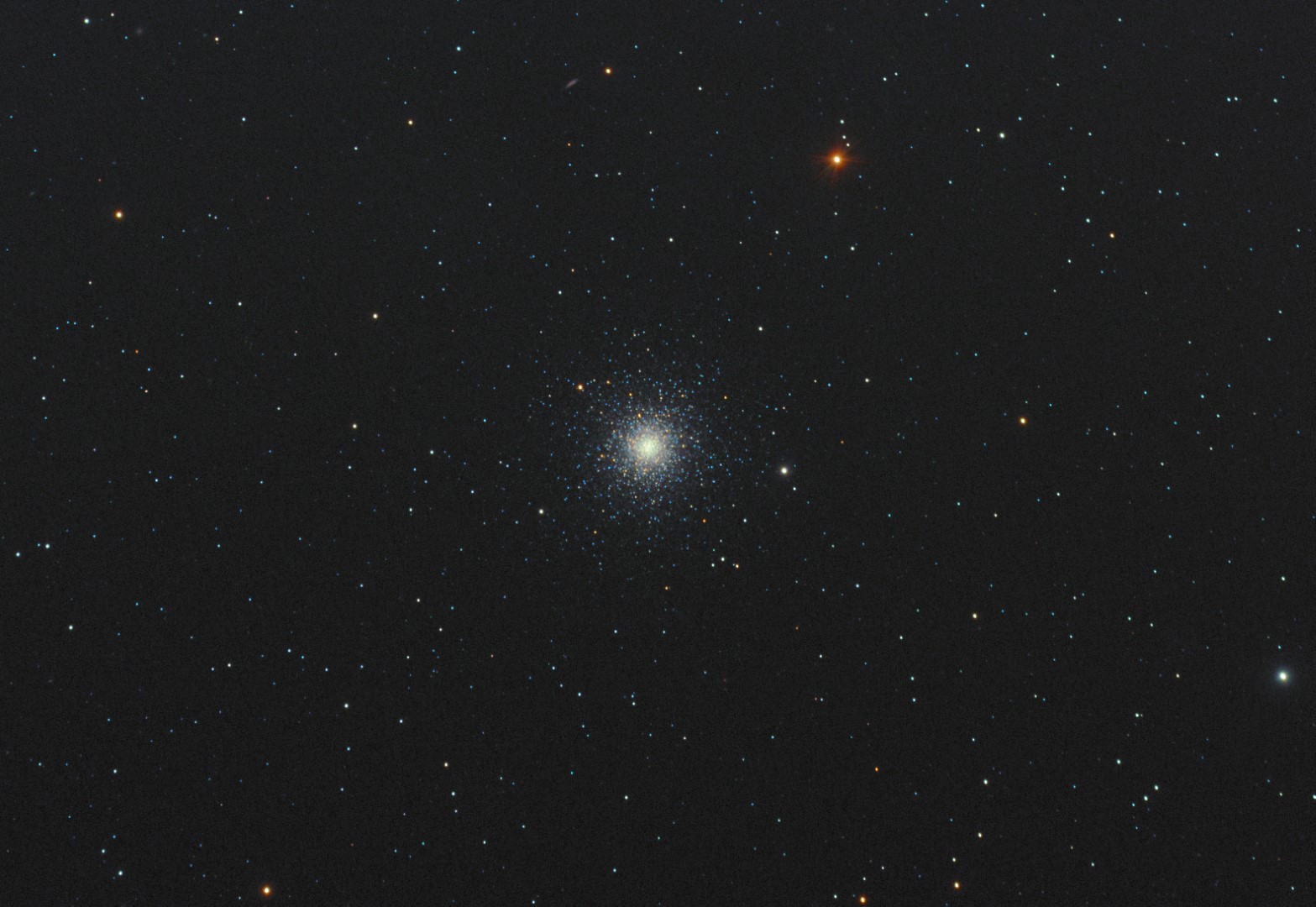
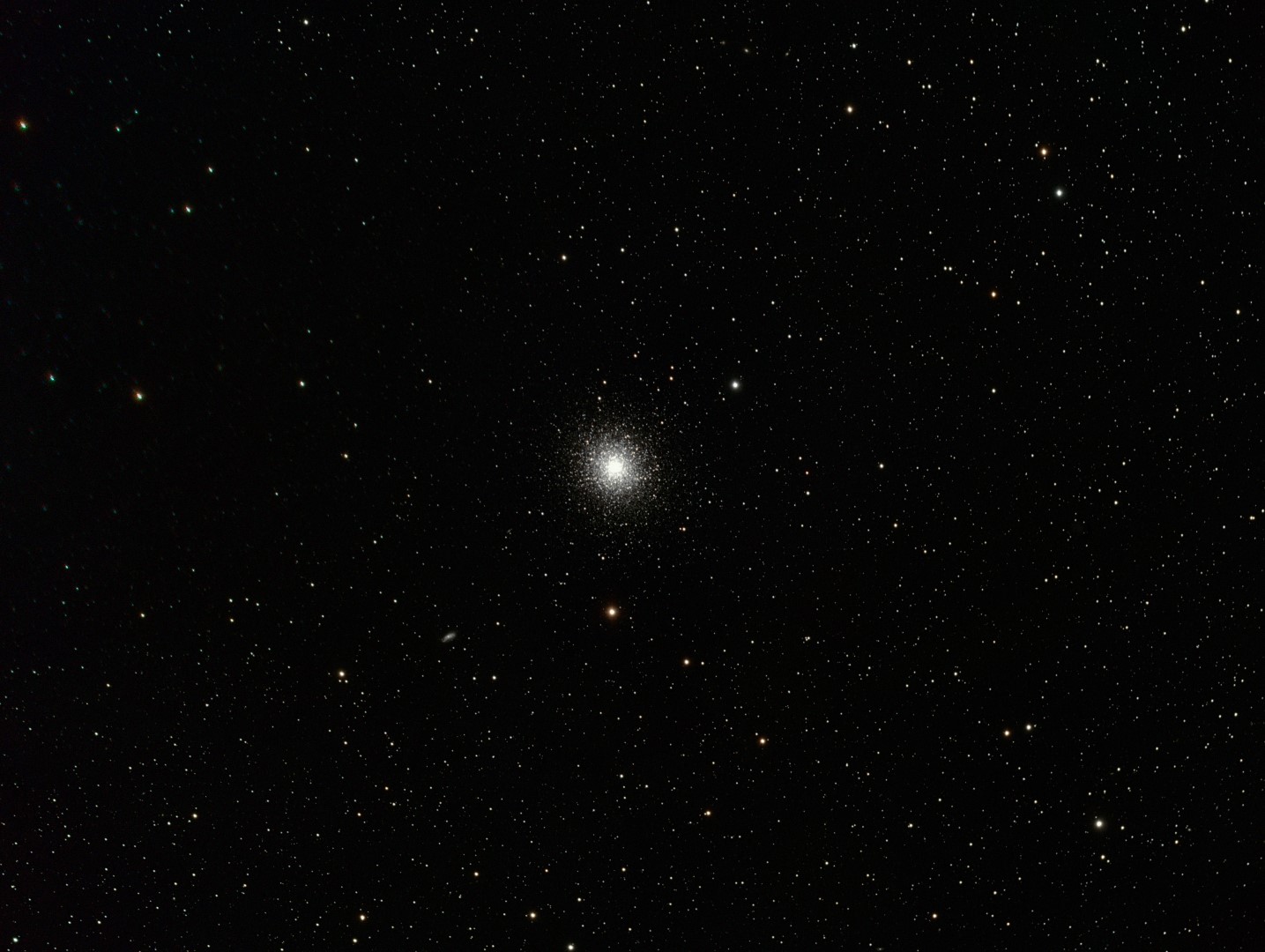
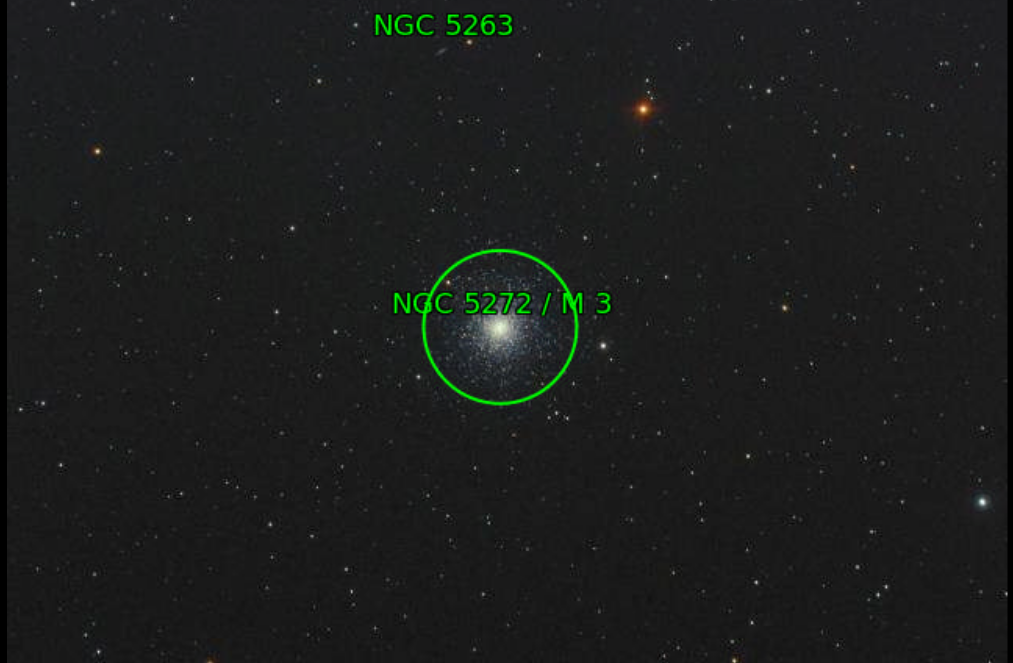
First up was M3 (Final image above), the very first Messier Object to be discovered by Charles Messier himself in 1764. Consisting of 500,000 stars, between 8 and 11-billion years old and spanning some 220 light-years, M3 is one of the largest and brightest (absolute) globular clusters associated with the Milky Way – about 300,000 times brighter than our Sun. It is noteworthy that the cluster contains some 274 variable stars, the highest number of any clusters, as well as a relatively high number of ‘blue stragglers’ – young main-sequence stars that appear to bluer and more luminous than the other stars in the cluster and are thought to be formed through stellar interaction of the older stars.
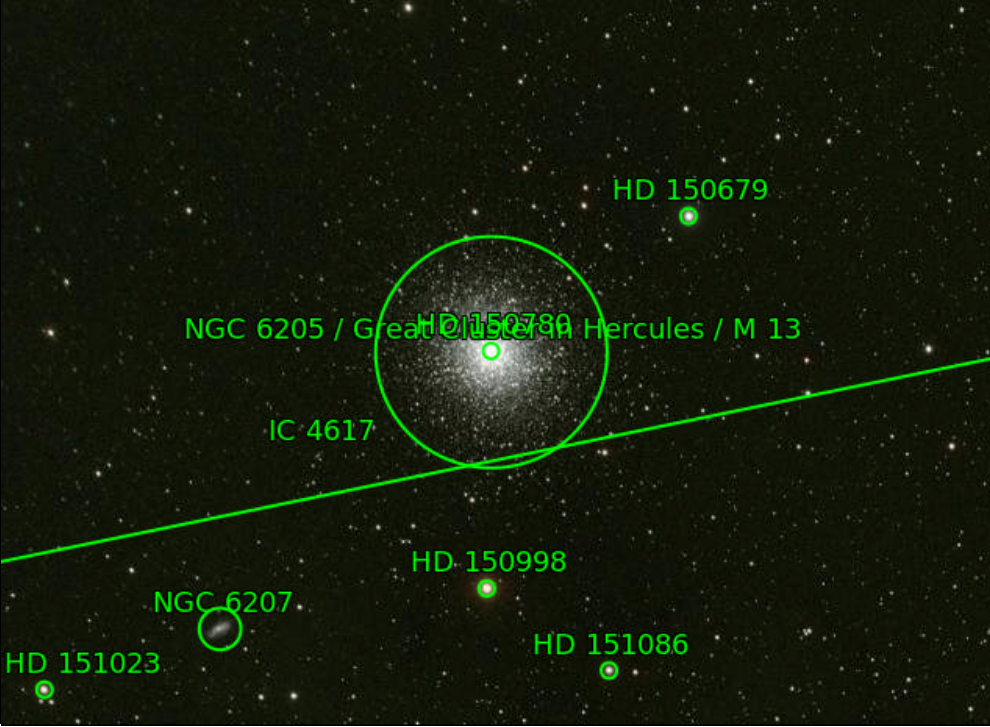
With these attributes it is not surprising that M3 is considered a popular target in astrophotography (cropped image above), likely surpassed however by M13 AKA the Great Globular Cluster in Hercules (cropped image top-of-the-page), which conveniently follows M3 in the same area of the sky about 3-hours later (together with nearby the globular cluster M92). And so having bagged M3 it was time to turn the telescope and camera towards M13 (Main image below). Discovered by the eponymous Edmond Hailey in 1716 (he of Hailey’s Comet), seen from Earth M13 is slightly brighter than M3 with a wide range of star colours that certainly makes for an exciting image. At 11.65 billion years old, M13 has been around almost three times as long as the planet Earth.
Since starting astrophotography I like to try my hand at imaging a globular cluster at least once each year but hitherto with disappointing results. This time I’m pleased with the outcome, especially M13 which is surely one of the most magnificent objects in our night sky; as a bonus there are also a few galaxies in the background of both the M3 and M13 images too. It is therefore fortunate that for those of us in the higher latitudes of the northern hemisphere the Great Globular Cluster in Hercules can be seen all-year round, though is at its highest and therefore best position between May and September – thereby inaccessible for the Kiwis who are instead compensated by Alpha Centauri! I expect to be back again next year to marvel at these amazing and enigmatic objects, if not before.
IMAGING DETAILS
Object
M3 (NGC 5272)
Constellation
Canes Venatici
Distance
33.9 million light-years
Size
18.0’ or 220 light-years
Apparent Magnitude
+6.2
Scope
William Optics GT81 + Focal Reducer FL 382mm f4.72
Mount
SW AZ-EQ6 GT + EQASCOM computer control
Guiding
William Optics 50mm guide scope
+ Starlight Xpress Lodestar X2 guide camera & PHD2 control
Camera
ZWO1600MM-Cool (mono) CMOS sensor
FOV 2.65o x 2.0o Resolution 2.05”/pix Max. image size 4,656 x 3,520 pix
The night sky is full of wonderful worlds, which themselves consist of amazing objects and features. I was originally drawn to astronomy by viewing Saturn through a telescope, which to this day retains a fascination and beauty for me. Of course it is Saturn’s rings that make it stand out as perhaps the iconic object of the night sky; even to the lay person their nature and colour tell us something special is taking place. The rings and associated shepherd moons indicate that something is happening to bring all the particles and objects precisely together in a disc that rotates around the planet – gravity. Perhaps surprisingly this force remains a mystery to science, although it is now clear that it has an overarching impact on the development of the Universe itself.
Another fascinating feature of gravity is the formation of globular clusters, which I find both beautiful and bewildering. Bound tightly by gravity, each cluster is made of at least several hundred thousand very old stars, typically between 8 to 10 billion years, which usually orbit at a far distance outside and at right angles to the galactic disc. So far about 158 globular clusters have been identified around the Milky Way and we now know such objects are also commonly associated with other galaxies. During the summer and autumn many of these enigmatic star clusters can be seen across the sky, which form wonderful imaging targets.
M15: 12bn light-years old globular star cluster | Constellation Pegasus, 33,600 ly from Earth, apparent mag. +6.2, size 18.0′ (diameter 176 ly) | WO GT81 + modded Canon 550D & FF | 10 x 300 sec @ ISO 800 & full calibration | 22nd October 2016
Although I have previously spent time observing and imaging Saturn and various globular clusters, as well as notable single stars such as Betelgeuse and Altair, for some reason I have neglected their binary relations. And so in early autumn this year I turned the telescope and camera towards two of the better examples of these double or binary stars. So-called Doubles consist of two stars orbiting around a barycentre, captured by each other’s gravity. The challenge is to ‘split’ the stars, thereby differentiating each star as individual features and if relevant by colour, either by observing though the telescope or in an image.
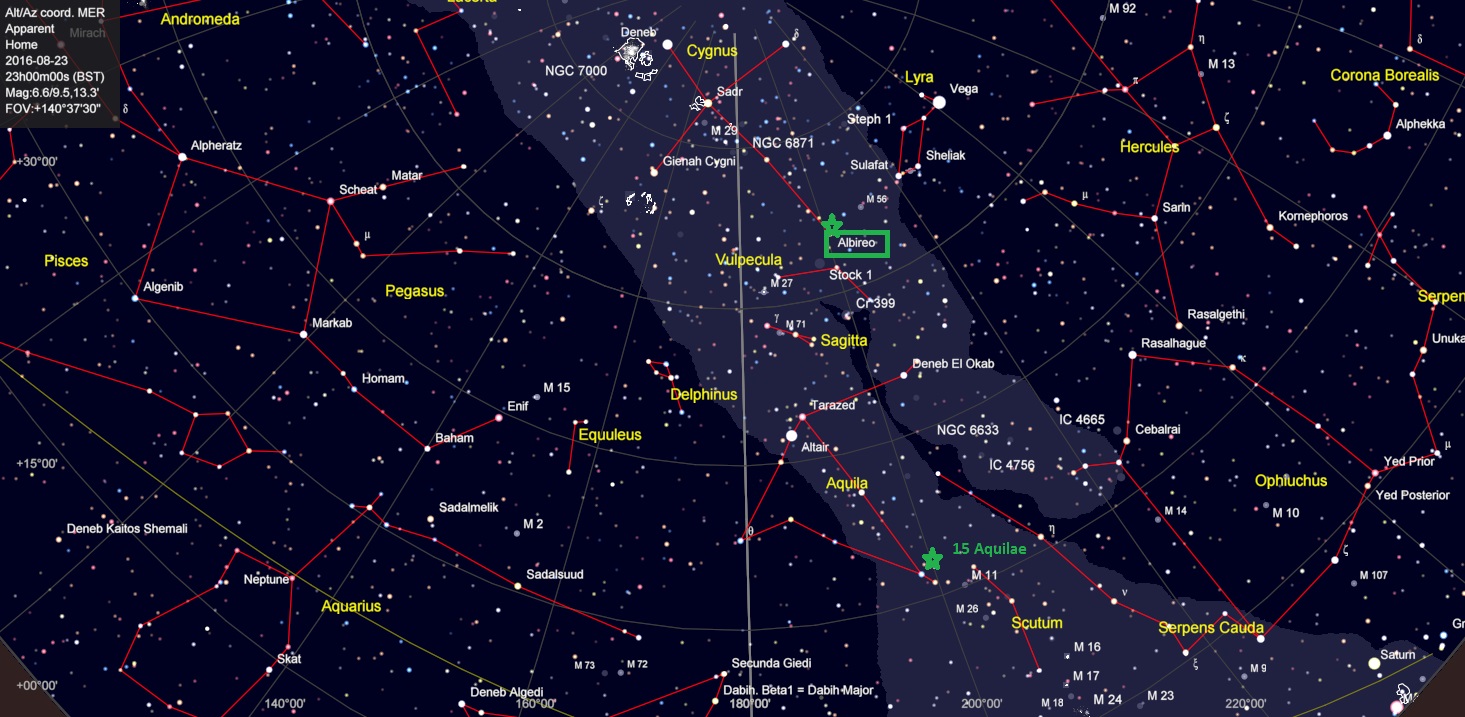
My initial target was the beautiful Albireo (below), a double star consisting of the mag. +3.1 gold coloured Beta Cygni A and its mag. +5.1 bright blue partner Beta Cygni-B. At a distance of 430 light-years from Earth and separated by 35 arc seconds, the stars have an implied orbital period of at least 100,000 years. Together with Deneb, Sadr, Gienah and Delta Cygni, Albireo forms the Northern Cross asterism, which lies almost overhead at midnight during the late summer months in the Northern Hemisphere. Situated at the head of the Cygnus (Swan) constellation, Albireo is also known as the “beak star”. The contrasting colours of the two stars form one of the most beautiful doubles of the summer sky and forms an attractive imaging target.
Located in the nearby constellation of Aquila but less notable than Albeiro, is the double 15 Aquilae (below). Some 4-billion years old and a hot 11,000oC in temperature, the larger mag. +5.4 orange giant star is located some 190 light-years from Earth. Its smaller partner is a cooler white mag. +7.7 star, situated 38 arc seconds away but ‘only’ 4,400oC hot. Such features abound in the Aquila constellation and I hope to return to this region of the sky again next year for more double fun!
Doubles are a real treasure of the night sky that are surprisingly common but are easy to overlook. They are often interesting as well as beautiful to observe and image – I can’t think why it’s taken me so long to get round to them?
Having missed 6-months astronomy earlier this year following an operation, come September I was desperate to get back to my nascent interest in astronomy and astroimaging. Apart from some initial operating mishaps, it turned out to be a good month: warm evenings, clear skies and interesting skies. Since then it’s all gone Pete Tong, with no imaging opportunities here at Fairvale Observatory since early October due either to cloudy skies or the coincidence of the full Moon with clear periods; it was therefore not surprising to learn that November was recorded as the dullest on record, with just 18 hours of sunshine compared to an average of 63 hours.
My antidote to physical incapacity and cloudy skies this year has been the MOOC or Massive Open Online Course – free online courses run by Universities from all over the world, in my case of course I naturally chose various aspects of astronomy:
In the night sky: Orion – Monica Grady, Open University. Orion constellation and star evolution.
Moons– David Rothery, Open University. Everything about moons; there are 176 moons in the Solar System some bigger than planets and some with the potential for life.
Imagining Other Earths– David Spergel, Princeton University. The complete astronomy course and more! Ongoing 24-week course that covers just about everything in astronomy – outstanding.
Gravity! – Pierre Binétruy and George Smoot (Nobel Laureate), Paris Centre for Cosmological Physics – Paris University Diderot. Gravity and how it shapes the universe etc.
This week marked the centenary of Einstein’s general theory of relativity and the end of the course Gravity! At the same time on Thursday ESA launched the LISAPathfinder space mission, that is designed to assess the viability of ground breaking technology which if successful will be used later to study and measure gravitational waves; whilst on this theme I also watched the movie Interstellar.
Whatever gravity is, and it is clear that despite Einstein et al we still don’t really know (no shortage of theories though), its effects clearly shape the Universe in a major way and at all levels.
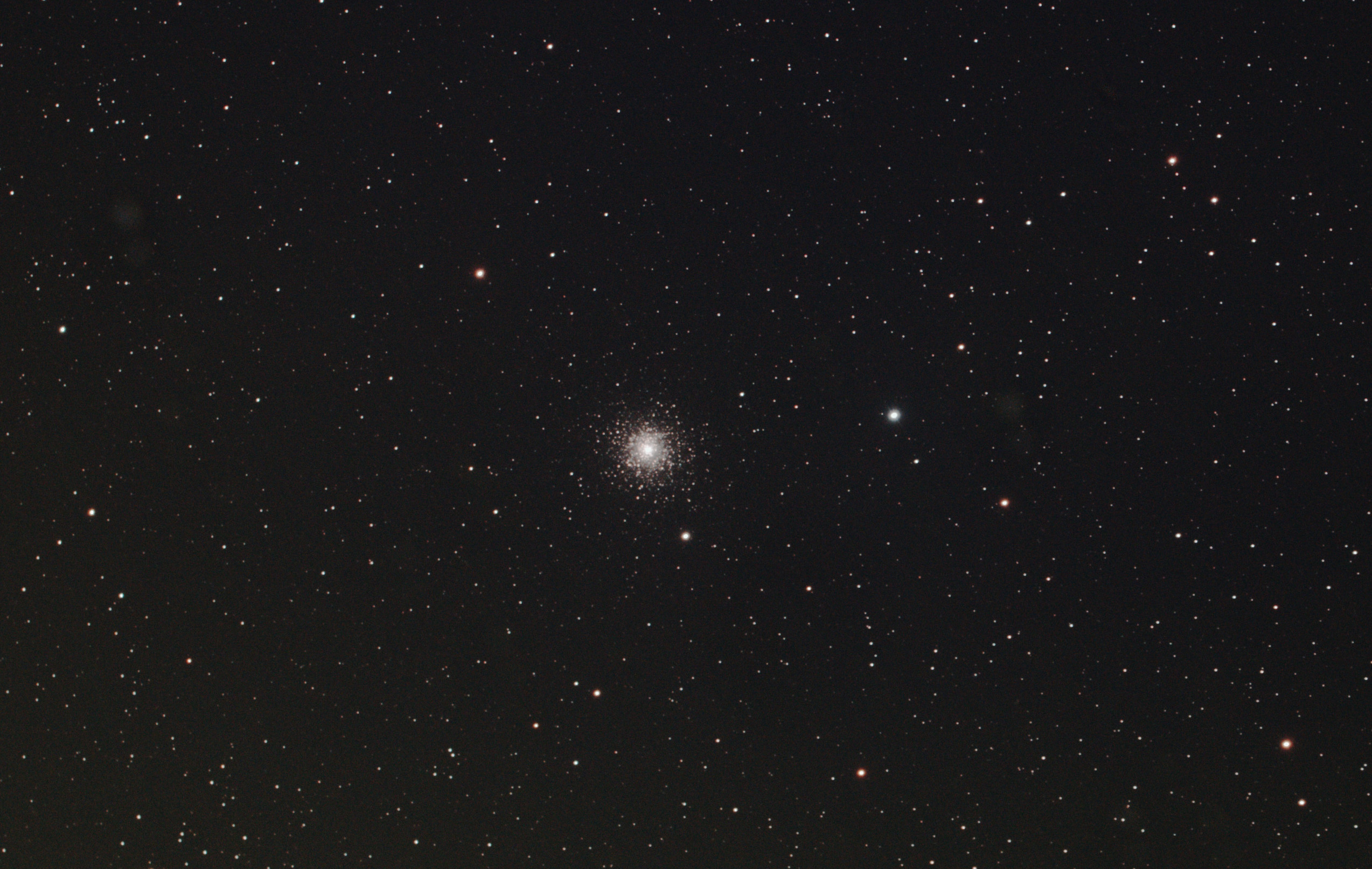
One such feature is the globular cluster, groups of up to one million very old stars, tightly bound by gravity that orbit a galactic core; over 150 have so far been identified with the Milky Way Galaxy. I find them to be one of the most interesting and enigmatic features of astronomy and therefore before the clouds rolled in some weeks ago I managed to image such a cluster, M15.
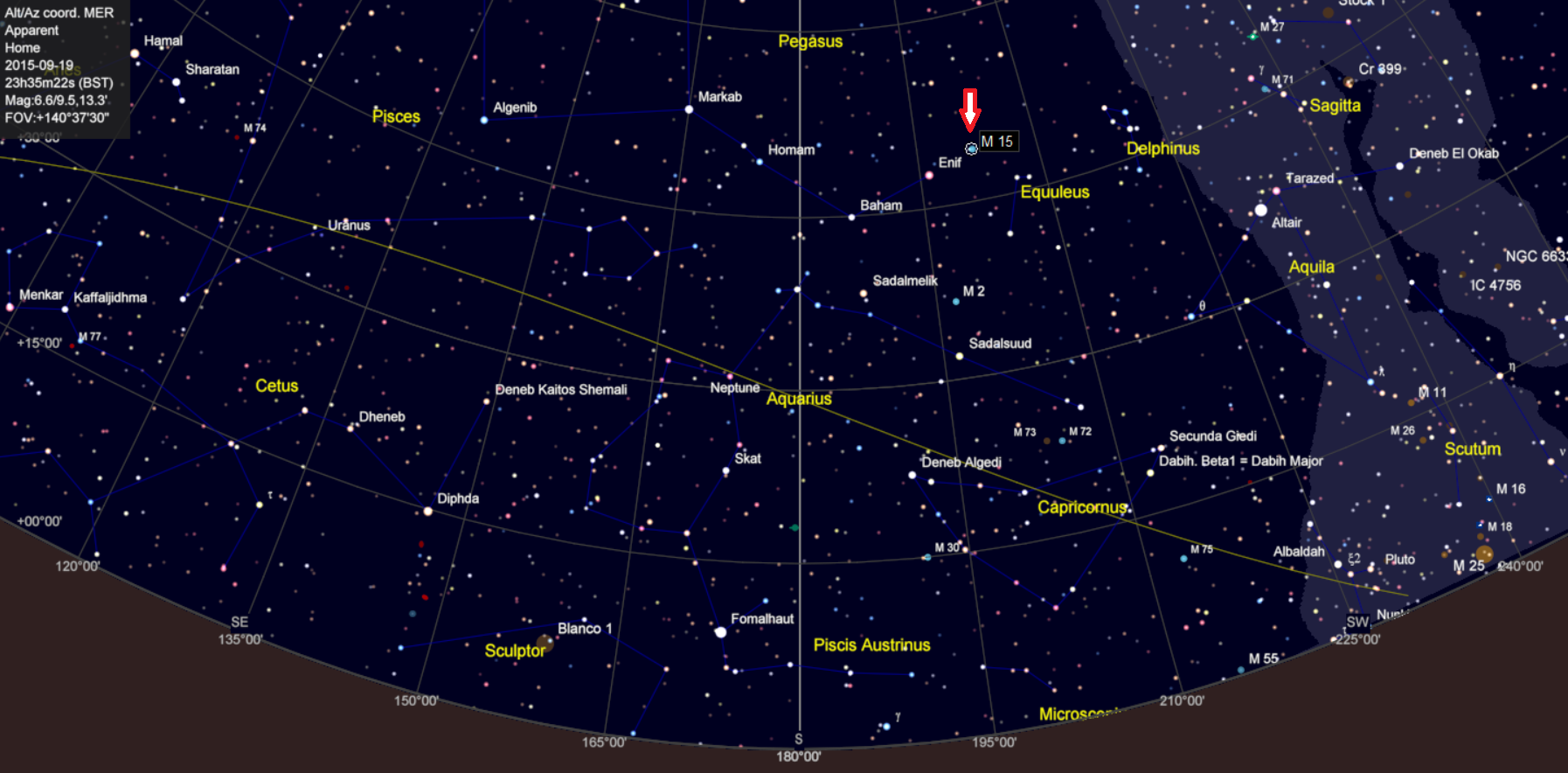
Globular star cluster M15 lies about 33,000 light years away towards the constellation Pegasus, about 4° northwest of Enif, the star at the tip of Pegasus’ nose. It was discovered by French-Italian astronomer Giacomo Filippo Maraldi in 1746 and rediscovered by Messier in 1764. At magnitude +6.2, M15 is generally considered to rank amongst the finest objects of its type in the northern sky.
M15 Globular Cluster WO GT81 + modded Canon 550D & FF | 15 x 120 secs @ ISO 1,600 | 19th September 2015
M15 has a diameter of 120 light years and revolves around the Galaxy once every 250 million years in a prograde orbit, meaning it moves about the galaxy in the same direction as the galaxy’s own rotation. In 1974, M15 was discovered to be a source of x-ray energy, which may suggest that one or more supernova remnants are buried deep within the cluster.
With such unreliable viewing conditions in the UK it’s essential to find other areas of interest when pursuing astronomy. I have found MOOCs to be an excellent and accessible source of first rate, up-to-date information that have expanded my knowledge of astronomy significantly, whilst post processing and planning are also both essential tasks that can also often be interesting. Notwithstanding, with Orion and other exciting features of the winter sky now upon us, I can’t wait to get back outside soon.









 WATCH THIS SPACE(MAN)