Nice But Dim

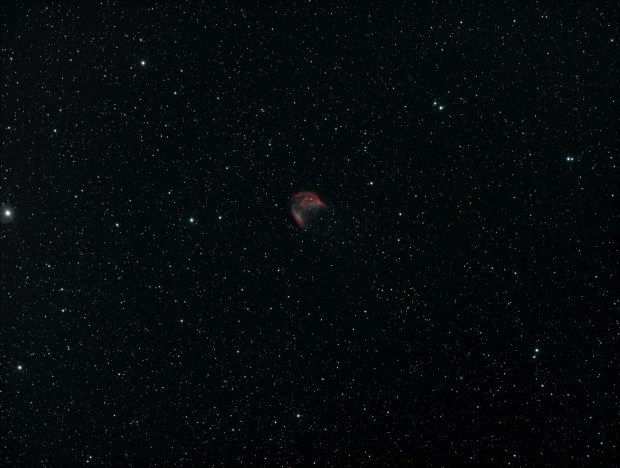
Abell 21 Combo All 2018 2020 RGB FINAL CROP (Large)

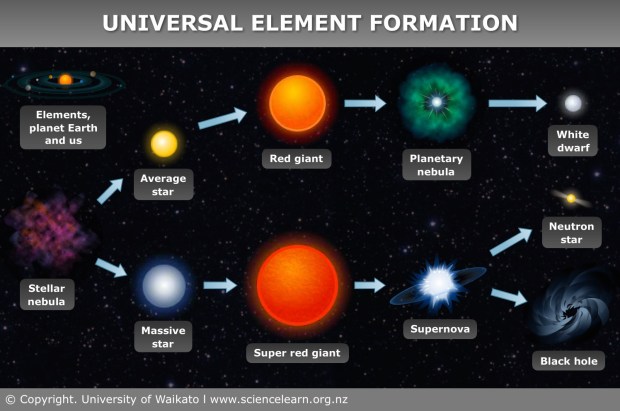
Contrary to appearance, a planetary nebula is not a planet but a emission nebula, an expanding shell of glowing ionized gas discharged from a red giant star at the end of its life.  At this late stage of stellar evolution the star runs out of fuel to burn, with the result that the outer layers are blown away and expand into space typically in the shape of a ring or bubble.  At the centre of the planetary nebula is the remnant of the star, which is left as a White Dwarf.
JEL_ITV_ElementFormation_BG-Plate_Updated_23Oct17

The term “planetary” nebula is therefore completely misleading and derives its name from none other than William Herschel, in an era when such objects were thought to look like planets.  We now believe some 10,000 planetary nebulae exist throughout the Milky Way, though only 1,500 have been identified (see NASA HST images below), including M57 the Ring Nebula and M27 the Dumbbell Nebula both popular amongst astrophotographers.
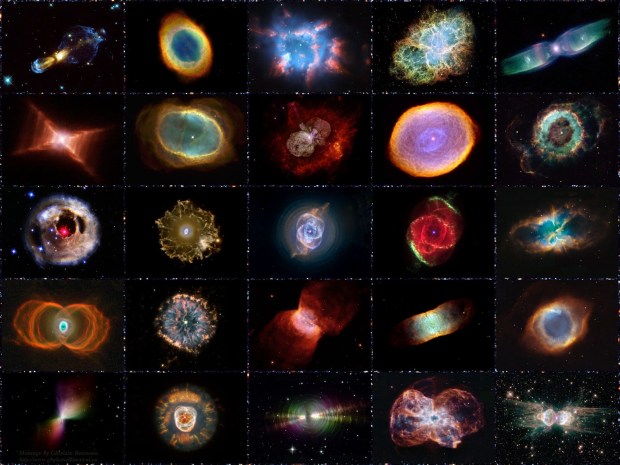
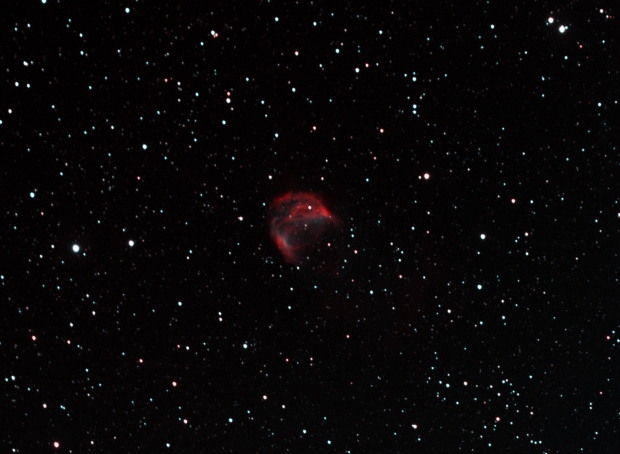
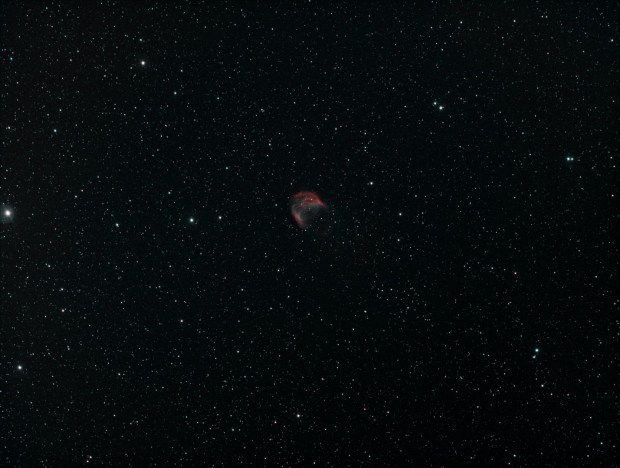
HST PNSuch objects are usually short lived and unfortunately small and faint, making them a challenge for smaller telescopes and Bortle 5-6 skies, such as I have at Fairvale Observatory.  However, I recently decided to return to the Medusa Nebula, a planetary nebula which I previously had imaged as a test in February 2018.  On that occasion the integration time was limited to only 75 minutes (see below), now the objective was to build on the previous data and thereby hopefully improve the image quality.
Abell 21 RGB 2018 Final (Large)

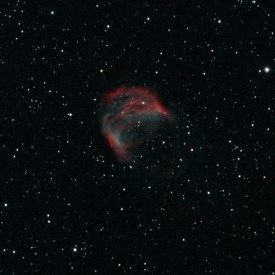
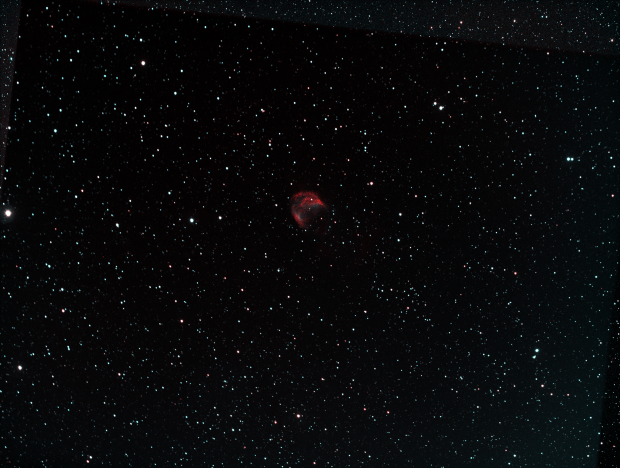
Combining the data from 2018 with that of 2020 resulted in a significant increase in total integration time to just over 5-hours, with the impact on the final image clearly noticeable (see top-of-the-page cropped and below uncropped – showing the difference in alignment between pre-plate solving 2018 & 2020 data), mainly in the form of reduced noise and better colour saturation.  I am a little surprised that the improvement was not greater but perhaps it’s a case of either (a) considerably more time is still required, particularly in the weak OIII wavelength,  or (b) it’s really too much of a challenge for my equipment?

However, looking at other images of the Medusa Nebula and considering its size and very low surface brightness, it’s obvious this is one of the more difficult planetary nebula objects to image and all things considered I’m happy with outcome new of this new version.
Abell 21 Combo All 2018 2020 RGB FINAL

IMAGING DETAILS
Object The Medusa Nebula  AKA Abell-21,  Sharpless 2-274 or PK205+14.1
Constellation Gemini
Distance 1,500 light-years
Size Approx.. 12’ x 9’
Apparent Magnitude +15.99
 
Scope  William Optics GT81 + Focal Reducer FL 382mm  f4.72
Mount SW AZ-EQ6 GT + EQASCOM computer control & Cartes du Ciel
Guiding William Optics 50mm guide scope
  + Starlight Xpress Lodestar X2 camera & PHD2 guiding
Camera ZWO1600MM-Cool mono  CMOS sensor
  FOV 2.65o x 2.0o Resolution 2.05”/pix  Max. image size 4,656 x 3,520 px   
EFW ZWOx8 + ZWO LRGB & Ha OIII SII 7nm filters 
Capture & Processing Astro Photography Tool + PHD2 +  Deep Sky Stacker & Photoshop CS3
Image Location              & Orientation Centre  RA 05:55:38      DEC 01:59:40  @20.49h                     

Image rotated 180o for presentation Top = South     

Exposures 37 x 300 sec  Ha, 25 x 300 sec RGB

Total Time 5hr 10 min   

  @ 139 Gain   21  Offset @ -20oC    
Calibration 5 x 300 sec Darks  20 x 1/4000 sec  Bias  10 x  Ha & OIII Flats  

@ ADU 25,000

Location & Darkness Fairvale Observatory – Redhill – Surrey – UK        Typically Bortle 5-6
Date & Time 11th February 2018  + 2nd &  3rd March 2020  @ +21.00h  
Weather Approx. 5oC   RH <=75%                  🌙 +29% waxing

Death Throes of a Star

Abell 21 RGB 1Final (Large)

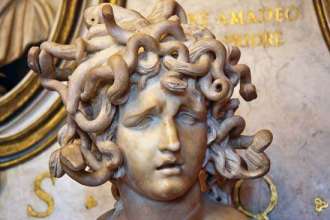
As the winter arm of the Milky Way proceeds inexorably towards the west, I’ve been seeking new objects and was pleasantly surprised to recently discover a small but nonetheless interesting planetary nebula located just to the east of the galactic plane between Canis Minor and Gemini.  Consisting of large filaments of glowing ionized gas, the feature goes by the popular name of the Medusa Nebula, after the Greek mythological gorgon figure which has hair of writhing snakes!

145615-004-A364787F

Statue of Medusa

Also known as Abell 21 (discovered by George Abell in 1955), Medusa is an ancient planetary nebula some 1,500 light-years away, officially situated within the constellation Gemini.  Like its dramatic mythological namesake, the planetary nebula represents the final stages of a low mass star such as our sun in the process of transforming from a red giant to hot a white dwarf star, in the process shedding its outer layers which are illuminated by ultraviolet radiation from the hot star within which powers its glow.

Medusa

At 4-light years across the Medusa Nebula is a small though reasonable size but with an apparent magnitude of some +15.99 is very faint and is therefore difficult to image.  Nonetheless, Ha and OIII gases are prevalent and as something of an experiment I chose to try and image this object at narrowband wavelenghts.

Abell 21 RGB 1FinalCrop (Large)

Considering the aforesaid problems I am quite pleased with the outcome (top of page), indeed I was surprised to see I had captured anything.  However, given its challenging low brightness and a total integration time of only 75-minutes, the final image was always going to be lacking in detail and noisy (cropped image immediately above).  Notwithstanding, now I know of its presence I will surely be returning to The Medusa Nebula on another occasion to improve the integration time and perhaps use a larger telescope to grab those photons which prove elusive to my current equipment set-up.


IMAGING DETAILS
Object The Medusa Nebula    (Abell 21 / Sharpless 2-274)     
Constellation Gemini
Distance 1,500 light-years
Size Approx. 12’ x 9’
Apparent Magnitude +15.99
 
Scope  William Optics GT81 + Focal Reducer FL 382mm  f4.72
Mount SW AZ-EQ6 GT + EQASCOM computer control
Guiding William Optics 50mm guide scope
  + Starlight Xpress Lodestar X2 guide camera & PHD2 control
Camera ZWO1600MM-Cool (mono)   CMOS sensor
  FOV 2.65o x 2.0o    Resolution 2.05”/pix  Max. image size 4,656 x 3,520 pix   
EFW ZWOx8 + ZWO LRGB & Ha OIII SII 7nm filters 
Capture & Processing Astro Photography Tool,  Deep Sky Stacker & Photoshop CS2
Exposures 10 x 300 sec Ha, 5 x 300 sec  OIII   (Total time: 75 minutes)
  @ 139 Gain  21 Offset @ -20oC  
Calibration 5 x 300 sec Darks  20 x 1/4000 sec Bias  10 x Flats Ha, OIII & SII @ ADU 25,000  
Location & Darkness Fairvale Observatory – Redhill – Surrey – UK        Typically Bortle 5
Date & Time 11th February 2018 @ 23.00h approx.


Flip Flop

Another night, another lesson learned, the hard way.

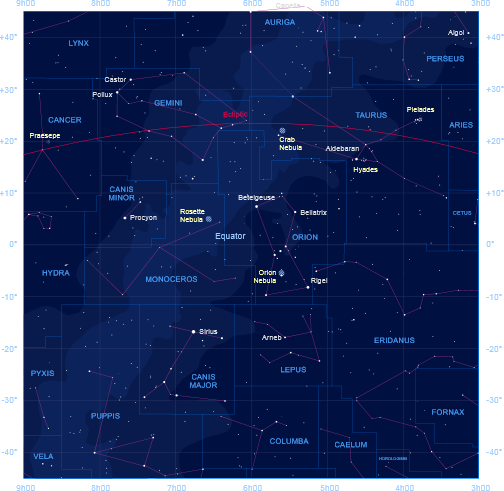
A good, clear sky on Saturday meant the prospect of a long and productive imaging session before the frost came down.  Whilst Orion has now moved to early evening, the light pollution from Gatwick airport to the south is bad at that time, so I’ll grab what I can but later is better when the light pollution starts to subside; from experience I presume they start to turn off the airport lights gradually from about 10pm, so that by midnight the sky is noticeably darker and much better for astronomy – though nothing like a true dark sky.  I therefore look more to the south east at about 8pm to line up potential imaging targets for about one to two hours later when objects will be  located at their best position, towards the Celestial Meridian and preferably high in the sky; such a location reduces the thickness of the atmosphere and improves tracking accuracy as the telescope’s angle with the object is less extreme.  At the moment this means something in or around the constellation of Gemini and later at night Cancer; Canis Major, Pupis and Hydra also fit the bill except for one critical problem, they are too low in the sky and are mostly obscured by houses and trees, grrrrr!

sky-06h00

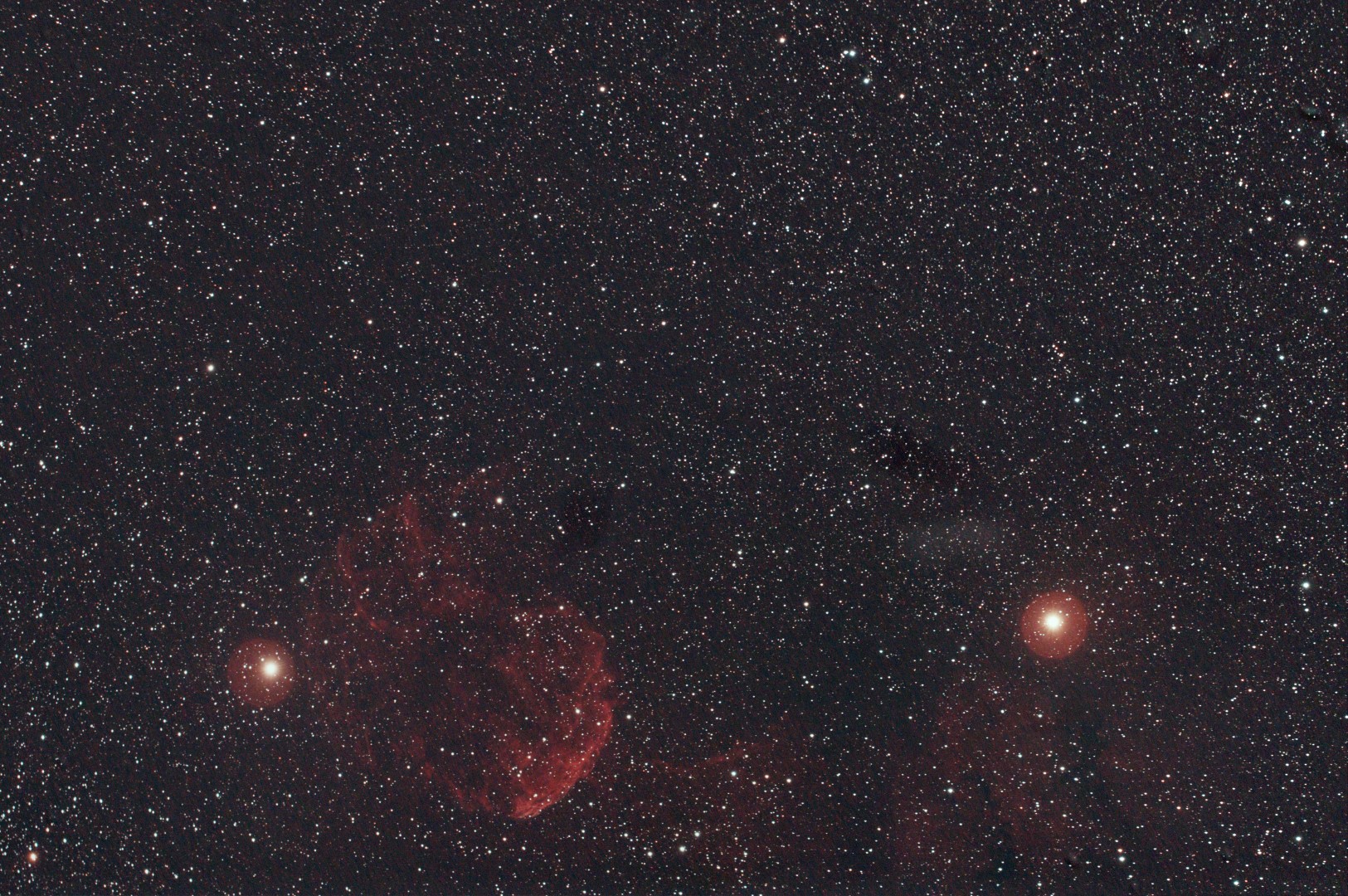
Having imaged three, mostly easier objects earlier in the evening, at about 10pm I then turned my attention to something more challenging.  Though large at some 100 light-years in diameter, the wonderfully named Jellyfish Nebula in the Gemini constellation (not far from the M35 open star cluster), with an apparent magnitude  of +12 is quite faint and would be difficult to photograph.  Notwithstanding, my first test image showed it was already in my field-of-view, though as anticipated faint, which I then set about adjusting to optimize its position within the frame before starting imaging.  In this regard two bright, dominant stars flank the nebula – to the left or East, Tejat Posterior and to the right or West, Propus – thus assisting on screen identification and the approximate position of the nebula on the camera’s sensor.

At this time the nebula was very close to the aforementioned Celestial Meridian and it was clear that during a 1-hour imaging run would actually cross the Meridian, thus requiring a so called ‘Meridian Flip’.  When setting-up the EQ-mount and telescope at the start, it is essential that they are aligned parallel with the Celestial Meridian in order that the mount and scope will then exactly track the movement of the night sky during subsequent viewing or imaging.  However, due to the physical nature (internal gears) and resulting constraints of the mount and tripod, as tracking proceeds from east to west and eventually encounters the Celestial Meridian, it is necessary to carry out a Meridian Flip, manually or automatically.  Such a flip requires that the mount and thus telescope and camera are swung from the west side of the tripod to the east, thereby ensuring that in continuing to track the object as it proceeds westwards they do not come into contact with the tripod.

Using the guide stars of Tejat Prosper and Propus to mark the East and West limits of the nebula and expecting the bulk of the other associated nebulosity to extend upwards, I positioned the stars towards the bottom of the frame.  However, the nebula had by now crossed the Meridian and the telescope and camera was switched (flipped) to the other side of the mount before I completed framing.  In-so-doing and, in my defence operating in the dark, I had overlooked that as a consequence of flipping across the Meridian, the camera had been inverted.  Oblivious to this change of the camera’s attitude, I continued to frame the stars and thus hopefully placing the nebula towards the bottom of the image, when instead I should be moving them towards the top of the frame as the camera was now upside down.  The result was that the final image unfortunately misses some of the associated nebulosity, though thankfully not the Jellyfish itself.

IC 443 The Jellyfish Nebula with Propus to the left and Tejat Prosper to the right after inverting the camera.  As a result much of the considerable interstellar cloud illuminated by interaction with the nebula is outside the  bottom of the image. WO GT81 + Canon 550D + FF | 20 x 180 secs @ ISO 1,600 + calibration | 24th January 2015

IC 443 The Jellyfish Nebula, with Propus to the left and Tejat Prosper to the right after a Meridian Flip inverted the camera before framing.  As a result much of the interstellar cloud illuminated by interaction with the nebula is lost outside the bottom of the image.
WO GT81 + Canon 550D + FF | 20 x 180 secs @ ISO 1,600 + calibration | 24th January 2015

The Jellyfish Nebula is considered to be the remnant of a supernova that took place between 3,000 and 30,000 years ago and is now interacting with surrounding molecular clouds.  Like similar supernovae such as M1 the Crab Nebula, the Jellyfish also harbours a neutron star within, indicating a collapsed stellar core.  The main Jellyfish is some 100 light-years across and 5,000 light years away from Earth.

IC-443 Jellyfish Nebula,  correctly orientated Propus is now to the right.

IC-443 Jellyfish Nebula, correctly orientated Propus is now to the right.

The denser, though still delicate nebulosity of the main ‘Jellyfish’ feature, is located immediately east of Prospus but most of the entire field between the two aforementioned stars and an equal area above is also occupied by extensive, though more faint nebulosity – it was this which was lost in my final image due to the framing error noted above.  Even with the new modded camera and 180 second exposures at ISO 1,600, the sensor has struggled to capture all the light but I am fascinated and pleased nonetheless with the result.  A better image of IC-443 AKA the Jellyfish Nebula will have to wait until I am able to undertake much longer exposures, which I hope to do one of these days soon.  In the meantime, I will be more aware of the Meridian Flip and its associated problems.

2 for 1

Whilst I know of Gemini I have limited knowledge about this constellation that, like Monoceros, starts to play a more prominent part in the night sky here after 10 pm at this time of the year.  Located immediately above Monoceros and north east if Orion, Gemini is Latin for twins and its asterism appropriately forms two stickmen whose ‘heads’ are formed by the stars of Castor and Pollux, also suitably twin brothers from Greek mythology.

Gemini

At the western extremity of Gemini, beyond Tejat Posterior (which means back foot), just above the ‘left foot’ of the upper stickman, lies the open cluster M35.  Located at the heart of the Milky Way and 2,700 light-years from Earth, M35 is formed of some 2,700 young stars of between 100 and 200 million years old.  On the same clear, cold evening I recently photographed the Rosette Nebula, I also produced an interesting image of M35 with good colours, including some yellow-orange stars.

Because of its short focal length, the relatively wide field-of-view of the William Optics GT81 can be both a good and sometimes a bad feature, depending on the size of the object being viewed.  From experience so far, it seems that the scope and DSLR camera produces good to fair resolution for objects down to about 5 arcminutes.  Whilst objects below this size can be identified, the power of the scope and sensitivity of the camera sensor can usually only show the presence of such features without providing useful detail.  However, at other times this set-up is perfect for wider but still detailed images that sometimes lead to me other, unexpected objects in the same picture.  The image of M35 is just such an example.

At the time of imaging, the less-than clear initial RAW images from the camera, with a dark blue hue from the CLS light pollution filter, nevertheless indicated that M35 was nicely positioned at the centre of the picture, with good resolution of the component stars.  However, it was evident that there were also some other bright features away from the M35 open cluster which I had not anticipated. Notable amongst these was what seemed like a pale yellow smudge to the immediate west, the importance of which only became apparent after stacking and post processing.

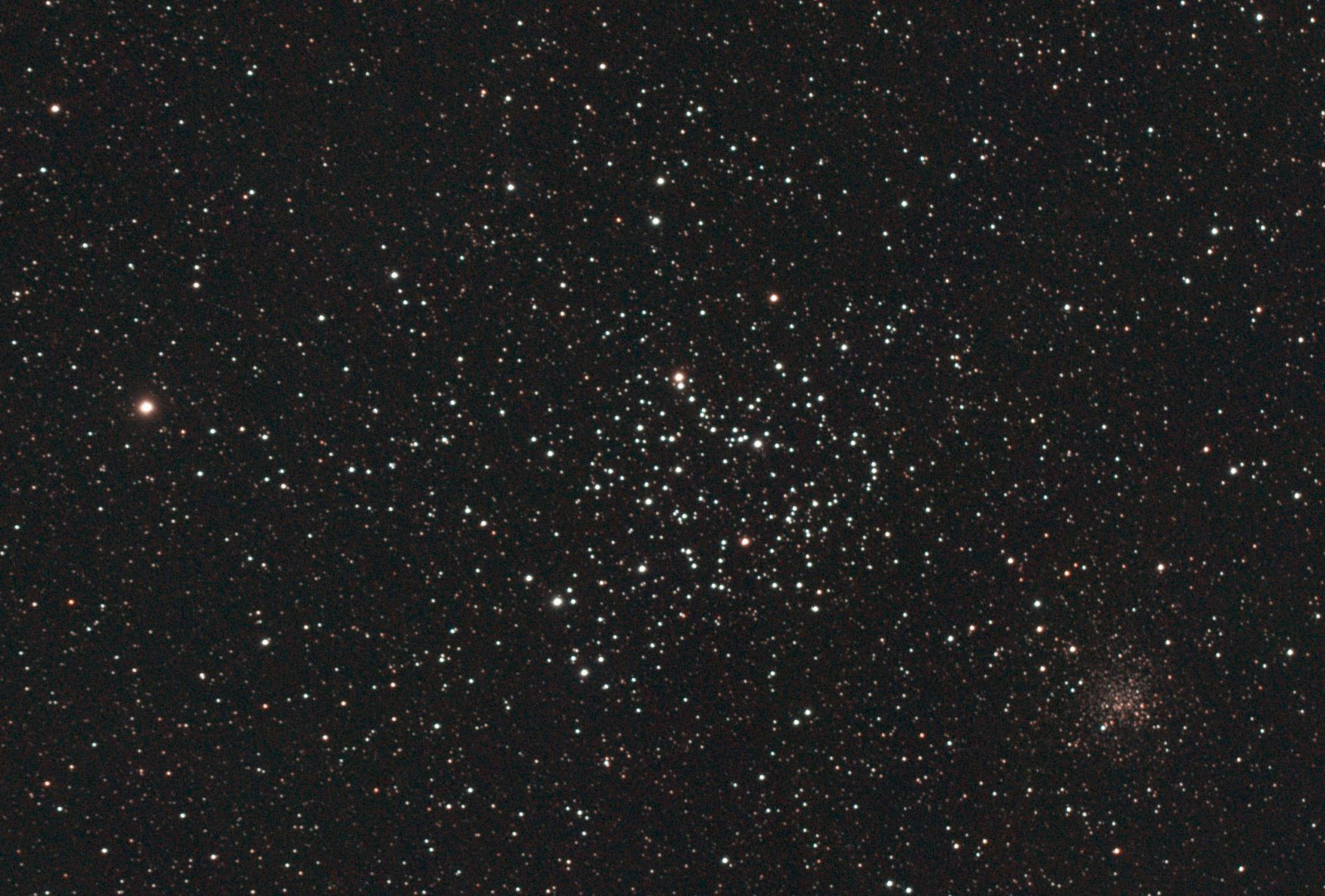
M35 & NGC 2158 Open Clusters WO GT81 + Canon 700D (unmodded) | 15 x 120 secs @ ISO 1,600 & calibration

M35 (Centre) & NGC 2158 (Lower right) Open Clusters
WO GT81 + Canon 700D (unmodded) | 15 x 120 secs @ ISO 1,600 & calibration

It turns out that M35’s neighbour, 20 arcminutes to the south-west, is no less than NGC 2158 – another cluster. To the eye NGC 2158 seems to form an attractive, golden globular cluster.  In fact it too is an open cluster but located more than 9,000 light-years beyond M35 and at 2 billion years, is much older.  As they say, with age comes beauty, and I find this feature to be the more interesting of the two, all the more so as I was not expecting to see anything there, instead I got 2 for 1.