The Wall

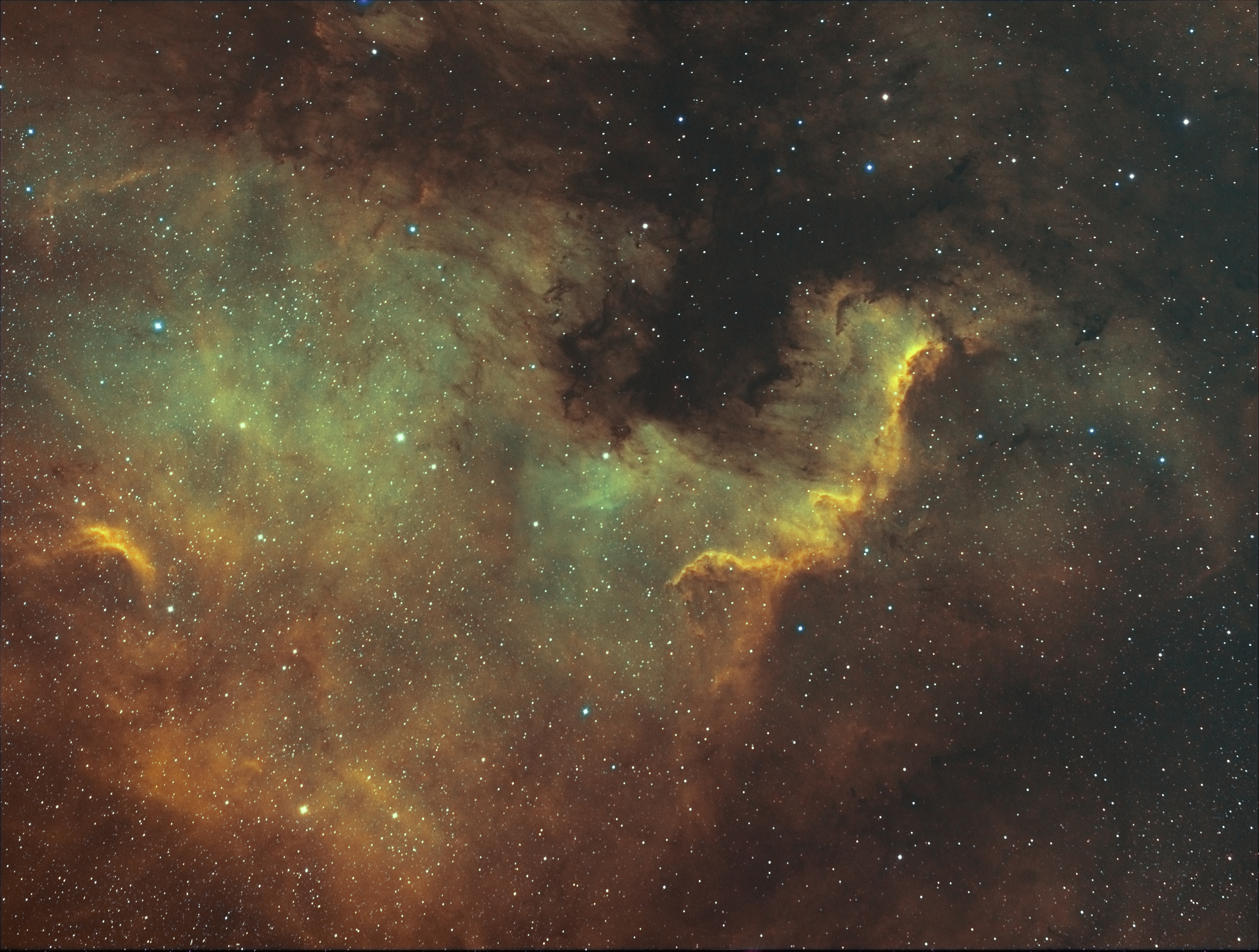
SHO2 FINAL

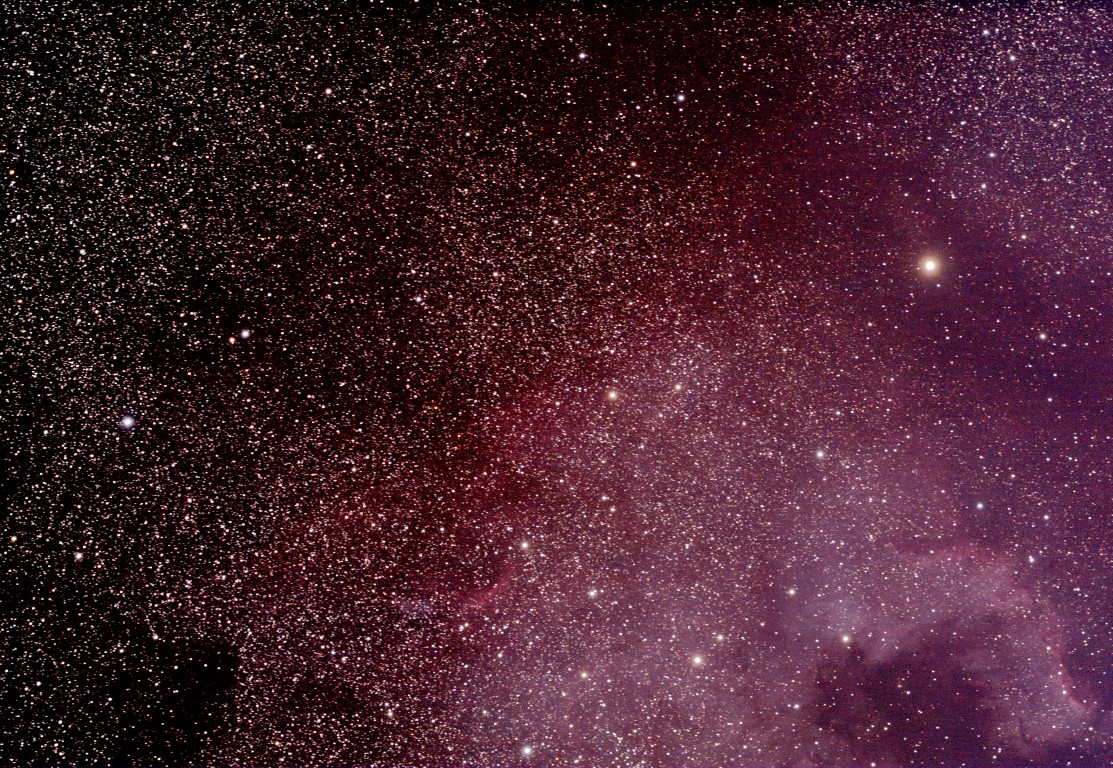
I first had a peek of the North America Nebula shortly after I started my then nascent astronomy hobby in August 2014.  With a Skywatcher 150PL Newtonian reflector and DSLR camera, I just managed to capture the edge of this very large nebula.  It was a very poor image and obviously navigation and framing were not my strong point but the mere glimpse of such Ha nebulosity was at the time something of an epiphany.  Hitherto I didn’t know such things existed, let alone their size and grandeur and the potential to catch even a part of it on camera was very exciting – that excitement has still not left me.

NGC 7000 240914 FINAL + Red (Medium)

NGC 7000 unmodded Canon 700D DSLR | September 2015

Armed the following year with a AZ-EQ6 GT mount and William Optics GT81 refractor, I managed to image most of the ‘continent’ and ‘Gulf’ (see above), although ‘Mexico’ was still missing; the title of my related blog at the time encapsulated my emotion at the time – WOW!  Since then I have often returned to NGC 7000 and with the combination of a modded DSLR, computer control and guiding gradually improved my technique so as to obtain better images.  However, the outcome of imaging the North America Nebula this year with the ZWO1600MM-Cool mono camera has been a revelation, resulting in perhaps some of my best images so far.

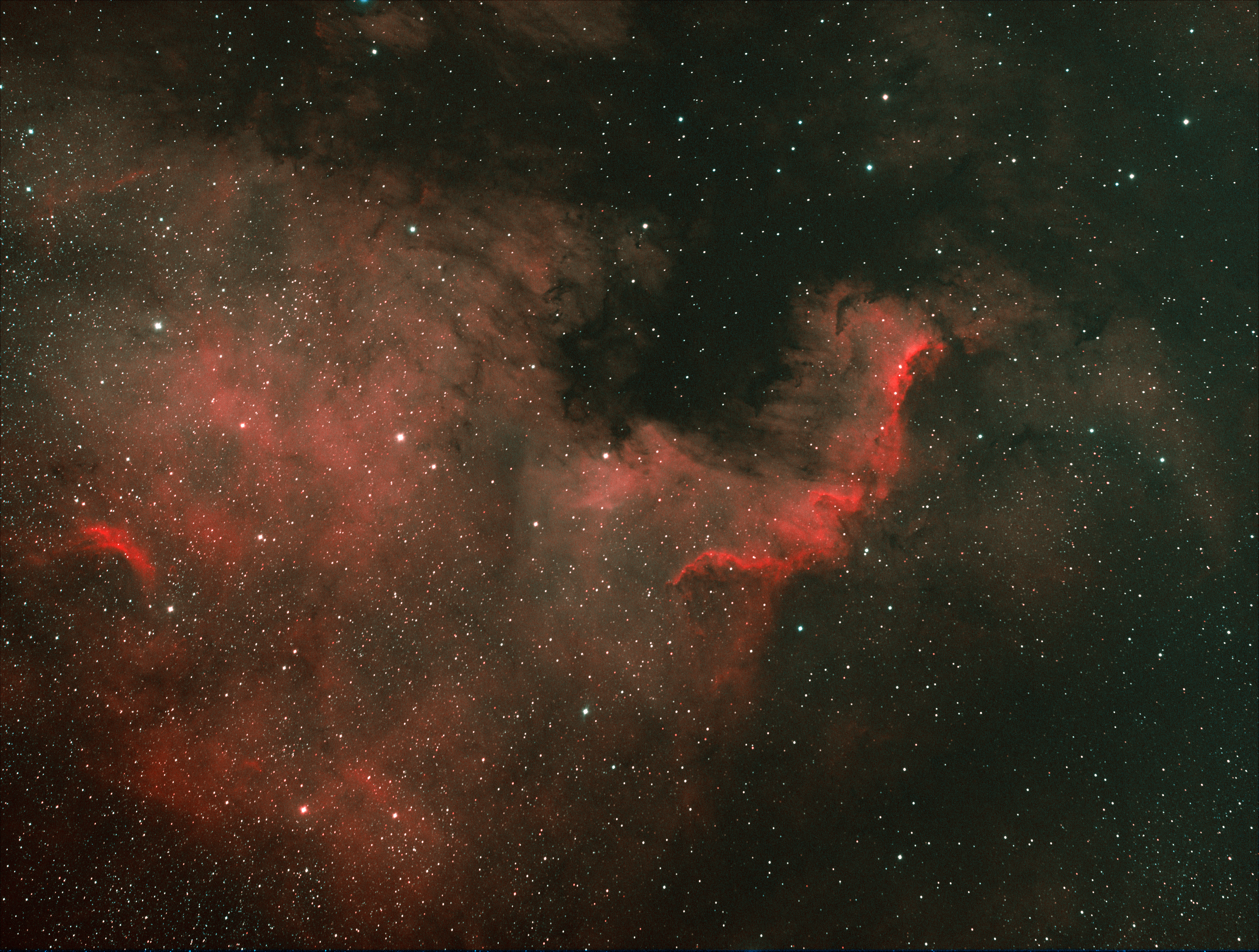
I’ve recently been spending time improving post processing methods, which together with increased knowledge gained from using the new camera for more than 6-months is now starting to pay off.  Being a very large HII-region the North America Nebula responds well to narrowband wavelength filters and I therefore took Ha-OIII-SII subs, which have subsequently combined well into Bi-colour (below) and SHO images that far surpass what I’ve previously achieved.

BiCol FINAL2

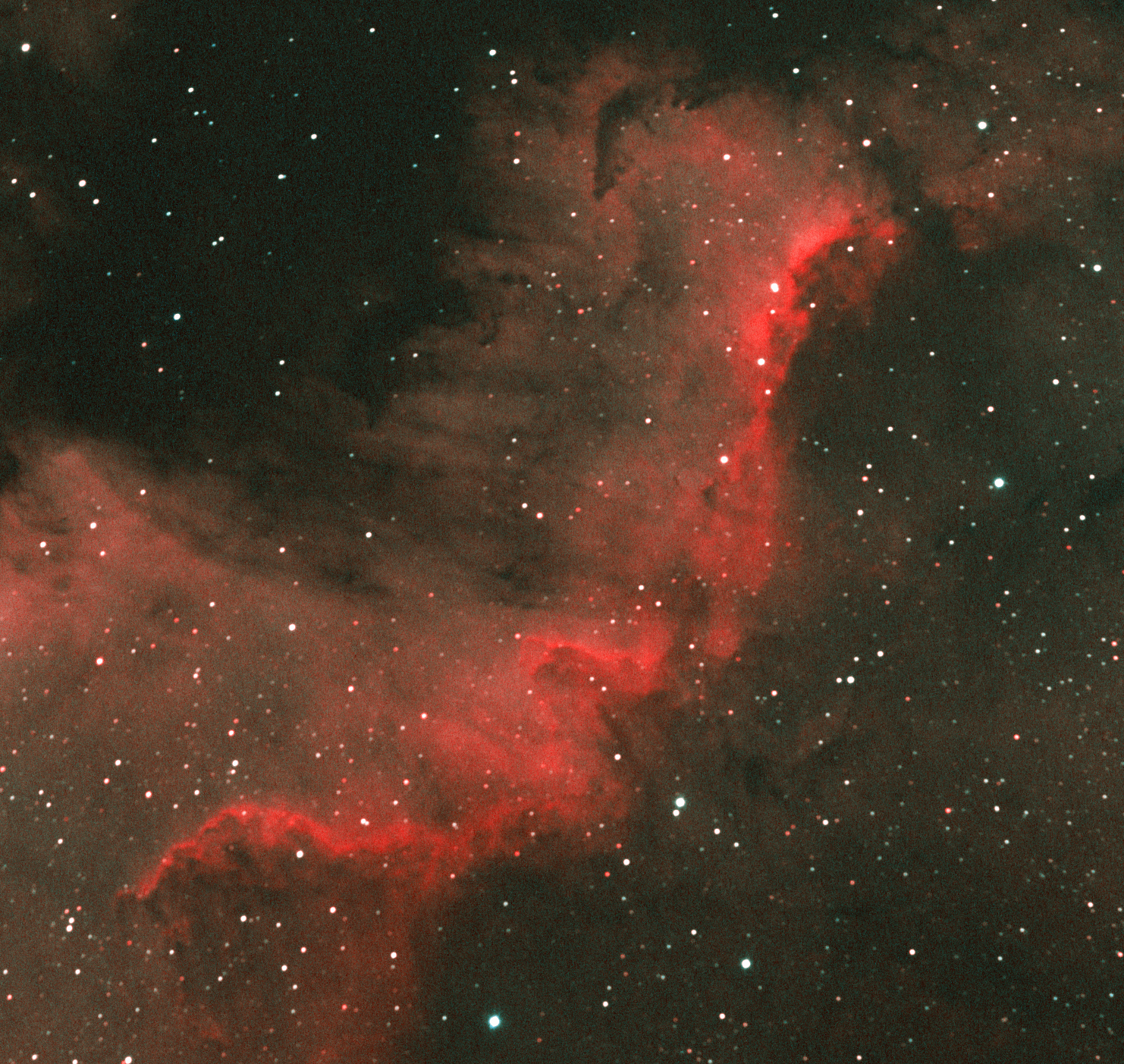
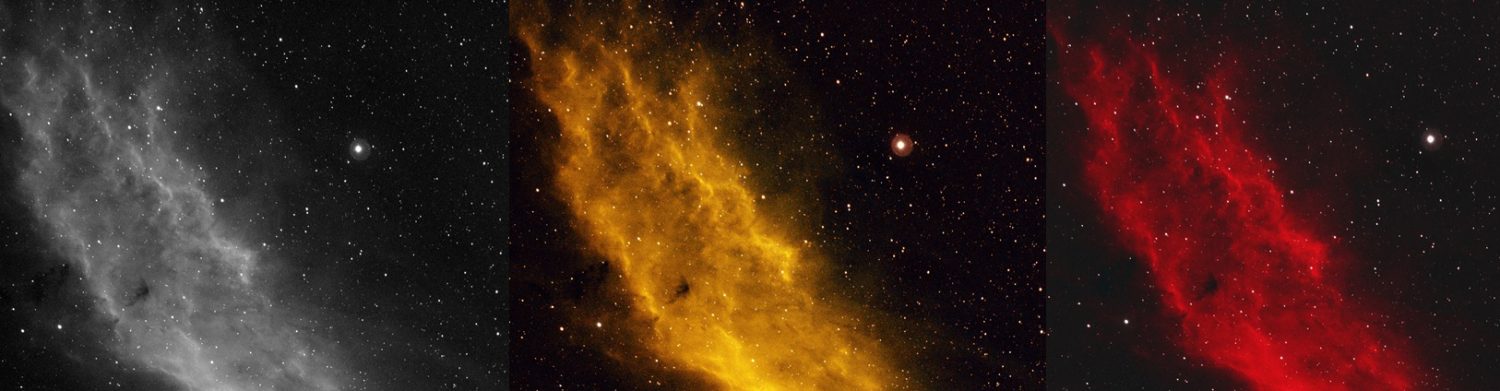
I was particularly keen to capture the Cygnus Wall for the first time, located along the ‘southern California’ and ‘Mexican’ coasts – so to speak.  In both cases the Wall shows up very well in detail (below in bi-colour), with its W-shaped edge dramatically illuminated by star forming regions from within.  I am particularly pleased with the SHO image (top of the page), which apart from the Wall illustrates delicate details across the entire nebula.

Cygnus Wall BiCol FINAL

Greater care during processing is improving such images but now that I’ve experienced this new camera across a number of different objects, it is clear that further enhancements are likely to be incremental and more difficult to achieve.  The one important factor that I suspect will still provide a noticeable improvement to my images will be longer integration time, which requires plate solving.   I’m already starting to learn this process and hope to adopt its use in the New Year.  In the meantime I feel recent imaging results and especially these narrowband images of the North America Nebula mark a very satisfying climax to my astrophotography year, progress over the past few years is very evident and I’m eagerly looking forwards to 2018.

IMAGING DETAILS
Object North America Nebula – NGC 7000   
Constellation Cygnus – near Deneb
Distance 1,600 light-years
Size Approx. 50 light-years or 2o
Apparent Magnitude +4.0
 
Scope  William Optics GT81 + Focal Reducer FL 382mm  f4.72
Mount SW AZ-EQ6 GT + EQASCOM computer control
Guiding William Optics 50mm guide scope
  + Starlight Xpress Lodestar X2 guide camera & PHD2 control
Camera ZWO1600MM-Cool (mono)   CMOS sensor
  FOV 2.65o x 2.0o   Resolution 2.05”/pix   Max. image size 4,656 x 3,520 pix   
EFW ZWOx8 + ZWO LRGB & Ha OIII SII 7nm filters 
Capture & Processing Astro Photography Tool,  Deep Sky Stacker & Photoshop CS2
Exposures 18 x Ha, 8 x OIII & 8 x SII @ 180 secs  (Total time: 102 minutes)
  @ 300 Gain 10 Offset @ -20oC  
Calibration 5 x 180 sec Darks 10 x 1/4000 sec Bias 10 x Flats Ha, OIII & SII  
Location & Darkness Fairvale Observatory – Redhill – Surrey – UK      Typically Bortle 5
Date & Time 27th August 2017 @ 21.50h

Eastern Promise

SHO Final

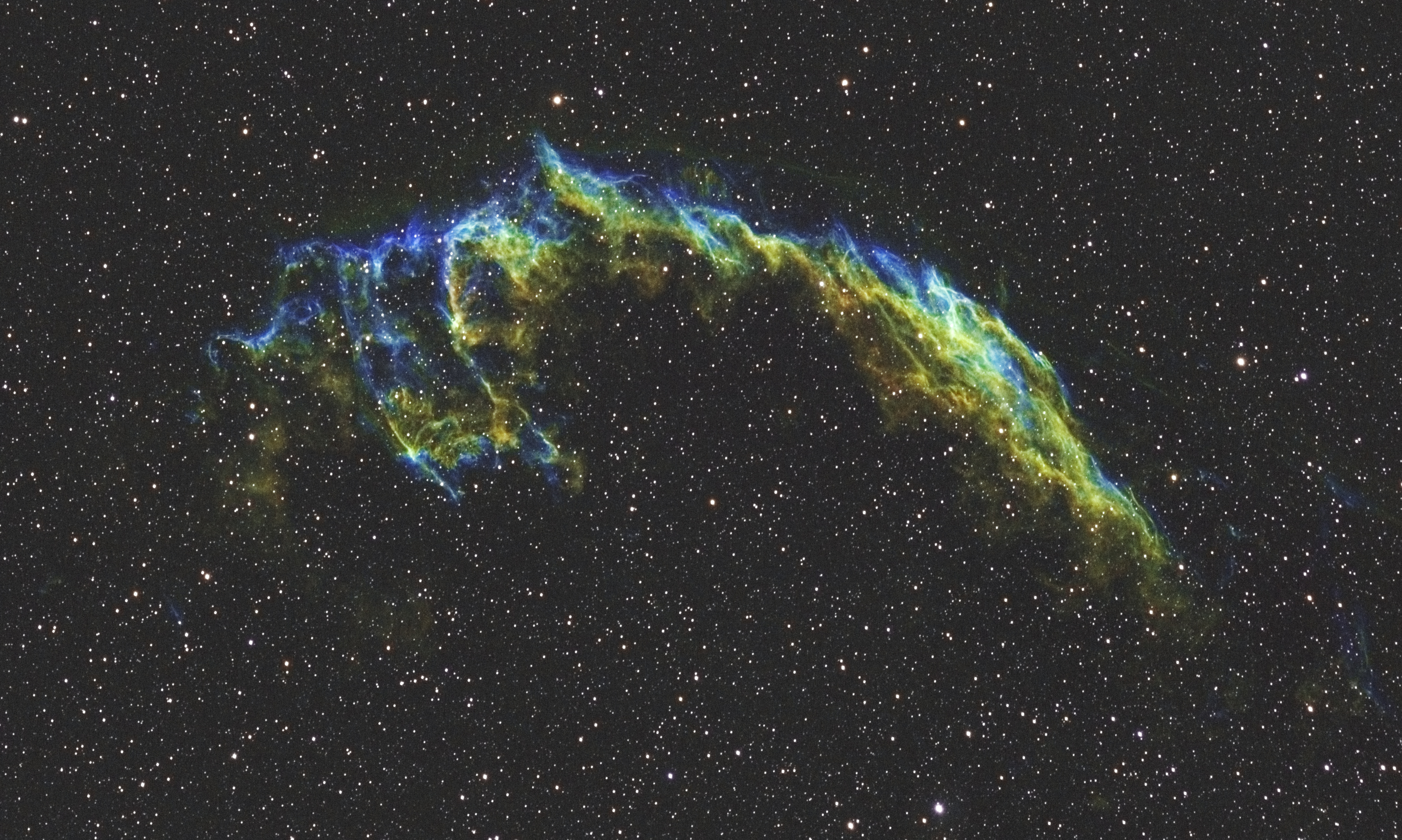
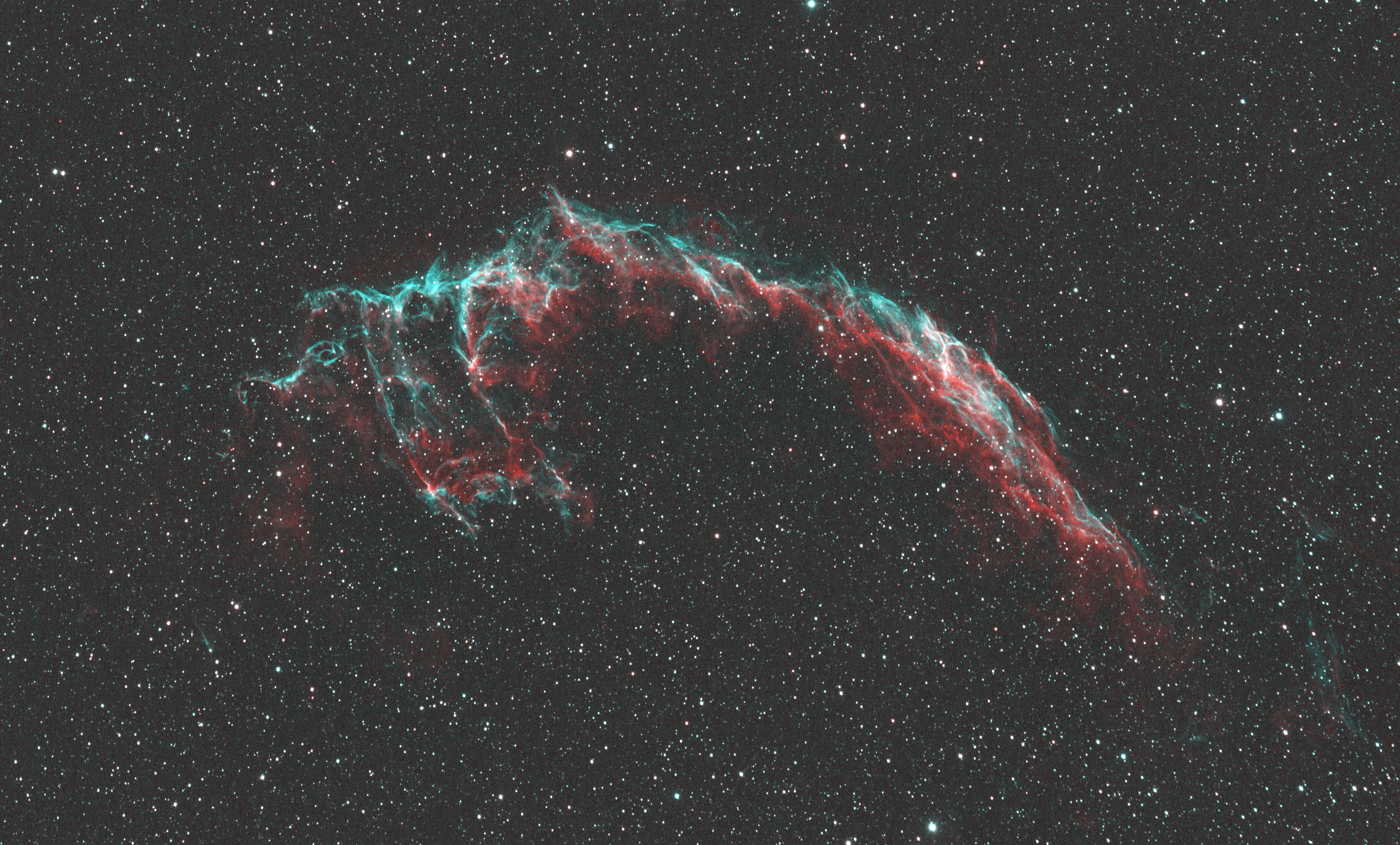
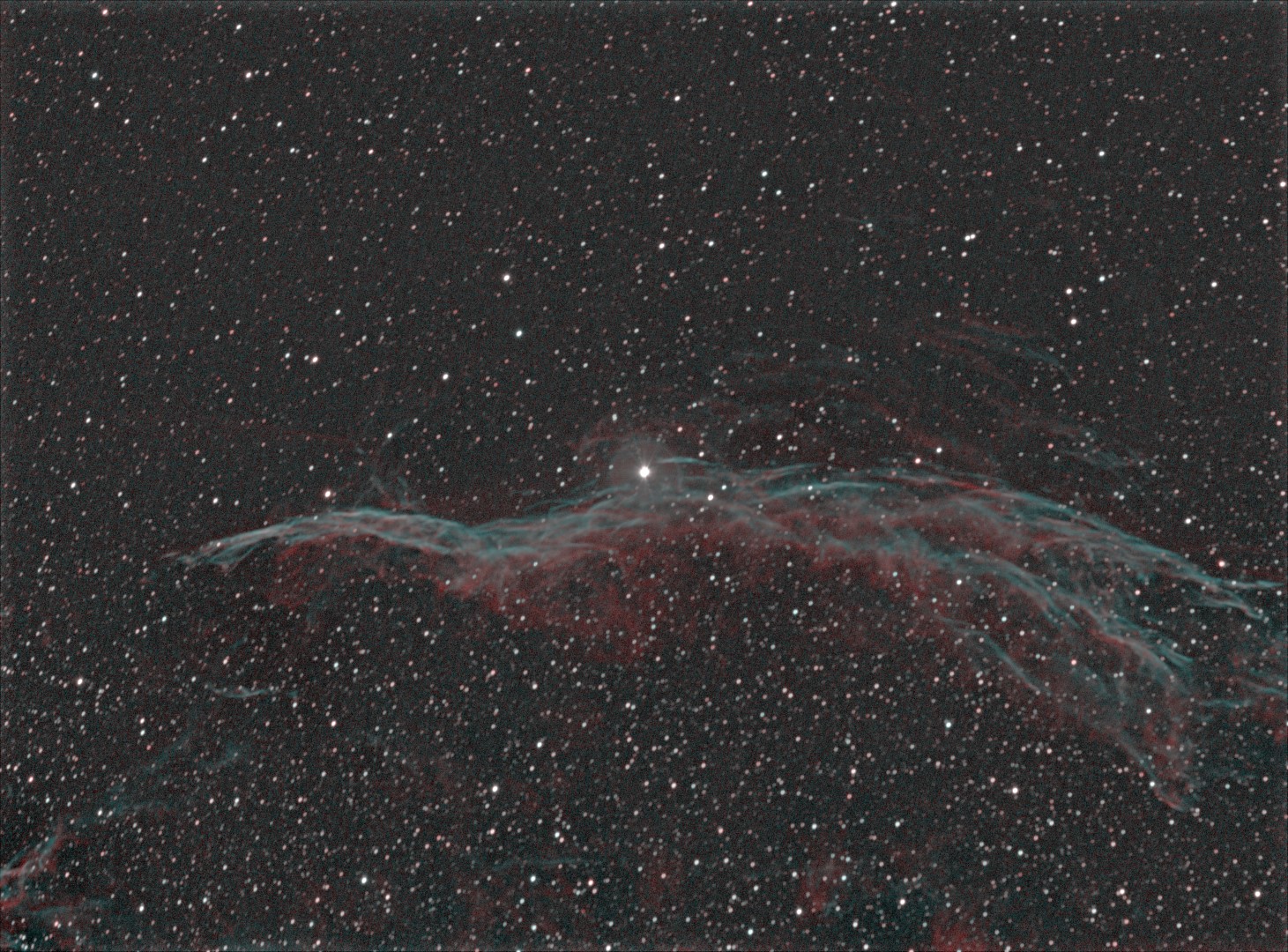
Eastern Veil Nebula NGC 6992 & NGC 6995 in SHO narrowband*

The East traditionally evokes connotations of the exotic and a promise of excitement.  This year the late Summer delivered plenty such opportunity for astrophotography combined with long, warm and clear nights, making for a productive and very enjoyable time.  Furthermore, this being the first year I’ve owned the mono ZWO1600MM-Cool camera, I’m mostly revisiting objects previously imaged with a modded DSLR and as a result am discovering details of hidden interest and beauty within the new images; on this occasion the object of my desire was the Eastern Veil Nebula in the Cygnus constellation.

Desperate to start re-imaging suitable targets with the ZWO camera, I briefly flirted with the Eastern Veil on the morning of the summer solstice this year.  But with limited darkness of any sort and coming just before dawn, imaging time was very limited.  I was still pleased with the result which bode well for longer, darker night conditions with the potential for extended imaging time.  In June I was only able to capture 18 minutes of Ha and 9 minutes each of OII and SII wavelengths, compared this time with a whopping 30 minutes for each!  OK it’s still quite short and for a standard CCD camera might only amount to one or two subs but given the unique sensitivity of the ZWO1600 operating at -20oC – itself a game changer in so many ways – the additional integration time achieved resulted in much more detailed and dramatic images than before.

Bicolour FINAL

Eastern Veil Nebula in Ha-OIII BiColour*

For the moment I’m very pleased with the outcome but it’s obvious that greater imaging time holds the prospect of even better images – although such improvements are likely to be less dramatic and more incremental in nature.  Due to practical limitations at this site I’m limited to about 2-hours dedicated imaging time each side of the Meridian and will only be able to increase the integration time beyond this barrier by using plate solving, thus enabling meridian flips during a session or cumulative imaging of the same object over different nights.  With plenty to learn and enjoy with the ZWO1600 camera, plus Orion already reappearing over the eastern horizon – my personal favourite, this is unlikely to occur before next year.  In the meantime, the Eastern Veil points towards a very promising future – Watch This Space!

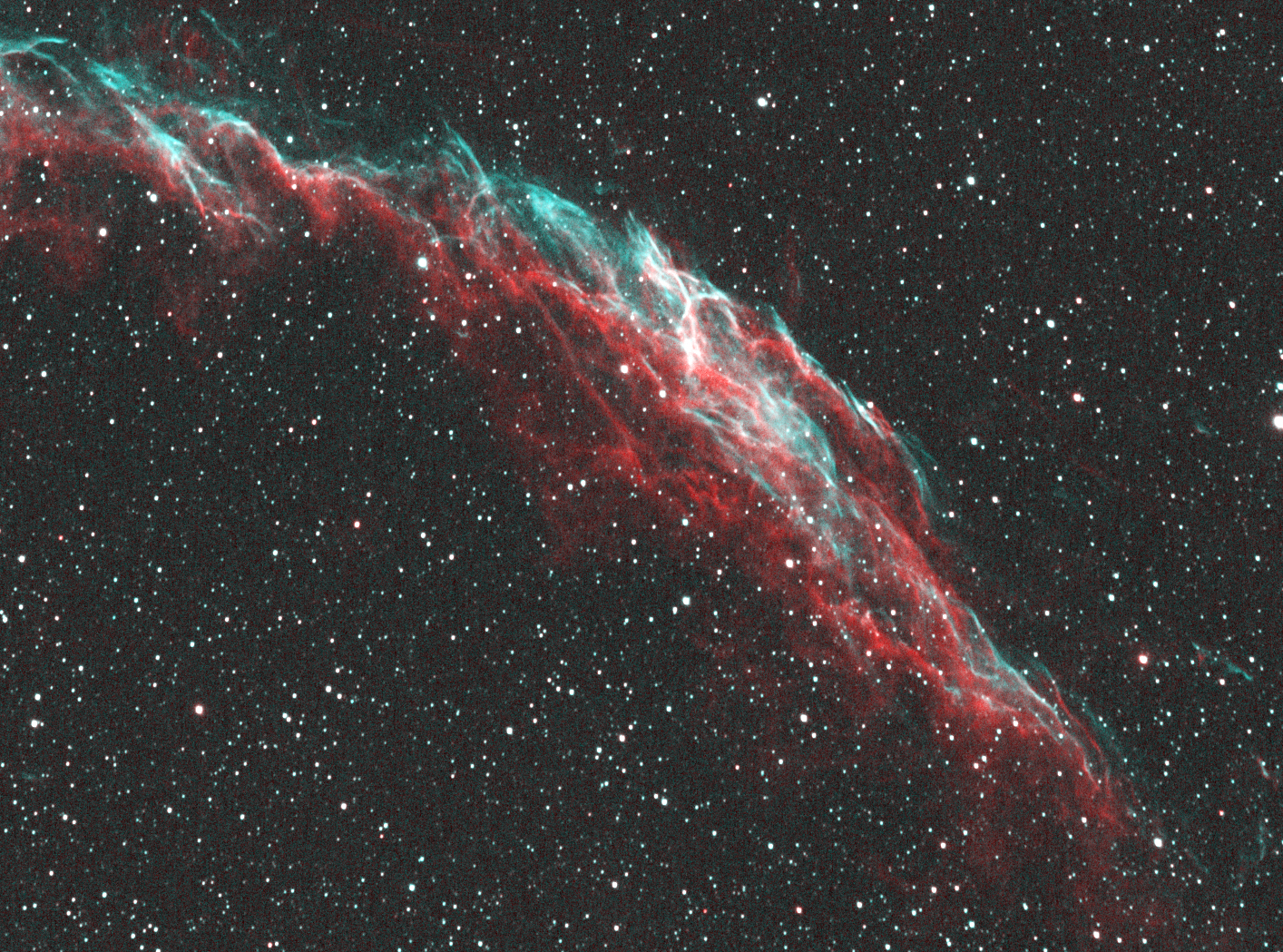
NGC 6992 Bicolour The Eastern Veil Nebula detail in Ha-OIII BiColour*

Bicolour FINAL BAT

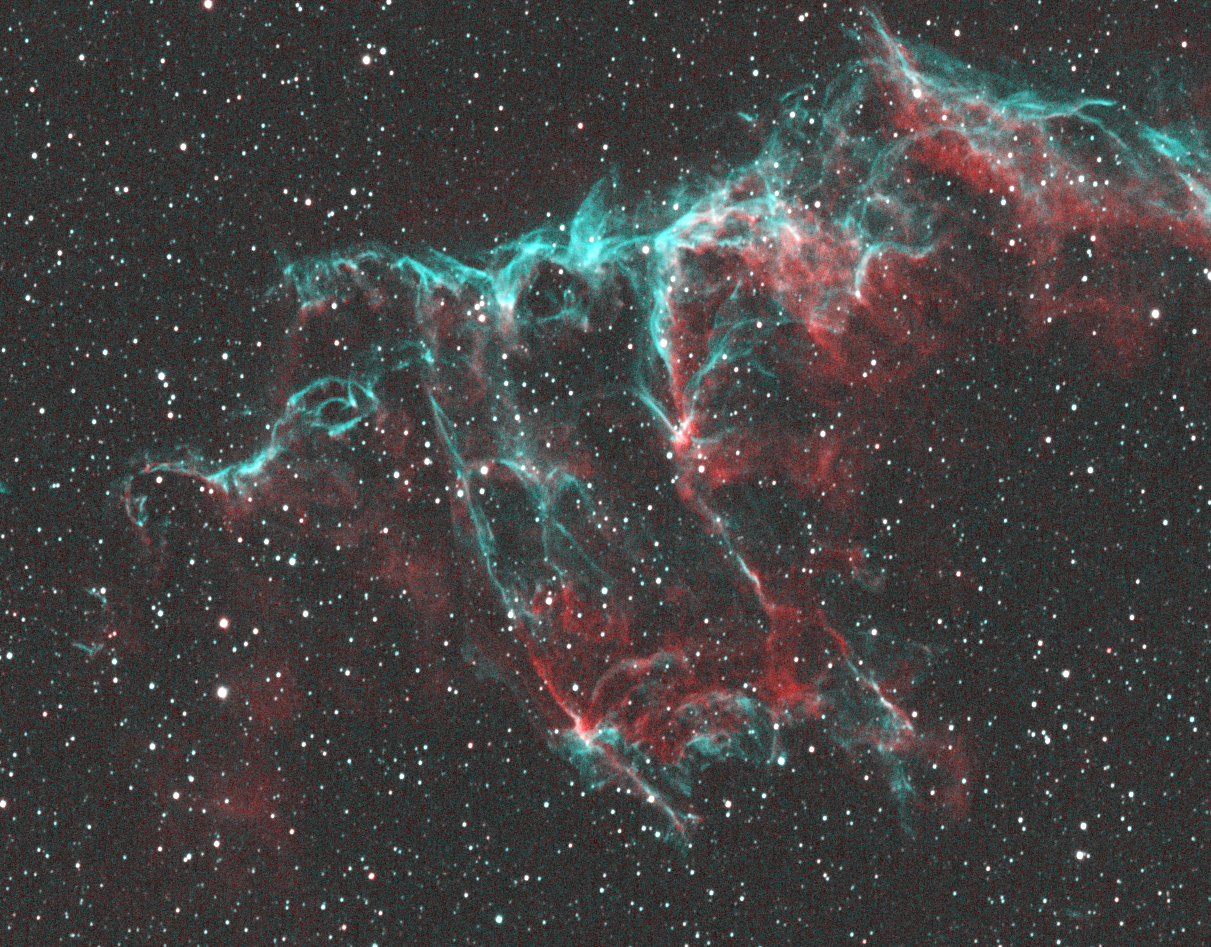
The Bat Nebula IC 1340 detail in Ha-OIII Bicolour*

IMAGING DETAILS*
Object Eastern Veil Nebula   AKA Caldwell 33      NGC 6995, NGC 6992 & IC1340   
Constellation Cygnus
Distance 1,470 light-years
Size Approx. 80’  vs Total Veil Nebula 3o
Apparent Magnitude +7.0
Scope  William Optics GT81 + Focal Reducer FL 382mm  f4.72
Mount SW AZ-EQ6 GT + EQASCOM computer control
Guiding William Optics 50mm guide scope
+ Starlight Xpress Lodestar X2 guide camera & PHD2 control
Camera ZWO1600MM-Cool (mono)   CMOS sensor 
FOV 2.65o x 2.0o   Resolution 2.05″/pix  Max. image size 4,656 x 3,520 pix
EFW ZWOx8 & ZWO LRGB Ha OIII SII 7nm filters 
Capture & Processing Astro Photography Tool,  Deep Sky Stacker & Photoshop CS2
Exposures 10 x 180 sec Ha, OIII & SII  (Total time: 90 minutes)
@ 300 Gain 10 Offset @ -20oC  
Calibration 5 x 180 sec Darks 10 x 1/4000 sec Bias 10 x Flats Ha, OIII & SII  
Location Fairvale Observatory – Redhill – Surrey – UK
Date & Time 19th August 2017 @ 22.38h


Pelican Brief

CNV00015

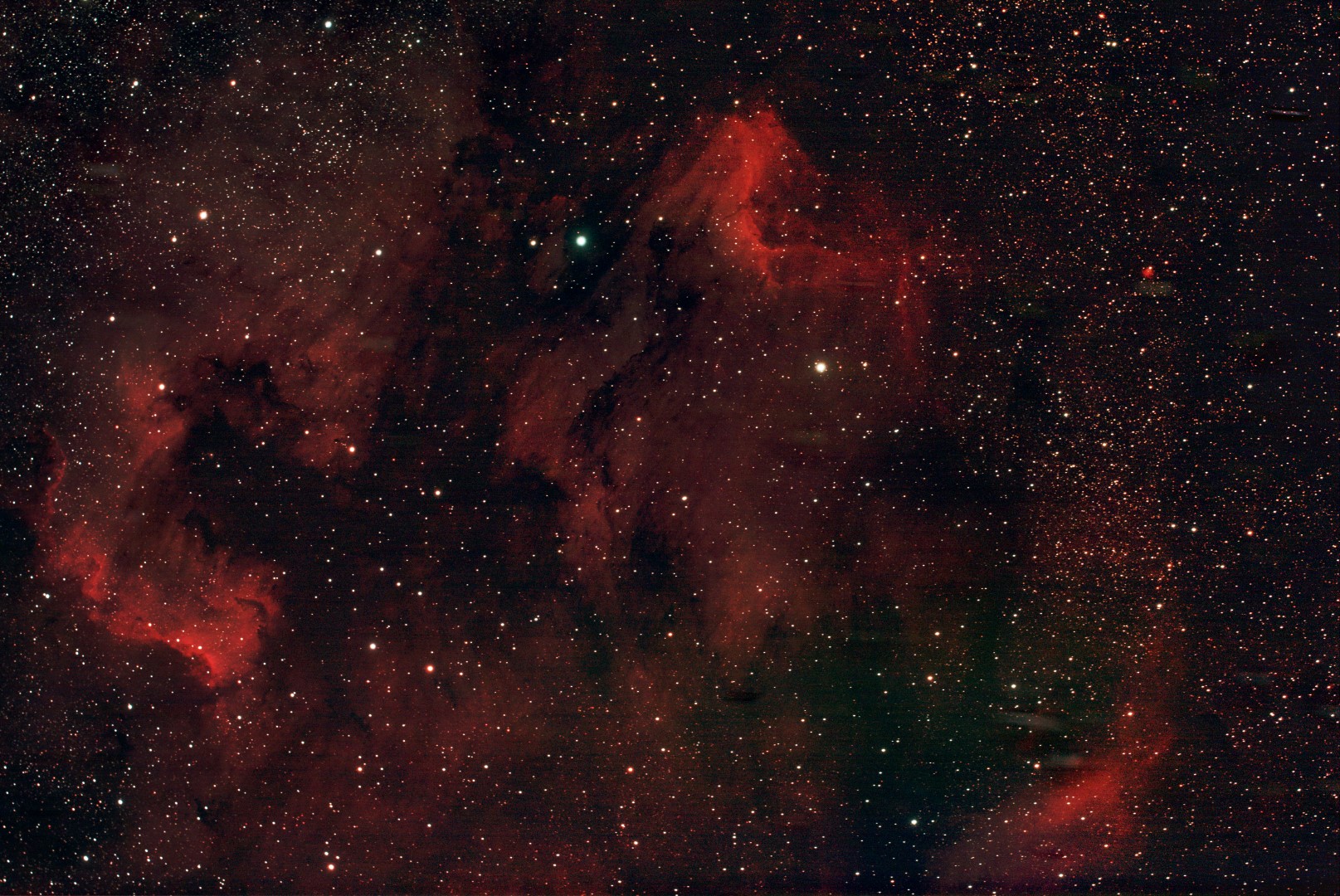
Located 3o west of the star Deneb in the Cygnus constellation, the North America Nebula is an emission nebula spanning some 50 light-years across, which contains numerous areas of astronomical interest that form some excellent imaging targets.  In the past I’ve usually concentrated on the ‘continent’ of North America itself but on this occasion moved my attention off the ‘east coast’ in search of the distinctive Pelican Nebula – it really does look like a pelican!

Picture saved with settings embedded.

North American Nebula (left) & Pelican Nebula | WO GT 81 & modded-Canon 550D | 2015

Separated from its neighbour by a molecular cloud of dark dust, the dominant HII region of the Pelican Nebula responds well to Ha imaging and I therefore sought to capture the ‘bird’ in this and other narrowband wavelengths.  Detail within the main cloud is further highlighted as a result of ionization from within created by young star formation, making for some pleasing and often spectacular effects.

Whilst image capture went well I was concerned by the outcome of stretching the Ha-image after stacking; the stacked image in DSS looked bright and detailed but after using Levels in Photoshop to establish the dark and light points the resulting image was somewhat dull in appearance and without the finer detail I had previously seen in DSS.  Responses to a question on the SGL Forum post made it clear that I needed to be bolder when stretching in order to achieve the desired result; I am further persuaded that I’ve been too timid with such processing techniques in the past and may need to revisit and reprocess some older data when time permits.

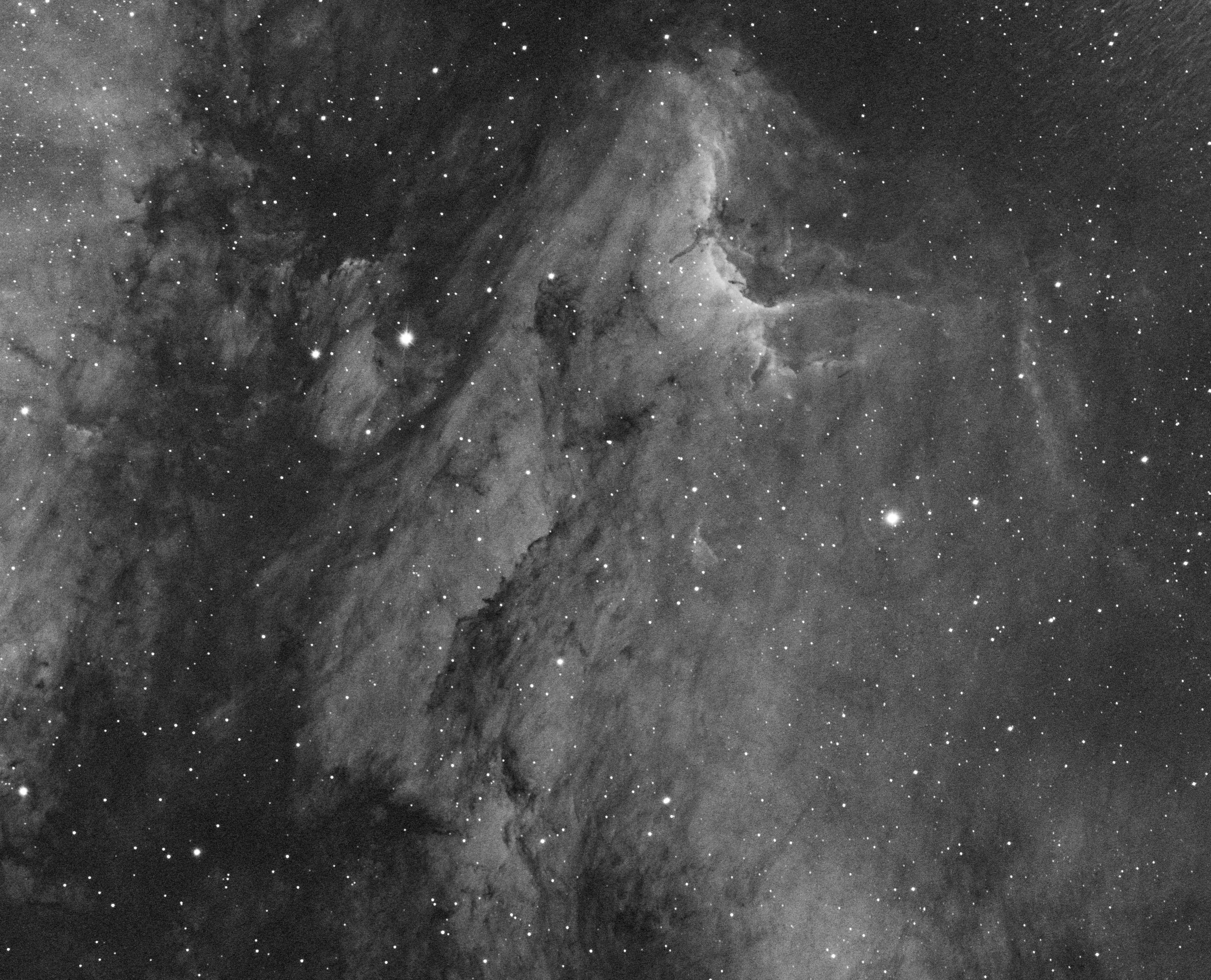
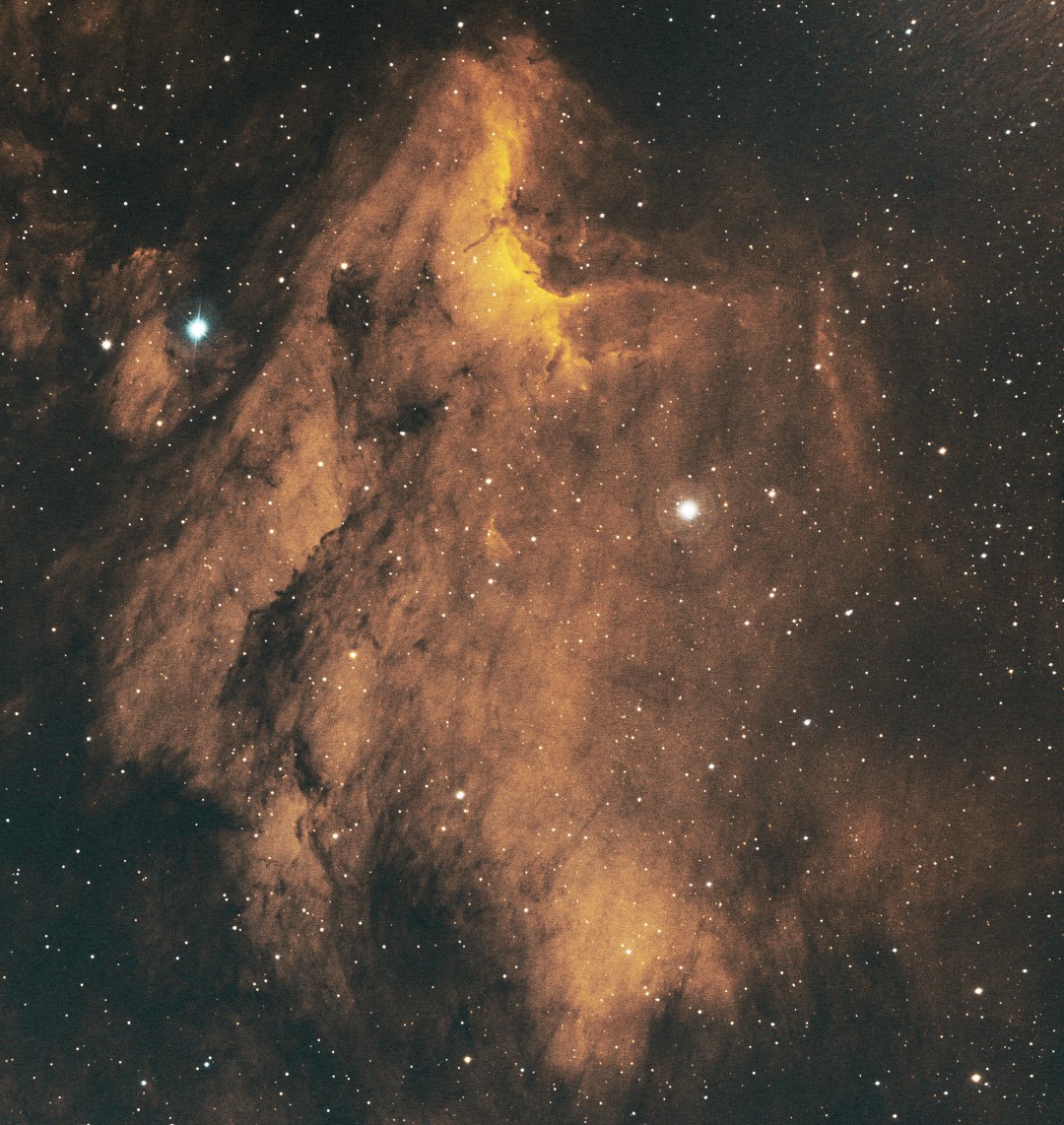
Pelican Images 10th August 2017 in order below:  

Ha – Bicolour – SHO narrowband

WO GT81 & ZWO1600MM-Cool + x0.80 focal reducer | 180 sec Gain 300 Offset 10 @ -20C 

10xHa + 10xOIII + 5x SII + full calibration    

Picture saved with settings embedded.

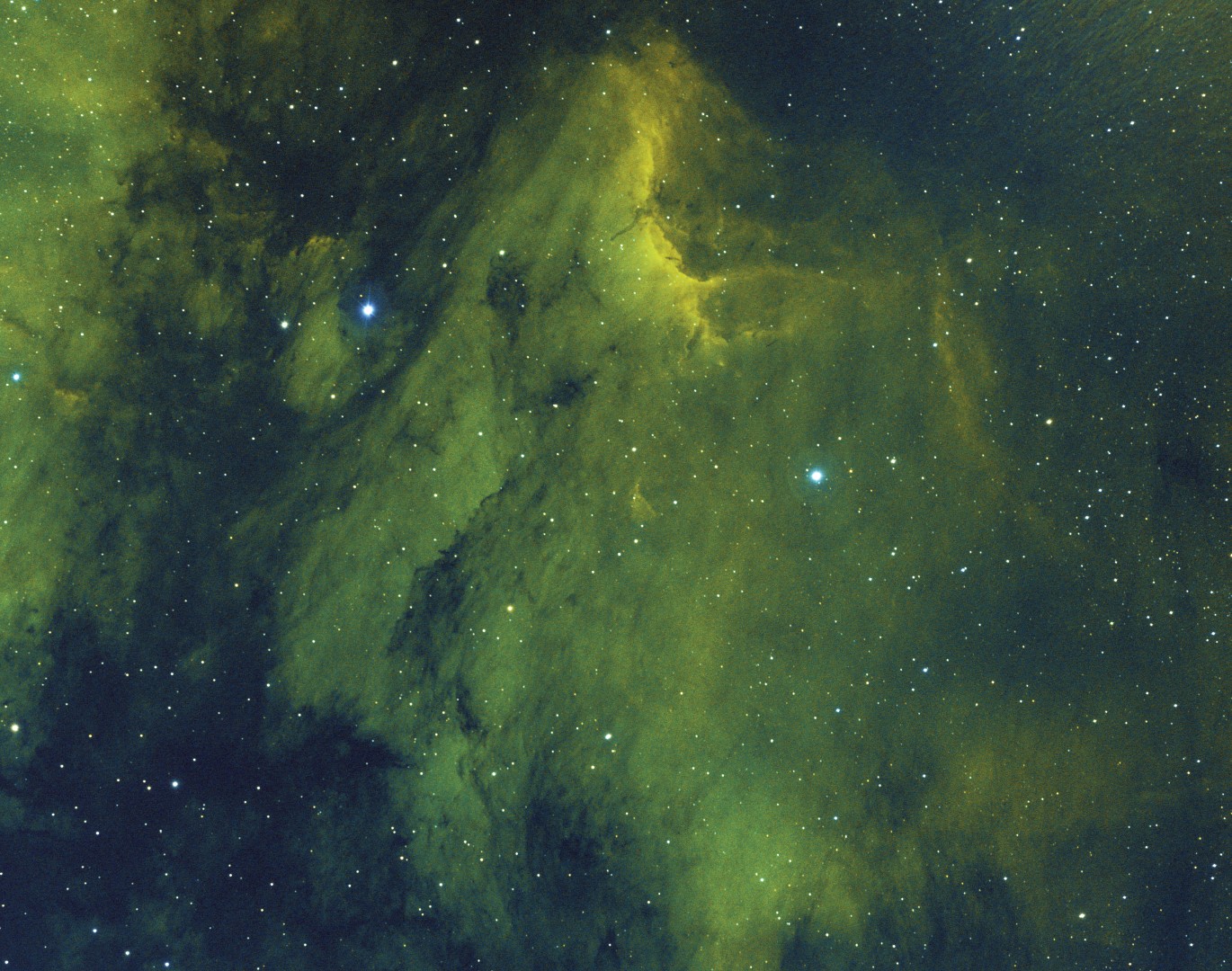
I went on to process the full narrowband data in both SHO and Bicolour, with interesting results.  The aforementioned assessment of linear stretching resulted in a much improved Ha-image, which subsequently impacted positively on the final compiled image.  However, there’s still much to consider when processing the combined channels, in particular in narrowband.

Some aspects of manipulation used during processing can have a material impact on the final image and I’ve long been concerned whether the resulting astrophotography presents a factual representation – in the case of narrowband the answer must surely be no.  Depending on the quality of data capture, detail and structure will usually be accurately recorded but subsequent ‘playing’ with the colour channels is most likely to produce a final image that is pleasing aesthetically to the photographer rather than factual; in the case of narrowband the colours available will be correctly determined by the respective filter wavelengths but there is no definitive measure of what actual colour should be in the final image.

RGB2crop (Large)In this case the Ha-image of The Pelican that was obtained demonstrated the significant improvements that can be achieved with the CMOS based ZWO1600MM-Cool camera compared to a DSLR.  I’m still learning about processing and in particular, with the plethora of options available when using LRGB and narrowband subs the issues have now escalated exponentially.  Notwithstanding the aforementioned issues I’m very pleased with my ‘new’ bird The Pelican Nebula.
SHO2 Crop (Large)

New Broom

witch

Converting from a DSLR to the ZWO1600MM-Cool camera feels in part like I’m starting out all over again and is exciting.  I’m getting used to the new field-of-view and its implications for framing, which is complicated further by using separate mono filters that can often make it difficult to identify on screen the chosen imaging target.  I’m also learning to use Astro Photography Tool (APT) for image capture, which is turning out to be an excellent programme, though at times somewhat idiosyncratic in nature.  APT contains useful Histogram and associated Stretch tools, which when applied to test shots prior to data capture can reveal underlying target detail which is otherwise unseen and thus enables suitable framing to be chosen.

With a set mount location, better polar alignment, calibrated PHD2 and a basic star alignment model established in EQ-ASCOM early in the summer, the process of imaging has now become much more efficient. After adding a few supplementary alignment points local to the target and some other minor adjustments, I have recently been able to set-up and start imaging in much less than one hour; excluding the physical set-up, imaging is possible within 30-minutes.  Contrast this with one or two hours when previously using various Synscan handset procedures and setting up the DSLR camera, I think it’s fair to say I have at last crossed the proverbial Rubicon!  Using a cooled sensor and compiling a calibration library has also been very helpful in streamlining imaging sessions, which all-in-all has made my astrophotography much more productive – qualitatively and surprisingly quantitatively too, despite all the extra subs and calibration required.

I’m currently working through familiar targets with Ha-OIII-SII subs to produce Hubble Palette based images.  It’s true to say that the use of narrowband filters has also been nothing less than a revolution for my imaging, in terms of process and results.  I’m particularly pleased that I purchased the ZWO x8 EFW and matching LRGB + narrowband filters with the new camera – 31mm parfocal filters also help minimize the need to re-focus for different wavelengths.

NGC 6960multiplelevelsonecontrast FINAL(Medium)

The Witch’s Broom (NGC 6960): WO GT81 & Canon 700D camera + 0.80x Focal Reducer | 20 x 90 sec + calibration @ ISO 800 | October 2014

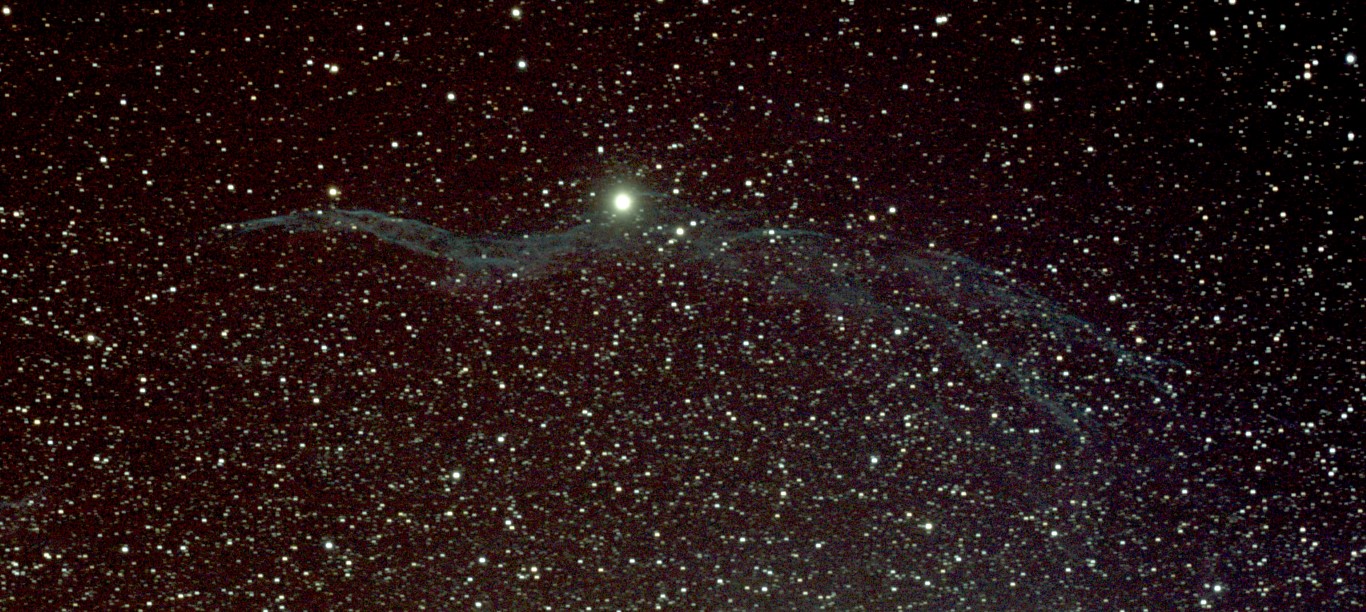
It’s about 4-years since I embarked on my nascent astrophotography journey and soon thereafter I first attempted to image the notoriously difficult Veil Nebula – which of course is why I had to try.  At the time I did not know one end of the Veil from the other of this very large but faint and widely dispersed supernova and was pleased to achieve a recognizable image of the Western Veil or Witch’s Broom (NGC 6960).  This July I set out to re-image the same feature for the first time using the ZWO1600MM-Cool camera in narrowband.

Cygnus_Loop_Labeled

The Veil Nebula AKA Cygnus Loop: Ultraviolet view ref. NASA

The full extent of the Veil is broadly demarcated by the Western and Eastern Veil Nebulae, with other generally more diffuse but related areas in between.  All-in-all the entire feature is some 3o or 110 light-years across.  The ZWO1600MM-Cool has two notable features that differentiate it from conventional CCD mono cameras, those being larger sensor size and high sensitivity when using only short exposures.  Unity of the sensor is 139 but like many other new users I’ve successfully been using a much higher Gain, in my case 300 with an Offset of 10; others have reported very good results as high as 600 Gain at just 30 second exposure, which though data heavy is very useful in helping to circumvent the UK’s fickle weather conditions and the need for perfect polar alignment, which was a major factor in deciding to purchase this type of mono camera.

Being still unfamiliar with the camera’s field-of-view using the William OpticsGT81 refractor and x0.80 focal reducer combination, on this occasion I centred the Broom just above the centre of the frame, thus adding the possibility of capturing other parts of the nebula located to the east and just below the Broom in this case.  As I’ve yet to master or even attempt mosaics or a Meridian flip with plate solving, for the moment my imaging is limited by the transit period defined from about 110o east to the Meridian or similarly to the west and between a 30o to 80o azimuth, which equates to just over 2 hours per target each side of the Meridian.  The nature of the object and lack of darkness at this time of the year can often restrict this available time even further.  Notwithstanding, on this occasion I was able to obtain 20 x Ha and 18 x OII 180 sec subs in order to produce a final bicolour image.

RGB C3GxXXX

The Witch’s Broom NGC 6960 & Pickering’s Triangle NGC 6979 Ha-OIII-OIII Bicolour: WO GT81 & ZWO1600 + 0.80x Focal Reducer | 180 sec x 20 Ha & 18 OIII Subs + calibration @ Gain 300 , 10 Offset & -20C | 31st July 2017

With a good set of subs the stacked and collated Ha-OIII image has turned out well, with nebulous filament details typical of the Veil that had not previously been clear when using a modded-DSLR camera now clearly visible.  Furthermore, on this occasion the aforesaid framing included detail of both the Broom and as something of a bonus Pickering’s Triangle, altogether forming a very pleasing image.

At this stage I would usually crop the Witch’s Broom and finesse the resulting image in Photoshop.  However, following a prior line of thought and questioning on the SGL Forum, this time I tried to use the Drizzle_technique during stacking to enhance the quality of The Broom itself.  Unfortunately it didn’t take long to discover that, as so often is the case with astrophotography, drizzling is a good deal more complicated than just placing a check in the Drizzle box.

Originally developed for use with the Hubble Space Telescope, drizzle is a digital processing method for the linear reconstruction of under-sampled images, thus improving the apparent resolution of the image.  Deep Sky Stacker is an excellent piece of software and provides the facility of x2 and x3 Drizzle but unlike some commercial packages has limited memory that is used for this task.  As a result after attempting to use Drizzle whilst stacking a number of times in DSS, the process crashed at the end of each sequence.  Finally another SGL Forum query provided the answers: (i) DSS lacks memory required to stack and process the original sub using Drizzle, but (ii) Drizzle will work by applying the Custom Rectangle Mode in DSS to a select a specific, smaller area of the sub.  It took me a while to figure this out but eventually I manged to process the Witch’s Broom area of the image successfully.  I’ve concluded that Drizzle is certainly a feature worth deploying during stacking from time to time but only where the main target is poorly sampled and where the specific object will fit within the Custom Rectangle Mode defined by DSS – it should also be noted that the resulting data size also increases very substantially when using Drizzle.

RGB FINAL (Large)

Witch’s Broom (as above) + 2x Drizzle

All-in-all it continues to be a great surprise just how different and often complex the techniques are with a mono camera and filters compared to a one-shot DSLR camera, both during capturing and processing.  I was previously aware of these issues and some related shortcomings but so far the results have justified the additional effort; I’m not sure I would say the same about a conventional mono CCD camera, that requires much longer imaging times which in my opinion are not suitable for the average user and weather conditions in the UK.  I know there’s still much to master – Plate Solving + Mosaics + Meridian Flips + Sequence Generator Pro etc. – and I’ll soon need to start a completely new alignment star model for winter and recalibrate PHD2 guiding but the past few months have really been good fun and very productive.

Two’s Company


230658_castr2hp2-copy

The night sky is full of wonderful worlds, which themselves consist of amazing objects and features.  I was originally drawn to astronomy by viewing Saturn through a telescope, which to this day retains a fascination and beauty for me.  Of course it is Saturn’s rings that make it stand out as perhaps the iconic object of the night sky; even to the lay person their nature and colour tell us something special is taking place.  The rings and associated shepherd moons indicate that something is happening to bring all the particles and objects precisely together in a disc that rotates around the planet – gravity. Perhaps surprisingly this force remains a mystery to science, although it is now clear that it has an overarching impact on the development of the Universe itself.

Another fascinating feature of gravity is the formation of globular clusters, which I find both beautiful and bewildering.  Bound tightly by gravity, each cluster is made of at least several hundred thousand very old stars, typically between 8 to 10 billion years, which usually orbit at a far distance outside and at right angles to the galactic disc.  So far about 158 globular clusters have been identified around the Milky Way and we now know such objects are also commonly associated with other galaxies.  During the summer and autumn many of these enigmatic star clusters can be seen across the sky, which form wonderful imaging targets.

Picture saved with settings embedded.

M15: 12bn light-years old globular star cluster | Constellation Pegasus, 33,600 ly from Earth, apparent mag. +6.2, size 18.0′ (diameter 176 ly) | WO GT81 + modded Canon 550D & FF | 10 x 300 sec @ ISO 800 & full calibration | 22nd October 2016

Although I have previously spent time observing and imaging Saturn and various globular clusters, as well as notable single stars such as Betelgeuse and Altair, for some reason I have neglected their binary relations.  And so in early autumn this year I turned the telescope and camera towards two of the better examples of these double or binary stars. So-called Doubles consist of two stars orbiting around a barycentre, captured by each other’s gravity.  The challenge is to ‘split’ the stars, thereby differentiating each star as individual features and if relevant by colour, either by observing though the telescope or in an image.

albireo-sky

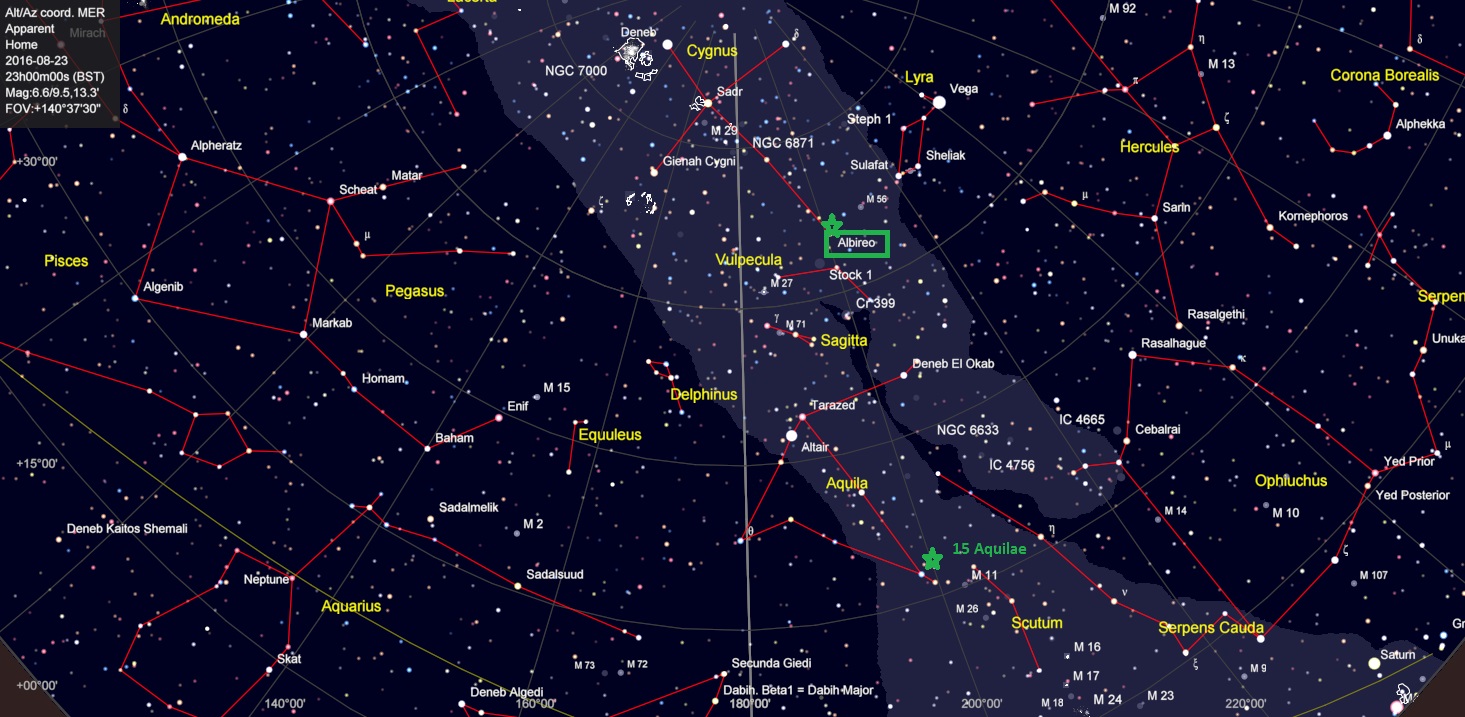
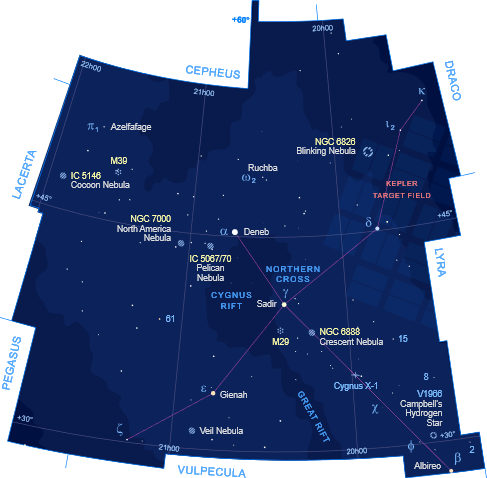
My initial target was the beautiful Albireo (below), a double star consisting of the mag. +3.1 gold coloured Beta Cygni A and its mag. +5.1 bright blue partner Beta Cygni-B.  At a distance of 430 light-years from Earth and separated by 35 arc seconds, the stars have an implied orbital period of at least 100,000 years.  Together with Deneb, Sadr, Gienah and Delta Cygni, Albireo forms the Northern Cross asterism, which lies almost overhead at midnight during the late summer months in the Northern Hemisphere. Situated at the head of the Cygnus (Swan) constellation, Albireo is also known as the “beak star”.  The contrasting colours of the two stars form one of the most beautiful doubles of the summer sky and forms an attractive imaging target.

albeiro-img_0042

Located in the nearby constellation of Aquila but less notable than Albeiro, is the double 15 Aquilae (below). Some 4-billion years old and a hot 11,000oC in temperature, the larger mag. +5.4 orange giant star is located some 190 light-years from Earth.  Its smaller partner is a cooler white mag. +7.7 star, situated 38 arc seconds away but ‘only’ 4,400oC hot.  Such features abound in the Aquila constellation and I hope to return to this region of the sky again next year for more double fun!

15-aquila-img_0050

Doubles are a real treasure of the night sky that are surprisingly common but are easy to overlook.  They are often interesting as well as beautiful to observe and image – I can’t think why it’s taken me so long to get round to them?


The big picture unveiled

About this time last year I successfully imaged first NGC 6960 the Western Veil, AKA the Witch’s Broom Nebula and shortly afterwards NGC 6992 the Eastern Veil, which includes NGC 6995 AKA the Bat Nebula.  In themselves they are both wonderful parts of the larger but perhaps more elusive (photographically speaking) Veil Nebula.  Located in the constellation Cygnus, the Veil Nebula or Cygnus Loop is formed from the remains of a supernova that exploded in our galaxy about ten thousand years ago and at a distance of almost 1,500 light-years, now spans a 3o area of the sky or 80 light-years in diameter.  At the time I struggled to get these images but was very pleased with the outcome.

cygnus

One year on and I was now thinking about other parts of the Veil, in particular Pickering’s Triangle.  The Triangle might be thought of as the third central section of the Veil, situated between the Eastern and Western Veils but slightly further north.  At some 52 x 35 arcminutes it is itself a significant feature, which surprisingly does not have an NGC catalogue number of its own.

Pickering's Triangle

Pickering’s Triangle

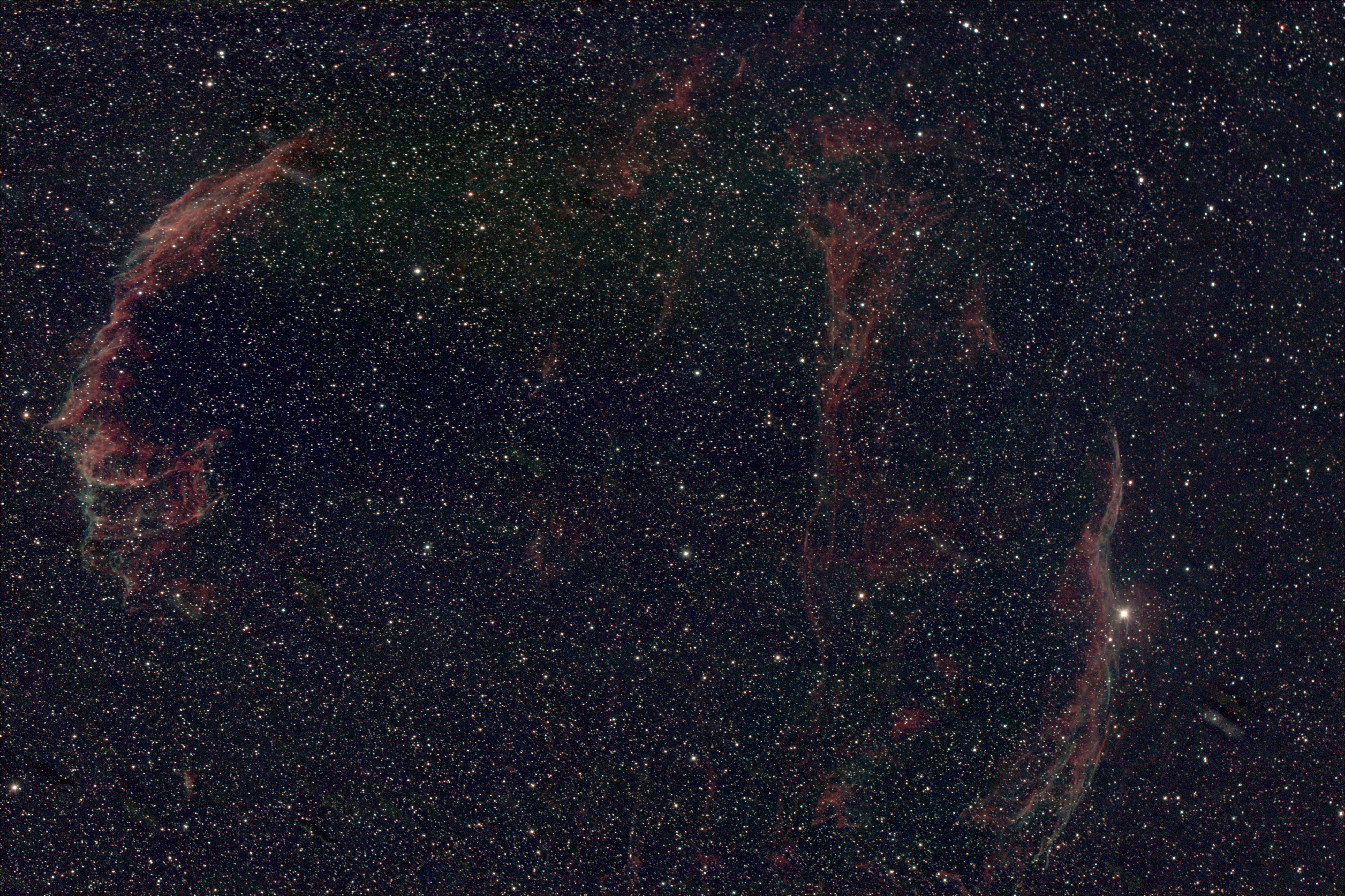
Notwithstanding the success of Pickering’s Triangle, in the end I got much more than I bargained for.  This time using a modded camera, I was able to capture the entire Veil Nebula in one photograph – progress indeed.

The Veil Nebula AKA Cygnus Loop: Ultraviolet view ref. NASA

The Veil Nebula AKA Cygnus Loop: Ultraviolet view ref. NASA

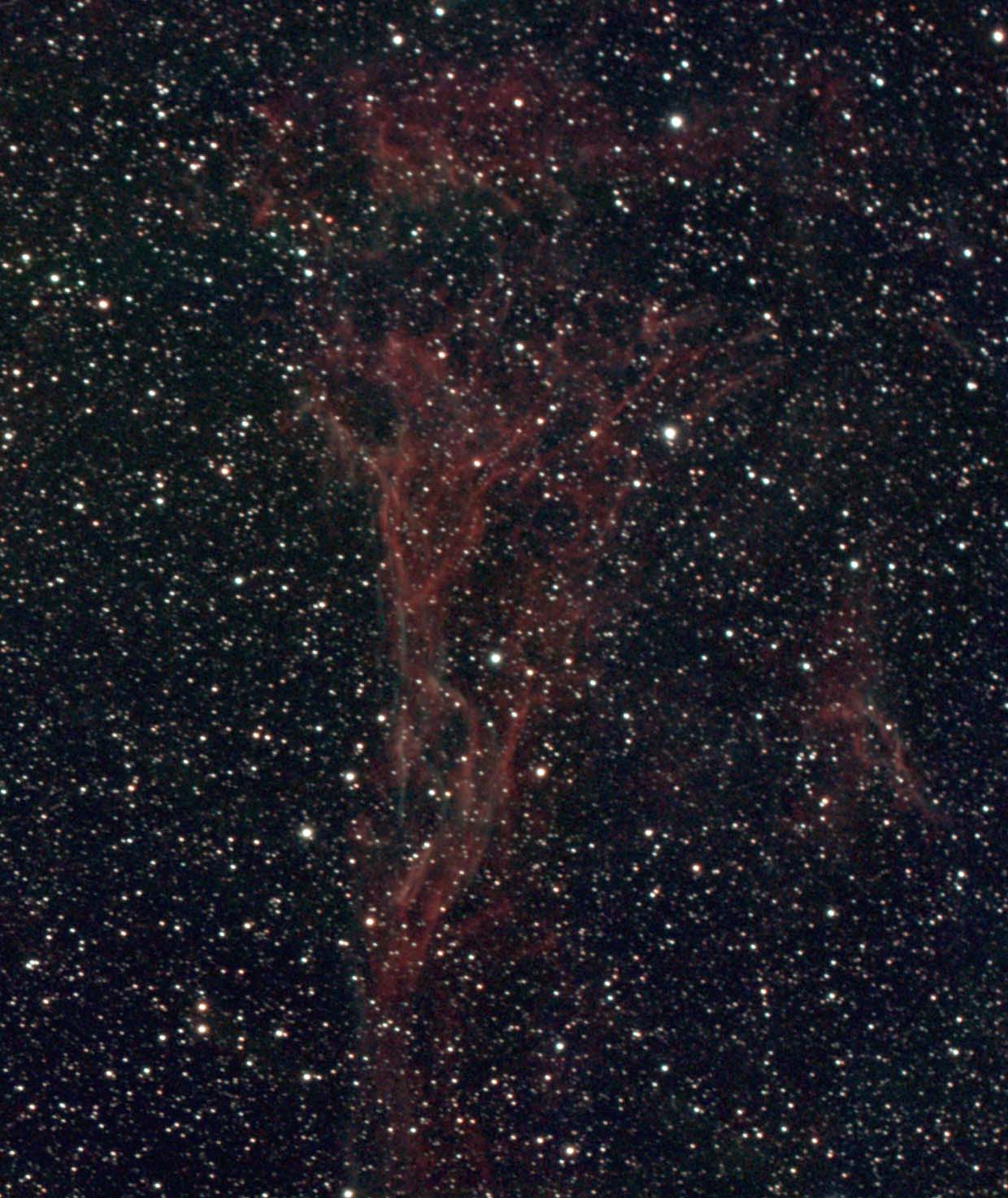
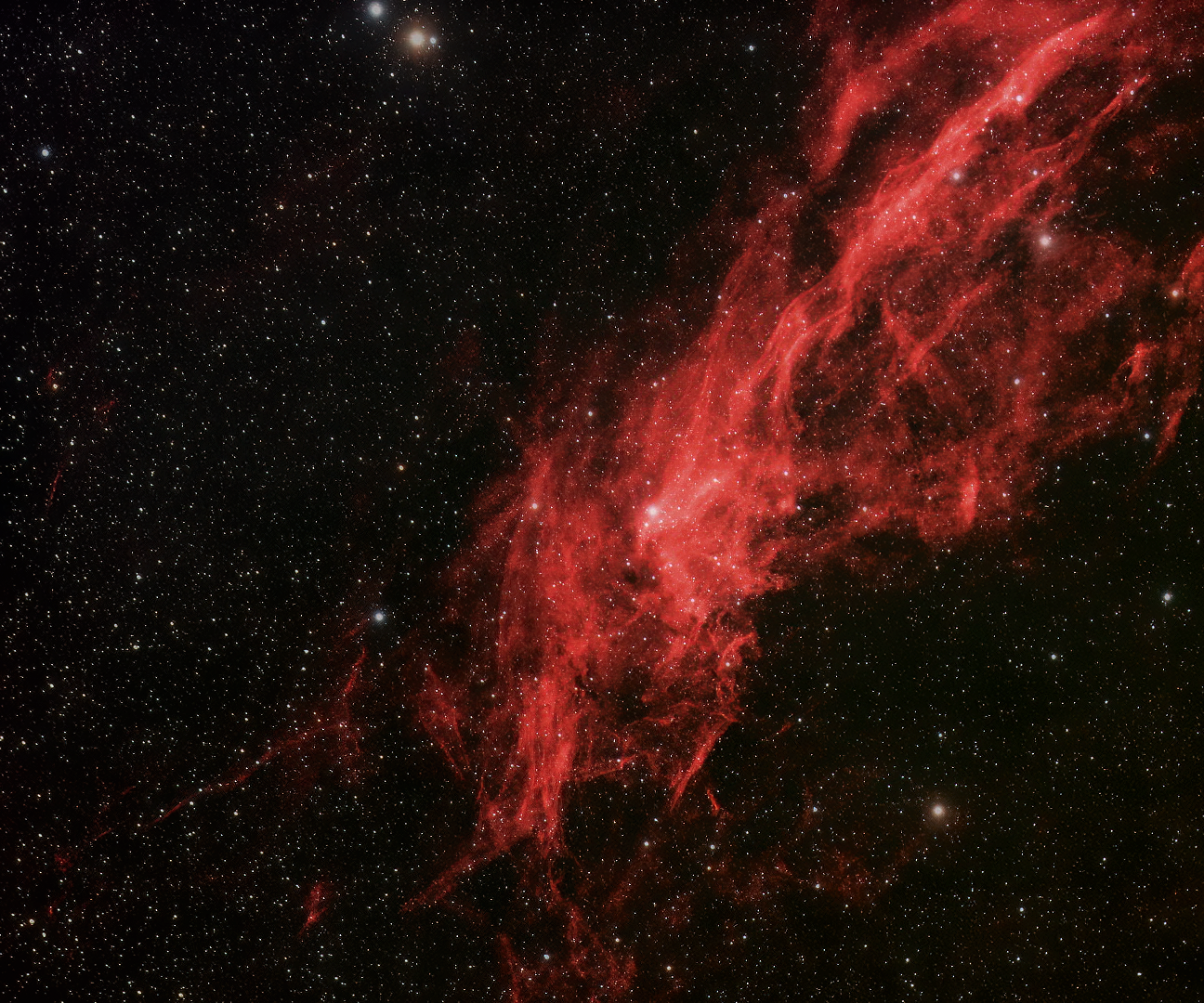
Light from the bulk of the Veil Nebula is very faint and notoriously difficult to image, whilst furthermore much of it is Ha in nature – hence this time finding its way to the camera’s sensor having had the IR filter removed.  The result is a staggering view of the entire supernova, with the Witch’s Broom in the west (right), the Eastern Veil (left) and Pickering’s Triangle nestled in between.  However, in addition extensive regions of delicate, wispy nebulous filaments can be seen flowing everywhere in between – hence the name of Veil.

Veil Nebula / Cygnus Loop WO GT81 & modded Canon 550D + FF | 30 x 180 sec exposures @ ISO 1,600 | 19th September 2015

Veil Nebula / Cygnus Loop
WO GT81 & modded Canon 550D + FF | 30 x 120 sec @ ISO 1,600 | 19th September 2015

Whilst I am very pleased with the resulting photograph, there’s still more to achieve another time.  Apart for the added potential that would be gained from longer, guided exposures, the use of Ha and OIII filters would also uncover even more of the Veil’s diaphanous beauty.


Rock On!

Due to my viewing limitations at Fairvale Observatory planning is essential, with the best imaging range mainly restricted to a zone between 65o and 85o and within +/-20o of the Meridian.  Furthermore, as I am mostly using the William Optics GT81 telescope at the moment, imaging targets should preferably be large – something between 1o & 2o is perfect, such as  the Rosetta Nebula at 1.3o or Andromeda Galaxy at 190’ x 60’.  As luck would have it these conditions are favourable for a number of objects at the moment and I have been somewhat spoilt for choice: North America Nebula, Veil Nebula and Andromeda.

Notwithstanding, for some reason I have until now overlooked the Sadr Region IC 1318, which is also large and in a similar part of the sky as the aforementioned North America and Veil Nebulae but perhaps overshadowed by their notoriety.  In reality it is an enormous area of nebulosity containing many features worthy of imaging which are perfect at this time of the year from my location.

cygnus

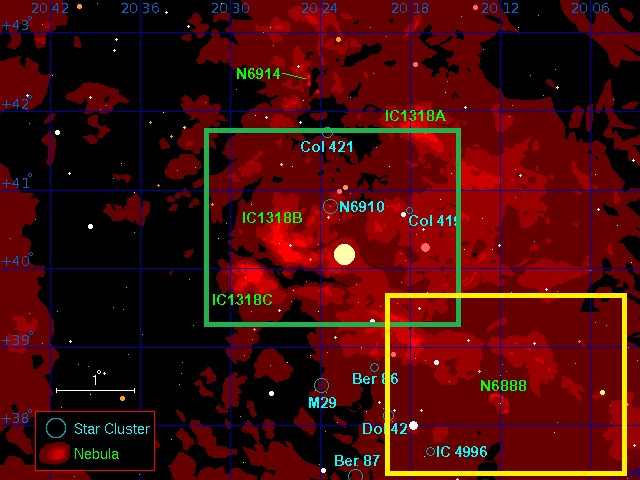
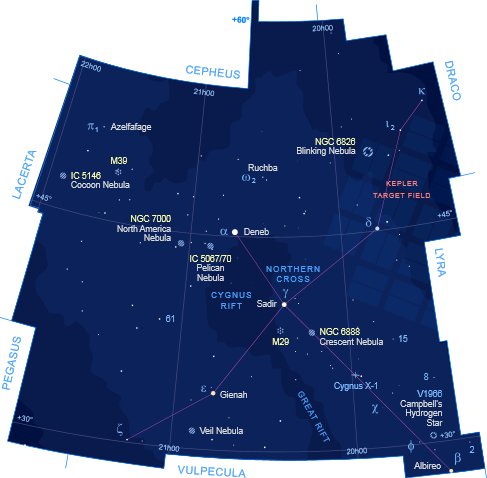
Sadr Region: green rectangle indicates the approximate area of IC 1318 image, yellow rectangle the NGC 6888 Crescent Nebula. image

Sadr Region: green rectangle indicates the approximate area of IC 1318 image, yellow rectangle the NGC 6888 Crescent Nebula image.

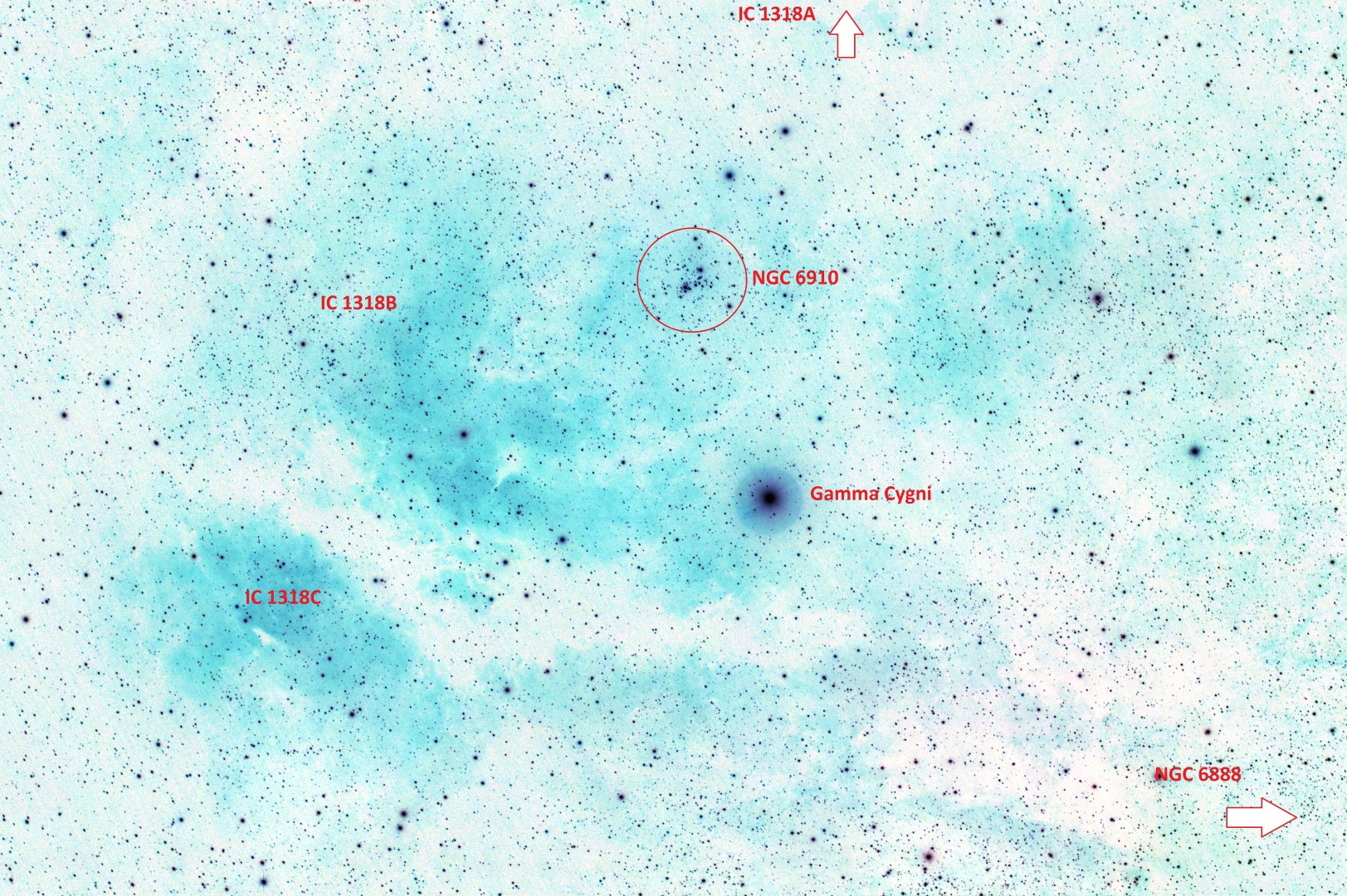
IC 1318 is a diffuse emission nebula surrounding the star Sadr or Gamma Cygni, which is at the centre of the Cygnus Cross and on the plane of the Milky Way.  The Sadr region is located deep within the Orion arm of the Milky Way about 3,000 light-years from Earth, with Gamma Cygni actually situated closer in the foreground. Such is the size of IC 1318 that its three constituent parts, A – B – C, extend over some 200 light-years or about 4 degrees, which is well beyond the FOV of the WO GT81; how could I have overlooked his enormous area of nebulosity before?  As a result of its size and complexity I also chose to image two other interesting features nearby.

IC 1318 Sadr Region - image inverted & annotated

IC 1318 Sadr Region – image inverted & annotated

IC 1318 Sadr Region WO GT81 + modded Canon 550D & FF | 30 x 120 secs @ ISO 1,600 | 30th September 2015

IC 1318 Sadr Region
WO GT81 + modded Canon 550D & FF | 30 x 120 secs @ ISO 1,600 | 30th September 2015

Situated just above Sadr is the small star cluster of NGC 6910 AKA Rocking Horse Cluster.  Although only 10’ in size the cluster is visually quite prominent, though I struggle to see the little horse that others have identified.  Notwithstanding, it is an interesting and attractive part of the Sadr region.

NGC 6910 The Rocking Horse Nebula as recorded by StarObersever.eu - located just above Gamma Cygni in the previous image.

NGC 6910 The Rocking Horse Nebula as recorded by StarObersever.eu – located just above Gamma Cygni in the previous image.

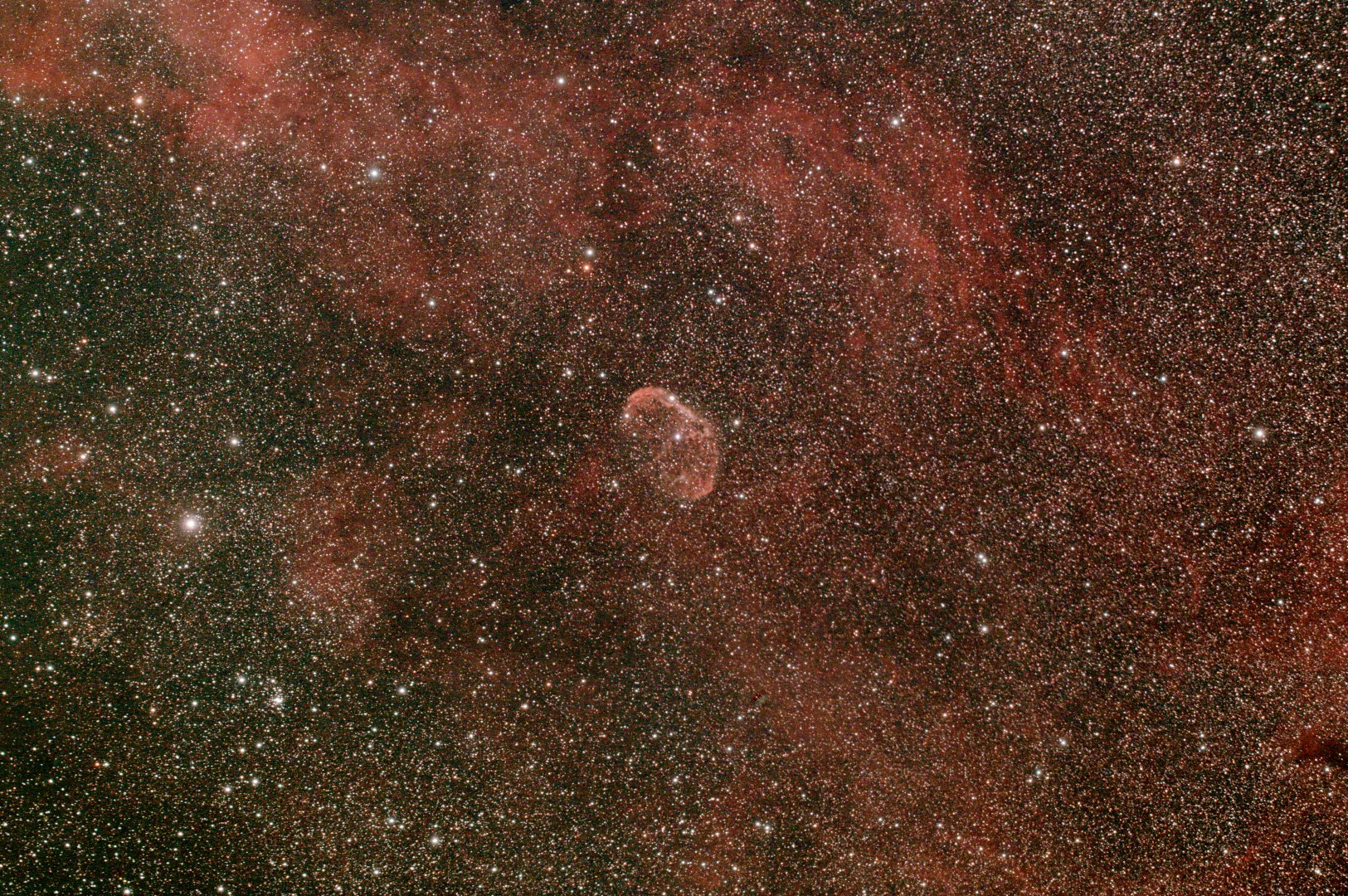
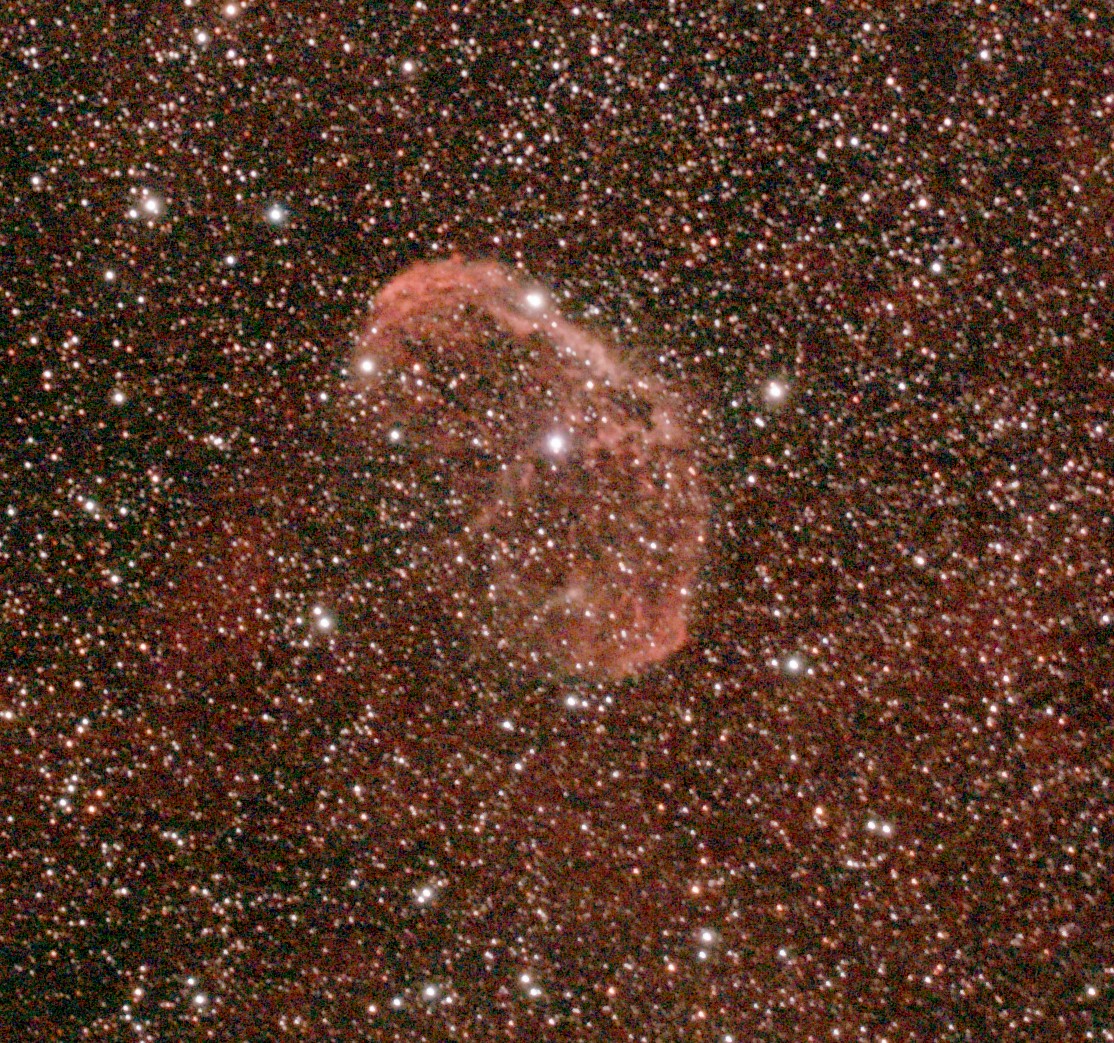
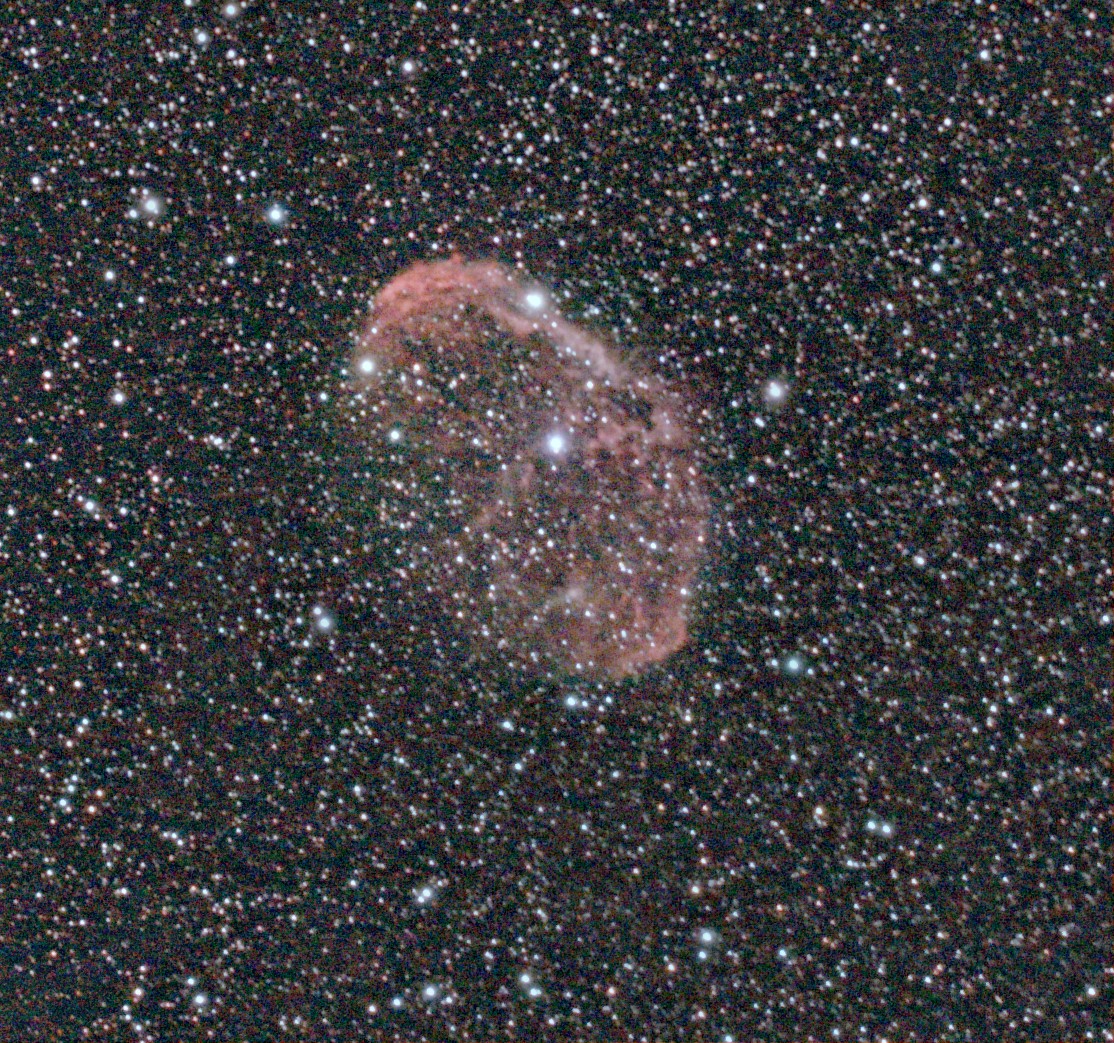
Located about 2 degrees south west of Sadr is the Crescent Nebula NGC 6888, which is not unlike the Jellyfish Nebula in appearance but is younger in its evolution.  An emission nebula, NGC 6888 is formed by a stellar wind from the Wolf-Rayet star WR 126 colliding with a slower moving wind ejected when the star previously became a red giant. The result is an illuminated shell-like feature consisting of two shock waves, one moving inward and the other outward, producing this amazing spectacle which measures some 25 light-years across.  Near the end of its existence, the star will eventually end its life in a spectacular supernova explosion – now that would be an image.

NGC 6888 Crescent Nebula WO GT81 + modded Canon 550D & FF | 20 x 180 secs @ ISO 1,600 | 9th October 2015

NGC 6888 Crescent Nebula
WO GT81 + modded Canon 550D & FF | 20 x 180 secs @ ISO 1,600 | 9th October 2015

Crescent Nebula - cropped

Crescent Nebula – cropped

Crescent Nebula - cropped + GradientXTerminator applied

Crescent Nebula – GradientXTerminator applied

Whilst IC 1318 has proved to be an excellent and productive imaging target for my equipment, it has become clear that it represents a much, much larger area of nebulosity that incorporates or is at least immediately adjacent to NGC 7000, the North America Nebula.  At a rough estimate this larger area spans a distance of some 2,000 light-years and is some 50-times bigger than the Sadr region.  Like other major areas of nebulosity (Barnard’s Loop) such a scale is way beyond the ability of my equipment and most others without resorting to a mosaic technique.

However, my interest in seeing and potentially imaging the bigger picture has been piqued and I have recently purchased a Vixen Polarie tracking mount, which can be fixed onto a camera tripod with a standard camera and lens in order to take long exposures without forming star trails. This set-up has two advantages over prime focus + telescope imaging: (i) it is highly portable and can easily be taken anywhere in a rucksack, and (ii) by using a camera lens of say <=50mm focal length it is possible to achieve a much wider FOV and thus photograph some of these very large nebulous areas in one image.

Alas the Sadr region is now moving on and it is probably too late to tackle using the Polarie mount but it will be something to look forwards to again next autumn and meanwhile Orion is just round the corner.  Watch this space for developments!

The Pelican & The Phoenix

As we pass the Autumn Equinox the promise of long and exciting Winter skies is not far off but there are still some wonderful late Summer features around worth imaging before they move away from the Meridian and out of view from Fairvale Observatory.  Following a major operation earlier in the year I’ve been unable to move the heavy equipment outdoors until very recently and have therefore almost completely missed the Summer skies; even as I’ve been getting better in recent weeks, poor skies and other circumstances have stopped my return to astronomy – until now.

Up until shortly before midnight the Cygnus constellation is favourably located close to the Meridian at the moment and at a very high, southerly altitude – perfect for my location – it was therefore here that I chose to make my long awaited resumption to astroimaging last Saturday.  The weather forecast in the morning showed clear skies for that night but by early evening had changed to cloud and looked like being another lost opportunity; on this basis the Flamsteed Astronomy Society had already cancelled their planned evening astronomy session.  However, unlike previous attempts in recent weeks when clear skies were forecast and the cloud rolled in unannounced, this time the outcome was very different, with a clear moonless sky throughout the night – I sometime wonder if the weather forecasters have windows and bother to look outside!

cygnus

Located northeast of the first magnitude star Deneb and some 1,600 ly from Earth is NGC 7000 or the North America Nebula, an enormous H II region that in outline resembles the North American continent.  I first encountered this emission nebula at a similar time last year, which was my first experience of such a feature and I was therefore thrilled to capture part of it in my picture; my blog title at the time captures my feelings – WOW!  However, taking the image using the longer focal length Skywatcher 150PL with a smaller field-of-view (FOV), the picture only captured part of the ‘USA’ and the ‘Gulf of Mexico’.  Furthermore, using an unmodded camera much of the red H-alpha light that is characteristic of these nebulae was not recorded.

Since then my equipment has changed in a number of important ways, so that the William Optics GT81 with a wider FOV would now enable me to image more of the nebula, whilst using a modded DSLR camera would also record much more of the H-alpha light; an additional year’s experience also helped.  This time my target was the related IC 5070 and IC 5067 H II regions otherwise known as the Pelican Nebula, situated just west of NGC 7000 and close to Deneb.

The Pelican Nebula, IC5070 & IC 5067. WO GT81 & modded Canon 550D + FF | 30 x 120 secs @ ISO 1,600 + calibration | 19th September 2015

The Pelican Nebula, IC5070 & IC 5067
WO GT81 & modded Canon 550D + FF cropped | 30 x 120 secs @ ISO 1,600 + calibration | 19th September 2015

With an apparent magnitude of +8 the Pelican is generally less bright than its larger +4 neighbour but is no less exciting.  The bright double star Cygnus 57 and binary Cygnus 56 shine conspicuously just in front of the ‘bird’ and within the ‘body’ respectively.  In addition a bright area at the northern top of the ‘bird’s head’ is an active area of star formation, which ionizes the gases creating the glowing red area.

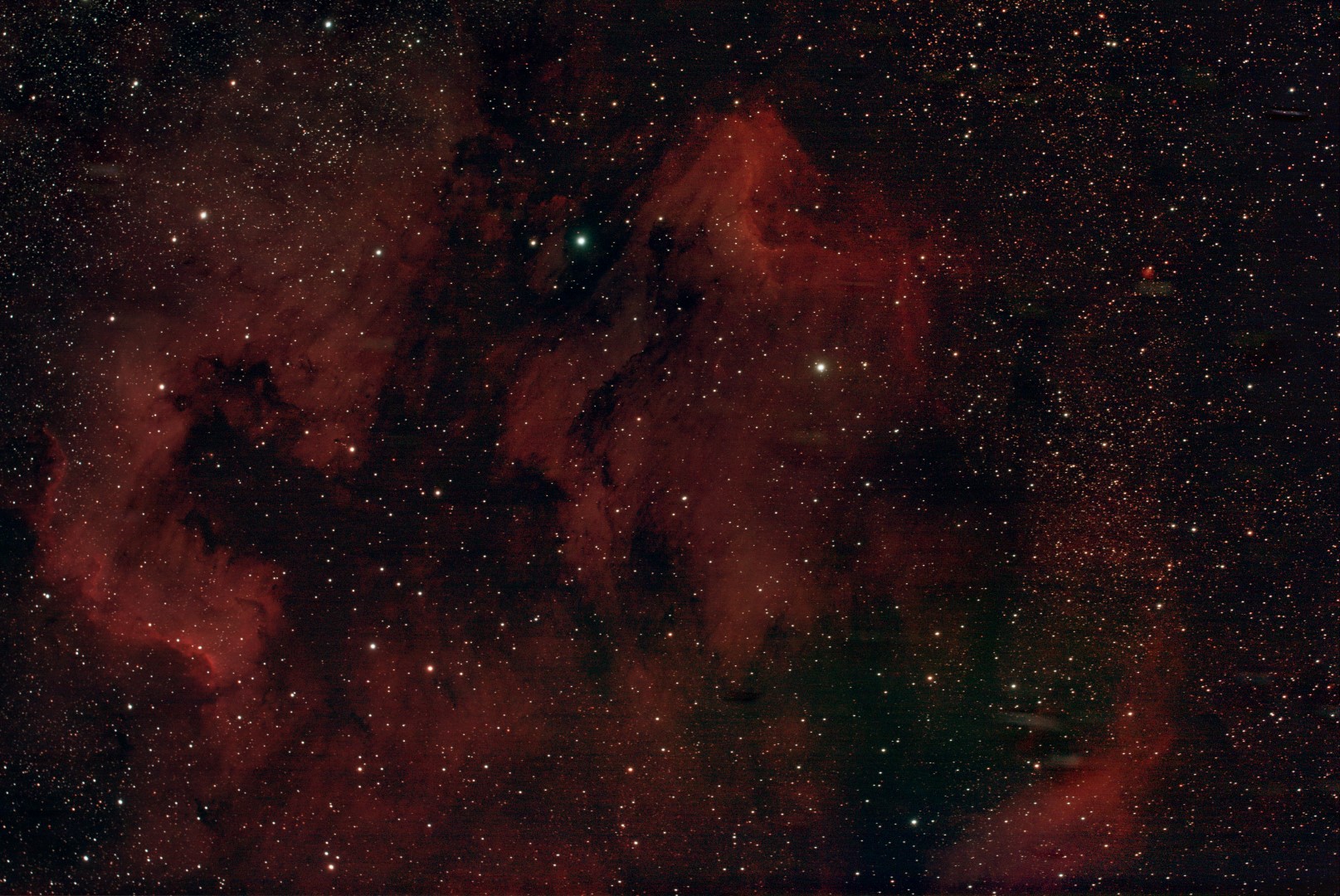
Whilst missing the impact of being my first H II nebula last time, the larger image of the North America Nebula now captures most of the ‘continent’ and encompasses ‘Central America’.  As a result the picture clearly shows the Cygnus Wall, another bright area of star formation that runs along ‘Baja California’ / ‘northern Mexico’ area.

NGC 7000 The North America & Pelican Nebulae WO GT81 + modded Canon EOS 550D + FF | 30 x 120 secs @ ISO 1,600 + calibration | 19th September 2015

NGC 7000 The North America & Pelican Nebulae
WO GT81 + modded Canon EOS 550D + FF | 30 x 120 secs @ ISO 1,600 + calibration | 19th September 2015

The combined Pelican and North America Nebulae span some 50 ly across, which when imaged together makes a wonderful picture of these spectacular features.  I would be happy with this image at any time but after nearly six months away from astroimaging it’s a very pleasing result.  I feel re-invigorated, like the phoenix has risen again.