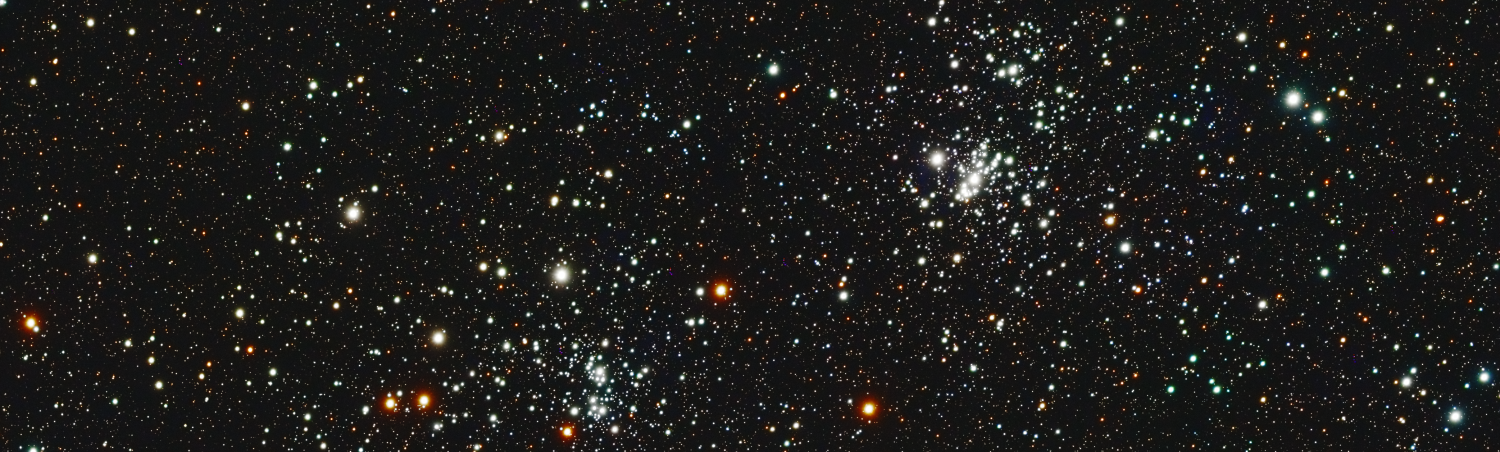
Seeing Stars

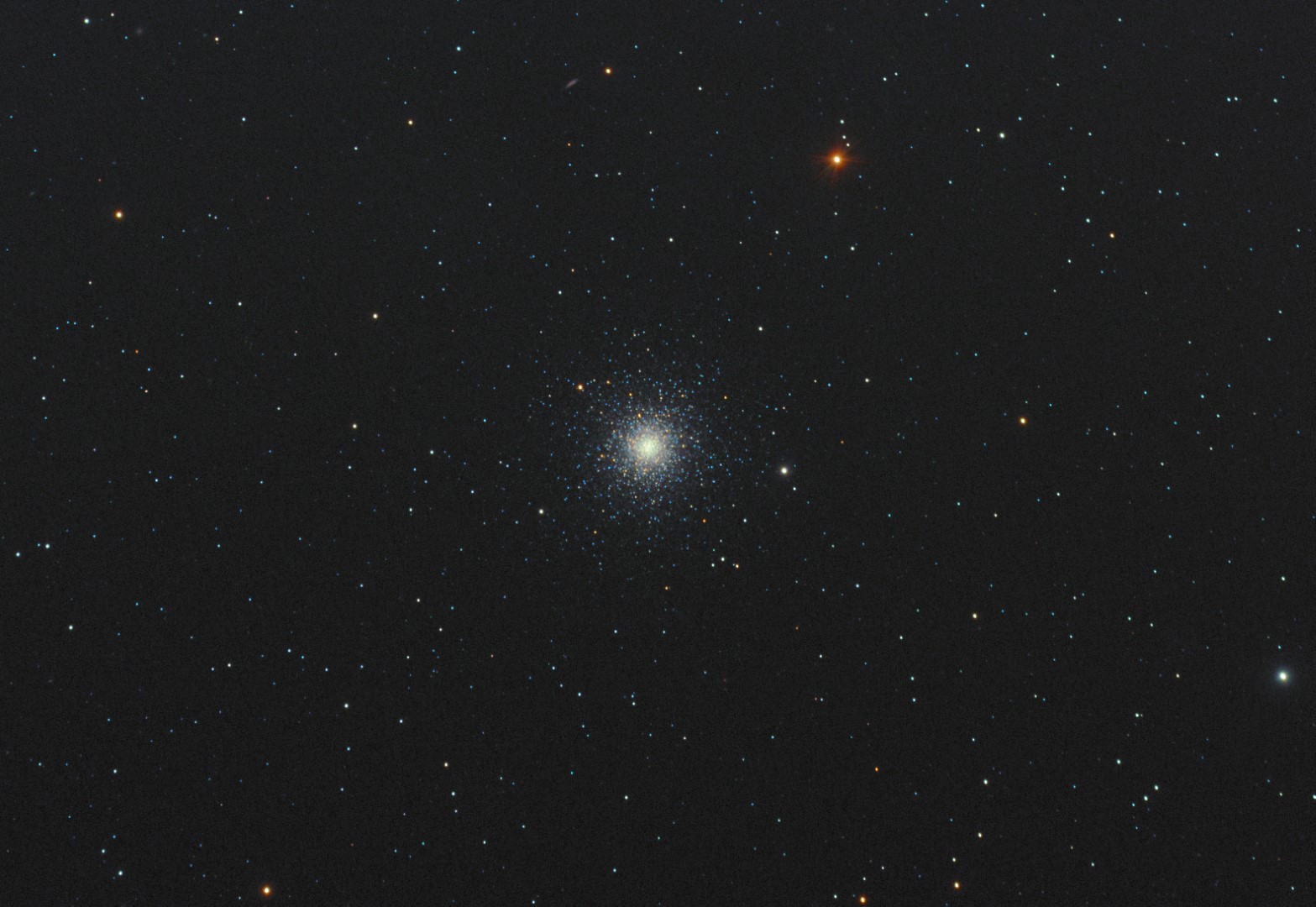
Of all the incredible features that constitute the Universe, located relatively close to home, I always marvel at the nature of globular clusters.  Largely unknown by the lay person and myself until I took-up astronomy, more than 150 of these incredible objects orbit around the Milky Way in the form of a spherical halo both above and below the galactic disc.  Between galaxy season (March – April) and the appearance of the Sagittarius arm of the Milky Way in the summer, is the globular so-called cluster season, which is heralded by the arrival of M3, one of the brightest and most popular of the clusters.

M3 was discovered by Charles Messier in 1764 but only correctly identified as a globular cluster twenty years later by William Herschel.  Consisting of more than 500,000 million stars, of which at least 274 are variable stars, it is estimated to be over 11-billion years old, thus being some of the oldest stars in the Universe.

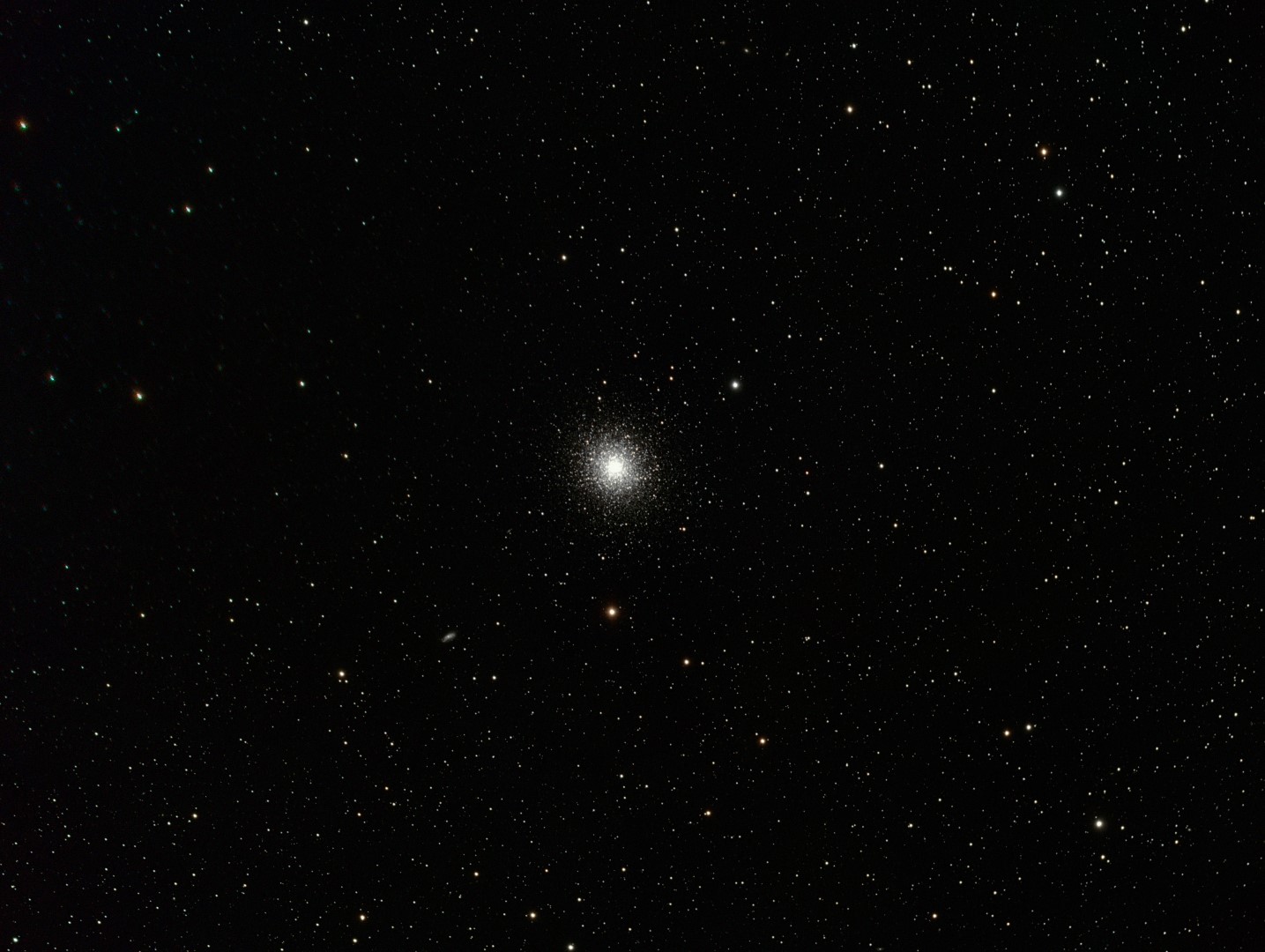
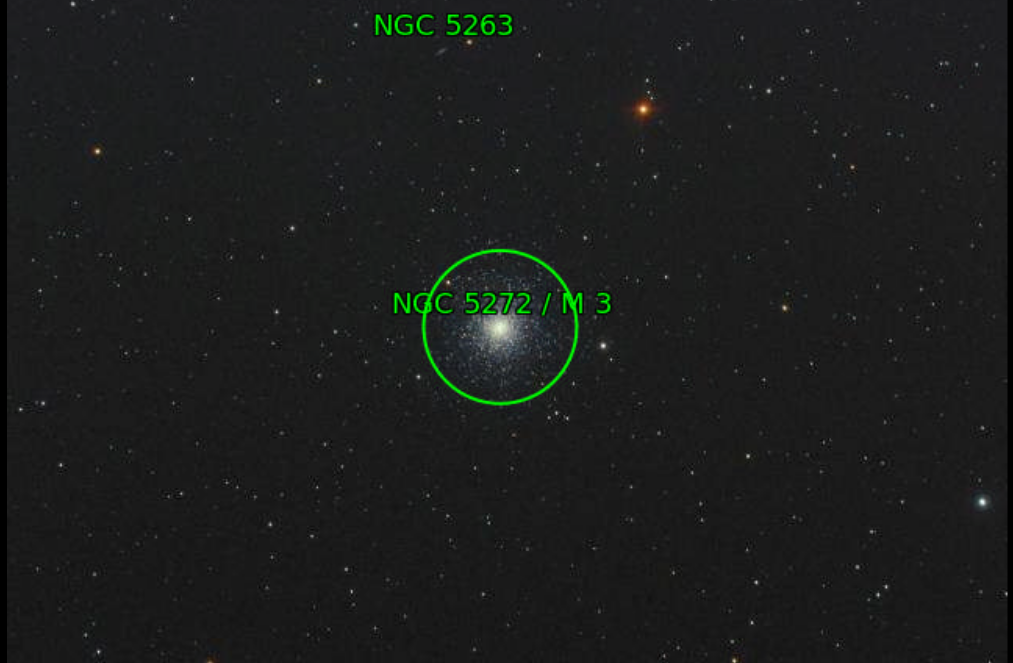
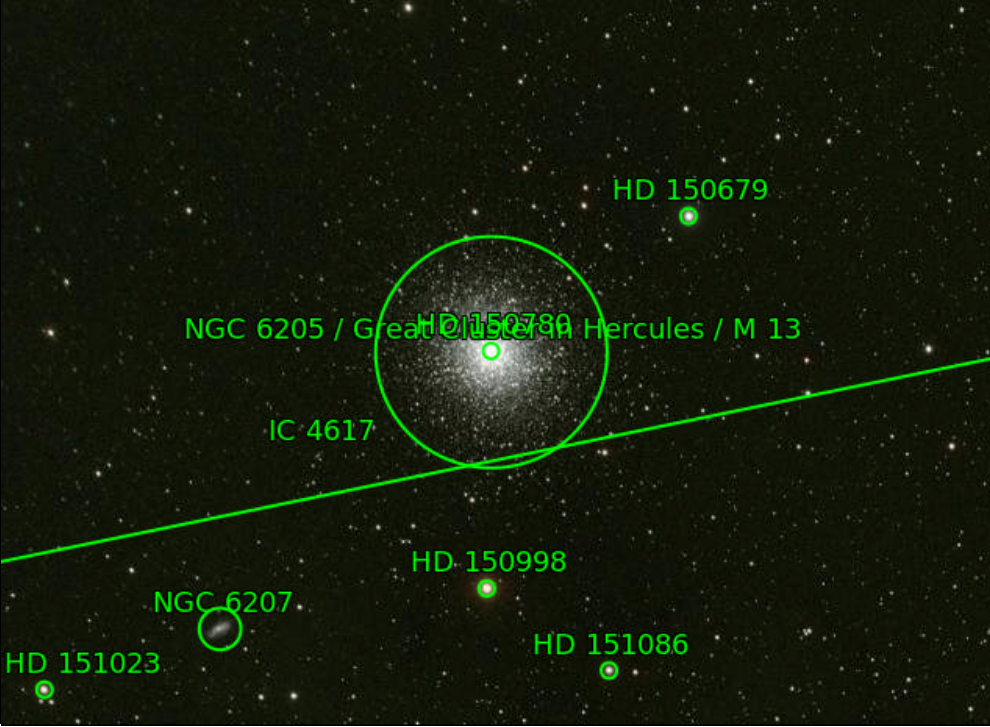
Using data gathered remotely from a Takahashi 106 FSQ situated in the dark skies of New Mexico, USA, the resulting image shows this spectacular object in all its glory.  Apart from the marvellous star details within the cropped version of M3 (see top of the page), there’s also much to see and enjoy in the original widefield image (see above), that is also bountiful of colourful stars as well as several galaxies.  Altogether I’m very pleased with the final image, which is probably my best globular cluster so far.

 IMAGING DETAILS
ObjectM3 Globular Cluster AKA NGC 5272
ConstellationCanes Venatici
Distance34,000 light-years
Size 18 arc minutes, which spans approx. 180 light-years
Apparent Magnitude+6.2
  
Scope Takahashi FSQ 106  FL 530mm  f/5  +  Moonlight Nightcrawler focuser  
MountParamount MyT
GuidingYes
CameraQSI 683-WSG8    KAF-8300 full frame CCD sensor   5.4nm pixels  
 FOV 1.94o x 1.46o   Resolution 2.1”/pix.   Image array 3326 x 2,507 pix   
ProcessingDeep Sky Stacker,  PixInsight v1.8.9-1
Image Location              & OrientationCentre – RA 13:42:12.768      DEC +28:23:5.03                       
ExposuresL x12, R x12, G x19, B x12 x 300 secs  @ -20C Total Integration Time: 4hr 35min     
Calibration30 x 300 secs Darks   x56 Bias & x20 LRGB Flats   
Location & DarknessDeep Sky West – amateur hosting facility near Rowe, New Mexico  – USA    SQM Typically >= 21.7
Date & TimeMay 2018    

Glactic Waltz

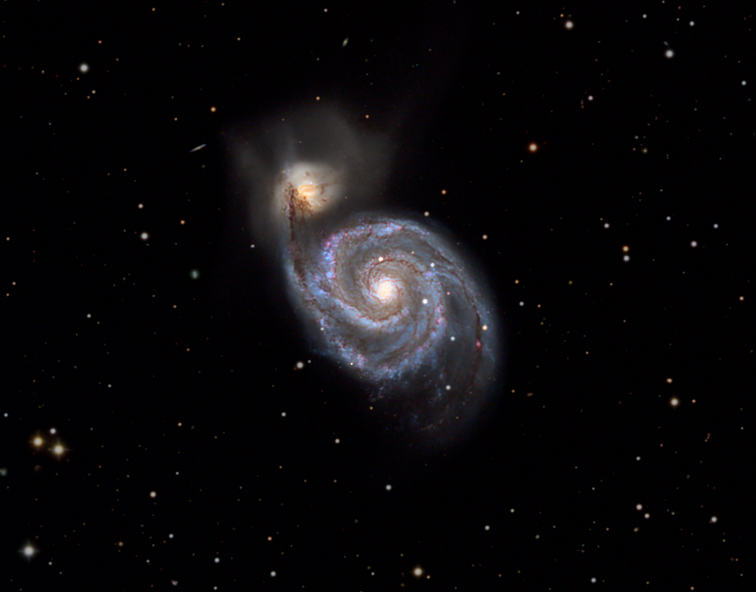
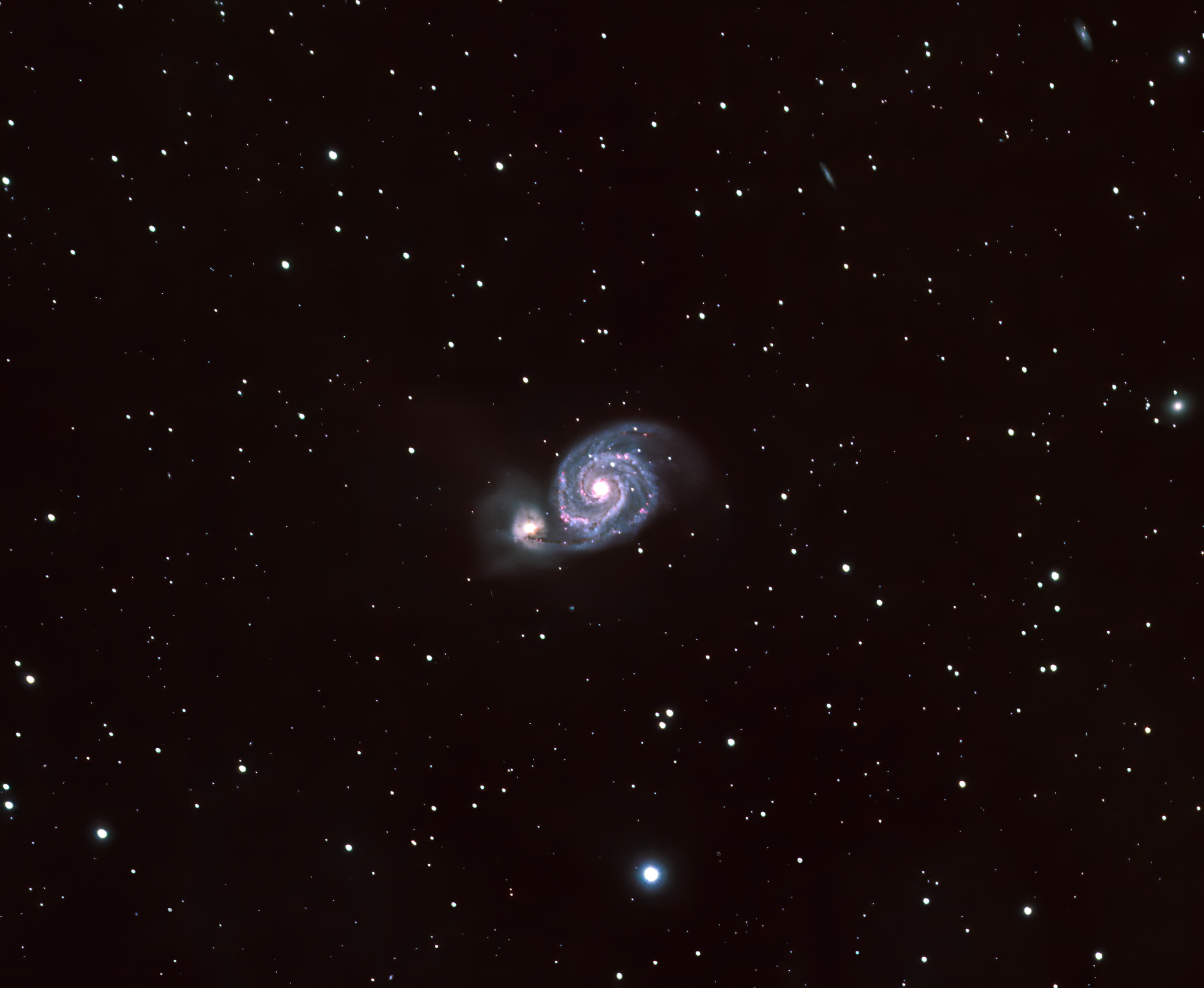
The size and diversity of the cosmos produces many wonderful features, of which M51 the Whirlpool Galaxy ranks highly amongst astrophotographers and is certainly one of my favourites.  Unfortunately, it is at the limit for my equipment and location, though in 2020 I was fortunate to capture over 16-hours integration time and a reasonable image (see here).  Whilst currently in the summer doldrums of limited darkness, I chose to process M51 data previously obtained using a Takahashi FSQ 106 located at Deep Sky West in New Mexico, USA.

Seen face-on from Earth, the balanced arms of this grand design galaxy contains dark dust lanes, blue star clusters and numerous pink star-forming regions rich in hydrogen gas.  But it is the cosmic dance taking place between M51 and its companion dwarf galaxy NGC 5195 that makes this such an exciting and popular object.

The most popular theory of what’s happening, is that the smaller galaxy is passing behind M51 and the joint gravitational forces are interacting between the two, resulting in the misalignment of stars and unusually bright blue and pink areas across the M51 galaxy.  Though not certain, it seems that their fates are inextricably linked and might eventually merge.  Whatever the process taking place, it will take millions of years if not longer to play out and is likely to provide this exciting spectacle for many generations of astrophotographers yet to come!

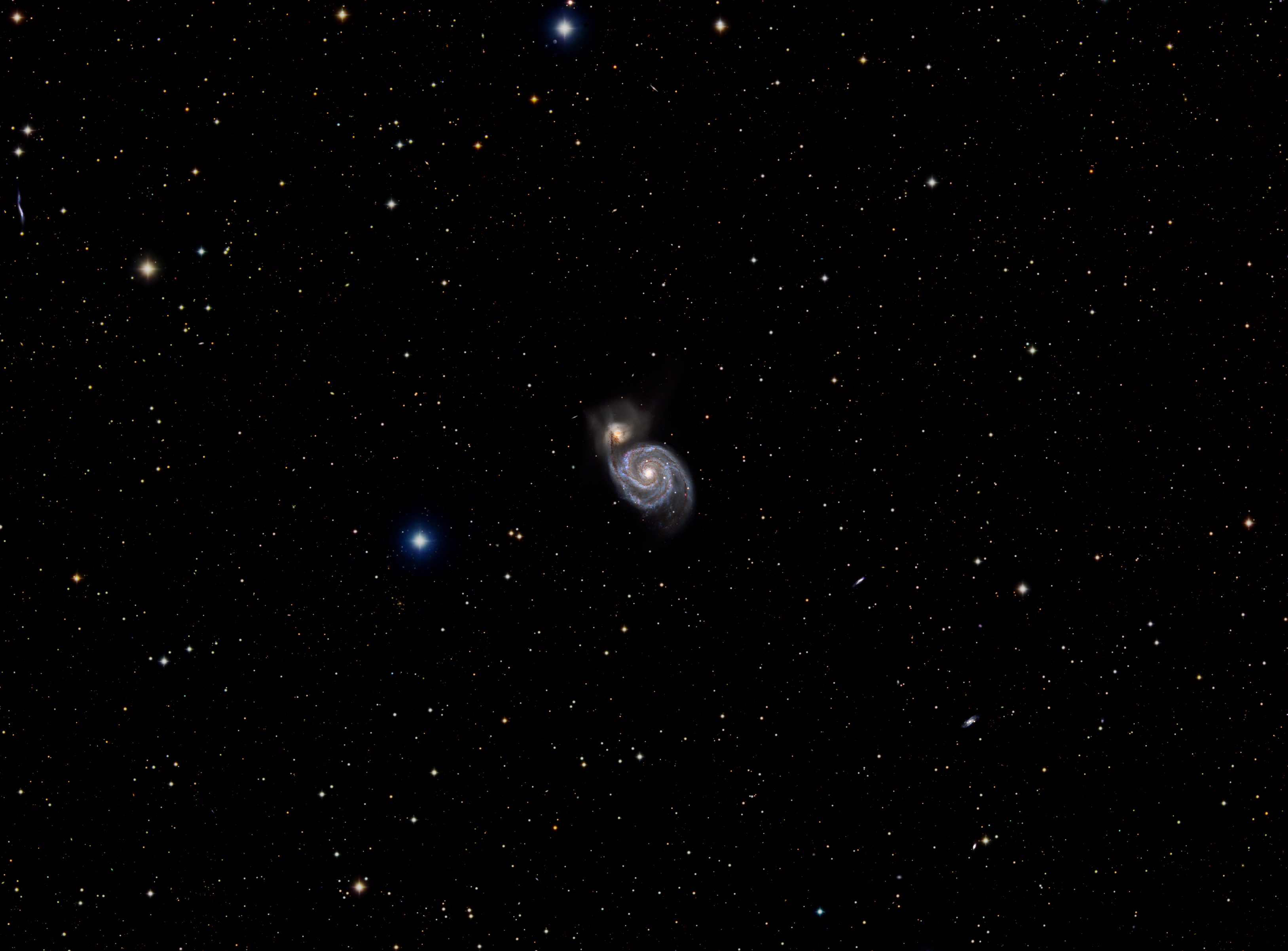
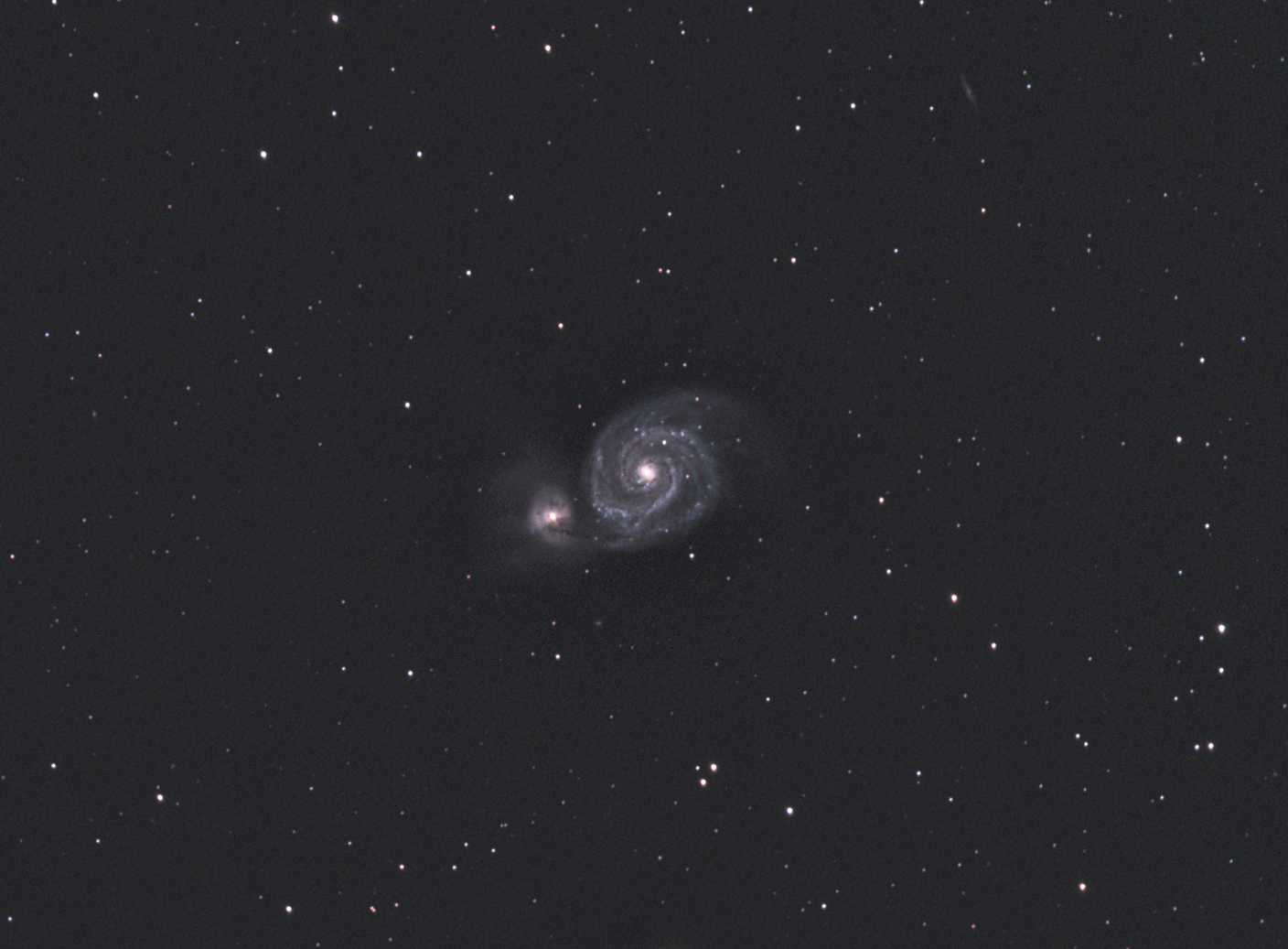
Whilst I was satisfied with my image obtained here in Surrey at Fairvale Observatory in 2020, there’s no denying that the data set from New Mexico is in a different league and was a pleasure to process.  Given the short focal length of both telescopes, Takahashi FSQ 106 (530mm f5) and William Optics GT 81 (382mm f4.72), out of the camera both set-ups inevitably produce a wide FOV but nonetheless pleasing images (see image above).  However, the quality of the DSW data holds up much better when cropping out M51 and its dance partner, thus showing off the aforesaid details of this dynamic and colourful scene to great effect (see top of page).   


 IMAGING DETAILS
ObjectM51 Whirlpool Galaxy & NGC 5195
ConstellationCanes Venatici
Distance23 million light-years
Size Approx. 77,000 light-years (M51 only) ~10 arc minutes
Apparent Magnitude-+8.4
  
Scope Takahashi FSQ 106  FL 530mm  f/5  +  Moonlight Nightcrawler focuser  
MountParamount MyT
GuidingYes
CameraQSI 683-WSG8    KAF-8300 full frame CCD sensor   5.4nm pixels  
 FOV 1.94o x 1.46o   Resolution 2.1”/pix.   Image array 3326 x 2,507 pix   
ProcessingDeep Sky Stacker, PixInsight v1.8.9-1
Image Location              & OrientationCentre – RA 13:29:55.31      DEC +47:11:41.608 Top Left = North                   
ExposuresL x 16, R x 18, G x 16, B x 17 @ 900 sec & -20o C Total Integration Time: 16hr 45min     
Calibration48 x 900 secs Darks   x47 Bias & x20 LRGB Flats   
Location & DarknessDeep Sky West – amateur hosting facility near Rowe, New Mexico  – USA    SQM Typically >= 21.7
Date & TimeJanuary 2018    

Canine Capers

Following a very poor winter period, spring has been nothing less than spectacular and provided many clear nights for astronomy, ironically made all the better by the covid-19 lockdown.  With the near absence of road traffic and especially aircraft – Fairvale Observatory is badly affected by flights from nearby Gatwick, Heathrow and Redhill aerodrome – it has resulted in noticeably better seeing, as well as a quieter and more enjoyable environment overall; it’s worth noting that after experimenting with Deep Sky Stacker (DSS), increasing the Kappa-Sigma clipping parameter from 2.0 to 2.50 for the light subs, in all but the worst cases eliminated aircraft tracks in the final stacked image.  Resulting from these favourable conditions, I’ve recently been able to image four otherwise difficult targets, amounting to some 40-hours total integration time, literally unprecedented conditions in the +30 years I’ve lived here.

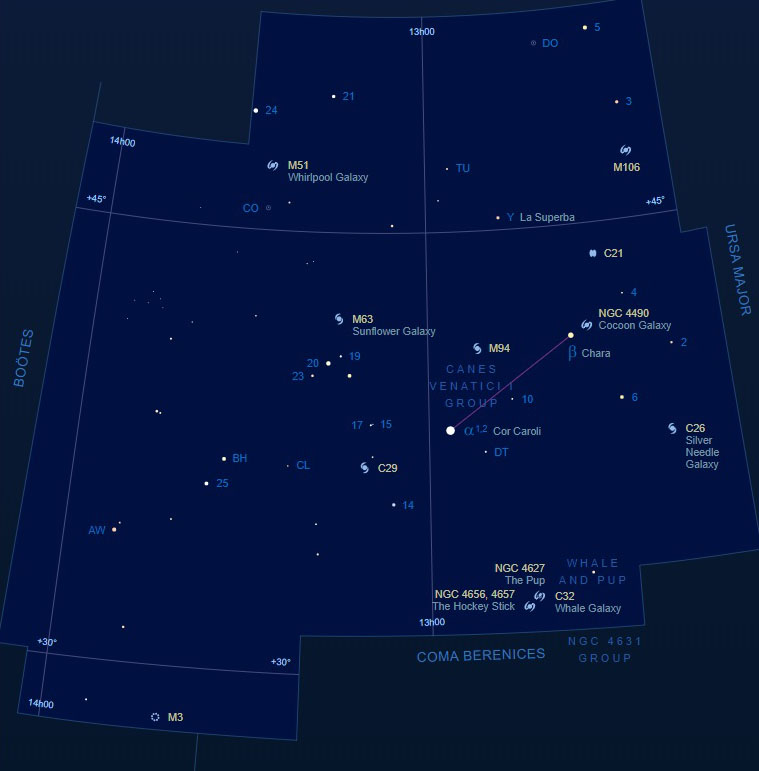
CanVen Map

Apart from a brief diversion imaging the Leo Triplet, my attention has otherwise been centered on the constellation of Canes Venatici, AKA the Hunting Dogs.  At this time of the year the constellation starts to come into view high overhead from the east at about 10 p.m. and crosses the meridian about three hours later.  Located below Ursa Major and above Bootes, the relatively small Canes Venatici hosts five Messier objects, four of which are galaxies and it is these I’ve been drawn to.  From earlier test shots I determined that the M94 galaxy was unlikely to be suitable for my equipment but I did obtain and have already described images of first M106 and then M63.  Notwithstanding, I had unfinished business with the last of the four galaxies, which I therefore now turned to.

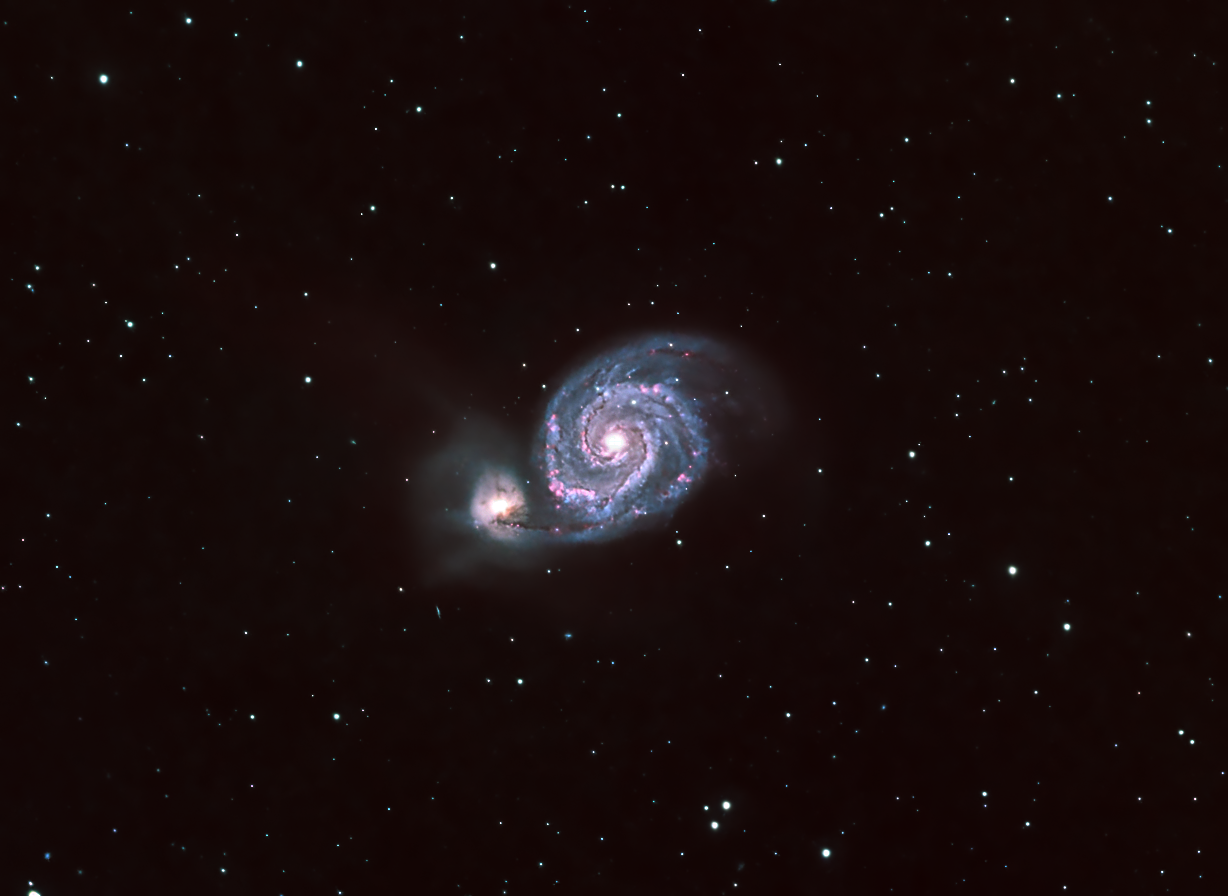
In 2019 I was pleased to acquire my first ever image of the wonderful M51Whirlpool Galaxy and its smaller companion, NGC 5195.  However, I noted then that the final LRGB image still needed much more integration time than just 2hr 18min. achieved, plus the addition of Ha-subs and that I hoped to return to the Whirlpool and its neighbour as soon as possible for this purpose.

M51 HaLRGBFinal-denoise-denoise

It was therefore a great pleasure to image M51 over no less than seven nights in March and April this spring, which combined with last year’s data resulted in over 16 hours integration time, substantially longer than any previous image I’ve compiled before.  Moreover, the quality of seeing also benefitted SNR and guiding quality, thus achieving RMS errors of at least 0.80 arc seconds or better.  I did encounter some plate solving issues and had to resort to manual framing on a few nights but fortunately DSS software dealt with alignment OK and the final image is all I could have hoped for (see above + top-of-the-page cropped).  Naturally the interaction of the two galaxies is the signature feature of this image but it is the improvement in general colour, detail and addition of Ha-subs highlighting regions of new star formation, that have been most transformative in portraying these objects in all their glory.

Using my current set-up it seems unlikely that the image would benefit significantly from any further data acquisition but I’d like to think I’ll return another day using a larger telescope and higher resolution with which to capture and enjoy even more detail of all these exciting objects of Canes Venatici.  It is said that “it’s an ill wind that blows no good” and I am doubtful we’ll ever have such good conditions here again but for now I was delighted to be able to positively exploit this otherwise difficult time in lockdown.

  IMAGING DETAILS
Object M51 The Whirlpool Galaxy & NGC 5951
Constellation Canes Venatici
Distance 23 million light-years
Size 11.2’ x 6.9’   77,000 light-years (M51 only)
Apparent Magnitude +8.4
   
Scope  William Optics GT81 + Focal Reducer FL 382mm  f4.72
Mount SW AZ-EQ6 GT + EQASCOM computer control & Cartes du Ciel
Guiding William Optics 50mm guide scope
  + Starlight Xpress Lodestar X2 camera & PHD2 guiding
Camera ZWO1600MM-Cool mono  CMOS sensor
  FOV 2.65o x 2.0o Resolution 2.05”/pix  Max. image size 4,656 x 3,520 pix   
EFW ZWO x8 ZWO LRGB & Ha OIII SII 7nm filters 
Capture & Processing Astro Photography Tool + PHD2 +  Deep Sky Stacker & Photoshop CS3
Image Location              & Orientation Centre  RA 13:30:03      DEC 47:11:43  (approx.)                   Top  = South  Bottom = North 
Exposures L x 95   R x 62   G x58   B x 66   Ha x 46 = 327 x 180 sec                                                         Total Integration Time: 16hr 21 minutes   
  @ 139 Gain   21  Offset @ -20oC    
Calibration 10 x 180 sec  Darks  20 x 1/4000 sec Bias  10 x  HaLRGB Flats                             @ ADU 25,000
Location & Darkness Fairvale Observatory – Redhill – Surrey – UK        Typically Bortle 5-6
Date & Time 10th April 2019 +23rd 24th 25th 27th March & 20th 21st 22nd April 2020@ +22.00h
Weather Approx. 6oC   RH <=60%                  🌙 New Moon approx.

Galactic Bloom


M63 HaLRGB FinalCropRotate3 (Large)-denoise-denoise

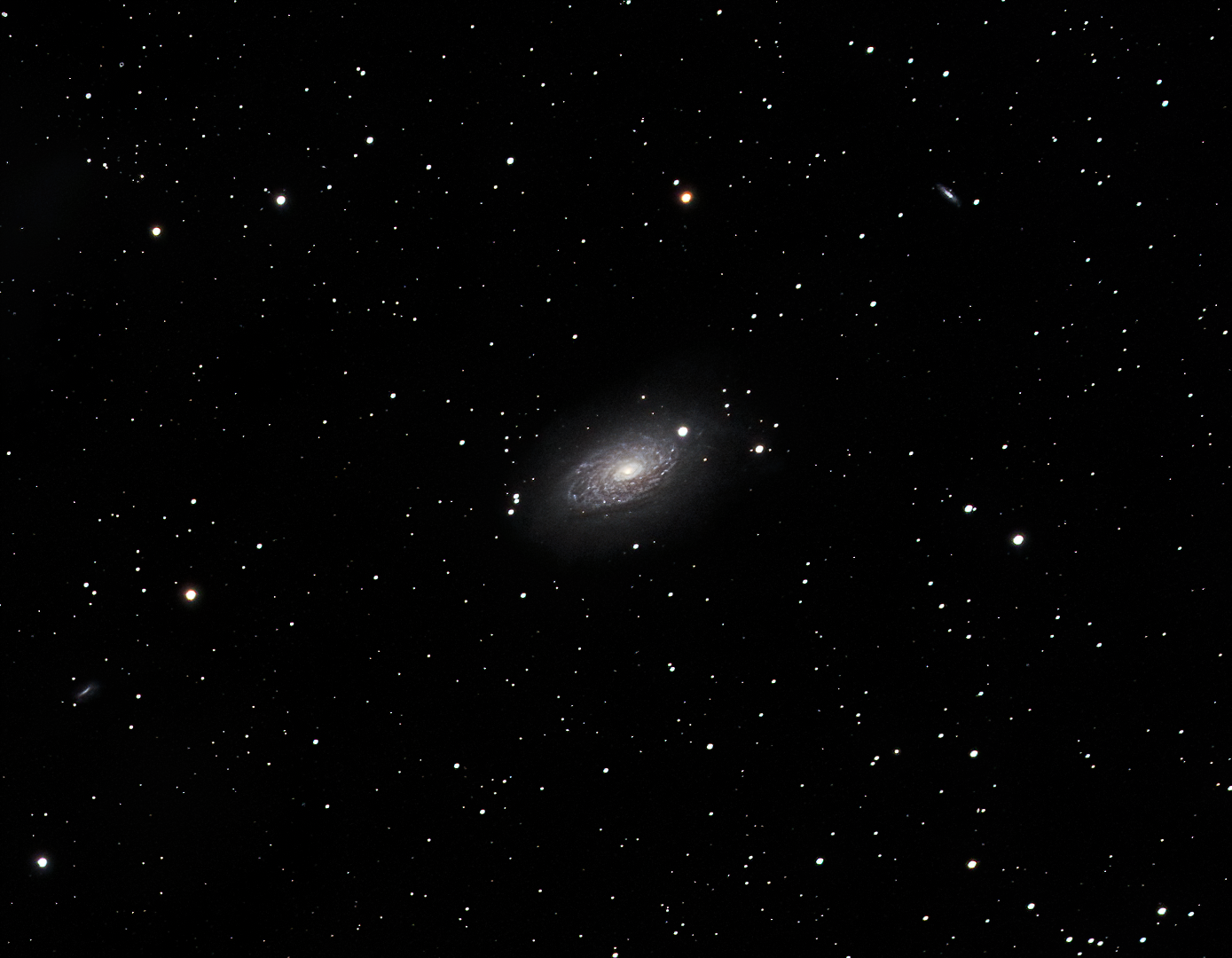
You don’t have to be an astronomer to appreciate Van Gogh’s wonderful evocation of the night sky in his 1889 painting Starry Night.  He knew a thing or two about sunflowers too and I’ve often stopped by the National Gallery in Trafalgar Square to take a peep at his famous painting of them.  However, it was still more than thirty years after completing these paintings that we first learned that such features as galaxies and the rest of the Universe even existed beyond our own Milky Way.  Since then our knowledge of the cosmos has expanded considerably and today provides no end of imaging opportunities for the astrophotographer, subject to clear skies!

Having started the galaxy season with M106 and, given the excellent conditions that prevailed throughout much of Spring this year, I chose to return to the same area of the sky again to image M63, AKA the Sunflower Galaxy.  M63 has a spiral form but with no apparent central bar and in visible light lacks large scale spiral structure, although two-arm structures are noticeable in near infra-red.  Instead the dust lanes are extensively disrupted producing a patchy appearance and is thus classified as a flocculent galaxy – in this case looking something like a sunflower.

As previously discussed, most galaxies are a real challenge for my equipment but an earlier experiment indicated it might just be possible to image M63, the trick would be obtaining sufficient integration time.  Fortunately three clear nights approaching a new moon in April provided over 8-hours of good subs, which I’m pleased to say resulted in a decent final image after all.  The background sky is less busy than I would wish but there’s nice colour in the stars and also a few very small faint fuzzies on close inspection.  Notwithstanding,  M63 is clearly the star of the show (no pun intended) with the so-called flocculation clearly evident and numerous random dust lanes criss-crossing the entire galactic disc.

Although in 1924 Edwin Hubble’s recognition that galaxies, such as our own, existed outside the Milky Way, M63 was discovered by Pierre Méchain and catalogued by Charles Messier in 1779, long before Van Gogh’s paintings.  He might conceivably have known of its presence therefore but not what it was and would surely be inspired to see and know about the Sunflower Galaxy as we do today.

IMAGING DETAILS
Object M63, NGC 5055 AKA Sunflower Galaxy
Constellation Canes Venatici
Distance 29 million light-years
Size 12.6’ x 7.2’
Apparent Magnitude +9.3
 
Scope  William Optics GT81 + Focal Reducer FL 382mm  f4.72
Mount SW AZ-EQ6 GT + EQASCOM computer control & Cartes du Ciel
Guiding William Optics 50mm guide scope
  + Starlight Xpress Lodestar X2 camera & PHD2 guiding
Camera ZWO1600MM-Cool mono  CMOS sensor
  FOV 2.65o x 2.0o Resolution 2.05”/pix  Max. image size 4,656 x 3,520 pix   
EFW ZWOx8 + ZWO LRGB & Ha OIII SII 7nm filters 
Capture & Processing Astro Photography Tool + PHD2 +  Deep Sky Stacker & Photoshop CS3
Image Location              & Orientation Centre  RA 13h 15m 49.47”      DEC +42o 01’ 45.62”                     

Top = North approx..     

Exposures 30 x L  17 x R  18 x G  23 x B  12 x Ha x 300 sec

Total Time:  8hr 20 min    

  @ 139 Gain   21  Offset @ -20oC    
Calibration 5 x 300 sec Ha + 10 X 300’ RGB  Darks,  20 x 1/4000 sec Bias  10 x  HaRGB Flats               @ ADU 25,000
Location & Darkness Fairvale Observatory – Redhill – Surrey – UK        Typically Bortle 5-6
Date & Time 14th 15th & 16th April 2020  @ +22.00h  
Weather Approx. <=8oC   RH 60 – 70%                  🌙 40% waning

Ancient Light

M106 HaLRGB final2 (Large)

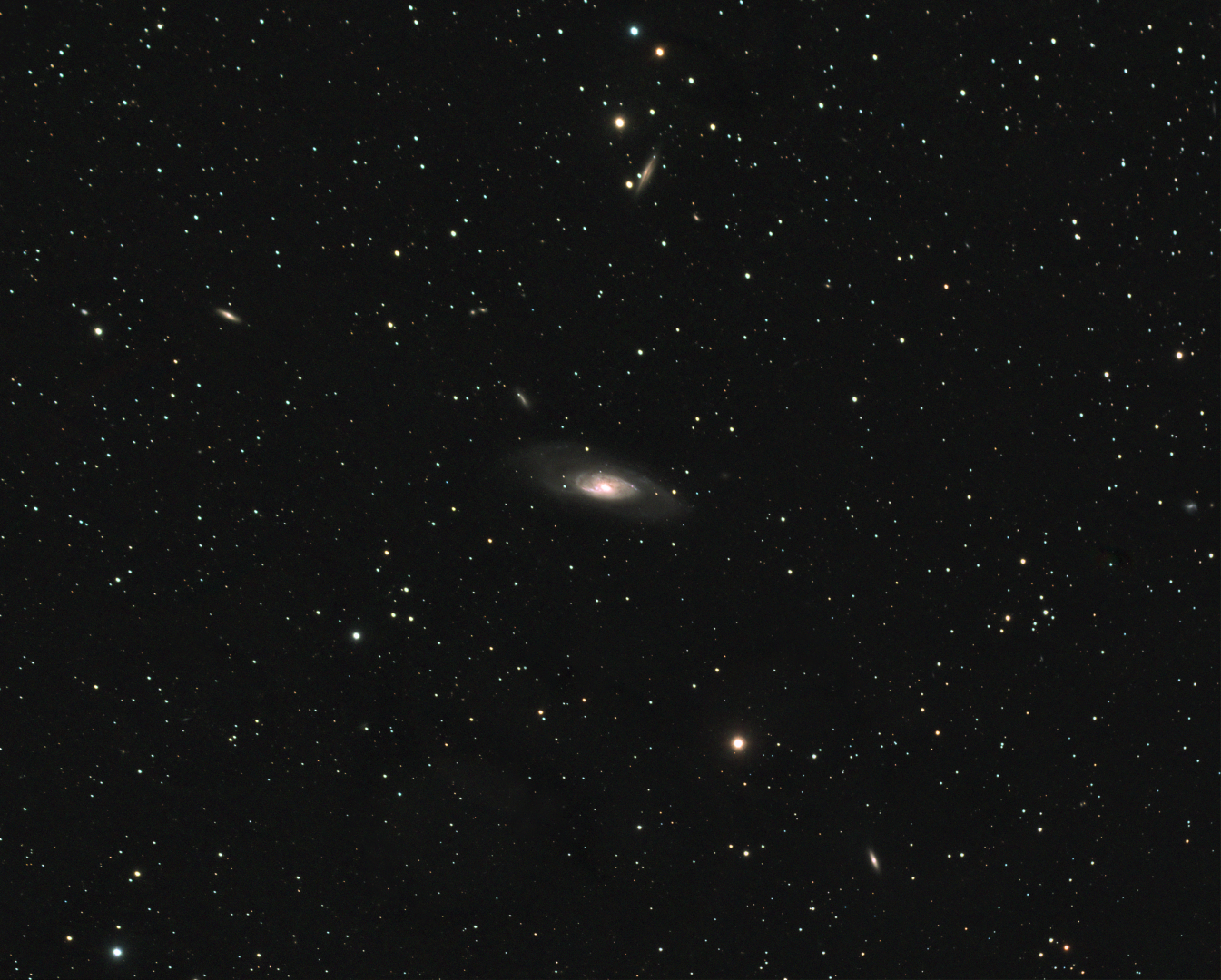
Having last year discovered that I could see parts of the zenith region of the sky at Fairvale Observatory (North), in particular Ursa Major and adjacent constellations for short periods during the spring galaxy season, it was an obvious location to return to this year.  Furthermore, a protracted period of good weather for most of 12-days coinciding with a New Moon provided an unprecedented opportunity to obtain long integration times on a number of smaller galaxies that abound there.

Following the aforementioned discovery, I was pleased to successfully image M101 AKA the Pinwheel Galaxy in 2019.  On this occasion I decided to start with M106 in the adjacent Canes Venatici (“the Hunting Dogs”) constellation, an intermediate galaxy thought to have a supermassive black hole at its centre (see location map and image orientation above).  Smaller than M101 with a slightly warped disc and viewed obliquely, it is not an easy target with my equipment but the area also teems with other galaxies and colourful stars that make for an attractive composition; it is intriguing that M106 is of similar size and luminosity to the Andromeda Galaxy M31 but is much further away.

M106 Astromet Names

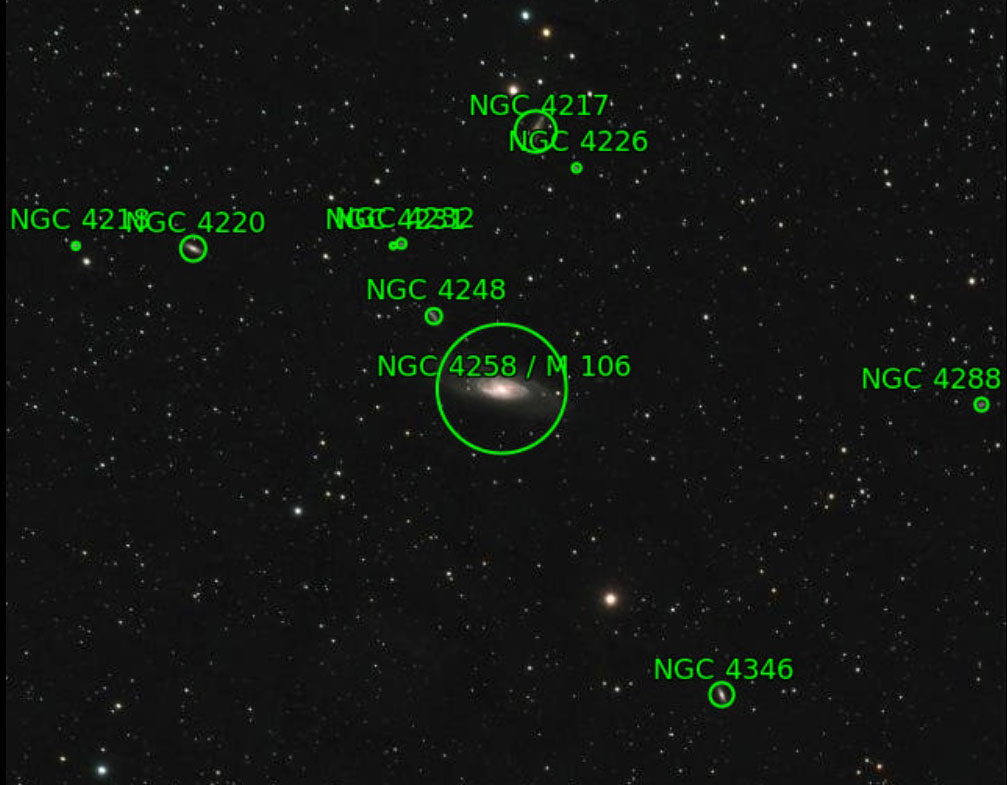
Taken over five evenings, the final HaLRGB image integration time of nearly 10 hours is the longest I’ve achieved to-date, producing a pleasing image of M106 with good colours and detail throughout the surrounding area (see image at the top-of-the-page).  Moreover, across the wider field-of-view a number of other galaxies can be seen clearly, thereby framing the centrally placed M106 and making for a more dramatic image (see annotated kimage above).

Most of the other galaxies vary in age between 20 to 60 million years old, with the edge-on spiral galaxy NGC 4217 thought to possibly be a companion galaxy of M106, however, it is NGC 4226 that I am most excited by.  Close to NGC 4217 and resolved only as a small blurred area with my equipment, nonetheless the light from this galaxy has travelled for 334 million years before reaching my camera. The time it left the galaxy we know as the Carboniferous period, when the major coal measures and rocks of the Yorkshire and the Mendip Hills were laid down, a long time before even dinosaurs roamed the Earth – ancient photons from amongst the furthest distance I’ve ever managed to capture on my sensor!

IMAGING DETAILS
Object M106     AKA NGC 4258
Constellation Canes Venatici
Distance 24 million light-years
Size 18.6’ x 7.2’    Diameter 135,000 light-years
Apparent Magnitude +8.4
 
Scope  William Optics GT81 + Focal Reducer FL 382mm  f4.72
Mount SW AZ-EQ6 GT + EQ-ASCOM computer control & Cartes du Ciel
Guiding William Optics 50mm guide scope
  + Starlight Xpress Lodestar X2 camera & PHD2 guiding
Camera ZWO1600MM-Cool mono  CMOS sensor
  FOV 2.65o x 2.0o Resolution 2.05”/px  Max. image size 4,656 x 3,520 px   
EFW ZWOx8 + ZWO LRGB & Ha OIII SII 7nm filters 
Capture & Processing Astro Photography Tool + PHD2 +  Deep Sky Stacker & Photoshop CS3
Image Location              & Orientation Centre  RA 12:18:58      DEC +47:18:14                        

North = Left    West = Top     

Exposures L x 58  R x 36 G x 36 B x 39 Ha x 20 x 180 secs

Total Time: 9hr 27 min   

  @ 139 Gain   21  Offset @ -20oC    
Calibration 10 x 180 sec x HaLRGB Darks   20 x 1/4000 sec Bias   10 x  HaLRGB Flats            @ ADU 25,000
Location & Darkness Fairvale Observatory – Redhill – Surrey – UK        Typically Bortle 5-6
Date & Time x5 nights 16th – 27th March 2020  @ +21.00h  
Weather Approx. <=5oC   RH 45-65%                  🌙 <=10% waning

Other Worlds

LRGB Image FINALX2 (Large)

Being galaxy season it was appropriate that the BAA spring meeting this year on 27th April was all about – galaxies.  This was my first BAA meeting and I’m pleased to say it was well attended and very worthwhile, I especially enjoyed the following presentations:

  • Prof. Richard Ellis: The Quest for “Cosmic Dawn”;
  • Prof. Chris Impey: Einstein’s Monsters: Black Holes at the Heart of Galaxies;
  • Stewart Moore: Galaxies: A Brief History of Discovery, and
  • Owen Brazell: Observing Galaxy Clusters.

It seems incredible that just 100-years ago the prevailing view was that Universe consisted entirely of the Milky Way, though that was soon about to change.  Whilst Immanuel Kant had proposed the possibility of galaxies outside our own as long ago as 1755, it was not until Edwin Hubble’s work at the Mount Wilson Observatory, California that the existence of other worlds, in the form of galaxies, was proven and accepted during the period between 1924 and 1929.

Following Copernicus’s controversial theory in 1543 that the Earth orbited the Sun, the evidence this time that there was much, much more beyond the Milky Way was equally profound in its implications, if not more so.  However, I was surprised to learn that it was Vesto Slipher and not Hubble who discovered the redshift of galaxies that was fundamental to understanding that galaxies existed outside the Milky Way that were moving away from us – it would seem to me that he deserves much greater credit as well as Hubble for this work.  The current estimate is that there are some 100 to 200 billion galaxies in the observable universe but new research now estimates that the total number is likely to be at least ten times greater!  Either way there are many other worlds out there.

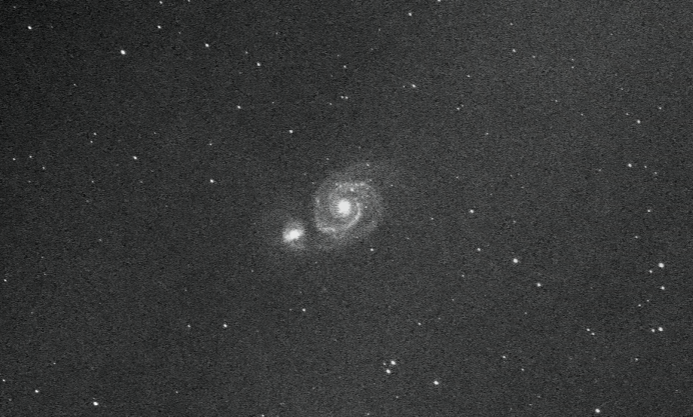
After recently learning that I could after all see and image a few larger galaxies from Fairvale Observatory  in-and-around the Ursa Major constellation, it was to my great delight when I then discovered that one of them was M51 AKA the Whirlpool Galaxy.  I’ve seen many images of this wonderful object and was frustrated that it seemed to be completely out of sight from here but thankfully that is not the case.  Armed with this knowledge, following an imaging session of M101 at the end of March, I therefore went on and immediately grabbed a single Luminance test sub of M51 (below) before it disappeared behind the roof of my house, (a) because I could, and (b) to see how it looked with my equipment.  The answer was that it was almost certainly a viable target for another night when more time was available.
M51 KStar

While located just above the star Alkaid in Ursa Major, M51 is now included within the nearby constellation Canes Venatici; created by Johannes Hevelius in the 17th Century, M51 was previously in Ursa Major.  One of the more famous grand-design spiral galaxies i.e. with prominent well-defined spiral arms, the Whirlpool Galaxy forms a striking image as it interacts and distorts the dwarf galaxy NGC 5195 located at the tail of its outer second arm.  The exquisite structure of M51 is further enhanced by large star-forming regions along the spirals, which are picked out by the associated hydrogen alpha gases.
CdC M51 location 100419 10pm

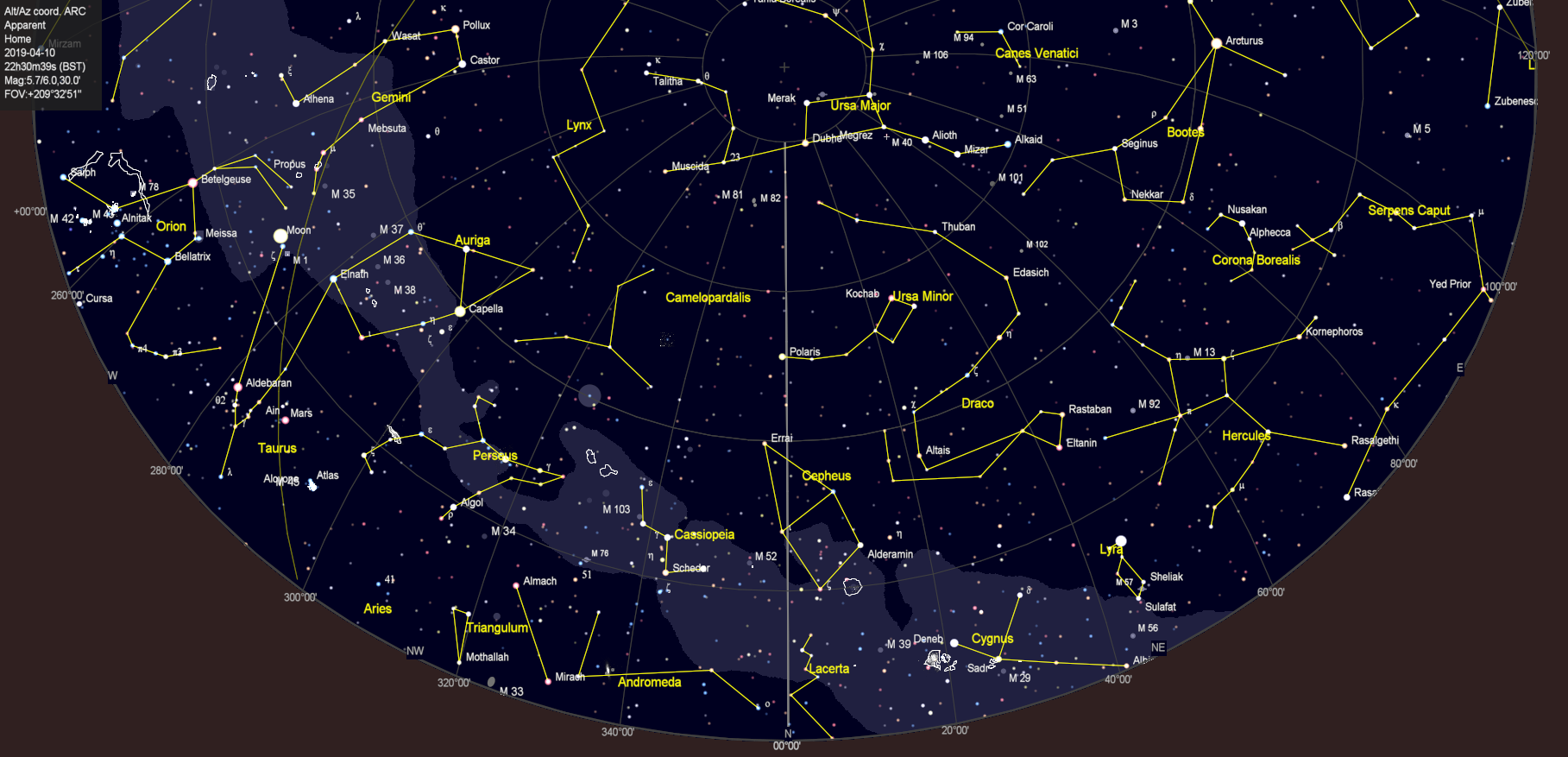
Timing is everything: M51 is in a tricky position seen from Fairvale Observatory, obscured for much of the time at the north viewing location by the house and from the south location by a 20ft hedge – in between there’s a maximum window of no more than 2.5 hours for imaging!

The smaller dimensions of the M51 galaxy would normally place it at the limit of my equipment for imaging but is helped by its aforementioned clear-cut features, strong colours, favourable apparent magnitude and its location towards the zenith immediately above my observatory.  This has long been in my top-10 ‘must-do’ imaging list but hitherto was thought to be out of view.  Unlike M101, which lies below Alkaid i.e. south, being further north the imaging time of M51 from Fairvale Observatory North is even shorter before it too retreats behind the rooftop.  However, this year I decided to move early to the summer location at the bottom of the garden – Fairvale Observatory South – where it was possible to gain a slightly longer view, though still only just over two hours before it disappears for the night, this time behind the adjacent 20-foot hedge!

It’s clear that the final LRGB image would be greatly enhanced with further integration time and the addition of Ha-wavelength but for now I’m content that at last I’ve managed to capture this spectacular object on camera.  Skies permitting I hope to return to the Whirlpool and its companion NGC 5195 as soon as possible.

IMAGING DETAILS
Object M51 The Whirlpool Galaxy & NGC 5951
Constellation Canes Venatici
Distance 23 million light-years
Size 11.2’ x 6.9’  or 43,000 light-years (M51 only)
Apparent Magnitude +8.4
 
Scope  William Optics GT81 + Focal Reducer FL 382mm  f4.72
Mount SW AZ-EQ6 GT + EQASCOM computer control & Cartes du Ciel
Guiding William Optics 50mm guide scope
  + Starlight Xpress Lodestar X2 camera & PHD2 guiding
Camera ZWO1600MM-Cool mono  CMOS sensor
  FOV 2.65o x 2.0o Resolution 2.05”/pix  Max. image size 4,656 x 3,520 pix   
EFW ZWO x8 ZWO LRGB & Ha OIII SII 7nm filters 
Capture & Processing Astro Photography Tool + PHD2 +  Deep Sky Stacker & Photoshop CS3
Image Location              & Orientation Centre  RA 13:30:03      DEC 47:11:43                     

Top  = South  Bottom = North 

Exposures (A)    L 18 x 180 sec  RG 9×180 sec  B 10 x 180                                                        (Total time: 2hr 18 minutes)   
  @ 139 Gain   21  Offset @ -20oC    
Calibration 10 x 180 sec  Darks  20 x 1/4000 sec Bias  10 x  HaLRGB Flats                                        @ ADU 25,000
Location & Darkness Fairvale Observatory – Redhill – Surrey – UK        Typically Bortle 5-6
Date & Time 10th April 2019 @ +22.00h  
Weather Approx. 6oC   RH 60%                  🌙 ¼ waxing

Star Struck


M13 LRGB F2 CROP (Large)

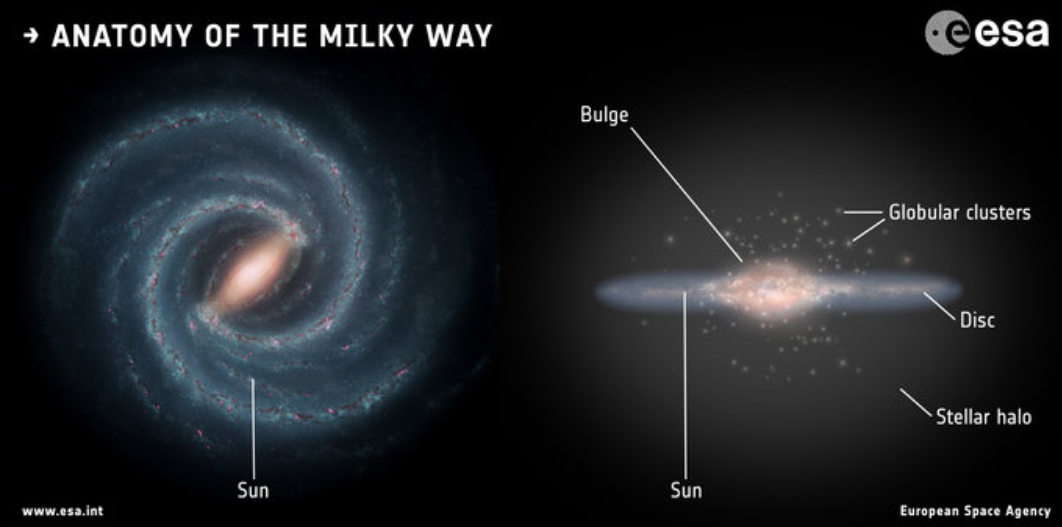
Of all the things I’ve discovered since taking up astronomy, perhaps it is the presence and nature of globular clusters that has most surprised me. Bound closely together by gravity, these massive spherical collections of stars orbit the galactic core perpendicular to its plane.  In the case of the Milky Way there are 150 globular clusters but they can be much larger in other galaxies, such as M87 which has some 13,000; clusters of clusters have also now been discovered in the Universe!  Typically each cluster might contain a few thousand or tens of thousands of stars, although in some cases they can be much larger.  Omega Centauri is the largest globular cluster in the Milky Way, being 150 light-years in diameter it contains 10 million stars; though clearly visible from Earth it can only be viewed from the Southern Hemisphere, which we unfortunately did not see when in New Zealand earlier this year.

MW &amp; globs

Despite all the advances being made in cosmology, the origin of globular clusters still seems to remain quite uncertain.  Characteristically the stars are all very old, typically in the region of 8 to 12-billion years and are of low metallicity i.e. they contain a low proportion of elements other than hydrogen and helium.  At least some, such as Alpha Centauri, are thought to have condensed from dwarf galaxies and such a process may currently be taking place within the large Magellanic Cloud – which we did see in New Zealand!  In other cases it is thought that the clusters have probably originated independently and were subsequently captured by the relevant galaxies.  However, their very old age – sometimes nearly as old as the universe itself – origin and relationship to galaxies remains intriguing.  For these and many other reasons I personally find globular clusters fascinating, probably more than any other astronomical feature, amazing as they too may be.

GlobsX

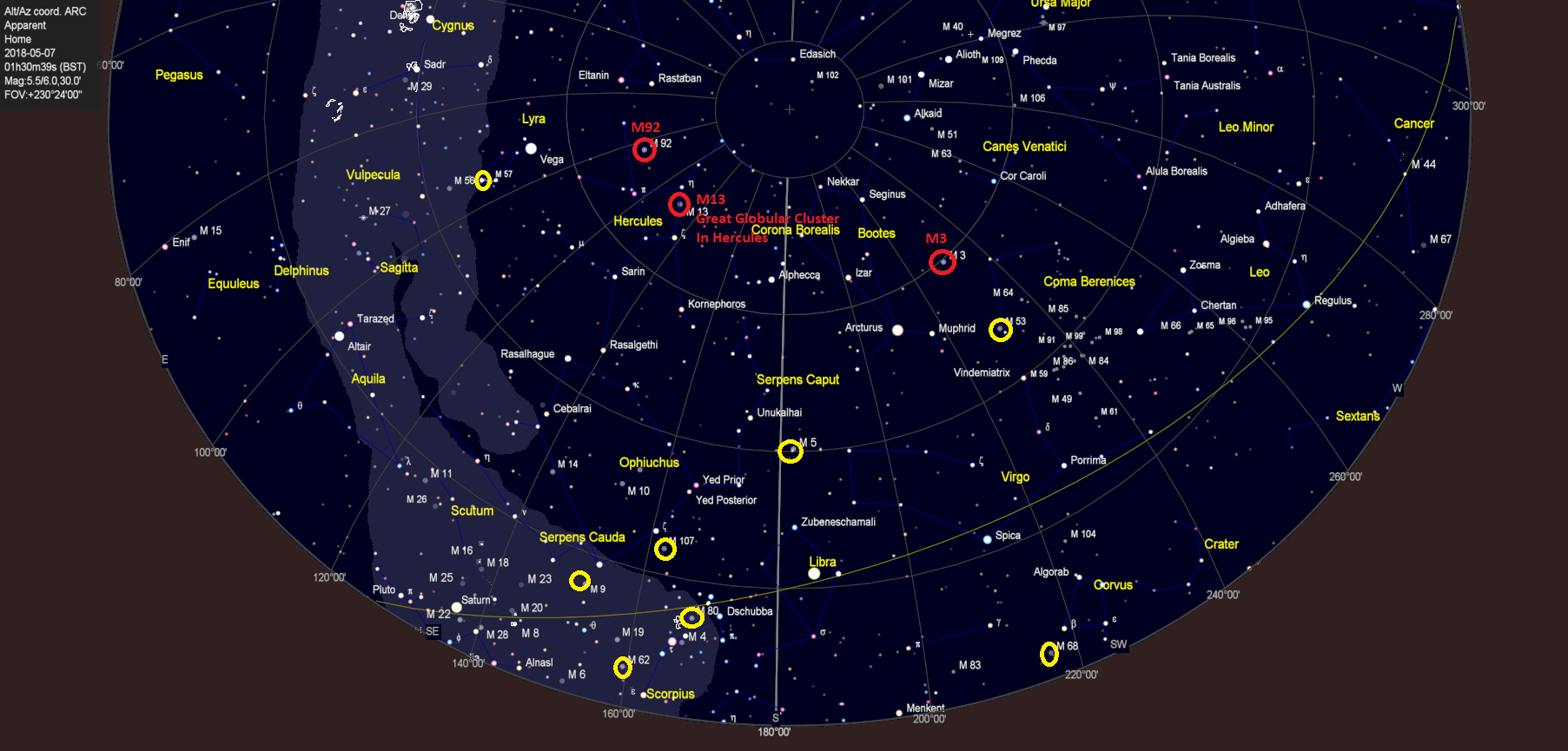
Globular Clusters May 2018: M3, M13 & M92 (red circles) + Others (yellow circles)

From time-to-time I’ve tried imaging various globular clusters but have not been satisfied with the outcome.  Now using guiding, plate solving and the high-resolution ZWO1600MM-Cool camera, it was time to give it another try this spring, when some of the best clusters are present in the northern night sky.

M3 LRGB Final (Large)

First up was M3 (Final image above), the very first Messier Object to be discovered by Charles Messier himself in 1764.  Consisting of 500,000 stars, between 8 and 11-billion years old and spanning some 220 light-years, M3 is one of the largest and brightest (absolute) globular clusters associated with the Milky Way – about 300,000 times brighter than our Sun.  It is noteworthy that the cluster contains some 274 variable stars, the highest number of any clusters, as well as a relatively high number of ‘blue stragglers’ – young main-sequence stars that appear to bluer and more luminous than the other stars in the cluster and are thought to be formed through stellar interaction of the older stars.

M3 LRGB Crop (Large)

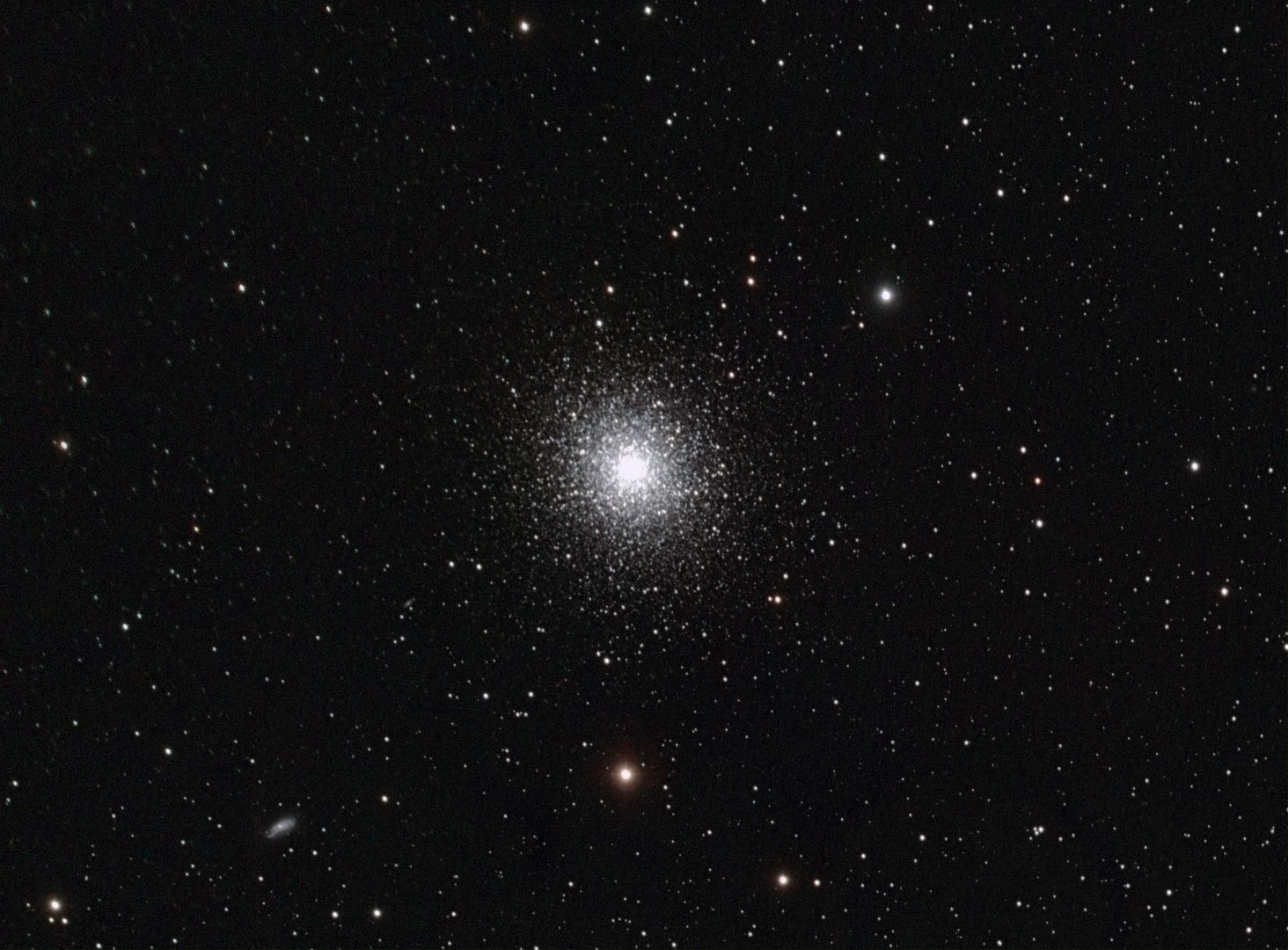
With these attributes it is not surprising that M3 is considered a popular target in astrophotography (cropped image above), likely surpassed however by M13 AKA the Great Globular Cluster in Hercules (cropped image top-of-the-page), which conveniently follows M3 in the same area of the sky about 3-hours later (together with nearby the globular cluster M92).  And so having bagged M3 it was time to turn the telescope and camera towards M13 (Main image below).  Discovered by the eponymous Edmond Hailey in 1716 (he of Hailey’s Comet), seen from Earth M13 is slightly brighter than M3 with a wide range of star colours that certainly makes for an exciting image.  At 11.65 billion years old, M13 has been around almost three times as long as the planet Earth.

M13 LRGB Final (Large)

Since starting astrophotography I like to try my hand at imaging a globular cluster at least once each year but hitherto with disappointing results.  This time I’m pleased with the outcome, especially M13 which is surely one of the most magnificent objects in our night sky; as a bonus there are also a few galaxies in the background of both the M3 and M13 images too.  It is therefore fortunate that for those of us in the higher latitudes of the northern hemisphere the Great Globular Cluster in Hercules can be seen all-year round, though is at its highest and therefore best position between May and September – thereby inaccessible for the Kiwis who are instead compensated by Alpha Centauri!  I expect to be back again next year to marvel at these amazing and enigmatic objects, if not before.

M3 Location Crop

IMAGING DETAILS
Object M3    (NGC 5272)     
Constellation Canes Venatici
Distance 33.9 million light-years
Size 18.0’ or 220 light-years     
Apparent Magnitude +6.2
 
Scope  William Optics GT81 + Focal Reducer FL 382mm  f4.72
Mount SW AZ-EQ6 GT + EQASCOM computer control
Guiding William Optics 50mm guide scope
  + Starlight Xpress Lodestar X2 guide camera & PHD2 control
Camera ZWO1600MM-Cool (mono)   CMOS sensor
  FOV 2.65o x 2.0o Resolution 2.05”/pix  Max. image size 4,656 x 3,520 pix   
EFW ZWO x 8 + ZWO LRGB & Ha- OIII-SII 7nm filters 
Capture & Processing Astro Photography Tool + PS2,  Deep Sky Stacker & Photoshop CS2
Image Location Centre  RA 13:42:23     DEC 28:22:50  
Exposures 24 x 180 sec L + 10×180 sec RGB  (Total time: 162 minutes)   
  Unity @ 139 Gain   21  Offset @ -20oC    
Calibration 10 x 180sec Darks  20 x 1/4000 sec Bias  10 x Flats LRGB  @ ADU 25,000  
Location & Darkness Fairvale Observatory – Redhill – Surrey – UK        Typically Bortle 5
Date & Time 5th + 6th  May 2018 @ +23.00h

M13 Location Crop

IMAGING DETAILS
Object M13     (NGC 6205)
Constellation Hercules
Distance >=20,000 light-years
Size 20’  or 150 light-years
Apparent Magnitude +5.8
 
Scope  William Optics GT81 + Focal Reducer FL 382mm  f4.72
Mount SW AZ-EQ6 GT + EQASCOM computer control
Guiding William Optics 50mm guide scope
  + Starlight Xpress Lodestar X2 guide camera & PHD2 control
Camera ZWO1600MM-Cool (mono)   CMOS sensor
  FOV 2.65o x 2.0o Resolution 2.05”/pix  Max. image size 4,656 x 3,520 pix   
EFW ZWOx8 + ZWO LRGB & Ha OIII SII 7nm filters 
Capture & Processing Astro Photography Tool + PS2,  Deep Sky Stacker & Photoshop CS2
Image Location Centre  RA 12:39:59    DEC -11:37:20  
Exposures 20 x 180 sec L + 15×180 sec RGB  (Total time: 195 minutes)   
  @ Unity 139 Gain   21  Offset @ -20oC  USB 40 
Calibration 10 x 180sec Darks  20 x 1/4000 sec Bias  10 x Flats LRGB  @ ADU 25,000  
Location & Darkness Fairvale Observatory – Redhill – Surrey – UK        Typically Bortle 5
Date & Time 6th + 7th + 9th May 2018 @ +00.30h