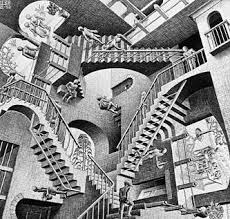
It’s All Relative

escher

I spent the first half of this year reading Walter Isaacson’s biography of Albert Einstein, which apart from providing a fascinating insight into the man and his work, whetted my appetite to understand better the science.  Following previous success studying astronomy courses online, I set out to find a suitable programme to achieve this goal.  As a result I enrolled for Understanding Einstein: the Special Theory of Relativity run by Professor Larry Lagerstrom of Stanford University, USA, which after two months I have just completed.spacetime
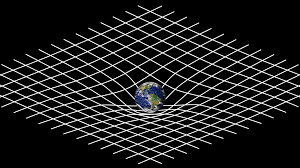
The course is a good mix of qualitative and quantitative information, which at times has been quite challenging but nonetheless proved very worthwhile. The lecturer is very clear and thorough, an essential quality when dealing with this difficult and often bewildering subject.  Einstein’s paper On the Electrodynamics of Moving Bodies outlines the Special Theory and was just one of four published at about the same time in 1905 (“The Miracle Year”) which included: Brownian motion, Mass-energy equivalence (E=Mc2) and The Photoelectric Effect, the latter of which won him the Noble Prize.  At the end I now feel I understand the basics of Einstein’s ground breaking science properly, which apart from being interesting provides valuable insight and understanding of the Universe and related issues of space and time.
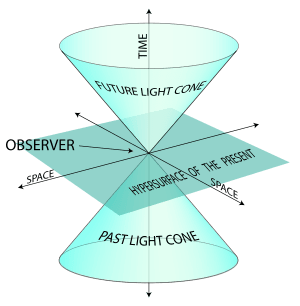
300px-world_line-svg

During this period I have also been thinking about how to improve my astrophotography and the way forwards.  I’ll be on the learning curve for years to come and accept that there’s much I can still improve on using current equipment and processes but after more than 2-years astroimaging, mostly with a DSLR camera, I feel I have reached something of a crossroads and need to change tack in order to achieve more meaningful advances once again.  Inevitably this is likely to mean new equipment and most likely a move to LRGB / Narrowband format.  In the interim, whilst I consider the options, I have also been researching suitable capture / sequencing software, post-processing techniques and programmes.  I am concerned that this will result in another level of complexity but I think it has to be done in order to progress – watch this space.

Continuing a trend that’s been apparent for the past year, clear nights have been something of a rarity since mid-September; this is a concern if I am to pursue astrophotography to the next level.  However, high pressure was unusually dominant over Fairvale Observatory during the last days of November and cold, clear skies have provided good conditions for astronomy at last.
img_20161130_234303293

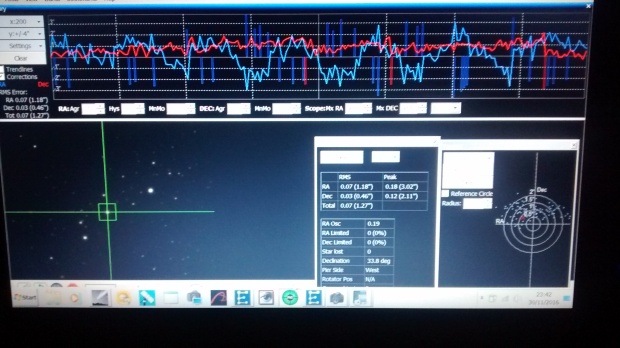
Getting better – PHD2 screen 30th November 2016: DEC is good but room for improvement with the RA settings. The impact on tracking and image quality is noticeable.

Whilst I have certainly not fully mastered guiding I am now routinely using PHD2.  This in itself has probably been the major breakthrough this year, which with the aforementioned clear skies I wanted to take full advantage of.  Hidden within PHD2 I have also discovered and am now starting to experiment with the on-screen drift align routine, with reasonable results; using the gamepad for mount control and a new wireless link with my tablet computer, I can also make focus and alignment adjustments at the mount without returning to the computer each time.

As a result I have dispersed with the SynScan handset for alignment and can now completely set-up and control imaging with the computer and tablet; this is nothing short of a revolution which I am hopeful will greatly increase set-up time as well as improving control and tracking accuracy – yipee!  Even with average guiding results I am now achieving good exposures of 5-minutes or more and therefore decided to put this success to work and re-image some winter wonders over three, yes three, consecutive nights at the end of November.
nov-objects

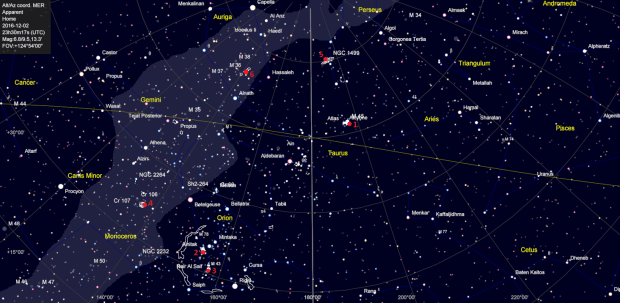
Imaging targets between 28th & 30th of November 2016 – for descriptions & previous images taken of these objects click on the following list of names: (1) M45 Pleiades (2) Barnard 33 The Horsehead Nebula & NGC 2024 Flame Nebula (3) M42 Orion Nebula (4) NGC 2244 Rosette Nebula (5) NGC 1499 California Nebula (6) IC 405 Flaming Star Nebula

The night sky at this time of the year contains many of my favourite objects, but surprisingly I had not imaged some of the chosen targets for more than a year or two and it was both enjoyable and pleasing to reacquaint myself again.  With a new perspective gained from this exercise, the progress I have made with equipment and techniques is more apparent.  Notwithstanding, it’s time to move on – everything’s relative.
Picture saved with settings embedded.

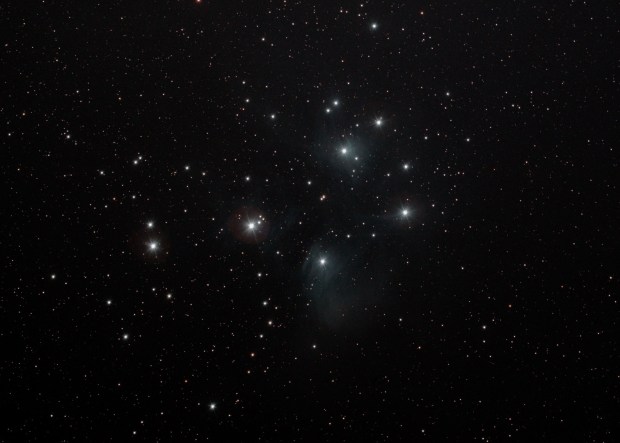
M45 Pleiades, Taurus constellation: 12 x 300 sec @ ISO 800 | 28th November 2016
Picture saved with settings embedded.

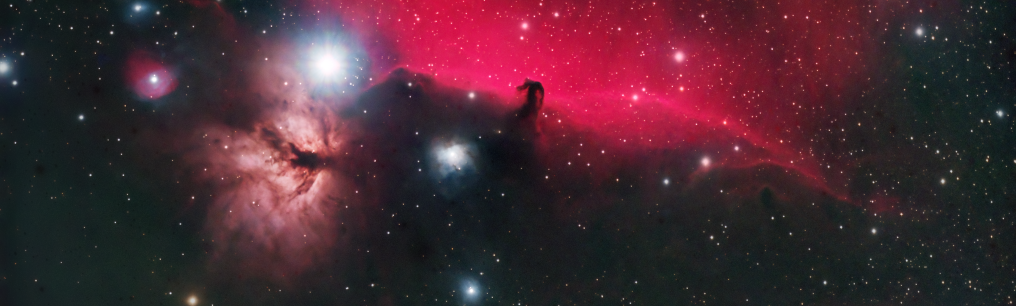
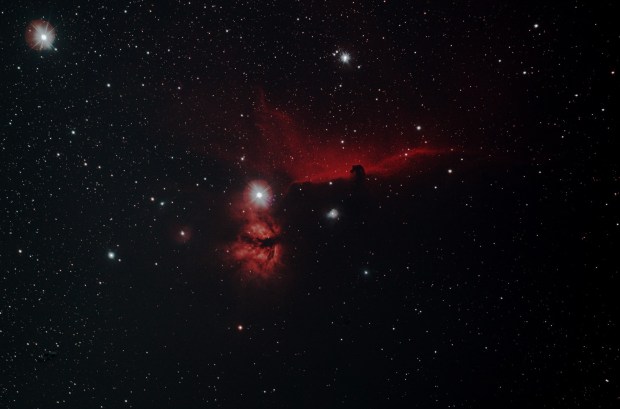
NGC 2014 Flame Nebula & Barnard 33 Horsehead Nebula, Orion constellation: 15 x 300 sec @ ISO 800 | 28th November 2016
Picture saved with settings embedded.

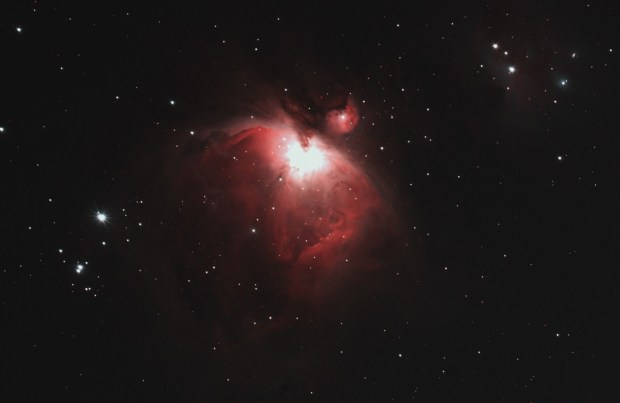
M42 Orion Nebula & M43 De Mairan’s Nebula, Orion constellation: 2 x 300 sec @ ISO 800 | 28th November 2016
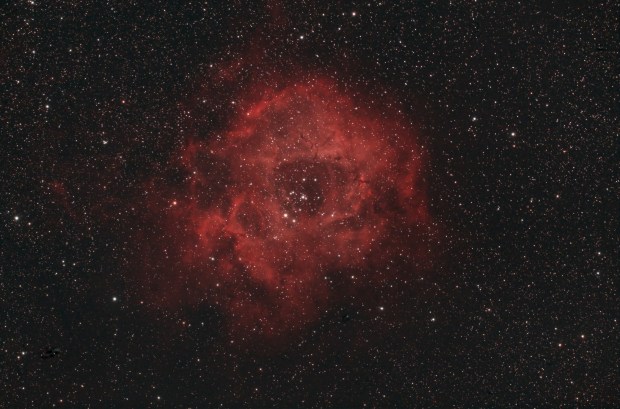
Picture saved with settings embedded.

NGC 2244 Rosette Nebula, Perseus arm of Milky Way, Monoceros region: 21 x 300 sec @ ISO 800 | 29th November 2016
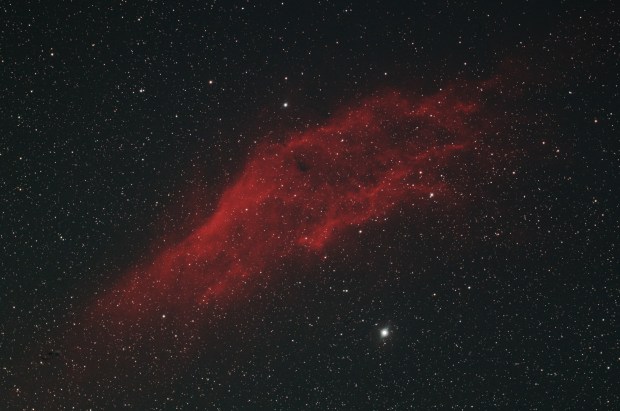
Picture saved with settings embedded.

California Nebula, Perseus constellation: 12 x 300 sec @ ISO 800 | 30th November 2016
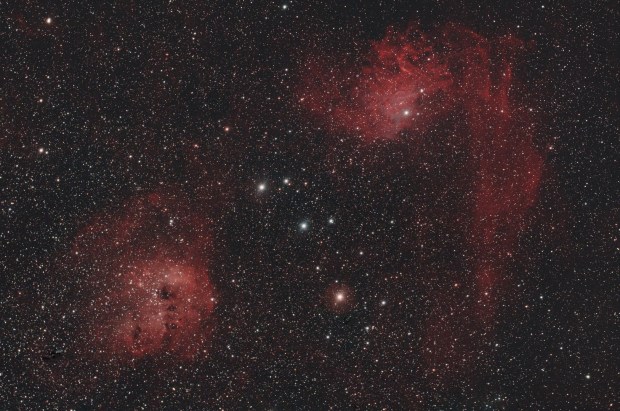
Picture saved with settings embedded.

IC 405 & 410 nebulae: 15 x 300 @ ISO 800 | 30th November 2016

Notes: all images taken using a William Optics GT81 refractor telescope + PHD2 guiding + modded Canon 550D DSLR & x0.80 field flattner @ ISO 800 with full darks + bias + flats calibration and processed in Deep Sky Stacker & Photoshop CS2  

The future is not what it used to be


sftf

If I’m honest my astrophotography has so far often been – never mind the quality feel the width!  That is to say, I have tended to chase objects – nebulae, galaxies, planets, solar – in order to learn about my equipment and the night sky as well as just have fun recording images of these distant worlds.  Nothing wrong with that is there?  It’s not that I don’t aspire to obtaining the best image possible and I have made good progress since starting out but I’ve often felt constrained by circumstances.

Although I’ve generally been happy with my images, it’s a fact that there are a number of factors that altogether make astrophotography difficult, especially here at Fairvale Observatory:

  • Poor weather & persistent cloud cover
  • The Moon
  • Buildings & trees obscure sightlines
  • Light pollution from Gatwick airport
  • Numerous aircraft passing overhead
  • Equipment problems
  • Software problems
  • Equipment and software failures
  • Equipment limitations
  • Need to assemble equipment each time
sky-mosaic

Bad weather, frequent cloud cover, limited sightlines, aircraft trails and the inevitable monthly occurrence of the Moon limit imaging opportunities here.

Under these circumstances I usually need to grab what I can, frankly it’s a miracle I’m able to achieve anything sometimes; Met office statistics for the six-months period from September 2105 showed cloud cover was a record 68% compared with an historical average of 32% for that time of year, as a result it was unusual to be able to undertake astrophotography more than once month, if that!  Wherever possible I therefore have to target those items that I can improve easily, quickly and cheaply dealt with, which is mostly equipment.  Buoyed by renewed enthusiasm from my recent autoguiding success, I now intend to concentrate on changing some key items that I hope will eventually bring about more noticeable improvements.

sign2For a while I have been thinking about getting a larger telescope, in order to get to those faint fuzzies that are beyond the capabilities of the otherwise excellent William Optics GT81.  As usual the choice is a minefield of possibilities, each with inevitable imaging pros and cons!  I started thinking about a Ritchey Chrétien or Schmidt Cassegrain but I have really appreciated the qualities of the aforementioned WO GT81 and am now erring towards a larger refractor.  However, after further consideration I am now considering a change of priorities.
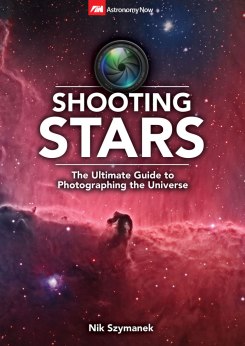
In September I was fortunate to attend a presentation on image processing by Nik Szymanek who, it has to be said, really knows his onions when it comes to astrophotography; I was intrigued and impressed to find out he also hails from my neck of the woods when I was a teenager in Essex and is an accomplished rock drummer – something I also used to meddle with in the past – what a geezer, as he would say.  The talk was very instructive and I am now ploughing my way through Nik’s fabulous book on the subject called Shooting Stars (published in magazine form by Astronomy Now).  Such personal, first-hand and relevant guidance is difficult to find in astroimaging and the book has a wealth of really practical information and useful advice that I wished I’d known sooner.  Good equipment is important but in the world of digital imaging the significance of processing cannot be overstated.  It’s a dark art alright (no pun intended) but Nik’s work has strengthened my resolve to improve my processing knowledge and I’m even more determined to raise the bar during the forthcoming winter.

20160708-shooting-stars-for-storeFollowing Nik’s talk and listening to others, the penny that has now dropped is that for the moment it’s not the telescope but the camera that needs changing.  After careful thought it’s apparent that I already have very good set-up, yes a bigger aperture would be good for those smaller fuzzies but the 81mm apochromatic refractor I already own is an outstanding telescope that still has much potential when combined with the AZ-EQ6 mount and now autoguiding.
99bc97fcafac09f14ac69801dab00398

The addition of a modded DSLR at the beginning of last year had a significant impact on my images, especially with Ha dominant DSOs which I literally saw in a new light using this camera.  I have continued with the DSLR for a number of reasons but mainly because I am familiar with such cameras which are relatively easy to use and produce reasonable results when starting out with astrophotography.  However, listening to Nik and reading the forums and elsewhere, I have come to accept that the best way forwards should now be a CCD-type camera.  As a result I am deep in my research of CCD issues and possible cameras – this could take some time and won’t be cheap!

The operation of CCDs is quite different to a DSLR and I’m sure will involve a whole new period of pain but it’s clear that this is the best route for now if I am to significantly improve my astrophotography.  Other than the technical challenges CCD imaging presents, I am however concerned about the greater number of frames needed for LRGB + calibration and how that’s going to work with the weather restrictions and other problems I have but it’s got to be worth a try.

However, before setting out on this daunting task I first slewed the camera towards a few familiar objects just to experiment with guiding and assess the benefits it might bring to my imaging in the interim.  A spell of unusually good weather in late August – early September was too good to miss and with guiding I was able to achieve exposures of up to 8 minutes.  However, for the moment I continued to limit the number of Subs and calibration frames just to ensure I could shoot more objects in the available time, plus you never know when the next bank of cloud will roll in – old habits die hard!

download

Looking at the results below demonstrates my progress when compared with earlier images but the limited number of frames and calibration has probably restricted the full benefit of what might be gained from guiding and some shots remains quite noisy. Nonetheless, I now have high hopes that the potential is within my grasp to make real progress in achieving better image quality.  I am not convinced I have yet reached a turning point but I am well positioned to navigate the tasks required to get there, which are now more clearly understood and in my sights or should that be RDF – watch this space!

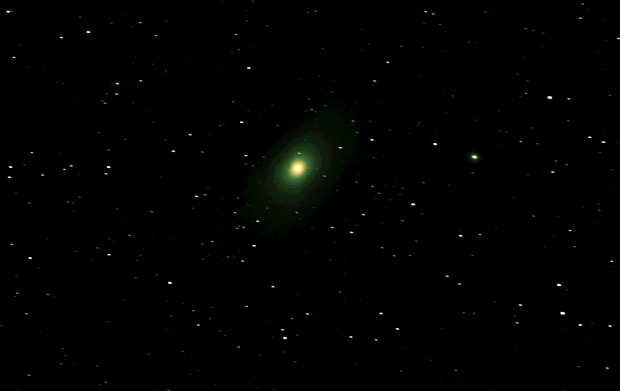
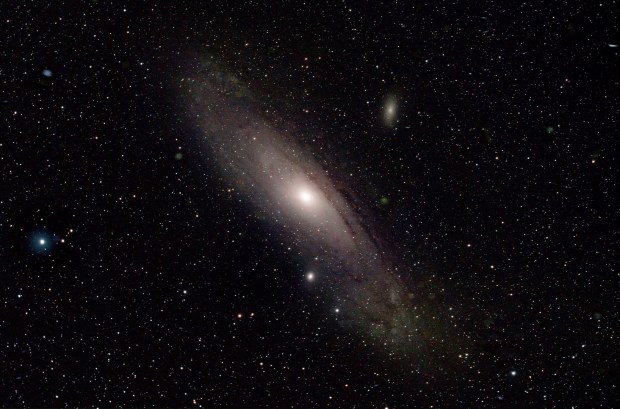
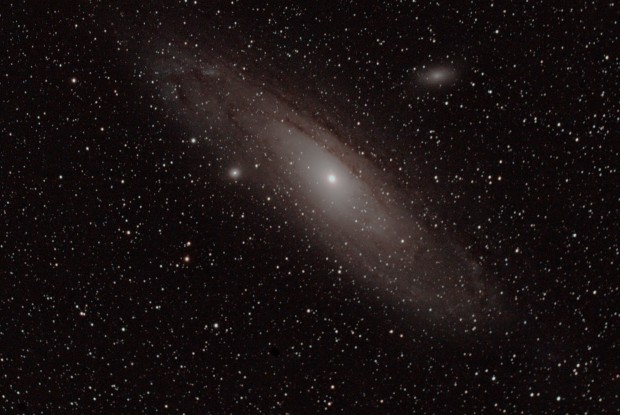
M31 Andromeda Galaxy

M31 DSS2 30 sec ISO800 170814crop

WO GT81 + unmodded Canon 700D & FF| 10 x 30 secs & ISO 800 | August 2014

Picture saved with settings embedded.

WO GT 81 + modded Canon 550D + FF | 9 x 120 secs @ ISO 1,600 | 19th September 2015

Picture saved with settings embedded.

WO GT81 + modded Canon 550D & FF & PHD guiding | 10 x 300 secs @ ISO 1,600 calibration | 8th September 2016

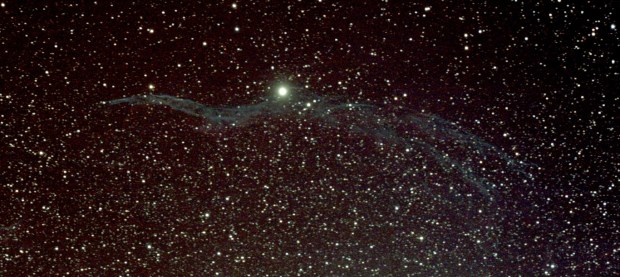
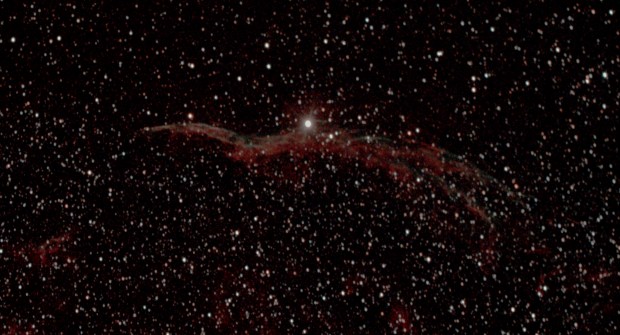
NGC 6905 Western Veil Nebula – The Witch’s Broom

NGC 6960multiplelevelsonecontrast FINAL(Medium)

Canon 700D | 20×90 sec + darks.bias/ flats @ ISO 800

Picture saved with settings embedded.

WO GT81 + modded Canon 550D + FF & PHD guiding | 5 x 300 secs @ ISO 1,600 & calibration | 8th September 2016

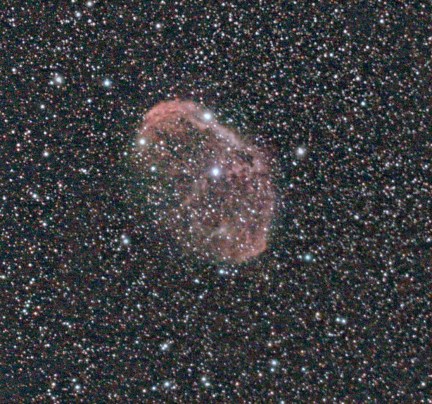
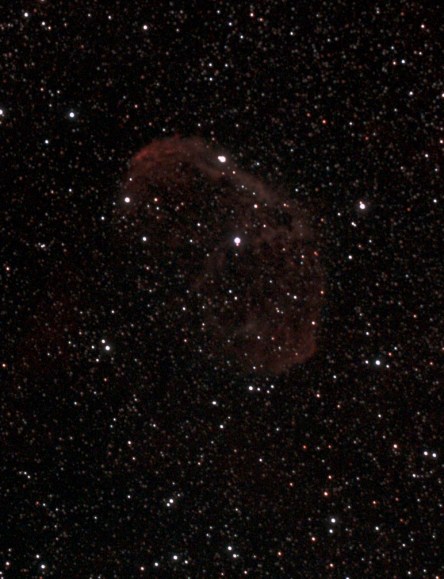
NGC 6888 Crescent Nebula

Picture saved with settings embedded.

WO GT81 + modded Canon 550D + FF | 19th October 2015

Picture saved with settings embedded.

WO GT81 modded Canon 550D + FF & guiding | 10 x 300 secs @ ISO 1,600 & calibration | 11th September 2016

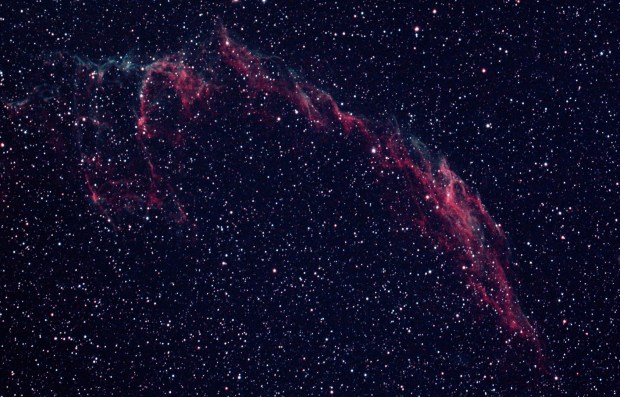
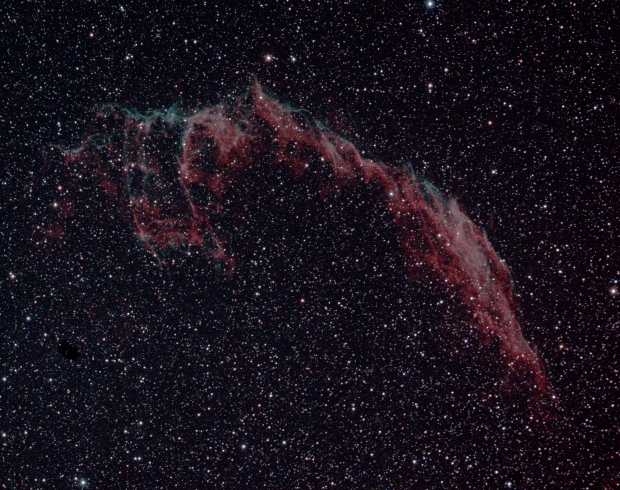
NGC 6992 Eastern Veil & Bat Nebula

NGC 6995 Stacked1-22 (Large)

Eastern Veil Nebula – NGC 6992 (right) & NGC 6995 (left). WO GT81 + Canon 700D & FF | 29 x 120 secs + darks/bias?flats @ ISO 1,600

Picture saved with settings embedded.

Eastern Veil Nebula (NGC 6922 & 6995): WO GT81 & modded Canon 550D + FF & guiding | 10 x 300 sec @ ISO 1,600 + darks | 11th September 2016