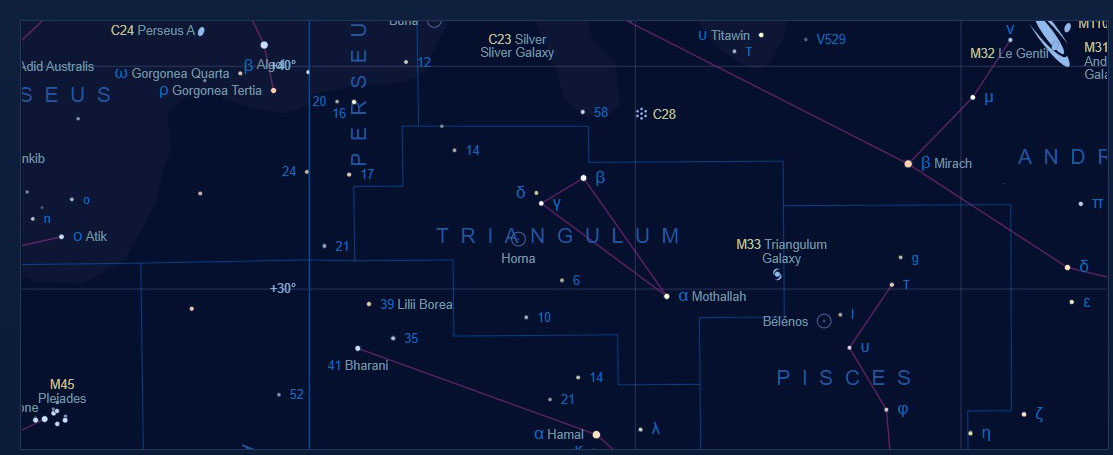
After successfully imaging M31 the Andromeda galaxy at new moon in early October, I was lucky that the next moon cycle in early November also provided good conditions and it seemed appropriate to just shift attention to Andromeda’s closest neighbour, which at this time of the year occupies a favourable part of the eastern sky in the early evening. Only 15o from M31, M33 AKA the Triangulum Galaxy is the third-largest member of the Local Group of galaxies after Andromeda and the Milky Way. Although very faint, in very good dark night sky conditions M33 can apparently be viewed with the naked eye. Along with our own Milky Way, this group travels together in the universe, as they are gravitationally bound.
Andromeda is eight times brighter and nearly four times larger than Triangulum, which for various reasons I have previously found difficult to image, despite its relative proximity to us. On this occasion I was therefore very pleased to obtain a good data set over three nights that included 3-hours of 10-minute Ha exposures. The result is definitely my best image yet of this tricky but attractive target, which in particular highlights the numerous red star-forming regions that abound throughout the galaxy’s arms. I’ll almost certainly be back again another day but for now I am at last satisfied with the result.
IMAGING DETAILS
Object
M33 Triangulum Galaxy
Constellation
Triangulum
Distance
Approx. 2.7 million light-years
Size
71’ x 42’ ~ 60,000 light-years
Apparent Magnitude
+5.72
Scope
William Optics GT81 + Focal Reducer FL 382mm f4.72
Mount
SW AZ-EQ6 GT + EQASCOM computer control
Guiding
William Optics 50mm guide scope
+ Starlight Xpress Lodestar X2 guide camera & PHD2 control
Camera
ZWO1600MM-Cool (mono) CMOS sensor
FOV 2.65o x 2.0o Resolution 2.05”/pix Max. image size 4,656 x 3,520 pix
EFW
ZWO x8 EFW & 31mm LRGB + 3nm Ha Chroma filters
Capture & Processing
Astro Photography Tool, Deep Sky Stacker, PixInsight v 1.8.8-9, Photoshop CS3, Topaz Ai Denosie
Image Location & Orientation
Centre: RA 01:33:53.6 DEC 30:39:18.9 Top = North Right = West
Exposures
15 x 300 sec LRGB + 18 x 600 sec Ha Total time: 8 hours
@ 139 Gain 21 Offset @ -20oC
Calibration
5 x 300 sec & 5 x 600 sec Darks + 15 x LRGBHa Flats & Dark Flats @ ADU 25,000
Location & Darkness
Fairvale Observatory – Redhill – Surrey – UK Typically Bortle 5
A year after taking up astronomy as a hobby, at the behest of my elder daughter I started this blog in 2014. Describing the objective and content of the blog I adopted the strapline “A personal discovery of the Universe through astronomy and astrophotography”, which could also be described as a journey. In reality it’s been an adventure consisting of two threads: the knowledge and related science of astronomy and the challenge of astrophotography. As we on Earth pass through space whilst at the same time rotating 360o each year around the sun our view of the night sky changes month-by-month, inevitably returning to the same perspective each 365-days. Against this background I therefore often return to certain objects every few years hopefully armed with new astrophotography skills in pursuit of an even better image.
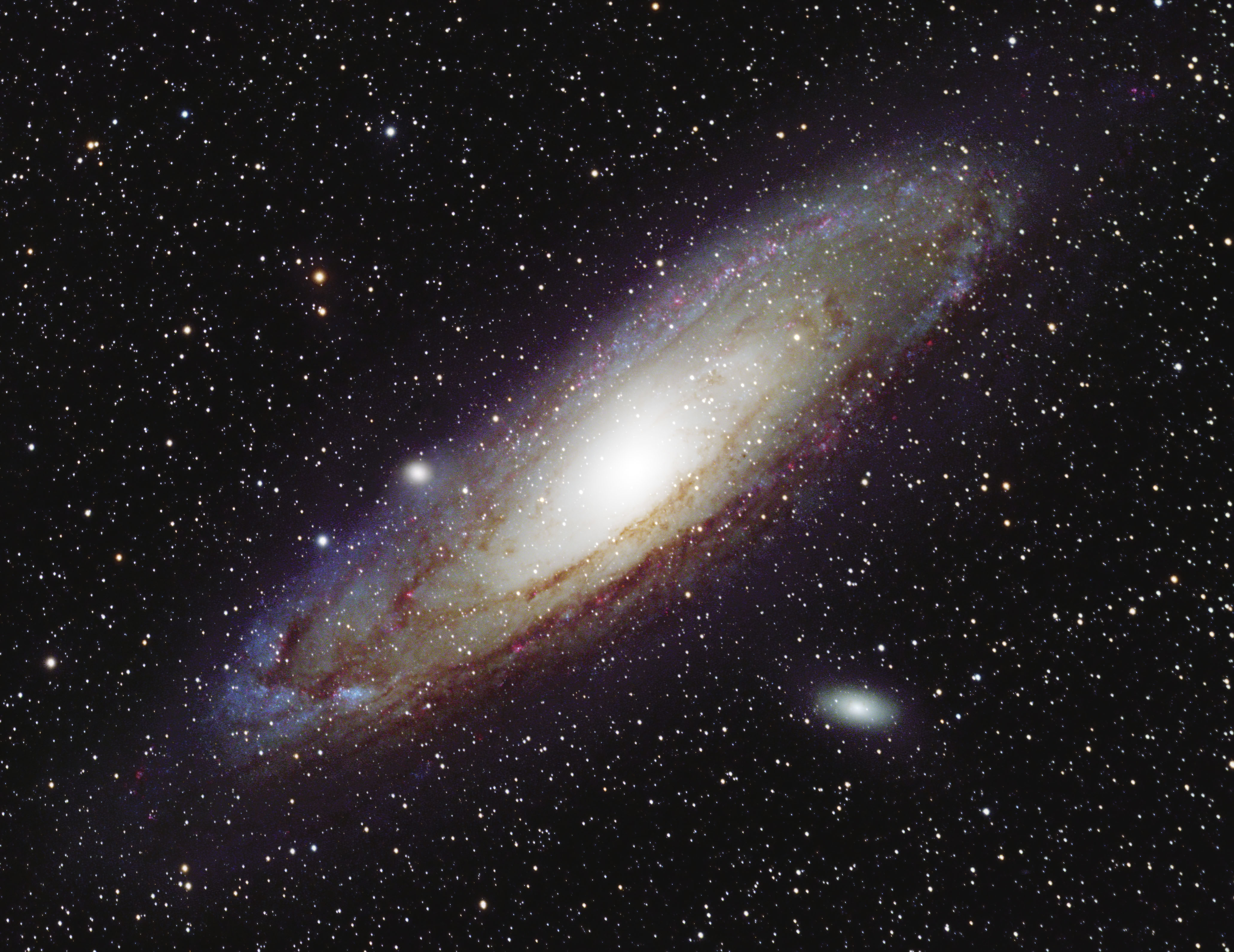
Following such a path I’ve already imaged M31 the Andromeda Galaxy on four separate occasions since 2015, each time enthralled by the majesty and beauty of this barred spiral galaxy. Notwithstanding, it was clear to me that there was significant scope for improvement of the previous images with both better data and processing. Since the last attempt in October 2019 a myriad of positive developments have taken place of which perhaps three stand out: multi-star guiding, the purchase of Chroma filters and in particular the use of PixInsight image for processing – all have been game changers, so much so that reprocessing that image now also looks good – see below.
However, whilst the said progress has already been transformative to my astrophotography during the past year, inevitabky it is imaging conditions that play the most critical role, especially in England. Fortunately during this autumn in both October and November for once the new moon coincided with clear skies, providing no less than six nights over which I was able to obtain almost 12-hours of some of perhaps my best ever data. Based on this I’ve been careful to apply my best new processing skills and am thankful that the final HaLRGB image has turned out very well. In particular, the dust lanes stand out against the bright core and surrounding blue intergalactic dust and gases, which are themselves punctuated by the bright red regions rich in Ha light.
In the blogs that accompanied previous Andromeda images I’ve often referred to the galaxy as a neighbour of the Milky Way but really we are part of the same family known as the Local Group. Some 10-million light years in diameter, more than 30 galaxies form two collections around the two largest galaxies of Andromeda and the Milky Way. Gravitational forces play the central role in controlling this group, especially Andromeda which is itself moving towards the Milky Way at about 70 miles per second and is destined to merge in about +/- 4 billion years; recent studies indicate that an outer halo of stars extending up to 2-billion light years from Andromeda may be in the influence of the galaxy, suggesting this event may already have started!
Thereby my personal journey of astrophotography is set to continue somewhat in parallel with that of Andromeda, which will I am sure lead to further hopefully even better images of this exciting deep sky object that is perfect for my equipment – after all we’re getting closer at the rate of 2,207,520,000 miles each year!
IMAGING DETAILS
Object
M31 the Andromeda Galaxy.
Constellation
Andromeda
Distance
2.5 million light-years
Size
3.2o x 1o or 220,000 light-years
Apparent Magnitude
+3.44
Scope
William Optics GT81 + Focal Reducer FL 382mm f4.72
Mount
SW AZ-EQ6 GT + EQASCOM computer control & Cartes du Ciel
Guiding
William Optics 50mm guide scope
+ Starlight Xpress Lodestar X2 guide camera & PHD2 guiding
Camera
ZWO1600M M-Cool mono CMOS sensor
FOV 2.65o x 2.0o Resolution 2.05”/pix Max. image size 4,656 x 3,520 pix
A very large emission nebula, the so-called Elephant’s Trunk Nebula in the Cepheus constellation is rightly one of astrophotography’s most iconic images. Unfortunately my house obscures northern views of the sky from the main observatory and I’ve therefore only imaged this once before in 2018 with some success but definite room for improvement. However, using a Takahashi FSQ 106 located at the DSW observatory in New Mexico, USA during Q3 there were no such constraints, which has resulted in a 29.5 hour data set that forms the foundation of this exciting HaSHO image.
SH2-131 consists of glowing gases illuminated by an open star cluster, which is divided by lanes of dark interstellar dust clouds. The ‘trunk’ itself, designated IC 1396A, dominates the centre of this image and is spectacularly illuminated from behind by a bright star forming region; a longer focal length combined with the QSI camera and 30% crop has produced much closer view than previoulsy in 2018. Together with the Cave Nebula, Fyling Bat and Giant Squid Nebula, the dark nebula LDN-1250 and now the Elephant Trunk Nebula, Cepheus, has proved a very productive area for me this year.
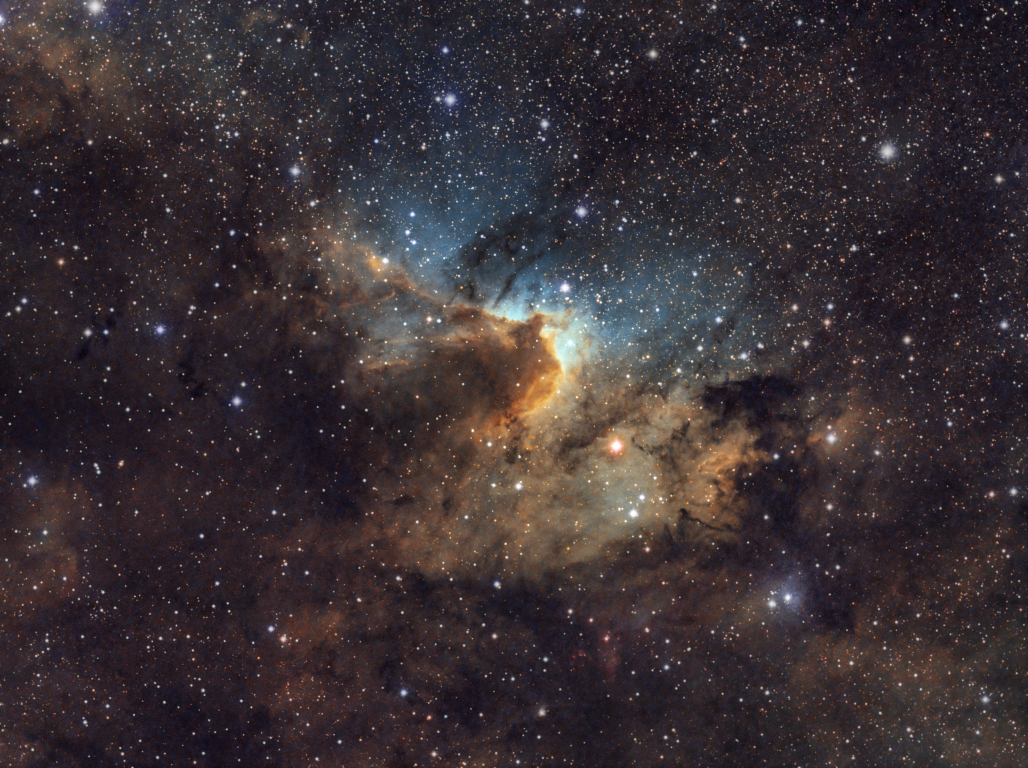
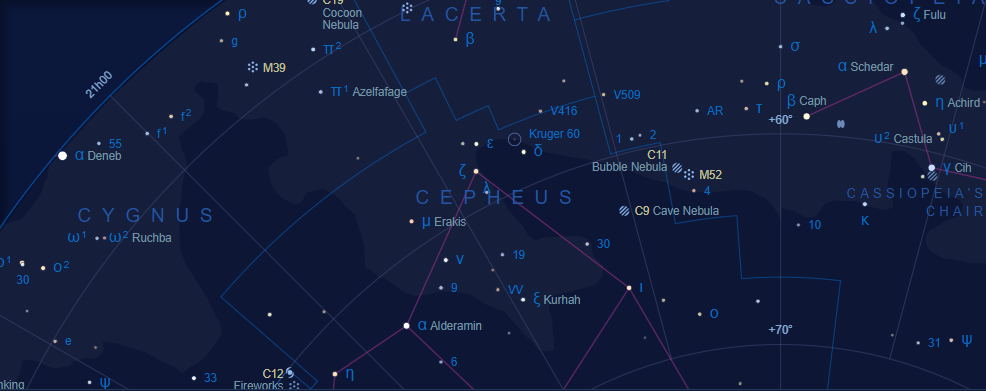
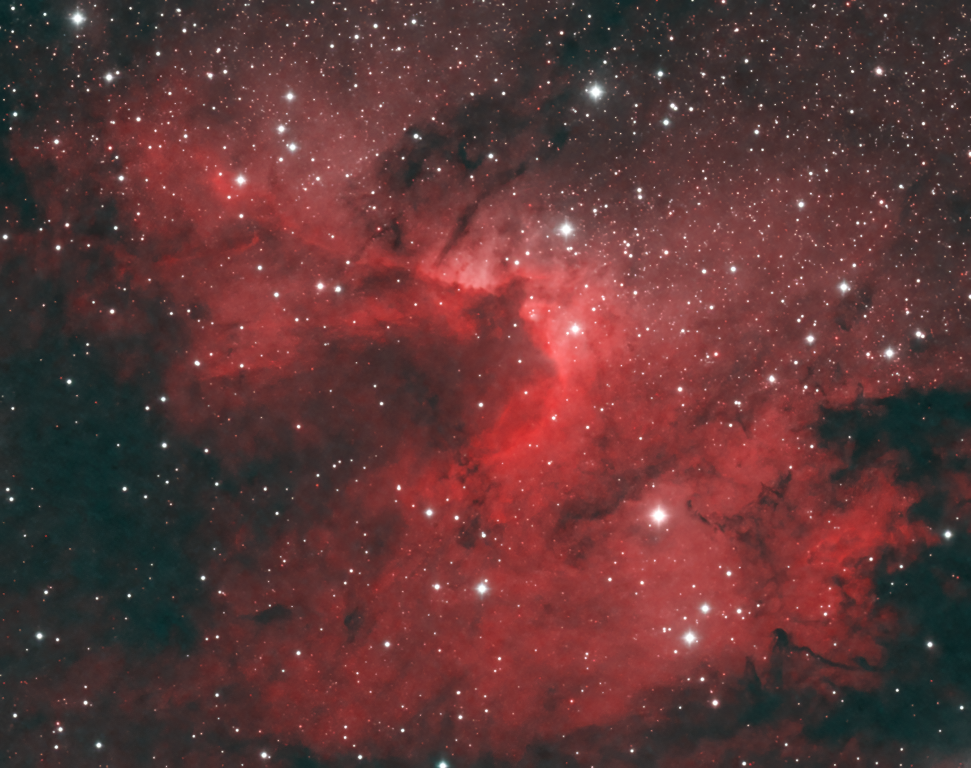
Located along the plane of the Milky Way in the Cepheus constellation is the diffuse emission nebula Sh2-155, commonly referred to as the Cave Nebula. This widefield view shows the so-called Cave at centre of the image, critically located at the boundary of the massive Cepheus molecular cloud and the hot, young stars of the Cepheus OB-3 association which ionize the surrounding gases to great effect.
Location of the Cave Nebula
Overall the features are very faint and even with a total integration time of nearly 40-hours for the full data-set the Cave is difficult to capture and process using the Hubble SHO palette but nonetheless has resulted in a striking final image (see top-of-the-page). An alternative bicolour HOO cropped version (see below) perhaps shows the details of Cave itself better?
IMAGING DETAILS
Object
SH2-155 Cave Nebula AKA Caldwell 9
Constellation
Cepheus
Distance
2,400 light-years
Size
50 x 30 arc minutes ~70.0 light-years; Cave Nebula ~10.0 light- years
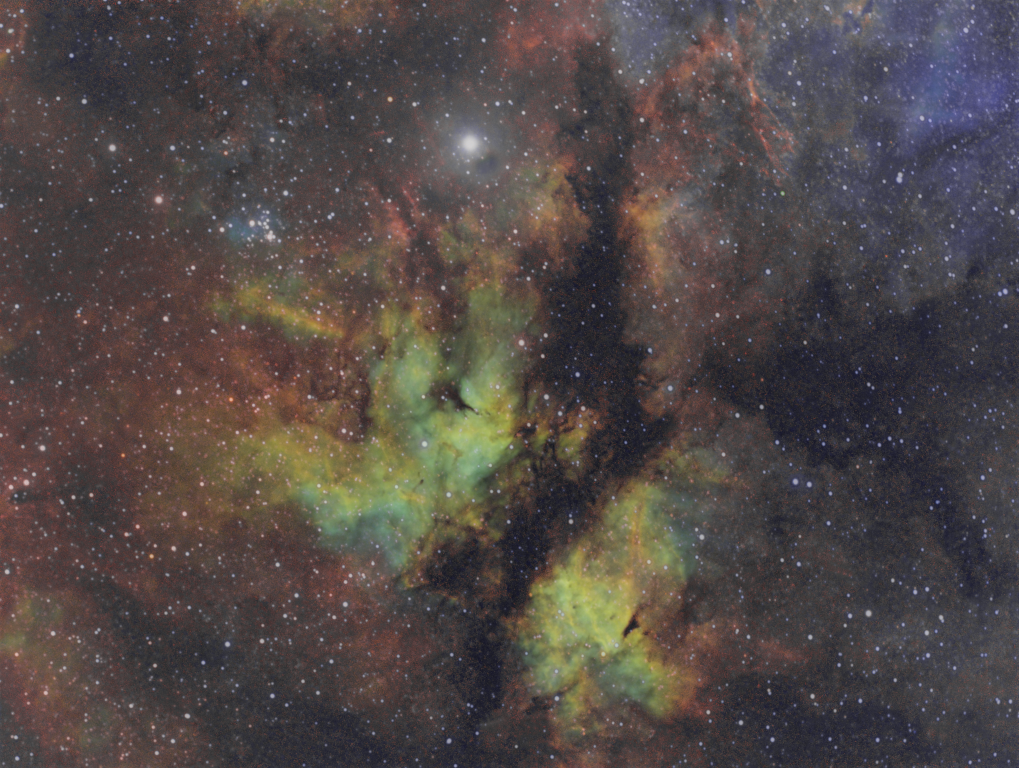
Located within the Orion Arm of the Milky Way galaxy is the Gamma Cygni nebula, a diffuse emission nebula that surrounds the star of the same name, otherwise better known as Sadr. Moreover, this large area forms part of an even bigger HII-region that is mainly (80%) located in the north and east quadrants of the so-called Cygnus Cross, which is defined by the stars Deneb – Sadr – Delta Cygni – Albireo – Aljanah (see below).
This vast area passes directly high overhead at this time the year before disappearing behind the house roofline in the early morning hours and has already provided many exciting imaging opportunities for me in the past. The heart (not the centre) of the region is the supergiant star Sadr and I first imaged this area in autumn 2015 using my modded DSLR camera. A return visit was therefore long overdue and this time I set out to better capture the so-called Butterfly Nebula in narrowband wavelengths.
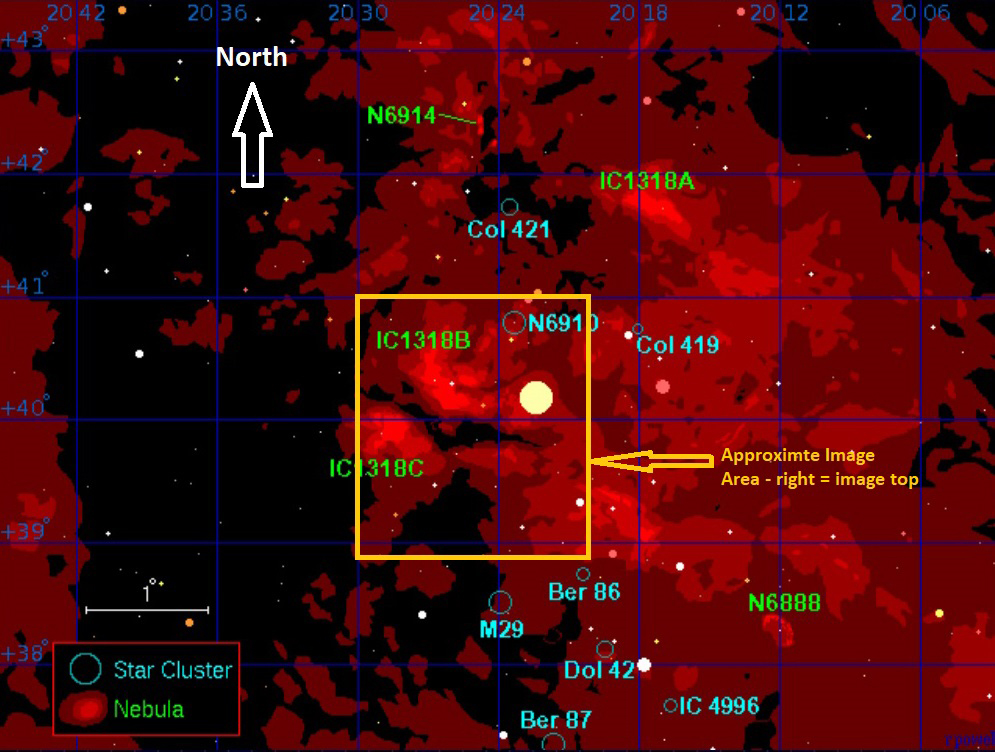
The resulting data has been processed to good effect as an SHO image (see top-of-the-page) using the Hubble Palette techniques. Other than the dominant supergiant star Sadr and widespread colourful nebulosity, two significant features are worthy of note in the final image. Either side of the almost central dark rift that divides the image laterally, are two large bright areas which together form the ‘wings’ of the so-called Butterfly Nebula IC 1318-C (right = south) and IC 1318-B (left = north). Furthermore, just beyond the Butterfly’s left wing north of Sadr is the young, bright open star cluster NGC 6910.
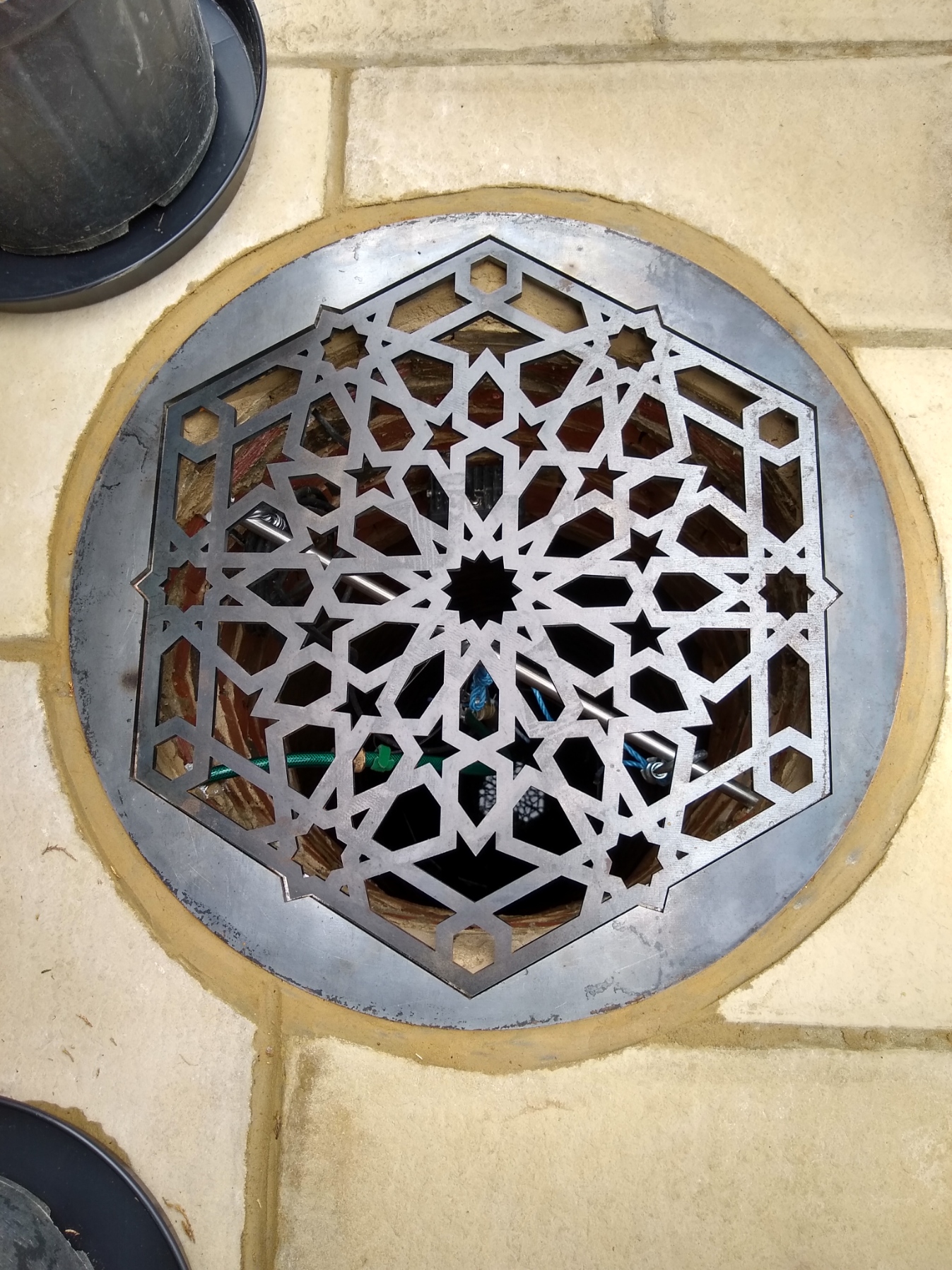
Finished well with submersible water pump & floodlight (turned off for astronomy!)
I’m very pleased with this image, which is my first since the end of March, in part because nowadays I take an astronomy break during the long late spring / summer days when astronomical darkness is largely absent. However, this year the pause has been protracted as the patio on which Fairvale Observatory is situated was re-laid, during which a hitherto unknown water well was discovered. Thereafter one thing led to another and turned into a summer project to recommission the well, thus delaying completion of the patio. As a result I’ve only recently been able to reinstate the astronomy equipment, a job that is still ongoing. The new patio is firm and flat, providing a much better surface for the mount than before and I’m hopeful that once recalibration is completed will result in improved tracking results – watch this space!
IMAGING DETAILS
Object
IC1318-B & IC1318-C Gamma Cygni Nebula or Butterfly Nebula NGC 6910 Open cluster
Constellation
Cygnus
Distance
3,700 light-years
Size
1Approximately 100 light-years
Apparent Magnitude
Varies
Scope
William Optics GT81 + Focal Reducer FL 382mm f4.72
Mount
SW AZ-EQ6 GT + EQASCOM computer control & Cartes du Ciel
Guiding
William Optics 50mm guide scope
+ Starlight Xpress Lodestar X2 camera & PHD2 guiding
Camera
ZWO1600MM-Cool mono CMOS sensor
FOV 2.65o x 2.0o Resolution 2.05”/pix Max. image size 4,656 x 3,520 pix
Somewhat tongue-in cheek, astrophotography is often referred to as something of a dark art and to be fair it sometimes seems that way, particularly when it comes to processing. My main interests in astrophotography are Deep Sky Objects such as emission nebulae, galaxies and planetary nebula but have long aspired to capture a more elusive category that abounds throughout the Universe – dark nebula.
Popular with astrophotographers, emission nebulae consist of vast clouds of ionised gases and regions of interstellar dust which reflect light from the said gases and or from stars and stellar nurseries that lie within – depending on their make-up the results are colourful in both broadband and narrowband wavelengths. Dark or absorption nebulae are also a type of interstellar cloud but are so dense they completely obscure and / or soak-up visible light emitted from objects behind or within, which as a result contrasts with general light flux of the Universe forming large dark regions. Because of their darkness they are usually faint, hard to see and moreover, difficult to image, especially from locations with light pollution.
The Horsehead Nebula is a dark nebula that has formed a part of my previous images but I’ve only imaged an isolated dark nebula once before – Barnard 142-3, which for obvious reasons is also known as the E-nebula (see above & here). Larger more complex dark nebulae require much darker skies to image than prevail at Fairvale Observatory, such as in New Mexico, USA where the Deep Sky West observatory is located and on this occasion has produced my first ‘serious’ image of a stand-alone dark nebula.
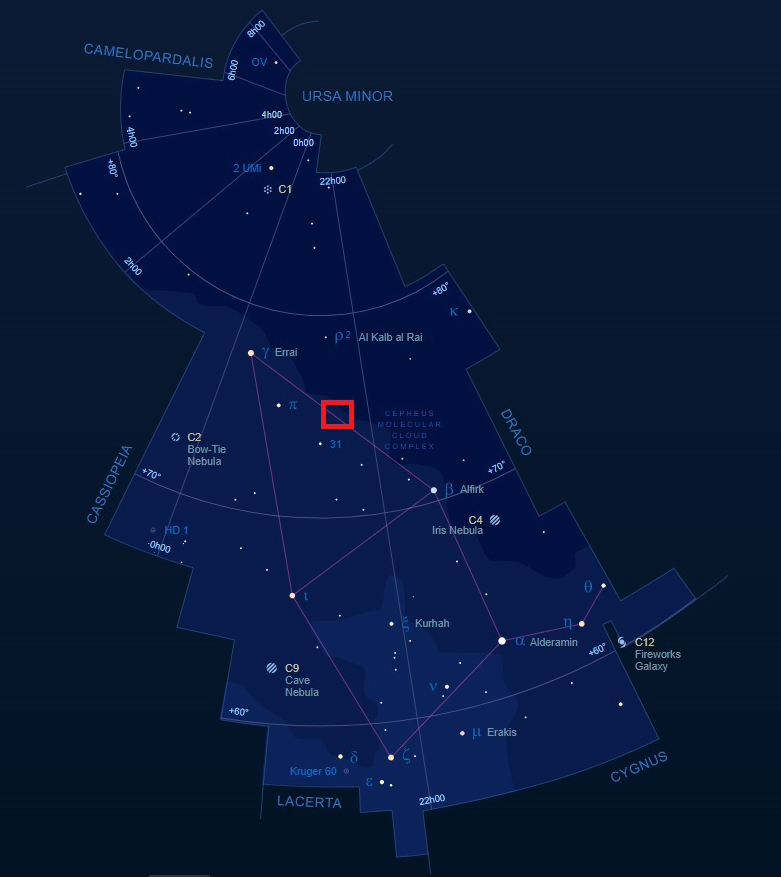
Cepheus & the aproximate location of LDN 1250 image indicated by the red square
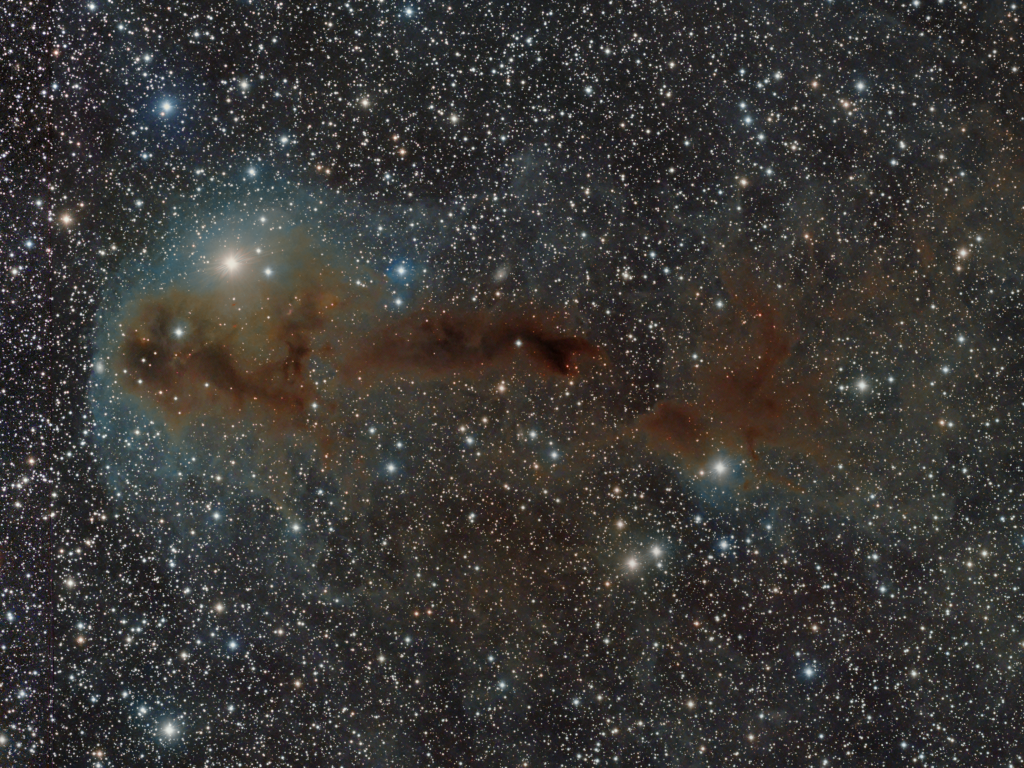
Lynds Dark Nebula (LDN) catalogue of dark nebulae was compiled by the eponymous Beverly T. Lynds in 1962 and is based on the study of red and blue photographic prints from the National Geographic-Palomar Observatory Sky Atlas. Situated in the north close to Polaris, the constellation of Cepheus has a number of dark nebulae, of which LDN 1250 is part of a huge complex of dark nebula surrounded by dust and scattered light from the stars of Cepheus.
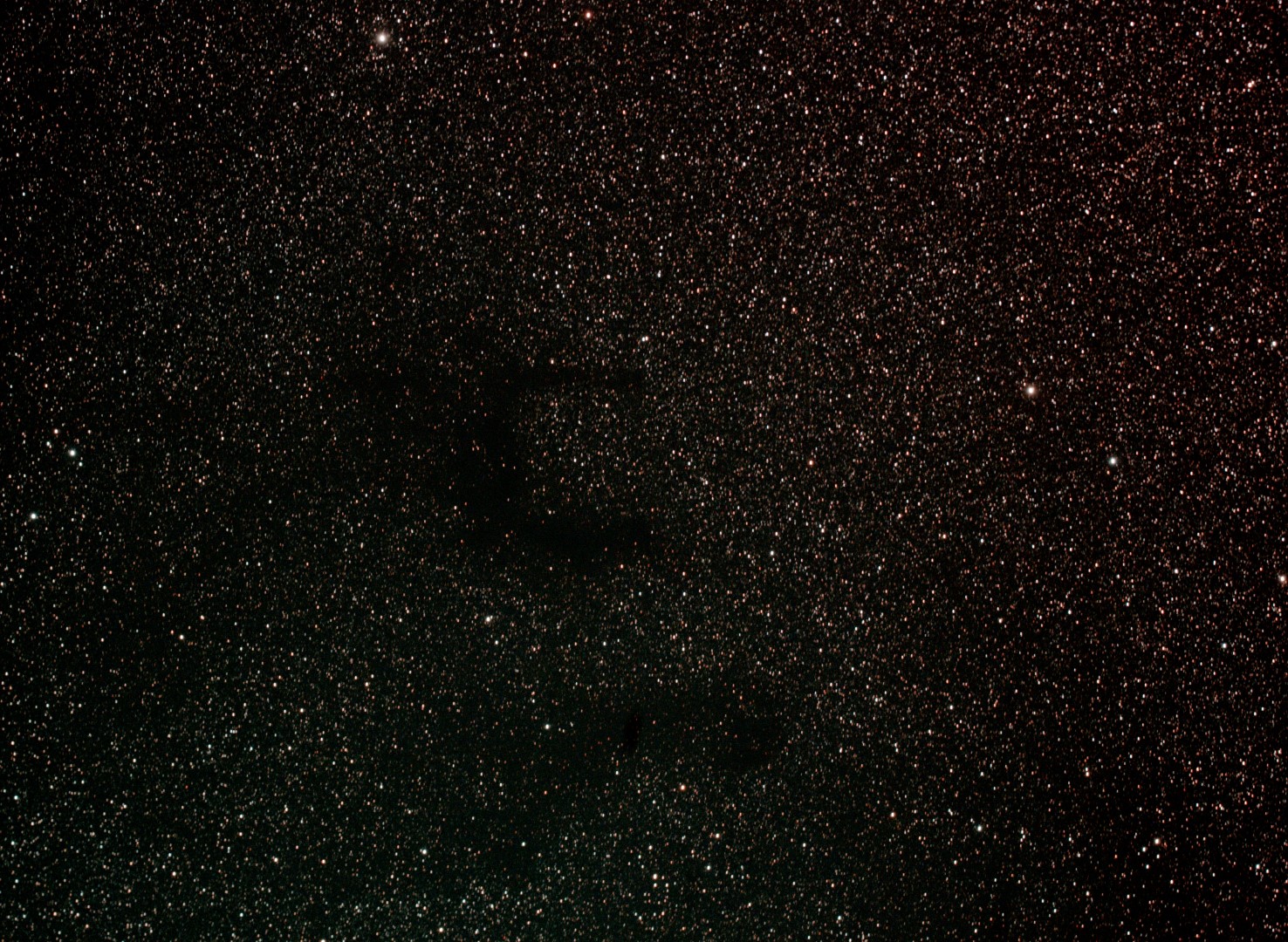
LDN 1250 luminance – RGB wavelengths are also strong
Imaged here in LRGB the features come out well in all wavelengths, however, such are the subtleties of the dark nebula components I found processing difficult and required plenty of ‘dark art’ techniques. The final image at the top of the page shows to good effect the main dark nebula, togeher with widespread but less opaque nebulosity and star colours, as well as some distant galaxies lurking in the background that together has produced a satisfying and very interesting outcome.
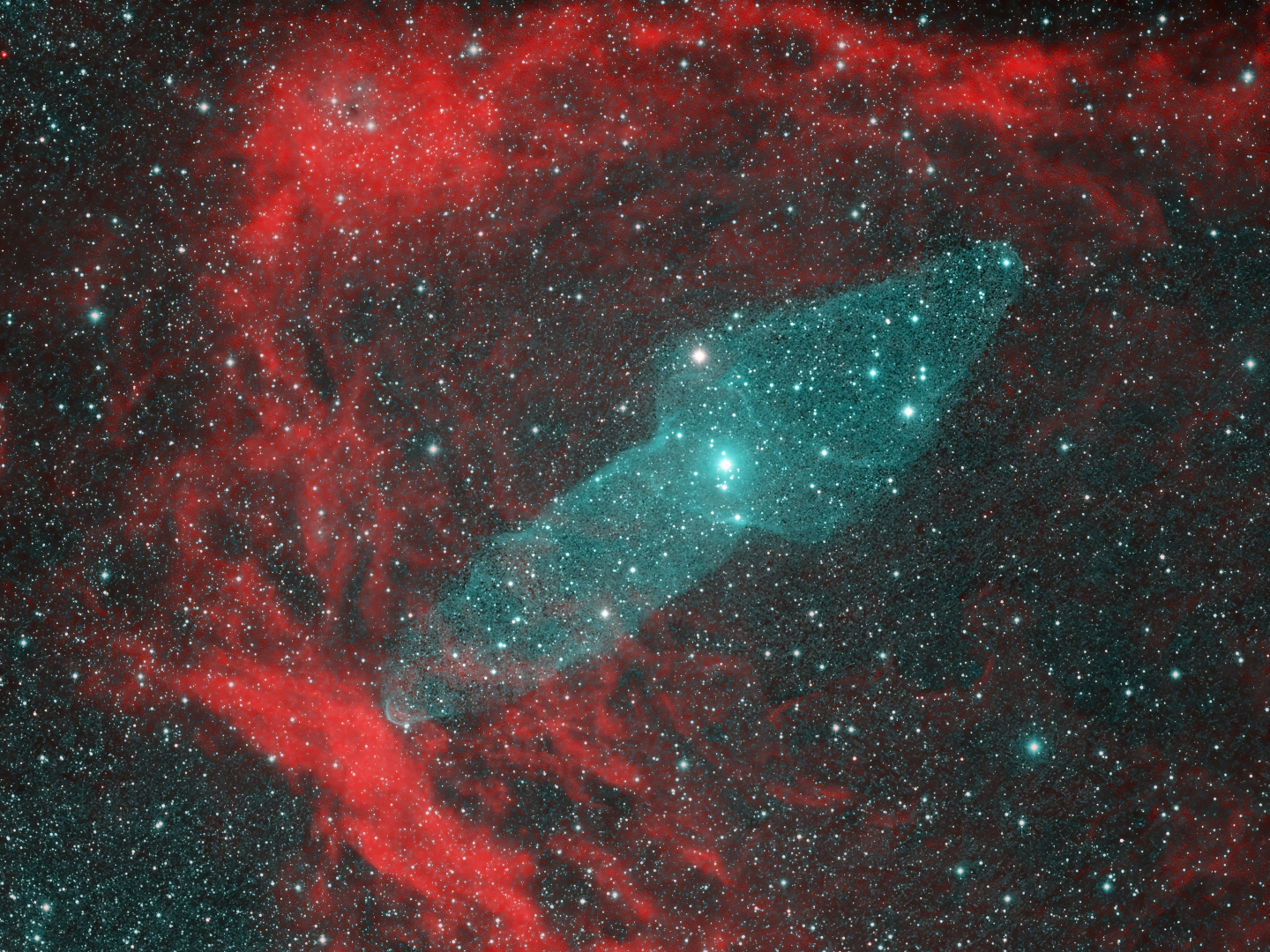
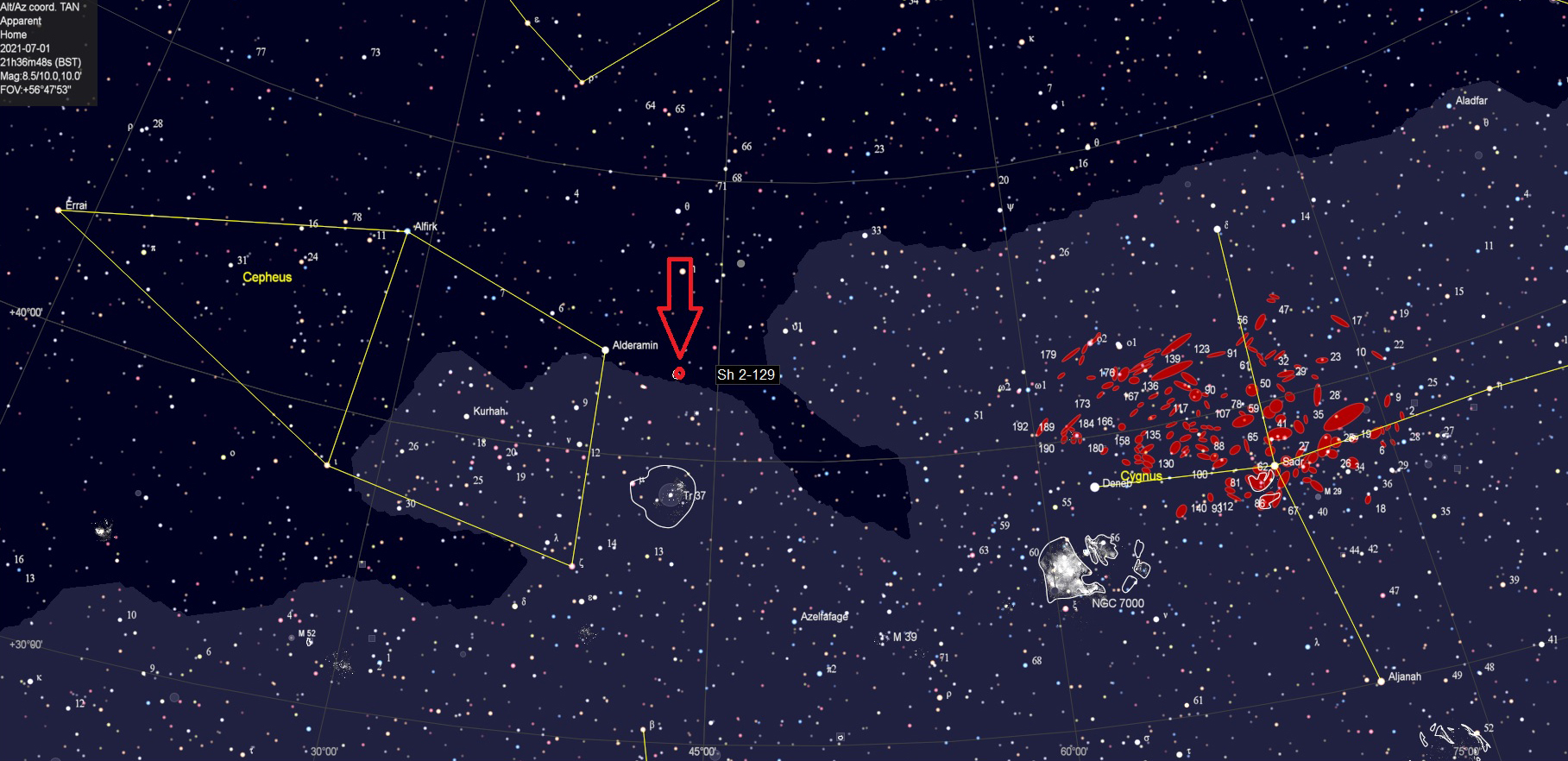
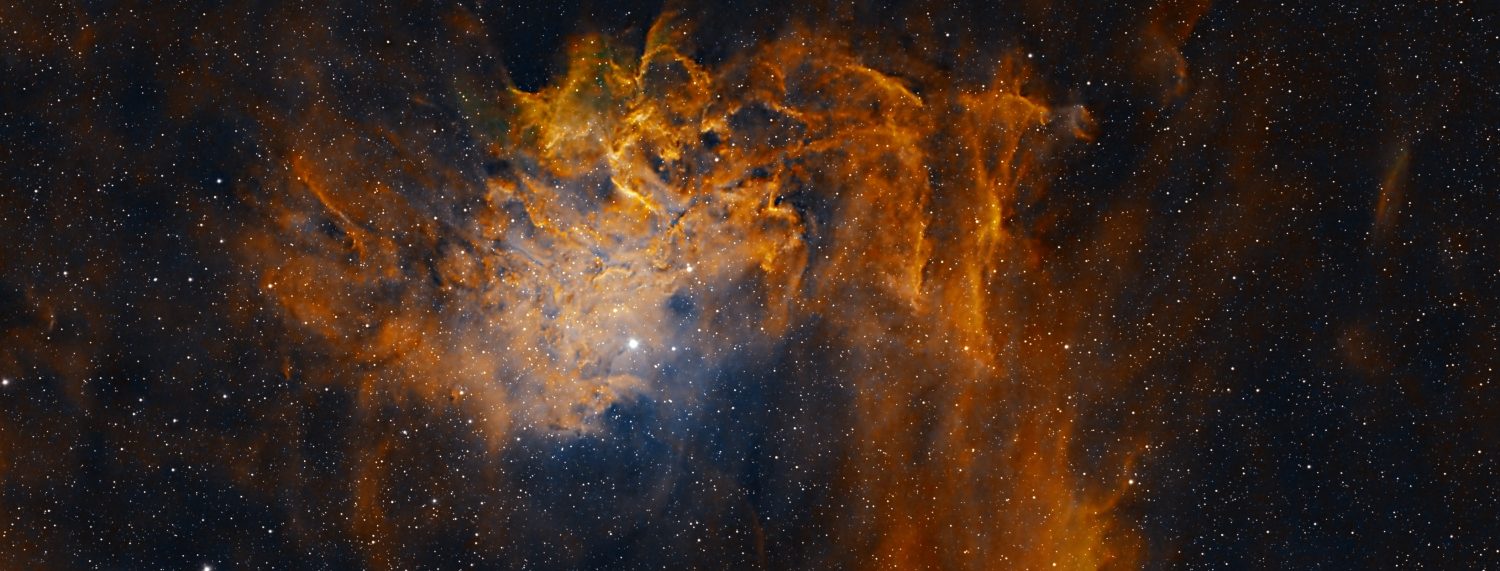
Discovered as recently as 2011 by French astronomer Nicolas Outters, is the very faint OIII emission nebula Ou4. Located in the constellation of Cepheus , this somewhat elusive object requires very long exposures and integration time to successfully image. For obvious reasons Ou4 has become known more commonly as the Giant Squid Nebula and belongs to the difficult but must-do objects list of astrophotographers. Moreover, the Squid lies within the much larger SH2-129 HII emission region or the Flying Bat Nebula, only part of which is shown here. In this case some 40-hours of exposure, of which the Squid is 15-hours, combined with careful processing has produced a wonderful image of both these exciting objects.
Initially considered to be a Planetary Nebula, Ou4 is now thought to be a bipolar outflow that was discharged 90,000 years ago from the hot massive triple star system HR 8119 situated within the Sh 2-129 HII-region, which is also responsible for ionizing the red emission nebula itself. The Squid consists of two collimated lobes with arc-shaped tips of enhanced OIII emission that resemble bow-shocks seen in stellar outflows and a few bubbles and filamentary arcs. The bipolar Ou4 lobes measure some 50×8 light-years, which though faint forms one of astrophotography’s great spectacles.
About this time of the year as astronomical darkness is lost for a few months I tend to take it easy, astronomically speaking. However, this year’s an exception as I have a large backlog of image processing to complete courtesy of the Photon Factory. With continuously bad weather prevailing across Europe back in February, it was more than four months since I’d been able to undertake any astrophotography here at Fairvale Observatory – of course such problems go with the hobby but this was ridiculous and somewhat disheartening. There were three solutions to the situation: continue waiting, give up all together or look further afield where the skies are reliably clear and dark, which like many others nowadays is what I did and thus joined the ever increasing band of remote imagers.
About 2-years ago I considered establishing equipment at one of the growing number of astrophotography host sites in southern Europe. However, after some research I concluded that whilst such a facility would be great to have it was probably too expensive for now and moreover, I first needed to spend more time improving my processing techniques before embarking on such a plan. Thus having since taken steps towards this goal, which included learning PixInsight, I felt the time was right to sign-up with Deep Sky West (DSW) situated in the state of New Mexico, USA. DSW were one of the early remote hosting observatories established and have a good reputation, reasonable prices and a wide choice of quality equipment. I therefore signed up for one year’s imaging with the following set-up:
QSI1683-WSGA camera 5.4 nm pixels & Astrodon 5nm filters
Paramount MyT mount
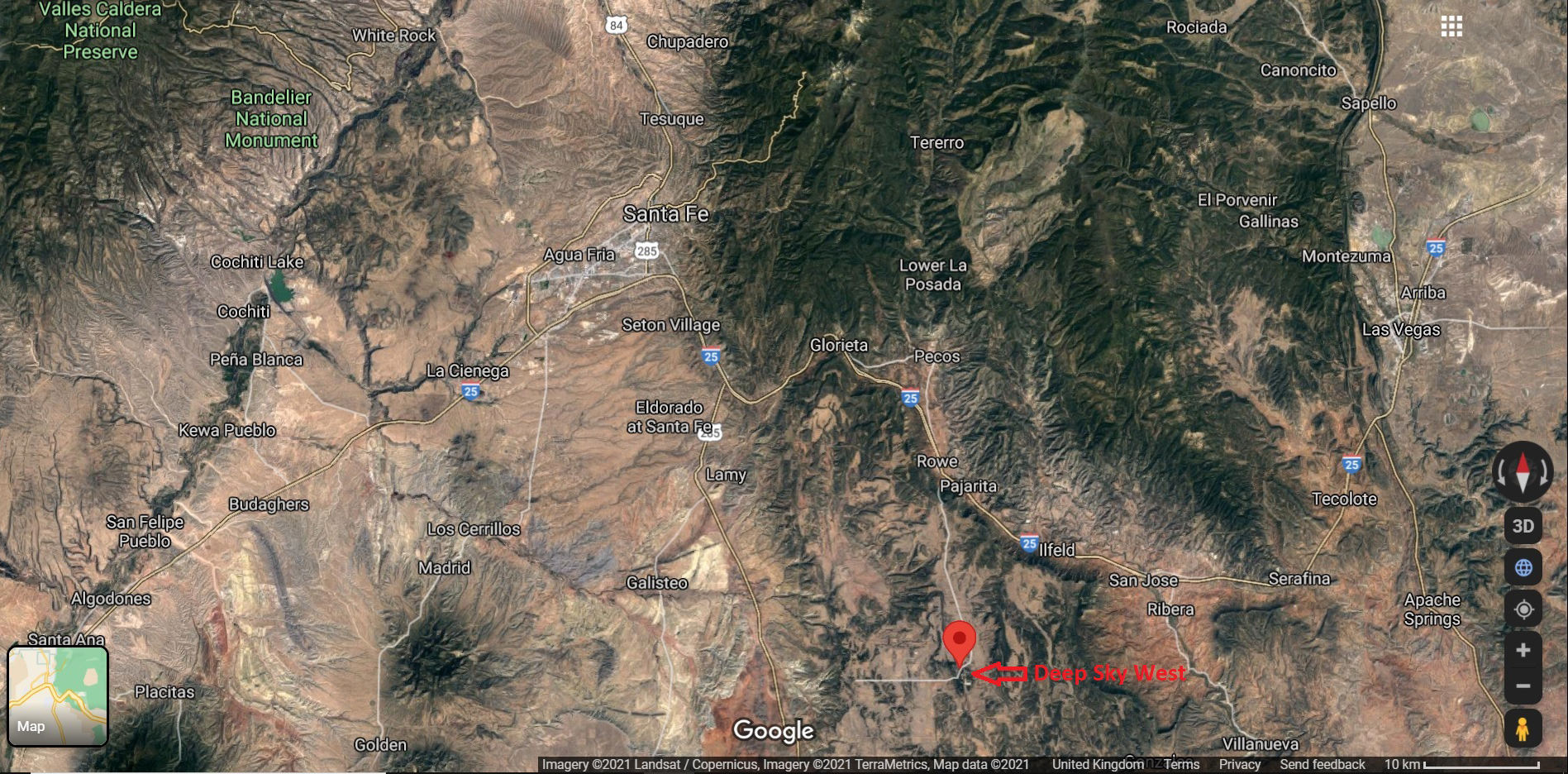
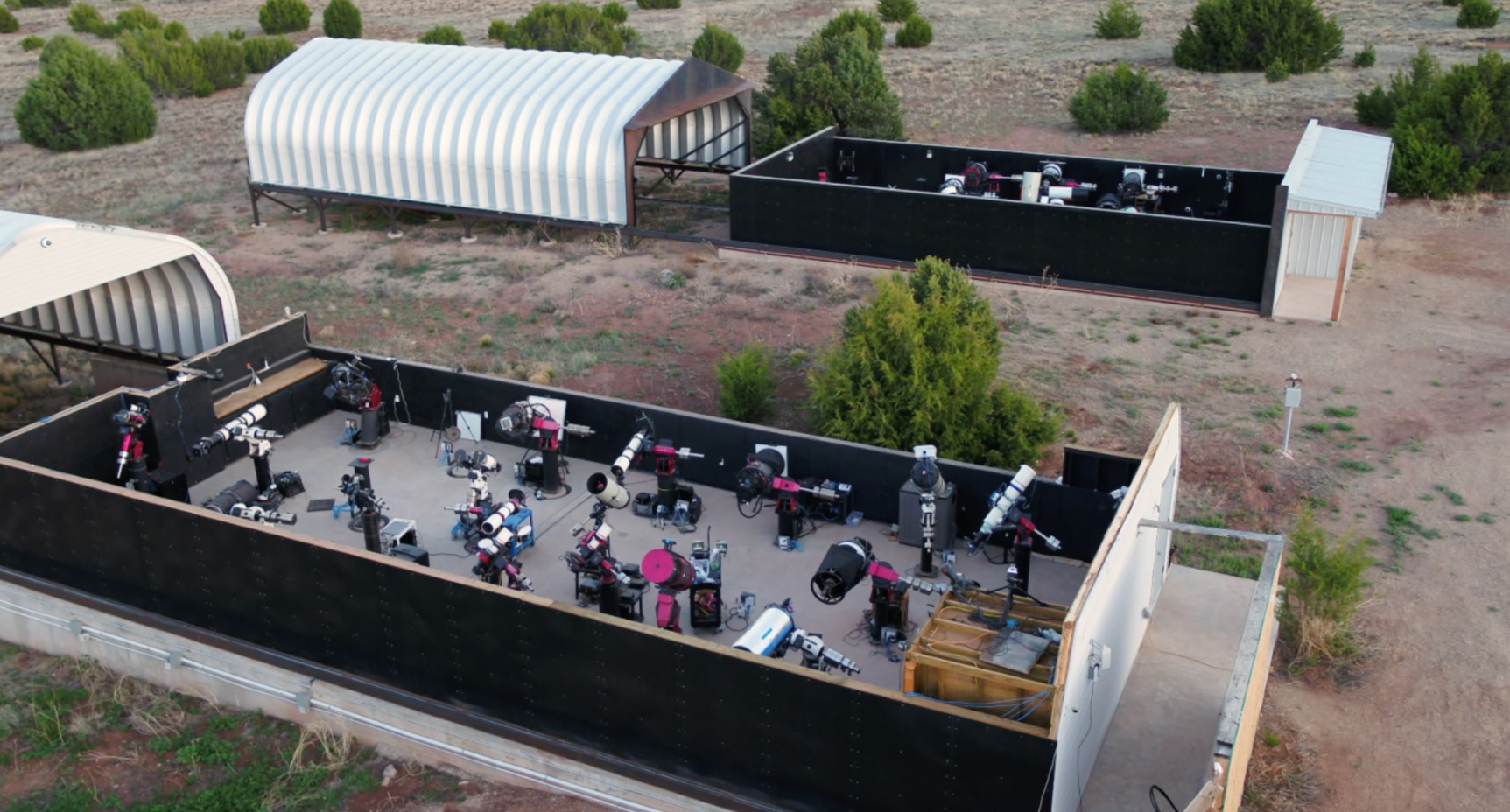
Deep Sky West is located about 35-miles south east of Santa Fe, at an elevation of 7,400ft on the Glorietta Mesa (see above map). Established by Lloyd Smith and Bruce Wright in 2015, there are now two large bespoke roll-off sheds (Alpha & Beta – see picture below) housing up to nearly forty rigs which are used by astrophotographers from across the world – you could call it a photon factory. DSW has since established a premier reputation as an observatory producing high quality data. Building on this success and the burgeoning demand for remote imaging, DSW are now expanding their service into Chile.
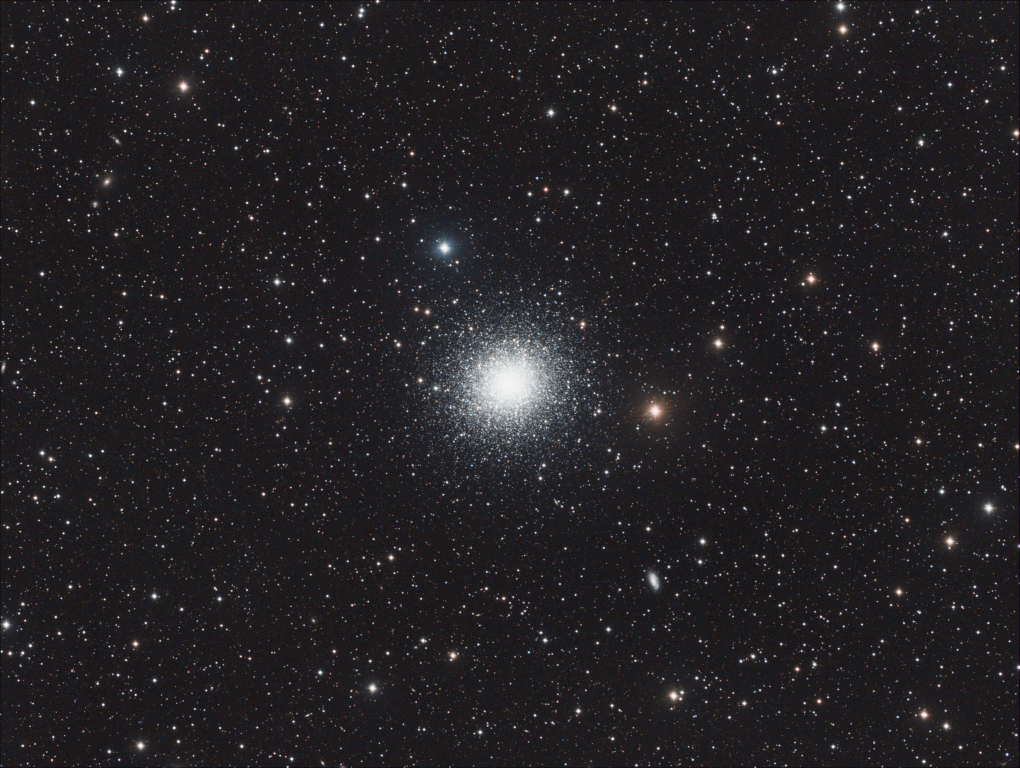
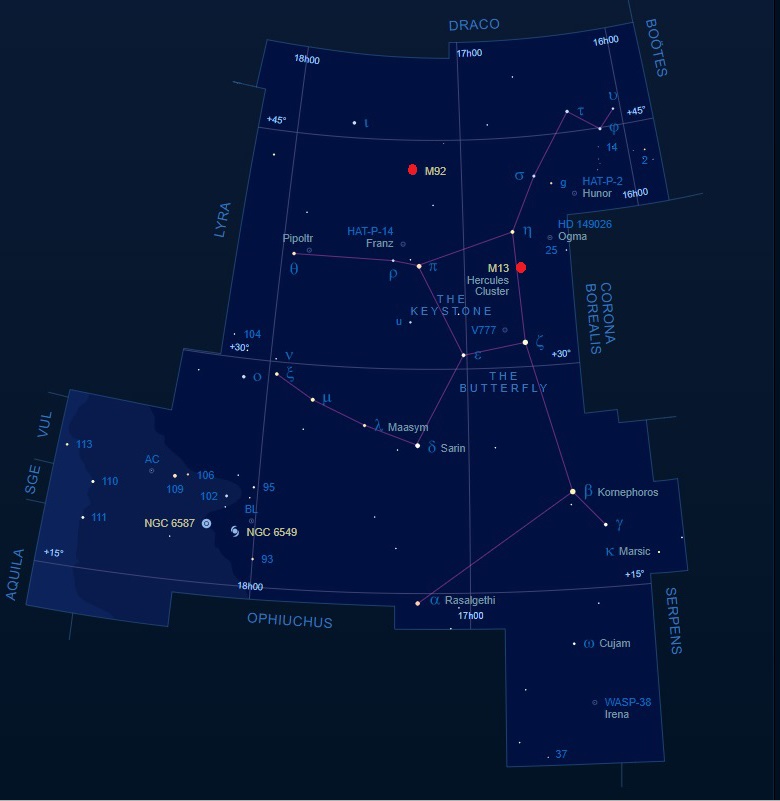
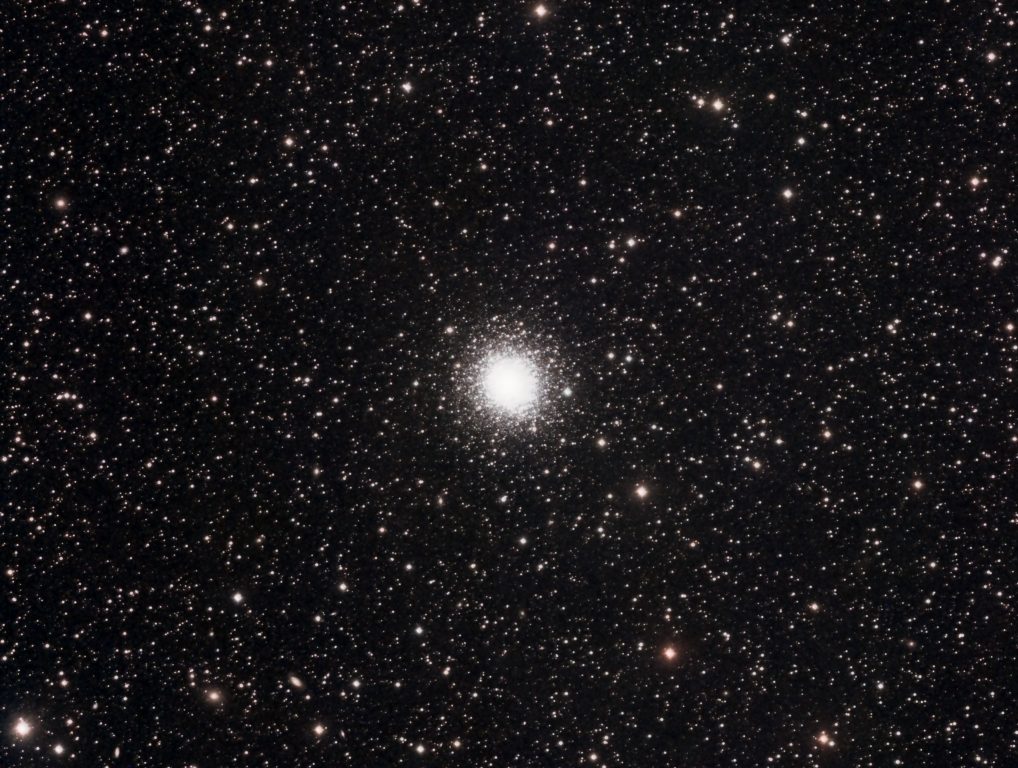
After imaging the globular cluster M53 from Fairvale Observatory in early April, it was opportune to be able to continue the same theme with my first two DSW images taken during Q1 and Q2 – the globular clusters M13 and M92, both located in the constellation of Hercules. With an angular separation of just 9o 33’, spatially the two clusters appear as neighbours but in reality M13 is some 4,560 thousand light-years closer. Spanning some 145 light years in diameter, M13 consists of several hundred thousand stars and as the brightest globular cluster in our galaxy it is generally considered to be the finest in the Northern Hemisphere. Whilst somewhat overshadowed by its more famous neighbour, M92 is still one of the brightest globular clusters orbiting the Milky Way and at +11 billion years is one of the oldest.
Since moving to mono imaging in 2017 I’ve only used a CMOS camera and therefore this is my first experience of working with CCD data, hitherto considered as the best, though more recent development of CMOS sensors suggests this is now likely to be the way forwards for amateur astrophotography. Whilst most of the techniques are the same there are minor differences such as using bias frames instead of dark flats with my CMOS camera for calibration.
The DSW equipment combination produces a field-of-view nearly 50% less than my equipment at home but with a similar resolution, thus improving the magnification and image details of smaller and/or complex features such as globular clusters. Notwithstanding, I was pleased with my previous image of M13 (above) taken from Fairvale Observatory in 2018, which after cropping compares well with the new DSW version (see main image at the top of the page). This is my first image of M92 (below), which though OK probably needs more attention, as I’m not convinced the combination of the 600 secs + 300 secs + 60 secs data has worked to its full potential.
The Takahashi 106 is one of my dream scopes and with up to 250 clear nights a year historically, the DSW location in New Mexico provides an opportunity to work with top level equipment in outstanding night sky conditions – what’s not to like with remote imaging? However, with a growing cadre of remote imagers this has become a something of a contentious issue amongst astrophotographers – there’s no doubt it produces excellent data which leads to outstanding images but as a hobby it’s still good to be hands-on. So far I’m really enjoying working with the remote data produced under optimum conditions but strangely there’s much to be said for imaging in the backyard even with or perhaps because of the problems it involves. Funny old world!
Here at Fairvale Observatory, most of the exciting deep sky objects associated with the transit of the Milky Way during winter have disappeared over the western horizon by early spring. Notwithstanding, a brief period of decent conditions at the very end of March provided a late window of opportunity to image a core area of our galaxy, which being viewed above Oirion at a higher declination in the constellation of Gemini, helped to extend the limited imaging time available. Frankly after such a terrible period of weather since last November, I was desperate to get one last image from this rich part of the night sky and try out my new Chroma narrowband filters again, which thankfully worked out well after imaging IC443 the Jellyfish Nebula over four nights, despite there being less than two hours of suitable viewing and darkness each night.
The remnant of a supernova that occurred between 3,000 and 33,000 years ago, located in the Gemini constellation the Jellyfish Nebula is some 5,000 light years from Earth. With a diameter of 70 light-years, the angular view of the nebula is some 50 arcminutes or nearly twice the size of a full moon. Overall the nebula consists of at least three distinct shells reflecting the complex nature of this Type-II supernova, which is interacting with the surrounding area of molecular clouds.
Red box indicates location and orientation of image
Acknowledging the limited time available – compounded by lingering cloud each night – I chose to image The Jellyfish in narrowband bicolour, hoping to collect some SII photons on another day to add to the Ha & OIII. At the end I also added some short LRGB subs to improve the final star colours and during processing used Ha as a false luminance layer to help bring out the complex structure of the nebula further. The image has been deliberately framed by the adjacent large stars Propus (bottom) and Tejat (top), which caused plenty of problems during processing but in my opinion form an essential component when imaging this object. Whilst IC443 is undoubtedly the main act, it is set off well by the large adjacent area of detailed nebulosity and the smaller reflection nebula IC444 to the right which is easy to overlook. Despite many issues I am very pleased with the final image that beautifully shows off this spectacular DSO and the surrounding region in all its glory, which seems all the better being something of a last chance opportunity that I thought I’d missed for this season.
IMAGING DETAILS
Object
IC443 Jellyfish Nebula & IC444
Constellation
Gemini
Distance
5,000 light-years
Size
50 arc minutes ~70 light years
Apparent Magnitude
+12
Scope
William Optics GT81 + Focal Reducer FL 382mm f4.72
Mount
SW AZ-EQ6 GT + EQASCOM computer control & Cartes du Ciel
Guiding
William Optics 50mm guide scope
+ Starlight Xpress Lodestar X2 camera & PHD2 guiding
Camera
ZWO1600MM-Cool mono CMOS sensor
FOV 2.65o x 2.0o Resolution 2.05”/pix Max. image size 4,656 x 3,520 pix
For good reason spring is known as “galaxy season” by astronomers but during this period, shortly before astronomical darkness inevitably disappears for summer, there’s also another show in town. Closer to home in the denser extremities of our galaxy, over 150 globular clusters have so far been identified orbiting above and below the plane of the Milky Way within the galactic halo. Globular clusters consist of hundreds of thousands of tightly packed stars that are surely one of the more enigmatic features of astronomy, as we now know that similar clusters also are associated with other galaxies throughout the Universe. Whilst the formation of globular clusters is poorly understood, we do know that at 10.0 to 13.5 billion years they are very old. Given their age, location and density, it seems that globular clusters formed under very different circumstances to the more recent dispersed star clusters.
Image Setting / Location
Sagittarius and Ophiuchus brim with globular clusters but at the higher latitude here at Fairvale Observatory it is necessary to view those around the regions of Canes Venatici, Virgo or Coma Berenices; the Great Cluster of M13 and others such as M92 and NGC 6229 located in the aforesaid Hercules constellation move into a better view later during early summer. Having previously imaged a number of these clusters in the past, this spring I looked around for something new and different, which I found in the name of M53 (Above + left of centre – main image top of the page) . In this case it turned out to be two for the price of one, as with careful framing it was possible to include a second globular cluster, NGC 5053 (Below + right of centre – main image top of the page).
Located in the southern area of the Coma Berenices constellation, M53 (Above left of centre – main image, top of the page) is some 58,000 light years from Earth. Containing some 500,000 metal-poor stars, the cluster equates to 13 arc minutes of sky or about 220 light years in diameter, with an estimated age of 12.67 billion years. Just over 1o east of M53, NGC 5053 is 53,500 light-years away, with an apparent size of 10.5 arc minutes or 160 light-years. Although classified as a globular cluster, NGC 5053 is more irregular and dispersed in nature without a distinct bright core and is therefore dimmer than its neighbour, making it more difficult to image.
M35 Full Crop
All-in-all I believe these two globular clusters, combined with the star studded background that just includes the binary Diadem star (Upper edge + right of middle – main image, top of the page) southwest of M53, altogether makes for a rich and interesting final image.
IMAGINGDETAILS
Object
M53 & NGC 5053
Constellation
Coma Berenices
Distance
Approx.. 58,000 & 53,000 light-years
Size
13.0 & 10.5 arc minutes
Apparent Magnitude
+8.33 & +10.00
Scope
William Optics GT81 + Focal Reducer FL 382mm f4.72
Mount
SW AZ-EQ6 GT + EQASCOM computer control & Cartes du Ciel
Guiding
William Optics 50mm guide scope
+ Starlight Xpress Lodestar X2 camera & PHD2 guiding
Camera
ZWO1600MM-Cool mono CMOS sensor
FOV 2.65o x 2.0o Resolution 2.05”/pix Max. image size 4,656 x 3,520 pix