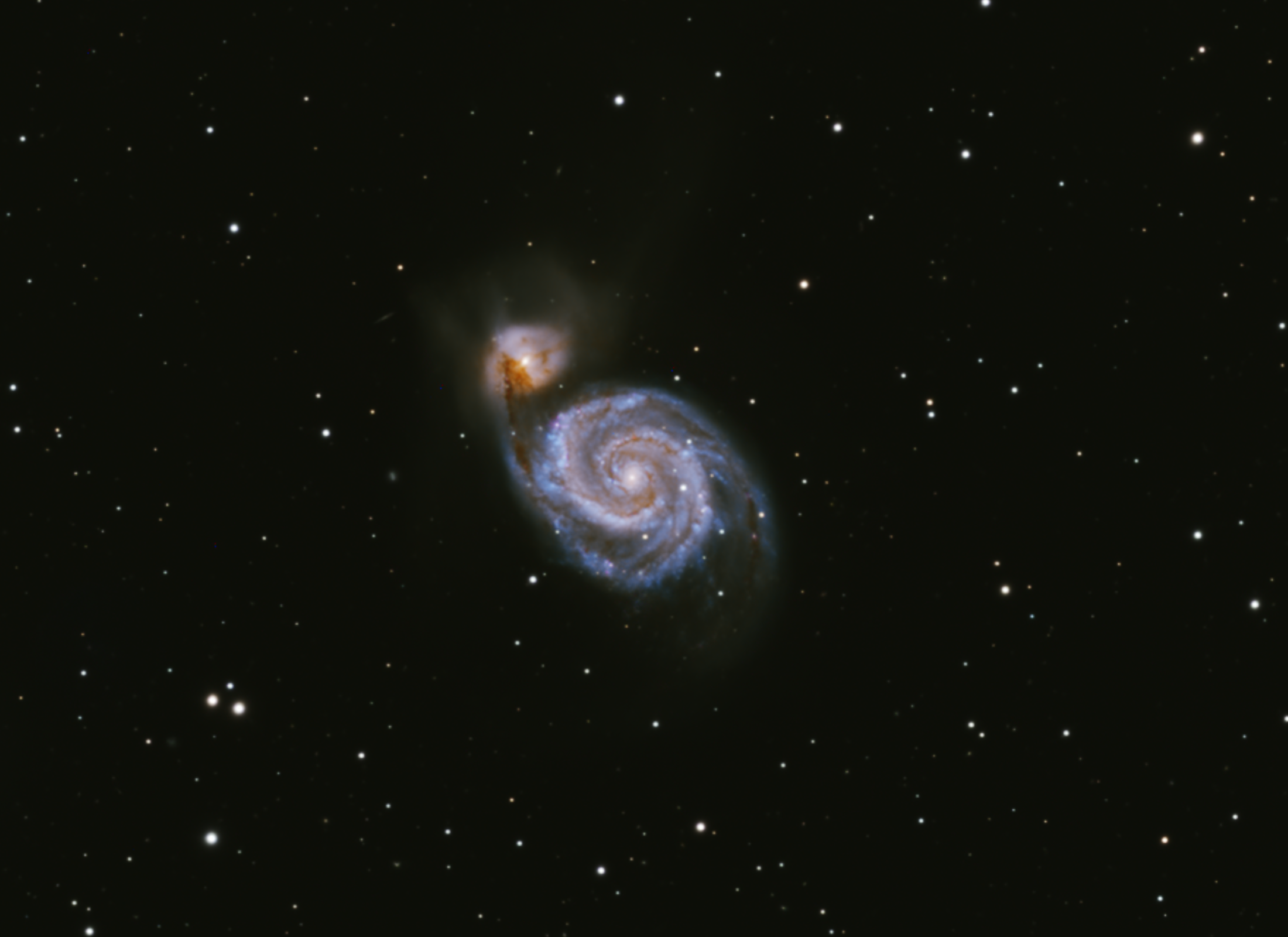
I have imaged this beguiling target a number of times before and it never ceases to please; previous images all obtained at my previous location in Surrey can be seen here – Other Worlds Whirlpool Galaxy 2019, Canine Capers June 2020, Galactic Waltz June 2023. Now based in Somerset, on this occasion the route leading to a final image of M51 has been somewhat more tortuous and protracted than before and the result perhaps more profound, at least for me.
Back in March I decided to give M51 another try from my new, darker Bortle-4 world and after three nights I had over 10 hours of good data, or so I thought. On closer inspection I discovered something was very wrong with the Ha subs, all of which contained a series of closely spaced light and dark horizontal lines. I have been using the same set-up and a proven calibration library for some time but had never encountered this problem before and therefore turned to the knowledgeable members of Stargazers Lounge forum for advice.
Not surprisingly the responses soon became highly technical, but I was not convinced. I had used 120 sec exposures, which worked fine with all the broadband filters but on reflection I realised that most previous narrowband images had been shot over considerably longer times, a necessary requirement given the filters are 3nm. In my opinion, the solution was therefore to shoot a new set of Ha subs at 300 sec but by now the clouds had rolled in. Notwithstanding, I reshot the Ha a few days later and the initial processed result was now a more satisfying image, though with work to do, but importantly no longer showing the aforesaid problem.
Meanwhile, during the intervening period I also had my eyes tested, which I expected would require a new prescription but instead resulted in cataract surgery on both my eyes, which has only recently been completed. I have been short sighted for over 60 years and already knew that I had early cataract development but I was surprised to learn that it had developed so quickly in the intervening period since my previous eye test and was warned that without surgery I would probably lose my driving licence within 12-months, it was therefore a no brainer! So, what’s this got to do with astrophotography?

Though I’m just over two weeks past my second (left eye) operation, within 48-hours of each procedure the result has been nothing less that life changing. The surgery is quick and painless but essentially consists of removing the lens from each eye, including the cataract, and replacing it with an artificial lens. Following consultation with the surgeon, the implants were a so-called mini-monovision. My dominant right eye lens is a monovision lens, which provides almost perfect long and medium distance vision and the left eye is also a monovision lens but instead adjusted to provide good near and medium vision, plus a (toric) function to correct an astigmatism. As if by magic, after a couple of days the brain starts to recalibrate the different views from each mini-monovision lens and slowly a new world starts to emerge, literally, which should continue to improve further over the following 4 to 6 weeks.
So, what has this got to do with astrophotography? It turns out, everything. The eye consists of rods (120 million) and cones (6 million), which respectively control light and colour. Now, with my two new lenses it’s clear (I hope) that my vision has been taken back to that when I was a child and my perception of light and colour has been completely transformed. Thus, returning to my M51 image which I had briefly processed earlier in the year, I could now literally see it in a completely different light – brighter and more colourful, in particular shifted more towards the blue wavelength. The changes are so profound I find myself reassessing almost everything, which I see as if for the first time, including my astrophotography. Inevitably, this poses a big question, of which the answer is are obvious: hitherto I have been seeing and therefore processing my images incorrectly, not on purpose but because of the impact my sight had on my general light and colours.
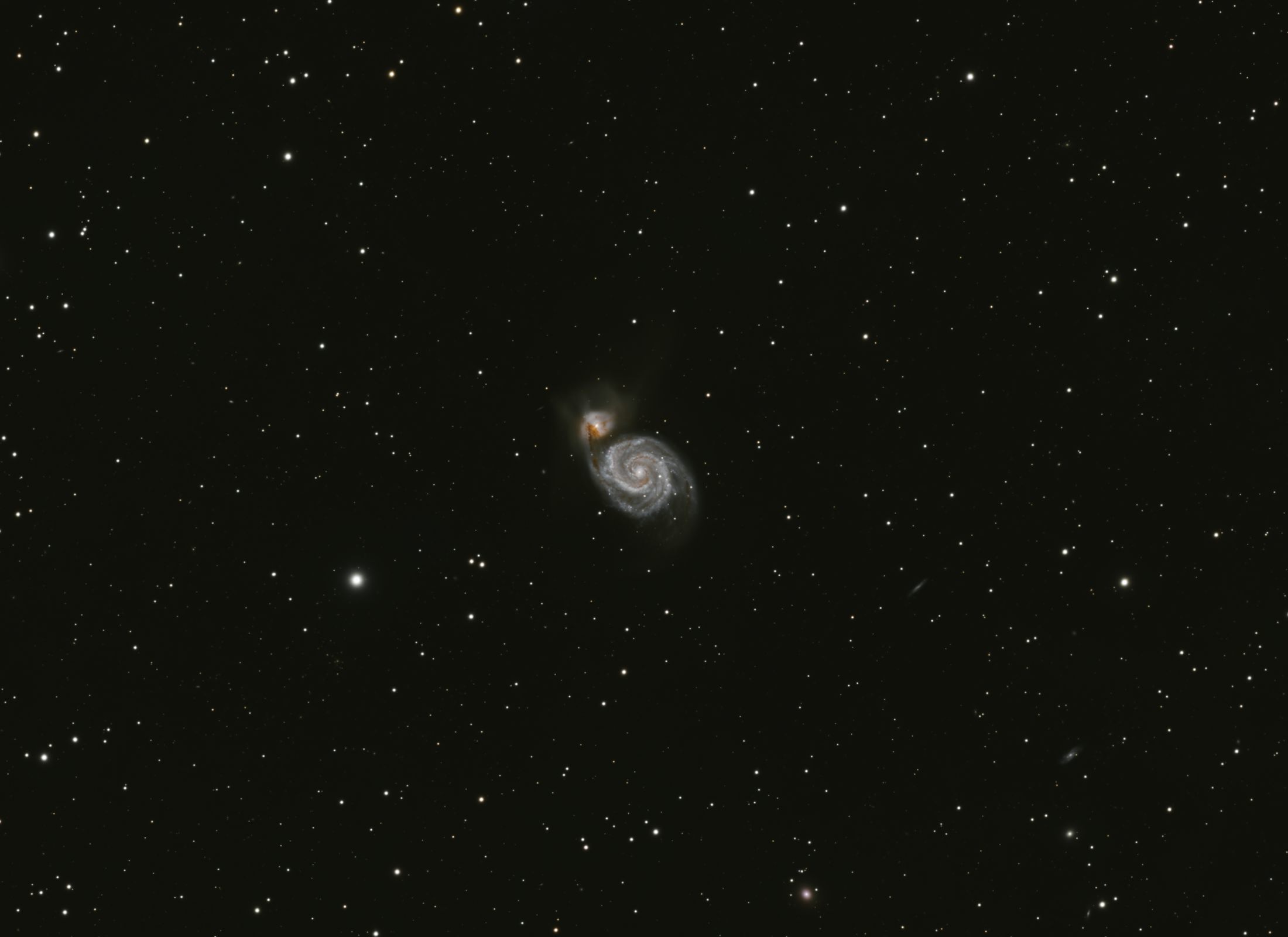

When I initially processed this M51 image, I thought I needed to significantly enhance the blue wavelength, though because of my cataracts it seems the blue was already there, I just couldn’t see it! Of course, anybody with good vision and no cataracts might therefore see incorrect colours and light balance in some other of my previous images! The message then is: if you are of an age (+50 to 60) where you might have signs of cataract development, get your eyes checked and if necessary, consider eye surgery, you won’t be disappointed + your astrophotography images will be seen in their true light by everyone, including you.
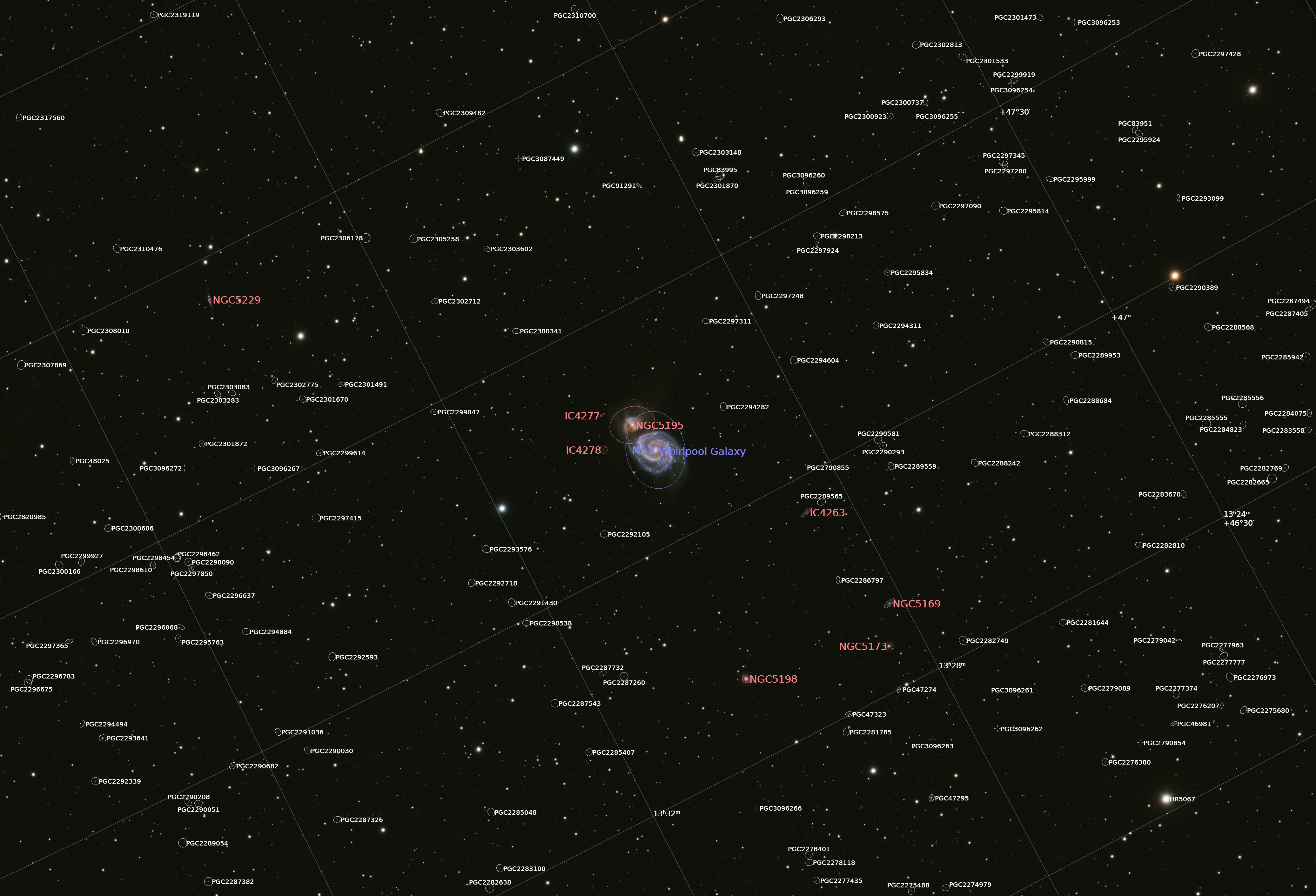
Footnote: What you might not see, even with the power of new eyes, PixInsight has identified no less than 158 galaxies (see below) in the original widefield image!
| IMAGING DETAILS | |
| Object | M51 The Whirlpool Galaxy & NGC 5951 |
| Constellation | Canes Venatici |
| Distance | 23 million light-years |
| Size | 11.2’ x 6.9’ 43,000 light-years (M51 only) |
| Apparent Magnitude | +8.4 |
| Scope | William Optics GT81 + Focal Reducer FL 382mm f4.72 |
| Mount | SW AZ-EQ6 GT + EQASCOM computer control & Cartes du Ciel |
| Guiding | William Optics 50mm guide scope |
| + Starlight Xpress Lodestar X2 camera & PHD2 guiding | |
| Camera | ZWO1600MM-Cool mono CMOS sensor |
| FOV 2.65o x 2.0o Resolution 2.05”/pix Max. image size 4,656 x 3,520 pix | |
| EFW | ZWO x8 ZWO LRGB & Ha OIII SII 7nm filters |
| Capture & Processing | Astro Photography Tool + PHD2 + Deep Sky Stacker & Photoshop CS3 |
| Image Location & Orientation | Centre RA 13:30:03 DEC 47:11:43 (approx.) Top = South Bottom = North |
| Exposures | L x 95 R x 62 G x58 B x 66 Ha x 46 = 327 x 180 sec Total time: 16hr 21 minutes |
| @ 139 Gain 21 Offset @ -20oC | |
| Calibration | 10 x 180 sec Darks 20 x 1/4000 sec Bias 10 x HaLRGB Flats @ ADU 25,000 |
| Location & Darkness | Fairvale Observatory – Redhill – Surrey – UK Typically Bortle 5-6 |
| Date & Time | 10th April 2019 + 23rd 24th 25th 27th March & 20th 21st 22nd April 2010@ +22.00h |
| Weather | Approx. 6oC RH <=60% 🌙 New Moon approx.. |
 WATCH THIS SPACE(MAN)