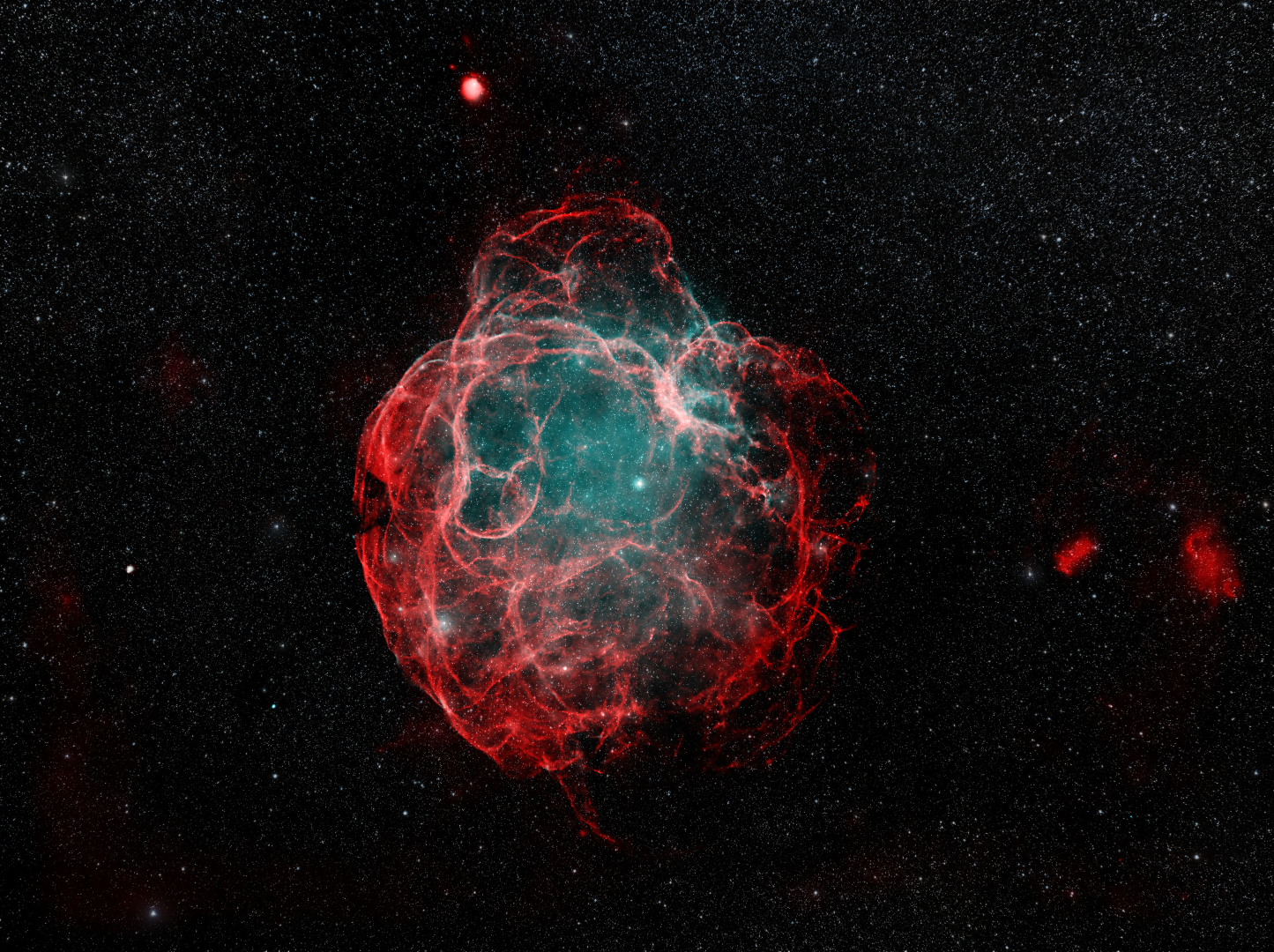
Straddling the boundary of Taurus and Auriga, is the giant supernova remnant (SNR) Simeis-147 AKA SH2-240 or the Spaghetti Nebula. It is believed that the stellar explosion that created Simeis-147 occurred some 40,000 years ago, leaving behind a rapidly spinning neutron star or pulsar at the core of the now complex, expanding SNR; the nebulous area has an almost spherical shell consisting of numerous filamentary structures. With an apparent diameter of 3o the SNR spans some 160 light-years, making it a very large astrophotography target.
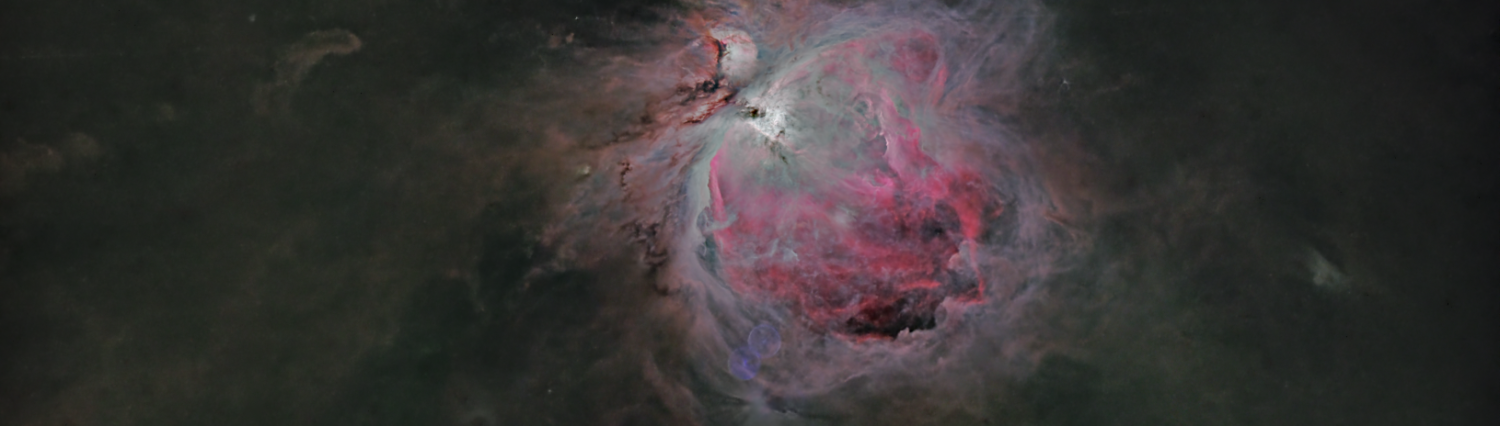
I’ve long admired the spectacular SNR Simeis-147 AKA Spaghetti Nebula, which I first imaged with my standard William Optics GT81 scope in January 2022. The outcome (see image below) was pleasing but with the limited FOV it had to be just a nibble of this large object – something of an appetiser you might say. Therefore, ever since putting my Samyang rig together last summer I’ve had only one object in mind with this excellent widefield set-up, which had to be the full menu version of Simeis-147!

Apart from its size, Simeis-147 is very faint, making long exposure time essential, which is always difficult in the UK. However, a rare spell of cold, clear nights this January provided sufficient opportunity over five nights to obtain just over 20-hours integration and a complete image of this truly magnificent SNR.
Notwithstanding the favourable conditions and long-time achieved – a record for me at this location – the faint nature of this object made image processing difficult too. After experimenting, I eventually adopted a tone mapping technique: pre-processing each individual wavelength stack before removing the stars, stretching and processing each of the starless Ha and OIII images before combining using Pixel Math in the ratio: R – (Ha*1.70) + G – (OIII*0.80)+(Ha*0.20) + B- (OIII*0.80)+(Ha*0.20).
With further processing of the HOO starless combination I was able to obtain the desired result of marvellous SNR detail, together with pleasing Ha (red) and especially OIII (blue/green) colours, that altogether with the addition of the stars and some final tweaking produced a striking image with good depth. Moreover, I feel the widefield setting achieved using the Samyang 135 lens produces a striking setting for this fascinating object.
| IMAGING DETAILS | |
| Object | Simeis 147 / SH2-240 AKA Spaghetti Nebula |
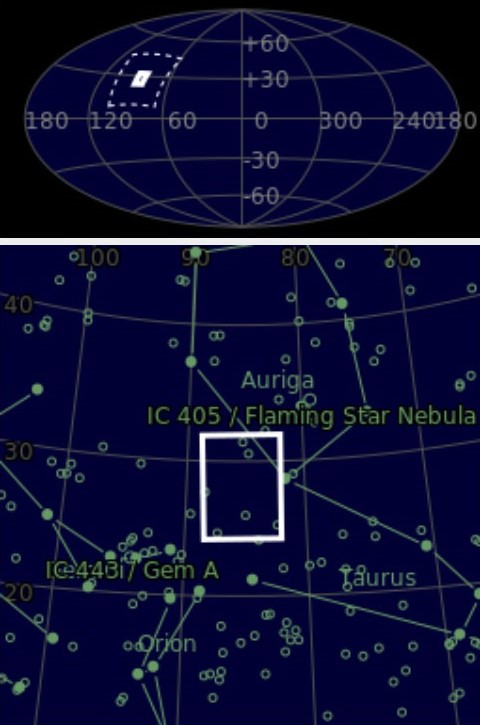
| Constellation | Taurus |
| Distance | 3,000 light-years |
| Size | Approx. 3.0o |
| Apparent Magnitude | Extremely faint |
| Scope / Lens | Samyang 135 @f2.8 |
| Mount | SW AZ-EQ6 GT + EQASCOM computer control & Cartes du Ciel |
| Guiding | Sky-Watcher EvoGuide 50ED |
| + Starlight Xpress Lodestar X2 camera & PHD2 guiding | |
| Camera | ZWO1600MM-Cool mono CMOS sensor |
| FOV 7.5o x 5.67o Resolution 5.81”/pix Max. Image Size 4,656 x 3,520 pix | |
| EFW | ZWOx8 EFW & 31mm ZWO LRGB & 7nm Narrowband filters |
| Capture & Processing | Astro Photography Tool + PHD2 + PixInsight v1.8.9-1 |
| Image Location & Orientation | Centre: RA 05:41:15.081 DEC +28:05:32.778 Right = North Top = East |
| Exposures | 60 x 600 sec Ha, 62 x 600 sec OIII Total Integration Time: 20 hr 20 min |
| @ 139 Gain 21 Offset @ -15oC | |
| Calibration | 5 x 600 sec Darks 20 x Flats & Flat Darks |
| Location & Darkness | Fairvale Observatory – Redhill – Surrey – UK Typically Bortle 5 – 6 |
| Date & Time | 12th 17th 18th 19th & 21st January 2023 @ +18.30h |
| Weather | Approx. <=0oC RH >=80% 🌙 70% to 0o New Moon |
 WATCH THIS SPACE(MAN)
That’s a very fine image! There’s a lot to be said for a fast wide-field lens, something I should acquire especially for the spectacular brighter comets that occasionally grace our skies. My attempt at Simeis 147 with a 2-part mosaic using a Megrez72 refractor at https://flic.kr/p/23Zwduj
LikeLike
Thanks Mike, that’s very kind of you. As you may know, the ‘fast’ Samyang 135 f2 is growing in popularity amongst astrophotographer’s, especially in places like the UK, where imaging time is usually limited by poor weather, making a mosaic even more of a challenge. Notwithstanding, your image looks great, well done
.
LikeLike